13656. Bank of the Commonwealth (New York, NY)

Bank Information

Episode Type
Run → Suspension → Closure
Bank Type
state
Start Date
September 20, 1873
Location
New York, New York (40.714, -74.006)

Metadata

Model
gpt-5-mini
Short Digest
3b28e178b861104a

Response Measures

None

Description

Contemporary articles describe heavy withdrawals / a run and the bank closed its doors during the Sept. 20–22, 1873 panic. The immediate trigger cited repeatedly is a large overdraft/over-certification by Edward Haight & Co.; a temporary suspension was followed by appointment of a receiver (Isaac H. Bailey) and winding up. A dividend was later paid by the receiver (March 1874). Classified as run → suspension → permanent closure/receivership.

Events (4)

1. September 20, 1873 Run
Cause
Bank Specific Adverse Info
Cause Details
Heavy withdrawals during the Sept. 20, 1873 panic; bank weakened by a large overdraft/over-certification to Edward Haight & Co. (reported ~$220,000–$400,000 in various articles).
Measures
Closed its doors; refused payments; later placed in hands of a receiver.
Newspaper Excerpt
the Bank of the Commonwealth, which closed its doors at an early hour. The excitement and panic which followed the suspension of these institutions were beyond description.
Source
newspapers
2. September 20, 1873 Suspension
Cause
Bank Specific Adverse Info
Cause Details
Suspension attributed to overdraft/over-certification for Edward Haight & Co. and inability to meet withdrawals during the broader panic of Sept. 1873; articles state overdraft amounts and suddenness of panic forced closure.
Newspaper Excerpt
The Union Trust Company had decided to stop until Monday. The suspension of the Trust Company was followed by that of the Bank of the Commonwealth, which closed its doors at an early hour.
Source
newspapers
3. September 22, 1873 Receivership
Newspaper Excerpt
Isaac H. Bailey has been appointed receiver of the Bank of the Commonwealth.
Source
newspapers
4. March 7, 1874 Other
Newspaper Excerpt
A dividend of 50 per cent will be paid to depositors by the receiver of the Bank of the Commonwealth.
Source
newspapers

Newspaper Articles (22)

Article from The Daily Dispatch, September 21, 1873

Click image to open full size in new tab

Article Text

MEASURES FOR RELIEF. NEW YORK. # UNPRECEDENTED PANIC AT THE OPENING OF THE STOCK EXCHANGE-GREAT TUMBLE IN VALUES-GENERAL DISASTER IMMINENT-THE EXCHANGE CLOSED -A STARTLING DEFALCATION-BETTER FEELING IN THE EVENING. [Special telegram to the Dispatch.] NEW YORK, September 20.-To-day has witnessed one of the greatest panics that ever occurred on the Stock Exchange. At the opening there was an improvement of two to six per cent. in values, and great hopes were entertained that the end had been reached. But these hopes were soon destroyed when it was announced that the Union Trust Company had decided to stop until Monday. The suspension of the Trust Company was followed by that of the Bank of the Commonwealth, which closed its doors at an early hour. The excitement and panic which followed the suspension of these institutions were beyond description. The Stock Exchange RESEMBLED A MAD-HOUSE, and the streets were blocked with people, all laboring under great excitement and frenzy. Prices tumbled from two to sixteen per cent., and stocks were slaughtered without any apparent regard to values. Amid the surging of an excited crowd in the Stock Exchange and continued destruction of values there were some few cool and level heads. These men conceived the idea of imitating the Vienna plan of CLOSING THE EXCHANGE, and immediately the Governing Committee was convened to take action thereon. In a few moments the Board was called to order, and from the rostrum the announcement was made that the Exchange would be closed until further orders from the President. This was received with great joy, and the Exchange resounded with cheers. The gong was sounded, and in less time than it takes to record the fact the wild excitement was over, the surging crowd of frantic brokers disappeared, and the Stock Exchange was nothing but a deserted hall. All this happened in so short a time that it seems almost impossible, and only those on the spot can realize the remarkable change. All dealings on the street are strictly prohibited under penalty of expulsion, and therefore no business can be transacted. MORE SUSPENSIONS. Soon after the suspension of the Union Trust Company was reported the suspension of the National Trust Company was announced, and this served, if possible, to intensify the excitement. The failures of brokers then began to be announced, and in a short time the following names were read out: C. G. White & Co.; Ketchumn & Belknap; W. G. Broadhead & Co.; Saxton & Rogers; Williams & Bostwick; Miller & Walsh; E. Haight & Co.; Laurens & Joseph; P. M. Myers & Co.; Taussig, Fisher & Co.; Feasing & Bellinger; S. B. White. It is impossible to say where the list would have ended had not the Governing Committee of the Exchange decided to close the institution until the panic was over. About this time UGLY RUMORS BEGUN TO GAIN CURRENC. on the street of irregularities in the Union Trust Company, and it is found that Carleton, the secretary, son of Rev. Dr. Carleton, of the Methodist Book House, was a defaulter, some fixing the amount at $250,000, others at $500,000. It was not known that Carleton was a defaulter until some time yesterday afternoon, when his absence begun to give rise to suspicions. He remained at his desk until 12 o'clock yesterday, conversing freely but exhibiting signs of excitement and trepidation. He left the Trust Company saying he was too unwell to remain, and desired some rest. When it was necessary to consult him in regard to certain matters, he was not to be found, and then it was that the trustees began to SUSPECT HE WAS A DEFAULTER. Under a hurried examination into his affairs it soon became quite certain that he had
Article from Evening Star, September 22, 1873

Click image to open full size in new tab

Article Text

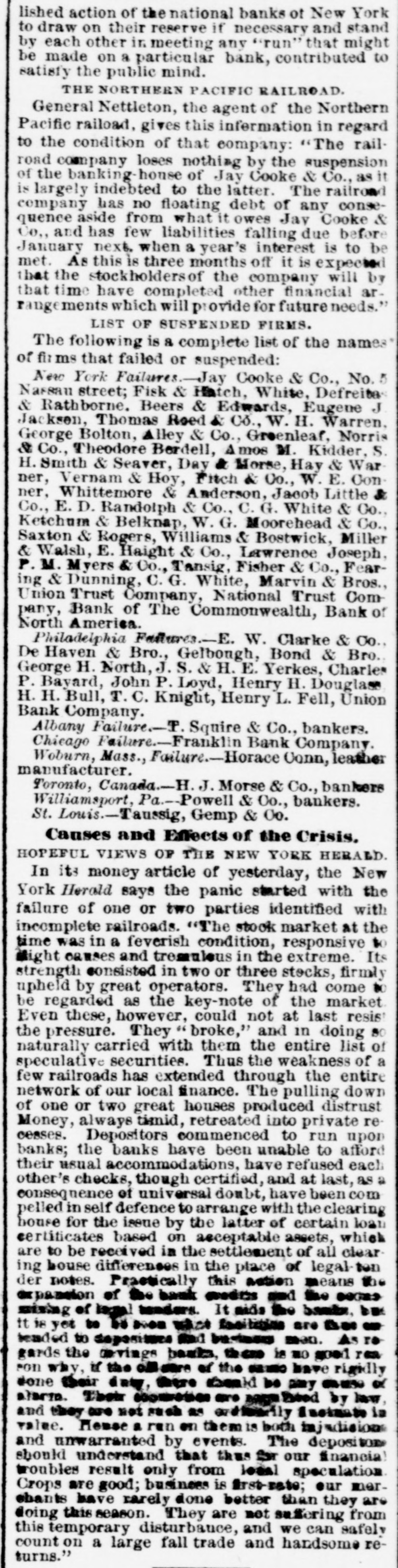
Lished action of the national banks ot New York to draw on their reserve if necessary and stand by each other in meeting any "run" that might be made on a particular bank, contributed to satisfy the public mind. # THE NORTHERN PACIFIC RAILROAD. General Nettleton, the agent of the Northern Pacific raiload, gives this information in regard to the condition of that company: "The rail- road company loses nothing by the suspension of the banking-house of Jay Cooke & Co., as it is largely indebted to the latter. The railroad company has no floating debt of any conse- quence aside from what it owes Jay Cooke & Co,, and has few liabilities falling due before January next, when a year's interest is to be met. As this is three months off it is expected that the stockholders of the company will by that time have completed other financial ar- rangements which will provide for future needs." # LIST OF SUSPENDED FIRMS. The following is a complete list of the names of firms that failed or suspended: New York Failures. Jay Cooke & Co., No. 5 Nassau street; Fisk & Hatch, White, Defreita & Rathborne. Beers & Edwards, Eugene J Jackson, Thomas Roed & Co., W. H. Warren. George Bolton, Alley & Co., Greenleaf, Norris & Co., Theodore Berdell, Amos M. Kidder, S. H. Smith & Seaver, Day Morse, Hay & War- ner, Vernam & Hoy, Fitch & Co., W. E. Con ner, Whittemore & Anderson, Jacob Little Co., E. D. Randolph & Co., C. G. White & Co., Ketchum & Belknap, W. G. Moorehead & Co., Saxton & Rogers, Williams & Bostwick, Miller & Walsh, E. Haight & Co., Lawrence Joseph, P. M. Myers & Co., Tansig, Fisher & Co., Fear- ing & Dunning, C. G. White, Marvin & Bros., Union Trust Company, National Trust Com pany, Bank of The Commonwealth, Bank of North America. Philadelphia Fatures.-E. W. Clarke & Co.. De Haven & Bro., Gelbongh, Bond & Bro.. George H. North, J. S. & H. E. Yerkes, Charles P. Bayard, John P. Loyd, Henry H. Douglase H. H. Bull, T. C. Knight, Henry L. Fell, Union Bank Company. Albany Failure. T. Squire & Co., bankers. Chicago Failure. Franklin Bank Company. Woburn, Mass., Failure.-Horace Conn, leather manufacturer. Toronto, Canada.-H. J. Morse & Co., bankers Williamsport, Pa.--Powell & Co., bankers. St. Louis. Taussig, Gemp & 00. # Causes and Effects of the Crisis, HOPEFUL VIEWS OF THE NEW YORK HERALD. In its money article of yesterday, the New York Herald says the panic started with the failure of one or two parties identified with incomplete railroads. "The stock market at the time was in a feverish condition, responsive to slight causes and tremulous in the extreme. Its strength consisted in two or three stocks, firmly upheld by great operators. They had come to be regarded as the key-note of the market. Even these, however, could not at last resist the pressure. They "broke," and in doing so naturally carried with them the entire list of speculative securities. Thus the weakness of a few railroads has extended through the entire network of our local finance. The pulling down of one or two great houses produced distrust Money, always timid, retreated into private re- cesses. Depositors commenced to run upon banks; the banks have been unable to afford their usual accommodations, have refused each other's checks, though certified, and at last, as a consequence of universal doubt, have been com- pelled in self defence to arrange with the clearing house for the issue by the latter of certain loan certificates based on acceptable assets, which are to be received in the settlement of all clear- ing house differences in the place of legal-ton- der notes. Practically this action means the expansion of the bank credits and the sens mixing of legal tenders. It aids the banks, but it is yet to be seen what facilities are thus ex- tended to depositors and business men. As re- gards the savings banks, there is no good rea- son why, if the officers of the same have rigidly done their duty, there should be any cause of alarm. Their investments are regulated by law, and they are not such as ordinarily fluctuate in value. Hence a run on them is both injudicious and unwarranted by events. The depositors should understand that thus far our financial troubles result only from local speculation. Crops are good; business is first-rate; our mer- chants have rarely done better than they are doing this season. They are not suffering from this temporary disturbance, and we can safely count on a large fall trade and handsome re- turns."


Article from New-York Tribune, September 22, 1873

Click image to open full size in new tab

Article Text

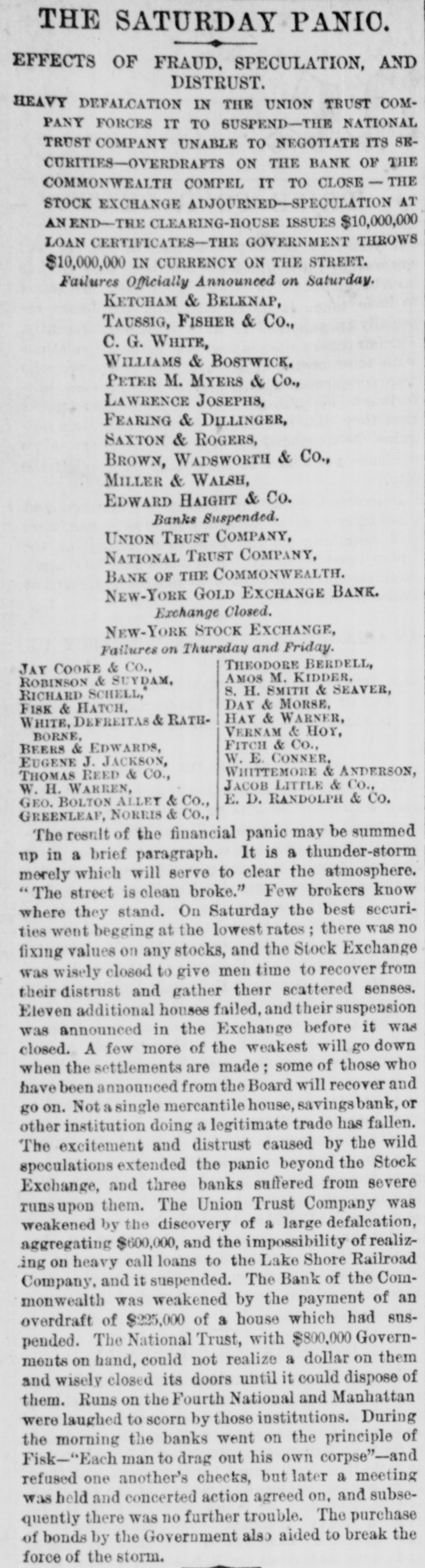
THE SATURDAY PANIC. EFFECTS OF FRAUD, SPECULATION, AND DISTRUST. HEAVY DEFALCATION IN THE UNION TRUST COMPANY FORCES IT TO SUSPEND-THE NATIONAL TRUST COMPANY UNABLE TO NEGOTIATE ITS SECURITIES-OVERDRAFTS ON THE BANK OF THE COMMONWEALTH COMPEL IT TO CLOSE - THE STOCK EXCHANGE ADJOURNED--SPECULATION AT ANEND-THE CLEARING-HOUSE ISSUES $10,000,000 LOAN CERTIFICATES-THE GOVERNMENT THROWS $10,000,000 IN CURRENCY ON THE STREET. Failures Officially Announced on Saturday. KETCHAM & BELKNAP, TAUSSIG, FISHER & Co., C.G. WHITE, WILLIAMS & BOSTWICK. PETER M. MYERS & Co., LAWRENCE JOSEPHS, FEARING & DILLINGER, SAXTON & ROGERS, BROWN, WADSWORTH & Co., MILLER & WALSH, EDWARD HAIGHT & Co. Banks Suspended. UNION TRUST COMPANY, NATIONAL TRUST COMPANY, BANK OF THE COMMONWEALTH. New-York GOLD EXCHANGE BANK. Exchange Closed. NEW-YORK STOCK EXCHANGE, Failures on Thursday and Friday. THEODORE BERDELL, JAY COOKE & Co., AMOS M. KIDDER. ROBINSON & SUYDAM, 8. H. SMITH & SEAVER, RICHARD SCHELL," DAY & MORSE. FISK & HATCH, HAY & WARNER, WHITE, DEFREITAS & RATHVERNAM & HOY, BORNE, FITCH & Co., BEERS & EDWARDS, W. E. CONNER, EUGENE J. JACKSON, WHITTEMORE & ANDERSON, THOMAS REED & Co., JACOB LITTLE & Co., W. H. WARREN, E. D. RANDOLPH & Co. GEO. BOLTON ALLEY & Co., GREENLEAF, NORRIS & Co., The result of the financial panic may be summed up in a brief paragraph. It is a thunder-storm morely which will serve to clear the atmosphere. "The street is clean broke." Few brokers know where they stand. On Saturday the best securities went begging at the lowest rates; there was no fixing values on any stocks, and the Stock Exchange was wisely closed to give men time to recover from their distrust and gather their scattered senses. Eleven additional houses failed, and their suspension was announced in the Exchange before it was closed. A few more of the weakest will go down when the settlements are made; some of those who have been announced from the Board will recover and o n. Not a single mercantile house, savingsba or other institution doing a legitimate trade has fallen. The excitement and distrust caused by the wild speculations extended the panic beyond the Stock Exchange, and three banks suffered from severe runsupon them. The Union Trust Company was weakened by the discovery of a large defalcation, aggregating $600,000, and the impossibility of realiz.ing on heavy call loans to the Lake Shore Railroad Company. and it suspended. The Bank of the Commonwealth was weakened by the payment of an overdraft of $225,000 of a house which had suspended. The National Trust, with $800,000 Governments on hand, could not realize a dollar on them and wisely closed its doors until it could dispose of them. Runs on the Fourth National and Manhattan were laughed to scorn by those institutions. During the morning the banks went on the principle of Fisk-"Each man to drag out his own corpse"-and refused one another's checks, but later a meeting was held and concerted action agreed on, and subsequently there was no further trouble. The purchase of bonds by the Government also aided to break the force of the storm.


Article from Wilmington Daily Gazette, September 22, 1873

Click image to open full size in new tab

Article Text

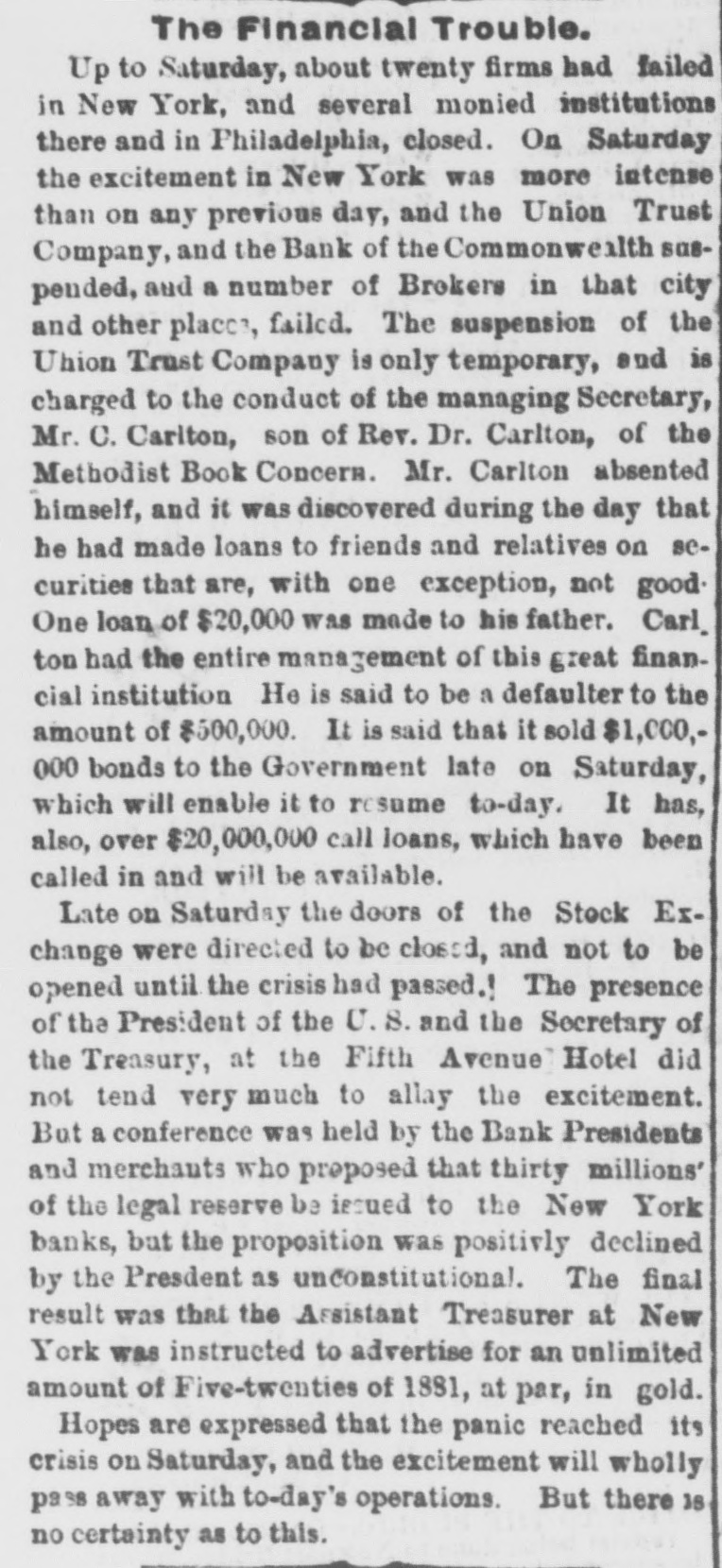
The Financial Trouble. Up to Saturday, about twenty firms had failed in New York, and several monied institutions there and in Philadelphia, closed. On Saturday the excitement in New York was more intense than on any previous day, and the Union Trust Company, and the Bank of the Commonwealth saspended, aud a number of Brokers in that city and other places, failed. The suspension of the Uhion Trust Company is only temporary, and is charged to the conduct of the managing Secretary, Mr. C. Carlton, son of Rev. Dr. Carlton, of the Methodist Book Concern. Mr. Carlton absented himself, and it was discovered during the day that he had made loans to friends and relatives on securities that are, with one exception, not good One loan of $20,000 was made to his father. Carl. ton had the entire management of this great financial institution He is said to be a defaulter to the amount of $500,000. It is said that it sold $1,000,000 bonds to the Government late on Saturday, which will enable it to resume to-day. It has, also, over $20,000,000 call loans, which have been called in and will be available. Late on Saturday the doors of the Stock Exchange were directed to be closed, and not to be opened until the crisis had passed.! The presence of the President of the U. 8. and the Secretary of the Treasury, at the Fifth Avenue Hotel did not tend very much to allay the excitement. But a conference was held by the Bank Presidents and merchants who proposed that thirty millions' of the legal reserve be issued to the New York banks, bat the proposition was positivly declined by the Presdent as unconstitutional. The final result was that the Assistant Treasurer at New York was instructed to advertise for an unlimited amount of Five-twenties of 1881, at par, in gold. Hopes are expressed that the panic reached its crisis on Saturday, and the excitement will wholly pass away with to-day's operations. But there 38 no certainty as to this.


Article from The Portland Daily Press, September 23, 1873

Click image to open full size in new tab

Article Text

NEW YORK. / Receiver Appointed. NEW YORK, Sept. 22.-Isaac H. Bailey has been appointed receiver of the Bank of the Commonwealth. WASHINGTON.


Article from The New York Herald, September 23, 1873

Click image to open full size in new tab

Article Text

The Union Trust Company in the Hands of a Receiver. Six Millions of Currency Disbursed by Sub-Treasury. Meeting of the Jay Cooke Firm To-Day. "E"CRISIS" IN THE COURTS The change in the aspect of Wall street from the turmoil and painful agitation of last week was strikingly noticeable yesterday. The closing of the Stock Exchange, the government declaration to buy an unlimited offer of five-twenties, the action of the banks in resolving to issue loan certificates, and the intervention of the Sabbath all contributed to calm the troubled waters and induce a better and clearer view of the situation. Friday and Saturday will long be remembered for the fierce and unprecedented excitement of the street. It was uncommon and at times feariul enough to make men tremble for the prospect ahead. A deep pall of impenetrable clouds hung over the monetary skies, and no where seemed to appear a solitary ray of light to illuminate the course of the future. Sunday evening the darkness broke, and Monday morning Wall street, with a few exceptional features wore its OLD-TIME APPEARANCE. There were no hurrying crowds, no pale and anxious groups, no heavy fringe of vacant eyed spectators on the sidewalks. In fact, had not the Stock Exchange been closed there was little to indicate that the street had so recently passed through a terrific financial nurricane. A tolerable calm settled down in the morning, and there was every appearance when the day ended that the period of panic was passed, and that with ordinary prudence the old state of things will in a few days prevail. THE ACTION OF THE PRESIDENT on Sunday night was very generally canvassed, but the preponderance of opinion was in favor of the course he selected. Had he yielded to the clamor of the big guns of the monetary world and stepped outside the law by loaning the currency reserve to the banks, those who, in the rash thought of the moment, implored him to commit the illegality might have been the first to condemn him. The feature of yesterday, in connection with the panic, was the unusual withdrawal of money by depositors from the savings banks. This is to be deplored, for of all other institutions the savings banks should be triply guarded from the disastrous innuence of a panic originating among speculators in Wall street. HERALD reporters visited yesterday THE SAVINGS INSTITUTIONS on the east and west side of town, and furnish accounts of what they saw in another column. The policy of keeping THE STOCK EXCHANGE closed until further notice met with general approval, as there is yet some time needed to arrange matters and allow the excitement of the hour to die out. When this is accomplished, and when the Exchange opens again, reasonable prices for settlement can be made. THE GOLD EXCHANGE voted to keep the Gold Room open, but to allow no dealings in gold on the penalty of loss of member ship. It was resolved to place the quotation of gold at 112 as the price and as a basis of clearance. There IS still a good deal of talk over THE PLAN DISCUSSED at the Fifth Avenue Hotel, Sunday, to meet the crisis. It appears the first proposition was that the Treasury should put anywhere from $20,000,000 to $40,000,000 legal tender in the banks as a deposit for which the associated banks should be responsible, Commodore Vanderbiit offering to deposit with the sub-Treasurer $10,000,000 as an additional guarantee. The proposition was declined because of no legal authority for the act, and for the reason that a few banks would reap the whole benefit and profit, to which the banks, not government depositories, would not assent. The plan that was finally agreed upon was that the Treasury should buy five-twenty bonds at fixed rate, privately, as shey were offered, until, if necessary, the legal tender reserve and the currency balance were exhausted. To this plan, which, it cannot be denied, works so far only ID milk and water way, the objections are that it obliges people to sacrifice the best securities in the market and which are sale to keep any time that the people who hold these bonds are not those who need the money, and that the institutions having these bonds, where they are savings banks, will probto use their reserved right of thirty to notice than ninety ably prefer days' from their depositors, bonds, and rather that accept a low price for institutions like insurance companies will consider it the most prudent thing to hold on to their bonds. The Treasury received offers for $3,339,150 PIVE-TWENTY BONDS YESTERDAY, being the issues to which purchases were these confined. Along with the amount taken in on Satbe about $6,000,000 currency will thrown urday, on the market, from which it be expected much relief will be may With the exception of the Bank experienced. North America, the Bank oi the Commonwealth of and the Fourth National Bank, there comparatively no run on the rest of the banks. The com- exhouses abstained from increasing the citement, mercial and few large amounts were withdrawn dein cases where business imperatively except manded. To-day will, in all likellhood, be squiet as yesterday. It will be devoted chiefly to consult tation, and the opinion prevails that the Stock Exchange will remain closed, and as consequence, stock there will be no quotation the volume of of transactions will be reduced. The condition THE TWO TRUST COMPANIES' affairs will be found narrated in another place, and be the statement of Jay Cooke & Co. cannot tail to read with interest. The HERALD reporters supply a mass of information, gathered from bankers and others. on the effect of the panic on American securities abroad, and the views of leading merchants on the situation are also given. The way in which the Brooklyn banks weather the storm is also told, and the reader 18 referred to the financial column for further statistical and speculative information. THE JAY COOKE FIRM. Messrs. Pitt Cooke & McCulloch arrived yesterday by the Egypt. To-day they will meet the other Cooke & affairs of the to in partners consuitation gentlemen in decline the on firm the or Jay speak firm. reference Co. Both and to hold these the a crisis. They LAT that were at sea when the storm


Article from The New York Herald, September 23, 1873

Click image to open full size in new tab

Article Text

Bank of the Commonwealth. This bank is now in the hands of the temporary receiver, Mr. Meigs, the Bank Examiner. It is already known that the cause of the suspension of this institution was the fact of having over-certified for the firm of Edward Haight & Co. on Satur. day. Mr. Haight was one of the bank's best cus. tomers, and had at one time been its president. When called on the firm was unable to make the loan good. However it may be well to state that since the close of the bank on Saturday several payments have been made OR the o verdraft, and there can be little doubt that ultimately the whole of the amount now in the hands of Mr. Haight will be turned over to the bank. The securities now held by the bank are sufficient to pay one-half of the amount. It is stated on good authority that the other creditors at Edward Haight & Co. will be dealt with fairly, an equitable adjustment being made all round. With the exception of this overdraft by this customer the accounts. of the bank show well, very few over-certifications having come to light, and they only in small amounts, incidental to almost every bank. It is stated that the bank will pay every cent iPowes to depositors, and that a permanent receiver has been appointed in the person of Isaac H. Balley, formerly of the Custom House. A statement will. no doubt, be made very shortly showing the condition of affairs. When the moneys in the bank are paid to the depositors it will, no doubt, serve further to alleviate the monetary distress. It is one more of the indications, say people who are posted, that the panic is rapidly blowing over.


Article from The Rutland Daily Globe, September 24, 1873

Click image to open full size in new tab

Article Text

FEW MORE FAILURES Tuesday's News, NEW York, Sept. 23. 10:15 im THE TIDAI WAVE RECEIDING Gold opened at 112. The following notice is posted until The further stock exchange orders." will remain closed The governing B.O. committee WHITE, will Secretary. meet half-past nine to-morrow. 10:50 p.m. -The excitementon the seems to be wearing itself out, appears to exist. Brokers gregated feeling and have street in front of the stock exchange. and formed a street market. all sales being for cash. The following are the quotations Central 91 and 92 bid: Lake Shore, 82 bash, and 110 50 offered: Harlem. bid: 109 bid Wit. bid: Rock Island. 88 bid: Paul, 85 bid: Ohio and Wisconsin, 30 St. I. Union Pacific, 21 and 22 bid: C. bid C. 21 bid Hannibal and St. Joseph, and 20 bid : Western Union Tel., 66 bid. 70 of Pacific Mail. 343 and 36 fered The bid. gold exchange is open and doing business as usual, gold 1141. 000 The bonds sub-treasury this morning. have purchased 83,500, The Union Trust Company are still paring a statement which they expect premake public late in the day. Noon Two millions of bonds havebeen bought Street at the sub-treasury to this hour. quotations now Ohio, 30 bid : CenWabash. 18 bid : St. Paul, 36 bid : tral. 93 Lake Sdore, 82 bid, THE SAVINGS BANKS banks 12:10 P. m. & light run on the savings is being continued. The their banks strictly adhere to the provision smaller charters which requires a notice of from tors. thirty to sixty days from heirdeposi. of The Bowery. Citizens'. Union, time Dime and Bleeker street savings bank con. to make payments up to 8100. THINGS DOWN TOWN. 12.15 P. m. There is but little more than lower the usual number of people in streets of the city, beyond the about the Stock in stocks. The gatherings are ten dickering Exchange, financial the small who presents the appearance of cen. after great manifested to have and is no lassitude, desire struggle. exhaustion the There stock exchange re-open. except by those wanting to purchase for investment. and brokers generally would like to have it continue closed during the remainder of remark among them is will materially thin number this The disaster general the out week. that the of brokers as was the case Black Friday, thus making more business with for those remaining. BONDS PURCHASED 12:30 p.m.--Gold 110 bid. The sub-treasurer has purchased 88, 100 bonds up to this hour. including Satur- 169. day and yesterday. 12. 45 P. -TheStreet quotations stocks are: Lake Shore 80: for 92: Northern Central Union Pacific S New Western York 65: Eric 58: Pacific Mail 31: Ohio and Mississippizo: Northwestern 40: Rock Island M.C.C.& L 22 St. Paul, com mon. 36 Wabash 15 ABOUT BANKS The Bank of the Commonwealth keeps its doors closed. The run on Fourth National has ceased. MORE GREENBACK Assistant Treasurer Hillhouse in greenbacks from Wash. morning. to the ington twenty this millions prevent received possi. bility of becoming embarrassed in the pur. chase of bonds, QUIET IN FINANCIAL CIRCLES 1 p.m. - Affairs are still quiet with prospect of continuing so. GOLD EXCHANGE BANK CLEARANCES of the Gold bank The clearances Exchange are complete. and the balances be paid as usual. FOOLISH DEPOSITORS Several depositor> are in line in front of the Union dime savings bank this morning, The president says they can all have their money. SMALL CROWD AT THE FIFTH AVENUE HOTEL The crowd at the Fifth Avenue Hotel last night was small and quiet. compared with previous evenings. SLOW-MOVING ALDERMEN. The board of aldermen have decided the special meeting not today, to hold called for to take action on the financial erisis. MENT. THE CRISIS OVER-PRAISE OF THE GOVERNPresident Kennedy of the Bank of Com. merce said last evening that government is doing that over. it probably The the the crisis best is can. President Kitchen of the National Park bank says that for reasons ped All the discounting only morning prudential it stop journals unite in express ing the opinion that the panic is over. AN OVER-DRAFT SETTLED. John Bonner, the banker the overdrew his account at the bank of North America to the extent of several hundred thousand dellars, has made a satisfactory settlement bank. Large orders from all over the be brokers with received the continue country to to for the purchase of stocks, so that lively bidding is anticipated when the Stock Exchange reopens. THE SUB-TREASURY yesterday declined to the of the sellers of bonds to the ernment, Gen. names Hillhouse the gov- give on ground that suspicion against the into the market to those might Some who sellers be directed rushed solvency realize of were connected with savings banks, Gen. Hillhouse has not to bonds of '81, as the dent thorized did buy been prosi- aunot believe he had a legal tight to take the bonds not yet due.


Article from The New York Herald, September 24, 1873

Click image to open full size in new tab

Article Text

BANKING INSTITUTIONS. Among the banks the feeling in the morning was very good. They cleared in the regular way, excepting that they paid into the Clearing House the new loan certificates instead of money. But all went on weil, and not the slightest misunderstanding existed between any of the banks and the Clearing House. Several of the bank presidents whom the reporter saw expressed themselves as being quite confident for themselves. In one case it was stated that one brokerage firm had refused to accept the certified checks of another upon the Mechanics' Banking Association. The reason for this was not given, and there seemed to be none for the action, because this bank is generally accredited with being one of the most solid in the street. Officers of banks as a rule state that if the Stock Exchange reopens they will be obliged to call in their loans from brokers, who, if they do not respond, will have their securities sold under the hammer. This will be enough of itself to keep the Stock Exchange closed, it IS said, as, if such action as this took place, universal suspension would be the only alternative. FOURTH NATIONAL BANK. It was at one time stated late in the afternoon that the Fourth National Bank had suspended. A reporter of the HERALD called at the establishment and saw the Cashier, Mr. Lane, who stated that there was not the slightest truth in the rumor, and at the time he pointed the reporter to a crowd of men and boys putting in their deposits. The look of them was very healthy. The reporter interviewed the Cashier about the statements that the Fourth National had thrown out the checks of Henry Clews & Co., and asked the reason. The Cashier said:"The statements of our having done this are quite true. We have been clearing for Henry Clews & Co. On Friday last Mr. Clews overdrew his account here $165,000, against which he, of course, had securities with us. This morning checks to the amount of $185,000 came through the Clearing House upon us from Henry Clews & Co., and, feeling we could not compromise ourselves any further, we threw them out. Mr. Clews then came here and begged us to let him have $200,000 cash on certain securities offered us, but we refused the transaction." REPORTER-Were these securities good? CASHIER-Well, I don't think they were. At all events they didn't please us and we were obliged to refuse the accommodation. or course when these checks were returned alshonored to his house he could not have continued any longer. The report as to our failure probably arose from some mention of this. We hold ample securities of the firm to make good whatever they owe us, and offered to lend him some upon which he might realize. But we suppose he couldn't. Money is hard to get just now. BANK OF THE COMMONWEALTH. At this suaneded bank Mr. Isaac H. Bailey the


Article from New-York Tribune, September 24, 1873

Click image to open full size in new tab

Article Text

deliver from a hundred thousand to half a million dollars' worth of stocks or gold per diem; larger houses, proportionately larger values. Purchases are frequently made in costly lots, requiring checks for sums running from $50,000 upward, and even as high as ten times that amount. Almost every banker or broker in good credit has an arrangement, definite or implied, with his bank, by which he is allowed to largely overdraw his balance -in payment for blocks of stock-with the understanding that before 3 p. m. of the same day he shall deposit the certified checks of other people, in amount sufficient for the redemption of his own checks and the maintenance of a respectable "balance." On the latter the bank makes its profit. Large houses often open accounts of this sort with several banks at once. Not only the suspended Bank of the Commonwealth and the Bank of North America have been in this practice for years, but, unless we are misinformed, almost every institution in their vicinity desirous of brokers' accounts. Among those who "certify"-to use the Street phrase-are the Fourth National, the Mechanics' Banking Association, the Bank of NewYork, the Bank of America, the Bank of the State of New-York, the Bank of the Republic, the Corn Exchange Bank, the Continental, and various others. All are more or less in one category. Each relies upon the honor of its customers to make the morning's overdrafts good; and, truth to say, in many years this reliance has not been without foundation. Instances are few and far between where dishonorable advantage has been taken of bank favors, and each case has been visited with severer penalty and disgrace than any form of commercial default. With respect to the Bank of the Commonwealth it is doubtful, to say the least, whether an overdraft was the main cause of its suspension. Mr. Haight's deficit was less than $200,000, about half of which has been made good, and it is perfectly well understood that nothing but the suddenness and severity of the panic prevented him from making his account good at the] usual hour. The action of two brokers, on Monday, with respect to the Bank of North America, was deliberate, and intended to secure themselves from loss by any disaster to that institution. The result proved it to have been needless, and it has received the censure of the Street. The whole system is perilous and illegal. There should at least be some provision by which the united banks should make themselves responsible for each other's certifications; but even this shadow of security is wanting for all parties concerned. Suppose that 400 houses overdraw, each, an average of $25,000 daily (and these figures do not half reach the truth), and it is seen that a dozen Banks "certify" to the extent of ten millions beyond their customers' deposits. When, as now, they suspend this usage, all business has to stop. Some method should be adopted, like that upon the London Bourse, by which "settlements" can be effected at stated periods. Three-fourths of the clearances would then be arranged by payment of differences, and there would be no need for "overdrafts" of any kind.


Article from Burlington Weekly Free Press, September 26, 1873

Click image to open full size in new tab

Article Text

The N. Y. Herald thus sums up the financial situation in New York City : So far the banks are not affected, except one or two, which were closely connected with the operations of the speculative brokers. The trust companies which have failed owe their downfall to similar causes, and in one case, partially at least, to defalcation. Outside of these there have been no failures. The mercantile interest is as safe as in the best of times. The railroads, except the wild-cat affairs which were made the basis of reckless speculation. are uninjured. Credit generally is unimpaired. Nothing more serious has happened than the overthrow of a few houses which were doing a notoriously unsafe business. It was a mere financial thunderstorm, passing through Wall street and toppling over some unsafe buildings, but leaving the substantial houses in as good condition as before. Already the storm is almost past, and the sky will soon be serene and fair and the atmosphere purer and better, if wise counsels prevail. There is no occasion whatever for a general panic. The real business interests of the country cannot suffer while the embarrassment is confined to the speculators in worthless railroad bonds and the gamblers in valueless stocks. It will be a wholesome lesson to all classes of business men if the storm is confined to those who courted it, and when it is over no one will regret that they who sowed the wind were compelled to reap the whirlwind. Few of the New York brokers know where they stand. On Saturday the best securities went begging at the lowest rates. There was no fixing values on any stocks, and the stock exchange was wisely closed to give men time to recover from their distrust and gather their scattered senses. A. few more of the weakest houses will go down when settlements are made. Some of these whose failures have been announced from the board will recover and go on. Not a single mercantile house, savings bank or other institution doing legitimate trade, has fallen. Excitement and distrust, caused by wild speculators, extended the panic beyond the stock exchange and three banks suffered from severe runs upon them. The Union Trust Company was weakened by the discovery of a large defalcation aggregating $800,000 and the impossibility of realizing on heavy call loans to the Lake Shore Railroad Company, and it suspended. The Bank of the Commonwealth was weakened by the payment of an overdraft of $220,000 of a house which has suspendad. The National Trust Company, with $800,000 in governments on hand, could not realize a dollar on them, and wisely closed its doors until it could dispose of them. Runs on the Fourth National and Manhattan banks laughed to scorn by those institutions. the the went on During were morning banks the principle of Fisk "Each man to drag out his own corpse. and refused each other's checks, but later a meeting was held, and concerted action agreed on. and subsequentt ly there was no further trouble. The purchase of bonds by the government also aided to break the force of the storm.-N. Y. Special.


Article from New-York Tribune, September 27, 1873

Click image to open full size in new tab

Article Text

THE FALLEN HOUSES. THE BANK OF THE COMMONWEALTH. The Directors of the Bank of the Commonwealth have held a meeting to take into consideration the condition of the bank and the possibility of resumption. It was resolved to employ counsel to represent the bank and look after its interests in the courts. Edward Haight & Co. have paid up one half of their overdraft on the bank, and have promised to make good the remainder. The Directors say that no one of their number is indebted to the bank, but, on the contrary, the bank is largely indebted to them. The following letter is written by an extensive importer, and one of the Directors: The Bank of the Commonwealth has been unwisely and precipitately put into the hands of a receiver, without any knowledge of or consultation with the Directors, and before the Bank Examiner could possibly know whether it was insolvent or not. It is now believed that the overdrafts of Edward Haight & Co., which was the principal cause of its suspension, will be paid in full, one-half of the amount having already been secured. If so, then the bank, if judiciously managed. can pay all its liabilities, and have its stock nearly if not quite intact; but if wound up by a receiver, both may be jeopardized. The Directors have taken steps to bring the matter before the Court, and it will be for the interest of the depositors and stockholders at once to see that their interest is protected. Henry Clews & Co. have issuedia circular to their depositors and correspondents, in which they announce that they purpose to continue their business by receiving special deposits in trust for new accounts, pledged only to payments drawn against such accounts, and that they will collect and realize upon loans, securities, and other assets, as fast as possible. Messrs. Howes & Macy are adjusting matters as rapidly as possible, and hope to resume business in a few days. They have notified to their depositors that it is their intention to continue operations as usual, by receiving special deposits in trust to new accounts, pledging themselves to use those deposits only in payment of their customers' respective checks against new accounts; and as fast as the firm can collect and realize from their loans and securities they will pay pro rata installments on their present indebtedness to their depositors until the whole shall be liquidated, the same drawing the usual rate of interest until paid. The banking-house of Jay Cooke & Co. is still busily engaged upon the statement of its condition, but will probably have nothing to report before Monday. Fisk & Hatch say that their books are perfectly kept, and all accounts can be quickly and readily understood, and as soon as there is anything of general interest to communicate it will be presented to the public, and this information is promised at an early date. and may possibly occur simultaneously with or be preceded by a resumption of payment. Everything is represented as in good condition, the assets 80 greatly exceeding the liabilities as to promise a large surplus at the final settlement.


Article from Delaware State Journal, September 27, 1873

Click image to open full size in new tab

Article Text

NEW YORK BANKING. The System of Certification-Over-drafts the Rule and Not the Exception. : [From the New York Tribune.] From the comments made upon the cases which the panic has brought to light of brokers' over drafts, it is evident that the public knows verv little of the system under which Wall street houses transact business, and effect daily "clearances" of an enormous volume of stocks. The Press is united in just reprehension of such banks as have einbarrassed themselves by certifying checks for customers, which the latter have failed to make good by adequate deposits : but these banks are not exceptional. They are no more blameworthy than their more fortunate neighbors, whose customers have been strong enough and honorable enough to prove that the contidence extended to them was not misplaced. It is the whole system of Wall street "certifications " that is at fault. So remarkable is the working of this system that business men are astonished when Informed with respect to it for the first time. A brief explanation of its nature would seem to be in order during the present crisis. Temporary "overdrafts" are the rule, and not the exception, with most of the banks in the vicinity of the Stock Exchange. No other way has yet been devised through which -8 broker,s " clearances" can be effected. Most houses with an average deposit of from $10,000 to $20,000 in bank have to receive and deliver from a hundred thousand to half a million dollars' worth of stocks or gold per diem; larger houses, proportionately larger values. Purchases are frequently made in costly lots, requiring checks for sums running from $50 000 upward, and even as high as teu times that amount. Almost every banker or broker in good credit has an arrangement, definite implied, with his bank, by allowed to which he or is largely for blocks overdraw his balance-In payment of. stock-with the understanding that before 3 p m. of the same day he shall deposit the certified checks of other people, in amount sufficient for the redemiplion of his own checks and the mainte nance of a respectable "balance." On the latter the bank makes its profit. Large houses often open accounts of this sort with several banks at once. Not only the suspended Bank of the Commonwealth and the Bank of North America have been in this practice for years, but, unless we are misinformed, almost every institution in their vicinity desirous of brokers' accounts. Among those who ' certify"- use the street phrase-are the Fourth National, the Mechanics' Banking Association, the Bank of New York, the Bank of America, the Bank of the State of New York, the Bank of the Republic, the Corn Exchange Bank, the Continental, and various I others. All are more or less in one category. Each relies upon the honor of its customers to make the morning's overdrafts good and, truth to say, in many years this reliance has not been without foundation. Instances are few and far : between where disbonorable advantage has been taken of bank favors, and each e case has been visited with severer penalty h and disgrace than any form of comtner : cial default.


Article from The New York Herald, September 27, 1873

Click image to open full size in new tab

Article Text

AROUND THE BANKS. Great quietude was observable at the bank of Henry Clews & Co., but considerable importance was attached by the firm to the following circular. which was issued in the early part of the day:BANKING HOUSE OF HENRY CLEWS & Co., 32 WALL STREET, NEW YORK, Sept. 26, 1873. To THE CORRESPONDENTS AND DEPOSITORS OF HENRY CLEWS & Co.:As already announced, the presentextraordinary financial crisis has rendered it necessary for us to make a temporary suspension of payments. We DOW beg to announce that we propose to continue our business as heretofore, by receiving special deposits ID trust for new accounts, pledged only to payments dra wn against such new accounts, and that we shall collect and realize upon our loans, securities and other assets, as fast as possible, and make payments pro rata as the same shall be realized on, until the entire amount shall be liquidated-interest being paid as heretofore. Should this arrangement meet your approval and you enter heartily into our proposal. our business can be resumed at once and continue without further delay. Our numerous depositors and friends in this city approve entirely of this plan and have already signified their readiness to continue their deposits and business with us as proposed. We trust you will favor us with an answer at the earliest practicable moment Very respectfully yours, HENRY CLEWS & CO. HOWES & MACY. At this bank there were some indications of activity, and Mr. Macy said that the effect of the circular issued yesterday by the firm had been to inspire confidence among their customers, and, though the circular had only been sent out the previous evening, there had been a very much larger response by depositors than could have been reasonably anticipated. There was a general expression of confidence in the ability of the house to resume business wholly, as it has, in effect, partially already done. FISK & HATCH. At this banking house clerks were busily engaged preparing a statement for the public, which will be ready, probably, to-day. This firm express the fullest confidence in their ability to resume business very shortly, and state that their assets are very much beyond their liabilities. BANK OF THE COMMONWRALTH. The Bank of the Commonwealth had its doors partially opened, and throughout the day there was a large number of inquirers; but, from the fact that the affairs of the bank are still in the hands of a receiver, Mr. Bailey, little that was satisfactory could be obtained in the shape of information. Mr. Bailey said he was unable to state when his report would be ready. The President and directors of the bank are making an effort to obtain control of its affairs, and it is believed that they will be successful.


Article from Chicago Daily Tribune, September 29, 1873

Click image to open full size in new tab

Article Text

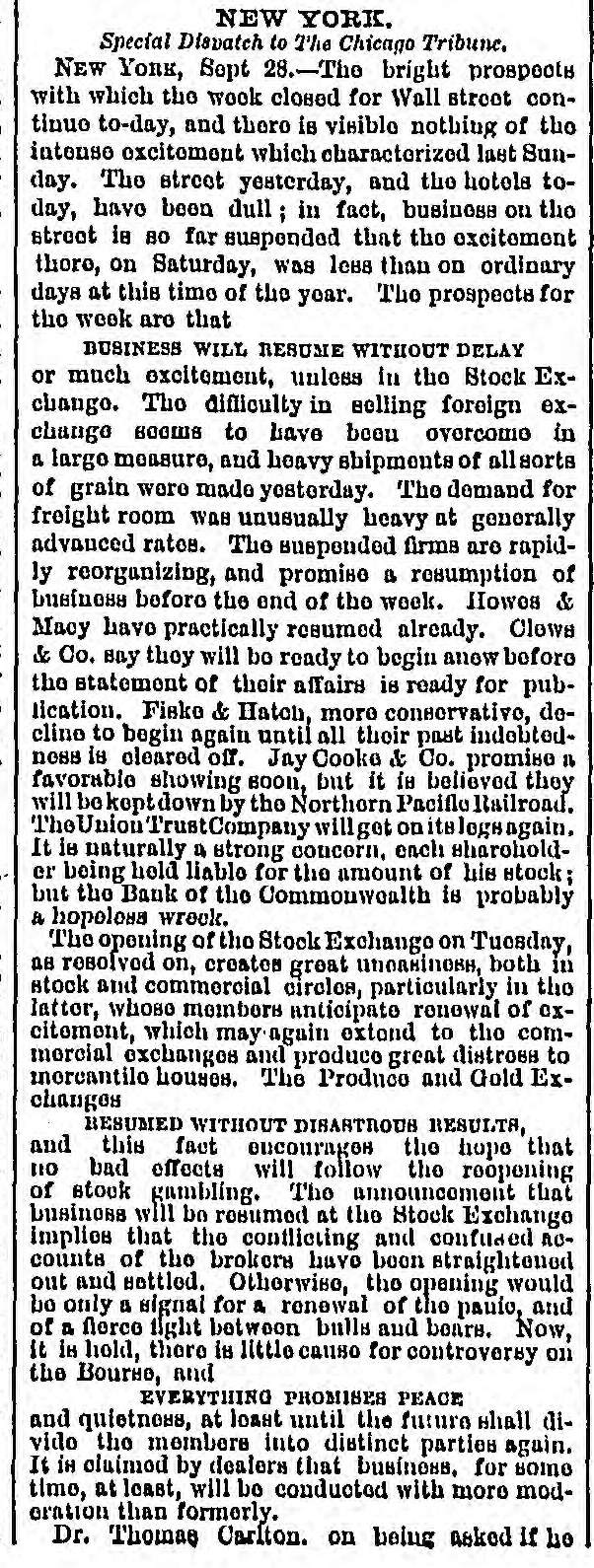
NEW YORK. Special Disvatch to The Chicago Tribune, NEW YORK, Sept 28.-The bright prospects with which the wook closed for Wall street continuo to-day, and there is visible nothing of the intense excitement which characterized last Sunday. The street yesterday, and the hotels today, have been dull in fact, business on tho street le 80 far suspended that the excitement thore, on Saturday, was less than on ordinary days at this time of the year. The prospects for tho week are that BUSINESS WILL RESUME WITHOUT DELAY or much excitement, unless in the Stock Exchango. Tho difficulty in selling foreign exchange Becms to have been overcomo in a large measure, and heavy shipments of allsorts of grain were made yesterday. The demand for freight room WAS unusually heavy at generally advanced rates. The suspended firms are rapidly reorganizing, and promise a resumption of business before the end of the week. Howes & Macy have practically resumed already. Clows & Co. say they will bo ready to begin anow before the statement of their affairs is ready for publication. Fisko & Hatch, more conservativo, declino to begin again until all their past indebtedness is cleared off. Jay Cooke & Co. promise n favorable showing soon, but it is believed they will be kept down by the Northorn Paciflo Railroad. The Union Trust Company will get on italegengain. It is naturally a strong concern, each sharoholder being hold liablo for the amount of his stock; but the Bank of the Commonwoulth is probably a hopeless wreck. The opening of the Stock Exchange on Tuesday, BB resolved on, creates great unoasinoss, both in stock and commercial circles, particularly in the latter, whose members anticipate renowal of excitement, which may again extend to the commoreial exchanges and produce great distross to morcantilo houses. The Produce and Gold Exchanges RESUMED WITHOUT DISARTROUS RESULTA, and this fact encourages the hope that 110 bad effects will follow the roopening of stock gambling. The announcement that business will be resumed at the Stock Exchange implies that the conflicting and confused nocounts of the brokers have boon straightened out and settled. Otherwise, the opening would be only a signal for & renewal of the pauio, and of a fierce light between bulls and boars. Now, it is hold, there is little cause for controversy on the Bourne, and EVERYTHING PROMISES PEACE and quietness, at loast until the futuro shall divido the members into distinct parties again. It in claimod by dealers that business, for some time, at least, will be conducted with more modoration than formerly. Dr. Thomas Carlton. on being asked if he


Article from The New York Herald, October 14, 1873

Click image to open full size in new tab

Article Text

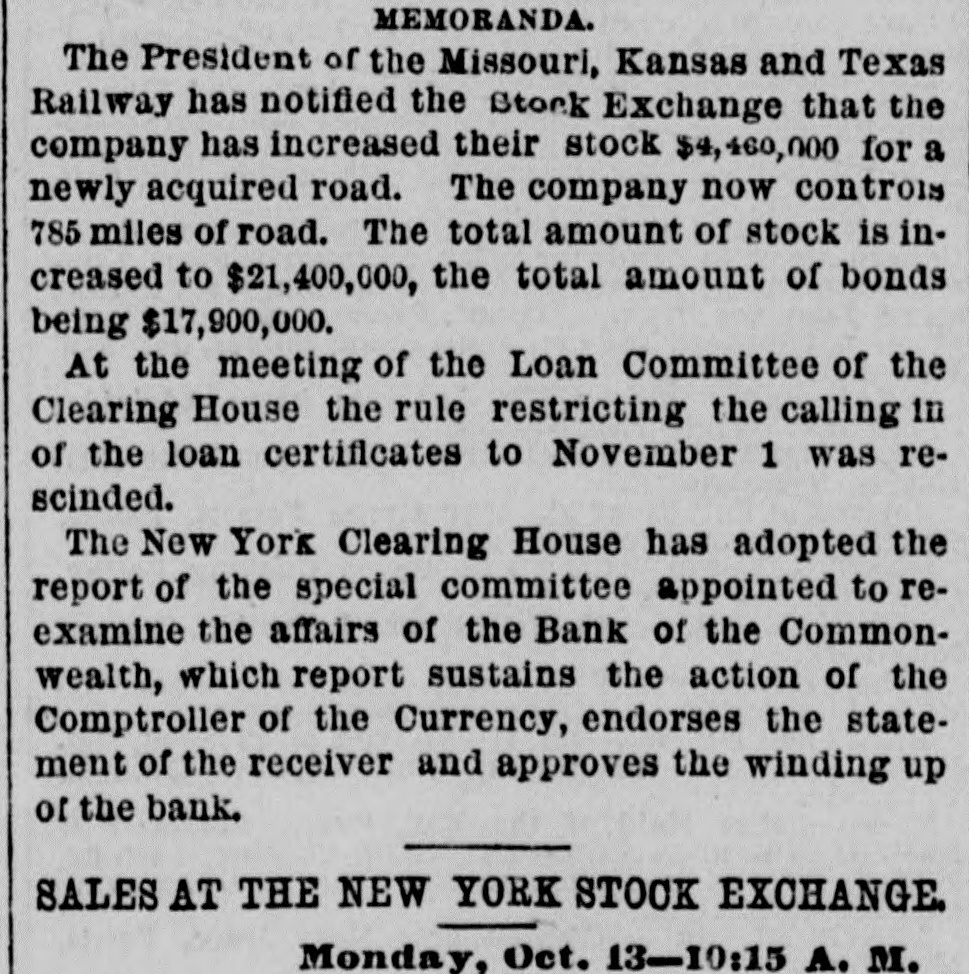
MEMORANDA. The President of the Missouri, Kansas and Texas Railway has notified the Stock Exchange that the company has increased their stock $4,460,000 for a newly acquired road. The company now controls 785 miles of road. The total amount of stock is increased to $21,400,000, the total amount of bonds being $17,900,000. At the meeting of the Loan Committee of the Clearing House the rule restricting the calling in of the loan certificates to November 1 was rescinded. The New York Clearing House has adopted the report of the special committee appointed to reexamine the affairs of the Bank of the Commonwealth, which report sustains the action of the Comptroller of the Currency, endorses the statement of the receiver and approves the winding up of the bank. SALES AT THE NEW YORK STOCK EXCHANGE M. Monday, Oct. 13-10:15 A.


Article from Memphis Daily Appeal, October 14, 1873

Click image to open full size in new tab

Article Text

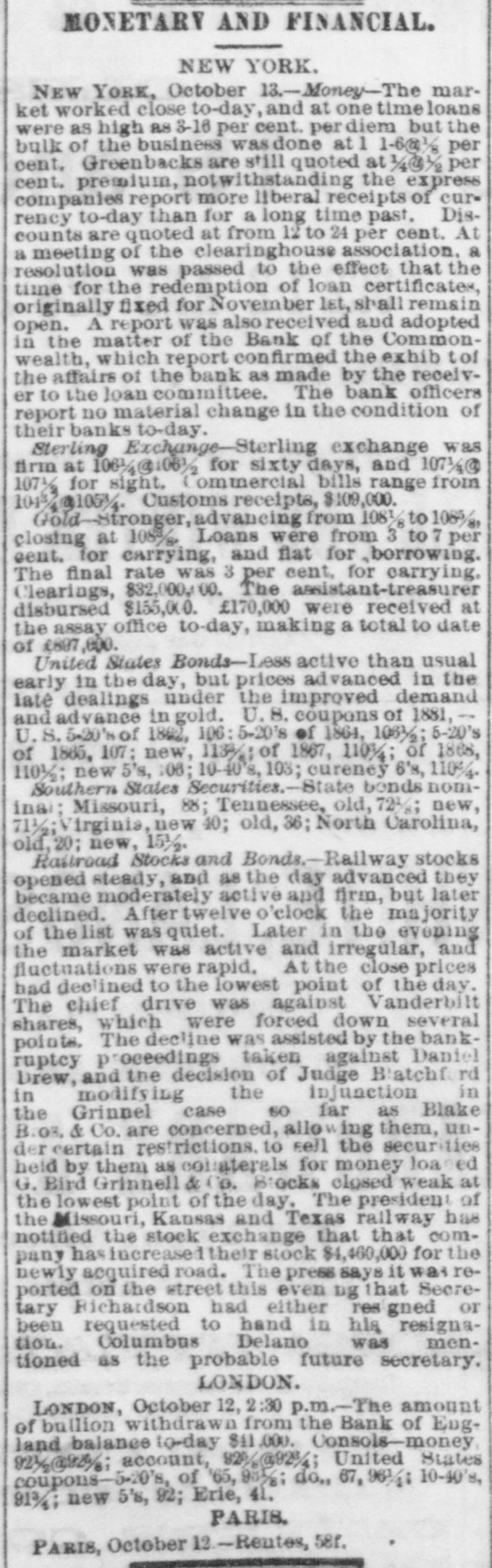
MONETARY AND FINANCIAL. NEW YORK. NEW YORK, October 13.-Money-The market worked close to-day, and at one time loans were as high as 3-10 per cent. per diem but the bulk of the business was done at 1 1-6@ per cent. Greenbacks are still quoted at 1/4/12 per cent. premium, notwithstanding the express companies report more liberal receipts of cur= rency to-day than for a long time past. Discounts are quoted at from 12 to 24 per cent. At a meeting of the clearinghouse association, a resolution was passed to the effect that the time for the redemption of loan certificates, originally fixed for November 1st, shall remain open. A report was also received and adopted in the matter of the Bank of the Commonwealth, which report confirmed the exhib tol the affairs of the bank as made by the receiver to the loan committee. The bank officers report no material change in the condition of their banks to-day. Sterling Exchange -Sterling exchange was firm at 10614@:06 /2 for sixty days, and 10714@ 1071/6 for sight. Commercial bills range from 1043/@105%4 Customs receipts, $109,000. Gold Stronger, advancing from 1081/8 to 1085, 80 closing at 108/8 Loans were from 3 to 7 per eent. for carrying, and flat for borrowing. The final rate was 3 per cent. for carrying, Clearings, $32,000.00. The ansistant-treasurer disbursed $155,000. £170,000 were received at the assay office to-day, making a total to date of £897,000. United States Bonds-Less active than usual early in the day, but prices advanced in the late dealings under the improved demand and advance in gold. U. 8. coupons of 1881, 8.5-20's of 1802, 106: 5-20's of 1864, 1061/2; 5-20's of 1865, 107; new, 113%: of 1867, 110% of 1868, 110%; new 5's, 00; 10-40's, 103; curency 6's, 110% Southern States Securities.-State bonds nominai: Missouri, 88; Tennessee, old, 721/3 new, 711/;Virginia, new 40; old, 36; North Carolina, old,20; new, 15% Railroad Stocks and Bonds,-Railway stocks opened steady, and as the day advanced they became moderately active and firm, but later declined. After twelve o'clock the majority of the list was quiet. Later in the evening the market was active and irregular, and fluctuations were rapid. At the close prices had declined to the lowest point of the day. The chief drive was against Vanderbilt shares, which were forced down several points. The decline was assisted by the bankruptcy proceedings taken against Daniel Drew, and the decision of Judge Blatchf rd in in modifying the injunction the Grinnel case so far as Blake B.O3. & Co. are concerned, allow ing them, under certain restrictions. to cell the securities held by them as poliaterals for money loa ed G. Bird Grinnell Co. Blocks clgsed weak at the lowest point of the day. The president of the Missouri, Kansas and Texas railway has notified the stock exchange that that company has increasedtheir stock $4,460,000 for the newly acquired road. The press says it was reported on the street this even Dg that Secretary Richardson had either res gned or been requested to hand in his resignation. Columbus Delano was mentioned as the probable future secretary. LONDON. LONDON, October 12,2:30 p.m.-The amount of bullion withdrawn from the Bank of Eug. land balance to-day $41.000. Consols-money 921/682% account, 920/@923/4; United States coupons-5-20's, of 65,98% do., 961/4: 10-40's, 9134 new 5's, 92; Erie, 41. PARIS. PARIS, October 12 -Reutes, 58f.


Article from The Wheeling Daily Intelligencer, October 14, 1873

Click image to open full size in new tab

Article Text

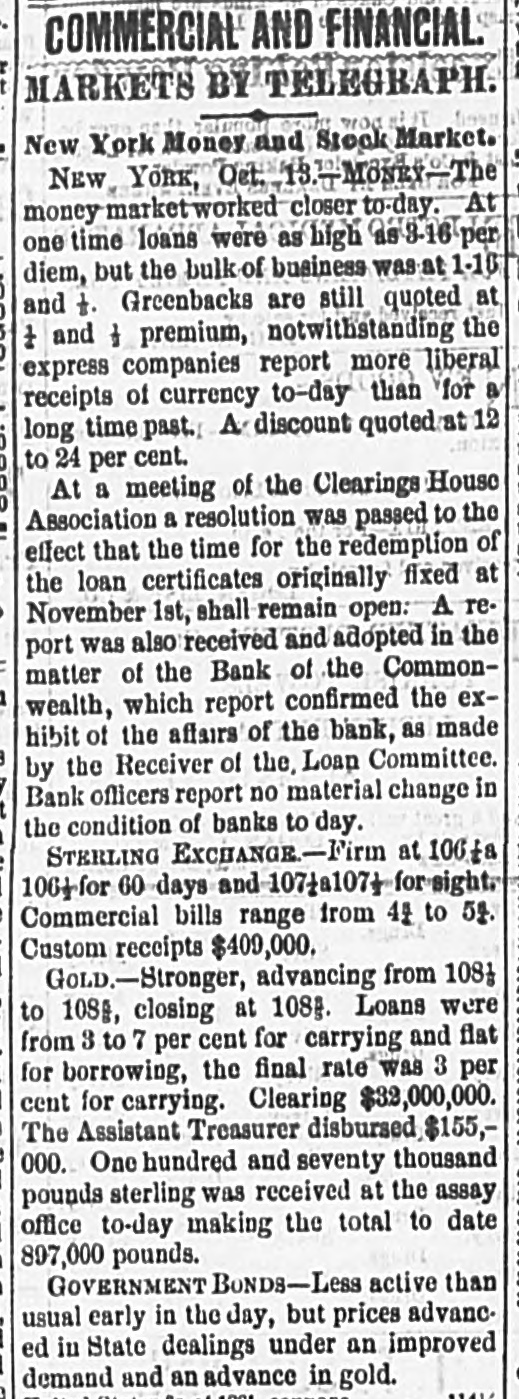
COMMERCIAL AND FINANCIAL MARKETS BY TELEGRAPH. New York Money and Stock Market. NEW YORK, Oct. 13. MONEY-The oO money market worked closer to-day. At one time loans were as high as 3-16 per diem, but the bulk of business was at 1-10 and t. Greenbacks are still qupted at 1 and 1 premium, notwithstanding the express companies report more liberal receipts of currency to-day than for a long time past. A discount quoted at 12 to 24 per cent. At a meeting of the Clearings House Association a resolution was passed to the effect that the time for the redemption of the loan certificates originally fixed at November 1st, shall remain open: A report was also received and adopted in the matter of the Bank of the Commonwealth, which report confirmed the exhibit of the affairs of the bank, as made by the Receiver of the, Loan Committee. Bank officers report no material change in the condition of banks to day. STERLING EXCHANGE-Firm at 106ta 106+for 60 days and 107a107+ for sight. Commercial bills range from 4 to 5g. Custom receipts $409,000. Gold.-Stronger, advancing from 1081 to 108g, closing at 108g. Loans were from 3 to 7 per cent for carrying and flat for borrowing, the final rate was 3 per cent for carrying. Clearing $32,000,000. The Assistant Treasurer disbursed $155,000. One hundred and seventy thousand pounds sterling was received at the assay office to-day making the total to date 897,000 pounds. GOVERNMENT BONDS-Less active than usual early in the day, but prices advanc. ed in State dealings under an improved demand and an advance in gold.


Article from The Rutland Daily Globe, October 24, 1873

Click image to open full size in new tab

Article Text

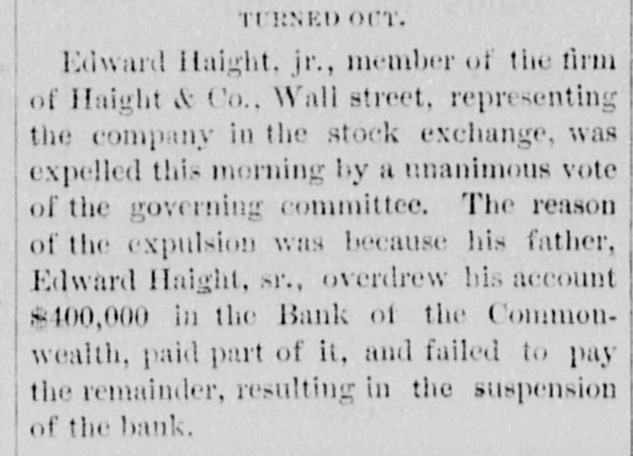
TURNED OUT. Edward Haight, jr., member of the firm of Haight & Co., Wall street, representing the company in the stock exchange, was expelled this morning by a unanimous vote of the governing committee. The reason of the expulsion was because his father, Edward Haight, SI., overdrew his account $400,000 in the Bank of the Commonwealth, paid part of it, and failed to pay the remainder, resulting in the suspension of the bank.


Article from Nashville Union and American, December 16, 1873

Click image to open full size in new tab

Article Text

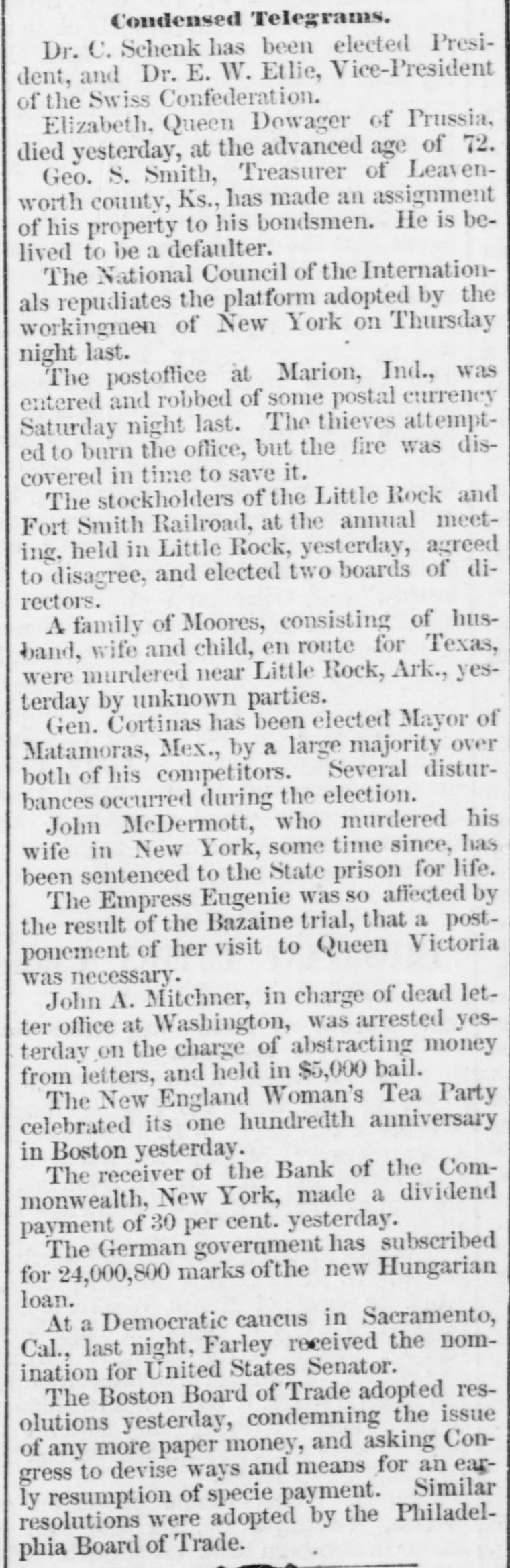
Condensed Telegrams. Dr. C. Schenk has been elected President, and Dr. E. W. Etlie, Vice-President of the Swiss Confederation. Elizabeth, Queen Dowager of Prussia, died yesterday, at the advanced age of 72. Geo. S. Smith, Treasurer of Leavenworth county, Ks., has made an assignment of his property to his bondsmen. He is belived to be a defaulter. The National Council of the Internationals repudiates the platform adopted by the workingment of New York on Thursday night last. The postoffice at Marion, Ind., was entered and robbed of some postal currency Saturday night last. The thieves attempted to burn the office, but the fire was discovered in time to save it. The stockholders of the Little Rock and Fort Smith Railroad, at the annual meeting, held in Little Rock, yesterday, agreed to disagree, and elected two boards of directors. A family of Moores, consisting of husband, wife and child, en route for Texas, were murdered near Little Rock, Ark., yesterday by unknown parties. Gen. Cortinas has been elected Mayor of Matamoras, Mex., by a large majority over both of his competitors. Several disturbances occurred during the election. John McDermott, who murdered his wife in New York, some time since, has been sentenced to the State prison for life. The Empress Eugenie was so affected by the result of the Bazaine trial, that a postponement of her visit to Queen Victoria was necessary. John A. Mitchner, in charge of dead letter office at Washington, was arrested yesterday on the charge of abstracting money from letters, and held in $5,000 bail. The New England Woman's Tea Party celebrated its one hundredth anniversary in Boston yesterday. The receiver of the Bank of the Commonwealth, New York, made a dividend payment of 30 per cent. yesterday. The German government has subscribed for 24,000,800 marks ofthe new Hungarian loan. At a Democratic caucus in Sacramento, Cal., last night, Farley received the nomination for United States Senator. The Boston Board of Trade adopted resolutions yesterday, condemning the issue of any more paper money, and asking Congress to devise ways and means for an early resumption of specie payment. Similar resolutions were adopted by the Philadelphia Board of Trade.


Article from The Wheeling Daily Intelligencer, March 9, 1874

Click image to open full size in new tab

Article Text

NEW YORK CITY. ROBBERS ARRESTED. NEW YORK, March 7.-On the night of January 9th, Adolph Hank called at the 20th police station house and informed the officers that his jewelry store had just been robbed, after he himself had been knocked down and gagged. The officers doubted the story, but being given the number of a hack seen in the neighborhood on the night of the robbery, arrested the driver, and he in turn gave the names of five thieves, three of whom have been arrested, and one of these was formerly a keeper in the city prison. None of the property was recovered. DISCOVERY OF STOWAWAYS. Captain Deaken, of the steamship City of New York, when about twelve miles out from Havana, put back to that city to give up to the authorities areestowaways just discovered on board. The men are represented to have declared that they were sympathizers with Cuban liberty and did not want to be drafted in Havana to go and fight against it, and that they would pay their passage money upon the arrival of the vessel in New York Monday next. ARRIVED-BAILED. Gen. Schenck, United States Minister to England, and ex-Senator Cattell, representing the Treasury Deparment in Europe, arrived to-day. Caleb Cushing sailed for Madrid today. SHOOTING AFFRAY-SUICIDE Dispatches from Meridien, Conn., say that this morning John Anderson, recently discharged from the spoke shop at Wallingford, entered the shop, and after speaking a few words angrily fired several shots at the men, two of whom, Horatio Hall and Frederick Newton, were la. tally wounded. Anderson then rushed from the building and cut his own throat. DIVIDEND TO BE PAID. A dividend of 50 per cent will be paid to depositors by the receiver of the Bank of the Commonwealth. OVER DUE. The steamer Wisconsin is now several days over due. The managers of the line believe it is owing to the terrible weather, BANK STATEMENT. The bank statement is as follows: Loans increase, $230,500; specie increase, $1,585,800; legal tender decrease, $259,900; deposits increase, $4,335,000; circula. tion increase, $132,700; increase of reserve, $208,975. GENERAL SCHENCK. NEW YORK, March 8.-Gen. Schenck says his visit to this country is solely on private affairs; that he has not come home to fill any Cabinet or other office here, and that he will return to England in May, when his leave of absence expires. He goes to Washington Tuesday, where he remains three days, then on a visit to Ohio, and then a stay of three weeks will be passed in this city. THE OCEAN NATIONAL BANK. The Herald says it is reported that the Sub-Committee of Banking and Currency of the House of Representatives has discovered that certain officers of the Ocean National Bank by a collusion with certain parties in Wall street, have made the necessary arrangements for having the bank closed up at a particular time, and that these arrangements were perfected months previous to the time that the bank really closed. Among other features of the arrangement it is alleged that the testimony shows that Mr. Davis was decided upon as referce from the first day the conspiracy was resolved upon, and that to make the conspiracy a success it was found necessary to secure the official assistance of a prominent and well-known official of the government at Washington. The committee last evening for Wash. ington. ANNIVERSARY OF PARIS COMMUNE. French citizens who fied to this city on account of taking part in the Comil mune, last night resolved to celebrate the 18th of March as the anniversary of the e Paris Commune, by a parade, banquet and ball.


Article from Chicago Daily Tribune, March 9, 1874

Click image to open full size in new tab

Article Text

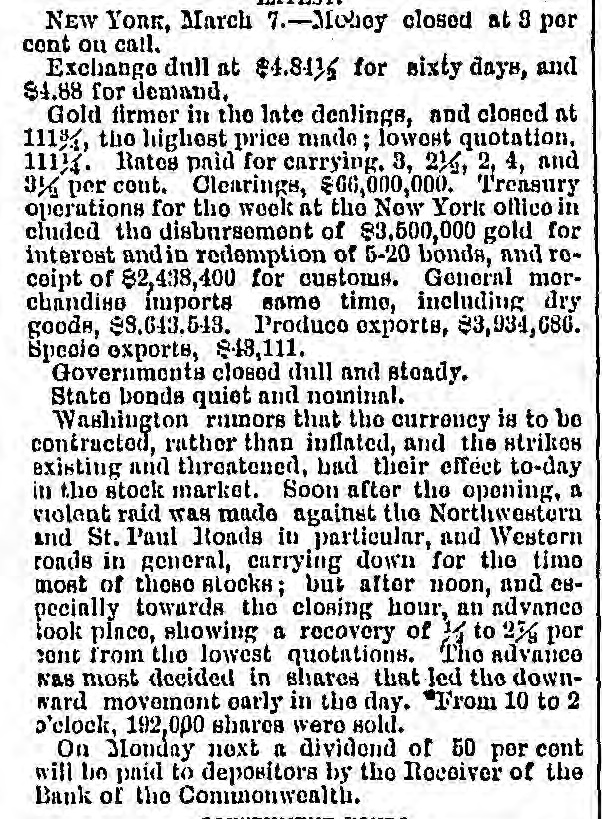
# LATEST. NEW YORK, March 7.-Money closed at 3 per cent on call. Exchange dull at $4.81½ for sixty days, and $4.88 for demand. Gold firmer in the late dealings, and closed at 111¾, the highest price made; lowest quotation, 111¼. Rates paid for carrying, 3, 2½, 2, 4, and 3½ per cent. Clearings, $66,000,000. Treasury operations for the week at the New York office included the disbursement of $3,500,000 gold for interest and in redemption of 5-20 bonds, and receipt of $2,438,400 for customs. General merchandise imports same time, including dry goods, $8,643.543. Produce exports, $3,934,686. Specie exports, $48,111. Governments closed dull and steady. State bonds quiet and nominal. Washington rumors that the currency is to be contracted, rather than inflated, and the strikes existing and threatened, had their effect to-day in the stock market. Soon after the opening, a violent raid was made against the Northwestern and St. Paul Roads in particular, and Western roads in general, carrying down for the time most of these stocks; but after noon, and especially towards the closing hour, an advance took place, showing a recovery of ¼ to 2⅝ per cent from the lowest quotations. The advance was most decided in shares that led the downward movement early in the day. From 10 to 2 o'clock, 192,000 shares were sold. On Monday next a dividend of 50 per cent will be paid to depositors by the Receiver of the Bank of the Commonwealth.