
13612. Bank of America (New York, NY)

Bank Information

Episode Type
Suspension → Reopening
Bank Type
state
Start Date
January 3, 1862
Location
New York, New York (40.714, -74.006)

Metadata

Model
gpt-5-mini
Short Digest
bbb9e33353e189d9

Response Measures

None

Description

Newspaper articles from Jan 1862 report the general suspension of specie payments by New York banks. The Bank of America is mentioned as having an interaction with the Treasury and as initially refusing to join the suspension vote but nevertheless operating; historically these suspensions were temporary during the Civil War. The articles do not explicitly report a later reopening for this specific bank, but the context indicates a coordinated, temporary suspension rather than permanent closure, so I classify as suspension_reopening while noting that a direct reopening statement is not present in the provided excerpts.

Events (2)

1. January 3, 1862 Suspension
Cause
Macro News
Cause Details
Coordinated suspension of specie payments by New York banks in response to large government financing needs and Civil War-related pressures (banks agreed to suspend specie payments Saturday night).
Newspaper Excerpt
The Suspension of Specie Payments... The policy of suspension agreed upon on Saturday night is concurred in by the outside public to-day.
Source
newspapers
2. January 4, 1862 Suspension
Cause
Macro News
Cause Details
Continuation of the city banks' suspension decision; Bank of America initially resisted joining the suspension vote but is discussed in context of the general specie suspension triggered by government financing demands.
Newspaper Excerpt
the suspension had been so long looked for... some of the leading institutions having refused to suspend... Chemical Bank, City and Bank of America [initially refused to suspend].
Source
newspapers

Newspaper Articles (3)

Article from Chicago Daily Tribune, January 3, 1862

Click image to open full size in new tab

Article Text

The Suspension of Specie Payments. [From the New York Times, Tuesday.) The public interest in the Bank return is much diminished by the general suspension of specie payments announced in this morning' paper. While the average of specie on the present return is reported $29. ,000, the actual amount in bank on the opening of business this morning is understood to be $23,319. 000, or about six millions below the average The policy of suspension agreed upon on Sat urday night is concurred in by the outside public to -day. with the greatest unanimity The previous indifference to the mere empty honor of the specie basis, in the face of the large prospective wants of the Government and the favorable condition of the actual bal ance of tradewithEurope, rendered the change much easier than the nervousness of some of our Bank officers might have presupposed. The transition is made not without the mo mentary unsettling of the market value of the gold and the rates of foreign exchange, but without the slightest apprehension that the difference will be seriously felt or substantially recognized a week hence. The quotations for gold over current funds to-day is variously quoted from 100% to 10116 per cent and Exchange London per cent. but the positive settlements in either case are 60 few as to render these figures next to nominal The bullion brokers are unwilling to name a price at which they would purchase American gold coin, and the banking houses engaged in Foreign Exchange did but very little business at or within the quotation just named for bills on London. A rumor obtained early in the day that a few of the banks were not in accord with the general suspension But this, if true, amounts to nothing more than a factitious attempt to gain little extra eredit, at a very small cost. As we understand the dodge, it is simply a recognition of the right of individual depositors to draw for their balances, as they stood at the close of business on Saturday, in gold, if they desire it. No bank in the city, as far as weare advised, is refusing, o-day, to conduct their engagements with depositors in current funds. that is receiving certified checks or the circulating notes of other city banks in account, to be repaid in kind. Nor are we advised that any of the large hanks refuse gold on checks drawn against deposits made up to Saturday last. where the necessities or convenience of the depositor requires gold instead of current d funds. This test has not yet been applied in a sufficient number of instances to authorize us to speak positively as to the rule to be obd served, but sufficient has transpired to know that the difference is not likely to amount to a rate sufficient to make the rate worth discussing before the public. The Government is understood to have vird tually suspended specie payments with the banks: the latter holding an aggregate balance of $21,000,000 to the credit of the Trea is sury, of which they propose to pay in a suffi n cient sum o-morrow to enable the Assistant n Treasurer in New York to pay the January interest on the Public Debt in gold, if demanded. The Circulating Notes of the United es States were employed to-day in current payof ments on the checks of the various disbursing officers of the Government The operation was conducted with mutual good will and d with every sign of entire confidence in the at credit of these Circulating Notes. The sulti is that the specie balance is almost the same at the close of the day as on Saturday night. Some few of the banks have manifest d ed less liberality than the public in reférence to the currency of United States Notes. The Bank of America, on whose books there is an undrawn balance of about $920,000 to the g credit of the Treasury, sent down Notary this afternoon to demand $80,000 in gold, on checks and drafte drawn upon the Sub-Treasuor ry, The demand was not persevered in, and no protest was entered. for the sufficient reahson that the scandal of the transaction would have more than counte rbalanced the miscrable s, pittance growing out of the difference between $80,000 in gold and $80,000 United States notes, which the bank is at liberty to set he off against a corresponding sum to the credit to of the Government on its own books, Anre other instance is mentioned of the refusal of the American Exchange Bank, on whose books the Treasury of the United States ry stands ereditor to the amount of about $1,525,000. to receive the Circulating Notes of the United States as current funds The President of this non-dividend paying concern il has recently issued one or more pamphlets amminst the credit of the Government, claimad ing in his last manifesto, indemnity for the ds past and security for thefuture, before granting further countenance from his Bank and its ey associates in the Clearing- house in the negoit, tiation of the Public Loans. This course of conduct carries its own comment The pruct, tical inference is that if the Bank in question a will pay in gold its own solemn undertaking to the Government the latter would probably ny be able to redeem in gold all the United States ve Notes that the Bank is likely to receive on ddeposit in the course of its ordinary business some time to come. Aside from the foreral going cases, we hear of no factions opposition wo our National currency, which, from its convertibility percent Treasury Bonds se of the Government or into a 6 per cent. Funded Stock, ought to be esteemed as at In least equivalent unsecured deposits S. resting under a general suspension of specie ary payments in our City Banks, The January interest on the public debt of orthe United States will assuredly be paid in So gold, if demanded. b also will be any other and obligations on the public debt due to the Assock einted Banks or other parties, on the 31st December provided the banks make good their A promise to protect these payments in the ach equivalent of gold. The Manhattan Company by as the agents of the State of New York, will also, it is understood pay the January intereen est. and such of the principal of the State ate debt of New York, in gold or its equivalent. ght The State of New York has yet to make the the first default in the payment of gold on its ma turing obligations. As far back as 1837, a pre1th miuni of 15 per cent was paid for specie to lese redeem a State debt then falling due on o and after 1857 at the option of the State. The suspension of the banks announced go, morning, was received on the Stock Exchang hat as a relief to the anxiety which had been fel rein regard to the course of the money market The event was previously deemed as inevita ble-as a question of a few days or weeks. It an occurrence before the banks have exhausted stop their stock of bullion by $23,000,000, and th dd. belief that the public are measurably indif ferent to the mere credit of maintaining a par all ticular basis while the prospective wants of th isGovernment are so enormous, caused an im mediate average advance of two per cent a prices. The excitement was quite marked isboth Fessions of the Board and large sale Ado were made at each, partly in realization The profits, and partly from the calculation tha the extreme advance might not be sustained fied, vice of the Cairo
Article from The Weekly Sun, January 4, 1862

Click image to open full size in new tab

Article Text

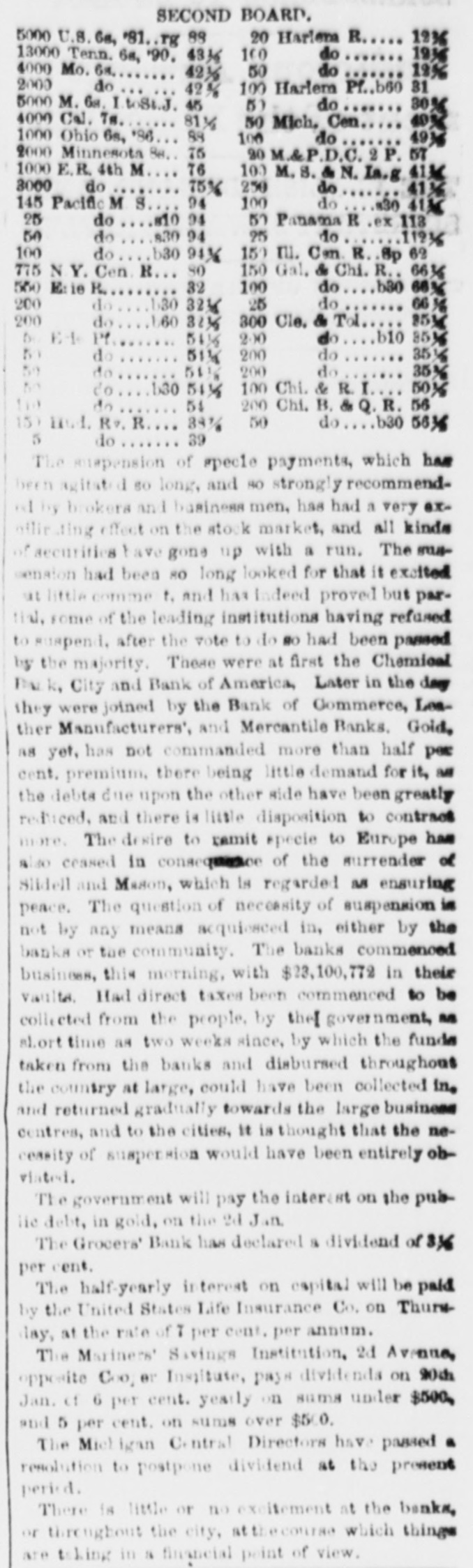
SECOND BOARD. 1936 20 Harlem R..... 5000 U.S. 6s, 81. rg 88 do 19% 100 13000 Tenn. 68, '90. 4314 4000 Mo. 6a. 50 do ******* 18% 42% 2000 do 100 Harlem Pf..b60 31 42% do 30% 5) 5000 M. 6a. I.toSt.J. 45 4000 Cal. Ts. 49% 50 Mich, Cen 81 1/2 88 1000 Ohio 6s, '86 do 100 49 75 2000 Minnesota 8H.. 20 M.&P.D.C. P. 57 1000 E.R. 4th M 76 100 M. 8. & N. Ia.g. 4136 3000 do 250 do 75% 41% do 94 100 145 Pacific M S.... 30 41 25 #10 94 do 50 Panama R .ex 113 50 25 do do 830 94 .11936 100 do b30 94% 150 III. Cen. R. 8p 69 80 775 N Y. Cen R 150 Gal. & Chi. R.. 6636 do 32 100 550 E:1e R. b80 66% do 200 do 25 66% 1.30 3216 200 do 15% 300 Cie. & Tol 160 31% b10 D 6-4 Pf 200 do 35% 51% 5 do do 35 1/6 51% 200 50 do 200 do 35% 51% to 100 Chi. & R. 1 do 50% 1330 511/1 tie do 51 200 Chi. B. & Q. R. 56 do R 50 Hold. 15 Rv. 8814 b30 5616 5 39 do The exeppnsion of specie payments, which has been agitated so long, and 40 strongly recommendof brokers and business men. has had a very exeffect on the stock market, and all kinds securities have gone up with a run. The sussension had been 80 long looked for that it excited at little comme t. and has Indeed proved but parlid. some of the leading institutions having refused to suspend. after the vote to do so had been passed by the majority These were at first the Chemical But k, City and Bank of America, Later in the day they were joined by the Bank of Commerce, Lesther Manufacturers', and Mercantile Banks. Gold, as yet, has not commanded more than half per cent. premium there being little demand for it, M the debts due upon the other side have been greatly reduced and there is little disposition to contract more. The desire to remit specie to Europe has also ceased in consequence of the surrender of Sidell and Mason, which is regarded as ensuring peace. The question of necessity of suspension in not by any means acquienced in, either by the banks or tue community. The banks commenced business, this morning, with $23,100,772 in their vaulta. Had direct taxes been commenced to be collected from the people. by the government, as slort time as two weeks since, by which the funda taken from the banks and disbursed throughout the country at large, could have been collected in. and returned gradually towards the large business centres, and to the cities, it is thought that the necensity of suspension would have been entirely obvisted. The government will pay the interest on the pubHe debt, in gold, on the 2d Jan The Grocera' Bank has declared a dividend of 316 per cent. The half-yearly interest on capital will be paid by the United States Life Insurance Co. on Thursday, at the rate of T per cent. per annum. The Mariners' Sivings Institution. 2d Avenue, opposite Coo, er Institute, pays dividends on 90th Jan. of 6 per cent. yearly on same under $500, and 5 per cent. on sums over $500. The Mich lgan Central Directors have passed a resolution to postpone dividend at the present period. There is little or no excitement at the banks, or throughout the city, atthecourae which things are taking in a financial point of view.


Article from Memphis Daily Appeal, January 15, 1862

Click image to open full size in new tab

Article Text

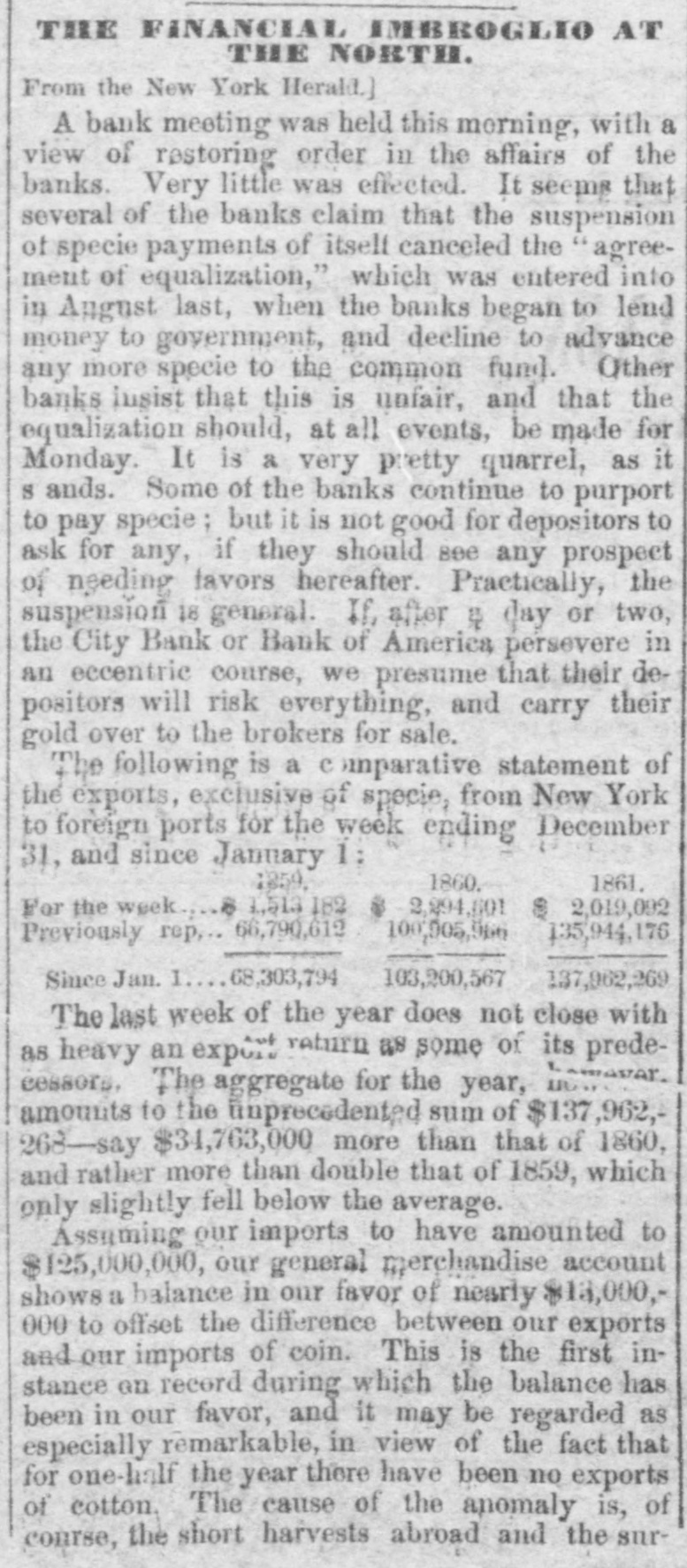
THE FINANCIAL IMBROGLIO AT THE NORTH. From the New York Herald.] A bank meeting was held this morning, with a view of restoring order in the affairs of the banks. Very little was effected. It seems that several of the banks claim that the suspension of specie payments of itself canceled the agreement of equalization," which was entered into in August last, when the banks began to lend money to government, and deeline to advance any more specie to the common fund. Other banks insist that this is unfair, and that the equalization should, at all events, be made for Monday. It is a very pretty quarrel, as it 8 ands. Some of the banks continue to purport to pay specie ; but it is not good for depositors to ask for any, if they should see any prospect of needing favors hereafter. Practically, the suspension 18 general. If, after BY day or two, the City Bank or Bank of America persevere in an eccentric course, we presume that their depositors will risk everything, and carry their gold over to the brokers for sale. The following is a € imparative statement of the exports, exclusive of specie, from New York to foreign ports for the week ending December 31, and since January 1: 1859, 1860. 1861. 2,294,601 8 1,513 182 For the week 2,019,092 100,905,966 135,944,176 Previously rep, 66,790,612 68,303,794 103,200,567 Since Jan. I 137,962,269 The last week of the year does not close with out return as some of its predeas heavy an expert cessors. The aggregate for the year, amounts to the imprecedented sum of $137,962,4 268-say $34,763,000 more than that of 1860, and rather more than double that of 1859, which only slightly fell below the average. Assuming our imports to have amounted to $125,000,000, our general merchandise account shows a balance in our favor of nearly $13,000,000 to offset the difference between our exports and our imports of coin. This is the first instance on record during which the balance has been in our favor, and it may be regarded as especially remarkable, in view of the fact that for one-half the year there have been no exports of cotton. The cause of the anomaly is, of course, the short harvests abroad and the sur-