13589. Atlantic National Bank (New York, NY)

Bank Information

Episode Type
Run → Suspension → Closure
Bank Type
national
Bank ID
1388
Charter Number
1388
Start Date
April 26, 1873
Location
New York, New York (40.714, -74.006)

Metadata

Model
gpt-5-mini
Short Digest
af7c61044e30f300

Response Measures

Accommodated withdrawals, Full suspension, Books examined

Receivership Details

Depositor recovery rate
100.0%
Date receivership started
1873-04-28
Date receivership terminated
1884-04-29
OCC cause of failure
Fraud
Share of assets assessed as good
49.6%
Share of assets assessed as doubtful
8.7%
Share of assets assessed as worthless
41.7%

Description

Contemporary reports (Apr 26–30, 1873) describe heavy withdrawals/panic upon disclosure of cashier F. L. Taintor's large defalcation, the bank paying out until about 3pm and then closing; Clearing House examiners found the institution insolvent and the Comptroller appointed a receiver (George/Charles E. Strong). The bank did not resume normal operations and was placed in receivership with later dividends paid to depositors. Dates derived from newspaper publication dates and internal chronology (rumors broke Apr 26, 1873; receiver appointment reported Apr 27–29).

Events (5)

1. July 1, 1865 Chartered
Source
historical_nic
2. April 26, 1873 Run
Cause
Bank Specific Adverse Info
Cause Details
Public disclosure that cashier F. L. Taintor had confessed large embezzlements/defalcations (reported $400,000–$600,000), triggering panic withdrawals.
Measures
Bank continued to pay depositors and paid every dollar demanded up to about 3:00 pm on day rumor broke; tellers continued to receive and pay for a time.
Newspaper Excerpt
a heavy run from such depositors as heard of the trouble...the doors remained open to three o'clock
Source
newspapers
3. April 27, 1873 Receivership
Newspaper Excerpt
Mr. George E. Strong, a lawyer...was sworn in as receiver of the bank; Mr. Meigs had been temporary receiver before turning over to Mr. Strong/Charles E. Strong was appointed receiver of the Atlantic national bank (reports Apr 27–29).
Source
newspapers
4. April 27, 1873 Suspension
Cause
Government Action
Cause Details
Clearing House committee's examination found assets insufficient after cashier's defalcation; Comptroller directed appointment of a receiver and bank was taken into custody, effectively suspending payments.
Newspaper Excerpt
The Comptroller of the Currency has appointed a receiver...the institution was bankrupt and would not be able to resume on Monday
Source
newspapers
5. April 28, 1873 Receivership
Source
historical_nic

Newspaper Articles (20)

Article from The New York Herald, April 27, 1873

Click image to open full size in new tab

Article Text

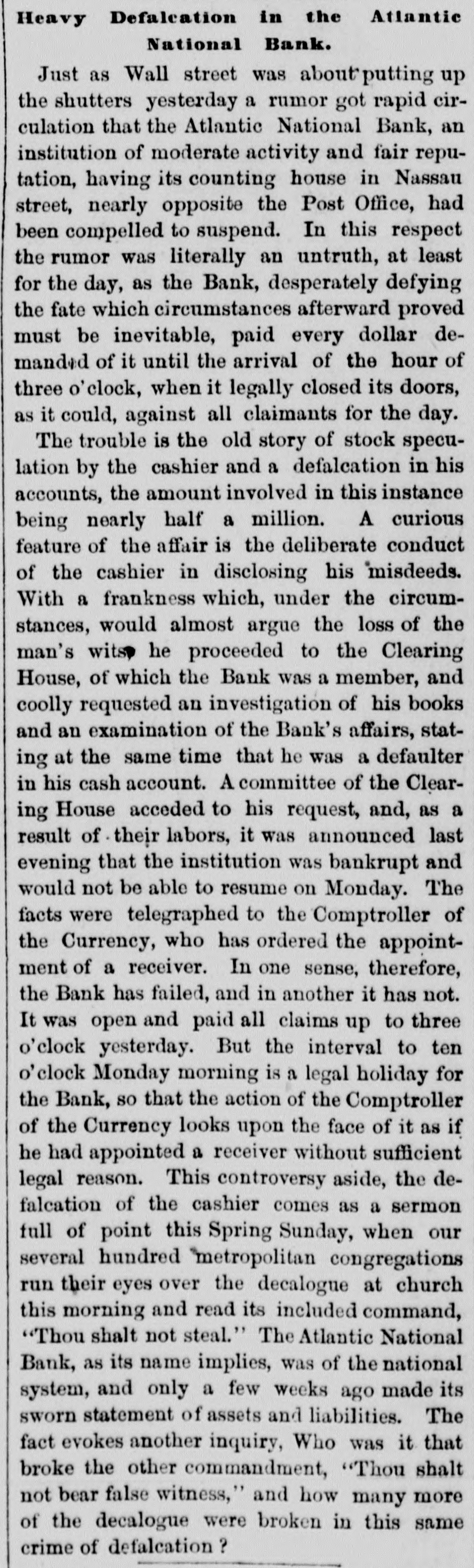
Heavy Defalcation in the Atlantic National Bank. Just as Wall street was about putting up the shutters yesterday a rumor got rapid circulation that the Atlantic National Bank, an institution of moderate activity and fair reputation, having its counting house in Nassau street, nearly opposite the Post Office, had been compelled to suspend. In this respect the rumor was literally an untruth, at least for the day, as the Bank, desperately defying the fate which circumstances afterward proved must be inevitable, paid every dollar demanded of it until the arrival of the hour of three o'clock, when it legally closed its doors, as it could, against all claimants for the day. The trouble is the old story of stock speculation by the cashier and a defalcation in his accounts, the amount involved in this instance being nearly half a million. A curious feature of the affair is the deliberate conduct of the cashier in disclosing his "misdeeds. With a frankness which, under the circumstances, would almost argue the loss of the man's wits, he proceeded to the Clearing House, of which the Bank was a member, and coolly requested an investigation of his books and an examination of the Bank's affairs, stating at the same time that he was a defaulter in his cash account. A committee of the Clearing House acceded to his request, and, as a result of their labors, it was announced last evening that the institution was bankrupt and would not be able to resume on Monday. The facts were telegraphed to the Comptroller of the Currency, who has ordered the appointment of a receiver. In one sense, therefore, the Bank has failed, and in another it has not. It was open and paid all claims up to three o'clock yesterday. But the interval to ten o'clock Monday morning is a legal holiday for the Bank, so that the action of the Comptroller of the Currency looks upon the face of it as if he had appointed a receiver without sufficient legal reason. This controversy aside, the defalcation of the cashier comes as a sermon full of point this Spring Sunday, when our several hundred metropolitan congregations run their eyes over the decalogue at church this morning and read its included command, "Thou shalt not steal." The Atlantic National Bank, as its name implies, was of the national system, and only a few weeks ago made its sworn statement of assets and liabilities. The fact evokes another inquiry, Who was it that broke the other commandment, "Thou shalt not bear false witness," and how many more of the decalogue were broken in this same crime of defalcation?


Article from Memphis Daily Appeal, April 27, 1873

Click image to open full size in new tab

Article Text

NEW YORK. Trouble Between the Ship Owners and Sailors' Boarding-House Keepers in Gotham. Scalping-Knives and Other Playthings for the Modoes and Other Tribes of Indians. The Eight-Hour Project Abandoned Rail- for the Present-Erie and Other road Intelligence. A Twenty-Thousand-Dollar Insurance Suit-Heavy Defalcation. YORK, Appil 26.-The ship NEW and ship-masters' association owners in view of the arrestslast of sailor- night, propose, far organized bands how interfere to see may These the commerce the port. their runners late. They have before the insist that keepers boarding-house-keepers bold from with of shipping and prevented commissioner, have been men by law, and even shall be have the hours after the men with= on board, and that the as twenty-four required advance-money put often paid within been seamen's signature to seek to prevent out They also the men down note. from the that they may break a shipping for that purpose have law, and the neighborhood of mittee in frightening the off com- com- seaoffice, into the missioner's and if a seaman does get there men, he is frequently followed violence and manner or office openly threatened with on terms if he ships with dietate. A number board, of have been deother eargoes than on their vessels, crews. their for days, awaiting the tained purchasing committee of board conThe Indian commissioners have three of for fifteen hundred and hundred tracted butcher-knives, and one dozen twenty dozen skinning-knives, the among and other articles to be furnished Indians. Street gossip intimates that Wes- if Wall and Atlantic and Great the cannot be term or running the a pro rata basis ments It is also said established. Erie railroads working on consolidated, that arrange- will Gould, have be Bischoffscheim and Goldsmidt campaign, the regular Erie stock on opened having gone short of long. The Gould the latter, who are sales to is to bestill further enlivened, by a campaign to the same authority, according be waged by Bischoffscheim, President Erie's war to London banker, on Watson. delegates, from various met Twenty-sev in the United States, and after trades-unions last evening, atin secret resolved to postpone rule discussion to enforce the until 1874. the tempt To-day session resumed legislative the investigation eight-hour committee any in jail on of grievances of Stephen English, now of libel case of bail, on a charge of in by Mr. Winston, Life insurance that the was taken showing and Testimony preferred the default Mutual Winston president company. the made against fact. had no counsel for Mr. testified that the Mr. bail, English is required allegations his dollars, Robert company Sewell, which foundation twenty Judge Winston, thousand in was fixed by or suggestion from him comto without fornish, Mutual Barbour any connected with the the one When English heard of fled pro- to pany. before Judge Barbour he and ceedings City, where he was followed, to find bail Jersey there ordered him dollars. the court sum of ten thousand York, the to be arrested in New Preferring here, and In in returned accordingly of bail. English in jail in default was the McCullough Tom lodged investigation that regard to witness testified in 1870, showed him a report to have the to the legislature, with he to Fields presented company, which was damaging but been had an interview subsequently arranged by which was favorable report Wm. M. Tweed, and a more assembly, but no was paid to secure the was cashier of the conmoney Fields, F.L. made Taintor, to the have change. Atlantic national bank, defaulter reported in to four hundred be thousand fessed bimself dollars, the bank is said to the temperorarily suspended. Investigation is being made the by acauthorities into of W. Whiting, New York the of the widow In against the Union and Fisk, credit to of c Washington unts the case Henry postoffice. Pecific of cashier James rail- be W. Butler, who asked road jr., company N. mobilier claims stock, others, twenty shares of counowner to-day, in Judge permitted to also sel, to be the gatchford of In benefits; through intervene without that suit and share not be discontinued notice to suits shall him. Decision reserved.


Article from The New York Herald, April 27, 1873

Click image to open full size in new tab

Article Text

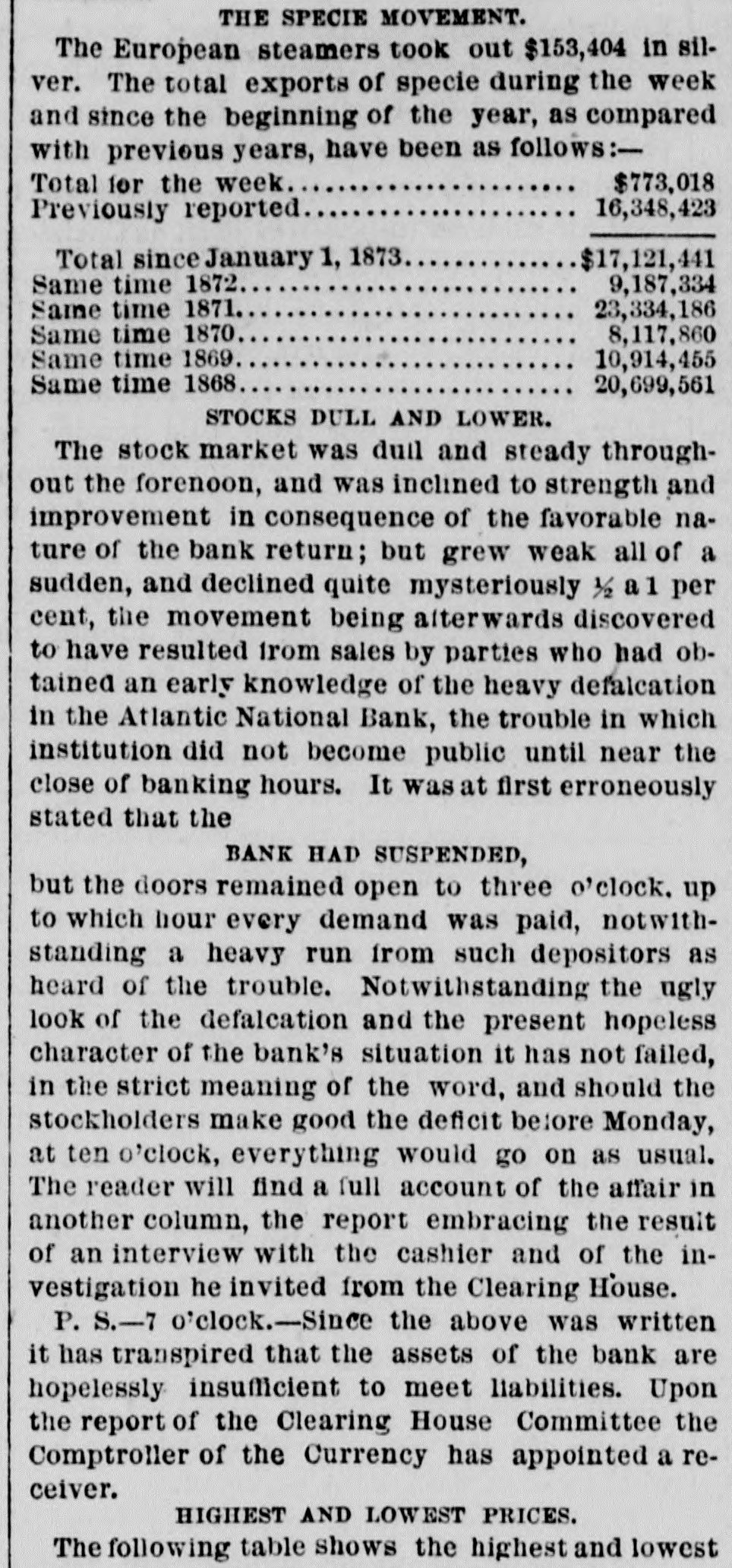
THE SPECIE MOVEMENT. The European steamers took out $153,404 in silver. The total exports of specie during the week and since the beginning of the year, as compared with previous years, have been as follows:Total for the week $773,018 16,348,423 Previously reported Total since January 1, 1873 $17,121,441 Same time 1872 9,187,334 Same time 1871. 23,334,186 Same time 1870 8,117,860 Same time 1869 10,914,455 Same time 1868 20,699,561 STOCKS DULL AND LOWER. The stock market was dull and steady throughout the forenoon, and was inclined to strength and improvement in consequence of the favorable nature of the bank return; but grew weak all of a sudden, and declined quite mysteriously 1/2 al per cent, the movement being alterwards discovered to have resulted from sales by parties who had obtained an early knowledge of the heavy defalcation in the Atlantic National Bank, the trouble in which institution did not become public until near the close of banking hours. It was at first erroneously stated that the BANK HAD SUSPENDED, but the doors remained open to three o'clock. up to which hour every demand was paid, notwithstanding a heavy run from such depositors as heard of the trouble. Notwithstanding the ugly look of the defalcation and the present hopeless character of the bank's situation it has not failed, in the strict meaning of the word, and should the stockholders make good the deficit before Monday, at ten o'clock, everything would go on as usual. The reader will find a full account of the affair in another column, the report embracing the result of an interview with the cashier and of the investigation he invited from the Clearing House. P. S.-7 o'clock.-Since the above was written it has transpired that the assets of the bank are hopelessly insufficient to meet liabilities. Upon the report of the Clearing House Committee the Comptroller of the Currency has appointed a receiver. HIGHEST AND LOWEST PRICES. The following table shows the highest and lowest


Article from New-York Tribune, April 28, 1873

Click image to open full size in new tab

Article Text

A BANK UNDERMINED THE ATLANTIC NATIONAL RUINED BY ITS CASHIER SELF-CONFESSED DEFAULTER FOR NEARLY HALF A MILLION-THE ENTIRE CAPITAL AND MUCH MORE THROWN AWAY IN WALL-ST. SPECULATIONS-THE CASHIER IN JAIL Wall-st. was thoroughly astounded on Satarday by the announcement first whispered but finally declared without reservation that the Atlantic National Bank had been ruined and that the cashier was de faulter in $500,000. Measures were instantly taken to assertain what truth there was in the statement, and it was soon learned that the reality exceeded even the wildest rumors which were in circulation regarding the bank and its operations. The circumstances of the dieclesure About Saturday, F.1 L. Taintor. cashier of the Atlantic National Bank, of No. 17 Nassau-st. entered private office of Frederick D. Tappen, President of Gallarin National Bank in Wall-st. and saluting him informed him that he was cashier of the Atlantic Na tional Bank and a defaulter to the extent of $100,000. Mr. Tappen sprang from his chair and confronting the who had 80 coolly made 80 remarkable a confession. asked him why he had come to him with such a statement. Taintor, thoroughly self possessed, said that it because Mr Tappen was Chairman of the Dearing-house Committee, and he wished to relingaish his trust into the hands of that officer. Beareely able to believe what he had heard, Mr Tappen asked why he had come to him to make such terconfession,and Taintor replied that the bank officials about to make examination into the affairs of bank. and was no longer possible, he wished by anticipating their action, al. though he knew at cost it would be to himself Tappen instructed him to return to the bank and his coming with the other members of the Clearing Committee. Taintor returned to the Atlantic National Bank, and Mr. Tappen immediately telegraphed to the other members of the Committee. Messrs. Cadup, Hayes, Hunter, Leverich and Perkins, to neet him in order that they might proceed to investicondition of the bank. Between and m. they entered the Atlantic National Bank, where matters were going on as faintor doing his work and giving instructions usual, to his abordinates. Sus the President office of Mr. Southworth they by him at the door. peeting that gone wrong he falteringly maked cause of their visit. When it was briefly a plained to him he was very much overcome, and said ex that would have suspected Taintor of such The arime Committee suggested that under the cir To would be wise to close the bank at this Mr. objected, declaring that once proved he would not until comclosing the bank as it stood well with the business consent to pay munity. As he declined to issue orders to suspend payments, the tellers continued to receive and usual. While the other members of the examining the bank's Comlearned securities, Mr. Tappen from Mr Southworth that on the day said to Mr. Taintor that the bank' loans previous had for time, and suggested not haps, that they would better them over together that, and perdewurred right. Much to his surprise, Tainton see and finally refused to comply with his demand permit him the loans. Southworth meeting of the Board of Directors to then called submit to escape this that compel Taintor Taintor sought to Tappen. PACIFIC MAIL VICTIM. While called the still in progress Mr. Tap Taintor the private office and the details of the fraud. Taintor questioned informed that the money had been lost in stock speculations, other manner. He stated that he was of being chosen as the cashier of a bank. and when proud went into Atlantic Bank, finding that it was be bessful andertook strong and reputable by weak, sucand he had not successful, the ventures were the Stock Exchange. Unfortunately period of about five years, until gone on February he immense sum by the decline making $400,000. or $100,000 than the capital probable of the bank. total said the responsibility of his operations that he accomplices, and that President the rest of associates were ignorant Dr his crimes. lessly The Committee, finding the bank was 80 lion insolvent. not as thorough hopedoubt. &8 they would done if there had an examinabetween They discovered. that the default been any $400,000 and $425,000. follows $160,000 worth was property gold, deposited for safe keeping $75. the eashier's represented tickets for $25,000 and $50,000 bank as drawer, and deposited with the banking collateral on loans. Just before the close of positors, and hours, some of of the trouble reached de demanding their them rushed to the bank, and, At courteous. unusually cashier being money, received it, the defaulting p.m., was however, the closed paying and no gained of depositors the bauk had who deposited were particularly however depositors, immunicated Tappen and received the WASHINGTON 1873, April 26 Section Currency. Mr had Tappen of the forma, purpose The United States examina the the bank and must there have been grossest and for otherwise on for a such DEFAULT Throughout never betraying the most unperturbable Tainton preserved the alightest tions mood. emotion. but relaxing occasionally into face. wittiers when be would address some commonplace the unfortunate depositors, who, ignorant words truth. they the had called upon the enalacrity who borea warrant the com furevidence custody, about medium hight, "appears Windham and owner of stock Bank. after Young Taintor, the clerk Bank, began in American years. to to the His untant. made first assistant He married,and So known be far within living extravagant, story his own his him into difficulties. his with installation as been to have able at to or make least of conjecture, the knowledge that it did ground


Article from Evening Star, April 28, 1873

Click image to open full size in new tab

Article Text

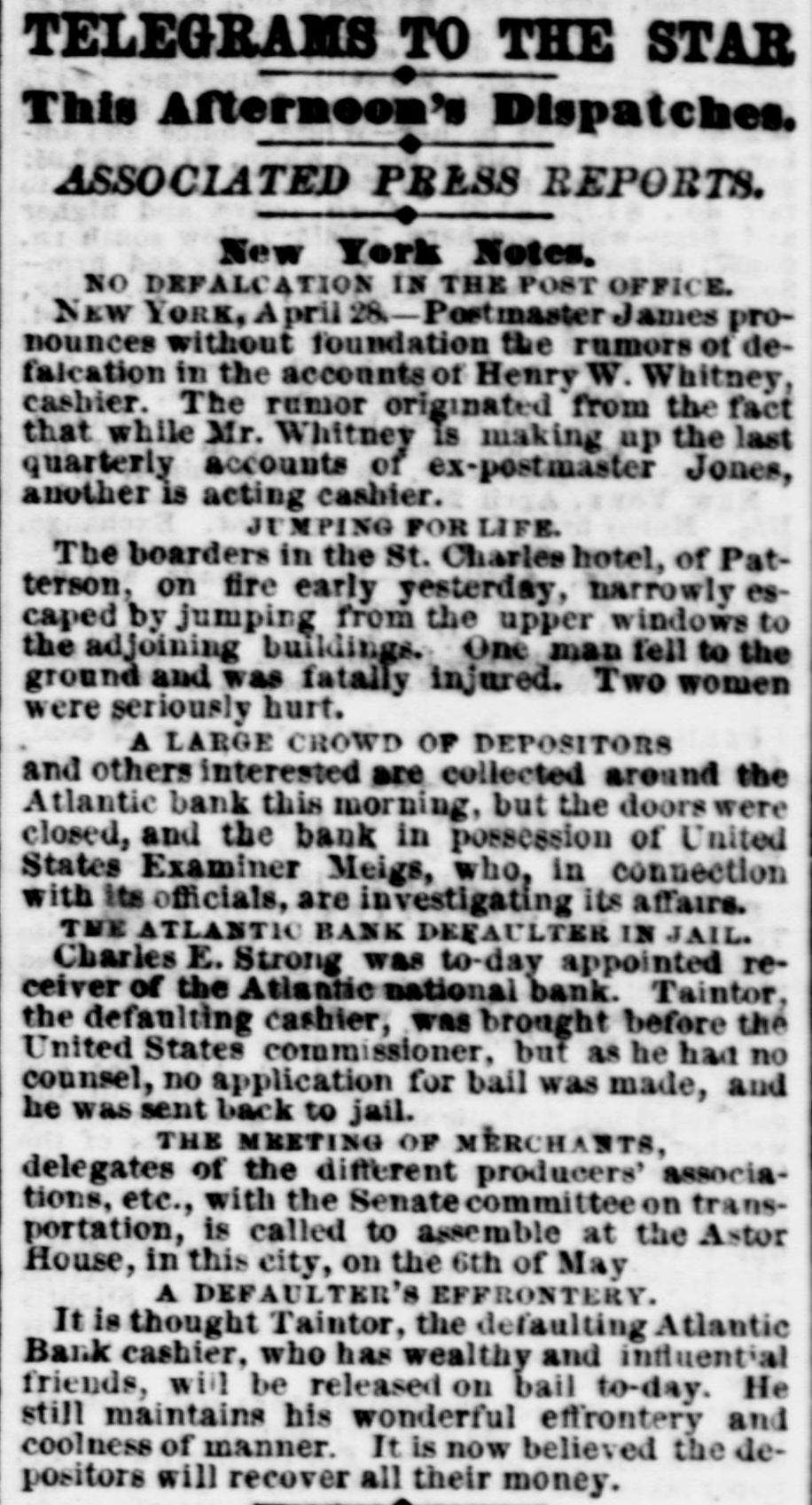
TELEGRAMS TO THE STAR This Afternoon's Dispatches. ASSOCIATED PRESS REPORTS. New York Notes. NO DEFALCATION IN THE POST OFFICE. NEW YORK, A pril - Postmaster James pronounces without foundation the rumors of defalcation in the accounts of Henry W. Whitney, cashier. The rumor originated from the fact that while Mr. Whitney is making up the last quarterly accounts of ex-postmaster Jones, another is acting cashier. JUMPING FOR LIFE. The boarders in the St. Charles hotel, of Patterson, on fire early yesterday, narrowly escaped by jumping from the upper windows to the adjoining buildings. One man fell to the ground and was fatally injured. Two women were seriously hurt. A LARGE CROWD OF DEPOSITORS and others interested are collected around the Atlantic bank this morning, but the doors were closed, and the bank in possession of United States Examiner Meigs, who, in connection with its officials, are investigating its affairs. THE ATLANTIC BANK DEFAULTER IN JAIL. Charles E. Strong was to-day appointed receiver of the Atlantic national bank. Taintor, the defaulting cashier, was brought before the United States commissioner, but as he had no counsel, no application for bail was made, and he was sent back to jail. THE MEETING OF MERCHANTS, delegates of the different producers' associations, etc., with the Senate committee on transportation, is called to assemble at the Astor House, in this city, on the 6th of May A DEFAULTER'S EFFRONTERY. It is thought Taintor, the defaulting Atlantic Bank cashier, who has wealthy and influential friends, will be released on bail to-day. He still maintains his wonderful effrontery and coolness of manner. It is now believed the depositors will recover all their money.


Article from Evening Star, April 28, 1873

Click image to open full size in new tab

Article Text

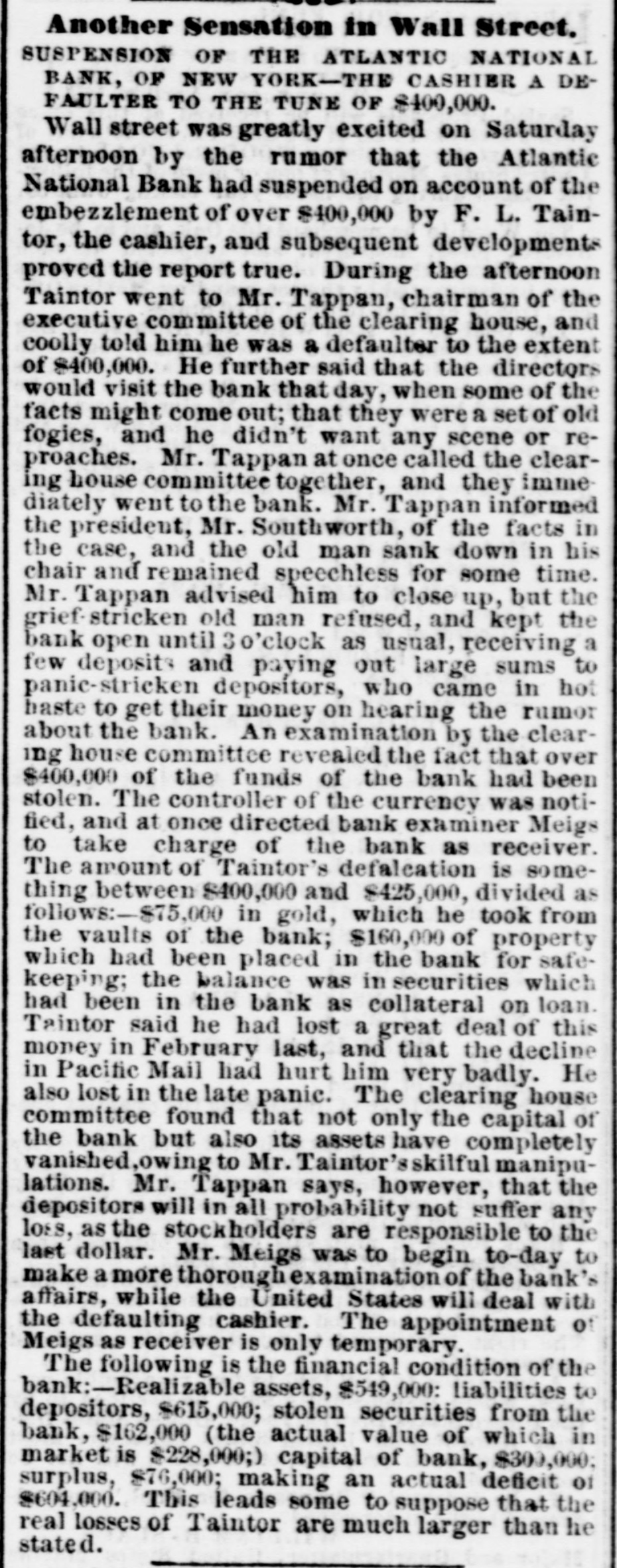
Another Sensation in Wall Street. SUSPENSION OF THE ATLANTIC NATIONAL BANK, OF NEW YORK-THE CASHIER A DEFAULTER TO THE TUNE OF $400,000. Wall street was greatly excited on Saturday afternoon by the rumor that the Atlantic National Bank had suspended on account of the embezzlement of over $400,000 by F. L. Taintor, the cashier, and subsequent developments proved the report true. During the afternoon Taintor went to Mr. Tappan, chairman of the executive committee of the clearing house, and coolly told him he was a defaulter to the extent of $400,000. He further said that the directors would visit the bank that day, when some of the facts might come out; that they were a set of old fogies, and he didn't want any scene or reproaches. Mr. Tappan at once called the clearing house committee together, and they immediately went to the bank. Mr. Tappan informed the president, Mr. Southworth, of the facts in the case, and the old man sank down in his chair and remained speechless for some time. Mr. Tappan advised him to close up, but the grief- stricken old man refused, and kept the bank open until o'clock as usual, receiving a few deposits and paying out large sums to panie-stricken depositors, who came in hot baste to get their money on hearing the rumor about the bank. An examination by the clearing house committee revealed the fact that over $400,000 of the funds of the bank had been stolen. The controller of the currency was notified, and at once directed bank examiner Meigs to take charge of the bank as receiver. The amount of Taintor's defalcation is something between $400,000 and $425,000, divided as follows:-$75,000 in gold, which he took from the vaults of the bank; $160,000 of property which had been placed in the bank for safekeeping; the balance was in securities which had been in the bank as collateral on loan. Taintor said he had lost a great deal of this money in February last, and that the decline in Pacific Mail had hurt him very badly. He also lost in the late panic. The clearing house committee found that not only the capital of the bank but also its assets have completely vanished,owing to Mr. Taintor's skilful manipulations. Mr. Tappan says, however, that the depositors will in all probability not suffer any loss, as the stockholders are responsible to the last dollar. Mr. Meigs was to begin to-day to make a more thorough examination of the bank's affairs, while the United States will deal with the defaulting cashier. The appointment o Meigs as receiver is only temporary. The following is the financial condition of the bank:-Realizable assets, $549,000: liabilities to depositors, $615,000; stolen securities from the bank, $162,000 (the actual value of which in market is $228,000;) capital of bank, $300,000; surplus, $76,000; making an actual deficit of $604,000. This leads some to suppose that the real losses of Taintor are much larger than he stated.


Article from Alexandria Gazette, April 28, 1873

Click image to open full size in new tab

Article Text

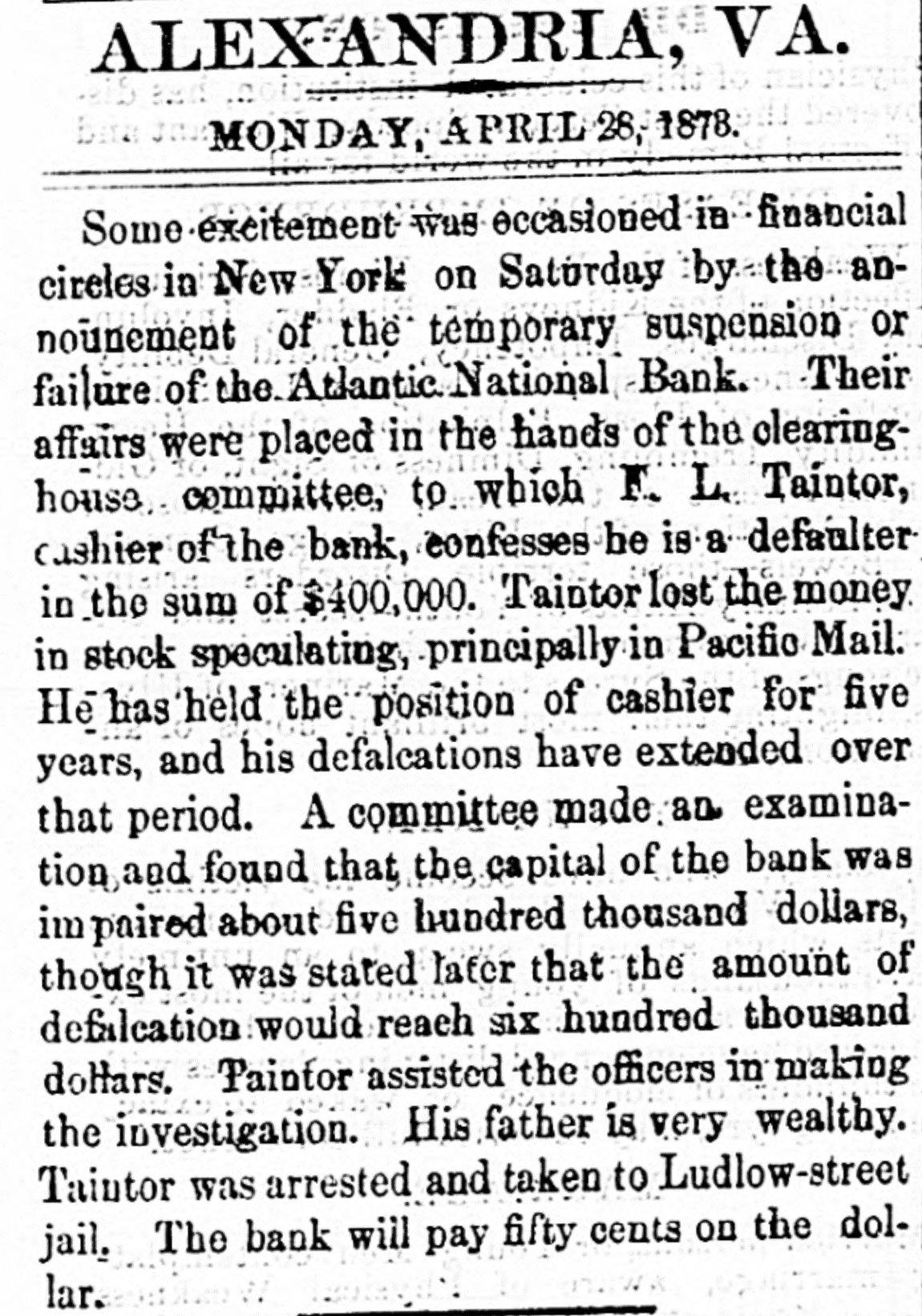
ALEXANDRIA, VA. MONDAY, A PRIL 28, 1878. Some excitement was occasioned in financial circles in New York on Saturday by - the announement of the temporary suspension or failure of: the Atlantic. National Bank. Their affairs were placed in the hands of the clearinghouse committee, to which F. L. Taintor, cashier oft the bank, confesses he is a defaulter in the sum of $400,000. Taintor lost the money in stock speculating, principally in Pacific Mail: He has held the position of cashier for five years, and his defalcations have extended over that period. A committee made an examination and found that the capital of the bank was im paired about five hundred thousand dollars, though it was stated later that the amount of defalcation would reach six hundred thousand dollars. Tainfor assisted the officers in making the investigation. His father is very wealthy. Taintor was arrested and taken to Ludlow-street jail, The bank will pay fifty cents on the dollar.


Article from The New York Herald, April 29, 1873

Click image to open full size in new tab

Article Text

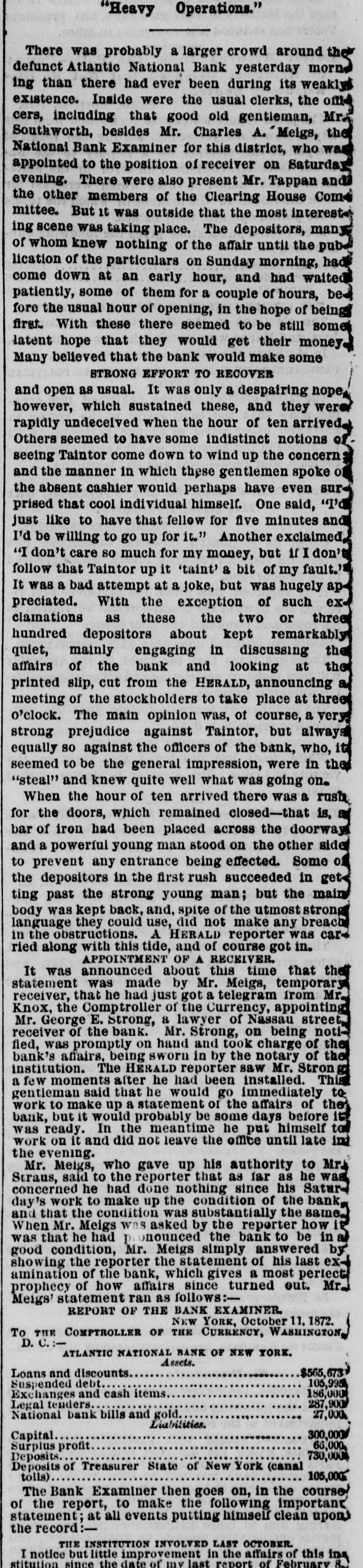
"Heavy Operations." There was probably a larger crowd around the defunct Atlantic National Bank yesterday morn. ing than there had ever been during its weakly existence. Inside were the usual clerks, the offid cers, including that good old gentleman, Mr. Southworth, besides Mr. Charles A. Meigs, the National Bank Examiner for this district, who was appointed to the position of receiver on Saturday evening. There were also present Mr. Tappan and the other members of the Clearing House Com4 mittee. But it was outside that the most interest ing scene was taking place. The depositors, many of whom knew nothing of the affair until the pub lication of the particulars on Sunday morning, had come down at an early hour, and had waited patiently, some of them for a couple of hours, be. fore the usual hour of opening, in the hope of being first. With these there seemed to be still some latent hope that they would get their money. Many believed that the bank would make some STRONG EFFORT TO RECOVER and open as usual. It was only a despairing nope, however, which sustained these, and they were rapidly undeceived when the hour of ten arrived. Others seemed to have some indistinct notions of seeing Taintor come down to wind up the concern and the manner in which these gentlemen spoke o the absent cashier would perhaps have even sur prised that cool individual himself. One said, "I'd just like to have that fellow for five minutes and I'd be willing to go up for it." Another exclaimed "I don't care so much for my money, but if Idon't follow that Taintor up it 'taint' a bit of my fault.' It was a bad attempt at a joke, but was hugely ap preciated. With the exception of such ex clamations as these the two or three hundred depositors about kept remarkably quiet, mainly engaging in discussing the affairs of the bank and looking at the printed slip, cut from the HERALD, announcing a meeting of the stockholders to take place at three o'clock. The main opinion was, ot course, a very strong prejudice against Taintor, but always equally so against the officers of the bank, who, it seemed to be the general impression, were in the "steal" and knew quite well what was going on. When the hour of ten arrived there was a rush for the doors, which remained closed-that is, at bar of iron had been placed across the doorway and a powerful young man stood on the other side to prevent any entrance being effected. Some of the depositors in the first rush succeeded in get ting past the strong young man; but the main body was kept back, and, spite of the utmost strong language they could use, did not make any breach in the obstructions. A HERALD reporter was carried along with this tide, and of course got in. APPOINTMENT OF A RECEIVER. It was announced about this time that the statement was made by Mr. Meigs, temporary receiver, that he had just got a telegram from Mr. Knox, the Comptroller of the Currency, appointing Mr. George E. Strong, a lawyer of Nassau street, receiver of the bank. Mr. Strong, on being notified, was promptly on hand and took charge of the bank's affairs, being sworn in by the notary of the institution. The HERALD reporter saw Mr. Stron a few moments after he had been installed. This gentleman said that he would go immediately to work to make up a statement of the affairs of the bank, but it would probably be some days before it was ready. In the meantime he put himself to work on it and did not leave the office until late ind the evening. Mr. Meigs, who gave up his authority to Mr Straus, said to the reporter that as far as he was concerned he had done nothing since his Saturday's work to make up the condition of the bank, and that the condition was substantially the same. When Mr. Meigs was asked by the reporter how was that he had p onounced the bank to be in good condition, Mr. Meigs simply answered by showing the reporter the statement of his last examination of the bank, which gives a most perfect prophecy of how affairs since turned out. Mr. Meigs' statement ran as follows:REPORT OF THE BANK EXAMINER. NEW YORK, October 11, 1872. To THE COMPTROLLER OF THE CURRENCY, WASHINGTON, D. C. :ATLANTIC NATIONAL BANK OF NEW YORK. Assets. $565,673 Loans and discounts 105,995 Suspended debt 186,000 Exchanges and cash items 287,900 Legal tenders. National bank bills and gold. 27,000 Liabilities. 300,000 Capital 66,000 Surplus profit Deposits. 730,000 Deposits of Treasurer State of New York (canal 105,000 tolls) The Bank Examiner then goes on, in the course of the report, to make the following important statement; at all events putting himself clean upon the record:THE INSTITUTION INVOLVED LAST OCTOBER. I notice butlittle improvement in the affairs of this ins stitution since the date of my last report of February 8.


Article from The New York Herald, April 29, 1873

Click image to open full size in new tab

Article Text

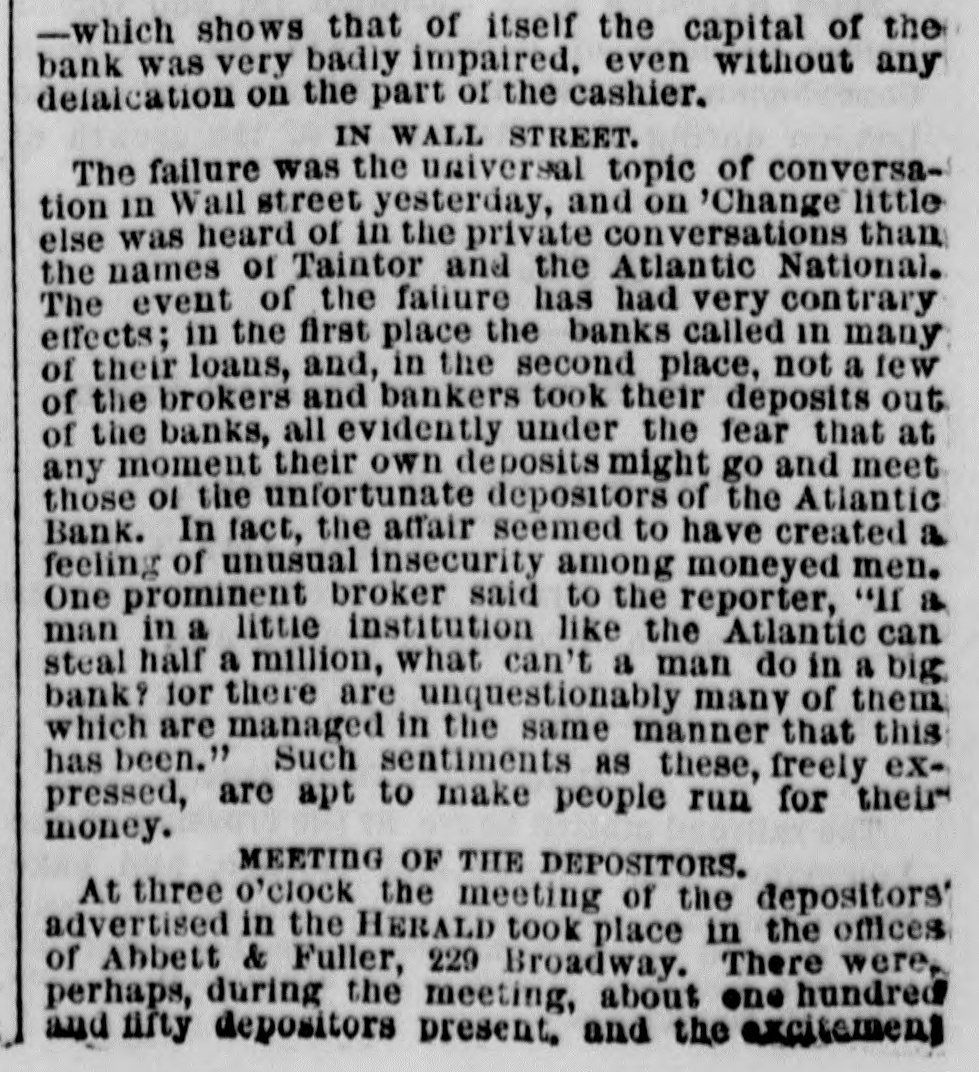
-which shows that of itself the capital of the bank was very badly impaired, even without any delalcation on the part of the cashier. IN WALL STREET. The failure was the universal topic of conversation in Wall street yesterday, and on 'Change little else was heard of in the private conversations than the names of Taintor and the Atlantic National. The event of the failure has had very contrary effects; in the first place the banks called in many of their loans, and, in the second place, not a few of the brokers and bankers took their deposits out of the banks, all evidently under the fear that at any moment their own deposits might go and meet those ol the unfortunate depositors of the Atlantic Bank. In fact, the affair seemed to have created a feeling of unusual insecurity among moneyed men. One prominent broker said to the reporter, "If a man in a little institution like the Atlantic can steal half a million, what can't a man do in a big bank? for there are unquestionably many of them which are managed in the same manner that this has been." Such sentiments as these, freely expressed, are apt to make people run for their money. MEETING OF THE DEPOSITORS. At three o'clock the meeting of the depositors' advertised in the HERALD took place in the offices. of Abbett & Fuller, 229 Broadway. There were, perhaps, during the meeting, about one hundred and fifty depositors present. and the excitement


Article from The Wheeling Daily Intelligencer, April 29, 1873

Click image to open full size in new tab

Article Text

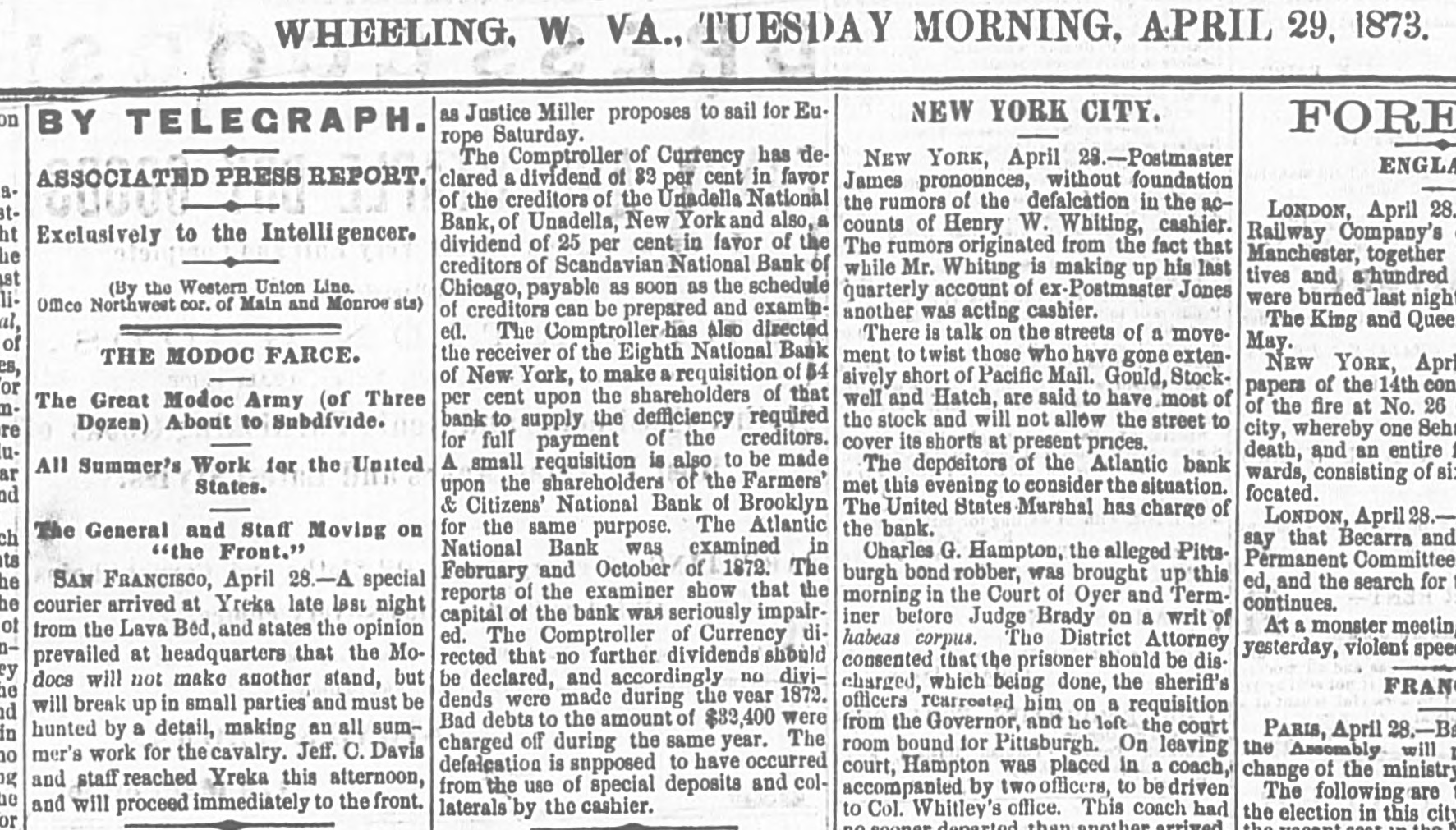
WHEELING. W. VA., TUESDAY MORNING, APRIL 29. 1873. NEW YORK CITY. as Justice Miller proposes to sail for Euon FORE BY TELEGRAPH rope Saturday. The Comptroller of Currency has deNEW YORK, April 23.-Postmaster ENGLA clared a dividend of 82 per cent in favor ASSOCIATED PRESS REPORT. James pronounces, without foundation a. of the creditors of the Unadella National the rumors of the defalcation in the acstLONDON, April 28. Bank, of Unadella, New York and also, a counts of Henry W. Whiting, cashier. ht Railway Company's Exclusively to the Intelli gencer. dividend of 25 per cent in favor of the The rumors originated from the fact that he Manchester, together creditors of Scandavian National Bank of while Mr. Whiting is making up his last tives and a hundred st (By the Western Union Line. Chicago, payable as soon as the schedule quarterly account of ex-Postmaster Jones liwere burned last night Office Northwest cor. of Main and Monroe sts) of creditors can be prepared and examinanother was acting cashier. al, The King and Quee There is talk on the streets of a moveed. The Comptroller has also directed of May. the receiver of the Eighth National Bank THE MODOC FARCE. ment to twist those who have gone extenNEW YORK, April es, of New York, to make a requisition of 54 sively short of Pacific Mail. Gould, Stockor papers of the 14th con well and Hatch, are said to have most of per cent upon the shareholders of that The Great Modoc Army (of Three of the fire at No. 26 nthe stock and will not allow the street to bank to supply the defficiency required Dozen) About to Subdívide. re city, whereby one Seh for full payment of the creditors. cover its shorts at present prices. udeath, and an entire 1 A small requisition is also to be made All Summer's Work for the United The depositors of the Atlantic bank ar wards, consisting of si upon the shareholders of the Farmers' States. met this evening to consider the situation. focated. nd & Citizens' National Bank of Brooklyn The United States Marshal has charge of LONDON, April 28.the bank. for the same purpose. The Atlantic The General and Staff Moving on ch say that Becarra and National Bank was examined in the Front." Charles G. Hampton, the alleged Pitts. its Permanent Committee February and October of 1872. The burgh bond robber, was brought up this he SAN FRANCISCO, April 28.-A special ed, and the search for 1 reports of the examiner show that the morning in the Court of Oyer and Termcontinues. he courier arrived at Yreka late last night capital of the bank was seriously impairiner before Judge Brady on a writ of of At a monster meetin from the Lava Bed, and states the opinion ed. The Comptroller of Currency dihabeas corpus. The District Attorney a yesterday, violent spee rected that no further dividends should prevailed at headquarters that the Moconsented that the prisoner should be disey docs will not make another stand, but be declared, and accordingly no divicharged, which being done, the sheriff's FRAN he dends were made during the year 1872. will break up in small parties and must be officers rearroated him on a requisition d Bad debts to the amount of $32,400 were from the Governor, and Lic loft the court hunted by a detail, making an all sumPARIS, April 28.-B in charged off during the same year. The room bound for Pittsburgh. On leaving the Assembly will I 10 mer's work for the cavalry. Jeff. C. Davis defalcation is supposed to have occurred court, Hampton was placed in a coach, change of the ministry and staff reached Yreka this atternoon, from the use of special deposits and colaccompanied by two officers, to be driven The following are 1 be and will proceed immediately to the front. laterals by the cashier. to Col. Whitley's office. This coach had the election in this city or the the IS no BOOROE departed than another arrived


Article from The Daily Dispatch, April 30, 1873

Click image to open full size in new tab

Article Text

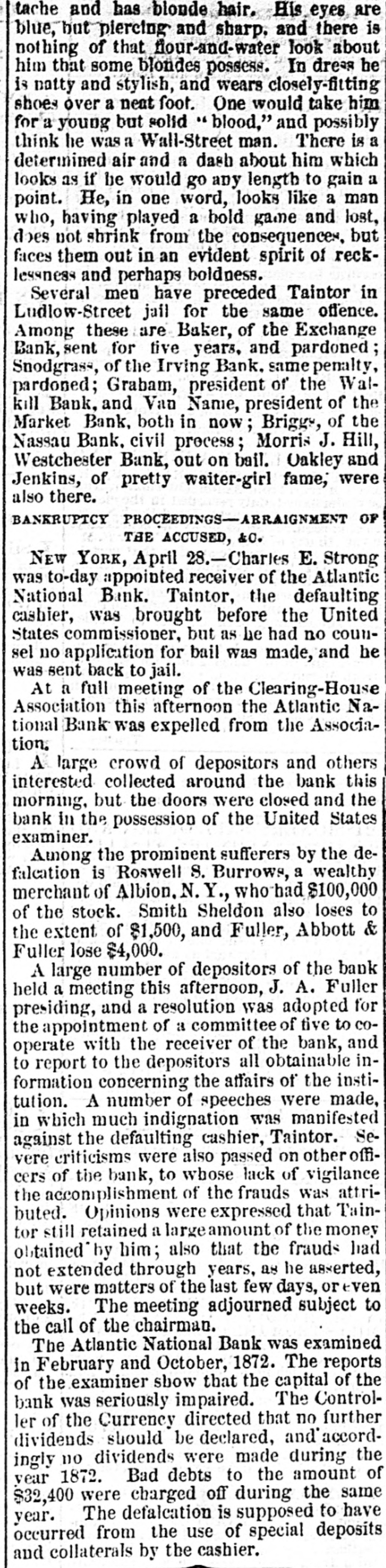
tache and has blonde hair. His eyes are blue, but piercing and sharp. and there is nothing of that flour-and-water look about him that some blondes possess. In dreas he is natty and stylish, and wears closely-fitting shoes over a neat foot. One would take him for a young but solid 06 blood," and possibly think he was a Wall-Street man. There is a determined air and a dash about him which looks as if be would go any length to gain a point. He, in one word, looks like a man who, having played a bold game and lost, does not shrink from the consequences, but faces them out in an evident spirit of recklessness and perhaps boldness. Several men have preceded Taintor in Ludlow-Street jail for the same offence. Among these are Baker, of the Exchange Bank, sent for tive years. and pardoned Snodgrass, of the Irving Bank. me penalty, pardoned; Grabam, president of the Walkill Bank, and Van Name, president of the Market Bank, both in now; Briggy, of the Nassau Bank. civil process; Morris J. Hill, Westchester Bank, out on bail. Oakley and Jenkins, of pretty waiter-girl fame; were also there. BANKRUPTCY PROCEEDINGS-ARRAIGNMENT OF THE ACCUSED, &0. NEW YORK, April 28.-Charles E. Strong was to-day appointed receiver of the Atlantic National Bank. Taintor, the defaulting cashier, was brought before the United States commissioner, but as he had no counsel no application for bail was made, and he was sent back to jail. At a full meeting of the Clearing-House Association this afternoon the Atlantic National Bank was expelled from the Association. A large crowd of depositors and others interested collected around the bank this morning, but the doors were closed and the bank in the possession of the United States examiner. Among the prominent sufferers by the defalcation is Roswell S. Burrows, a wealthy merchant of Albion. N. Y., who had $100,000 of the stock. Smith Sheldon also loses to the extent of $1,500, and Fuller, Abbott & Fuller lose $4,000. A large number of depositors of the bank held a meeting this afternoon, J. A. Fuller presiding, and a resolution was adopted for the appointment of a committee of five to cooperate with the receiver of the bank, and to report to the depositors all obtainable information concerning the affairs of the institution. A number of speeches were made, in which much indignation was manifested against the defaulting cashier, Taintor. Severe criticisms were also passed on other officers of the bank, to whose lack of vigilance the accomplishment of the frauds was attributed. Opinions were expressed that Taintor still retained a largeamount of the money obtained by him; also that the frauds had not extended through years, as he asserted, but were matters of the last few days, or even weeks. The meeting adjourned subject to the call of the chairman. The Atlantic National Bank was examined in February and October, 1872. The reports of the examiner show that the capital of the bank was seriously impaired. The Controller of the Currency directed that no further dividends should be declared, and accordingly no dividends were made during the year 1872. Bad debts to the amount of $32,400 were charged off during the same year. The defalcation is supposed to have occurred from the use of special deposits and collaterals by the cashier.


Article from The New York Herald, April 30, 1873

Click image to open full size in new tab

Article Text

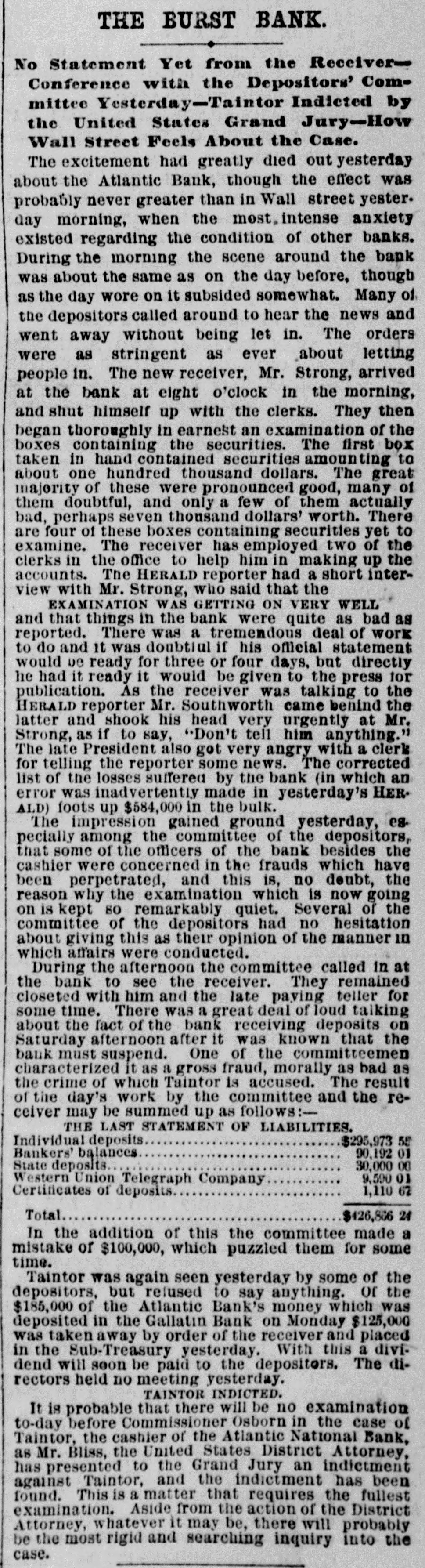
THE BURST BANK. No Statement Yet from the ReceiverConference with the Depositors' Committee Yesterday-Taintor Indicted by the United States Grand Jury-How Wall Street Feels About the Case. The excitement had greatly died out yesterday about the Atlantic Bank, though the effect was probably never greater than in Wall street yesterday morning, when the most, intense anxiety existed regarding the condition of other banks. During the morning the scene around the bank was about the same as on the day before, though as the day wore on it subsided somewhat. Many of the depositors called around to hear the news and went away without being let in. The orders were as stringent as ever about letting people in. The new receiver, Mr. Strong, arrived at the bank at eight o'clock in the morning, and shut himself up with the clerks. They then began thoroughly in earnest an examination of the boxes containing the securities. The first box taken in hand contained securities amounting to about one hundred thousand dollars. The great majority of these were pronounced good, many of them doubtful, and only a few of them actually bad, perhaps seven thousand dollars' worth. There are four of these boxes containing securities yet to examine. The receiver has employed two of the clerks in the office to help him in making up the accounts. The HERALD reporter had a short interview with Mr. Strong, who said that the EXAMINATION WAS GETTING ON VERY WELL and that things in the bank were quite as bad as reported. There was a tremendous deal of work to do and it was doubtiui if his official statement would DO ready for three or four days. but directly he had it ready it would be given to the press for publication. As the receiver was talking to the HERALD reporter Mr. Southworth came benind the latter and shook his head very urgently at Mr. Strong, as if to say, "Don't tell him anything." The late President also got very angry with a clerk for telling the reporter some news. The corrected list of the losses suffered by the bank (in which an error was inadvertently made in yesterday's HER. ALD) foots up $584,000 in the bulk. The impression gained ground yesterday, eg. pecially among the committee of the depositors, that some of the officers of the bank besides the cashier were concerned in the frauds which have been perpetrated, and this is, no deubt, the reason why the examination which is now going on is kept so remarkably quiet. Several of the committee of the depositors had no hesitation about giving this as their opinion of the manner in which affairs were conducted. During the afternoon the committee called in at the bank to see the receiver. They remained closeted with him and the late paying teller for some time. There was a great deal of loud talking about the fact of the bank receiving deposits on Saturday afternoon after it was known that the bank must suspend. One of the committeemen characterized it as a gross fraud, morally as bad as the crime of which Taintor is accused. The result of the day's work by the committee and the receiver may be summed up as follows:THE LAST STATEMENT OF LIABILITIES. Individual deposits $295,973 55 Bankers' balances 90,192 01 State deposits 30,000 00 9,590 01 Western Union Telegraph Company 1,110 62 Certificates of deposits Total $426,806 24 In the addition of this the committee made a mistake of $100,000, which puzzled them for some time. Taintor was again seen yesterday by some of the depositors, but refused to say anything. Of the $185,000 of the Atlantic Bank's money which was deposited in the Gallatin Bank on Monday $125,000 was taken away by order of the receiver and placed in the Sub-Treasury yesterday. With this a dividend will soon be paid to the depositors. The directors held no meeting yesterday. TAINTOR INDICTED. It is probable that there will be no examination to-day before Commissioner Osborn in the case of Taintor, the cashier of the Atlantic National Bank, as Mr. Bliss, the United States District Attorney, has presented to the Grand Jury an indictment against Taintor, and the indictment has been found. This is a matter that requires the fullest examination. Aside from the action of the District Attorney, whatever it may be, there will probably be the most rigid and searching inquiry into the case.


Article from The Kenosha Telegraph, May 1, 1873

Click image to open full size in new tab

Article Text

pected at San Francisco on the morning 897 bus of the 29th. William M Reynolds, for forty years merchant in Poughkeepsie, N. Y., died at that place on the 27th. poitota eds 1a The St. Crispin of New York threaten to strike. traft Delegates representing the trades' unions of the United States met at New York and resolved not to attempt any e foreement of the eight hour system till 1874. Six thieves who for several years past have been committing depredations upon the freight-yards at Quincy, III., wele ar balley rested on Friday. The town of Mariana, Ark, was nearly destroyed by fire Thursday. James A. Ward, pork-packer of Kansas City. and Life and General Insurance Bank, of Memphis, have suspended. Hon. Levi Walker, of Flint, Migh, died at Lansing Saturday morning. Taintor, cashier of the Atlantic Nation al Bank of New York, is a defaulter to the amount of $400 000. Frost at Nushville and in middle Ten. nesce Friday night damaged corn, fruit, and vegetables. Odd Fellows of Little Rock, Ark., cele brated the fifty sixth anniversary by procession and banquet. Carl Sehurz has gone to Europe. The New York state canals will be opened May 16th. Holland hassent fourteen steamers to Sumatra to cooperate with the Dutch troops. London Republicans will persecute the Carlist Committee of that city for aiding Den Carlos in violation of international law A Madrid dispatch says the Carlists have been defeated several times recently, losing one hundred men wounded in one and engagement. Changes in the Spanish Ministry are anticipated soon. Captain-General Vallarde has ordered the inhabitants of county districts in vaded by Carlists to abandon their farms and homes and retire to the cities. M. Barodet, Radical, has b en elected to the French Assembly from the city of Puris. The Emperor of Germany arrived at St. Petersburg on he 27th, and was received with extraordinary honors. The explorer of the Lindon Daily Telegraph has, it 18 announced, made many many important discoveries in Assyria. l'ano TUESDAY. A riot occurred at Keene, N. H 03 Saturday night, and after it was suppressed the chief of police was badly beaten. Arthur M. Arnold, son of Isaac N. Arnold of Chicago, was drowned at Dixon, III.. on Saturday. The walls of a burning building at Iowa City, Iowa, fell burying five persons in the ruins. Dorman B. Eaton will accept the pcsition of member of the Advisory Civil Service Board. The stage between Hamilton and Piosche, Nevada, was robbed Sunday night by men disguised as Indians. A severe storm of wind and hail passed over Little Rock Monday. The steam-boiler in & planing mill at on Monday, dethe building, enmolishing Indianapolis exploded killing ladies ti.e gineer, and fatally injuring two A Mrs. Metcalf and two children were poisoned near Decatur, Ill., by drinking milk in which strychnine had been placed to kill mice Benjamin T. Murphy what never at tended but two years, was the successful competitor in a class of fifteen for the West Point cadetship from the first 7001107 Illinois Congressional District. There are a thousand Chinese engaged in various occupations in S. Louis Federalists held a monster meeting in Madrid sunday. sit tedt add The Lapcashire Railway Company's works in Manchester, with tifty locomo= tives and one hundred and fifty coaches,


Article from The Wheeling Daily Intelligencer, May 2, 1873

Click image to open full size in new tab

Article Text

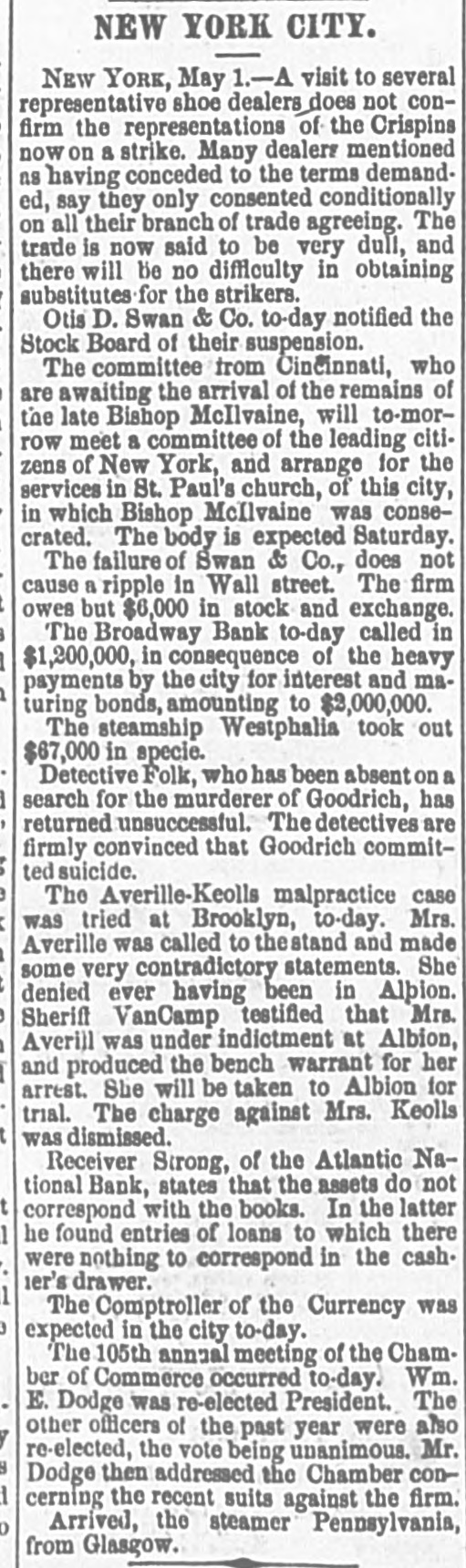
NEW YORK CITY. NEW YORK, May 1.-A visit to several representative shoe dealers does not confirm the representations of the Crispins now on a strike. Many dealers mentioned as having conceded to the terms demanded, say they only consented conditionally on all their branch of trade agreeing. The trade is now said to be very dull, and there will be no difficulty in obtaining substitutes for the strikers. Otis D. Swan & Co. to-day notified the Stock Board of their suspension. The committee from Cincinnati, who are awaiting the arrival of the remains of the late Bishop McIlvaine, will to-morrow meet a committee of the leading citizens of New York, and arrange for the services in St. Paul's church, of this city, in which Bishop McIlvaine was consecrated. The body is expected Saturday. The failure of Swan & Co., does not cause a ripple in Wall street. The firm owes but $6,000 in stock and exchange. The Broadway Bank to-day called in $1,200,000, in consequence of the heavy payments by the city for interest and maturing bonds, amounting to $2,000,000. The steamship Westphalia took out $67,000 in specie. Detective Folk, who has been absent on a search for the murderer of Goodrich, has returned unsuccessful. The detectives are firmly convinced that Goodrich committed suicide. The Averille-Keolls malpractice case was tried at Brooklyn, to-day. Mrs. Averille was called to the stand and made some very contradictory statements. She denied ever having been in Alpion. Sheriff VanCamp testified that Mrs. Averill was under indictment at Albion, and produced the bench warrant for her arrest. She will be taken to Albion for trial. The charge against Mrs. Keolls was dismissed. Receiver Strong, of the Atlantic National Bank, states that the assets do not correspond with the books. In the latter he found entries of loans to which there were nothing to correspond in the cash. er's drawer. The Comptroller of the Currency was expected in the city to-day. The 105th annual meeting of the Cham. ber of Commerce occurred to-day. Wm. E. Dodge was re-elected President. The other officers of the past year were also re-elected, the vote being unanimous. Mr. Dodge then addressed the Chamber concerning the recent suits against the firm. Arrived, the steamer Pennsylvania, from Glasgow.


Article from The Fremont Weekly Journal, May 2, 1873

Click image to open full size in new tab

Article Text

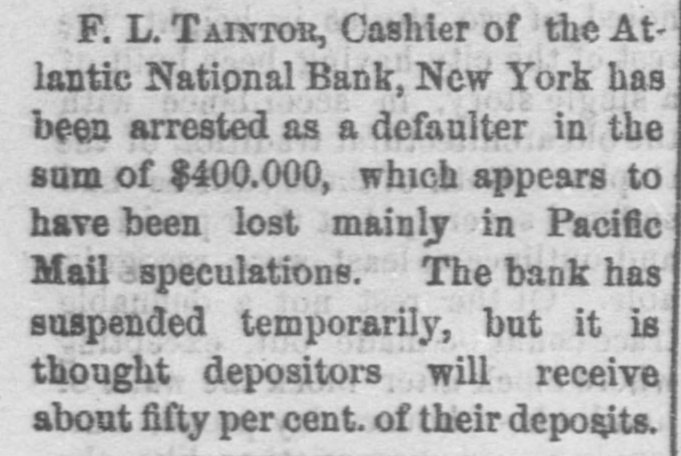
F. L. TAINTOR, Cashier of the Atlantic National Bank, New York has been arrested as a defaulter in the sum of $400.000, which appears to have been lost mainly in Pacific Mail speculations. The bank has suspended temporarily, but it is thought depositors will receive about fifty per cent. of their deposits.


Article from The Daily Dispatch, May 3, 1873

Click image to open full size in new tab

Article Text

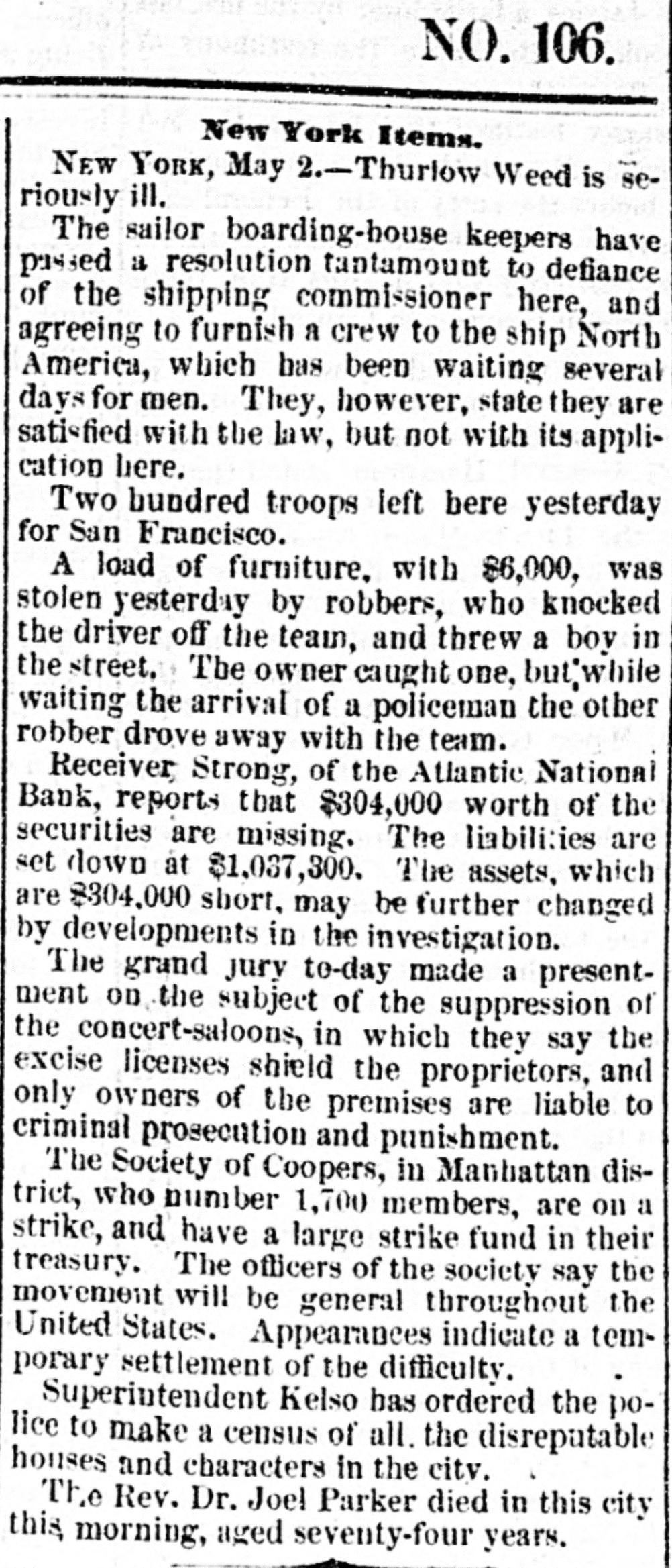
NO. 106. New York Items. NEW YORK, May 2.-Thurlow Weed is seriously ill. The sailor boarding-house keepers have passed a resolution tantamount to defiance of the shipping commissioner here, and agreeing to furnish a crew to the ship North America, which has been waiting several days for men. They, however, state they are satisfied with the law, but not with its application here. Two bundred troops left here yesterday for San Francisco. A load of furniture, with $6,000, was stolen yesterday by robbers, who knocked the driver off the team, and threw a boy in the street. The owner caught one, but'while waiting the arrival of a policeman the other robber drove away with the team. Receiver Strong, of the Atlantic National Bank, reports that $304,000 worth of the securities are missing. The liabilities are set down at $1,037,300. The assets, which are $304,000 short, may be further changed by developments in the investigation. The grand jury to-day made a presentment on the subject of the suppression of the concert-saloons, in which they say the excise licenses shield the proprietors, and only owners of the premises are liable to criminal prosecution and punishment. The Society of Coopers, in Manhattan district, who number 1,700 members, are on a strike, and have a large strike fund in their treasury. The officers of the society say the movement will be general throughout the United States. Appearances indicate a temporary settlement of the difficulty. Superintendent Kelso has ordered the police to make a census of all. the disreputable houses and characters in the citv. The Rev. Dr. Joel Parker died in this city this morning, aged seventy-four years.


Article from Nashville Union and American, May 3, 1873

Click image to open full size in new tab

Article Text

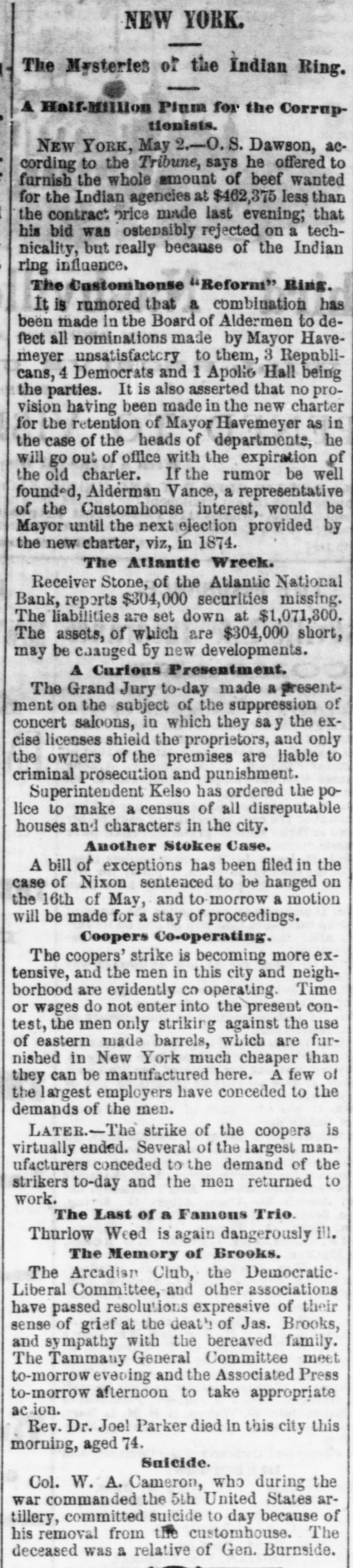
NEW YORK. The Mysteries of the Indian Ring. A Half-Million Plum for the Corruptionists. NEW YORK, May 2.-0.S. Dawson, according to the Tribune, says he offered to furnish the whole amount of beef wanted for the Indian agencies at $462,375 less than the contract price made last evening; that his bid was ostensibly rejected on a technicality, but really because of the Indian ring influence. The Custombouse "Reform" Ring. It is rumored that a combination has been made in the Board of Aldermen to defect all nominations made by Mayor Havemeyer unsatisfactory to them, 3 Republicans, 4 Democrats and 1 Apolio Hall being the parties. It is also asserted that no provision having been made in the new charter for the retention of Mayor Havemeyer as in the case of the heads of departments, he will go out of office with the expiration of the old charter. If the rumor be well founded, Alderman Vance, a representative of the Customhouse interest, would be Mayor until the next election provided by the new charter, viz, in 1874. The Atlantic Wreck. Receiver Stone, of the Atlantic National Bank, reports $304,000 securities missing. The liabilities are set down at $1,071,300. The assets, of which are $304,000 short, may be changed by new developments. A Curious Presentment. The Grand Jury to-day made a presentment on the subject of the suppression of concert saloons, in which they sa y the excise licenses shield the proprietors, and only the owners of the premises are liable to criminal prosecution and punishment. Superintendent Kelso has ordered the police to make a census of all disreputable houses and characters in the city. Another Stokes Case. A bill of exceptions has been filed in the case of Nixon sentenced to be hanged on the 16th of May, and to morrow a motion will be made for a stay of proceedings. Coopers Co-operating. The coopers' strike is becoming more extensive, and the men in this city and neighborhood are evidently CO operating. Time or wages do not enter into the present contest, the men only striking against the use of eastern made barrels, which are furnished in New York much cheaper than they can be manufactured here. A few of the largest employers have conceded to the demands of the men. LATER.-The strike of the coopers is virtually ended. Several of the largest manufacturers conceded to the demand of the strikers to-day and the men returned to work. The Last of a Famous Trio. Thurlow Weed is again dangerously ill. The Memory of Brooks. The Arcadian Club, the DemocraticLiberal Committee, and other associations have passed resolutions expressive of their sense of grief at the death of Jas. Brooks, and sympathy with the bereaved family. The Tammany General Committee meet to-morrow levening and the Associated Press to-morrow afternoon to take appropriate action. Rev. Dr. Joel Parker died in this city this morning, aged 74. Suicide. Col. W. A. Cameron, who during the war commanded the 5th United States artillery, committed suicide to day because of his removal from the customhouse. The deceased was a relative of Gen. Burnside.


Article from The Ottawa Free Trader, May 3, 1873

Click image to open full size in new tab

Article Text

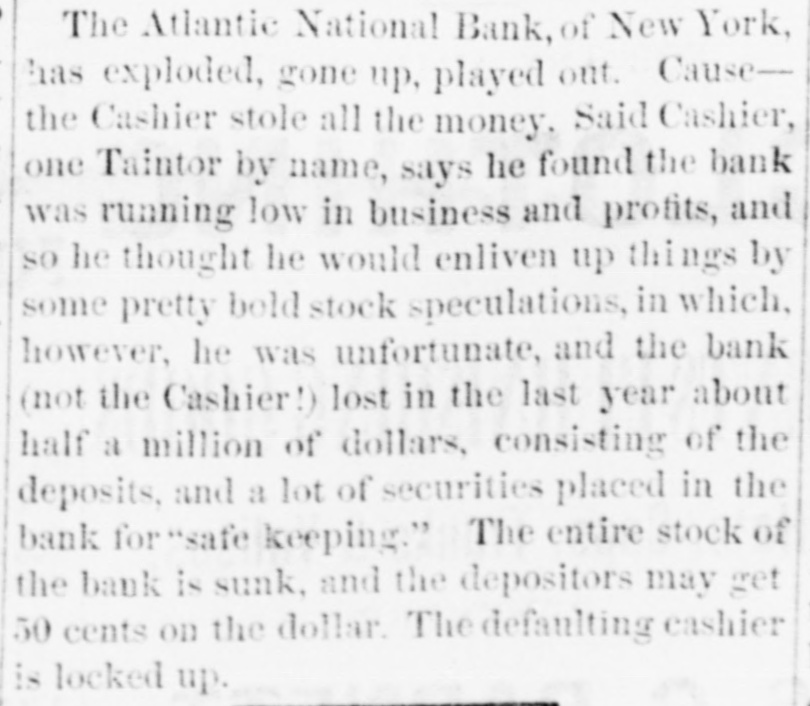
The Atlantic National Bank, of New York, has exploded, gone up, played out. Causethe Cashier stole all the money. Said Cashier, one Taintor by name, says he found the bank was running low in business and profits, and so he thought he would enliven up things by some pretty bold stock speculations, in which, however, he was unfortunate, and the bank (not the Cashier!) lost in the last year about half a million of dollars, consisting of the deposits, and a lot of securities placed in the bank for safe keeping." The entire stock of the bank is sunk, and the depositors may get 50 cents on the dollar The defaulting cashier is locked up.


Article from Memphis Daily Appeal, October 2, 1873

Click image to open full size in new tab

Article Text

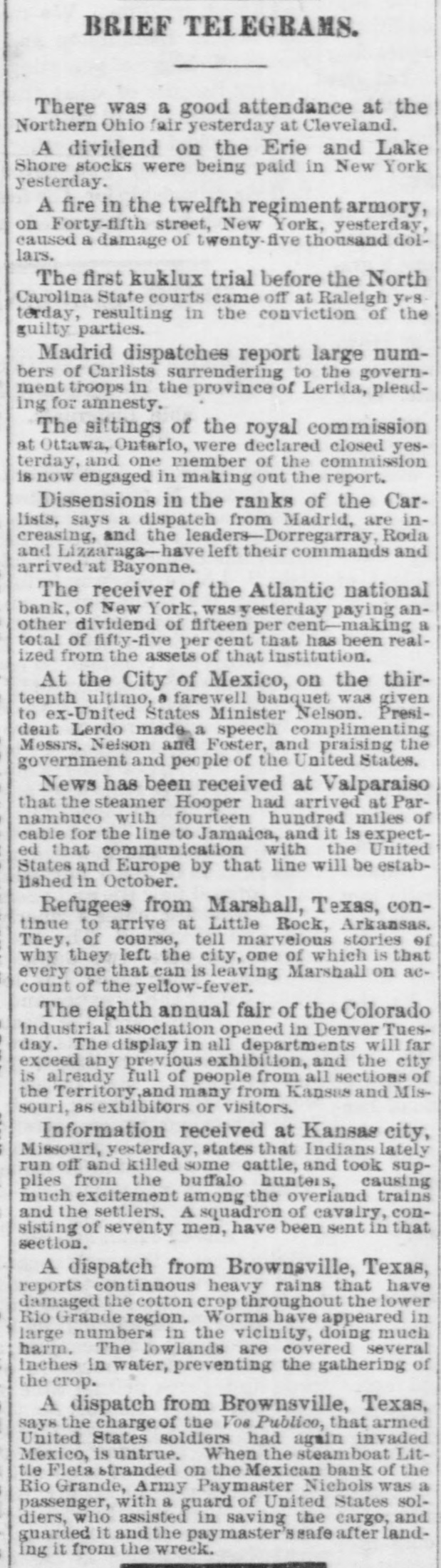
BRIEF TELEGRAMS. There was a good attendance at the Northern Ohio fair yesterday at Cleveland. A dividend on the Erie and Lake Shore stocks were being paid in New York yesterday. A fire in the twelfth regiment armory, on Forty-fifth street, New York, yesterday, caused a damage of twenty-five thousand dollars. The first kuklux trial before the North Carolina State courts came off at Raleigh yes terday, resulting in the conviction of the guilty parties. Madrid dispatches report large numbers of Carlists surrendering to the government troops in the province of Lerida, pleading for amnesty. The sittings of the royal commission at Ottawa, Ontario, were declared closed yesterday, and one member of the commission is now engaged in making out the report. Dissensions in the ranks of the Carlists. says a dispatch from Madrid, are increasing, and the leaders-Dorregarray, Roda and Lizzaraga-have left their commands and arrived at Bayonne. The receiver of the Atlantic national bank. of New York, was yesterday paying another dividend of fifteen per cent-making a total of fifty-five per cent that has been realized from the assets of that institution. At the City of Mexico, on the thirteenth ultimo, a farewell banquet was given to ex-United States Minister Nelson. Presideut Lerdo made a speech complimenting Messrs. Nelson and Foster, and praising the government and people of the United States. News has been received at Valparaiso that the steamer Hooper had arrived at Parnambuco with fourteen hundred miles of cable for the line to Jamaica, and it is expected that communication with the United States and Europe by that line will be established in October. Refugees from Marshall, Texas, continue to arrive at Little Rock, Arkansas. They, of course, tell marvelous stories of why they left the city, one of which is that every one that can is leaving Marshall on account of the yellow-fever. The eighth annual fair of the Colorado industrial association opened in Denver Tuesday. The display in all departments will far exceed any previous exhibition, and the city is already full of people from all sections of the Territory and many from Kansas and Missouri, 88 extilbitors or visitors. Information received at Kansas city, Missouri, yesterday, states that Indians lately run off and killed some cattle, and took supplies from the buffalo hunters, causing much excitement among the overland trains and the settlers. A squadron of cavalry, consisting of seventy men, have been sent in that section. A dispatch from Brownsville, Texas, reports continuous heavy rains that have damaged the cotton crop throughout the lower Rio Grande region. Worms have appeared in large number* in the vicinity, doing much harm. The lowlands are covered several inches in water, preventing the gathering of the crop. A dispatch from Brownsville, Texas, says the charge of the Vos Publico, that armed United States soldiers had again invaded Mexico, is untrue. When the steamboat Littie Fleta stranded on the Mexican bank of the Rio Grande, Army Paymaster Nichols was a passenger, with a guard of United States soldiers, who assisted in saving the cargo, and guarded it and the paymaster's ssafe after landIng it from the wreck.


Article from New-York Tribune, March 24, 1874

Click image to open full size in new tab

Article Text

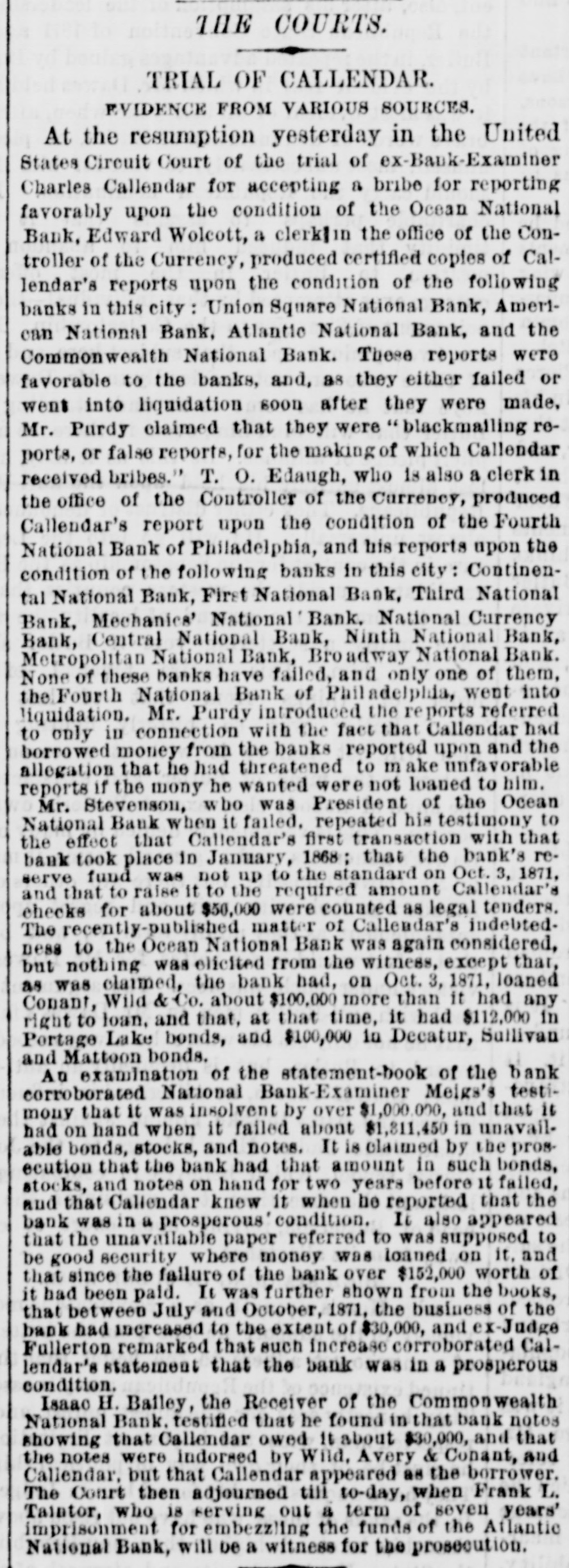
THE COURTS. TRIAL OF CALLENDAR. EVIDENCE FROM VARIOUS SOURCES. At the resumption yesterday in the United States Circuit Court of the trial of ex-Bank-Examiner Charles Callendar for accepting a bribe for reporting favorably upon the condition of the Ocean National Bank, Edward Wolcott, a clerklin the office of the Controller of the Currency, produced certified copies of Callendar's reports upon the condition of the following banks in this city Union Square National Bank, American National Bank, Atlantic National Bank, and the Commonwealth National Bank. These reports were favorable to the banks, and, as they either failed or went into liquidation soon after they were made, Mr. Purdy claimed that they were 'blackmailing reports, or false reports, for the making of which Callendar received bribes." T. O. Edaugh, who is also a clerk in the office of the Controller of the Currency, produced Callendar's report upon the condition of the Fourth National Bank of Philadelphia, and his reports upon the condition of the following banks in this city: Continental National Bank, First National Bank, Third National Bank, Mechanics' National' Bank. National Currency Bank, Central National Bank, Ninth National Bank, Metropolitan National Bank, Broadway National Bank. None of these banks have failed, and only one of them, the Fourth National Bank of Philadelphia, went into liquidation. Mr. Purdy introduced the reports referred to only in connection with the fact that Callendar had borrowed money from the banks reported upon and the allegation that he had threatened to m ake unfavorable reports if the mony he wanted were not loaned to him. Mr. Stevenson, who was President of the Ocean National Bank when it failed. repeated his testimony to the effect that Callendar's first transaction with that bank took place in January, 1868; that the bank's reserve fund was not up to the standard on Oct. 3, 1871, and that to raise it to the required amount Callendar's checks for about $50,000 were counted as legal tenders. The recently-published matter of Callendar's indebtedness to the Ocean National Bank was again considered, but nothing was elicited from the witness, except that, as was claimed, the bank had, on Oct. 3, 1871, loaned Conant, Wild & Co. about $100,000 more than it had any right to loan, and that, at that time, it had $112,000 in Portage Lake bonds, and $100,000 in Decatur, Sullivan and Mattoon bonds. Au examination of the statement-book of the bank corroborated National Bank-Examiner Meigs's testimony that it was insolvent by over $1,000.000, and that it had on hand when it failed about $1,811,450 in unavailable bonds, stocks, and notes. It is claimed by the prosecution that the bank had that amount in such bonds, stocks, and notes on hand for two years before it failed, and that Callendar knew it when he reported that the bank was in a prosperous' condition. It also appeared that the unavailable paper referred to was supposed to be good security where money was loaned on it, and that since the failure of the bank over $152,000 worth of it had been paid. It was further shown from the books, that between July and October, 1871, the business of the bank had increased to the extent of $30,000, and ex-Judge Fullerton remarked that such increase corroborated Callendar's statement that the bank was in a prosperous condition. Isaao H. Bailey, the Receiver of the Common wealth National Bank. testified that he found in that bank notes showing that Callendar owed It about $30,000, and that the notes were indorsed by Wild, Avery & Conant, and Callendar, but that Callendar appeared as the borrower. The Court then adjourned till to-day, when Frank L. Taintor, who is serving out a term of seven years' imprisonment for embezzling the funds of the Atlantic National Bank, will be a witness for the prosecution.