13572. American Loan & Trust Company (New York, NY)

Bank Information

Episode Type
Run β†’ Suspension β†’ Closure
Bank Type
trust
Start Date
February 17, 1891
Location
New York, New York (40.714, -74.006)

Metadata

Model
gpt-5-mini
Short Digest
270433f6d601cb06

Response Measures

None

Description

Newspaper accounts (Feb 17–19, 1891) report an initial run by small depositors (Feb 17), followed by the company closing/suspending on Feb 18 when large demands from savings banks could not be met. A receiver (J. Edward Simmons) was appointed and continued to wind up the company's affairs, indicating permanent closure/receivership.

Events (3)

1. February 17, 1891 Run
Cause
Correspondent
Cause Details
Heavy withdrawals by small depositors and large presented checks; later articles note unexpected demands by several savings banks for large sums that the company could not meet.
Measures
Paid small depositors promptly; large checks were asked to wait or given five days' notice; called in loans to raise funds.
Newspaper Excerpt
The run on the American Loan & Trust Company continues.... The run was mostly by small depositors, and the bank met all their demands.
Source
newspapers
2. February 18, 1891 Suspension
Cause
Correspondent
Cause Details
Unexpected large demands (reported between $200,000 and $300,000, or ~ $300,000 in some dispatches) by several savings banks and other correspondent institutions that the company lacked funds to satisfy; superintendent/inspector took possession.
Newspaper Excerpt
The American Loan and Trust company closed its doors. The immediate cause of the failure was the demand for a large amount of money made by the savings banks of this city which the Trust Company could not meet.
Source
newspapers
3. March 11, 1891 Receivership
Newspaper Excerpt
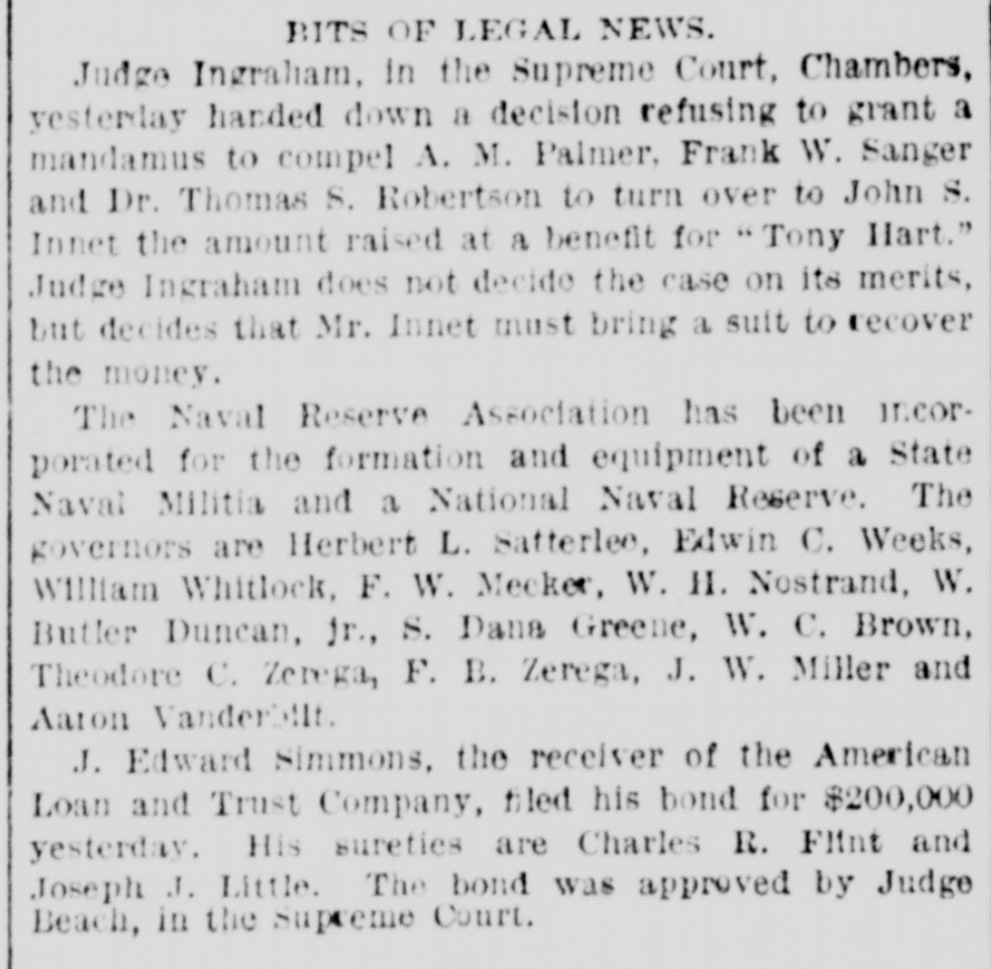
J. Edward Simmons, the receiver of the American Loan and Trust Company, filed his bond for $200,000 yesterday. His sureties are Charles R. Flint and Joseph J. Little. The bond was approved by Judge Beach, in the Supreme Court.
Source
newspapers

Newspaper Articles (24)

Article from The Seattle Post-Intelligencer, February 18, 1891

Click image to open full size in new tab

Article Text

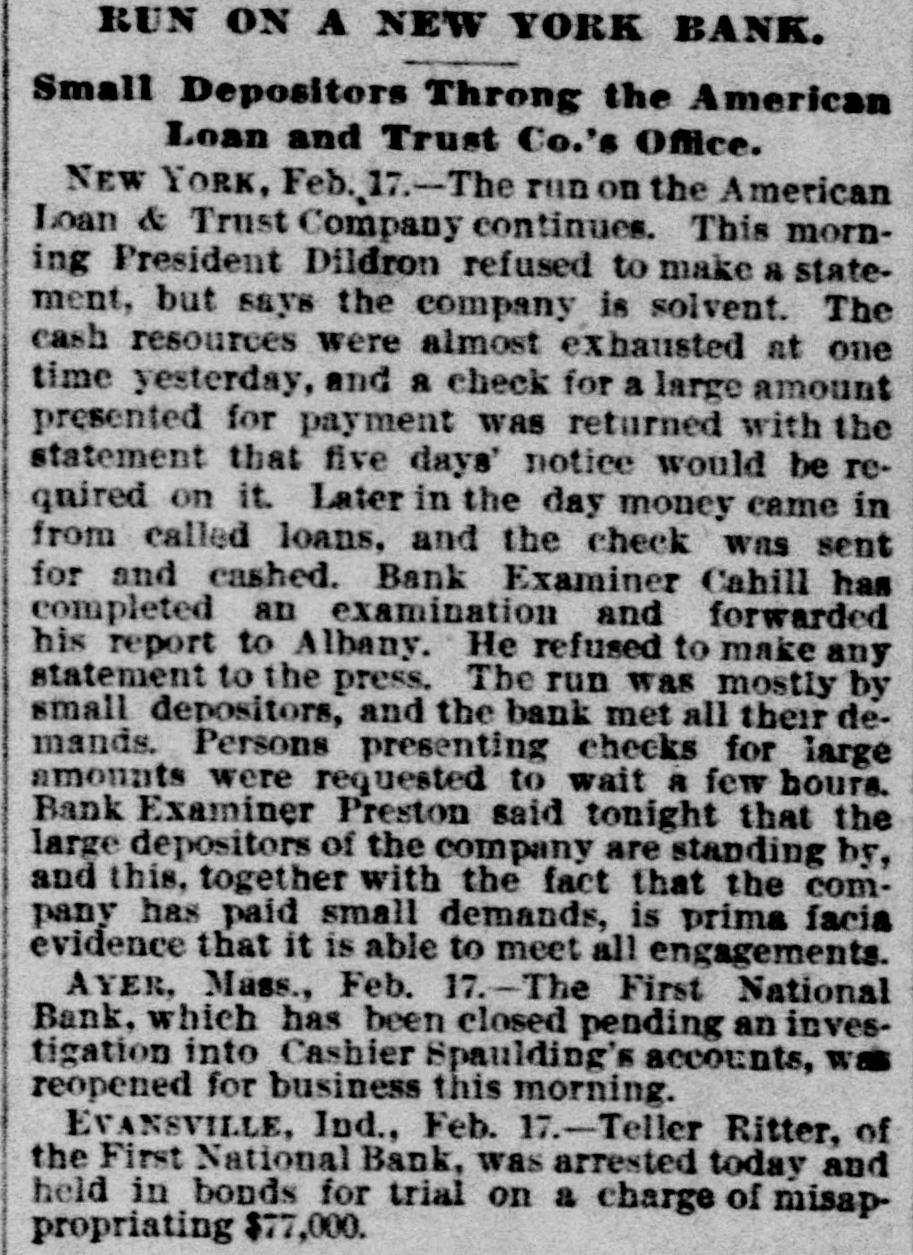
RUN ON A NEW YORK BANK. Small Depositors Throng the American Loan and Trust Co.'s Office. NEW YORK, Feb. 17.-The run on the American Loan & Trust Company continues. This morning President Dildron refused to make 8 statement, but says the company is solvent. The cash resources were almost exhausted at one time yesterday, and a check for a large amount presented for payment was returned with the statement that five days' notice would be required on it. Later in the day money came in from called loans, and the check was sent for and cashed. Bank Examiner Cahill has completed an examination and forwarded his report to Albany. He refused to make any statement to the press. The run was mostly by small depositors, and the bank met all their demands. Persons presenting checks for large amounts were requested to wait a few hours. Bank Examiner Preston said tonight that the large depositors of the company are standing by, and this, together with the fact that the company has paid small demands, is prima facia evidence that it is able to meet all engagements. AYER, Mass., Feb. 17. The First National Bank. which has been closed pending an investigation into Cashier Spaulding's accounts, was reopened for business this morning. EVANSVILLE, Ind., Feb. 17.-Teller Ritter, of the First National Bank, was arrested today and held in bonds for trial on a charge of misappropriating $77,000.


Article from The Morning Call, February 18, 1891

Click image to open full size in new tab

Article Text

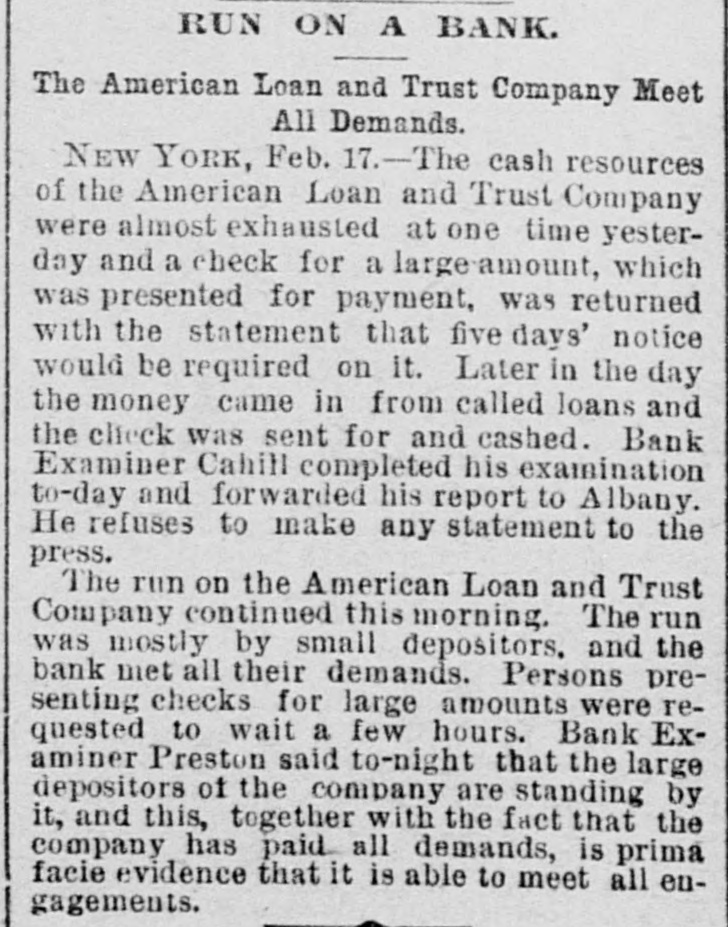
RUN ON A BANK. The American Loan and Trust Company Meet All Demands. NEW YORK, Feb. 17.-The cash resources of the American Loan and Trust Company were almost exhausted at one time yesterday and a check for a large-amount, which was presented for payment, was returned with the statement that five days' notice would be required on it. Later in the day the money came in from called loans and the check was sent for and cashed. Bank Examiner Cahill completed his examination to-day and forwarded his report to Albany. He refuses to make any statement to the press. The run on the American Loan and Trust Company continued this morning. The run was mostly by small depositors, and the bank met all their demands. Persons presenting checks for large amounts were requested to wait a few hours. Bank Examiner Preston said to-night that the large depositors of the company are standing by it, and this, together with the fact that the company has paid all demands, is prima facie evidence that it is able to meet all engagements.


Article from New-York Tribune, February 19, 1891

Click image to open full size in new tab

Article Text

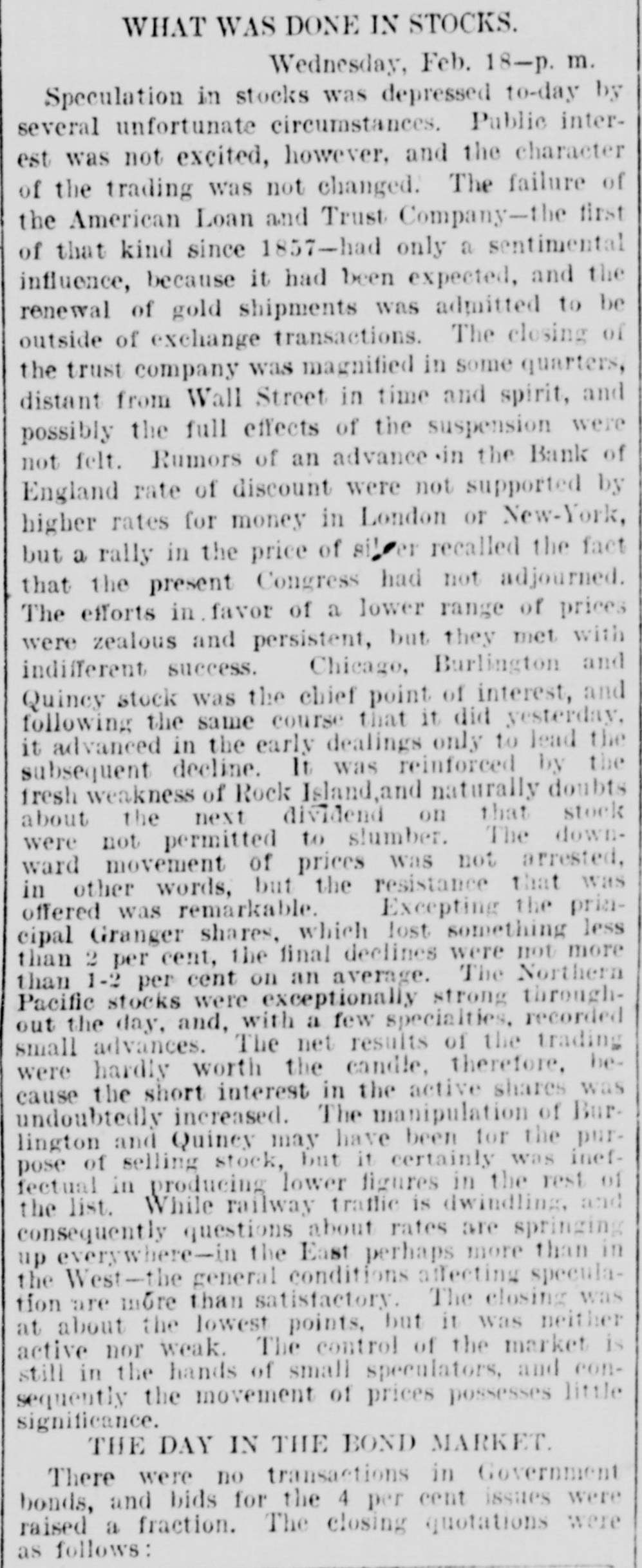
WHAT WAS DONE IN STOCKS. Wednesday, Feb. 18-p. m. Speculation in stocks was depressed to-day by several unfortunate circumstances. Public interest was not excited, however, and the character of the trading was not changed. The failure of the American Loan and Trust Company-the first of that kind since 1857-had only a sentimental influence, because it had been expected, and the renewal of gold shipments was admitted to be outside of exchange transactions. The closing of the trust company was magnified in some quarters, distant from Wall Street in time and spirit, and possibly the full effects of the suspension were not felt. Rumors of an advance .in the Bank of England rate of discount were not supported by higher rates for money in London or New-York, but a rally in the price of siler recalled the fact that the present Congress had not adjourned. The efforts in favor of a lower range of prices were zealous and persistent, but they met with indifferent success. Chicago, Burlington and Quincy stock was the chief point of interest, and following the same course that it did yesterday, it advanced in the early dealings only to lead the subsequent decline. It was reinforced by the fresh weakness of Rock Island, and naturally doubts about the next dividend on that stock were not permitted to slumber. The downward movement of prices was not arrested, in other words, but the resistance that was offered was remarkable. Excepting the principal Granger shares, which lost something less than 2 per cent, the final declines were not more than 1-2 per cent on an average. The Northern Pacific stocks were exceptionally strong throughout the day, and, with a few specialties, recorded small advances. The net results of the trading were hardly worth the candle. therefore, because the short interest in the active shares was undoubtedly increased. The manipulation of Burlington and Quiney may have been for the purpose of selling stock, but it certainly was ineffectual in producing lower figures in the rest of the list. While railway traffic is dwindling, and consequently questions about rates are springing up everywhere-in the East perhaps more than in the West-the general conditions affecting speculation are more than satisfactory. The closing was at about the lowest points, but it was neither active nor weak. The control of the market is still in the hands of small speculators, and consequently the movement of prices possesses little significance. THE DAY IN THE BOND MARKET There were no transactions in Government bonds, and bids for the 4 per cent issues were raised a fraction. The closing quotations were as follows:


Article from The Record-Union, February 19, 1891

Click image to open full size in new tab

Article Text

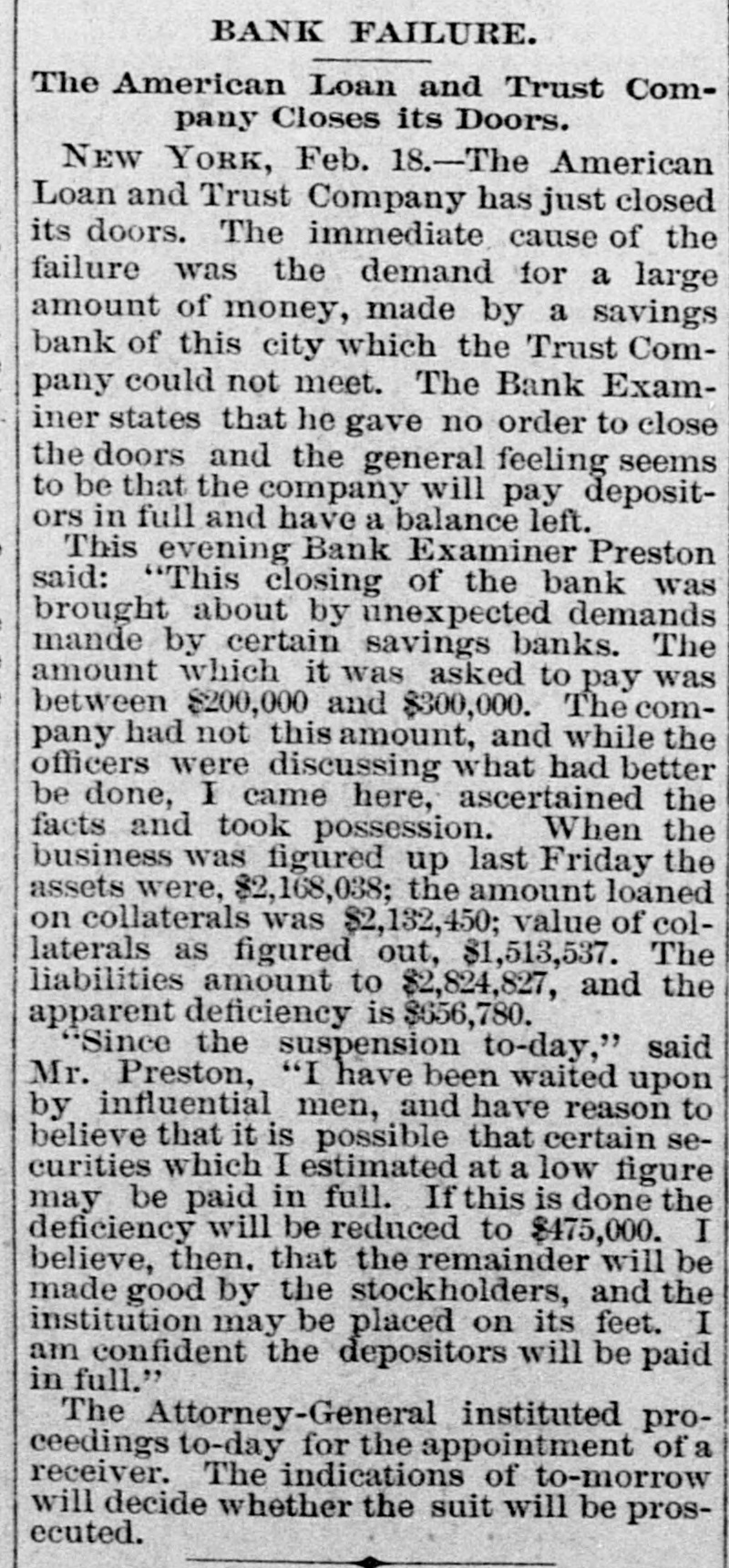
BANK FAILURE. The American Loan and Trust Company Closes its Doors. NEW YORK, Feb. 18.-The American Loan and Trust Company has just closed its doors. The immediate cause of the failure was the demand for a large amount of money, made by a savings bank of this city which the Trust Company could not meet. The Bank Examiner states that he gave no order to close the doors and the general feeling seems to be that the company will pay depositors in full and have a balance left. This evening Bank Examiner Preston said: "This closing of the bank was brought about by unexpected demands mande by certain savings banks. The amount which it was asked to pay was between $200,000 and $300,000. The company had not this amount, and while the officers were discussing what had better be done, I came here, ascertained the facts and took possession. When the business was figured up last Friday the assets were, $2,168,038; the amount loaned on collaterals was $2,132,450; value of collaterals as figured out, $1,513,537. The liabilities amount to $2,824,827, and the apparent deficiency is $656,780. "Since the suspension to-day," said Mr. Preston, "I have been waited upon by influential men, and have reason to believe that it is possible that certain securities which I estimated at a low figure may be paid in full. If this is done the deficiency will be reduced to $475,000. I believe, then. that the remainder will be made good by the stockholders, and the institution may be placed on its feet. I am confident the depositors will be paid in full." The Attorney-General instituted proceedings to-day for the appointment of a receiver. The indications of to-morrow will decide whether the suit will be prosecuted.


Article from The Helena Independent, February 19, 1891

Click image to open full size in new tab

Article Text

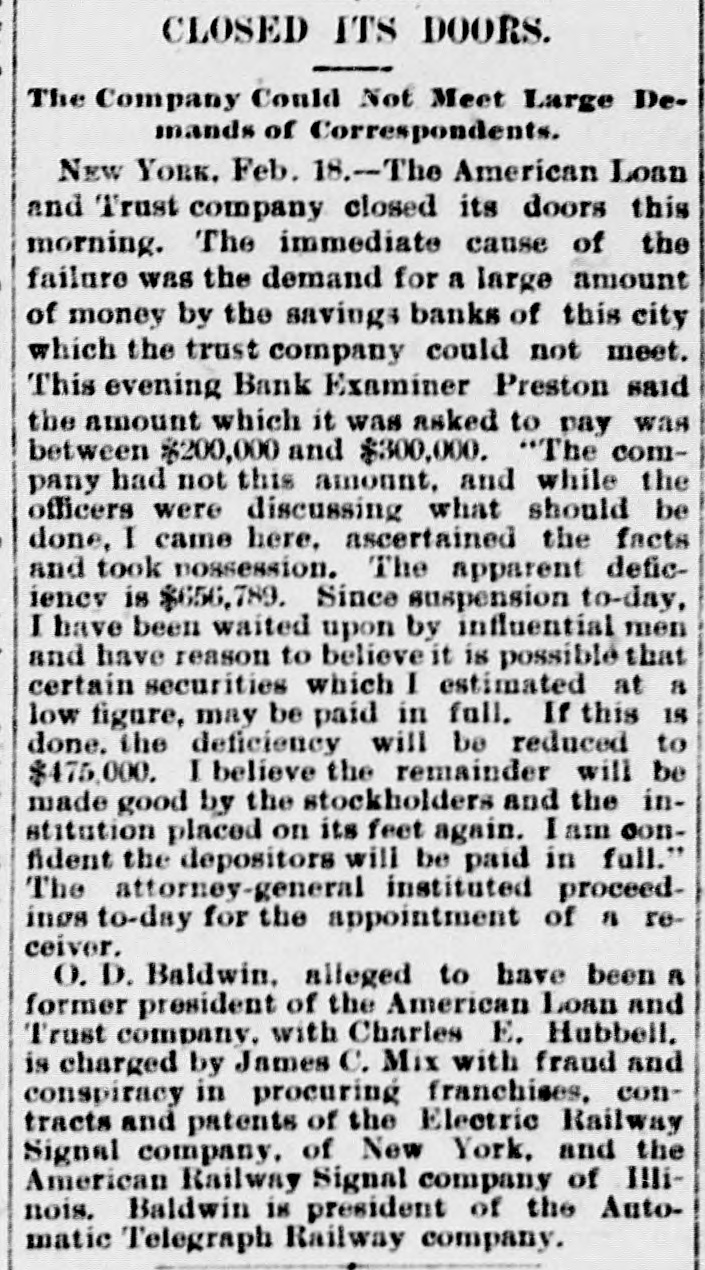
CLOSED ITS DOORS. The Company Could Not Meet Large Demands of Correspondents. NEW YORK. Feb. 18.-The American Loan and Trust company closed its doors this morning. The immediate cause of the failure was the demand for a large amount of money by the savings banks of this city which the trust company could not meet. This evening Bank Examiner Preston said the amount which it was asked to pay was between $200,000 and $300,000. "The company had not this amount. and while the officers were discussing what should be done, I came here. ascertained the facts and took possession. The apparent deficienev is $656,789. Since suspension to-day, I have been waited upon by influential men and have reason to believe it is possiblΓ© that certain securities which I estimated at a low figure, may be paid in full. If this 18 done. the deficiency will be reduced to $475,000. I believe the remainder will be made good by the stockholders and the institution placed on its feet again. I am confident the depositors will be paid in full." The attorney-general instituted proceedings to-day for the appointment of n receiver. O. D. Baldwin, alleged to have been A former president of the American Loan and Trust company. with Charles E. Hubbell. is charged by James C. Mix with fraud and conspiracy in procuring franchises. contracts and patents of the Electric Railway Signal company. of New York, and the American Railway Signal company of Illinois. Baldwin is president of the Automatic Telegraph Railway company.


Article from Deseret Evening News, February 19, 1891

Click image to open full size in new tab

Article Text

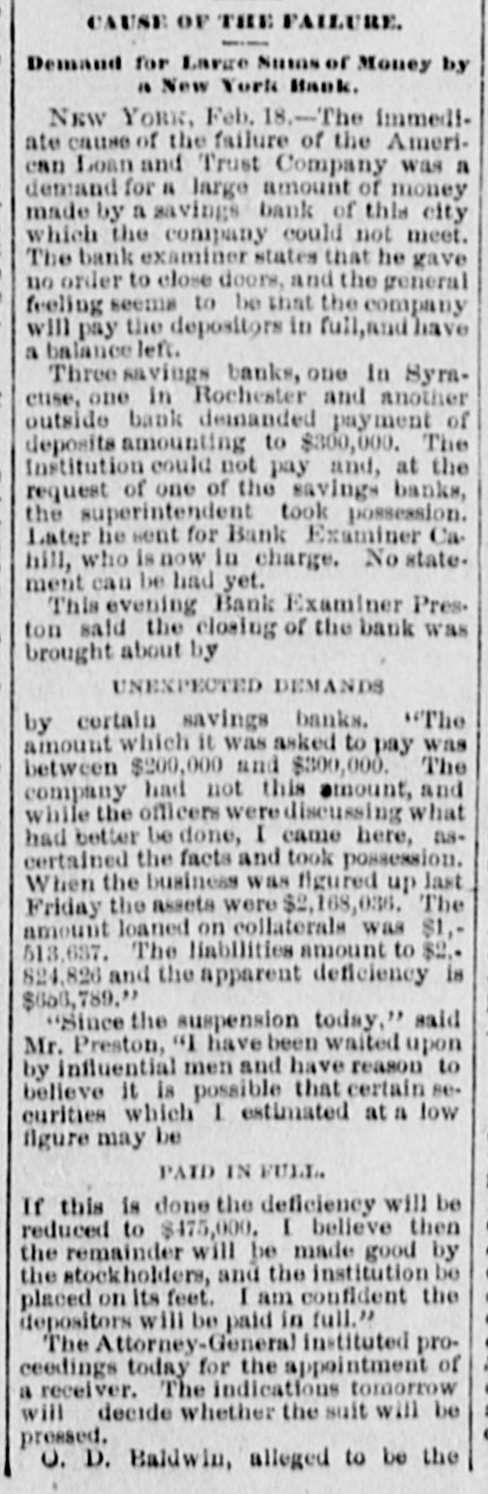
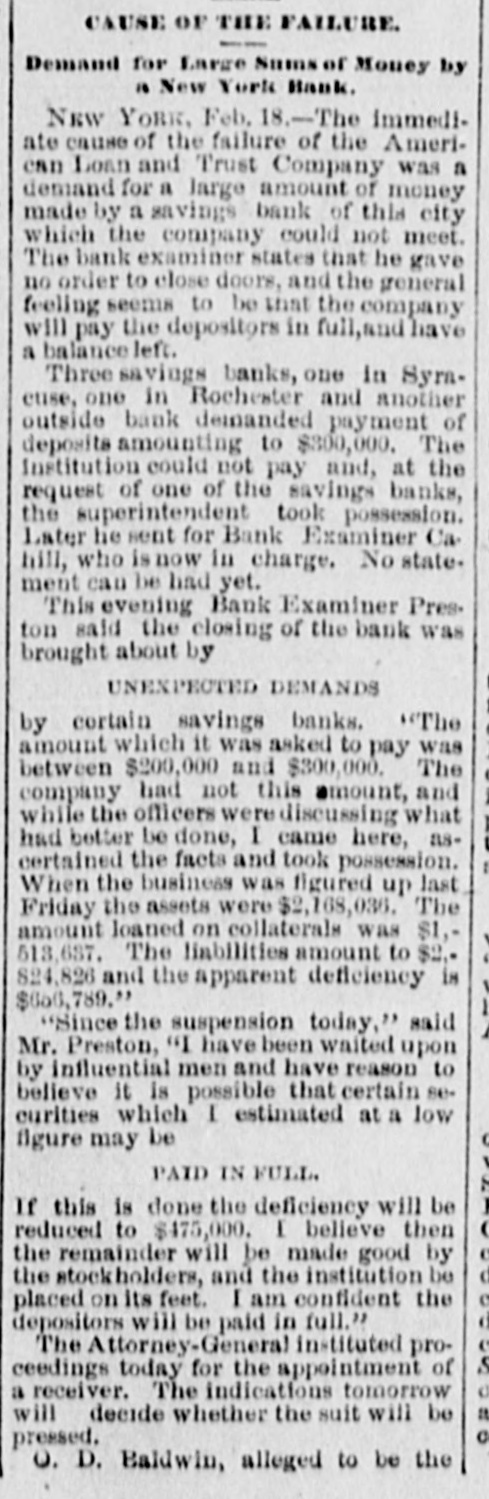
CAUSE OF THE FAILURE. Demand for Large Sums of Money by is New York Bank. NEW YORK, Feb. 18.-The immediate cause of the failure of the American Loan and Trust Company was a demand for " large amount of money made by a savings bank of this city which the company could not meet. The bank examiner states that he gave no order to close doors, and the general feeling seems to be that the company will pay the depositors in full, and have a balance left. Three savings banks, one In Syracuse, one in Rochester and another outside bank demanded payment of deposits amounting to $300,000. The Institution could not pay and, at the request of one of the savings banks, the superintendent took possession. Later he sent for Bank Examiner Cahill, who is now in charge. No statement can be had yet. This evening Bank Examiner Pres. ton said the closing of the bank was brought about by UNEXPECTED DEMANDS by certain savings banks. "The amount which it was asked to pay was between $200,000 and $300,000. The company had not this amount, and while the officers werediscussing what had better be done, I came here, ascertained the facts and took possession. When the business was figured up last Friday the assets were $2,168,036. The amount loaned on collaterals was $1,513,637. The liabilities amount to $2.824,826 and the apparent deficiency is $656,789." "Since the suspension today," said Mr. Preston, "I have been waited upon by influential men and have reason to believe it is possible that certain securities which I estimated at a low figure may be PAID IN FULL. If this is done the deficiency will be reduced to $475,000. I believe then the remainder will be made good by the stockholders, and the institution be placed on Its feet. I am confident the depositors will be paid in full." The Attorney-General instituted proceedings today for the appointment of a receiver. The indications tomorrow will decide whether the suit will be pressed. O. D. Baldwin, alleged to be the


Article from The Times, February 19, 1891

Click image to open full size in new tab

Article Text

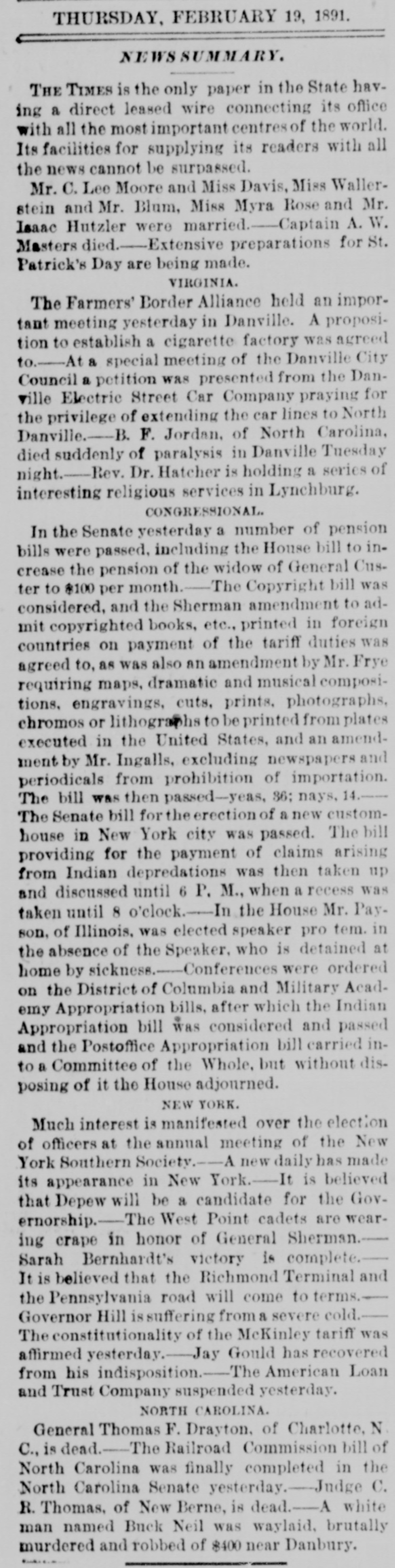
THURSDAY, FEBRUARY 19, 1891. NEWSSUMMARY. THE TIMES is the only paper in the State having a direct leased wire connecting its office with all the most important centres of the world. Its facilities for supplying its readers with all the news cannot be surpassed. Mr. C. Lee Moore and Miss Davis, Miss Wallerstein and Mr. Blum, Miss Myra Rose and Mr. Isaac Hutzler were married.-Captain A. W. Masters died.-Extensive preparations for St. Patrick's Day are being made. VIRGINIA. The Farmers' Border Alliance held an important meeting yesterday in Danville. A proposition to establish a cigarette factory was agreed to.-At a special meeting of the Danville City Council a petition was presented from the Danville Electric Street Car Company praying for the privilege of extending the car lines to North Danville.-B. F. Jordan, of North Carolina, died suddenly of paralysis in Danville Tuesday night.-Rev. Dr. Hatcher is holding a series of interesting religious services in Lynchburg. CONGRESSIONAL. In the Senate yesterday a number of pension bills were passed, including the House bill to increase the pension of the widow of General Custer to $100 per month.-The Copyright bill was considered, and the Sherman amendment to admit copyrighted books, etc., printed in foreign countries on payment of the tariff duties was agreed to, as was also an amendment by Mr. Frye requiring maps, dramatic and musical compositions, engravings, cuts, prints, photographs, chromos or lithographs to be printed from plates executed in the United States, and an amendment by Mr. Ingalls, excluding newspapers and periodicals from prohibition of importation. The bill was then passed-yeas, 36; nays, 14.The Senate bill for the erection of a new customhouse in New York city was passed. The bill providing for the payment of claims arising from Indian depredations was then taken up and discussed until 6 P. M., when a recess was taken until 8 o'clock.-In the House Mr. Payson, of Illinois, was elected speaker pro tem. in the absence of the Speaker, who is detained at home by sickness.-Conferences were ordered on the District of Columbia and Military Academy Appropriation bills, after which the Indian Appropriation bill was considered and passed and the Postoffice Appropriation bill carried into a Committee of the Whole, but without disposing of it the House adjourned. NEW YORK. Much interest is manifested over the election of officers at the annual meeting of the New York Southern Society.--A new daily has made its appearance in New York.-It is believed that Depew will be a candidate for the Governorship.-The West Point cadets are wearing crape in honor of General Sherman.Sarah Bernhardt's victory is complete.β€” It is believed that the Richmond Terminal and the Pennsylvania road will come to terms.Governor Hill issuffering from a severe cold.β€” The constitutionality of the McKinley tariff was affirmed yesterday.-Jay Gould has recovered from his indisposition.-The American Loan and Trust Company suspended yesterday. NORTH CAROLINA. General Thomas F. Drayton, of Charlotte, N. C., is dead.-The Railroad Commission bill of North Carolina was finally completed in the North Carolina Senate yesterday.-Jndge C. R. Thomas, of New Berne, is dead.-A white man named Buck Neil was waylaid, brutally murdered and robbed of $400 near Danbury.


Article from The Salt Lake Herald, February 19, 1891

Click image to open full size in new tab

Article Text

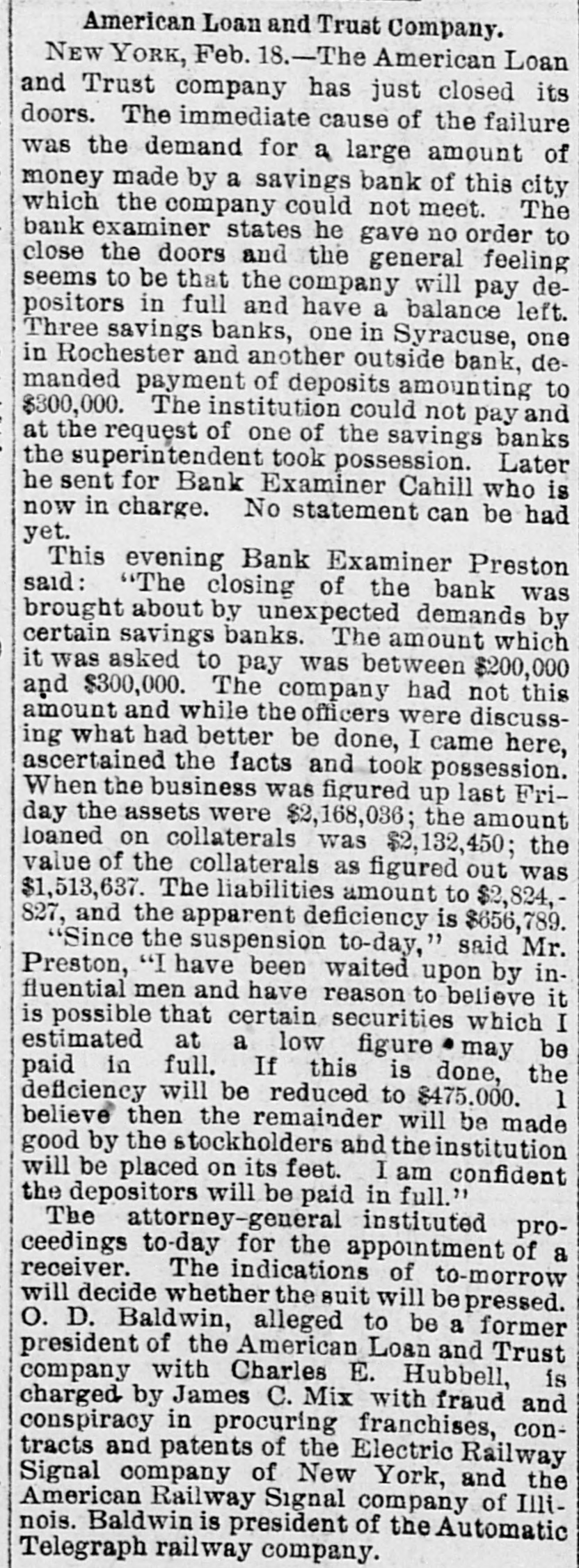
American Loan and Trust Company. NEW YORK, Feb. 18.-The American Loan and Trust company has just closed its doors. The immediate cause of the failure was the demand for a large amount of money made by a savings bank of this city which the company could not meet. The bank examiner states he gave no order to close the doors and the general feeling seems to be that the company will pay depositors in full and have a balance left. Three savings banks, one in Syracuse, one in Rochester and another outside bank, demanded payment of deposits amounting to $300,000. The institution could not pay and at the request of one of the savings banks the superintendent took possession. Later he sent for Bank Examiner Cahill who is now in charge. No statement can be had yet. This evening Bank Examiner Preston said: "The closing of the bank was brought about by unexpected demands by certain savings banks. The amount which it was asked to pay was between $200,000 and $300,000. The company had not this amount and while the officers were discussing what had better be done, I came here, ascertained the facts and took possession. When the business was figured up last Friday the assets were $2,168,036; the amount loaned on collaterals was $2,132,450; the value of the collaterals as figured out was $1,513,637. The liabilities amount to $2,824,827, and the apparent deficiency is $656,789. "Since the suspension to-day," said Mr. Preston, "I have been waited upon by influential men and have reason to believe it is possible that certain securities which I estimated at a low figure may be paid in full. If this is done, the deficiency will be reduced to $475,000. 1 believe then the remainder will be made good by the stockholders and the institution will be placed on its feet. I am confident the depositors will be paid in full." The attorney-general instituted proceedings to-day for the appointment of a receiver. The indications of to-morrow will decide whether the suit will be pressed. O. D. Baldwin, alleged to be a former president of the American Loan and Trust company with Charles E. Hubbell, is charged by James C. Mix with fraud and conspiracy in procuring franchises, contracts and patents of the Electric Railway Signal company of New York, and the American Railway Signal company of Illinois. Baldwin is president of the Automatic Telegraph railway company.


Article from New-York Tribune, February 19, 1891

Click image to open full size in new tab

Article Text

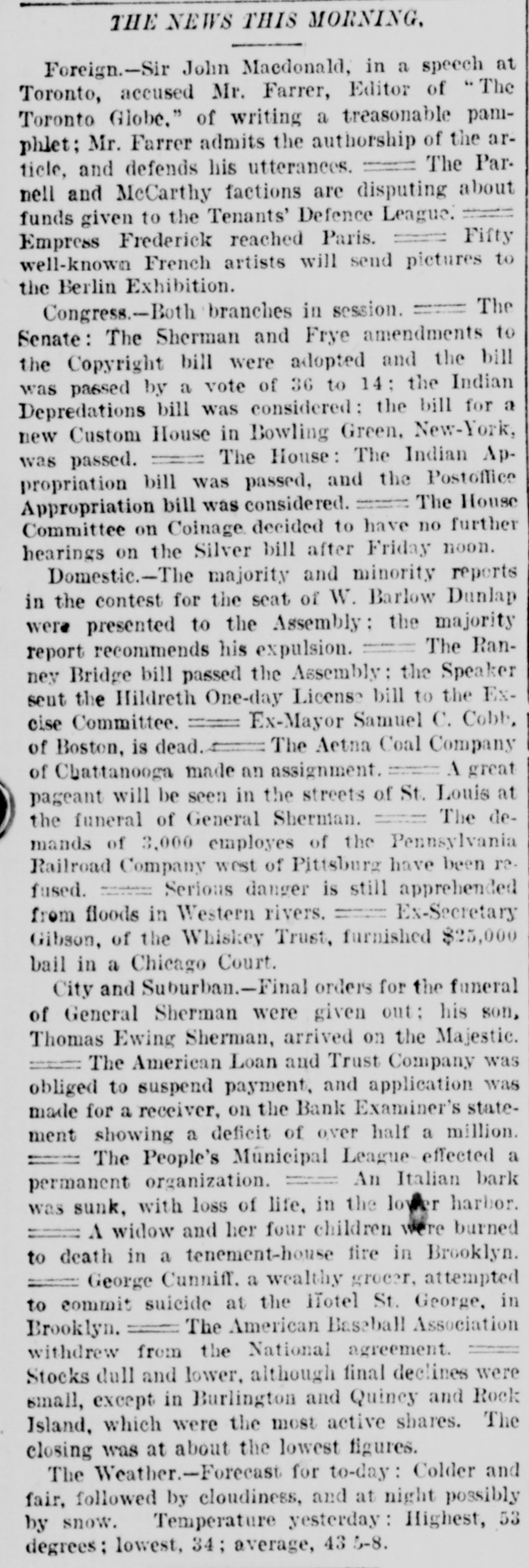
THE NEWS THIS MORNING, Foreign.-Sir John Macdonald, in a speech at Toronto, accused Mr. Farrer, Editor of "The Toronto Globe," of writing a treasonable panphlet; Mr. Farrer admits the authorship of the article, and defends his utterances. The Parnell and McCarthy factions are disputing about funds given to the Tenants' Defence League. Fifty Empress Frederick reached Paris. well-known French artists will send pictures to the Berlin Exhibition. Congress.-Both branches in session. The Senate: The Sherman and Frye amendments to the Copyright bill were adopted and the bill was passed by a vote of 36 to 14: the Indian Depredations bill was considered: the bill for a new Custom House in Bowling Green, New-York, The House: The Indian Apwas passed. propriation bill was passed, and the Postoffice Appropriation bill was considered. The House Committee on Coinage decided to have no further hearings on the Silver bill after Friday noon. Domestic.-The majority and minority reports in the contest for the seat of W. Barlow Dunlap were presented to the Assembly: the majority report recommends his expulsion. The Ranney Bridge bill passed the Assembly: the Speaker seut the Hildreth One-day License bill to the Excise Committee. Ex-Mayor Samuel C. Cobb. The Aetna Coal Company of Boston, is dead. A great of Chattanooga made an assignment. pageant will be seen in the streets of St. Louis at The dethe funeral of General Sherman. === mands of 3,000 employes of the Pennsylvania Railroad Company west of Pittsburg have been refused. - Serious danger is still apprehended from floods in Western rivers. Ex-Secretary Gibson, of the Whiskey Trust, furnished $25,000 bail in a Chicago Court. City and Suburban.-Final orders for the funeral of General Sherman were given out; his son, Thomas Ewing Sherman, arrived on the Majestic. === The American Loan and Trust Company was obliged to suspend payment. and application was made for a receiver, on the Bank Examiner's statement showing a deficit of over half a million. == The People's MΓΌnicipal League effected a permanent organization. An Italian bark was sunk, with loss of life, in the lower harbor. A widow and her four children were burned to death in a tenement-house fire in Brooklyn. = George Cunniff. a wealthy grocer. attempted to commit suicide at the Hotel St. George, in The American Baseball Association Brooklyn. withdrew from the National agreement. Stocks dull and lower, although final declines were small, except in Burlington and Quincy and Rock Island, which were the most active shares. The closing was at about the lowest figures. The Weather.-Forecast for to-day: Colder and fair, followed by cloudiness, and at night possibly by snow. Temperature yesterday: Highest, 53 degrees; lowest, 34; average, 43 5-8.


Article from Deseret Evening News, February 19, 1891

Click image to open full size in new tab

Article Text

CAUSE OF THE FAILURE. Demand for Large Sums of Money by is New York Bank. NEW YORK, Feb, 18.-The immediate cause of the failure of the American Loan and Trust Company was a demand for a large amount of money made by a savings bank of this city which the company could not meet. The bank examiner states that he gave no order to close doors, and the general feeling seems to be that the company will pay the depositors in full, and have a balance left. Three savings banks, one In Syraeuse, one in Rochester and another outside bank demanded payment of deposits amounting to $800,000. The Institution could not pay and, at the request of one of the savings banks, the superintendent took possession. Later he sent for Bank Examiner Cahill, who is now in charge. No statement can be had yet. This evening Bank Examiner Preston said the closing of the bank was brought about by UNEXPECTED DEMANDS by cortain savings banks. "The amount which it was asked to pay was between $200,000 and $300,000. The company had not this amount, and while the officers were discussing what had better be done, I came here, ascertained the facts and took possession. When the business was figured up last Friday the assets were $2,168,036. The amount loaned on collaterals was $1,513,637. The liabilities amount to $2,S24,826 and the apparent deficiency is $656,789." "Since the suspension today," said Mr. Preston, "I have been waited upon by influential men and have reason to believe it is possible that certain securities which I estimated at a low figure may be PAID IN FULL. If this is done the deficiency will be reduced to $475,000. I believe then the remainder will be made good by the stockholders, and the institution be placed on its feet. I am confident the depositors will be paid in full." The Attorney-General instituted proceedings today for the appointment of a receiver. The indications tomorrow will decide whether the suit will be o pressed. O. D. Baldwin, alleged to be the


Article from St. Paul Daily Globe, February 19, 1891

Click image to open full size in new tab

Article Text

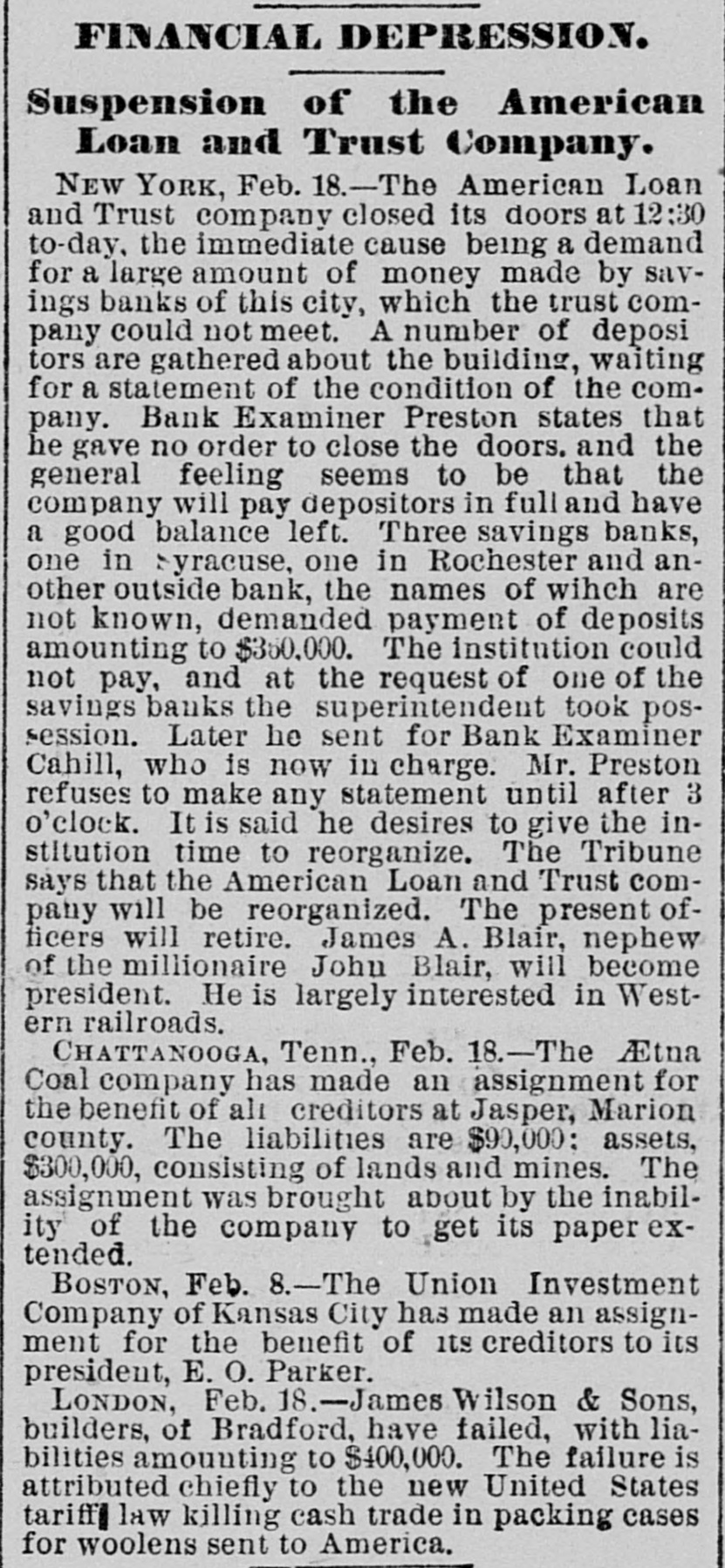
FINANCIAL DEPRESSION. Suspension of the American Loan and Trust Company. NEW YORK, Feb. 18.-The American Loan and Trust company closed its doors at 12:30 to-day, the immediate cause being a demand for a large amount of money made by savings banks of this city, which the trust company could not meet. A number of deposi tors are gathered about the building, waiting for a statement of the condition of the company. Bank Examiner Preston states that he gave no order to close the doors. and the general feeling seems to be that the company will pay depositors in full and have a good balance left. Three savings banks, one in Syracuse, one in Rochester and another outside bank, the names of wihch are not known, demanded payment of deposits amounting to $350,000. The institution could not pay, and at the request of one of the savings banks the superintendent took possession. Later he sent for Bank Examiner Cahill, who is now in charge. Mr. Preston refuses to make any statement until after 3 o'clock. It is said he desires to give the institution time to reorganize. The Tribune says that the American Loan and Trust company will be reorganized. The present officers will retire. James A. Blair, nephew of the millionaire John Blair, will become president. He is largely interested in Western railroads. CHATTANOOGA, Tenn., Feb. 18.-The Etna Coal company has made an assignment for the benefit of ali creditors at Jasper, Marion county. The liabilities are $90,000; assets, $300,000, consisting of lands and mines. The assignment was brought about by the inability of the company to get its paper extended. BOSTON, Feb. 8.-The Union Investment Company of Kansas City has made an assignment for the benefit of its creditors to its president, E. O. Parker. LONDON, Feb. 18.-James Wilson & Sons, builders, of Bradford, have failed, with liabilities amounting to $400,000. The failure is attributed chiefly to the new United States tariff] law killing cash trade in packing cases for woolens sent to America.


Article from Grant County Herald, February 26, 1891

Click image to open full size in new tab

Article Text

JAMES B. KINSLEY, a Boston wool dealer, was held in bonds of $30,000 on a charge of embezzling $34,000 from Boston banks. MRS. JOHN HENRY and her four children and Jacob Enrich were suffocated in a burning building in Brooklyn, N. Y. THE American Loan and Trust Company of New York closed its doors. Depositors would be paid in full. A WHITE man and a negro weretaken from the county jail in Gainesville, Fla., by a mob and hanged for complicity in numerous assaults. FREDERICK THIES. a farmer living in the Salt Creek valley in Kansas, was left $7,000,000 by a brother who died in California. IN a test case in the United States Circuit Court in New York the McKinley tariff law was declared constitutional. THE Union Investment Company of Kansas City, Mo., assigned, with liabilities and assets each $1,000,000. GEORGE J. GIBSON, the indicted secretary of the whisky trust. gave bond in Judge Shepard's court in Chicago in the sum of $25,000. ROBERT MEREDITH, of Center, Wis., has returned from a trip around the world began a year ago. He started with $18 and came back with $5. AT Little Rock ex-Treasurer Woodruff paid into the State Treasury of Arkansas $63,740.50, the full amount of his shortage. RIVERSIDE, a suburb of Parkersburg, W. Va., was destroyed by a flood. No lives were lost. AN express train struck and killed Martha Moore and Sarah Mules (colored) at Lake Station, Md. C. V. McChesney, of Cincinnati, was presented the Wanamaker gold medal offered to the postal clerk in the Fifth division railway mail service making the best record during 1890. THE census bureau announced the population of Tennessee by races as follows: White, 1,332,971; colored, 434,300; Indians, 173; Chinese, 64; Japanese, 10; total, 1,767,518. The population of West Virginia was given as follows: White. 729,262; colored, 33,508; Indians, 8; Chinese, 16; total, 763,794. ANTECO (2:16 14), by Electioneer, was purchased at Lexington, Ky., by S. A. Brown, of Kalamazoo, Mich., for $55,000. A FIRE at Rochester, N. Y., destroyed the Grand Opera-House, valued at $90,000, and damaged the Windsor Hotel $10,000. FIVE horses valued at $10,000 were burned in the barn of C. E. Butler, near Paris, Ky. MRS. JAMES BASS was murdered by Anderson Rosell, a negro, at Bartonia, Ind. She knew of a forgery which Rosell had committed. THE remaius of the late General Sherman were on the 19th borne from the family residence in New York to the depot and embarked on a train for St. Louis. The ceremonies were attended by President Harrison and his Cabinet and many other distinguished persons, and thousands of old soldiers were in the line of march. AT Martin's Ferry, O., an explosion of natural gas in the house of William Kuntz burned nine persons, two of them, Mrs. Kuntz and Miss Graves, fatally. JOHN BULL, an Indian, was hanged by a mob at Battlefield, Miss., for the murder of Ben Pierce, a farmer. A STORM of slee? and snow did great damage to the telegraph service in the Northwest. SIX trainmen were killed and seven injured by a collision of railway trains on the New Haven railroad in New York City. THE Lake Front was abandoned by the world's fair directory. There will not be a building placed upon it and the World's Columbian Exposition will be held in Jackson Park. It was said the expenses of the fair would be $17,625,453, and the receipts were estimated at $21,000,000. IN the United States the business failures during the seven days ended on the 20th numbered 295. against 297 the preceding week and 271 the corresponding week last year. THE Standard Oil Company has purchased 20,000 acres of oil lands in Green County, Pa. This corporation now own nearly all of five counties in Pennsylvania. WILLIAM McCuBBIN, a wealthy and prominent citizen of Leigh, Neb., and well known throughout the State, shot and killed his wife and his hired man and then cut his own throat. Jealousy was said to have prompted the crime. THE total production of white pine lumber in the Northwest during the past season was 4,068,285,584 feet, an
Article from Iowa County Democrat, February 27, 1891

Click image to open full size in new tab

Article Text

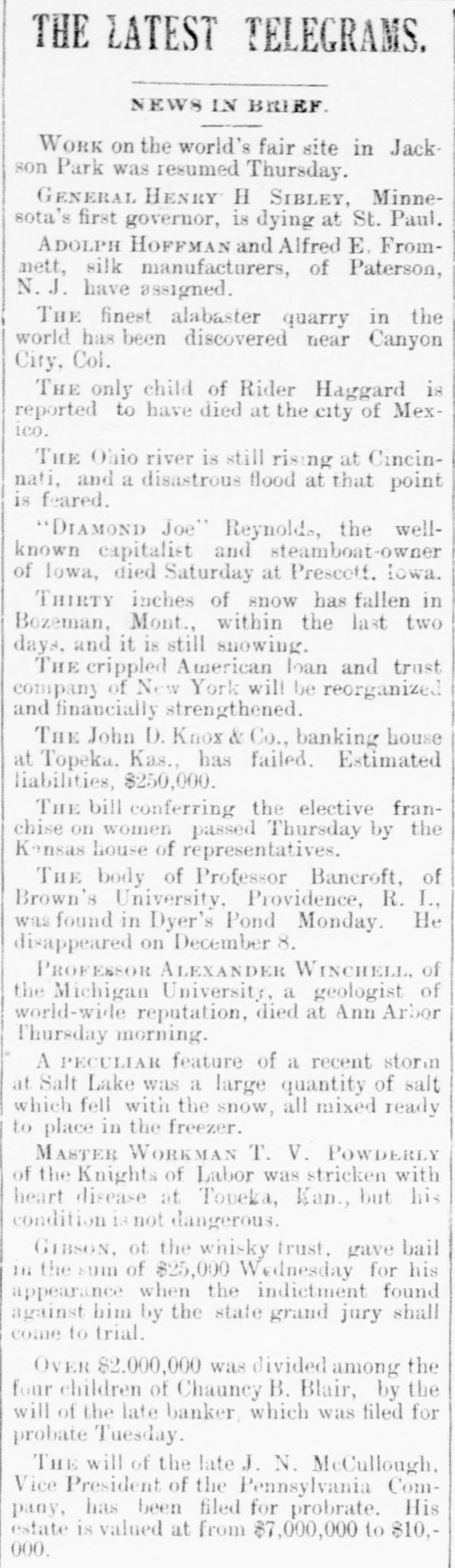
THE LATEST TELEGRAMS. NEWS IN BRIEF WORK on the world's fair site in Jack son Park was resumed Thursday. GENERAL HENRY H SIBLEY, Minnesota's first governor, is dying at St. Paul. ADOLPH HOFFMAN and Alfred E. Frommett, silk manufacturers, of Paterson, N.. J. have assigned. THE finest alabaster quarry in the world has been discovered near Canyon City, Col. THE only child of Rider Haggard is reported to have died at the city of Mexico. THE Ohio river is still rising at Cincinnati, and a disastrous flood at that point is feared. "DIAMOND Joe Reynolds, the wellknown capitalist and steamboat-owner of Iowa, died Saturday at Prescott. Iowa. THIRTY inches of snow has fallen in Bozeman, Mont. within the last two days, and it is still snowing. THE crippled American loan and trust company of New York will be reorganized and financially strengthened. THE John D. Knox & Co., banking house at Topeka. Kas., has failed. Estimated liabilities, $250,000. THE bill conferring the elective franchise on women passed Thursday by the Kensas house of representatives. THE body of Professor Bancroft, of Brown's University, Providence, R. I., was found in Dyer's Pond Monday. He disappeared on December 8. PROFESSOR ALEXANDER WINCHELL of the Michigan University, a geologist of world-wide reputation, died at Ann Arbor Thursday morning. A PECULIAR feature of a recent storm at Salt Lake was a large quantity of salt which fell with the snow, all mixed ready to place in the freezer. MASTER WORKMAN T. V. POWDERLY of the Knights of Labor was stricken with heart disease at Toveka, Kan., but his condition is not dangerous. GIBSON, ot the whisky trust, gave bail in the sum of $25,000 Wednesday for his appearance when the indictment found against him by the state grand jury shall come to trial. OVER $2,000,000 was divided among the four children of Chauncy B. Blair, by the will of the late banker which was filed for probate Tuesday. THE will of the late J. N. McCullough, Vice President of the Pennsylvania Company, has been filed for probrate. His estate is valued at from $7,000,000 to $10,000.


Article from New-York Tribune, March 11, 1891

Click image to open full size in new tab

Article Text

BITS OF LEGAL NEWS. Judge Ingraham, in the Supreme Court, Chambers, yesterday harded down a decision refusing to grant a mandamus to compel A. M. Palmer, Frank W. Sanger and Dr. Thomas S. Robertson to turn over to John S. Innet the amount raised at a benefit for "Tony Hart." Judge Ingraham does not decide the case on its merits, but decides that Mr. Innet must bring a suit to recover the money. The Naval Reserve Association has been incorporated for the formation and equipment of a State Naval Militia and a National Naval Reserve. The governors are Herbert L. Satterlee, Edwin C. Weeks, William Whitlock, F. W. Mecker, W. H. Nostrand, W. Butler Duncan, Jr., S. Dana Greene, W. C. Brown, Theodore C. Zerega, F. B. Zerega, J. W. Miller and Aaron Vanderbilt. J. Edward Simmons, the receiver of the American Loan and Trust Company, filed his bond for $200,000 yesterday. His sureties are Charles R. Flint and Joseph J. Little. The bond was approved by Judge Beach, in the Supreme Court.


Article from New Ulm Weekly Review, May 13, 1891

Click image to open full size in new tab

Article Text

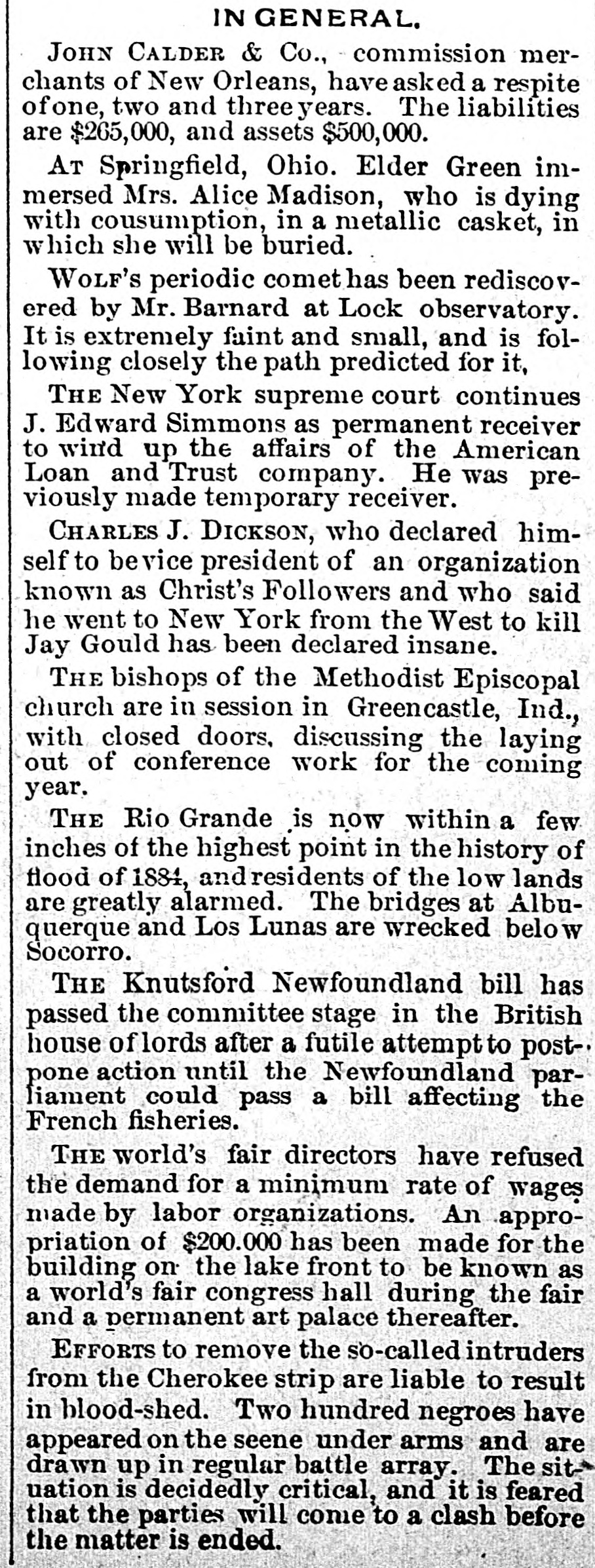
INGENERAL. JOHN CALDER & Co., commission merchants of New Orleans, have asked a respite ofone, two and three years. The liabilities are $265,000, and assets $500,000. AT Springfield, Ohio. Elder Green immersed Mrs. Alice Madison, who is dying with cousumption, in a metallic casket, in which she will be buried. WOLF'S periodic comet has been rediscovered by Mr. Barnard at Lock observatory. It is extremely faint and small, and is following closely the path predicted for it, THE New York supreme court continues J. Edward Simmons as permanent receiver to wind up the affairs of the American Loan and Trust company. He was previously made temporary receiver. CHARLES J. DICKSON, who declared himself to bevice president of an organization known as Christ's Followers and who said he went to New York from the West to kill Jay Gould has been declared insane. THE bishops of the Methodist Episcopal church are in session in Greencastle, Ind., with closed doors, discussing the laying out of conference work for the coming year. THE Rio Grande is now within a few inches of the highest point in the history of flood of 1884, andresidents of the low lands are greatly alarmed. The bridges at Albuquerque and Los Lunas are wrecked below Socorro. THE Knutsford Newfoundland bill has passed the committee stage in the British house of lords after a futile attemptto post-. pone action until the Newfoundland parliament could pass a bill affecting the French fisheries. THE world's fair directors have refused the demand for a minimum rate of wages made by labor organizations. An appropriation of $200.000 has been made for the building on the lake front to be known as a world's fair congress hall during the fair and a permanent art palace thereafter. EFFORTS to remove the so-called intruders from the Cherokee strip are liable to result in blood-shed. Two hundred negroes have appeared on the seene under arms and are drawn up in regular battle array. The situation is decidedly critical, and it is feared that the parties will come to a clash before the matter is ended.


Article from The Princeton Union, May 14, 1891

Click image to open full size in new tab

Article Text

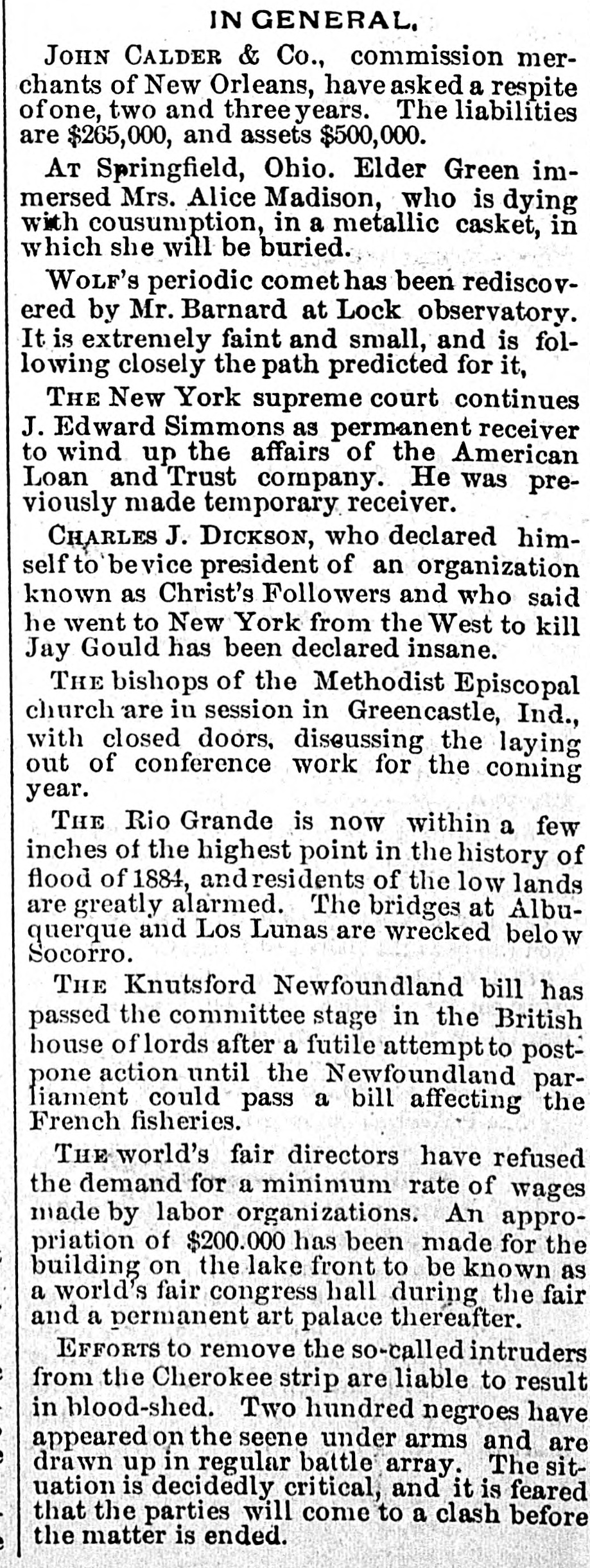
IN GENERAL, JOHN CALDER & Co., commission merchants of New Orleans, have asked a respite of one, two and three years. The liabilities are $265,000, and assets $500,000. AT Springfield, Ohio. Elder Green immersed Mrs. Alice Madison, who is dying with cousumption, in a metallic casket, in which she will be buried. WOLF'S periodic comet has been rediscovered by Mr. Barnard at Lock observatory. It is extremely faint and small, and is following closely the path predicted for it, THE New York supreme court continues J. Edward Simmons as permanent receiver to wind up the affairs of the American Loan and Trust company. He was previously made temporary receiver. CHARLES J. DICKSON, who declared himself to vice president of an organization known as Christ's Followers and who said he went to New York from the West to kill Jay Gould has been declared insane. THE bishops of the Methodist Episcopal church are in session in Greencastle, Ind., with closed doors, discussing the laying out of conference work for the coming year. THE Rio Grande is now within a few inches of the highest point in the history of flood of 1884, andresidents of the low lands are greatly alarmed. The bridges at Albuquerque and Los Lunas are wrecked below Socorro. THE Knutsford Newfoundland bill has passed the committee stage in the British house of lords after a futile attempt to postpone action until the Newfoundland parliament could pass a bill affecting the French fisheries. THE world's fair directors have refused the demand for a minimum rate of wages made by labor organizations. An appropriation of $200.000 has been made for the building on the lake front to be known as a world's fair congress hall during the fair and a permanent art palace thereafter. EFFORTS to remove the so-called intruders from the Cherokee strip are liable to result in blood-shed. Two hundred negroes have appeared on the seene under arms and are drawn up in regular battle array. The situation is decidedly critical, and it is feared that the parties will come to a clash before the matter is ended.


Article from Morning Journal and Courier, July 21, 1891

Click image to open full size in new tab

Article Text

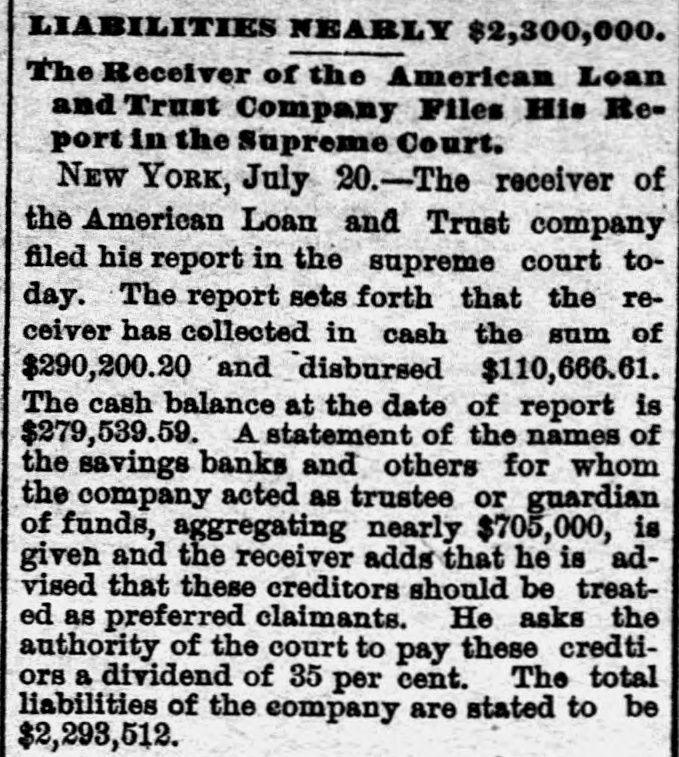
LIABILITIES NEARLY $2,300,000. The Receiver of the American Loan and Trust Company Files His Report in the Supreme Court. NEW YORK, July 20.-The receiver of the American Loan and Trust company filed his report in the supreme court today. The report sets forth that the receiver has collected in cash the sum of $290,200.20 and disbursed $110,666.61. The cash balance at the date of report is $279,539.59. A statement of the names of the savings banks and others for whom the company acted as trustee or guardian of funds, aggregating nearly $705,000, is given and the receiver adds that he is advised that these creditors should be treated as preferred claimants. He asks the authority of the court to pay these credtiors a dividend of 35 per cent. The total liabilities of the company are stated to be $2,293,512.


Article from Evening Journal, July 22, 1891

Click image to open full size in new tab

Article Text

RECEIVER SIMMONS says the American Loan and Trust Company of New York was "conducted like a low gambling den;" that heavy loans were made on rotten securities: that bankrupts and convicts were among the easily accomodated borrowers


Article from New-York Tribune, January 24, 1892

Click image to open full size in new tab

Article Text

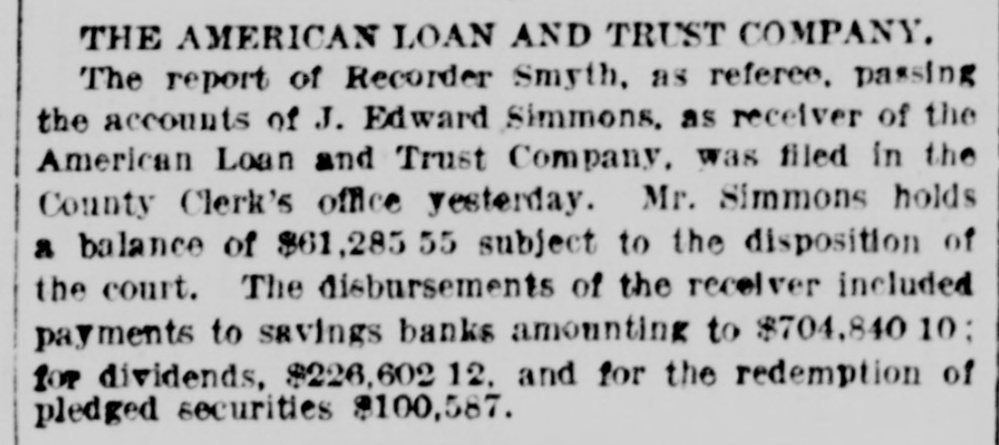
# THE AMERICAN LOAN AND TRUST COMPANY. The report of Recorder Smyth, as referee, passing the accounts of J. Edward Simmons, as receiver of the American Loan and Trust Company, was filed in the County Clerk's office yesterday. Mr. Simmons holds a balance of $61,285 55 subject to the disposition of the court. The disbursements of the receiver included payments to savings banks amounting to $704,840 10; for dividends, $226,602 12, and for the redemption of pledged securities $100,587.


Article from The Sun, July 13, 1893

Click image to open full size in new tab

Article Text

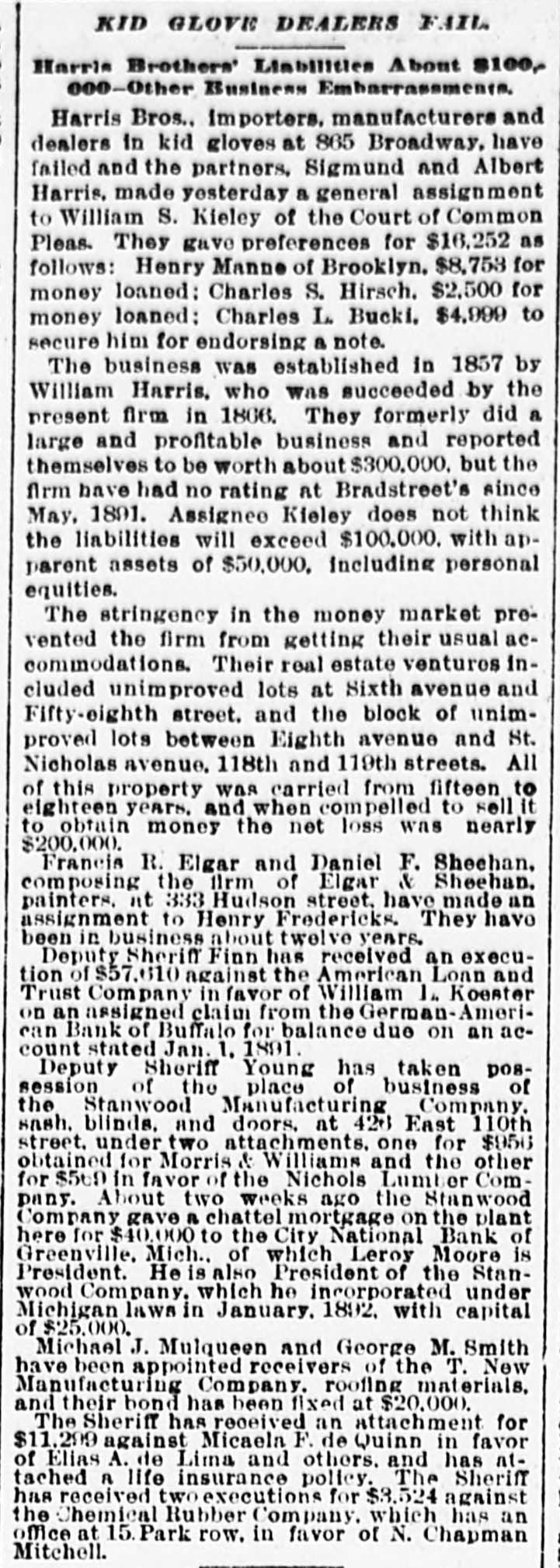
# KID GLOVE DEALERS FAIL Harris Brothers' Liabilities About $100, 000-Other Business Embarrassments. Harris Bros., importers, manufacturers and dealers in kid gloves at 865 Broadway, have failed and the partners, Sigmund and Albert Harris, made yesterday a general assignment to William S. Kieley of the Court of Common Pleas. They gave preferences for $16,252 as follows: Henry Manne of Brooklyn, $8,753 for money loaned; Charles S. Hirsch, $2,500 for money loaned; Charles L. Bucki, $4,999 to secure him for endorsing a note. The business was established in 1857 by William Harris, who was succeeded by the present firm in 1866. They formerly did a large and profitable business and reported themselves to be worth about $300,000, but the firm have had no rating at Bradstreet's since May, 1891. Assignee Kieley does not think the liabilities will exceed $100.000, with ap- parent assets of $50,000, including personal equities. The stringency in the money market pre- vented the firm from getting their usual ac- commodations. Their real estate venturos in- cluded unimproved lots at Sixth avenue and Fifty-eighth street, and the block of unim- proved lots between Eighth avenue and St. Nicholas avenue, 118th and 119th streets. All of this property was carried from fifteen to eighteen years, and when compelled to sell it to obtain money the net loss was nearly $200,000. Francis R. Elgar and Daniel F. Sheehan, composing the firm of Elgar & Sheehan, painters, at 333 Hudson street, have made an assignment to Henry Fredericks. They have been in business about twelve years. Deputy Sheriff Finn has received an execu- tion of $57,010 against the American Loan and Trust Company in favor of William 1. Koester on an assigned claim from the German-Ameri- can Bank of Buffalo for balance due on an ac- count stated Jan. 1, 1891. Deputy Sheriff Young has taken pos- session of the place of business of the Stanwood Manufacturing Company, sash, blinds, and doors, at 420 East 110th street, under two attachments, one for $956 obtained for Morris & Williams and the other for $509 in favor of the Nichols Lumber Com- pany. About two weeks ago the Stanwood Company gave a chattel mortgage on the plant here for $40.000 to the City National Bank of Greenville, Mich., of which Leroy Moore is President. He is also President of the Stan- wood Company, which he incorporated under Michigan laws in January, 1892, with capital of $25,000. Michael J. Mulqueen and George M. Smith have been appointed receivers of the T. New Manufacturing Company, roofing materials, and their bond has been fixed at $20,000. The Sheriff has received an attachment for $11,209 against Micaela F. de Quinn in favor of Elias A. de Lima and others, and has at- tached a life insurance policy. The Sheriff has received two executions for $3.524 against the Chemical Rubber Company, which has an office at 15. Park row, in favor of N. Chapman Mitchell.


Article from The Progressive Farmer, July 18, 1893

Click image to open full size in new tab

Article Text

Harris Bros., New York, importers, manufacturers and dealers in kid gloves, assigned on the 12th. Liabilities, $100,000. Elgar & Sheehan, painters, New York, assigned on the 12th. Richard Wooley's Sons, New York, were attached by the sheriff for a debt of $21,000 on the 12th. American Loan and Trust Company, New York, were attached by an execution for $57,610 on the 12th. Attachments were issued on the 12th against the Standard Manufacturing Co., John H. Queen, M. F. De Quin, C. W. Webb, all of New York, on the 12th, for large amounts. The New Jersey Sheep and Wool Co., Trenton, N. J., went into the hands of a receiver on the 12th. A freight train on the Findly, Fort Wayne and Western R. R., was seized by a sheriff for taxes due, on the 12th. R. M. Ollcott, exporter of grain and general merchandise, N. Y., assigned on the 12th. Liabilities over $50,000. SIOUX CITY, July 14 - -Baker & Birhall, hardware merchants, have failed. Liabilities $10.000. BUFFALO, N. Y., July 13 The safe in Ward's Bank at Forestville has been opened at last. Only $71 in cash was discovered, mostly in silver and pennies. Very few securities were found. Certificates representing several thousand shares of mining stock, which are considered valueless, are all the assets now known. The liabilities are unobtainable. The only ones known are the amounts due depositors, which together are somewhat over $100,000. It is doubtful if the depositors will ever receive over 10 or 15 per cent. TERRE HAUTE, Ind., July 13.-The Terre Haute Car Works Company, the largest in Indiana, employing more


Article from New-York Tribune, May 30, 1894

Click image to open full size in new tab

Article Text

BITS OF LEGAL NEWS. Justice Patterson, of the Supreme Court, yesterday appointed Calvin Frost referee on the claim of the American Lloyds, of America, to $90,000, In the hands of ex-Mayor Hugh J. Grant, as receiver of the St. Nicholas Bank. J. Edward Simmons, receiver of the American Loan and Trust Company, was yesterday authorized by Justice Patterson, of the Supreme Court, to sell $100,000 par of Consolidated New-York City two and a half bonds, which have been transferred to him by Charles M. Preston, the superintendent of the State Banking Department. These bonds were deposited with the Trust Company at the time of its failure, under the banking laws, and were taken possession of by the superintendent of the Banking Department. They have now been turned over to the receiver, who wants to sell them and divide the assets in his possession. Edith Allen, the divorced wife of Colonel Vanderbilt Allen, the grandson of Commodore Vanderbilt, yesterday secured from Justice Patterson, of the Supreme Court, a temporary injunction against the Farmers' Loan and Trust Company and the United States Trust Company, restraining them from paying over to Colonel Allen, or any other persons in his behalf, any interest or income of certain bonds and funds which they have in their possession, in trust for him, until he has compiled with an order of the Supreme Court for the payment of alimony to Mrs. Allen, under the decree of divorce which she secured against him several years ago. Proceedings have been taken in the Surrogate's Court, through Edmund Kelly, for a revocation of the probate of the will of Michael J. B. Messemer, in behalf of Charlotte Von Kuchnau, who lives in Europe. It is now alleged that this will admitted to probate is not the last will of Mr. Messemer, but that he executed one on December 15, 1893, while he was staying at Falckenstein, Germany. Under this will he appointed his brother, Edward J. Messemer, and the petitioner. executor and executrix. She states that she is named as legatee under the will executed in 1893, and has an interest in the estate. The matter will be brought before Surrogate FitzGerald on Monday next. An order was signed by Justice Patterson, of the Supreme Court, yesterday directing Mrs. Florence S. Striker to pay to J. Lewis Lyon, as receiver of the property at the southwest corner of Fiftiethst. and Ninth-ave., $574. which she collected from the tenants after the appointment of the receiver in a suit brought by the Garfield National Bank for the foreclosure of a mortgage. A report was submitted yesterday to Surrogate Fitzgerald by Thomas E. Rush, referee on the claim to the estate of David K. Williams, made by a woman calling herself Mrs. Sarah Williams, his widow. but generally known as "Widow O'Toole." The referee decided that the claimant to the $75,000 left by Williams had failed to make good her assertion that she was his common law widow. He reports that the property should be divided among Mrs. A. L. Shaw, of Flushing, L. I., a sister of Williams, and various nephews and nieces. A motion was made by counsel to confirm the report. The motion was opposed by J. C. Quinn and decision reserved.


Article from New-York Tribune, November 16, 1894

Click image to open full size in new tab

Article Text

HEAVY MORTGAGE FORECLOSURE DIFFICULTIES OF THE SARATOGA GAS AND ELECTRIC LIGHT COMPANY Saratoga, Nov. 15.-The Saratoga Gas and Electrie Light Company was among the corporations whose bonds were floated by Coffin & Stanton, when it was organized about seven years ago, by William Foster, jr., Rowland N. Hazard of NewYork, and others, who capitalized it at $350,000. The company was founded on two former plants, the Saratoga Gas Company and the Saratoga Electric Light Company For the former the new company paid $120,000 on its purchase and $35,000 for the latter. and executed a trust mortgage to the American Loan and Trust Company for $300,000. Under this the company issued $300,000 in bonds, which were placed with Coffin & Stanton at 90. From the $270,000 thus received, the company used $75,000 in improvements to the plant and lost $55,000 to Rowland N Hazard, who was the treasurer of the company. William Foster jr., of No. 146 Broadway, New-York City, was president of the company, and E. H. Peters, of Saratoga, its first secretary, was succeeded by William V. Reynolds, of No. 93 Nassau-st. New-York City, When the American Loan and Trust Company failed. the New-York Security and Trust Company was substituted as mortgage trustee. It is now foreclosing the mortgage. and 1. B. Gleason, receiver, of No. 49 Wallst., New- York City, is in charge of the company's finances and plant.


Article from The Daily Morning Journal and Courier, November 30, 1894

Click image to open full size in new tab

Article Text

FINANCIAL A few years ago when, there was "money to burn" a neat financial trick was extensively played. In order to allay whatever little hesitation about burning their money some people might have a "guarantee" was given them that they could get their money back after they had burned it. This trick was especially efficient in the matter of western mortgages. Companies with gilt-edged names and gilt-edged directors made their appearance prepared to guarantee all creation If they were asked to. And between them they did guarantee most of the part of creation west of the Mississippi river in the United States of America. This generous and self-sacrificing action was greatly appreciated by thousands who had not taken the thirty-third degree in human nature and who had not lost faith in the ability of a company to do anything that its advertisements and its agents might say it could do. But alas for the hopes of men. It became plain after awhile that a "guarantee" when tested must have something to sustain it except wind. So there has been great trouble and loss. and though "doubtless the pleasure is as great of being cheated as to cheat," it will be some months before those who have been allowed to discover what a guarantee really is will want any more of the kind of pleasure they have found in the process. The pleasures and the usefulness of the guarantee are called to mind by an auction sale which took place in New York the other day. It was a sale of mortgages on properties in nine southern and eight northwestern and Pacific coast States, and somewhat more than $3,000,000 were realized, which was about 65 per cent. of their par value. There were 3,200 mortgages, and 175 parcels of land that had been obtained by foreclosures, sold. The loans on these properties had been made by the Equitable Mortgage company of Kansas, which had turned off all these mortgages to the American Loan and Trust company to secure the payment fo its debenture bonds. In 1890 the latter company failed, and the Supreme court of New York transferred the trusteeship to the New York Security and Trust company. In September, 1893, the Equitable Mortgage company failed, and its affairs were turned over to receivers. The debenture holders then called upon the New York Security company to sell those securities and in compliance with that demand the sale was ordered. So the holders of these debenture bonds may in the end get half the money they put into them back. And this will make them feel twice as well as they once expected to.