Irving National Bank (New York, NY)

Episode Information

Episode UID
135701292
Episode Type
Suspension → Reopening
Bank Type
national
Bank ID
13570 national
Charter Number
1357
Start Date
August 1, 1907*
Location
New York, New York (40.714, -74.006)

Metadata

Model
gpt-5-mini (chosen from majority vote of a three-model LLM ensemble)
Short Digest
649b3091534d9465

Response Measures

None

Description

Articles describe the 1907 New York banks' suspension of cash payments and issue of clearing-house certificates that would have applied to New York national banks generally.

Events (3)

1. June 29, 1865 Chartered
Source
historical_nic
2. March 1, 1907 Voluntary Liquidation
Source
historical_nic
3. August 1, 1907* Suspension
Cause
Macro News
Cause Details
Systemic panic of 1907: New York banks suspended cash payments and issued clearing-house certificates during the national financial crisis.
Newspaper Excerpt
suspension of payment by the New York banks and the issue by these banks of clearing house certificates
Source
newspapers

Newspaper Articles (8)

Article from The Tucumcari News and Tucumcari Times, December 14, 1907

Click image to open full size in new tab

Article Text

The Shoe Fits the Other Foo Harper's Weekly in a recent issue "jumped astraddle" the Las Vegas bankers editorially because the banks of the Meadow City issued clearing house certificates which courageously and honestly stated upon their face that payment would be made when the clearing house committee deemed advisable. This was done not for the purpose of deceit or to be dishonest, but simply to give those who received clearing house certificates due and timely notice of the purpose and intention of the banks that issued them. Like many other newspapers and many many men that great "journal of civilization" saw the splinter in the eye of the Las Vegas clearing house association but paid no attention to the great big beams in the eyes of the clearing house association and banks in its own great city. The Pueblo Chieftain neatly turns the tables on Harper's Weekly editorially remarking. "The current number of Harper's Weekly contains an editorial 'roast' of the clearing house certificates issued in Las Vegas, New Mexico. In view of the fact that the financial difficulties of the west were wholly due to the suspension of payment by the New York banks and the issue by these banks of clearing house certificates and other forms of 'Johnsmith' currency-as it is now called-it would seem that the Weekly might have found a target for its ammunition nearer home. The New York writer seems to find special objection to the statement that the Las Vegas certificates will be paid when the clearing house committee thinks it is advisable, but the only fault with this seems to be that the New Mexicans have boldly and honorably stated upon the face of these certificates the fact relating to their payment, which fact the New York financiers have tried to conceal and misrepresent."-New Mexican.


Article from The Spokane Press, January 18, 1908

Click image to open full size in new tab

Article Text

How did the panic start? Morgan and the Standard Oil went after the Thomases and Heinze. But that did not shake the financial structure. What first did? When the Commercial bank, owned by Morgan and Ryan, refused to clear for the Knickerbocker Trust Co. That started things. That started the runs. And then, at the command of Morgan, the banks in the clearing house association refused to pay cash to their creditors. They refused to send balances due western bankers. Which forced western banks to the clearing house basis—which precipitated all the alarm and financial trouble that happened. The power of Morgan at that time and afterward is we'l shown by what occurred. When the force of the created panic became greater than anticipated; when it began to threaten the Morgan and Rockefeller interests, Morgan himself took command. What was the first thing he did? He ordered the cessation of all margin stock speculation. His command went to the 1100 members of the stock exchange, and with it went a threat of financial reprisal of any offender. And the order was obeyed. He knew that when a customer put up $100,000 as a margin the broker puts up a like sum, and that some bank must furnish the other $800,000 for the million-dollar gamble. This takes money away from the legitimate business of the country. It depletes the cash reserves, and it drains the channels where money is needed in proper commerce. Who won in this panic? The government turned over many millions without interest to the Wall st, banks. The steel trust gobbled up at a bargain price its chief competitor, the Tennessee Coal & Iron Co.; the New Haven railroad crowd swallowed the competing boat lines, and after the little bargain counter affray is over, Mr. Carnegie opines that it is "an act of Providence," while Mr. Morgan


Article from Crittenden Record=press, July 23, 1908

Click image to open full size in new tab

Article Text

The situation was dramatic. There was never greater evidence to forbearance exemplified. Banks loaned money to each other and refused to pay their depositors. The people put up with it. Every bank in the country could have been made to close or pay its depositors on proper notice; but this drastic measure was not resorted to. Now I wonder how much gratitude there is among the banking fraternity as a result of this leniency. This was not all. As an emergency many banks issued script to tide over the panic. I wish to call attention to the words of Senator Owens, of Oklahoma in a speech in the United States senate, Feb., 26 1908, on this point, which I had the pleasure of hearing. Mr. Owen said: If you will observe the national banks and all other banks issued clear-house certificates issued cashier's checks, and issued various devices to the amount of hundreds of millions for their own relief. These various banks resorted to that practice which we are told by the chairman of the committee on finance will not be endured again, that the country will not stand it another time—although the country will, all right. The country will stand it and will thank God that the banks violate the laws of this country, as we all have done heretofore. When the New York banks, the Boston banks and the Philadelphia banks issued clearing-house certificates, we all knew it was a violation of the law and we thank the good Lord that they had the nerve to violate the laws as they were written, and I, for one, commend them for it, as I would commend the suspension of habeas corpus made sufficient public danger or a vigilance committee when common sense requires it." The statement of December 3, showed that the national banks had outstanding about sixty-five million in clearing-house certificates. Other banks had many millions in certificates. National banks have asked for the privilege of expanding and contracting the bank currency at will but it takes four months to have the notes printed and the present legal limit to nine million per month may delay them in withdrawing; besides, while it increases the volume of money in the country it does not increase the bank's supply as the cost of the government bonds is equal to the amount of circulation issued against them. This handicap has caused the banks to ask for the privilege of issuing an "asset" currency which was discussed for months by congress and turned down. The enormous demands for money incident to moving the great staple crops shocked the business world and creates stringencies that unsettle values. This is a legitimate demand. But artificial demand created by frenzied high finance among stock gamblers is not legitimate and should not be responded to by the government or the banks. The prosperity of the merchant depends on the prosperity of the farmer and the wage-earners. The contestant disturbing factor in the money market is the dumping of the crops on the market faster than needed by the consumers. Every secretary of the treasury, at the instagnation of the banks, for the last twenty years, advocated a "flexible volume of currency." It distresses the financial centers to furnish the enormous amount of money required to move the wheat and cotton crops when they are thrown


Article from New-York Tribune, September 9, 1909

Click image to open full size in new tab

Article Text

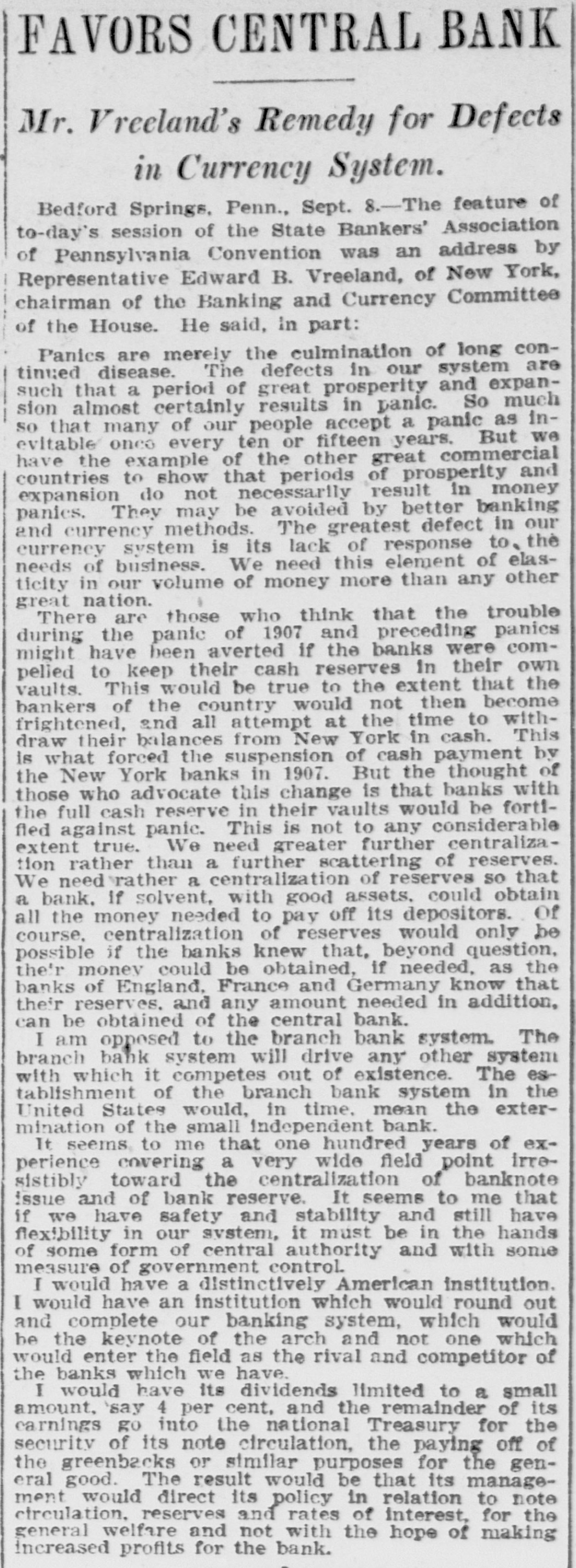
FAVORS CENTRAL BANK Mr. Vreeland's Remedy for Defects in Currency System. Bedford Springs, Penn., Sept. -The feature of to-day's session of the State Bankers' Association of Pennsylvania Convention was an address by Representative Edward B. Vreeland, of New York, chairman of the Banking and Currency Committee of the House. He said, in part: Panics are merely the culmination of long continued disease. The defects in our system are such that a period of great prosperity and expansion almost certainly results in panic. So much so that many of our people accept a panic as inevitable once every ten or fifteen years. But we have the example of the other great commercial countries to show that periods of prosperity and expansion do not necessarily result in money panies. They may be avoided by better banking and currency methods. The greatest defect in our currency system is its lack of response to. the needs of business. We need this element of elasticity in our volume of money more than any other great nation. There are those who think that the trouble during the panic of 1907 and preceding panics might have been averted if the banks were compelied to keep their cash reserves in their own vaults. This would be true to the extent that the bankers of the country would not then become frightened, and all attempt at the time to withdraw their balances from New York in cash. This is what forced the suspension of cash payment by the New York banks in 1907. But the thought of those who advocate this change is that banks with the full cash reserve in their vaults would be fortifled against panic. This is not to any considerable extent true. We need greater further centralization rather than a further scattering of reserves. We need rather a centralization of reserves so that a bank. If solvent, with good assets. could obtain all the money needed to pay off its depositors. Of course, centralization of reserves would only be possible if the banks knew that, beyond question, their money could be obtained, if needed, as the banks of England, France and Germany know that their reserves. and any amount needed in addition, can be obtained of the central bank. I am opposed to the branch bank system. The branch bank system will drive any other system with which it competes out of existence. The establishment of the branch bank system in the United States would, in time, mean the extermination of the small independent bank. It seems to me that one hundred years of experience covering a very wide field point irresistibly toward the centralization of banknote issue and of bank reserve. It seems to me that if we have safety and stability and still have flexibility in our system, it must be in the hands of some form of central authority and with some measure of government control. I would have a distinctively American institution. I would have an institution which would round out and complete our banking system, which would be the keynote of the arch and not one which would enter the field as the rival and competitor of the banks which we have. I would have its dividends limited to a small amount, `say 4 per cent, and the remainder of its earnings go into the national Treasury for the security of its note circulation, the paying off of the greenbacks or similar purposes for the general good. The result would be that its management would direct its policy in relation to note circulation, reserves and rates of interest, for the general welfare and not with the hope of making increased profits for the bank.


Article from Deseret Evening News, July 5, 1910

Click image to open full size in new tab

Article Text

Monetary Commission Issues Statement of History of Crises Under Banking Regulations. RESERVE OF LENDING POWER Prof. Sprague of Harvard Finishes Complete Summary of BankIng History. Washington, July 5.-The most complete summary of the banking history of the great crises of 1873. 1884, 1893 and 1907 which has yet been prepared 18 embodied in a monograph by Prof. O. M. W. Sprague, of Harvard university which has just been made public by the national monetary commission Prof. Sprague not only enters into a careful analysis, covering several hundred pages, of the banking and financial history of these events, but presents also in an appendix several of the most authe ritative articles which have heretofore been written on these subjects by secretaries of the treasury and comptrollers of the currency and by such specialists as Mr. A D. Noyes, of the New York Evening Post; Dr A Piait Andrew, now assistant secretary of the treasury, and the chairman of the New York clearing house committee The account of the crisis of 1907 will naturally attract the greatest interest among bankers because of the recent date of the event and the manner in which Prof. Sprague discusses what he describes as defects in the existing monetary system. He declares that ali the banks judged by the average of the preceding half dozen years, were in a normal condition of strength and that those outside of New York and St Louis were in a slightly stronger condition in 1907 than in 1906 The upward tendency of loans was not 80 marked in New York as in the case of the banks in general The $408,000. 000 of New York bank loans in 1897 was nearly 20 per cent of all the loans of the national banks. while the $712,000,000 in 1907 was just above 15 per cent of the total The Increase in the deposits of state banks and trust companies, however, held by the national banks of New York was striking and, Prof. Sprague thinks might well have been considered alarming In 10 years, from 1897 to 1907 the net deposits due na tional banks by those of New York in creased from $155,000,000 to $213,800,000 while net deposits due to state banks, trust companies, etc increased from $75,900,000 to $196,300,000 From a little more than one-third the aggregate of bankers' deposits in 1897 the deposits due to institutions. had become in almost equal to those due to the national banks. The ease with which the growth of the trust compantes made possible the shifting of tens or millions of loans and deposit liabilities seems to have obscured the essential nature of the situation WOULD CHANGE BURDEN Prof. Sprague points out that if. for any reason It should become necessary for the trust companies to contract their banking operations It would obvlously be necessary for the national banks to shoulder the burden in order to save the local situation There was also the element of outside loans. estimated in 1906 to amount to at least $300,000,000. The outside banks, It is declared feel no responsibility for the course of the market They will nat. urally withdra from It when affairs at home require more of their funds or when they come to distrust the future. It therefore becomes necessary for the local banks in the money center to be able at all times to shoulder at least a part of the loans which may be Hqul dated by outside banks and also LO supply the cash which is thus drawn away Taking up the relation between the New York banks themselves. Prof. Sprague points out that the seven leading banks controlled in 1873 only about 30 per cent of the resources of all the New York national banks. In 1907 the six principal banks-the City. Commerce First. Park, Chase, and Hanover -controlled over 60 per cent of the total Their cash reserve had increased from less than two-fifths to about two-thirds of that held by all the banks The net obligation of these six banks to other bankers on Aug 22. 1907, was $304,200.000 out of a net obligation for the 38 na tional banks of the city of $410,200,000 The only certain resource for banks holding large bankers' deposits is a large cash reserve. and that. Prof. Sprague SBVS was as conspicuously lacking in 1907 as it had been in 1878. In both years net bankers deposits were more than twice the cash reserves of these banks and their proportion of cash to net deposits was but slightly above the 25 per cent required by law The total cash reserve of all banks was $218,800,000. of which the six leading banks held $140 700,000 It is declared that as few of the trust companies held cash reserves in receiving deposits from them the banks were as. suming a risk of a particularly explosive character: but they did not on this account maintain reserves proportionately greater than those held in former years ELEMENT OF WEAKNESS After a lively account of the failure of the so-called Morse banks and the run upon certain trust companies, it is declared that but for the powerful influence of Mr J P. Morgan it is probable that no united action whatever would have been taken. and that "it is certainly an element of weakness in our central money market that in fluential credit institutions should have to be dragooned into doing what is atter all in their own interest as well as to the general advantage When If was decided to issue loan certificates and to suspend cash payments It was in pursuance of a tradition which is an ever present source of weakness and which Prof Sprague savs. can only be broken by successful endurance by the banks of the strain of a crisis The opinion is expressed that there can be little doubt that the seriousness of the general economic situation was greatly exaggerated by observers in New York Evidence of this conclusion is found in the limited number of bankIng failurese which occurred and the short duration of general business de pression contrasted with either 1873 or 1893 In the actual management of the crisis It is argued that resumption of cash payments was delayed unnecessarily and that the additional money secured after suspension served no


Article from The Salt Lake Tribune, July 6, 1910

Click image to open full size in new tab

Article Text

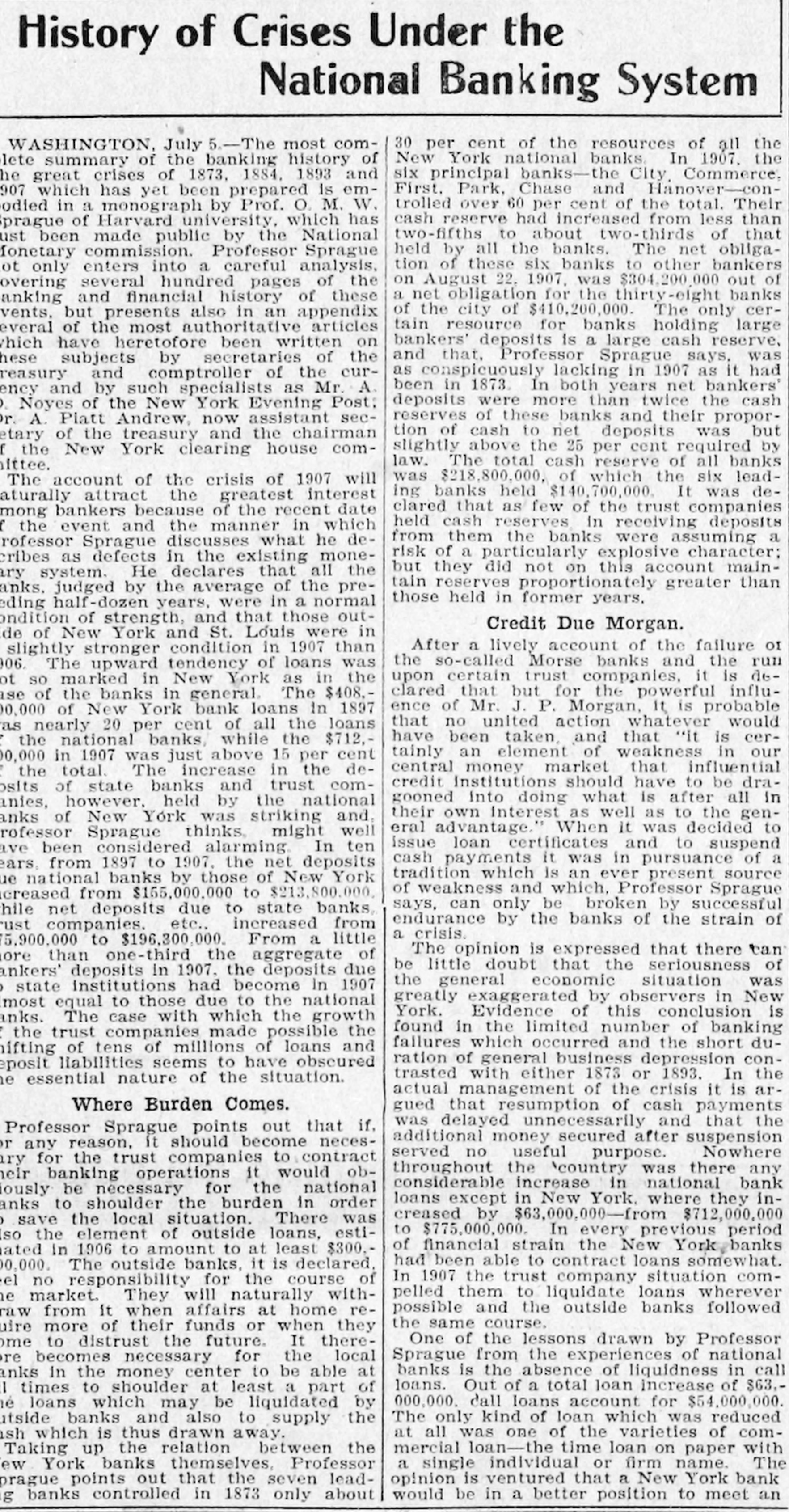
History of Crises Under the National Banking System 30 per cent of the resources of all the WASHINGTON July 5.-The most comNew York national banks In 1907. the lete summary of the banking history of six principal banks-the City, Commerce, he great crises of 1873. 1884. 1893 and First. Park, Chase and Hanover-con907 which has yet been prepared Is emtrolled over 60 per cent of the total. Their odied in a monograph by Prof. O. M. W. cash reserve had increased from less than prague of Harvard university, which has two-fifths to about two-thirds of that ust been made public by the National held by all the banks. The net obligaIonetary commission. Professor Sprague tion of these six banks to other bankers lot only enters into a careful analysis, on August 22. 1907. was $304,200,000 out of overing several hundred pages of the a net obligation for the thirty-eight banks anking and financial history of these of the city of $410,200,000. The only cervents. but presents also in an appendix tain resource for banks holding large everal of the most authoritative articles bankers' deposits is a large cash reserve, which have heretofore been written on and that, Professor Sprague says, was hese subjects by secretaries of the as conspicuously lacking in 1907 as it had reasury and comptroller of the curbeen in 1873 In both years net bankers' ency and by such specialists as Mr. A. deposits were more than twice the cash > Noyes of the New York Evening Post: reserves of these banks and their proporr. A. Platt Andrew, now assistant section of cash to net deposits was but etary of the treasury and the chairman slightly above the 25 per cent required by f the New York clearing house comlaw. The total cash reserve of all banks littee. was $218,800,000. of which the six leadThe account of the crisis of 1907 will ing banks held $140,700,000. It was deaturally attract the greatest interest clared that as few of the trust companies mong bankers because of the recent date held cash reserves in receiving deposits f the event and the manner in which from them the banks were assuming a rofessor Sprague discusses what he derisk of a particularly explosive character; cribes as defects in the existing monebut they did not on this account mainary system. He declares that all the tain reserves proportionately greater than anks, judged by the average of the prethose held in former years. eding half-dozen years, were in a normal ondition of strength, and that those outCredit Due Morgan. de of New York and St. Louis were in After a lively account of the failure or slightly stronger condition in 1907 than the so-called Morse banks and the run 906. The upward tendency of loans was upon certain trust companies, it is deot so marked in New York as in the clared that but for the powerful influse of the banks in general. The $408.ence of Mr. J. P. Morgan, It is probable 0.000 of New York bank loans in 1897 that no united action whatever would as nearly 20 per cent of all the loans have been taken and that "It is certhe national banks, while the $712,tainly an element of weakness in our 0,000 in 1907 was just above 15 per cent central money market that influential the total. The increase in the decredit Institutions should have to be draosits of state banks and trust comgooned into doing what is after all in nies, however, held by the national their own Interest as well as to the genanks of New York was striking and, eral advantage." When it was decided to rofessor Sprague thinks might well Issue loan certificates and to suspend ave been considered alarming In ten cash payments it was in pursuance of a ears, from 1897 to 1907. the net deposits tradition which is an ever present source ue national banks by those of New York of weakness and which, Professor Sprague creased from $155,000,000 to $213,800,000 says, can only be broken by successful hile net deposits due to state banks, endurance by the banks of the strain of ust companies. etc., increased from a crisis. 5.900.000 to $196,300,000. From a little The opinion is expressed that there 'can ore than one-third the aggregate of be little doubt that the seriousness of ankers' deposits in 1907. the deposits due the general economic situation was > state institutions had become In 1907 greatly exaggerated by observers in New most equal to those due to the national York. Evidence of this conclusion is anks. The case with which the growth found in the limited number of banking : the trust companies made possible the failures which occurred and the short duhifting of tens of millions of loans and ration of general business depression coneposit liabilities seems to have obscured trasted with either 1873 or 1893. In the e essential nature of the situation. actual management of the crisis it is arWhere Burden Comes. gued that resumption of cash payments was delayed unnecessarily and that the Professor Sprague points out that if, additional money secured after suspension r any reason, it should become necesserved no useful purpose. Nowhere rry for the trust companies to contract throughout the \country was there any heir banking operations it would obconsiderable increase in national bank lously be necessary for the national loans except in New York, where they inanks to shoulder the burden in order creased by $63,000,000-from $712,000,000 ) save the local situation. There was to $775,000,000. In every previous period so the element of outside loans, estiof financial strain the New York banks lated in 1906 to amount to at least $300.had been able to contract loans somewhat. 0.000. The outside banks, it is declared, In 1907 the trust company situation comel no responsibility for the course of pelled them to liquidate loans wherever e market. They will naturally withpossible and the outside banks followed raw from it when affairs at home rethe same course. uire more of their funds or when they One of the lessons drawn by Professor me to distrust the future. It thereSprague from the experiences of national re becomes necessary for the local banks is the absence of liquidness in call anks in the money center to be able at loans. Out of a total loan increase of $63.I times to shoulder at least a part of 000,000. call loans account for $54,000,000. e loans which may be liquidated by The only kind of loan which was reduced utside banks and also to supply the at all was one of the varieties of comsh which is thus drawn away. mercial loan-the time loan on paper with Taking up the relation between the few York banks themselves, Professor a single individual or firm name. The opinion is ventured that a New York bank prague points out that the seven leadwould be in a better position to meet an g banks controlled in 1873 only about

Article from The Washington Times, December 9, 1913

Click image to open full size in new tab

Article Text

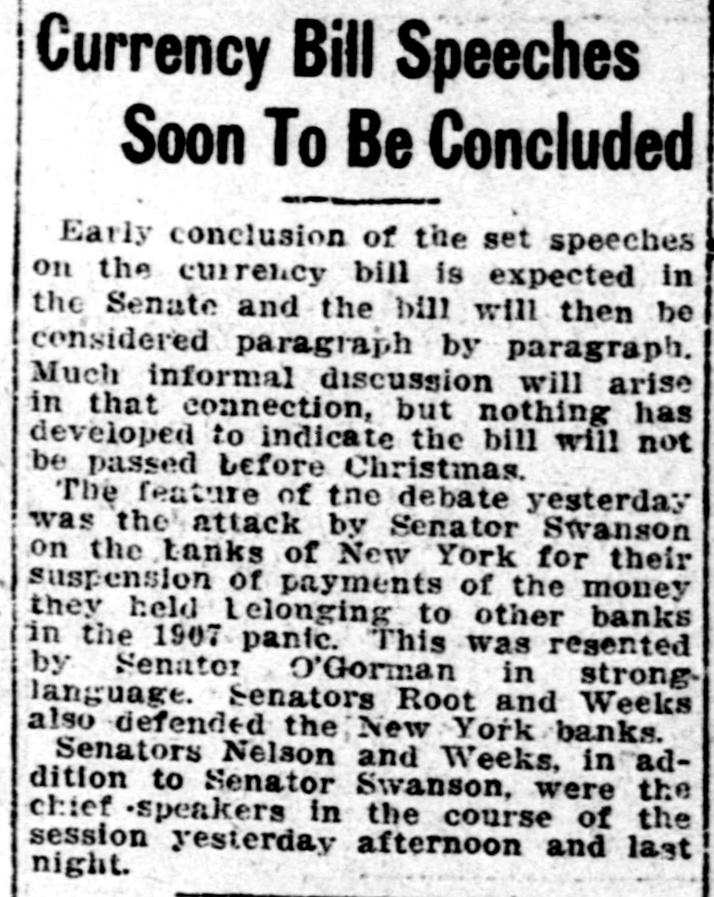
Currency Bill Speeches Soon To Be Concluded Early conclusion of the set speeches on the currency bill is expected in the Senate and the bill will then be considered paragraph by paragraph. Much informal discussion will arise in that connection, but nothing has developed to indicate the bill will not be passed before Christmas. The feature of the debate yesterday was the attack by Senator Swanson on the banks of New York for their suspension of payments of the money they held belonging to other banks in the 1907 panic. This was resented by Senator O'Gorman in strong language. Senators Root and Weeks also defended the New York banks. Senators Nelson and Weeks, in addition to Senator Swanson, were the chief speakers in the course of the session yesterday afternoon and last night.


Article from The Jeffersonian, October 1, 1914

Click image to open full size in new tab

Article Text

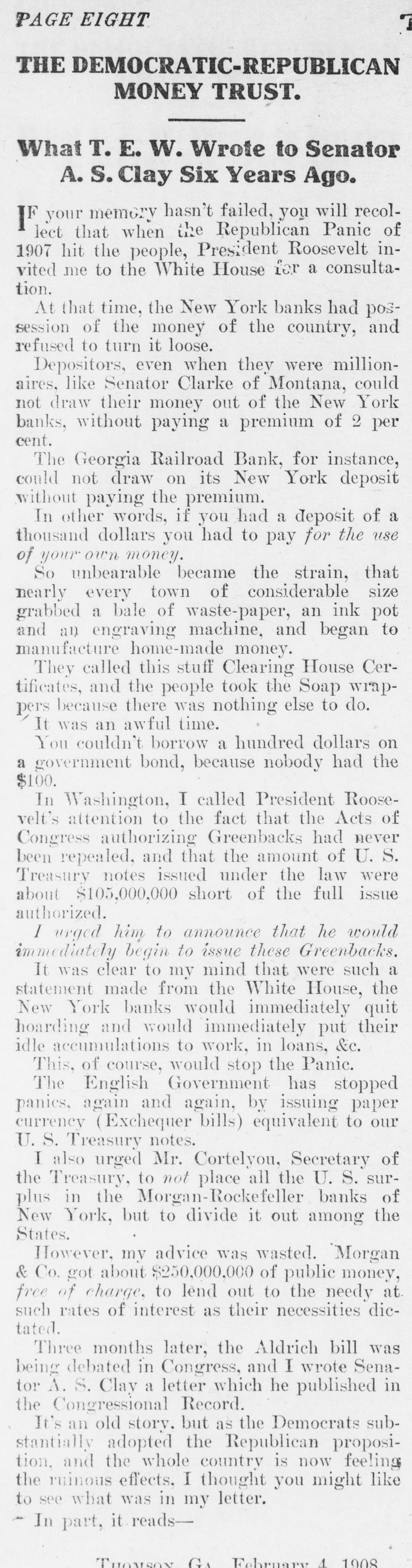
PAGE EIGHT THE DEMOCRATIC-REPUBLICAN MONEY TRUST. What T. E. W. Wrote to Senator A. S. Clay Six Years Ago. IF your memory hasn't failed, you will recollect that when the Republican Panic of 1907 hit the people, President Roosevelt invited me to the White House for a consultation. At that time, the New York banks had possession of the money of the country, and refused to turn it loose. Depositors, even when they were millionaires, like Senator Clarke of Montana, could not draw their money out of the New York banks, without paying a premium of 2 per cent. The Georgia Railroad Bank, for instance, could not draw on its New York deposit without paying the premium. In other words, if you had a deposit of a thousand dollars you had to pay for the use of your own money. So unbearable became the strain, that nearly every town of considerable size grabbed a bale of waste-paper, an ink pot and an engraving machine, and began to manufacture home-made money. They called this stuff Clearing House Certificates, and the people took the Soap wrappers because there was nothing else to do. It was an awful time. You couldn't borrow a hundred dollars on a government bond, because nobody had the $100. In Washington, I called President Roosevelt's attention to the fact that the Acts of Congress authorizing Greenbacks had never been repealed, and that the amount of U. S. Treasury notes issued under the law were about $105,000,000 short of the full issue authorized. I urged him to announce that he would immediately begin to issue these Greenbacks. It was clear to my mind that were such a statement made from the White House, the New York banks would immediately quit hoarding and would immediately put their idle accumulations to work, in loans, &c. This, of course, would stop the Panic. The English Government has stopped panics, again and again, by issuing paper currency (Exchequer bills) equivalent to our U.S. Treasury notes. I also urged Mr. Cortelyou, Secretary of the Treasury, to not place all the U. S. surplus in the Morgan-Rockefeller banks of New York, but to divide it out among the States. However, my advice was wasted. Morgan & Co. got about $250,000,000 of public money, free of charge, to lènd out to the needy at. such rates of interest as their necessities dictated. Three months later, the Aldrich bill was being debated in Congress, and I wrote Senator A. S. Clay a letter which he published in the Congressional Record. It's an old story, but as the Democrats substantially adopted the Republican proposition, and the whole country is now feeling the ruinous effects, I thought you might like to see what was in my letter. In part, it reads— THOMSON GA February 4 1908