Article Text
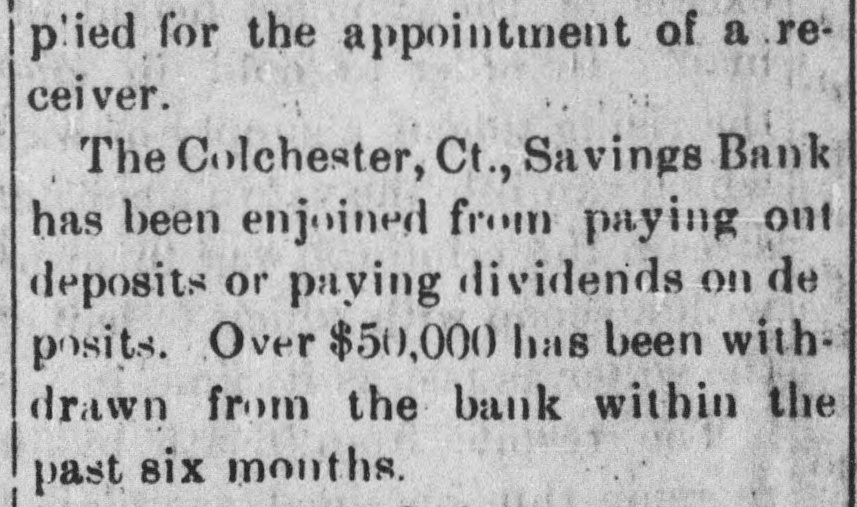
plied for the appointment of a receiver. The Colchester, Ct., Savings Bank has been enjoined from paying ont deposits or paying dividends on de posits. Over $50,000 has been with. drawn from the bank within the past six months.
283a136f3f5b6127None
Click image to open full size in new tab
plied for the appointment of a receiver. The Colchester, Ct., Savings Bank has been enjoined from paying ont deposits or paying dividends on de posits. Over $50,000 has been with. drawn from the bank within the past six months.

Click image to open full size in new tab
money advocates, about $1,000,000. The City national bank of Gatesville, Tex., has suspended. Stealings by "honest" m.oney advocates, about $200,000. The Lebanon, Pa., rolling mills company has made an assignment. W. C. Eccleston, grocer at Natick, R I., has filed a petition in insolvency. A receiver has been appointed for the Salem iron company, of Leetonia, Ohio. J. M. Pancake, general store and gin, at Bush, Tex., has given a trust deed. E. Albertson, dealer in notions, at Hannibal, Mo., has made an assignment. The sheriff has closed the store of W. C. Bernardi, dealer in dry goods at Pittsburg, Pa. E. D. Neustadt & Co., flour commission dealers of New York city, have assigned. A receiver has been appointed for Lundy & Smith, general store at Duncombe, Ia. The American exchange bank of Buffalo, N. Y., has gone into voluntary liquidation. The Bank of Bartley, Neb., is closing its affairs, and is paying depositors' claims in full. It is not run by "honest" money advocates. The Jacksonville, Tampa and Key West railway has been offered for sale in Jacksonville, Fla. George S. Kinney's Sons, wholesale liquor dealers, at Nashville, Tenn., have made an assignment. Tanner & Stark, general store, at Otter Lake, Mich., have given a chattel mortgage in trust for $7,800. L. Graham & Son, printers at New Orleans, have called a meeting of creditors to ask an extension. The Stratto Bros. Company, dealer in dry goods at Gardner, Mass., has made an assignment. The First national bank of Comanche, Tex., chartered in 1886, capital $100,000, surplus $20,000, closed its doors. "Honest" money the cause. James B. Brewster & Co., reorganized, carriage manufacturers at New York, have assigned without preferences. C. Henry Gabel, an undertaker, contractor and builder, of Pottstown, Pa., has made an assignment. The Citizens' bank of Bowling Green, Mo., suspended April 2. It had a paid in capital of $25,000 and deposits of $100,000. "Honest" money did it up. An assignment for the benefit of creditors has been made by the Safe deposit building and loan association in Kensington, Ohio. "Honest" money did it. A. J. Davidson & Co., wholesale dealers in produce and agricultural implements at Helena, Mont., have been attached for $8,000. The comptroller of the currency has given authority for the organization of the First national bank of Greensboro, Pa.; capital, $50,000. Hurrah for "sound" money. The Cumberland coal company, at Sturgis, Ky., owned by capitalists of Nashville, Tenn., with W. W., Smith as president, has assigned. Edward S. and Henry V. Williams, stockholders of the New York history company, have applied for the appointment of a receiver. The Colchester, Ct., savings bank has been enjoined from paying out deposits or paying dividends on deposits. Over $50,000 has been withdrawn from the bank within the past six months. Economy No Panacea. When you hear a man discoursing (un) learnedly about economy and saving something out of his scanty income by subsisting on a poorer living and depriving himself of every species of enjoyment and leisure he hasn't stu.
Click image to open full size in new tab
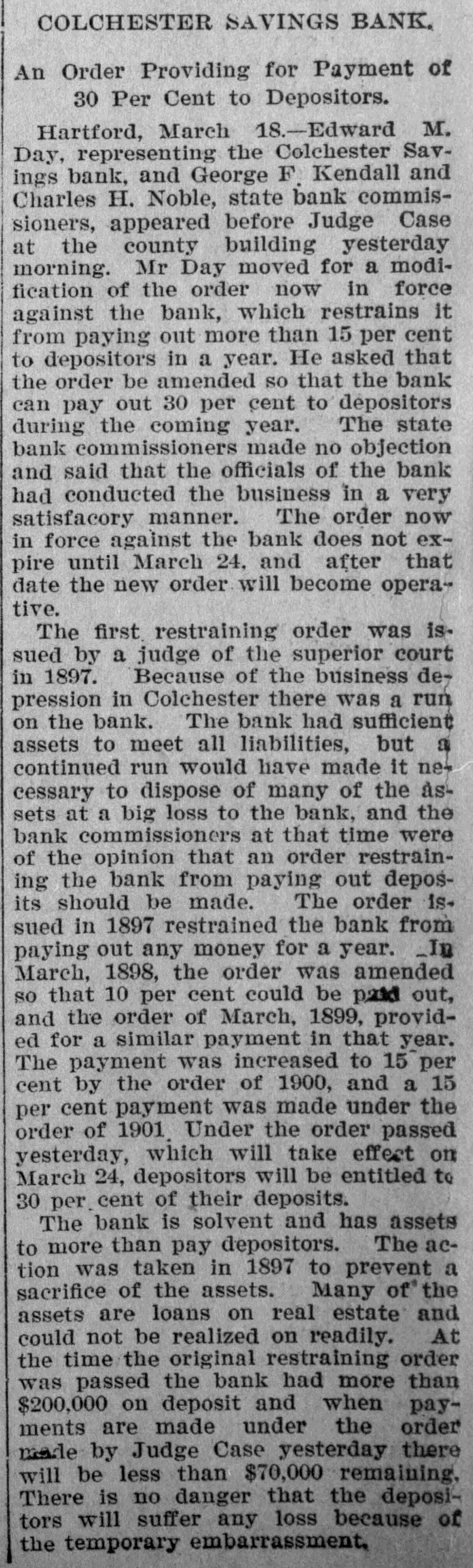
COLCHESTER SAVINGS BANK. An Order Providing for Payment of 30 Per Cent to Depositors. Hartford, March 18.-Edward M. Day, representing the Colchester Savings bank, and George F Kendall and Charles H. Noble, state bank commissioners, appeared before Judge Case at the county building yesterday morning. Mr Day moved for a modification of the order now in force against the bank, which restrains it from paying out more than 15 per cent to depositors in a year. He asked that the order be amended SO that the bank can pay out 30 per cent to depositors during the coming year. The state bank commissioners made no objection and said that the officials of the bank had conducted the business in a very satisfacory manner. The order now in force against the bank does not expire until March 24, and after that date the new order will become operative. The first restraining order was issued by a judge of the superior court in 1897. Because of the business depression in Colchester there was a run on the bank. The bank had sufficient assets to meet all liabilities, but a continued run would have made it ne+ cessary to dispose of many of the àssets at a big loss to the bank, and the bank commissioners at that time were of the opinion that an order restraining the bank from paying out deposits should be made. The order issued in 1897 restrained the bank from paying out any money for a year. _In March, 1898, the order was amended SO that 10 per cent could be paid out, and the order of March, 1899, provided for a similar payment in that year. The payment was increased to 15 per cent by the order of 1900, and a 15 per cent payment was made under the order of 1901 Under the order passed yesterday, which will take effect on March 24, depositors will be entitled to 30 per. cent of their deposits. The bank is solvent and has assets to more than pay depositors. The action was taken in 1897 to prevent a sacrifice of the assets. Many of the assets are loans on real estate and could not be realized on readily. At the time the original restraining order was passed the bank had more than $200,000 on deposit and when payments are made under the order made by Judge Case yesterday there will be less than $70,000 remaining, There is no danger that the depositors will suffer any loss because of the temporary embarrassment,
Click image to open full size in new tab
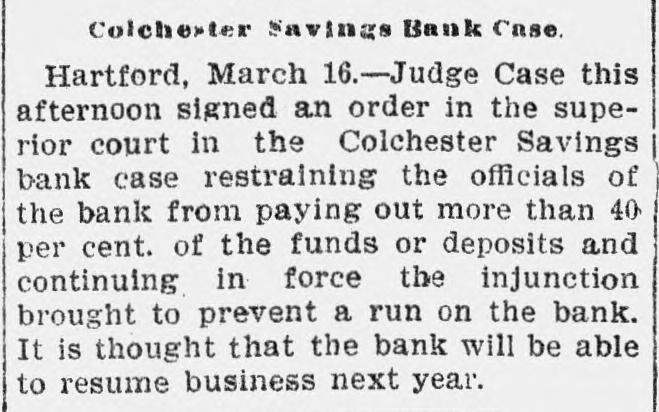
Colchexter Savings Bank Case. Hartford, March 16.-Judge Case this afternoon signed an order in the superior court in the Colchester Savings bank case restraining the officials of the bank from paying out more than 40 per cent. of the funds or deposits and continuing in force the injunction brought to prevent a run on the bank. It is thought that the bank will be able to resume business next year.