13532. Wallkill National Bank (Middletown, NY)

Bank Information

Episode Type
Run → Suspension → Closure
Bank Type
national
Bank ID
1473
Charter Number
1473
Start Date
November 26, 1872
Location
Middletown, New York (41.445, -74.424)

Metadata

Model
gpt-5-mini
Short Digest
44a6c6ec1a8ede55

Response Measures

Borrowed from banks or large institutions, Fed/other loan, Full suspension, Books examined

Receivership Details

Depositor recovery rate
100.0%
Date receivership started
1872-12-31
Date receivership terminated
1880-01-08
OCC cause of failure
Fraud
Share of assets assessed as good
63.0%
Share of assets assessed as doubtful
24.7%
Share of assets assessed as worthless
12.3%

Description

Multiple contemporary newspapers report a run on the Wallkill National Bank in late November 1872 triggered by discovery that President W.M. Graham and Cashier C.H. Horton had misapplied/embezzled bank funds (roughly $50,000–$100,000 reported). The run forced the bank to suspend (articles give suspension dates around Nov 23–26, 1872; the State examiner was called). The bank did not resume normal operations and a receiver (John Burroughs) was subsequently appointed; the institution is repeatedly described as 'defunct' in later pieces. OCR variants of the name (Walkill/Walkill/Walkkin) appear in the sources; corrected to Wallkill. I do not infer any reopening — records in the articles show receivership and litigation. Dates are assigned from the contemporaneous reports (suspension/run in late Nov 1872; receiver appointment reported in 1873).

Events (5)

1. July 21, 1865 Chartered
Source
historical_nic
2. November 26, 1872 Run
Cause
Bank Specific Adverse Info
Cause Details
Discovery that President William M. Graham and Cashier Charles H. Horton had used large sums (reported $50,000–$100,000) of depositors' funds in Wall Street speculations; bonds left for safekeeping were reported missing.
Measures
Directors called an investigation and notified the State Superintendent of Banks; requested an examiner; directors met to investigate; no successful emergency liquidity measures reported.
Newspaper Excerpt
On Monday a run commenced, continuing until Tuesday noon, when the bank was forced to close its doors.
Source
newspapers
3. November 26, 1872 Suspension
Cause
Bank Specific Adverse Info
Cause Details
Forced to suspend because misapplication/embezzlement of funds by the president and cashier left the bank short of funds and a protested draft by Park Bank precipitated depositor withdrawals.
Newspaper Excerpt
The Wallkill National Bank suspended; the bank stopped or suspended on the 26th of November.
Source
newspapers
4. December 31, 1872 Receivership
Source
historical_nic
5. January 1, 1873* Receivership
Newspaper Excerpt
John Burroughs was appointed receiver of the bank (reported in later articles); the bank is described as defunct and in the hands of a receiver in subsequent reports and litigation citations in 1876 and 1879 mentioning the appointment in 1873 and suits by depositors and the Comptroller of the Currency's action against officers' estates).
Source
newspapers

Newspaper Articles (18)

Article from The New York Herald, November 28, 1872

Click image to open full size in new tab

Article Text

NEWBURG ITEMS. Consolatory Verdict of a Jury-A Shower of Stars-Reported Suspension of the Wallkill National Bank. NEWBURG, N. Y., Nov. 27, 1872. The Coroner's jury in the case of Frederick Kirk, of Port Jervis, a brakeman, killed by a freight train at Chester, on the Erie Railroad, some days ago, have rendered a verdict to the effect that the deceased came to his death by being hit by a stone dropped by Daniel Showers from a railroad bridge, striking Kirk on the head and knocking him under the cars. Showers is a colored boy, eight years old, living at Chester. The stone dropped weighs five or six pounds. At this hour (eight P. M.) meteors averaging three per minute are falling, radiating from near the pleiades. The general direction is southeast. Great excitement is occasioned in financial circles in this county by the report to-day of the suspension of the Wallkill National Bank of Middletown. The deficit is stated at from sixty to seventy-five thousand. The President of the bank is ex-State Senator William M. Graham and the Chairman is Charles H. Horton, late democratic candidate for Congress from the Thirteenth district.


Article from The Sun, November 29, 1872

Click image to open full size in new tab

Article Text

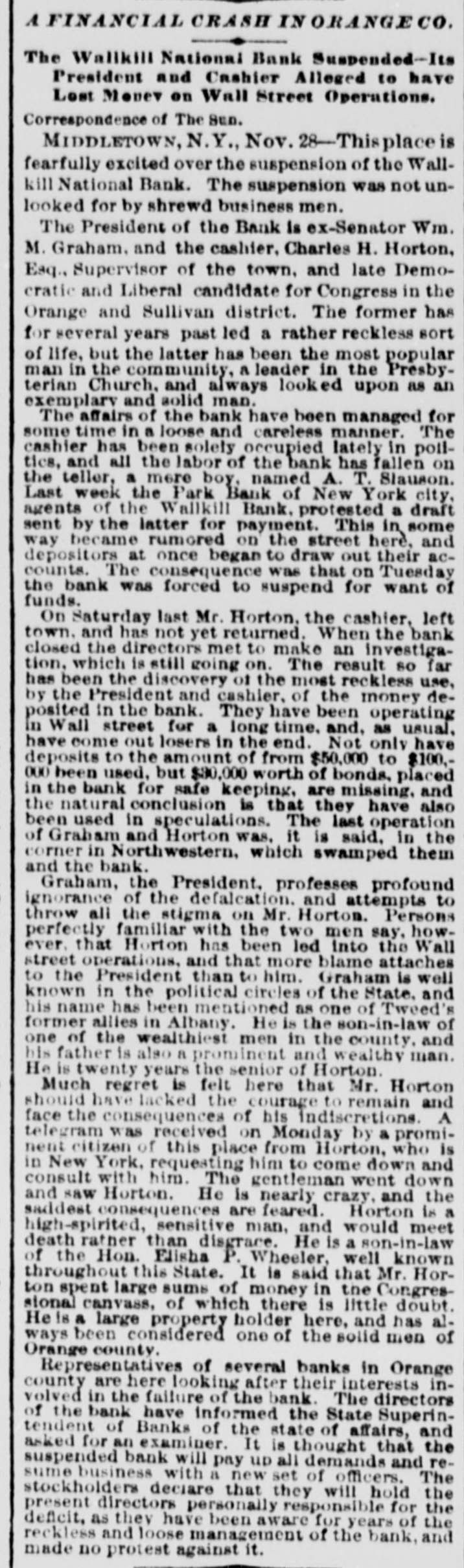
A FINANCIAL CRASH INORANGECO. The Wallkill National Bank Suspended-Its President and Cashier Alleged to have Lost Monev on Wall Street Operations. Correspondence of The Sun. MIDDLETOWN, N.Y., Nov.28-Thisplace fearfully excited over the suspension of the Wallkill National Bank. The suspension was not unlooked for by shrewd business men. The President of the Bank is ex-Senator Wm. M. Graham. and the cashier. Charles H. Horton, Esq., Supervisor of the town, and late Democratic and Liberal candidate for Congress in the Orange and Sullivan district. The former has for several years past led a rather reckless sort of life, but the latter has been the most popular man in the community, a leader in the Presbyterian Church. and always looked upon as an exemplary and solid man. The affairs of the bank have been managed for some time in a loose and careless manner. The cashier has been solely occupied lately in polltics, and all the labor of the bank has fallen on the teller, a more boy, named A. T. Slauson. Last week the Park Bank of New York city, agents of the Wallkill Bank. protested a draft sent by the latter for payment. This in, some way became rumored on the street here, and depositors at once began to draw out their accounts. The consequence was that on Tuesday the bank was forced to suspend for want of funds. On Saturday last Mr. Horton, the cashier. left town. and has not yet returned. When the bank closed the directors met to make an investigation, which is still going on. The result so far has been the discovery of the most reckless use, by the President and cashier. of the money deposited in the bank. They have been operating in Wall street for a long time. and, as usual. have come out losers in the end. Not only have deposits to the amount of from $50,000 to $100,000 been used. but $80,000 worth of bonds. placed in the bank for safe keeping, are missing. and the natural conclusion is that they have also been used in speculations. The last operation of Graham and Horton was. it is said. in the corner in Northwestern. which swamped them and the bank. Graham, the President. professes profound ignorance of the defalcation. and attempts to throw all the stigma on Mr. Horton. Persons perfectly familiar with the two men say, however. that Horton has been led into the Wall street operations, and that more blame attaches to the President than to him. Graham is well known in the political circles of the State. and his name has been mentioned as one of Tweed's former allies in Albany. He is the son-in-law of one of the wealthiest men in the county. and his father is also a prominent and wealthy man. He is twenty years the senior of Horton. Much regret is felt here that Mr. Horton should have lacked the courage to remain and face the consequences of his Indiscretions A telegram was received on Monday by a prominent citizen of this place from Horton, who is in New York, requesting him to come down and consult with him. The gentleman went down and saw Horton. He is nearly crazy, and the saddest consequences are feared. Horton is a high-spirited, sensitive man, and would meet death rather than disgrace. He is a son-in-law of the Hon. Elisha P. Wheeler, well known throughout this State. It is said that Mr. Horton spent large sums of money in the Congressional canvass, of which there is little doubt. Hels a large property holder here, and has always been considered one of the solid men of Orange county. Representatives of several banks in Orange county are here looking after their interests involved in the failure of the bank. The directors of the bank have informed the State Superintendent of Banks of the state of affairs, and asked for an examiner. It is thought that the suspended bank will pay up all demands and resume business with a new set of officers. The stockholders declare that they will hold the present directors personally responsible for the deficit, as they have been aware for years of the reckless and loose management of the bank, and made no protest against it.


Article from Alexandria Gazette, November 29, 1872

Click image to open full size in new tab

Article Text

NEW YORK, Nov. 29.-Last evening an enthusiastic meeting attended by Cubans and their sympthizers was held at Cooper Institute in commemoration of the anniversary of the execution of the eight Havana students. The officers of the North German bark Hannibal from Liverpool fifty-four days, report the direst sufferings from storms during the voyage in which the men underwent the severest privations from hunger and fatigue. It is understood that Judge Brady will hold the December term of the criminal court and will sit through until all the great criminals here are disposed of. At Middleron, N. Y., it has transpired that Wm. M. Graham, and Charles H. Horton. cashier of the Walkill National Bank, used monies of the institution to the amount of about $100,000 in Wall street speculations and being concerned in the northwestcorner were swamped to a large extent. The result was a run on the bank and its failure. The bank officers were men of prominence. Snow fell here this morning to the depth of two inches. The Herald prints two communications signed "Chemist," in which the writer, who says he is one of the Paris communists, states that the Boston fire was the work of labor reformers; that the explosions heard during the fire which were attributed to other things were but explosions of a powerful chemical combination lately invented and known only to him and his confreres, DO larger than an ordinary apple and costing only ninety two cents each. He says their work at Boston was but the commencement and intimates that capitalists shall still further suffer if the rights of labor are not respected.


Article from The New York Herald, November 29, 1872

Click image to open full size in new tab

Article Text

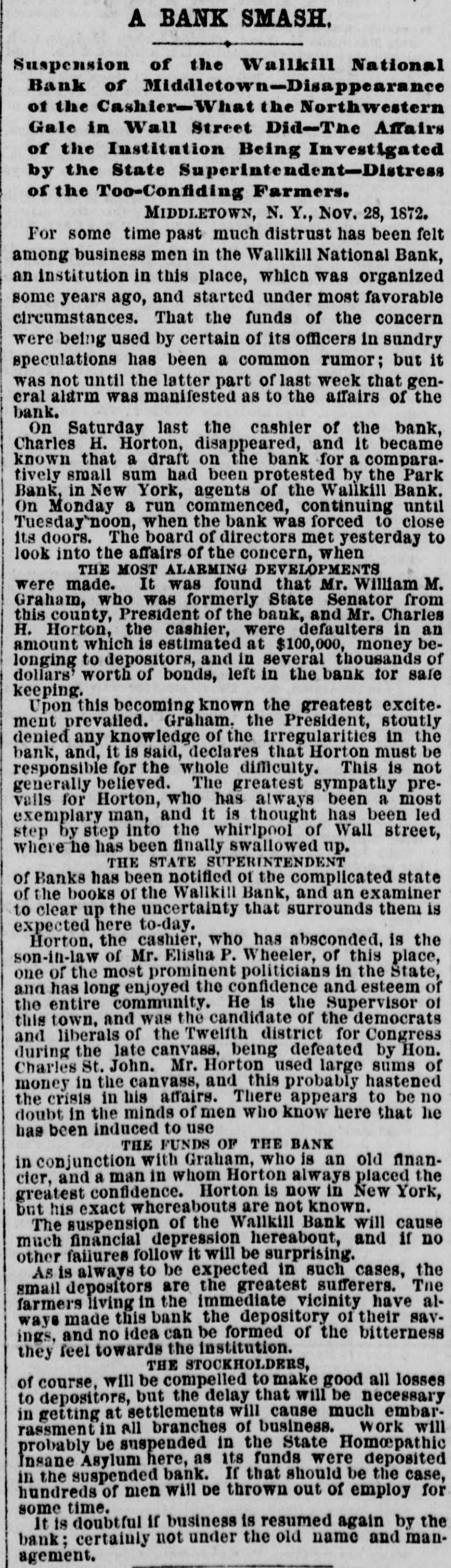
A BANK SMASH. Suspension of the Wallkill National Bank of Middletown-Disappearance of the Cashier-What the Northwestern Gale in Wall Street Did-The Affairs of the Institution Being Investigated by the State Superintendent-Distress or the Too-Confiding Farmers. MIDDLETOWN, N. Y., Nov. 28, 1872. For some time past much distrust has been felt among business men in the Wallkill National Bank, an institution in this place, which was organized some years ago, and started under most favorable circumstances. That the funds of the concern were being used by certain of its officers in sundry speculations has been a common rumor; but it was not until the latter part of last week that general alarm was manifested as to the affairs of the bank. On Saturday last the cashier of the bank, Charles H. Horton, disappeared, and it became known that a draft on the bank for a comparatively small sum had been protested by the Park Bank, in New York, agents of the Wallkill Bank. On Monday a run commenced, continuing until Tuesday noon, when the bank was forced to close its doors. The board of directors met yesterday to look into the affairs of the concern, when THE MOST ALARMING DEVELOPMENTS were made. It was found that Mr. William M. Graham, who was formerly State Senator from this county, President of the bank, and Mr. Charles H. Horton, the cashier, were defaulters in an amount which is estimated at $100,000, money belonging to depositors, and in several thousands of dollars' worth of bonds, left in the bank for sale keeping. Upon this becoming known the greatest excite. ment prevailed. Graham. the President, stoutly denied any knowledge of the irregularities in the bank, and, it is said, declares that Horton must be responsible for the whole difficulty. This is not generally believed. The greatest sympathy prevalls for Horton, who has always been a most exemplary man, and it is thought has been led step by step into the whirlpool of Wall street, where he has been finally swallowed up. THE STATE SUPERINTENDENT of Banks has been notified of the complicated state of the books of the Walikill Bank, and an examiner to clear up the uncertainty that surrounds them is expected here to-day. Horton. the cashier, who has absconded, is the son-in-law of Mr. Elisha P. Wheeler, of this place, one of the most prominent politicians in the State, and has long enjoyed the confidence and esteem of the entire community. He is the Supervisor of this town, and was the candidate of the democrats and liberals of the Twelfth district for Congress during the late canvass, being defeated by Hon. Charles St. John. Mr. Horton used large sums of money in the canvass, and this probably hastened the crisis in his affairs. There appears to be no doubt in the minds of men who know here that he has been induced to use THE FUNDS OF THE BANK in conjunction with Graham, who is an old financier, and a man in whom Horton always placed the greatest confidence. Horton is now in New York, but his exact whereabouts are not known. The suspension of the Wallkill Bank will cause much financial depression hereabout, and if no other failures follow it will be surprising. As is always to be expected in such cases, the small depositors are the greatest sufferers. The farmers living in the immediate vicinity have always made this bank the depository of their savings, and no idea can be formed of the bitterness they feel towards the institution. THE STOCKHOLDERS, of course, will be compelled to make good all losses to depositors, but the delay that will be necessary in getting at settlements will cause much embarrassment in all branches of business. work will probably be suspended in the State Homoepathic Insane Asylum here, as its funds were deposited in the suspended bank. If that should be the case, hundreds of men will be thrown out of employ for some time. It is doubtful If business is resumed again by the bank; certainly not under the old name and management.


Article from Wilmington Daily Commercial, November 30, 1872

Click image to open full size in new tab

Article Text

Thirty-three lottery policy dealers were arrested in New York yesterday. Mary Ann Moore was beaten to death at Dover N. J., on Thursday night. It is believed that the crime was committed by her husband, David Moore, when both were drunk. By the running of the Providence train into a freight train, near the Coliseum, at Boston, the engine and several freight cars were wrecked and four horses killed. The North German bark Hannibal has arrived at New York from Liverpool, after a stormy pasBage of fifty-four days, during which her crew suffered terribly from hunger and fatigue. The Walkill National Bank, at Middletown, N. Y., has suspended. The cause of its suspension is said to be the appropriation by two of its officers of $100,000 of its funds for Wall street speculations and the loss of most of the money through the Northwestern corner.


Article from Nashville Union and American, November 30, 1872

Click image to open full size in new tab

Article Text

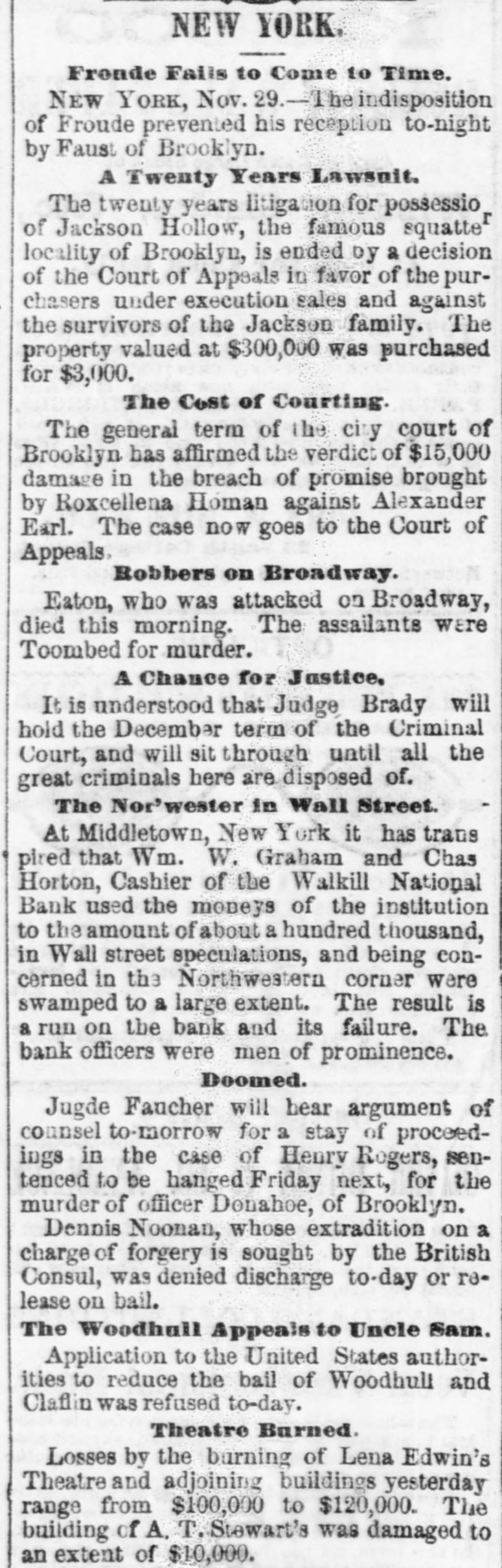
NEW YORK. Fronde Falls to Come to Time. NEW YORK, Nov. 29.-The indisposition of Froude prevented his reception to-night by Faust of Brocklyn. A Twenty Years Lawsnit. The twenty years litigation for possessio of Jackson Hollow, the famous squatte locality of Brooklyn, is ended by a decision of the Court of Appeals in favor of the purchasers under execution sales and against the survivors of the Jackson family. The property valued at $300,000 was purchased for $3,000. The Cost of Courting. The general term of the city court of Brooklyn has affirmed the verdict of $15,000 damage in the breach of promise brought by Roxcellena Homan against Alexander Earl. The case now goes to the Court of Appeals. Robbers on Broadway. Eaton, who was attacked on Broadway, died this morning. The assailants were Toombed for murder. A Chance for Justice. It is understood that Judge Brady will hold the December term of the Criminal Court, and will sit through until all the great criminals here are disposed of. The Nor'wester in Wall Street. At Middletown, New York it has trans pired that Wm. W. Graham and Chas Horton, Cashier of the Walkill National Bank used the moneys of the institution to the amount of about a hundred thousand, in Wall street speculations, and being concerned in the Northwestern corner were swamped to a large extent. The result is a run on the bank and its failure. The bank officers were men of prominence. Doomed. Jugde Faucher will hear argument of counsel to-morrow for a stay of proceedings in the case of Henry Rogers, sentenced to be hanged Friday next, for the murder of officer Donahoe, of Brooklyn. Dennis Noonan, whose extradition on a charge of forgery is sought by the British Consul, was denied discharge to-day or release on bail. The Woodhall Appeals to Uncle Sam. Application to the United States authorities to reduce the bail of Woodhull and Claflin was refused to-day. Theatre Burned. Losses by the burning of Lena Edwin's Theatre and adjoining buildings yesterday range from $100,000 to $120,000. The building of A. T. Stewart's was damaged to an extent of $10,000.


Article from Dallas Herald, November 30, 1872

Click image to open full size in new tab

Article Text

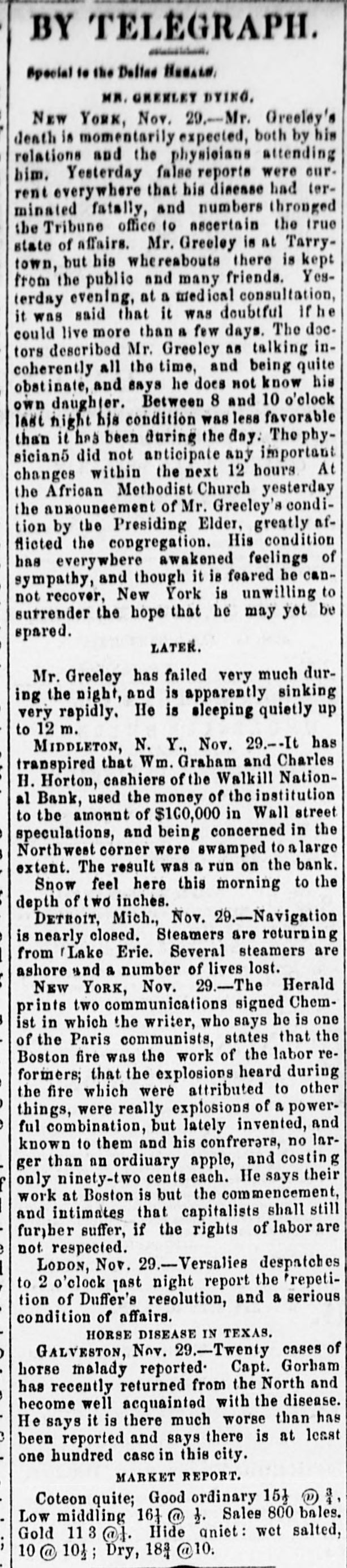
/ Special 10 the Deline Hospital MR. GREELET DYING. NEW YORK, Nov. 29.-Mr. Greeley's death is momentarily expected, both by his and the him. relations Yesterday false physicians reports were attending current everywhere that his disease had terminated fatally, and numbers thronged the Tribune office to ascertain the true state of affairs. Mr. Greeley is at Tarrytown, but his whereabouts there is kept the public and many friends. Yesat a from terday evening, medical consultation, If he it was said that it was doubtful could live more than a few days. The doc. tors described Mr. Greeley as talking incoherently all the time, and being quite obstinate, and says he does not know his Between 8 and 10 o'clock his condition was own last night daughter. less favorable than it has been during the day. The physician5 did not anticipate any important changes within the next 12 hours At the African Methodist Church yesterday the announcement of Mr. Greeley's condithe Presiding Elder, greatly afflicted tion by the congregation. His condition of has everywhere awakened feelings sympathy, and though it is feared he cannot recover, New York is unwilling to surrender the hope that he may yet be spared. LATER. Mr. Greeley has failed very much during the night, and is apparently sinking very rapidly. He is sleeping quietly up to 12 m. MIDDLETON, N. Y., Nov. 29.--It has transpired that Wm. Graham and Charles H. Horton, cashiers of the Walkill National Bank, used the money of the institution to the amount of $100,000 in Wall street speculations, and being concerned in the 3 Northwest corner were swamped to a large extent. The result was a run on the bank. Snow feel here this morning to the depth of two inches. DETROIT, Mich., Nov. 29.-Navigation is nearly closed. Steamers are returning from Lake Erie. Several steamers are ashore and a number of lives lost. : NEW YORK, Nov. 29.-The Herald prints two communications signed Chem3 ist in which the writer, who says he is one of the Paris communists, states that the Boston fire was the work of the labor reformers; that the explosions heard during the fire which were attributed to other things, were really explosions of a powerful combination, but lately invented, and them and his confrerars, no known to and costing larger than an ordiuary apple, f only ninety-two cents each. He says their work at Boston is but the commencement, and intimates that capitalists shall still furnher suffer, if the rights of labor are ) not respected. I LODON, Nov. 29.-Versalies despatches to 2 o'clock last night report the repetition of Duffer's resolution, and a serious condition of affairs. HORSE DISEASE IN TEXAS. ) GALVESTON, Nov. 29.-Twenty cases of horse malady reported Capt. Gorham has recently returned from the North and , become well acquainted with the disease. He says it is there much worse than has C been reported and says there is at least one hundred casc in this city. MARKET REPORT. Coteon quite; Good ordinary 151 01. Low middling 161 @ 1. Sales 800 bales. Gold 11 3 @t. Hide aniet: wet salted, ; 10 @ 101; Dry, 18 10.


Article from The Daily Phoenix, November 30, 1872

Click image to open full size in new tab

Article Text

# MR. GREELEY'S CONDITION were current in many quarters that his disease had terminated fatally, and numbers besieged the Tribune to ascertain the true state of affaire. Mr. Greeley is at Tarrytown, but his whereabouts there are kept from the public and many friends. Yesterday evening, at a medical consultation, it was said that it was doubtful if he could live more than a few days. Dr. W. A. Hammond, one of the physicians, said: "I doubt if he will live forty-eight hours longer, and I should not be surprised to hear of his death to-night. While I was at his bedside," added the Doctor, "Mr. Weed, an old friend of Mr. Greeley's, came up, and wishing to test Mr. Greeley, I said, 'Mr. Greeley, do you know Mr. Weed?' Mr. Greeley stared vacantly, and answered that he had never met him in his life before, and said, further, 'I never heard the name of Weed before.'" The Doctor described Mr. Greeley as talking incoherently all the time, and being quiet and obstinate. He says he doesn't know his own daughter. Between 8 and 10 o'clock, last night, his condition was ess favorable than during the day. His physicians did not anticipate any important change within twelve hours. In the African Methodist Church, yesterday, the announcement of Mr. Greeley's condition by the presiding elder greatly affected the congregation. His condition has everywhere awakened a feeling of sympathy, and though it is feared that he cannot recover, many are unwilling to surrender the hope that he may yet be spared. LATER.-Mr. Greeley failed very much during the night, and is apparently sinking rapidly. He is sleeping quietly this morning. Last evening, an enthusiastic meeting, attended by Cubans and their sympathizers, was held at Cooper Institute, in commemoration of the anniversary of the execution of the eight Havana students. The officers of the North German bark Hannibal, from Liverpool, fifty-four days, report the direst sufferings from stormy during the voyage, in the course of which the men underwent the severest privations from hunger and fatigue. It is understood that Judge Brady will hold the December term of the criminal court, and will sit through until all the great criminals here are disposed of. At Middletown, N. Y., it has transpired that Wm. M. Graham and Charles H. Horton, cashier of the Walkill National Bank, used the funds of the institution to the amount of about $100,000 in Wall street speculations, and being concerned in the North-west corner, were swamped to a large extent, which resulted in a run on the bank. Snow fell here this morning to the depth of two inches. The Herald prints a communication, signed "Chemist," in which the writer, who says he is one of the Paris Communists, states the Boston fire was the work of the labor reformers; that the explosions heard during the fire, which were attributed to other things, were but the explosions of a powerful chemical combination, lately invented, and known only to him and his confreres. It is no larger than an ordinary apple, and cost only ninety-two cents each. He says their work at Boston was but the commencement, and intimates that capitalists shall still further suffer, if the rights of labor are not respected. MONTGOMERY, ALA., November 29. - Governor Lewis sent a communication to the bolters to-day, promising co-operation with them in the Legislature. Governor Lindsey, before retiring, sent his message to the regularly constituted Senate and House, in session at the Capitol. It thus turns out that both bodies have received gubernatorial recognition. The bolters were without a quorum in either house, but by admitting Baker as Senator from Morgan County, Chisholm as Senator from Limestone, Deran as Senator from Marengo, and Miller as Senator from Bulkler and Conecut Counties, none of whom held certificates or other credentials, they got up the necessary quorum. Three of these had never filed a notice of contest on the Senators holding certificates, nor did any one have official knowledge of their claim to seats as Senators, until they appeared and were sworn in. Among the bolters at the United States Court room, the same rule prevailed in getting up a quorum in their House of Representatives, men enough having been there admitted without credentials to do so. This action by Governor Lewis is severely criticised by the people, who say that he has assumed to create a Legislature where, for want of a quorum, none existed before. Much excitement exists, but the Legislature at the Capitol having, in both branches, been called to order by officers and means provided by the Constitution of the


Article from The Daily Dispatch, December 2, 1872

Click image to open full size in new tab

Article Text

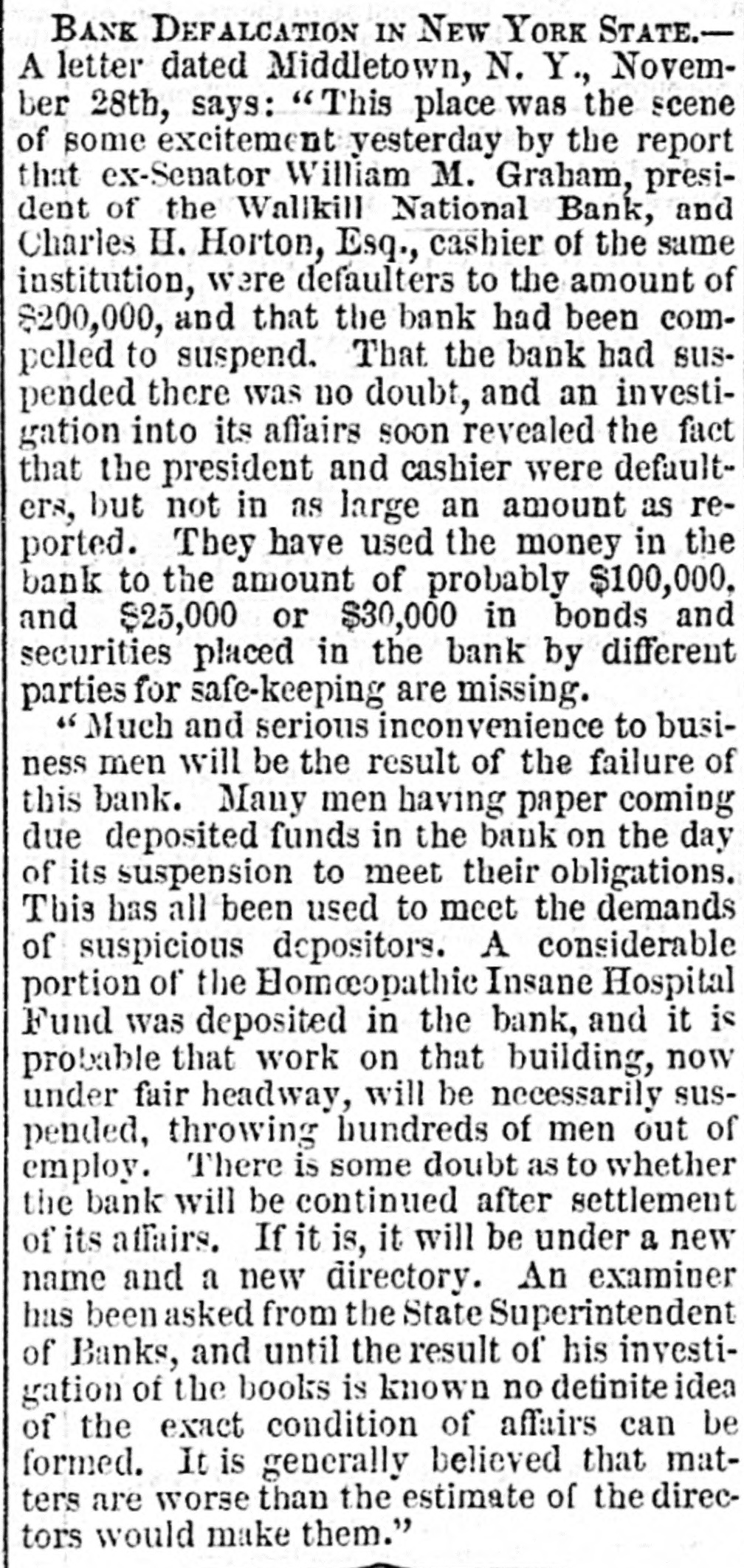
BANK DEFALCATION IN NEW YORK STATE.A letter dated Middletown, N. Y., November 28th, says: "This place was the scene of some excitement yesterday by the report that ex-Senator William M. Graham, president of the Wallkill National Bank, and Charles II. Horton, Esq., cashier of the same institution, were defaulters to the amount of $200,000, and that the bank had been compelled to suspend. That the bank had suspended there was no doubt, and an investigation into its affairs soon revealed the fact that the president and cashier were defaulters, but not in as large an amount as reported. They have used the money in the bank to the amount of probably $100,000, and $25,000 or $30,000 in bonds and securities placed in the bank by different parties for safe-keeping are missing. "Much and serious inconvenience to business men will be the result of the failure of this bank. Many men having paper coming due deposited funds in the bank on the day of its suspension to meet their obligations. This has all been used to meet the demands of suspicious depositors. A considerable portion of the Homceopathic Insane Hospital Fund was deposited in the bank, and it is probable that work on that building, now under fair headway, will be necessarily suspended, throwing hundreds of men out of employ. There is some doubt as to whether the bank will be continued after settlement of its affairs. If it is, it will be under a new name and a new directory. An examiner has beenasked from the State Superintendent of Banks, and until the result of his investigation of the books is known no definite idea of the exact condition of affairs can be formed. It is generally believed that matters are worse than the estimate of the directors would make them."


Article from The New York Herald, December 6, 1872

Click image to open full size in new tab

Article Text

THE WEEKLY HERALD. The Cheapest and Best Newspaper In the Country. The WEEKLY HERALD of the present week, now ready, contains the very Latest News by telegraph from All Parts of the World up to the hour of publication, together with the President's Mea. sage; Annual Report of the Secretary of the Treasury; Death of Horace Greeley, with a Sketch of His Life, the Deathbed Scene and the Last Honors to the Remains; Shipwrecks and Frightful Disasters at Sea and on the Lakes; Shocking Accident on the Delaware and Lackawanna Railroad; A Murderous Arkansas Gambler; Suspension of the Wallkill National Bank of Middletown, and the Public Debt Statement for November. It also contains the latest News by Telegraph from Washington ; Political, Religious, Fashionable, Artistic, Literary and Sporting Intelligence; Obit. uary Notices; Varieties; Amusements; Editorial Articles on the prominent topics of the day; Que Agricultural Budget; Reviews or the Cattle, Horse and Dry Goods Markets; Financial and Com: mercial Intelligence, and accounts of all the im. portant and interesting events of the week. TERMS:-Singlesubscription, $2; Three copies, $5; Five copies, $8; Ten copies, $15; Single copies, five cents each. A limited number of advertisements inserted in the WEEKLY HERALD.


Article from New-York Tribune, December 10, 1872

Click image to open full size in new tab

Article Text

THE WALLKILL BANK INVESTIGATION The examination of ex-Senator William M Graham, charged with embezzling $100,000 from the Wallkill National Bank, Middletown, Orange County, began, yesterday, before Commissioner Osborn. Chas. G. Dill represented the bank, and Chas. S. Spencer appeared for Mr. Graham. A.C. Schlosser testified, in part: I am teller of the Wallkill National Bank; this (referring to a document handed to him) is what is called a "banking dummy;" it is a paper representing a note left with us for collection, last October, by Brown and Beardsley; it is customary to have .. dummies" in this manner, and I don't know of anything wrong in thistransaction. Dr. David C. Winfield testified in substance: I am one of the directors of the bank; it suspended on Nov. 20; a meeting of the directors was held last week Wednesday Dr. Everett, the Vice-President : B. W. Shaw, Leander Crawford, and other directors were present; we sent for Graham, and told him that Mr. Madden had been told by Mr. Horton, the cashier; that he (Graham) was a defaulter to the extent of $50,000; I asked him if that was true, and he said that he did not want to answer till Horton came back; we also asked him what he had done with the bonds and money which he had drawn from the bank in New-York the day before; be said that he had drawn $9,000, $8,000 of which he had applied to redeeming some bonds which he said belonged to his father-in-law, to whom he had given the bonds; he said that he had the other $1,000 at his house; he then got the $1,000 and unwillingly gave it up; when we asked him how he got the means to redeem the bonds, he said that he took down some drafts, and that the rest we had in the bank; I afterward had a private conversation with Graham, and he admitted that he had once privately used a large amount of the bank's funds; he also said that he had paid the bank with Wm. M. Tweed's check for $25,000, with another for $20,000, and with $7,500 in money; I do not know that, by authority of the directors, $10,000 was borrowed from Mr. Denton, and about $40,000 from the Park Bank; I do not know that the law requires the cashier to make a certified statement five times a year; the bank directors met about once a year.


Article from The New York Herald, December 10, 1872

Click image to open full size in new tab

Article Text

THE WALLKILL BANK DEFALCATION. The Charge of Embezzlement Against Ex-Senator William M. GrahamWhat Are "Banking Dummies !"-The Defendant Paying Out Tweed's Checks. Yesterday Commissioner Osborn commenced so take testimony in the case of the United States vs. Ex-Senator William M. Graham, who is enarged with having, while acting as President of the Wallkill National Bank of Middletown, N.Y., embezzled $100,000, the property of the stockholders of that institution. A large number of the directors of the bank were present. Mr. Charles G. Dill appeared on behalf of the bank, Mr. Purdy for the government and Mr. Charles S. Spencer for the prisoner. TESTIMONY FOR THE PROSECUTION. Mr. Schlosser, Teller of the Wallkill Bank, was the first witness:-He was shown a paper, which he declared to be a banking "dummy," representing a note which had been left at their office during the month of October for collection by Mr. Brown, of Brown & Beardsley, the owner of the note; Mr. Graham asked the witness to mark on the collection book "discounted.' On cross-examination the witness said he was not aware there was any wrong in the transaction; it was nothing unusual to have "dummies." Dr. David C. Winfield, one of the directors of the bank, testified that the bank stopped or suspended on the 26th of November; meeting of the directors was held last Wednesday week; they sent for Mr. Graham; witness said to him that Mr. Madden had been told by Horton, the Cashier, that Mr. Graham was a defaulter to the amount of $50,000; witness asked Mr. Graham if that was true; he said ne did not want to answer that question until Horton came pack; we asked him what he did with the bonds and money which he had drawn from the bank in New York the day beforeeither from the Park Bank or from the First National Bank, with both of which the Wallkill Bank was in the habit of transacting business; Mr. Graham said he had drawn $9,000, and had applied $8,000 to redeeming some bonds which, he stated, belonged to his father-in-law, and had given the bonds to him; when asked for the $1.000 he said he had it at his house; he went there, got it and gave it up, unwillingly, as the witness thought; when he was asked how he got the money to redeem the bonds Mr. Graham said he took down some drafts and the rest they had in bank. Witness subsequently had a conversation privately with Mr. Graham, who admitted to him that he had privately used at one time a large amount of the funds of the bank: that he had paid the bank back with a check of William M. Tweed's for $25,000, and with another check for $20,000 and $7,500 in money. Witness did not know that by authority of the directors $40,000 and $10,000 were borrowed from Mr. Denton and about $40,000 from the Park Bank, 80 that you could "retire" a certain amount; did not know that the law required the cashier to make a certified statement every year; the bank directors met but once a year. In the course of the investigation Mr. Spencer, counsel for the accused, several times stated that the charge against Mr. Graham was not specific; that it merely embraced the broad and general language of the statute, and that the affidavit charging the offence was indefinite. The Commissioner ruled that in order to maintain the charge it must be proved that there was a defalcation, that the defendant was connected with that defalcation, and that the body of the offence must be proved. Mr. Spencer replied that that was exactly what he wanted. They should find out how far Mr. Graham was responsible, so that they might have something definite to answer. The further hearing of the case was adjourned for a week.


Article from New-York Tribune, December 31, 1873

Click image to open full size in new tab

Article Text

# TRIAL OF EX-SENATOR GRAHAM. TESTIMONY INDICATING THAT HE EMBEZZLED SE- CURITIES OF THE WALLKILL NATIONAL BANK IN ORDER TO NEGOTIATE A CALL LOAN FROM THE MARKET SAVINGS BANK. The trial of ex-Senator William M. Graham, charged with misapplying the funds of the Wallkill Na- tional Bank, was begun yesterday in the United States Circuit Court, before Judge Benedict. Ex-Judge Fuller- ton appeared as counsel for Mr. Graham, who preserved a very quiet and confident demeanor. Assistant United States District-Attorney Purdy conducted the prosecu- tion, and in his opening remarks to the jury spoke sub- stantially as follows: The prisoner is indicted under Section 55 of the Na- tional Bank act, which says "that every President, director, cashier, teller, or agent, of any association who shall embezzle, abstract, or willfully misapply any of the moneys, funds, or credits of the association, or shall, without authority from the directors, issue or put in cir- culation any of the notes of the association shall be deemed guilty of a misdemeanor, and upon convic- tion thereof shall be punished by imprisonment not less than five nor more than 10 years." The prisoner is in- dicted for converting and misapplying the funds of the Wallkill National Bank. It is always difficult to prove such charges except by surrounding circumstances; but the circumstances of this case point so clearly to the guilt of the prisoner that it does not seem possible for him to escape conviction. We shall show you that when the bank suspended the directors made an examination of its affairs, and found that its entire capital, amounting to $123,000, and $25,000 in deposits, had dis- appeared, with the exception of about $600. On that day, Nov. 23, 1872, the directors also discovered that Horton, the cashier, had absconded, that Graham was absent, and that the bank was in charge of a boy. It will also appear that, in the first instance, Graham embezzled the securities of the Wallkill National Bank for the purpose of negotiating a call loan from the Market Savings Bank, and that he afterward illegally withdrew from the First National Bank money deposited to the credit of the Wallkill National Bank, to take up the securities left in the Market Savings Bank for the call loan referred to. The investigation of the affairs of the bank shows, going back as it does through a series of years, that Graham was as guilty as the cashier. In February, 1871, the bank was in an in- solvent condition, and the Controller of the Currency wrote to Mr. Graham saying that the affairs of the bank were almost bad enough to justify its suspension, and that, for the future, they must be properly attended to. I propose to select a few of the many transactions of the Wallkill National Bank and submit them to the jury, so that they may perfectly understand this case. I shall show by the evidence that Graham and the cashier kept a stock account with Jay Cooke & Co., and that checks were drawn on the funds of the Wallkill National Bank to the amount of $10,000, and were applied on that account. Now the books of that bank show no such account, and yet it appears from them that the money was paid to Jay Cooke & Co. It will further appear that Graham indorsed a large num- ber of notes left at the bank for collection, sold them to a Mr. Gallaudet, and put the proceeds in his own pocket: that Mr. Conklin of the Market Savings Bank, Mr. Gra- ham, and Mr. Horton, the cashier of the Wallkill Na- tional Bank, engaged in stock speculations; that their accounts were kept in the former bank; that Graham's account was kept in his own name, and that he took certain securities left in the Wallkill National Bank and deposited them in the Market Savings Bank as securities for his call loans. After Conklin had left that bank, Graham took from it his securities to the amount of $11,917 25. On Jan. 26, 1872, Graham drew a check for that amount and paid it to the Market Savings Bank; but it was not credited to that bank until almost a month after. Judge Benedict here suggested that, as conviction on any one count of the indictment would be sufficient, it would be better for the Government not to go into all of the counts at first. Acting upon the Judge's suggestion, Mr. Purdy said that he would for the present take up the count charging Graham with paying to the Market Savings Bank $11,917 25 of the funds of the Wallkill National Bank, and the following witnesses testified in behalf of the prosecution: Abraham A. Bromley-I reside in Middletown: Mr. Graham was the President of the Wallkill National Bank in that place; I was one of its directors when it failed; we had a meeting on the third day after the bank failed, when we found that Mr. Graham had been absent; we sent for him and asked him what had become of the money he had taken from the First National Bank; he said that he had given $8,000 of it in five-twenty bonds to his father-in-law, Mr. Denton. Elbert Hegeman-I am assisting the assignee in closing up the affairs of the Market Savings Bank, and I was the assistant teller of that bank; the book handed to me is one of the bank's books, and it contains its account with Mr. Graham. [The book was excluded tempora- rily.] The check shown to me is indorsed "James Den- nis, Receiver of the Market Savings Bank," and Mr. Graham's signature is on the check; it was deposited in the National Park Bank by the Market Savings Bank on Jan. 26, 1872, the day of its date; the cut on it shows that it was paid by the First National Bank, and it was drawn by Mr. Graham; the books of the Market Savings Bank show that it was credited on them. Judge Benedict (after a long discussion)-Did you see the prisoner pay anything in connection with the ac- counts in that book? The witness said that he had not, and he was directed to stand aside. James Dennis-I am an appraiser of real estate; the check handed me bears my signature, and when I wrote it I was the receiver of the Market Savings Bank; the check is to my order; both Horton and Graham had call loans in that bank, and I was one of its trustees be- fore I was appointed receiver; after I had been in the bank a few days as receiver, Graham and Horton came to take up their loans, and they did so; in order to give them the money I had to indorse the check; my counsel told me to do so; on Jan. 26, 1872, when Graham and Horton came to take up their loans, I found the amount of the check from the books, and I gave them nothing but the collaterals and the call loan notes; the check balanced the prisoner's account. The cross-examination elicited nothing new, and the check was admitted in evidence. It was for $11,917 25, and the books showed that it covered Graham's indebt- edness to the bank. H. R. Mills-I was the general bookkeeper of the Market Savings Bank, and the book handed to me is the call loan book of that bank; I kept it, and it contains Graham's account: I was present when Graham came to take up his call loans, and he said that he wanted to take up all loans standing against him; he paid the amount of the loans, and the securities were handed to him: on Jan. 26, 1872, $11,917 25 balanced Horton's and Graham's account with the Market Savings Bank. Mr. Purdy put in evidence the certificate of the or- ganization of the Wallkill National Bank. Geo. F. Baker-I am the cashier of the First National Bank; this check (it was the check for $11,917 25) was paid in full, with the funds on deposit to the credit of the Wallkill National Bank. B. A. McDonald testified-I am an accountant expert, and I have examined the affairs of the Wallkill National Bank; on Feb. 19, 1872, I found a check in that bank for $11,917 25: it was charged to no one, but was credited to the First National Bank; in the books of the Wallkill National Bank I found no account with the Market Savings Bank. Mr. Purdy here asked the Court to direct a verdict of guilty if the jury believed that Graham used the check in question to take up his call loans in the Market Sav- ings Bank. Judge Benedict said that he would do so in the absence of any evidence on the part of the defense. Ex-Judge Fullerton-Suppose, your honor, that on the same day in which Graham withdrew the $11.917 25 from the First National Bank, he deposited an equal amount from his own private funds. Judge Benedict-That would make no difference; if Graham illegally laid his hands upon the money depos- ited to the credit of the Wallkill National Bank, he is guilty. Ex Judge Fullerton-It is very evident that we have been taken by surprise by the introduction of the books of the Market Savings Bank, and we desire time to ex- amine them. My client thinks that he can show that the call loans were made to the Wallkill National Bank. Ex-Judge Fullerton was given a chance to examine the books, and the Court adjourned till to-day. # ROMANCE OF A MURDERER'S ESCAPE. END OF THE MAGGIE JOURDAN TRIAL-THE CASE GIVEN TO THE JURY. The trial of Maggie Jourdan, accused of aiding the murderer Sparkey to escape from the Tombs

Article from The Sun, January 16, 1876

Click image to open full size in new tab

Article Text

The Defunct Wallkill Bank. MIDDLETOWN. N. Y., Jan. 15.-Geo. H. Decker. a Middletown attorney, has been appointed, by Judge Sykeman, as Commissioner to go to Rio Janetro, South America, to take the testimony of Charies H. Horton, the absconding cashier of the defunct Wallkill National Bank, in sixteen suite brought by the depositors in the Supreme Court 01 Orange county against the Institution and John Burroughs, the receiver, to recover for bonds left in the bank, amounting to $40,000, alleged to have been squandered by its officers.


Article from The New York Herald, January 16, 1876

Click image to open full size in new tab

Article Text

THE DEFUNCT WALLKILL BANK. MIDDLETOWN, N. Y., Jan. 15, 1876. George H. Decker, a Middletown attorney, has been appointed by Judge Sykeman as Commissioner to go to Rio Janeiro, South America, to take the testimony of Charles H. Horton, the absconding cashier of the defunct Wallkill National Bank, in sixteen suits, brought by the depositors, in the Supreme Court of Orange county, against the institution and John Burroughs, the receiver, to recover for bonds left in the bank, amounting to $40,000, alleged to have been squandered by its officers.


Article from The New York Herald, March 12, 1876

Click image to open full size in new tab

Article Text

THE WALKILL BANK DEFALCATION. The suit instituted by Comptroller of the Currency Knox against the estate of William M. Graham, the former President, and Charles N. Norton, the former cashier of the Walkill National Bank, to recover the amount of the deficiency in the bank at the time of its failure, was continued yesterday before Register John W. Little. of No. 4 Warren street. Samuel Briggs, of the firm of Brigg & Moody, proprietors of a gambling saloon on Broadway, was the only witness examined. Mr. A. Oakey Hall appeared as Briggs' counsel. It is alleged that Briggs & Moody during the year 1872, while they kept a gambling saloon at No. 16 West Twenty-fourth street swindled Graham out of over $30,000, which amount belonged to the bank. The manner of their alleged fraudulent operation has already been explained in the HERALD. Moody has been keeping out of sight recently to avoid being called as a witness in the case. Mr. George H. Decker appeared yesterday for the assignees and Mr Charles G. Dill for the receivers of the bank. Briggs proved to be a very reloctant witness, answering nearly every question put to him, by don't recollect," or words to that effect, and refused to answer others on the ground that his answers would criminate him. He testified that he lived at No. 119 Perry street, and had known Charies Moody Ive or six years; knew Moody lived at No. 16 West Twenty-fourth street, with his family, and believed that he let out furnished apartments in the house; did not remember how many times he had been in the house, or how any room in the house was furnished; when asked if he had over seen the game of faro played in Moody's house. he declined to answer, on the advice of counsel, on the ground that any person who witnesses a game of the kind commits a felony. Witness thought he had seen Graham in Moody's house, but did not remember who invited him there or what he did there did not remember whether he had ever seen Graham under the influence of liquor. Did not recollect ever having received any money or check from Graham. Did not recollect ever having had any transaction, business or otherwise, with Graham, but visited him at the bank at Middletown on one occasion during banking hours. As the witness' " don't recollect" began to accumulate, Mr. Dill intimated pleasantly, that a man with such a bad memory should be placed in an asylum. There being no hope of obtaining any important evidence from the wily Briggs the examination was ad. journed, at half-past four o'clock, until next Saturday at twelve M.


Article from The Sun, June 4, 1879

Click image to open full size in new tab

Article Text

Wallkin National Bank Troubles. MIDDLETOWN. N. Y., June 3.-In 1872 the Wallkill National Bank of this place failed. Ex-Senator W. M. Graham was the President and Charles H. Horton the Cashier. It was discovered that the bank had been defrauded of several hundred thousand dollars by its officers. Horton, who was the Democratic candidate for Congress, and a son-in-law of the Hon. E. P. Wheeler, fled the country. going to Central America. Senator Graham was arrested. tried. and sentenced to a long term of imprisonment. He was pardoned in 1877. John Burroughs, the author. was app ointed receiver of the bank. A number of stockholders of the defunct bank brought suit recently against the directors to recover $8 1,000 they had lost, averring that it was through negligence in performing their daties as directors that Graham and Horton were able to carry on their peculations. One of the cases was before Judge Barnard on Saturday. He dismissed it without waiting to hear the defence. on the ground that the statute of hunitations barred litigation.


Article from Wood County Reporter, August 31, 1893

Click image to open full size in new tab

Article Text

A LOVER OF NATURE. John Burroughs was born on a farm in the beautiful country near Roxbury, N. Y. He learned to love nature in his babyhood and now at the age of fiftysix his devotions to her is stronger than ever. No man could interpret nature's woods as he has done unless he had the deepest sympathy with them. Such sympathy gives insight. Even the titles of his essays have a deligthful odor of fields and wild flowers about them: Birds and Poets, Locusts and Wild Honey and Wake, Robin, for instance. Mr. Burroughs taught school nine years and then went to New York and became a newspaper man. Then he was a clerk in the treasury department at Washington for nine years more. In 1873 he was appointed receiver of the Wallkill National bank in Middleton, N. Y. A year later he settled on a farm near Esopus, N. Y., and gave his time to literature and fruit culture. The poetic contributions made by Mr. Burroughs to our literature are comparatively few, but one of them at least deserves and will doubtless receive a place among American classics. It is entitled Waiting: