Hanover National Bank (New York, NY)

Episode Information

Episode UID
135201319
Episode Type
Suspension โ†’ Closure
Bank Type
national
Bank ID
13520 national
Charter Number
1352
Start Date
November 2, 1909
Location
New York, New York (40.714, -74.006)

Metadata

Model
gpt-5-mini (chosen from majority vote of a three-model LLM ensemble)
Short Digest
ef75277c6d03802d

Response Measures

None

Description

Supreme Court entries refer to the bank with a receiver (William F. Suddath), indicating closure/receivership.

Events (3)

1. June 28, 1865 Chartered
Source
historical_nic
2. November 2, 1909 Receivership
Newspaper Excerpt
No. 12. The Hanover National Bank of the city of New York. plaintiff in error. agt. William F. Suddath. as receiver. etc.: ... judgment affirmed.
Source
newspapers
3. April 23, 1929 Voluntary Liquidation
Source
historical_nic

Newspaper Articles (9)

Article from The Washington Herald, April 21, 1909

Click image to open full size in new tab

Article Text

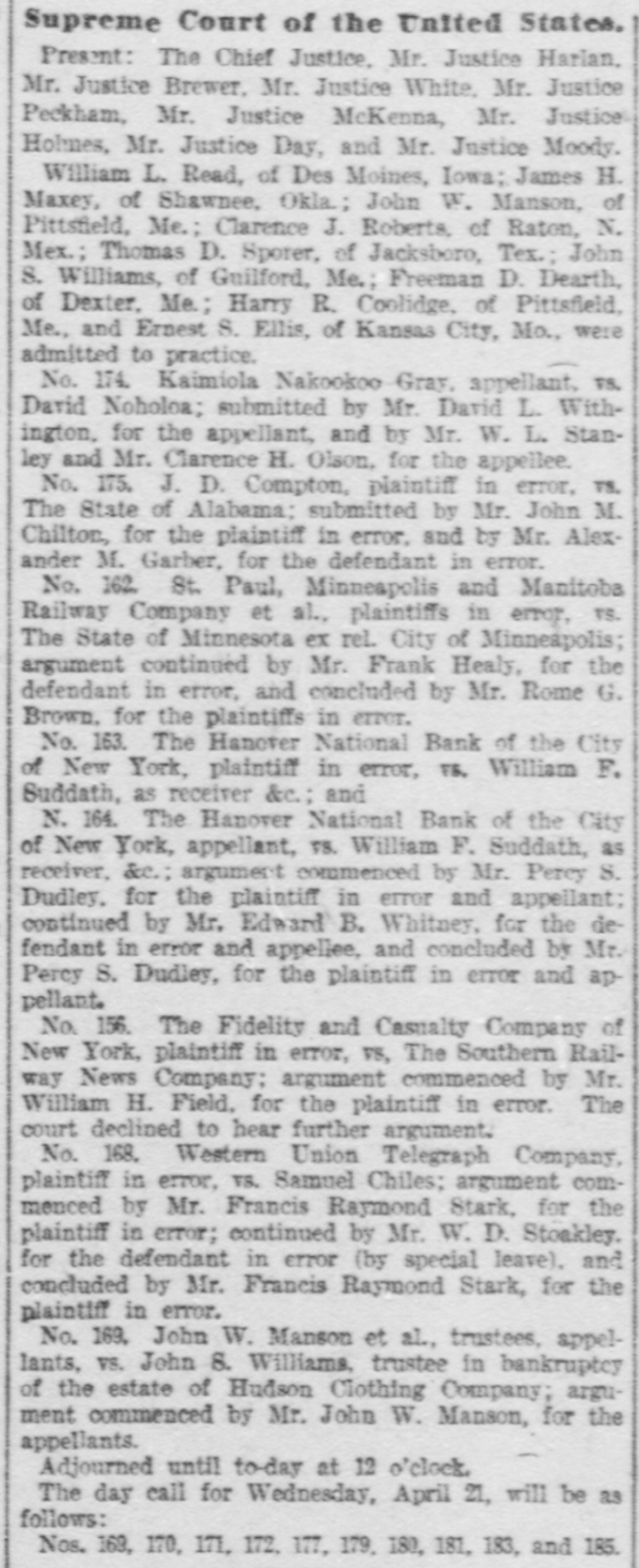
Supreme Court of the United States. Present: The Chief Justice. Mr. Justice Harlan, Mr. Justice Brewer, Mr. Justice White, Mr. Justice Peckham, Mr. Justice McKenna, Mr. Justice Holmes, Mr. Justice Day, and Mr. Justice Moody. William L. Read, of Des Moines, Iowa: James H. Maxey, of Shawnee, Okla: John W. Manson, of Pittsfield, Me.; Clarence J. Roberts, of Raton, N. Mex.; Thomas D. Sporer, of Jacksboro, Tex.: John S. Williams, of Guilford, Me.; Freeman D. Dearth of Dexter. Me.; Harry R. Coolidge. of Pittsfield. Me., and Ernest S. Ellis, of Kansas City, Mo., were admitted to practice. No. 174. Kaimiola Nakookoo Gray, appellant, TS. David Noholoa; submitted by Mr. David L. Withington. for the appellant, and by Mr. W. L. Stanley and Mr. Clarence H. Olson. for the appellee. No. 175. J. D. Compton, plaintiff in error, vs. The State of Alabama: submitted by Mr. John M. Chilton, for the plaintiff in error. and by Mr. Alexander M. Garber, for the defendant in error. No. 162 St. Paul, Minneapolis and Manitoba Railway Company et al., plaintiffs in error, vs. The State of Minnesota ex rel. City of Minneapolis; argument continued by Mr. Frank Healy, for the defendant in error, and concluded by Mr. Rome G. Brown. for the plaintiffs in error. No. 163. The Hanever National Bank of the City of New York, plaintiff in error, F5. William F. Suddath, as receiver &c.; and N. 164. The Hanover National Bank of the City of New York, appellant, vs. William F. Suddath, as receiver, &c.; argument commenced by Mr. Percy S. Dudley. for the plaintiff in error and appellant; continued by Mr. Edward B. Whitney, for the defendant in error and appellee, and concluded by Mr. Percy S. Dudley, for the plaintiff in error and appellant. No. 156. The Fidelity and Casualty Company of New York, plaintiff in error, vs, The Southern Railway News Company: argument commenced by Mr. William H. Field. for the plaintiff in error. The court declined to hear further argument. No. 168. Western Union Telegraph Company. plaintiff in error, vs. Samuel Chiles: argument commenced by Mr. Francis Raymond Stark, for the plaintiff in error; continued by Mr. W. D. Stoakley. for the defendant in error (by special leave). and concluded by Mr. Francis Raymond Stark, for the plaintiff in error. No. 169. John W. Manson et al., trustees, appellants, vs. John 8. Williams, trustee in bankruptcy of the estate of Hudson Clothing Company; argument commenced by Mr. John W. Manson, for the appellants. Adjourned until to-day at 12 o'clock. The day call for Wednesday, April 21, will be as follows: Nos. 169, 170, 171, 172. 177, 179. 180, 181, 183, and 185.

Article from Rock Island Argus, October 19, 1909

Click image to open full size in new tab

Article Text

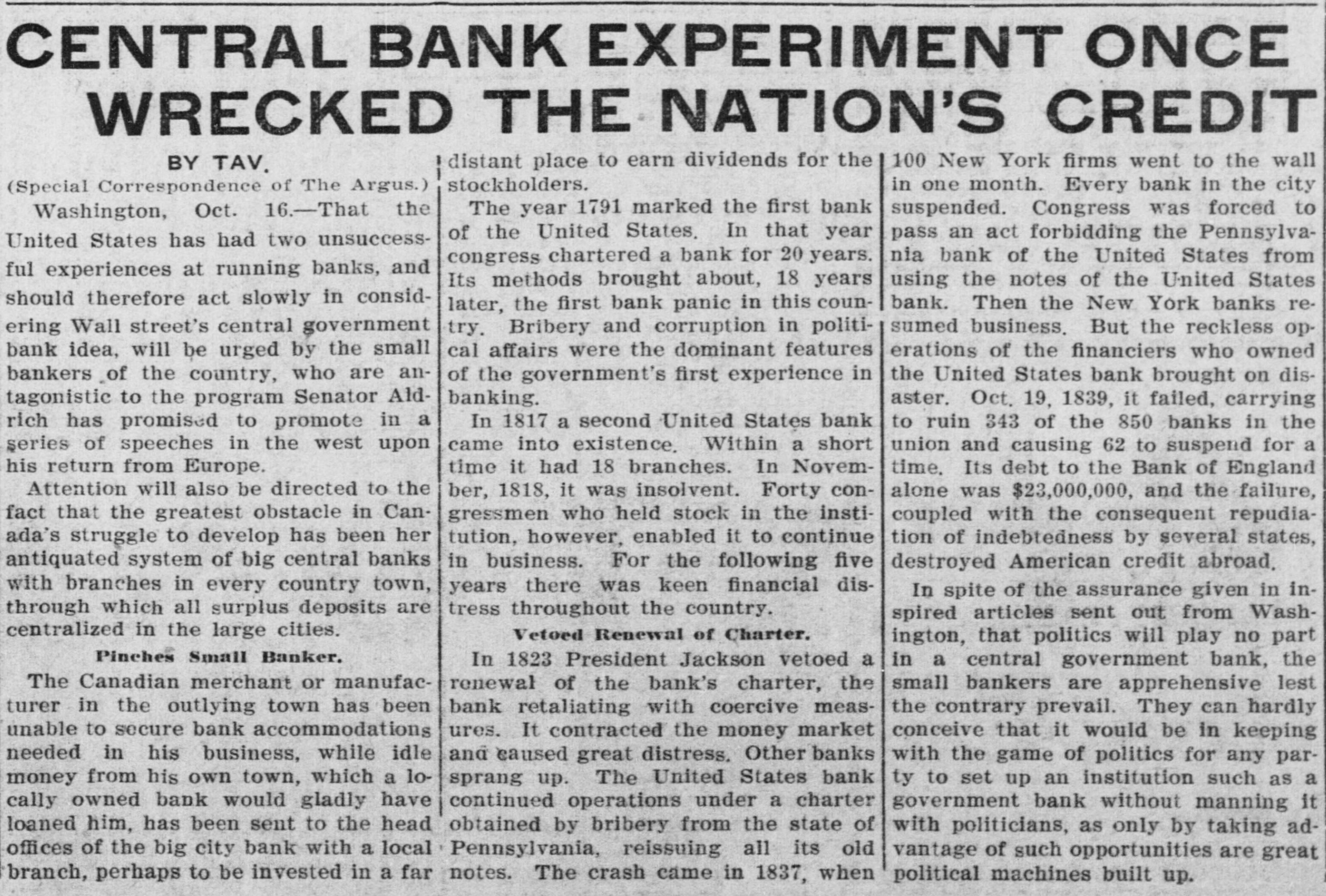
CENTRAL BANK EXPERIMENT ONCE WRECKED THE NATION'S CREDIT 100 New York firms went to the wall distant place to earn dividends for the BY TAV. stockholders. in one month. Every bank in the city (Special Correspondence of The Argus.) suspended. Congress was forced to The year 1791 marked the first bank Washington, Oct. 16.-That the of the United States. In that year pass an act forbidding the PennsylvaUnited States has had two unsuccessnia bank of the United States from congress chartered a bank for 20 years. ful experiences at running banks, and Its methods brought about, 18 years using the notes of the United States should therefore act slowly in considbank. Then the New York banks relater, the first bank panic in this counering Wall street's central government try. Bribery and corruption in politisumed business. But the reckless opcal affairs were the dominant features erations of the financiers who owned bank idea, will be urged by the small bankers of the country, who are anof the government's first experience in the United States bank brought on distagonistic to the program Senator Aldbanking. aster. Oct. 19, 1839, it failed, carrying In 1817 a second United States bank to ruin 343 of the 850 banks in the rich has promised to promote in a came into existence. Within a short series of speeches in the west upon union and causing 62 to suspend for a time it had 18 branches. In Novemhis return from Europe. time. Its debt to the Bank of England Attention will also be directed to the ber, 1818, it was insolvent. Forty conalone was $23,000,000, and the failure, fact that the greatest obstacle in Cangressmen who held stock in the insticoupled with the consequent repudiaada's struggle to develop has been her tion of indebtedness by several states, tution, however, enabled it to continue antiquated system of big central banks in business. For the following five destroyed American credit abroad. with branches in every country town, years there was keen financial disIn spite of the assurance given in inthrough which all surplus deposits are tress throughout the country. spired articles sent out from Washcentralized in the large cities. Vetoed Renewal of Charter. ington, that politics will play no part Pinches Small Banker. In 1823 President Jackson vetoed a in a central government bank, the The Canadian merchant or manufacrenewal of the bank's charter, the small bankers are apprehensive lest turer in the outlying town has been the contrary prevail. They can hardly bank retaliating with coercive measunable to secure bank accommodations ures. It contracted the money market conceive that it would be in keeping needed in his business, while idle and caused great distress. Other banks with the game of politics for any parmoney from his own town, which a losprang up. The United States bank ty to set up an institution such as a cally owned bank would gladly have continued operations under a charter government bank without manning it loaned him, has been sent to the head obtained by bribery from the state of with politicians, as only by taking adoffices of the big city bank with a local Pennsylvania, reissuing all its old vantage of such opportunities are great branch, perhaps to be invested in a far notes. The crash came in 1837, when political machines built up.


Article from Evening Star, November 29, 1909

Click image to open full size in new tab

Article Text

U. S. SUPREME COURT. Monday, November 2. 1909. Present: The Chief Justice, Mr. Justice Harlan. Mr. Justice Brewer, Mr. Justice White, Mr. Justice McKenna. Mr. Justice Holmes and Mr. Justice Day. Asa L. Duncan of Missoula. Mont.: Ralph W. Crockett of Lewiston. Me.: Martin B. Koon of Minneapolis, Minn.: Arthur J. McCabe of Topeka. Kan.: Francis Fitch of New York city: William Howell of Cleveland, Ohio: Lewis L. Delafield of New York city: Frank Stetson of Washington, D. C.; John A. Kratz, jr., of Washington. D. C.: James B. Horigan of Washington, D. C.; Frederick M. Hudson of Miami, Fla., and William R. Vance of Washington, D. C., were admitted to practice. No. 292. The United States, plaintiff in error, agt. Tilden B. Stevenson. et al.; in error to the district court of the United States for the district of Massachusetts; judgment reversed and cause remanded for further proceedings in conformity with the opinion of this court; opinion by Mr. Justice Day. No. 293. The United States. plaintiff in error. agt. Tilden B. Stevenson, et al.: in error to the district court of the United States for the district of Massachusetts; judgment reversed and cause remanded for further proceedings in conformity with the opinion of this court; opinion by Mr. Justice Day. No. 22. Isaac H. Callga, plaintiff in error, agt. Inter Ocean Newspaper Company; in error to the United States circuit court of appeals for the seventh circuit; judgment affirmed with costs and cause remanded to the circuit court of the United States for the northern distriet of Illinois: opinion by Mr. Justice Day. No. 11. The state of Louisiana ex rel. Louis A. Hubert, receiver, plaintiff in error, agt. the mayor and council of the city of New Orleans; in error to the supreme court of the state of Louisiana; judgment reversed with costs and cause remanded for further proceedings not inconsistet with the opinion of this court; opinion by Mr. Justice Day. No. 9. Rumford Chemical Works, petitioner, agt. Higienic Chemical Company: on writ of certiorari to the United States circuit court of appeals for the third circuit; decree affirmed, with costs and cause remanded to the circuit court of the United States for the district of New Jersey: opinion by Mr. Justice Holmes. No. 121. Higienic Chemical Company of New York et al., petitioners, agt. the Rumford Chemical Works; on writ of certiorari to the United States circuit court of appeals for the seventh circuit: decree reversed with costs and cause remanded to the circuit court of the United States for the southern district of New York for further proceedings in conformity with the opinion of this court; opinion by Mr. Justice Holmes. % No. 27. Demetrius M. Steward et al., petitioners, agt. The American Lava Company et al., and No. 28. Moritz Kirchberger et al., petitioners, agt. American Lava Company et al.: on writs of certiorari to the United States circuit court of appeals for the sixth circuit: decrees affirmed with costs and cause remanded to the circuit court of the United States for the eastern district of Tennessee: opinion by Mr. Justice Holmes: dissenting, Mr. Justice McKenna. No. 21. Mathew Scully, plaintiff in error, agt. Louise Squier et al.: in error to the supreme court of the state of Idaho: judgment affirmed with costs: opinion by Mr. Justice McKenna. No. 243. B. W. Simmons, late master of the tug Helen, et al., etc.. agt. the steamship Jefferson. etc.; appeal from the district court of the United States for the eastern district of Virginia: decree reversed. with costs and cause remanded for further proceedings in conformity with the opinion of this court. No. 12. The Hanover National Bank of the city of New York. plaintiff in error. agt. William F. Suddath. as receiver. etc.: is error to the United States circuit court of appeals for the second circuit; judgment affirmed. and cause remanded to the circuit court of the United States for the southern district of New York; opinion by Mr. Justice White No. 13. The Hanover National Bank of the City of New York, appellant. agt. William F. Suddath, as receiver, etc.: appeal from the United States circuit court of appeals for the second circuit: decree affirmed with costs and cause remanded to the circuit court of the United States for the southern district of New York; opinion by Mr. Justice White. No. 31. Thomas J. Kenney et al., specia) administrators of William J. Corbett, deceased. plaintiffs in error, agt. Michael Craven; in error to the superior court of the state of Massachusetts; dismissed for the want of jurisdiction; opinion by Mr. Justice White No. 251. The interstate commerce commission, appellant, agt. A. B. Stickney et al., receivers, etc.; appeal from the circuit court of the United States for the district of Minnesota: decree affirmed, with costs; opinion by Mr. Justice Brewer. No. 1. George L. Everett, plaintiff in error, agt. Edward Everett: in error to the supreme court of the state of New York: dismissed for the want of jurisdiction; opinion hv Mr. Justice Harlan. The Chief Justice announced the following orders of the court: No. 481. Helvetia-Swiss Fire Insurance


Article from The Roswell Daily Record, November 29, 1909

Click image to open full size in new tab

Article Text

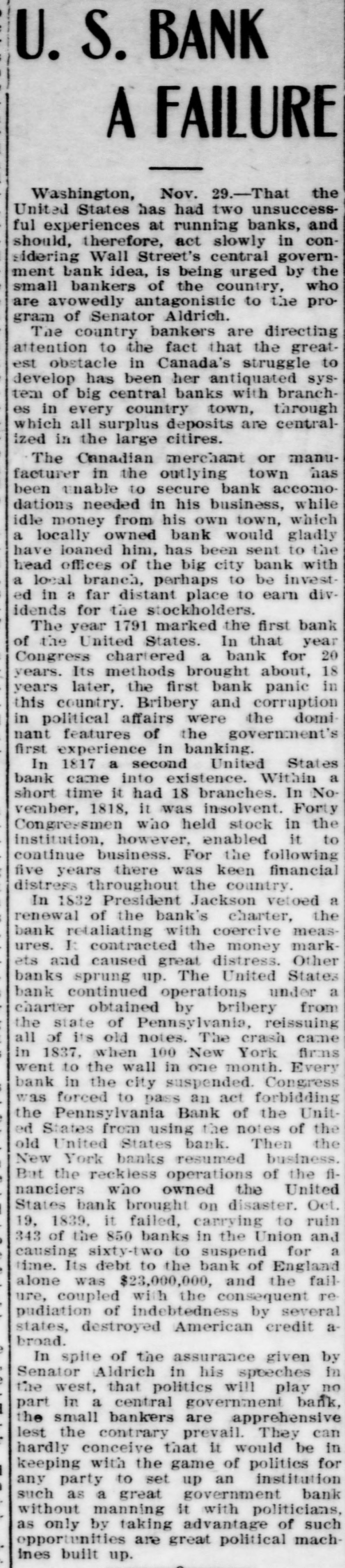
U. S. BANK A FAILURE Washington, Nov. 29.-That the United States has had two unsuccessful experiences at running banks, and should, therefore, act slowly in considering Wall Street's central government bank idea, is being urged by the small bankers of the country, who are avowedly antagonistic to the program of Senator Aldrich. The country bankers are directing attention to the fact that the greatest obstacle in Canada's struggle to develop has been her antiquated systerm of big central banks with branches in every country town, through which all surplus deposits are centralized in the large citires. The Canadian merchant or manufacturer in the outlying town has been unable to secure bank accomodations needed in his business, while idle money from his own town, which a locally owned bank would gladly have loaned him, has been sent to the head offices of the big city bank with a local branch, perhaps to be invested in a far distant place to earn dividends for the stockholders. The year 1791 marked the first bank of the United States. In that year Congress chartered a bank for 20 years. Its methods brought about, 18 years later, the first bank panic in this country. Bribery and corruption in political affairs were the domi nant features of the government's first experience in banking. In 1817 a second United States bank came into existence. Within a short time it had 18 branches. In No. vember, 1818, it was insolvent. Forty Congressmen who held stock in the institution, however, enabled it to continue business. For the following five years there was keen financial distress throughout the country. In 1832 President Jackson vetoed a renewal of the bank's charter, the bank retaliating with coercive measures. I: contracted the money markets and caused great distress. Other banks sprung up. The United States bank continued operations under a charter obtained by bribery from the state of Pennsylvania, reissuing all of its old notes. The crash came in 1837, when 100 New York firms went to the wall in one month. Every bank in the city suspended. Congress was forced to pass an act forbidding the Pennsylvania Bank of the United States from using the notes of the old United States bank. Then the New York banks resumed business. But the reckless operations of the financiers who owned the United States bank brought on disaster. Oct. 19, 1839. it failed, carrying to ruin 343 of the 850 banks in the Union and causing sixty-two to suspend for a time. Its debt to the bank of England alone was $23,000,000, and the failure, coupled with the consequent ren pudiation of indebtedness by several states, destroyed American credit abroad. In spite of the assurance given by Senator Aldrich in his speeches in the west, that politics will play no 1 part in a central government bank, the small bankers are apprehensive [ lest the contrary prevail. They can hardly conceive that it would be in I keeping with the game of politics for any party to set up an institution such as a great government bank without manning it with politicians, as only by taking advantage of such opportunities are great political machines built up. :


Article from New-York Tribune, December 9, 1913

Click image to open full size in new tab

Article Text

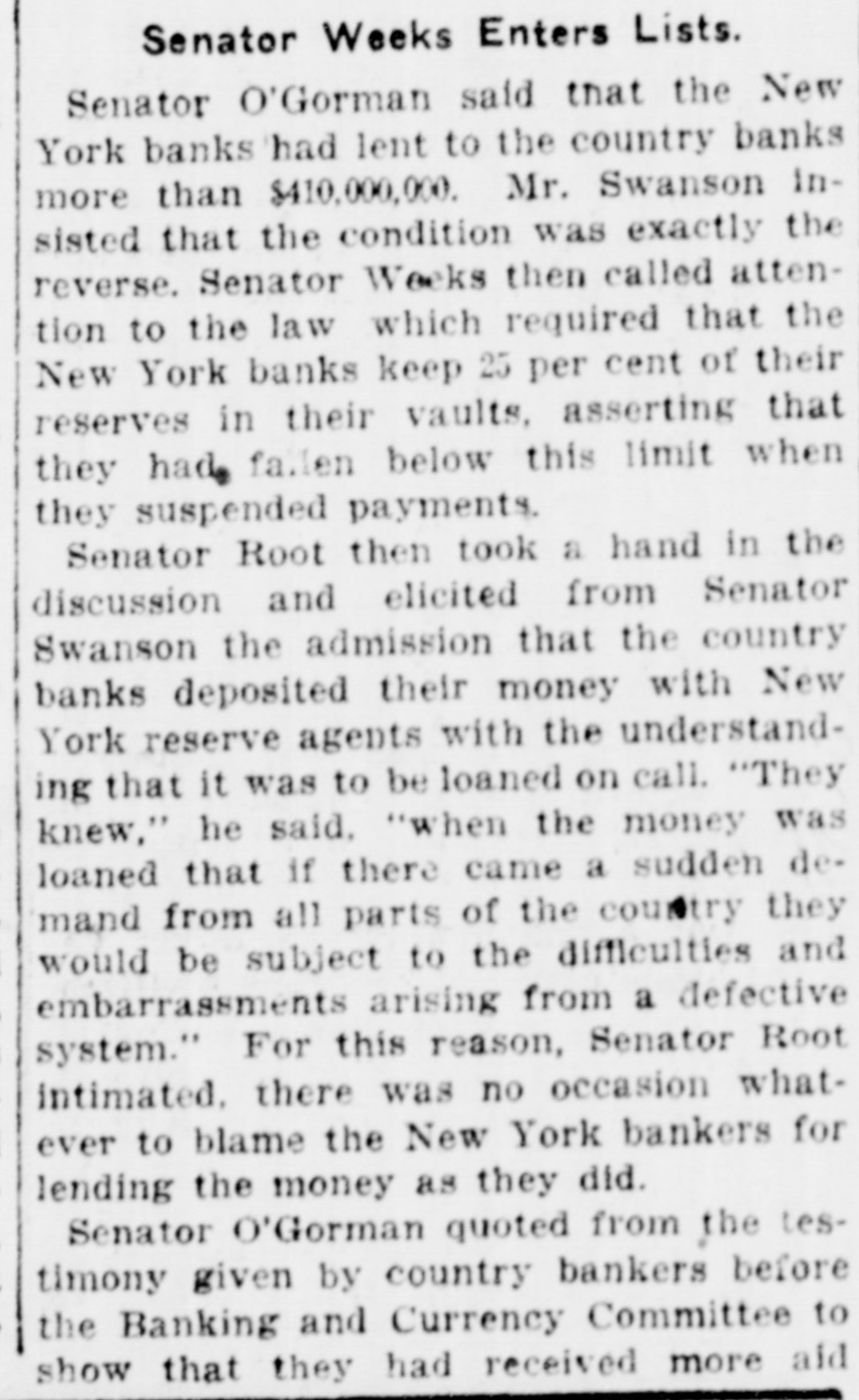
# Senator Weeks Enters Lists. Senator O'Gorman said that the New York banks had lent to the country banks more than $410,000,000. Mr. Swanson insisted that the condition was exactly the reverse. Senator Weeks then called attention to the law which required that the New York banks keep 25 per cent of their reserves in their vaults, asserting that they had fallen below this limit when they suspended payments. Senator Root then took a hand in the discussion and elicited from Senator Swanson the admission that the country banks deposited their money with New York reserve agents with the understanding that it was to be loaned on call. "They knew," he said, "when the money was loaned that if there came a sudden demand from all parts of the country they would be subject to the difficulties and embarrassments arising from a defective system." For this reason, Senator Root intimated, there was no occasion whatever to blame the New York bankers for lending the money as they did. Senator O'Gorman quoted from the testimony given by country bankers before the Banking and Currency Committee to show that they had received more aid


Article from The Citizen-Republican, August 6, 1914

Click image to open full size in new tab

Article Text

MEASURES TAKEN TO CONSERFE READY CASH This Action Believed Best In Order to Assure Stability of Business. In order to conserve the American supply of gold and to maintain the credit of the national banks of New York, Chicago and Boston Monday decided to suspend the payment of specie and issue clearing house certificates instead. Other cities throughout the country are expected to follow the lead of these big financial centers. Depositors also will be required to give 60 days notice to banks before withdrawing funds on time deposit. The situation is not regarded as grave by any means and reassuring statements have been issued in every quarter. The measures being taken are purely of a precautionary nature.


Article from The Tabor Independent, August 6, 1914

Click image to open full size in new tab

Article Text

MEASURES TAKEN TO CONSERFE READY CASH This Action Believed Best In Order to Assure Stability of Business. In order to conserve the American supply of gold and to maintain the credit of the national banks of New York, Chicago and Boston Monday decided to suspend the payment of specie and issue clearing house certificates instead. Other cities throughout the country are expected to follow the lead of these big financial centers. DeposItors also will be required to give 60 days notice to banks before withdrawing funds on time deposit. The situation is not regarded as grave by any means and reassuring statements have been issued in every quarter. The measures being taken are purely of a precautionary nature.


Article from Evening Star, August 7, 1914

Click image to open full size in new tab

Article Text

be prevented, or, at least, its effects minimized can by the proper organization sysand control of a country's banking tem. No such premium upon money or taken such collapse of credit has of in of the leading that the last 100 years as Noplace general Europe during any States countries in in the United in December of 1907, war and social witnessed vember periods and of condition revolution. except of similar disastrous for a and credits in England one must Namoney back to the time of the wars of go while in Germany no such foun- ocpoleon, has taken place since the shown currence of the empire. France has the dation such a banking condition but once that in was several generations, and last defeat at the hands of Prussia, war after her payment of her billion-dollar troubles. indemity the and bitter internal There have been suspensions of banks and great failures of business and banking houses in Failures Abroad Not these countries just the same as as Heavy as Here. in the United States, yet these disasters have not (as so offen has been the case here) been alIowed to paralyze the credit of the country. In Great Britain, the powerful firm of Overend Gurney failed in 1866, the Bank of Glasgow in 1878 and the house of Baring Bros. in 1890. Yet, on each occasion, the trouble was confined and no national financial convulsion followed. In France the same ability to avert financial panic was shown upon the failof such great banking institutions as ure the Union Generale in 1882 and the Comptoir d' Escompte in 1899; while in Germany the failure of the famous Leipziger Bank in 1901 is another example. in the United States, the suspension of Yet, payments by the New York banks has been followed by distress from Maine to California. Although banking reform had been demanded for a number of years, it took the panic of 1907 to insure a thorough prosecution of the task. Minor changes in our banking laws had been made from time to time, but the great prosperity of the country caused Congress to shrink from the responsibility of undertaking extensive reconstruction of the laws to under any which business had attained such mighty proportions. * * In 1000 Congress pased a currency act for the better support of the greenbacks, the Treasury notes of 1890 Better Support of and the silver Greenbacks by Law. dollars. After the panic of 1007 the Aldrich-Vreeland act was promulgated, which provided that the national banks might organize themselves into national currency assoclations, and that a member bank, with outstanding note circulation secured by States bonds equal to 40 per cent of might extend its United its capital, note issues upon other classes of securities until the total was equal to the sum of its capital and surplus. This act was intended only to be an emergency measure, and was enacted to expire by limitation June 30, 1914. The provision for increasing their note issue up to the present has not been taken advantage of by the banks The act has been extended to June 30. 1915. Further, following the panic, the national monetary commission was established, for the purpose of investigating means for improving credit arrangements in this country. Members of this commission visited England, France and Germany, and made thorough studies of the banking systems in vogue in these coun- of tries. The banking arrangements Canada, Scotland, Belgium, Sweden. Switzerland, Italy, Russia, Mexico and Japan were also investigated. The findings of the commission were published in reforty volumes, which form a good view of the world's banking business. Out of these studies grew proposals for the establishment of a National Reserve Association, a representative association the banks, the units of which were of to all be the clearing house associations which the banks of each city now mainThe democratic Congress rejected this tain. plan in favor of the federal reserve whose provisions, wisely enforced. act, will probably be found better suited to needs of the country than would have been the any one among the numberless plans which have been proposed.


Article from The Kenna Record, August 7, 1914

Click image to open full size in new tab

Article Text

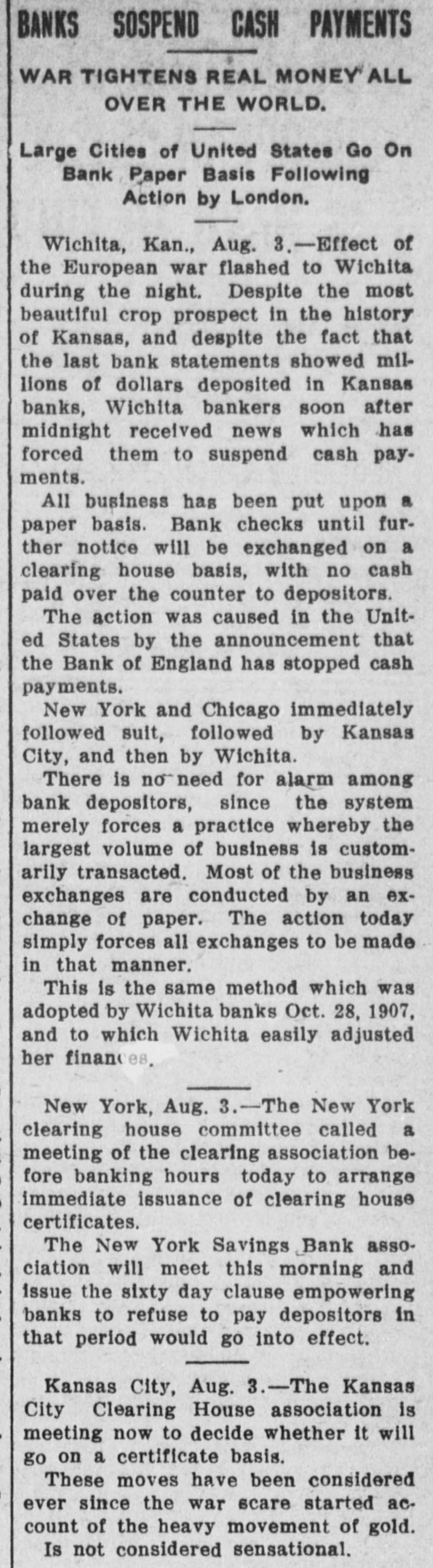
BANKS SOSPEND CASH PAYMENTS war TIGHTENS REAL MONEY ALL OVER THE WORLD. Large Cities of United States Go On Bank Paper Basis Following Action by London. Wichita, Kan., Aug. 3.-Effect of the European war flashed to Wichita during the night. Despite the most beautiful crop prospect in the history of Kansas, and despite the fact that the last bank statements showed millions of dollars deposited in Kansas banks, Wichita bankers soon after midnight received news which has forced them to suspend cash payments. All business has been put upon a paper basis. Bank checks until further notice will be exchanged on a clearing house basis, with no cash paid over the counter to depositors. The action was caused in the United States by the announcement that the Bank of England has stopped cash payments. New York and Chicago immediately followed suit, followed by Kansas City, and then by Wichita. There is no need for alarm among bank depositors, since the system merely forces a practice whereby the largest volume of business is customarily transacted. Most of the business exchanges are conducted by an exchange of paper. The action today simply forces all exchanges to be made in that manner. This is the same method which was adopted by Wichita banks Oct. 28, 1907, and to which Wichita easily adjusted her financ New York, Aug. 3.-The New York clearing house committee called a meeting of the clearing association before banking hours today to arrange immediate issuance of clearing house certificates. The New York Savings Bank association will meet this morning and issue the sixty day clause empowering banks to refuse to pay depositors in that period would go into effect. Kansas City, Aug. 3.-The Kansas City Clearing House association is meeting now to decide whether it will go on a certificate basis. These moves have been considered ever since the war scare started account of the heavy movement of gold. Is not considered sensational.