Article Text
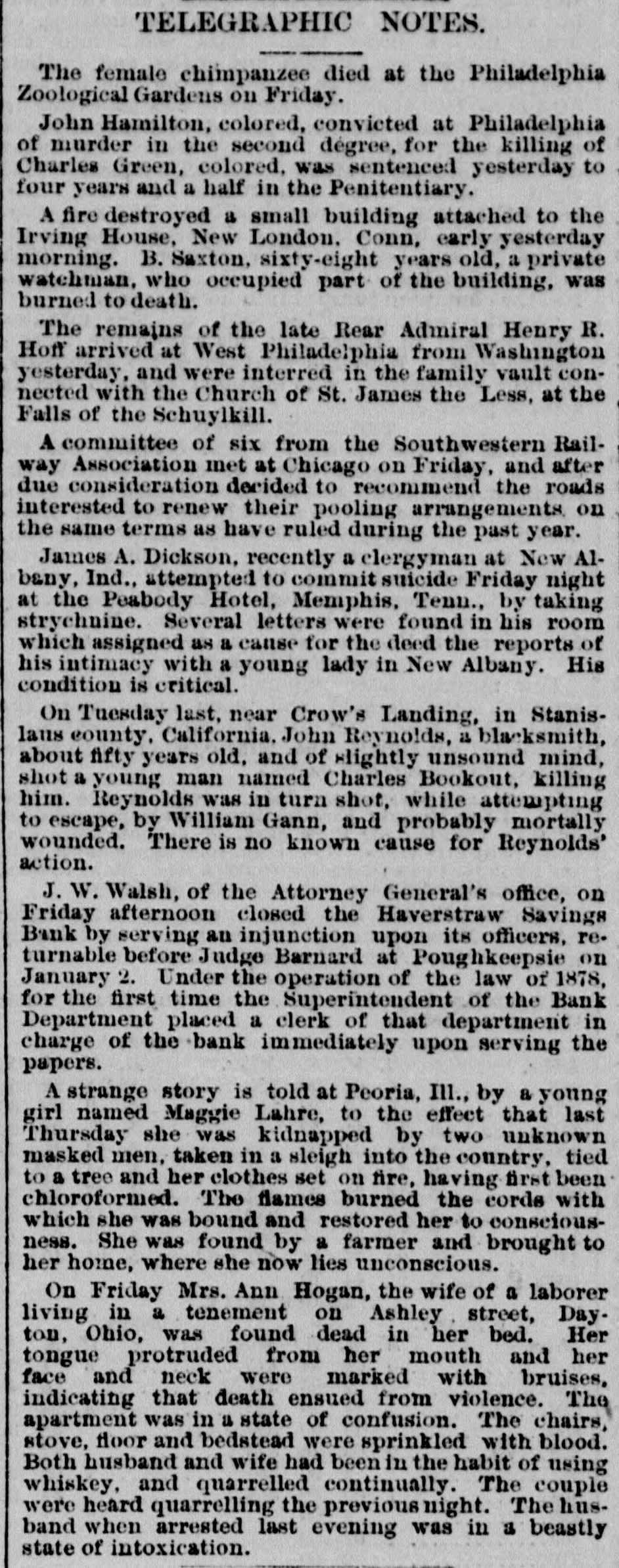
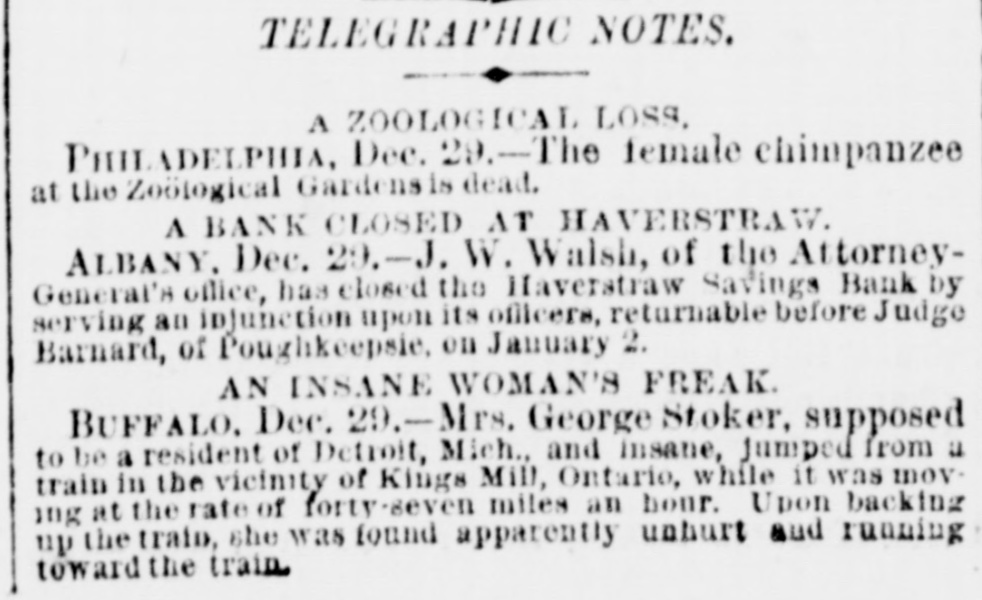
not responsible for the deed. Justice Morrison, however, bound him over in $2,000 bonds. THE LAST RESORT. MEMPHIS, Dec. 28.-James Dixon, formerly a minister at New Albrny, Ind., attempted to commit suicide last night at the Peabody hotel by taking strychnine. Several letters were found in his room, written previously to the attempted self destruction, which gave as a cause for his action reports of his intimacy with a young lady at New Albany. His condition is yet critical. CUSTOM HOUSE THIEF. NEW YORK, Dec. 28.-Robert A. Pedrech, custom house clerk of Benkhard & Hutton, this city, accused of appropriating $108,000 entrusted to him for payment of customs duties, was arrested this morning. PRINT WORKS SCORCHED. DOVER, N. H., Dec. 28.-A fire in the Cocheco print works damaged the building and contents $75,000. Insured. HELD FOR TRIAL. CINCINNATI, Dec. 28.-The case of Chas. P. Forbes and R. C. Wheeler, charged with embezzlement in the police court to-day, was set for hearing Thursday, Jan. 2. READS LIKE KENTUCKY. SAN FRANCISCO, Dec. 28.-Last Tuesday near Chew's Landing in Stanislaus county John Reynolds, blacksmith, about 50 years old and of slightly unsound mind, shot a young man named Chas Bookout, killing him. Reynolds in turn was shot while attempting to escape by William Gann and probably mortally wounded. There is no known cause for Reynold's action. CREMATED. NEW YORK, Dec. 28.-By the burning of a barn at East Orange, N. J., two young men were burned to death, and an old woman and the watchman lost their lives by the burning of small house attached to the ironing house, near London, Ct. THE POCKETBOOK RETURNED. NEW YORK, Dec. 28.-The pocketbook lost by the messenger of the Importers' & Traders' bank yesterday has been returned by mail minus $7,739. The Evening Post says this amount includes all the cash and $900 in small securities. NITRO GLYCERINE EXPLOSION. PATERSON, N. J., Dec. 28.-Three men are reported killed by an explosion of the nitroglycerine works at Upper Preakness, five miles away. Houses here were shaken as if by an earthquake. CINCINNATI PORK FAILURE. CINCINNATI, Dec. 28.-It is now estimated that the failure of Wheeler & Co., pork men, mentioned in the dispatches yesterday, will amount to between $40,000 and $50,000 when all the persons with whom they had dealings are heard from. Chas. H. Forbes, the company of the firm, who was arrested, was released yesterday afternoon, but later re- arrested on complaint of Samuel Kyle, of Middletown, who charged him with embezzlement. SAVINGS BANK CLOSED. ALBANY, N. Y., Dec. 28.-The Haverstraw savings bank has been closed by the attorney general. WIFE MURDER AND SUICIDE. SAN FRANCISCO, Dec. 28.-A Sacramento dispatch says the bodies of Allen Reynolds and his wife were found to-day in their house. They had not been seen since Wednesday last. The cause of death was poison. Supposed case of wife murder and suicide. PIANO FACTORY BURNED. BOSTON. Dec. 28.-The Emerson piano company's factory burned to-night. Loss, $100,000; insured. Eighty-five men thrown out of employment. SCHOONER WRECKED. PORTLAND, Me., Dec. 28.-The schooner Ellen, from St. John for New Haven, was wrecked on the coast of Maine. The captain and three seamen were drowned. ROBBED HIMSELF. PEORIA, III., Dec. 28.-Charles L. Otto, who reported Thursday morning that his jewelry store had been burglarized. has confessed he did the job himself. The money was found concealed in the dome of the court house, which he had the key to for the purpose of taking care of the town clock, and the box containing the balance of the goods was found behind lumber pile two blocks from the store. His creditors have attached his stock. INSANE SHOOTI NG. NEW YORK, Dec. -William L. Palmer, of Stonington, Conn., guest of the Metropolitan hotel, threatened to shoot with a revolver he flourished the private detective O the house. The detective secured the aid of Officer Furness and other policemen, who attempted to disarm the man, but he maintained possession and shot down Furness, severely if not fatally wounding him. Palmer then rushed to the station house, and saying he had shot two men who had attempted to arrest him, surrendered the pistol and was locked up. Palmer is insane. FLOURING MILL BURNED. DETROIT, Mich., Dec. 28.-A fire at Comstock, Mich., to-day, destroyed Dunbar's flouring mill. Loss $8,000; partially insured. GROUNDS FOR AN INDICTMENT. ST. LOUIS, Dec. 28.-A rumor is on the street late to-night that the United States grand jury voted, just prior to adjournment this evening, to indict the three principle directors of the old bank of the State of Missouri, for transactions in connection with the management of that bank extending back several years. Efforts to trace the rumor to authentic sources have failed, but as it is pretty well known the grand jury have been investigating the affairs of the bank, the rumor has ground for some credence. JUDGE BLODGETT'S IMPEACHMENT CHICAGO, Dec. 28.-The bar association held a meeting this afternoon and adopted a resolution calting upon members of the body who haveinstituted preceedings looking to the impeachment of Judge Blodgett to make known to a committee of five the character and substance of their charges. The committee is empowered to investigate such charges and report to the association. Fighting Old Boreas at St. Louis. ST. LOUIS, Dec. 28.-Two or three ferry boats were released from positions in the ice to-day and in connection with the transfer boat Bogy and three or four small tugs have been breaking all the afternoon. A goodly part of the harbor bel W the bridge is now clear of ice and there is a channel through the gorge to open water. Below Carondolet the