Click image to open full size in new tab
Article Text
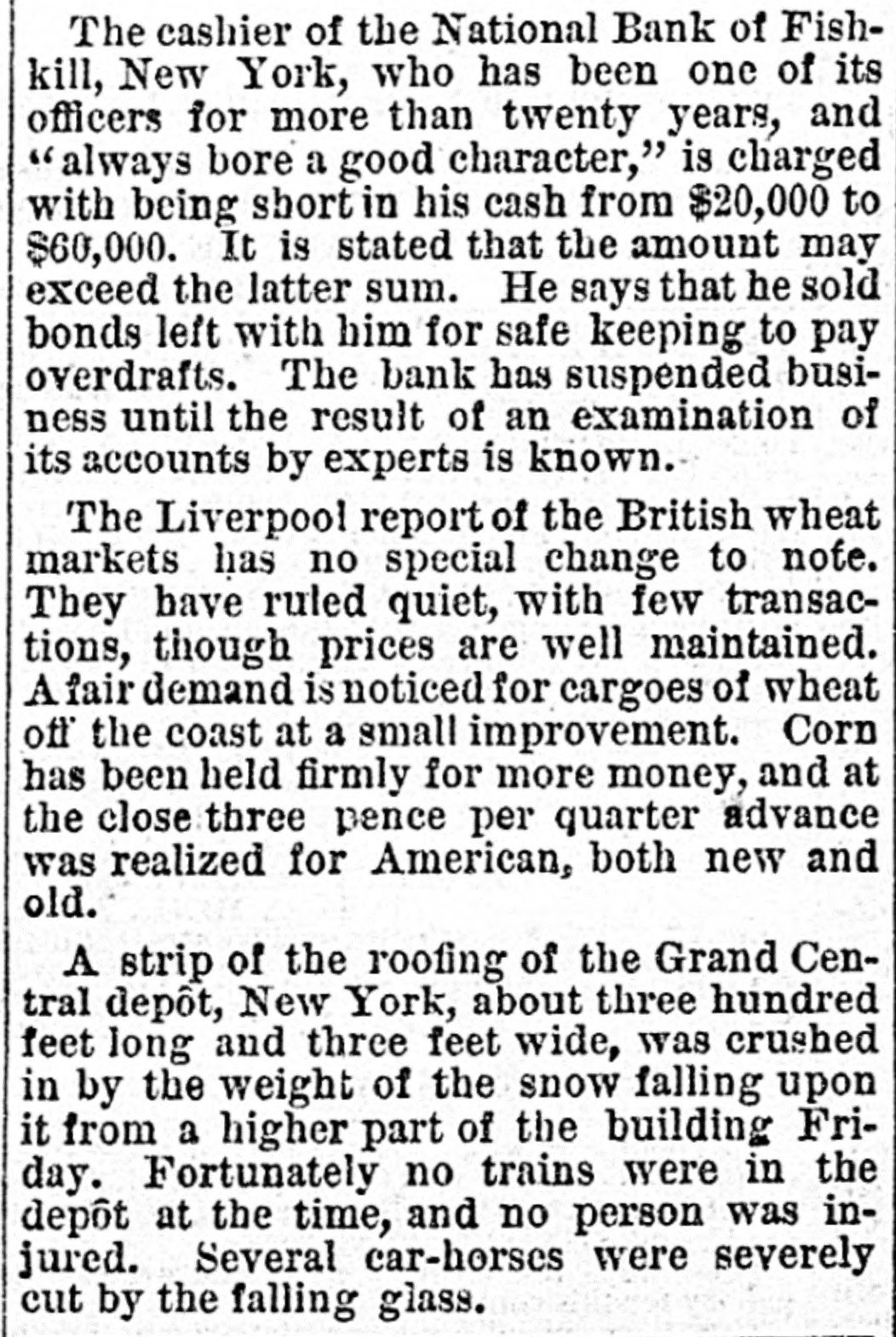
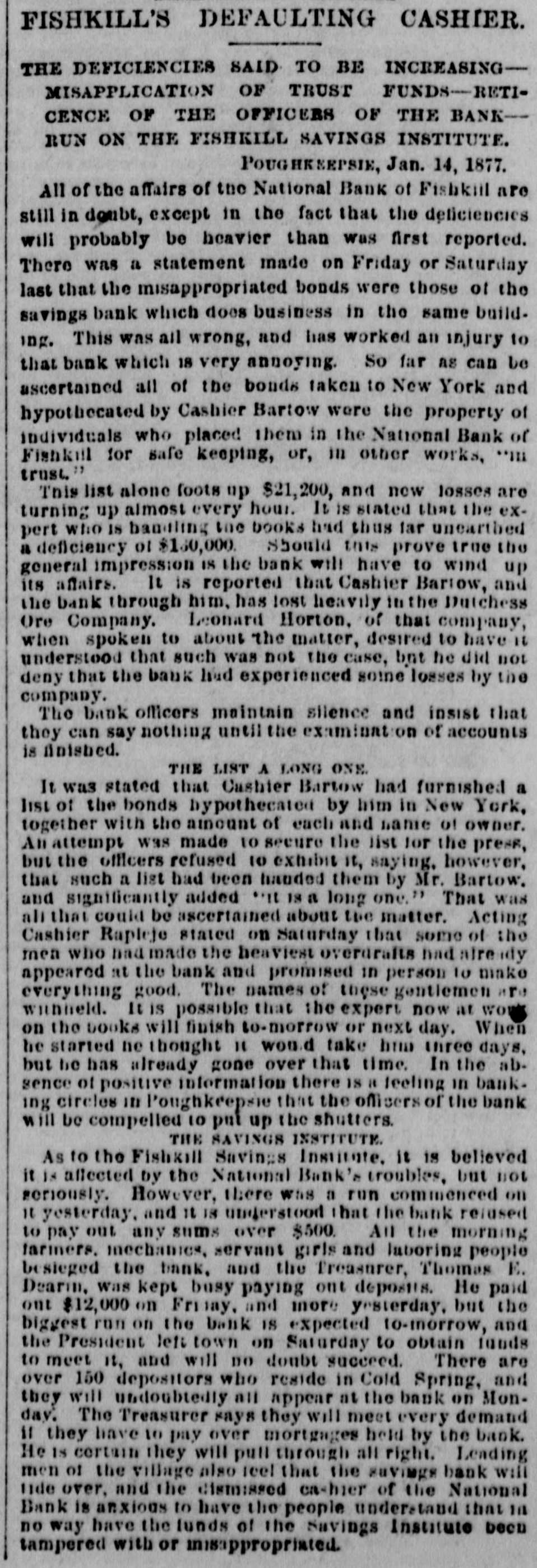
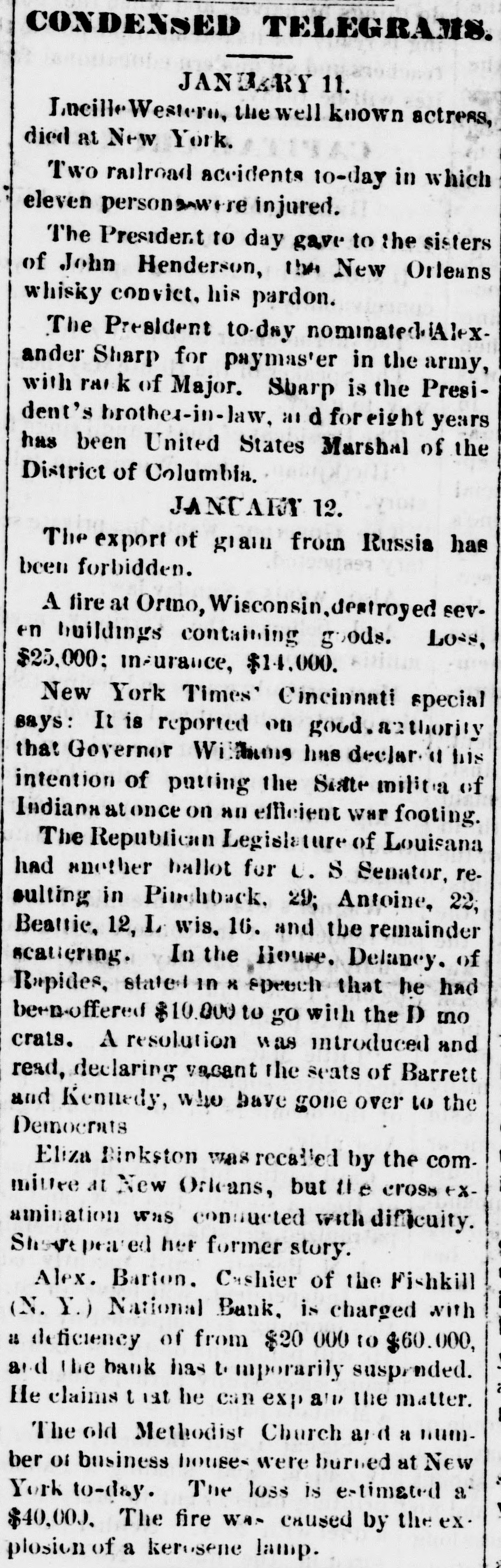
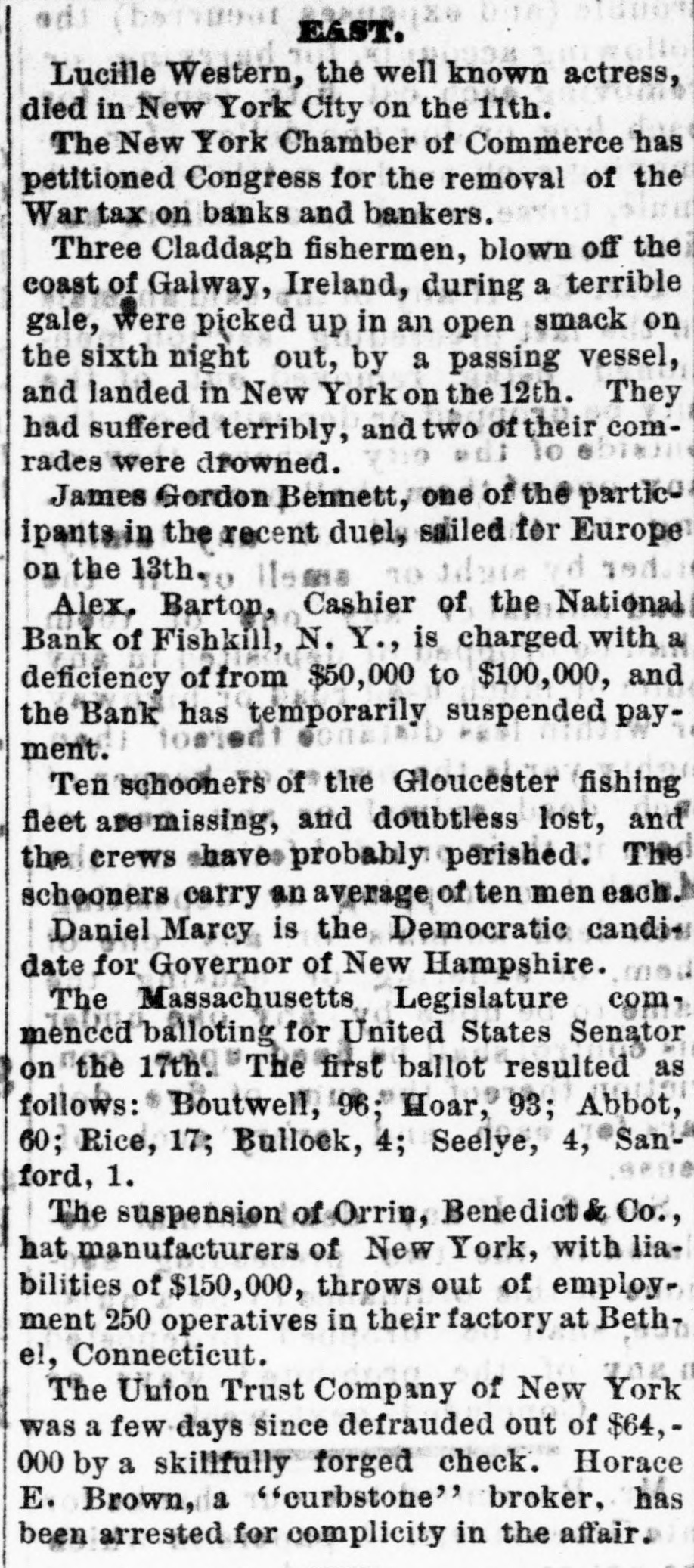
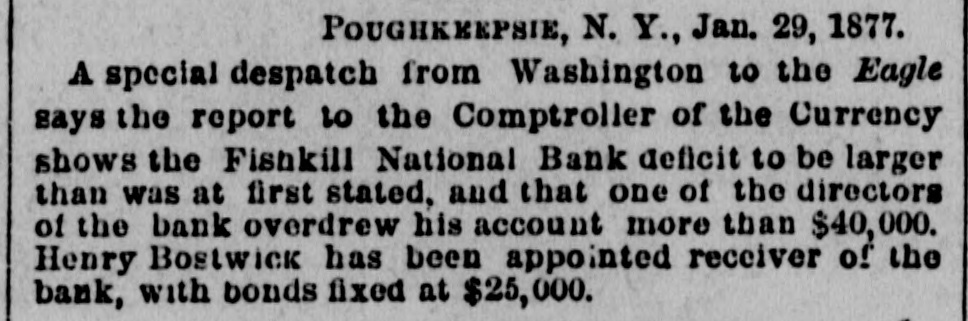
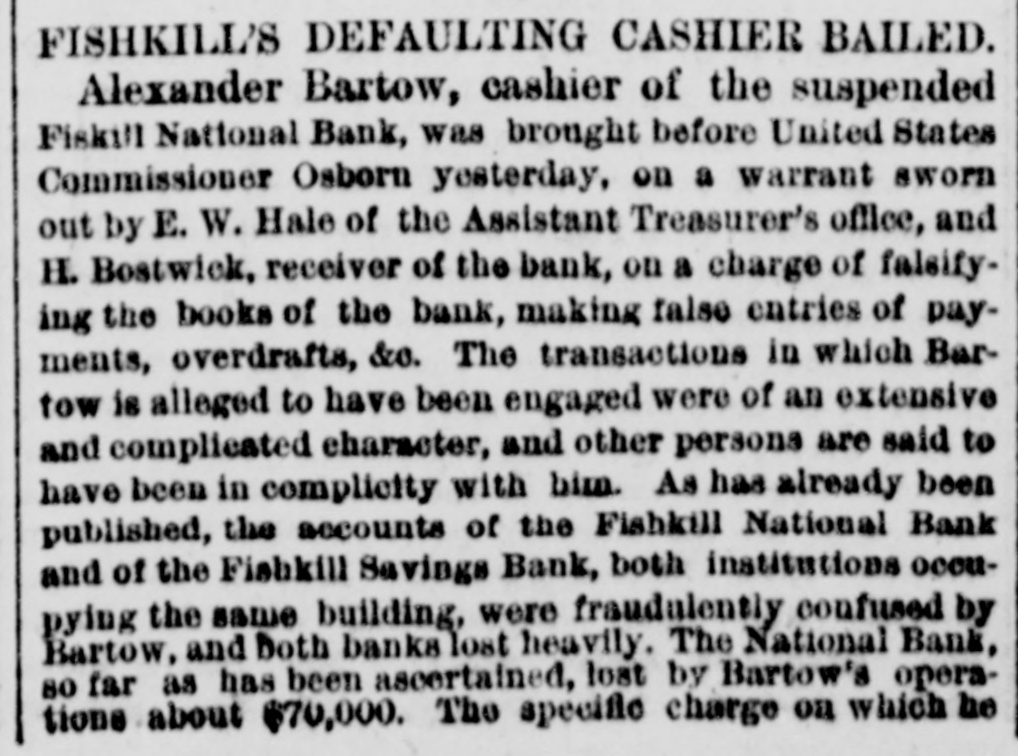
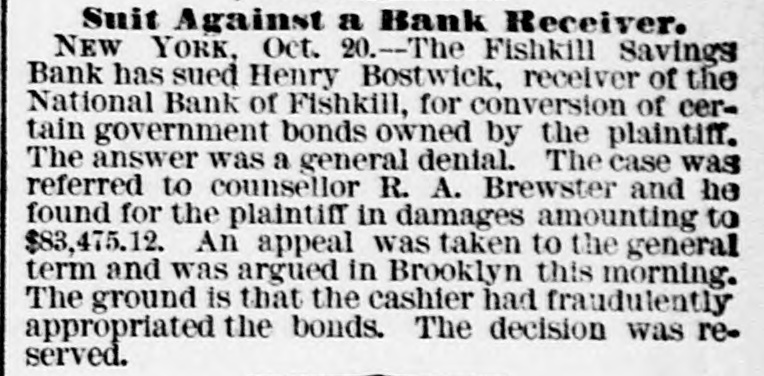
THE COURTS. Bottom Facts of the Fishkill Bank Defalcation. GIVING BOSTON THE COLD SHOULDER. Important Point as to Oaths Required of Referees. The trial of Alexander Bartow, ex-cashier of the Fishkill Bank, was continued yesterday in the criminal branch of the United States Circuit Court, before Judge Benedict and ajury. Mr. Herrick appeared on behalf of the government and General B. F. Tracey for the defendant Mr. W. E. Browning testified that checks were drawn by Dykeman, and that they were paid after the credit of $21,000. On cross-examination the witness said that the account with Wilmingding, Duer & Co., on the 12th of December, 1874, showed an indebtedness of $54,000. Mr. Bartow had sole charge of that account. Mr. Henry Bostwick was next called and said that he was director of the National Bank of Fishkill from 1872 to 1877, and was now receiver. The capital of the bank was $200,000. He knew E. P. Dykeman. He had conversation with Bartow in relation to the Dykeman account. He had moved, as director, in January, 1876, that the loan to Dyke man should be reduced. Mr. Bartow was then acting as clerk. He read out the item of $21,000 to Bartow, who told witness that Dykeman had never deposited it and that the credit was not correct. He stated further that he was present at the regular meetings of the board of directors generally, but could not say that he was present at every meeting He lived twenty miles away from the bank. The question of granting interest to persons who made certificates of deposit never came up, according to his knowledge, at the meeting of directors. On cross-examination he stated that the credit of $21,000, as shown on the books, left Mr. Dykeman a debtor to the bank about $40,000; in his conversation with Bartow about Dykeman's credit 01 $21,000 Bartow said that it was a wrong entry; Bartow did not go into explanation as to why that credit was put there; his mind was. clear that Bartow said that the entry was wrong, and that "wrong" was the word used. Mr. Van Wythe was the next witness, and said that he was a director of the bank, but he did not know what the practice of the bank was in reference to the issue of certificates of dieposits, and only knew what 11 was from the conversation that bad taken place among the directors SILMCO the trouble of the bank; the subject of certificates of deposit was never before the directorate. Assistant District Attorney Herrick, after the examination or Mr. Van Wythe was concluded, said that 11 was near the time of adjournment and that the next witherls, the last witness for the government, would occupy nearly half a day. He, therefore, would ask then for an adjournment. General Tracey objected. Ee said tbat the trial had proceeded very slowly and it was a great burden to lingants and counsel. He would undertake to assert that any fair-minded man would say, on looking at shis case, that it could have been tried in a day. The Court here, however, notwithstanding the opposition to adjournment, adjourned to next Monday morning. BENJAMIN BROWN'S EXTRADITION. The matter of the extradition of Benjamin Brown, claimed under a requisition from the Governor of Massachusetts, already reported in the HERALD, came up in the Marine Court, before Judge Sinnott, yesterday, on a side issue. When Judge Barrett, in the Supreme Court, disposed of the habeas corpus, which had been issued in lavor of the prisoner. adversely to him, it appeared that he was still held by the Sheriff under an order of arrestissued from the Marine Court, in a suit brought against him by Morris Herzhold and another for $400. This order of arrest had been ISsued on the allegation that Brown had incurred the debt by falsely representing that he owned a mortgage for $2,500 on a "sample room'' in Boston, besides other property. This mortgage is alleged to be the same which forms the grounds of the Massachusetts' prosecution, it being there charged that atter nrst getting a loan of $1,500 on the mortgage note (the mortgage itself being a part of the collateral), he again borrowed on the mortgage, alleging that Le had lost the note. The case, as It came before the Court yesterday, was on a motion to vacate the order of arrest. This motion was made on the part of the Commonwealth of Massachusetts, by Mr. À. H. Ammidown, on the ground that the allegation of false representations, on which the order was issued, was not true, and that the order was the result of collusion between Brown and some other partace. The faisity of the allegation, counsel contended, was apparent from the fact that It appeared that Brown had only pledged the mortgage us coliateral, SO that the legal title to it remained in him at the time 18 was alleged ne told plaintiff he owned it, and that the conspiracy might be interred from the fact that the false statement as to ownership, relied upon by plaintiffs, was, by the defendant himself, admitted to be false, waile in law it was true. Mr. Joseph J. Stein, who appeared as counsel for the plaintiffs, in opposition to the motion submitted an affidavit menying absolutely any collusion or conspiracy in obtaining the order arrest, alleg10g that the plaintiffs were only acting in good faith by using diligence 10 secure an honest debt, and that only in this regard did they incidentally delay the extradition of the prisoner to the State of MassachuBetts to answer there whatever charge they might have against him, a charge which, he said, if well founded, could be as well enforced after DIS client's case had been disposed of as now. He also stated that he would like an opportunity to submit further affidavits showing perfect good faith and legal right