13386. German Savings Bank (Omaha, NE)

Bank Information

Episode Type
Suspension → Closure
Bank Type
savings bank
Start Date
July 9, 1896
Location
Omaha, Nebraska (41.259, -95.938)

Metadata

Model
gpt-5-mini
Short Digest
5f88080f

Response Measures

None

Description

Contemporary articles report the German Savings Bank closed its doors on July 9, 1896, and a receiver was appointed later in July (application 1896-07-19; receiver appointed 1896-07-23/24). There is no mention of a depositor run prior to suspension in the provided texts — the bank was closed and placed in receivership and remained in receivership. Liabilities reported ~$60,000. Cause classified as government_action (court/state receiver due to alleged unlawful business/impairing assets).

Events (4)

1. July 9, 1896 Suspension
Cause
Government Action
Cause Details
Bank closed (ceased payments/closed doors) July 9, 1896; cited by later reports as the date of closing that precipitated receivership proceedings and drains on other local banks' deposits.
Newspaper Excerpt
On July 9 the German Savings bank closed its doors
Source
newspapers
2. July 19, 1896 Other
Newspaper Excerpt
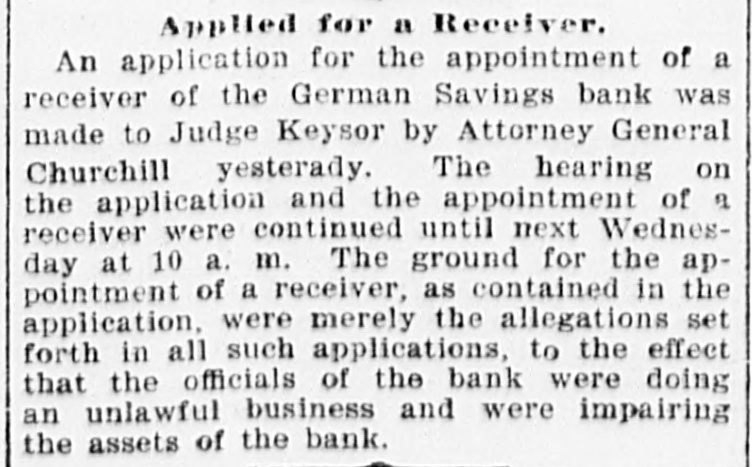
An application for the appointment of a receiver of the German Savings bank was made to Judge Keysor by Attorney General Churchill yesterday. The hearing on the application and the appointment of a receiver were continued until next Wednesday at 10 a. m. The ground for the appointment of a receiver ... officials of the bank were doing an unlawful business and were impairing the assets of the bank.
Source
newspapers
3. July 23, 1896 Receivership
Newspaper Excerpt
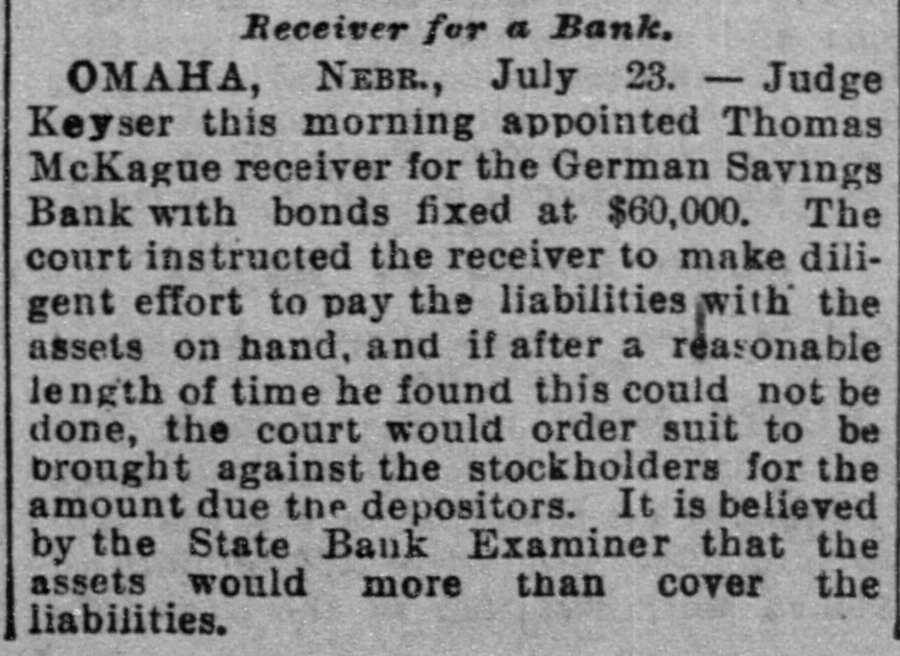
Judge Keyser this morning appointed Thomas McKague receiver for the German Savings Bank with bonds fixed at $60,000. The court instructed the receiver to make diligent effort to pay the liabilities with the assets on hand
Source
newspapers
4. January 2, 1897 Other
Newspaper Excerpt
On July 9 the German Savings bank closed its doors and a steady and constant drain was made upon our bank, so our deposits have shrunk ... (statement describing fallout for Omaha Savings Bank).
Source
newspapers

Newspaper Articles (15)

Article from Omaha Daily Bee, July 19, 1896

Click image to open full size in new tab

Article Text

# Applied for a Receiver. An application for the appointment of a receiver of the German Savings bank was made to Judge Keysor by Attorney General Churchill yesterday. The hearing on the application and the appointment of a receiver were continued until next Wednesday at 10 a. m. The ground for the appointment of a receiver, as contained in the application, were merely the allegations set forth in all such applications, to the effect that the officials of the bank were doing an unlawful business and were impairing the assets of the bank.


Article from Omaha Daily Bee, July 19, 1896

Click image to open full size in new tab

Article Text

REST FROM HIS TROUBLES nton Ziskousky Found Dead in Bed Yesterday Morning. HAD SHOT HIMSELF DURING THE NIGHT Financial Troubles and the Remembrances of the Logan Wreck Attributed as the Cause of a Suicide. A shot from a revolver fired by his own hand some time last night killed Anton Ziskousky, a Bohemian, living at 1457 South Fourteenth street. The shot was unheard and therefore it was not until 10 o'clock yesterday morning that Ziskousky was found dead in bed. At that hour a caller visited the house and asked for Ziskousky. The latter's son, also named Anton, went to his father's bedroom to call him. In a few moments he ran back to the door, crying: "My father is so pale and so cold." Two stepdaughters ran into the bedroom and found Ziskousky lying in bed upon bedclothing that was soaked with blood. Upon his undershirt on the breast was a huge bloodstain. An examination speedily disclosed the fact that the man had shot himself through the heart and was dead. The coroner was at once summoned. Insanity is believed to have been the cause that drove the deceased to the act of selfdestruction. During a week back he had acted and spoken strangely. Two causes are assigned for the mental condition. One is the failure of the German Savings bank, in which Ziskousky had some of his own money and other money which was in his care as the treasurer of a secret society. His mind was also worked up DY the Logan wreck. He attended the picnic of the Pioneers and was on the train when the terrible disaster occurred. Some of the killed and injured were his friends. The subject of the accident appeared to have been continually upon his mind, and on account of that he has not worked for a week past. "I cannot sleep," he told his children, "Whenever I lie down I see that terrible sight." The failure of the savings bank, however, seemed to have the most effect, upon his mind. His papers were covered with figures and statements. Upon one leaf of his book he bids a simple farewell to his wife. The rest of the epistle is a statement of the moneys he has in banks. The words are indefinite and badly written. He came home Friday night at 10:30 o'clock, after an absence of two days. He made few answers to the questions put to him by his children and these were foreign to the questions asked. He asked for paper, and, after scribbling a few lines, abruptly ordered the light out out and retired to bed. One of his daughters did not go to sleep until after midnight and heard no shot. At 8 o'clock the son arose, found his father's bedroom door slightly open, closed it and- quietly set about the housework in order not to disturb him. At 10 o'clock the visitor came and the suicide was discovered. After an examination of the body the coroner came to the conclusion that the man had been dead five or six hours. His body was not yet cold. He therefore probably killed himself in the early morning. The revolver with which the deed was committed was an old one and had not been seen by the children before. Four shells were empty, but three of these showed that they had been fired some time ago. Ziskousky was one of the early Bohemian settlers of the city, having lived here for years. He was a cabinet maker in the Union Pacific shops. He was reputed to be fairly well off. He was a member of the


Article from The San Francisco Call, July 24, 1896

Click image to open full size in new tab

Article Text

Receiver for a Bank, OMAHA, NEBR., July 23. - Judge Keyser this morning appointed Thomas McKague receiver for the German Savings Bank with bonds fixed at $60,000. The court instructed the receiver to make diligent effort to pay the liabilities with the assets on hand, and if after a reasonable length of time he found this could not be done, the court would order suit to be brought against the stockholders for the amount due the depositors. It is believed by the State Bank Examiner that the assets would more than cover the liabilities.


Article from The Evening Times, July 24, 1896

Click image to open full size in new tab

Article Text

Bank Receiver Appointed. Omaha, Neb,, July 24.-Judge Keysor yesterday appointed Thomas H. McCague as receiver for the German Savings Bank, with bond fixed at $60,000. It is believed by the State bank examiner that the assets will more than cover the liabilities.


Article from The Ely Miner, July 29, 1896

Click image to open full size in new tab

Article Text

William Wiley, a tailor, aged 37, shot and killed his wife in Cincinnati and then committed suicide. Four children survive them. Three miles from Royston, Ga., Dave Berryman, while in a drunken fury, killed his wife and three children and then committed suicide. The Central Labor union of Cleveland, in a discussion of the Brown Hoisting company's strike, decided to boycott every firm in Cleveland which furnishes employment to members of the state militia. Henry Schwant and his wife died at their home near Fremont, O., from eating toadstools for mushrooms. In a celebration of the thirty-eighth anniversary of the birth of the queen regent of Spain, Capt. Gen. Weyler, of Cuba, liberated 102 political prisoners. Alfred and Edward Kasserman, aged 34 and 21 years respectively, and two horses which they were driving, were killed by lightning at Newton, Ill. H. L. Grimes and John Hall were killed by lightning at Derby, Ia. Grimes had just insured his life for $5,000. Heavy rains throughout West Virginia caused great damage. James T. Hurst, a millionaire lumberman at Wyandotte, Mich., made an assignment with liabilities of $500,000. Maj. McKinley took part in the celebration of the fiftieth anniversary of Mount Union college at Alliance, O., of which he is one of the trustees. James Armstrong & Co., manufacturers of soap, candles, etc., in Baltimore, failed for $100,000. William T. Wiley, a tailor and furrier in Cincinnati, shot and killed his wife and then shot himself, but not fatally. Domestic trouble was the cause. The feature of the centennial celebration at Cleveland on the 23d was a big New England dinner, at which addresses were made by Senators Hawley and Sherman. Maj. McKinley and others. Chillicothe, O., celebrated the 100th anniversary of its existence ,and the oration was delivered by Postmaster General Wilson. Diamonds valued at $30,000 were stolen at Narragansett Pier, R. I., from Mrs. J. J. Coogan, wife of a New York real estate agent. John Pryde, who murdered Andrew Peterson five months ago and robbed him of $42, was hanged in the county jail at Brainerd, Minn. The new one-dollar silver certificate designed by Mr. Low, of New York, made its first public appearance in Washington. The German savings bank at Omaha. Neb., went into the hands of a receiver with liabilities of $60,000. The Commercial Law League of America in annual session at Omaha, Neb., elected E. M. Bartlett, of that city, as president.


Article from River Falls Journal, July 30, 1896

Click image to open full size in new tab

Article Text

# WEST AND SOUTH. George W. Jones, the oldest surviving ex-United States senator, died in Dubuque, Ia., aged 92 years. When Iowa was made a state in 1846 Gen. Jones was made its first senator and served two terms, when he was appointed by President Buchanan as minister to Colombia. In Cincinnati William Wiley, a tailor, aged 37, shot and killed his wife and then committed suicide. Four children survive them. From eating toadstools for mushrooms Henry Schwant and his wife died at their home near Fremont, O. Dave Berryman, living three miles from Royston, Ga., while in a drunken fury, killed his wife and three children and then committed suicide. At Springfield, Mo., the republican state convention adopted resolutions indorsing the St. Louis platform and nominated R. E. Lewis, of Henry county, for governor. The execution of John Pryde, who murdered Andrew Peterson five months ago and robbed him of $42, took place in the county jail at Brainerd, Minn. At Omaha, Neb., the German savings bank went into the hands of a receiver with liabilities of $60,000. In annual session at Omaha, Neb., the Commercial Law League of America elected E. M. Bartlett, of that city, as president. Edward and Alfred Kasserman, aged 21 and 34 years respectively, and two horses which they were driving, were killed by lightning at Newton, Ill. John Hall and H. L. Grimes were killed by lightning at Derby, Ia. Grimes had just insured his life for $5,000. Throughout West Virginia heavy rains caused great damage. At Wyandotte, Mich., James T. Hurst, a millionaire lumberman, made an assignment with liabilities of $500,000. The firm of James Armstrong & Co., manufacturers of soap and candles in Baltimore, failed for $100,000. At Cleveland the feature of the centennial celebration on the 23d was a big New England dinner, at which addresses were made by Senators Hawley and Sherman, Maj. McKinley and others. The 100th anniversary of Chillicothe, O., was celebrated, and the oration was delivered by Postmaster General Wilson. Diana Smith (colored) died near Homer, Mich., aged 117 years. Democrats of the Eleventh Indiana district nominated Joseph Larimer for congress, and in the third Michigan district A. O. Knappen was nominated by the prohibitionists. It was decided at a conference in Chicago of "sound money" men from nine states to take immediate action for the purpose of nominating a second democratic ticket for president and vice president of the United States. William T. Wiley, a tailor in Cincinnati, shot and killed his wife and then shot himself, but not fatally. Domestic trouble was the cause. The first state convention was held in Denver, Col., of the national party, the reorganized silver wing of the prohibitionists, and Levi Booth, of Denver, was nominated for governor. The national convention in St. Louis on the 24th of the American silver party nominated William J. Bryan, of Nebraska, for president, and Arthur Sewall, of Maine, for vice president. The platform declares for the free and unlimited coinage of both gold and silver at a ratio of sixteen to one, independent of any foreign power. After changing the name of the organization to the national bimetallic party the convention adjourned sine die. At a meeting of the new national committee Charles D. Lane, of California, was elected chairman. Charles Morris, Henry L. Edson, Miss Laura Guard and Miss Emma Young were drowned near Vancouver, Wash., by the upsetting of a boat. In Bear creek canyon, just above Morrison, Col., a cloudburst did great damage to property and caused the loss of from 15 to 20 lives. John Pascoe, aged 17, and William Hosking, aged 26, residents of Iron Mountain, Mich., were drowned in Spread Eagle lake by the capsizing of a boat. At Carlton, Minn., Jim O'Darrah shot and killed William Caffry and wife, proprietors of a bagnio, after a dispute over money. At New Orleans James Murray (colored) was hanged for the murder of Policeman Michael Cotter July 26, 1894. The Illinois prohibition state executive committee met in Champaign and nominated George W. Gere, of that city, for governor. In Chicago Parkhurst & Wilkinson, dealers in iron, failed for $250,000. In St. Paul Henry B. White fatally shot Miss Tillie Strumpf because she refused to marry him and then fatally shot himself. In Chicago the "sound money" democrats perfected their plans for putting another democratic ticket in the field by making arrangements for the choice of a new national committee which is to meet at Indianapolis August 7 for the purpose of issuing a formal call for a national convention, to be held not later than September 2. Barns on the Forsythe (Ind.) race track were destroyed by fire and five valuable horses were cremated.


Article from The Worthington Advance, July 30, 1896

Click image to open full size in new tab

Article Text

The News Condensed. Important Intelligence From All Parts. DOMESTIC. George Swain, a farmer aged 40 years living near Attica, Mich., while insane over the death of his wife killed his three children and then took his own life. Naylor's opera house and other buildIngs were burned at Terre Haute, Ind., the total loss being $300.000. A strike of the various organizations constituting the Brotherhood of Tailors was declared in New York, involving 12,000 workmen. The Monona Lake Assembly opened its seventeenth annual encampment at Lakeside. near Madison, Wis. Prof. A. L. Miller, a prominent German musician of Pana, III., drowned himself at Pekin, Ill. In a wreck on the Chicago & Texas railroad one mile south of Murphysboro, Ill., 12 persons were injured, two of them fatally. Fifteen hundred persons gathered at the John Brown farm in Saranac Lake, N. Y., to witness the unveiling of a John Brown monument. Miss Bessie Engle, a prominent young society girl of Philadelphia, was drowned at Ocean Grove, N. J., while bathing. The national convention of Methodist deaconnesses began at Asbury Park, N.J. The will of Austin Corbin was probated in New York. It leaves $10,000,000 to his wife and children. In the United States court the Iowa anti-cigarette law was declared unconstitutional. John D. Rockefeller presented the city of Cleveland, O., with $600,000 as a centennial gift. A sudden flood in Benson creek, near Frankfort, Ky., drowned ten persons, swept away many bridges and buildings and ruined hundreds of acres of corn and other crops. William Wiley, a tailor. aged 37, shot and killed his wife in Cincinnati and then committed suicide. Four children survive them. Three miles from Royston, Ga., Dave Berryman, while in a drunken fury, killed his wife and three children and then committed suicide. The Central Labor union of Cleveland, in a discussion of the Brown Hoistling company's strike, decided to boycott every firm in Cleveland which furnishes employment to members of the state militia. Henry Schwant and his wife died at their home near Fremont, O., from eating toadstools for mushrooms. In a celebration of the thirty-eighth anniversary of the birth of the queen regent of Spain, Capt. Gen. Weyler, of Cuba, liberated 102 political prisoners. Alfred and Edward Kasserman, aged 34 and 21 years respectively, and two horses which they were driving, were killed by lightning at Newton, III. H. L. Grimes and John Hall were killed by lightning at Derby, Ia. Grimes had just insured his life for $5,000. Heavy rains throughout West Virginia caused great damage. James T. Hurst, a millionaire lumberman at Wyandotte, Mich., made an assignment with liabilities of $500,000. Maj. McKinley took part in the celebration of the fiftieth anniversary of Mount Union college at Alliance, O., of which he is one of the trustees. James Armstrong & Co., manufacturers of sonp, candles, etc., in Baltimore, failed for $100,000. William T. Wiley, a tailor and furrier in Cincinnati, shot and killed his wife and then shot himself, but not fatally. Domestic trouble was the cause. The feature of the centennial celebration at Cleveland on the 23d was a big New England dinner, at which addresses were made by Senators Hawley and Sherman. Maj. McKinley and others. Chillicothe, O., celebrated the 100th anniversary of its existence ,and the oration was delivered by Postmaster General Wilson. Diamonds valued at $30,000 were stolen at Narragansett Pier, R. I., from Mrs. J. J. Coogan, wife of a New York real estate agent. John Pryde, who murdered Andrew Peterson five months ago and robbed him of $42, was hanged in the county jail at Brainerd, Minn. The new one-dollar silver certificate designed by Mr. Low, of New York, made its first public appearance in Washington. The German savings bank at Omaha. Neb., went into the hands of a receiver with liabilities of $60,000. The Commercial Law League of America in annual session at Omaha, Neb., elected E. M. Bartlett, of that city. as president. The exchanges at the leading clearing houses in the United States during the week ended on the 24th aggregated $989,300,404, against $954,742,363 the previous week. The increase compared with the corresponding week in 1895 is 6.6. Henry L. Edson, Charles Morris, Miss Laura Guard and Miss Emma Young were drowned near Vancouver, Wash., by the upsetting of a boat. There were 280 business failures in the United States in the seven days ended on the 24th, against 216 the week previous and 239 in the corresponding period of 1895. William Hosking, aged 26, and John Pascoe, aged 17, residents of Iron Mountain, Mich., were drowned in Spread Eagle lake by the capsizing of a boat. cloudburst in Bear creek canyon
Article from The L'anse Sentinel, August 1, 1896

Click image to open full size in new tab

Article Text

The national convention of Methodist deaconnesses began at Asbury Park, N.J. The will of Austin Corbin was probated in New York. It leaves $10,000,000 to his wife and children. In the United States court the Iowa anti-cigarette law was declared unconstitutional. John D. Rockefeller presented the city of Cleveland, O., with $600,000 as a centennial gift. William Wiley, a tailor. aged 37, shot and killed his wife in Cincinnati and then committed suicide. Four children survive them. Three miles from Royston, Ga., Dave Berryman, while in a drunken fury, killed his wife and three children and then committed suicide. The Central Labor union of Cleveland, in a discussion of the Brown Hoisting company's strike, decided to boycott every firm in Cleveland which furnishes employment to members of the state militia. Henry Schwant and his wife died at their home near Fremont, O., from eating toadstools for mushrooms. In a celebration of the thirty-eighth anniversary of the birth of the queen regent of Spain, Capt. Gen. Weyler, of Cuba, liberated 102 political prisoners. Alfred and Edward Kasserman, aged 34 and 21 years respectively, and two horses which they were driving, were killed by lightning at Newton, III. H. L. Grimes and John Hall were killed by lightning at Derby, Ia. Grimes had just insured his life for $5,000. Heavy rains throughout West Virginia caused great damage. James T. Hurst, a millionaire lumberman at Wyandotte, Mich., made an assignment with liabilities of $500,000. Maj. McKinley took part in the celebration of the fiftieth anniversary of Mount Union college at Alliance, O., of which he is one of the trustees. James Armstrong & Co., manufacturers of soap, candles, etc., in Baltimore. failed for $100,000. William T. Wiley, a tailor and furrier in Cincinnati, shot and killed his wife and then shot himself, but not fatally. Domestic trouble was the cause. The feature of the centennial celebration at Cleveland on the 23d was a big New England dinner, at which addresses were made by Senators Hawley and Sherman, Maj. McKinley and others. Chillicothe, O., celebrated the 100th anniversary of its existence .and the oration was delivered by Postmaster General Wilson. Diamonds valued at $30,000 were stolen at Narragansett Pier, R. I., from Mrs. J. J. Coogan, wife of a New York real estate agent. John Pryde, who murdered Andrew Peterson five months ago and robbed him of $42, was hanged in the county jail at Brainerd, Minn. The new one-dollar silver certificate designed by Mr. Low, of New York, made its first public appearance in Washington. The German savings bank at Omaha. Neb., went into the hands of a receiver with liabilities of $60,000. The Commercial Law League of America in annual session at Omaha, Neb., elected E. M. Bartlett, of that city, as president.


Article from Omaha Daily Bee, October 6, 1896

Click image to open full size in new tab

Article Text

to the public. The plan IS to building suitable for the use of all wor organizations. The discussion of this plan will be t at the next regular meeting two V rom yesterday. Mrs. Hoobler, chairman of the comm provide a program for a public me nown as "Gentlemen's night" reported seemed best to postpone further arra nents until "after election." On behalf of the committee upon r Hoobler stated that the arrangen vere perfected for retaining the roon ast year for department meetings, but of Creighton theater could be sed or the public meetings if the club des vote 1: was decided to hold the neeting in that place as a test of the As the head of the piano committee Lindsay asked the secretary to report iction of the directory upon this sul The secretary announced the direct recommendation that a piano be purch or the use of the club, and the name he committee appointed by it. Mrs. 1 ay then gave her report. The club vot make this committee's action its own. impowered it to purchase a suitable I or the club. Mrs. Ford again rose to explain the he musical department desired to do ear pursuing the Derthich method musical literature course. Club men lesiring to avail themselves of the c vere asked to pay $1, although no f compulsory. To those outside the club course is $2.00. The president then asked Mrs. Keys present the case of the Federation lib The story briefly told is this: The 1 this. the traveling library, the pro the Nebraska State Federation, amou about $220. About one-half of this spent in books and the remai $111.89, was deposited in the German Sa bank. The suspension of that instit rendered the library committee helple his. the time of year when the small nost need help, thus withdrawing aid when the struggling clubs had learne lepend upon getting it. Mrs. Keysor earnest plea to the club to advance ibrary the money which it now needed take possession of the receiver's certif Mrs. Peattie, who is chairman of th brary committee. said she thought suc upon the club's part would be of value than the annual donation. The matter was put to a vote and car there being but one dissenting voice. Omaha Women's club will thus make the women of the state the whole an of money entrusted by Omaha women Omaha bank. Those must interested be one of the most public spirited of club's many good deeds Mrs. Draper Smith was chosen to I the club at the State Federation at Fremont. September 8 and 9, Mrs. McGilton and Mrs. H. S. Jaynes a ternates. Then came, in some respects, the mo teresting discussion of the afternoon hour of meeting. Many of the house seriously object to the time of 3:30 to makes them late to dinner. On the hand now that school holds until 4 o' the old hour of 3 o'clock would shut ou teachers altogether. So the relative lectual needs of teachers and housek were aired, and there were several su tions as to how other people's bus might be managed to fit this emerg is estimated that there are fifty tea in the club when the motion by Mrs. drews, "that we return to our old tin b'clock" was put, a rising vote was : for by the chair. after which it was nounced that the present hour 3:30 won. Mrs. Galloway, president of the Eau ( Wis., Women's club, the guest of Mrs. Jaynes, who had occupied a seat at president's right, was introduced and an address which was all too short. F ring in a happy vein to the ambition o club to play hostess to the National f in 1898, she said she should lay all scruples and pull every possible that she might be a delegate. Mrs. Baldwin and Mrs. Hungerford presented the club with a piece of exq hand-embroidered linen. These will after shine at all tea-drinkings. Mrs. Peattie then read her address, \ was at once a greeting and a farewel was, in sentiment, in grace, in all, all


Article from Omaha Daily Bee, November 11, 1896

Click image to open full size in new tab

Article Text

LOCAL BREVITIES. The Outre Mer Athletic club of the South Side will give its second invitation party this evening at Cosmopolitan hall. Frank Leslie and Jennie Smith were married last night at the home of the bride, 1718 Douglas street. Rev. T. J. Mackey officiated. Chauncey Whitting, who lives in a hovel down under the Eleventh street viaduct, was arrested last night on a charge of adultery. The woman in the case is Mrs. Lewis. The Omaha Bimetallic league has called a meeting for next Friday evening at Knights of Labor hall. at which time and place a permanent organization will be effected. John Sidner, driver of No. 3 hose cart, was kicked by a horse Monday afternoon. He was struck on the leg about the knee and received some severe injuries that will lay him up for some time. The depositors of the defunct Midland State bank will hold a meeting at 615 North Sixteenth street Thursday evening. at which time they will discuss the bringing of legal proceedings against the officers of the bank. Gate City hive No. 9 of the Ladies of the Maccabees, will hold its review in Labor hall, Seventeenth and Douglas streets, next Wednesday evening instead of in Patterson hall, Seventeenth and Farnam streets, as reported in The Sunday Bee. Christene Peterson has applied for a divorce from John F. Peterson on the ground of drunkenness. Her petition relates that they were married in this city on July 14, 1892, and have two children, both girls. She asks for the custody of the children. The funeral of the late Jerome Miller was held from the residence, 541 South Twentyfifth avenue, yesterday afternoon. The details were in charge of the members of Beech camp, Modern Woodmen of America. of which the deceased was a member. Interment was at Forest Lawn. Ross Crome, Robert Taylor and Clarence Gilmore, the three small boys who were arrested Monday night for breaking one of the big stones used in the construction of the new Creighton Medical college building, admitted their guilt yesterday morning in police court and were bound over to the district court in the sum of $100 each to answer to the charge of incorrigibility. A number of the depositors of the defunct German Savings bank met at Germania hall Monday night. A committee appointed at a previous meeting reported that the court had instructed the receiver to bring suit against the stockholders of the bank to recover the amount due the depositors. A committee was also directed to inspect the books of the bank and report back to the depositors. During the past month $4,633 worth of property was pawned and $3,914 worth was sold to pawnbrokers and second hand dealers by Omaha citizens. This is a slight decrease from former months. During the


Article from The Salt Lake Herald, January 3, 1897

Click image to open full size in new tab

Article Text

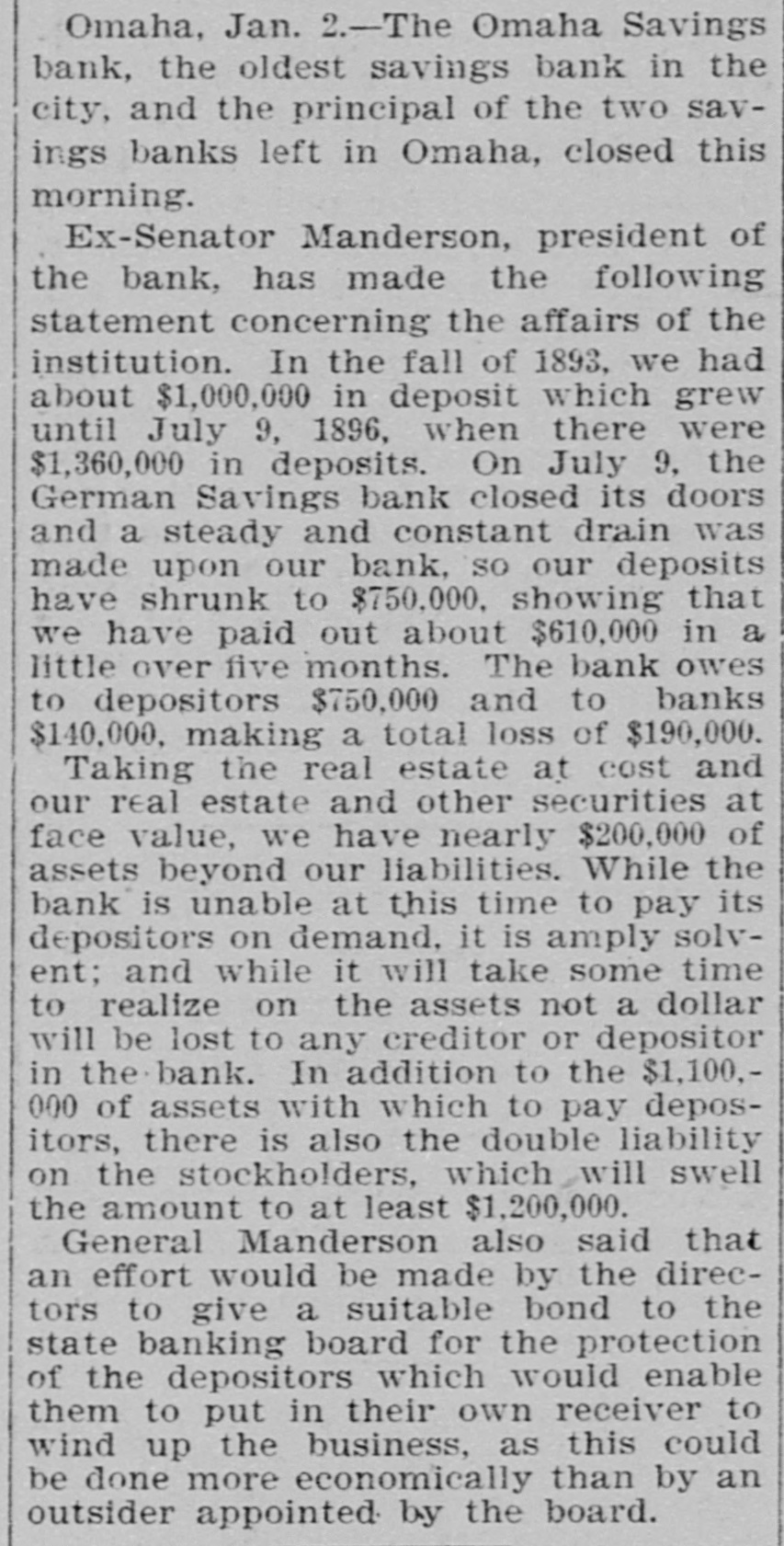
Omaha, Jan. 2.-The Omaha Savings bank, the oldest savings bank in the city, and the principal of the two savings banks left in Omaha, closed this morning. Ex-Senator Manderson, president of the bank, has made the following statement concerning the affairs of the institution. In the fall of 1893. we had about $1,000,000 in deposit which grew until July 9, 1896, when there were $1,360,000 in deposits. On July 9, the German Savings bank closed its doors and a steady and constant drain was made upon our bank, so our deposits have shrunk to $750,000. showing that we have paid out about $610,000 in a little over five months. The bank owes to depositors $750,000 and to banks $140,000. making a total loss of $190,000. Taking the real estate at cost and our real estate and other securities at face value, we have nearly $200,000 of assets beyond our liabilities. While the bank is unable at this time to pay its depositors on demand, it is amply solvent; and while it will take some time to realize on the assets not a dollar will be lost to any creditor or depositor in the-bank. In addition to the $1,100,000 of assets with which to pay depositors, there is also the double liability on the stockholders, which will swell the amount to at least $1,200,000. General Manderson also said that an effort would be made by the directors to give a suitable bond to the state banking board for the protection of the depositors which would enable them to put in their own receiver to wind up the business, as this could be done more economically than by an outsider appointed by the board.


Article from The Salt Lake Herald, January 3, 1897

Click image to open full size in new tab

Article Text

Omaha, Jan. 2.-The Omaha Savings bank, the oldest savings bank in the city, and the principal of the two savings banks left in Omaha, closed this morning. Ex-Senator Manderson, president of the bank, has made the following statement concerning the affairs of the institution. In the fall of 1893, we had about $1,000,000 in deposit which grew until July 9, 1896, when there were $1,360,000 in deposits. On July 9, the German Savings bank closed its doors and a steady and constant drain was made upon our bank, SO our deposits have shrunk to $750,000, showing that we have paid out about $610,000 in a little over five months. The bank owes to depositors $750,000 and to banks $140,000, making a total loss of $190,000. Taking the real estate at cost and our real estate and other securities at face value, we have nearly $200,000 of assets beyond our liabilities. While the bank is unable at this time to pay its depositors on demand, it is amply solvent; and while it will take some time to realize on the assets not a dollar will be lost to any creditor or depositor in the bank. In addition to the $1,100,000 of assets with which to pay depositors, there is also the double liability on the stockholders, which will swell the amount to at least $1,200,000. General Manderson also said that an effort would be made by the directors to give a suitable bond to the state banking board for the protection of the depositors which would enable them to put in their own receiver to wind up the business, as this could be done more economically than by an outsider appointed by the board.


Article from The San Francisco Call, January 3, 1897

Click image to open full size in new tab

Article Text

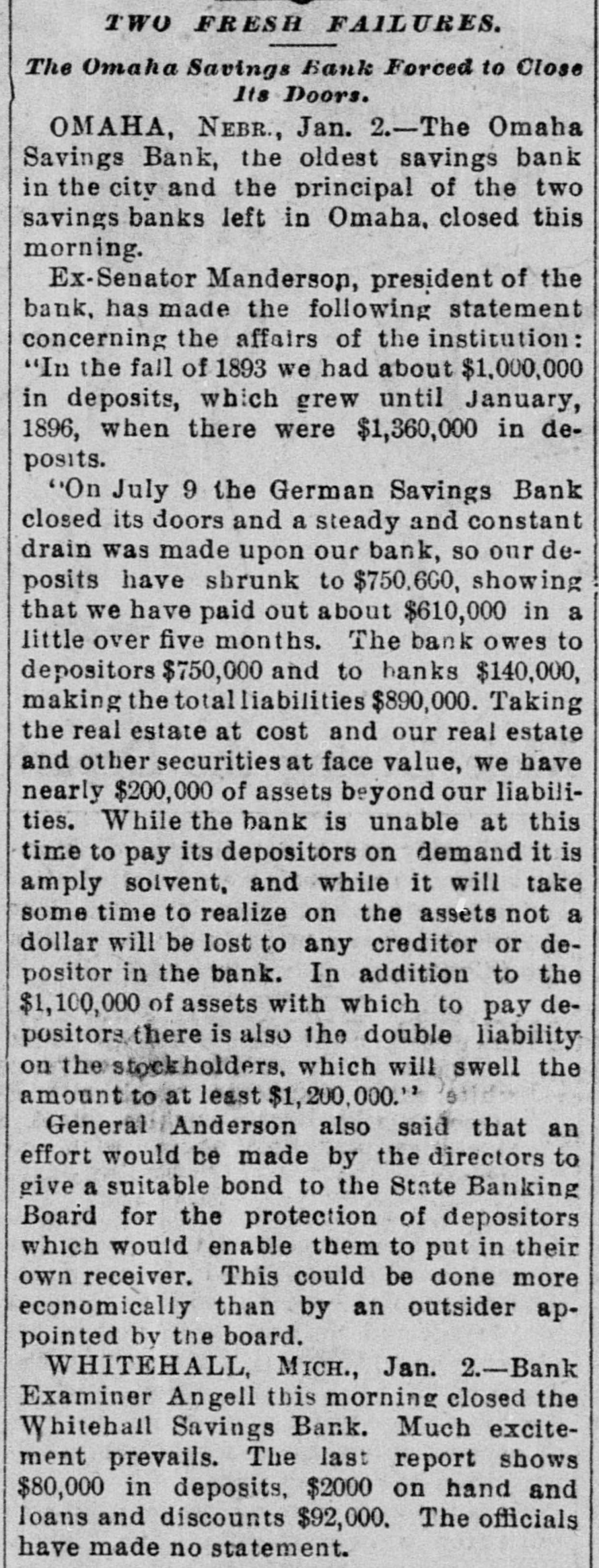
TWO FRESH FAILURES. The Omaha Savings Bank Forced to Close Its Doors. OMAHA, NEBR., Jan. 2.-The Omaha Savings Bank, the oldest savings bank in the city and the principal of the two savings banks left in Omaha. closed this morning. Ex-Senator Manderson, president of the bank, has made the following statement concerning the affairs of the institution: "In the fall of 1893 we had about $1,000,000 in deposits, which grew until January, 1896, when there were $1,360,000 in deposits. "On July 9 the German Savings Bank closed its doors and a steady and constant drain was made upon our bank, so our deposits have shrunk to $750,600, showing that we have paid out about $610,000 in a little over five months. The bank owes to depositors $750,000 and to banks $140,000, making the total liabilities $890,000. Taking the real estate at cost and our real estate and other securities at face value, we have nearly $200,000 of assets beyond our liabilities. While the bank is unable at this time to pay its depositors on demand it is amply solvent, and while it will take some time to realize on the assets not a dollar will be lost to any creditor or depositor in the bank. In addition to the $1,100,000 of assets with which to pay depositors there is also the double liability on the stock holders. which will swell the amount to at least $1,200,000." General Anderson also said that an effort would be made by the directors to give a suitable bond to the State Banking Board for the protection of depositors which would enable them to put in their own receiver. This could be done more economically than by an outsider appointed by the board. WHITEHALL MICH., Jan. 2.-Bank Examiner Angell this morning closed the Whitehall Savings Bank. Much excitement prevails. The last report shows $80,000 in deposits, $2000 on hand and loans and discounts $92,000. The officials have made no statement.


Article from Omaha Daily Bee, January 16, 1897

Click image to open full size in new tab

Article Text

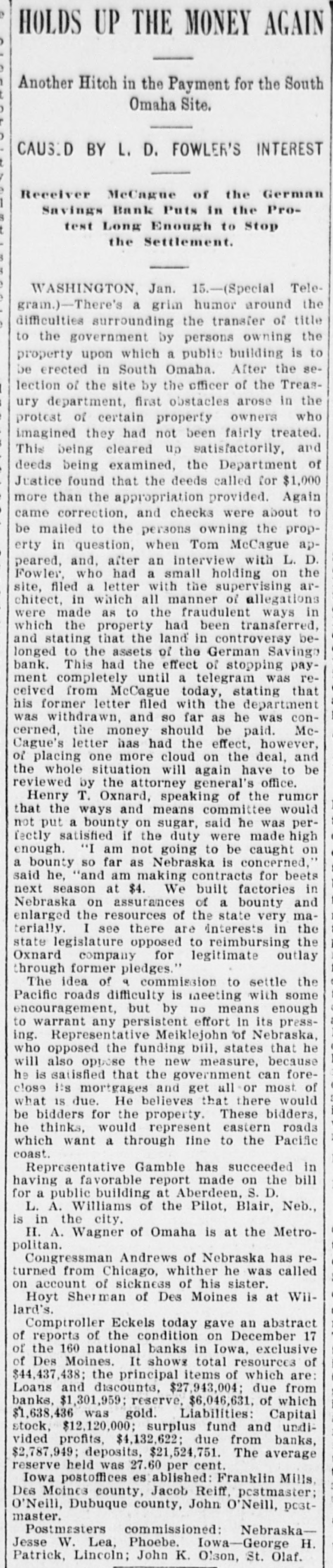
# HOLDS UP THE MONEY AGAIN Another Hitch in the Payment for the South Omaha Site. CAUSED BY L. D. FOWLER'S INTEREST Receiver McCague of the German Savings Bank Puts in the Protest Long Enough to Stop the Settlement. WASHINGTON, Jan. 15. (Special Telegram.) There's a grim humor around the difficulties surrounding the transfer of title to the government by persons owning the property upon which a public building is to be erected in South Omaha. After the selection of the site by the officer of the Treasury department, first obstacles arose in the protest of certain property owners who imagined they had not been fairly treated. This being cleared up satisfactorily, and deeds being examined, the Department of Justice found that the deeds called for $1,000 more than the appropriation provided. Again came correction, and checks were about to be mailed to the persons owning the property in question, when Tom McCague appeared, and, after an interview with L. D. Fowler, who had a small holding on the site, filed a letter with the supervising architect, in which all manner of allegations were made as to the fraudulent ways in which the property had been transferred, and stating that the land in controversy belonged to the assets of the German Savingo bank. This had the effect of stopping payment completely until a telegram was received from McCague today, stating that his former letter filed with the department was withdrawn, and so far as he was concerned, the money should be paid. McCague's letter has had the effect, however, of placing one more cloud on the deal, and the whole situation will again have to be reviewed by the attorney general's office. Henry T. Oxnard, speaking of the rumor that the ways and means committee would not put a bounty on sugar, said he was perfectly satisfied if the duty were made high enough. "I am not going to be caught on a bounty so far as Nebraska is concerned," said he, "and am making contracts for beets next season at $4. We built factories in Nebraska on assurances of a bounty and enlarged the resources of the state very materially. I see there are interests in the state legislature opposed to reimbursing the Oxnard company for legitimate outlay through former pledges." The idea of a commission to settle the Pacific roads difficulty is meeting with some encouragement, but by no means enough to warrant any persistent effort in its pressing. Representative Meiklejohn of Nebraska, who opposed the funding bill, states that he will also oppose the new measure, because he is satisfied that the government can foreclose its mortgages and get all or most of what is due. He believes that there would be bidders for the property. These bidders, he thinks, would represent eastern roads which want a through line to the Pacific coast. Representative Gamble has succeeded in having a favorable report made on the bill for a public building at Aberdeen, S. D. L. A. Williams of the Pilot, Blair, Neb., is in the city. H. A. Wagner of Omaha is at the Metropolitan. Congressman Andrews of Nebraska has returned from Chicago, whither he was called on account of sickness of his sister. Hoyt Sherman of Des Moines is at Willard's. Comptroller Eckels today gave an abstract of reports of the condition on December 17 of the 160 national banks in Iowa, exclusive of Des Moines. It shows total resources of $44,437,438; the principal items of which are: Loans and discounts, $27,943,004; due from banks, $1,301,959; reserve, $6,046,631, of which $1,638,436 was gold. Liabilities: Capital stock, $12,120,000; surplus fund and undivided profits, $4,132,622; due from banks, $2,787,949; deposits, $21,524,751. The average reserve held was 27.60 per cent. Iowa postoffices established: Franklin Mills, Des Moines county, Jacob Reiff, pcstmaster; O'Neili, Dubuque county, John O'Neill, postmaster. Postmasters commissioned: Nebraska-Jesse W. Lea, Phoebe. Iowa George H. Patrick, Lincoln; John K. Olson, St. Olaf.


Article from Omaha Daily Bee, January 19, 1897

Click image to open full size in new tab

Article Text

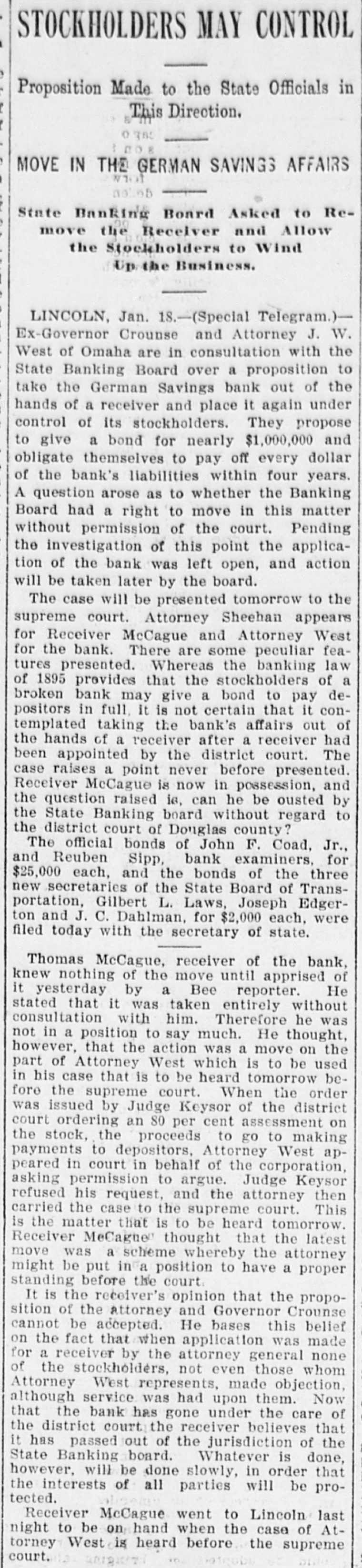
STOCKHOLDERS MAY CONTROL Proposition Made to the State Officials in This Direction. MOVE IN THE GERMAN SAVINGS AFFAIRS what State Banking Board Asked to Remove the Receiver and Allow the Stockholders to Wind Up the Business. LINCOLN, Jan. 18.-(Special Telegram.)Ex-Governor Crounse and Attorney J. W. West of Omaha are in consultation with the State Banking Board over a proposition to take the German Savings bank out of the hands of a receiver and place it again under control of its stockholders. They propose to give a bond for nearly $1,000,000 and obligate themselves to pay off every dollar of the bank's liabilities within four years. A question arose as to whether the Banking Board had a right to move in this matter without permission of the court. Pending the investigation of this point the application of the bank was left open, and action will be taken later by the board. The case will be presented tomorrow to the supreme court. Attorney Sheehan appears for Receiver McCague and Attorney West for the bank. There are some peculiar features presented. Whereas the banking law of 1895 provides that the stockholders of a broken bank may give a bond to pay depositors in full, it is not certain that it contemplated taking the bank's affairs out of the hands of a receiver after a receiver had been appointed by the district court. The case raises a point never before presented. Receiver McCague is now in possession, and the question raised is, can he be ousted by the State Banking board without regard to the district court of Douglas county? The official bonds of John F. Coad, Jr., and Reuben Sipp, bank examiners, for $25,000 each, and the bonds of the three new secretaries of the State Board of Transportation, Gilbert L. Laws, Joseph Edgerton and J. C. Dahlman, for $2,000 each, were filed today with the secretary of state. Thomas McCague, receiver of the bank, knew nothing of the move until apprised of it yesterday by a Bee reporter. He stated that it was taken entirely without consultation with him. Therefore he was not in a position to say much. He thought, however, that the action was a move on the part of Attorney West which is to be used in his case that is to be heard tomorrow before the supreme court. When the order was issued by Judge Keysor of the district court ordering an 80 per cent assessment on the stock, the proceeds to go to making payments to depositors, Attorney West appeared in court in behalf of the corporation, asking permission to argue. Judge Keysor refused his request, and the attorney then carried the case to the supreme court. This is the matter that is to be heard tomorrow. Receiver MeCague thought that the latest move was a scheme whereby the attorney might be put in a position to have a proper standing before the court. It is the receiver's opinion that the proposition of the attorney and Governor Crounse cannot be accepted. He bases this belief on the fact that when application was made for a receiver by the attorney general none of the stockholders, not even those whom Attorney West represents, made objection, although service was had upon them. Now that the bank has gone under the care of the district court the receiver believes that it has passed out of the jurisdiction of the State Banking board. Whatever is done, however, will be done slowly, in order that the interests of all parties will be protected. Receiver McCague went to Lincoln last night to be on hand when the case of Attorney West is heard before the supreme court.