Click image to open full size in new tab
Article Text
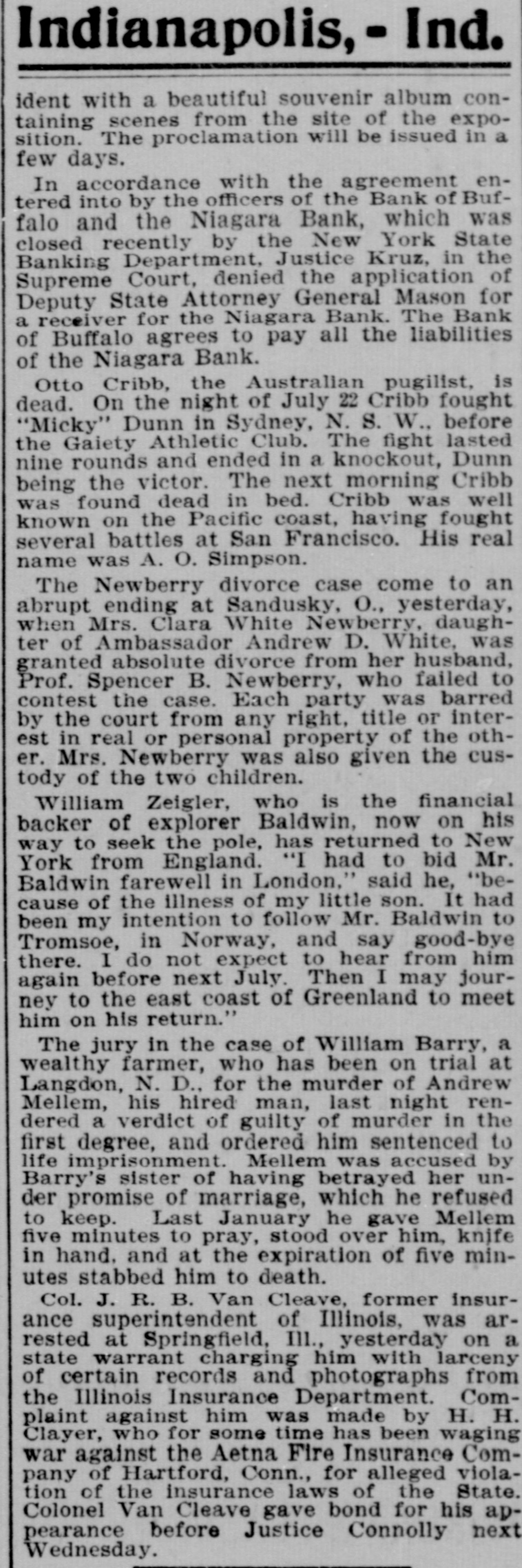
Indianapolis,- Ind. ident with a beautiful souvenir album containing scenes from the site of the exposition. The proclamation will be issued in a few days. In accordance with the agreement entered into by the officers of the Bank of Buffalo and the Niagara Bank, which was closed recently by the New York State Banking Department, Justice Kruz, in the Supreme Court, denied the application of Deputy State Attorney General Mason for a receiver for the Niagara Bank. The Bank of Buffalo agrees to pay all the liabilities of the Niagara Bank. Otto Cribb, the Australian pugilist, is dead. On the night of July 22 Cribb fought "Micky" Dunn in Sydney, N. S. W., before the Gaiety Athletic Club. The fight lasted nine rounds and ended in a knockout, Dunn being the victor. The next morning Cribb was found dead in bed. Cribb was well known on the Pacific coast, having fought several battles at San Francisco. His real name was A. O. Simpson. The Newberry divorce case come to an abrupt ending at Sandusky, O., yesterday, when Mrs. Clara White Newberry, daughter of Ambassador Andrew D. White, was granted absolute divorce from her husband, Prof. Spencer B. Newberry, who failed to contest the case. Each party was barred by the court from any right, title or interest in real or personal property of the other. Mrs. Newberry was also given the custody of the two children. William Zeigler, who is the financial backer of explorer Baldwin, now on his way to seek the pole, has returned to New York from England. "I had to bid Mr. Baldwin farewell in London." said he, "because of the illness of my little son. It had been my intention to follow Mr. Baldwin to Tromsoe, in Norway, and say good-bye there. I do not expect to hear from him again before next July. Then I may journey to the east coast of Greenland to meet him on his return." The jury in the case of William Barry, a wealthy farmer, who has been on trial at Langdon, N. D., for the murder of Andrew Mellem, his hired man, last night rendered a verdict of guilty of murder in the first degree, and ordered him sentenced to life imprisonment. Mellem was accused by Barry's sister of having betrayed her under promise of marriage, which he refused to keep. Last January he gave Mellem five minutes to pray, stood over him, knife in hand. and at the expiration of five minutes stabbed him to death. Col. J. R. B. Van Cleave, former insurance superintendent of Illinois, was arrested at Springfield, Ill., yesterday on a state warrant charging him with larceny of certain records and photographs from the Illinois Insurance Department. Complaint against him was made by H. H. Clayer, who for some time has been waging war against the Aetna Fire Insurance Company of Hartford, Conn., for alleged violation of the insurance laws of the State. Colonel Van Cleave gave bond for his appearance before Justice Connolly next Wednesday.