Gallatin National Bank (New York, NY)

Episode Information

Episode UID
132401294
Episode Type
Suspension → Reopening
Bank Type
national
Bank ID
13240 national
Charter Number
1324
Start Date
October 26, 1907
Location
New York, New York (40.714, -74.006)

Metadata

Model
gpt-5-mini (chosen from majority vote of a three-model LLM ensemble)
Short Digest
f0531c6715d28519

Response Measures

None

Events (5)

1. June 22, 1865 Chartered
Source
historical_nic
2. October 26, 1907 Run
Cause
Macro News
Cause Details
General panic of October 1907 produced heavy withdrawals and runs on New York banks.
Measures
Depositors at many savings banks were required to give 30 to 90 days' notice (invocation of by-law withdrawal notice) to stem lines and heavy withdrawals.
Newspaper Excerpt
Many Send in Written Desires to Withdraw Deposits.
Source
newspapers
3. October 26, 1907 Suspension
Cause
Macro News
Cause Details
Widespread financial panic led New York banks to suspend payment and invoke delaying clauses in by-laws (30-90 day notices).
Newspaper Excerpt
All of the savings banks in New York today refused to pay depositors on demand.
Source
newspapers
4. December 26, 1907 Reopening
Newspaper Excerpt
Today was the date of the expiration of most of the sixty-day withdrawal notices ... but scarcely a depositor called for his money (Dec. 26, 1907).
Source
newspapers
5. May 27, 1912 Voluntary Liquidation
Source
historical_nic

Newspaper Articles (14)

Article from The Washington Times, October 26, 1907

Click image to open full size in new tab

Article Text

Many Send in Written Desires to Withdraw Deposits. Cortelyou Given Credit for Terminating the Money Flurry. NEW YORK, Oct. 26.-All of the savings banks in New York today refused to pay depositors on demand. Under an agreement reached at a meeting of their presidents yesterday, the banks took advantage of the clause in their by-laws which permits them to demand from thirty to ninety days' notice from depositors who wish to draw on their accounts. Notices were posted on all savings banks to this effect today, from the biggest, with deposits of almost $100,000,000, to the smallest, with deposits of only $17,000. The result was felt immediately. At those banks which had experienced runs the lines disappeared, although many filed written notices of their intention to withdraw their deposits at the expiration of the thirty, sixty, or ninety days, according to whichever period the bank adopted.


Article from The Madison Daily Leader, October 30, 1907

Click image to open full size in new tab

Article Text

SCARE IS SUBSIDING Runs Upon New York Banks Practically Cease. STOCK MARKET UNSTEADY Calling in of Loans Causes a Decline in Prices, Canadian Pacific Leading in the Slump-Worldwide Scramble for Gold. New York, Oct. 30.-The financial situation is without notable developments. and the abating interest indicates that the public has pretty well gotten over its scare. The stock markets is a little unsteady, but without extreme agitation. The announcement at the ImpeS rial bank of Germany a raised its discount rate from 5 1/2 to 6 1/2 per cent in order to protect its gold holdings was not unexpected by bankers here. It is thought quite likely that the Bank of England will follow suit by raising its rate at the regular meeting on Thursday. The scramble for gold is such at all the financial centersLondon, Paris, Berlin and New York -that the metel will go to the highest bidder and under present conditions New York is likely to appear for a time in this role. Her ability to get gold is due not only to the need for it, but to the large credits which are being established by the movement of the crops and other products-notably wheat, cotton, copper, tobacco and meats-and by the sale of American securities. These influences are usually more potent than artificial measures to obtain the yellow metal. It is believed this will be effective to place sufficient gold at the command of the New York market and to maintain credit and cause the resumption of banking operations in the usual manner within a few days. Runs upon the banks here have practically ceased since the banks adopted the policy of paying large depositors in checks. Some transfers of accounts are being made from the smaller to the larger banks, which resulted in adverse balances against the former, but strengthening the ability of the larger institutions to meet pressure and to support the market.


Article from The Stark County Democrat, November 22, 1907

Click image to open full size in new tab

Article Text

CANNON Arrives in Washington With Cheerful View of Financial Situation SAYS NATION IS SOLID Washington, Nov. 21.-Joseph G. Cannon, of Illinois, speaker of the house, arrived here to day looking in fine health and very optimistic as to the financial and business outlook. "A great many plans have been proposed to relieve the money stringency," said Speaker Cannon. "In fact there are as many plans as there are people advocating them. In other words, there is a confusion of ideas as to what emergency legislation might be necessary. Before making up my mind as to what should be done, I prefer to await the recommendations of the president and the secretary of the treasury and the appropriate committee that has jurisdiction over the subject." Discussing the situation generally the speaker said: "The masses of the people in the United States never were so rich as they are today. The cotton, the corn, the wheat and the meat produced this year and now waiting to be marketed are of the value of at least ten billion dollars, and the people who produced them are substantially out of debt. There is a demand for the great bulk of these products in the United States and there is a demand for all we have to spare in the markets of the world at extraordinary high prices. These products cannot start to market because of the currency panic or currency famine. They will begin to go to market the moment the banks resume payment of their obligations. New York, the great clearing house of the new United States, was the first to suspend the payment of currency. It must be the first to resume the payment of currency and the moment New York resumes that will unlock the three thousand millions of currency and


Article from The Roswell Daily Record, December 3, 1907

Click image to open full size in new tab

Article Text

"The current number of Harper's Weekly contains an editorial 'roast' of the clearing house certificates issued in Las Vegas, New Mexico. In view of the fact that the financial difficulties of the West were wholly due to the suspension of payment by the New York banks, and the issue by these banks of clearing house certificates and other forms of 'Johnsmith' currency—as it is now called—it would seem that the Weekly might have found a target for its ammunition nearer home.—Socorro Chieftain.


Article from Deseret Evening News, December 3, 1907

Click image to open full size in new tab

Article Text

# RESUMPTION. Horace Greely was wont to say that "the way to resume is to resume." The New York banks have been announcing for some time that specie payments are about to be resumed. It appears that the bankers elsewhere are ready to pay cash as soon as New York decides to keep its promises. It is noted as one peculiar feature of the present panic that some of the New York bankers will become rich because of it. And we doubt not that the most immediate cause of the suspension of cash payment by the banks all over the country was the stoppage of such payments by the banks in New York. As long as the banks of that city continue to withhold payment of their obligations, there seems to be no reason why they might not be purchasing the government bonds and so making a profit out of withholding cash payments to the rest of the country. Such a suggestion is made in many quarters, and the way to negative any such suspicion is for the New York banks to pay their obligations inland in the current money of the realm.


Article from Albuquerque Morning Journal, December 27, 1907

Click image to open full size in new tab

Article Text

BANK DEPOSITORS RECOVER FROM PANIC (New York. Dec. 26.-Today was the date of the expiration of most of the sixty-day withdrawal notices re. quired by the savings banks at the height of the paniè in October, but searcely a depositor called for his money


Article from The Times Dispatch, February 7, 1908

Click image to open full size in new tab

Article Text

City were increased on the security of stock and bond loans from $281,000,000 to $302,000,000. Three hundred and twelve millions loaned on collateral of Wall Street, and yet they suspended payments to their individual depositors and to their banking correspondents throughout the country. And they did it when they had money in their treasury with which to meet their obliga-tions." ### Kept Cash; Got Premium. Mr. Culberson declared that while New York had so much cash in its banks Southern banks were paying a premium for cash. The Aldrich bill, he declared, would give the banks more power and would foster stock and bond speculation by the banks and still further discriminate against the general public, and in the interest of the bondholding classes. "Against this policy," he added, "I want to enter my earnest and emphatic protest." Senator Hopkins replied briefly to Mr. Culberson. "Every statement made by the Senator," he said, "has been answered by the Secretary of the Treasury in his report." Mr. Culberson said the secretary refused to give the Texas banks deposits they asked for, and Mr. Hopkins replied that he had done the same thing in respect to Chicago banks, as he put the money where he believed the greatest emergency existed. The consideration of Mr. Culberson's resolution was postponed, and it was allowed to lie on the table.


Article from The Birmingham Age-Herald, March 12, 1908

Click image to open full size in new tab

Article Text

FINANCIAL BILL HOTLY DENOUNCED Senator Clarke of Arkansas Hits Several Fierce Blows ALDRICH ATTEMPTS REPLY Investigation of Causes of the Panic Is Demanded by Senator Clarke, Who Also Denounces New York Stock Exchange. Washington, March 11.-Senator Clarke of Arkansas denounced the pending currency bill in a speech in the Senate today, declaring that no currency legislation should be enacted until an investigation is held as to the causes of the panic. "No such legislation is necessary now, said Mr. Clarke. "It is not only not necesI sary, but it may become dangerous. am not disposed to tolerate the idea of giving any support to the committee bill, nor the substitute proposed by the minority members of the Senate." If emergency currency is to be provided, Mr. Clarke said, the benefits should be extended all persons whose legitimate business demands cause them to need it. Mr. Clarke denounced the operations of stock exchanges and said the American people would not be satisfied with the proposed currency legislation without a complete knowledge of causes of the panic. "The time has arrived," he said, "when the affairs of the New .York stock exchange and other stock exchanges must be looked into." Mr. Clarke's reference to the stoppage of the payments by the New York banks called Mr. Aldrich to his feet with the remark that he did not believe the people would permit that course again to be pursued. "I trust the senator from Rhode Island as a historian," retorted Mr. Clarke, "but I do not trust him as a prophet." Mr. Clarke expressed the opinion that the majority would not pass the bill allowing the emergency circulation to be retired without limitation. Mr. Clarke said he would not only require a restriction of reserves, but he would deny to a national bank the right to pay interest on checking accounts. Senator Nelson suggested that the national banks should pay interest on the $250,000,000 of government deposits. Mr. Aldrich said that five years ago he had introduced a bill providing for the payment of interest on such deposits at the rate of 1 1/2 per cent, but, he added, senators had opposed that bill on the ground that it changed the nature of the loan. Former Senator Spooner and the late Senator Morgan, he said, opposed the bill. If that objection could be overcome he declared his willingness to again bring in such a measure. He did not know any reason unless it should be a legal one, of the kind suggested, why interest should not be charged on these deposits. Mr. Culberson, he said, had introduced a bill to require payment of interest on government deposits and it was now before the committee on finance. Mr. Bailey spoke at some length suggesting that the main purpose of his substitute was to favor the principle of government money instead of bank money He explained that he had provided for a distribution of the emergency currency in accordance with population, although he realized that business necessity was a greater measure of the amount they should have. But it was not possible to make sure of the business needs of the several sections and it was a simple matter to ascertain the population. An extended argument was made by Mr. Newlands of Nevada in favor of his view that the sending of a check from one state to another makes the business of banking interstate commerce.


Article from New-York Tribune, September 9, 1909

Click image to open full size in new tab

Article Text

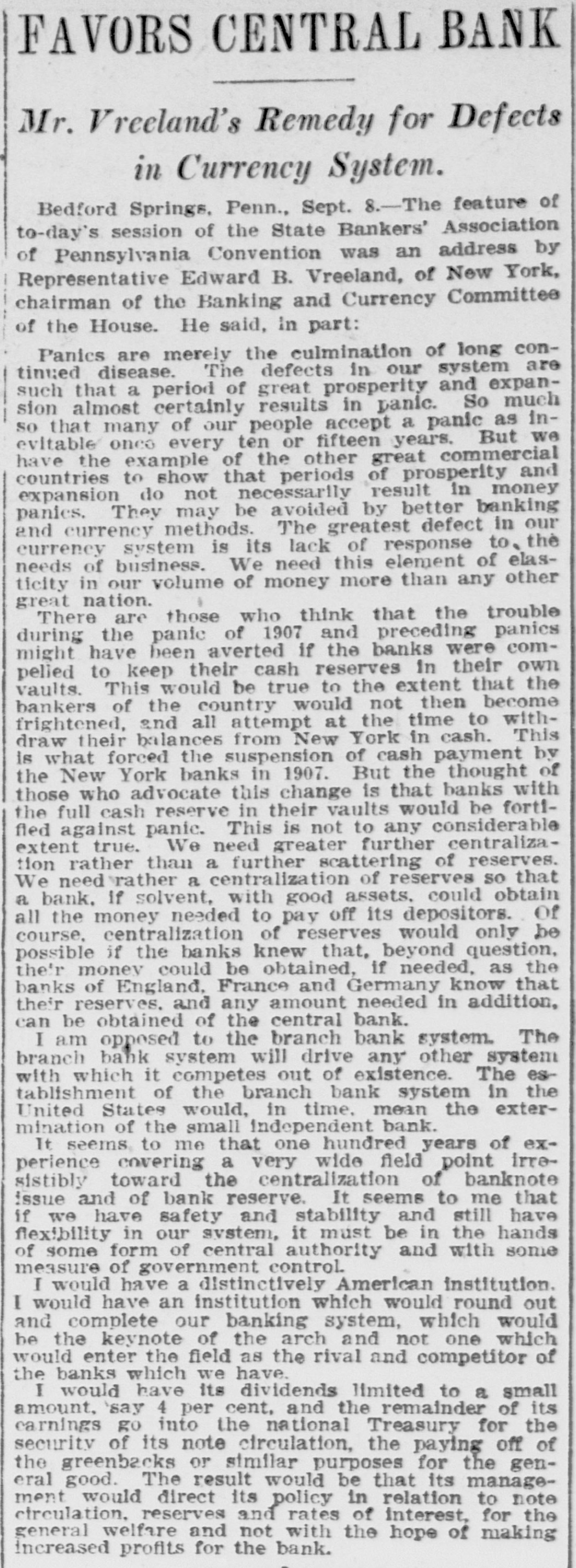
FAVORS CENTRAL BANK Mr. Vreeland's Remedy for Defects in Currency System. Bedford Springs, Penn., Sept. -The feature of to-day's session of the State Bankers' Association of Pennsylvania Convention was an address by Representative Edward B. Vreeland, of New York, chairman of the Banking and Currency Committee of the House. He said, in part: Panics are merely the culmination of long continued disease. The defects in our system are such that a period of great prosperity and expansion almost certainly results in panic. So much so that many of our people accept a panic as inevitable once every ten or fifteen years. But we have the example of the other great commercial countries to show that periods of prosperity and expansion do not necessarily result in money panies. They may be avoided by better banking and currency methods. The greatest defect in our currency system is its lack of response to. the needs of business. We need this element of elasticity in our volume of money more than any other great nation. There are those who think that the trouble during the panic of 1907 and preceding panics might have been averted if the banks were compelied to keep their cash reserves in their own vaults. This would be true to the extent that the bankers of the country would not then become frightened, and all attempt at the time to withdraw their balances from New York in cash. This is what forced the suspension of cash payment by the New York banks in 1907. But the thought of those who advocate this change is that banks with the full cash reserve in their vaults would be fortifled against panic. This is not to any considerable extent true. We need greater further centralization rather than a further scattering of reserves. We need rather a centralization of reserves so that a bank. If solvent, with good assets. could obtain all the money needed to pay off its depositors. Of course, centralization of reserves would only be possible if the banks knew that, beyond question, their money could be obtained, if needed, as the banks of England, France and Germany know that their reserves. and any amount needed in addition, can be obtained of the central bank. I am opposed to the branch bank system. The branch bank system will drive any other system with which it competes out of existence. The establishment of the branch bank system in the United States would, in time, mean the extermination of the small independent bank. It seems to me that one hundred years of experience covering a very wide field point irresistibly toward the centralization of banknote issue and of bank reserve. It seems to me that if we have safety and stability and still have flexibility in our system, it must be in the hands of some form of central authority and with some measure of government control. I would have a distinctively American institution. I would have an institution which would round out and complete our banking system, which would be the keynote of the arch and not one which would enter the field as the rival and competitor of the banks which we have. I would have its dividends limited to a small amount, `say 4 per cent, and the remainder of its earnings go into the national Treasury for the security of its note circulation, the paying off of the greenbacks or similar purposes for the general good. The result would be that its management would direct its policy in relation to note circulation, reserves and rates of interest, for the general welfare and not with the hope of making increased profits for the bank.


Article from Rock Island Argus, October 19, 1909

Click image to open full size in new tab

Article Text

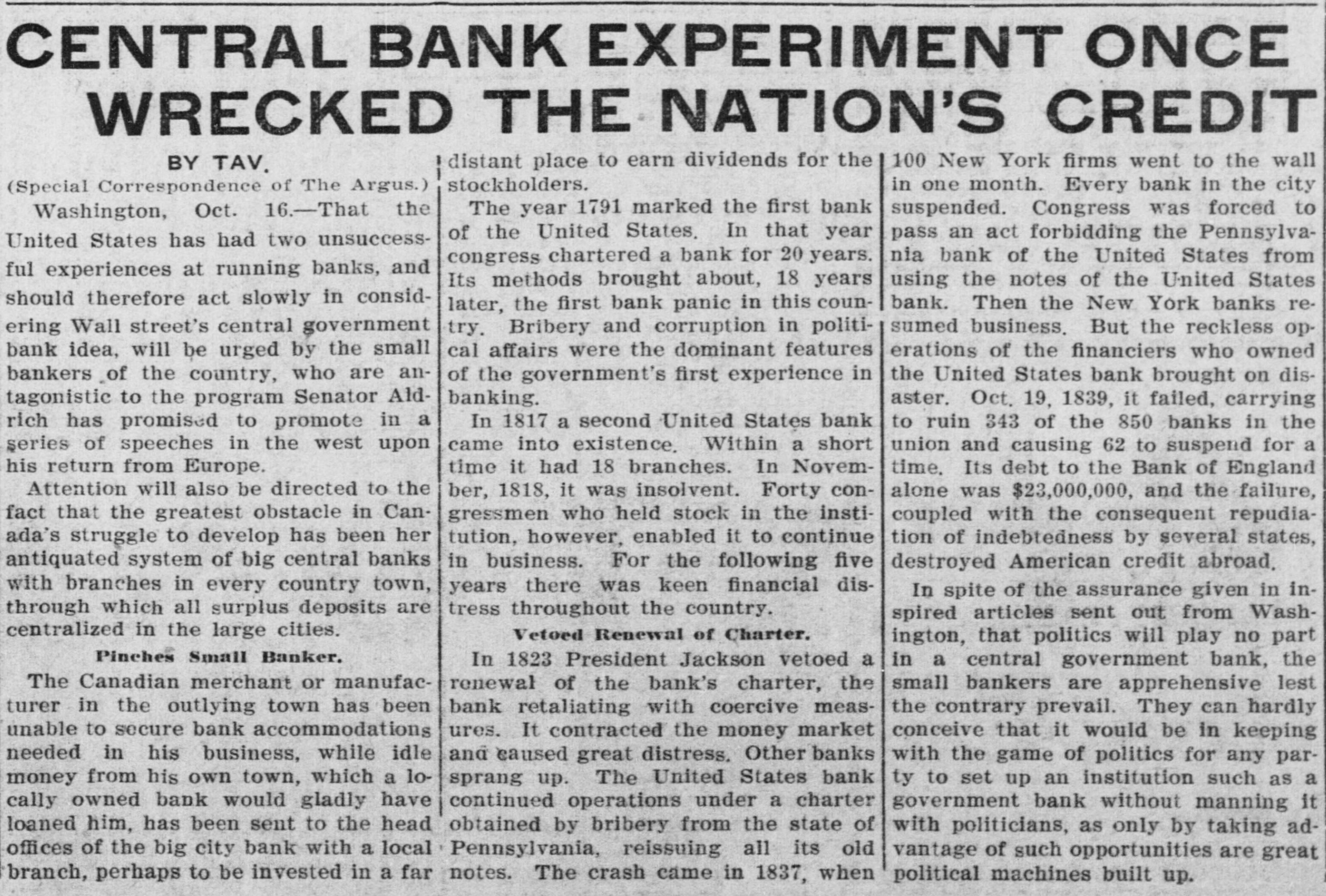
CENTRAL BANK EXPERIMENT ONCE WRECKED THE NATION'S CREDIT 100 New York firms went to the wall distant place to earn dividends for the BY TAV. stockholders. in one month. Every bank in the city (Special Correspondence of The Argus.) suspended. Congress was forced to The year 1791 marked the first bank Washington, Oct. 16.-That the of the United States. In that year pass an act forbidding the PennsylvaUnited States has had two unsuccessnia bank of the United States from congress chartered a bank for 20 years. ful experiences at running banks, and Its methods brought about, 18 years using the notes of the United States should therefore act slowly in considbank. Then the New York banks relater, the first bank panic in this counering Wall street's central government try. Bribery and corruption in politisumed business. But the reckless opcal affairs were the dominant features erations of the financiers who owned bank idea, will be urged by the small bankers of the country, who are anof the government's first experience in the United States bank brought on distagonistic to the program Senator Aldbanking. aster. Oct. 19, 1839, it failed, carrying In 1817 a second United States bank to ruin 343 of the 850 banks in the rich has promised to promote in a came into existence. Within a short series of speeches in the west upon union and causing 62 to suspend for a time it had 18 branches. In Novemhis return from Europe. time. Its debt to the Bank of England Attention will also be directed to the ber, 1818, it was insolvent. Forty conalone was $23,000,000, and the failure, fact that the greatest obstacle in Cangressmen who held stock in the insticoupled with the consequent repudiaada's struggle to develop has been her tion of indebtedness by several states, tution, however, enabled it to continue antiquated system of big central banks in business. For the following five destroyed American credit abroad. with branches in every country town, years there was keen financial disIn spite of the assurance given in inthrough which all surplus deposits are tress throughout the country. spired articles sent out from Washcentralized in the large cities. Vetoed Renewal of Charter. ington, that politics will play no part Pinches Small Banker. In 1823 President Jackson vetoed a in a central government bank, the The Canadian merchant or manufacrenewal of the bank's charter, the small bankers are apprehensive lest turer in the outlying town has been the contrary prevail. They can hardly bank retaliating with coercive measunable to secure bank accommodations ures. It contracted the money market conceive that it would be in keeping needed in his business, while idle and caused great distress. Other banks with the game of politics for any parmoney from his own town, which a losprang up. The United States bank ty to set up an institution such as a cally owned bank would gladly have continued operations under a charter government bank without manning it loaned him, has been sent to the head obtained by bribery from the state of with politicians, as only by taking adoffices of the big city bank with a local Pennsylvania, reissuing all its old vantage of such opportunities are great branch, perhaps to be invested in a far notes. The crash came in 1837, when political machines built up.


Article from The Roswell Daily Record, November 29, 1909

Click image to open full size in new tab

Article Text

U. S. BANK A FAILURE Washington, Nov. 29.-That the United States has had two unsuccessful experiences at running banks, and should, therefore, act slowly in considering Wall Street's central government bank idea, is being urged by the small bankers of the country, who are avowedly antagonistic to the program of Senator Aldrich. The country bankers are directing attention to the fact that the greatest obstacle in Canada's struggle to develop has been her antiquated systerm of big central banks with branches in every country town, through which all surplus deposits are centralized in the large citires. The Canadian merchant or manufacturer in the outlying town has been unable to secure bank accomodations needed in his business, while idle money from his own town, which a locally owned bank would gladly have loaned him, has been sent to the head offices of the big city bank with a local branch, perhaps to be invested in a far distant place to earn dividends for the stockholders. The year 1791 marked the first bank of the United States. In that year Congress chartered a bank for 20 years. Its methods brought about, 18 years later, the first bank panic in this country. Bribery and corruption in political affairs were the domi nant features of the government's first experience in banking. In 1817 a second United States bank came into existence. Within a short time it had 18 branches. In No. vember, 1818, it was insolvent. Forty Congressmen who held stock in the institution, however, enabled it to continue business. For the following five years there was keen financial distress throughout the country. In 1832 President Jackson vetoed a renewal of the bank's charter, the bank retaliating with coercive measures. I: contracted the money markets and caused great distress. Other banks sprung up. The United States bank continued operations under a charter obtained by bribery from the state of Pennsylvania, reissuing all of its old notes. The crash came in 1837, when 100 New York firms went to the wall in one month. Every bank in the city suspended. Congress was forced to pass an act forbidding the Pennsylvania Bank of the United States from using the notes of the old United States bank. Then the New York banks resumed business. But the reckless operations of the financiers who owned the United States bank brought on disaster. Oct. 19, 1839. it failed, carrying to ruin 343 of the 850 banks in the Union and causing sixty-two to suspend for a time. Its debt to the bank of England alone was $23,000,000, and the failure, coupled with the consequent ren pudiation of indebtedness by several states, destroyed American credit abroad. In spite of the assurance given by Senator Aldrich in his speeches in the west, that politics will play no 1 part in a central government bank, the small bankers are apprehensive [ lest the contrary prevail. They can hardly conceive that it would be in I keeping with the game of politics for any party to set up an institution such as a great government bank without manning it with politicians, as only by taking advantage of such opportunities are great political machines built up. :
Article from Tulsa Daily World, November 16, 1911

Click image to open full size in new tab

Article Text

# NECESSITY FOR CURRENCY REFORM. The National Citizens' league for the promotion of a sound banking system in the United States is receiving support and encouragement from every section in the country. It is purely a non-partisan organization and is approaching the subject of currency legislation from a business and not a political point of view. The indications are constantly growing brighter for the successful solution of this problem of national finances upon a basis that will make panics and consequent disasters a thing of the past. In discussing this subject the Saturday Evening Post relates the circumstances which Germany was recently called upon to face and asks the pertinent question, "What would have happenned here?" Upon this point the Post says: "They might have had a panic in Berlin this fall. There had been speculation and overtrading. Credit was under a severe strain. Some eighty million dollars of treasury notes were maturing. The war-clouded political horizon caused France to draw in her money, and the amount of Parsian funds lying at call in Berlin was estimated at 200 million dollars. In some parts of the empire signs of uneasiness among bank depositors appeared. The failure of the Bank of Egypt did not help matters. "The gravity of the situation appears from the fact that in a single week the Imperial Bank lost thirty-nine million dollars of its cash reserve. This is a rather larger loss of cash reserve than the New York associated banks suffered in October, 1907, when they resorted to clearing house loan certificates and restricted cash payments-leading to a wholesale dislocation of the country's banking system. There was no restriction of cash payments at Berlin, however. On the contrary, in six business days the Imperial bank increased its loans and discounts by 145 million dollars, and in order to do so increased its note issue by 154 million dollars. "Thus, notwithstanding the severe strain and the large loss of cash. October settlements were met without a hitch and Berlin paid back to Paris a 150 million dollars of call loans. Ten days later the discount rate at Berlin had fallen to 4 per cent. "All of which shows how a great central bank can deal with a crisis. What would have happened here under like conditions? Perhaps another suspension of cash payments; another breakdown of the banking system; another six or eight months of business doldrums-because we haven't the apparatus to meet a crisis. We know we are rather more liable to fiscal conflagrations than any other great nation; but we rely upon nothing but a volunteer bucket brigade to put them out."


Article from New-York Tribune, December 9, 1913

Click image to open full size in new tab

Article Text

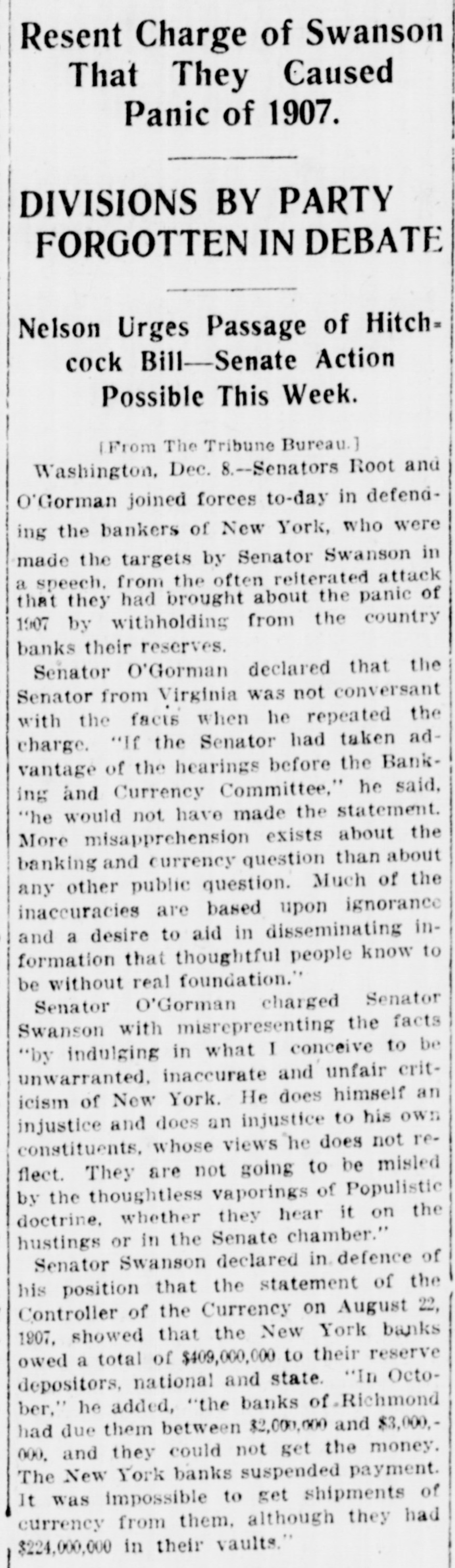
# Resent Charge of Swanson That They Caused Panic of 1907. # DIVISIONS BY PARTY FORGOTTEN IN DEBATE Nelson Urges Passage of Hitchcock Bill—Senate Action Possible This Week. [From The Tribune Bureau.] Washington, Dec. 8.--Senators Root and O'Gorman joined forces to-day in defend-ing the bankers of New York, who were made the targets by Senator Swanson in a speech, from the often reiterated attack that they had brought about the panic of 1907 by withholding from the country banks their reserves. Senator O'Gorman declared that the Senator from Virginia was not conversant with the facts when he repeated the charge. "If the Senator had taken ad-vantage of the hearings before the Bank-ing and Currency Committee," he said, "he would not have made the statement. More misapprehension exists about the banking and currency question than about any other public question. Much of the inaccuracies are based upon ignorance and a desire to aid in disseminating in-formation that thoughtful people know to be without real foundation." Senator O'Gorman charged Senator Swanson with misrepresenting the facts "by indulging in what I conceive to be unwarranted, inaccurate and unfair crit-icism of New York. He does himself an injustice and does an injustice to his own constituents, whose views he does not re-flect. They are not going to be misled by the thoughtless vaporings of Populistic doctrine, whether they hear it on the hustings or in the Senate chamber." Senator Swanson declared in defence of his position that the statement of the Controller of the Currency on August 22, 1907, showed that the New York banks owed a total of $409,000,000 to their reserve depositors, national and state. "In Octo-ber," he added, "the banks of Richmond had due them between $2,000,000 and $3,000,000, and they could not get the money. The New York banks suspended payment. It was impossible to get shipments of currency from them, although they had $224,000,000 in their vaults."


Article from The Washington Times, December 9, 1913

Click image to open full size in new tab

Article Text

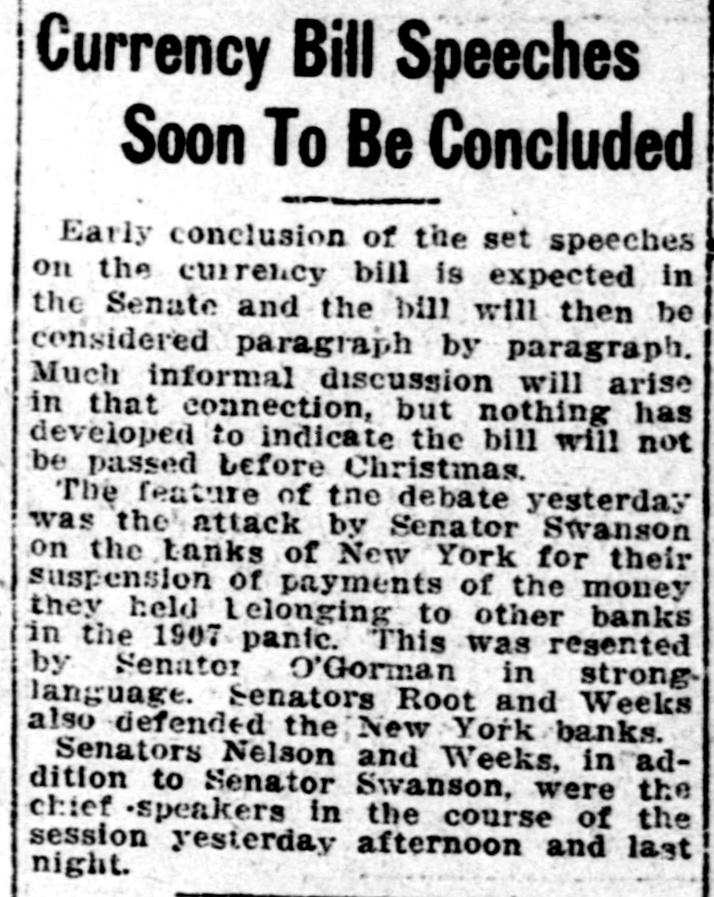
Currency Bill Speeches Soon To Be Concluded Early conclusion of the set speeches on the currency bill is expected in the Senate and the bill will then be considered paragraph by paragraph. Much informal discussion will arise in that connection, but nothing has developed to indicate the bill will not be passed before Christmas. The feature of the debate yesterday was the attack by Senator Swanson on the banks of New York for their suspension of payments of the money they held belonging to other banks in the 1907 panic. This was resented by Senator O'Gorman in strong language. Senators Root and Weeks also defended the New York banks. Senators Nelson and Weeks, in addition to Senator Swanson, were the chief speakers in the course of the session yesterday afternoon and last night.