13219. Lafayette Trust Company (Brooklyn, NY)

Bank Information

Episode Type
Run โ†’ Suspension โ†’ Closure
Bank Type
trust
Start Date
October 26, 1907
Location
Brooklyn, New York (40.660, -73.951)

Metadata

Model
gpt-5-mini
Short Digest
12f0d8af69e04c77

Response Measures

None

Description

The Jenkins Trust Co. suspended during the October 1907 panic (a run/macroeconomic panic). It reorganized as Lafayette Trust Co. and reopened in mid-April 1908, then failed to resume business and went into liquidation on Nov 30, 1908 with the state superintendent taking charge. Cause of final failure was inability to raise new capital and lingering bad assets from the prior failure.

Events (4)

1. October 26, 1907 Run
Cause
Macro News
Cause Details
Closed during the financial panic of October 1907 (panic-induced run/closures).
Measures
Suspension/closure (placed in hands of receiver)
Newspaper Excerpt
The institution closed on October 26.
Source
newspapers
2. April 15, 1908 Reopening
Newspaper Excerpt
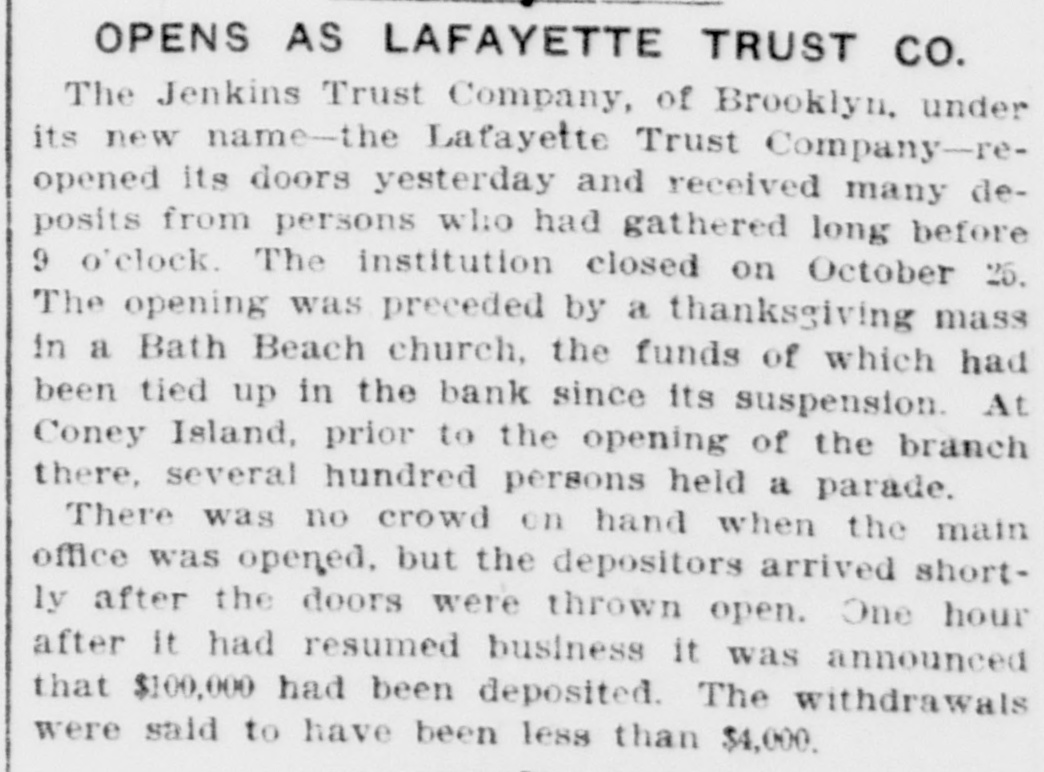
The Jenkins Trust Company, of Brooklyn, under its new name-the Lafayette Trust Company-reopened its doors yesterday ... One hour after it had resumed business it was announced that $100,000 had been deposited. The withdrawals were said to have been less than $4,000.
Source
newspapers
3. November 30, 1908 Receivership
Newspaper Excerpt
The superintendent of banks took charge of the trust company today. An officer of the bank said depositors will receive 100 cents on the dollar.
Source
newspapers
4. November 30, 1908 Suspension
Cause
Bank Specific Adverse Info
Cause Details
Failure to obtain an increase in capital and heavy drain from installment payments to former depositors; large doubtful assets from the prior Jenkins Trust failure.
Newspaper Excerpt
The Lafayette Trust company ... did not open for business today. An announcement was made that the officers of the institution had decided to liquidate. The superintendent of banks took charge of the Trust company today.
Source
newspapers

Newspaper Articles (19)

Article from New-York Tribune, April 16, 1908

Click image to open full size in new tab

Article Text

OPENS AS LAFAYETTE TRUST CO. The Jenkins Trust Company, of Brooklyn, under its new name-the Lafayette Trust Company-reopened its doors yesterday and received many deposits from persons who had gathered long before 9 o'clock. The institution closed on October 26. The opening was preceded by a thanksgiving mass in a Bath Beach church, the funds of which had been tied up in the bank since its suspension. At Coney Island, prior to the opening of the branch there, several hundred persons held a parade. There was no crowd on hand when the main office was opened. but the depositors arrived shortly after the doors were thrown open. One hour after It had resumed business it was announced that $100,000 had been deposited. The withdrawals were said to have been less than $4,000.


Article from Albuquerque Citizen, November 30, 1908

Click image to open full size in new tab

Article Text

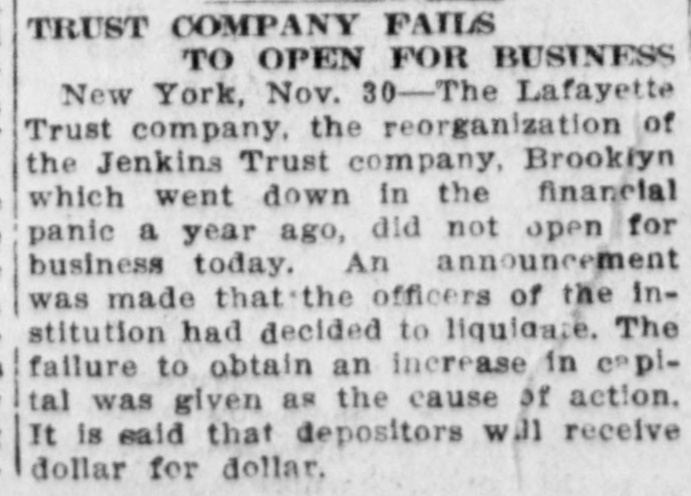
TRUST COMPANY FAILS TO OPEN FOR BUSINESS New York, Nov. 30-The Lafayette Trust company. the reorganization of the Jenkins Trust company, Brooklyn which went down in the financial panic a year ago, did not open for business today. An announcement was made that.the officers of the institution had decided to liquidate. The failure to obtain an increase in capital was given as the cause of action. It is said that depositors will receive dollar for dollar.


Article from The Fargo Forum and Daily Republican, November 30, 1908

Click image to open full size in new tab

Article Text

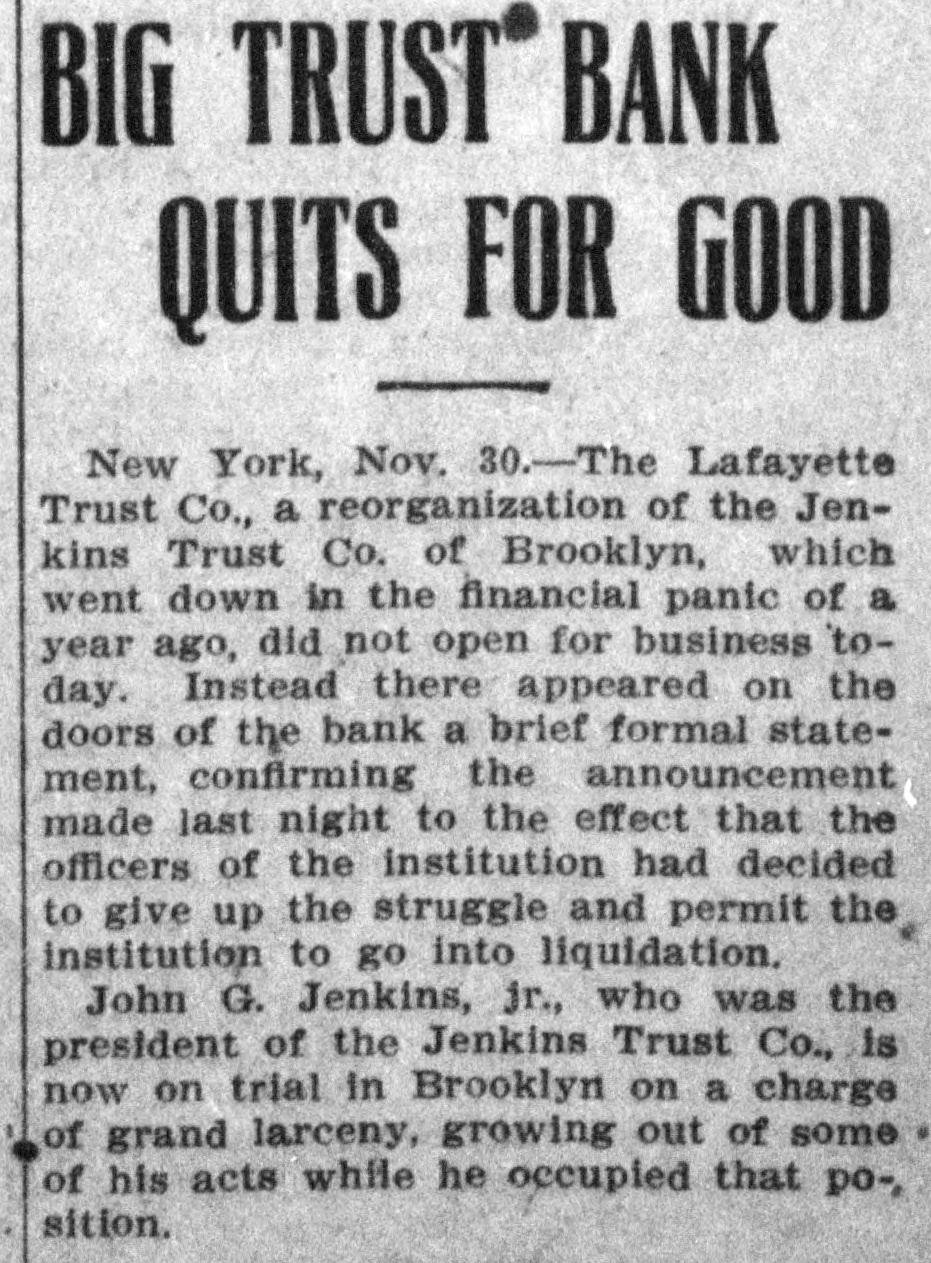
BIG TRUST BANK QUITS FOR GOOD New York, Nov. 30.-The Lafayette Trust Co., a reorganization of the Jenkins Trust Co. of Brooklyn, which went down in the financial panic of a year ago, did not open for business today. Instead there appeared on the doors of the bank a brief formal statement, confirming the announcement made last night to the effect that the officers of the institution had decided to give up the struggle and permit the institution to go into liquidation. John G. Jenkins, jr., who was the president of the Jenkins Trust Co., is now on trial in Brooklyn on a charge of grand larceny, growing out of some of his acts while he occupied that po-, sition.


Article from Evening Times-Republican, November 30, 1908

Click image to open full size in new tab

Article Text

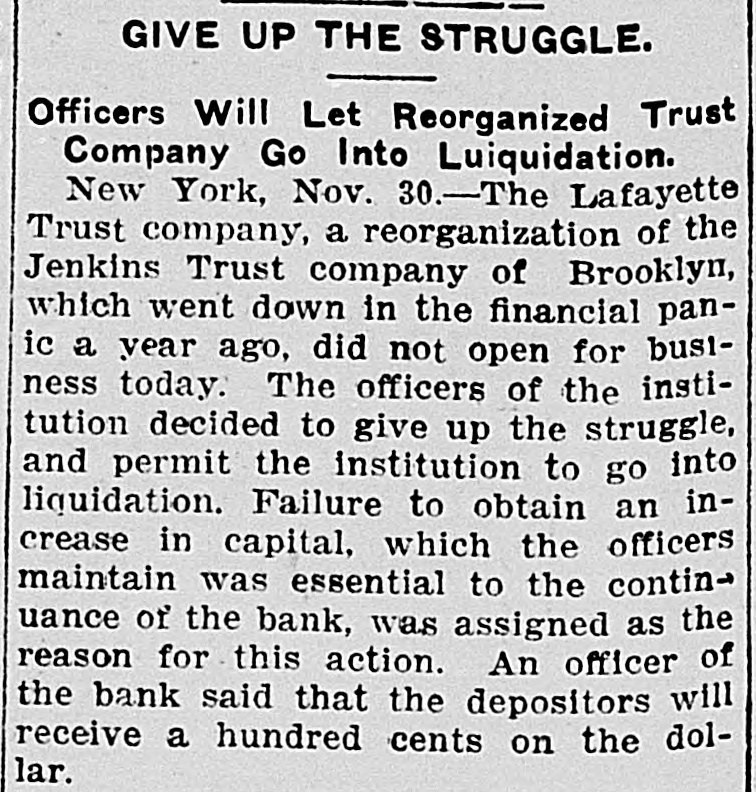
GIVE UP THE STRUGGLE. Officers Will Let Reorganized Trust Company Go Into Luiquidation. New York, Nov. 30.-The Lafayette Trust company, a reorganization of the Jenkins Trust company of Brooklyn, which went down in the financial panic a year ago, did not open for business today. The officers of the institution decided to give up the struggle, and permit the institution to go into liquidation. Failure to obtain an increase in capital, which the officers maintain was essential to the continuance of the bank, was assigned as the reason for this action. An officer of the bank said that the depositors will receive a hundred cents on the dollar.


Article from The Marion Daily Mirror, November 30, 1908

Click image to open full size in new tab

Article Text

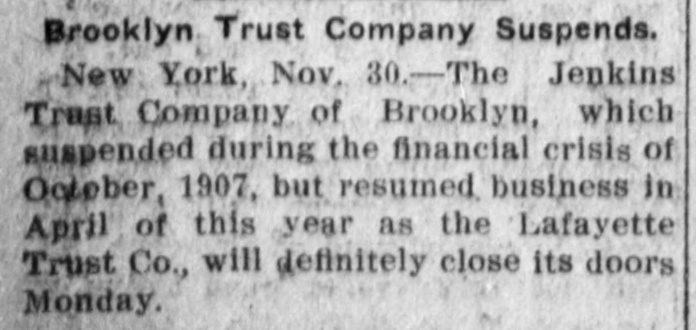
Brooklyn Trust Company Suspends. New York, Nov. 30.-The Jenkins Trust Company of Brooklyn, which suspended during the financial crisis of October, 1907, but resumed business in April of this year as the Lafayette Trust Co., will definitely close its doors Monday.


Article from Deseret Evening News, November 30, 1908

Click image to open full size in new tab

Article Text

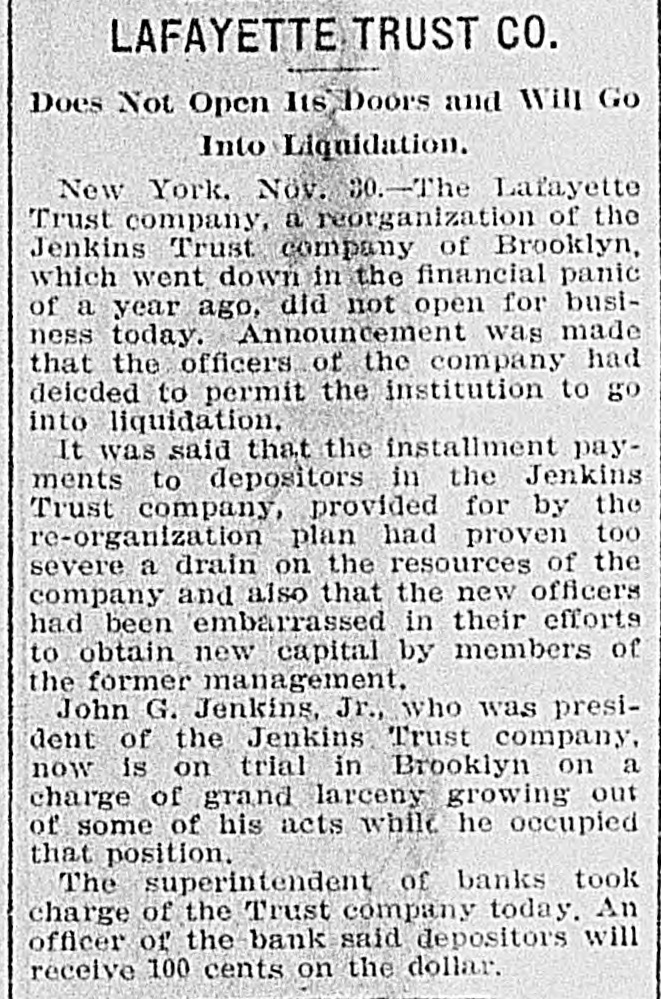
LAFAYETTE TRUST CO. Does Not Open Its Doors and Will Go Into Liquidation. New York, Nov. 30.-The Lafayette Trust company, a reorganization of the Jenkins Trust company of Brooklyn, which went down in the financial panic of a year ago, did not open for business today. Announcement was made that the officers of the company had deicded to permit the institution to go into liquidation. It was said that the installment payments to depositors in the Jenkins Trust company, provided for by the re-organization plan had proven too severe a drain on the resources of the company and also that the new officers had been embarrassed in their efforts to obtain new capital by members of the former management. John G. Jenkins, Jr., who was president of the Jenkins Trust company, now is on trial in Brooklyn on a charge of grand larceny growing out of some of his acts while he occupied that position. The superintendent of banks took charge of the Trust company today. An officer of the bank said depositors will receive 100 cents on the dollar.


Article from The Topeka State Journal, November 30, 1908

Click image to open full size in new tab

Article Text

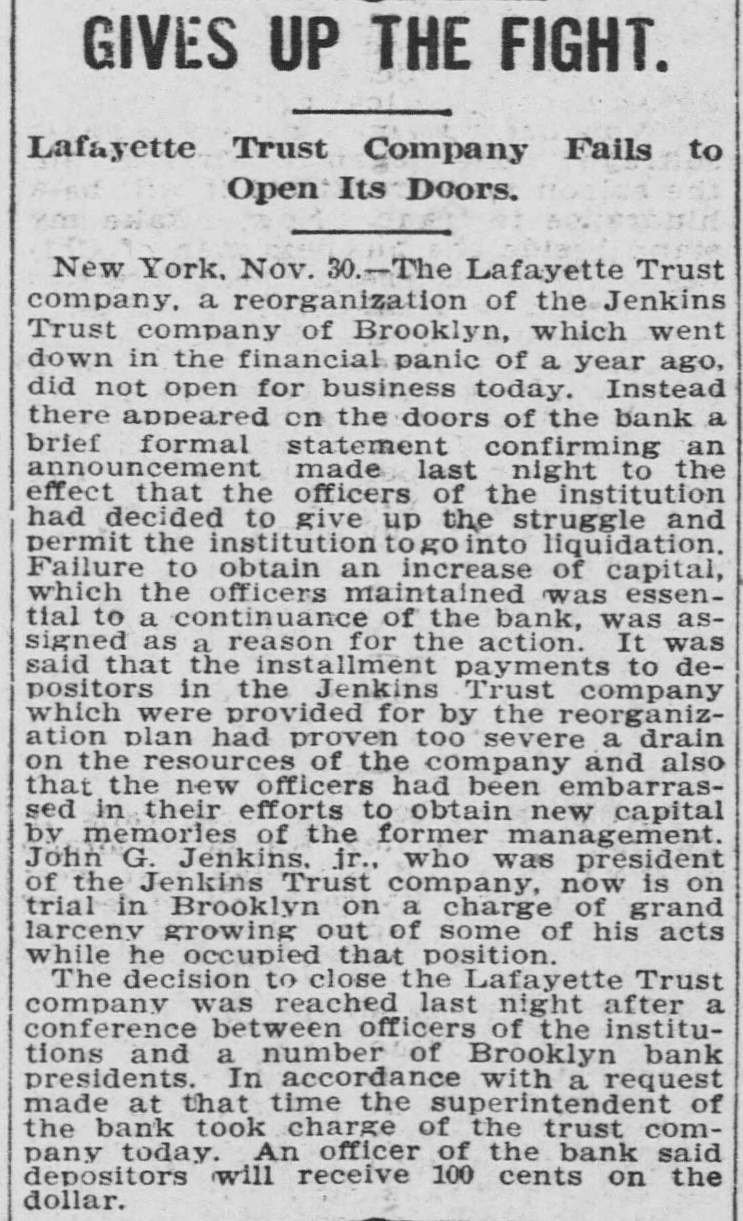
GIVES UP THE FIGHT. Lafayette Trust Company Fails to Open Its Doors. New York, Nov. 30.-The Lafayette Trust company, a reorganization of the Jenkins Trust company of Brooklyn, which went down in the financial panic of a year ago, did not open for business today. Instead there appeared on the doors of the bank a brief formal statement confirming an announcement made last night to the effect that the officers of the institution had decided to give up the struggle and permit the institution to liquidation. Failure to obtain an increase of capital, which the officers maintained was essential to a continuance of the bank, was assigned as a reason for the action. It was said that the installment payments to depositors in the Jenkins Trust company which were provided for by the reorganization plan had proven too severe a drain on the resources of the company and also that the new officers had been embarrassed in their efforts to obtain new capital by memories of the former management. John G. Jenkins. jr., who was president of the Jenkins Trust company, now is on trial in Brooklyn on a charge of grand larceny growing out of some of his acts while he occupied that position. The decision to close the Lafayette Trust company was reached last night after a conference between officers of the institutions and a number of Brooklyn bank presidents. In accordance with a request made at that time the superintendent of the bank took charge of the trust company today. An officer of the bank said depositors will receive 100 cents on the dollar.


Article from Waterbury Evening Democrat, November 30, 1908

Click image to open full size in new tab

Article Text

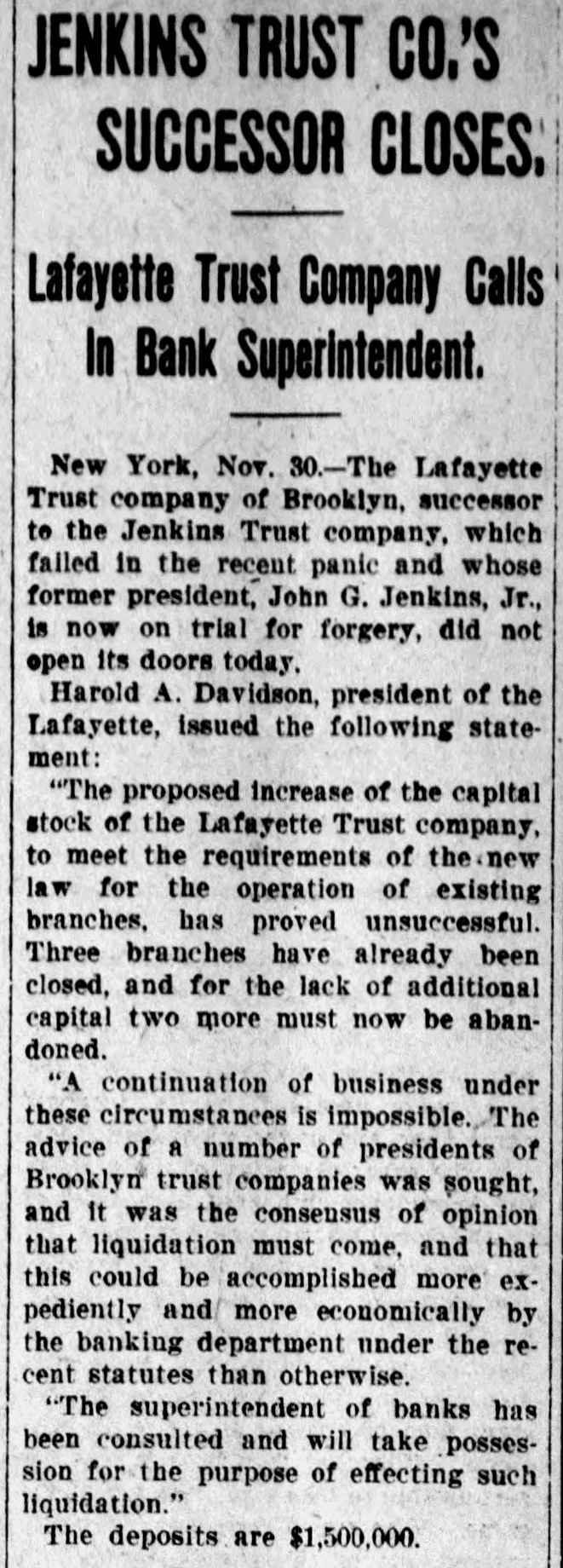
JENKINS TRUST CO.'S SUCCESSOR CLOSES. Lafayette Trust Company Calls In Bank Superintendent. New York, Nov. 30.-The Lafayette Trust company of Brooklyn, successor to the Jenkins Trust company, which falled in the recent panic and whose former president, John G. Jenkins, Jr., is now on trial for forgery, did not open its doors today. Harold A. Davidson, president of the Lafayette, issued the following statement: "The proposed increase of the capital stock of the Lafayette Trust company, to meet the requirements of the.new law for the operation of existing branches, has proved unsuccessful. Three branches have already been closed, and for the lack of additional capital two more must now be abandoned. "A continuation of business under these circumstances is impossible. The advice of a number of presidents of Brooklyn trust companies was sought, and it was the consensus of opinion that liquidation must come, and that this could be accomplished more expediently and more economically by the banking department under the recent statutes than otherwise. "The superintendent of banks has been consulted and will take possession for the purpose of effecting such liquidation." The deposits are $1,500,000.


Article from Los Angeles Herald, December 1, 1908

Click image to open full size in new tab

Article Text

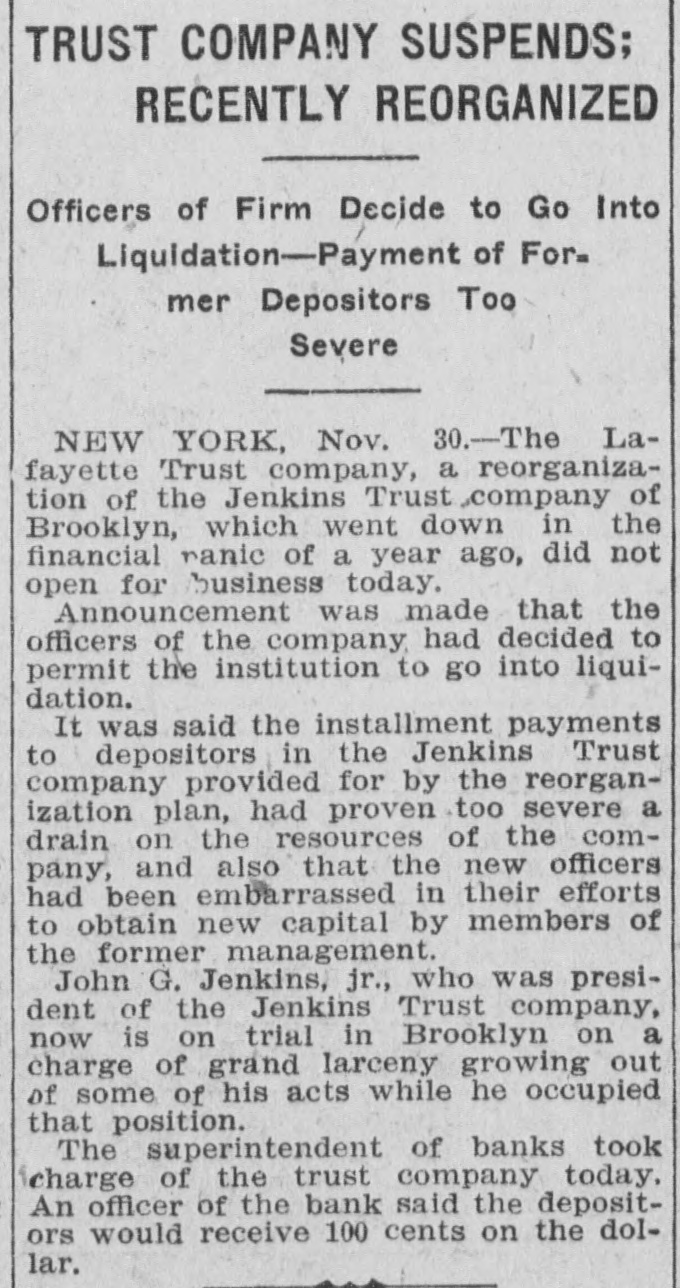
TRUST COMPANY SUSPENDS; RECENTLY REORGANIZED Officers of Firm Decide to Go Into Liquidation-Payment of Former Depositors Too Severe NEW YORK, Nov. 30.-The Lafayette Trust company, a reorganization of the Jenkins Trust company of Brooklyn, which went down in the financial ranic of a year ago, did not open for business today. Announcement was made that the officers of the company had decided to permit the institution to go into liquidation. It was said the installment payments to depositors in the Jenkins Trust company provided for by the reorganization plan, had proven too severe a drain on the resources of the company, and also that the new officers had been embarrassed in their efforts to obtain new capital by members of the former management. John G. Jenkins, jr., who was president of the Jenkins Trust company, now is on trial in Brooklyn on a charge of grand larceny growing out of some of his acts while he occupied that position. The superintendent of banks took charge of the trust company today. An officer of the bank said the depositors would receive 100 cents on the dollar.


Article from The White Pine News, December 1, 1908

Click image to open full size in new tab

Article Text

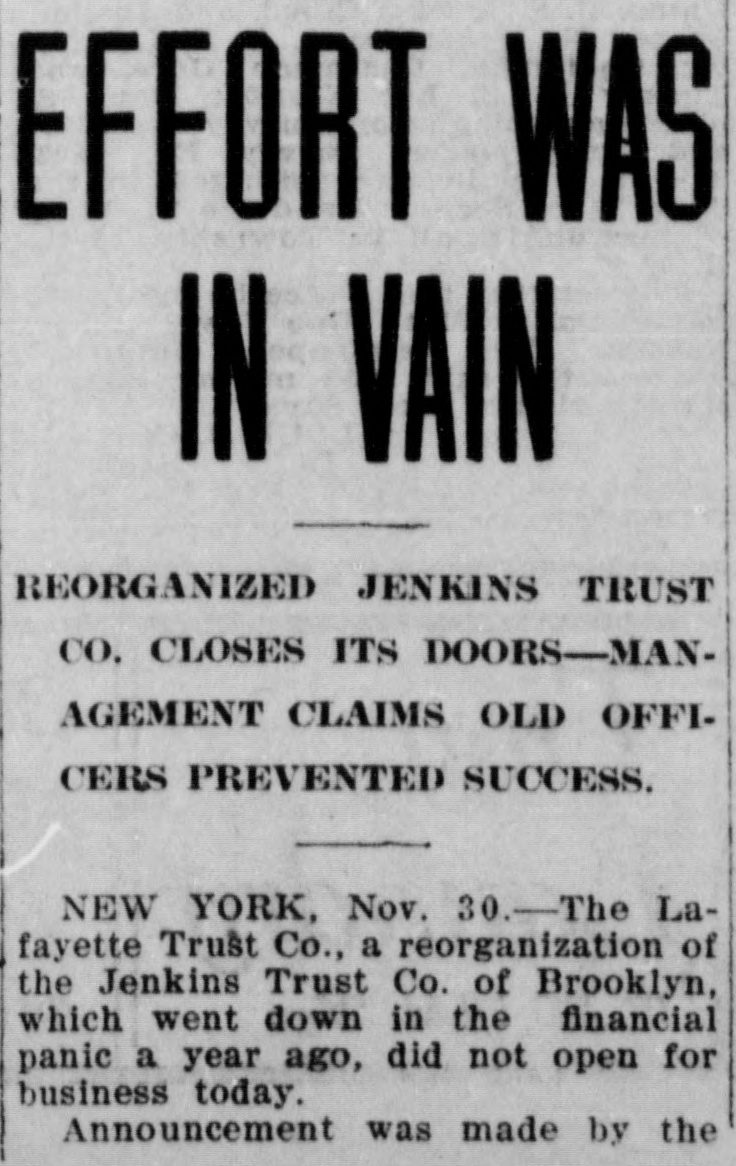
EFFORT WAS IN VAIN REORGANIZED JENKINS TRUST CO. CLOSES ITS DOORS-MANAGEMENT CLAIMS OLD OFFICERS PREVENTED SUCCESS. NEW YORK, Nov. 30.-The Lafayette Trust Co., a reorganization of the Jenkins Trust Co. of Brooklyn, which went down in the financial panic a year ago, did not open for business today. Announcement was made by the


Article from The Montgomery Advertiser, December 1, 1908

Click image to open full size in new tab

Article Text

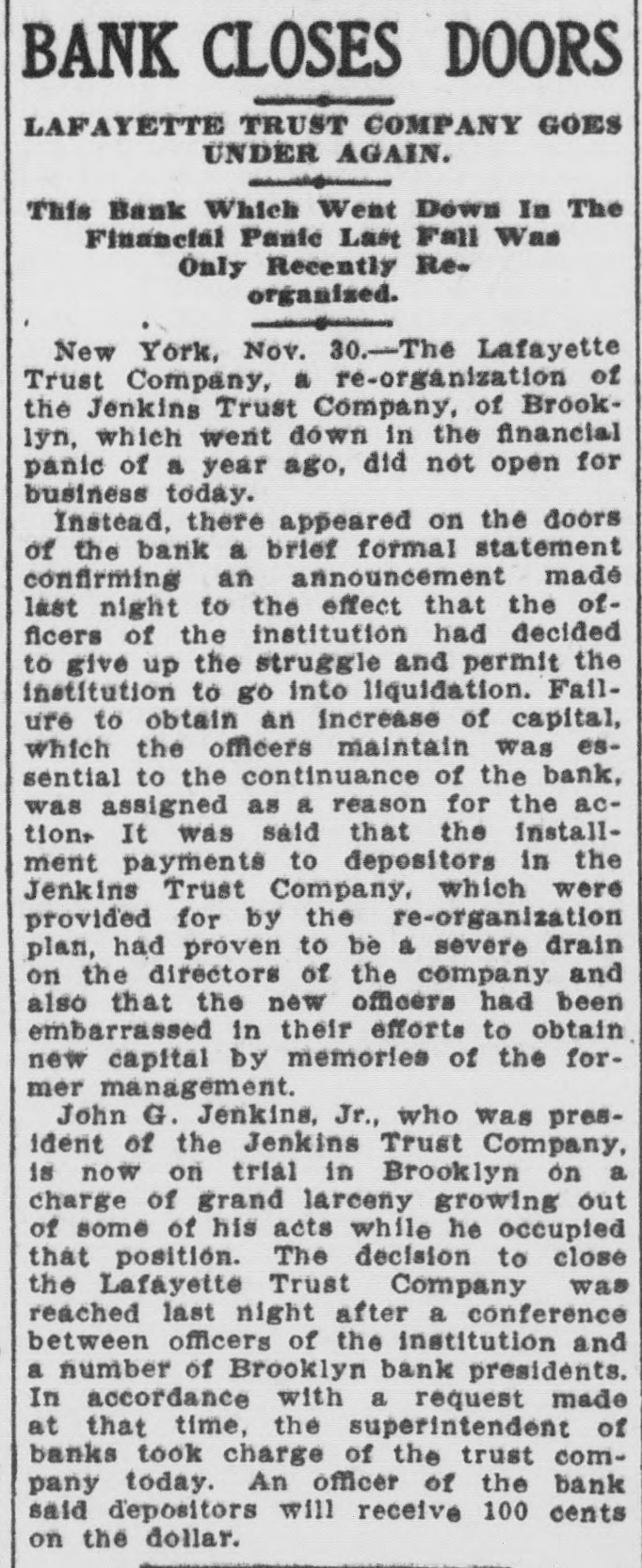
BANK CLOSES DOORS LAFAYETTE TRUST COMPANY GOES UNDER AGAIN. This Bank Which Went Down In The Financial Panic Last Fall Was Only Recently Reorganized. / New York, Nov. 30.-The Lafayette Trust Company, a re-organization of the Jenkins Trust Company, of Brooklyn, which went down in the financial panic of a year ago, did not open for business today. Instead, there appeared on the doors of the bank a brief formal statement confirming an announcement made last night to the effect that the officers of the institution had decided to give up the struggle and permit the institution to go into liquidation. Failure to obtain an increase of capital, which the officers maintain was essential to the continuance of the bank, was assigned as a reason for the action+ It was said that the installment payments to depositors in the Jenkins Trust Company, which were provided for by the re-organization plan, had proven to be a severe drain on the directors of the company and also that the new officers had been embarrassed in their efforts to obtain new capital by memories of the former management. John G. Jenkins, Jr., who was president of the Jenkins Trust Company, is now on trial in Brooklyn on a charge of grand larceny growing out of some of his acts while he occupied that position. The decision to close the Lafayette Trust Company was reached last night after a conference between officers of the institution and a number of Brooklyn bank presidents. In accordance with a request made at that time, the superintendent of banks took charge of the trust company today. An officer of the bank said depositors will receive 100 cents on the dollar.


Article from The San Francisco Call, December 1, 1908

Click image to open full size in new tab

Article Text

REORGANIZATION FAILS NEW YORK, Nov. 30.-The Lafayette trust company, a reorganization of the Jenkins trust company of Brooklyn, which went down in the financial panic of a year ago, did not open for business today. Announcement was made that the officers of the company had decided to. permit the institution to go into liquidation.


Article from The Barre Daily Times, December 1, 1908

Click image to open full size in new tab

Article Text

TRUST CONCERN TO LIQUIDATE. The Lafayette Co. of Brooklyn Unable to Carry Financial Load. New York, Dec. 1.-The Lafayette Trust company, a reorganization of the Jenkins Trust company of Brooklyn which went down in the financial panie of a year ago, did not open for business yesterday. Instead there appeared on the deors of the bank a brief formal statement confirming an n.n. nouncefent made last night to the effect that the officers of the institution


Article from Daily Kennebec Journal, December 1, 1908

Click image to open full size in new tab

Article Text

GIVES UP STRUGGLE. Lafayette Trust Co. of Brooklyn Decides to Go Into Liquidation. New York, Nov. 30.-The Lafayette Trust Co., a re-organization of the Jenkins Trust Co. of Brooklyn, which went down in the financial panic of a year ago, did not open for business today. Instead there appeared on the doors of the bank a brief formal statement confirming an announcement made last night to the effect that the officers of the institution had decided to give up the struggle and permit the institution to go into liquidation. It was said that the instalment payments to depositors in the Jenkins Trust Co., which were provided for by the reorganization plan, had proved too severe a drain on the resouces of the company and also that the new officers had been embarrassed in their efforts to obtain new capital by members of the former 1 management. John J. Jenkins, Jr.. who was president of the Jenkins Trust Co., now is on trial in Brooklyn on a charge of grand larceny growing out of some of his acts while he occupied that positior. The superintendent of banks took charge of the trust company today. An officer of the bank said the depositors will receive 100 cents on the dollar.


Article from Omaha Daily Bee, May 5, 1909

Click image to open full size in new tab

Article Text

No matter how much indignation is directed toward Mr. Maybray and his pals, his method of separating "Mikes" from their money appears decidedly raw when contrasted with the smooth work of financial experts. Possibly the fact that "miking" Is not sanctioned by law gives the taint of rawness to the scheme. Under guise of legal sanction the game of collusive robbery is no less rank, but It takes a veneer of cleverness in keeping within the forms of law while canning the spirit of the law and making off with the goods. But to the point: The Brooklyn Eagle relates that the Jenkins Trust company of that city, organized in 1905 with a capital of $500,000 and a surplus of $150,000. went into the hands of a receiver in October, 1907. with deposits of $4,500,000. On the following January reorganization was affected with the approval of the state's attorney general and the state superintendent of banks. In April, last year. the Lafayette Trust company reopened for business with capital stock increased to $800,000. In seven months the concern was again in the hands of receivers. But between April and November favored depositors got in their work, drawing out 75 per cent of the deposits, leaving 25 per cent to hold the sack. That was the purpose of the reorganization and the managers made good. Recently the receivers filed an inventory with the supreme court. in which it is shown that the nominal assets were $600,000 in excess of liabilities, but that of such assets more than $700,000 are doubtful or impossible of collection. In the detail of this report it is set forth that loans to the amount of $100,746 are of problematical value, and that there are other loans amounting to $677,618. on which it is impossible to realize anything at the present time. Another detail is that this total of bills purchased and past due amounts to $220,528. of which only 10 or 15 per cent is collectible. Here there is nearly $1,000,000 of assets, at least, pronounced doubtful by the receivers.


Article from New-York Tribune, September 22, 1909

Click image to open full size in new tab

Article Text

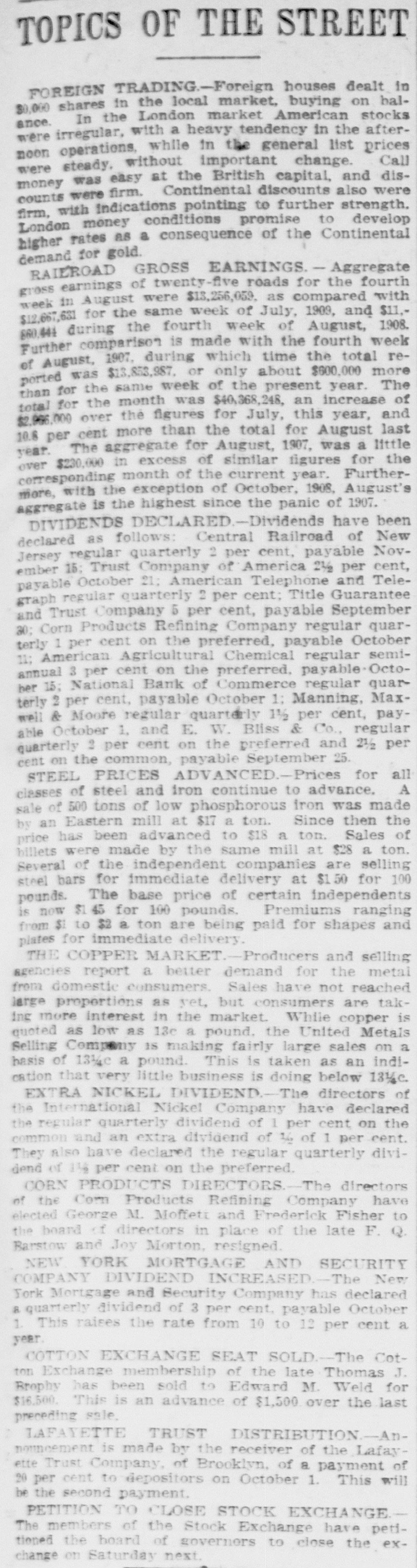
TOPICS OF THE STREET FOREIGN TRADING.-Foreign houses dealt in shares in the local market, buying on bal$0,000 In the London market American stocks ance. irregular, with a heavy tendency in the afterwere operations, while in the general list prices noon steady. without important change. Call easy at the firm. Continental money counts were were was British discounts capital, further also strength. and were diswith indications pointing to firm, money conditions promise to develop rates as a consequence for GROSS higher London demand RAIEROAD gold. EARNINGS. of the for Continental the Aggregate fourth of twenty-five roads gross were $13,256,059. as for the same week of the fourth week 860,444 week $12,667,631 in earnings during August July, of compared 1909, August, fourth and week with 1908. $11.Further comparison is made with the 1907. during which time the total rewas $13,853,987. or only same week of the year. of ported August, for the about present $600,000 more The of than for the month was $40,368,248, an increase total over the figures for July, this year, and cent more than the total for aggregate for August, was a 10.8 year. $2,966,000 per The 1907, August for little last the $230,000 in excess of similar figures corresponding over month of the current year. Furtherthe exception of October, is the highest since aggregate more, with the panic 1908, of August's 1907. DIVIDENDS DECLARED.-Dividends have been declared as follows: Central Railroad of New quarterly 2 per cent. 15: Trust Company of America per ember Jersey regular Telephone payable 21/2 and Nov- Tele- cent, payable October 21; American graph regular quarterly 2 per cent: Title Guarantee Trust Company 5 per cent, payable September Products Refining Company 1 cent on the preferred, 30: and terly Corn per payable regular October quar- semi11; American Agricultural Chemical regular annual 3 per cent on the preferred, payable-OctoNational Bank of Commerce 2 cent. payable October 1: terly her 15: per Manning, regular quar- Max- paywell & Moore regular quarterly 1 1/2 per cent, able October 1. and E. W. Bliss & Co., regular quarterly 2 per cent on the preferred and 2 1/2 per cent on the common, payable September 25. STEEL PRICES ADVANCED.-Prices for all classes of steel and iron continue to advance. A sale of 500 tons of low phosphorous iron was made by an Eastern mill at $17 a ton. Since then the price has been advanced to $18 a ton. Sales of billets were made by the same mill at $28 a ton. Several of the independent companies are selling steel bars for immediate delivery at $1.50 for 100 pounds. The base price of certain independents is now $1.45 for 100 pounds. Premiums ranging from $1 to $2 a ton are being paid for shapes and plates for immediate delivery. THE COPPER MARKET. Producers and selling agencies report a better demand for the metal from domestic consumers. Sales have not reached large proportions as yet, but consumers are taking more interest in the market. While copper is quoted as low as 13c a pound. the United Metals Selling Company is making fairly large sales on a basis of 13% a pound. This is taken as an indication that very little business is doing below 131/c EXTRA NICKEL DIVIDENDThe directors of the International Nickel Company have declared the regular quarterly dividend of 1 per cent on the common and an extra dividend of 1/6 of 1 per cent. They also have declared the regular quarterly dividend of 14 per cent on the preferred CORN PRODUCTS DIRECTORS The directors of the Corn Products Refining Company have elected George M. Moffett and Frederick Fisher to the board of directors in place of the late F. Q. Barstow and Joy Morton resigned NEW YORK MORTGAGE AND SECURITY COMPANY DIVIDEND INCREASED.-The New York Mortgage and Security Company has declared a quarterly dividend of 3 per cent. payable October 1. This raises the rate from 10 to 12 per cent a year COTTON EXCHANGE SEAT SOLD.-The Cotton Exchange membership of the late Thomas J. Brophy has been sold to Edward M. Weld for $16,500. This is an advance of $1,500 over the last preceding sale. LAFAYETTE TRUST IDISTRIBUTION-Announcement is made by the receiver of the Lafayette Trust Company, of Brooklyn, of a payment of 20 per cent to depositors on October 1. This will be the second payment. PETITION TO CLOSE STOCK EXCHANGE.The members of the Stock Exchange have petitioned the board of governors to close the exchange on Saturday next
Article from New-York Tribune, October 1, 1909

Click image to open full size in new tab

Article Text

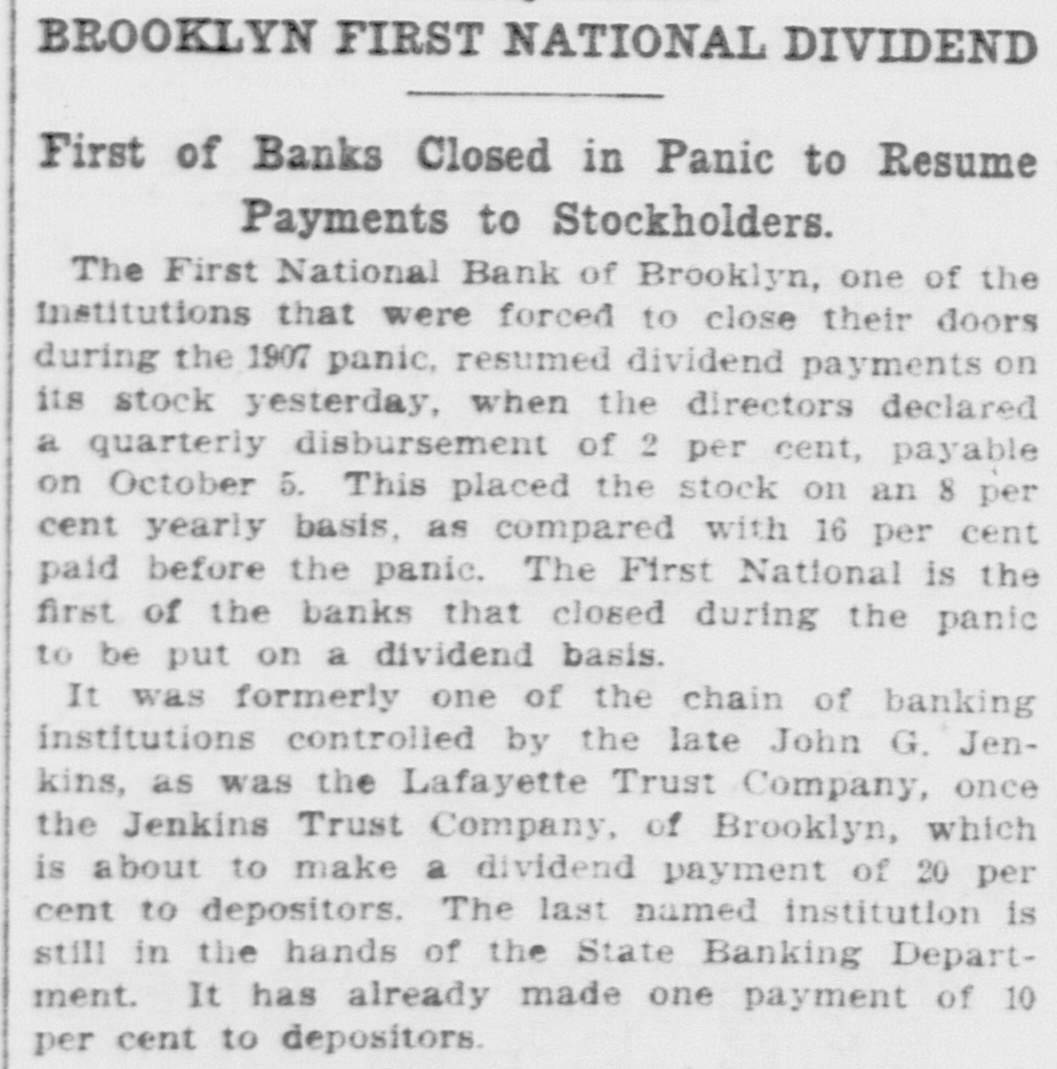
BROOKLYN FIRST NATIONAL DIVIDEND First of Banks Closed in Panic to Resume Payments to Stockholders. The First National Bank of Brooklyn, one of the institutions that were forced to close their doors during the 1907 panic, resumed dividend payments on its stock yesterday, when the directors declared a quarterly disbursement of 2 per cent, payable on October 5. This placed the stock on an 8 per cent yearly basis, as compared with 16 per cent paid before the panic. The First National is the first of the banks that closed during the panic to be put on a dividend basis. It was formerly one of the chain of banking institutions controlled by the late John G. Jenkins, as was the Lafayette Trust Company, once the Jenkins Trust Company, of Brooklyn, which is about to make a dividend payment of 20 per cent to depositors. The last named institution is still in the hands of the State Banking Department. It has already made one payment of 10 per cent to depositors.


Article from New-York Tribune, January 18, 1911

Click image to open full size in new tab

Article Text

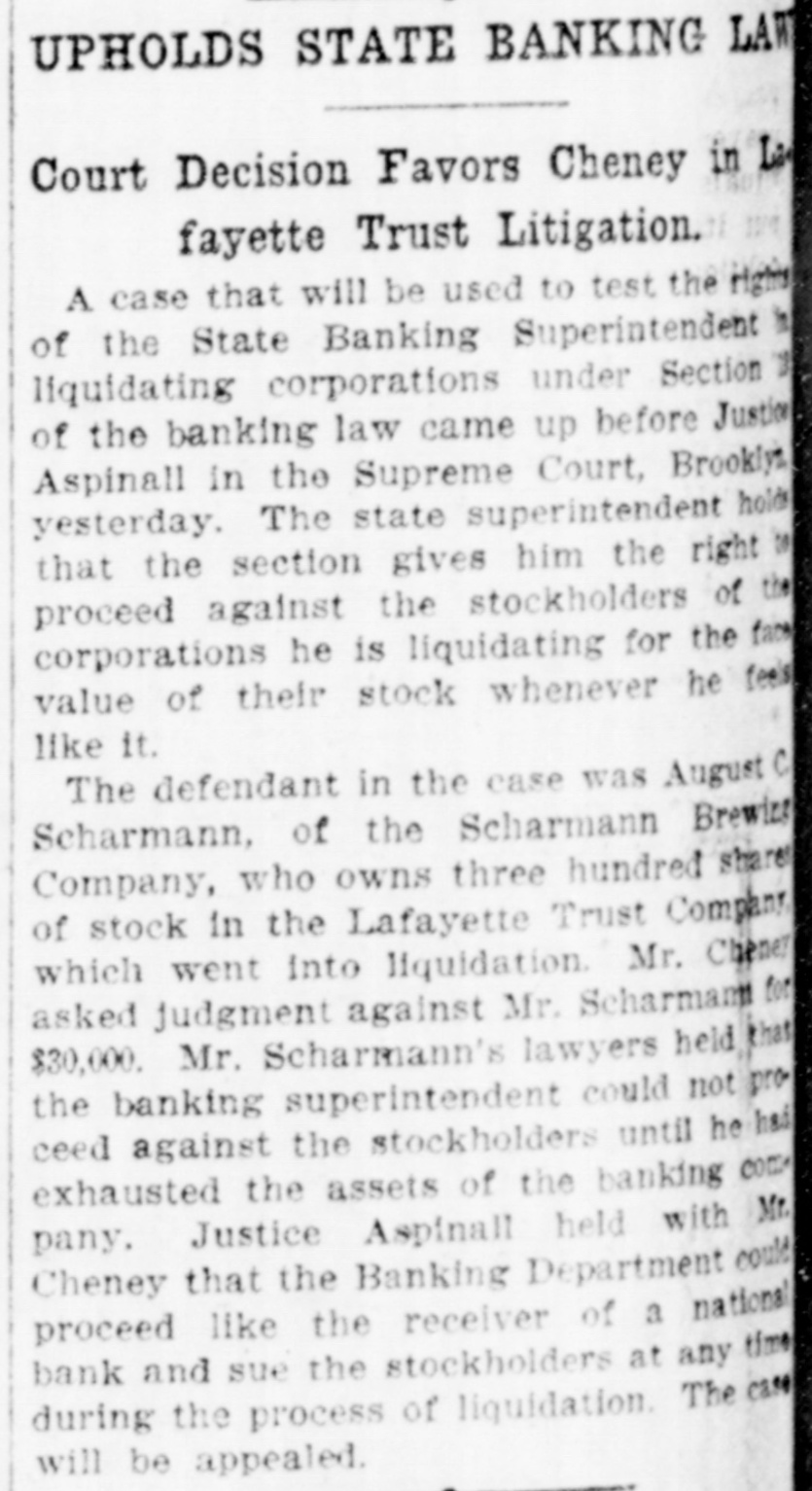
UPHOLDS STATE BANKING LAW Court Decision Favors Cheney in La fayette Trust Litigation. A case that will be used to test the of the State Banking Superintendent liquidating corporations under Section of the banking law came up before Justice Aspinall in the Supreme Court, Brooklys yesterday. The state superintendent hold that the section gives him the right proceed against the stockholders of the corporations he is liquidating for the face value of their stock whenever he feels like it. The defendant in the case was August C Scharmann, of the Scharmann Brewies Company, who owns three hundred share of stock in the Lafayette Trust Company which went into liquidation. Mr. Cheney asked judgment against Mr. Scharmant for $30,000. Mr. Scharmann's lawyers held that the banking superintendent could not pro ceed against the stockholders until he has exhausted the assets of the banking com pany. Justice Aspinall held with Mr. Cheney that the Banking Department could proceed like the receiver of a national bank and sue the stockholders at any time during the process of liquidation The case will be appealed.


Article from New-York Tribune, January 22, 1911

Click image to open full size in new tab

Article Text

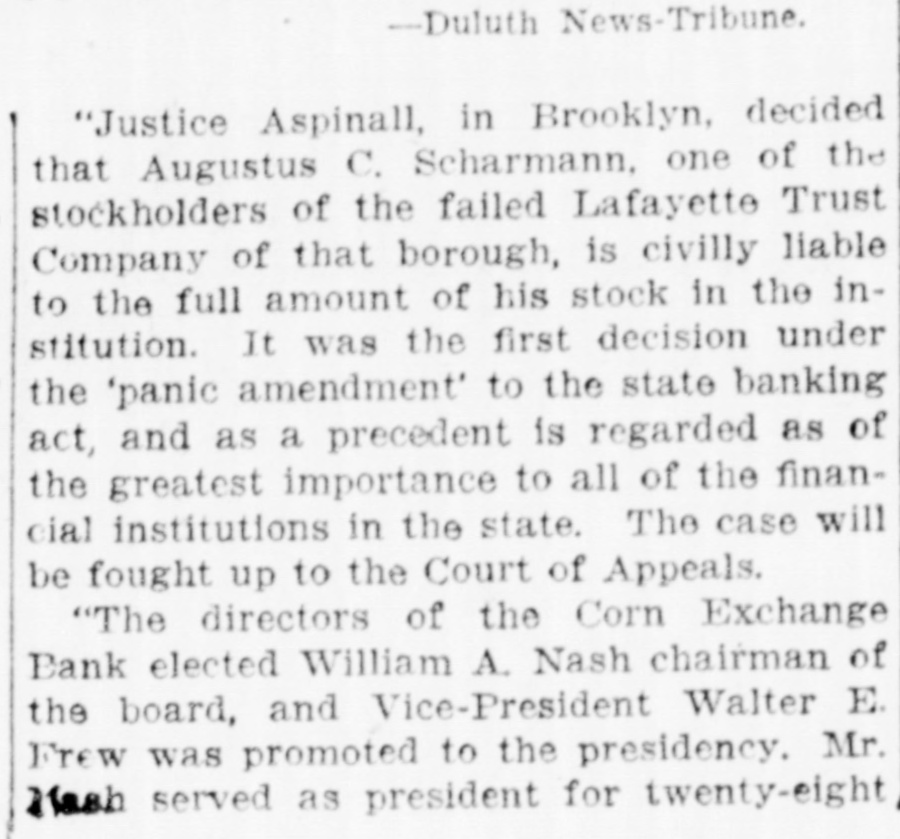
"Justice Aspinall, in Brooklyn, decided that Augustus C. Scharmann, one of the stockholders of the failed Lafayette Trust Company of that borough, is civilly liable to the full amount of his stock in the institution. It was the first decision under the 'panic amendment' to the state banking act, and as a precedent is regarded as of the greatest importance to all of the financial institutions in the state. The case will be fought up to the Court of Appeals. "The directors of the Corn Exchange Bank elected William A. Nash chairman of the board, and Vice-President Walter E. Frew was promoted to the presidency. Mr. Nash served as president for twenty-eight