13214. Jenkins Trust Company (Brooklyn, NY)

Bank Information

Episode Type
Suspension β†’ Reopening
Bank Type
trust
Start Date
October 25, 1907
Location
Brooklyn, New York (40.660, -73.951)

Metadata

Model
gpt-5-mini
Short Digest
e4470d5280600da5

Response Measures

None

Description

The Jenkins Trust Company (Brooklyn) closed/suspended on Oct. 25, 1907 during the general panic and money stringency; temporary receivers were appointed Nov. 16, 1907 after investigations found illegal overloans. The company was reorganized and permitted to resume business (reopened under plans and then as Lafayette Trust Co.) in April 1908. There is no clear single discrete depositor 'run' described for Jenkins itself in these articles (closures are described as due to money stringency and protective action by banking authorities), so the sequence is a suspension followed by reopening. OCR errors in some articles (e.g., miscellaneous spacing and broken words) were corrected for names and dates where obvious.

Events (4)

1. October 25, 1907 Suspension
Cause
Government Action
Cause Details
Closed during the October 1907 financial stringency; the State Banking Department/Comptroller actions and clearing-house concerns led to the institution's doors being closed to protect depositors amid lack of ready cash.
Newspaper Excerpt
The Jenkins Trust company of Brooklyn ... closed its doors during the afternoon.
Source
newspapers
2. November 16, 1907 Receivership
Newspaper Excerpt
Temporary receivers were appointed today for ... the Jenkins Trust Company of Brooklyn ... Applications for the receivers was made by William F. Mackey for Attorney General Jackson. ... evidence of illegal overloans ... was found in the Jenkins Trust company of Brooklyn, aggregating $557,000 to the president, John G. Jenkins, jr..
Source
newspapers
3. November 17, 1907 Other
Newspaper Excerpt
Attorney General Jackson declared that in ... the Jenkins Trust company evidence has been found of illegal overloans ... aggregating $557,000. (criminal/civil investigations and indictments followed).
Source
newspapers
4. April 5, 1908 Reopening
Newspaper Excerpt
Justice Betts last night signed an order discharging the temporary receiver for the Jenkins Trust Company, of Brooklyn, and permitting that institution to resume business. ... The banking company is instructed to open for business on or before April 22.
Source
newspapers

Newspaper Articles (24)

Article from The Madison Daily Leader, October 26, 1907

Click image to open full size in new tab

Article Text

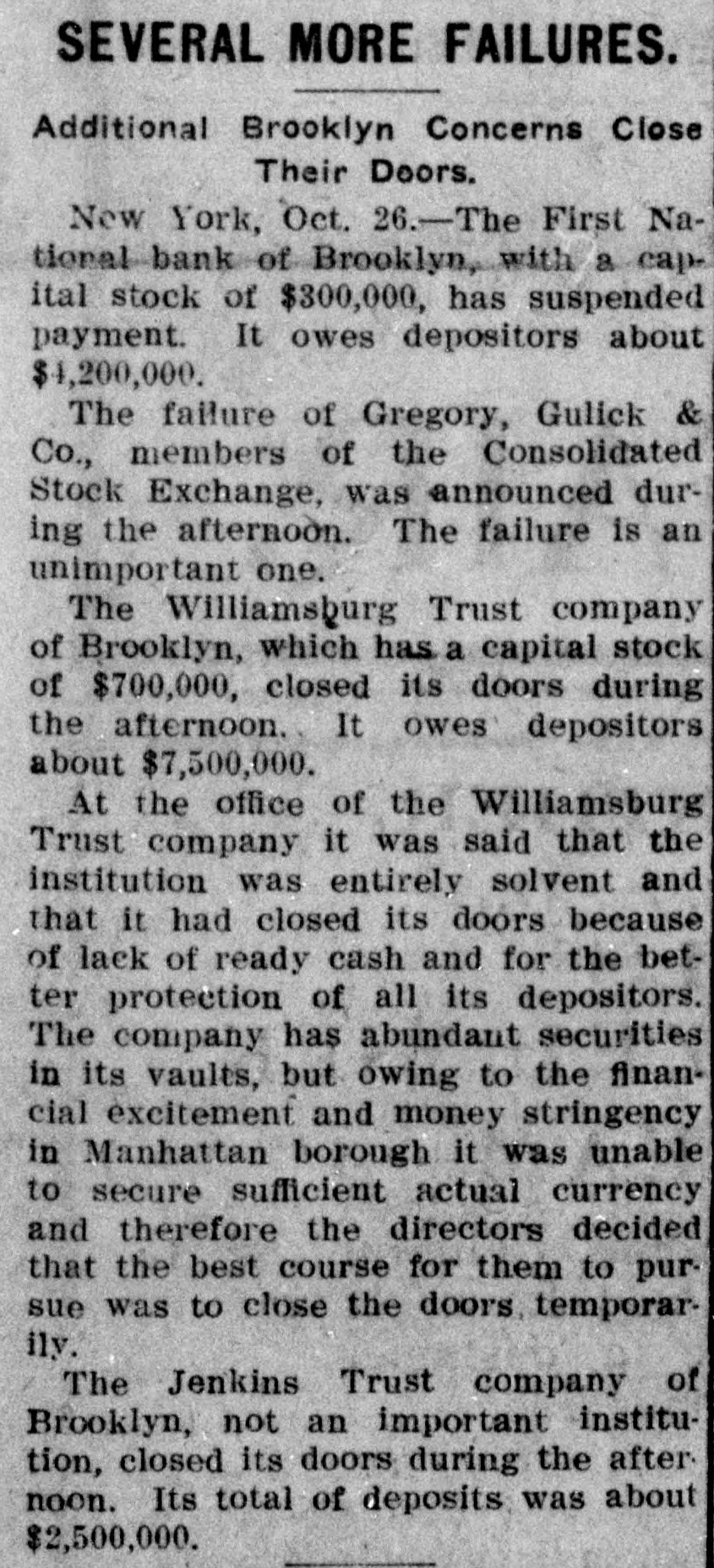
SEVERAL MORE FAILURES. Additional Brooklyn Concerns Close Their Doors. New York, Oct. 26.-The First National bank of Brooklyn, with a cap. ital stock of $300,000, has suspended payment. It owes depositors about $4,200,000. The failure of Gregory, Gulick & Co., members of the Consolidated Stock Exchange, was announced during the afternoon. The failure is an unimportant one. The Williamsburg Trust company of Brooklyn, which has a capital stock of $700,000, closed its doors during the afternoon. It owes depositors about $7,500,000. At the office of the Williamsburg Trust company it was said that the institution was entirely solvent and that it had closed its doors because of lack of ready cash and for the better protection of all its depositors. The company has abundant securities in its vaults, but owing to the financial excitement and money stringency in Manhattan borough it was unable to secure sufficient actual currency and therefore the directors decided that the best course for them to pursue was to close the doors, temporarily. The Jenkins Trust company of Brooklyn, not an important institution, closed its doors during the after noon. Its total of deposits was about $2,500,000.


Article from The Montgomery Advertiser, October 26, 1907

Click image to open full size in new tab

Article Text

NEW YORK PASSES TRYING DAY (Continued from Page One.) issues occurred in 1873 and 1884. The last occasion on which they were used was in 1893. The clearing house certificate is practically a guarantee byal banks in the clearing house that the certificates shall be redeemed at par, but the clearing house banks are protected against loss by the fact that first class securities, either commercial -paper or stocks and bonds, are required before the certificates are issued. The certificates are used only be tween banks. They do not appear in general circulation, but by relieving the banks of the strain of large debit balances, they enable them to keep their cash reserves comparatively in. tact It is believed by competent bankers that an issue of $50,000,000 will be the outside requirement at present. It is believed also that the mere fact that they are to be issued will so far re store confidence that runs upon banks win cease, so that it will not be necessary to keep certificates outstanding for any considerable time. Already the strong city banks are receiving large deposits from persons who have withdrawn their money from institutions which have fallen under suspicion. This does not preclude the fact that considerable amounts have been put in safe deposit boxes and thereby withdrawn from circulation, but it is believed that renewed confidence will cause the return of this money to the banks within a short time Imports of Gold. Late in the afternoon a favorable light was cast upon the prospects of imports of gold by a sudden fall in foreign exchange. The market has been practically at standstill for several days with large offerings of bills and few takers This afternoon, how ever, the rate dropped to 4.85. which practically makes imports of gold possible at a profit. Leading bankers and foreign exchange houses have been looking for this development but hardly expected that it would come so soon. The tide of gold, once it sets on. the way, will undoubtedly reach a large volume, in view of the considerable amounts due this country for the outgoing crops and for securities. While the present market is one to encourage the general public to buy American securities, there are always shrewd observers in Europe who are disposed to buy at times like the present and some of them have been in the market during the past few days. It will be possible even by the process of Joans to transfer a part of the burden of carrying stocks from New York to London and Paris, but this has been tone thus far to only a limited extent The fact that the banks and the stock exchanges will be open for business but two hours tomorrow and that Sunday with all its opportunities of calming public sentiment will intervene, added to the more hopeful view taken by leading financiers tonight will do much toward clearing the financial skies before next week. At a meeting of the directors of the Lincoln Trust Company tonight, Louis Stern, a director, was authorized to make the following statement: (The directors of the Lincoln Trust Company are justified in stating that the company is in a position to meet every demand that may be made upon it and that the company is In a strong. et position tonight than any day this week. Furthermore, the withdrawal of funds has been less day by day At a meeting late today the direc. tors, of the Knickerbocker Trust Com. pany appointed a committee to take steps to bring about a resumption of business The committee later announced that an agreement providing for the deposit of claims of depositors and of shares of stock of the company was being prepared The committee will meat Monday to pass on this agreement Run Continues Baltimore. Oct. 25. The run on the East Branch of the Home Bank, continued today and shortly before noon, the depositors who were in line waiting for their money were notified that the bank would take advantage of a chare ter provision which permits the institution to demand sixty days notice of a positor's intention to withdraw his or her account A member of the firm of Bernstein, Cohen and Company, owners of the bank, today admitted that the run has been of much larger proportions than had been reported. Runs on Pawtucket Banks. Pawtucket R. I. Oct. -Follow ing the posting of the ninety day notice to depositors by the local branch of the New England Trust Company, of Providence runs were started today on all banks in Pawtucket. With the exception of the New England Trust Company all the banks met the demand without difficulty GOVERNOR APPEALED TO. A Legal Holiday to Relieve Financial Situation Asked For. Albany, N. Y., Oct. 25 -Governor Hughes today received a number of telegrams suggesting that he proclaim a legal holiday during which the financial situation might be relieved. The Governor acknowledged the receipt of all of these messages without indicat ing his intentions. He would not dis. cuss the question tonight, but there is a good reason to believe there is no immediate probability of his taking this step. COMPTROLLER OF CURRENCY GIVES OUT A STATEMENT. Washington, Oct. 25.- The following statement was given out today by the Comptroller's office: The First National Bank of Brook lyn. N. Y., closed its doors this afternoon and National Bank Examiner George T. Cutts has taken charge by order of the Comptroller of the Currency. The First National Bank cleared for the Williamsburg Trust Com pany and the Jenkins Trust Company of Brooklyn, both of which failed to. day The National Bank was closed to protect its depositors against the checks of the Trust Companies, which might be presented through the Clear ing House.


Article from The Bemidji Daily Pioneer, October 26, 1907

Click image to open full size in new tab

Article Text

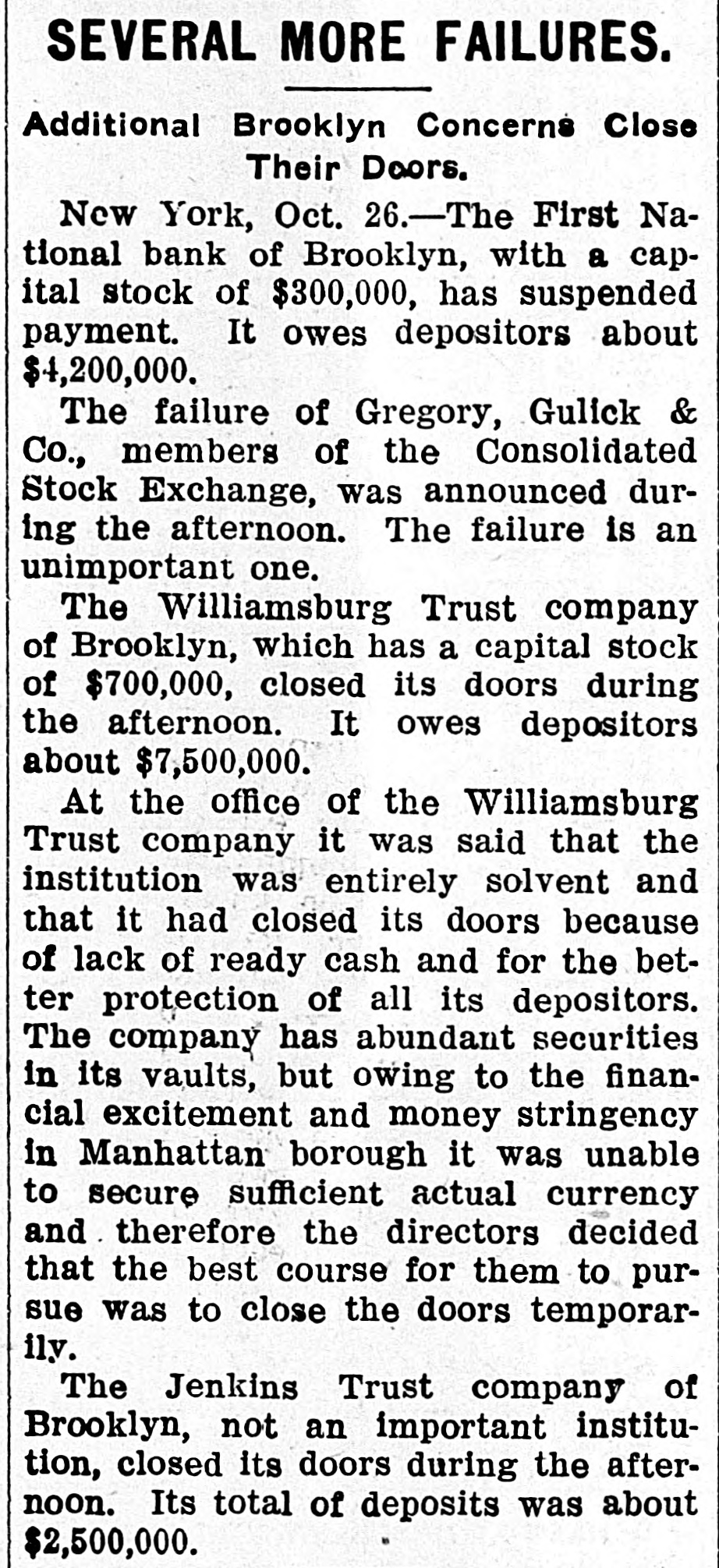
SEVERAL MORE FAILURES. Additional Brooklyn Concerns Close Their Doors. New York, Oct. 26.-The First National bank of Brooklyn, with a capital stock of $300,000, has suspended payment. It owes depositors about $4,200,000. The failure of Gregory, Gulick & Co., members of the Consolidated Stock Exchange, was announced during the afternoon. The failure is an unimportant one. The Williamsburg Trust company of Brooklyn, which has a capital stock of $700,000, closed its doors during the afternoon. It owes depositors about $7,500,000. At the office of the Williamsburg Trust company it was said that the institution was entirely solvent and that it had closed its doors because of lack of ready cash and for the better protection of all its depositors. The company has abundant securities in its vaults, but owing to the financial excitement and money stringency in Manhattan borough it was unable to secure sufficient actual currency and therefore the directors decided that the best course for them to pursue was to close the doors temporarily. The Jenkins Trust company of Brooklyn, not an important institution, closed its doors during the afternoon. Its total of deposits was about $2,500,000.


Article from The Salt Lake Herald, October 26, 1907

Click image to open full size in new tab

Article Text

Knickerbocker Will Resume. At a meeting late today the directors of the suspended Knickerbocker Trust company appointed a committee to take immediate steps to bring about a resumption of the business of the company. The committee, which is made up of Fred G. Bourne, chairman; President A. Foster Higgins, G. Louis/Boissevain Moses Taylor, William A. Tucker, Charles Perrin and Leopold Wallach, later announced that an agreement providing for the -deposit of claims of depositors and of shares of stock of the company was being prepared. The committee will meet at 10:30 o'clock Monday morning and pass upon this agreement proposition as submitted by counsel. CLOSED FOR PROTECTION. Statement Concerning First National Bank of Brooklyn. Washington, Oct. 25.-Comptroller of the Currency Ridgely stated this afternoon that the Banking & Trust company and the Williamsburg Trust company, which suspended payment today, were directly responsible for the closing of the doors of the First National bank of Brooklyn. It appears that the latter bank cleared for the two trust companies and the closing of the bank doors today was for the purpose of protecting their depositors, inasmuch as otherwise It would have been held responsible for the paper of the two trust companies that might come in any time up to tomorrow morning. The following statement was given out late today from the comptroller's office: "The First National bank of Brooklyn closed its doors this afternoon and National Bank Examiner George T. Cutts has taken charge by order of the comptroller of the currency. The First National bank cleared for the Williamsburg Trust company, and the Jenkins Trust company of Brooklyn, both of which failed today. The National bank was closed to protect its depositors against the checks of the trust companies which might be presented through the clearing house."


Article from The Greenville Times, October 27, 1907

Click image to open full size in new tab

Article Text

BANKS NOW ASK LONG NOTICE BEFORE DEPOSITORS CAN WITHDRAW MONEY EXCHANGES ARE NOW SAFE Pool of Ten Million Dollars Formed to Tide Them Over-Commercial Houses Safe-Jenkins' Trust Co., of Brooklyn, Fails New York, Oct. 25.-Union Dime Savings Bank at Thirty-second street and Broadway, this afternoon posted a notice that it will require sixty days' notice from all depositors desiring to withdraw. It has $27,450,000 due to depositors. Jenkins Trust Company, of Brooklyn, not an important institution, closed its doors this afternoon. Its total of deposits is about $3,500,000. Representatives of the largest banks of this city agreed at a meeting today to require from thirty to sixty days' notice of depositors de. siring to withdraw their accounts. The Trust Company of America, and the Lincoln Trust Company successfully withstood all demands of depositors throughout the day and closed at 3 o'clock, the usual hour. A pool off $10,000,000 or more was formed at a conference held at the clearing house this afternoon to take care of the money needs of the stock exchanges. It was confidently thought that this section would tide over the situation so completely SQ far as the stock exchange is concerned. All loans made today will be carried until Monday. First open loan of money on call was made about 12:20 in lots of $50,000 to $100,000 at 50 per cent. Among rumors afloat in New York there have been many affecting a number of leading commercial houses. These rumors have evidently been started for the purpose of affecting the stock market. A man high in authority in the firm of John Wannamaker makes the following statement: "The rumbors that have been in circulation regarding this firm recently are without foundation. Affairs of the firm were never in better shape than they are now and the business of the New York store was never better."


Article from The Salt Lake Herald, November 8, 1907

Click image to open full size in new tab

Article Text

gaining their old volume of business are under discussion, but will require some time for definite conclusions. The temporary scarcity of currency is being met very generally, according to reports reaching New York, by the issue of printed certified checks or temporary interest-bearing notes, and in some cases by scrip issued by manufacturing and other non-banking corporations. Scrip Resorted to in 1893. This recourse was very generally resorted to in the panic of 1893, and practically no trouble arose from any such issues. Most of the scrip issued at that time was payable after a specified period, as ninety days or six months, but where issued by the banks with support of the clearing house, usually specified that the paper would be received on deposit at clearing house banks. Some question arose at that time as to whether this paper would be subject to the tax of 10 per cent imposed upon the issue of notes to circulate as money by individuals or institutions other than national banks. The question was settled by Attorney General Oiney after the panic was practically over, in an opinion of Nov. 21, 1893. The captions of that opinion pretty well express its text-that "the tax on state banks imposed by the act of Feb. 8, 1875, chapter 35, section 19, applies only to promissory notes, and not to other negotiable or quasi-negotiable paper." Not Notes, but Checks. The attorney general advised that three of the instruments submitted to him were plainly not notes, but checks, and might be left out of consideration. The test case was on a certificate of the clearing house of Albany, Ga., which stated that there had been a deposit of securities to double the amount of the obligation to the bank which was responsible for the note, and that these securities were deposited for the payment to the bank or bearer in lawful money of the United States at six months from date, or earlier, at the option of said bank. The attorney general not only laid down a rule that such paper was not subject to the 10 per cent tax, but he also cited the general rule of law, which will undoubtedly afford an adequate protection for all such use in the present case, "that if there is any doubt as to the meaning of the statute imposing the tax, the doubt must be resolved in favor of exemption." Depositors Paid Off. The individual depositors of the Trust Company of America. both at the main and branch offices, were all paid off. today. The board of directors of the Jenkins Trust company of Brooklyn, which suspended over two weeks ago, today issued a formal statement announcing they are taking measures to insure its reopening. That the end of the movement of gold from England to America has not been reached was shown today, when Goldman, Sache/& Co. announced the engagement of $1,650,000 for import from London. Kuhn, Loeb & Co. also announced that they had secured $500,000 in Europe. This makes the total for the movement $39,175,000. The Illinois Trust & Savings bank of Chicago today engaged $500,000 gold for import, and announced that it would negotiate for $500,000 additional. The sub-treasury today transferred for banks currency to the amount of $1,137,000. Of this amount $850,000 went to San Francisco, $137,000 to PhiladelContinued on Page 2.


Article from Bismarck Daily Tribune, November 17, 1907

Click image to open full size in new tab

Article Text

Have Been Appointed For Several Busted Banks of New York Found That Crookedness Had Much To Do With Their Failure New York, N. Y., Nov. 16.-In securing today the appointment of a receiver for three banks and three trust companies in New York and Brooklyn which recently suspended payment, Attorney General Jackson declared that in the Borough bank of Brooklyn and in the Jenkins Trust company evidence has been found of illegal overloans and of both civil and criminal action and liability. In the case of the Borough bank Mr. Jackson stated there is evidence also of overdrafts, forged papers and other criminal transactions, all of which will be presented to the grand jury. In the Jenkins Trust company the attorney general declares the records show overloans to the president, John G. Jenkins, jr., aggregating $557,000. The applications for a receiver were made to Justice Betts of the supreme court at Kingston, N. Y., based upon affidavits of Clerk Williams, superintendent of banking, and temporary receivers were appointed for the following: Williamsburg Trust company, Hamilton bank, Borough bank of Brooklyn, Jenkins Trust company, Broklyn bank and International Trust company. Mr. Jackson said today he will continue to co-operate in all efforts to rehabilitate the banks now in the hands of temporary receivers. Attorneys for the Brooklyn bank issued B. statement this afternoon in which they declared that the Brooklyn bank and International Trust company


Article from Omaha Daily Bee, November 17, 1907

Click image to open full size in new tab

Article Text

RECEIVERS FOR SIX BANKS Application Made on Behalf of Attorney General Jackson of New York. KINGSTON. N. Y., Nov. 16. - -Temporary receivers were appointed today for six New York City banks and trust companies which recently suspended payment The banks are the Hamilton of One Hun dred and Twenty-fifth street, New York the Brooklyn bank, and the Borough bank of Brooklyn, and the trust companies, the Williamsburg and Jenkins of Brooklyn. and the International of New York. Ap plication for the receivers was made by William F. Mackey for Attorney General Jackson. Orders to show cause why permanent receivers should not be appointed were granted and were made returnable at Albany November 30. NEW YORK, Nov. 16.-Attorney General Jackson stated this afternoon that, in his opinion, evidence of both criminal and civil liability has been unearthed in the investigation of the Borough Bank of Brook lyn and the Jenkins Trust company of Brooklyn, and that in the Borough Bank of Brooklyn there has been found evidence of illegal overloans, overdrafts, forged paper and other criminal transactions, all of which will be presented to the grand jury. In the Jenkins Trust company, the attorney general says, there, has been found evidence of illegal overloans. It is claimed by the trustees, the attorney general adds, that they knew nothing about these illegal loans made to the president of the company. The attorney general's announcement contains the statement that the investigation thus far has been confined to the Borough Bank of Brooklyn and the Jenkins Trust company.


Article from Evening Star, November 17, 1907

Click image to open full size in new tab

Article Text

Receivers Named in New York and Brooklyn. PROSECUTIONS TO FOLLOW Some of the Officials Are Criminally Liable. ONE PRESIDENT GOT $557,000 Small Institutions at Other Points That Are Also in Trouble-Will Be Civil Suits. NEW YORK, November 16.-In receivers securtoday the appointment of compaing three banks and three trust which for in New York and Brooklyn Atrecently nies suspended payment State in General Jackson declared that the the torney Borough Bank of Brooklyn and in has Jenkins Trust Company evidence of been found of illegal overloans and the both civil and criminal liability In of the Borough Bank, Mr. Jackson case stated there is evidence also of overdrafts. forged paper and other criminal transactions, all of which will be presented to the grand jury. In the Jenkins deTrust Company the attorney general the clares the records show overloans to president. John G. Jenkins, jr., aggregating $557,000. The applications for receivers were made to Justice Betts of the supreme court at Kingston, N. Y., and were based affidavits of Clark Williams, superintendent upon of banking The court appointed the following temporary receivers: Williamsburg Trust Company, Frank L. of Buffalo: bond, $300,000. Hamilton Bapst Frank White of New York; bond, Bank. $200,000. Borough Bank of Brooklyn, Isaac Henry A. Powe11 of Brooklyn and bond, Cox of Ellenville, Ulster county: N. each Jenkins Trust Company. $200,$100,000 John Mulhall of New York: bond, Brooklyn Bank, Bruyn Hasbrouck Interna000. New Platz; bond, $130,000. of of tional Trust Company. Goodwin Brown Yonkers; bond, $100,000 of the Bapst Some is managing Men. director of the He Mr. American Bank of Buffalo. affairs German charge of winding up the White of had Pan-American exposition. Mr. under the first deputy attorney general attorney was Jackson. Mr. Powell is an Mr. Cox Mr. residing in Brooklyn. at-law former member of Congress, and Bank is is a president of the First National estate now Mr. Mulhall is a real of with offices in New dealer. is a merchant and was Ellenville. Mr. brick Brown York. manu- Mr. Hasbrouck Paltz. and facturer at New under Gov. Cleveland, pardon clerk was appointed on-the served state for lunacy subsequently commission, where he fifteen years. on October 25 and 26 that depart- SuperIt was Williams of the banking general intendent reported to the attorney Wilment he had taken possession of Hamilton the that Trust Company. the Jenkins Hamsburg the Borough Bank, the International Bank, and the unsafe and that it was to for those and Trust Trust inexpedient Company Company institutions attorney doing business. Both the Williams continue and Superintenden officers general to co-operate with the in an sought directors of the closed banks and put them on their feet again. Thursday Superintendent the the attorney general effort informed Again to to that Williams mentioned were unable secure banks additional capital and that of be placed in the the they necessary should delay. hands receivers without further Mr. Statement Jackson said From today Brooklyn. that he will still to co-operate in the banks now to rehabilitate continue all in efforts inves- the hands of temporary receivers. The tigation thus far has been confined to the Borough Bank of Brooklyn and the Jenkins Trust Company. Attorneys for the Brooklyn bank which issued a statement this afternoon, in they declared that the Brooklyn bank and the International Trust Company the have assets $800,000 in excess of amount owed depositors: that they exI pect soon to complete arrangements with depositors to accept certificates of deposit that in part payment of their claims, and they hope to avert a permanent receivership. Idaho Bank Suspends. POINT. Idaho, November 16.The State Bank, payment $15,000. SAND Traders' suspended capitalized temporarily at Inability to realize on secured loans is given as of The bank of yesterday. suspension. deposits the amount $60,000 cause have to $125,000. all of which the officials pledged themselves to make good. Run on Buffalo Bank. Special Dispatch to The Star. N. Y., November run BUFFALO, 16.-A yesterday that started in a small way assumed fairly large proporthis and is now tions afternoon morning in The progress bank on the Buffalo Savings Bank. of $2,658,317. It is one the and strongest the The run was started by decity. has a biggest surplus of banks Polish in positors.


Article from Alexandria Gazette, November 18, 1907

Click image to open full size in new tab

Article Text

News of the Day. Nearly 1,000 women of Mobile, A's, have petitioned the Lugislature against the enactment of a prohibition bill. Mexico has ceded Magdalena Bay, Lower California, to be used for a coaling station by the United States navy. J. E. Sherman, broker on the Consolidate Exchange, New York, today announced his suspension on that exchange. Four severe earthquake shocks were felt in Manila and surrounding provinces Saturday night and yesterday morn. ing. There was no damage. About four thousand men were laid off at the plant of the Lackawanna Steel Company at West Seneca, N. Y., Saturday. A small run on a Buffalo bank followed. In official circles in Berlin it is believed the visit of Emperor William to King Edward will result in the termination of the 10-year estrangement between Germany and Great Britain. Governor Warfield has appointed Mr. Glenn H. Worthington, of Frederick county, as chief judge of the Sixth judicial circuit of Maryland to succeed the late Chief Justice McSherry. Twenty men participated last night in a fight in front of the Mariett, an Italian theatre in Union street, Brooklyn, in which one man was killed, another fatally wounded and probably a half dozen less seriously hurt. Count Giolio Senni, of Italy, and Miss Mary Gayley, formerly of -Maryland, who met when the Count saved Miss Gayley's life in a runaway accident, were married in New York Saturday, the Count having pressed his suit four years. President Roosevelt has written a letter to Gov. Swanson inviting hin to attend a conference to be held in Washington May 13-15 of next year, to discuss measures for conserving the natural resources of the country and to preserve some of the sources of revenue and profit for the coming generations. General discussion in Wall street today followed the announcement from Washington of the government plans to releave the financial situation. Fome doubt was expressed of the success of the three per cent. treasury certificates though the strengthening tendency of the announcement was powerful in the early market operations. Cardinal Gibbons, as chancellor of the Catholic University of America, has issued a circular letter relative to the income of the institution. He expresses satisfaction with the result of last year's collection, which amounted to $100,000, but points out that, in order for the university to become what its name implies, at least $2,000,000 will be required. Justice Betts, of the New York Supreme Court, has appointed receivers for the Hamilton Bank and the International Trust Company, of Manhattan, and the Jenkins Trust Company, the Williams burg Trust Company, the Brooklyn Bank and the Borough Bank of Brooklyn, all of which were closed by the State Banking Department in the recent financial flurry. For the first time in the legal history of Georgia the writ of injunction has been used to prevent & wedding, Judge Whipple, of the Superior Court of Fitzgerald, Ga., having temporarily enjoined A. L. Reeves, a prominent young business man, from marrying Miss Tinna White, daughter of a wealthy merchant. White objects to his daughter's marriage on account of her age, sbe being only sixteen yearsold. Henry L. Saur, 8 Southern Railway employe, twenty-three years old, of Washington, was found dead in his room yesterday morning. Gas was escaping from an open jet just above his bed. Deputy Coroner Glazebrook, after an investigation, issued a certificate of death from accidental asphyxiation. Mr. Saur spent Saturday evening with his fiancee, Miss Annie whom he was to have married on Thanksgiving.

Article from Union County Courier, November 21, 1907

Click image to open full size in new tab

Article Text

CRIMES LAID TO BANKERS. Attorney General of New York A1leges Criminal Transactions. New York, Nov. 19.-In securing the appointment of receivers for three banks and three trust companies in New York and Brooklyn which recently suspended payment, State Attorney General Jackson declared that in the Borough Bank of Brooklyn and in the Jenkins Trust company evidence has been found of illegal over. loans and possible warrant for both civil and criminal action and for enforcement of liability.


Article from Troy Weekly News, November 22, 1907

Click image to open full size in new tab

Article Text

Fraud Charged. New York, Nov. 18.-Charging that the president of the Jenkins Trust company of Brooklyn borrowed illegally $557,000 from that institution and that evidence of civil and crimnal liability had been found in the Borough bank of Brooklyn as well, Attorney General Jackson has startled financial circles by the obtaining of temporary receivers for six suspended banks and trust companies.


Article from New-York Tribune, November 24, 1907

Click image to open full size in new tab

Article Text

WALL STREET CHEERS UP. Money Stringency Relaxes, Stocks Advance and Gold Flows In. A more cheerful feeling than has been evident for many days prevailed yesterday in Wall Street, based upon the opinion that definite relaxation in the money stringency was at hand. The premium on currency remained at about Friday's closing rates, 1 per cent being paid by the money brokers for cash sold to them and 2 per cent asked by them from purchasers; but only a moderate business was done, and the money dealers characterized the market for currency as weak. In the Danks it was said that the demand from institutions in the interior, which has been held chiefly responsible for a continuance of the money famine at this centre, was slackening, and that as a consequence the prospect was that the local banks would be able this week to accommodate their customers with currency to a much larger extent than before. Currency transfers through the Sub-Treasury aggregated $390,000, of which $310,000 was sent to San Francisco, $50,000 to Denver and $30,000 to Philadelphia. The stock market was strong during the two hours of business. prices advancing from the outset and closing at the best figures of the day. Among the net gains were 3% points in Union Paelfic, 21/4. in St. Paul, 2% in Pennsylvania, 2% in Reading, 21/4 in Northern Pacific, 3% in American Smelting and Refiring, and 2 points each in Southern Pacific and in Amalgamated Copper. The weekly bank statement, which was issued at the close of the market. made an encouraging showing Loans decreased $4,012,000. the first shrinkage in this item since the beginning of the panic period. and deposits decreased $9,485,000. A decrease in cash holdings of $2,807,900 was shown, comparing with the preliminary estimates of a less of more than $6,000,000. Owing to the large decrease in deposits, the decrease in required reserve was only $436,650 less than that in the actual reserve, this amount bringing the total deficit in reserve to $54,103,600. The percentage of reserve to liabilities is now 19.99. against 20.07 a week ago. Some of the banks which have subscribed for the government 3 per cent certificates of indebtedness, for the purpose of using them as a basis for taking out additional circulation, made payments of cash at the local Sub-Treasury yesterday, on account of their subscriptions. Of these subscriptions the banks are to be allowed to retain 75 per cent as special government deposits, secured by collateral other than government bonds, the remaining 25 per cent to be paid over to the Treasury. No additional gold engagements were announced. The Sub-Treasury and the Assay Office had a busy day, receiving more than $12,000,000 gold which had been brought in by the Mauretania, the Baltic and La Savoie. the gold going to the Sub-Treasury and the bars to the Assay Office. Committees representing the depositors of the Jenkins Trust Company and its various branches effected a permanent organization at the Brooklyn Club last night. Almet R. Latson, president of the Union League Club, was selected as counsel, and Magistrate E. G. Higginbotham and ex-Judge Owen Finnerty as members of an executive committee. They will co-operate with Hugo Hirsh, counsel of the directors, in fighting making the receivership permanent. Reports of progress will be made at a meeting of depositors to be held at the Bedford branch of the Young Men's Christian Association on Tuesday night.


Article from Iowa State Bystander, November 29, 1907

Click image to open full size in new tab

Article Text

# JENKINS BROTHERS INDICTED. Former Officials of Trust Companies Accused of Forgery. New York.--John G. Jenkins, Jr., until recently president of the Jenkins Trust company of Brooklyn; Frank Jenkins, deposed head of the Williamsburg Trust company, and Fred Jenkins, formerly a director of the latter institution, were jointly indicted Tuesday for forgery in the third degree. The indicted men are brothers and the charge against them grew out of loans made the broker firm of F. & J. G. Jenkins, Jr., & Co., by the Jenkins Trust company. The transactions were disclosed during the examination of the trust company's books after the institution had suspended. The three men were arraigned and after entering pleas of not guilty, were released, each under a bond of $10,000.


Article from The Free Lance, December 3, 1907

Click image to open full size in new tab

Article Text

Out of Job, He Tried Suicide. New York, Dec. 2.-Worried over the loss of his position as an assistant bookkeeper for the Jenkins Trust company, of Brooklyn, which recently suspended, Errich Schumann, said to be a descendant of the composer, attempted to kill himself by inhaling illuminating gas. He was found in time by a servant, and physicians say he will recover.


Article from The Evening World, December 4, 1907

Click image to open full size in new tab

Article Text

NEW INDICTMENTS ARE DRAWN FOR BANK WRECKERS Brooklyn Grand Jury Ready to Present More Bills in Scandal. POLITICIANS UNEASY. Men Who Expected Subpoenas Are Wondering Why They Didn't Get Them. The December Grand Jury investigathan into the wrecking of the Brooklyn banks has progressed so far that indictments have, been prepared and will be submitted "to the Court as soon as the evidence is all in. The Williamsburg Trust Company officials were on the Grand Jury rack to-day. Marshall Driggs, a director who was apposed to the control of the conqern by the Jenkins family, was called beSere the Grand Jury twice. The other witnesses were Directors Charles Jerome Edwards, J. H. Weber, J. N. Mobeidt, T. F. Jackson, R. T. Weber and Paying Teller W. A. Fields. District-Attorney Clarke has succeeded in burying his investigations under mound of secrecy that is causing a lot of uneasiness in Brooklyn financial and political circles. Certain directors of suspended banks who have not been called as witnesses before the Grand Jury are wondering why. They recall that none of those thus far indicted was called before the Grand Jury except Arthur Campbell, cashier of the Borsugh Bank, who turned State's evidenoe. Ald for Two Trust Companies. The controversy between the receive ers appointed at the instance of Attor ney-General Jackson for the bankrupt Brooklyn banks and the stockholders and depositors who are not willing to have the institutions go into permanent receiverships wages bitterly. It was announced to-day that two syndicates have been formed to aid the Williams. burg Trust Company and the Jenkins Trust Company to resume business, the former company to be advanced $1,000,000 and the latter $500,000. Stephen C. Baldwin, attorney for the three Jenkins brothers, against whom indictments have already been found, fearing his clients may be indicted on other counts, has addressed letters to Police Commissioner Bingham and Deputy O'Keeffe warning the Police De partnent not to put John G. Jenkins, Jr., through the workings of the Berfillon system if he is arrested. The report current to-day was that Indictments were expected against at least two of the Jenkins family for alleged fraudulent loans from the Williamsburg Trust Company. made through clerks. Frank Jenkins, deposed head of the Williamsburg Trust Company: John G. Jenkins, Jr., former President of the Jenkins Trust Company, and Fred Jen. kins, a director in the latter CO ern, have already been indicted for similar loans made from the Jenkins Trust Company. After their first indictments Frank and Fred Jenkins were photographed for the Rogues' Gallery and measured by the Bertillon system. John G., Jr., escaped this humiliation through a writ after surfendering in court. Mr. Baldwin has promised to surrender any member of the Jenkins family to court as soon as additional indictments are found. Sympathy for Jenkins, Sr. Two sons-in-law of John G. Jenkins,


Article from New-York Tribune, January 12, 1908

Click image to open full size in new tab

Article Text

MAY RESUME BUSINESS. Williams Approves Plan Affecting Jenkins Trust Company. Albany, Jan. 11.-The Jenkins Trust Company, of Brooklyn, which got into difficulties resulting in a receivership during the recent financial disturbance, will be permitted to resume operations within a short time, provided it carries out the plan of reorganization and resumption which was submitted some time ago to Supreme Court Justice Betts at Kingston. In a communication to Justice Betts to-day, in special term in this city, Clark Williams, State Superintendent of Banks, indicated his approval of the plan, and early in the proceedings it was intimated that there would be no opposition to it on the part of the Attorney General, at whose instance the receiver was appointed. The case was adjourned and the receivership continued until next Saturday at Kingston. During the interval the trust company is to elect officers and directors and take other preliminary steps toward resumption of business. Next week Justice Betts will consider the discharge of the receiver. Superintendent Williams, in his memorandum to the court, says the plan for resumption appears to be feasible and practicable, but pertains solely to the relation between the trust company and the depositors. "The resumption of business." he adds, "would require a safe and sound condition in cash/position, assets and management. Certain adjustments of the loan and securities accounts would be necessary, and adΓ©quate cash should be available, in addition to which capable and efficient management should be assured." At the proceedings to-day Almet Reed Latson appeared for the depositors. The stockholders were represented by Hugo Hirsch, and Attorney General Jackson, who was personally present. was represented by Deputy Attorney General Mackey. Henry Killeen represented the temporary receiver. The plan for resumption provides, among other things, for the obtaining of cash, selling of bonds and stocks, mortgaging of real estate and a pledge of $100,000 by the directors. The depositors are to be paid 10 per cent of their money monthly. James Moffett, a vice-president and director of the Jenkins Trust Company, said last night that the condition of the institution is such that it can be opened at any time. The plan for the reopening had been submitted to the court in D cember, said Mr. Moffett, and he never believed otherwise than that the company would resume business. The Jenkins Trust Company was closed in October by the State Banking Department, with several other institutions in which members of the Jenkins family were interested. Three of the latter have since been indicted in Kings County. One of these, Joha G. Jenkins, jr., was president of the Jenkins Trust Company. New officers of the company will be elected at a directors meeting to be held this week.


Article from New-York Tribune, March 1, 1908

Click image to open full size in new tab

Article Text

JENKINS TRUST COMPANY PLANS. Reorganization Scheme Presented to Court in Kingston. Kingston, N. Y., Feb. 29.-The effort to reorganize the Jenkins Trust Company of Brooklyn, which has been in the hands of temporary receivers since last November, was resumed before Justice Betts, in the Supreme Court here. to-day. A plan for complete reorganization was submitted by counsel for the directors and depositors of the institution, and the Court ordered an adjournment of one week to give the Attorney General an opportunity to examine into the details of the proposed plan. The reorganization plan was contained in an affidavit of Harold A. Davidson, who has been elected president of the company. He declares that he found the capital stock unimpaired and a surplus of approximately $154,000 after deducting all proper charges for doubtful accounts and unmarketable assets. For insuring stability in the administration of the company a majority of the stock has been placed in a voting trust, composed of August Scharman, Almet Reed Latson and Mr. Davidson. The trust will continue two years. The bylaws have been amended whereby there will be two vicepresidents, instead of five, and two assistant secretaries are abolished. Limitations are to be made upon loans, so that directors shall be kept absolutely informed of all details. President Davidson said he has established relations with New York banks and obtained a line of discount up to $500,000. He said also that other banks have agreed to open accounts with the Jenkins company if it is allowed to reopen. It is his intention also to change the company's name. The affidavit declares that agreements have been made to purchase $100,000 of mortgages, that the directors have created E fund of $100,000. that the larger depositors have agreed to leave their deposits in the company for one year without interest, and that depositors aggregating 90 per cent have accepted the resumption plan. John G. Jenkins, jr., formerly president, offered an affidavit that collateral deposited by the Jenkins family exceeds the indebtedness, and that he, his father and brothers are anxious to lend all possible assistance toward reorganization. Affidavits of many persons willing to pay their indebtedness to the company are included among the papers. A statement by J. Lee Nicholson & Co., certified public accountants, said that the available assets one month after date of resumption would be $2,013,438, and the liabilities payable at the same time, including payments to depositors of 10 per cent of deposits, would be $799,738.


Article from New-York Tribune, March 8, 1908

Click image to open full size in new tab

Article Text

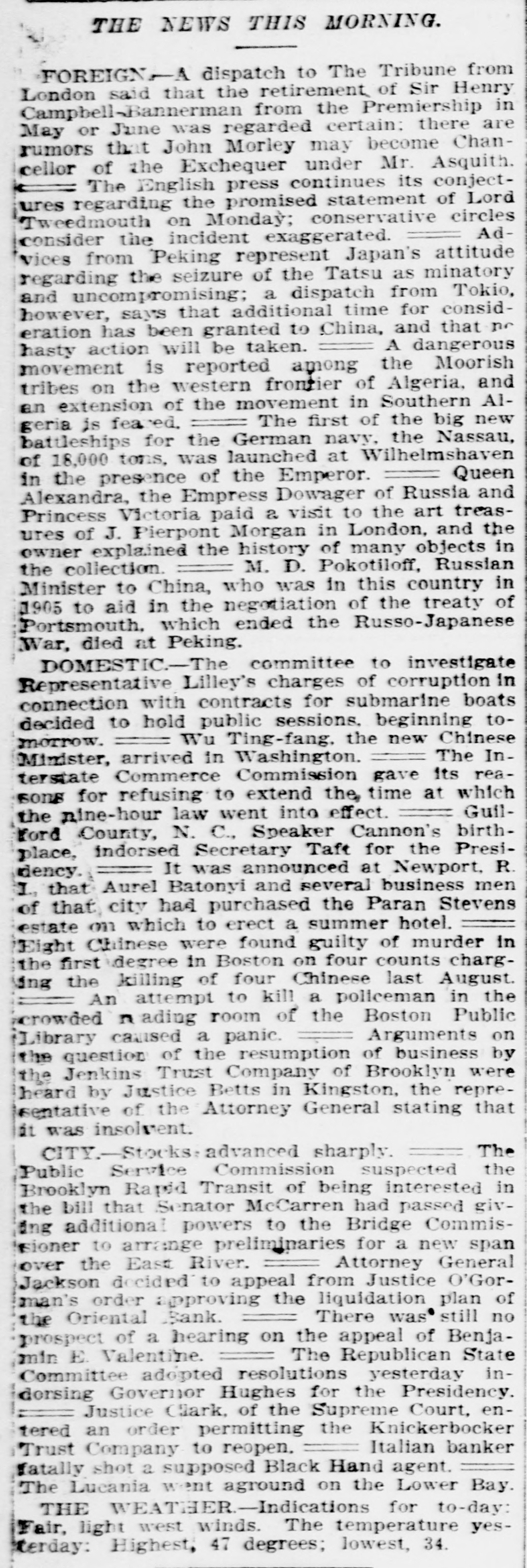
THE NEWS THIS MORNING. FOREIGN.-A dispatch to The Tribune from London said that the retirement of Sir Henry Campbell-Bannerman from the Premiership in May or June was regarded certain: there are rumors that John Morley may become Chancellor of the Exchequer under Mr. Asquith. The English press continues its conjectures regarding the promised statement of Lord Tweedmouth on Monday; conservative circles Adconsider the incident exaggerated. vices from Peking represent Japan's attitude regarding the seizure of the Tatsu as minatory and uncompromising; a dispatch from Tokio, however, says that additional time for consideration has been granted to China, and that nr A dangerous hasty action will be taken. movement is reported among the Moorish tribes on the western frontier of Algeria, and an extension of the movement in Southern AlThe first of the big new geria is feared. battleships for the German navy, the Nassau, of 18,000 tons, was launched at Wilhelmshaven Queen in the presence of the Emperor. Alexandra, the Empress Dowager of Russia and Princess Victoria paid a visit to the art treasures of J. Pierpont Morgan in London, and the owner explained the history of many objects in M. D. Pokotiloff, Russian the collection. Minister to China, who was in this country in 1905 to aid in the negotiation of the treaty of Portsmouth, which ended the Russo-Japanese War, died at Peking. DOMESTIC.-The committee to investigate Representative Lilley's charges of corruption in connection with contracts for submarine boats decided to hold public sessions. beginning toWu Ting-fang, the new Chinese morrow. The InMinister, arrived in Washington. terstate Commerce Commission gave its reasons for refusing to extend the, time at which Gullthe nine-hour law went into effect. ford County, N. C., Speaker Cannon's birthplace, indorsed Secretary Taft for the PresiIt was announced at Newport, R. dency. I that Aurel Batonyi and several business men of that city had purchased the Paran Stevens estate on which to erect a summer hotel. Eight Chinese were found guilty of murder in the first degree in Boston on four counts chargdng the killing of four Chinese last August. An attempt to kill a policeman in the crowded n ading room of the Boston Public Arguments on Library caused a panic. the question of the resumption of business by the Jenkins Trust Company of Brooklyn were heard by Justice Betts in Kingston, the reprefentative of the Attorney General stating that it was insolvent. The CITY-Stocks: advanced sharply. Public Service Commission suspected the Brooklyn Rapid Transit of being interested in the bill that Senator McCarren had passed givdng additional powers to the Bridge Commisfisioner to arrange preliminaries for a new span Attorney General over the East River. Jackson decided to appeal from Justice O'Gorman's order approving the liquidation plan of There was' still no the Oriental Bank. prospect of a hearing on the appeal of BenjaThe Republican State min E. Valentine. Committee adopted resolutions yesterday indorsing Governor Hughes for the Presidency. Justice Clark, of the Supreme Court, entered an order permitting the Knickerbocker Italian banker Trust Company to reopen. fatally shot a supposed Black Hand agent. The Lucania went aground on the Lower Bay. THE WEATHHER-Indications for to-day: Fair, light west winds. The temperature yesMerday: Highest, 47 degrees; lowest, 34.


Article from New-York Tribune, April 6, 1908

Click image to open full size in new tab

Article Text

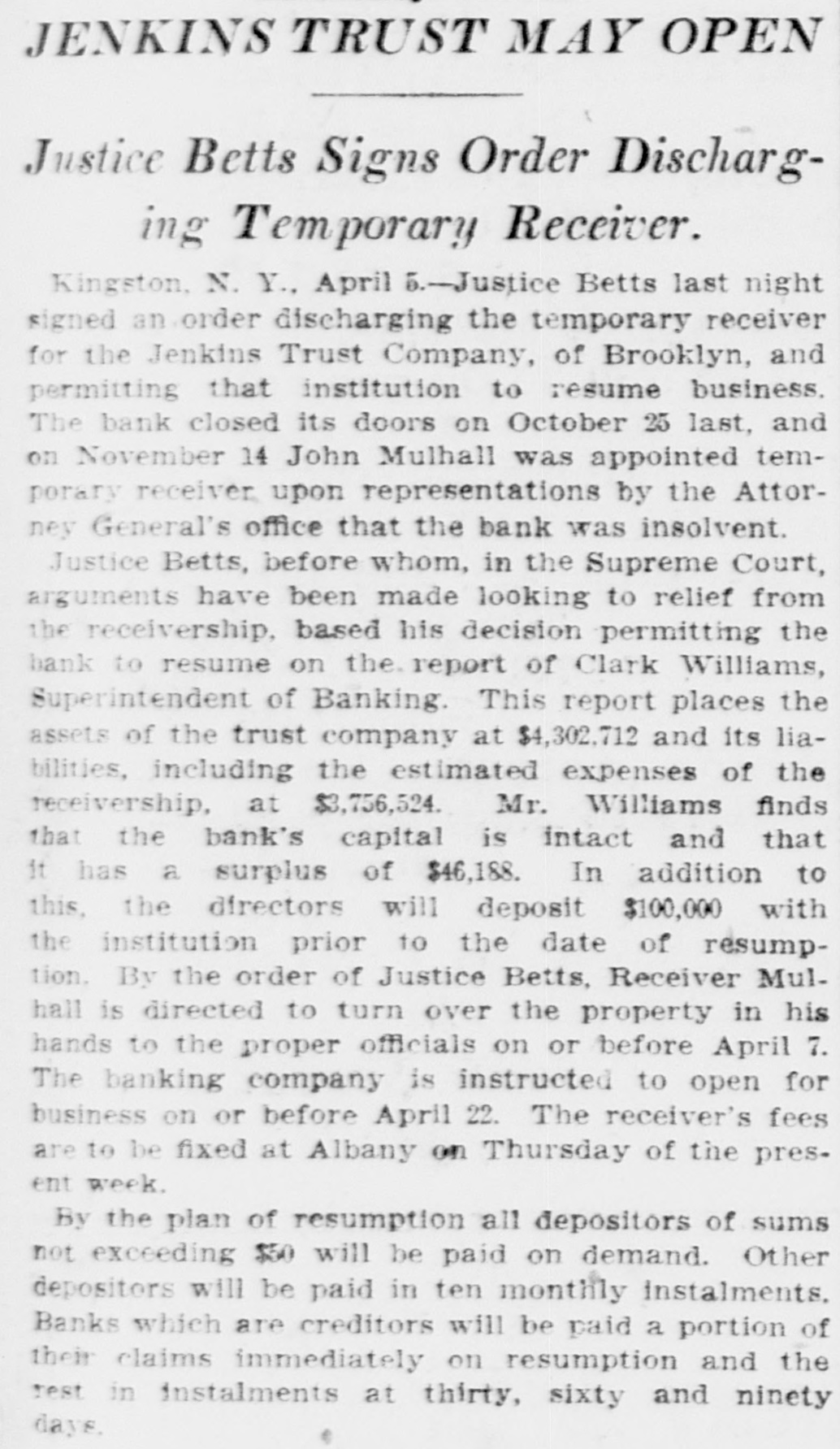
JENKINS TRUST MAY OPEN Justice Betts Signs Order Discharging Temporary Receiver. Kingston, N. Y., April 5.-Justice Betts last night signed an order discharging the temporary receiver for the Jenkins Trust Company, of Brooklyn, and permitting that institution to resume business. The bank closed its doors on October 25 last, and on November 14 John Mulhall was appointed temporary receiver upon representations by the Attorney General's office that the bank was insolvent. Justice Betts, before whom, in the Supreme Court, arguments have been made looking to relief from the receivership, based his decision permitting the bank to resume on the report of Clark Williams, Superintendent of Banking. This report places the assets of the trust company at $4,302,712 and its liabilities, including the estimated expenses of the receivership, at $3,756,524. Mr. Williams finds that the bank's capital is intact and that it has a surplus of $46,188. In addition to this, the directors will deposit $100,000 with the institution prior to the date of resumption. By the order of Justice Betts, Receiver Mulhall is directed to turn over the property in his hands to the proper officials on or before April 7. The banking company is instructed to open for business on or before April 22. The receiver's fees are to be fixed at Albany on Thursday of the present week. By the plan of resumption all depositors of sums not exceeding $50 will be paid on demand. Other depositors will be paid in ten monthly instalments. Banks which are creditors will be paid a portion of their claims immediately on resumption and the test in instalments at thirty, sixty and ninety days.


Article from The Barre Daily Times, April 10, 1908

Click image to open full size in new tab

Article Text

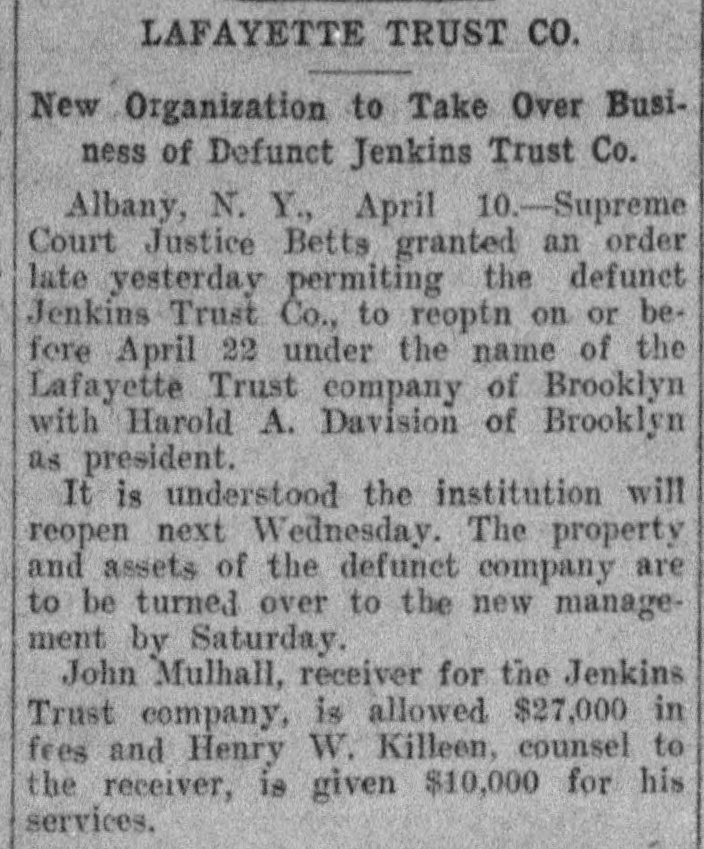
LAFAYETTE TRUST CO. New Organization to Take Over Business of Defunct Jenkins Trust Co. Albany, N. Y., April 10. Supreme Court Justice Betts granted an order late yesterday permiting the defunct Jenkins Trust Co., to reoptn on or befere April 22 under the name of the Lafayette Trust company of Brooklyn with Harold A. Davision of Brooklyn as president. It is understood the institution will reopen next Wednesday. The property and assets of the defunct company are to be turned over to the new management by Saturday. John Mulhall, receiver for the Jenkins Trust company, is allowed $27,000 in fees and Henry W. Killeen, counsel to the receiver, is given $10,000 for his services.


Article from Lewiston Evening Teller, July 2, 1908

Click image to open full size in new tab

Article Text

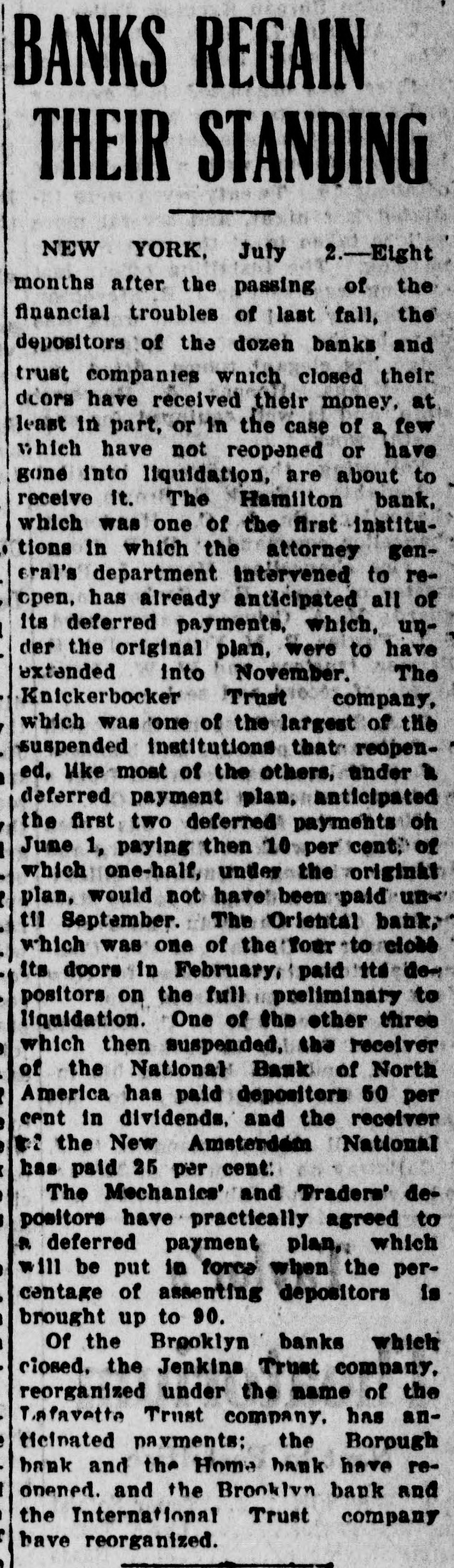
BANKS REGAIN THEIR STANDING NEW YORK, July 2.-Eight months after the passing of the financial troubles of last fall, the depositors of the dozen banks and trust companies which closed their doors have received their money, at least in part, or in the case of a few which have not reopened or have gone into liquidation, are about to receive it. The Hamilton bank, which was one of the first institutions in which the attorney general's department Intervened to reopen, has already anticipated all of its deferred payments, which, under the original plan, were to have extended into November. The Knickerbocker Trust company, which was one of the largest of the suspended institutions that reopened, like most of the others, under in deferred payment plan, anticipated the first two deferred payments oh June 1, paying then 10 per cent, of which one-half, under the original plan, would not have been paid until September. The Oriental bank, which was one of the four to close its doors in February, paid its de-: positors on the full preliminary to liquidation. One of the other three which then suspended, the receiver of the National Bank of North America has paid depositors 50 per cent in dividends, and the receiver to: the New Amsterdam National has paid 25 per cent: The Mechanics' and Traders' depositors have practically agreed to R. deferred payment plan, which will be put in force when the percentage of assenting depositors is brought up to 90. Of the Brooklyn banks which closed. the Jenkins Trust company, reorganized under the name of the T.afavette Trust company. has anticinated payments: the Borough bank and the Home bank have reonened. and the Brooklyn bank and the International Trust company have reorganized.


Article from The Salt Lake Herald, November 24, 1908

Click image to open full size in new tab

Article Text

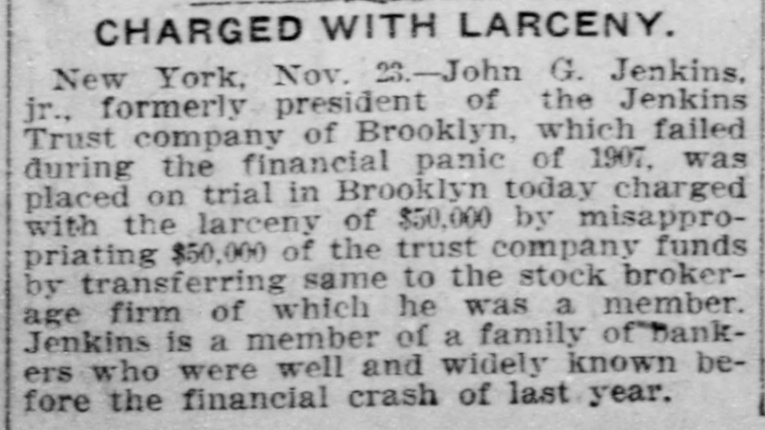
CHARGED WITH LARCENY. New York, Nov. 23.-John G. Jenkins, jr., formerly president of the Jenkins Trust company of Brooklyn, which failed during the financial panic of 1907, was placed on trial in Brooklyn today charged with the larceny of $50,000 by misappropriating $50,000 of the trust company funds by transferring same to the stock brokerage firm of which he was a member. Jenkins is a member of a family of bankers who were well and widely known before the financial crash of last year.


Article from Burlington Weekly Free Press, November 26, 1908

Click image to open full size in new tab

Article Text

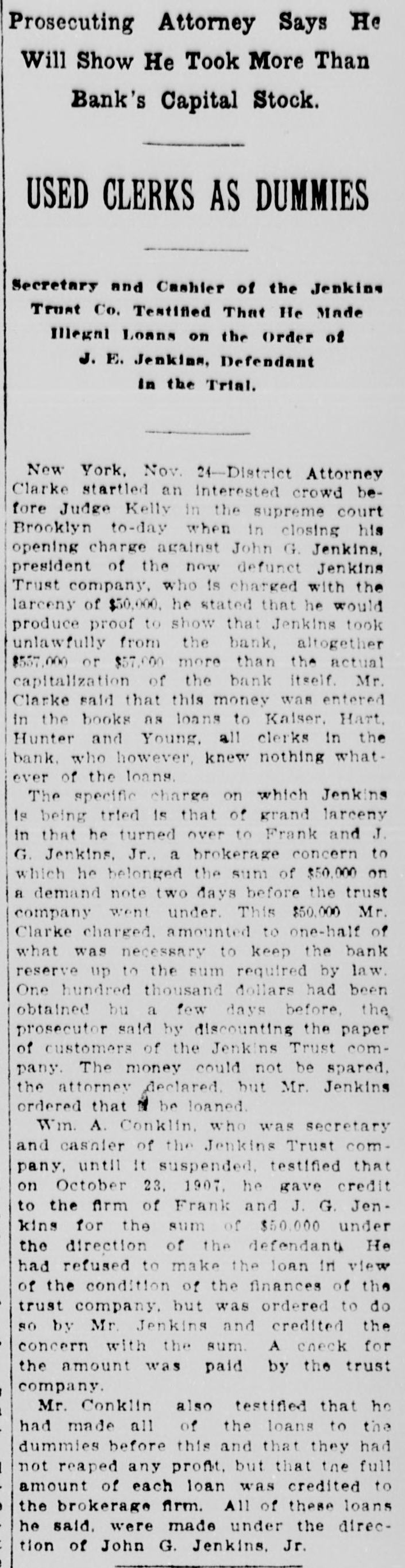
Will Show He Took More Than Bank's Capital Stock. USED CLERKS AS DUMMIES Secretary and Cashier of the Jenkins Trust Co. Testified That He Made Illegal Loans on the Order of J. E. Jenkins, Defendant In the Trial. New York, Nov. 24-District Attorney Clarke startled an interested crowd before Judge Kelly in the supreme court Brooklyn to-day when in closing his opening charge against John G. Jenkins, president of the now defunct Jenkins Trust company, who is charged with the larceny of $50,000. he stated that he would produce proof to show that Jenkins took unlawfully from the bank, altogether $557,000 or $57,000 more than the actual capitalization of the bank itself. Mr. Clarke said that this money was entered in the books AS loans to Kaiser. Hart. Hunter and Young, all clerks in the bank. who however, knew nothing whatever of the loans. The specific charge on which Jenkins is being tried is that of grand larceny in that he turned over to Frank and J. G. Jenkins. Jr., a brokerage concern to which he belonged the sum of $50,000 on a demand note two days before the trust company went under. This $50,000 Mr. Clarke charged. amounted to one-half of what was necessary to keep the bank reserve up to the sum required by law. One hundred thousand dollars had been obtained bu a few days before, the prosecutor said by discounting the paper of customers of the Jenkins Trust company. The money could not be spared, the attorney declared. but Mr. Jenkins ordered that be loaned. Wm. A. Conklin, who was secretary and cashier of the Jenkins Trust company, until It suspended, testified that on October 23, 1907. he gave credit to the Arm of Frank and J. G. Jenkins for the sum of $50,000 under the direction of the defendant He had refused to make the loan in view of the condition of the finances of the trust company, but was ordered to do so by Mr. Jenkins and credited the concern with the sum. A check for the amount was paid by the trust company. Mr. Conklin also testified that he had made all of the loans to the dummies before this and that they had not reaped any profit, but that the full amount of each loan was credited to the brokerage firm. All of these loans he said. were made under the direction of John G. Jenkins. Jr.