Contemporary articles report a run beginning Feb 1, 1908; directors suspended payments and the State Banking Department took charge (April 22). The institution was later reopened under the State Banking Department's administration (resumed business June 3–4, 1908). Cause of the run is tied to the panic and the recent failure/suspension of related local banks (Mechanics and Traders' Bank), so classified as 'local_banks'. Dates normalized where explicit in articles.
Events (4)
1.February 1, 1908Run
Cause
Local Banks
Cause Details
Run followed the October panic and news that Mechanics and Traders' Bank (and its Brooklyn branches) had suspended/failed, which caused depositors to clamor for funds.
Measures
Directors met and decided to suspend rather than try to withstand further withdrawals; many business efforts were made to restore confidence.
Newspaper Excerpt
The Home bank of Brooklyn, a state institution, on which a run was started yesterday, did not open for business today.
Source
newspapers
2.February 1, 1908Suspension
Cause
Local Banks
Cause Details
Directors ordered business suspended after heavy withdrawals driven by panic and failures of related banks; state banking authorities later took charge.
Newspaper Excerpt
The Home Bank of Brooklyn failed to open its doors this morning. A run on the bank has been in progress for several days. A bank official announced that the State Banking Department has taken charge of the institution.
Source
newspapers
3.April 22, 1908Receivership
Newspaper Excerpt
The Home Bank, which closed its doors on April 22, will resume business to-morrow ... affairs of this bank have been administered ... by the State Banking Department. George S. Leonard ... was designated ... to liquidate the Brooklyn institution.
Source
newspapers
4.June 4, 1908Reopening
Newspaper Excerpt
The Home Bank of Brooklyn ... will resume business to-morrow ... resumed business on June 4, 1908, after having been in the hands of the State Banking Department for forty-two days.
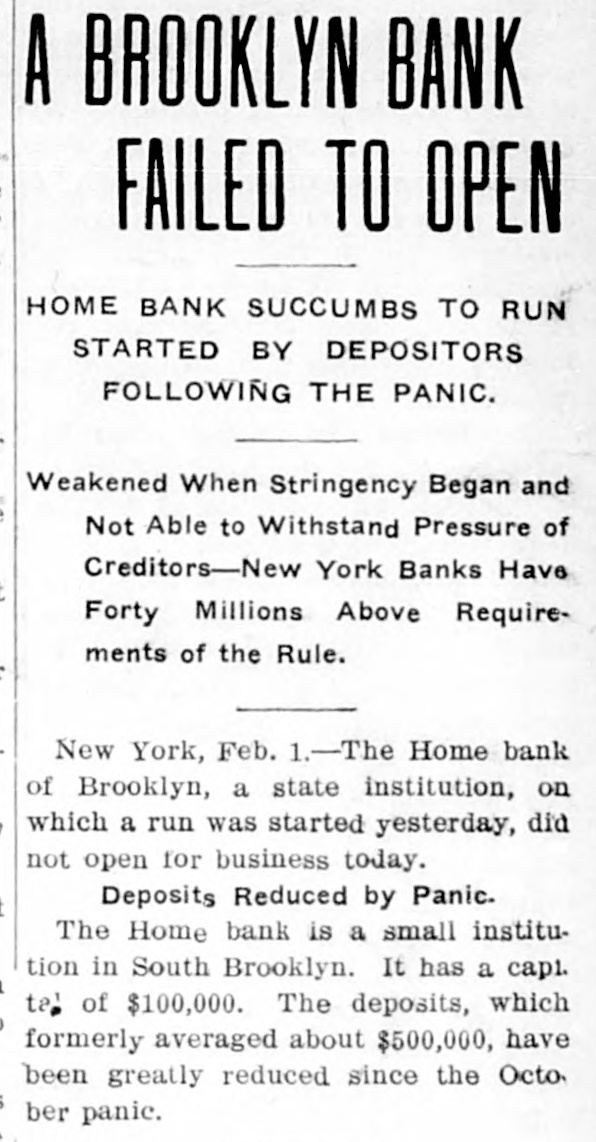
A BROOKLYN BANK FAILED TO OPEN HOME BANK SUCCUMBS TO RUN STARTED BY DEPOSITORS FOLLOWING THE PANIC. Weakened When Stringency Began and Not Able to Withstand Pressure of Creditors-New York Banks Have Forty Millions Above Requirements of the Rule. New York, Feb. 1.-The Home bank of Brooklyn, a state institution, on which a run was started yesterday, did not open for business today. Deposits Reduced by Panic. The Home bank is a small institution in South Brooklyn. It has a capi. tal of $100,000. The deposits, which formerly averaged about $500,000, have been greatly reduced since the Octo. ber panic.
2.February 1, 1908Alexandria GazetteAlexandria, VA
Click image to open full size in new tab
Article Text
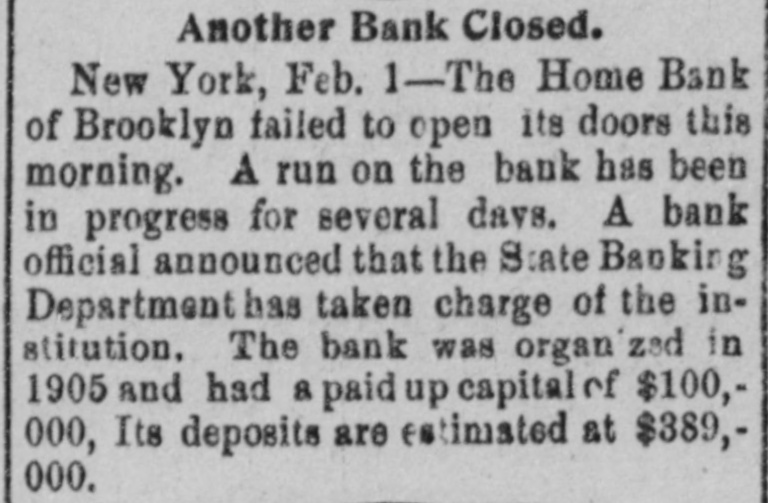
Another Bank Closed. New York, Feb. 1-The Home Bank of Brooklyn failed to open its doors this morning. A run on the bank has been in progress for several davs. A bank official announced that the State Banking Departmenthas taken charge of the institution. The bank was organ'zed in 1905 and had a paid up capital of $100,000, Its deposits are estimated at $389,000.
3.February 1, 1908Evening JournalWilmington, DE
Click image to open full size in new tab
Article Text
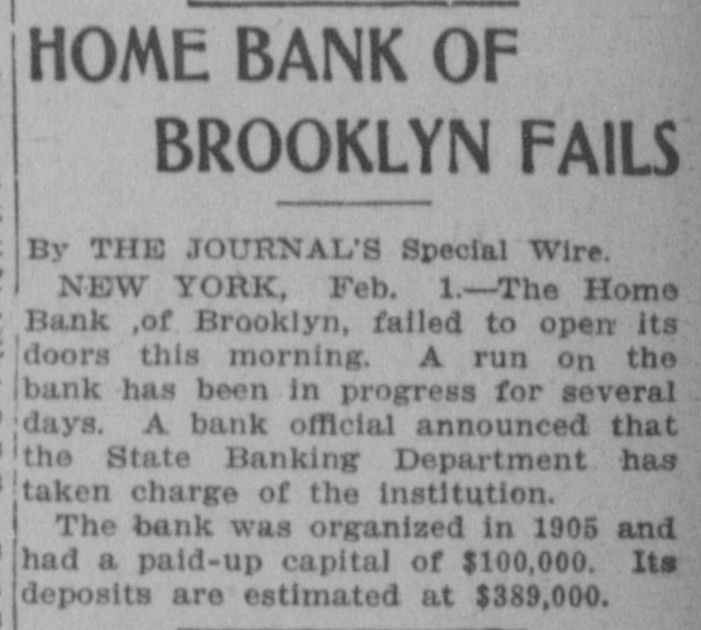
HOME BANK OF BROOKLYN FAILS By THE JOURNAL'S Special Wire. NEW YORK, Feb. 1.-The Home Bank ,of Brooklyn, failed to open its doors this morning. A run on the bank has been in progress for several days. A. bank official announced that the State Banking Department has taken charge of the institution. The bank was organized in 1905 and had a paid-up capital of $100,000. Its deposits are estimated at $389,000.
4.February 1, 1908Deseret Evening NewsSalt Lake City, UT
Click image to open full size in new tab
Article Text
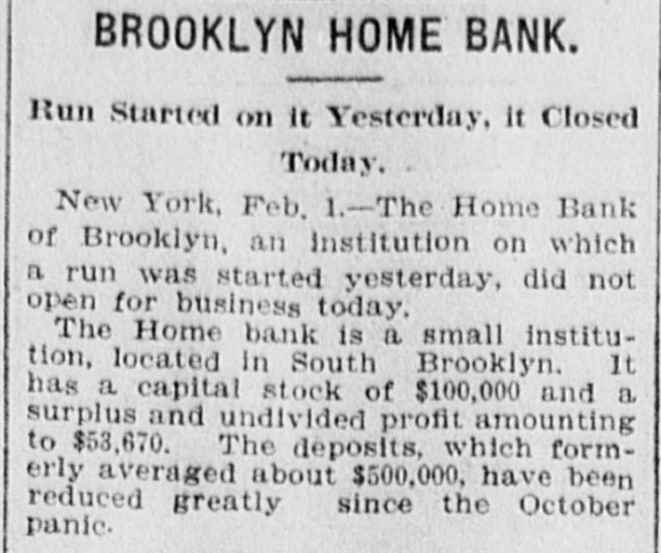
BROOKLYN HOME BANK. Run Started on it Yesterday, it Closed Today. New York, Feb. 1.-The Home Bank of Brooklyn, an Institution on which a run was started yesterday, did not open for business today. The Home bank is a small institution, located in South Brooklyn. It has a capital stock of $100,000 and a. surplus and undivided profit amounting to $53,670. The deposits, which formerly averaged about $500,000, have been reduced greatly since the October panic.
5.February 1, 1908The Evening WorldNew York, NY
Click image to open full size in new tab
Article Text
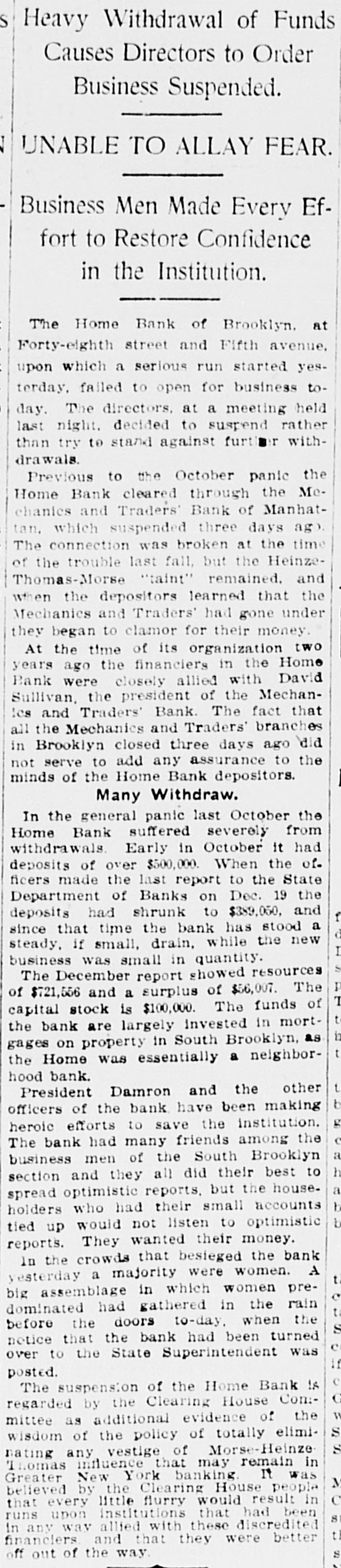
Heavy Withdrawal of Funds Causes Directors to Order Business Suspended. UNABLE TO ALLAY FEAR. Business Men Made Every Effort to Restore Confidence in the Institution. The Home Bank of Brooklyn. at Forty-eighth street and Fifth avenue. upon which a serious run started yesterday, failed to open for business today. The directors, at a meeting held r last night. decided to suspend rather withthan try to stand against furt drawals. Previous to the October panic the Home Bank cleared through the Mechanics and Traders' Bank of Manhattan. which suspended three days ag). The connection was broken at the time of the trouble last fall, but the HeinzeThomas-Morse "taint" remained. and when the depositors learned that the Mechanics and Traders' had gone under they began to clamor for their money. At the time of its organization two years ago the financiers in the Home Bank were closely allied with David Sullivan, the president of the MechanIcs and Traders' Bank. The fact that all the Mechanics and Traders' branches in Brooklyn closed three days ago did not serve to add any assurance to the minds of the Home Bank depositors. Many Withdraw. In the general panic last October the Home Bank suffered severely from withdrawals. Early in October it had deposits of over $500,000. When the of. ficers made the last report to the State Department of Banks on Dec. 19 the f deposits had shrunk to $389,050, and since that time the bank has stood a I steady, if small, drain, while the new business was small in quantity. The December report showed resources P of $721,556 and a surplus of $56,007. The T capital stock is $100,000. The funds of t the bank are largely invested in mortin t a gages on property in South Brooklyn, neighbor- as the Home was essentially hood bank. t President Damron and the other b officers of the bank have been making g heroic efforts to save the institution. The bank had many friends among the a business men of the South Brooklyn h section and they all did their best to a spread optimistic reports. but the houseb holders who had their small accounts b tied up would not listen to optimistic reports. They wanted their money. In the crowds that besieged the bank t yesterday a majority were women. A c big assemblage in which women pret dominated had gathered in the rain S before the doors to-day. when the e notice that the bank had been turned over to the State Superintendent was if C posted. The suspension of the Home Bank is regarded by the Clearing House ComW mittee as additional evidence of the S wisdom of the policy of totally elimiis any vestige of Morse-Heinze nating Thomas influence that may remain in M Greater New York banking It was believed by the Clearing House people C every little flurry would result in that Institutions that had been 8
6.February 2, 1908The Washington HeraldWashington, DC
Click image to open full size in new tab
Article Text
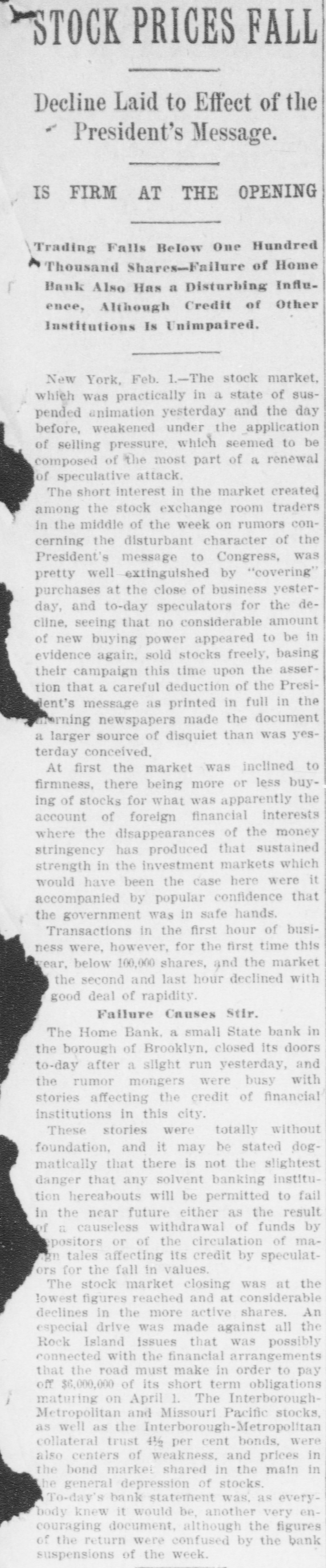
STOCK PRICES FALL Decline Laid to Effect of the President's Message. IS FIRM AT THE OPENING Trading Falls Below One Hundred Thousand Shares-Failure of Home Bank Also Has a Disturbing Influence, Although Credit of Other Institutions Is Unimpaired. New York, Feb. 1.-The stock market, which was practically in a state of suspended animation yesterday and the day before, weakened under the application of selling pressure, which seemed to be composed of the most part of a renewal of speculative attack. The short interest in the market created among the stock exchange room traders in the middle of the week on rumors concerning the disturbant character of the President's message to Congress, was pretty well extinguished by "covering" purchases at the close of business yesterday, and to-day speculators for the decline, seeing that no considerable amount of new buying power appeared to be in evidence again. sold stocks freely, basing their campaign this time upon the assertion that a careful deduction of the President's message as printed in full in the morning newspapers made the document a larger source of disquiet than was yesterday conceived. At first the market was inclined to firmness, there being more or less buying of stocks for what was apparently the account of foreign financial interests where the disappearances of the money stringency has produced that sustained strength in the investment markets which would have been the case here were it accompanied by popular confidence that the government was in safe hands. in the first hour of business for the first Transactions were, however, time this year, below 100,000 shares, and the market the second and last hour declined with good deal of rapidity. Failure Causes Stir. The Home Bank, a small State bank in the borough of Brooklyn, closed its doors to-day after a slight run yesterday, and the rumor mongers were busy with stories affecting the credit of financial institutions in this city. These stories were totally without foundation, and it may be stated dogmatically that there is not the slightest danger that any solvent banking institution hereabouts will be permitted to fail in the near future either as the result a causeless withdrawal of funds by positors or of the circulation of maagn tales affecting its credit by speculators for the fall in values. The stock market closing was at the lowest figures reached and at considerable declines in the more active shares. An especial drive was made against all the Rock Island issues that was possibly connected with the financial arrangements that the road must make in order to pay off $6,000,000 of its short term obligations maturing on April 1. The InterboroughMetropolitan and Missouri Pacific stocks, as well as the Interborough-Metropolitan collateral trust 41/2 per cent bonds, were also centers of weakness, and prices in the bond market shared in the main in he general depression of stocks. To-day's bank statement was, as everybody knew it would be, another very encouraging document, although the figures of the return were confused by the bank suspensions of the week.
7.February 3, 1908The Spokane PressSpokane, WA
Click image to open full size in new tab
Article Text
COULDN'T STAND RUN. NEW YORK, Feb. 3.-The Home bank of Brooklyn failed to open this morning, a run having been in progress several days. The state banking department has taken charge of the institution. It organized in 1850 and had a capital of $100,000 and deposits estimated at $389,000.
SMALL BANK CLOSES. NEW YORK, Feb. 1-The Home Bank of Brooklyn, a state institution, on which a run started yesterday, did not open for business today. It is a small institution and has a capital stock of $100,000 and surplus and undivided profits of $53,570. The deposits are not large.
9.February 6, 1908River Falls JournalRiver Falls, WI
Click image to open full size in new tab
Article Text
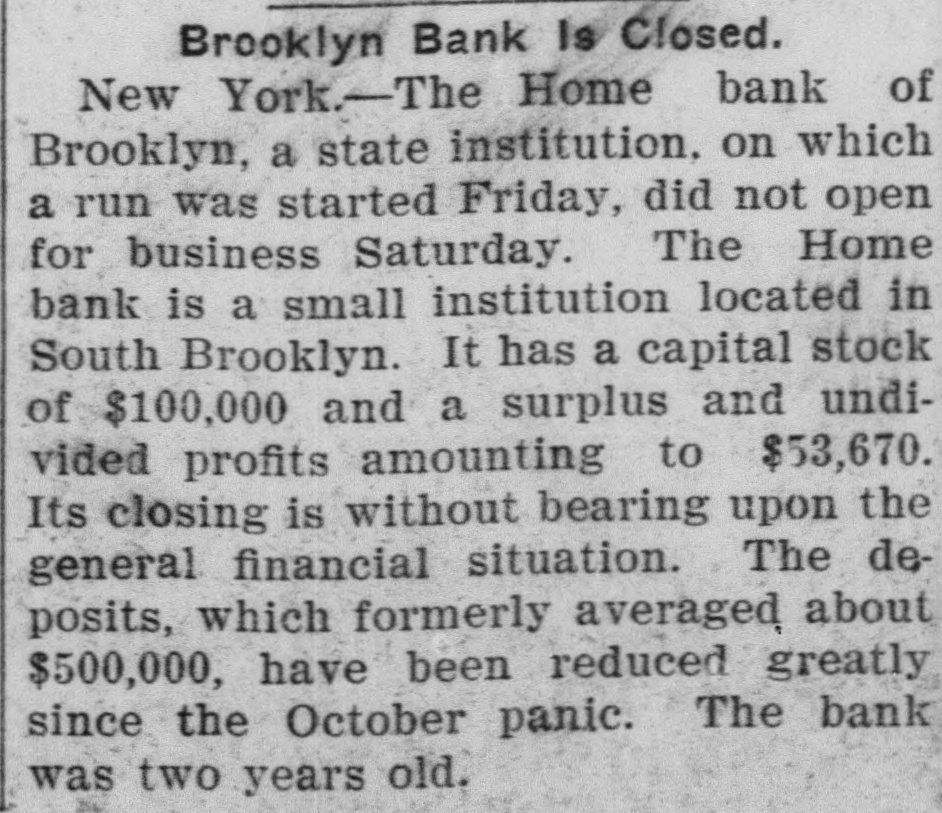
Brooklyn Bank Is Closed. New York.-The Home bank of Brooklyn, a state institution, on which a run was started Friday, did not open for business Saturday. The Home bank is a small institution located in South Brooklyn. It has a capital stock of $100,000 and a surplus and undivided profits amounting to $53,670. Its closing is without bearing upon the general financial situation. The deposits, which formerly averaged about $500,000, have been reduced greatly since the October panic. The bank was two years old.
10.February 7, 1908The Kendrick GazetteKendrick, ID
Click image to open full size in new tab
Article Text
NEWS OF THE WORLD SHORT DISPATCHES FROM ALL PARTS OF THE GLOBE. A Review of Happenings in Both Eastern and Western Hemispheres During the Past Week-National, Historical, Political and Personal Events. The Home bank of Brooklyn, an institution on which a run was started Saturday, has failed. David Yerkes, for years a weigher in the United States mint at Philadelphia, died at Spokane recently, at the age of 76 years. The grand jury at Kansas City returned 200 indictments against actors, actresses and theatrical managers and attaches charged with violating the Sunday law. It required $54,000 to cover the necessary bonds. Milton D. Purdy, assistant to the attorney general, "chief trust buster," and originator of the receivership innovation in trust prosecution, will shortly retire from the department of justice. Purdy is said to be slated for a circut judgeship in the eighth circuit. Gil Blas, a paper of Paris, says that Mme. Anna Gould intends to sell her property in Paris and return to America. The monthly coinage statement issued by the director of the mint Saturday shows the amount of coinage executed at the United States mints during January 1908, to have been $15,431,120, as follows: Gold, $13,044,950; silver, $2,129,000; minor coins, $257,170. Mrs. Annie Ackerly, the first woman ever convicted of arson in Brooklyn, has been sentenced to serve 14 years in prisón. It is reported important steps will be taken within the next few days in the effort to cause the removal from office of Lieutenant Governor Dunsmuir. The most disastrous blizzard of the winter passed over Chicago and vicinity Sunday. Oldtime residents of the Northwest have been astonished by the news that "Jack" Lavelle, for many years chief of police in Butte, is dying of cancer of the stomach in a Reno (Nev.) hospital. The memory of John Muir, California's writer and nature lover, will be perpetuated in a forest reservation near San Francisco, made up of giant redwoods and towering douglas firs, thousands of years old. It has been designated the Muir national forest. The trial of Mrs. Dora McDonald, widow of Chicago's millionaire gambler king, for the death of Webster Guerin, furnishes the first instance in the history of Illinois jurisprudence of a dying woman being placed in jeopardy of her life. Chief counsel for the defense of Mrs. McDonald is Colonel James Hamilton Lewis, former congressman from Washington state. The shipbuilders on the northeast coast of England have given notice that the services of all workingmen will be dispensed with on February 10. This action is an outcome of the strike inaugurated January 2, the men refusing to accept a reduction in wages. After the suspension of construction work for the last two months, the Harriman lines are to resume the building of Oregon railroads. General Manager O'Brien issued orders yesterday to assemble men and materials
11.February 15, 1908Elk City Mining NewsElk City, Red River Hot Springs, Red River, Newsome, Dixie, Buffalo Hump, Buffalo, Crooked River, ID
Click image to open full size in new tab
Article Text
NEWS OF THE WORLD SHORT DISPATCHES FROM ALL PARTS OF THE GLOBE. A Review of Happenings in Both Eastern and Western Hemispheres During the Past Week-National, Historical, Political and Personal Events. The Home bank of Brooklyn, an institution on which a run was started Saturday, has failed. David Yerkes, for years a weigher in the United States mint at Philadelphia, died at Spokane recently, at the age of 76 years. The grand jury at Kansas City returned 200 indictments against actors, actresses and theatrical managers and attaches charged with violating the Sunday law. It required $54,000 to cover the necessary bonds. Milton D. Purdy, assistant to the attorney general, "chief trust buster," and originator of the receivership innovation in trust prosecution, will shortly retire from the department of justice. Purdy is said to be slated for a circut judgeship in the eighth circuit. Gil Blas, a paper of Paris, says that Mme. Anna Gould intends to sell her property in Paris and return to America. The monthly coinage statement issued by the director of the mint Saturday shows the amount of coinage executed at the United States mints during January 1908, to have been $15,431,120, as follows: Gold, $13,044,950; silver, $2,129,000; minor coins, $257,170. Mrs. Annie Ackerly, the first woman ever convicted of arson in Brooklyn, has been sentenced to serve 14 years in prison. It is reported important steps will be taken within the next few days in the effort to cause the removal from office of Lieutenant Governor Dunsmuir. The most disastrous blizzard of the winter passed over Chicago and vicinity Sunday. Oldtime residents of the Northwest have been astonished by the news that "Jack" Lavelle, for many years chief of police in Butte, is dying of cancer S of the stomach in a Reno (Nev.) hospital. The memory of John Muir, California's writer and nature lover, will be perpetuated in a forest reservation t near San Francisco, made up of giant redwoods and towering douglas firs, thousands of years old. It has been designated the Muir national forest. The trial of Mrs. Dora McDonald, e widow of Chicago's millionaire game bler king, for the death of Webster Guerin, furnishes the first instance in the history of Illinois jurisprudence S of a dying woman being placed in jeopardy of her life. Chief counsel for d the defense of Mrs. McDonald is k Colonel James Hamilton Lewis, former congressman from Washington state. The shipbuilders on the northeast 11 coast of England have given notice e that the services of all workingmen will be dispensed with on February 10.
12.June 3, 1908The SunNew York, NY
Click image to open full size in new tab
Article Text
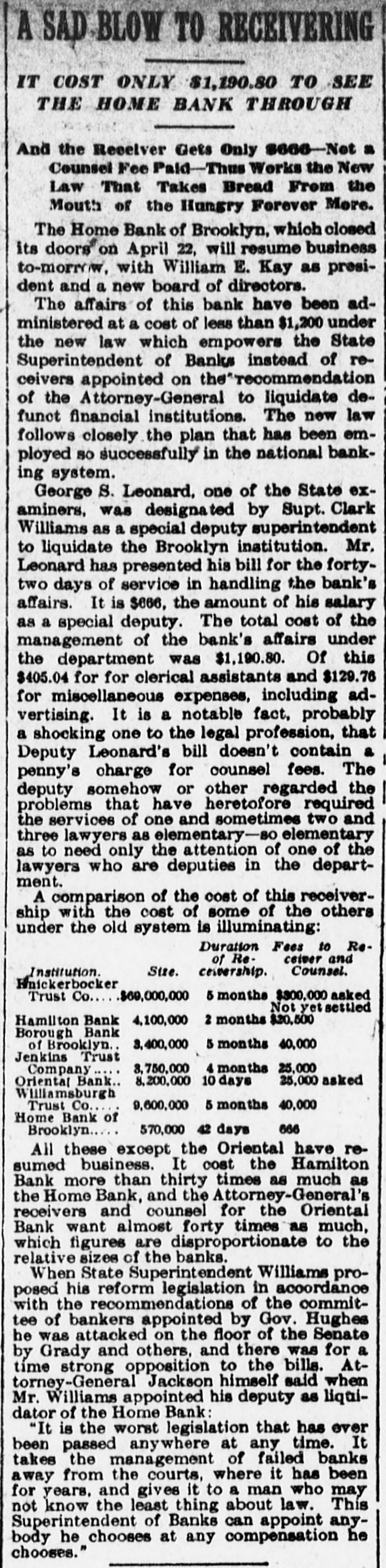
A SAD BLOW TO RECEIVERING IT COST ONLY $1,190.80 TO SEE THE HOME BANK THROUGH And the Receiver Gets Only $666-Not a Counsel Fee Paid-Thus Works the New Law That Takes Bread From the Mouth of the Hungry Forever More. The Home Bank of Brooklyn, which closed its doors on April 22, will resume business to-morrow, with William E. Kay as president and a new board of directors. The affairs of this bank have been administered at a cost of less than $1,200 under the new law which empowers the State Superintendent of Banks instead of receivers appointed on the"recommendation of the Attorney-General to liquidate defunct financial institutions. The new law follows closely the plan that has been employed so successfully in the national banking system. George S. Leonard, one of the State examiners, was designated by Supt. Clark Williams as a special deputy superintendent to liquidate the Brooklyn institution. Mr. Leonard has presented his bill for the fortytwo days of service in handling the bank's affairs. It is $666, the amount of his salary as a special deputy. The total cost of the management of the bank's affairs under the department was $1,190.80. Of this $405.04 for for clerical assistants and $129.76 for miscellaneous expenses, including advertising. It is a notable fact, probably a shocking one to the legal profession, that Deputy Leonard's bill doesn't contain a penny's charge for counsel fees. The deputy somehow or other regarded the problems that have heretofore required the services of one and sometimes two and three lawyers as elementary-so elementary as to need only the attention of one of the lawyers who are deputies in the department. A comparison of the cost of this receivership with the cost of some of the others under the old system is illuminating: Duration Fees to Receiver and of ReCounsel. Stre. Institution. ceivership. Hnickerbocker 5 months $800,000 asked Trust Co $69,000,000 Not yet settled Hamilton Bank 2 months $20,500 4,100,000 Borough Bank 5 months 40,000 of Brooklyn. 3,400,000 Jenkins Trust 4 months 25,000 3,750,000 Company 35,000 asked 10 days 8,200,000 Oriental Bank.. Williamsburgh 5 months 40,000 Trust Co 9,600,000 Home Bank of 570,000 42 days 666 Brooklyn All these except the Oriental have resumed business. It cost the Hamilton Bank more than thirty times as much as the Home Bank, and the Attorney-General's receivers and counsel for the Oriental Bank want almost forty times as much, which figures are disproportionate to the relative sizes of the banks. When State Superintendent Williams proposed his reform legislation in accordance with the recommendations of the committee of bankers appointed by Gov. Hughes he was attacked on the floor of the Senate by Grady and others, and there was for a time strong opposition to the bills. Attorney-General Jackson himself said when Mr. Williams appointed his deputy as liquidator of the Home Bank: "It is the worst legislation that has ever been passed anywhere at any time. It takes the management of failed banks away from the courts, where it has been for years, and gives it to a man who may not know the least thing about law. This Superintendent of Banks can appoint anybody he chooses at any compensation he chooses."
13.June 4, 1908New-York TribuneNew York, NY
Click image to open full size in new tab
Article Text
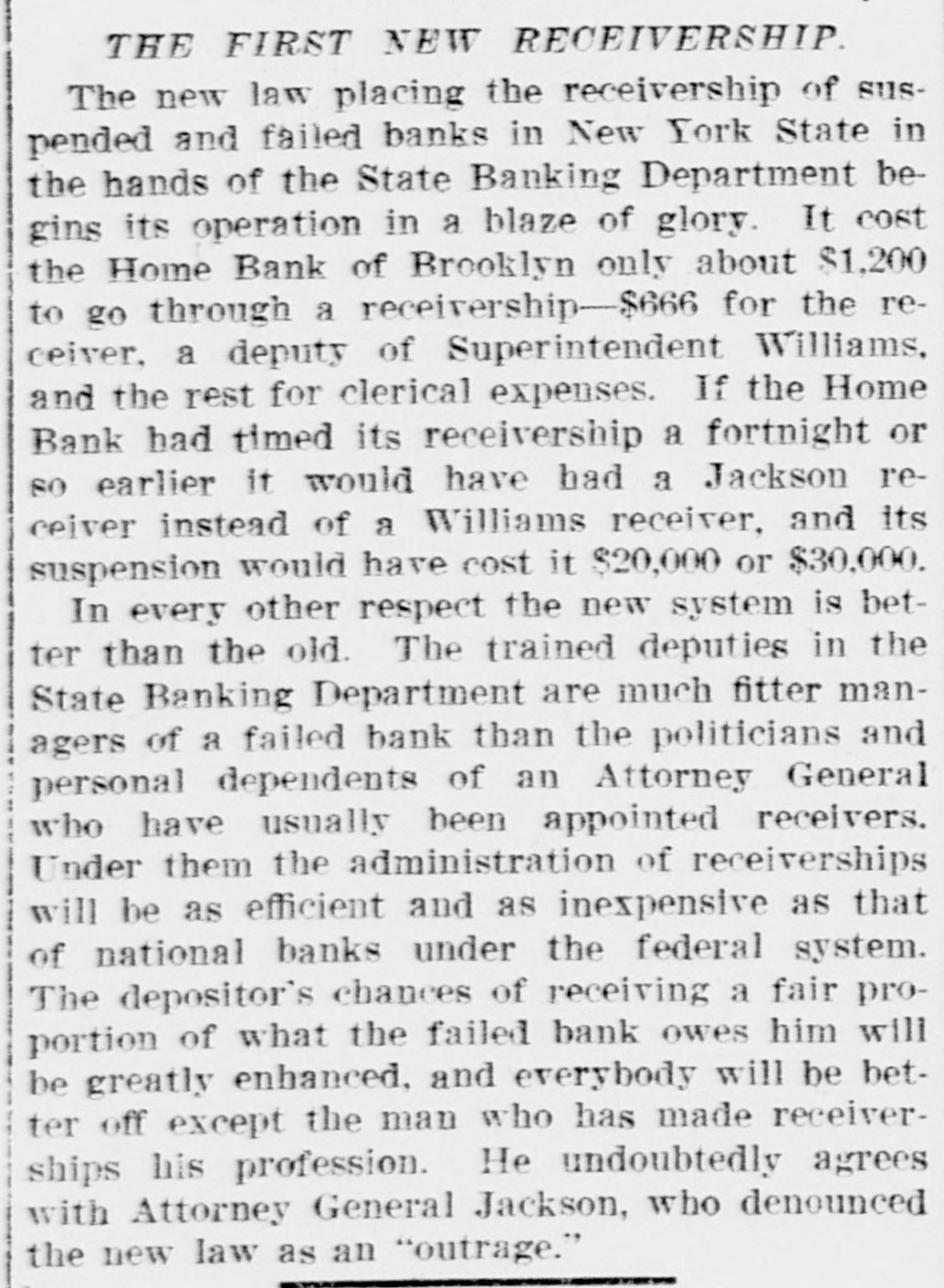
THE FIRST NEW RECEIVERSHIP: The new law placing the receivership of suspended and failed banks in New York State in the hands of the State Banking Department begins its operation in a blaze of glory. It cost the Home Bank of Brooklyn only about $1,200 to go through a receivership-$666 for the receiver. a deputy of Superintendent Williams, and the rest for clerical expenses. If the Home Bank had timed its receivership a fortnight or so earlier it would have had a Jackson receiver instead of a Williams receiver, and its suspension would have cost it $20,000 or $30,000. In every other respect the new system is better than the old. The trained deputies in the State Banking Department are much fitter managers of a failed bank than the politicians and personal dependents of an Attorney General who have usually been appointed receivers. Under them the administration of receiverships will be as efficient and as inexpensive as that of national banks under the federal system. The depositor's chances of receiving a fair proportion of what the failed bank owes him will be greatly enhanced, and everybody will be better off except the man who has made receiverships his profession. He undoubtedly agrees with Attorney General Jackson, who denounced the new law as an "outrage."
14.June 6, 1908The Barre Daily TimesBarre, VT
Click image to open full size in new tab
Article Text
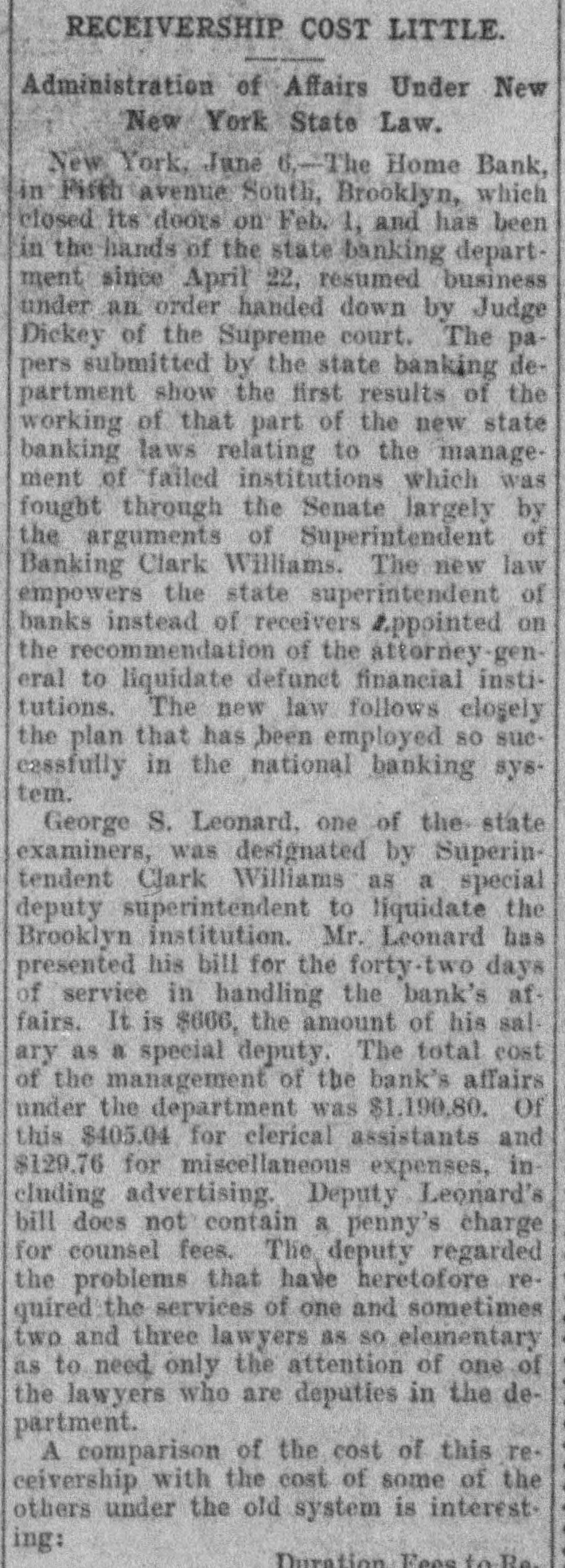
RECEIVERSHIP COST LITTLE. Administration of Affairs Under New New York State Law. ,New York, June 6,-The Home Bank, in Fifth avenue South, Brooklyn, which closed its doots on Feb. 1, and has been in the hands of the state banking department since April 22, resumed business under an order handed down by Judge Dickey of the Supreme court. The papers submitted by the state banking department show the first results of the working of that part of the new state banking laws relating to the management of failed institutions which was fought through the Senate largely by the arguments of Superintendent of Banking Clark Williams. The new law empowers the state superintendent of banks instead of receivers Appointed on the recommendation of the attorney-general to liquidate defunct financial institutions. The new law follows elogely the plan that has ,been employed so suecassfully in the national banking system. George S. Leonard, one of the state examiners, was designated by Superintendent Clark Williams as a special deputy superintendent to liquidate the Brooklyn institution. Mr. Leonard has presented his bill for the forty-two days of service in handling the bank's affairs. It is $666, the amount of his salary as a special deputy. The total cost of the management of the bank's affairs under the department was $1,190,80. Of this $405.04 for clerícal assistants and $129.76 for miscellaneous expenses, including advertising. Deputy Leonard's bill does not contain & penny's charge for counsel fees. The deputy regarded the problems that have heretofore required the services of one and sometimes two and three lawyers as so elementary as to need only the attention of one of the lawyers who are deputies in the department. A comparison of the cost of this receivership with the cost of some of the others under the old system is interesting: Duration Fees to Re:
15.June 6, 1908New-York TribuneNew York, NY
Click image to open full size in new tab
Article Text
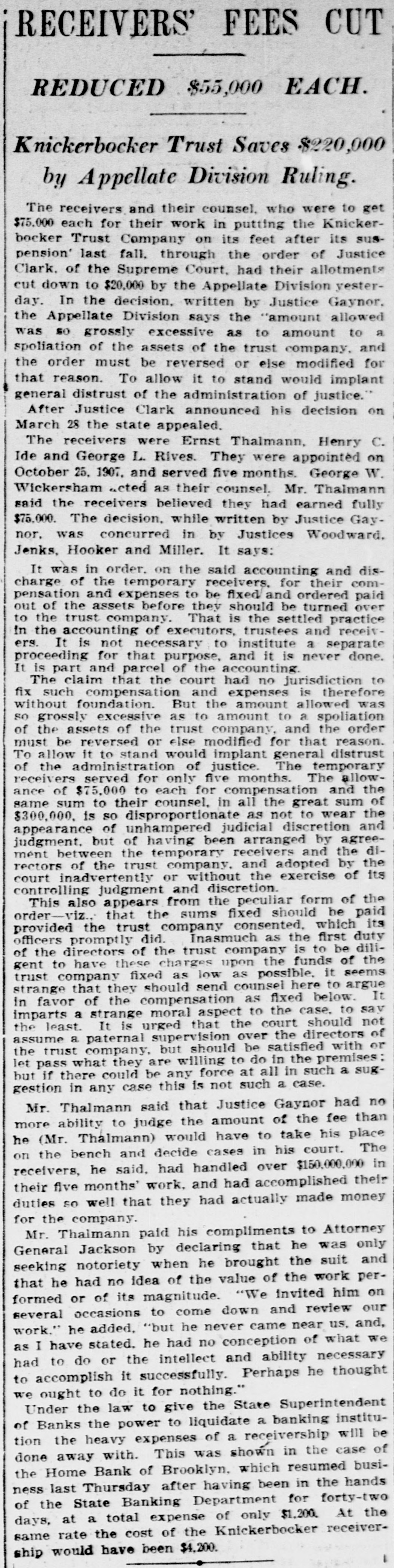
RECEIVERS' FEES CUT EACH. $55,000 REDUCED Knickerbocker Trust Saves $220,000 by Appellate Division Ruling. The receivers and their counsel. who were to get $75,000 each for their work in putting the Knickerbocker Trust Company on its feet after its suspension' last fall, through the order of Justice Clark. of the Supreme Court, had their allotments cut down to $20,000 by the Appellate Division yesterday. In the decision, written by Justice Gaynor, the Appellate Division says the "amount allowed was so grossly excessive as to amount to a spoliation of the assets of the trust company. and the order must be reversed or else modified for that reason. To allow it to stand would implant general distrust of the administration of justice. After Justice Clark announced his decision on March 28 the state appealed. The receivers were Ernst Thalmann, Henry C. Ide and George L. Rives. They were appointed on October 25. 1907. and served five months. George W. Wickersham acted as their counsel. Mr. Thalmann said the receivers believed they had earned fully $75,000. The decision, while written by Justice Gaynor, was concurred in by Justices Woodward. Jenks, Hooker and Miller. It says: It was in order. on the said accounting and discharge of the temporary receivers, for their compensation and expenses to be fixed and ordered paid out of the assets before they should be turned over to the trust company. That is the settled practice in the accounting of executors, trustees and receivers. It is not necessary to institute a separate proceeding for that purpose, and it is never done. It is part and parcel of the accounting The claim that the court had no jurisdiction to fix such compensation and expenses is therefore without foundation. But the amount allowed was so grossly excessive as to amount to a spoliation of the assets of the trust company, and the order must be reversed or else modified for that reason. To allow it to stand would implant general distrust of the administration of justice. The temporary receivers served for only five months. The allowance of $75,000 to each for compensation and the same sum to their counsel. in all the great sum of $300,000. is so disproportionate as not to wear the appearance of unhampered judicial discretion and judgment. but of having been arranged by agreement between the temporary receivers and the directors of the trust company. and adopted by the court inadvertently or without the exercise of its controlling judgment and discretion. This also appears from the peculiar form of the order-viz... that the sums fixed should be paid provided the trust company consented. which its officers promptly did. Inasmuch as the first duty of the directors of the trust company is to be diligent to have these charges upon the funds of the trust company fixed as low as possible. it seems strange that they should send counsel here to argue It in favor of the compensation as fixed below. imparts a strange moral aspect to the case. to say the least. It is urged that the court should not assume a paternal supervision over the directors of the trust company, but should be satisfied with or let pass what they are willing to do in the premises: sugbut if there could be any force at all in such a gestion in any case this is not such a case. Mr. Thalmann said that Justice Gaynor had no more ability to judge the amount of the fee than he (Mr. Thalmann) would have to take his place The on the bench and decide cases in his court. receivers, he said. had handled over $150,000,000 in their five months' work. and had accomplished their duties so well that they had actually made money for the company. Mr. Thalmann paid his compliments to Attorney General Jackson by declaring that he was only seeking notoriety when he brought the suit and that he had no idea of the value of the work performed or of its magnitude. "We invited him on several occasions to come down and review our work." he added, "but he never came near us. and, as I have stated. he had no conception of what we had to do or the intellect and ability necessary to accomplish it successfully. Perhaps he thought we ought to do it for nothing." Under the law to give the State Superintendent of Banks the power to liquidate a banking institution the heavy expenses of a receivership will be done away with. This was show in the case of the Home Bank of Brooklyn. which resumed business last Thursday after having been in the hands of the State Banking Department for forty-two days, at a total expense of only $1,200. At the same rate the cost of the Knickerbocker receivership would have been $4,200.
16.June 6, 1908The Barre Daily TimesBarre, VT
Click image to open full size in new tab
Article Text
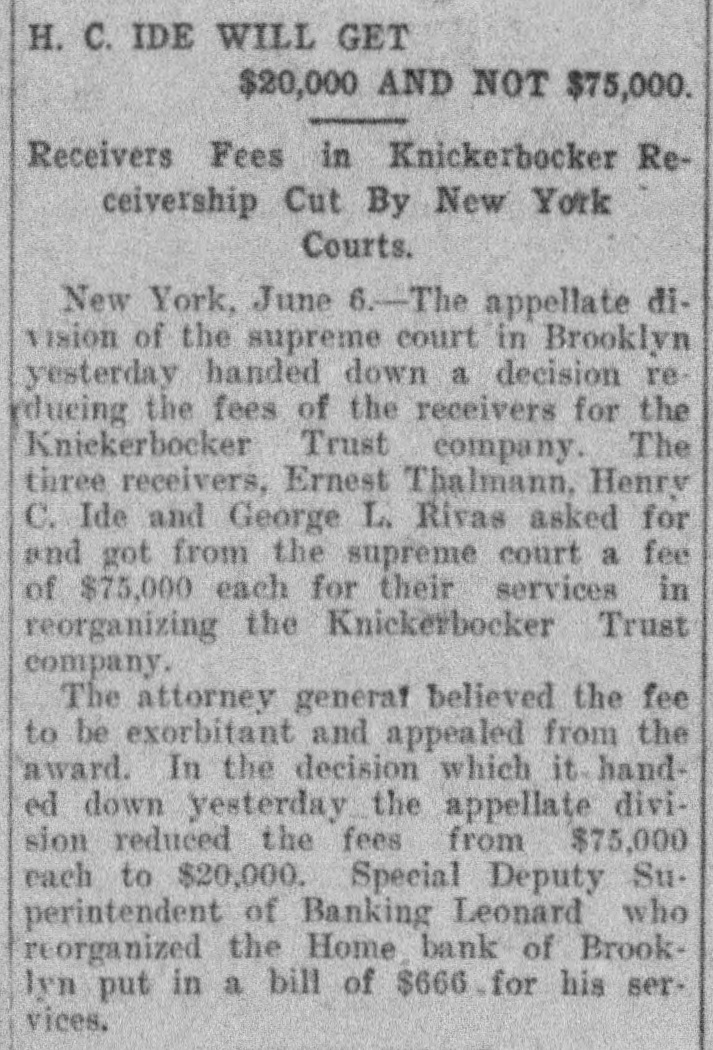
H. C. IDE WILL GET $20,000 AND NOT $75,000. Receivers Fees in Knickerbocker Receivership Cut By New York Courts. New York, June 6.-The appellate division of the supreme court in Brooklyn yesterday handed down a decision rerelueing the fees of the receivers for the Kniekerbocker Trust company. The three receivers, Ernest Thalmann, Henry C. Ide and George L. Rivas asked for and got from the supreme court a fee of $75,000 each for their services in reorganizing the Knickerbocker Trust company. The attorney general believed the fee to be exorbitant and appealed from the award. In the decision which it handed down yesterday the appellate division reduced the fees from $75,000 each to $20,000. Special Deputy Superintendent of Banking Leonard who reorganized the Home bank of BrookIvn put in a bill of $666 for his services.
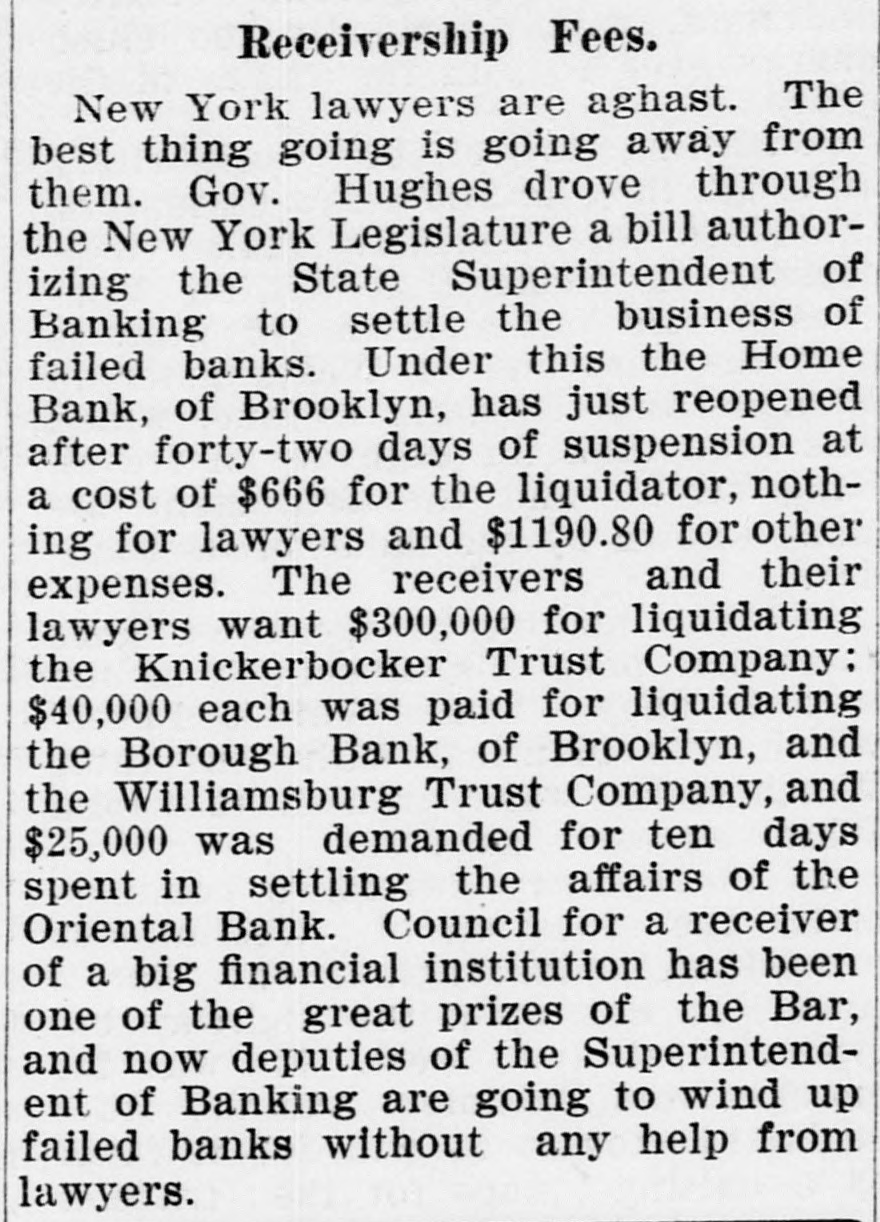
Receivership Fees. New York lawyers are aghast. The best thing going is going away from them. Gov. Hughes drove through the New York Legislature a bill authorizing the State Superintendent of Banking to settle the business of failed banks. Under this the Home Bank, of Brooklyn, has just reopened after forty-two days of suspension at a cost of $666 for the liquidator, nothing for lawyers and $1190.80 for other expenses. The receivers and their lawyers want $300,000 for liquidating the Knickerbocker Trust Company: $40,000 each was paid for liquidating the Borough Bank, of Brooklyn, and the Williamsburg Trust Company, and $25,000 was demanded for ten days spent in settling the affairs of the Oriental Bank. Council for a receiver of a big financial institution has been one of the great prizes of the Bar, and now deputies of the Superintendent of Banking are going to wind up failed banks without any help from lawyers.
18.May 4, 1909Yorkville EnquirerYork, SC
Click image to open full size in new tab
Article Text
(Continued from Friday Issue.) Behind this recommendation of the banking commission was the long and honorable precedent established by com- the liquidation of national banks. A York between the costs of New and national impressive in this somewhat state parison receiverships connec- is tion. The average ratio of expense in winding up the New York state banks and building and loan associations was 13.01 per cent of receipts. During one As year the average was 37 per cent. stated, the cost has reached 90 On the other hand, averper already cent. thirty the nine age cost of liquidating nabanks in New York state was 8.92 per cent. The tional only average and sixty- cost four hundred national banks of eight liquidating scattered cent. all over In the United States was 7.42 per cases the administration of a bank receivership cost per national many the 4.2 assets cent of the nominal value of and 7.5 per cent of the amount collected. No case is more striking than the that of the National Bank America in New a of very North latest, receiver York was city, a Morse bank. The trained and trusted national bank examiner, and the expense of winding up its affairs was 1.7 per cent of the money collected and seven-tenths of one per cent of the assets. This bank paid every depositor dollar for dollar and interest; and it was wound up in less than a year. Uncle Sam was a good model in this for the controller had established the of rency respect, of custom the curnational bank examiners on of liquidating putting the job failure banks but the right to name laymen, it not often done. So an takes the helm and, in hand He is has experienced most cases, work. he simply gets a per diem for his What is more important, the receiver of a national bank is the attorney and agent for the depositor. The New York state receiver was often the agent for himself. as Governor Hughes was with all these acacquainted As soon facts the banking he the suggestions of and, at his were introduced at cepted bills commission banking Albany instigation, profor changes in the laws. aroused such bitter as statute which put the viding None the, discussion liquidation of institutions into the hands of of it the failed superintendent banks. measure But was was to no avail; the adopted and became a law exactly one year ago. By its provisions the superintendent has the to of its deputies as a of one banks authority receiver install of institution. The to give a bond. failed quired deputy The superin- The is renames the counsel. aid and of the courts are when absolutely necessary tendent voked advice only inPublicity must attend the collection and expenditure of all moneys. This new banking law became a sort Charta for the bank deposiof New York state; tors of Magna likewise failed bank. it insured a square deal for the first case that came gave impressive proof The provisions very under of its its economy and efficiency. Home Bank of an with assets of stitution The Brooklyn, $570,000, closed indoors. Superintendent Williams and named as G. took its charge receiver who had been for years S. Leonard, of the most capable and trusted bank examiners and of state the thoroughly. who knew He banking business a special Instead of a long, redent. the was made deputy expensive superintenthat wound lazily through and became in ceivership the courts enmeshed the bank legal red tape, the affairs of were cleared up in what seemed an in credibly brief time. forty-two days after the failed the receivership and bank In exactly able to ended the institution was resume Nothing could be more eloof the new order of than business. quent of expenses: things this simple schedule Salary of special deputy su$ 666.00 perintendent 405.04 Clerical assistance Miscellaneous expenses, including printing, stationery and 129.75 advertising $7,200.79 Total This expense account is significant. In the first place, there is no charge for counsel fees, which shows that in many cases a capable, trained man can go into a bank and clear it up without recourse to law or legal advice. In the second place, the pay of the is just about the per a bank examiner. In diem receiver of maximum this case about $15.85 a day. considered it compenaveraged ceiver adequate The resation for his labors. When you compare this modest stipend with the huge fees of receivers who operated under the old law you get a new idea of the economy and efficiency of the new statute. table shows what some receivcost in time and money erships This makes under the old order of things, and it a striking contrast with the statement of the Home Bank:
19.April 6, 1910New-York TribuneNew York, NY
Click image to open full size in new tab
Article Text
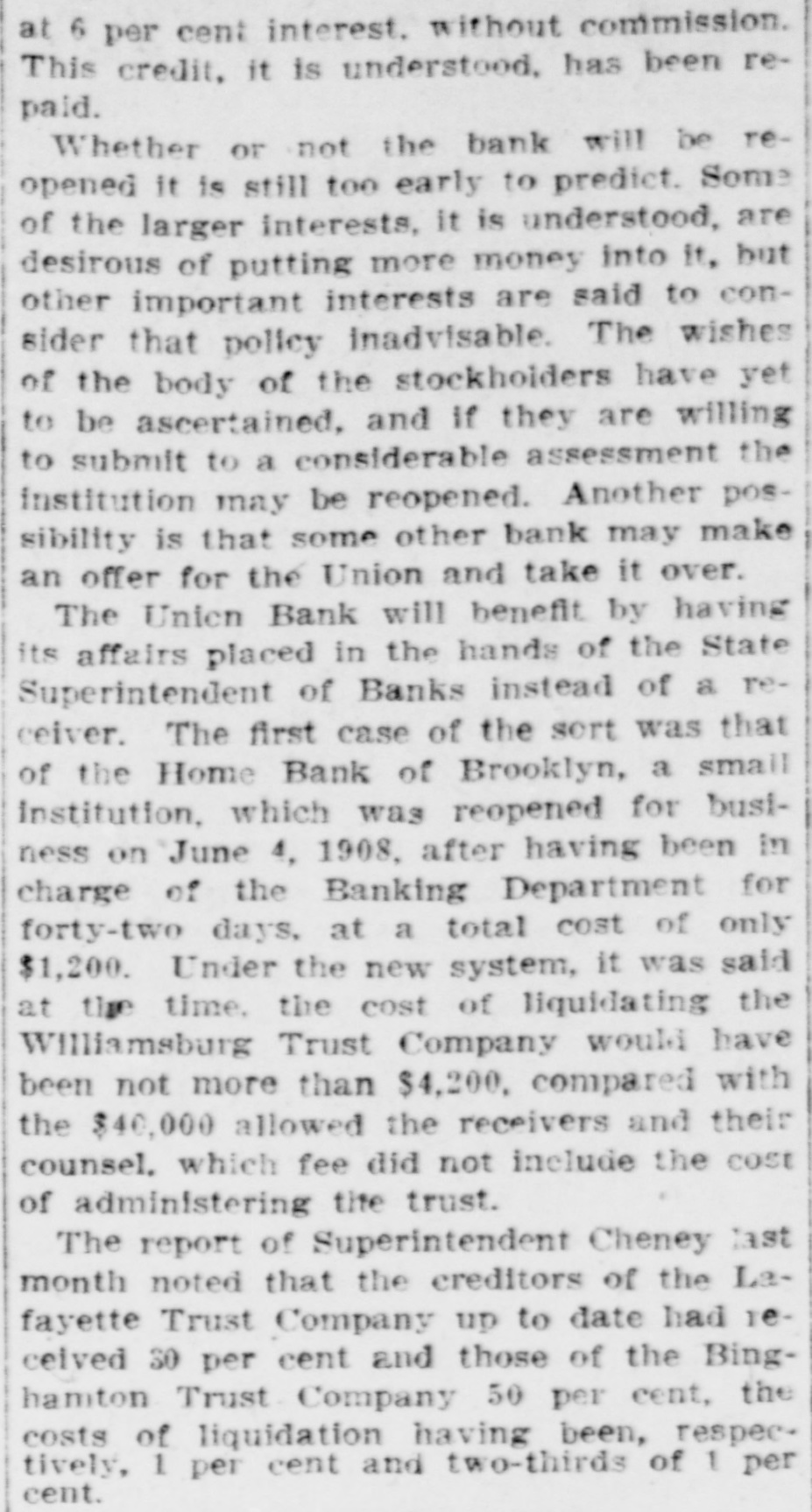
at 6 per cent interest, without commission. This credit, it is understood, has been repaid.
Whether or not the bank will be reopened it is still too early to predict. Some of the larger interests, it is understood, are desirous of putting more money into it, but other important interests are said to consider that policy inadvisable. The wishes of the body of the stockholders have yet to be ascertained, and if they are willing to submit to a considerable assessment the institution may be reopened. Another possibility is that some other bank may make an offer for the Union and take it over.
The Union Bank will benefit by having its affairs placed in the hands of the State Superintendent of Banks instead of a receiver. The first case of the sort was that of the Home Bank of Brooklyn, a small institution, which was reopened for business on June 4, 1908, after having been in charge of the Banking Department for forty-two days, at a total cost of only $1,200. Under the new system, it was said at the time, the cost of liquidating the Williamsburg Trust Company would have been not more than $4,200, compared with the $40,000 allowed the receivers and their counsel, which fee did not include the cost of administering the trust.
The report of Superintendent Cheney last month noted that the creditors of the Lafayette Trust Company up to date had received 30 per cent and those of the Binghamton Trust Company 50 per cent, the costs of liquidation having been, respectively, 1 per cent and two-thirds of 1 per cent.
20.January 23, 1913The Evening WorldNew York, NY
Click image to open full size in new tab
Article Text
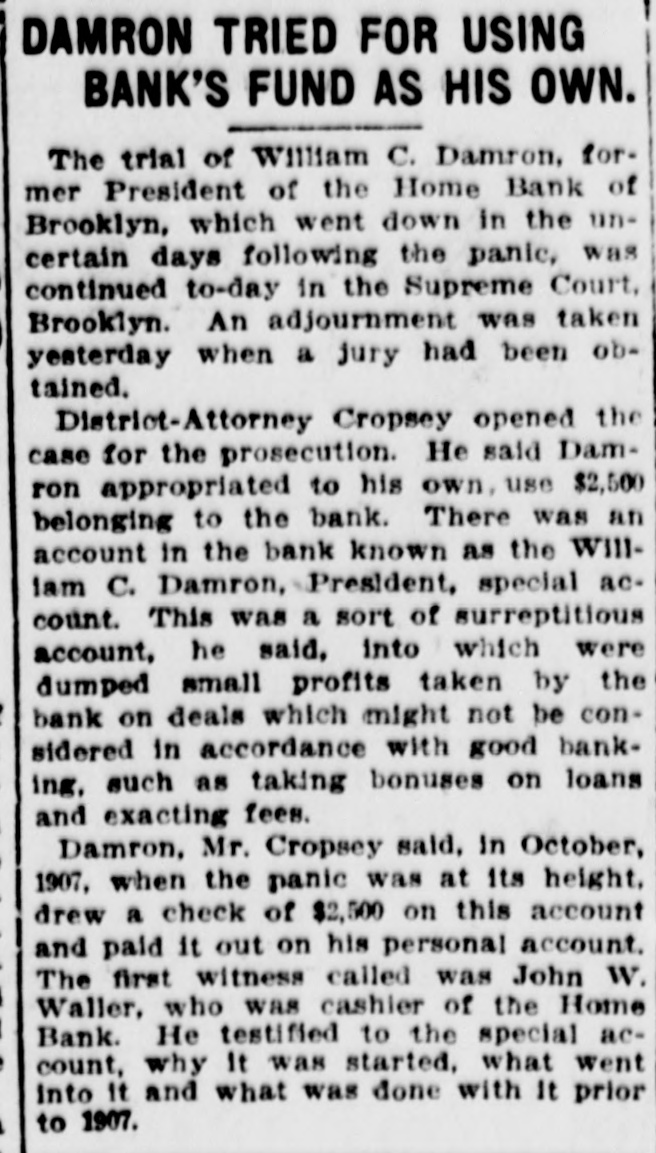
DAMRON TRIED FOR USING BANK'S FUND AS HIS OWN. The trial of William C. Damron, former President of the Home Bank of Brooklyn, which went down in the uncertain days following the panic, was continued to-day in the Supreme Court, Brooklyn. An adjournment was taken yesterday when a jury had been obtained. District-Attorney Cropsey opened the case for the prosecution. He said Damron appropriated to his own, use $2,500 belonging to the bank. There was an account in the bank known as the WillIam C. Damron, President, special account. This was a sort of surreptitious account, he said, into which were dumped small profits taken by the bank on deals which might not be considered in accordance with good banking. such as taking bonuses on loans and exacting fees. Damron, Mr. Cropsey said, in October, 1907, when the panic was at its height, drew a check of $2,500 on this account and paid it out on his personal account. The first witness called was John W. Waller, who was cashier of the Home Bank. He testified to the special account, why It was started, what went into It and what was done with It prior to 1907.