13199. First National Bank (Brooklyn, NY)

Bank Information

Episode Type
Suspension β†’ Reopening
Bank Type
national
Bank ID
923
Charter Number
923
Start Date
October 25, 1907
Location
Brooklyn, New York (40.660, -73.951)

Metadata

Model
gpt-5-mini
Short Digest
66dfaa8ede364375

Response Measures

None

Receivership Details

Date receivership started
1907-10-25
Date receivership terminated
1908-02-10
OCC cause of failure
Losses

Description

The First National Bank of Brooklyn suspended on Oct 25, 1907 after affiliated trust companies (Jenkins Trust Company and Williamsburg Trust Company) failed; it was placed in hands of a receiver and later reopened Feb 10, 1908 after stockholders covered a deficiency. OCR errors corrected (e.g., Willamsburg -> Williamsburg; Jenkins family involvement). No clear standalone depositor run on this national bank is described β€” the bank closed to protect against checks of the failed trust companies.

Events (7)

1. March 21, 1865 Chartered
Source
historical_nic
2. October 25, 1907 Receivership
Source
historical_nic
3. October 25, 1907 Receivership
Newspaper Excerpt
The First National bank of Brooklyn closed its doors this afternoon and National Bank Examiner George T. Cutts has taken charge by order of the comptroller of the currency. ... the national bank was closed to protect its depositors ... the bank was in the hands of John W. Schofield as receiver.
Source
newspapers
4. October 25, 1907 Suspension
Cause
Local Banks
Cause Details
The First National cleared for Jenkins Trust Company and Williamsburg Trust Company; those trust companies suspended and the national bank closed to protect depositors from incoming paper/ checks of the failed trusts.
Newspaper Excerpt
Comptroller ... stated ... the Jenkins Trust Company and the Williamsburg Trust Company, which suspended payment today, were directly responsible for the closing of the doors of the First National bank of Brooklyn.
Source
newspapers
5. February 10, 1908 Reopening
Newspaper Excerpt
The First National Bank, which recently suspended, has reopened. ... The deficiency of $165,000, which existed when the bank suspended, has been made good by the stockholders.
Source
newspapers
6. February 10, 1908 Restored To Solvency
Source
historical_nic
7. November 22, 1928 Voluntary Liquidation
Source
historical_nic

Newspaper Articles (24)

Article from Evening Times-Republican, October 25, 1907

Click image to open full size in new tab

Article Text

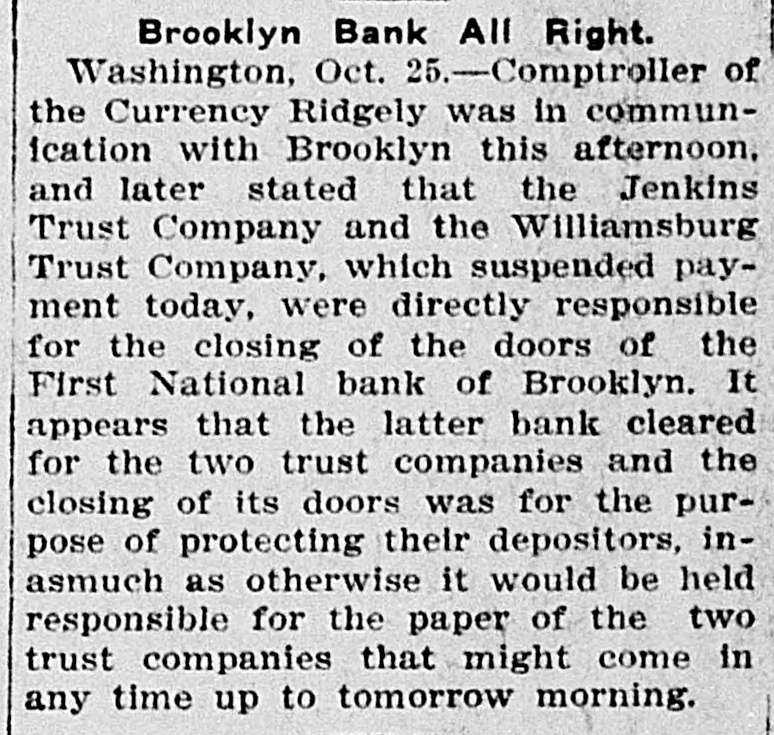
Brooklyn Bank All Right. Washington, Oct. 25.-Comptroller of the Currency Ridgely was in communication with Brooklyn this afternoon, and later stated that the Jenkins Trust Company and the Williamsburg Trust Company, which suspended payment today, were directly responsible for the closing of the doors of the First National bank of Brooklyn. It appears that the latter bank cleared for the two trust companies and the closing of its doors was for the purpose of protecting their depositors, inasmuch as otherwise it would be held responsible for the paper of the two trust companies that might come in any time up to tomorrow morning.


Article from Rock Island Argus, October 25, 1907

Click image to open full size in new tab

Article Text

SMALL BANKS FAILING Trouble Extends Beyond New York---Stocks Gather Some Strength. New York, Oct. 25.-A fund of $10,000,000 or more was formed at a conference held at the clearing house this to care the afternoon of the take of money needs stock exchange, and it was over the situation would confidently tide believed this complete- action ly SO far as the stock exchange was concerned. Carry Till Monday. over until Trust of All Monday. loans made The today will Company carry America and Lincoln Trust without diffihad withstood depositors company culty up to 2:15 this afternoon and officials of the companies expressed themselves as confident of the result. Several Close Doors. Several financial institutions closed their doors today, but this action was without effect in larger circles. It was believed the institutions were solvent to obtain them to and cash that had only caused inability suspend ready payment, and it was hoped the suspension would be only temporary. Great Demand for Fund. New York, Oct. 25.-Bankers organized to support the stock exchange houses had about for that $15,000,000 p. to use purpose. Up to 2:45 m. $12. 000,000 had been loaned at about 50 per cent. The stock market became quite strong after these effective relief measures and prices were generally at the highest point of the day. Still Pouring Currency In. New York, Oct. i.-The secretary of to in a Another cial the treasury assistance is continuing large way. give finansmall bills is to York from large rushed supply New of Washington, being A statement issued by the sub-treasurer the local $28,707,000 today shows banks gained from the sub-treasury This in part of the large during the the week. deposits represents government funds made with New York banks, Cash Through Sub-Treasury. New York, Oct. -Cash amounting to was sent to the $4,400,000 of America this Trust Company morning through the subtreasury. The International Trust company, a small and inconspieuous trust concern closed its doors at 10:40. This company had business connections with the Borough Bank of Brooklyn. Another Squeezed. The Brooklyn bank. at Fulton and did not for bank a Clinton business streets, today. Brooklyn, The has open capital of $300,000 and owes deposit ors a million and a half. Stocks Advance at Opening. New York, Oct. 25.-Opening prices of stocks showed many wide advance but in international issues they fell far short, as a result of the London parity established before the local stock mar ket opened. Morgan Renews Loans. New York, Oct. 25.-The large loans made by J. Pierpont Morgan & Co. an. their associates to stock brokers yes terday when the brokers were demoral ized were renewed today at 20 per cent. Brooklyn National Goes. New York, Oct. 25.-The First Na tional bank of Brooklyn, with a capita of $300,000. suspended payment today It owes depositors $4,200,000. The failure of Gregory, Gulick & Co. members of the Consolidated Stock ex change, was announced this afternoon The failure is unimportant. The Williams Trust company o Brooklyn, capital $300,000. temporarily closed its doors this afternoon. owes depositors $7,500,000. Resume Payment to Depositors. New York, Oct. 25.-The Trust Com pany of America and the Lincol t as Ta Trust their depositors company resumed usual today. payment stock exchange made their daily se tlements of accounts as usual to th clearing house. morn Secretary "There Cortelyou is nothing said today this ing, to caus me to change my former expression of belief that matters are steadily in proving." Brooklyn Institution Closes. New York, Oct. 25.-The "Borough


Article from The Topeka State Journal, October 25, 1907

Click image to open full size in new tab

Article Text

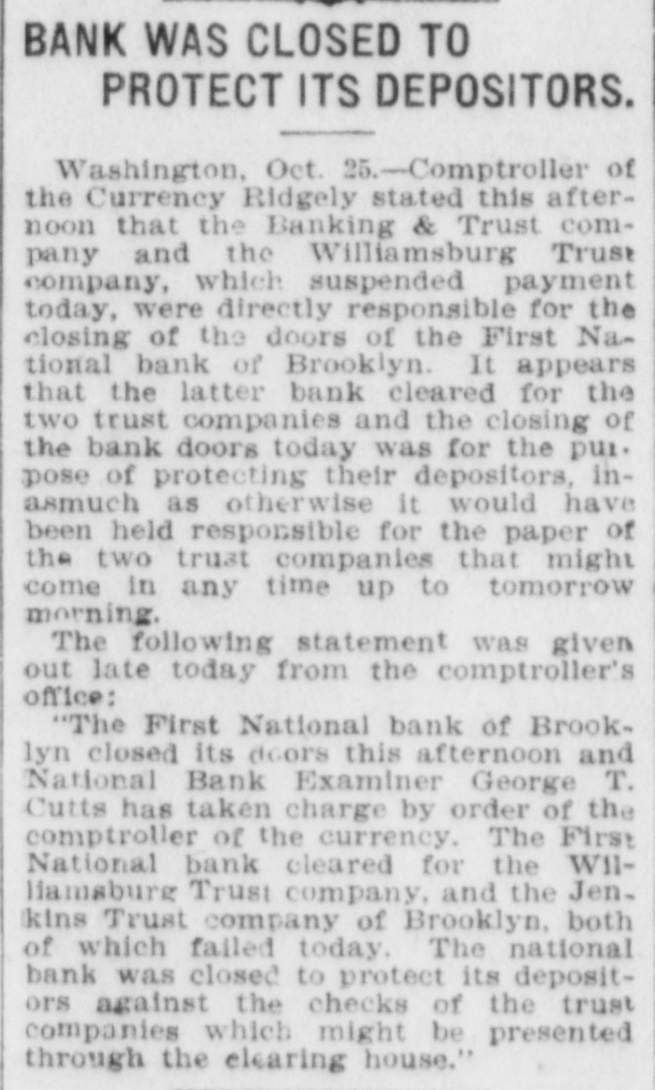
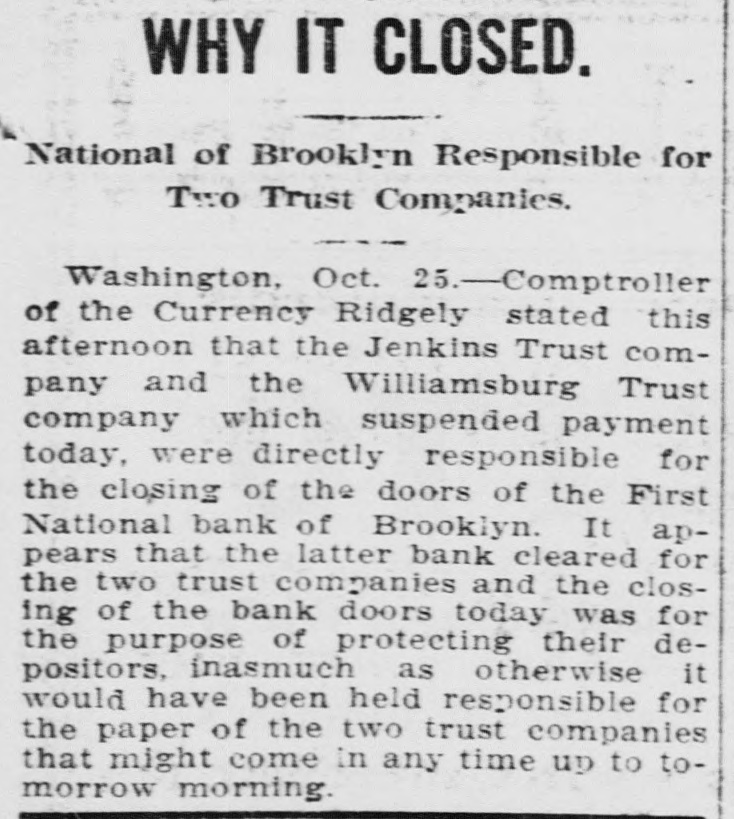
WHY IT CLOSED. National of Brooklyn Responsible for Two Trust Companies. Washington, Oct. 25.-Comptroller of the Currency Ridgely stated this afternoon that the Jenkins Trust company and the Williamsburg Trust company which suspended payment today, were directly responsible for the closing of the doors of the First National bank of Brooklyn. It appears that the latter bank cleared for the two trust companies and the closing of the bank doors today was for the purpose of protecting their depositors, inasmuch as otherwise it would have been held responsible for the paper of the two trust companies that might come in any time up to tomorrow morning.


Article from Deseret Evening News, October 26, 1907

Click image to open full size in new tab

Article Text

BANK WAS CLOSED TO PROTECT ITS DEPOSITORS. Washington, Oct. 25.-Comptroller of the Currency Ridgely stated this afternoon that the Banking & Trust company and the Williamsburg Trust company, which suspended payment today, were directly responsible for the closing of the doors of the First National bank of Brooklyn. It appears that the latter bank cleared for the two trust companies and the closing of the bank doors today was for the pui. pose of protecting their depositors, inasmuch as otherwise it would have been held responsible for the paper of the two trust companies that might come in any time up to tomorrow morning. The following statement was given out late today from the comptroller's office: "The First National bank of Brooklyn closed its doors this afternoon and National Bank Examiner George T. Cutts has taken charge by order of the comptroller of the currency. The First National bank cleared for the WilHamsburg Trust company, and the Jenkins Trust company of Brooklyn, both of which failed today. The national bank was closed to protect its depositors against the checks of the trust companies which might be presented through the elearing house."


Article from The Daily Morning Journal and Courier, October 26, 1907

Click image to open full size in new tab

Article Text

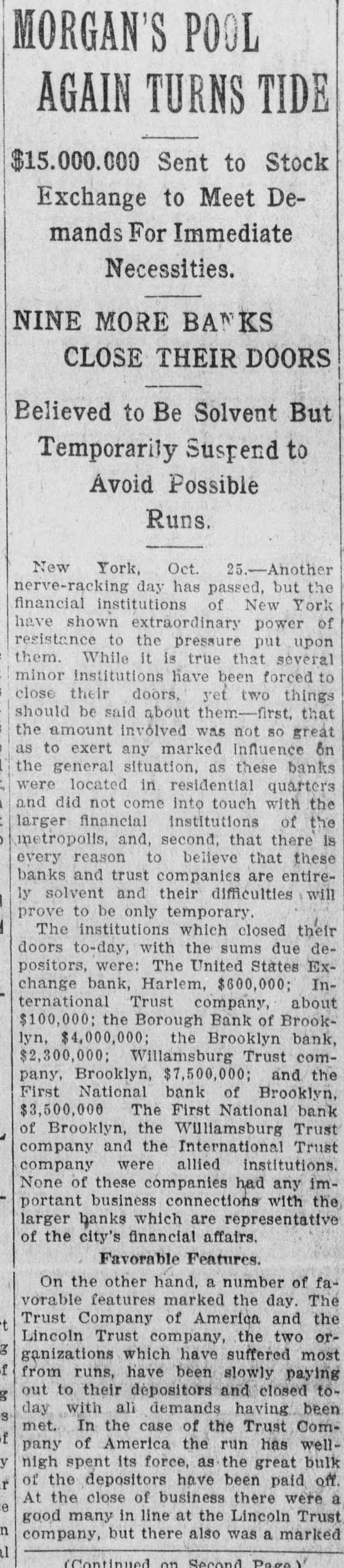
MORGAN'S POOL AGAIN TURNS TIDE $15.000.000 Sent to Stock Exchange to Meet Demands For Immediate Necessities. NINE MORE BANKS CLOSE THEIR DOORS Believed to Be Solvent But Temporarily Suspend to Avoid Possible Runs. New York, Oct. 25.- -Another nerve-racking day has passed, but the financial institutions of New York have shown extraordinary power of resistance to the pressure put upon them. While it is true that sΓ©veral minor institutions have been forced to close their doors, yet two things should be said about them-first, that the amount involved was not so great as to exert any marked influence on the general situation, as these banks were located in residential quarters and did not come into touch with the larger financial institutions of the metropolis, and, second, that there is every reason to believe that these banks and trust companies are entirely solvent and their difficulties will prove to be only temporary. The institutions which closed their doors to-day, with the sums due depositors, were: The United States Exchange bank, Harlem, $600,000; International Trust company, about $100,000; the Borough Bank of Brooklyn, $4,000,000; the Brooklyn bank, $2,300,000; Willamsburg Trust company, Brooklyn, $7,500,000; and the First National bank of Brooklyn, $3,500,000 The First National bank of Brooklyn, the Williamsburg Trust company and the International Trust company were allied institutions. None of these companies had any important business connections with the larger banks which are representative of the city's financial affairs. Favorable Features. On the other hand, a number of favorable features marked the day. The Trust Company of America and the t Lincoln Trust company, the two org ganizations which have suffered most f from runs, have been slowly paying out to their depositors and closed tog day with all demands having been S met. In the case of the Trust Comf pany of America the run has welly nigh spent its force, as the great bulk of the depositors have been paid off. r At the close of business there were a e good many in line at the Lincoln Trust n company, but there also was a marked il (Continued on Second Page Y


Article from The Pacific Commercial Advertiser, October 26, 1907

Click image to open full size in new tab

Article Text

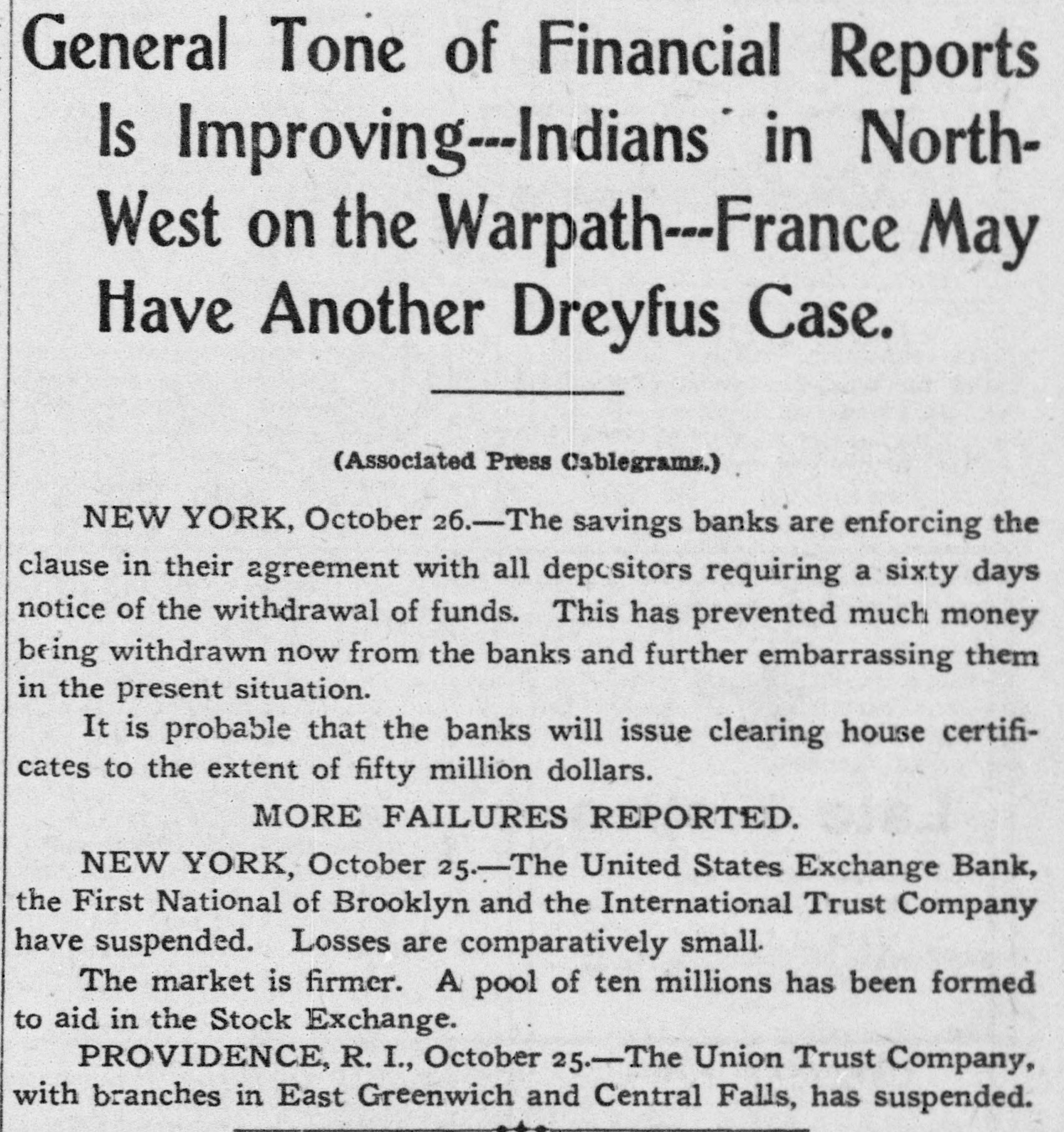
General Tone of Financial Reports Is Improving--Indians in NorthWest on the Warpath--France May Have Another Dreyfus Case. (Associated Press Cablegrams.) NEW YORK, October 26.-The savings banks are enforcing the clause in their agreement with all depositors requiring a sixty days notice of the withdrawal of funds. This has prevented much money being withdrawn now from the banks and further embarrassing them in the present situation. It is probable that the banks will issue clearing house certificates to the extent of fifty million dollars. MORE FAILURES REPORTED. NEW YORK, October 25.-The United States Exchange Bank, the First National of Brooklyn and the International Trust Company have suspended. Losses are comparatively small. The market is firmer. A pool of ten millions has been formed to aid in the Stock Exchange. PROVIDENCE, R. I., October 25.-The Union Trust Company, with branches in East Greenwich and Central Falls, has suspended.


Article from New-York Tribune, October 26, 1907

Click image to open full size in new tab

Article Text

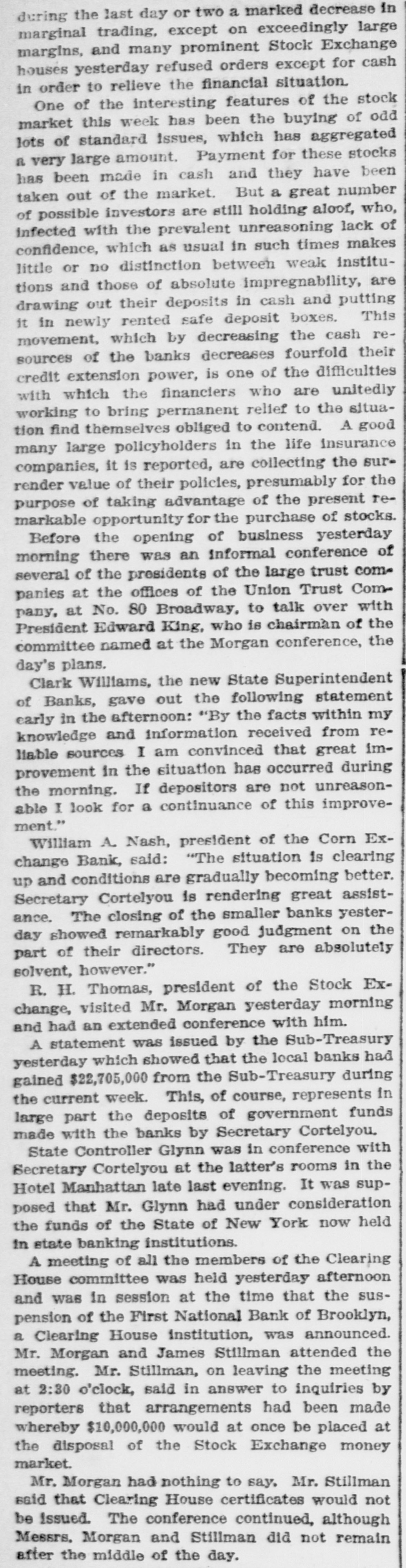
during the last day or two a marked decrease in marginal trading, except on exceedingly large margins, and many prominent Stock Exchange houses yesterday refused orders except for cash in order to relieve the financial situation. One of the interesting features of the stock market this week has been the buying of odd lots of standard issues, which has aggregated a very large amount. Payment for these stocks has been made in cash and they have been taken out of the market. But a great number of possible investors are still holding aloof, who, infected with the prevalent unreasoning lack of confidence, which as usual in such times makes little or no distinction between weak institutions and those of absolute impregnability, are drawing out their deposits in cash and putting it in newly rented safe deposit boxes. This movement, which by decreasing the cash resources of the banks decreases fourfold their credit extension power, is one of the difficulties with which the financiers who are unitedly working to bring permanent relief to the situation find themselves obliged to contend. A good many large policyholders in the life insurance companies, it is reported, are collecting the surrender value of their policies, presumably for the purpose of taking advantage of the present remarkable opportunity for the purchase of stocks. Before the opening of business yesterday morning there was an informal conference of several of the presidents of the large trust companies at the offices of the Union Trust Company, at No. 80 Broadway, to talk over with President Edward King, who is chairman of the committee named at the Morgan conference, the day's plans. Clark Williams, the new State Superintendent of Banks, gave out the following statement early in the afternoon: "By the facts within my knowledge and information received from reliable sources I am convinced that great improvement in the situation has occurred during the morning. If depositors are not unreasonable I look for a continuance of this improvement." William A. Nash, president of the Corn Exchange Bank, said: "The situation is clearing up and conditions are gradually becoming better. Secretary Cortelyou is rendering great assistance. The closing of the smaller banks yesterday showed remarkably good judgment on the part of their directors. They are absolutely solvent, however." R. H. Thomas, president of the Stock Exchange, visited Mr. Morgan yesterday morning and had an extended conference with him. A statement was issued by the Sub-Treasury yesterday which showed that the local banks had gained $22,705,000 from the Sub-Treasury during the current week. This, of course, represents in large part the deposits of government funds made with the banks by Secretary Cortelyou. State Controller Glynn was in conference with Secretary Cortelyou at the latter's rooms in the Hotel Manhattan late last evening. It was supposed that Mr. Glynn had under consideration the funds of the State of New York now held in state banking institutions. A meeting of all the members of the Clearing House committee was held yesterday afternoon and was in session at the time that the suspension of the First National Bank of Brooklyn, a Clearing House institution, was announced. Mr. Morgan and James Stillman attended the meeting. Mr. Stillman, on leaving the meeting at 2:30 o'clock, said in answer to inquiries by reporters that arrangements had been made whereby $10,000,000 would at once be placed at the disposal of the Stock Exchange money market. Mr. Morgan had nothing to say. Mr. Stillman said that Clearing House certificates would not be issued. The conference continued, although Messrs. Morgan and Stillman did not remain after the middle of the day.


Article from New-York Tribune, October 28, 1907

Click image to open full size in new tab

Article Text

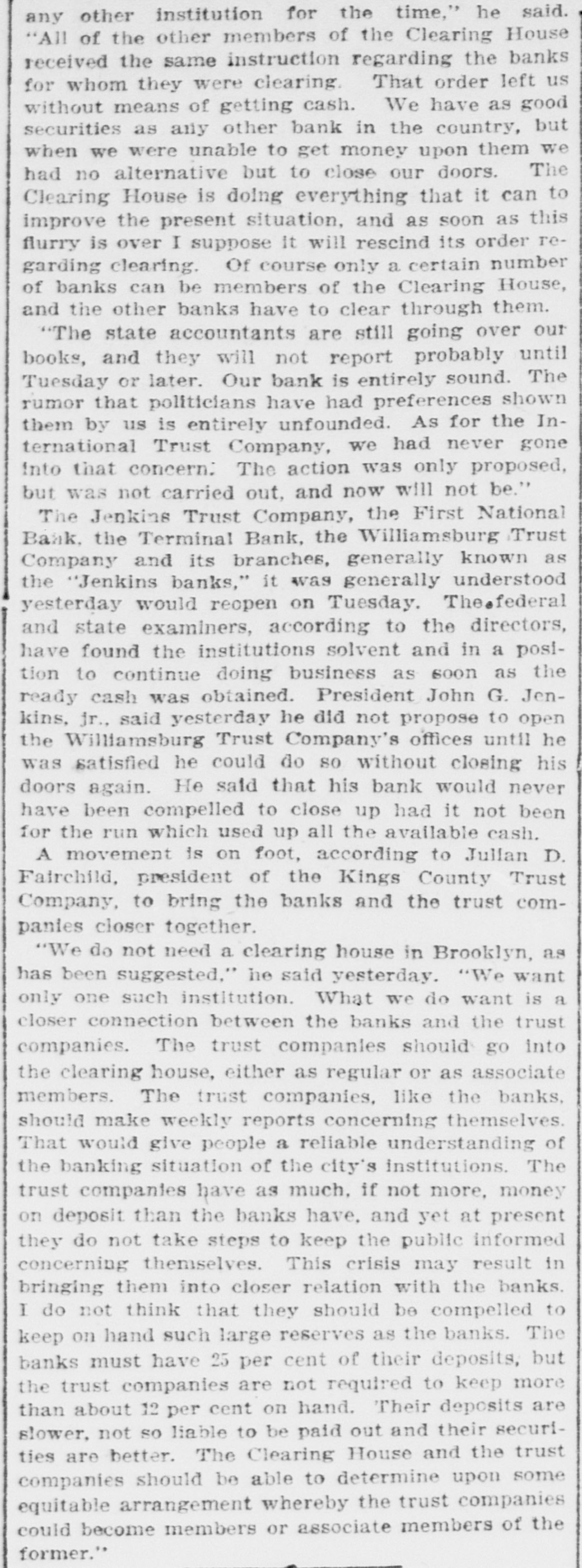
any other institution for the time," he said. "All of the other members of the Clearing House received the same instruction regarding the banks for whom they were clearing That order left us without means of getting cash. We have as good securities as any other bank in the country, but when we were unable to get money upon them we had no alternative but to close our doors. The Clearing House is doing everything that it can to improve the present situation, and as soon as this flurry is over I suppose it will rescind its order regarding clearing. Of course only a certain number of banks can be members of the Clearing House, and the other banks have to clear through them. "The state accountants are still going over our books, and they will not report probably until Tuesday or later. Our bank is entirely sound. The rumor that politicians have had preferences shown them by us is entirely unfounded. As for the International Trust Company, we had never gone into that concern. The action was only proposed, but was not carried out, and now will not be." The Jenkins Trust Company, the First National Bank. the Terminal Bank, the Williamsburg Trust Company and its branches, generally known as the "Jenkins banks," it was generally understood yesterday would reopen on Tuesday. The federal and state examiners, according to the directors, have found the institutions solvent and in a position to continue doing business as soon as the ready cash was obtained. President John G. Jenkins, jr., said yesterday he did not propose to open the Williamsburg Trust Company's offices until he was satisfied he could do SO without closing his doors again. He said that his bank would never have been compelled to close up had it not been for the run which used up all the available cash. A movement is on foot, according to Jullan D. Fairchild, president of the Kings County Trust Company, to bring the banks and the trust companies closer together. "We do not need a clearing house in Brooklyn, as has been suggested," he said yesterday. "We want only one such institution. What we do want is a closer connection between the banks and the trust companies. The trust companies should go into the clearing house, either as regular or as associate members. The trust companies, like the banks, should make weekly reports concerning themselves. That would give people a reliable understanding of the banking situation of the city's institutions. The trust companies have as much. if not more, money on deposit than the banks have, and yet at present they do not take steps to keep the public informed concerning themselves. This crisis may result in bringing them into closer relation with the banks. I do not think that they should be compelled to keep on hand such large reserves as the banks. The banks must have 25 per cent of their deposits, but the trust companies are not required to keep more than about 12 per cent on hand. Their deposits are slower. not so liable to be paid out and their securities are better. The Clearing House and the trust companies should be able to determine upon some equitable arrangement whereby the trust companies could become members or associate members of the former."


Article from New-York Tribune, October 31, 1907

Click image to open full size in new tab

Article Text

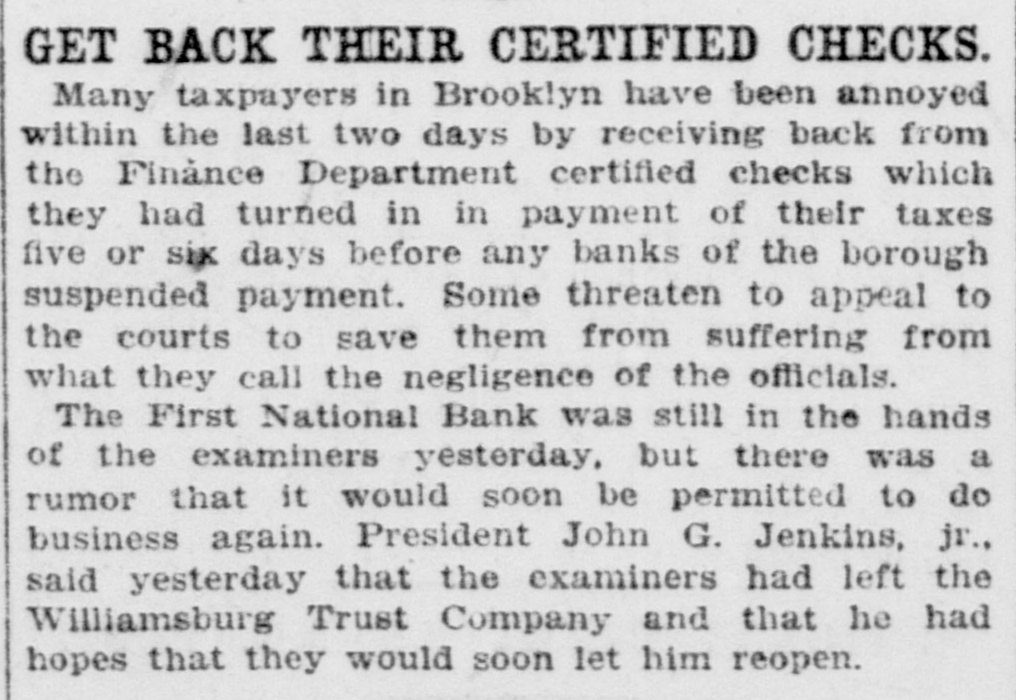
GET BACK THEIR CERTIFIED CHECKS. Many taxpayers in Brooklyn have been annoyed within the last two days by receiving back from the Finance Department certified checks which they had turned in in payment of their taxes five or six days before any banks of the borough suspended payment. Some threaten to appeal to the courts to save them from suffering from what they call the negligence of the officials. The First National Bank was still in the hands of the examiners yesterday, but there was a rumor that it would soon be permitted to do business again. President John G. Jenkins, jr., said yesterday that the examiners had left the Williamsburg Trust Company and that he had hopes that they would soon let him reopen.


Article from The Evening World, November 30, 1907

Click image to open full size in new tab

Article Text

$2,000,000 FROM NATIONAL BANK IN JENKINS LOANS Federal Examiners Unearth More Scandal in Brooklyn. BANK'S RECORDS GONE. Clarke District Attorney Traces Last Day Transactions to Save Insiders. Consational as the developments have stone the Kings County Grand Jury took up the investigation of the Berough Bank and the Jenkins Trust Company. more surprising revelations are looloed for in the Federal and county joint investigation of the looting of the First National Bank It is reported by men who have means of knowing what the prelimimary investigation of the National Back Examiners has revealed that the banking members of the Jenkins famBy obtained close to $2,000,000 from that institution while John G. Jenkine, sr., was Hs president. The money was as tained, 1t is alleged. through fake loans such as were made by the Williamsburg Trust Company and the Jenkins Trust Company to the brokerage firm of Frank. & J. G. Jenkins, Jr., & Co. "The First National Bank," said one of the men who knows about it to-day, "he the most hopelessly involved of any of the Brooklyn institutions that failed." Clarke Finds New Frauds. District-Attorney Clarke, with bank examiners and assistants. was busy today arranging his documentary evidence to be presented to the Grand Jury in the Brooklyn bank cases Monday. The betwork of fraud spreads hourly, and it may be days before the District-Attorney can reveal all who are enmeshed. It is known that on the day of the suspension of the bank the notes and forged papers which were used to cover up the crooked transactions of Gow. Maxwell and Campbell were destroyed. However, the District-Attorney. through the confession of Campbell and through the books which were secured from the wreck will be able to build up circumstantial cases. even with the papers absent. Through the evidence of clerks he hopes to be able to establish the identity of every "inside" depositor and director who withdrew his money on the day of the suspension, before and after the bank closed Some of these men are amenable to the law. According to a statement secured from a clerk a prominent city official withdrew $30,000 from the bank after the doors closed t and a false entry was made on the books to conceal the faot. Gow May Accuse Others. Martin W. Littleton. counsel for WillAsm Gow in & proceeding in the Kings h County Supreme Court to-day looking u to the removal of Gow's picture from the Rogues' Gallery, intimated that Gow 11 is not disposed to stand for everything p In his own defense he appears to be determined to drag in other directors F the bank. of 11 Mr. Littleton in his argument made t pointed references to "Honest Bill" Hurley. one of the directors, who has been working night and day since the close of the bank to make up the deg Sciency created by the crooked methods b employed by the officers of the institun tion. It is apparent that Gow will give G the lie to some of the directors who P have maintained that they knew nothing about the the crooked work that was going on. a The directors of the Jenkins Trust R Company are working valiantly to keep 11 the Institution from a permanent receivership. They assort that the directO a ors are willing to leave their money in K the bank for one year If the depositors will agree to limit their withdrawals to 10 per cent. of the total. should the bank be allowed to reopen. The depositors, however. are anxious to know what the Jenkins family in goins to do about repaying the great sums of money borrowed from the Jenkins Trust Company to further various schemes. /


Article from The Topeka State Journal, February 4, 1908

Click image to open full size in new tab

Article Text

Permits Bank to Reopen. Washington, Feb. 4.-The comptroller of the currency today granted permission to the First National bank of Brooklyn, N. Y., to resume business on February, 10. The bank suspended several months ago.


Article from Tonopah Daily Bonanza, February 7, 1908

Click image to open full size in new tab

Article Text

SUSPENDED BANK TO REOPEN. WASHINGTON, Feb. 6.- The Controller of the Currency today granted permission to the First National Bank of Brooklyn, N. Y., to resume business on Monday, February 10th. The bank suspended six months ago.


Article from The Hawaiian Star, February 10, 1908

Click image to open full size in new tab

Article Text

TO RUSH GRAFTERS (Associated Press Cable to The Star.) SAN FRANCISCO, February 10.Assistant District Attorney Heney returned to this city today to push the graft prosecutions. REOPENING OF A BANK (Associated Press Cable to The Star.) BROOKLYN, February 10-The First National Bank, which recently suspended, has reopened.


Article from The Star and Newark Advertiser, February 10, 1908

Click image to open full size in new tab

Article Text

BROOKLYN BANK REOPENED. NEW YORK, Feb. 10.-The First National Bank of Brooklyn which closed on October 25 last reopened for business today. Since its closing the bank has been in the hands of John W. Schofield as receiver. A deficiency of $165,000, which existed when the bank suspendod, has been made good by the stockholders.


Article from Rock Island Argus, February 10, 1908

Click image to open full size in new tab

Article Text

Brooklyn National Reopens. New York, Feb. 10.-The First National bank of Brooklyn, which closed Oct. 21 last, reopened for business today. The deficiency of $165,000, which existed when the bank suspended, was made good by stockholders.


Article from Bluefield Evening Leader, February 10, 1908

Click image to open full size in new tab

Article Text

REOPEN BROOKLYN BANK. New York, Feb. 10.-The First National bank of Brooklyn, which closed its doors during the panic, was reopened for business today. The directors declare that the institution is now in a sound condition and prepared to meet all demands of depositors.


Article from The Evening World, February 10, 1908

Click image to open full size in new tab

Article Text

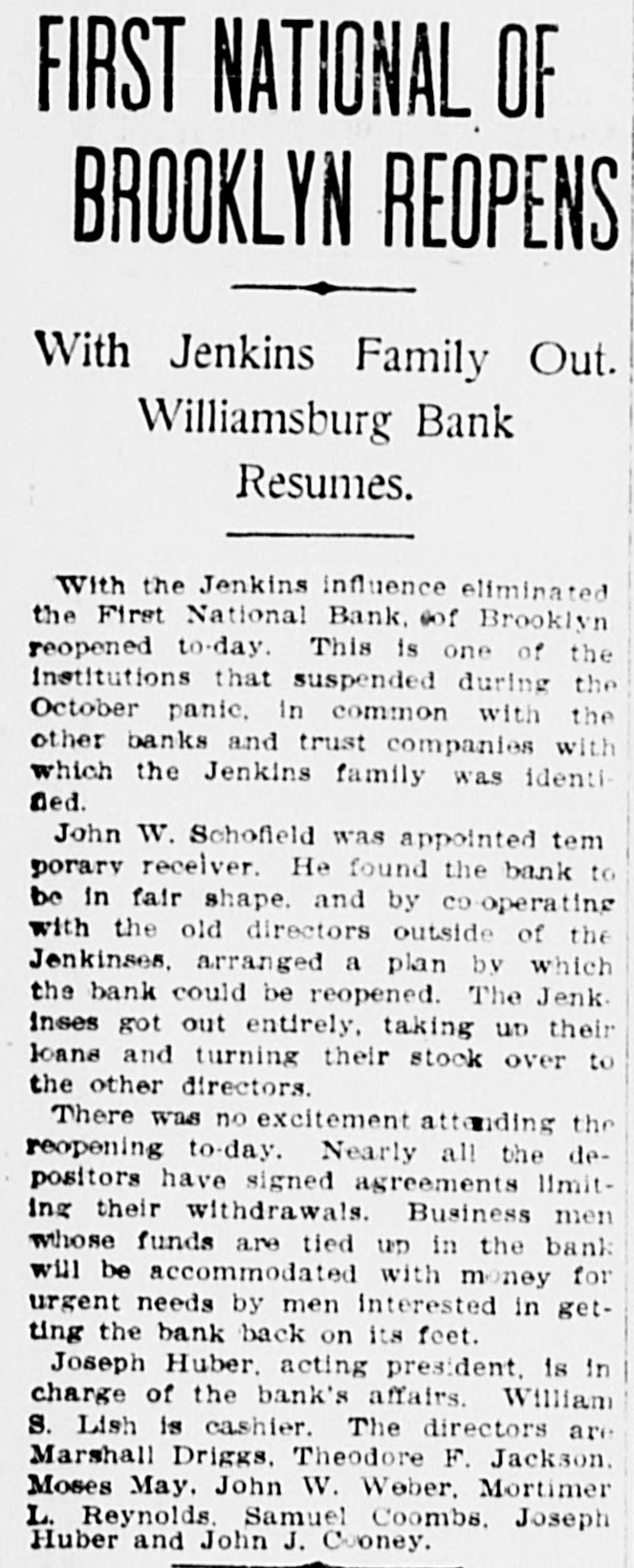
FIRST NATIONAL OF BROOKLYN REOPENS With Jenkins Family Out. Williamsburg Bank Resumes. With the Jenkins influence eliminated the First National Bank, sof Brooklyn reopened to-day. This is one of the institutions that suspended during the October panic, in common with the other banks and trust companies with which the Jenkins family was identified. John W. Schofield was appointed tem porary receiver. He found the bank to be in fair shape. and by o-operating with the old directors outside of the Jenkinses, arranged a plan by which the bank could be reopened. The Jenk. Inses got out entirely, taking up their loans and turning their stock over to the other directors. There was no excitement attending the reopening to-day. Nearly all the depositors have signed agreements limiting their withdrawals. Business men whose funds are tied up in the bank will be accommodated with money for urgent needs by men interested in getting the bank back on its feet. Joseph Huber. acting president, is in charge of the bank's affairs. William S. Lish is cashier. The directors are Marshall Driggs, Theodore F. Jackson. Moses May. John W. Weber, Mortimer L. Reynolds. Samuel Coombs. Joseph Huber and John J. Cooney.


Article from New-York Tribune, February 11, 1908

Click image to open full size in new tab

Article Text

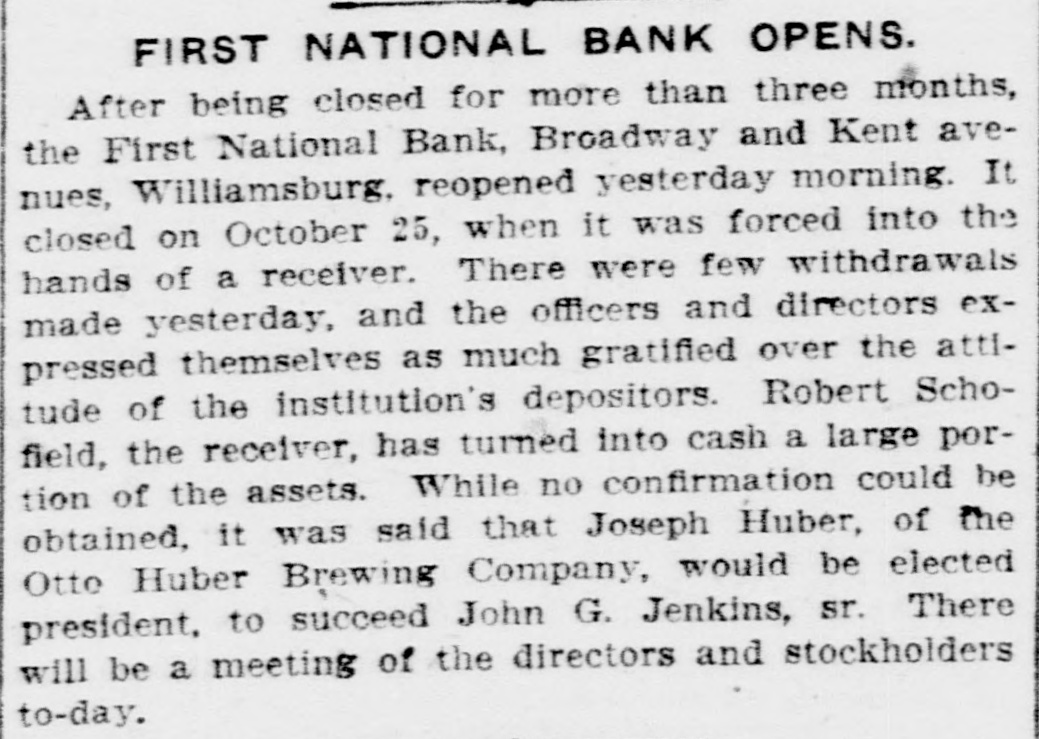
FIRST NATIONAL BANK OPENS. After being closed for more than three months, the First National Bank, Broadway and Kent avenues, Williamsburg. reopened yesterday morning. It closed on October 25, when it was forced into the hands of a receiver. There were few withdrawals made yesterday, and the officers and directors expressed themselves as much gratified over the attitude of the institution's depositors. Robert Schofield, the receiver, has turned into cash a large portion of the assets. While no confirmation could be obtained, it was said that Joseph Huber, of the Otte Huber Brewing Company, would be elected president, to succeed John G. Jenkins, sr. There will be a meeting of the directors and stockholders to-day.


Article from The Montgomery Advertiser, February 11, 1908

Click image to open full size in new tab

Article Text

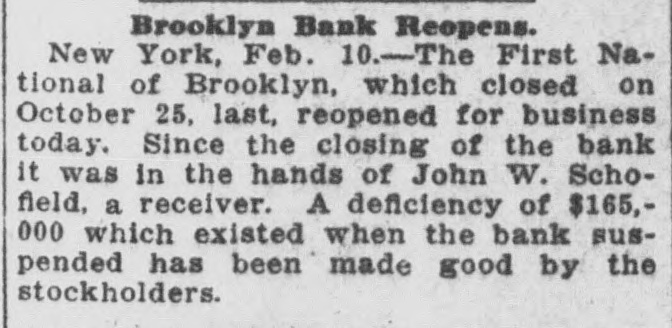
Brooklyn Bank Reopens. New York, Feb. 10.-The First National of Brooklyn, which closed on October 25, last, reopened for business today. Since the closing of the bank it was in the hands of John W. Schofield, a receiver. A deficiency of $165,000 which existed when the bank suspended has been made good by the stockholders.


Article from The Birmingham Age-Herald, February 11, 1908

Click image to open full size in new tab

Article Text

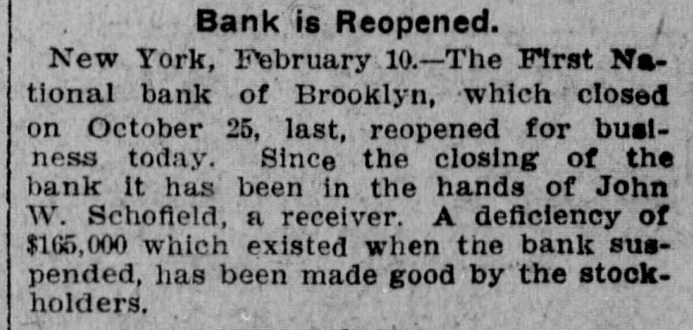
Bank is Reopened. New York, February 10.-The First National bank of Brooklyn, which closed on October 25, last, reopened for business today. Since the closing of the bank it has been in the hands of John W. Schofield, a receiver. A deficiency of $165,000 which existed when the bank suspended, has been made good by the stockholders.


Article from Yorkville Enquirer, February 14, 1908

Click image to open full size in new tab

Article Text

MERE-MENTION. Plans have been completed for the erection of a $20,000,000 union terminal The station at San Francisco United States forestry department has given orders for the slaying of about 15,000 wild horses that roam the govRobernment reserves in Nevada ert Womack, discoverer of the Cripple Creek, Col., gold field, is living at Colorado Springs, an object of charity. He sold a claim for $500 that has since produced $15,000,000 in gold. The estate of the late Marshall Field has recently paid the city of Chicago $1,000,000 back taxes on unlisted securities that came to light after Mr. Field's demise The Oklahoma house has passed a bill which will require all hotels to provide beds with nine-foot sheets, and that no cup, dish, vessel, etc., that has a visible crack can be used in serving food More than 75,000 hogs were received at Chicago stockyards on Monday. The receipts were the largest on record for a single Henry Thaxter, a negro, was day hanged at Birmingham, Ala., Monday, for murder. He made an address from the scaffold, saying, "Friends, I am here once again," and ending with, "ThankThe ing you for your attention. First National bank of Brooklyn, which closed October 25, was reopened for York New A business this week judge a few days ago fined seventyfour absent talesmen $100 each for lax attendance after being summoned for jury duty Sixteen locomotives, made in the United States and shipped to the Manchurian railway, were lost off the coast of China a few days ago by the sinking of the vessel carrying them Thousands of iron and steel workers are returning to work throughout Illinois, Ohio and Pennsylvania as business prospects grow brighter Chas. W. Morse, a former banker and ice magnate of New York, is under indictment by the Federal grand jury for Mrs. Dora Mcgrand larceny Donald, on trial in Chicago since January 20 for the murder of Webster Guerrin was acquitted by a jury TuesThe 100th anniverday night sary of the successful burning of anthracite coal in a grate, was celebrated The at Wilkesbarre, Pa., Tuesday mayor of Milton, Del., says he will resign the job because the town has become so quiet and peaceful under prohibition that there are not enough Judge fees to pay for his time Kennesaw Landis, in Chicago on Tuesday, refused to appoint a receiver in a bankruptcy case involving two liquor saloons. The judge said, "I refuse to go in the liquor business, and, therefore, will appoint no receiver. I will enjoin anyone from moving away Russia or selling the assets." will spend $6,000,000, in the next three years in building a fortress at VladLeavenworth, Kan., afivostok ter a bitter campaign lasting several weeks, has voted to adopt a commission form of government instead of Mrs. Violet by mayor and council Goold, sentenced to death by the guillotine at Monte Carlo, France, for murder, has had her sentence commuted to life imprisonment. She and her husband murdered a woman namThe ed Levin, for the latter's jewels attorney generals of Texas, Kansas and Missouri, have decided to cooperate in a warfare on violaters of An anti-trust laws of those states 8-year-old negro girl was killed in Atlanta, Wednesday morning by a live telephone wire Six automobiles made the start in the New York to Paris race from New York on WedSquire Mutnesday morning chin, a negro, who claimed to be 133 years old, died at Troy, Ala., Tuesday. Mutchun claimed to be a native of More than 3,000 South Carolina merchants from the south and west landed in New York, Tuesday, to buy spring goods. It is estimated that the visiting merchants will buy close to $100,000,000 worth of goods.

Article from New-York Tribune, March 17, 1908

Click image to open full size in new tab

Article Text

REGULAR AUCTION SALE OF STOCKS AND BONDS By ADRIAN H. MULLER & SON, OFFICE, NO. 55 WILLIAM ST. Wednesday, March 18th, 1908, at 12:30 o'clock. at the EXCHANGE SALESROOM NOS. 14 and 16 VESEY STREET BY ORDER OF EXECUTORS $10,000 Simpson Securities Co. Coll. Trust c. Bonds, 1929 100 shs. Simpson Securities Co. 100 shs. Union Typewriter Co. 2d pfd. 20 shs. First Natl. Bank of Yonkers. N. Y. BY ORDER OF RECEIVER 70 shs. First Nati. Bank of Brooklyn. assessment of $55 per share, payable on or before May 1st, 1908. 82 shs. Sea Cliff Bank. 78 shs. Dominion Park Co., Limited $45,000 Colorado Fuel & Iron Co. 3 D. c. 10-year Gold Deb. Bds., 1911. 20,000 American Ice Co., 5 p. c. Skg. Fund Coll. Trust Bds., 1922 $10,000 Cin., Ham. & Dayton Ry. 412 p. €. Notes. 1932, Central Trust Co. Receipts. $10,000 Dominion Park Co., Limited, 1st Mige 6 p. C. Bds., 1921 $3,300 Dominion Park Co., Limited. 6 p. c. Deb. Bds, 1916, Series B. BY ORDER OF TRUSTEES. 10 shs. Otis Elevator Co. pfd. $9,000 Second Avenue R. R. 1st Consid. Mtge. 5 p. a Bds. 1948. FOR ACCOUNT OF WHOM IT MAY CONCERN. 300 shs. Texas Company. 30 shs. Producers Oil Co. 40 shs. Lincoln Gas & Electric Light Co. 1 share Peoria Light Co. common 5 shs. Peoria Light Co. pfd. 5 shs.. Evansville Light Co. pfd. 1 share Evansville Light Co. common 10 shs. American Beet Sugar €a pfd. $3,000 Brockville, Westport & No. Western R. R. 1st is 1923 10 shs. N. Y. Mortgage & Security €0. 10 shs. Importers & Traders' Natl Bank 50 shs. International Banking Corp. 326 shs. Evansville & Terre Haute R. R. common 100 shs. New Amsterdam Natl. Bank $1,000 Federal Publishing Ca. 6 D. €. Coll. Trust 3d., 1920. $1,000 Ohio & Little Kanawha R. R. 1st 3s. 1900 $3,000 Pine Creek 1st Mtge. 6s, 1932: Guar $2,000 New York & Greenwood Lake R. R. Prior Lien 5s. 1946 16 shs. Sharon Railway €o. $4,000 North American Co. Coil. Trust 5 p. €. Notes. 1912 $10,000 Rio Grande Southern R. R Guar 4s. 1940 $1,000 St. Louis. Iron Mt. & Southern R. R. 3s. Guar. 1931. $25,000 Toledo, St. Louis & Western R. R. Prior Lien 31 p. €. Bds. 1925 25 shs. Title Insurance Co of N. F 200 shs. St. Joseph & Grand Island Rv 2d ofd. 20 shs. United States Title Guar. & Indemnity 8 20 shs. Casualty Co. of America. $1,000 Atlantic Ave. R. R. 1st Mige 5s. 1909. 40 shs. German Exchange Bank 100 shs. Commercial Trust Co. of N. J. 100 shs United States Leather Co. pfd. $2,000 Mutual Union Telegraph Ca 1st 6s. 1911 5 shs. Fairchild & Johnson Co. 10 shs. Century Realty Co. 40 shs. Woods Realty Co. $1,625 25 shs. United National R'ways Copper Investment Bank. Co. 5 p c. Div. Scrip, dated January, 1907. 82 shs. Conover Building Co. 28 shs. International Elevating Co. 20 shs. South Brooklyn Saw Mill Ca 250 shs. Read Timber & Lumber Co. Ltd. common 25 shs. Broadway Trust Co. of N. Y. $6,000 Tidewater & Western R. R. 1st 4s. 1903 60 shs. Tidewater & Western R. R. common owner 23 shs. Broadway Building Co. 6 p. e. pfd of 170 Broadway. S E. cor. Maiden Lane owner 25 shs. Broadway Building Co. 6 D. €. com. of 170 Broadway S. E. cor. Maiden Lane. 75 shs. National Copper Bank. 10 shs. First National Bank of Biklyn. 10 shs. Home Insurance Co. 280 shs. City Investing Co. 100 shs. Chicago, Ind. & Louisville R. R. so shs. Carnegie Trust €o. 38 shs. Albany Insurance Co. se shs. Amalgamated Copper €0. 50 shs. Northern Pacific R. R. common 10 shs. Southern Pacitic R. R. common 5 shs. Carnegie Trust Co. $25,000 Cin.. Ham. & Dayton F. R. 4120 Notes. (Cent. Trust Co. Ctfs. of Dep.). $5,000 Atch. Topeka & Santa FΓ© R. R. 4% Deb. Bds., 1910. $25,000 $4,000 Bush Louisville Terminal & Nashville Co. 5% Rds. R. R. 1965 (M. & M Div.) 41/2% Bds 1945 1918 $1,000 McKeesport & Belle Vernon R. R. 1st 6s. 127 shs. Provident Savings Life Assurance Society of N. Y 40 shs. Merchants' Exchange Nati Bank $4,000 Atlantic Shore Line R'way Ref. Mige 4% Bds. 1926 shs. United Gas & Electric Co. Prfd. $18,000 20 Mexican Sugar Refining €0. Ltd. of New Orles 1 Mtge. 6% Bds., 1921


Article from Goldsboro Weekly Argus, April 23, 1908

Click image to open full size in new tab

Article Text

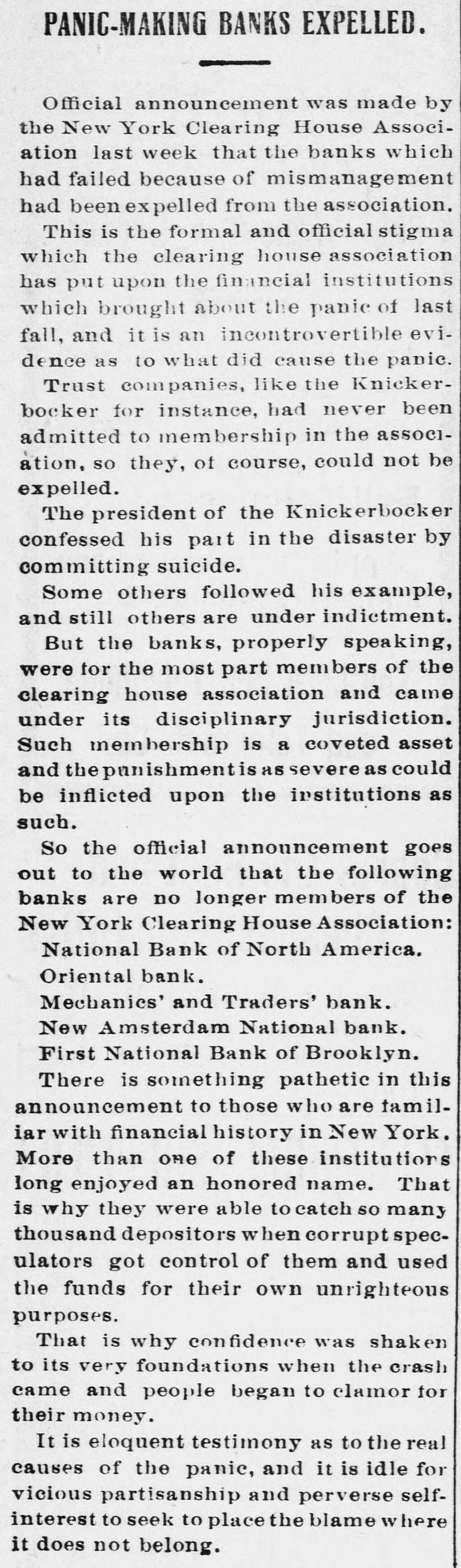
PANIC-MAKING BANKS EXPELLED. Official announcement was made by the New York Clearing House Association last week that the banks which had failed because of mismanagement had been expelled from the association. This is the formal and official stigma which the clearing house association has put upon the financial institutions which brought about the panic of last fall, and it is an incontrovertible evidence as to what did cause the panic. Trust companies, like the Knickerbocker for instance, had never been admitted to membership in the association, so they, of course, could not be expelled. The president of the Knickerbocker confessed his pait in the disaster by committing suicide. Some others followed his example, and still others are under indictment. But the banks, properly speaking, were for the most part members of the clearing house association and came under its disciplinary jurisdiction. Such membership is a coveted asset and thepunishmenti is as severe as could be inflicted upon the institutions as such. So the official announcement goes out to the world that the following banks are no longer members of the New York Clearing House Association: National Bank of North America. Oriental bank. Mechanics' and Traders' bank. New Amsterdam National bank. First National Bank of Brooklyn. There is something pathetic in this announcement to those who are familiar with financial history in New York. More than one of these institutions long enjoyed an honored name. That is why they were able to catch so many thousand depositors when corrupt speculators got control of them and used the funds for their own unrighteous purposes. That is why confidence was shaken to its very foundations when the crash came and people began to clamor for their money. It is eloquent testimony as to the real causes of the panic, and it is idle for vicious partisanship and perverse selfinterest to seek to place the blame where it does not belong.


Article from The Washington Herald, April 26, 1908

Click image to open full size in new tab

Article Text

James C. Hallock, of Brooklyn, whose father originated the clearing house in America, and who has himself studied the subject of clearing houses for many years, said yesterday in an interview with a representative of The Washington Herald: "Thirty-two thousand depositors in Brooklyn, probably 100,000 in Greater New York, had accounts in failed banks last winter. of the "Millions have citizens distrust throughout Wall Union come to street as a stewpot of panics, which boils over unexpectedly. The American people would rejoice to see Congress enact a law which would protect the country against financial disturbance from that quarter. Favors Legislative Action. a few men in New York scream as If were to killed. would "Possibly they be than But even in battle many more are killed think they are going to be. However, it is true, I wish our Representatives would rise as one man and render harmless some New York/ bankers, who could be crushed as easily as a spider. "Understand that the principal banks in the city belong to a union; yet they let one of their number suspend and deserted five, forcing four to fail, so that for months there have been closed banks on whose dusty windows the passing throng have been reading a shameless advertisement of desertion in the soiled letters, 'Member of the New York Clearing House. "Cannot even its members be trusted? Now, though these broken banks suffered losses which their shareholders have had to bear, every one of the six will resume or pay depositors in full. "Their funds would have far exceeded their liabilities to depositors. if a little time had been allowed them to realize on their assets. Banking in New York Safe. in New York is conducted more safely than suppose. much "Banking since people National Not the Marine Bank failed, in 1884, with a net loss to depositors of $765,800, has a dollar been lost by depositors of failed national banks in the city of New York. The only other net loss that ever occurred was $25,612 by the failure of the Croton National Bank, 1867; that is to say, less than $800,000 years of of less than a year, in in an forty-five average national $18,000 banking, with no net loss at all for the past twenty-four years. "St. Louis has had only one net loss from the failure of a national bank, $38.428, in 1887, an annual average of less than $860. with no net loss at all for over twenty years. Chicago has had four small aggregating $462,453 since 1675. for of only $14,000 thirty-three years, no net net an the average losses, past annually with loss since 1893. "In short, the national banks of New York are so absolutely safe that they could guarantee each other's deposits without practically any risk. When the occurred on the Mercantile National runs Bank, First National Bank of Brooklyn, National Bank of North America, and New Amsterdam National Bank, all the other national banks in the city receive could without peril have offered to checks on them for deposit. What Existing Lew Requires, "National banks are required by law at par any and all notes or by other national to bills to receive issued banks. power Conunder its constitutional gress, promote the general welfare, should also compel the national banks of New York to accept checks on any of their number. "There can be no question that it would promote the general welfare. History shows that in this country no great panic anywhere but in New York, could not be one if at has and there started bank all there times checks on every national were accepted by all. "Bank notes are always received, bank that issued them may So, in New York, na- on banks should be though the national have though failed. the received bank checks drawn by on or bad, open or banks have lost nothing the tional were tional good banks, notes. closed. by And receiv- Nspar national bank would lose New on receiving national ing nothing at in banks the end of by York checks under other national banks in the city, all circumstances. Bank Assassinations. "Investigation would show that more New of the closed banks in banks than one assassinated by other York were The offense of bank assassination dethere. in its nature. To protect is criminal against the effects of bank of as- repositors the criminal character national sassination, accept checks on other recognized banks fusals' of to New York, should be the law of the land. New in refuse checks drawn temporarily on a "To bank. which, though meet York has sufficient funds to is a them by mischief embarrassed, any process of liquidation, which, if it form of malicious the bank, may annoy results in closing thousands of citizens, credi- with and their injure wives, children, parents, and of tors. "In New York thy it brother?" is the old And story he anCain. 'Where know is not. Am my What brother's hast swered: 'I the Lord said, keeper?' Then voice of thy brother's from the blood thou done? crieth to The me earth. York, Concern in New Mutual New York banks assert the since right "The their brother's keeper. following Ever the to be 1884, in the month the June 4. Marine National Bank, emfailure committee has for clearing of house the considered been it whenever it examine the interest of the powered, of the association, to and the any bank member from any member association, securities as to require amount and character for the committee might resulting the of protection such exchanges an of the of balances deem clearing sufficient house. bank from or the every non-member member same institution "Since 1890 submit clearing to through the members a examinahas had to of are as required tions