Exchange Bank (Greencastle, IN)

Episode Information

Episode UID
1314978790685
Episode Type
Run Only
Bank Type
state
Bank ID
131497879 hash
Start Date
January 19, 1857
Location
Greencastle, Indiana (39.644, -86.865)

Metadata

Model
gemini-3-flash-preview (chosen from majority vote of a three-model LLM ensemble)
Short Digest
a3f0fb9409d95ee3

Response Measures

None

Description

The articles describe a systemic panic where the bank's notes were 'received with distrust' and it was expected to 'sustain a heavy run'.

Events (1)

1. January 19, 1857 Run
Cause
Local Banks
Cause Details
Failure of the Gramercy and Shawnee Banks in Indiana caused a systemic panic and distrust of all Free Banks.
Newspaper Excerpt
The Bank of the Capitol at Indianapolis, the Exchange Bank at Greencastle, Ind., and the Farmers' and Traders' Bank at Charleston, Ill., are received with distrust. ... All the Free Banks will sustain a heavy run
Source
newspapers

Newspaper Articles (3)

Article from Indiana American, January 23, 1857

Click image to open full size in new tab

Article Text

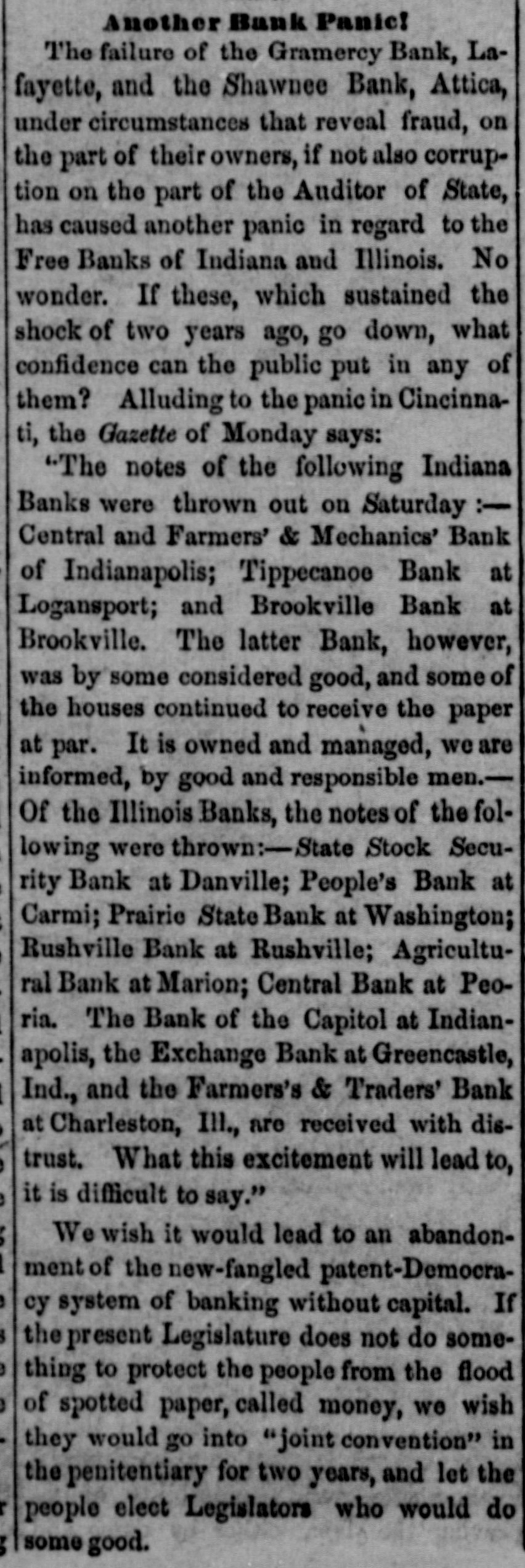
Another Bank Panic! The failure of the Gramercy Bank, Lafayette, and the Shawnee Bank, Attica, under circumstances that reveal fraud, on the part of their owners, if not also corruption on the part of the Auditor of State, has caused another panic in regard to the Free Banks of Indiana and Illinois. No wonder. If these, which sustained the shock of two years ago, go down, what confidence can the public put in any of them? Alluding to the panic in Cincinnati, the Gazette of Monday says: "The notes of the following Indiana Banks were thrown out on Saturday :Central and Farmers' & Mechanics' Bank of Indianapolis; Tippecanoe Bank at Logansport; and Brookville Bank at Brookville. The latter Bank, however, was by some considered good, and some of the houses continued to receive the paper at par. It is owned and managed, we are informed, by good and responsible men.Of the Illinois Banks, the notes of the following were thrown:-State Stock Security Bank at Danville; People's Bank at Carmi; Prairie State Bank at Washington; Rushville Bank at Rushville; Agricultural Bank at Marion; Central Bank at Peoria. The Bank of the Capitol at Indianapolis, the Exchange Bank at Greencastle, Ind., and the Farmers's & Traders' Bank at Charleston, III., are received with distrust. What this excitement will lead to, it is difficult to say." We wish it would lead to an abandonment of the new-fangled patent-Democracy system of banking without capital. If the present Legislature does not do something to protect the people from the flood of spotted paper, called money, we wish they would go into "joint convention" in the penitentiary for two years, and let the people elect Legislators who would do some good.
Article from Daily Nashville Patriot, January 23, 1857

Click image to open full size in new tab

Article Text

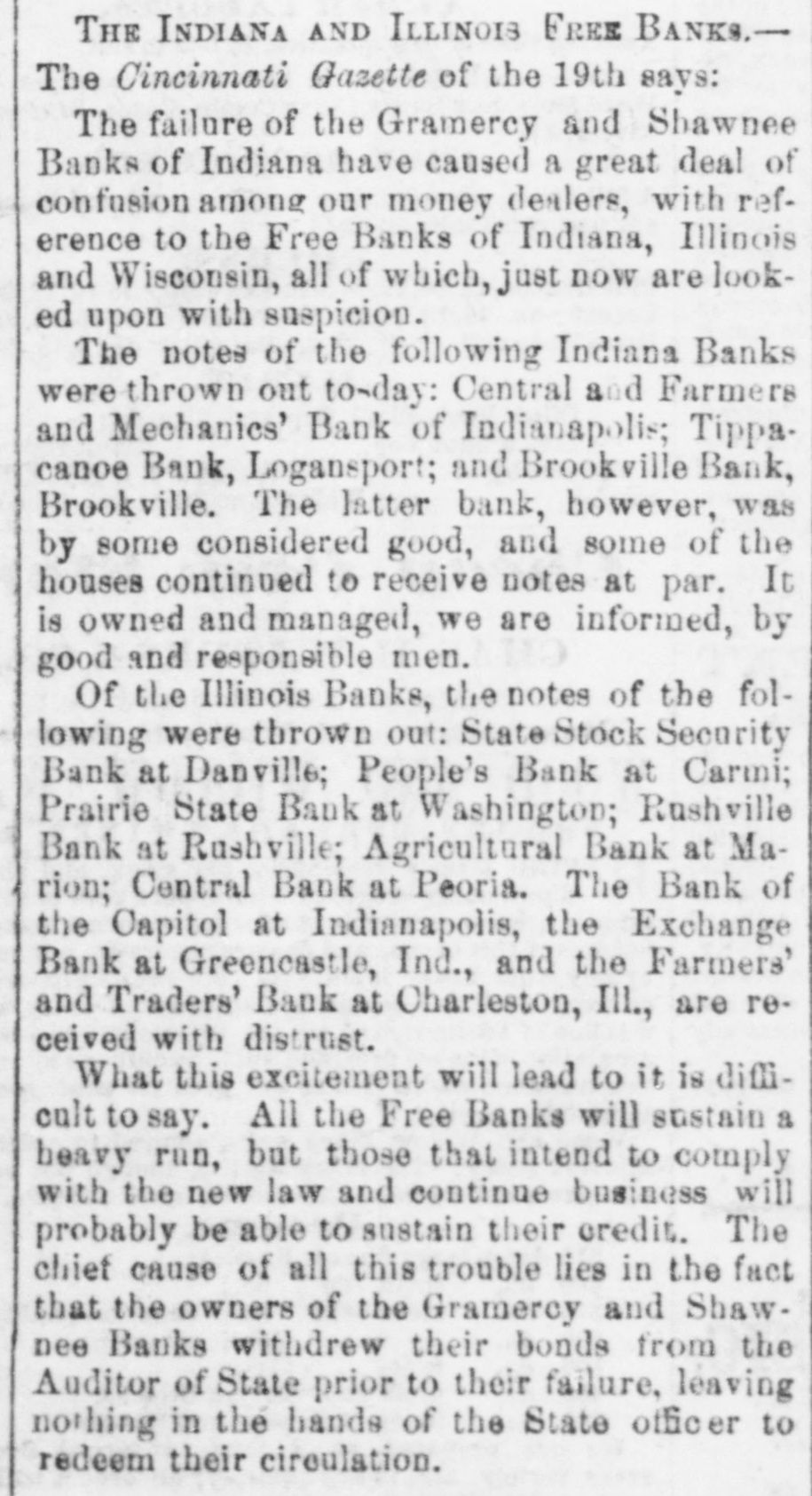
THE Indiana AND ILLINOIS FREE BANKS.The Cincinnati Gazette of the 19th says: The failure of the Gramercy and Shawnee Banks of Indiana have caused a great deal of confusion among our money dealers, with reference to the Free Banks of Indiana, Illinois and Wisconsin, all of which, just now are looked upon with suspicion. The notes of the following Indiana Banks were thrown out to-day: Central and Farmers and Mechanics' Bank of Indianapolis; Tippacanoe Bank, Logansport; and Brookville Bank, Brookville. The latter bank, however, was by some considered good, and some of the houses continued to receive notes at par. It is owned and managed, we are informed, by good and responsible men. Of the Illinois Banks, the notes of the following were thrown out: State Stock Security Bank at Danville; People's Bank at Carmi; Prairie State Bank at Washington; Rushville Bank at Rushville; Agricultural Bank at Marion; Central Bank at Peoria. The Bank of the Capitol at Indianapolis, the Exchange Bank at Greencastle, Ind., and the Farmers' and Traders' Bank at Charleston, Ill., are received with distrust. What this excitement will lead to it is difficult to say. All the Free Banks will sustain a heavy run, but those that intend to comply with the new law and continue business will probably be able to sustain their credit. The chief cause of all this trouble lies in the fact that the owners of the Gramercy and Shawnee Banks withdrew their bonds from the Auditor of State prior to their failure, leaving nothing in the hands of the State officer to redeem their cireulation.


Article from Fayetteville Observer, January 29, 1857

Click image to open full size in new tab

Article Text

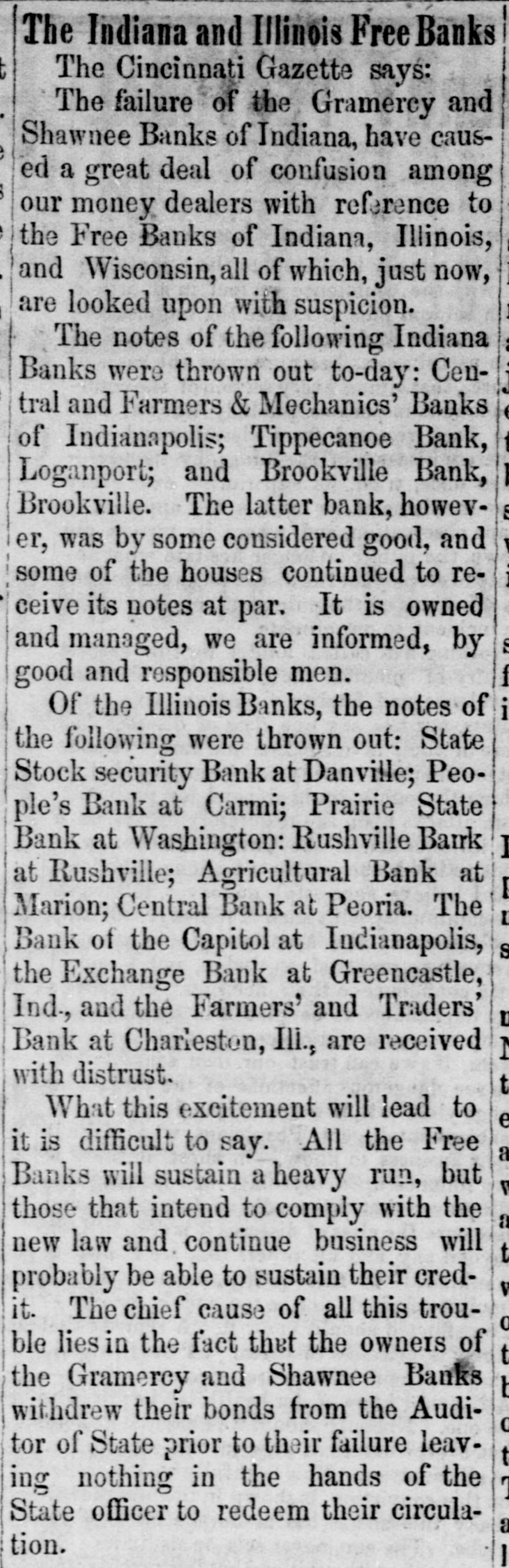
The Indiana and Illinois Free Banks The Cincinnati Gazette says: The failure of the Gramercy and Shawnee Banks of Indiana, have caused a great deal of confusion among our money dealers with reference to the Free Banks of Indiana, Illinois, and Wisconsin, all of which, just now, are looked upon with suspicion. The notes of the following Indiana Banks were thrown out to-day: Central and Farmers & Mechanics' Banks of Indianapolis; Tippecanoe Bank, Loganport; and Brookville Bank, Brookville. The latter bank, however, was by some considered good, and some of the houses continued to receive its notes at par. It is owned and managed, we are informed, by good and responsible men. Of the Illinois Banks, the notes of the following were thrown out: State Stock security Bank at Danville; People's Bank at Carmi; Prairie State Bank at Washington: Rushville Bank at Rushville; Agricultural Bank at Marion; Central Bank at Peoria. The Bank of the Capitol at Indianapolis, the Exchange Bank at Greencastle, Ind., and the Farmers' and Traders' Bank at Charleston, Ili., are received with distrust. What this excitement will lead to it is difficult to say. All the Free Banks will sustain a heavy run, but those that intend to comply with the new law and continue business will probably be able to sustain their credit. The chief cause of all this trouble lies in the fact that the owners of the Gramercy and Shawnee Banks withdrew their bonds from the Auditor of State prior to their failure leaving nothing in the hands of the State officer to redeem their circulation.