13059. Canal Bank (Albany, NY)

Bank Information

Episode Type
Suspension → Closure
Bank Type
state
Start Date
July 11, 1848
Location
Albany, New York (42.653, -73.756)

Metadata

Model
gpt-5-mini
Short Digest
c1fb8d4f0ea543b6

Response Measures

None

Description

The Canal Bank of Albany suspended payments on or about July 11, 1848 and a receiver was appointed; extensive frauds and insolvency were revealed and the institution did not resume operations as a going bank. Later items document receivership and dividends to note holders. No article describes a depositor run prior to suspension — the cause is internal fraud/insolvency.

Events (6)

1. July 11, 1848 Suspension
Cause
Bank Specific Adverse Info
Cause Details
Bank suspended due to insolvency revealed by examinations; examiners found nearly empty vaults, very small coin holdings, large loans to directors and insider fraud and mismanagement.
Newspaper Excerpt
a telegraph despatch from Albany to-day, announces the suspension of the Canal Bank of that city.
Source
newspapers
2. July 12, 1848 Other
Newspaper Excerpt
The failure of the Canal Bank of Albany was the chief topic of conversation in the street. The liabilities of the concern have not transpired. It was one of the old Safety Fund institutions.
Source
newspapers
3. July 14, 1848 Receivership
Newspaper Excerpt
examiners appointed by the Comptroller ... they were appointed on the 11th day of July, inst., they proceeded to the said examination ... they found in the said bank the sum of eleven hundred and two dollars in coin ... assets will not be sufficient to pay their debts liabilities ... more than one half of the amount of the capital stock of said bank has been loaned to, and is now due and owing from, the directors.
Source
newspapers
4. July 15, 1848 Other
Newspaper Excerpt
The bills of the Canal Bank were sold this morning at 50 per cent. discount. ... It is the duty of the Judge ... to appoint a Receiver of the means of the Bank, who is to collect its debts and apportion the money among the creditors ... appoint a Receiver.
Source
newspapers
5. July 11, 1849 Receivership
Newspaper Excerpt
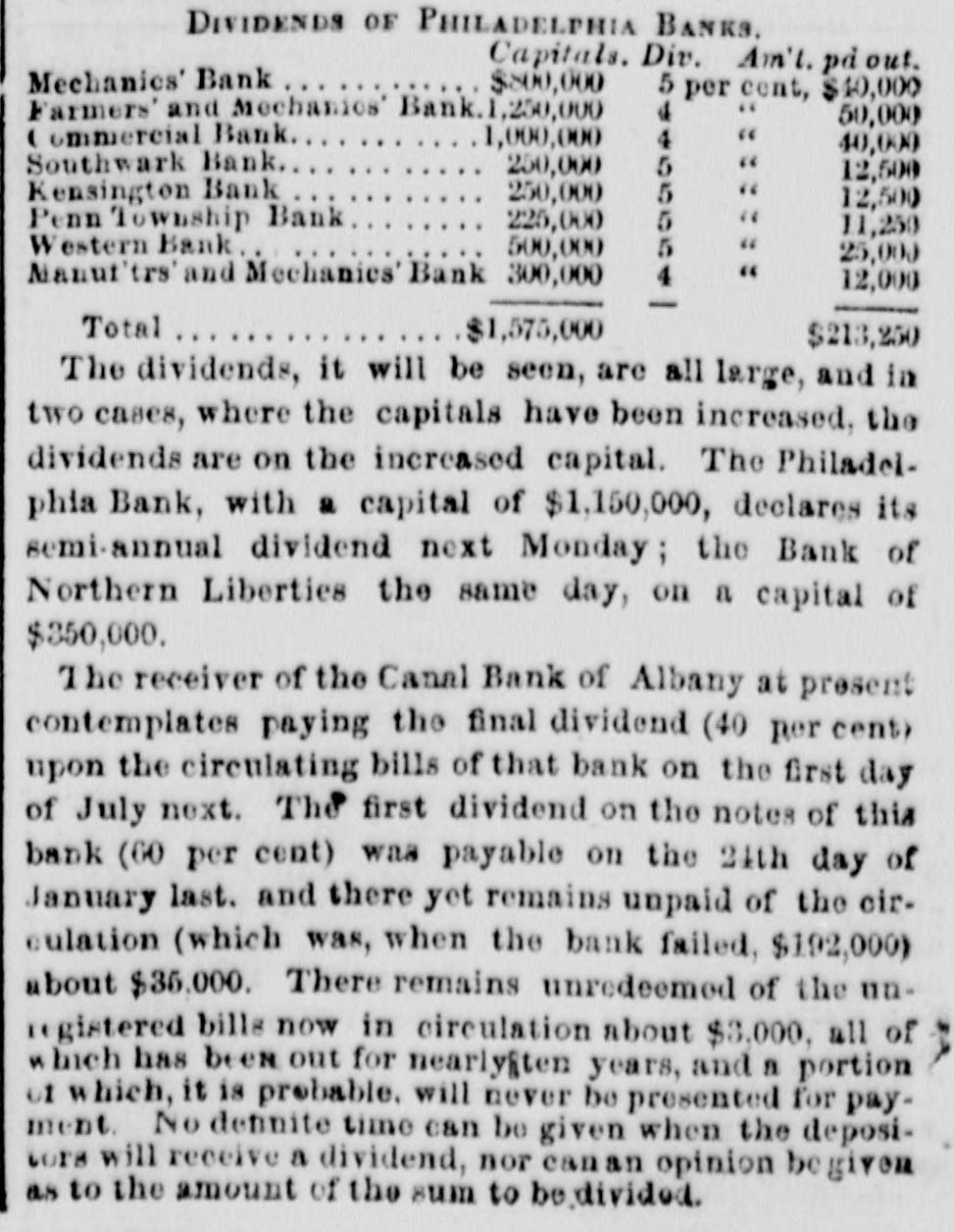
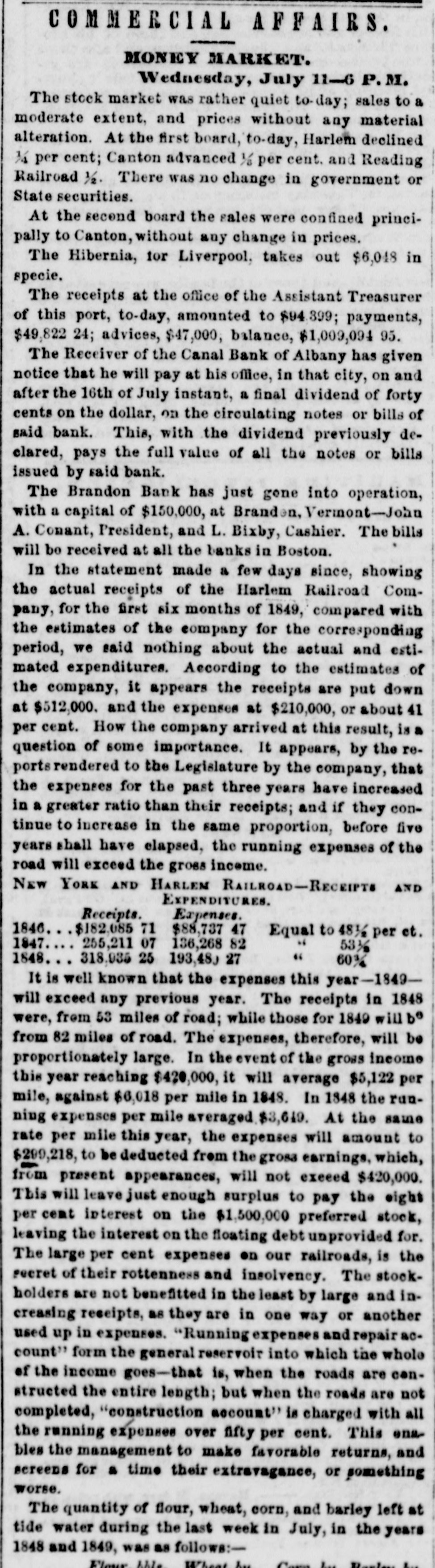
The receiver of the Canal Bank of Albany at present contemplates paying the final dividend (40 per cent) upon the circulating bills of that bank on the first day of July next.
Source
newspapers
6. January 15, 1852 Receivership
Newspaper Excerpt
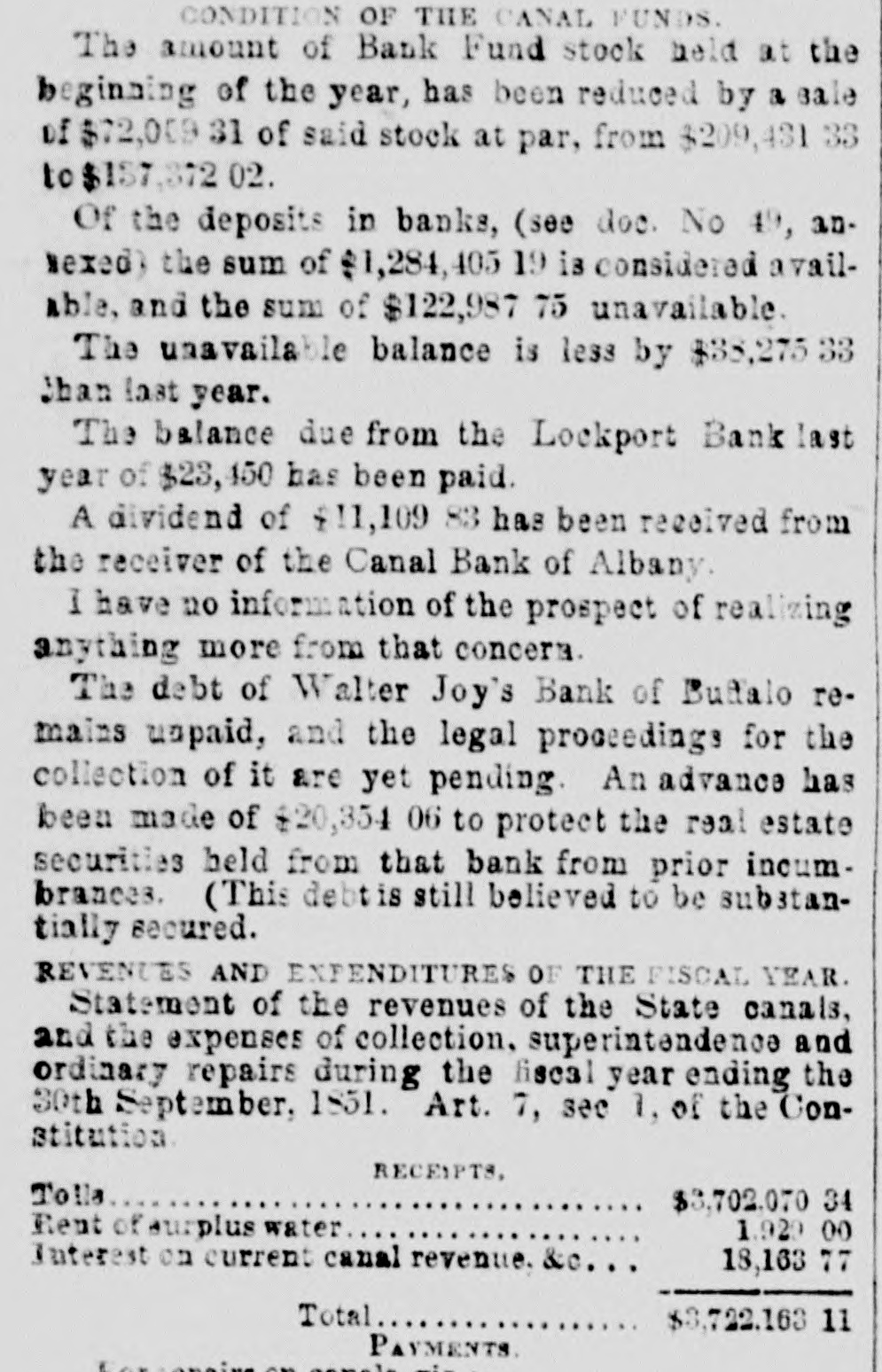
A dividend of $11,109 83 has been received from the receiver of the Canal Bank of Albany. I have no information of the prospect of realizing anything more from that concern.
Source
newspapers

Newspaper Articles (22)

Article from New-York Daily Tribune, July 12, 1848

Click image to open full size in new tab

Article Text

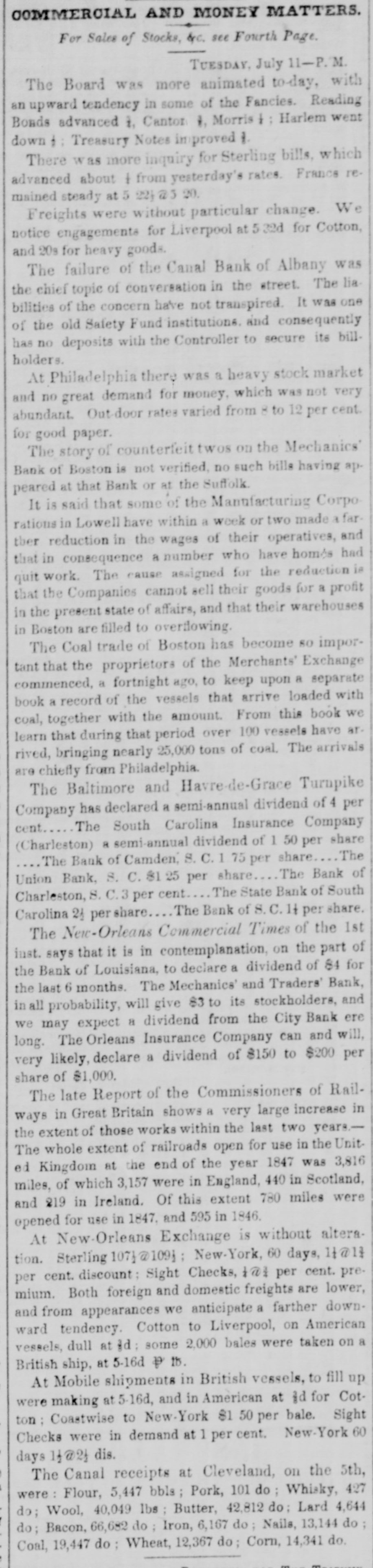
COMMERCIAL AND MONEY MATTERS. For Sales of Stocks, & see Fourth Page. TUESDAY July 11-P.M. The Board was more animated today, with an upward tendency in some of the Fancies. Reading Bonds advanced it Cantor 1. Morris / Harlem went down : Treasury Notes improved 1. There was more inquiry for Sterling bills. which advanced about t from yesterday's rates. France remained steady at 5 22}@3 20. Freights were without particular change. We notice engagements for Liverpool at 532d for Cotton, and 20s for heavy goods. The failure of the Canal Bank of Albany was the chief topic of conversation in the street. The lia. bilities of the concern have not transpired It was one of the old Safety Fund institutions. and consequently has no deposits with the Controller to secure its billholders. At Philadelphia there was a heavy stock market and no great demand for money, which was not very abundant. Out-door rates varied from 8 to 12 per cent. for good paper. The story of counterfeit twos on the Mechanics' Bank of Boston is not verified no such bills having appeared at that Bank or at the Suffolk It is said that some of the Manufacturing Corpo rations in Lowell have within a week or two made a farther reduction in the wages of their operatives, and that in consequence a number who have homés had quit work. The cause assigned for the reduction is that the Companies cannot sell their goods for a profit in the present state of affairs, and that their warehouses in Boston are filled to overflowing. The Coal trade of Boston has become so important that the proprietora of the Merchants' Exchange commenced, a fortnight ago, to keep upon a separate book a record of the vessels that arrive loaded with coal, together with the amount From this book we learn that during that period over 100 vessels have ar. rived, bringing nearly 25,000 tons of coal. The arrivals are chiefly from Philadelphia. The Baltimore and Havre-de-Grace Turnpike Company has declared a semi-annual dividend of 4 per The South Carolina Insurance Company cent (Charleston) a semi-annual dividend of 1 50 per share The Bank of Camden, S. C. 75 per share The of Bank Union Bank, S. C. per share The Charleston, S. C.3 per cent The State Bank of South Carolina 21 per share The Bank of S.C.1 per share. The New-Orleans Commercial Times of the 1st just. says that it is in contemplanation, on the part of the Bank of Louisiana, to declare a dividend of 84 for the last 6 months. The Mechanics' and Traders' Bank, in all probability, will give 83 to its stockholders, and we may expect a dividend from the City Bank ere long. The Orleans Insurance Company can and will, very likely, declare a dividend of $150 to $200 per share of $1,000. The late Report of the Commissioners of Railways in Great Britain shows a very large increase in the extent of those works within the last two years.The whole extent of railroads open for use in the Unit. ed Kingdom at the end of the year 1847 was 3,816 miles, of which 3,157 were in England, 440 in Scotland, and 219 in Ireland. Of this extent 780 miles were opened for use in 1847. and 595 in 1846. At New-Orleans Exchange is without alteration. Sterling A@1091; New-York, 60 days, 11@14 per cent. discount Sight Checks, 1@1 per cent. premium. Both foreign and domestic freights are lower, and from appearances we anticipate a farther down. ward tendency. Cotton to Liverpool, on American vessels, dull at d some 2,000 bales were taken on a British ship, at 5-16d ₽ tb. At Mobile shipments in British vessels, to fill up were making at 5-16d, and in American at id for Cot. ton: Coastwise to New-York 81 50 per bale. Sight Checks were in demand at 1 per cent. New-York 60 days 11@21 dis. The Canal receipts at Cleveland, on the 5th, were : Flour, 5,447 bbls; Pork, 101 do : Whisky, 427 do; Wool, 40,049 lbs : Butter, 42,812 do: Lard 4,644 do; Bacon, 66,682 do : Iron, 6,167 do; Nails, 13,144 do Coal, 19,447 do : Wheat, 12,367 do; Corn, 14,341 do.
Article from The New York Herald, July 12, 1848

Click image to open full size in new tab

Article Text

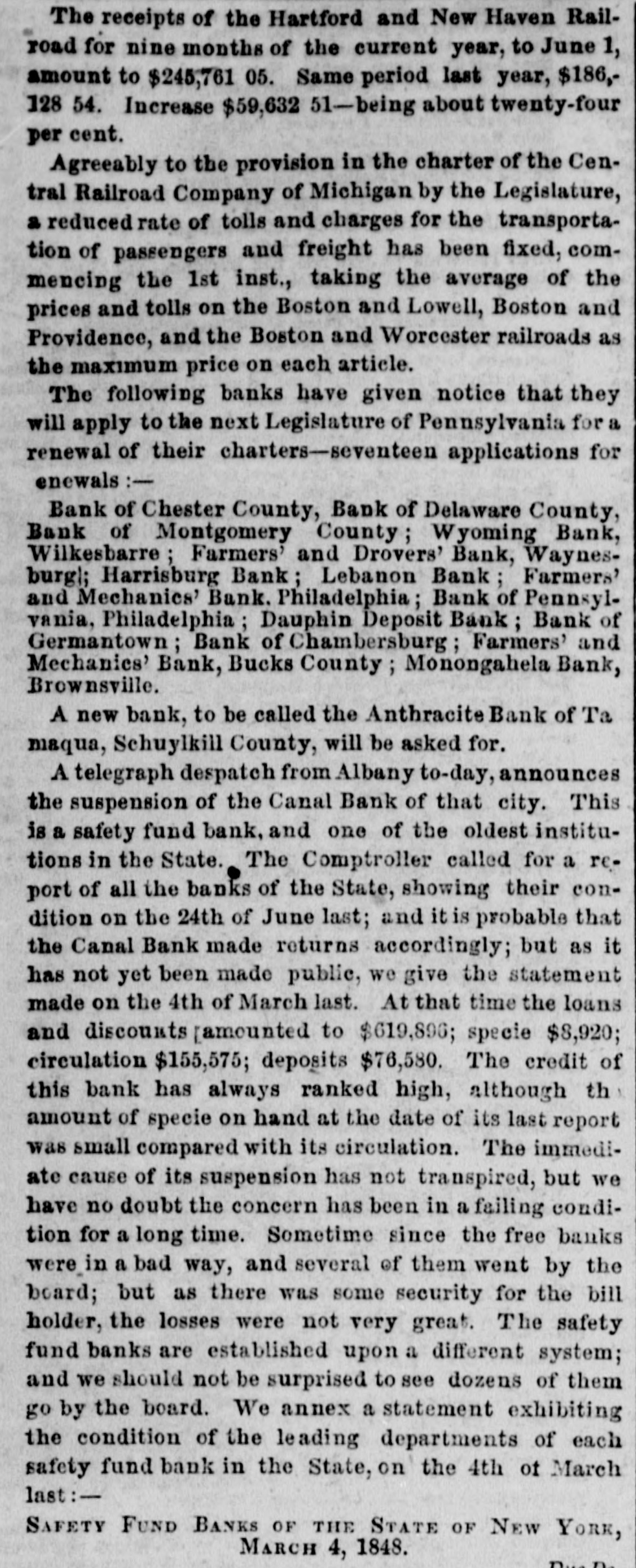
The receipts of the Hartford and New Haven Railroad for nine months of the current year, to June 1, amount to $245,761 05. Same period last year, $186,128 54. Increase $59,632 51-being about twenty-four per cent. Agreeably to the provision in the charter of the Central Railroad Company of Michigan by the Legislature, a reduced rate of tolls and charges for the transportation of passengers and freight has been fixed, commencing the 1st inst., taking the average of the prices and tolls on the Boston and Lowell, Boston and Providence, and the Boston and Worcester railroads as the maximum price on each article. The following banks have given notice that they will apply to the next Legislature of Pennsylvania for a renewal of their charters-seventeen applications for enewals:Bank of Chester County, Bank of Delaware County, Bank of Montgomery County; Wyoming Bank, Wilkesbarre : Farmers' and Drovers' Bank, Waynesburgl; Harrisburg Bank; Lebanon Bank; Farmers' and Mechanics' Bank. Philadelphia; Bank of Pennsylvania, Philadelphia ; Dauphin Deposit Bank; Bank of Germantown; Bank of Chambersburg; Farmers' and Mechanics' Bank, Bucks County; Monongahela Bank, Brownsville. A new bank, to be called the Anthracite Bank of Ta maqua, Schuylkill County, will be asked for. A telegraph despatch from Albany to-day, announces the suspension of the Canal Bank of that city. This is a safety fund bank, and one of the oldest institutions in the State. The Comptroller called for a report of all the banks of the State, showing their condition on the 24th of June last; and it is probable that the Canal Bank made returns accordingly; but as it has not yet been made public, we give the statement made on the 4th of March last. At that time the loans and discounts [amounted to $619,896; specie $8,920; circulation $155,575; deposits $76,580. The credit of this bank has always ranked high, although th amount of specie on hand at the date of its last report was small compared with its circulation. The immediate cause of its suspension has not transpired, but we have no doubt the concern has been in a failing condition for a long time. Sometime since the free banks were in a bad way, and several of them went by the board; but as there was some security for the bill holder, the losses were not very great. The safety fund banks are established upon a different system; and we should not be surprised to see dozens of them go by the board. We annex a statement exhibiting the condition of the leading departments of each safety fund bank in the State, on the 4th of March last: :SAFETY FUND BANKS OF THE STATE OF NEW YORK, MARCH 4, 1848.


Article from The New York Herald, July 13, 1848

Click image to open full size in new tab

Article Text

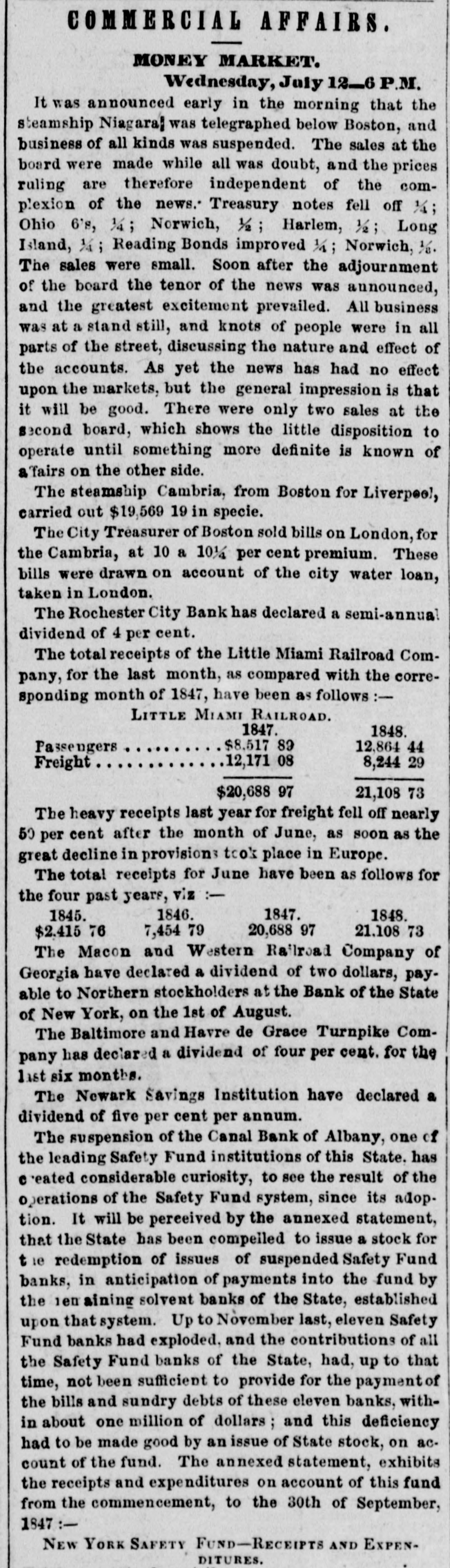
COMMERCIAL AFFAIRS. MONEY MARKET. Wednesday, July 12_6 P.M. It was announced early in the morning that the steamship Niagara; was telegraphed below Boston, and business of all kinds was suspended. The sales at the board were made while all was doubt, and the prices ruling are therefore independent of the complexion of the news. Treasury notes fell off 1/4; Ohio 6's, 3/4 Norwich, 1/2; Harlem, 1/2; Long Island, 14; Reading Bonds improved 1/1; Norwich, 1/6. The sales were small. Soon after the adjournment of the board the tenor of the news was announced, and the greatest excitement prevailed. All business was at a stand still, and knots of people were in all parts of the street, discussing the nature and effect of the accounts. As yet the news has had no effect upon the markets, but the general impression is that it will be good. There were only two sales at the second board, which shows the little disposition to operate until something more definite is known of a fairs on the other side. The steamship Cambria, from Boston for Liverpool, carried out $19,569 19 in specie. The City Treasurer of Boston sold bills on London, for the Cambria, at 10 a 1014 per cent premium. These bills were drawn on account of the city water loan, taken in London. The Rochester City Bank has declared a semi-annual dividend of 4 per cent. The total receipts of the Little Miami Railroad Company, for the last month, as compared with the corresponding month of 1847, have been as follows:LITTLE MIAMI RAILROAD. 1847. 1848. $8,517 89 Passengers 12,864 44 12,171 08 8,244 29 Freight $20,688 97 21,108 73 The heavy receipts last year for freight fell off nearly 50 per cent after the month of June, as soon as the great decline in provisions took place in Europe. The total receipts for June have been as follows for the four past years, viz :1847. 1846. 1848. 1845. 21.108 73 20,688 7,454 $2.415.76 The Macon and Western Railroad Company of Georgia have declared a dividend of two dollars, payable to Northern stockholders at the Bank of the State of New York, on the 1st of August. The Baltimore and Havre de Grace Turnpike Company has declared a dividend of four per cent. for the list six months. The Newark Savings Institution have declared a dividend of five per cent per annum. The suspension of the Canal Bank of Albany, one of the leading Safety Fund institutions of this State. has created considerable curiosity, to see the result of the operations of the Safety Fund system, since its adop. tion. It will be pereeived by the annexed statement, that the State has been compelled to issue a stock for t e redemption of issues of suspended Safety Fund banks, in anticipation of payments into the fund by the 1en aining solvent banks of the State, established upon that system. Up to November last, eleven Safety Fund banks had exploded, and the contributions of all the Safety Fund banks of the State, had, up to that time, not been sufficient to provide for the payment of the bills and sundry debts of these eleven banks, within about one million of dollars ; and this deficiency had to be made good by an issue of State stock, on account of the fund. The annexed statement, exhibits the receipts and expenditures on account of this fund from the commencement, to the 30th of September, 1847 :NEW YORK SAFETY FUND-RECEIPTS AND EXPENDITURES.


Article from New-York Daily Tribune, July 15, 1848

Click image to open full size in new tab

Article Text

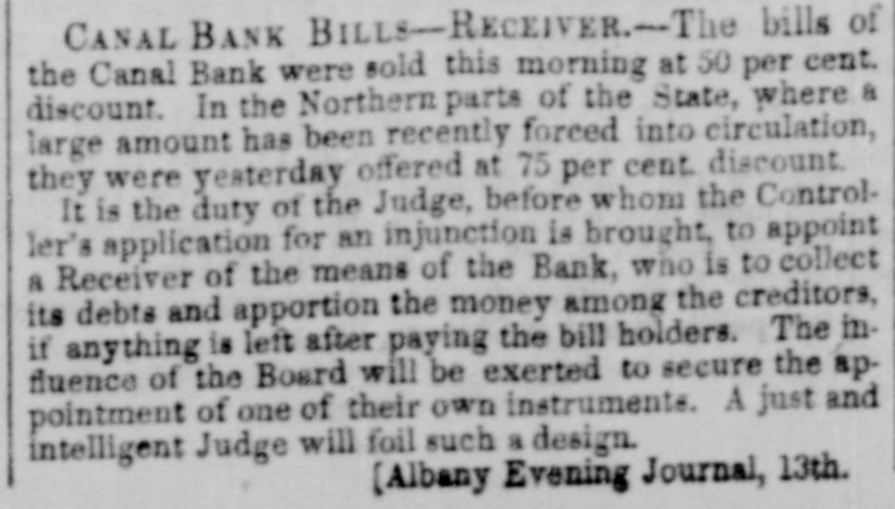
CANAL BANK BILLS-RECEIVER. The bills of the Canal Bank were sold this morning at 50 per cent. discount. In the Northern parts of the State, where a large amount has been recently forced into circulation, they were yesterday offered at 75 per cent. discount. It is the duty of the Judge, before whom the Controller's application for an injunction is brought, to appoint a Receiver of the means of the Bank, who is to collect its debts and apportion the money among the creditors, if anything is left after paying the bill holders. The influence of the Board will be exerted to secure the appointment of one of their own instruments. A just and intelligent Judge will foil such a design. [Albany Evening Journal, 13th.


Article from New-York Daily Tribune, July 15, 1848

Click image to open full size in new tab

Article Text

COMMERCIAL AND MONEY MARKETS For Sales of Stocks, & see Fourth Page FRIDAY July 14-P. M The buoyancy of the fancies continued to-day and the quotations are better. For sound stocks there is fair inquiry and Treasury Notes were rather firmer In Bills there was no important movement The rates remain as before 94 104 for good bills Continental bills are very dull There is something doing in Freights About 25,000 bush Corn have been engaged to Liverpool at 3)d in a British vessel, and 4d in an American bottom. Cotton at +d@3.16d. Heavy freight at 15s @20s. 2,000 bble Naval Stores at 6d; Oil to London at 20s; 500 bbis Tur to Glasgow at 2s 6d : Cotton at 532d, and Lard at 20s In Money there is no marked change. The diffi culty in negotiating paper continues, and the Banks are throwing out a considerable portion of their offerings The occasion of the present tightness in the money market is the payments being made on the new loan. We understand that four and half millions have alrea dy been paid up-asum amply sufficient to produce the stringency which now exists. The above is larger amount than it was anticipated would be called for, but parties have taken advantage of their privilege to pay up their whole subscriptions The Sub-Treasury is rap diy disgorging- process, we trust will bring gradually relief. We hear from Washington that the process of funding Treasury Notes is going on to an enormous ex tent We hear of a certificate for 8300,000 thus funded in the name of Rothschilds & Co A letter from London states that between the sailing of the Niagara and the previous boat, a sale in one lot of $430,000 Government Sixes was made at 951 The market was afterward lower The notes of the Lewis County Bank were re fused redemption at Albany yesterday one of the re suite of the Canal Bank failure Some of the brokers in Wall st. are buying Ca all notes at 50@60 ets on the dollar. The accounts of the condition of the institution are very bad, and render it very questionable if assets will be found sufficient to pay the circulation. The Albany Atlas says The Commissioners appointed to examine into the concern have found at is said, less than a thousand dollars and bank and this and the lation broken notes band constitute the asseta the Bank On the other hand, the circu lation is found to be double the amount first reported by the officers It already $190,000 and the investigation has not terminated The amount due to individual depositors and to Country Banks very great, for the institution paid large and unar customed rate of interest deposits The hope that was first entertained that the loss would be confined to the stockholders. and that the billholders and depositors would be safe has sensibly di minished before this revelation the emptiness the Bank vauits and the discovery of this unexpected amount indebtedness The notes were purchased yesterday, at Albany, at 50 per cent discount The shipments of Coin thus far this month have been 81,314 Trent Bermuda $50,000 Bavaria, Have 176,775 Schr Decatur, Maracaibo. 10,002 Previously in July $604.799 ShipNewWorld,Liverpool.186,508) Total for July The Brooklyn and Jamaica Railroad Company have declared a dividend of 33 per cent The Green wich Savings Bank the usual dividend payable on the 17th inst The Kensington (Philadelphia) Gas Company a dividend of 5 per cent payable on the 20th inst. ... The Bank of Upper Canada a semi annual dividend of 2 per cent The Planters' Bank of Tennessee, and the Union Bank of the same State, have made semi- an nual dividends of 2 per cent. each The Auditor of the State of Ohio has levied the following tax for the current year 3:10 mill. For general revenue purposes 2-10 do. For Common School fund For payment of int'st on State and Sinking fund 25-10 do 3 mills Total At Cincinnati, on the 8th Exchange on the East was firm at 14 prem. Money as scarce at any time previous. The annual report of the Bank of Charleston has just been made The annexed statement shows the cash assets and liabilities on the 30th June last LIABILITIES ASSETS $738,510 $389,739 Circulation Coin 344,597 676,182 Deposits Due by Banks 1,943,153 100,758 Due Banks Bank notes Total $3,041,260 $1,166,679 Total In addition to these assets, the Bank has two millions and a half of domestic and foreign Exchange running to maturity The net profits of the past year, after deducting cura rent expenses amount to $377,287 87, being within fraction of 12 per cent. upon its capital, ($3,160,000.) The losses in the same time amount to $26,186 09. From the profits the Directors declared two semi an. nual dividends of 3 per cent each, and carried to an ac. count designated The Reserve Profit Account," the sum of $189,648 being equal to year @ dividend of 6 per cent The object of this reserve fund appears to be besides strengthening the Bank to insure the certainty of 8 dividend to the stockholders for the future. under almost any contingency that may happen. An amount of $72,960 24. independent of the reserve profit account of $189,648. being still left to cover the suspended debt account and other outstanding risks. The nature and extent of the business of the Bank for the past year will be understood from the following statement Sterling Exchange purchased from 1st July, $3,490,662 66 1847,10 lat July, 1848 282,869 82 do French do. 6,186,518 82 Domestic Exchange purchased 89,960,068.30 Notes discounted 10,447,026.44 Total $20,407,094 7 The Bank has also furnished Northern Exchange by its checks on New-York Boston, Philadelphia, and other Northern cities, without ceasing to check a single day from 1st July, 1847. to 1st July, 1848, $7,642,234 86. Of French Exchanges, there has been protested $12. 262 71, which is said to be good at both ends, and its payment On Sterling Exchange no loss appears to have been made Markets CAREFULLY REPORTED FOR THE TRIBUNE FRIDAY, July 14. ASHES- Are firmer. Sale of 500 bbls were made at 4.873645. mostly $5 for Pote and 5 87 16 for Pearls. COTTON- The market rather firmer than it was and 15 no lower than before the steamer arrived. Sales 600 or 700 bales, mostly for export FLOUR AND MEAL The market for Flour was without par ticular change day and the sales were to fair extent. About 4,000 changed hands at AMES 25 for common and good brands State and Western. Brand better than common sold 5 50 to $6 Fine Flour 475@ with sales 500 bbls. There was ad. in amount of Flour going into store, the receipts being good. rather Flour vace of the sales. The inquiry for bakers' brands freez news What For Southe there fair


Article from The New York Herald, July 19, 1848

Click image to open full size in new tab

Article Text

MONEY MARKET. Tuesday, July 18_6 P. The money market has been somewhat easier for day or two; but it is yet very stringent. Stocks are steadily declining, and we see no immediate prospect of any change for the better. At the first board, today, there was enough business done to give employment to one active broker, and the street generally was unusually quiet. Treasury notes fell off 1/1/2 per cent; Harlem, 1/6; Reading Railroad advanced 1/4 per cent; Reading bonds, 1/2; Reading mortgage bonds, 2. There has been an active demand for sterling exchange to-day; the rates have been firm at 93/4 a 10 per cent premium. It is reported in the street that the steamer will take out a large amount of specie. The market is well supplied with sterling exchange of second and third rate quality," which is offered at 81/2 a 9 per cent premium. The Auditor of the State of Ohio has levied the following tax for the current year:-For general revenue purposes, 3-10 mill; for common school fund, £.10 do: for payment of interest on State and sinking fund, 25-10 do. Total, 3 mills. It appears, by the report of the Finance Committee in the Senate of the Legislature of Wisconsin, that the expenditures of the Treasury are in advance of its revenue:FINANCES OF WISCONSIN-RECEIPTS AND EXPENDITURES, 1848 AND 1849. The estimated expenses of the State until $35,000 January 1st, 1849 40,000 Estimated expense for 1849 Total $75,000 This sum will be necessary to defray the expenses of the State, before the taxes of the next year can be levied and collected. To meet this expense, the State has the following available resources $4,111 52 Amount in hands of the Treasurer 5,000 Available delinquent taxes 10,000.00 In the hands of the canal receiver $19,111 52 Total -Learing deficit of $55,888 48, to be provided for by direct taxation. The taxable property in the State, of all kinds, both real and personal, is estimated at $21,000,000. But the assessed value, as returned from the several counties, the present year, is put down at $13,189,285 30. An increase of the rate of taxation of four and a half mills on the dollar, on this last sum, is recommended, in preference to a re-assessment of property, the cost of which would amount to one-fifth of the entire State revenue proposed to be levied. Such an increase would yield the sum of $59,351 78. We have not had, for several months, such an expose of the operations of our banking systems, as presented in the affairs of the Canal Bank of Albany The statements which have, from time to time, been made public, since the suspension of that institution, are nothing compared with that which we annex, made by the examiners appoiuted by the Comptroller, We give this affidavit at length, that the public generally, and those interested particularly, may see what the condition of the bank was at the time of its suspension:CANAL BANK OF ANY-EXAMINERS AFFIDAVIT. State of New York. City and County of Albany, Andrew White and Thomas McMullen being duly sworn, say, that on the 11th day of July, inst., they were appointed by the Hon Millard Fillmore, Comptroller of the State of New York, special agents to examine the affairs of the president. directors and company of the Canal Bank of Albany. That in pursuance of that appointment they proceeded to the said examination. and have been diligently engaged therein on the said 11th. 12th, 13th and 14th days of said month of July That they have been yet un able to make out statement from the complicated, confused and extended nature of said affairs, and, some considerable degree, from the want of diligence one of the former clerks of said bank. who proffered and undertook to balance the books as to show the amounts due to and from the bank. and entered upon said undertaking; but he proceeded in the same in very tardy and unsatisfactory manner. That although deponents have been unable to make out full statement of the affairs of said bank, they have ceeded o e nablethem to -and they do depose say-that from\the books, papers and af fairs and vouchers of the bank, and from testimony given before them by the late teller of said bank. it appears that the bills of said bank in circulation, unredeemed and unpaid. amount to about one hundred and eighty-nine thousand dollars and Theodore Olcott. late cashier of said bank. has informed deponents- and they believe to be true-that said bank indebted to individuals for deposites above fifty thousand dollars. and to the State of New York about sixty three thousand dollars. That they found in the said bank the sum of eleven hundred and two dollars. or thereabouts, in coin. and in good current bank bills not exceeding ten or fifteen dollars. besides some worthless. or almost worthless, United States Bank bills of the nominal amount of two hundred and ten dollars. The above constitute all the asaets of said bank except their real estate and stocks. and debts due them--the amount of which deponents, for the reasons above mentioned, are not able to state. Deponents further say that from the testimony of the late teller of the said bank taken before them, and from the declarations of the late cashier and from their general observations, and the aspecet of things appertaining to said bank. they are fully satisfied that the assets of said bank will not be sufficient to pay their debts liabilities, independent of the original stock paid in. And deponents, further say, that i appears satisfactory to them. from the books and papers of said bank that more than one half of the amount of the capital stock of said bank has been loaned to, and is now due and owing from, the directora of said bank And further. that the late teller of said bank. according to his own testimony before deponents taken, has been in the habit of making large leans to many individuals, upon his own responsibilit and without the knowledge authority. or consent. of the directors; but. as he testifies. with the knowledge and sanction of the cashier. That such loans due and unpaid, amount, according to deponents understanding. and their best knowledge as derived from the said teller's testimony, together with the books and vouchers, to at least twenty-five thousand dollars. That said amounts have been loaned principally and almost or quite entirely, without any notes, endorsers or sureties, but upon simple memorandum checks. post dated, and other memoranda. most of which have yet many months torun That thesaid amounts. and other large amounts. have been uniformly counted as cash, in making the statements of the affairs of said bank. and in calculations for and making their semi annual ividends It further appears that said teller. with the knowledge and sanction of the cashier. as he testifies, loaned eight thousand dollars to one Marlett, a contractor on the Erie Railroad, within a very few days before the said 11th of July, without any note, bond or security, any endorser or surety except the said Martlett' memorandum check. and his naked promise that he would send a draft on the Erie Railroad Company for the amount. but which amount. or any part thereof, has not yet been found. That package of eight thousand dollars was sent to Pepoon. Hoffman and Ten Broeck, in June last. with the knowledge and by the direction of the cashier. and never charged upon the books of said bank, until the 10th day of Jaly instant and it further appears that Edwin Croswell one of the directors of said bank. is indebted to said bank about seventy-five thousand dollars; and that John Keyes Paige. one of the said directors, is indebted to said bank for about fifty thousand dollars. for money loaned him by said said bank. as president of glass pany, in the city of Albany about the solvency of which glass company deponents have no satisfactory


Article from The New York Herald, July 20, 1848

Click image to open full size in new tab

Article Text

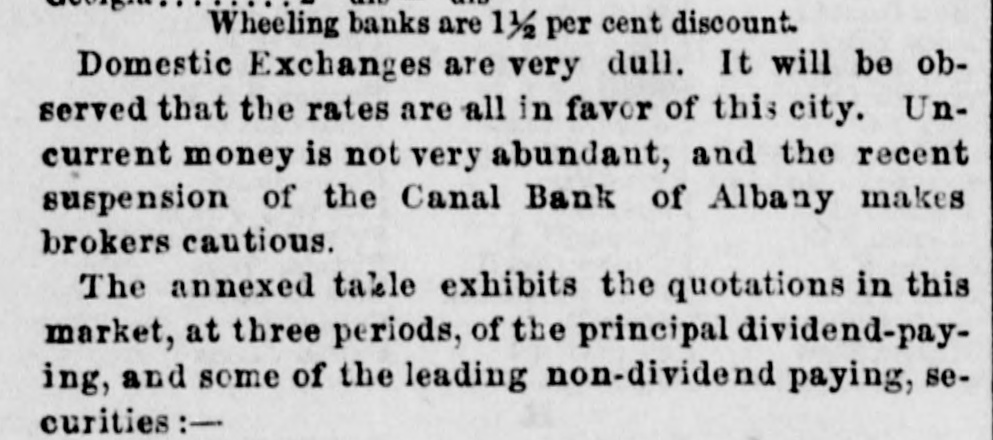
Wheeling banks are 1 1/2 per cent discount. Domestic Exchanges are very dull. It will be observed that the rates are all in favor of this city. Uncurrent money is not very abundant, and the recent suspension of the Canal Bank of Albany makes brokers cautious. The annexed table exhibits the quotations in this market, at three periods, of the principal dividend-paying, and some of the leading non-dividend paying, securities:-


Article from The New York Herald, August 6, 1848

Click image to open full size in new tab

Article Text

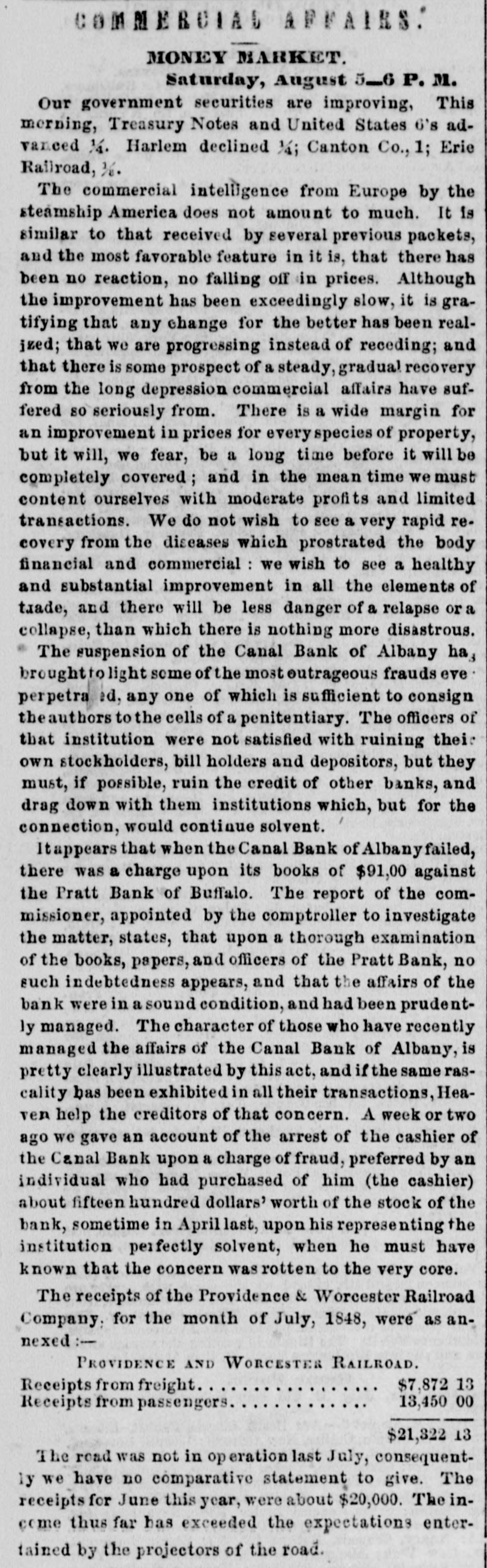
COMMERCIAL AFFAIRS. MONEY MARKET. Saturday, August 5_6 P. M. Our government securities are improving, This morning, Treasury Notes and United States 6's advareed 14. Harlem declined 14; Canton Co., 1; Erie Railroad, 1/6. The commercial intelligence from Europe by the steamship America does not amount to much. It is similar to that received by several previous packets, and the most favorable feature in it is, that there has been no reaction, no falling off in prices. Although the improvement has been exceedingly slow, it is gratifying that any change for the better has been realized; that we are progressing instead of receding; and that there is some prospect of a steady, gradual recovery from the long depression commercial affairs have suffered so seriously from. There is a wide margin for an improvement in prices for every species of property, but it will, we fear, be a long time before it will be completely covered; and in the mean time we must content ourselves with moderate profits and limited transactions. We do not wish to see a very rapid recovery from the diseases which prostrated the body financial and commercial : we wish to see a healthy and substantial improvement in all the elements of trade, and there will be less danger of a relapse or a collapse, than which there is nothing more disastrous. The suspension of the Canal Bank of Albany ha, brought to light some of the most outrageous frauds eve perpetra ed, any one of which is sufficient to consign theauthors to the cells of a penitentiary. The officers of that institution were not satisfied with ruining their own stockholders, bill holders and depositors, but they must, if possible, ruin the credit of other banks, and drag down with them institutions which, but for the connection, would continue solvent. Itappears that when the Canal Bank of Albany failed, there was a charge upon its books of $91,00 against the Pratt Bank of Buffalo. The report of the commissioner, appointed by the comptroller to investigate the matter, states, that upon a thorough examination of the books, papers, and officers of the Pratt Bank, no such indebtedness appears, and that the affairs of the bank were in a sound condition, and had been prudently managed. The character of those who have recently managed the affairs of the Canal Bank of Albany, is pretty clearly illustrated by this act, and if the same rascality has been exhibited in all their transactions, Heaven help the creditors of that concern. A week or two ago we gave an account of the arrest of the cashier of the Canal Bank upon a charge of fraud, preferred by an individual who had purchased of him (the cashier) about fifteen hundred dollars' worth of the stock of the bank, sometime in Aprillast upon his representing the institution perfectly solvent, when he must have known that the concern was rotten to the very core. The receipts of the Providence & Worcester Railroad Company for the month of July, 1848, were as annexed:PROVIDENCE AND WORCESTER RAILROAD. $7,872 13 Receipts from freight 13,450 00 Receipts from passengers $21,322 13 The road was not in operation last July, consequently we have no comparative statement to give. The receipts for June this year, were about $20,000. The income thus far has exceeded the expectations entertained by the projectors of the road.


Article from The New York Herald, August 14, 1848

Click image to open full size in new tab

Article Text

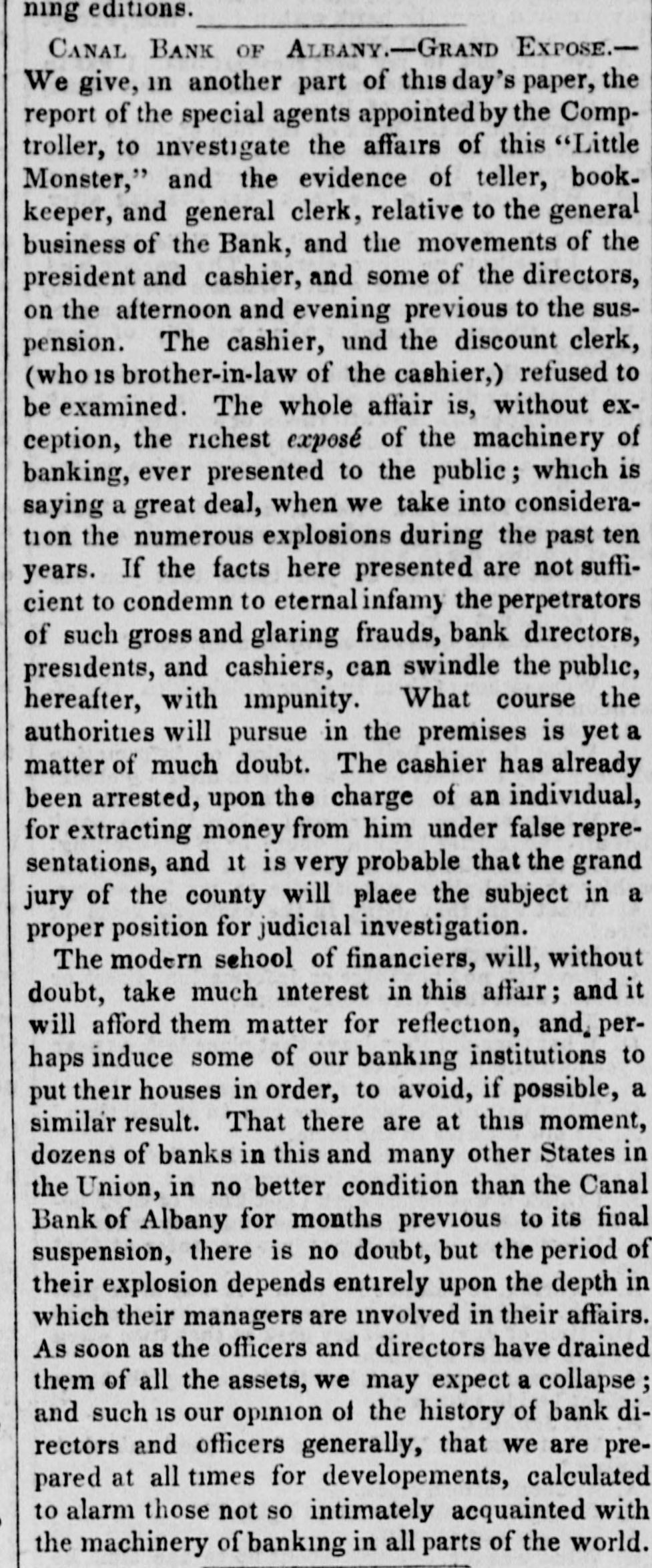
ning editions. CANAL BANK OF ALBANY.-GRAND EXPOSE.We give, in another part of this day's paper, the report of the special agents appointed by the Comptroller, to investigate the affairs of this "Little Monster," and the evidence of teller, bookkeeper, and general clerk, relative to the general business of the Bank, and the movements of the president and cashier, and some of the directors, on the afternoon and evening previous to the suspension. The cashier, und the discount clerk, (who brother-in-law of the cashier,) refused to be examined. The whole affair is, without exception, the richest exposé of the machinery of banking, ever presented to the public; which is saying a great deal, when we take into consideration the numerous explosions during the past ten years. If the facts here presented are not sufficient to condemn to eternal infamy the perpetrators of such gross and glaring frauds, bank directors, presidents, and cashiers, can swindle the public, hereafter, with impunity. What course the authorities will pursue in the premises is yet a matter of much doubt. The cashier has already been arrested, upon the charge of an individual, for extracting money from him under false representations, and it is very probable that the grand jury of the county will place the subject in a proper position for judicial investigation. The modern school of financiers, will, without doubt, take much interest in this affair; and it will afford them matter for reflection, and, perhaps induce some of our banking institutions to put their houses in order, to avoid, if possible, a similar result. That there are at this moment, dozens of banks in this and many other States in the Union, in no better condition than the Canal Bank of Albany for months previous to its final suspension, there is no doubt, but the period of their explosion depends entirely upon the depth in which their managers are involved in their affairs. As soon as the officers and directors have drained them of all the assets, we may expect a collapse; and such IS our opinion of the history of bank directors and officers generally, that we are prepared at all times for developements, calculated to alarm those not so intimately acquainted with the machinery of banking in all parts of the world.


Article from New-York Daily Tribune, September 9, 1848

Click image to open full size in new tab

Article Text

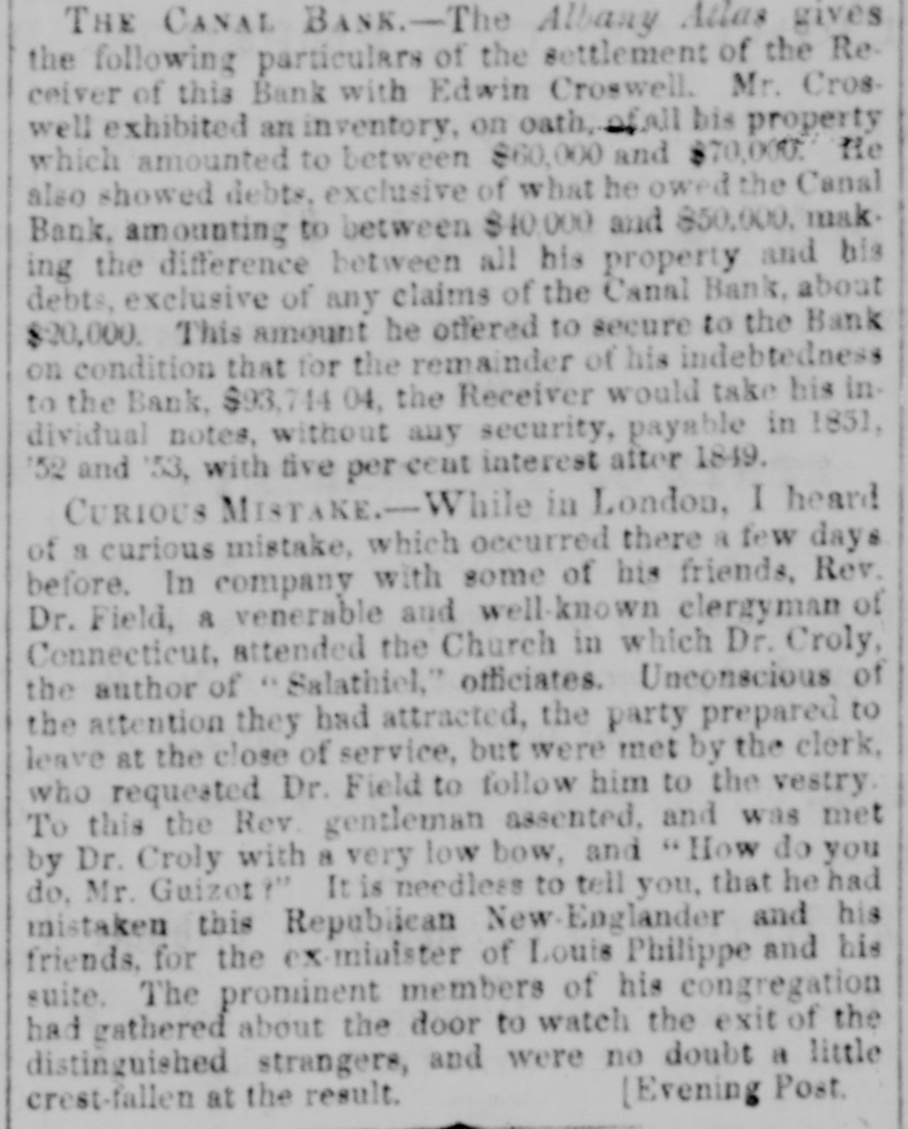
THE CANAL BANK.-The Albany Atlas gives the following particulars of the settlement of the Receiver of this Bank with Edwin Croswell. Mr. Cros. well exhibited an inventory, on oath, all bis property which amounted to between $60,000 and $70,000. He also showed debts, exclusive of what he owed the Canal Bank, amounting to between $40,000 and 850,000. mak ing the difference between all his property and his debts, exclusive of any claims of the Canal Bank, about $20,000. This amount he offered to secure to the Bank on condition that for the remainder of his indebtedness to the Bank, $93,744 04, the Receiver would take his individual notes, without any security, payable in 1851, 52 and '33, with tive per cent interest after 1849. CURIOUS MISTAKE.- - in London, I heard of 8 curious mistake, which occurred there a few days before. In company with some of his friends, Rev. Dr. Field, 8 venerable and well-known clergyman of Connecticut, attended the Church in which Dr. Croly, the author of "Salathiel," officiates. Unconscious of the attention they had attracted, the party prepared to leave at the close of service, but were met by the clerk, who requested Dr. Field to follow him to the vestry. To this the Rev gentleman assented, and was met by Dr. Croly with a very low bow, and "How do you do, Mr. Guizot?" It is needless to tell you, that he had mistaken this Republican New-Englander and his friends. for the ex-minister of Louis Philippe and his suite. The prominent members of his congregation had gathered about the door to watch the exit of the distinguished strangers, and were no doubt a little [Evening Post crest-fallen at the result.


Article from New-York Daily Tribune, March 15, 1849

Click image to open full size in new tab

Article Text

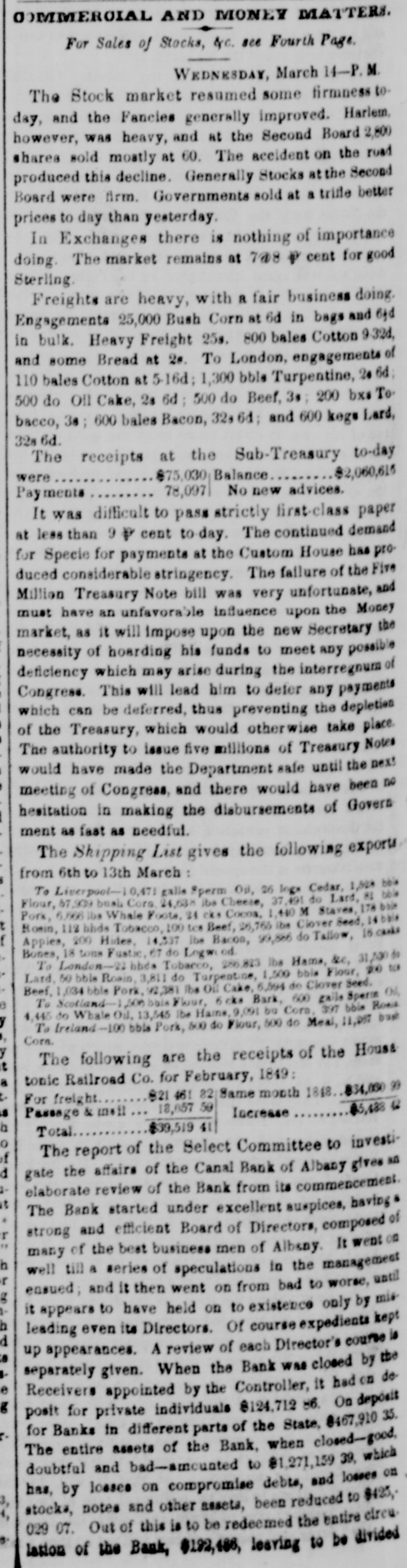
OOMMEROIAL AND MONEY MATTERS. For Sales of Stocks, & see Fourth Page. WEDNESDAY, March 14-P.M. The Stock market resumed some firmness day, and the Fancies generally improved. Harlem however, was heavy, and at the Second Board 2,800 shares sold mostly at 60. The accident on the road produced this decline. Generally Stocks at the Second Board were firm. Governments sold at a tride better prices to day than yesterday. In Exchanges there is nothing of importance doing. The market remains at 7@8 P cent for good Sterling Freights are heavy, with a fair business doing. Engagements 25,000 Bush Corn at 6d in bags and 6jd in bulk. Heavy Freight 25s. 800 bales Cotton 932d, and some Bread at 2s. To London, engagements of 110 bales Cotton at 5-16d; 1,300 bble Turpentine, 2.6d 500 do Oil Cake, 2a 6d ; 500 do Beef, 3s; 200 bx: To bacco, 38; 600 bales Bacon, 32.6d; and 600 kegs Lard, 32a 6d. The receipts at the Sub-Treasury to-day $2,060,615 $75,030 Balance were No new advices. 78,097 Payments It was difficult to pass strictly first-class paper at less than 9 P cent to day. The continued demand for for at the Custom House has proconsiderable The failure duced Specie payments stringency. of the Five and Million Treasury Note bill was very unfortunate, must have an unfavorable influence upon the Money market, as it will impose upon the new Secretary the necessity of hoarding his funds to meet any possible deficiency which may arise during the interregnum of Congress. This will lead him to defer any payments which can be deferred, thus preventing the depletion of the Treasury, which would otherwise take place. The authority to issue five millions of Treasury Notes would have made the Department safe until the next meeting of Congress and there would have been no hesitation in making the disbursements of Govern ment as fast as needful. The Shipping List gives the following exports from 6th to 13th March To Liverpuel- 10,471 galls sperm Oil, 26 logs Cedar, 1,192 bble bbir Flour, 67,939 bush Cors 24,638 lbs Cheese, 37,491 do Lard, Pork, 6,666 lbs Whale Foots, 24 cks Cocoa, 1,440 M Staves, 14 bale t Rosin, 112 bhds Tobacco, 100 to Beef, 26,765 Clover Seed, f Apples, 200 Hides, 14,337 lbs Bacon, 99,866 do Tallow, 16 casks Bones, 18 tons Fustic, er do Logw ed. To London-2 hada Tobacco, 286.823 lbs Hame, sec, 31,530.00 20 to . Lard. 50 bbls Roain, 3,811 do Turpentine, 1,500 bbie Flour, Oil, Beef. bble Pork,92,381 lbs Oil Cake, 6,594 de Clover seed. e To Scotland-1,500 balal Flour, 6 cks Bark, 600 gails Speris Road 4,445 do Whale 04,13,545 lbe Hame, 9,091 be Cora. 397 bbin bust y To Ireland-100 bbla Pork, 500 do Flour, 500 do Meal, 11,087 , Corn. y The following are the receipts of the House t tonic Railroad Co. for February, 1849: a 82 Same month 1848 $34,080.99 461 821 C. For freight & 18,057 50 $5,488 s Increase Passage & meil a $39,519 41 Total O The report of the Select Committee to investiof the affairs of the Canal Bank of Albany gives in d 1of the Bank from its t started under excellent suspices, * gate elaborate The Bank review commencement. having of strong and efficient Board of Directors, composed r 13 of the best business men of Albeny It h well till a series of in the many speculations management went until on r ensued and it then went on from bad to worse, g to have held on to existence only 1. h even its Directors. of course expedients d it leading appears course by kept mis is up A review of each Director's When the Bank was closed e Receivers the Controller, it had on separately appearances. given. appointed by deposit by the deg posit for private individuals $124,712 86. On for in different of the State, of the Bank, when The Banks entire assets parts closed-good $467,910 which 35. doubtful and bad-amounted to $1,271,159 39, leases on compromise debts, and losses on 3, and other assets, been reduced to 4, stocks, has, by notes $425, circu. 07. Out of this is to be redeemed the entire 029 lation of the Bank, $192,486, learing to be divided


Article from New-York Daily Tribune, April 26, 1849

Click image to open full size in new tab

Article Text

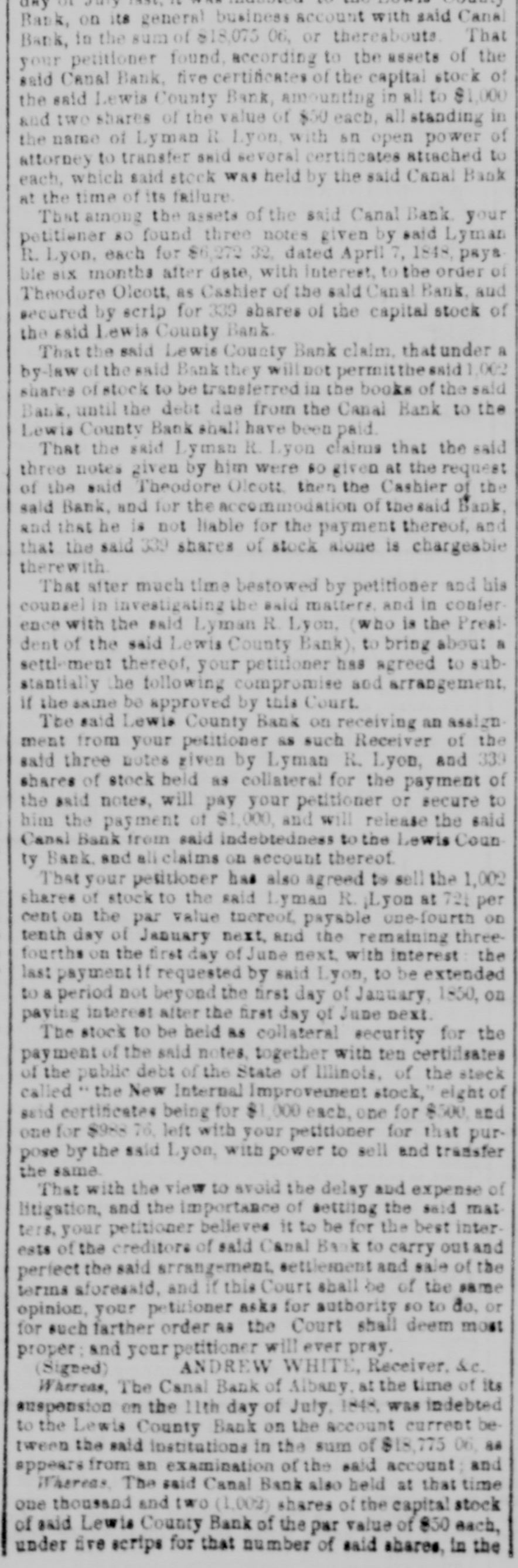
day 1/1 dury Bank, on its general business account with said Canal Bank, in the sum of $18,073 06, or thereabouts That your petitioner found according to the assets of the said Canal Bank, five certificates of the capital stock of the said Lewis County Bank amounting in all to $1,000 and two shares of the value of $50 each, all standing in the name of Lyman R Lyon with sn open power of attorney to transfer said several certificates attached to each, which said stock was held by the said Canal Bank at the time of its failure That among the assets of the said Canal Bank your petitioner 80 found three notes given by said Lyman R. Lyon. each for $6,272 32. dated April 1848, paya bie SIX months after date with interest to the order of Theodore Olcott. as Cashier of the said Canal Bank and secured by scrip for 339 shares of the capital stock of the said Lewis County Bank That the said Lewis County Bank claim, that under a by-law of the said Bank they will not permitthe said 1,002 shares of stock to be transferred in the books of the said Bank, until the debt due from the Canal Bank to the Lewis County Bank shall have been paid. That the said Lyman R. Lyon claims that the said three notes given by him were 80 given at the request of the said Theodore Olcott then the Cashier of the said Bank, and for the accommodation of thesaid Bank and that he is not liable for the payment thereof, and that the said 339 shares of stock alone is chargeable therewith That after much time bestowed by petitioner and his counsel in investigating the anid matters and in confer ence with the said Lyman R Lyon, (who is the President of the said Lewis County Bank), to bring about a settlement thereof, your petitioner has agreed to sub. stantially the following compromise and arrangement, if the same be approved by this Court. The said Lewis County Bank on receiving an assignment from your petitioner as such Receiver of the said three notes given by Lyman R. Lyon, and 339 shares of stock held as collateral for the payment of the said notes, will pay your petitioner or secure to him the payment of $1,000, and will release the said Canal Bank from said indebtedness to the Lewis Coun ty Bank and all claims on account thereof. That your petitlober has also agreed to sell the 1,002 shares of stock to the said Lyman R. ;Lyon at 721 per cent on the par value thereof, payable one-fourth on tenth day of January next and the remaining threefourth on the first day of June next with interest the last payment if requested by said Lyon, to be extended to & period not beyond the first day of January 1850, on paying interest after the first day of June next The stock to be held as collateral security for the payment of the said notes, together with ten certificates of the public debt of the State of Illinois. of the stock called the New Internal Improvement stock, eight of said certificates being for $1,000 each one for 8500 and one for $988 76. left with your petitioner for that purpose by the said Lyon, with power to sell and transfer the same That with the view to avoid the delay and expense of litigation, and the importance of settling the said mat ters. your petitioner believes it to be for the best interests of the creditore of said Canal Bank to carry out and perfect the said arrangement settlement and sale of the terms sforesaid and if this Court shall be of the same opinion, your petitioner asks for authority so to do. or for such farther order as the Court shall deem most proper and your petitioner will ever pray. ANDREW WHITE, Receiver. &.c. (Signed) Whereas, The Canal Bank of Albany, at the time of its suspension on the 11th day of July, 1848, was indebted to the Lewis County Bank on the account current be tween the said Institutions in the sum of $18,775 06 as appears from an examination of the said account; and Whereas The said Canal Bank also held at that time one thousand and two (1,002) shares of the capital stock of said Lewis County Bank of the par value of 850 each, under five scrips for that number of said shares, in the


Article from The New York Herald, May 4, 1849

Click image to open full size in new tab

Article Text

DIVIDENDS OF PHILADELPHIA BANKS. Capitals. Div. Am't. pd out. 5 Mechanics' Bank $800,000 per cent, $10,000 4 Farmers' and Mechanics' Bank. 1,250,000 50,000 " ( emmercial Bank. 4 1,000,000 40,000 " Southwark Bank. 250,000 5 12,500 " 5 250,000 Kensington Bank 12,500 " 5 225,000 Penn Township Bank 11,250 " Western Bank 5 500,000 25,000 " 4 Manut'trs' and Mechanics' Bank 300,000 12,000 Total $1,575,000 $213,250 The dividends, it will be seen, are all large, and in two cases, where the capitals have been increased, the dividends are on the increased capital. The Philadelphia Bank, with a capital of $1,150,000, declares its semi-annual dividend next Monday; the Bank of Northern Liberties the same day, on a capital of $350,000. 1 he receiver of the Canal Bank of Albany at present contemplates paying the final dividend (40 per cent) upon the circulating bills of that bank on the first day of July next. The first dividend on the notes of this bank (60 per cent) was payable on the 24th day of January last. and there yet remains unpaid of the circulation (which was, when the bank failed, $192,000) about $35,000. There remains unredeemed of the unregistered bills now in circulation about $3,000, all of which has been out for nearlysten years, and a portion 01 which, it is probable. will never be presented for payment No definite time can be given when the deposiLOTS will receive a dividend, nor canan opinion be given as to the amount of the sum to devdided.


Article from New-York Daily Tribune, June 14, 1849

Click image to open full size in new tab

Article Text

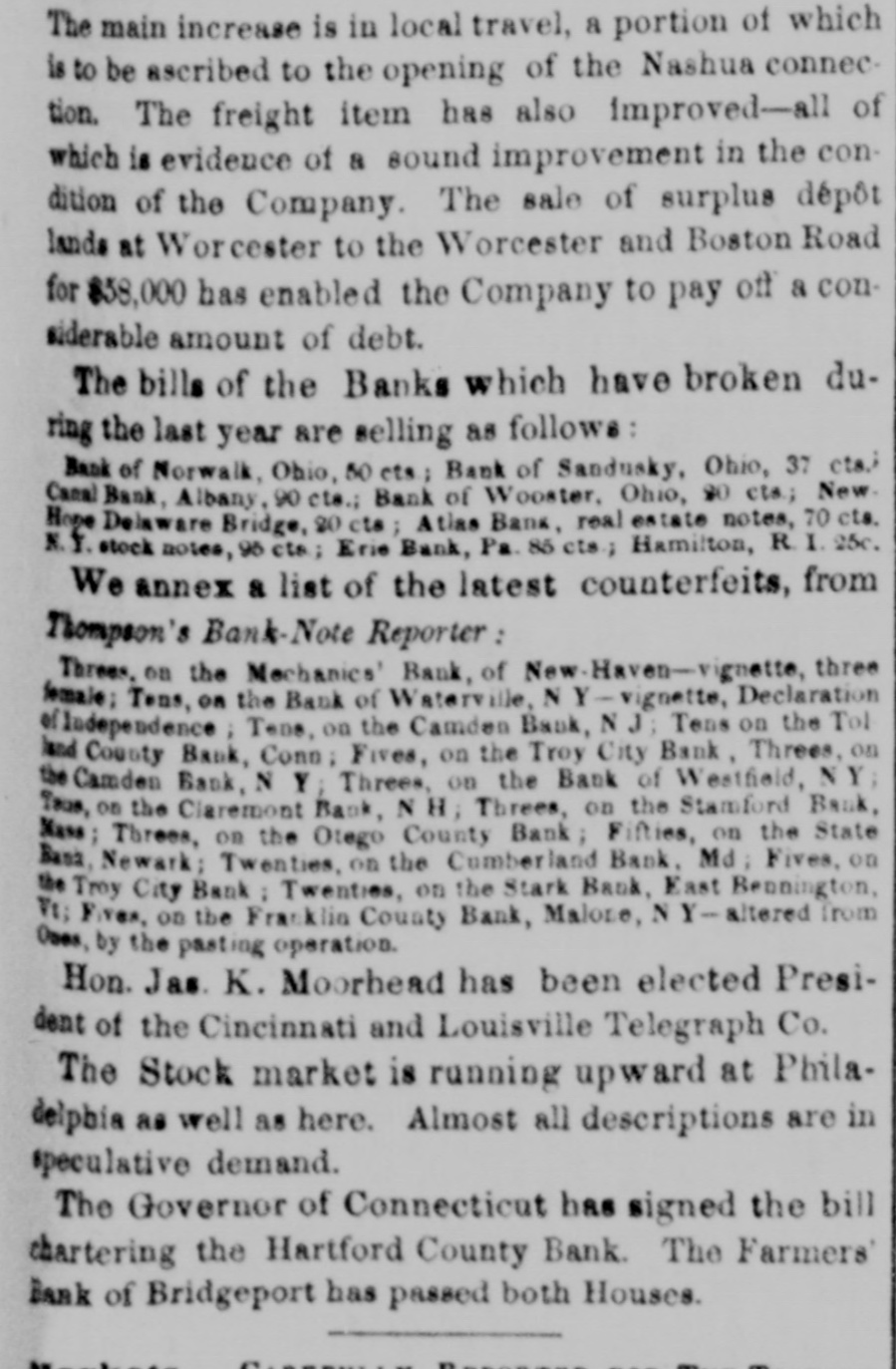
The main increase is in local travel, a portion of which is to be ascribed to the opening of the Nashua connection. The freight item has also improved—all of which is evidence of a sound improvement in the condition of the Company. The sale of surplus dépôt lands at Worcester to the Worcester and Boston Road for $58,000 has enabled the Company to pay off a considerable amount of debt. The bills of the Banks which have broken during the last year are selling as follows: Bank of Norwalk, Ohio, 50 cts; Bank of Sandusky, Ohio, 37 cts.; Canal Bank, Albany, 90 cts.; Bank of Wooster, Ohio, 20 cts.; New Hope Delaware Bridge, 20 cts; Atlas Bank, real estate notes, 70 cts. N. Y. stock notes, 95 cts; Erie Bank, Pa. 85 cts.; Hamilton, R. I. 25c. We annex a list of the latest counterfeits, from Thompson's Bank-Note Reporter: Threes, on the Mechanics' Bank, of New-Haven—vignette, three female; Tens, on the Bank of Waterville, N Y—vignette, Declaration of Independence; Tens, on the Camden Bank, N J; Tens on the Tolland County Bank, Conn; Fives, on the Troy City Bank, Threes, on the Camden Bank, N Y; Threes, on the Bank of Westfield, N Y; Tens, on the Claremont Bank, N H; Threes, on the Stamford Bank, Mass; Threes, on the Otego County Bank; Fifties, on the State Bank, Newark; Twenties, on the Cumberland Bank, Md; Fives, on the Troy City Bank; Twenties, on the Stark Bank, East Bennington, Vt; Fives, on the Franklin County Bank, Malone, N Y—altered from Ones, by the pasting operation. Hon. Jas. K. Moorhead has been elected President of the Cincinnati and Louisville Telegraph Co. The Stock market is running upward at Philadelphia as well as here. Almost all descriptions are in speculative demand. The Governor of Connecticut has signed the bill chartering the Hartford County Bank. The Farmers' Bank of Bridgeport has passed both Houses.


Article from The New York Herald, July 12, 1849

Click image to open full size in new tab

Article Text

COMMERCIAL AFFAIRS. MONEY MARKET. Wednesday, July 11-6 P.M. The stock market was rather quiet to day; sales to a moderate extent. and prices without any material alteration. At the first board, to-day, Harlem declined 3/4 per cent; Canton advanced 1/6 per cent. and Reading Railroad 1/2. There was no change in government or State securities. At the second board the sales were confined principally to Canton, without any change in prices. The Hibernia, for Liverpool, takes out $6,048 in specie. The receipts at the office of the Assistant Treasurer of this port, to-day, amounted to $94.399; payments, $49,822 2 24; advices, $47,000, balance, $1,009,094 95. The Receiver of the Canal Bank of Albany has given notice that he will pay at his office, in that city, on and after the 16th of July instant, a final dividend of forty cents on the dollar, on the circulating notes or bills of said bank. This, with the dividend previously declared, pays the full value of all the notes or bills issued by said bank. The Brandon Bank has just gene into operation, with a capital of $150,000, at Branden, Vermont-John A. Conant, President, and L. Bixby, Cashier. The bills will be received at all the banks in Boston. In the statement made a few days since, showing the actual receipts of the Harlem Railroad Company, for the first six months of 1849, compared with the estimates of the company for the corresponding period, we said nothing about the actual and estimated expenditures. According to the estimates of the company, it appears the receipts are put down at $512,000. and the expenses at $210,000, or about 41 per cent. How the company arrived at this result, is a question of some importance. It appears, by the reportsrendered to the Legislature by the company, that the expenses for the past three years have increased in a greater ratio than their receipts; and if they continue to increase in the same proportion, before five years shall have elapsed, the running expenses of the road will exceed the gross income. NEW YORK AND HARLEN RAILROAD-RECEIPTO AND EXPENDITURES. Receipts. Expenses. 1846 $182.085 7 $88,737 47 Equal to 481/4 per ct. 1847 255,211 07 136,268 82 531/6 " 1848 318.935 : 25 193,48, 27 603 It is well known that the expenses this year-1849will exceed any previous year. The receipts in 1848 were, from 53 miles of road; while those for 1849 will b from 82 miles of road. The expenses, therefore, will be proportionately large. In the event of the gross income this year reaching $420,000, it will average $5,122 per mile, against $6,018 per mile in 1848. In 1848 the running expenses per mile averaged $3,619. At the same rate per mile this year, the expenses will amount to $299,218, to be deducted from the gross earnings, which, from present appearances, will not exceed $420,000. This will leave just enough surplus to pay the eight per cent interest on the $1,500,000 preferred stock, leaving the interest on the floating debt unprovided for. The large per cent expenses on our railroads, is the pecret of their rottenness and insolvency. The stockholders are not benefitted in the least by large and increasing receipts, as they are in one way or another used up in expenses. "Running expenses and repair account" form the general reservoir into which the whole of the income goes-that is, when the roads are constructed the entire length; but when the roads are not completed, "construction account" is charged with all the running expenses over fifty per cent. This onebles the management to make favorable returns, and screens for a time their extravagance, or something worse. The quantity of flour, wheat, corn, and barley left at tide water during the last week in July, in the years 1848 and 1849, was as follows:Flow thle Wheat be Care the Declare he


Article from The New York Herald, January 15, 1852

Click image to open full size in new tab

Article Text

CONDITION OF THE CANAL FUNDS. The amount of Bank Fund stock held at the beginning of the year, has been reduced by a sale of $72,009 31 of said stock at par, from $209,481 33 to $157,372 02. Of the deposits in banks, (see doc. No 40, annexed) the sum of $1,284,405 19 is considered available, and the sum of $122,987 75 unavailable. The unavailable balance is less by $35,275 33 than last year. The balance due from the Lockport Bank last year of $23,450 has been paid. A dividend of $11,109 83 has been received from the receiver of the Canal Bank of Albany. I have no information of the prospect of realizing anything more from that concern. The debt of Walter Joy's Bank of Buffalo remains unpaid, and the legal proceedings for the collection of it are yet pending. An advance has been made of $20,354 06 to protect the real estate securities held from that bank from prior incumbrances. (This debt is still believed to be substantially secured. REVENUES AND EXPENDITURES OF THE FISCAL YEAR. Statement of the revenues of the State canals, and the expenses of collection, superintendence and ordinary repairs during the fiscal year ending the 30th September, 1851. Art. 7, sec 1, of the Constitution. RECEIPTS, Tolls.... $3.702.070 34 Rent of surplus water. 1.920 00 Interest on current canal revenue. &c... 18,163 77 Total.... $3,722.163 11 PAYMENTS.


Article from The New York Herald, February 24, 1852

Click image to open full size in new tab

Article Text

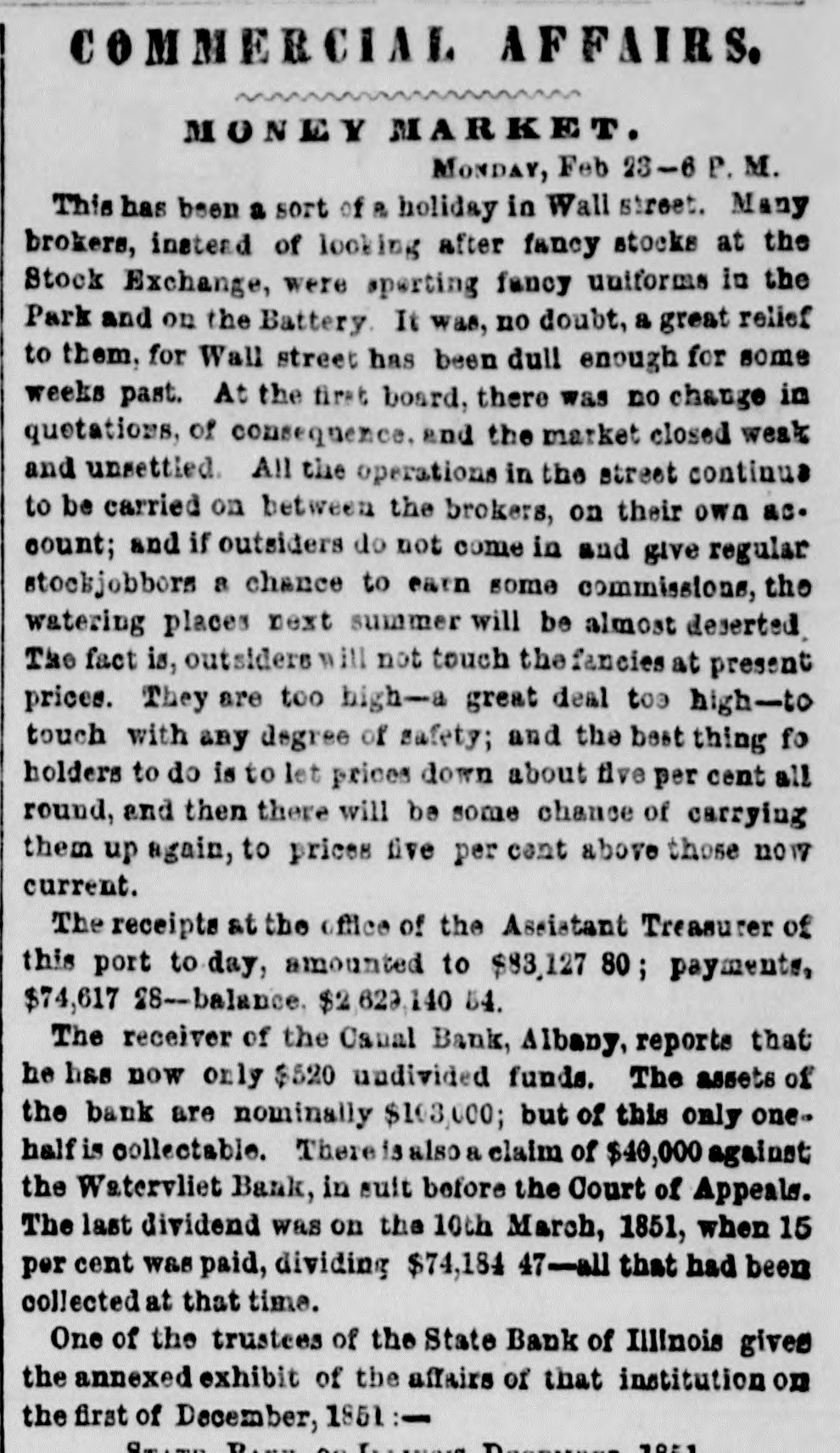
COMMERCIAL AFFAIRS. MONEY MARKET. MONDAY, Feb 23-6 P. M. This has been a sort of a holiday in Wall street. Many brokers, instead of looking after fancy stocks at the Stock Exchange, were sporting fancy uniforms in the Park and on the Battery It was, no doubt, a great relief to them. for Wall street has been dull enough for some weeks past. At the first board, there was no change in quetations, of consequence. and the market closed weak and unsettled All the operations in the street continua to be carried on between the brokers, on their own ac. count; and if outsiders do not come in and give regular stockjobbors a chance to earn some commissions, the watering places next summer will be almost deserted The fact is, outsiders will not touch the fancies at present prices. They are too high-a great deal too high touch with any degree of safety; and the best thing fo holders to do is to let prices down about five per cent all round, and then there will be some chance of carrying them up again, to prices five per cent above those now current. The receipts at the office of the Assistant Treasurer of this port to day, amounted to $83,127 80; payments, $74,617 28--balance. $2,629,140 54. The receiver of the Canal Bank, Albany, reports that he has now only $520 undivided funds. The assets of the bank are nominally $103,000; but of this only one. half is collectable. There is also a claim of $40,000 against the Watervliet Bank, in suit before the Court of Appeals. The last dividend was on the 10th March, 1851, when 15 per cent was paid, dividing $74,184 47-all that had been collected at that time. One of the trustees of the State Bank of Illinois gives the annexed exhibit of the affairs of that institution on the first of December, 1851 :-


Article from New-York Daily Tribune, April 23, 1852

Click image to open full size in new tab

Article Text

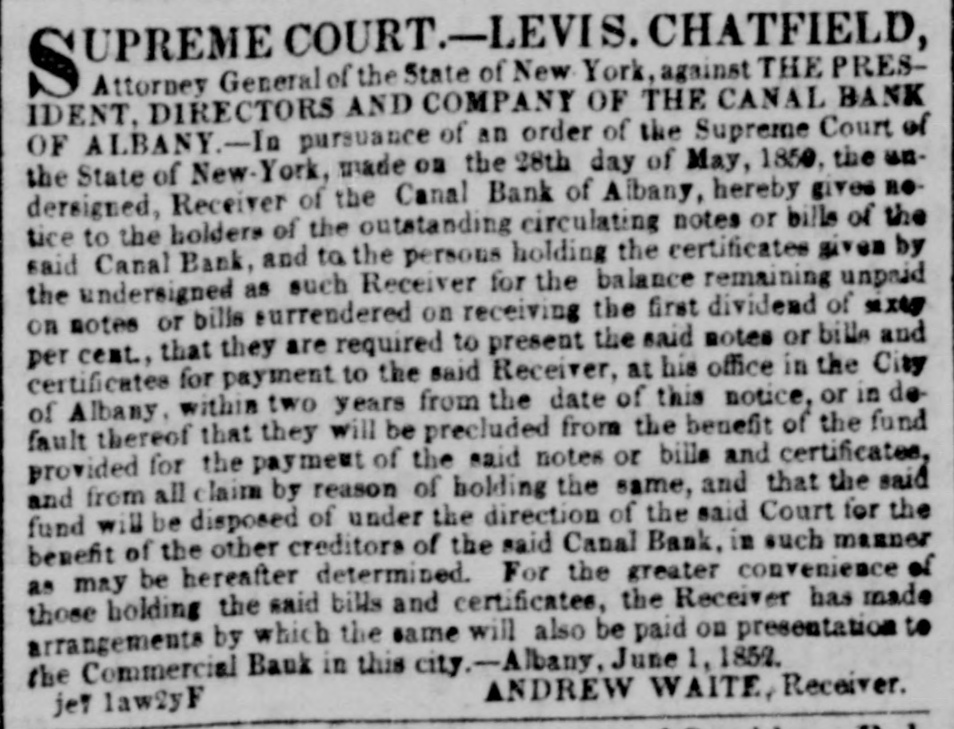
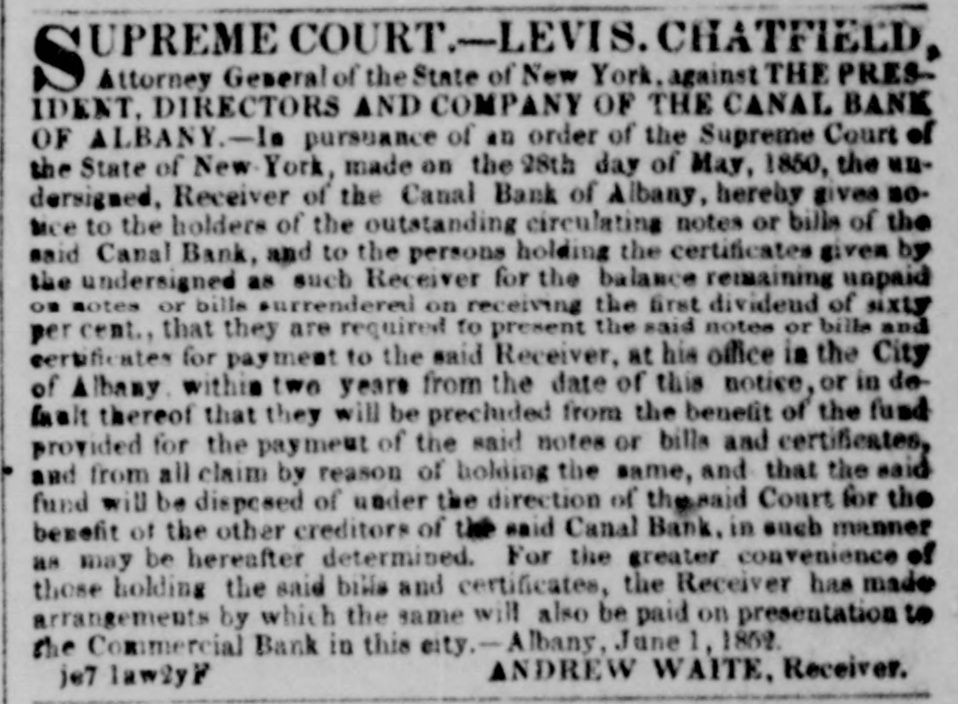
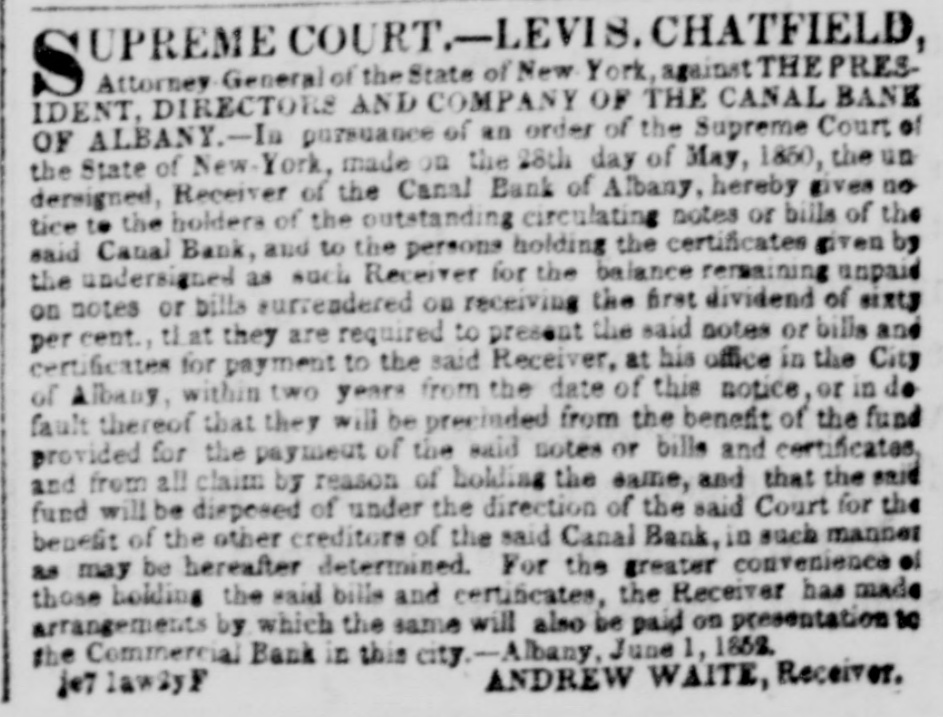
UPREME COURT.-LEVIS. CHATFIELD, Attorney General of the State of New York, against THE PRESIDENT. DIRECTORS AND COMPANY OF THE CANAL BANK OF ALBANY.-1 In pursuance of an order of the Supreme Court of the State of New-York, made on the 28th day of May, 1850, the undersigned, Receiver of the Canal Bank of Albany, hereby gives notice to the holders of the outstanding circulating notes or bills of the said Canal Bank, and to the persons holding the certificates given by the undersigned as such Receiver for the balance remaining unpaid on notes or bills surrendered on receiving the first dividend of sixes per cent., that they are required to present the said notes or bills and certificates for payment to the said Receiver, at his office in the City of Albany, within two years from the date of this notice, or in de fault thereof that they will be precluded from the benefit of the fund provided for the payment of the said notes or bills and certificates, and from all claim by reason of holding the same, and that the said fund will be disposed of under the direction of the said Court for the benefit of the other creditors of the said Canal Bank, in such manner as may be hereafter determined. For the greater convenience of those holding the said bills and certificates, the Receiver has made arrangements by which the same will also be paid on presentation to the Commercial Bauk in this city.-Albany,June1,1852 ANDREW WAITE, Receiver. jet law2yF


Article from New-York Daily Tribune, May 21, 1852

Click image to open full size in new tab

Article Text

UPREME COURT.-LEVIS CHATFIELD Attorney General of the State of New York, against THE PRES IDENT. DIRECTORS AND COMPANY OF THE CANAL BANK OF ALBANY.- la pursuance of an order of the Supreme Court of the State of New York, made on the 28th day of May, 1850, the undersigned, Receiver of the Canal Bank of Albany, hereby gives soMce to the holders of the outstanding circulating notes or bills of the said Canal Bank, and to the persons holding the certificates given by the undersigned as such Receiver for the balance remaining unpaid on notes or bills surrendered on receiving the first divideud of axiy per cent., that they are required to present the said notes or billa and certificates for payment to the said Receiver, at his office in the City of Albany within two years from the date of this notice, or in defast thereof that they will be precluded from the benefit of the fund provided for the payment of the said notes or bills and certificates, and from all claim by reason of holding the same, and that the said fund will be disposed of under the direction of the maid Court for the benefit of the other creditors of the said Canal Bank. in such manner as may be hereafter determined. For the greater convenience of those holding the said bills and certificates, the Receiver has made arrangements by which the same will also be paid on presentation to the Commercial Bank in this city. - Albany, June 1, 1859. ANDREW WAITE, Receiver. je7 law2yF


Article from Iowa Capitol Reporter, June 9, 1852

Click image to open full size in new tab

Article Text

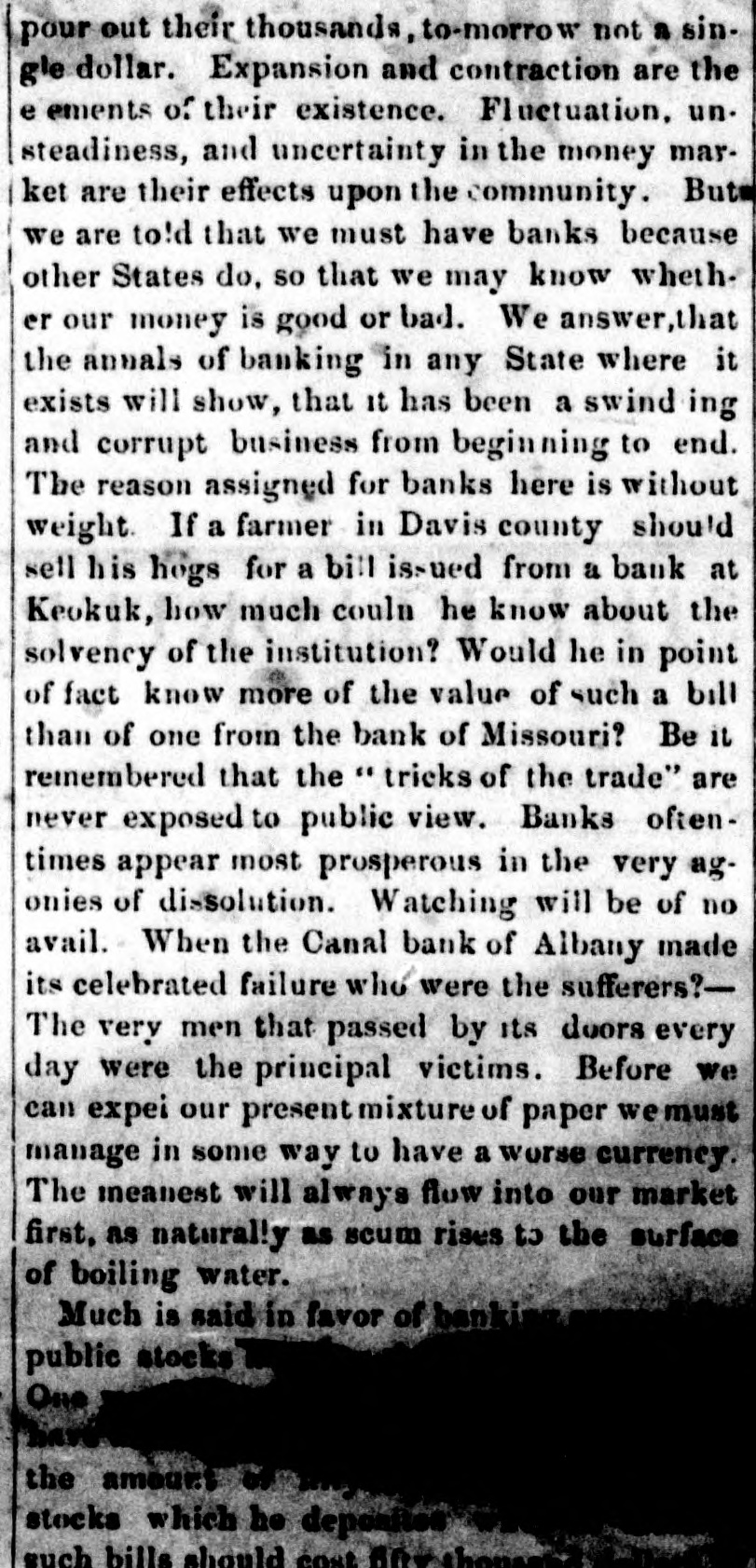
pour out their thousands, to-morrow not a single dollar. Expansion and contraction are the elements of their existence. Fluctuation, unsteadiness, and uncertainty in the money market are their effects upon the community. But we are told that we must have banks because other States do, so that we may know whether our money is good or bad. We answer, that the annals of banking in any State where it exists will show, that it has been a swindling and corrupt business from beginning to end. The reason assigned for banks here is without weight. If a farmer in Davis county shou'd sell his hogs for a bill issued from a bank at Keokuk, how much couln he know about the solvency of the institution? Would he in point of fact know more of the value of such a bill than of one from the bank of Missouri? Be it remembered that the "tricks of the trade" are never exposed to public view. Banks oftentimes appear most prosperous in the very agonies of dissolution. Watching will be of no avail. When the Canal bank of Albany made its celebrated failure who were the sufferers? The very men that passed by its doors every day were the principal victims. Before we can expei our present mixture of paper we must manage in some way to have a worse currency. The meanest will always flow into our market first, as naturally as scum rises to the surface of boiling water. Much is said in favor of banking public stocks One the amount of stocks which he deposites such bills should cost fifty thou


Article from The Miners' Express, June 16, 1852

Click image to open full size in new tab

Article Text

and irresistable. army of hi and hirelings might be thrown into State under pretext of improving the country but truth contra the election and grand scheine of espionage and would be establish before which would melt wax the hat Ge The but those loca with from the Public Treasury contend that Congress should improv the navigation of the Mississippi over its jurisdiction great tional but we rightfully take the money of the nation seat build road canal from one county the same either another State, benefit "to localities such the county Congress adopting this Whig "right and nation, duty" must of necessity bankrupt or be guilty of great partiality and injustice Suppose the National egislature should ten thousand dollars for harbor Bu wharf at Keokuk. would not Madison, lington, the right the purpose navigable the United States, waters could made navigabl waters in the of the country equal appropriations What should be theresult of such policy? Favoritism special privileges, and class legislation, on the one hand, and Bankruptcy, a National debt, and high taxes on the other Democrats are charged with inconsistency for being in favor of soine Improvements and not for all The line that separates National from State improvements may not be apparent to eye, but cannot be said therefore not to exist. In all cases where concurrent vested in the two Gove rnments, the exact which such powers diverge gener difficult to find, but none the less true, that lines of demarkation do exist, and that some things are clearly one side of them, and some ob things as clearly the other To remove structions from the dississippi river plainly national work dig out Mud creek in he middle of Illinois, plainly State work The Democrats are in favor of using the nation money for the former. and opposed its use the latter, Whiggery is in favor of using for both Donations of the public lands to the States in which they lie for purposes of improvement are alledged to be contrary to our creed This deny. Suppose hundred citizens and the General are contiguous land hold ers. They agree build railroad through each one and con their his and means, the tributes in work A made This clearly Democratic grant of land which doubles the value of another entir ly diffierent from mere gratuof money paid into the Public Treasury for support of Government, and not to squandered gifts to its favorites In the case Government loges nothing, in the everything given. We submit. fellow system. whether permanent securing zens, the integrity of the Union, the rights of the States, and the purity of legislation. the dem ocratic doctrine on this subject is not wiser better than the whig, and we are confi dent that no appeals or local feeling blind the honest men to the value of principle Constitu State our whig because the General sembly create banks This without Bank Whiggerv surprise Chinese household without its God. The morning and evening incense of political adoration the Deity, the desert may pour in'o the lap of the hus bandman Education and virture may exalt the people social comforts may abound but from all these higgery turns with indifference bank and for sighs see back thy let my thy me voice is and thy to lv thy the fellew matter. plain question wiser, bet propose the of people Iowa with be happier them the than banks Does chant receive fair equivalent for his goods for and the the farmer produce, for merchant his labor? D these w ho work thrive de this State with industry and economy bank be to elsewhere establish Suppose ed. who will allowed to borrow its pictured Will promises blacksmiths its favorites Will the day laborer, or the more fortunate log cabin and quarter acction of land bask in its golden smiles? The history of banking the contrary Stock holders, specula the shavers. social tors, brokers. and cater pillars which into life and fattens up its allow of the banking as desired whigs, to by trol the monetary ffairs of the State. It legitimate function in provide medium of exchange for the people, and festly wrong for half a dozen persons to usurp and exercise such power to the exclusion others Currency the life blood of the busiworld. should be sound and equable but banks make the reverse. To day they may pour out thousands. to morrow single dollar. Expansion and contraction are the elements of their existence "Inctuation, unsteadiness, and uncertainty in the money market are their upon the community But are told that we must have banks be other know States cause bad whethe We good our ans wer, that the banking in any State where exists show, that has been swindling and corrupt business from beginning end The assigned for banks here without weight farmer in Davis co should sell his hogs bill issued from bank Keokuk, how could he know about the solvency of the institution he point of fact know more of the value of such bill Be than of one from the bank of Missouri remembered that the "tricks the trade never exposed to public view. Banks often times appear most presperous in the very ago nies of dissolution. Watching will be of no avail When the Canal bank of Albany made its celebrated failure who were the sufferers The very men that passed by day were the principal victims mixture of man must present some The meanest into our naturally scum rises to the surface of Much said in banking secured by stocks public Illinois One word upon he which from the bank thousand of amount the fifty which he deposites when he such bills the make should cost fifty thousand dollars take bill holders safe Why could not A then money hich he pays for the and loan and as he which but represent The would be much d. but the truth busi forward straigt plain, body can uuderstan the crooked various chances operation frauds and speculation Banks produce They add nothing to the real wealth society, and immense fortunes hich their sucke out of the substa of the people With our Constitution unchan The not may money Kings and Splendor luxury and ling mag nificence dazzle our eyes every hand may not be common, but there will be equal distribution of prop with moderate tortunes of comfortable under the regime the banks thousand then that the citizens of this State and the hue and upon this sub think has been chiefly raised by greedy


Article from New-York Daily Tribune, August 13, 1852

Click image to open full size in new tab

Article Text

UPREME COURT.-LEVIS.CHATFIELD, Attorney General of the State of New York, against THE PRES S IDENT, DIRECTORS AND COMPANY OF THE CANAL BANK OF ALBANY.- - In pursuance of an order of the Supreme Court of the State of New York, made on the 28th day of May, 1850, the un dersigned, Receiver of the Canal Bank of Albany, hereby gives no tice to the holders of the outstanding circulating notes or bills of the said Canal Bank, and to the persons holding the certificates given by the undersigned as such Receiver for the balance remaining unpaid on notes or bills surrendered on receiving the first dividend of sixty per cent., tl at they are required to present the said notes or bills and certificates for payment to the said Receiver, at his office in the City of Albany, within two years from the date of this notice, or in do fault thereof that they will be precinded from the benefit of the fund provided for the payment of the said notes or bills and certificates, and from all claim by reason of holding the same, and that the said fund will be disposed of under the direction of the said Court for the benefit of the other creditors of the said Canal Bank, in such manner as may be hereafter determined. For the greater convenience of those bolding the said bills and certificates, the Receiver has made arrangements by which the same will also be paid on presentation to the Commercial Bank in this ANDREW WAITE, Receiver. je7 lawlyF