City National Bank (Kearney, NE)

Episode Information

Episode Type
Suspension โ†’ Closure
Start Date
May 14, 1927
Location
Kearney, Nebraska (40.699, -99.081)
Bank Type
national
Charter Number
13013

Metadata

Receivership Details

Depositor recovery rate
50.9%
Date receivership started
1927-05-14
Date receivership terminated
1932-11-01
OCC cause of failure
Governance
Share of assets assessed as good
28.9%
Share of assets assessed as doubtful
70.2%
Share of assets assessed as worthless
0.9%

Notes

Used the known receivership date (May 14, 1927) as the closure/receivership date mentioned by later articles.

Events (6)

1. December 8, 1926 Chartered
Source
historical_nic
2. May 14, 1927 Suspension
Cause
Bank Specific Adverse Info
Cause Details
Bank failed/broke in May 1927 leading to appointment of a receiver.
Newspaper Excerpt
the bank broke last May
Source
newspapers
3. May 14, 1927 Receivership
Newspaper Excerpt
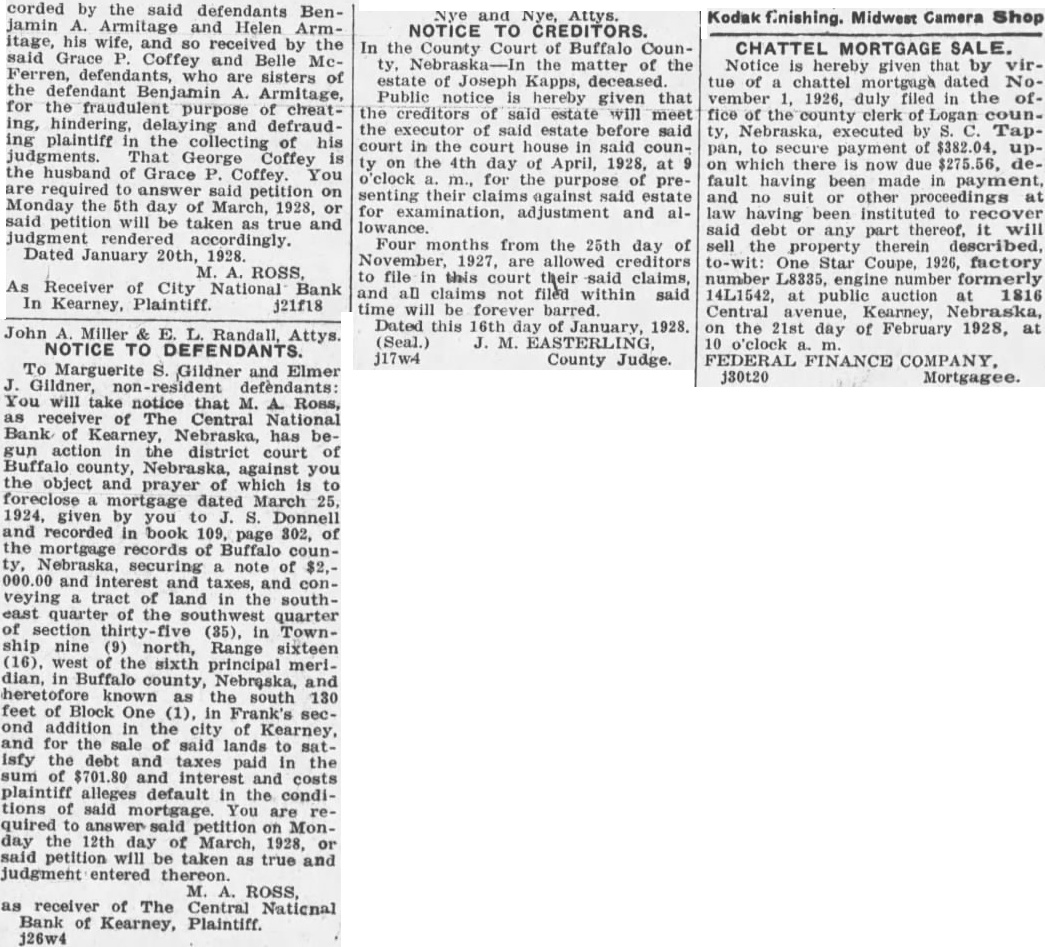
M. Ross, as receiver City National Bank in Kearney, Nebraska, plaintiff, has begun an action ... M. Ross, As Receiver of City National Bank In Kearney, Plaintiff. j21f18
Source
newspapers
4. May 14, 1927 Receivership
Source
historical_nic
5. April 12, 1928 Other
Newspaper Excerpt
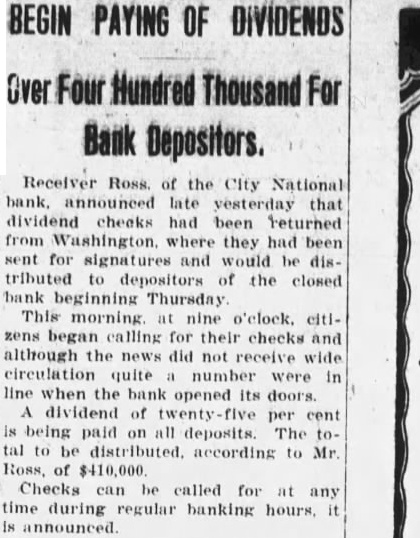
BEGIN PAYING OF DIVIDENDS ... dividend of twenty-five per cent is being paid on all deposits. Checks can be called for at any time during regular banking hours, it announced.
Source
newspapers
6. May 8, 1931 Other
Newspaper Excerpt
Building and equipment of the old City National bank here are to be sold. Sealed bids on the property will be received tomorrow. Right has been reserved by the comptroller of currency to reject any and all bids and provision is made for occupancy of the bank offices by bank receivers until the affairs of the closed bank have been cleared up.
Source
newspapers

Newspaper Articles (10)

Article from Kearney Hub, February 11, 1928

Click image to open full size in new tab

Article Text

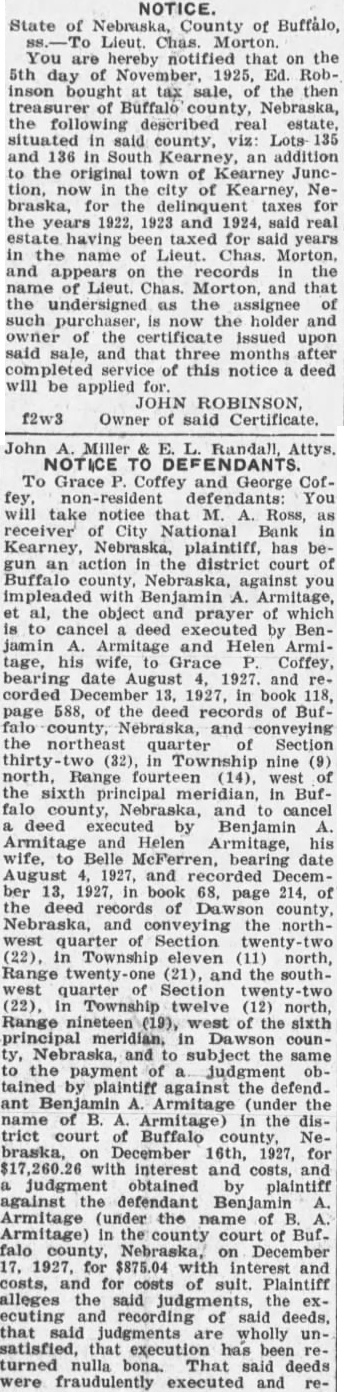
NOTICE. State of Nebruska, County of Buffรกlo, Lieut. Chas. You are hereby notified that on the 5th day of November, 1925, Ed. Robinson bought tax sale, of the then treasurer of Buffalo county, Nebraska, the following described real estate, situated in said county, viz: Lots- 135 and in South Kearney, an addition to the original town of Kearney Junetion, now in the city of Kearney, Nebraska, for the taxes for the years 1922, 1923 and 1924, said real having been taxed for said years in the name of Lieut. Chas. Morton. and appears the records in the name of Lieut. Chas. Morton, and that the undersigned as the assignee of such purchaser, is now the holder and owner of the certificate issued upon said sale, and that three months after completed service of this notice deed will be applied for. JOHN f2w3 Owner of said Certificate. John Miller E. Randall, Attys. NOTICE TO DEFENDANTS. To Grace P. Coffey and George Coffey, non-resident defendants: You will take notice that M. A. Ross, as receiver City National Bank in Kearney, Nebraska, plaintiff, has begun an action in the district court of Buffalo county, Nebraska, against you impleaded with Benjamin A. Armitage, al, the object and prayer of which to deed executed by Benjamin and Helen Armitage, his wife, to Grace Coffey, bearing date August 1927. and recorded December 13, 1927, in book 118, page 588, of the deed records of Buffalo county, Nebraska, and conveying the northeast quarter Section (32), in Township nine (9) north, Range (14), west of the sixth principal in Buffalo Nebraska, and to cancel deed by Benjamin A. Armitage and Helen Armitage, his wife, to Belle McFerren, bearing date August 1927, and recorded December 13, 1927, in book 68, page 214, of the deed records of Dawson county, Nebraska, and conveying the northwest of Section (22), in Township eleven (11) north, Range twenty-one (21), and the southwest quarter of Section (22), in Township twelve (12) north, Range nineteen (19), west of the sixth principal meridian, county, Nebraska, and to subject the same to the payment of judgment obtained by plaintiff against the defend. ant Benjamin A. Armitage (under the name of B. Armitage) in the district court of Buffalo county. Nebraska, December 16th, 1927, for with interest and costs, and a judgment obtained by plaintiff against the defendant Benjamin A. Armitage (under the name of B. Armitage) the county court of Buffalo county, Nebraska, on December 17. 1927, for $875.04 with interest and costs, and for costs of suit. Plaintiff alleges the said judgments, the executing and recording of said deeds, that said judgments are wholly unsatisfied, that execution has been returned nulla bona. That said deeds were fraudulently executed and re-
Article from Kearney Hub, February 11, 1928

Click image to open full size in new tab

Article Text

corded by the said defendants Benjamin Armitage and Helen Armitage, his wife, 80 received by the said Grace Coffey and Belle McFerren, defendants, are sisters of the defendant Benjamin A. Armitage, for the fraudulent purpose of cheating, hindering, and defrauding plaintiff in the collecting of his judgments. That George Coffey is the husband of Grace P. Coffey. You are required to answer said petition on Monday the 5th day of March, 1928, or said petition will be taken as true and rendered Dated January 20th, 1928. M. ROSS, As Receiver of City National Bank In Kearney, Plaintiff. j21f18 John Miller & E. L. Randall, Attys. NOTICE TO DEFENDANTS. To Marguerite S. Gildner and Elmer J. defendants: You will take notice that M. Ross, as of The Central National Bank of Nebraska, has begun in the district court of Buffalo county, Nebraska, against you the object and prayer of which is to foreclose mortgage dated March 25, 1924, given by you to S. Donnell and recorded in book 109, page 302, of the mortgage records of Buffalo counNebraska, securing note of $2,and Interest and taxes, and conveying tract of land in the southeast quarter of the quarter of section (35), in Township nine (9) north, Range sixteen (16), west of the sixth principal meridian, in Buffalo county, Nebraska, and heretofore known as the south 130 feet of Block One (1), in Frank's second addition in the city of Kearney, and for the sale of said lands to satisfy the debt and taxes paid in the sum of $701.80 and interest and costs plaintiff default in the conditions of said mortgage are required petition on Monday the 12th day of March, 1928, or said petition will be taken as true and judgment entered thereon. as receiver of The Central National Bank of Kearney, Plaintiff. j26w4 Nye and Nye, Attys. NOTICE TO CREDITORS. In the County Court of Buffalo County, the matter of the of Joseph Kapps, Public hereby given that the creditors of said estate will meet the executor of said estate before said court in the court house in said county on the 4th day of April, 1928, o'clock m., for the purpose of presenting their claims against said estate for examination, adjustment and allowance. Four from the 25th day of 1927, are creditors to file this court their said claims, and all not filed within said time will be barred. Dated this 16th day of January, 1928. (Seal.) J. M. EASTERLING. j17w4 County Judge. Kodak finishing. Midwest Camera Shop CHATTEL MORTGAGE SALE. Notice is given by virtue of chattel dated November 1926, duly filed in the office the clerk of Logan county, Nebraska, executed by Tappan, to secure payment of $382.04, upon which there now due $275.56, default having been made in payment, and no suit or other proceedings at law having been instituted to recover said debt any part thereof. it will sell the property to-wit: One Star Coupe, 1926, factory number L8335, formerly 14L1542, at public auction at 1816 Central Kearney, Nebraska, on the 21st day of February 1928, at o'clock FEDERAL FINANCE COMPANY, j30t20 Mortgagee.


Article from Kearney Hub, April 12, 1928

Click image to open full size in new tab

Article Text

BEGIN PAYING OF DIVIDENDS Over Four Hundred Thousand For Bank Depositors. Receiver Ross. of the City National bank, announced late yesterday that dividend checks had been returned from Washington where they had been sent for signatures and would be distributed to depositors of the closed bank beginning Thursday This morning at nine o'clock. citizens began calling for their checks and although the news did not receive wide circulation quite number were in line when the bank opened its doors dividend of twenty-five per cent is being paid on all deposits. The total to be distributed. according to Mr. Ross, of $410,000 Checks can be called for at any time during regular banking hours, it announced.


Article from The Pilot-Tribune, April 25, 1928

Click image to open full size in new tab

Article Text

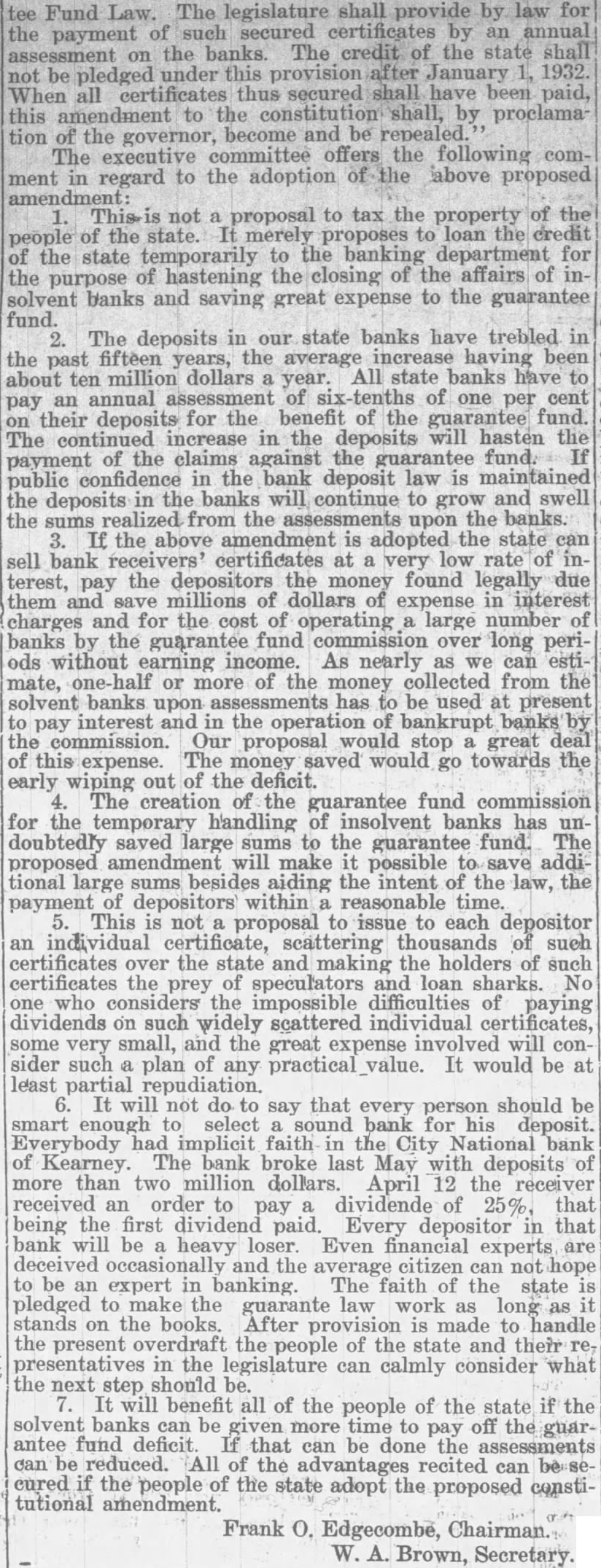
tee Fund Law. The legislature shall provide by law the payment of such secured certificates by an annual assessment on the banks. The credit of the state shall under this provision after January 1932. not be pledged all certificates thus secured shall have been paid, When this amendment to the shall, by proclamation of the governor, become and be repealed. The executive committee offers the following comment in regard to the adoption of the above proposed amendment: This is not proposal to tax the property of the of the state. merely to loan the credit people proposes of the state temporarily to the banking department for the purpose of hastening the closing of the affairs of solvent banks and saving great expense to the guarantee fund. The deposits in state banks have trebled in our the fifteen the average increase having been past years, million dollars All state banks have to about ten year. pay an annual assessment of six-tenths of one per cent on their deposits for the benefit of the guarantee fund. continued increase in the deposits will hasten the The of the claims against the guarantee fund. If payment public confidence in the bank deposit law is maintained the deposits in the banks will continue to grow and swell the from the assessments the banks. sums upon 3. If the above amendment is adopted the state can sell bank receivers' certificates at a very low rate of terest, pay the depositors the money found legally due them and save millions of dollars of expense in interest and for the cost of operating a large number charges banks by the guarantee fund commission over long periods without earning income. As nearly as we can mate, or more of the money collected from the solvent banks has to be used at present upon to pay interest and in the operation of bankrupt banks the commission. Our proposal would stop a great deal of this expense. The money saved would go towards the wiping out of the deficit. early 4. The creation of the guarantee fund commission for the temporary handling of insolvent banks has undoubtedly saved large sums to the guarantee fund. The proposed amendment will make it possible save additional large sums besides aiding the intent of the law, the payment of depositors within a reasonable time. 5. This is not proposal to issue to each depositor an individual certificate, scattering thousands of such certificates over the state and making the holders of such certificates the prey of speculators and loan sharks. No one who considers the impossible difficulties of paying dividends on such widely scattered individual certificates, some very small, and the great expense involved will consider such a plan of any practical value. It would be at least partial repudiation. It will not do to say that every person should be smart enough select sound bank for his deposit. had implicit faith in the City National bank of Kearney. The bank broke last May with deposits of more than two million dollars. April 12 the receiver received an order to pay dividende of 25%, that being the first dividend paid. Every depositor in that bank will be heavy loser. Even financial experts are deceived occasionally and the average citizen can to be an expert in banking. The faith of the state pledged to make the guarante law work as long as stands on the books. After provision is made to handle the present overdraft the of the state and their people presentatives in the legislature can calmly consider what the next step should be. will benefit all of the people of the state if the solvent banks can be given more time to pay off the guarantee fund deficit. that can be done the can be reduced. All of the recited can cured if the people of the state adopt the proposed constitutional amendment. Frank O. Edgecombe, Chairman. Brown, Secretary.


Article from Silver Creek Sand, April 27, 1928

Click image to open full size in new tab

Article Text

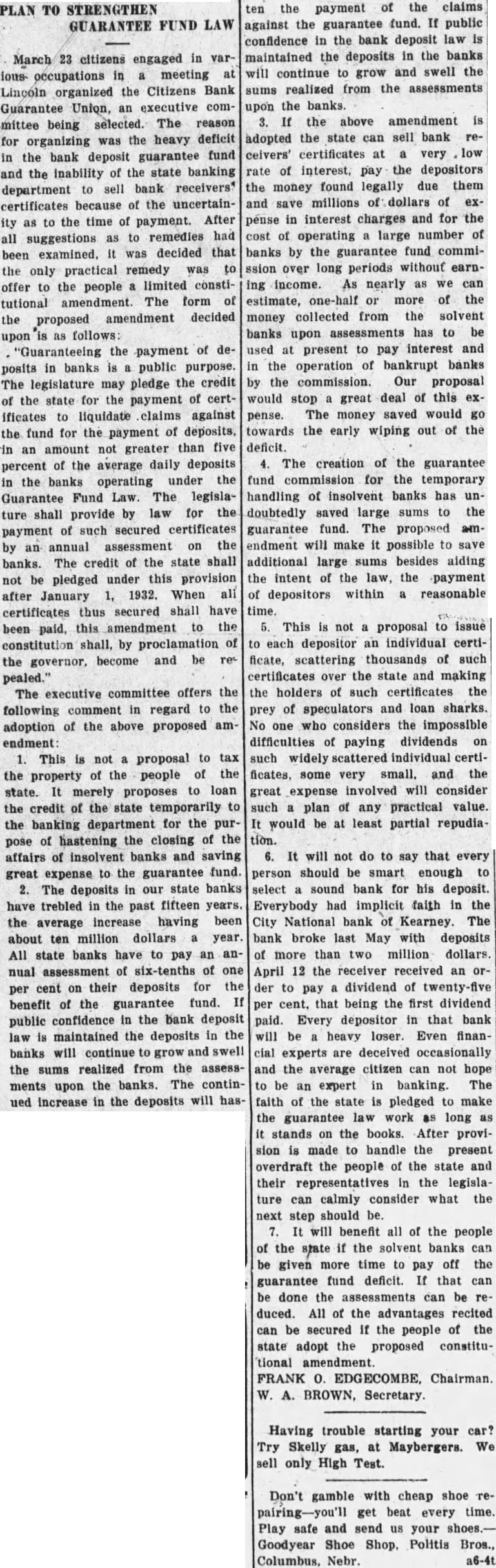
PLAN TO STRENGTHEN GUARANTEE FUND LAW March 23 citizens engaged in various- occupations in a meeting at Lincoln organized the Citizens Bank Guarantee Union, an executive committee being selected. The reason for organizing was the heavy deficit in the bank deposit guarantee fund and the inability of the state banking department to sell bank receivers' certificates because of the uncertainity as to the time of payment. After all suggestions as to remedies had been examined, it was decided that the only practical remedy was to offer to the people a limited constitutional amendment. The form of the proposed amendment decided upon is as follows: "Guaranteeing the payment of deposits in banks is a public purpose. The legislature may pledge the credit of the state for the payment of certificates to liquidate claims against the fund for the payment of deposits, in an amount not greater than five percent of the average daily deposits in the banks operating under the Guarantee Fund Law. The legislature shall provide by law for the payment of such secured certificates by an annual assessment on the banks. The credit of the state shall not be pledged under this provision after January 1, 1932. When all certificates thus secured shall have been paid, this amendment to the constitution shall, by proclamation of the governor. become and be repealed." The executive committee offers the following comment in regard to the adoption of the above proposed amendment: 1. This is not a proposal to tax the property of the people of the state. It merely proposes to loan the credit of the state temporarily to the banking department for the purpose of hastening the closing of the affairs of insolvent banks and saving great expense to the guarantee fund. 2. The deposits in our state banks have trebled in the past fifteen years. the average increase having been about ten million dollars a year. All state banks have to pay an annual assessment of six-tenths of one per cent on their deposits for the benefit of the guarantee fund. If public confidence in the bank deposit law is maintained the deposits in the banks will continue to grow and swell the sums realized from the assessments upon the banks. The continued increase in the deposits will has- ten the payment of the claims against the guarantee fund. If public confidence in the bank deposit law is maintained the deposits in the banks will continue to grow and swell the sums realized from the assessments upon the banks. 3. If the above amendment is adopted the state can sell bank receivers' certificates at a very low rate of interest, pay the depositors the money found legally due them and save millions of dollars of expense in interest charges and for the cost of operating a large number of banks by the guarantee fund commission over long periods without earning income. As nearly as we can estimate, one-half or more of the money collected from the solvent banks upon assessments has to be used at present to pay interest and in the operation of bankrupt banks by the commission. Our proposal would stop a great deal of this expense. The money saved would go towards the early wiping out of the deficit. 4. The creation of the guarantee fund commission for the temporary handling of insolvent banks has undoubtedly saved large sums to the guarantee fund. The proposed amendment will make it possible to save additional large sums besides aiding the intent of the law, the payment of depositors within a reasonable time. 5. This is not a proposal to issue to each depositor an individual certificate, scattering thousands of such certificates over the state and making the holders of such certificates the prey of speculators and loan sharks. No one who considers the impossible difficulties of paying dividends on such widely scattered individual certificates, some very small. and the great expense involved will consider such a plan of any practical value. It would be at least partial repudiation. 6. It will not do to say that every person should be smart enough to select a sound bank for his deposit. Everybody had implicit faith in the City National bank of Kearney. The bank broke last May with deposits of more than two million dollars. April 12 the receiver received an order to pay a dividend of twenty-five per cent, that being the first dividend paid. Every depositor in that bank will be a heavy loser. Even financial experts are deceived occasionally and the average citizen can not hope to be an expert in banking. The faith of the state is pledged to make the guarantee law work as long as it stands on the books. After provision is made to handle the present overdraft the people of the state and their representatives in the legislature can calmly consider what the next step should be. 7. It will benefit all of the people of the state if the solvent banks can be given more time to pay off the guarantee fund deficit. If that can be done the assessments can be reduced. All of the advantages recited can be secured if the people of the state adopt the proposed constitutional amendment. FRANK O. EDGECOMBE. Chairman. W. A. BROWN, Secretary. Having trouble starting your car? Try Skelly gas, at Maybergers. We sell only High Test. Don't gamble with cheap shoe repairing-you'll get beat every time. Play safe and send us your shoes.Goodyear Shoe Shop. Politis Bros., Columbus, Nebr. a6-4t


Article from The Ewing Advocate, May 4, 1928

Click image to open full size in new tab

Article Text

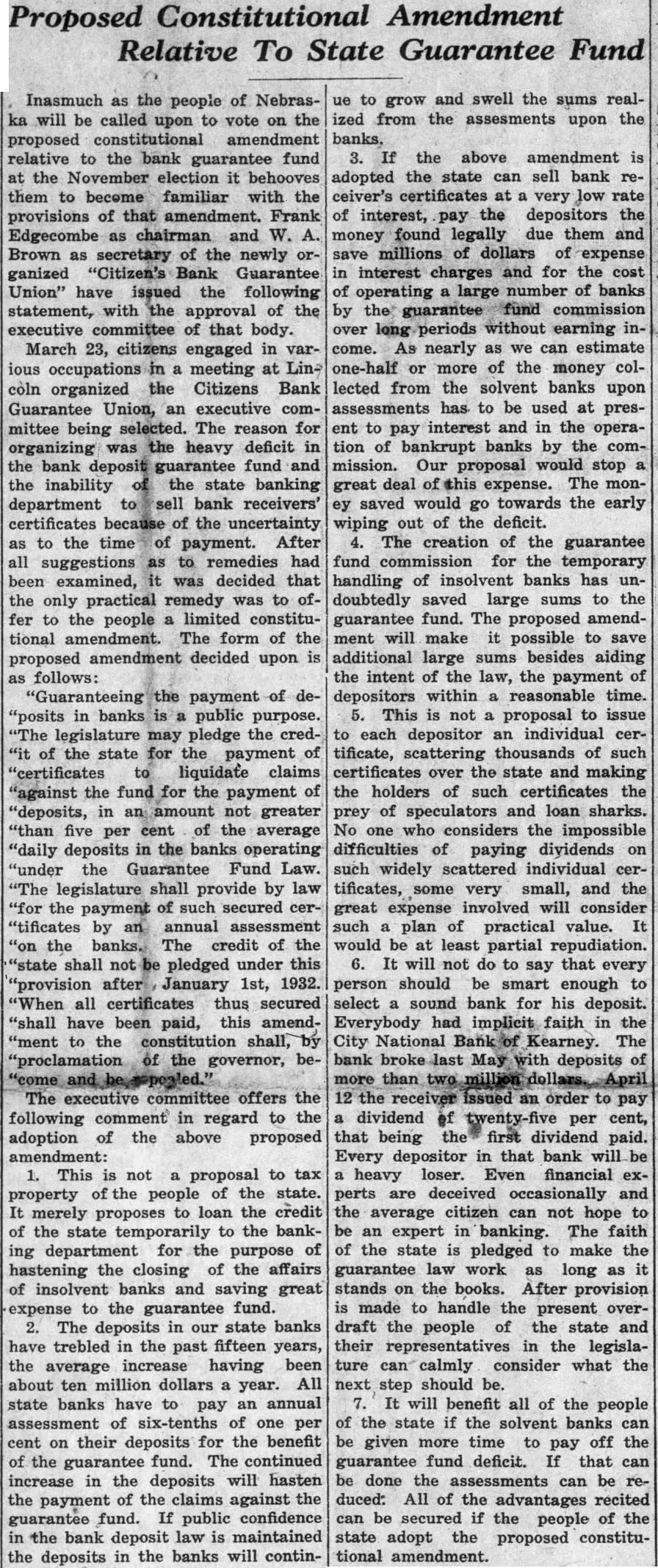
Proposed Constitutional Amendment Relative To State Guarantee Fund Inasmuch as the people of Nebraswill be called upon to vote on the proposed constitutional amendment relative to the bank guarantee fund at the November election it behooves them to become familiar with the provisions of that amendment. Frank Edgecombe as chairman and Brown as secretary of the newly ganized "Citizen's Bank Guarantee Union" have issued the following statement, with the approval of the executive committee of that body. March 23, citizens engaged in ious occupations meeting at cรฒln organized the Citizens Bank Guarantee Union, an executive mittee being selected. The reason for organizing was the heavy deficit in the bank fund and the inability the state banking department to sell bank receivers' certificates of the uncertainty as to the time of payment. After all suggestions as to remedies had been examined, was decided that the only practical remedy was to fer to the people limited constitutional amendment. The form of the proposed amendment decided upon as follows: "Guaranteeing the payment of "posits in banks public purpose. legislature may pledge the credof the state for the payment of "certificates liquidate claims "against the fund for the payment of "deposits, in amount not greater "than five per cent of the average "daily deposits in the banks operating "under the Guarantee Fund Law. legislature shall provide by law "for the payment of such secured "tificates by annual assessment the banks. The credit of the shall not pledged under this "provision January 1st, 1932. all certificates thus secured "shall have been paid, this amend"ment to the constitution shall, the governor, The offers the following comment in regard to the adoption of the above proposed amendment: This is not proposal to tax property the people of the state. merely proposes to loan the credit of the state temporarily to the banking department for the of purpose hastening the closing of the affairs of insolvent banks and saving great expense to the guarantee fund. The deposits in our state banks have trebled in the past fifteen years, the average increase having been about ten million dollars a year. All state banks have to pay an annual assessment of six-tenths of one per cent on their deposits for the benefit of the guarantee fund. The continued increase in the deposits will hasten the payment of the claims against the guarantee fund. If public confidence in the bank deposit law is maintained the deposits in the banks will contin- ue to and swell the realgrow sums ized from the assesments upon the banks. 3. the above amendment adopted the state can sell bank ceiver's certificates at very low rate of interest, pay the depositors the money found legally due them and save millions of dollars expense in interest charges and for the cost of operating large number of banks by the guarantee commission over without earning come. As nearly as we can estimate or more of the money collected from the solvent banks upon assessments has to be used at present to pay interest and in the operation of bankrupt banks by the mission. Our proposal would stop great deal this expense. The monsaved would go towards the early wiping out of the deficit. 4. The creation of the guarantee fund commission for the temporary handling of insolvent banks has doubtedly saved large sums to the guarantee fund. The proposed amendment will make it possible to save additional large sums besides aiding the intent of the law, the payment of depositors within reasonable time. This is not proposal to issue to each depositor an individual tificate, scattering thousands of such certificates over the state and making the holders of such certificates the prey of speculators and loan sharks. No one who considers the impossible difficulties of paying such widely scattered individual tificates, some very small, and the great expense involved will consider such plan of practical value. It would be at least partial repudiation. 6. It will not do to say that every person should be smart enough select sound bank for his deposit. Everybody had implicit faith in the City National Kearney. The bank broke with deposits of than the issued order to pay dividend cent, per that being dividend paid. Every depositor in that bank heavy loser. Even financial perts are deceived occasionally and the average citizen can not hope to an expert in banking. The faith of the state is pledged to make the guarantee law work as long as it stands on the books. After provision made to handle the present overdraft the people of the state and their representatives in the legislature calmly consider what the next step should be. It will benefit all of the people of the state if the solvent banks can be given more time to pay off the guarantee fund deficit. If that can be done the assessments can be duced: All of the advantages recited can be secured if the people of the state adopt the proposed constitutional amendment.


Article from Nemaha County Republican, June 28, 1928

Click image to open full size in new tab

Article Text

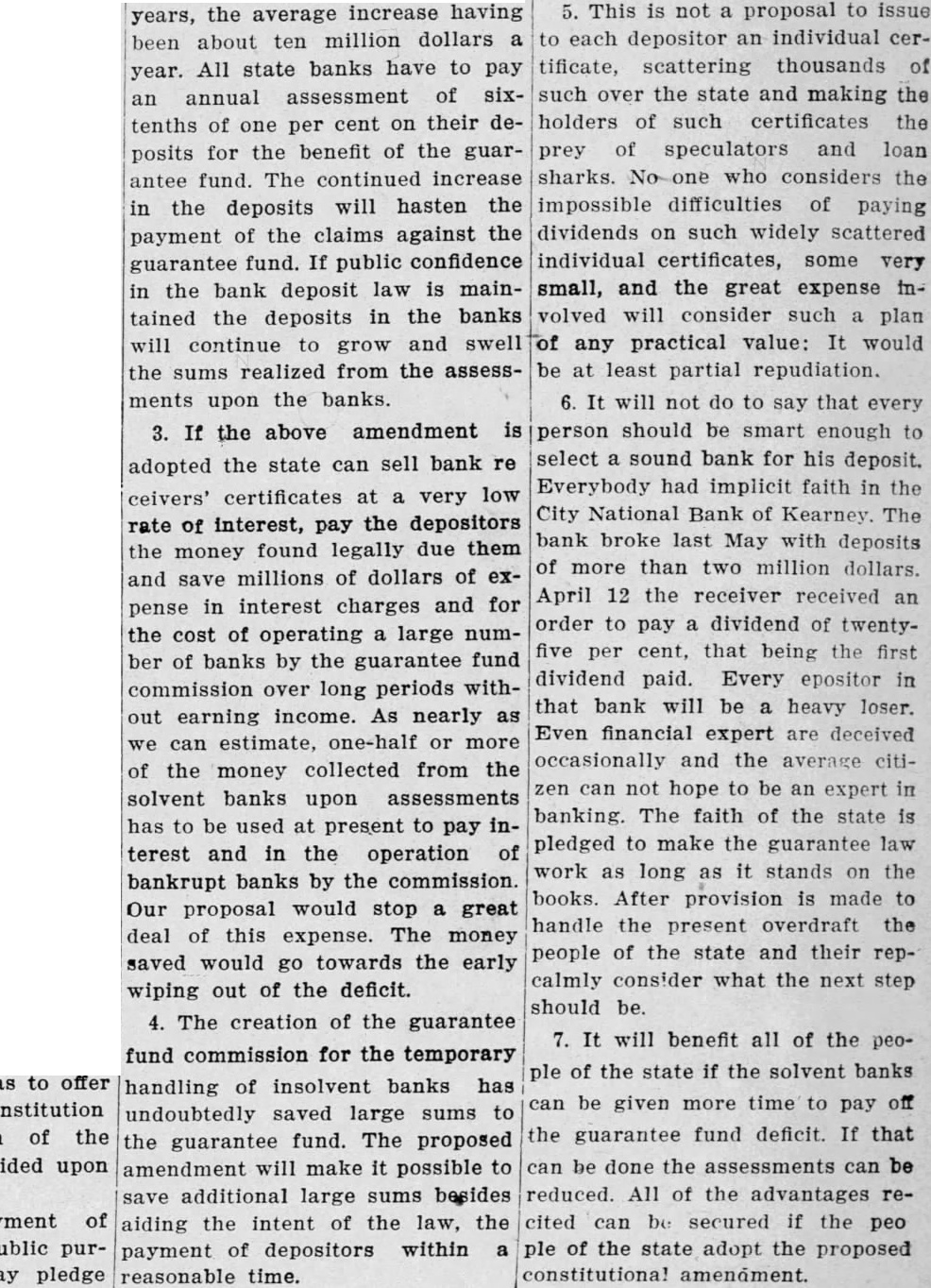
the average increase been about ten million dollars All state banks have to pay year. annual assessment of tenths of one per cent their posits for the benefit of the guarfund. The continued increase the deposits will hasten the payment of the claims against the fund. If public confidence guarantee the bank deposit law maintained deposits in the banks continue to grow and the sums realized from the assessments upon the banks. If the above amendment adopted the state can sell bank ceivers' certificates at very low rate of interest, the depositors the money found legally due them and save millions of dollars of pense interest charges and for the cost of operating large ber of banks by the guarantee fund commission long periods without earning income. As nearly estimate, one-half the money collected from the solvent banks upon assessments to be used at present to pay terest and in the operation of bankrupt banks by the commission. Our proposal would stop great deal of this expense. The money saved would go towards the early wiping out of the deficit. The creation of the guarantee fund commission for the temporary handling of insolvent banks has undoubtedly saved large sums the guarantee fund. The proposed amendment will make it possible additional large sums besides aiding the intent of the law, the payment of depositors within reasonable time. This not a proposal each depositor an individual certificate, scattering thousands of over the state and making the holders of such certificates the prey speculators and loan sharks. who considers the impossible difficulties of paying dividends on such widely scattered individual certificates, some very small, and the great expense involved will consider such plan any practical value: It would be at least partial repudiation. will not do to say that every person should be smart enough to select sound bank for his deposit. Everybody had implicit faith in the City National Bank Kearney. The bank broke last May with deposits more than two million dollars. April 12 the receiver received an order to pay dividend of twentyfive per cent, that being the first dividend paid. Every epositor in that bank will be heavy loser. Even financial expert deceived occasionally and the average can not hope to an expert banking. The faith of the state pledged to make the guarantee law work as long stands on the books. After provision made handle the present overdraft the people of the state and their repcalmly consider what the next step should be. will benefit all of the ple of the state if the solvent banks can be given more time to off pay the guarantee fund deficit. If that be done the assessments can be reduced. All the advantages cited can secured the peo ple of the state adopt the proposed


Article Text

To Sell Closed Kearney Bank Building Tomorrow Kearney, May 8 (LP)-Building and equipment of the old City National bank here are to be sold. Sealed bids on the property will be received tomorrow. Right has been reserved by the comptroller of currency to reject any and all bids and provision is made for occupancy of the bank offices by bank receivers until the affairs of the closed bank have been cleared up.


Article Text

TEST MONITOR STATION GRAND ISLAND, Neb., May (U.P)Acceptance tests on equip ment and apparatus at the govern ment radio monitor station have been conducted by government ex perts. W. D. Terrell, director of radio in the department of com merce; S. W. Edwards, superinten dent of development and produc tion of radio in the department of commerce and the designer of the monitor station here and Superin tendent Ben Wolf made the tests TO SELL BANK BUILDING KEARNEY, Neb., May 8-(U.P.)Building and equipment of the old City National Bank here are to be sold. Sealed bids on the property will be received tomorrow. Right has been reserved by the comptroller of currency to reject any and all bids and provision is made for occupancy of the bank offices by bank receivers until the affairs of the closed bank have been cleared up.


Article Text

TO SELL EQUIPMENT KEARNEY Neb., May Building and equipment of the old City National bank here are to be sold. Sealed bids on the property will be received tomorrow. Right has been reserved by the comptroller of currency to reject any and all bids and provision is made for occupancy of the bank offices by bank receivers until the affairs of the closed bank have been cleared up.