Article Text
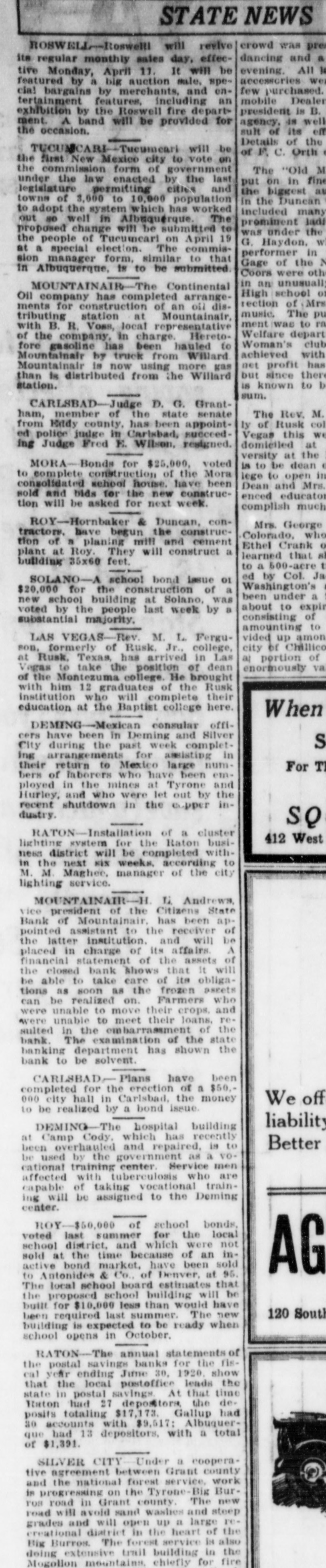
STATE NEWS will reviewe crowd was pre dancing and a its regular monthly sales day. effecevening. All ) tive Monday, April 11. It will be accessories we cia! featured by a big auction mile. few purchased. bargains by merchants, and spe- enmobile Dealer tertainment features, including president is B. exhibition by the Roswell fire depart> an agency, is well ment. the A band will be provided for occasion. sult of its em Details of the will of F. C. Orth the the first New Mexico city to vote be The "Old M commission form of government on put on in fine under the law enacted by the last the biggest au towns legislature permitting cities and in the Dunean to of 3,000 to 10,000 population included many out adopt the system which has worked prominent ladi so well in Albuquerque. was under the proposed the change will be submitted The G. Haydon, w at people of Tucumcari on April 19 to a special election. The performer in N Gage of the in sion manager form, similar commis- to that Coors were oth Albuquerque, is to be submitted in an unusually MOUNTAINAIR Continental High school of Oil company has completed rection of Mrs at station music. The pu tributing ments for construction of an arrange- oil dis. ment was to ra of with B. R. Vosa, local representative Mountainair, Welfare depart the company, in charge. HeretoWoman's club fore gasoline has been hauled achieved with Mountainair by truck from Willard to net profit has Mountainair is now using more but since there Station. than is distributed from the Willard gas is known to b sum. CARLSBAD Judge D. G. GrantThe Rev. M. ham, member of the state ly of Rusk col from ed Hitdy county. has been senate Vegas this we police judge in Carlsbad, succeed. appointdomiciled at ing Judge Fred E. Wilson, resigned. versity at the is to be dean MORA Bonds for $25,000, voted lege to open in to complete construction of the Mora Dean and Mrs. sold consolidated school house. have been enced educator and bids for the new construccomplish much tion will be asked for next week. Mrs. George ROY -Hornbaker & Duncan, conColorado, who tractors. have begun the construcEthel Crank tion of a planing mill and cement learned that plant at Roy. They will construct a buildink 35x60 feet. to a 500-aere ed by Col. Ja SOLANO A school bond issue Washington's been under a $20,000 for the construction of 01 a new school building at Solano, about to expir consisting of voted by the people last week by was a substantial majority. amounting to vided up amon LAS VEGAS Rev. M. L. Fergucity of Chillico son. formerly of Rusk. Jr.. at portion of at Rusk. Texas, has arrived college, in Las enormously va Vagas to take the position of of with the Montezuma college. He brought dean him 12 graduates of the Rusk Institution who will complete their When education at the Baptist college here. DEMING -Mexican consular officers have been in Deming and Silver S City during the past week completing arrangements for assisting For T bers their return to Mexico large num. in of laborers who have been ployed in the mines at Tyrone emHurley, and who were let out by and the dustry. recent shutdown in the cupper inSQ 412 West RATON-Installation of a cluster lighting system for the Raton busi. ness in district will be completed with. M. the next six weeks, according M Maghee, manager of the city to lighting service. MOUNTAINAIT--j L. Andrews, vice president of the Citizens State Bank of Mountainair. has been pointed assistant to the receiver ap. the latter institution. and will be of placed in charge of its affairs. financial statement of the assets of A the closed bank shows that It will be able to take care of its obligations as soon as the frozen can be realized on. Farmers assets who were unable to move their crops. and were unable to meet their loans, resulted in the embarrassment of the bank. The examination of the state banking department has shown the bank to be solvent. CARLSBAD Plans have been completed for the erection of a $50.We off 000 city hall in Carlsbad, the money to be realized by a bond issue. liability DEMING The hospital building at Camp Cody. which has recently Better been overhauled and repaired, is to be used by the government as a vo. cational training center. Service men affected with tuberculosis who are capable of taking vocational train. center. ing will be assigned to the Deming ROY $50,000 of school bonds voted last summer for the local school district, and which Were not sold at the time because of an inAG active bond market, have been sold to Antonides & Co., of Denver, at The local school board estimates that 96. the proposed school building will be buttt for $10,000 less than would 120 South been required last summer. The have building is expected to be ready when new school opens in October RATON The annual statements of the postal savings banks for the fiscal year ending Jime 30, 1920 show that the local postoffice leads the state in postal savings At that time Raton had 27 depositors the deposits totaling $17,173. Gallup had 30 accounts with $9,617: Albuquerque had 13 depositors, with a total of $1,391. SILVER CITY Under a cooperative agreement between Grant county and the national forest service, work is progressing on the Tyrone Big BurFOR road in Grant county The new road will avoid sand washes and steep grades and will open up a large creational district in the heart of re. Big Burros. The forest service is also the doing extensive trail building in the Mogollon mountains chiefly for fire