Click image to open full size in new tab
Article Text
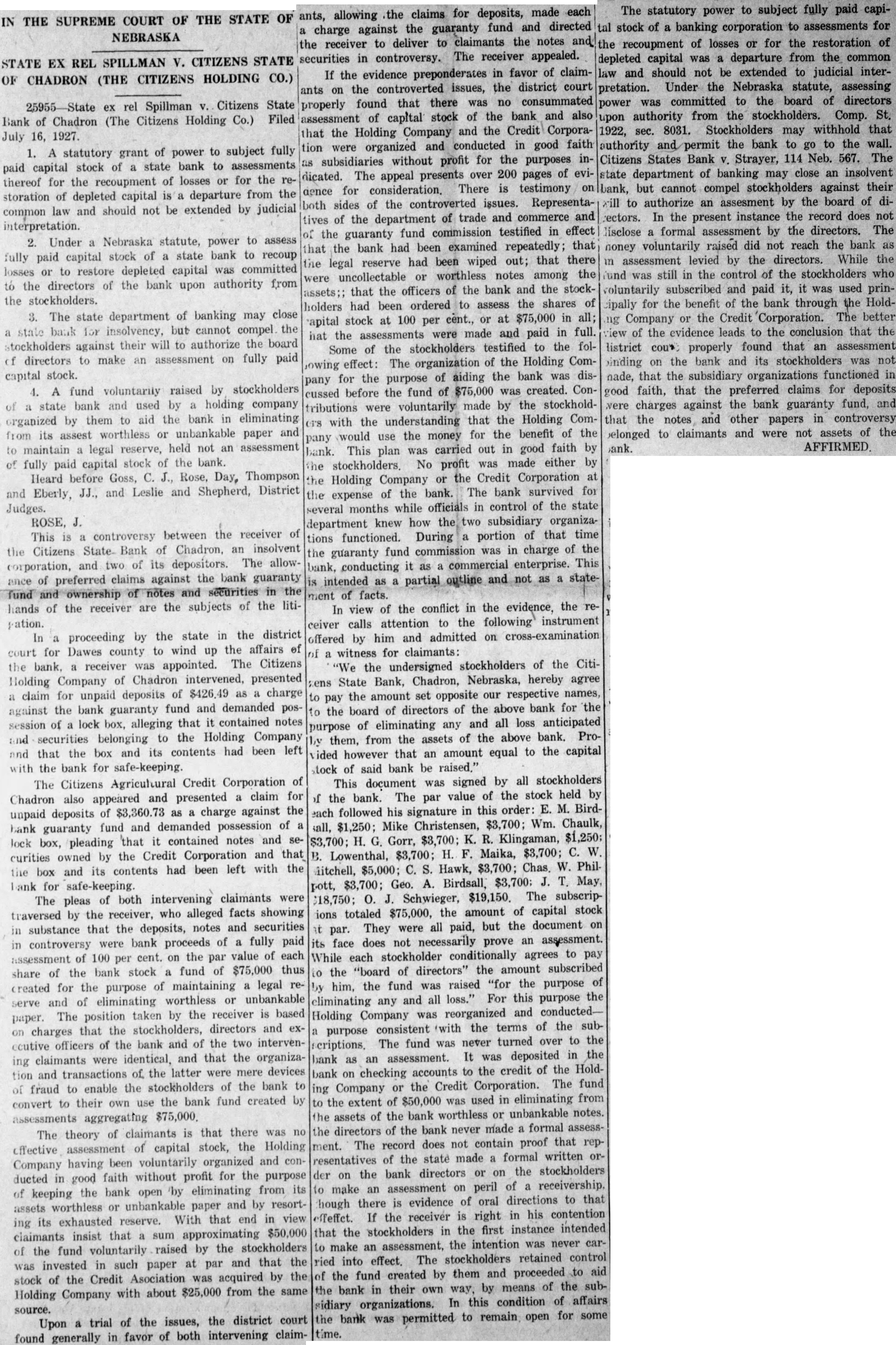
IN THE SUPREME COURT OF THE STATE OF NEBRASKA
STATE EX REL SPILLMAN V. CITIZENS STATE OF CHADRON (THE CITIZENS HOLDING CO.)
25955-State ex rel Spillman V. Citizens State Bank of Chadron (The Citizens Holding Co.) Filed July 16, 1927. 1. A statutory grant of power to subject fully paid capital stock of a state bank to assessments thereof for the recoupment of losses or for the restoration of depleted capital is a departure from the common law and should not be extended by judicial interpretation. 2. Under a Nebraska statute, power to assess fully paid capital stock of a state bank to recoup losses or to restore depleted capital was committed to the directors of the bank upon authority from the stockholders. 3. The state department of banking may close a state bank for insolvency, but cannot compel. the stockholders against their will to authorize the board of directors to make an assessment on fully paid capital stock. 1. A fund voluntarily raised by stockholders of a state bank and used by a holding company organized by them to aid the bank in eliminating from its assest worthless or unbankable paper and to maintain a legal reserve, held not an assessment of fully paid capital stock of the bank. Heard before Goss, C. J., Rose, Day, Thompson and Eberly, JJ., and Leslie and Shepherd, District Judges. ROSE, J. This is a controversy between the receiver of the Citizens State- Bank of Chadron, an insolvent corporation, and two of its depositors. The allowance of preferred claims against the bank guaranty fund and ownership of notes and securities in the hands of the receiver are the subjects of the litiIn a proceeding by the state in the district court for Dawes county to wind up the affairs of the bank, a receiver was appointed. The Citizens Holding Company of Chadron intervened, presented a claim for unpaid deposits of $426.49 as a charge against the bank guaranty fund and demanded possession of a lock box, alleging that it contained notes and securities belonging to the Holding Company and that the box and its contents had been left with the bank for safe-keeping. The Citizens Agricultural Credit Corporation of Chadron also appeared and presented a claim for unpaid deposits of $3,360.73 as a charge against the bank guaranty fund and demanded possession of a lock box, pleading that it contained notes and securities owned by the Credit Corporation and that the box and its contents had been left with the Bank for safe-keeping. The pleas of both intervening claimants were traversed by the receiver, who alleged facts showing in substance that the deposits, notes and securities in controversy were bank proceeds of a fully paid assessment of 100 per cent. on the par value of each share of the bank stock a fund of $75,000 thus created for the purpose of maintaining a legal reserve and of eliminating worthless or unbankable paper. The position taken by the receiver is based on charges that the stockholders, directors and exccutive officers of the bank and of the two intervening claimants were identical, and that the organization and transactions of the latter were mere devices of fraud to enable the stockholders of the bank to convert to their own use the bank fund created by assessments aggregating $75,000. The theory of claimants is that there was no offective assessment of capital stock, the Holding Company having been voluntarily organized and conducted in good faith without profit for the purpose of keeping the bank open by eliminating from its assets worthless or unbankable paper and by resorting its exhausted reserve. With that end in view claimants insist that a sum approximating $50,000 of the fund voluntarily raised by the stockholders was invested in such paper at par and that the stock of the Credit Asociation was acquired by the Holding Company with about $25,000 from the same source. Upon a trial of the issues, the district court found generally in favor of both intervening claim- ants, allowing the claims for deposits, made each a charge against the guaranty fund and directed the receiver to deliver to claimants the notes and securities in controversy. The receiver appealed. If the evidence preponderates in favor of claimants on the controverted issues, the district court properly found that there was no consummated assessment of capital stock of the bank and also that the Holding Company and the Credit Corporation were organized and conducted in good faith as subsidiaries without profit for the purposes indicated. The appeal presents over 200 pages of eviaence for consideration. There is testimony on both sides of the controverted issues. Representatives of the department of trade and commerce and of the guaranty fund commission testified in effect that the bank had been examined repeatedly; that the legal reserve had been wiped out; that there were uncollectable or worthless notes among the assets;; that the officers of the bank and the stockholders had been ordered to assess the shares of capital stock at 100 per cent., or at $75,000 in all; hat the assessments were made and paid in full. Some of the stockholders testified to the folLowing effect: The organization of the Holding Company for the purpose of aiding the bank was discussed before the fund of $75,000 was created. Contributions were voluntarily made by the stockholdG'S with the understanding that the Holding Company would use the money for the benefit of the bank. This plan was carried out in good faith by the stockholders. No profit was made either by the Holding Company or the Credit Corporation at The bank survived for the expense of the bank. several months while officials in control of the state how the two subsidiary organizaknew department tions functioned. During a portion of that time the guaranty fund commission was in charge of the bank, conducting it as a commercial enterprise. This is intended as a partial outline and not as a statement of facts. In view of the conflict in the evidence, the receiver calls attention to the following instrument offered by him and admitted on cross-examination of a witness for claimants: "We the undersigned stockholders of the Citizens State Bank, Chadron, Nebraska, hereby agree to pay the amount set opposite our respective names, to the board of directors of the above bank for the purpose of eliminating any and all loss anticipated by them, from the assets of the above bank. Provided however that an amount equal to the capital tock of said bank be raised." This document was signed by all stockholders of the bank. The par value of the stock held by each followed his signature in this order: E. M. Birdsall, $1,250; Mike Christensen, $3,700; Wm. Chaulk, $3,700; H. G. Gorr, $3,700; K. R. Klingaman, $1,250; B. Lowenthal, $3,700; H. F. Maika, $3,700; C. W. litchell, $5,000; C. S. Hawk, $3,700; Chas. W. Philpott, $3,700; Geo. A. Birdsall, $3,700; J. T. May, $18,750; O. J. Schwieger, $19,150. The subscripions totaled $75,000, the amount of capital stock it par. They were all paid, but the document on its face does not necessarily prove an assessment. While each stockholder conditionally agrees to pay to the "board of directors" the amount subscribed by him, the fund was raised "for the purpose of climinating any and all loss." For this purpose the Holding Company was reorganized and conducteda purpose consistent (with the terms of the subacriptions, The fund was never turned over to the bank as an assessment. It was deposited in the bank on checking accounts to the credit of the Holding Company or the Credit Corporation. The fund to the extent of $50,000 was used in eliminating from the assets of the bank worthless or unbankable notes. the directors of the bank never made a formal assessment. The record does not contain proof that representatives of the state made a formal written order on the bank directors or on the stockholders to make an assessment on peril of a receivership. hough there is evidence of oral directions to that effeffct. If the receiver is right in his contention that the stockholders in the first instance intended to make an assessment, the intention was never carried into effect. The stockholders retained control of the fund created by them and proceeded to aid the bank in their own way, by means of the subsidiary organizations. In this condition of affairs the bank was permitted to remain open for some time.
The statutory power to subject fully paid capital stock of a banking corporation to assessments for the recoupment of losses or for the restoration of depleted capital was a departure from the common law and should not be extended to judicial interpretation. Under the Nebraska statute, assessing power was committed to the board of directors upon authority from the stockholders. Comp. St. 1922, sec. 8031. Stockholders may withhold that authority and permit the bank to go to the wall. Citizens States Bank V. Strayer, 114 Neb. 567. The state department of banking may close an insolvent bank, but cannot compel stockholders against their will to authorize an assesment by the board of directors. In the present instance the record does not lisclose a formal assessment by the directors. The noney voluntarily raised did not reach the bank as in assessment levied by the directors. While the fund was still in the control of the stockholders who voluntarily subscribed and paid it, it was used principally for the benefit of the bank through the Holdng Company or the Credit Corporation. The better view of the evidence leads to the conclusion that the listrict cou*: properly found that an assessment inding on the bank and its stockholders was not nade, that the subsidiary organizations functioned in good faith, that the preferred claims for deposits vere charges against the bank guaranty fund, and that the notes and other papers in controversy elonged to claimants and were not assets of the AFFIRMED ank.