Washington County National Bank (Greenwich, NY)

Episode Information

Episode UID
126600942
Episode Type
Suspension โ†’ Closure
Bank Type
national
Bank ID
12660 national
Charter Number
1266
Start Date
June 11, 1878
Location
Greenwich, New York (43.091, -73.499)

Metadata

Model
gpt-5-mini (chosen from majority vote of a three-model LLM ensemble)
Short Digest
8c981c0e7d36f3da

Response Measures

None

Receivership Details

Depositor recovery rate
100.0%
Date receivership started
1878-06-08
Date receivership terminated
1879-07-05
OCC cause of failure
Fraud
Share of assets assessed as good
54.0%
Share of assets assessed as doubtful
4.8%
Share of assets assessed as worthless
41.1%

Description

Receiver appointed by the Acting Comptroller; cashier later committed suicide after suspension.

Events (6)

1. June 13, 1865 Chartered
Source
historical_nic
2. June 8, 1878 Receivership
Source
historical_nic
3. June 11, 1878 Suspension
Cause
Government Action
Cause Details
Placed in the hands of receivers by the Acting Comptroller of the Currency (official suspension of payments).
Newspaper Excerpt
The Washington County National Bank at Greenwich, New York, ... have been placed in the hands of receivers by the acting comptroller of currency.
Source
newspapers
4. June 16, 1878 Receivership
Newspaper Excerpt
Mr. L. M. Price, as receiver... found them as reported, to close the doors and possession; he did two days after his arrival.
Source
newspapers
5. June 19, 1878 Other
Newspaper Excerpt
Edwin Andrews, cashier of the Washington County National Bank of Greenwich, committed suicide this morning by hanging.
Source
newspapers
6. October 10, 1878 Other
Newspaper Excerpt
The Controller of the Currency has declared a dividend of 25 per cent in favor of the creditors of the Washington County National Bank of Greenwich, New York...
Source
newspapers

Newspaper Articles (6)

Article from National Republican, October 4, 1873

Click image to open full size in new tab

Article Text

# SHALL THE BANK SUSPENSION CONTINUE It is very much to be feared that the banks will over-do the "financial business" in main-taining themselves in a state of slege against the demands of the business necessities of the country, and by a protracted suspension of business excite a feeling of uneasiness and alarm in the public mind. It may have been necessary immediately following the financial crash of September 26 and 27, and the con-sequent panic produced in the popular mind, to adopt such measures as were calculated to prevent a positive breaking up and ruin of legitimate commercial business; but the feel-ing is now rapidly gaining ground that no real necessity exists for the banks maintain-ing closed doors against the payment of the demands of those who have entrusted money deposits to their keeping. So long as the necessity for this embargo was patent the public acquiesced in it; but it is becoming a matter of doubt whether the time has not ar-rived when the banks should manifest a dis-position to return to the normal condition of affairs. In a case of this kind a mere doubt in the public mind becomes a positive and threaten-ing danger, a danger as pregnant with dire-ful results to the banks as to the industrial and commercial interests of the country. There is certainly nothing in the present situ-ation to warrant the banks in maintaining an almost absolute suspension of payment; and the fact that some of these monetary institu-tions, by a little business enterprise, have continued to pay all demands of their patrons furnishes some justification for this view. We believe there should be at least some re-laxation of the established embargo, if not a full resumption of payments; and it is to be hoped the banks will act in such a manner as not to permit the impression to get abroad that they are taking advantage of a mag-nanimous public indulgence to speculate upon the people. Every day this suspension is maintained adds to the danger of the situation. Mechan-ical and manufacturing establishments are being forced to stop operations and discharge their workmen because of the maintenance of the bank suspension, and the mechanics thus deprived of their sources of daily supply when applying to the banks and savings in-stitutions for their savings against an emer-gency of this character are turned away empty handed. Herein lies the great danger of the situation now. It will not do to per-mit this state of affairs to continue. If the banks fail to meet the emergency the emer-gency may overwhelm the banks in the com-mon disaster that is threatened. In connec-tion with this matter the following paragraph, from the St. Louis Democrat, is pertinent and timely: "Resumption is the sure refuge of the banks; it will save them from the disasters of the whole-sale depreciation of securities and products which a protracted suspension would almost cer-tainly precipitate; it will save the dry goods and grocery merchants from the reflex surge of the derangement, which, if not arrested, may over-whelm them; it will save the banks from the cold, settled distrust which will certainly creep into the public mind if the suspension continues; it will rescue trade from its present idleness, and it will save the country from the serious peril of a shinplasterinundation. We say nothing here about the bankruptcy act further than this: that any Congressional relief for violations of it will necessarily be impartial. If it extends to the banks, it will have to extend to the debtors of the banks also, and thus in the end it might do more harm to a solvent bank than good. The New York banks suspended on Thursday, the 24th inst., and their fourteen days' limit under the act will terminate on the 8th of October. In all seriousness, we do not believe it will be safe for them to delay their resumption beyond that day. It would be better if they begin it before, for there is no conjecturing what feeling the present suspense of the public mind may result in."


Article from Daily Kennebec Journal, June 11, 1878

Click image to open full size in new tab

Article Text

Bank Matters. The Washington County National Bank at Greenwich, New York, and the First National Bank of Dallas, Texas, have been placed in the hands of receivers by the acting comptroller of currency.

Article from New-York Tribune, June 17, 1878

Click image to open full size in new tab

Article Text

4 BANK RUINED BY ITS OFFICERS. THE WASHINGTON COUNTY NATIONAL IN A VERY BAD CONDITION. IBY TELEGRAPH TO THE TRIBUNE.] WASHINGTON, June 16.-Mr. Langworthy, Acting Controller of the Curreney. refuses to give out for publication the late reports of the Bank Examiner concerning the affairs of the Washington County National Bank, at Greenwich, N. Y. These reports, he says, are made only for the information of the bureau, and not for publication, and as the condition of the bank is not yet fully ascertained, the publication of an incomplete statement would be very likely to produce unnecessary alarm among those holding claims against the bank and cause them to sacrifice their interests for little or nothing. It 18 not yet known what proportion of its debt the bank will be able to pay, and it is not impossible, Mr. Langworthy says. that all may be paid. The bank is now in the hands of Mr. L. M. Price, as receiver, a gentleman who has had long experience in the business, and in whom the department has the utmost confidence. It is learned from other gentlemen who have seen the latest reports made by the Examiner to the Controller's Office touching the Washington County Bank, that the affairs of that institution could hardly be in a worse condition. The entire capital of the bank has been lost or stolen. and recent dividends have probably been paid from funds belonging to depositors, a large pro portion of whom are poor people, many of them widows and orphans. It is thought that the cashier, and perhaps the president, of the bank have for months past been falsifying the statements made to the directors and to the Treasury Department. The last regular statement of the bank, made if May 1, would be a favorable showing for the bank on the statement was correct, but some of the items given in the report and sworn to are known to be false. Of the $26,000 claimed to be due from other banks, $15,000 was said to be on deposit in a bank in New-York City. It is known, however, that the Washington County Bank had withdrawn all except was of this fund sometime before the report be $3,000 A large portion of the $337,000 claimed to among made. the assets, was paper long overdue, not secured and utterly worthless. only grounds of hope for the creditors of the The he in a possible assessment upon the shareholders. be chase amount, bank comes When According money the liable if suspicion necessary, to in paid law case the for of of equal owner his fraud disaster stock, to in of the the not National but face management only for value to lose the pur. bank of his stock of stock this to became almost a certainly, Mr. Price was sent and, bank with instructions to look into matters, take Greenwich he found them as reported, to close the doors and possession. if This he did two days after his arrival.

Article from New-York Tribune, June 20, 1878

Click image to open full size in new tab

Article Text

# A BANK CASHIER'S SUICIDE. TROY, N. Y., June 19.--Edwin Andrews, cashier of the Washington County National Bank of Greenwich, committed suicide this morning by hanging. A revolver was found in his pocket. The bank was recently suspended, and is found to be entirely wrecked by the operations of the cashier, who has heretofore enjoyed a high reputation as a man and Christian.

Article from The New Orleans Daily Democrat, October 11, 1878

Click image to open full size in new tab

Article Text

Butler as a Greenbacker-Dividends in Favor of Bank Directors. WASHINGTON, Oct. 10.-In the House of Representatives, June 6. 1870, while the funding bill was being pressed to its passage, Hon. B. F. Butler, of Massachusetts, moved to amend section 4 by adding the words, "And the United States also solemnly pledges Its faith to make provision, at the earliest practicable period, for redemption of United States notes in coin." which amendment was disagreed to, though Mr. Butler voted in the affirmative. The Controller of the Currency has declared a dividend of 25 per cent in favor of the creditors of the Washington County National Bank of Greenwich, New York, making in all dividends of 50 per cent. He has also declared a dividend of 15 per cent in favor of the creditors of the First National Bank of Kansas City, Mo., making in all 30 per cent. Also a dividend of 12 per cent in favor of the creditors of the First National Bank of Bethel, Conn., payable as soon as the necessary schedules can be prepared by the receiver.

Article from Burlington Weekly Free Press, June 25, 1880

Click image to open full size in new tab

Article Text

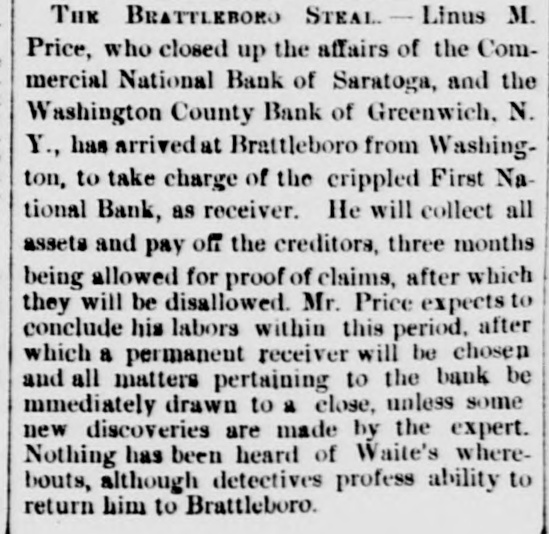
THE BRATTLEBORO STEAL - Linus M. Price, who closed up the affairs of the Commercial National Bank of Saratoga, and the Washington County Bank of Greenwich, N. Y., has arrivedat Brattleboro from Washington, to take charge of the crippled First National Bank, as receiver. He will collect all assets and pay off the creditors, three months being allowed for proof of claims, after which they will be disallowed. Mr. Price expects to conclude his labors within this period, after which a permanent receiver will be chosen and all matters pertaining to the bank be mmediately drawn to a close, unless some new discoveries are made by the expert. Nothing has been heard of Waite's wherebouts, although detectives profess ability to return him to Brattleboro.