12657. Newark Savings Institution (Newark, NJ)

Bank Information

Episode Type
Run → Suspension → Closure
Bank Type
savings bank
Start Date
December 12, 1877
Location
Newark, New Jersey (40.736, -74.172)

Metadata

Model
gpt-5-mini
Short Digest
228b5cd679a0bf48

Response Measures

None

Description

Contemporary articles (Dec 12–14, 1877) describe a large run on the Newark Savings Institution, followed by the officers petitioning the Chancellor and the bank being taken into chancery/receivership. The trigger described is heavy losses from depreciated securities (notably Chesapeake & Ohio railroad bonds) and bad investments, not a discrete false rumor. The bank paid limited instalments (18%, later 20% and further dividends) under court supervision but ultimately was placed in receivership; thus the sequence is run → suspension (court/receiver) → closure (remained under control of Chancery/receiver). Dates are taken from the newspaper dates and text.

Events (6)

1. December 12, 1877 Receivership
Newspaper Excerpt
The Newark Savings Institution ... has been taken in charge of by a chancellor on petition of its managers ... The chancellor orders the payment of 18 per cent of the principal ... meanwhile he will make a full investigation.
Source
newspapers
2. December 12, 1877 Run
Cause
Bank Specific Adverse Info
Cause Details
Runs driven by discovery of impaired assets and depreciation of securities (notably Chesapeake & Ohio and other railroad bonds) and prior local bank failures that undermined confidence.
Measures
Officers arranged to pay a limited percentage (18%) immediately; managers petitioned the Chancellor to take charge to ensure equal distribution.
Newspaper Excerpt
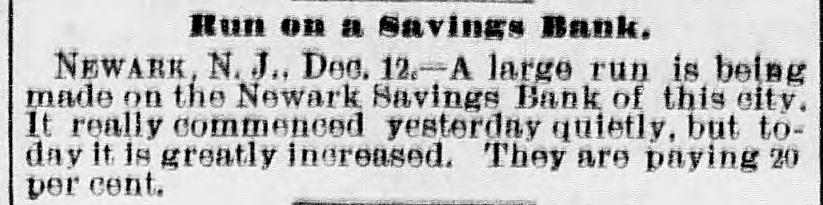
A large run is being made on the Newark Savings Bank of this city. It really commenced yesterday quietly, but today it is greatly increased.
Source
newspapers
3. December 12, 1877 Suspension
Cause
Government Action
Cause Details
Managers petitioned the Chancellor and the court took the bank into chancery/receivership to prevent unfair withdrawals and to supervise distribution of assets; Chancellor ordered interim payments (18% then 20%).
Newspaper Excerpt
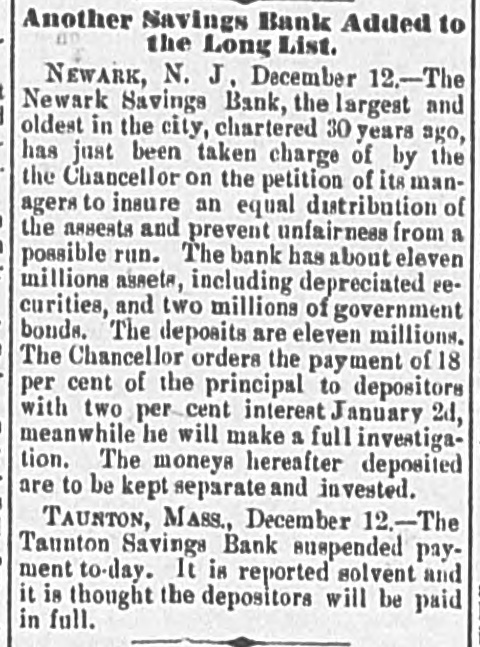
The Newark Savings Institution ... has just been taken charge of by the Chancellor on the petition of its managers to insure an equal distribution of the assets and prevent unfairness from a possible run.
Source
newspapers
4. June 1, 1878 Other
Newspaper Excerpt
Managers ... to apply to Chancellor Runyon for permission to pay a second instalment of twenty per cent to depositors on and after June 1 . . . the Examining Commissioners will be ready to report the actual condition of the bank in a tow weeks . . . . (payments under court supervision).
Source
newspapers
5. July 18, 1879 Other
Newspaper Excerpt
The bank people are happy and depositors are clamoring for another payment of ten per cent on the amount of their deposite. (Appreciation of railroad securities increased realizable assets.)
Source
newspapers
6. November 30, 1880 Other
Newspaper Excerpt
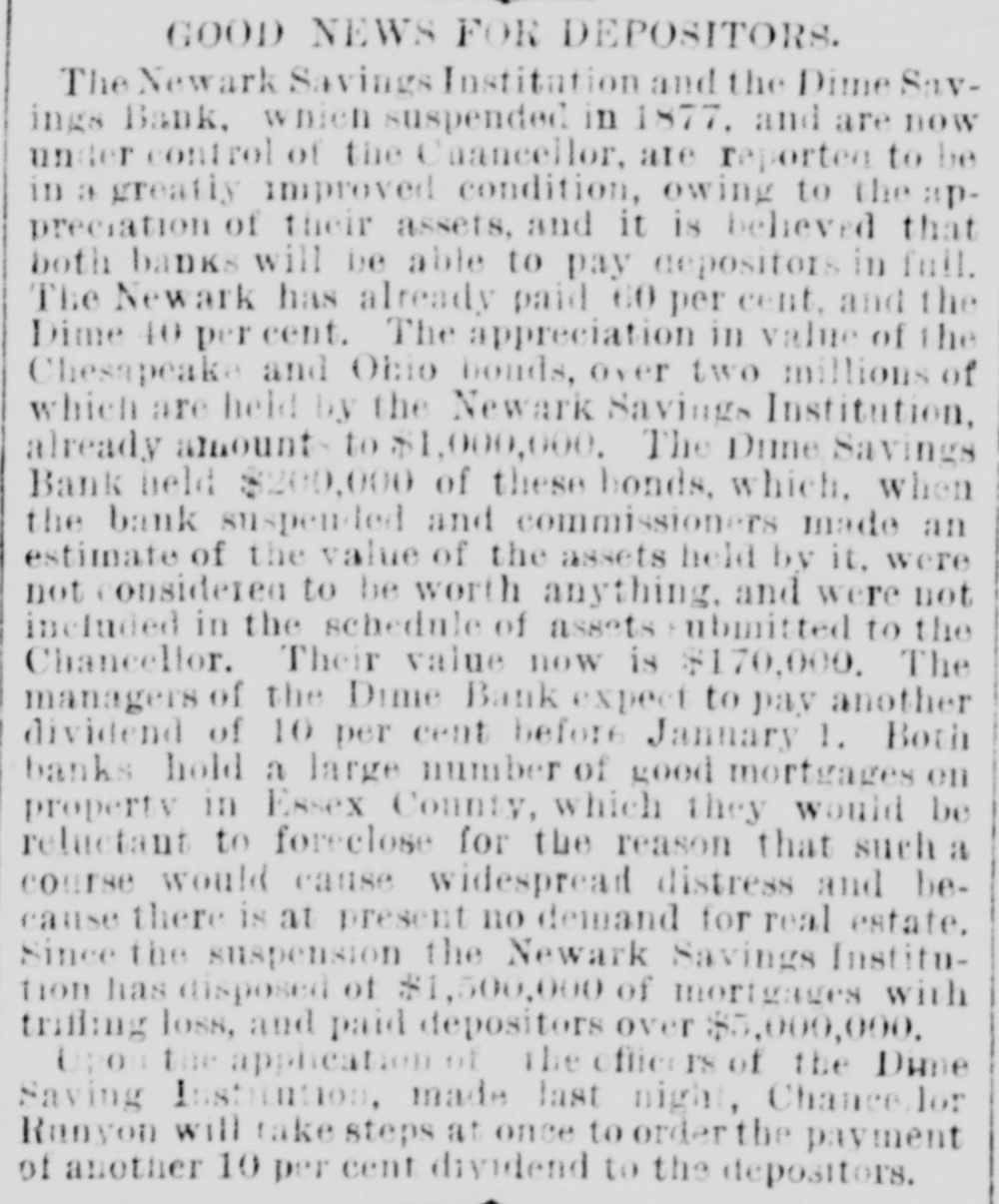
The Newark Savings Institution and the Dime Savings Bank, which suspended in 1877, and are now under control of the Chancellor, are reported to be in a greatly improved condition ... The Newark has already paid 60 per cent ... it is believed that both banks will be able to pay depositors in full.
Source
newspapers

Newspaper Articles (23)

Article from The Portland Daily Press, December 13, 1877

Click image to open full size in new tab

Article Text

News and Other Items. Blondin has traveled nearly 2500 miles on the tight rope. Lydia Thompson's burlesque troupe has broken up and Lydia is going to Europe. The gas company of Richmond, Va., has cut off the gas from the custom house there on account of the non-payment of the gas bill. The Newark Savings Institution has been taken charge of by the Chancellor. Assets, $12,000,000; deposits $11,000,000. Geo. N. Jennott, aged 21, was killed Tuesday by an engine, while walking on the track at Nashua, N. H. A Catholic priest named Bloomer is in jail at Elmira, N. Y., for refasing to answer a query of the court. He stands OD professional privilege, and not on church discipline. Peter B. Sweeney sailed from New York for Europa yesterday, having settled with the city to the amount of $450,000 for his ring thieving. He expects to return soon on a lecturing tour. The canal system of the Khedive of Egypt has reclaimed 500,000 acres of desert land within 15 years and 300,000 acres more are being op' erated upon. A cancan troupe traveling,West has got into limbo at South Bend, Ind., the proprietors having been arrested under a law prohibiting immoral exhibitions. About two-thirds of the Southern cotton crop has been gathered, and the yield falls about 10 per cent. bebind that of last year. Nearly half of it has already been sold. Qneen Isabella of Spain is expected to visit Rome this winter with the intention and hope, it is thought, of effecting a reconciliation between the Pope and the King of Italy. Toronto Savings Bank has suspended payments. It is represented as solvent and has $125.000 of real estate. There is said to be no doubt but that the depositors will be paid in full. Among the delegates elected to the Republican general committee of New York, Tuesday night, are Naval Officer Cornell, U. S. Marshal Mike Cregan. U. S. Bankrupt Register Dayton and customs officer o' Brion. The City Hotel, two stores and four small buildings in Beringher City, Pa., have been burned. Loss about $10,000. A. B. McCartney of Mercer, Pa., was burned to death in the hotel. William and Mary College at Williamsburg, Va., wants Congress to pay her for the destruction of some of the college buildings by federal soldiers in 1862. This claim has been presented before and the House voted to pay it, but the Senate failed to concur. By recent decisions of the New York courts, a man is held responsible for his wife's funeral expenses, the same as for her living, no matter how much she may leave. But he may charge her estate with extra expenses on account of religious forms, it she was not of his denomination. Mr. Eliha Barritt of New Britain, Conn., "the learned blacksmith," had a severe hemorrhage of the lungs last Friday, and is considered by his physicians to be in a very critical condition. He has been in feeble health for some months, and as he is sixty-seven years old, it is not probable that he will again be restored to health. There lives in Tolland county, Conn., an old man named Bernard Covert, whom some of the elderly men of our day will recollect as a famous singer at political meetings in aid of the Whig and Republican cause. He took part in successive Presidential canvasses from the famous "log cabin and hard cider" canvass of 1840 up to that of 1868. Horace Greeley used often to agree to take the stump only on condition that Mr. Covert accompanied him. The death of Bishop Marvin of the Methodist Episcopal church South, will require the election of three bishops by the General Conference which meets at Atlanta, Ga., next May. It is probable that the Rev. Dr. Lynus Parker, editor of the New Orleans Christian Advocate, will be urged for one of the places. Had the Rev. Dr. Dancan, who died a few months ago lived, he would undoubtedly been elected to a bishopric. Mrs. Chisholm, whose husband was murderf ed in Kemper county, Miss., says that the persons who attacked him in jail were all old resi1 dents, and, what seemed most strange, all religions were represented. "There were," she says, "Catholics, Presbyterian elders, and, most of all, I noticed two Methodist class-leaders that were very active all through the matter. One of these men was a great exhorter, and had often labored with us for the good of our souls. At the last camp-meeting I attended this man got so "happy" he shouted at a great rateand ca ne up to Mr. Chisholm and took him around the neck and begged him to go forward, and said, It is all you lack, Judge, to be a first rate man-all you lack is religion.' And that man helped kill my husband."
Article from The New Orleans Daily Democrat, December 13, 1877

Click image to open full size in new tab

Article Text

Run on a Savings Bank. NEWARK, N. J., Dec. 12.-A large run is being made on the Newark Savings Bank of this city. It really commenced yesterday quietly, but today it is greatly increased. They are paying 20 per cent.


Article from The Sun, December 13, 1877

Click image to open full size in new tab

Article Text

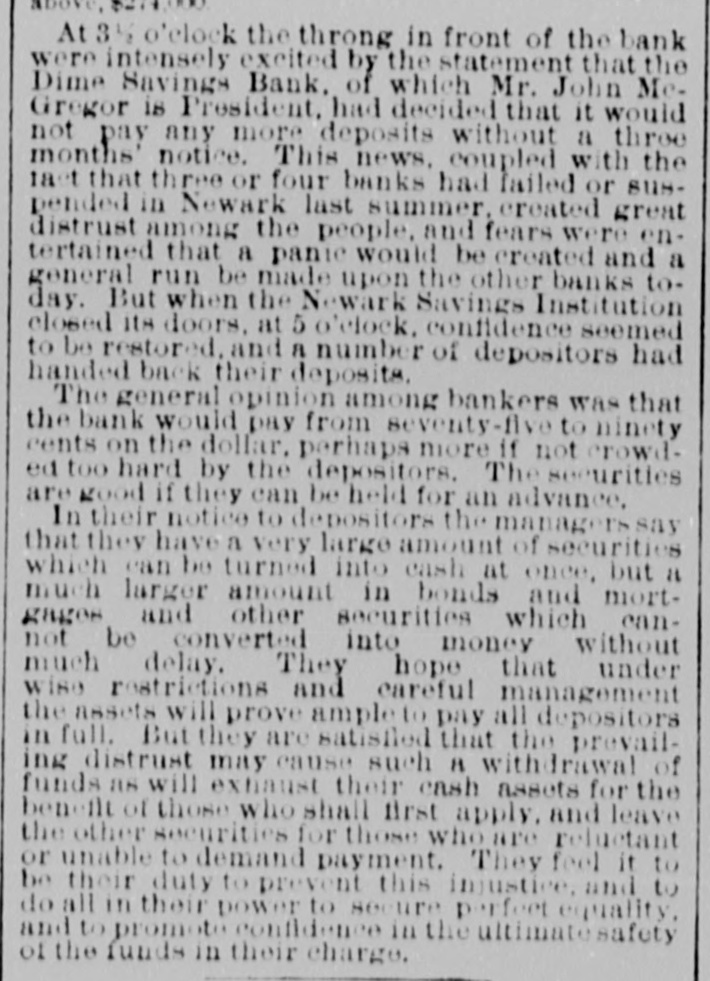
At 3% o'clock the throng in front of the bank were intensely excited by the statement that the Dime Savings Bank. of which Mr. John MeGregor is President, had decided that it would not pay any more deposits without a three months notice. This news, coupled with the tast that th ree or four banks had failed or suspended in Newark last summer, created great distrust among the people. and fears were entertained that a panic would be created and a general run be made upon the other banks today. But when the Newark Savings Institution closed its doors. at o'clock. confidence seemed to be restored. and a number of depositors had handed back their deposits. The general opinion among bankers was that the bank would pay from seventy-five to ninety cents on the dollar. perhaps more if not crowd. ed too hard by the depositors. The securities are good if they can be held for an advance. In their notice to depositors the managers say that they have a very large amount of securities which can be turned into cash at once, but a much larger amount in bonds and mortgages and other securities which cannot be converted into money without much delay. They hope that under wise restrictions and careful management the assets will prove ample to pay all depositors in full. But they are satisfied that the prevailing distrust may cause such H withdrawal of funds as will exhaust their cash assets for the benefit of those who shall first apply. and leave the other securities for those who are reluctant or unable to demand payment. They feel it to be their duty to prevent this injustice, and to do all in their power to secure perfect equality. and to promote confidence in the ultimate safety of the funds in their charge.


Article from The Wheeling Daily Intelligencer, December 13, 1877

Click image to open full size in new tab

Article Text

Another Savings Bank Added to the Long List. NEWARK, N. J. December 12.-The Newark Savings Bank, the largest and oldest in the city, chartered 30 years ago, has just been taken charge of by the the Chancellor on the petition of its managers to insure an equal distribution of the assests and prevent unfairness from a possible run. The bank has about eleven millions assets, including depreciated recurities, and two millions of government bonds. The deposits are eleven millions. The Chancellor orders the payment of 18 per cent of the principal to depositors with two per-cent interest January 2d, meanwhile he will make a full investigation. The moneya hereafter deposited are to be kept separate and invested. TAUNTON, MASS., December 12.-The Taunton Savings Bank suspended payment to-day. It is reported solvent and it is thought the depositors will be paid in full.


Article from The Daily Dispatch, December 13, 1877

Click image to open full size in new tab

Article Text

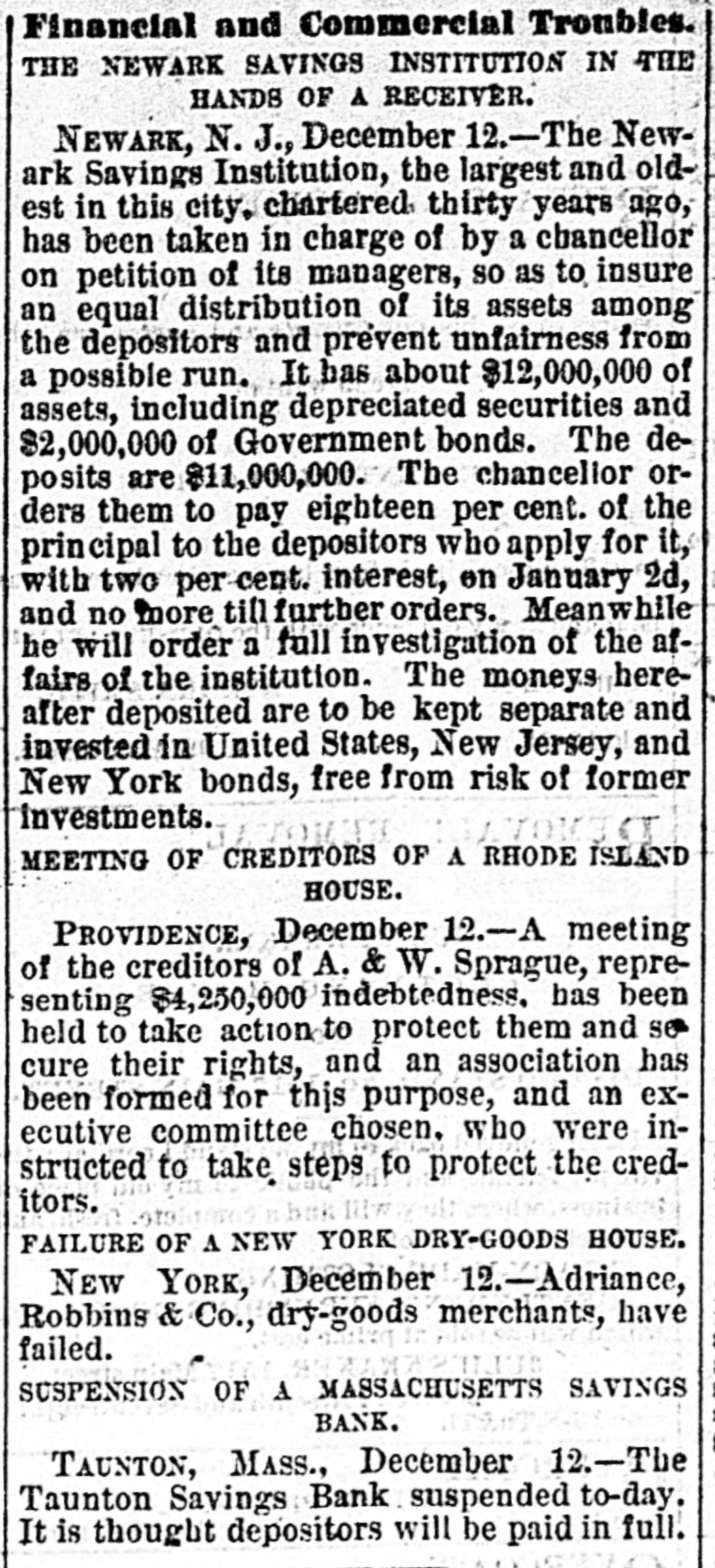
Financial and Commercial Troubles. THE NEWARK SAVINGS INSTITUTION IN THE HANDS OF A RECEIVER. NEWARK, N. J., December 12.-The Newark Savings Institution, the largest and oldest in this city, chartered thirty years ago, has been taken in charge of by a chancellor on petition of its managers, so as to insure an equal distribution of its assets among the depositors and prevent unfairness from a possible run. It has about $12,000,000 of assets, including depreciated securities and $2,000,000 of Government bonds. The deposits are $11,000,000. The chancellor orders them to pay eighteen per cent. of the principal to the depositors who apply for it, with two per cent. interest, on January 2d, and no more till further orders. Meanwhile he will order a full investigation of the affairs of the institution. The moneys hereafter deposited are to be kept separate and invested in United States, New Jersey, and New York bonds, free from risk of former investments. MEETING OF CREDITORS OF A RHODE ISLAND HOUSE. PROVIDENCE, December 12.-A meeting of the creditors of A. & W. Sprague, representing $4,250,000 indebtedness. has been held to take action to protect them and Secure their rights, and an association has been formed for this purpose, and an executive committee chosen. who were instructed to take steps to protect the creditors. FAILURE OF A NEW YORK DRY-GOODS HOUSE. NEW YORK, December 12.-Adriance, Robbins & Co., dry-goods merchants, have failed. SUSPENSION OF A MASSACHUSETTS SAVINGS BANK. TAUNTON, MASS., December 12.-The Taunton Savings Bank suspended to-day. It is thought depositors will be paid in full.


Article from New-York Tribune, December 13, 1877

Click image to open full size in new tab

Article Text

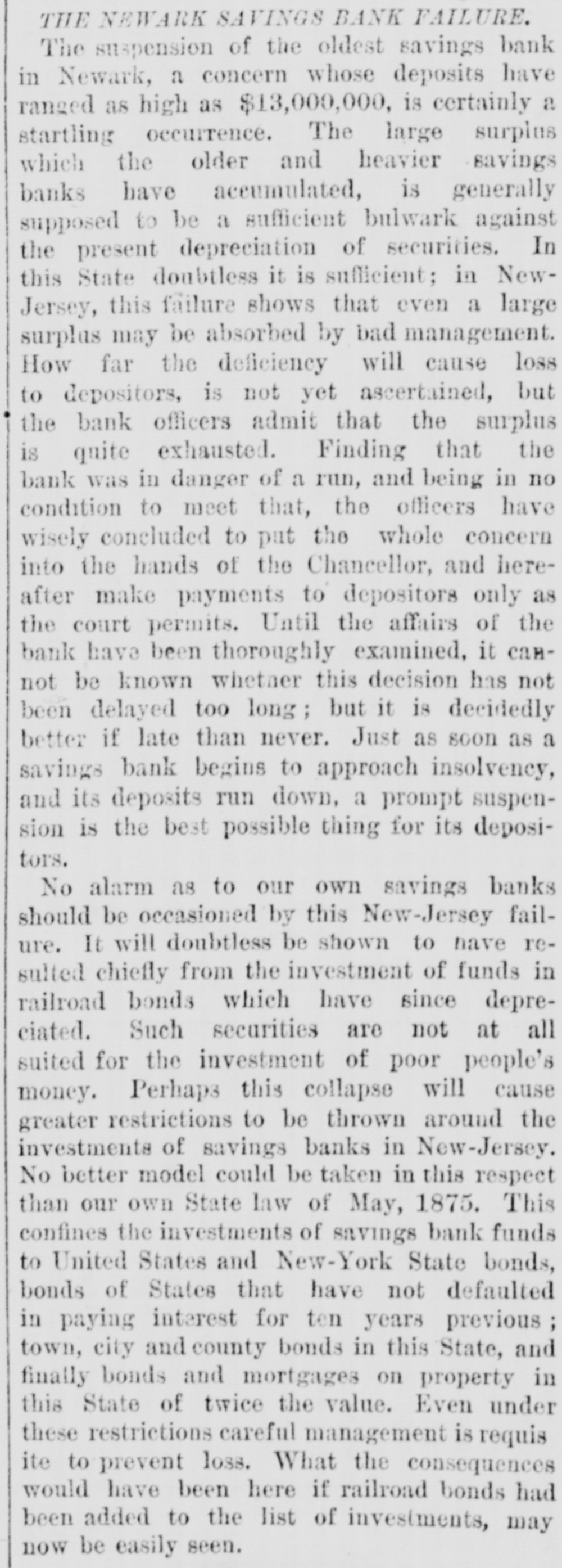
THE NEWARK SAVINGS BANK FAILURE. The suspension of the oldest savings bank in Newark, a concern whose deposits have ranged as high as $13,000,000, is certainly a startling occurrence. The large surplus which the older and heavier savings banks have accumulated, is generally supposed to be a sufficient bulwark against the present depreciation of securities. In this State doubtless it is sufficient; in NewJersey, this failure shows that even a large surplus may be absorbed by bad management. How far the deficiency will cause loss to depositors, is not yet ascertained, but the bank officers admit that the surplus is quite exhausted. Finding that the bank was in danger of a run, and being in no condition to meet that, the officers have wisely concluded to put the whole concern into the hands of the Chancellor, and hereafter make payments to depositors only as the court permits. Until the affairs of the bank have been thoroughly examined, it cannot be known whether this decision has not been delayed too long; but it is decidedly better if late than never. Just as soon as a savings bank begins to approach insolvency, and its deposits run down, a prompt suspension is the best possible thing for its depositors. No alarm as to our own savings banks should be occasioned by this New-Jersey failure. It will doubtless be shown to have resulted chiefly from the investment of funds in railroad bonds which have since depreciated. Such securities are not at all suited for the investment of poor people's money. Perhaps this collapse will cause greater restrictions to be thrown around the investments of savings banks in New-Jersey. No better model could be taken in this respect than our own State law of May, 1875. This confines the investments of savings bank funds to United States and New-York State bonds, bonds of States that have not defaulted in paying interest for ten years previous ; town, city and county bonds in this State, and finally bonds and mortgages on property in this State of twice the value. Even under these restrictions careful management is requis ite to prevent loss. What the consequences would have been here if railroad bonds had been added to the list of investments, may now be easily seen.


Article from The New York Herald, December 14, 1877

Click image to open full size in new tab

Article Text

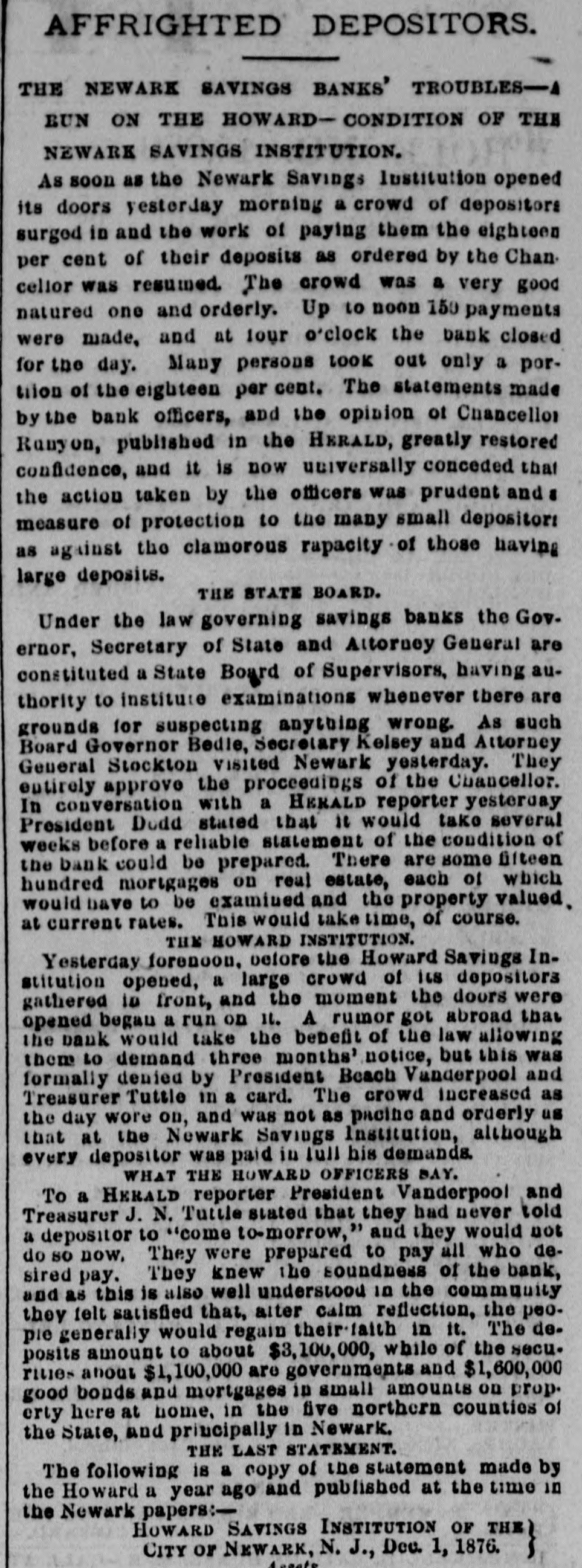
AFFRIGHTED DEPOSITORS. THE NEWARK SAVINGS BANKS' TROUBLES-A RUN ON THE HOWARD- CONDITION OF THE NEWARK SAVINGS INSTITUTION. As soon as the Newark Savings Institution opened its doors yesterday morning a crowd of depositors surged in and the work of paying them the eighteen per cent of their deposits as ordered by the Chan. celior was resumed. The crowd was a very good natured one and orderly. Up to noon 150 payments were made, and at four o'clock the bank closed for the day. Many persons LOOK out only a portiion of the eighteen per cent. The statements made by the bank officers, and the opinion of Chancellon Runyon, published in the HERALD, greatly restored confidence, and it is now universally conceded that the action taken by the officers was prudent and a measure of protection to the many small depositor: as against the clamorous rapacity of those having large deposits. THE STATE BOARD. Under the law governing savings banks the Gov. ernor, Secretary of State and Attorney General are constituted a State Board of Supervisors, having authority to institute examinations whenever there are grounds for suspecting anything wrong. As such Board Governor Bedle, Secretary Kelsey and Attorney General Stockton visited Newark yesterday. They entirely approve the proceedings of the Chancellor. In conversation with a HERALD reporter yesterday President Dodd stated that it would take several weeks before a reliable statement of the condition of the bank could be prepared. There are some fifteen hundred mortgages on real estate, each of which would have to be examined and the property valued. at current rates. This would take time, of course. THE HOWARD INSTITUTION. Yesterday forenoon, before the Howard Savings Institution opened, a large crowd of its depositors gathered in front, and the moment the doors were opened began a run on 11. A rumor got abroad that the bank would take the benefit of the law allowing them to demand three months' notice, but this was formally denied by President Beach Vanderpool and Treasurer Tuttle in a card. The crowd increased as the day wore on, and was not as pacihe and orderly us that at the Newark Savings Institution, although every depositor was paid in lull his demands. WHAT THE HOWARD OFFICERS DAY. To a HERALD reporter President Vanderpool and Treasurer J. N. Tuttle stated that they had never told a depositor to "come to-morrow," and they would not do so now, They were prepared to pay all who desired pay. They knew the soundness of the bank, and as this is also well understood in the community they felt satisfied that, alter calm reflection, the peopie generally would regain their-faith in it. The deposits amount to about $3,100,000, while of the secu. rities about $1,100,000 are governments and $1,600,000 good bonds and mortgages in small amounts on prop. erty here at home, in the five northern counties of the State, and principally in Newark. THE LAST STATEMENT. The following is a copy of the statement made by the Howard a year ago and published at the time in the Newark papers:HOWARD SAVINGS INSTITUTION OF THE) CITY or NEWARK, N. J., Dec. 1, 1876. Assets


Article from Daily Kennebec Journal, December 14, 1877

Click image to open full size in new tab

Article Text

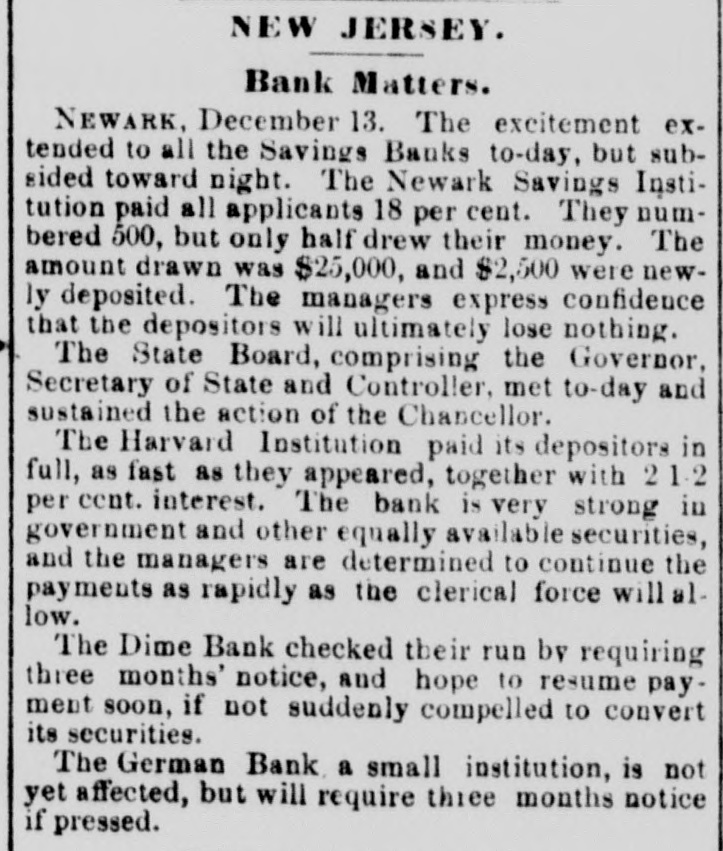
NEW JERSEY. Bank Matters. NEWARK, December 13. The excitement extended to all the Savings Banks to-day, but subsided toward night. The Newark Savings Institution paid all applicants 18 per cent. They numbered 500, but only half drew their money. The amount drawn was $25,000, and $2,500 were newly deposited. The managers express confidence that the depositors will ultimately lose nothing. The State Board, comprising the Governor, Secretary of State and Controller, met to-day and sustained the action of the Chancellor. The Harvard Institution paid its depositors in full, as fast as they appeared, together with 2 1-2 per cent. interest. The bank is very strong in government and other equally available securities, and the managers are determined to continue the payments as rapidly as the clerical force will allow. The Dime Bank checked their run by requiring three months' notice, and hope to resume payment soon, if not suddenly compelled to convert its securities. The German Bank a small institution, is not yet affected, but will require three months notice if pressed.


Article from The Daily Dispatch, December 14, 1877

Click image to open full size in new tab

Article Text

Financial and Commercial Troubles. THE EXCITEMENT AMONG THE NEWARK BANKSTHE DEFUNCT PATERSON INSURANCE COMPANY-THE HILDREDTH DEFALCATION. NEWARK, N. J., December 13.-The excitement to-day extended to all the savings banks, and subsided toward night. The Newark Savings Institution paid all applicants eighteen per cent. The amount drawn was $25,000, and $2,400 were newly deposited. The managers express contidence that the depositors will ultimately lose nothing. The Howard Institution paid depositors in full as fast as they appeared. The managers have determined to continue the payments as rapidly as the clerical force will allow. The Dime Bank checked their run by requiring, three months' notice, and hope to resume payments soon if not suddenly compelled to convert their securities. The German Bank-a swall institutionis not yet affected, but will adopt the three months'-notice rule if pressed. PATERSON, N. J., December 18.-An inventory of the defunct Paterson Fire-Insurance Company shows "the liabilities to be $450,000, including $200,000 capital; assets, $65,000; NEW YORK, December 13.-The amount of defalcation in the Watson J. Hildreth & Co. collecting agency is over $200,000. Many of the shrewdest merchants in town are among the victims. Investigations of numerous other similar institutions have already begun under the impulse of this failure.


Article from The Sun, December 17, 1877

Click image to open full size in new tab

Article Text

A Week's Bad Record. The past week was a bad week for the unsound savings banks and insurance companies. It-opened ominously. On Monday we got news of the appointment of a receiver for the German Savings Bank of Chicago; of the discovery that an Indiana cashier was a defaulter in the sum of $50,000; and of a suit brought against the stockholders of a broken Iowa bank by indignant depositors, who averred that only $5,000 of available assets could be found to meet liabilities aggregating $1,000,000. In the middle of the week came the astounding news that the Newark Savings Institution, with $12,000,000 of assets and $10,800,000 of deposits, was in trouble, had appealed to the courts, and was paying depositors for the present only 18 per cent. of their money. The week ended as it had begun. On Saturday Receiver BEST made public the fact that the affairs of the National Trust Company of this city had been mismanaged. that there had been irregularities and violations of the charter, and that the company's assets had been impaired to the extent of $700,000. On the same day, the New York public learned that the Oriental Savings Bank had put it. self in the hands of the Attorney-General to be closed up; that a receiver had been appointed for the Brewers' and Maltsters' Fire Insurance Company at its own request; that between one and two hundred depositors of the Long Island Savings Bank had consented to take eighty cents on the dollar, and had actually received forty cents; and that good Deacon BROADWELL of Clairmont Savings Bank fame had been arrested on a beneh warrant for perjury. He is now in the City Prison, where he has ex-President CASE of the Security Life Insurance Company for a neighbor. These incidents, added to the developments of the LAMBERT trial, the arrest of the ex-cashier of the Reading Savings Bank on a charge of embezziement, and other recent occurrences of a like nature, have made a deep impression on the public mind. It is not a pleasant impression. In its first, immediate effects it is a very painful impression. These discoveries of institutional rottenness are discouraging; they are disquieting. They beget suspicion and distrust, shaking confidence, and alarming timidity. Yet, we repeat, the revelations, astonishing and discreditable as some of them may be, are to be welcomed. It is better for the community that the facts should come out-the worst of them. The disease discovered is not so dangerous as the disease unsuspected, eating its way in secret. Both the public morals and the publie pocket will gain by the disclosure of the past week. Take the case of the National Trust Company. It seemed to be, and was esteemed, a sound, safe institution. When street rumor, a fortnight or SO since, began to whisper doubts as to its real condition, its President promptly rushed into print with a card in which he affirmed that the company was as solid as granite-or words to that effectand denounced the street reports as wicked and malicious lies. He was able to refer to a report made by an examining committee of the trustees as late as Dec. 7, in which the company was described as solvent, with a clear surplus of $30,000 over all liabilities. Yet it does not take Special Examiner (now Receiver) BEST very many hours to discover a $700,000 hole in the company's assets. Mr BEST expresses the belief that many of the trustees didn't know; they were surprised and indignant when he told them. We dare say respectable trustees usually are in these cases. As the trustees are personally responsible, there is more ground than there otherwise would be for his professed confidence that depositors will ultimately lose nothing. That is one of the advantages of being a well-to-do man and depositing some of your spare money with a trust company instead such think your very a earnings little it pretentious of will being reflection be in clear a sham, a poor savings to that every insolvency man the bank. reader and exposure passing putting But upon we of a itself off as soundness, is not a thing to be mourned over but to be rejoiced in The fact is wholly deplorable, but the exposure is


Article from The New York Herald, December 19, 1877

Click image to open full size in new tab

Article Text

THE SAVINGS NEWARK INSTITUTION. 0 Yesterday Chancellor Runyon announced his ap. pointment of a board of three commissioners to make a strict examination of the affairs of the Newark Savings Institution. The commissioners are George F. Tuttle, judge of one of the Newark district courts George Wilkenson, an experienced business man and accountant, and James F. Bond, one of the most reliable real estate brokers in the city. The appoint. ments, representing as they do the law, practical business knowledge and familiarity with the value of real estate, are generally approved, In the order sppointing them the Chancelior refers to them as "uninserested persons," and says:They are hereby appointed and commissioned to make is strict, careful and thorough examination of and into the past management of the institution. and into the character and value of its assets. and the amount due to depo-itors and others. and to report the result of their examination to this Court. And they are to state the various kinds of assets and of what they consist, with the present value of ea kind thereof, in order that the exact condition of the institution. as to the value or its investments and other property, may be made manifest by the report. And it is further ordered that the managers and officers of the institution furnish to and provide for them all necessary facidics and clerical aid in said examination, and give them free access to all the books, papers and documents of the institution pertaining to its management and property. with free access to all the assets and property. The com. missioners are to enter at once on the examination, and are to make It with all the despatch when the nature of the business and the thoroughness hereby required of them therein will allow. and the are to report the result of their investigation to this Court without unnecessary THEODORE RUNYON, Chancellor. delny. Such an examination as the Chancellor requires will, at the most expeditions rate, take considerable timeweeks, it not months-as may be realized when 16 18 Stated that there are mortgages held by the bank to the number of about one thousand five hundred, each of which will have to be examined and the property inspected. Besides, there are the other securities, in all to the value of $11,000,000. The officers of the bank emphatically deny that they gave any information to favored depositors, who drew their funds belore the suspension, and express themselves perfectly willing to resign their places it the depositors will unite in some efficient method of releasing them. There is some talk of depositors calling a meeting to take counsel as to whether there 18 any necessity for taking any steps toward investigation other than those alroady taken.


Article from The New York Herald, December 28, 1877

Click image to open full size in new tab

Article Text

SAVINGS INSTITUTIONS. MEETING OF DEPOSITORS IN NEWARK-ANOTHER CHANCERY ORDER. About tive hundred persons, chiefly Germans, gath. ered at Turn Hall, Plane street, Newark. last evening and considered the situation as regards the suspended Newark Savings Institution, in which nearly all of those present were depositors. Mr. Joseph Christle was unanimously chosen 10. preside, and Mr. A. F. Spacth was elected secretary. Rev. Mr. Krait spoke. As one of the directors of the Tenth Ward Life Insuranco Association, which had called the meeting, he gave it as his opinion that it could do something toward securing a portion. at least of the deposits. He finally made two motions. First, one condemning the management of the bank as unworthy of further confidence; and second, calling for the appointment of a committee to wait upon the commissioner. appointed by the Chancellor and obtain from thein sucu information as could be furnished regarding the condition of the bank, its bad and worthless securities and its real assets. Both motions were carried. Messra. A. F. Spaeth, Samuel Lagowetz. Theodore Merz, Adain Wagner and Joseph Christle were Lappointed by the audience as the committee to wait upon the examining commissioners. ADDITIONAL ORDER FROM THE CHANCELLOR. Yesterday Chancellor Runyon issued a supplementary order, which modifies or alters the first order so that each depositor who has not drawn the eighteen per cent will be entitled to receive twenty per cent of his deposit, and those who have drawn the eighteen per cent will be entitled to draw two per cent more on the amount of their deposit, as it was on the 12th of December insi., the date of the order."


Article from The Sun, January 4, 1878

Click image to open full size in new tab

Article Text

BANK DEPOSITORS' DEMANDS. Seeking the Removal of the Officers of the Newark Savings Institution. An adjourned meeting of the depositors of the Newark Savings Institution was held in the Academy of Music, Newark, last night. to hear the report of the committee appointed at a previous meeting to apply to Chancellor Runyon for permission to examine the books of the bank. Mr. William Alling said, on taking the chair, that the action of the managers of the Newark Savings Institution was a subject of fair criticism from the depositors who had in. trusted their money to their keeping. The bank's surplua of nearly $1,500,000 had disapbeared in four years, and the bank was unable to meet the demands of the depositors and had to appeal to the Chancellor for protection. The managers said, in their application, that all of their securities, even United States bonds, had depreciated: but they said nothing about the bonds that they bought at par and sold nt a premium, nor about Newark bonds, which are rated at a premium. Mr. A. F. Spaeth reported that the committee had first waited upon the Chancellor and made a formal application for permission to examine the books of the bank and had then called upon President Dodd, who said that he could do nothing. The Commissioners promised to have an inventory of Assets ready for the meeting. but had sent word that it would not be ready until Friday noon. The Rev. Mr. Kraft said: "Our money was not invested as the law requires. In the last annual statement of the bank the $2,000,000 in Chesapcake and Ohio bonds was not mentioned. The depositors were hoodwinked. The money in that bank is ours. and we want to know what has become of it." The Rev. Mr. Kraft then read a resolution calling for the appointment of a committee of five to take legal steps to have the managers and officers of the bank removed and to have men appointed in their places in whom the DOOple have confidence, and who will obey the charter. On motion of Mr. Geo. R. Gray the resolution was amended 80 as to link for the retention of the present Vice-President, Ira M. Harrison. who, it was said, had occupied the position six months ago in the interest of the depositors. and had saved money for them. The resolution was then adopted amid applause.


Article from New-York Tribune, January 5, 1878

Click image to open full size in new tab

Article Text

New-York Daily Cribune. FOUNDED BY HORACE GREELEY, SATURDAY, JANUARY 5. 1878. THE NEWS THIS MORNING. FOREIGN.-The City of Sophia is defenceless, and will offer no resistance to the Russian forces. Russia counsels England not to let the Turks suppose that she will oppose the occupation of ConstanGreece has demanded of the Powers tinople admission to any Congress held prior to the conclusion of peace. DOMESTIC.-Orders have been issued to Collector Tutton to sell the abandoned exhibits left at Professors Watson "Andrew D. Philadelphia. White, and a few other names have been agreed on Mr. for Assistant-Commissioners at Paris. Schleicher has prepared a very exhaustive report on Mexican relations, in which smuggliag, trade, recognition of Diaz, and other topics are discussed. === The House Military Committee will bring in a bill to reduce the staff of the army. The list of wrecks on the coast increases; the United States steamer Kearsarge is on the rocks S. H. White, near Portsmouth, N. H., harbor. former Vice-President of the Charter Oak Life Insurance Company appeared in court and Snow storms prevailed generally gave bonds. throughout the country. Two failures are reported from Chicago and three from Cincinnati; J. N. Thomas. banker at Des Moines, Iowa, suspended. CITY AND SUBURBAN.-Thomas Lord and his wife have not yet returned to the city. The preparation of evidence in the legal proceedings is in proThe Aldermen voted yesterday for gress. Judge BraTweed's release by 13 to 7. dy rebuked W. W. Macfarland for unbecoming language in the Erie litigation. A new plan for Lehigh and Wilkesbarre reorganization was Many securities adopted by the bondholders. repledged by Bonner were sold. A meeting of leading banks is to be held to-day to agree to a gold basis for loans. The contract for weighing merchandise at this port has been awarded. No bodies were disThe covered yesterday in the Barclay-st. ruins. depositors in the Newark Savings Institution are promised 70 per cent, and possibly 90 per cent. Gold 10234 102% 10234. Gold value of the legal-tender dollar at the close, 97810 cents. Stocks dull and declining with a fall in coal shares. THE WEATHER.-TRIBUNE local observations indicate clear and cold, followed by somewhat warmer and partly cloudy weather. Thermometer yesterday, 32°, 42°, 33°.


Article from The Carbon Advocate, January 12, 1878

Click image to open full size in new tab

Article Text

PARAGRAPHIC , . -Syracuse, N. Y., has a stone"pile which : keeps away all tramps. i -According to vital statistics for the year 1877, 26,194 persons died in the city of New s York. 29.152 died during 1876. -The Harrisburg Telegraph says that the f grave of the late Governor Geary is the most > neglected spot in the cemetery in that city. -The old county jail at Jacksonville, Fla., is being repaired, and will be used as an arsenal for the military organizations of that State. -The worst managed financial concern thus far is the Miners' Trust Company, of Pottsville, Pa. One centon the dollar is all that is left. -Miss Jennie Collins, of Boston, is getting up a fair, the proceeds of which will constitute a fund for giving dinners to working girls who are out of employment this winter. -The suspended Jersey City Savings Bank, it is now stated, will probably be able to pay its depositors in full. The receiver already has enough cash on hand to pay 60 per cent. -The commissioners appointed to: examine the condition of the Newark Savings Institution report that it can pay at least 72 per cent to depositors, and the assets may realize more. -A blind Italian beggar brought suit in San Francisco court several days ago to recover $100, and during the trial it came out that the plaintiff had $1000 to his credit in a savings bank. -A swarm of bees were recently discovered under the eaves of the Congregational Church in Boscawen, N. II., and with 69 pounds of honey taken from their hidingplace a festival was held which brought the church a large sum. -One of the largest shoe firms in Boston has just concluded an arrangement with the Perúvian Government to furnish 35,000 pairs of men's shoes. They had previously filled an order for the same Government for 10,000 pairs of shoes. -The people of Branford, Conn., are' going to petition the Legislature to prohibit the carrying away of oysters from the beds there to stock private grounds, on the plea that it deprives them of a large part of their necessary food supply. -Steamboat navigation of the Suwanee river, Fla., has been resumed after a long suspension. This is one of the bodies of water that would be ultilized in the construction of the proposed Atlantic and Gulf ship canal, and the extent of its navigable capacity is an interesting question. -In addition to the use of the telephone for military purposes in Gerinany, these instruments have been provided for telegraph operators at ten principal towns, and many more are being constructed. They are also in use between the offices of the Postmaster General and the Director of Telegraphs and of other high public officials. Experiments on a large scale between France and Germany are also being carried on. -The United States Government receives license fees from one wholesale liquor establishment, two breweries and 433 saloons in Vermont, and yet the State officials cannot find one of these places. It is proposed in the next Legislature to make the payment of a license to the General Government or the receipt therefor prima facie evidence of the manufacture or the sale of liquor. Such a law would have increased Vermont's revenue the last year $20,000. -One of the up-town police stations in New York, is, according to the Tribune, the headquarters of a band of boy policemen, consisting of a captain, two sergeants, and half a dozen patrolmen. The lads are all under fifteen years of age and report at the station promptly at 6 P. M., every day. They are furnished with a list of untenanted houses, which they visit at night: inspect with great care, to see that they are not disturbed hy burgulars. During the past year no less than three burglarshave been gaught and convicted through the efforts of these boys.


Article from The New York Herald, May 15, 1878

Click image to open full size in new tab

Article Text

NEWARK SAVINGS INSTITUTION. It has been resolved by the managers of the Newark Savings Institution to apply to Chancellor Runyon for permission to pay a second instalment of twenty per cent to depositors on and after June 1. The managers have also re-elected President Dold and the old Finance Committee, Messrs. A. S. Reeve, A. B. Baldwin and Henry G. Darcy. The Examining Commissioners will be ready to report the actual condition of the bank in a tow weeks.


Article from The New York Herald, July 18, 1879

Click image to open full size in new tab

Article Text

# HAPPY DEPOSITORS. When the Newark Savings Institution, the oldest savings bank in New Jersey, suspended its assets included over $2,000,000 worth (face value) of Chesapeake and Ohio Railroad bonds. The examiners appointed by the Chancellor valued these and other securities representing $600,000 at a total of $500,000, less than one-fifth the face value. Since then the railroad stock has risen so that the $2,000,000 is now worth $1,000,000. The bank people are happy and depositors are clamoring for another payment of ten per cent on the amount of their deposite.


Article from The Daily Dispatch, July 21, 1879

Click image to open full size in new tab

Article Text

When the Newark Savings Institution, the oldest savings bank in New Jersey, suspended, its assets included over $2,000,000 worth (face-value) of Chesapeake and Ohio railroad bonds. The examiners appointed by the Chancellor valued these and other securities representing $600,000 at a total of $500,000-less than one fifth the face-value. Since then the railroad stock has risen, so that the $2,000,000 is now worth $1,000,000. The bank people are happy, and depositors are clamoring for another payment of ten per cent. on the amount of their deposits.


Article from New-York Tribune, December 1, 1879

Click image to open full size in new tab

Article Text

NEW YORK CITY. Last week's record 1,242 arrests, 537 deaths, 563 births, and 227 marriages. The Indies' fair for the benefit of St. Joseph's Church, at One-hundrod-and-twenty-fifth-st. and Ninth-ave., will close to-day. The body of an unknown man, about forty years old, of medium height, and dressed like a longshoroman, was found in the East River at Pier No. 23 yesterday. A meeting of the striking cabinetmakers and varnishers who had been employed by Pottier & Stymus.was held Saturday,and it was reported that 135 men were now on strike. Michael Lavitzki, a Russian pedler, seventy-twovears old, hanged himself at his home, No. 28 Suffolk st., Saturday evening. He was depressed by bad health and the infirmities of old age. The forty-ninth anniversary of the Polish Revolution of 1830 was celebrated by the Polish residents of this city at Dramatic Hall, Houston-st., Saturday evening. Several speeches were made. Drainage and contracts for the laying out of streets the topics discussed at the special meeting of the West Side Association Saturday evening, and among the speakers were General Egbert L. Viele, Dwight H. Olinstead, and John D. Crimmins. A committee of the Westchester Polo Club, consisting of James Gordon Bennett, August Belmont, jr., Herman Oelrichs. F. Gray Griswold and H. L, Herbert. has selected grounds at Fifth-ave. and One-hundred-and-tenth-st, where a club-house will be erected. The total (estimated) amount of grain on the canal from Buffalo and Oswego coming toward tidewater on Saturday noon was Wheat. 179,000 bushels; corn. 273,000 bushels; barley, 94,000 bt shels; rye, 19,600 bushels; peas, 12,200 bushels. The canals will be closed officially on Saturday. The Socialistic Labor party met at the Germania Assembly Rooms Saturday evening, and several speakers spoke of the condition of the workingmen. Resolutions were adopte. protesting against the alleged attempts of the capitalists and their hirelings, the paid politicians of California, to violate the rights of the people." The Tammany committee to investigate the O'Callaghan-Haskin trouble in the XIXth Assembly District met Saturday night. A characteristic letter was received from Mr. Haskin, in which he tried toshow that Callaghan had proved treacherous to the Tammany organization, and asked tbat he be expelled. The subject will next come up before the Committee on Organization. The inmates of the Roosevelt Hospital were gladdened by the gifts which came to them on Thanksgiving Day from the Church of the Covenant, of which the Rev. Dr. Vincent is pastor. These consisted of a bouquet oreach patient, sixteen pots of flowers, a barrel of bananas, apples and oranges, a keg of Malaga grapes, three boxes of grapes, SIX baskets of choice fruits, twelve dozen lemons, a box of oranges, and a box of pears. Information has been received in this city of the arrest in Frankfort-on-the-Main of Alfred Engene Lagrave, who is famous for having swindled prominen! firms in New-York, Boston and Philadelphia in 1871. At that time he fled to Canada, and thence went to Belfast. He was subsequently arrested in London, but was discharged. Again be was arrested in France and brought to New- York, having about $80,000 in his possession, and was again discharged. He 18 now in custody on a charge of forging medical certificates and diplomas. BROOKLYN. The payment of taxes will begin to-day. During the year ending September 30, the Brooklvn, Flatoush and Coney Island Railroad carried 873,960 passengers. Itseatnings were $203,051 30 and its expenditures $155,328 07. Mrs. Barnes, age fifty, living in South Fifth-st., was seiz d with a fit of sickness while walking through Fourth-st. last evening, and died while being taken to St. Catherine's Hospital in an ambulance. Three burglars were discovered in a grocery store at Livingston and Hoyt-sts., Saturday morning, by D. Warms. He caught and held one of them until the arrival of the police. The burglar gave his name as George Watson, of No. 23 Bayard-st., NewYork. Justice Gertrum, of East New-York, has committed to the Penitentiary for thirty days the Rev. David Tibner, a colored preacher, who was charged with assaulting his wife, and whose excuse was that she had gossipped about him among the neighbors. A number of residents of the Eighteenth and Twenty-first Wards held a meeting Saturday night, at Broadway and Myrtle-ave., to protest against the use of steam motors on the Broadway Railroad. A committee of seventeen members was appointed to take proper measures. The St. Matthew's English Lutheran Church Society, which formerly worshipped in State-st., near Hoyt-st., has secured the use of the church at Chinton and Amity-sts., and dedication services were held there yesterday morning. A sermon was preached by the Rev. S. A. Ort, of New York. The Rev. M. W. Hamma IS the pastor of the church. George W. Beilby, of No. 426 Gold-st., who was arrested on Thanksgiving Day on a charge of perjury, has been admitted to bail: He sued W illiam allace and William Lombard, by whom he had been employed as a travelling agent, for breach of contract in lischarging him without paying him his salary for the balance of the year. and recovered a verdict of $560. The defendants have made a joint affidavit that Beilby swore falsely. JERSEY CITY. A hearing in the contest over the $18,000 left by David Leach, the miserly rag-picker who died a year ago, was held in Jersey City on Saturday in the Hudson County Orphan's Court. Mary J. Davis testified that she was a niece of the dead miser, and exhibited some articles which he had given her. Patrolman Thomas Flynn, of the First Police Precinct of Jersey City, died suddenly Saturday morning. He was on duty Thursday night, and returned to the station-house Friday morning with his clothing soiled with mud and his nose bleeding. It was alleged that be had been beaten. Chief of Police Murphy says the officer's death was caused by congestion of the brain. At the last meeting of the Board of Education of Jersey City the salaries of the principals were reduced 16-3 per cent, those of the other teachers 18 per cent, and those of the janitors 1734 per cent. Superintend Dickson's salary was reduced from $2,500 to $1,800, and that of the Clerk of the Board from $1,800 to $1,200. The reductions will take effect from to-day. NEWARK. August Bock, a boy employed in E. Simon & Sons trunk factory, had his skull fractured on Saturday by an iron bar, which another boy dropped upon his head through an open hatchway. He was in a ing condition yesterday. The body of a young man, well dressed. was found lying near the track at the coal dumps on the Penusylvania Railroad below Broad Street Station early yesterday morning. It was shockingly mutilated, the head being crushed and almost entirely severed from the body. The name could not be ascertained. Mr. Dodd, president of the Newark Savings Institution, which suspended over a year ago, states that within the last few months the securities held by the bank have advanced in market value over $1,000,000, and that the time IS not far distant when the managers will be able to pay dollar for dollar, and continue the business as of old. NEW-JERSEY. WEST HOBOKEN.-Francis Wenser, age fourteen years, and livingat West Hoboken, has been missing since last Thursday morning, hen he went hunting on the Seacaucus meadows. ELIZABETH.-Geore Meyer, of Menlo Park, accidentally killed his thirteen-year-old son Friday afternoon. He was cleaning a shot-gun, not knowing that it was loaded, and it went off, the charge entering the boy's hip and thigh. He bled to death before assistance could be obtained.


Article from New-York Tribune, November 30, 1880

Click image to open full size in new tab

Article Text

GOOD NEWS FOR DEPOSITORS. The Newark Savings Institution and the Dime Savings Bank, which suspended in 1877, and are now under control of the Caancellor, are reported to be in a greatly improved condition, owing to the appreciation of their assets, and it is believed that both banks will be able to pay depositors in full. The Newark has already paid 60 per cent, and the Dime 40 per cent. The appreciation in value of the Chesapeake and Ohio bonds, over two millions of which are held by the Newark Savings Institution, already amounts to $1,000,000. The Dime Savings Bank held $200,000 of these bonds, which, when the bank suspended and commissioners made an estimate of the value of the assets held by it, were not considerea to be worth anything, and were not included in the schedule of assets ubmitted to the Chancellor. Their value now is $170,000. The managers of the Dime Bank expect to pay another dividend of 10 per cent before January 1. Both banks hold a large number of good mortgages on property in Essex County, which they would be reluctant to foreclose for the reason that such a course would cause widespread distress and because there is at present no demand for real estate. Since the suspension the Newark Savings Institution has disposed of $1,500,000 of mortgages with triffing loss, and paid depositors over $5,000,000. Upon the application of the officers of the Dime Saving Institution, made last night, Chance. for Runyon will take steps at once to order the payment of another 10 per cent dividend to the depositors.


Article from New-York Tribune, July 18, 1882

Click image to open full size in new tab

Article Text

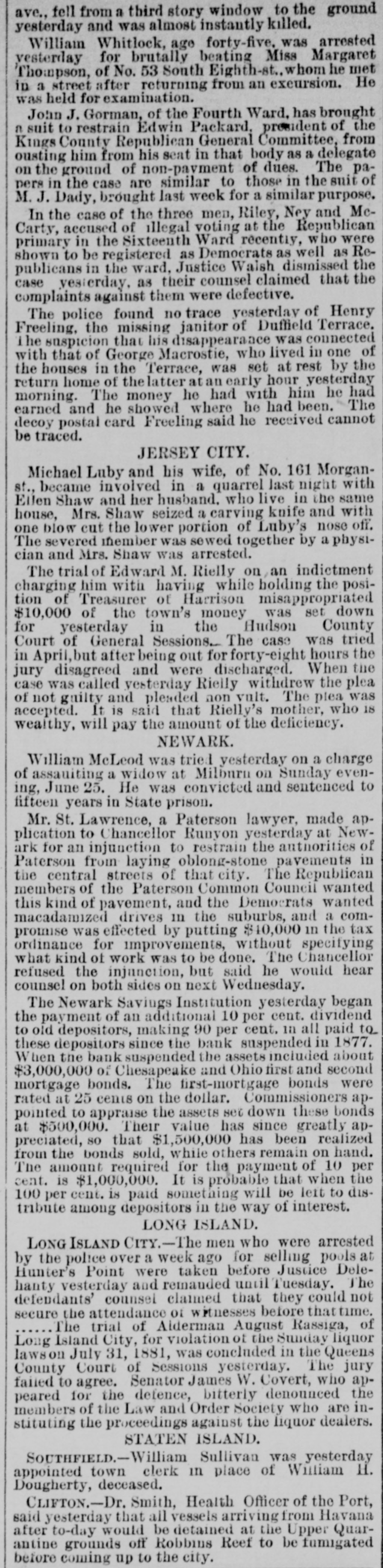
ave., fell from a third story window to the ground yesterday and was almost instantly killed. William Whitlock, age forty-five, was arrested yesterday for brutally beating Miss Margaret Thompson, of No. 53 South Eighth-st. whom he met in a street after returning from an excursion. He was held for examination. John J. Gorman, of the Fourth Ward, has brought a suit to restrain Edwin Packard, president of the Kings County Republican General Committee, from ousting him from his seat in that body as a delegate on the ground of non-payment of dues. The papers in the case are similar to those in the suit of M. J. Dady, brought last week for a similar purpose. In the case of the three men, Riley, Ney and McCarty, accused of illegal voting at the Republican primary in the Sixteenth Ward recently, who were shown to be registered as Democrats as well as Republicans in the ward, Justice Walsh dismissed the case yesterday. as their counsel claimed that the complaints against them were defective. The police found no trace yesterday of Henry Freeling, the missing janitor of Duffield Terrace. The suspicion that his disappearance was connected with that of George Macrostie, who lived in one of the houses in the Terrace, was set at rest by the return home of the latter atan early hour yesterday morning. The money he had with him he had earned and he showed where he had been. The decoy postal card Freeling said he received cannot be traced. JERSEY CITY. Michael Luby and his wife, of No. 161 Morganst., became involved in a quarrel last night with Ellen Shaw and her husband, who live in the same house, Mrs. Shaw seized a carving knife and with one blow cut the lower portion of Luby's nose off. The severed member was sewed together by a physician and Mrs. Shaw was arrested. The trial of Edward M. Rielly on an indictment charging him with having while holding the position of Treasurer of Harrison misappropriated $10,000 of the town's money was set down for yesterday in the Hudson County Court of General Sessions. The case was tried in April, but after being out for forty-eight hours the jury disagreed and were discharged. When the case was called yesterday Rielly withdrew the plea of not guilty and pleaded non vult. The plea was accepted. It is said that Rielly's mother, who 18 wealthy, will pay the amount of the deficiency. NEWARK. William McLeod was tried yesterday on a charge of assauiting a widow at Milburn on Sunday evening, June 25. He was convicted and sentenced to fifteen years in State prison. Mr. St. Lawrence, a Paterson lawyer, made application to Chancellor Runyon yesterday at Newark for an injunction to restrain the authorities of Paterson from laying oblong-stone pavements in the central streets of that city. The Republican members of the Paterson Common Council wanted this kind of pavement, and the Democrats wanted macadamized drives in the suburbs, and a compromise was effected by putting $10,000 in the tax ordinance for improvements, without specifying what kind of work was to be done. The Chancellor refused the injunction, but said he would hear counsel on both sides on next Wednesday. The Newark Savings Institution yesterday began the payment of an additional 10 per cent. dividend to old depositors, making 90 per cent. in all paid to these depositors since the bank suspended in 1877. When the bank suspended the assets included about $3,000,000 of Chesapeake and Ohio first and second mortgage bonds. The first-mortgage bonds were rated at 25 cents on the dollar. Commissioners appointed to appraise the assets set down these bonds at $500,000. Their value has since greatly appreciated, so that $1,500,000 has been realized from the bonds sold, while others remain on hand. The amount required for the payment of 10 per cent. is $1,000,000. It is probable that when the 100 per cent. is paid something will be left to distribute among depositors in the way of interest. LONG ISLAND. LONG ISLAND CITY.-The men who were arrested by the police over a week ago for selling pools at Hunter's Point were taken before Justice Delehanty vesterday and remanded until Tuesday. The defendants' counsel claimed that they could not secure the attendance of witnesses before that time. The trial of Alderman August Rassiga, of Long Island City, for violation of the Sunday liquor lawson July 31, 1881, was concluded in the Queens County Court of Sessions yesterday. The jury failed to agree. Senator James W. Covert, who appeared for the defence, bitterly denounced the members of the Law and Order Society who are instituting the proceedings against the liquor dealers. STATEN ISLAND. SOUTHFIELD.-William Sullivan was yesterday appointed town clerk in place of William H. Dougherty, deceased. CLIFTON.-Dr. Smith, Health Officer of the Port, said yesterday that all vessels arriving from Havana after to-day would be detained at the Upper Quarantine grounds off Robbins Reef to be fumigated before coming up to the city.


Article from New-York Tribune, August 27, 1884

Click image to open full size in new tab

Article Text

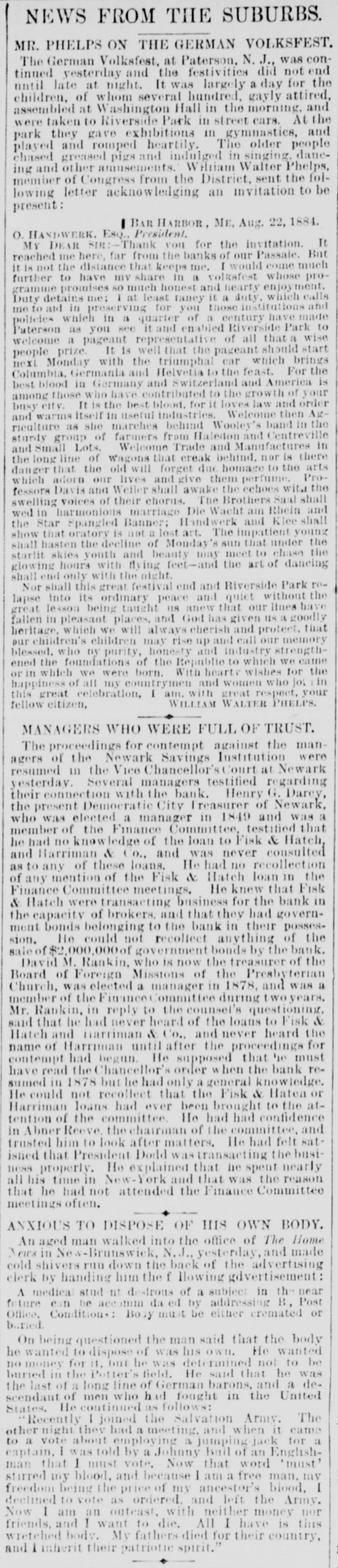
children, gayly assembled at Washington Hall in the morning, and were taken to Riverside Park in street cars. At the park they gave exhibitions in gymnastics, and played and romped heartily. The older people chased greased pigs and indulged in singing, daneing and other amusements. Wiltiam Walter Phelps, member of Congress from the District, sent the following letter acknowledging an invitation to be present: BAR HARBOR, ME, Aug. 22, 1884. O. HANDWERK. Esq., President. MY DEAR SIR:-Thank you for the invitation. It reached me here, far from the banks of our Passaic. But it is not the distance that keeps me. I would come much further to have my share in a volksfest whose programme promises so much honest and hearty enjoy ment. Duty detains me; I at least tancy it a duty, which calls me to and in preserving for you those institutions and policies which in a quarter of a century have made Paterson as you see it and enabled Riverside Park to welcome a pageant representative of all that a wise people prize. It is well that the pageant should start next Monday with the triumphal car which brings Columbia, Germania and Helvetia to the feast. For the best blood in Germany and Switzerland and America is among those who have contributed to the growth of your busy city. It is the best blood, for it loves law and order and warms itself in useful industries. Welcome then Agriculture as she marches behind Wooley's band in the sturdy group of farmers from Haledon and Centreville and Small Lots. Welcome Trade and Manufactures in the long line of wagons that creak behind, nor is there danger that the old will forget due homage to the arts which adorn our lives and give them perfume. Professors Davis and Weiler shall awake the echoes with the swelling voices of their chorus. The Brothers Saal shall wed in harmonions marriage Die Wacht am Rhein and the Star Spangled Banner; Handwerk and Klee shall show that oratory is not a lost art. The impatient young shall hasten the decline of Monday's sun that under the starlit skies youth and beauty may meet to chase the glowing hours with flying feet-and the art of dancing shall end only with the night. Nor shall this great festival end and Riverside Park relapse into its ordinary peace and quiet without the great lesson being taught us anew that our lines have fallen in pleasant places, and God has given us a goodly heritage. which we will always cherish and protect, that our children's children may rise up and call our memory blessed. who by purity, honesty and industry strengthened the foundations of the Republic to which we came or in which we were born. With heartv wishes for the happiness of all my countrymen and women who joi in this great celebration, I am. with great respect, your WILLIAM WALTER PHELPS. fellow citizen, MANAGERS WHO WERE FULL OF TRUST. The proceedings for contempt against the managers of the Newark Savings Institution were resumed in the Vice Chancellor's Court at Newark yesterday. Several managers testified regarding their connection with the bank. Henry G. Darcy, the present Democratic City Treasurer of Newark, who was elected a manager in 1849 and was a member of the Finance Committee, testified that he had no knowledge of the loan to Fisk & Hatch, and Harriman & Co., and was never consulted as to any of these loans. He had no recollection of any mention of the Fisk & Hatch loan in the Finance Committee meetings. He knew that Fisk & Hatch were transacting business for the bank in the capacity of brokers. and that they had government bonds belonging to the bank in their possession. He could not recollect anything of the sale of $2,000 000of government bonds by the bank. David M. Rankin, who is now the treasurer of the Board of Foreign Missions of the Presbyterian Church, was elected a manager in 1878, and was a member of the Financet ommittee during two years. Mr. Rankin, in reply to the counsel's questioning, said that he had never heard of the loans to Fisk & Hatch and marriman & Co., and never heard the name of Harrman until after the proceedings for contempt had begun. He supposed that he must have read the Chancellor's order when the bank resumed in 1878 but he had only a general knowledge. He could not recollect that the Fisk & Haten or Harriman loans had ever been brought to the attention of the committee. He had had confidence in Abner Reeve, the chairman of the committee, and trusted him to look after matters. He had felt satistied that President Dodd was transacting the business properly. He explained that he spent nearly all his time in New-York and that was the reason that he had not attended the Finance Committee meetings often. ANXIOUS TO DISPOSE OF HIS OWN body. An aged man walked into the office of The Home News in New-Brunswick, N.J., yesterday, and made cold shivers run down the back of the advertising clerk by handing him the f llowing gdvertisement: A medical stud nt desirous of a subject in the near future can be accomm da ed by addressing B, Post Office. Conditions: Boby must be either cremated or buried. On being questioned the man said that the body he wanted to dispose of was his own. He wanted no money for it, but he was determined not to be buried in the Potter's field. He said that he was the last of a long line of German barons, and a descendant of men who had fought in the United States. He continued as follows: Recently I joined the Salvation Army. The other night they had a meeting, and when it came to a vote about employing a jumping jack for a captain, I was told by a Johnny Bull of an English-


Article from New-York Tribune, June 25, 1895

Click image to open full size in new tab

Article Text

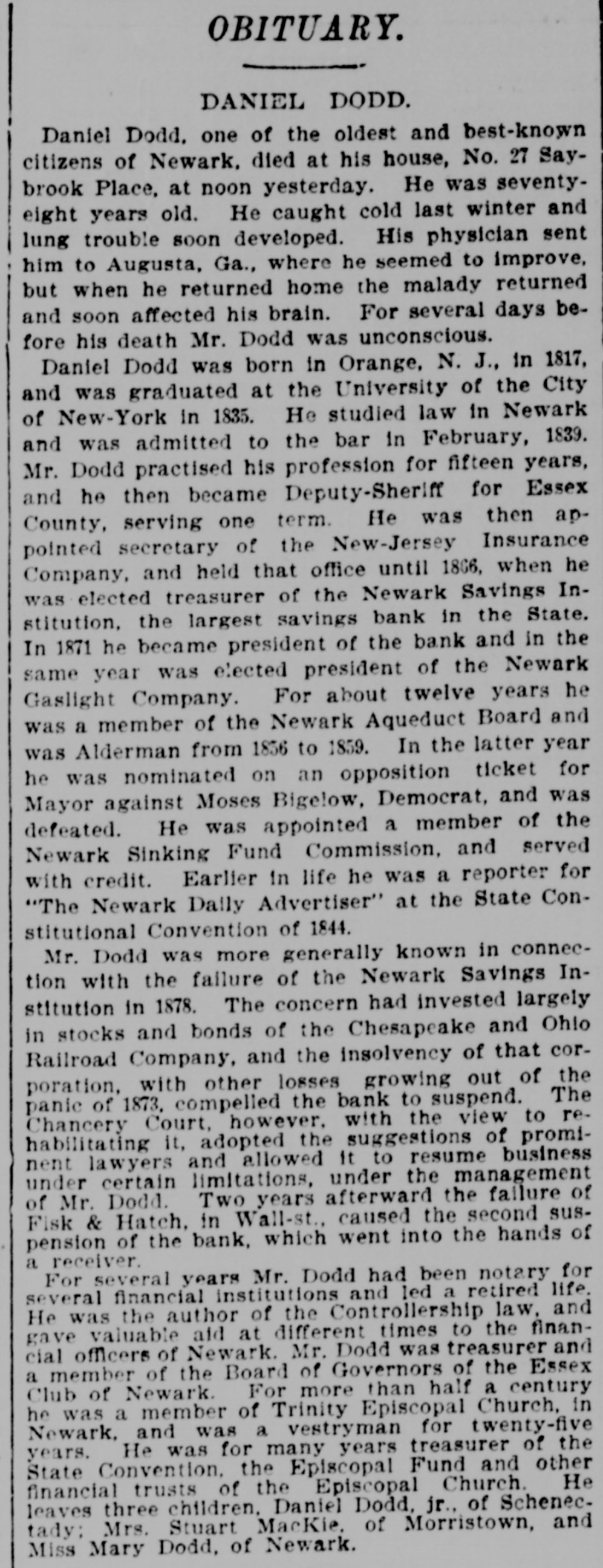
OBITUARY. DANIEL DODD. Daniel Dodd. one of the oldest and best-known citizens of Newark. died at his house, No. 27 Saybrook Place, at noon yesterday. He was seventyeight years old. He caught cold last winter and lung trouble soon developed. His physician sent him to Augusta, Ga., where he seemed to improve, but when he returned home the malady returned and soon affected his brain. For several days before his death Mr. Dodd was unconscious. Daniel Dodd was born in Orange, N. J., in 1817, and was graduated at the University of the City of New-York in 1835. He studied law in Newark and was admitted to the bar in February, 1839. Mr. Dodd practised his profession for fifteen years, and he then became Deputy-Sheriff for Essex County, serving one term. He was then appointed secretary of the New-Jersey Insurance Company, and held that office until 1866, when he was elected treasurer of the Newark Savings Institution, the largest savings bank in the State. In 1871 he became president of the bank and in the same year was elected president of the Newark Gaslight Company. For about twelve years he was a member of the Newark Aqueduct Board and was Alderman from 1856 to 1859. In the latter year he was nominated on an opposition ticket for Mayor against Moses Bigelow, Democrat, and was defeated. He was appointed a member of the Newark Sinking Fund Commission, and served with credit. Earlier in life he was a reporter for "The Newark Daily Advertiser" at the State Constitutional Convention of 1844. Mr. Dodd was more generally known in connection with the failure of the Newark Savings Institution in 1878. The concern had invested largely in stocks and bonds of the Chesapeake and Ohio Railroad Company, and the insolvency of that corporation, with other losses growing out of the panic of 1873, compelled the bank to suspend. The Chancery Court, however, with the view to rehabilitating it, adopted the suggestions of prominent lawyers and allowed It to resume business under certain limitations, under the management of Mr. Dodd. Two years afterward the failure of Fisk & Hatch, in Wall-st., caused the second suspension of the bank, which went into the hands of a receiver. For several years Mr. Dodd had been notary for several financial institutions and led a retired life. He was the author of the Controllership law, and gave valuable aid at different times to the financial officers of Newark. Mr. Dodd was treasurer and a member of the Board of Governors of the Essex Club of Newark. For more than half a century he was a member of Trinity Episcopal Church, in Newark, and was a vestryman for twenty-five years. He was for many years treasurer of the State Convention. the Episcopal Fund and other financial trusts of the Episcopal Church. He leaves three children. Daniel Dodd, jr., of Schenectady; Mrs. Stuart MacKie. of Morristown, and Miss Mary Dodd, of Newark.