Central Bank (New York, NY)

Episode Information

Episode UID
1260104190660
Episode Type
Suspension β†’ Run β†’ Closure
Bank Type
state
Bank ID
126010419 hash
Start Date
December 13, 1854
Location
New York, New York (40.714, -74.006)

Metadata

Model
gemini-3-flash-preview (chosen from majority vote of a three-model LLM ensemble)
Short Digest
a6f0c4092f0761a6

Response Measures

None

Description

The bank was suspended from the Clearing House for failing to meet its balances, which triggered a run by depositors and note-holders before it formally closed for liquidation.

Events (4)

1. December 13, 1854 Other
Newspaper Excerpt
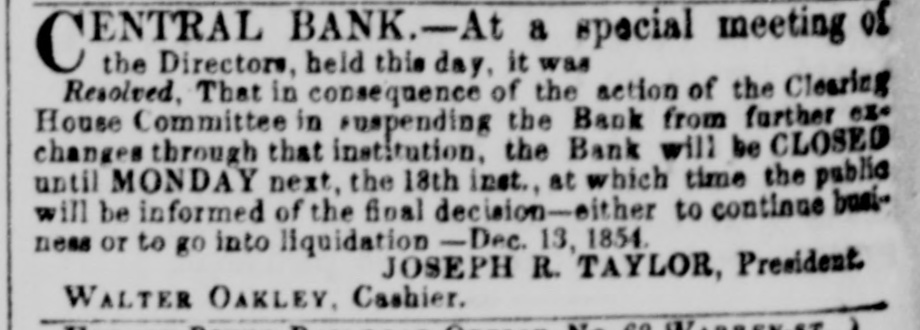
the bank will be closed until Monday next, the 18th instant, at which time the public will be informed of the final decision, either to continue business or to go into liquidation.
Source
newspapers
2. December 13, 1854 Run
Cause
Bank Specific Adverse Info
Cause Details
The bank's suspension from the Clearing House triggered a rush of withdrawals.
Measures
The bank closed its doors and held a directors' meeting to decide on liquidation.
Newspaper Excerpt
The suspension was followed by a rush of note-holders and depositors, which would be fatal to almost any Bank in the city.
Source
newspapers
3. December 13, 1854 Suspension
Cause Details
Suspended from the Clearing House for failing to pay balances according to rules.
Newspaper Excerpt
The Central Bank, situated in Chambers st near Broadway, has been suspended from the Clearing-House.
Source
newspapers
4. December 19, 1854 Receivership
Newspaper Excerpt
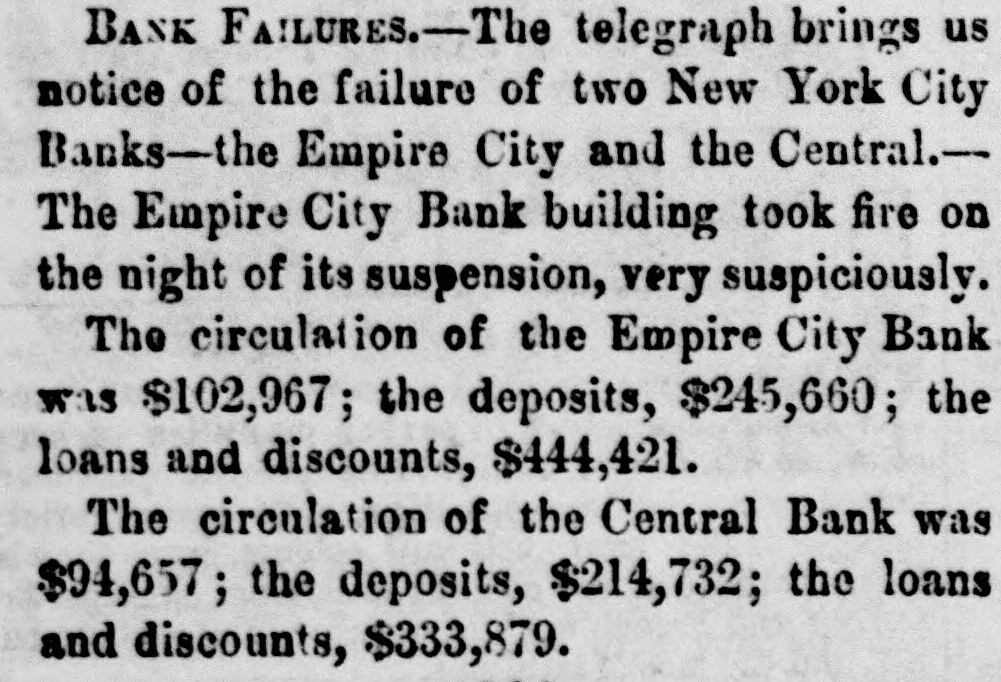
The telegraph brings us notice of the failure of two New York City Banks-the Empire City and the Central.
Source
newspapers

Newspaper Articles (16)

Article from Evening Star, December 6, 1854

Click image to open full size in new tab

Article Text

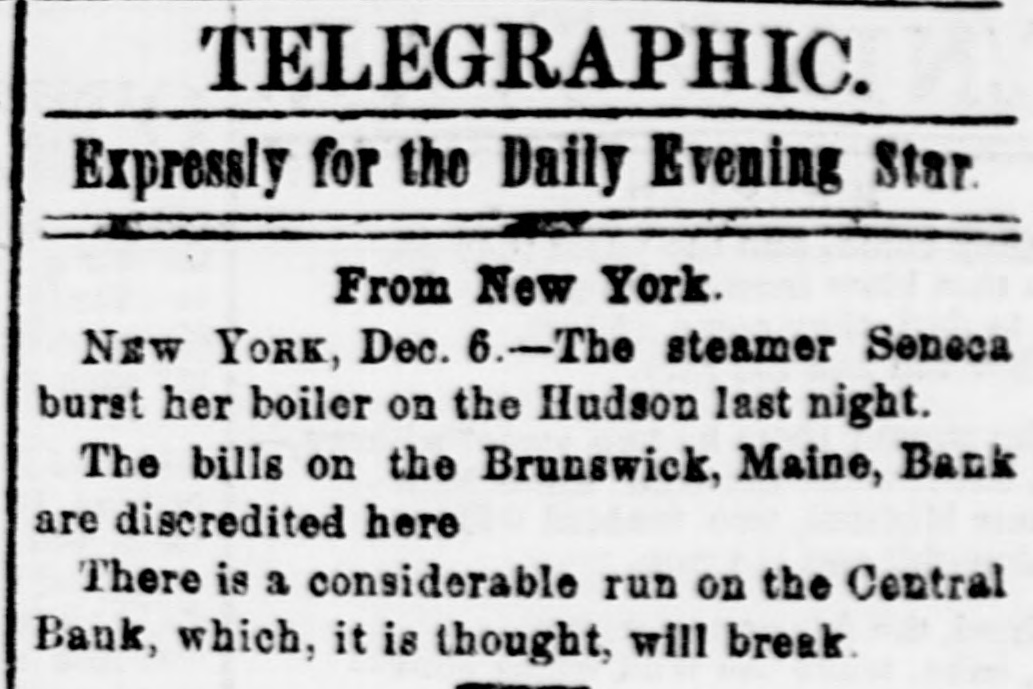
TELEGRAPHIC. Expressly for the Daily Evening Star From New York. NEW YORK, Dec. 6.-The steamer Seneca burst her boiler on the Hudson last night. The bills on the Brunswick, Maine, Bank are discredited here There is a considerable run on the Central Bank, which, it is thought, will break.


Article from Evening Star, December 7, 1854

Click image to open full size in new tab

Article Text

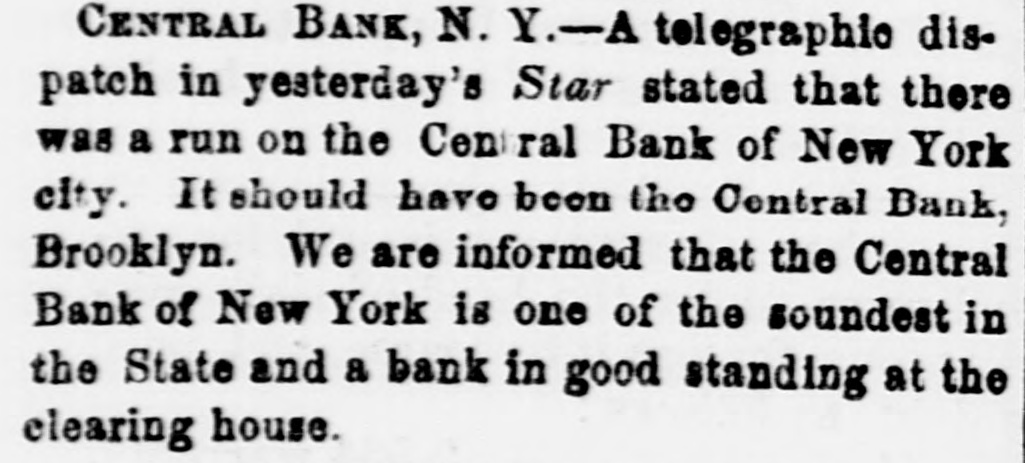
CENTRAL BANK, N. Y.-A telegraphic dispatch in yesterday's Star stated that there was a run on the Central Bank of New York city. It should have been the Central Bank, Brooklyn. We are informed that the Central Bank of New York is one of the soundest in the State and a bank in good standing at the clearing house.


Article from Daily American Organ, December 7, 1854

Click image to open full size in new tab

Article Text

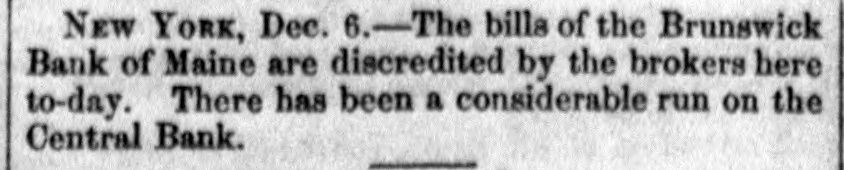
NEW YORK, Dec. 6.-The bills of the Brunswick Bank of Maine are discredited by the brokers here to-day. There has been a considerable run on the Central Bank.


Article from The Daily Dispatch, December 8, 1854

Click image to open full size in new tab

Article Text

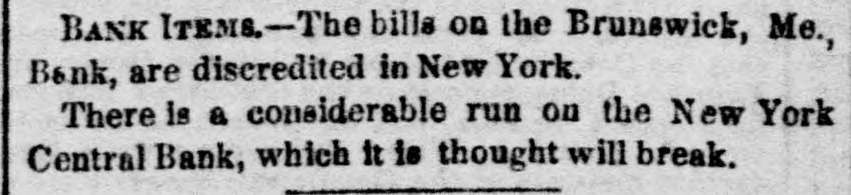
BANK ITEMS.-The bills on the Brunswick, Me., Bank, are discredited in New York. There is a considerable run on the New York Central Bank, which It is thought will break.


Article from The Daily Dispatch, December 8, 1854

Click image to open full size in new tab

Article Text

RICHMOND, VA: FRIDAY MORNING, DECEMBER 3, 1854. SPIRIT TOFTHEPRESS Enquirer expresses its perfect Convention-not satisfaction The action of the Stauston says, was with the incident of which, it of applause to the fidelity the the affairs of the Federal the tribute least which pleasing Executive. Government and ability There with administered by the present bad feeling in the Whig press about the but the m s much in the Convention; that was the Enquirer saw nothing In for writer the friends of competing of between in exhibited aspirants hopes the struggle the the which should flatter the in demonominations, These contests often occur detriment of adversary. and never to the struggle in a fair and honorable as true democrats, have no to the party. the cratic minority, conventions, Beaten and alternative labor by the will of the party, has but to abide for its success. The Enquirer He ll buckle zealously Mr. Leake or his friends." of rush into the fight with on his armor impetuous daring of a ted distrust zeal an and knight, prowees the devo. whose the is unquestioned and whose for loyalty unequalled. is In 1851, Mr. Wise Convention was beaten of that of the Staunton or did not relapse into and himself into the his splendid elequence to the Leake and the contribted nomination ference. day, he He threw Bocock. In inactivity another struggle Democratic election article, indif- and of Johnson, gives an account of night, the Enquirer African church on Tuesday speeches meeting and glowingly at the describes the efforts of the on occasion. that thinks that the Democratic ratification the The Whig sad commentary upon presented a characterized their ga. and in times gone by, and was In the "speedy decline and credit meeting spirit therings enthusiaem their that fall." sorrowfully of ominous of the cause of Democracy, the rights, the speeches, internal improvements, touched State's upon, in the State, of the South, &c., were only style of Democratic absorbed attention being with rights the usual briefly-their orators, "another rather on more to a marked extent, haunt the that occasion, Know Nothingism appeared to scorned imaginations subject. of every speaker. They of Virginia the unterritied Democracy humbug; idea of by this Know Nothing importance being frightened while they showed, by the question, that yet, all attached the to the Know Nothing and had an awful were considerably elections. effects upon the meeting dread says the Whig, on the they they calculated, of its terrified, approaching that the spot, It is several bundred Know Nothings exhibitions made many more, such Democratic As to the and how manufacture, God only knows. regards Mr. will speeches, the writer unworthy of merit of effort as the a failure, and wholly Not much was Wise's A. Wise once was. and hence expected what Henry from the rest ot the candidates, nobody was disappointed. Post alludes in terms of praise Gordon to the The Penny of General Improvement on Internal speech meeting Tuesday Democratic ratification one of Virgiat the The words of wisdom from sons should not night. oldest and most practical to tall unheeded upon the writer) the din of the nia's (says popular ear. be Amid allowed be inflicted, politics let interna us with not which we are now about duty to to the cause of with improvement, forget that we owe which a carnot be neglected safety. the general sentiment of women the recent and meet- nerIt of was Dentists in New York to that erroneous impresing vous men are often the subject influence of ether. Two sions while under each of which a young were the operator had cases woman believed mentioned, that in and those of others kissed who con her. and all his arguments, convince her to the present, could not that the operator had One woman who took her the face. reduction of luxation him into the father had thrown form slapped thought trary. were during his A thought little boy, his hip. of the chloro- Many coa hip, rate were gnawing occurred in the hole, and interesting the cases, which had mentioned. practice other of those present, were has Leonard Henley, of Philadelphia, to Townsend sent. Dr. John Tyler, jr., a challenge duel. The latter, however, through city, to tight a notice it Smith, of like that a sensible man, has appears, taken no was last of the matter. The doctor, Lunatic Department of spring dismissed from subsequently, the It is said, he had the Almshouse, two personal and altercations with Mr. Smith Hence one or the present difficulty. Eugenie, of France, no declares unnecessary that The Empress shall take place, and houseno state balle incurred by the Emperor's hold, expenses until shall the be taking of Sebastopol is un fait In accompli. John L. Norri has been convicted Mary's county, of murder Md., for the second his alave, degree, and in sentenced St. to the penitentiary killing for years and months. 5 ITEMS.-The bills on York. the Brunswick, Me., Bank, BANK are discredited considerable in New run on the New York Central There Bank, is a which it is thought will break. and Dr. in Saturday afternoon the George mesmeric Farland art, called Amanda, Hoffman, On professors Arch street, of Philadelphia, agirl boarding for the purat a house of perimenting. been put in a and mesmeric she bethe pose house, had previously but easily awakened, Farland put state by the Farland, subject upon this requested occasion. Dr. Hoffman pres. to to his magnetic blowing in her ear. the girl, add her came sleep, hand and and influence, then which awake he did Being by satis. but sing her their test, they tried found to this impossible.- and the fied their with astonishment person they for eight hours. of the in She to meantime laid like a dead the police the being informed into custody took


Article from New-York Daily Tribune, December 13, 1854

Click image to open full size in new tab

Article Text

miles per hour, therefore, reduces the wear and tear 45 P cent With all these facts in mind, we believe the following estimate will be amply realized: $6,300,000 Gross rece ipts Expenses & $ cent which is equal to 60 Y cent. on 3,150,000 former rates charged last year $3,150,000 Net Income $1,739,570 Deduct 7 4 cent. on debt 420,000 Sinking Fund $2,159,570 Net income applicable to cash dividends and $990,430 With such contingencies a margin beyond all the eng agements tal by the Company, can any one believe, for a moment, that the interest on the debt and the pay. ments to the Sinking Fund can ever fail to be promptly ? met The earnings of the road must continue to increase yearly for a long time to come, for not only must the future increase of population and productions of the Western States add greatly each year to the traffic on the Erie Road, but there must also be a rapid and im portant yearly increase in the local traffic; for it is only within a few years that the counties through which the road passes have had access to a market for their products, and consequently the local traffic is, as yet, only in its infancy The Sinking Fund of the New York and Erie Railroad Company will absorb in the twelve months after the negotiation of the loan, if the bonds are purchased $420,000 15,000 Plus at eix par months' interest on said amount, about $435 000 In the first year 420,000 nd year $420,000 Plus six months interest on 45,000 435,008 Plus 12 months interest on $900,000 In two years. The effect of the monthly purchases of the new bonds by the Sinking Fund, must be to cause them to be firmly held at a profit from the very day of their negotiation, for all but needy sellers will wait for a rise before they sell, and those desirous of selling will only offer them when the purchases of the Sinking Fund are made. The needy sellers will probably not more than suffice for the purchases of the Sinking Fund, particularly if, as there is every probability, the money markets next year should everywhere become easy, and interest fall to moderate rates. The steadiness which all this will produce in the market value of the new bonds, will soon attract the attention of persons who have temporary investments to make, and these bonds will, no doubt, soon obtain a preference from this class of capitalists over every other investment offering in this market. This will further improve their market value, 80 that it appears certain to us that the original takers of the new loan will realize a profit on them within a moderate time. Should the entire loan be taken in Europe, the holders could at once establish the price at par, and the Company would be forced to take them at this price; and should the holders refuse to sell at par, the Company will then be forced to purchase the bonds of 1862 and 1871, which would, in that event, soon rise to par. If the present holders of the 1862 and 1871 bonds were to take the new loan, they would soon see their old bonds rise to par as well as the new ones. No loan has ever been offered anywhere, on which a profit was 80 certain to be realized, as the new Loan of the New.York and Erie Railroad Company. As the Company has decided to close Construction Account for the present, there is no danger that the pecuniary embarrassments of the past can ever occur again. We regret to announce that another City ank has been, through mismanagement, brought into trouble. The Central Bank, situated in Chambers st near Broadway, has been suspended from the ClearingHouse. It paid up its balances to day, but, after examination, the Committees thought it judicious to euspend them. Mr. Jos. R. Taylor is President and Walter Oakley, Cashier of this bank. Its statemen in the Bank Statement of Monday last was-Loans and discounts, $301,173; specie, $22,405; circulation, $83,733; deposits, $186,249; capital, $300,000. The cans, It will be seen, have been reduced to within $1,200 of the capital. The securities with the Controller for the circulation are worth about $116,000, 80 that the notes reperfectly secure. The depositors will probably be paid in full The fine new marble build ing on the corner of Chambers-st. and Broadway was intended for the occupancy of this institution. The assets of the Empire City Bank, we hear, are of very doubtful character. The deposits may be paid, but the stock dividend promises to be small. The stock has been sold at 44. The interest on the New-York Central Railroad Convertible Bonds, due on the 15 inst., will be paid at the banking-houses of Messrs. Duncan, Sherman & Co., of this City. The Central Bank of Brooklyn has declared a semi-annual dividend of 4 P cent. With regard to the failure of Messrs. Blodgett & Co., of Boston, announced yesterday, it is stated that they owe between $1,900,000 and $2,000,000, aud show a surplus of $200,000 or $300,000. They owe one Milk-st. house $176,000, and another $151,000, and owe several other creditors about $50,000 each. The failures at the South and West, and the utter impossibility of collecting the vast sums due them, is the cause assigned for this suspension. It is the Jargest failure of the season in Boston. The generally received explanation of the nonincrease of specie in the last Bank Statement is, that the late disbursements of coin from the Assay Office have been drawn off for the purpose of strengthening the banks of Philadelphia, Boston and the West. From the latter section of the country, however, as far as we can ascertain, the receipts have been about equal to the shipments. The Philadelphia and Boston banks are very short of specie, and have been oorrowing here. There is also, probably some hoarding of gold among parties who have no means of discriminating between bank notes which are safe to hold and those which are not. The day of departure of the Collins steamers from this port has been changed from Saturday to Wednesday, in consequence of the withdrawal of the Cunard"ere. The next Collins steamer from this port will leave on Wednesday, the 27th inst. Mr. Edward Bill's Circular gives the following statistics of the exports of Breadstuffs to Great Britain and Ireland from 1st September, 1854: Flour, C.Meal, Whest, Corn, bbls bbla. bush From bush 22 New York 19,589 41,108 1,721,951 New Orleans 4719 1,164
Article from The New York Herald, December 14, 1854

Click image to open full size in new tab

Article Text

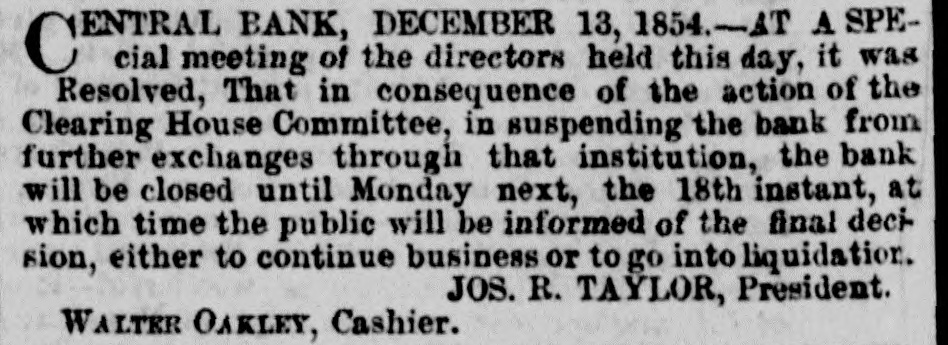
ENTRAL BANK, DECEMBER 13, 1854.-AT A SPEC cial meeting of the directors held this day, it was Resolved, That in consequence of the action of the Clearing House Committee, in suspending the bank from further exchanges through that institution, the bank will be closed until Monday next, the 18th instant, at which time the public will be informed of the final decision, either to continue business or to go into liquidation. JOS. R. TAYLOR, President. WALTER OAKLEY, Cashier.


Article from New-York Daily Tribune, December 14, 1854

Click image to open full size in new tab

Article Text

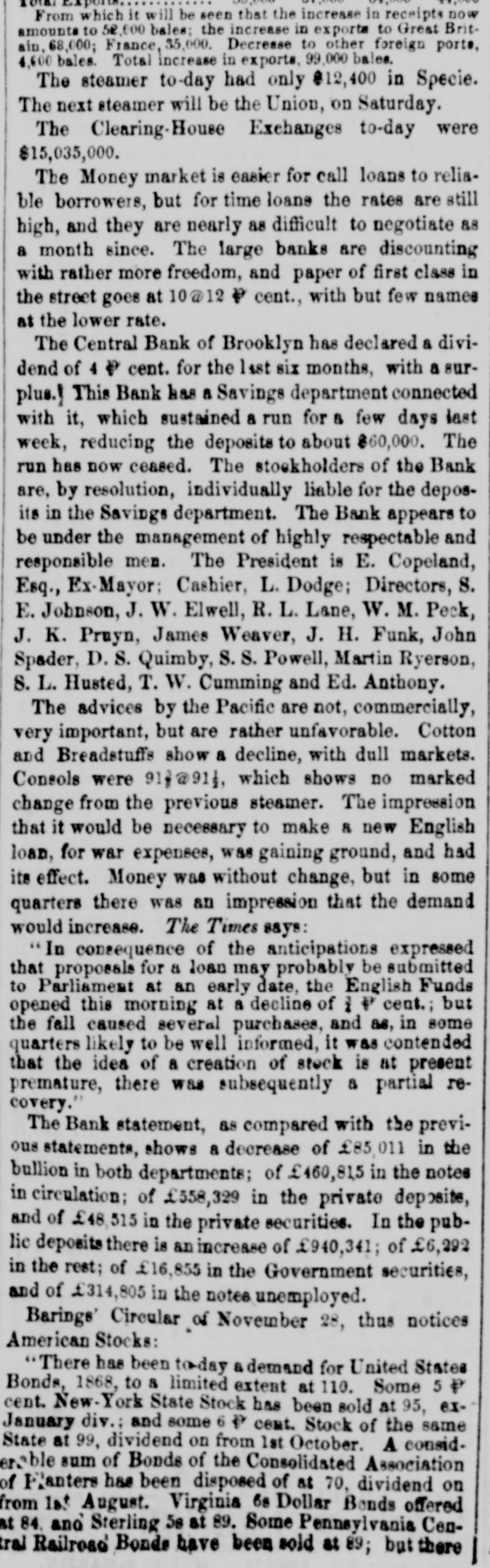
From which it will be seen that the increase in receipts now amounts to 52,000 bales; the increase in exports to Great Britain, 68,000; France, 35,000. Decrease to other foreign porte, 4,000 bales. Total increase in exports, 99,000 bales. The steamer to-day had only $12,400 in Specie. The next steamer will be the Union, on Saturday. The Clearing-House Exchanges to-day were $15,035,000. The Money market is easier for call loans to reliable borrowers, but for time loans the rates are still high, and they are nearly as difficult to negotiate as a month since. The large banks are discounting with rather more freedom, and paper of first class in the street goes at 10@12 P cent., with but few names at the lower rate. The Central Bank of Brooklyn has declared a dividend of 4 P cent. for the last six months, with a surplus.} This Bank has a Savings department connected with it, which sustained a run for 8 few days last week, reducing the deposits to about $60,000. The run has now ceased. The stockholders of the Bank are, by resolution, individually liable for the deposits in the Savings department. The Bank appears to be under the management of highly respectable and responsible men. The President is E. Copeland, Esq., Ex-Mayor; Cashier, L. Dodge; Directors, S. E. Johnson, J. W. Elwell, R. L. Lane, W. M. Peck, J. K. Pruyn, James Weaver, J. H. Funk, John Spader, D.S. Quimby, S.S. Powell, Martin Ryerson, S. L. Husted, T. W. Cumming and Ed. Anthony. The advices by the Pacific are not, commercially, very important, but are rather unfavorable. Cotton and Breadstuffs show a decline, with dull markets. Consols were 91f@91}, which shows no marked change from the previous steamer. The impression that it would be necessary to make 8 new English loan, for war expenses, was gaining ground, and had its effect. Money was without change, but in some quarters there was an impression that the demand would increase. The Times says: In consequence of the anticipations expressed that proposals for a loan may probably be submitted to Parliament at an early date, the English Funds opened this morning at a decline of I P cent.; but the fall caused several purchases, and as, in some quarters likely to be well informed, it was contended that the idea of a creation of stock is at present premature, there was subsequently a partial recovery." The Bank statement, as compared with the previous statements, shows a decrease of Β£85,011 in the bullion in both departments; of Β£460,815 in the notes in circulation; of Β£558,329 in the private deposite, and of Β£48,515 in the private securities. In the public deposits there is an increase of Β£940,341; of Β£6,292 in the rest; of Β£16,855 in the Government securities, and of Β£314,805 in the notes unemployed. Barings' Circular of November 28, thus notices American Stocks: "There has been to-day a demand for United States Bonds, 1868, to a limited extent at 110. Some 5 P cent. New-York State Stock has been sold at 95, 6xJanuary div.: and some 6 P cent. Stock of the same State at 99, dividend on from 1st October. A considerable sum of Bonds of the Consolidated Association of Flanters has been disposed of at 70, dividend on from lat August. Virginia 6s Dollar Bends offered at 84. and Sterling 5s at 89. Some Pennsylvania Central Railroad Bonds have been sold at 89; but there


Article from New-York Daily Tribune, December 14, 1854

Click image to open full size in new tab

Article Text

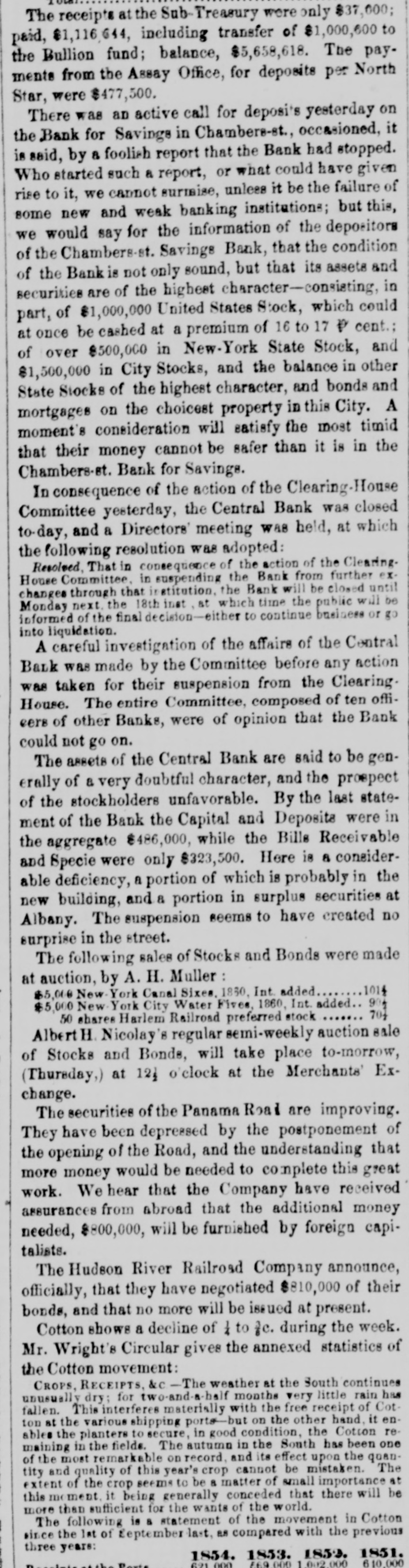
receipts paid, $1,116,644, including transfer of $1,000,600 to the Bullion fund; balance, $5,658,618. The payments from the Assay Office, for deposits per North Star, were $477,500. There was an active call for deposits yesterday on the Bank for Savings in Chambers-st., occasioned, it is said, by a foolish report that the Bank had stopped. Who started such & report, or what could have given rise to it, we cannot surmise, unless it be the failure of some new and weak banking institutions; but this, we would say for the information of the depositors of the Chambers-st. Savings Bank, that the condition of the Bank is not only sound, but that its assets and securities are of the highest character-consisting, in part, of $1,000,000 United States Stock, which could at once be cashed at a premium of 16 to 17 P cent.; of over $500,000 in New-York State Stock, and $1,500,000 in City Stocks, and the balance in other State Stocks of the highest character, and bonds and mortgages on the choicest property in this City. A moment's consideration will satisfy the most timid that their money cannot be safer than it is in the Chambers-st. Bank for Savings. In consequence of the action of the Clearing-House Committee yesterday, the Central Bank was closed to-day, and a Directors' meeting was held, at which the following resolution was adopted: Resolved, That in consequence of the action of the ClearingHouse Committee, in suspending the Bank from further exchanges through that institution, the Bank will be closed until Monday next. the 18th inst at which time the public will be informed of the final decision-either to continue business or go into liquidation. A careful investigation of the affairs of the Central Bank was made by the Committee before any action was taken for their suspension from the Clearing. House. The entire Committee, composed of ten offieers of other Banks, were of opinion that the Bank could not go on. The assets of the Central Bank are said to be generally of a very doubtful character, and the prospect of the stockholders unfavorable. By the last statement of the Bank the Capital and Deposits were in the aggregate $486,000, while the Bills Receivable and Specie were only $323,500. Here is 8 considerable deficiency, a portion of which is probably in the new building, and & portion in surplus securities at Albany. The suspension seems to have created no surprise in the street. The following sales of Stocks and Bonds were made at auction, by A. H. Muller : 1014 $5,000 New-York Canal Sixes. 1830, Int. added $5,000 New-York City Water Fives, 1860, Int. added 901 703 50 shares Harlem Railroad preferred stock Albert H. Nicolay's regular semi-weekly auction sale of Stocks and Bonds, will take place to-morrow, (Thursday,) at 12, o'clock at the Merchants' Exchange. The securities of the Panama Road are improving. They have been depressed by the postponement of the opening of the Road, and the understanding that more money would be needed to complete this great work. We hear that the Company have received assurances from abroad that the additional money needed, $800,000, will be furnished by foreign capitalists. The Hudson River Railroad Company announce, officially, that they have negotiated $810,000 of their bonds, and that no more will be issued at present. Cotton shows a decline of & to fc. during the week. Mr. Wright's Circular gives the annexed statistics of the Cotton movement: CROPS, RECEIPTS, &c -The weather at the South continues unusually dry; for two-and-a-half months very little rain has fallen. This interferes materially with the free receipt of Cotton at the various shipping ports-but on the other hand, it enables the planters to secure, in good condition, the Cotton remaining in the fields. The autumn in the South has been one of the most remarkable on record, and its effect upon the quanbe mistak The


Article from New-York Daily Tribune, December 14, 1854

Click image to open full size in new tab

Article Text

ENTRAL BANK.-At a special meeting of C the Directors, held this day, it was Resolved, That in consequence of the action of the Clearing House Committee in suspending the Bank from further ex. changes through that institution, the Bank will be CLOSED until MONDAY next, the 18th inst., at which time the public will be informed of the final decision-either to continue business or to go into liquidation -Dec. 13, 1854. JOSEPH R. TAYLOR, President. WALTER OAKLEY, Cashier.


Article from The New York Herald, December 15, 1854

Click image to open full size in new tab

Article Text

At the second board there was a better feeling in the market, and an advance was realized in nearly call the leading fancies. Erie Railroad went up 1 per cent; New York Central Railroad, 1; Reading Railroad, 4; Canton Company, 4. New York Central Bonds fell off 1/27 per cent, and Nicaragua Transit closed firm at our quotations. At the close the tendency was upward. The receipts at the office of the Assistant Treasu. rer of this port to day, amounted to $116,041; payments, $122,402 27-balance, $5,652,257 60. Paid Assay Office, $221,303 37. The steamship Prometheus, at New Orleans from San Juan, Nicaragua, brings California dates to the :24th of November, one week later than those pre viously recieved. The steamship Northern Light lef San Juan on the 8th inst. for New York, with about OLE million of dollars in gold and gold dust. She will be due here to morrow. The Hudson River Railroad Company have given official notice that $810,000 of its recent issue of mort gage bords have been disposed of, and that no fur ther sales of them will be made at present. A meeting of the directors of the Central Bank was held yesterday, and the following resolution was :adopted :Resolved, That in consequence of the action of the -Clearing House Committee, in suspending the bank from further exchanges through that institution, the bank will be closed until Monday next, the 18th inΒ°t., at which time the public will be informed of the final decisionβ€” either to continue business or go into liquidation. Copper stocks were firmer in Boston yesterday. Toltec advanced to 31; Copper Falls was in demand at 25 bid 26 asked; Isle Royle, 10Β½ bid for 10 shares, 11 asked for any part of 50 shares; Northwestern, 15 bid 20 asked; Minnesota, 160 asked; Pittsburg, 120 asked. The Roston and Providence Railroad Company will pass its next dividend. The stockholders think they ought to have it in bonds or stock, if it has been earned. The probability is that it has not been earned, and they will have to go without it. Railroads have turned out bad this year. We have hitherto regarded the attempts of railroad corporations by means of conventions and combinations to advance the rate of freights and faies with most unqualified disapprobation but when in their discussions at these meetings the "question is how to reduce the cost of running their roads-how to economize in the use of fuel-then there are ivantages to be achieved which we are dis. posed to encourage. The enormous cost of wood as a fuel for locomotives was one of the subjects before the convention on Tuesday night, and we notice the letter of Joel White, Esq., President of the Norwich and Worcester Railroad, giving very clearly the result of an experiment made under his own direction with Cumberland coal, and showing a large saving over wood-and wood at four dollars per cord. When it is remembered that the cost of wood in the sheds on our roads is eight dollars per cord, the saving would be double what is given in Mr. White's statement. But to show the lament able indisposition of railroad managers and employ era to adopt any plan to which they are unaccustomed, we will state that the Baltimore and Ohio Railroad and the Baltimore and Sasquehanna have used the Cumberland coal for years, and we hav the authority of Mr. Latrobe, the eminent chief engineer of the former work, for saying that one ton of Cumberland coal is equal to two and 'a half cords of best pine wood. With these facts staring as in the face, it is a wonder New England railroads have so long resisted its introduction. The public is interested in the economical administration of railroads, for the cheaper they are managed the better the public is served. . The Cleveland, Painerville and Ashtabula Railroad Company have declared a semi-annual dividend of five per cent; the Boston and Maine Railroad Company four per cent. The earnings of the Baltimore and Ohio Railroad Company for the month of November, 1854, were as annexed:BALIMORE AND Onio BAILBOAR


Article from Burlington Tri-Weekly Hawk-Eye, December 19, 1854

Click image to open full size in new tab

Article Text

BANK FAILURES.-The telegraph brings us notice of the failure of two New York City Banks-the Empire City and the Central.The Empire City Bank building took fire on the night of its suspension, very suspiciously. The circulation of the Empire City Bank was $102,967; the deposits, $245,660; the loans and discounts, $444,421. The circulation of the Central Bank was $94,657; the deposits, $214,732; the loans and discounts, $333,879.


Article from Litchfield Enquirer, December 21, 1854

Click image to open full size in new tab

Article Text

# Matters and Things in New York. NEW YORK, Dec. 156, 1854. Alter a side of two hundred miles through uninterrupted snow banks, one is rather surprised to find himself promenading dry flags and cobble stones in New York. The city is innocent of snow. Yet the weather we have here is dispiriting enough, raining, foggy, true London weather. The sun has forsaken us, for the seat of war, or some other center of interest. Coming from cheerful firesides of Yankeedom, where nuts are cracked and apples eaten, one is struck by the careworn and anxious expression which sits on all the "old familiar faces," from the Wall street banker to the Fulton Ferry apple woman. The countenances of business men are "signs of the times," betokening bankruptcy, famine, and all such direful visions. Therefore, the city is doleful, though fashion spreads her peacock tail no less superbly than of old. Among the poor there is and will be, through the winter, a great deal of suffering. It is difficult to obtain employment and many are thrown out of occupation by the reverses of employees. The benevolent societies of this and the adjoining cities are lahoring faithfully to improve the condition of the various classes of the poor whom they have taken in charge. The Female Employment Society of Brooklyn, is affording the means of support to many indigent seamstresses, by enabling them to dispose of their work at remunerative prices. One would think from the dolorous outcry that we were all in danger of starvation. Everybody is frightened. But while fishes swim the water and cattle walk the land, the great maw of the Metropolis shall be filled In connection with this melancholic train of observations, we may appropriately speak of the recent failure of the Central Bank of this city. This bank was broken by an arbitrary action of the "Clearing House," which institution, in fact possesses the power of breaking almost any bank in the city, if it chooses to try. The Clearing House operates in this way. Each city bank receives daily from its depositors, checks upon and notes of the different banks. A messenger from ench bank meets at 10 A. M.. at the Clearing House, the next day, and exchanges checks and notes at 12 M.: the banke-meet again, and pay the balances against them. If this balance is not paid by 2 P. M., it is reclaimed, and the bank suspended from the privileges of the institution. The Central Bauk did not conform to this rule, and was suspended accordingly. The suspension was followed by a rush of note-holders and depositors, which would be fatal to almest any bank in the city. The balances however, were paid at 3 P. M., but on Wednesday the bank was closed, and the directors intimate a possibility of its re-opening on Monday. This bank, as well as the Empire City, will probably be obliged to wind up its aff is. Its circulation is well secured, but the depositors may lose something. Enough of bankruptcy and starvation. The topic of absorbing interest is the wa the extensive details of which, furnished by English papers, bring the battlefield almost before our eyes. The pr spect of a rupture between the allied and German powers, and consequently, of new revolutionary outbreaks in Europe, produces considerable excitement among the exiled patriots in this city, and they are probably holding themselves in readiness for any opportunity. There are republican secret societies of French, Germans, Poles, Hungarians, and Italians, and no done knows what combustibles and explosives may be piled up waiting for the match. Singular adver isements appear now and then in the dailies, which read like the ravings of an idiot. They are shil to be cipher communications intelligible only to the refugers. What episodes of romantis histories might be written out from some of the advertisements in our vehicles of commercial intelligence as they hkle wedged in between notifications of sorp, hats, tiddlesticks, and all the humbugs of Vanity Fair-Lost friends, found fortunes, disconnected words which have a deep meaning for s two eyes cut of fifty thousand that read them! a wonderful thing, indeed, is a nowspaper, The murderer, Tucker, formerly editor of the Brooklyn Advertiser, is now on l.is trial. Probably he will escape on plea of insanity. He was, no doubt, mad with drink when he murdered his helpless family, but it is doubtful whether constitutional fasani y can be proved. Iluman life is one of the few commodities that


Article from The Athens Post, December 22, 1854

Click image to open full size in new tab

Article Text

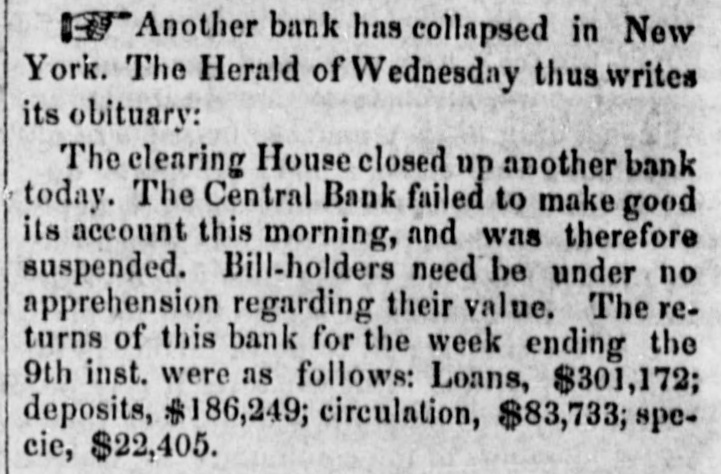
Another bank has collapsed in New York. The Herald of Wednesday thus writes its obituary: The clearing House closed up another bank today. The Central Bank failed to make good its account this morning, and was therefore suspended. Bill-holders need be under no apprehension regarding their value. The returns of this bank for the week ending the 9th inst. were as follows: Loans, $301,172; deposits, $186,249; circulation, $83,733; specie, $22,405.


Article from The Ashland Union, December 27, 1854

Click image to open full size in new tab

Article Text

I Correspondence of the Ashland Union.] FROM NEW YORK. NEW YORK, Dec. 25, 1854. The Weather and a Few Dolorous Remarks. Failure of the Central Bank. -Mysterious Movements.-Murdcr and Insanity. Dedication, &-c., &c, After a ride of two hundred miles through uninterrupted snow-banks, one is rather surprised to find himself promenading dry flags and cobble-stones in New York. The city is innocent of snow. Yet the weather we-have here is dispiriting enough, rainy, foggy, true London weather. The sun has forsaken for the seat of war, or some other centre of interest. Coming from cheer ful firesides of Yankeedom, where nuts are cracked, and apples eaten, one is struck by the careworn, anxious expreswhich sits on all the " old familiar faces," from the Wall banker to the Fulton Ferry apple-woman. The countenances of business men are "signs of the times," betokening bankruptcy famine, and all such direful visions. Therefore city is doleful though Fashion spreads her peacock tail no less superbly than of old. Among the poor there is, and will be, through the winter, a great leal of suffering. It is difficult to obain employment, and many are thrown of occupation by the reverses of emloyers. The benevolent societies of and the adjoining cities are laboring aithfully to improve the condition of the arious classes of poor whom they have aken in charge. The Female employSociety of Brooklyn, is affording he means of support to many indigent eamstresses, by enabling them to disof their work at remuneration rices. One would think from the lolorous outcry, that we were all in langer of starvation. Everybody is rightened, But while fishes swim the vater and cattle walk the land, the great of the metropolis shall be filled. In connection with this melancholic rain of observations, we may appropritely speak of the recent failure of the Central Bank of this city. This Bank broken by an arbitrary action of the Clearing House," which Institution, in possesses the power of breaking lmost any bank in the city, if it choose try. The Cleraing House operates in his way. Each city Bank receives daily its depositors, checks upon and notes the different banks. A messenger each bank meets at 10 A. M., at he Clearing House, the next day, and exchange checks and notes at 12 M., banks meet again, and balances gainst them. If this balance is not aid by two P. M., it is reclaimed and bank suspended from the privileges the Institution. The Central Bank did not conform to their rule, and was suspended accordingly. The suspension followed by a rush of note-holders and depositors, which would be fatal to almost any Bank in the city. The balances however, were paid at 3 P. M. On Wednesday, the bank was closed, but the directors intimate a possibility its reopening on Monday. This Bank, as well as the Empire City, will probably be obliged to wind up its affairs. Its circulation is well secured-but the depositors may lose something. Enough of " bankruptcy and starvation." The topic of absorbing interest the War, the extensive detail of which, furnished by English papers, the battle field almost before our eyes. The prospect of a rupture between the Allied and German Powers, and consequently, of new revolutionary outbursts in Europe, produces considerable excitement among the exiled patriots in this city, and they are probably holdthemselves in readiness for any opportunity. There are republican secret societies of French, Germans, Poles, Hungarians and Italians, no one knows what combustibles and explosives may be piled up, waiting for the match. Singular advertisement appear now and then in the dailies, which read like the ravings of an idiot. They are said to be cipher-communications, intelligible only to the refugees. What episodes of romantic histories might be written out from some of the advertisements in our vehicles of commercial intelligence, as they lire wedged in between notifications of soap, hats, fiddlesticks, and all the humbug of Vanity Fair. Lost friends, found fortunes, disconnected words which have a deep meaning for


Article from The Daily Minnesota Pioneer, January 1, 1855

Click image to open full size in new tab

Article Text

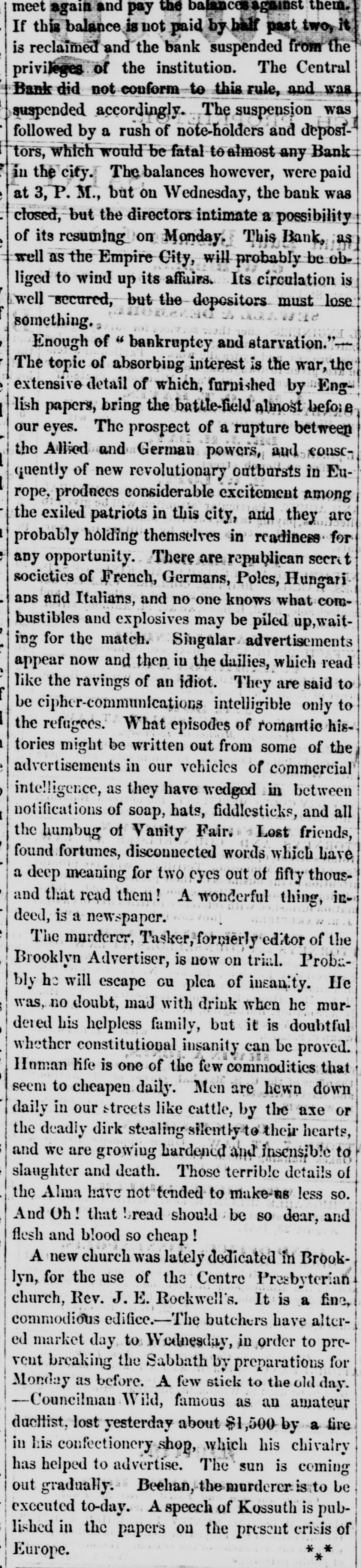
meet again and pay the balances against them. If this balance is not paid by half past two, it is reclaimed and the bank suspended from the privileges of the institution. The Central Bank did not conform to this rule, and was suspended accordingly. The suspension was followed by a rush of note-holders and deposi-tors, which would be fatal to almost any Bank in the city. The balances however, were paid at 3, P. M., but on Wednesday, the bank was closed, but the directors intimate a possibility of its resuming on Monday. This Bank, as well as the Empire City, will probably be obliged to wind up its affairs. Its circulation is well secured, but the depositors must lose something. Enough of "bankruptcy and starvation."- The topic of absorbing interest is the war, the extensive detail of which, furnished by English papers, bring the battle-field almost before our eyes. The prospect of a rupture between the Allied and German powers, and consequently of new revolutionary outbursts in Europe, produces considerable excitement among the exiled patriots in this city, and they are probably holding themselves in readiness for any opportunity. There are republican secret societies of French, Germans, Poles, Hungarians and Italians, and no one knows what combustibles and explosives may be piled up, waiting for the match. Singular advertisements appear now and then in the dailies, which read like the ravings of an idiot. They are said to be cipher-communications intelligible only to the refugees. What episodes of romantic histories might be written out from some of the advertisements in our vehicles of commercial intelligence, as they have wedged in between notifications of soap, hats, fiddlesticks, and all the humbug of Vanity Fair. Lost friends, found fortunes, disconnected words which have a deep meaning for two eyes out of fifty thousand that read them! A wonderful thing, indeed, is a newspaper. The murderer, Tasker, formerly editor of the Brooklyn Advertiser, is now on trial. Probably he will escape cu plea of insanity. He was, no doubt, mad with drink when he murdered his helpless family, but it is doubtful whether constitutional insanity can be proved. Human life is one of the few commodities that seem to cheapen daily. Men are hewn down daily in our streets like cattle, by the axe or the deadly dirk stealing silently to their hearts, and we are growing hardened and insensible to slaughter and death. Those terrible details of the Alma have not tended to make us less so. And Oh! that bread should be so dear, and flesh and blood so cheap! A new church was lately dedicated in Brooklyn, for the use of the Centre Presbyterian church, Rev. J. E. Rockwell's. It is a fine, commodious edifice. - The butchers have altered market day, to Wednesday, in order to prevent breaking the Sabbath by preparations for Monday as before. A few stick to the old day. --Councilman Wild, famous as an amateur ducilist, lost yesterday about $1,500 by a fire in his confectionery shop, which his chivalry has helped to advertise. The sun is coming out gradually. Beehan, the murderer is to be executed to-day. A speech of Kossuth is published in the papers on the present crisis of Europe.