12257. Wisner State Bank (Wisner, NE)

Bank Information

Episode Type
Suspension → Closure
Bank Type
state
Start Date
October 24, 1931
Location
Wisner, Nebraska (41.987, -96.914)

Metadata

Model
gpt-5-mini
Short Digest
9bd66ab905048c1a

Response Measures

None

Description

Multiple articles (1932 court docket entries and 1933 legal opinion) show Wisner State Bank had a receiver (E. H. Luikart) and was closed by October 1931; receiver was actively administering the bank through 1932 (including attempting to sell the bank building). There is no description of a depositor run in the sources. Thus this is a suspension resulting in permanent closure/receivership.

Events (3)

1. October 24, 1931 Suspension
Cause
Government Action
Cause Details
Bank was closed and a receiver (E. H. Luikart) was appointed in late 1931; bank remained in receivership through 1932 as courts handled liquidation and asset sales.
Newspaper Excerpt
The Farmers Merchants State Bank of McCook had been closed on October 1931... The Wisner State Bank became solvent in 1931. H. Luikart wa duly appointed receiver
Source
newspapers
2. March 1, 1932* Receivership
Newspaper Excerpt
E. H. Luikart, Receiver Wisner State Bank (court docket); the receiver filed application ... for authority to sell the bank building ... March 1932; Howard Doty was in active charge of the bank under the receiver.
Source
newspapers
3. April 1, 1932* Other
Newspaper Excerpt
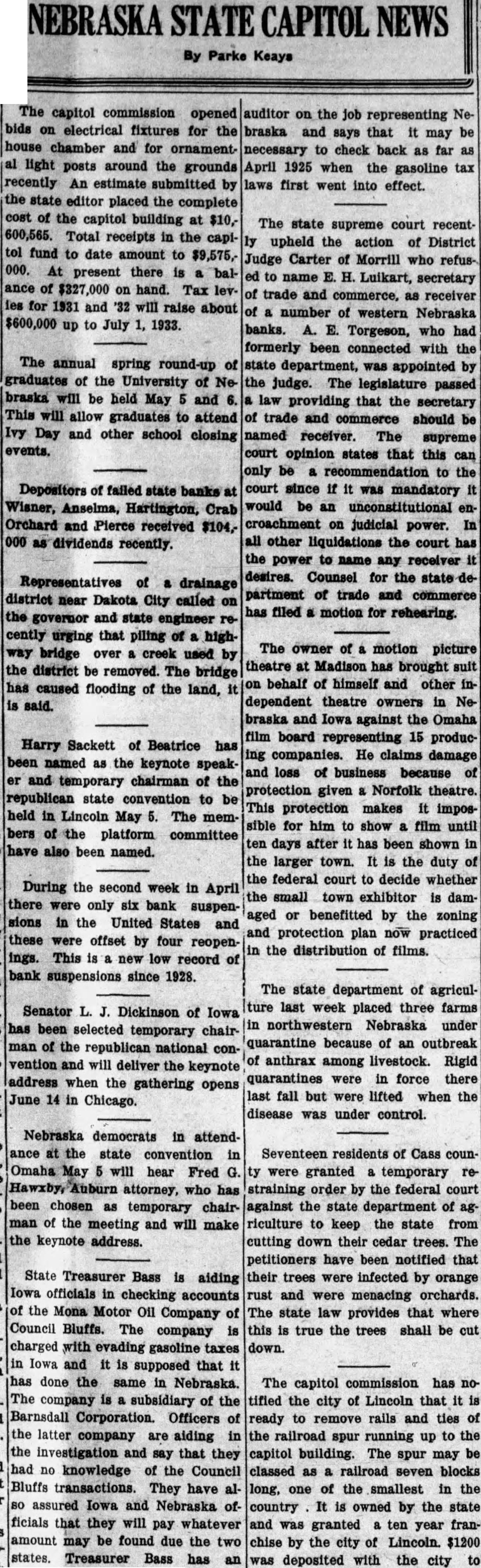
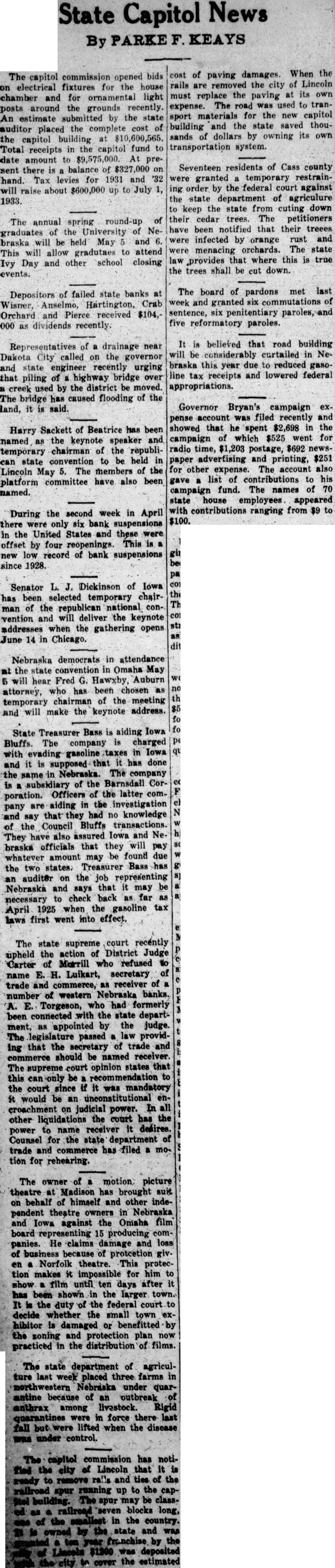
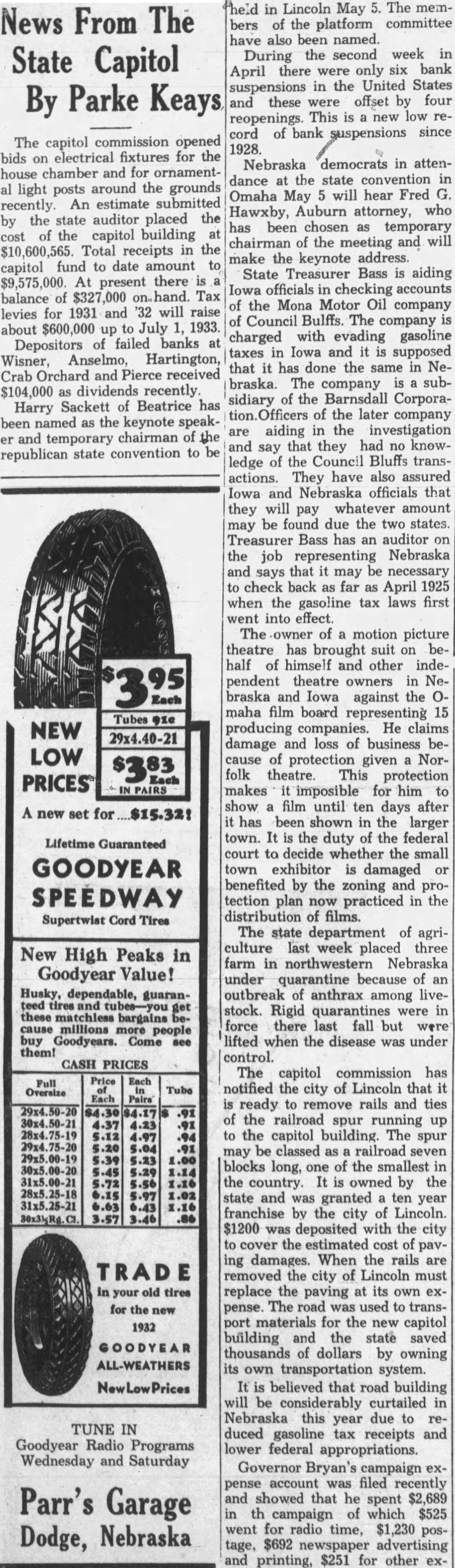
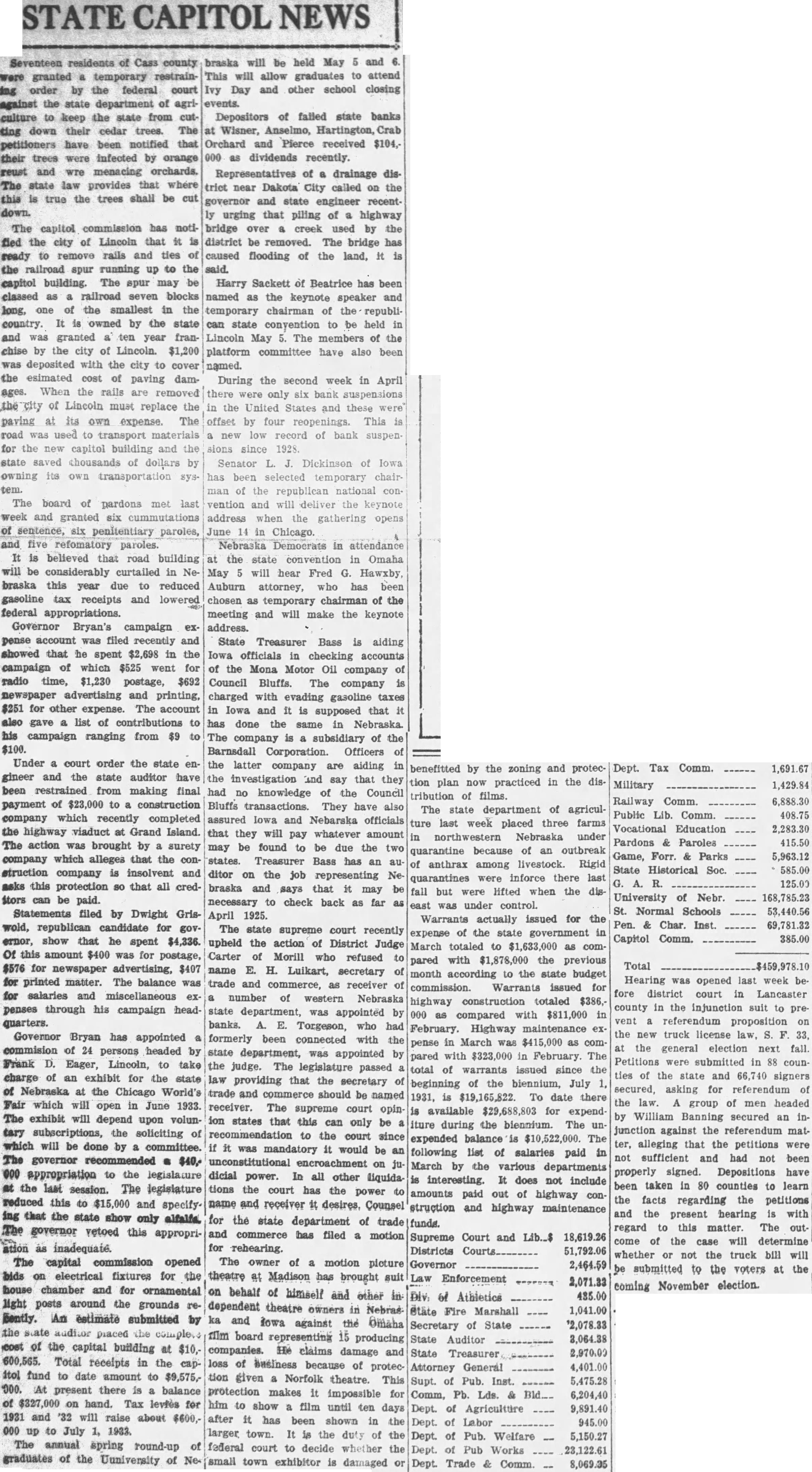
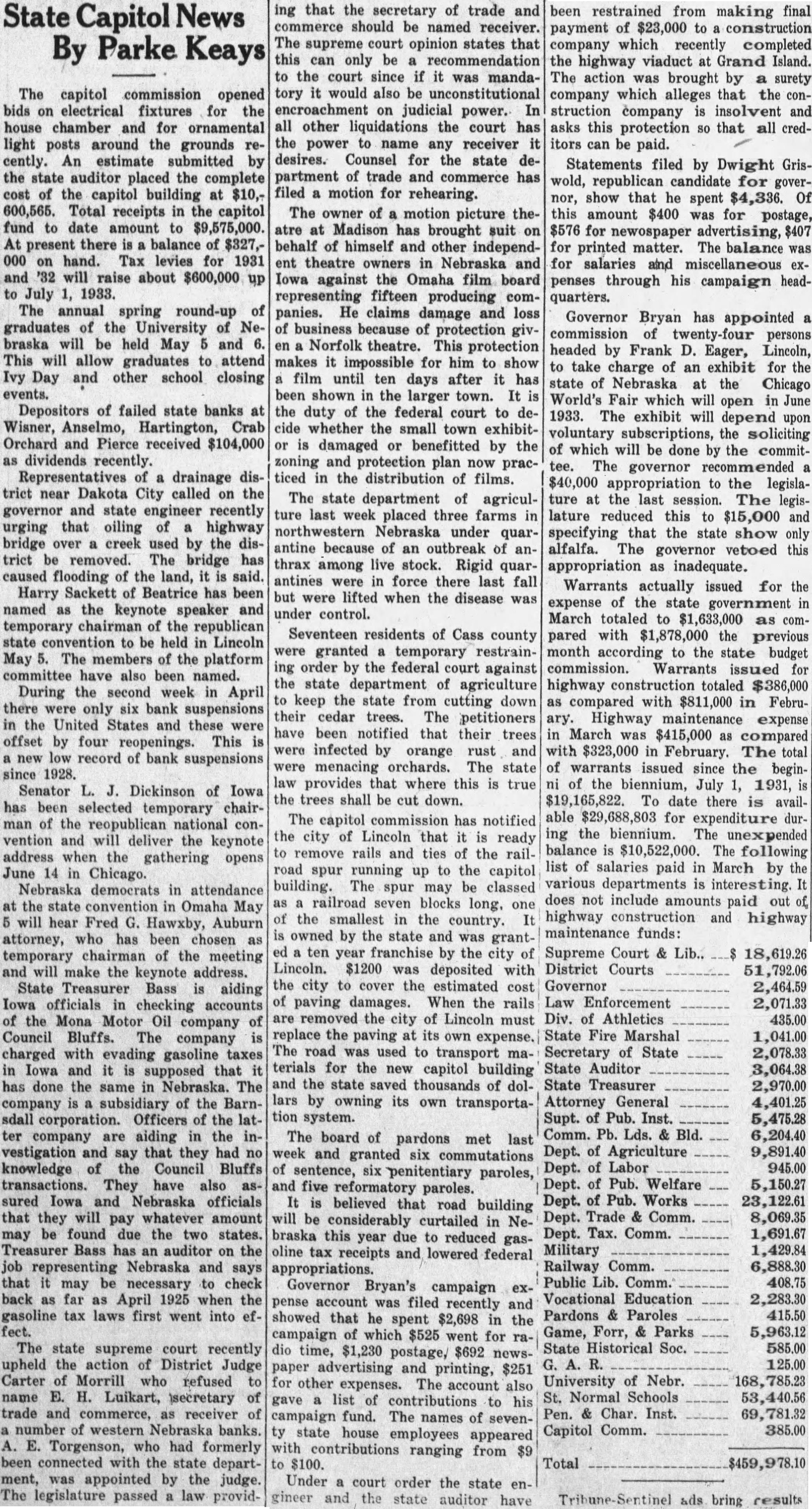
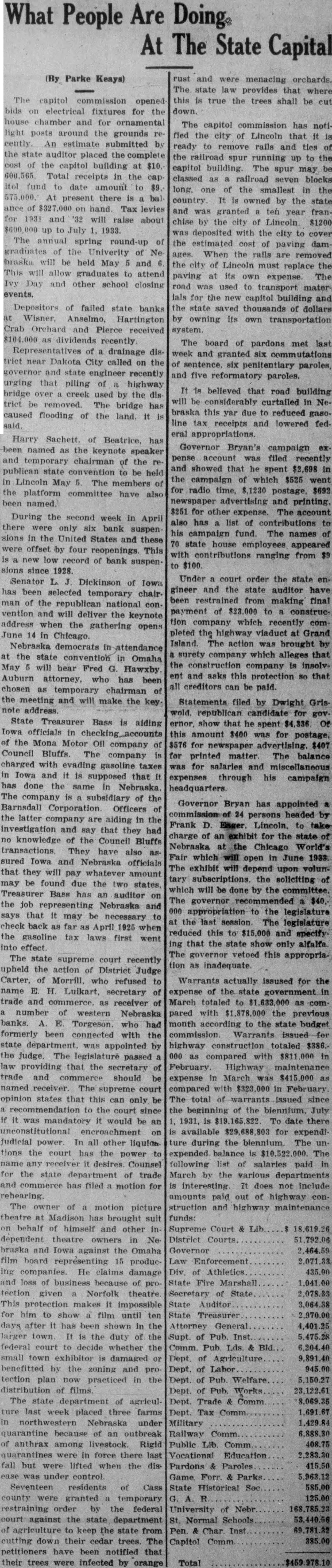
Depositors of failed state banks at Wisner, Anselmo, Hartington, Crab Orchard and Pierce received $104,000 as dividends recently.
Source
newspapers

Newspaper Articles (9)

Article from Cuming County Democrat, March 3, 1932

Click image to open full size in new tab

Article Text

(Accounting and Charles Kaup and Emma Schiferl Executors, Conrad Welding (Foreclosure Mortgage.) Elizabeth Maloney Tien, name unknown. (Damages.) Re Application of Peter Ludwig, Adm. Est. Franz Malchow, deceased. (To sell real estate.) H. Nuveman Sophia Sellentin (Partition.) Minna Leitow vs. August Leitow. (Divorce.) Johanna Wickert Alfred Wick (Separate Maintenance.) C. Smith vs. Anna Stephens Guernsey et (Foreclosure Mortgage.) Lloyd M. Maxwell Henry Schorn (Foreclosure Mortgage.) Skaggs Co. Jerman Bros. (On Contract) Christ Hunke Henry Goeken (Foreclosure State ex Sorensen, AtGen. Wisner State Bank. (Receivership.) Re Estate Frank Wickert, Deceased.) Emley VS. Robert Leisy (Foreclosure Mechanic's Lien.) Emma Reimers VS. John Schmad(Bastardy.) First National Bank of Beemer H. West (On Note.) Wallace Oswald (Foreclosure Mtg.) The Travelers Ins. Co. Rollo Hutchinson et al. (Foreclosure Mtg.) Walter Gardels vs. George Miller et al. (Quiet Title.) National Bond Inv. Co. Charles H. Hass. (Replevin.) Henry Roepken George Garland et al. (Damages.) Henrietta Roepken vs. George Garland et (Damages.) E. Manny, Receiver West Point Natl. Bank William Wickert. (On notes.) Katharina Stratman vs. Carl Stratmann (To re-instate Lien.) Jos. Canarsky vs. Louise Canarsky. (Divorce.) The First Natl Bank of Paw Paw, Mich. VS. Stanley Pipal. (On Notes.) Otto H. Zacek XS. Fred Lindemann (Foreclosure Mtg.) Otto H. Piepenbrink vs. Stanley Pipal et (Judgment.) William Thisius VS. Alphonse W. Blye et (Quiet Title.) E. H. Luikart, Receiver Wisner State Bank vs. John Helms. (On Note.) E. H. Luikart, Receiver Wisner State Bank Hugo Leisy. (Stockholders Liability.) William McKinley Nellor et al Charles H. Nellor al. Partition. Re West Point Natl. Bank. (Receivers Applications.) E. H. Luikart, Receiver Wisner State Bank Fergus V. McGuire. (On Notes.) Andrew Larsen VS. Niels Andersen, al. (Foreclosure Mtg.) E. H. Luikart, Receiver Wisner State Bank William H. Fleming. (On Note.) Port Huron Machinery Supply Co. Lincoln, Nebr. vs. Rich. (On Notes.)


Article from Newman Grove Reporter, April 27, 1932

Click image to open full size in new tab

Article Text

Keays The capitol commission opened bids on electrical fixtures for the house chamber and for ornamentlight posts around the grounds recently An estimate submitted by the state editor placed the complete cost of the capitol building at $10,600,565. Total receipts in the tol fund to date to amount $9,575,000. At present there is ance of on hand. Tax levies for 1931 and '32 will raise about up to July The annual spring round-up of graduates of the University of Nobraska will be held May and This will allow graduates to attend Ivy Day and other school closing events. Depositors of failed state banks Wisner, Anselma, Hartington, Crab Orchard and Pierce received $104,dividends recently. Representatives of drainage district near Dakota City called on the governor and state engineer cently urging that piling of highway bridge over creek used by the district be removed. The bridge has caused flooding of the land, said. Harry Sackett of Beatrice has been named as the keynote speakand temporary chairman of the republican state convention to be held in Lincoln May The members of platform committee also been named. During the second week in April there were only six bank suspensions in the United States and these were offset by four reopenings. This is new low record of bank suspensions since 1928. Senator Dickinson of Iowa has been selected temporary chairman of the republican national conwill deliver the keynote address when the gathering opens June 14 in Chicago. Nebraska democrats in attendance at the state convention in Omaha May will hear Fred attorney, who has been chosen as temporary chairman of the meeting and will make the keynote address. State Treasurer Bass is aiding Iowa officials in checking accounts of the Mona Motor Oil Company of Council Bluffs. The company charged with evading gasoline taxes in Iowa and it is supposed that has done the same in Nebraska. The company is subsidiary of the Barnsdall Corporation. Officers of the latter company are aiding in the investigation and say that they had no knowledge of the Council Bluffs transactions. They have alassured Iowa and Nebraska officials that they will pay whatever amount may be found due the two states. Treasurer Bass has an auditor on the job representing Nebraska and that it be says may necessary to check back as far 1925 when the gasoline tax laws first went into effect. The state supreme court recentupheld the action of District Judge Carter of Morrill who refusto name H. Luikart, secretary trade and commerce, as receiver number of western Nebraska banks. A. Torgeson, who had formerly been connected with the state department, was appointed the judge. The legislature passed law providing that the secretary trade and commerce should be named receiver. The supreme court opinion states that this can only be recommendation to the court since if it was mandatory would be an unconstitutional encroachment on judicial power. In other liquidations the court has the power to name any receiver desires. Counsel for the partment of trade and commerce has filed motion for rehearing. The owner of motion picture theatre at Madison has brought suit behalf of himself and other independent theatre owners in Nebraska and Iowa against the Omaha film board representing 15 produccompanies. He claims damage and loss of business because of protection given Norfolk theatre. This protection makes it impossible for him to show film until days after has been shown in the larger town. is the duty of the federal court to decide whether the small town exhibitor is aged or benefitted by the zoning and protection plan now practiced in the distribution of films. The state department of agriculture last week placed three farms northwestern Nebraska under quarantine because of an outbreak anthrax among livestock. Rigid quarantines were in force there last fall but were lifted when the disease was under control. Seventeen residents of Cass were granted temporary straining order by the federal court against the state department of agriculture to keep the state from cutting down their cedar trees. The petitioners have been notified that their trees were infected by orange rust and were menacing orchards. The state law provides that where this is true the trees shall be cut down. The capitol commission has notified the city of Lincoln that ready to remove rails and ties of the railroad spur running up to the capitol building. The spur may be classed as railroad seven blocks long, one of the smallest in the country It is owned by the state and was granted ten year franchise by the city of Lincoln. $1200 was deposited with the city


Article from The Wauneta Breeze, April 27, 1932

Click image to open full size in new tab

Article Text

State Capitol News By PARKE KEAYS The capitol commission opened bids on electrical fixtures for the house chamber and for ornamental light posts around the grounds recently. An estimate submitted by the state auditor placed the complete cost of the capitol building at $10,600,565. Total receipts in the capitol fund to date amount to $9,575,000. At present there is balance of on hand. Tax levies for 1931 and '32 will raise about $600,000 up to July 1, 1933. The annual spring round-up of graduates of the University of Nebraska will be held May and 6. This will allow gradutaes to attend Ivy Day and other school closing events. Depositors of failed state banks at Wisner, Anselmo, Hartington, Crab Orchard and Pierce received $104,000 as dividends recently. Representatives of a drainage near Dakota City called on the governor and state engineer recently urging that piling of a highway bridge over creek used by the district be moved. The bridge has caused flooding of the land, it is said. Harry Sackett of Beatrice has been named as the keynote speaker and temporary chairman of the republican state convention to be held in Lincoln May 5. The members of the platform committee have also been named. During the second week in April there were only six bank suspensions in the United States and these were offset by four reopenings. This is new low record of bank suspensions since 1928. Senator L. J. Dickinson of Iowa has been selected temporary chairman of the republican national convention and will deliver the keynote addresses when the gathering opens June 14 in Chicago. Nebraska democrats in attendance the state convention in Omaha May 5 will hear Fred G. Hawxby, Auburn attorney, who has been chosen as temporary chairman of the meeting and will make the keynote address. State Treasurer Bass is aiding Iowa Bluffs. The company is charged with evading gasoline taxes in Iowa and it is supposed it has done the same in Nebraska. The company is subsidiary of the Barnsdall Corporation. Officers of the latter company are aiding in the investigation and say that they had no knowledge of the Council Bluffs transactions. "They have also assured Iowa and Nebraska officials that they will pay whatever amount may be found due the two states. Treasurer Bass has an auditor on the job representing Nebraska and says that it may be necessary to check back as far as April 1925 when the gasoline tax laws first went into effect, The state supreme court recently upheld the action of District Judge Carter of Morrill who refused to name E. H. Luikart, secretary of trade and commerce, as receiver of number of western Nebraska banks. A. E. Torgeson, who had formerly been connected with the state department, as appointed by the judge. The legislature passed law providing that the secretary of trade and commerce should be named receiver. The supreme court opinion states that this can-only be a recommendation to the court since if it was mandatory it would be an unconstitutional encroachment on judicial power. In all other liquidations the court has the power to name receiver it desires. Counsel for the state department of trade and commerce has filed motion for rehearing. The owner of motion picture theatre at Madison has brought suit on behalf of himself and other independent theatre owners in Nebraska and Iowa against the Omaha film board representing 15 producing companies. He claims damage and loss of business because of protcetion giv. en a Norfolk theatre. This protection makes it impossible for him to show film until ten days after it has been shown in the larger town. It in the duty of the federal court to decide whether the small town exhibitor is damaged or benefitted by the zoning and protection plan now practiced in the distribution of films. The state department of agriculture last week placed three farms in morthwestern Nebraska under quarantine because of an outbreak of among Rigid quarantines were in force there last lifted when the disease under control. capitol commission has notithe of Lincoln that remove and ties of the up to the capmay be classblocks long, in the country. state and was by the the estimated cost of paving damages. When the rails are removed the city of Lincoln must replace the paving at its own expense. The road was used to transport materials for the new capitol building and the state saved thousands of dollars by owning its own transportation system. Seventeen residents of Cass county were granted temporary restraining order by the federal court against the state department of agriculure to keep the state from cuting down their cedar trees. The petitioners have been notified that their treees were infected by orange rust and were menacing orchards. The state law provides that where this is true the trees shall be cut down. The board of pardons met last week and granted six commutations of sentence, six penitentiary paroles, five reformatory paroles. It is believed that road building will be considerably curtailed in Nebraska this year due to reduced gasoline tax receipts and lowered federal appropriations. Governor Bryan's campaign expense account was filed recently and showed that he spent $2,698 in the campaign of which $525 went for radio time, $1,203 postage, $692 newspaper advertising and printing, $251 for other expense. The account also gave list of contributions to his campaign fund. The names of 70 state house employees. appeared with contributions ranging from $9 to $100.


Article from The Dodge Criterion, April 28, 1932

Click image to open full size in new tab

Article Text

News From The State Capitol By Parke Keays The capitol commission opened bids on electrical fixtures for the house chamber and for ornamental light posts around the grounds recently. An estimate submitted by the state auditor placed the cost of the capitol building at $10,600,565. Total receipts in the capitol fund to date amount to $9,575,000. At present there is a balance of $327,000 hand. Tax levies for 1931 and '32 will raise about $600,000 up to July 1, 1933. Depositors of failed banks at Wisner, Anselmo, Hartington, Crab Orchard and Pierce received $104,000 as dividends recently. Harry Sackett of Beatrice has been named as the keynote speaker and temporary chairman of the republican state convention to be held in Lincoln May 5. The members of the platform committee have also been named. During the second week in April there were only six bank suspensions in the United States and these were offset by four reopenings. This is a new low record of bank suspensions since 1928. Nebraska democrats in attendance at the state convention in Omaha May 5 will hear Fred G. Hawxby, Auburn attorney, who has been chosen as temporary chairman of the meeting and will make the keynote address. State Treasurer Bass is aiding Iowa officials in checking accounts of the Mona Motor Oil company of Council Bulffs. The company is charged with evading gasoline taxes in Iowa and it is supposed that it has done the same in Nebraska. The company is a subsidiary of the Barnsdall Corporation. Officers of the later company are aiding in the investigation and say that they had no knowledge of the Council Bluffs transactions. They have also assured Iowa and Nebraska officials that they will pay whatever amount may be found due the two states. Treasurer Bass has an auditor on the job representing Nebraska and says that it may be necessary to check back as far as April 1925 when the gasoline tax laws first went into effect. The owner of a motion picture theatre has brought suit on behalf of himself and other independent theatre owners in Nebraska and Iowa against the Omaha film board representing 15 producing companies. He claims damage and loss of business because of protection given a Norfolk theatre. This protection makes it imposible for him to show a film until ten days after it has been shown in the larger town. It is the duty of the federal court to decide whether the small town exhibitor is damaged or benefited by the zoning and protection plan now practiced in the distribution of films. The state department of agriculture last week placed three farm in northwestern Nebraska under quarantine because of an outbreak of anthrax among livestock. Rigid quarantines were in force there last fall but were lifted when the disease was under control. The capitol commission has notified the city of Lincoln that it is ready to remove rails and ties of the railroad spur running up to the capitol building. The spur may be classed as a railroad seven blocks long, one of the smallest in the country. It is owned by the state and was granted a ten year franchise by the city of Lincoln. $1200 was deposited with the city to cover the estimated cost of paving damages. When the rails are removed the city of Lincoln must replace the paving at its own expense. The road was used to transport materials for the new capitol building and the state saved thousands of dollars by owning its own transportation system. It is believed that road building will be considerably curtailed in Nebraska this year due to reduced gasoline tax receipts and lower federal appropriations. Governor Bryan's campaign expense account was filed recently and showed that he spent $2,689 in th campaign of which $525 went for radio time, $1,230 postage, $692 newspaper advertising and printing, $251 for other ex-


Article from The Grand Island Herald, April 28, 1932

Click image to open full size in new tab

Article Text

STATE CAPITOL NEWS Seventeen residents of Cass county were granted a temporary restraining order by the federal court against the state department of agriculture to keep the state from cutting down their cedar trees. The petitioners have been notified that their trees were infected by orange reust and wre menacing orchards. The state law provides that where this is true the trees shall be cut down. The capitol commission has notified the city of Lincoln that it is ready to remove rails and ties of the railroad spur running up to the capitol building. The spur may be classed as railroad seven blocks long, one of the smallest in the country. It is owned by the state and was granted a ten year franchise by the city of Lincoln. $1,200 was deposited with the city to cover the esimated cost of paving damages. When the rails are removed the city of Lincoln must replace the paving at its own expense. The road was used to transport materials for the new capitol building and the state saved thousands of dollars by owning its own transportation system. The board of pardons met last week and granted six cummutations of sentence, six penitentiary paroles, and five refomatory paroles. It is believed that road building will be considerably curtailed in Nebraska this year due to reduced gasoline tax receipts and lowered federal appropriations. Governor Bryan's campaign expense account was filed recently and showed that the spent $2,698 in the campaign of which $525 went for radio time, $1,230 postage, $692 newspaper advertising and printing, $251 for other expense. The account also gave a list of contributions to his campaign ranging from $9 to $100. Under a court order the state engineer and the state auditor have been restrained from making final payment of $23,000 to a construction company which recently completed the highway viaduct at Grand Island. The action was brought by a surety company which alleges that the construction company is insolvent and asks this protection so that all credStors can be paid. Statements filed by Dwight Griswold, republican candidate for governor, show that he spent $4,336. Of this amount $400 was for postage, $576 for newspaper advertising, $407 for printed matter. The balance was for salaries and miscellaneous expenses through his campaign headquarters. Governor Bryan has appointed a commision of 24 persons headed by Frank D. Eager, Lincoln, to take charge of an exhibit for the state of Nebraska at the Chicago World's Fair which will open in June 1933. The exhibit will depend upon voluntary subscriptions, the soliciting of which will be done by a committee. The governor recommended a $40,000 appropriation to the legislature at the last session. The legislature reduced this to $15,000 and specifying that the state show only alfalfa. The governor vetoed this appropriation as inadequate. The capital commission opened bids on electrical fixtures for the house chamber and for ornamental light posts around the grounds reCently. An estimate submitted by the state auditor placed the complete reost of the capital building at $10,600,565. Total receipts in the capitol fund to date amount to $9,575,000. At present there is a balance of $327,000 on hand. Tax levies for 1931 and '32 will raise about $600,000 up to July 1, 1933. The annual spring round-up of graduates of the University of Ne- braska will be held May 5 and 6. This will allow graduates to attend Ivy Day and other school closing events. Depositors of failed state banks at Wisner, Anselmo, Hartington, Crab Orchard and Pierce received $104,000 as dividends recently. Representatives of a drainage district near Dakota City called on the governor and state engineer recently urging that piling of a highway bridge over a creek used by the district be removed. The bridge has caused flooding of the land, it is said. Harry Sackett of Beatrice has been named as the keynote speaker and temporary chairman of the republican state conyention to be held in Lincoln May 5. The members of the platform committee have also been named. During the second week in April there were only six bank suspensions in the United States and these were offset by four reopenings. This is a new low record of bank suspensions since 1928 Senator L. J. Dickinson of Iowa has been selected temporary chairman of the republican national con vention and will deliver the keynote address when the gathering opens June 14 in Chicago Nebraska Democrats in attendance at the state convention in Omaha May 5 will hear Fred G. Hawxby, Auburn attorney, who has been chosen as temporary chairman of the meeting and will make the keynote address. State Treasurer Bass is aiding Iowa officials in checking accounts of the Mona Motor Oil company of Council Bluffs. The company is charged with evading gasoline taxes in Iowa and it is supposed that it has done the same in Nebraska The company is a subsidiary of the Barnsdall Corporation. Officers of the latter company are aiding in the investigation and say that they had no knowledge of the Council Bluffs transactions. They have also assured Iowa and Nebarska officials that they will pay whatever amount may be found to be due the two states. Treasurer Bass has an au ditor on the job representing Nebraska and says that it may be necessary to check back as far as April 1925. The state supreme court recently upheld the action of District Judge Carter of Morill who refused to name E. H. Luikart, secretary of trade and commerce, as receiver of a number of western Nebraska state department, was appointed by banks. A. E. Torgeson, who had formerly been connected with the state department, was appointed by the judge. The legislature passed law providing that the secretary of trade and commerce should be named receiver. The supreme court opinion states that this can only be a recommendation to the court since if it was mandatory it would be an unconstitutional encroachment on judicial power. In all other liquidations the court has the power to name and receiver it desires, Counsel for the state department of trade and commerce has filed a motion for rehearing. The owner of a motion picture theatre at Madison has brought suit on behalf of himself and other in dependent theatre owners in Nebraska and Iowa against the Omaha film board representing 15 producing companies. He claims damage and loss of business because of protection given a Norfolk theatre. This protection makes it impossible for him to show a film until ten days after it has been shown in the larger town. It is the duty of the federal court to decide whether the small town exhibitor is damaged or benefitted by the zoning and protection plan now practiced in the distribution of films. The state department of agriculture last week placed three farms in northwestern Nebraska under quarantine because of an outbreak of anthrax among livestock. Rigid quarantines were inforce there last fall but were lifted when the diseast was under control. Warrants actually issued for the expense of the state government in March totaled to $1,633,000 as compared with $1,878,000 the previous month according to the state budget commission. Warrants issued for highway construction totaled $386,000 as compared with $811,000 in February. Highway maintenance expense in March was $415,000 as com pared with $323,000 in February. The total of warrants issued since the beginning of the biennium, July 1, 1931, is $19,165,822. To date there is available $29,688,803 for expend iture during the biennium. The un expended balance is $10,522,000. The following list of salaries paid in March by the various departments is interesting. It does not include amounts paid out of highway con struction and highway maintenance funds. Supreme Court and Lib..$ 18,619.26 Districts Courts 51,792.06 Governor 2,464.59 Law Enforcement 2,071.33 Div: of Athletics 485.00 State Fire Marshall 1,041.00 Secretary of State State Auditor 3,064.38 State Treasurer 2,970.00 Attorney General 4,401.00 Supt. of Pub. Inst. 5,475.28 Comm. Pb. Lds. & Bld... 6,204,40 Dept. of Agriculture 9,891.40 Dept. of Labor 945.00 Dept. of Pub. Welfare 5,150.27 Dept. of Pub Works 23,122.61 Dept. Trade & Comm. 8,069.35 Dept. Tax Comm. 1,691.67 Military 1,429.84 Railway Comm. 6,888.30 Public Lib. Comm. 408.75 Vocational Education 2,283.30 Pardons Paroles 415.50 Game, Forr. & Parks 5,963.12 State Historical Soc. 585.00 G. A. R. 125.00 University of Nebr. 168,785.23 St. Normal Schools 53,440.56 Pen. Char. Inst. 69,781.32 Capitol Comm. 385.00 Total $459,978.10 Hearing was opened last week before district court in Lancaster county in the injunction suit to prevent a referendum proposition on the new truck license law, S. F. 33, at the general election next fall Petitions were submitted in 88 counties of the state and 66,740 signers secured, asking for referendum of the law. A group of men headed by William Banning secured an injunction against the referendum mat ter, alleging that the petitions were not sufficient and had not been properly signed. Depositions have been taken in 80 counties to learn the facts regarding the petitions and the present hearing is with regard to this matter. The outcome of the case will determine whether or not the truck bill will be submitted to the voters at the coming November election.


Article from Grant Tribune-Sentinel, April 28, 1932

Click image to open full size in new tab

Article Text

State Capitol News By Parke Keays The capitol commission opened bids on electrical fixtures for the house chamber and for ornamental light posts around the grounds recently. An estimate submitted by the state auditor placed the complete cost of the capitol building at $10,600,565. Total receipts in the capitol fund to date amount to $9,575,000. At present there is a balance of $327,000 on hand. Tax levies for 1931 and '32 will raise about $600,000 up to July 1, 1933. The annual spring round-up of graduates of the University of Nebraska will be held May 5 and 6. This will allow graduates to attend Ivy Day and other school closing events. Depositors of failed state banks at Wisner, Anselmo, Hartington, Crab Orchard and Pierce received $104,000 as dividends recently. Representatives of a drainage district near Dakota City called on the governor and state engineer recently urging that oiling of a highway bridge over a creek used by the district be removed. The bridge has caused flooding of the land, it is said. Harry Sackett of Beatrice has been named as the keynote speaker and temporary chairman of the republican state convention to be held in Lincoln May 5. The members of the platform committee have also been named. During the second week in April there were only six bank suspensions in the United States and these were offset by four reopenings. This is a new low record of bank suspensions since 1928. Senator L. J. Dickinson of Iowa has been selected temporary chairman of the reopublican national convention and will deliver the keynote address when the gathering opens June 14 in Chicago. Nebraska democrats in attendance at the state convention in Omaha May 5 will hear Fred G. Hawxby, Auburn attorney, who has been chosen as temporary chairman of the meeting and will make the keynote address. State Treasurer Bass is aiding Iowa officials in checking accounts of the Mona Motor Oil company of Council Bluffs. The company is charged with evading gasoline taxes in Iowa and it is supposed that it has done the same in Nebraska. The company is a subsidiary of the Barnsdall corporation. Officers of the latter company are aiding in the investigation and say that they had no knowledge of the Council Bluffs transactions. They have also assured Iowa and Nebraska officials that they will pay whatever amount may be found due the two states. Treasurer Bass has an auditor on the job representing Nebraska and says that it may be necessary to check back as far as April 1925 when the gasoline tax laws first went into effect. The state supreme court recently upheld the action of District Judge Carter of Morrill who refused to name E. H. Luikart, secretary of trade and commerce, as receiver of a number of western Nebraska banks. A. E. Torgenson, who had formerly been connected with the state department, was appointed by the judge. The legislature passed a law provid- ing that the secretary of trade and commerce should be named receiver. The supreme court opinion states that this can only be a recommendation to the court since if it was mandatory it would also be unconstitutional encroachment on judicial power. In all other liquidations the court has the power to name any receiver it desires. Counsel for the state department of trade and commerce has filed a motion for rehearing. The owner of a motion picture theatre at Madison has brought suit on behalf of himself and other independent theatre owners in Nebraska and Iowa against the Omaha film board representing fifteen producing companies. He claims damage and loss of business because of protection given Norfolk theatre. This protection makes it impossible for him to show a film until ten days after it has been shown in the larger town. It is the duty of the federal court to decide whether the small town exhibitor is damaged or benefitted by the zoning and protection plan now practiced in the distribution of films. The state department of agriculture last week placed three farms in northwestern Nebraska under quarantine because of an outbreak of anthrax among live stock. Rigid quarantines were in force there last fall but were lifted when the disease was under control. Seventeen residents of Cass county were granted a temporary restraining order by the federal court against the state department of agriculture to keep the state from cutting down their cedar trees. The petitioners have been notified that their trees were infected by orange rust and were menacing orchards. The state law provides that where this is true the trees shall be cut down. The capitol commission has notified the city of Lincoln that it is ready to remove rails and ties of the railroad spur running up to the capitol building. The spur may be classed as a railroad seven blocks long, one of the smallest in the country. It is owned by the state and was granted a ten year franchise by the city of Lincoln. $1200 was deposited with the city to cover the estimated cost of paving damages. When the rails are removed the city of Lincoln must replace the paving at its own expense. The road was used to transport materials for the new capitol building and the state saved thousands of dollars by owning its own transportation system. The board of pardons met last week and granted six commutations of sentence, six penitentiary paroles, and five reformatory paroles. It is believed that road building will be considerably curtailed in Nebraska this year due to reduced gasoline tax receipts and lowered federal appropriations. Governor Bryan's campaign expense account was filed recently and showed that he spent $2,698 in the campaign of which $525 went for radio time, $1,230 postage, $692 newspaper advertising and printing, $251 for other expenses. The account also gave a list of contributions to his campaign fund. The names of seventy state house employees appeared with contributions ranging from $9 to $100. Under a court order the state engineer and the state auditor have been restrained from making final payment of $23,000 to a construction company which recently completed the highway viaduct at Grand Island. The action was brought by a surety company which alleges that the construction company is insolvent and asks this protection so that all creditors can be paid. Statements filed by Dwight Griswold, republican candidate for governor, show that he spent $4,336. Of this amount $400 was for postage, $576 for newospaper advertising, $407 for printed matter. The balance was for salaries and miscellaneous expenses through his campaign headquarters. Governor Bryan has appointed a commission of twenty-four persons headed by Frank D. Eager, Lincoln, to take charge of an exhibit for the state of Nebraska at the Chicago World's Fair which will open in June 1933. The exhibit will depend upon voluntary subscriptions, the soliciting of which will be done by the committee. The governor recommended a $40,000 appropriation to the legislature at the last session. The legislature reduced this to $15,000 and specifying that the state show only alfalfa. The governor vetoed this appropriation as inadequate. Warrants actually issued for the expense of the state government in March totaled to $1,633,000 as compared with $1,878,000 the previous month according to the state budget commission. Warrants issued for highway construction totaled $386,000 as compared with $811,000 in February. Highway maintenance expense in March was $415,000 as compared with $323,000 in February The total of warrants issued since the beginni of the biennium, July 1, 1931, is $19,165,822. To date there is available $29,688,803 for expenditure during the biennium. The unexpended balance is $10,522,000. The following list of salaries paid in March by the various departments is interesting. It does not include amounts paid out of highway construction and highway maintenance funds: Supreme Court & Lib.. $ 18,619.26 District Courts 51,792.06 Governor 2,464.59 Law Enforcement 2,071.33 Div. of Athletics 435.00 State Fire Marshal 1,041.00 Secretary of State 2,078.33 State Auditor 3,064.38 State Treasurer 2,970.00 Attorney General 4,401.25 Supt. of Pub. Inst. 5,475.28 Comm. Pb. Lds. & Bld. 6,204.40 Dept. of Agriculture 9,891.40 Dept. of Labor 945.00 Dept. of Pub. Welfare 5,150.27 Dept. of Pub. Works 23,122.61 Dept. Trade & Comm. 8,069.35 Dept. Tax. Comm. 1,691.67 Military 1,429.84 Railway Comm. 6,888.30 Public Lib. Comm. 408.75 Vocational Education 2,283.30 Pardons & Paroles 415.50 Game, Forr, & Parks 5,963.12 State Historical Soc. 585.00 G. A. R. 125.00 University of Nebr. 168,785.23 St. Normal Schools 53,440.56 Pen. & Char. Inst. 69,781.32 Capitol Comm. 385.00 Total $459,978.10 Tribune-Sentinel ads bring results


Article from Meadow Grove News, April 28, 1932

Click image to open full size in new tab

Article Text

STATE CAPITOL NEWS (By Parke Keays) The capitol commission opened bids on electrical fixtures for the house chamber and for ornamental light posts around the grounds recently. An estimate submitted by the state auditor placed the complete cost of the capitol building at $10,600,565. Total receipts in the capitol fund to date amount to $9,575,000. At present there is balance of $327,000 on hand. Tax levies and '32 will raise about $600,000 up to July 1933. The annual spring round-up of graduates of the University of Nebraska will be held May and This will allow graduates to attend Ivy Day and other school closing events. Depositors of failed state banks at Wisner. Anselmo, Hartington. Crab Orchard and Pierce received $104,000 as dividends recently. Representatives of a drainage district near Dakota City called on the governor and state engineer recently urging that piling of highway bridge over creek used by the district be removed. The bridge has caused flooding of the land, it is said. Harry Sackett of Beatrice has been named as the keynote speaker and temporary chairman of the republican state convention to be held in Lincoln May 5. The members of the platform committee have also been named. During the second week in April there were only six bank suspensions in the United States and offset by four reopenings. This new low record of bank suspensions since 1928. Senator L. J. Dickinson of Iowa has been selected temporary chairman of the republican national convention and will deliver the keynote address when the gathering opens June 14 in Chicago. Nebraska democrats in attendance at the state convention in Omaha May will hear Fred G. Hawxby, Auburn attorney. who has been chosen as temporary chairman of the meeting and will make the keynote address. State Treasurer Bass is aiding Iowa officials in checking accounts of the Mona Motor Oil company of Council Bluffs. The company is charged with evading gasoline taxes in Iowa and it is supposed that it has done the same in Nebraska. The company is a subsidiary of the Barnsdall Corporation. Officers of the latter company are alding in the investigation and say that they had no know. ledge of the Council Bluffs transactions. They have also assured Iowa and Nebraska officials that they will pay whatever amount may be found due the two states. Treasurer Bass has an auditor on the job representing Nebraska and says that it may be necessary to check back as far as April 1925 when the gasoline tax laws first went into effect. The state supreme court recently upheld the action of District Judge Carter of Morrill who refused to name E. H. Luikart, secretary of trade and commerce. as receiver of number of western Nebraska banks. A. E. Torgeson, who had formerly been connected with the state department, was appointed by the judge. The legislature passed law providing that the secretary of trade and commerce should be named receiver. The supreme court opinion states that this can only be a recommendation to the court since if it was mandatory it would be an unconstitutional encroachment on judicial power. In all other liquidations the court has the power to name any receiver desires. Counsel for the state department of trade and commerce has filed motion for rehearing. The state department of agriculture last week placed three farms in north western Nebraska under quarantine because of an outbreak of anthrax among livestock. Rigid quarantines in force there last fall but were lifted when the disease was under control. Seventeen residents of Cass county were granted temporary restraining order by the federal court against the state department of agriculture to keep the state from cutting down their cedar trees. The DAtitioners have been notified that their trees were infected by orange and were menacing orchards. The state law provides that this is true the trees shall be cut down. The capitol commission has notified the city of Lincoln that It is ready to remove rails and ties of the railroad spur running the capitol (Continued


Article from The Oxford Standard, April 28, 1932

Click image to open full size in new tab

Article Text

What People Are Doing® At The State Capital (By Parke Keays) capitol commission opened electrical fixtures for the house chamber and for ornamental light posts around the grounds An estimate submitted the state auditor placed the complete of the capitol building at $10. Total receipts the cap. fund date amount to At present there bal on hand. Tax levies and will raise about to 1933. The annual spring round-up graduates the Univerity of braska will be held May and will allow graduates attend Day and other school closing events. Depositors of failed banks Wisner, Hartington Crab Orchard and Pierce received dividends recently. drainage disnear Dakota City called governor and state engineer recently urging that piling of highway bridge over creek used by the dis trict removed. The bridge has caused flooding of the land. said. Harry Sachett. of Beatrice, has been named as the keynote speaker and temporary chairman the publican state convention be held Lincoln May The members of the platform committee have also been named. During the second week in April there were only six bank suspensions in the United States and these offset by four reopenings. This new low record of bank suspensions since 1928. Senator Dickinson of Iowa has been selected temporary chairman of the republican national con. vention and will deliver the keynote address when the gathering opens June Chicago. Nebraska democrats the state convention Omaha May will hear Fred Hawxby Auburn who has been chosen temporary chairman the meeting and will make the note State Treasurer Bass aiding Iowa officials of the Mona Motor Oil company Council Bluffs. The company charged with evading gasoline taxes in Iowa and it supposed that has done the same in Nebraska The company subsidiary of the Barnsdall Corporation. Officers the latter company are aiding in the investigation and say that they had no knowledge of the Council Bluffs They also sured Iowa and Nebraska officials that they will pay whatever amount may be found due the two Treasurer Bass has an auditor on the job Nebraska and that may necessary check back far April when the gasoline tax laws first went The state supreme court recently upheld the action of District Judge Carter, of Morrill, who refused to name Luikart, secretary of trade and commerce. as receiver of number of western Nebraska banks. Torgeson. who had formerly been connected with the state department. appointed by the The legislature passed law providing that the secretary trade and commerce should named receiver. The supreme court opinion states that this can only be the court since was mandatory would be an unconstitutional encroachment judicial power. In all other tions the court has the power receiver desires Counsel for the state department trade and commerce has filed motion for rehearing. The owner of motion picture theatre at Madison has brought suit behalf of himself and other dependent theatre owners Nobraska and Iowa against the Omaha film hoard représenting produeing companies. He claims damage loss of business because of tection given Norfolk protection makes impossible him to show film until ten after has been shown in the larger town. the duty the federal court decide whether the small exhibitor damaged benefitted the zoning and tection plan now practiced in the distribution of films. The state department agricullast week placed farms northwestern Nebraska under because of an outbreak anthrax among livestock. Rigid quarantines were in force there last fall but lifted when the disunder control. Seventeen residents of Cass county granted temporary restraining order by federal the department agriculture to keep the state from cutting down their cedar trees. petitioners have been notified that their trees were infected by orange and menacing orchards. The state law provides that where this true the trees shall be cut down. The capitol commission has notified the city of Lincoln that is ready to remove rails and ties of the railroad spur running up to the building. The spur be may classed as seven blocks one of the smallest the country. owned by the state and was granted ten franyear by the city of Lincoln. $1200 deposited with the city to cover the estimated cost of paving damages. When the rails are removed the city of Lincoln must replace the paving its expense The road was used transport materlals for the new capitol building and the state saved thousands of dollars by owning its own transportation system. The board of pardons met last week and granted six commutations of sentence. six penitentiary paroles, and five reformatory paroles. believed that road building will be considerably curtailed in Nobraska this yar due to reduced line receipts and lowered federal appropriations. Governor Bryan's campaign pense account was filed recently and showed that spent the campaign of which $525 went for radio time, $,1230 postage, $692 newspaper advertising and printing. $251 for other expense. account also has list of contributions to his campaign fund. The names state house employees appeared with contributions ranging from to $100. Under court order the state gineer and the state auditor have been restrained from making final payment to tion company which recently completed the highway viaduct at Grand Island. The action was brought by surety company which alleges that the construction company is insolvent and asks this protection that all creditors can be paid. Statements filed by Dwight Griswold. republican candidate for show that spent this amount $400 for $576 for newspaper advertising. $407 for printed The balance was for salaries and miscellaneous expenses through his campaign headquarters. Governor Bryan has appointed persons headed by Frank to take charge of for the state Nebraska Chicago World's Fair which open in June 1933. The exhibit will depend upon voluntary the soliciting which will be done by the committee. The governor recommended 000 appropriation to the legislature the last session. The legislature reduced this to $15,000 and ing that the state show only alfalfa. The governor vetoed this appropriation as inadequate. Warrants actually issused for the expense of the state government in March totaled com pared with $1,878,000 the previous month according to the state budget Warrants issued for highway construction totaled $386.000 as compared with February. Highway maintenance expense March compared with February The total of warrants issued since the beginning the July $19,165,822 To date there available for expenditure during the biennium. The expended balance is The following list salaries paid March the various departments does not include amounts paid out of highway struction and highway maintenance funds: Supreme Court District Courts. 51,792.06 Governor 2,464.59 Law Enforcement Div. Athletics 435.00 Fire Marshall Secretary State 2,078.33 State Auditor 3,064.38 State Treasurer 2,970.00 Attorney General 4,401.25 Supt. of Pub. Comm. Pub. Lds. 6,204.40 Dept. of Agriculture 9,891.40 Dept. Labor 945.00 Dept. Welfare 5,150.27 Dept. Pub. 23,122.61 Dept. Trade Comm 8,069.35 Dept. Tax 1,691.67 Military 1,429.84 Railway Comm. 6,888.30 Public Lib. Comm Vocational Education 2,283.30 Pardons Paroles 415.50 Forr. Parks 5,963.12 State Historical 585.00 125.00 University 168,785.23 Normal Schools Pen. Char Inst 69,781.32 Capitol Comm 385.00 Total


Article from Nebraska Legal News, November 11, 1933

Click image to open full size in new tab

Article Text

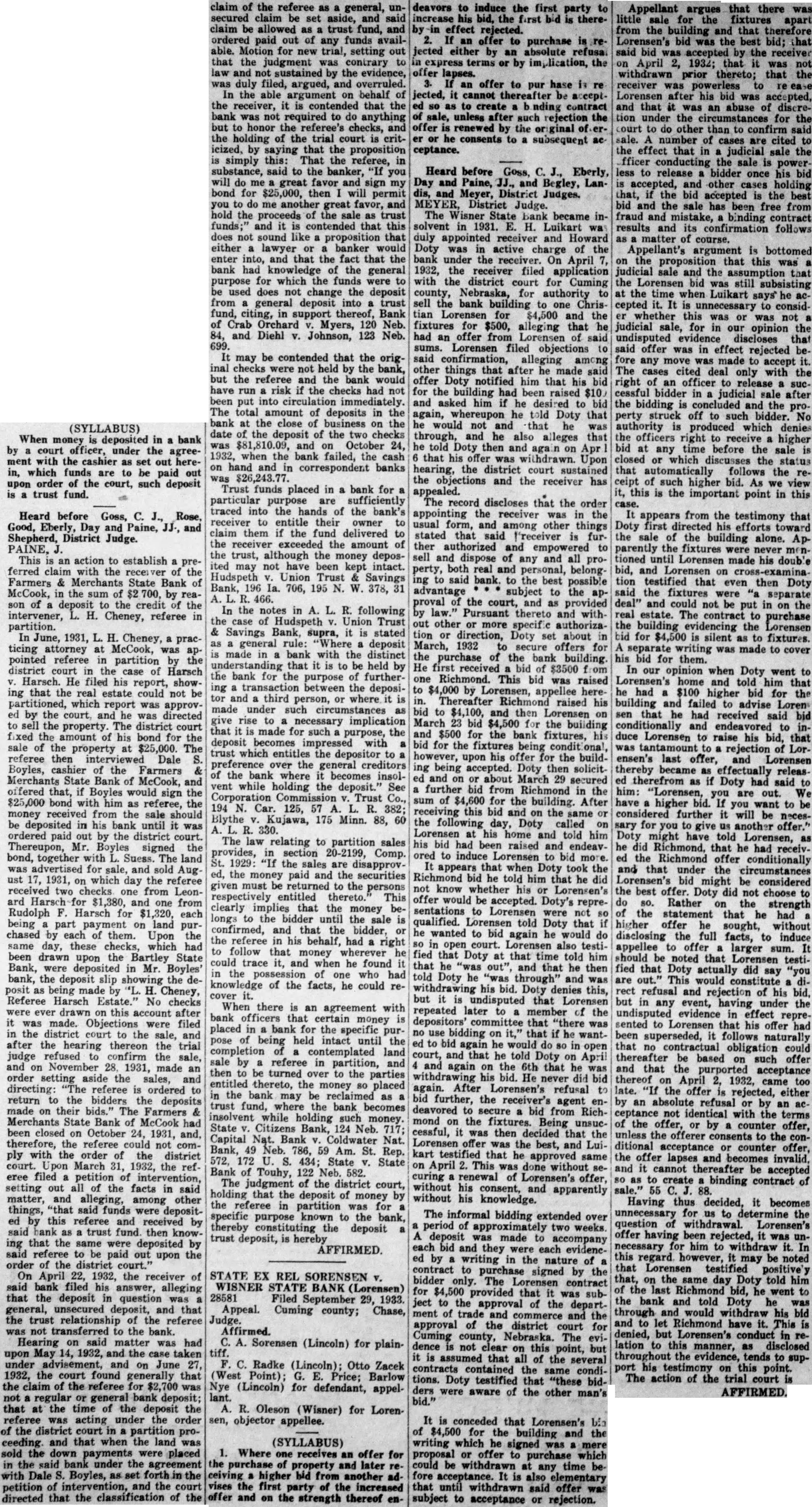
(SYLLABUS) When money is deposited in bank by court under the agreement with the cashier as set out herein, which funds are to be paid out upon order of the court, such deposit is trust fund. Heard before Goss, Rose, Good, Eberly, Day and Paine, and Shepherd, District Judge. PAINE, This is an action to establish preferred claim with the of the Farmers & Merchants State Bank of McCook, in the sum of by reaof deposit to the credit of the intervener, H. Cheney, referee partition. In June, 1931, Cheney, practicing attorney at McCook, was pointed referee in partition by the district court in the case of Harsch Harsch. He filed his report, showing that the real estate could partitioned, which report was approvby the court, and he was directed to sell the property. The district court fixed the amount of his bond for the sale of the property at The referee then interviewed Dale Boyles, cashier of the Farmers Merchants State Bank of McCook, and offered that, if Boyles would sign the bond with him as referee, the money received from the sale should deposited in his bank until it was ordered paid out by the district court. Thereupon, Mr. Boyles signed the bond, together with Suess. The land was advertised for sale, and sold August 1931, on which day the referee received two checks one from Leonard and one from Rudolph Harsch for $1,320, each being part payment on land purchased by each of them. the same day, these checks, which had been drawn upon the Bartley State Bank, were deposited in Mr. Boyles' bank, the deposit showing the posit as being made by H. Cheney, Referee Harsch Estate." No checks were ever drawn on this account after was made. Objections were filed in the district court to the sale, and after the hearing thereon the trial judge refused to confirm the sale, and on November 28. 1931, made an order setting aside the sales, and directing: referee is ordered return to the bidders the deposits made on their bids." The Farmers Merchants State Bank of McCook had been closed on October 1931, and, therefore, the referee could not comply with the order of the district court. March 31, 1932, the referee filed petition of intervention, setting out all of the facts in said matter, and alleging, among other things, "that said funds were deposited by this referee and received said bank as trust fund then that the same were deposited by said referee to be paid out upon the order of the district On April 1932, the receiver of said bank filed his answer, alleging that the deposit in question general, unsecured deposit, and that the trust relationship of the referee not transferred to the bank. Hearing on said matter was had upon May 1932, and the case taken under advisement, and on June 27, 1932, the court found generally that the claim of the referee for was not regular or general bank deposit; that at the time of the deposit the referee was acting under the order the district court in partition proceeding. and that when the land was sold the down payments placed in the said bank under the agreement with Dale Boyles, as set the of intervention, and the court petition directed that the classification of the claim of the referee as general, unsecured claim be set aside, and said claim be allowed as trust fund, and ordered paid out of funds availany able. Motion for new trial, setting out that the judgment was contrary to law and not sustained by the evidence, was duly filed, argued, and overruled. In the able argument on behalf of the receiver, it contended that the bank was not required to do anything but to honor the referee's checks, and the holding of the trial court is criticized, by saying that the proposition simply this: That the referee, in substance, said to the banker, you will do great favor and sign my bond for $25,000, then will permit you to do me another great favor, and hold the proceeds of the sale as trust funds;' and it is contended that this does not sound like proposition that either lawyer or banker would enter into, and that the fact that the bank had knowledge of the general purpose for which the funds were to be used does not change the deposit from general deposit into trust fund, citing, in support thereof, Bank of Crab Orchard Myers, 120 Neb. and Diehl Johnson, 123 Neb. 699. It may be contended that the original checks were not held by the bank, but the referee and the bank would have run risk if the checks had not been put into circulation immediately. The total amount of deposits in the bank at the close of business on the date of the deposit of the two checks was $81,810.09, and on October 24, 1932, when the bank failed, the cash on hand and in correspondent banks $26,243.77. Trust funds placed in bank for particular purpose are sufficiently traced into the hands of the bank's receiver to entitle their owner to claim them if the fund delivered to the receiver exceeded the amount of the trust, although the money deposited not have been kept intact. may Hudspeth Union Trust Savings Bank, Ia. 706, 378, 466. In the notes in following the case of Hudspeth Union Trust Savings Bank, supra, it is stated as general rule: deposit made in bank with the distinct understanding that it is to be held by the bank for the purpose of furthertransaction between the depositor and third person, or where made under such circumstances as rise to necessary implication that it is made for such purpose, the deposit becomes impressed with trust which entitles the depositor to preference over the general creditors of the bank where it becomes insolvent while holding the deposit." See Corporation Commission Trust 194 N. Car. 125, R. 382; Kujawa, 175 Minn. 88, The law relating to partition sales provides, in section 20-2199, Comp. the sales are disapproved, the money paid and the securities must be returned to the respectively entitled thereto." This clearly implies that the money longs to the bidder until the sale confirmed, and that the bidder, or the referee in his behalf, had right to follow that wherever money he could trace it, and when he found the possession of one who had knowledge of the facts, he could cover it. When there is an agreement with bank officers that certain money placed in a bank for the specific purpose of being held intact until the completion contemplated land sale by referee in partition, and then to be turned over to the parties entitled thereto, the money so placed the bank may be reclaimed trust fund, where the bank becomes insolvent while holding such money. State Citizens Bank, 124 Neb. Capital Nat. Bank Coldwater Nat. Bank, 49 Neb. 786, Am. St. Rep. 572, 172 434; State State Bank of Touhy, 122 Neb. 582. The judgment of the district court, holding that the deposit of money by the referee in partition was for specific purpose known to the bank, thereby constituting the deposit trust deposit, is hereby AFFIRMED. deavors to induce the first party to increase bid, the first bid thereeffect rejected. 2. If an to purchase jected either by an absolute terms or by the lapses. an offer to pur hase jected, it cannot be acceptso as to create nding contract sale, unless after such rejection the is renewed by the or he consents subsequent ceptance. Heard before Eberly, Day and Paine, JJ., and Begley, Landis, and Meyer, District Judges. District Judge. The Wisner State Bank became solvent in 1931. H. Luikart wa duly appointed receiver and Howard Doty was in active charge of the bank under the receiver. On 1932, the receiver filed application with the district court for Cuming county, Nebraska, for authority sell the bank building to one Christian Lorensen for and the $4,500 fixtures for $500, alleging that he had an offer from Lorensen of said sums. Lorensen filed objections said confirmation, alleging among other things that after he made said offer Doty notified him that his bid for the building had been raised and asked him if he desired to bid again, whereupon he told Doty that he would not and that he was through, and he also alleges that he told Doty then and on that his offer was withdrawn. hearing, the district court sustained the objections and the receiver has appealed. The record discloses that the order appointing the receiver was the usual form, and among other things stated that said l'receiver further authorized and empowered sell and dispose of any and all property, both real and personal, belongto said bank. to the best possible advantage subject to the proval the court, and as provided Pursuant thereto and without other or more specific authorization or direction, Doty set about March, 1932 to offers for secure the purchase of the bank building He first received bid of one Richmond. This bid was raised to by Lorensen, appellee hereThereafter Richmond raised his bid to and then Lorensen March bid for the building and $500 for the bank fixtures, his bid for the fixtures being however, upon his offer for the buildbeing accepted. Doty then solicitand on or about March 29 secured further bid from Richmond in the sum of $4,600 for the building. After this bid and on the same the following day, Doty called Lorensen at his home and told him his bid had been raised and endeavored to induce Lorensen to bid It appears that when Doty took the Richmond bid he told him that he did not know whether his or Lorensen's offer would be accepted. Doty's representations to Lorensen were not qualified. Lorensen told Doty that he wanted to bid again he would do in open court. Lorensen also testified that Doty at that time told him that he and that he then told Doty he through" and was his bid. Doty denies this, but it undisputed that Lorensen repeated later to member of the depositors' committee that was use bidding on that if he wantto bid again he would do so in open court, and that he told Doty on April and again on the 6th that he withdrawing his bid. He never did bid again. After Lorensen's refusal bid further, the receiver's agent deavored to secure bid from Richmond on the fixtures. Being unsuccessful, it was then decided that the Lorensen was the best, and kart testified that he approved same on April This was done without curing renewal of Lorensen's offer, without his consent, and apparently without his knowledge. The informal bidding extended over period of two weeks. deposit was made to accompany each bid and they each evidencby writing in the of nature contract to purchase signed by the bidder only. The Lorensen contract for $4,500 that provided it was subject to the approval of the department of trade and commerce and the approval of the district court for Cuming county, Nebraska. The dence is not clear this point, but is assumed that all of the several contracts contained the conditions. Doty testified that bidders were of the aware other man's It is conceded that Lorensen's bio of $4,500 for the building and the writing which he signed was proposal or offer to purchase which could be withdrawn at time any fore acceptance. is also elementary that until withdrawn said offer subject to acceptance or rejection. Appellant argues that there was little sale for the fixtures apart from the building and that Lorensen's bid was the best said bid accepted by the receiver April 1932; that it was not withdrawn prior thereto; that the receiver was powerless to Lorensen after his bid was and that was an abuse of discretion under the circumstances for the court to do other than to confirm said sale. number of cases are cited to the effect that in judicial sale the fficer conducting the sale is powerless to release bidder once bid accepted, and other cases holding that, if the bid accepted is the best bid and the sale has been free from fraud and mistake, binding contract results and its confirmation follows matter of course. Appellant's argument is bottomed the proposition that this was judicial sale and the assumption that the Lorensen bid still was subsisting at the time when Luikart he cepted it. It is to considunnecessary whether this was or was not judicial sale, for in our the opinion undisputed evidence discloses that said offer was in effect rejected before any move was made to accept The cases cited deal with only the right of an officer to release successful bidder in judicial sale after the bidding is concluded and the property struck off to such bidder. No authority is produced which denies the officers right to receive higher bid at any time before the closed or which discusses the status that automatically follows the ceipt of such higher bid. As we view this is the important point in this It appears from the testimony that Doty first directed his efforts toward the sale of the building alone. Apparently the fixtures were never tioned until Lorensen made his bid, and Lorensen on tion testified that even then Doty said the fixtures were separate deal" and could not be put in on the estate. The contract to purchase the building evidencing the Lorensen bid for $4,500 is silent as to fixtures. separate writing was made to cover his bid for them. In our opinion when Doty went to Lorensen's home and told him that had $100 higher bid for the building and failed to advise Loren that he had received said bid conditionally and endeavored to induce Lorensen to raise his bid, that was tantamount to rejection of Lorensen's last offer, and Lorensen thereby became as effectually releastherefrom as if Doty had said to him: "Lorensen, out. you are have higher bid. If you want to considered further it will be necesfor you to give us another offer." Doty might have told Lorensen, he did Richmond, that he had ed the Richmond offer conditionally and that under the circumstances Lorensen's bid might be considered the best offer. Doty did not choose to Rather on the strength the statement that he had higher offer he sought, without disclosing the full facts, to induce appellee to offer larger sum. should be noted that Lorensen testified that Doty actually did say This would constitute rect refusal and rejection of his bid, but in any event, having under the undisputed evidence in effect represented to Lorensen that his offer had been superseded, it follows naturally that contractual obligation could thereafter be based on such offer and that the purported acceptance thereof on April 1932, came too late. the offer rejected, either by an absolute refusal or by an ceptance not identical with the terms the offer, or by counter offer, unless the offerer consents to the ditional acceptance or counter offer, the offer lapses and becomes invalid, and it cannot thereafter be accepted as to create binding contract of 55 Having thus decided, it becomes unnecessary for us to determine the question of withdrawal. Lorensen's offer having been rejected, it was necessary him to withdraw this regard however, may be noted that Lorensen testified positive'y that, the same day Doty told him of the last Richmond bid, he went to the bank and told Doty he through and would withdraw his and to let Richmond have it. This denied, but Lorensen's conduct in lation to this as disclosed manner, throughout the evidence, tends to port his testimony on this point. The action of the trial court is AFFIRMED.