Articles describe the State Bank of Superior as having a receiver (Clarence Bliss; later E. H. Luikart) and being involved in litigation over a 1930 settlement/payment fund for failed banks. No newspaper text describes any depositor run or an attempted reopening; the bank was failed and in receivership, so classified as a suspension leading to closure (receivership). Dates reflect article publication; I did not infer any undocumented run or suspension dates.
Events (2)
1.June 22, 1931Receivership
Newspaper Excerpt
the State bank of Superior names Clarence Bliss, receiver
Source
newspapers
2.March 14, 1932Other
Newspaper Excerpt
a brief was filed ... on behalf of E H. Luikart as receiver for the Superior State Bank, in support of an appeal
Source
newspapers
Newspaper Articles (2)
1.June 22, 1931Fremont TribuneFremont, NE
Click image to open full size in new tab
Article Text
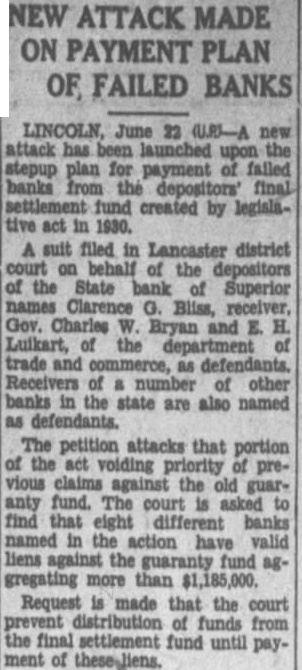
NEW ATTACK MADE ON PAYMENT PLAN OF FAILED BANKS
LINCOLN, June 22 (U.R.-A new attack has launched the stepup plan for payment of banks the fund created by legislative act in suit filed Lancaster district on behalf the depositors the State bank of Superior names Clarence Bliss, receiver, Gov. W. and E. Luikart, of the department of trade and as number of other banks in the are also named as The petition attacks that portion the act voiding priority previous against the old fund. court is asked named in the action liens the aggregating than $1,185,000. Request made that the distribution of funds from the settlement fund until payment of
2.March 14, 1932The Hastings Daily TribuneHastings, NE
Click image to open full size in new tab
Article Text
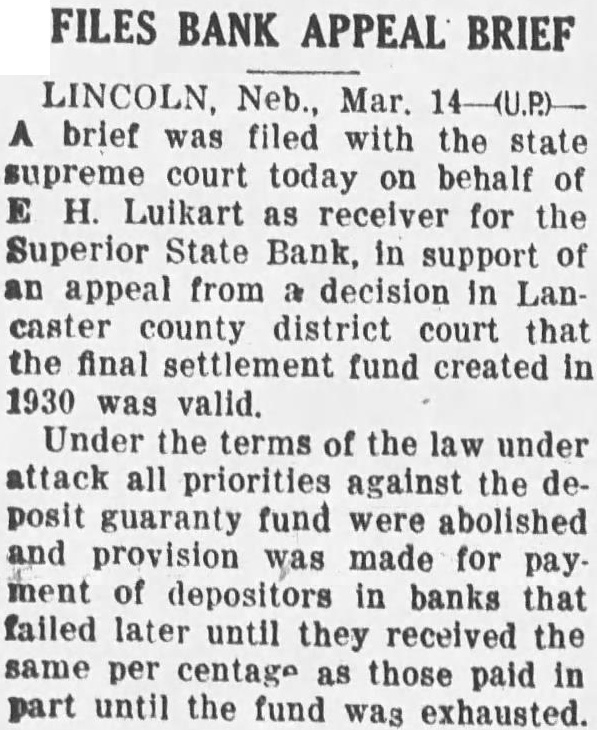
FILES BANK APPEAL BRIEF
LINCOLN, Neb., Mar. 14-(U.P)A brief was filed with the state supreme court today on behalf of E H. Luikart as receiver for the Superior State Bank, in support of an appeal from a decision In Laneaster county district court that the final settlement fund created in 1930 was valid. Under the terms of the law under attack all priorities against the deposit guaranty fund were abolished and provision was made for payment of depositors in banks that failed later until they received the same per centage as those paid in part until the fund was exhausted.