Marine National Bank (New York, NY)

Episode Information

Episode UID
121500930
Episode Type
Suspension β†’ Closure
Bank Type
national
Bank ID
12150 national
Charter Number
1215
Start Date
June 22, 1877
Location
New York, New York (40.714, -74.006)

Metadata

Model
gpt-5-mini (chosen from majority vote of a three-model LLM ensemble)
Short Digest
18761777fe087135

Response Measures

None

Receivership Details

Depositor recovery rate
83.5%
Date receivership started
1884-05-13
Date receivership terminated
1899-09-30
OCC cause of failure
Fraud
Share of assets assessed as good
59.4%
Share of assets assessed as doubtful
13.9%
Share of assets assessed as worthless
26.7%

Description

Receiver appointed in 1877; premises later occupied by a new Commercial Bank (1885).

Events (5)

1. June 3, 1865 Chartered
Source
historical_nic
2. June 22, 1877 Receivership
Newspaper Excerpt
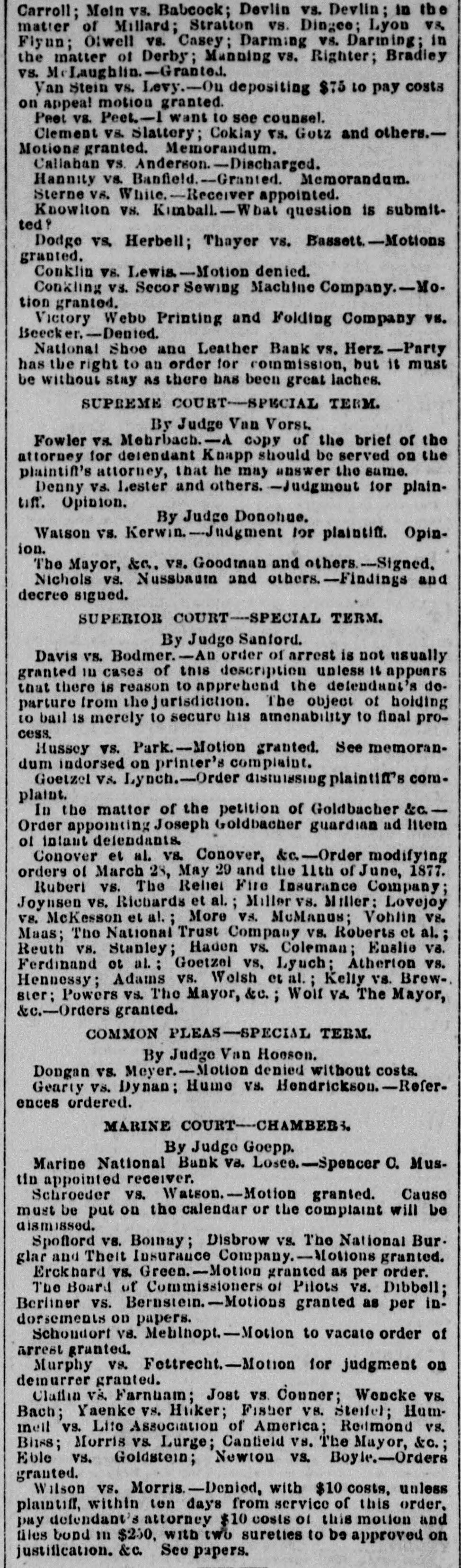
Spencer C. Mustin appointed receiver. (Marine National Bank).
Source
newspapers
3. June 22, 1877 Suspension
Cause
Government Action
Cause Details
Receiver (Spencer C. Mustin) appointed by court, indicating suspension/placement in receivership.
Newspaper Excerpt
Marine National Bank V8. Losee.-Spencer C. Mustin appointed receiver.
Source
newspapers
4. May 13, 1884 Receivership
Source
historical_nic
5. July 1, 1885 Other
Newspaper Excerpt
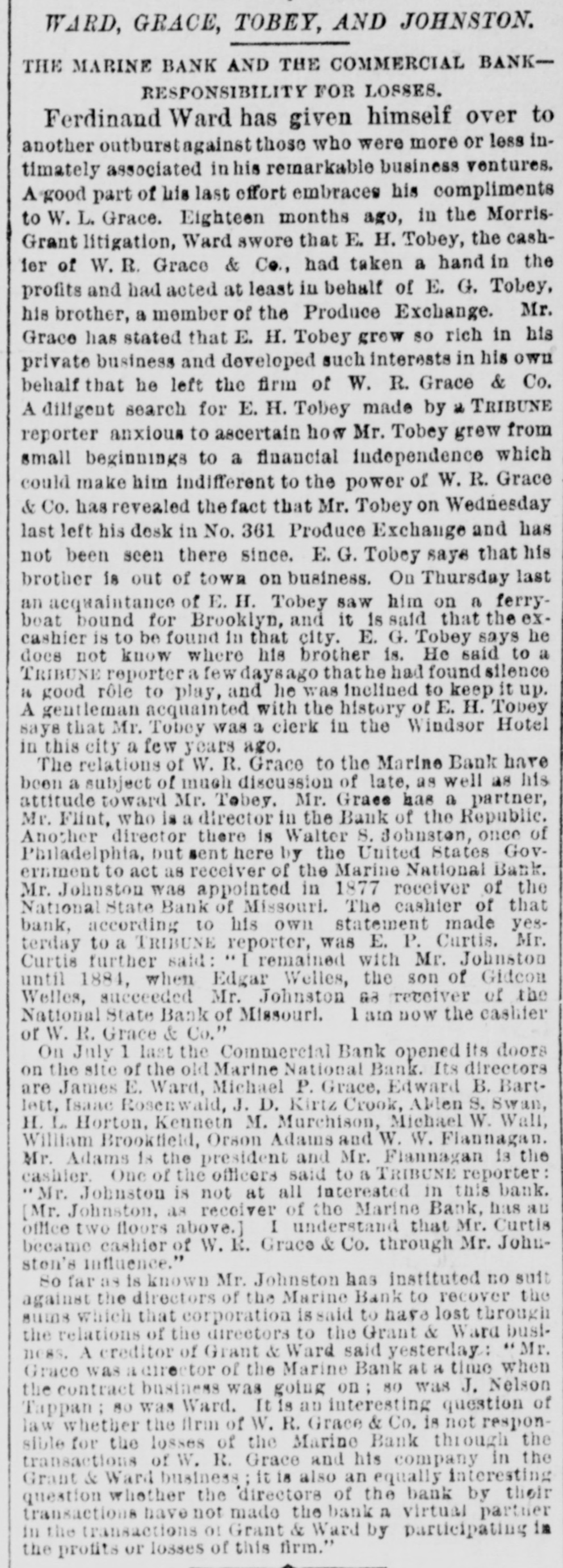
On July 1 last the Commercial Bank opened its doors on the site of the old Marine National Bank.
Source
newspapers

Newspaper Articles (4)

Article from The Portland Daily Press, September 30, 1876

Click image to open full size in new tab

Article Text

NEW YORK. The Hell Gate Explosion. NEW YORK, Sept. 29.-Gen. Newton officially reports to the Pilot Commissioners the following deptbs of water over late Hallett's reef. Since the explosion, from 180 feet distan from the shore line to the line of buoys, the bottom slopes gradually from 8 feet depth at mean low water to 20 feet. Outside the line of buoys not less than 20 feet depth at mean low tide was observed. Divers have been examining the reef and report a thorough break-up. The Book Trade Fair. The fourth fair of the American Book Trade Association closed at 6 o'clock last night. The last day proved to be the most successful of the four in a business point of view, and there were as many books sold yesterday as there were during the three previous days. Full returns of sales will not be made for several days, but it is thought the aggregate amount will reach $100,000 Savings Bank Panic. The recent suspension of the New Amster dam and Bond street Savings Bank has produced quite an excitement among the smaller depositors in the different savings institutions, and this morning every savings bank in the city was crowded with depositors, demanding their money. The Express says that before the close of another week the probabilities are that others of the small banks will be compelled to close their doors. The depositors of the Bond street Savings Bank met to-night and received the report of the committee on investigation. The report showed that the amount due depositors is $1,286,688. The assets amount to $1,412,287. The assets are composed of U. S. bonds, real estate. cash on hand, call loans, bonds and mortgages. Gift to Charitable Institutions. The board of estimate and apportionment of aldermen to-day voted about $17,000 of excise money to charitable institutions. Yellow Fever Scare. A yellow fever scare was created in Jersey City to-day, where two cases and one death are said to have occurred, the latter a lady who nursed her sick husband in Savannah. The physicians, however. say her death was caused by intermittent fever. Deaths are announced of the wife of Commodore Garrison, and of Newton St. John, formerly a leaging banker of Mobile, all of this city. Child Murder. Catherine Stevens, who is endeavoring to prosecute her reputed husband, Robert Stevens, for bigamy, asserts that he in the past fourteen years has drowned her four children before they were a day old. Defranding Insurance Companies. Samuel Harlem, of the firm of Harlem & Co., manufacturers of clothing at 12 Sirpenpard street, was arrested to-day, charged by the Fire Marshal with attempting to defraud the following fire insurance companies: Williamsburgh City, Relief Insprance Co., Girard of Philadelphia, British American Assurance Co. of Toronto, Mechanics' Insurance Co of Brooklyn. His place of business was burned some time ago, and assisted by the merchant creditors of the firm, who furnished him with fraudulent invoices, he endeavored to extort $17,344 75 from these companies, while his actual loss was about $7000. The total amount for which he was insured was $22,000. Steps will be taken to punish the merchants who furnished him with fraudulent invoices. International College Race in Prospect. ITHICA, Sept. 29.-At a very large and enthusiastic meeting of the various classes of Cornell University, held to-night, it was decided to send a challenge to the winners in the Cambridge-Oxford race, which occurs in March next. The challenge will be fours or eights, with a coxswain, as the Englishmen may desire, and for a four-mile race over the regular course, from Putney to Mortlake.

Article from The New York Herald, June 22, 1877

Click image to open full size in new tab

Article Text

Carroll; Mein vs. Babcock; Devlin vs. Devlin; in the matter of Millard; Stratton vs. Dingeo; Lyon vs. Fiyun; O:well vs. Casey; Darming vs. Darming; in the matter of Derby; Manning vs. Righter; Bradley vs. McLaughlin.-Grante.L. Van Stein vs. Levy. depositing $75 to pay costs on appeal motion granted. Peel vs. Peet.- want to see counsel. Clement vs. Slattery; Coklay vs. Gotz and others.Motions granted. Memorandum. Callahan vs. Anderson.-Discharged. Hannity vs. Banfield.--Granted. Memorandum. Sterne VS. White.-Receiver appointed. Knowlton VS. Kimball.-What question is submitted? Dodge vs. Herbell; Thayer vs. Bassett.-Motions granted. Conklin VS. Lewis-Motion denied. Conkling vs. Secor Sewing Machine Company.-Mo. tion granted. Victory Webb Printing and Folding Company vs. Beecker.-Dented. National Shoe and Leather Bank vs. Herz-Party has the right to an order for commission, but it must be without stay as there has been great laches. SUPREME COURT-SPECIAL TERM. By Judge Van Vorsi. Fowler vs. Mehrbach. -A copy of the brief of the attorney for defendant Knapp should be served on the plaintin's attorney, that he may answer the same. Denny VS. Lester and others. -Judgmout for plaintiff. Opinion. By Judge Donohue. Watson vs. Kerwin.-Judgment for plaintiff. Opinion. The Mayor, &a. vs. Goodman and others.-Signed. Nichols vs. Nussbaum and others.-Findings and decree signed. SUPERIOR COURT-SPECIAL TERM. By Judge Sanford. Davis vs. Bodmer.-A order of arrest is not usually 111 cases of this description unless 16 appears is reason to apprehend the that granted there defendant's ot holding departure from thejurisdiction. The object to bail is merely to secure his amenability to final process. Hussey vs. Park.-Motion granted. See memorandum indorsed on printer's complaint. Goetzel vs. Lynch.-Order disturesing plaintiffs complaint. In the matter of the petition of Goldbacher &c.Order appointing Joseph Goldbacher guardian ad Item of intant defendants. Conover et al. vs. Conover, &c.-Order modifying orders of March 28, May 29 and the 11th of June, 1877. Rubert vs. The Reliei Fire Insurance Company; Joyusen vs. Richards et al.; Miller vs. Miller: Lovejoy vs. McKesson et al.; More vs. McManus; Vohlin vs. Maas; The National Trust Company vs. Roberts et al.; Reuth vs. Stanley; Haden vs. Coleman; Euslie V8. Ferdinand et al.: Goetzel vs. Lyuch; Atherion vs. Hennessy; Adains vs. Welsh et al. ; Kelly vs. Brew-. ster; Powers vs. The Mayor, &c.; Wolf VA. The Mayor, &c.-Orders granted. COMMON PLEAS-SPECIAL TERM. By Judge Van Hoesen. Dongan vs. Meyer.-Mot denied without costs Gearty vs. Dynan; Hume vs. Hondrickson.-References ordered. MARINE COURT CHAMBEB3. By Judge Goepp. Marine National Bank V8. Losee.-Spencer C. Mustin appointed receiver. Schroeder vs. Watson.-Motion granted. Cause must be put on the calendar or the complaint will be dismissed. Spoflord vs. Boinay; Disbrow vs. The National Bur. glar and Theit Insurance Company.-Motions granted. Erckhard vs. Green.-Motion granted as per order. The Board of Commissioners of Pilots vs. Dibbell; Berliner vs. Bernstein.-Motions granted as per indorsements on papers. Schoudorf VS. Mebihopt.--M to vacate order of arrest granted. Murphy vs. Fettrecht.-Motton for judgment on demurrer granted. Clailin VA. Farnuam; Jost vs. Couner; Wencke vs. Bach; Yaenke vs. Hiker; Fisher vs. Steilel; Humvs. Life Association of America; Reimond vs. Morris vs. Lurge; vs. vs. vs. granted. Eble mell Bliss; Goldstein; Newton Cantield The Boyle.-Orders Mayor, &c.; Wilson vs. Morris.-Denied with $10 costs, unless plaintiff, within ton days from service of this order. pay defendant's attorney $10 costs 01 this motion and files bond 111 $230, with two sureties to be approved on justification. &c. See papers.


Article from Essex County Herald, October 25, 1878

Click image to open full size in new tab

Article Text

On the failure of Jay Cooke & Co., a general feeling of distrust was engendered, and the consequence was the utter failure of many of the Nat onal Banks, and the total suspension of all the National Banks in the city of New York. Now this was not suspension of specie payments, but was a suspension of payments in legal tender Lotes or greenbacks. The promises of the government in the form of greenbacks rose to a premium of four per cent. above the value of National Bank notes, and who can tell the extent of the disaster to the whole country if we had been doing business upon a spe ie basis, as it is called? The ruin would have been general, but as it was, everybody knew that there was precisely the same amount of paper money in the country af'er as before the panic, and consequently it was of short duration, and there was comparative-ly very little derangement in the movements of the products of the country. If the banks could not pay in greenbacks when there was in the country more in amount of legal tenders tean the entire national bank circulation, how can it be expected hat they can maintain coin payments? The fact is, his talk about specie payments is simply absurd, whether uttered by Mr. Greeley or the Solons of Congress. Mr. Greeley's saying that the "way to resumption was to resume," is not a whit more absurd than the more elaborate proposition pending in Congress. To maintain coin payments in this count.y, commercial as it is, is simply impossible unti the Almighty has changed the character and habits of the people-until, as a nation and as individuals, we become a frugal and economical people, sp nding, as a whole, less than our incomes; and until our national, state, railroad and commercial debt abroad is paid or largely reduced, we cannot be secure from the effects of the vicissitudes that creditor nations are liable to, and consequently, if our banks are on a coin basis, we are liabl at all times to a foreign drain, which would compel suspension, Allowing the national ba ks to issue any currency is an unmitigated evil, and is the real obstacle to sound, wise a d wholesome legislation, and and they ought to be divested of that power as speedily as it can be done without disturbing values. This real or fanced -interests are antagonistic to wholesome financial legislation. Capital is timid and selfish, and at the same time is influential, and it has been said (by Senator Sprague) that nothing is meaner than one million of dollars except two millions. The circulation enjoyed by the banks is a valuable privilege, ard to protect it they will overlook every consideration of public good. The evils of such special favors do not end with the banks, for to secure and perpetuate favorable legislation for themselves hey must not oppose legislation for the benefi of other interests: so, legislation becomes a matter of special favor to various interests, and not for the general good. Therefore, the sooner Congress is relieved of this insidious and baneful influence the better. We have at this session of Congress ample evidence of the baneful work of men blinded by the supposed interests, r led by those who have se fish interests to uphold. The men outside of Congress who have tendered their advice, and whose suggestions will probably be followed, have intere ts in national banks, and wish to be protected in the privileges they now enjoy; and the mistake that many congressnen make, no doubt honestly, is in treating the interests of the banks as the public interests, while, in fact, the public has no interest in them other than to divest them, as soon as practicable, of the power or privilege of issuing money. But giving to congressmen full credit for honesty and the best intentions, it is, after all, pitiable to see how little comprehension they bring to the consideration of financial questions. They seem to be trying how not to do it. They appear to be in a muddle, or else they are determined to keep matters in a muddle, and we really cannot make up our mind which. It is hard to believe that they are so much at a loss as they appear to be, and yet. t is equally past belief that they desire to do wrong on questions of finance, for upon questions outside of t eir duties as congressmen, they are certainly equal to the average of business men in ability and honesty. We have come to the conclusion that in this matter of finance their appare..t want of foresight comes from the fact that in all uch matters they yield their convictions to the vews of supposed experts, such as the officers, stockholders and attorneys of the national banks in their several districts. Now the banks have a valuable privilege to maintain and protect, every one of them receiving an annual bonus from government of more than 4 per cent. on their entire capital, over and above all national taxation, for furnishing a circulating medium for the country, which is printed and renewed at the expense of government, and which is no better than greenback, and amounting in the aggregate to an annual net bonus to the stockholders of the national banks of over $15,000,000. At the same time government is obliged to maintain a more complicated and expensive system than would be required if the government is-sued the entire currency of the nation. Sensible and honest men out of Congress ask why this is done, when the nation so much needs the $15,000,000 annually to pay current expenses? Of ou senators and representatives, each proposes a different remedy for financial evils and an empty treasury. One wants more "greenbacks;" another national bank notes; another demands specie payments on a day to be fixed by Congress; an-


Article from New-York Tribune, October 14, 1885

Click image to open full size in new tab

Article Text

WARD, GRACE, TOBEY, AND JOHNSTON. THE MARINE BANK AND THE COMMERCIAL BANKRESPONSIBILITY FOR LOSSES. Ferdinand Ward has given himself over to another outburstagainstthose who were more or less intimately associated in his remarkable business ventures. A good part of his last effort embraces his compliments to W. L. Grace. Eighteen months ago, in the MorrisGrant litigation, Ward swore that E. H. Tobey, the cash1er of W. R. Grace & Co., had taken a hand in the profits and had acted at least in behalf of E. G. Tobey, his brother, a member of the Produce Exchange. Mr. Grace has stated that E. H. Tobey grow so rich in his private business and developed such interests in his own behalf that he left the firm of W. R. Grace & Co. A diligent search for E. H. Tobey made by a TRIBUNE reporter anxious to ascertain how Mr. Tobey grew from small beginnings to a financial independence which could make him indifferent to the power of W. R. Grace & Co. has revealed the fact that Mr. Tobey on Wednesday last left his desk in No. 361 Produce Exchange and has not been seen there since. E. G. Tobey saye that his brother is out of town on business. On Thursday last an acquaintance of E. H. Tobey saw him on a ferryboat bound for Brooklyn, and it is said that the excashier is to be found in that city. E. G. Tobey says he does not know where his brother is. He said to a TRIBUNE reportera few daysago that had found silence a good rΓ΄le to play, and he was inclined to keep it up. A gentleman acquainted with the history of E. H. Tobey says that Mr. Tobey was a clerk in the Windsor Hotel in this city a few years ago. The relations of W. R. Grace to the Marine Bank have been a subject of much discussion of late, as well as his attitude toward Mr. Tobey. Mr. Grace has a partner, Mr. Flint, who is a director in the Bank of the Republic. Another director there is Walter S. Jobuston, once of Philadelphia, but sent here by the United States Government to act as receiver of the Marine National Bank. Mr. Johnston was appointed in 1877 receiver of the National State Bank of Missouri. The cashier of that bank, according to his own statement made yesterday to a TRIBUNE reporter, was E. P. Curtis. Mr. Curtis further said: remained with Mr. Johnston until 1884, when Edgar Welles, the son of Gideon Welles, succeeded Mr. Johnston 68 receiver of the National State Bank of Missouri. 1 am now the cashier of W. R. Grace & Co." On July 1 last the Commercial Bank opened its doors on the site of the old Marine National Bank. Its directors are James E. Ward, Michael P. Grace, Edward B. Bartlett, Isaac Rosenwald, J. D. Kirtz Crook, Allen S. Swan, H. L. Horton, Kenneth M. Murchison, Michael W. Wall, William Brookfield, Orson Adams and W. W. Flannagan. Mr. Adams 18 the president and Mr. Flannagan is the cashier One of the officers said to a TRIBUNE reporter: 'Mr. Johnston is not at all intereated in this bank. [Mr. Johnston, as receiver of the Marine Bank, has au office two floors above.] I understand that Mr. Curtis became cashier of W. R. Grace & Co. through Mr. Johnston's influence." So far as is known Mr. Johnston has instituted BO suit against the directors of the Marine Bank to recover the sums which that corporation is said to have lost through the relations of the directors to the Grant & Ward bustness. A creditor of Grant & Ward said yesterday: "Mr. Grace was a director of the Marine Bank at a time when the contract business was going on: 80 was J. Nelson Tappan 80 was Ward. It is an interesting question of law whether the frrm of W. R. Grace & Co. is not responsible for the losses of the Marine Bank through the transactions of W. R. Grace and his company in the Grant & Ward business it 18 also an equally interesting question whether the "directors of the bank by their transactions have not made the bank a virtual partier in the transactions 01 Grant & Ward by participating in the profits or losses of this firm."