City National Bank (Binghamton, NY)

Episode Information

Episode UID
118901141
Episode Type
Run Only
Bank Type
national
Bank ID
11890 national
Charter Number
1189
Start Date
January 25, 1895
Location
Binghamton, New York (42.099, -75.918)

Metadata

Model
gpt-5-mini (chosen from majority vote of a three-model LLM ensemble)
Short Digest
c8696633186c42b7

Response Measures

Accommodated withdrawals, Borrowed from banks or large institutions, Books examined

Description

Articles describe a city-wide panic and a neighboring bank's suspension but do not name City National Bank directly.

Events (3)

1. May 27, 1865 Chartered
Source
historical_nic
2. January 25, 1895 Run
Cause
Local Banks
Cause Details
Run on multiple Binghamton banks triggered by discovery of embezzlement at Chenango Valley Savings Bank and resulting panic.
Measures
Money arriving by train; New York banks pledged up to $1,000,000 to the city to meet withdrawals.
Newspaper Excerpt
There has been a heavy run on the other savings banks in the city all day
Source
newspapers
3. January 25, 1895 Suspension
Cause
Bank Specific Adverse Info
Cause Details
State examiner closed Chenango Valley Savings Bank after discovering long-running defalcation/embezzlement by cashier T. R. Morgan.
Newspaper Excerpt
Why did you close this bank? 'Because I found that there had been a defalcation here,' he replied.
Source
newspapers

Newspaper Articles (4)

Article from Evening Journal, January 25, 1895

Click image to open full size in new tab

Article Text

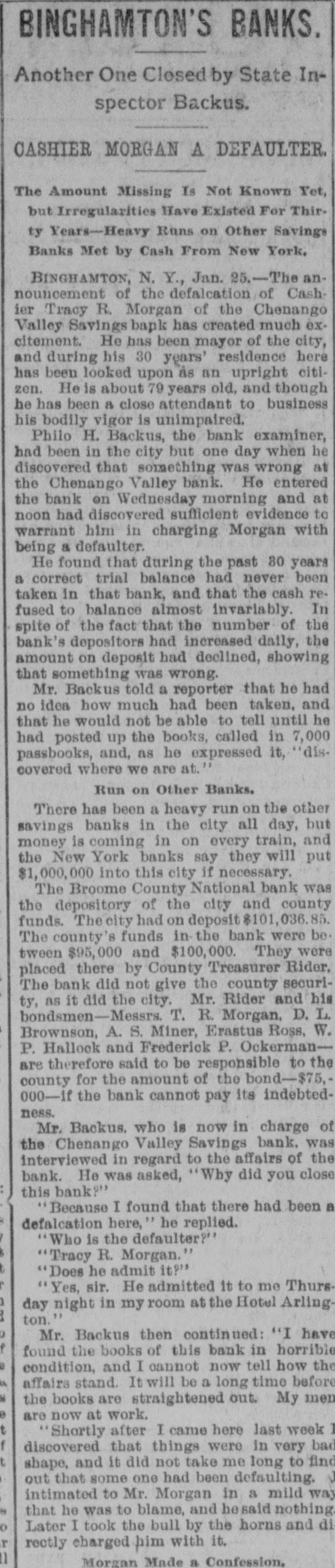
BINGHAMTON'S BANKS. Another One Closed by State Inspector Backus. CASHIER MORGAN A DEFAULTER. The Amount Missing Is Not Known Yet, but Irregularities Have Existed For Thirty Years-Heavy Runs on Other Savings Banks Met by Cash From New York, BINGHAMTON, N. Y., Jan. 25.-The announcement of the defalcation of Cashier Tracy R. Morgan of the Chenango Valley Savings bank has created much excitement. He has been mayor of the city, and during his 30 years' residence here has been looked upon as an upright citizen. He is about 79 years old, and though he has been a close attendant to business his bodily vigor is unimpaired. Philo H. Backus, the bank examiner, had been in the city but one day when he discovered that something was wrong at the Chenango Valley bank. He entered the bank on Wednesday morning and at noon had discovered sufficient evidence to warrant him in charging Morgan with being a defaulter. He found that during the past 80 years a correct trial balance had never been taken in that bank, and that the cash refused to balance almost invariably. In spite of the fact that the number of the bank's depositors had increased daily, the amount on deposit had declined, showing that something was wrong. Mr. Backus told a reporter that he had no idea how much had been taken, and that he would not be able to tell until he had posted up the books, called in 7,000 passbooks, and, as he expressed it, discovered where we are at.' Run on Other Banks. There has been a heavy run on the other savings banks in the city all day, but money is coming in on every train, and the New York banks say they will put $1,000,000 into this city if necessary. The Broome County National bank was the depository of the city and county funds. The city had on deposit $101,036.85. The county's funds in the bank were be tween $95,000 and $100,000. They were placed there by County Treasurer Rider, The bank did not give the county security, as it did the city. Mr. Rider and his bondsmen-Messrs T. R. Morgan, D. Brownson, A. S. Miner, Erastus Ross, W. P. Hallook and Frederick P. Ockermanare therefore said to be responsible to the county for the amount of the bond-$75, 000-1f the bank cannot pay its indebtedness. Mr. Backus. who is now in charge of the Chenango Valley Savings bank. was interviewed in regard to the affairs of the bank. He was asked, "Why did you close : this bank?' Because I found that there had been a defalcation here,' he replied. 'Who is the defaulter?' $ "Tracy R. Morgan.' t "Does he admit i r "Yes, sir. He admitted it to me Thurs 1 day night in my room at the Hotel Arling I ton.' 0 Mr. Backus then continued: "I have f found the books of this bank in horrible a condition, and I cannot now tell how the in affairs stand. It will be a long time before w the books are straightened out. My men a are now at work. t Shortly after I came here last week f discovered that things were in very bad t shape, and it did not take me long to find out that some one had been defaulting. intimated to Mr. Morgan in a mild way H that he was to blame, and resaid nothing 0 Later I took the bull by the horns and di r rectly charged him with it. ) Morgan Made a Confession.


Article from Waterbury Evening Democrat, January 25, 1895

Click image to open full size in new tab

Article Text

BINGHAMTON'S BANKS. Another One Closed by State Inspector Backus. CASHIER MORGAN A DEFAULTER. The Amount Missing Is Not Known Yet, but Irregularities Have Existed For Thirty Years-Heavy Runs on Other Savings Banks Met by. Cash From New York, BINGHAMTON, N. Y., Jan. The announcement of th defalcation of Cashier Tracy R. Morgan of the Chenango Valley Saving bank has created much ex citement. He has been mayor of the city, and during his 30 years' residence here has been looked upon as an upright citizen. He is about 19 years old. and though he has been a close attendant to business bodily vigor is unim aired. Philo H. Ba kus, the bank examiner, had been in the city but one day when he discovered that something was wrong at the Chenango Valley bank He entered the bank on Wednesday morning and at noon had discovered sufficient evidence to warrant him in charging Morgan with being a defaulter He found hat during the past 30 years a correct trial balance had never been taken in that bank. and that the cash refused to balance almo t invariably In spice of the fact that the number of the bank's depositors had increased daily. the amount on deposit had declined, showing that something was wrong Mr. Backus told a reporter that he had no idea how much had been taken, and that he would not be able to tell until he had posted up the books, called in 7,000 passbooks. and as he expressed it, "discovered where we are at Run on Other Banks, There has been a heavy run on the other savings banks in the city all day. but money is coming in on every train, and the New York banks say they will put $1,000,000 into this city if necessary. The Bro me County National bank was the depository of the city and county funds Theci had on deposit $101,036.85. The county's funds in the bank were be tween $95,000 and $100,000. They were placed there by County Treasurer Rider. The bank did not give the county security, as it did the city. Mr. Rider and his bondsmen-Messrs T. R Morgan. D. L. Brownson, Miner. Erastus Ross, W. P. Hallock and Frederick P. Ockermanare said to be responsible to the county for the amount of the bond000-if the bank cannot pay its indebtedness. Mr. Backus who is now in charge of the Chenango Valley Savings bank. was interviewed in regard to the affairs of the bank lie was asked, Why did you close this bank Because I found that there had been a defalcation here he replied Who is the defaulter Tracy R Morgan. Does he admit it Yes sir He admitted it to me Thursday night in my room at the Hotel Arlington Mr. Backus then continued: I have found the books of this bank in horrible condition. and 1 cannot now tell how the affairs stand It will be a long time before the books straightened out My men are now at work Shortly after I came here last week I discovered that things were in very bad shape. and it did not take me long to find I out that some one had been defaulting. intimated to Mr Morgan in a mild way that he was to blame, and he said nothing. Later too the bull by the borns and di rectly charged him with it. Morgan Made a Confession, 'He admitted he had taken the funds of the bank. 1 was taken sick at the ho tel. and Morgan and Mr. Lrownson came to sco me fina Iv got Morgan to admit that he had taken the funds of the bank. but am not at rty to tell all that he told me I then cautioned both men not to go near the bash and against touching one of the books or papers. Mr. Morgan promised to keep away, but subse juent events preved that wa- justified in taking the savings bank funds and securities to the Binghamton Savings bank Messrs organ and Brownson are liable for burg ary in entering is bank and taking out the books If I had not set the directors watching the building, I should have no books here today to work on. 1 certainly never found a bank in such condition. can't say how the affairs of the Na tional Broome County bank stand, and I do not know whether or not the funds from the savings bank have been trans ferred to the national bank. It will be some time before the books here are posted up sufficiently to show how the finances of the bank stand. I cannot say how heavy the defalcation has been. I hope it has not been sufficiently large to break the bank It became absolutely necessary to close this lank until we can find out how its finances stand Kept the Books Alone. The great question here is, What bas Morgan done with the money It is not known that be was extravagant to any extent. or that he had any particular vices which would aid him in getting rid of a fortune. He lived quietly and has devoted apparently most of his time to business. He has kept the books of the savings bank almost entirely alone. Not one of the emp eyees know anything of his accounts, with the exception of a young girl who has for several years been Morgan chief helper Today a watchman is in the bank to prevent any one from tampering with the books The atement that all the other banks are in a turry-a report that early in the day gained some credence here-is not borne out by the facts Each bank is prepared for a bad run, and there is fully $1,000,000 more in the city than the total amount of the deposits in all the banks It was reported about the city that Harry Ross of the defunct Merchants bank and the private bank of Ross & Sons was missing, but the report is not true


Article from Evening Star, January 25, 1895

Click image to open full size in new tab

Article Text

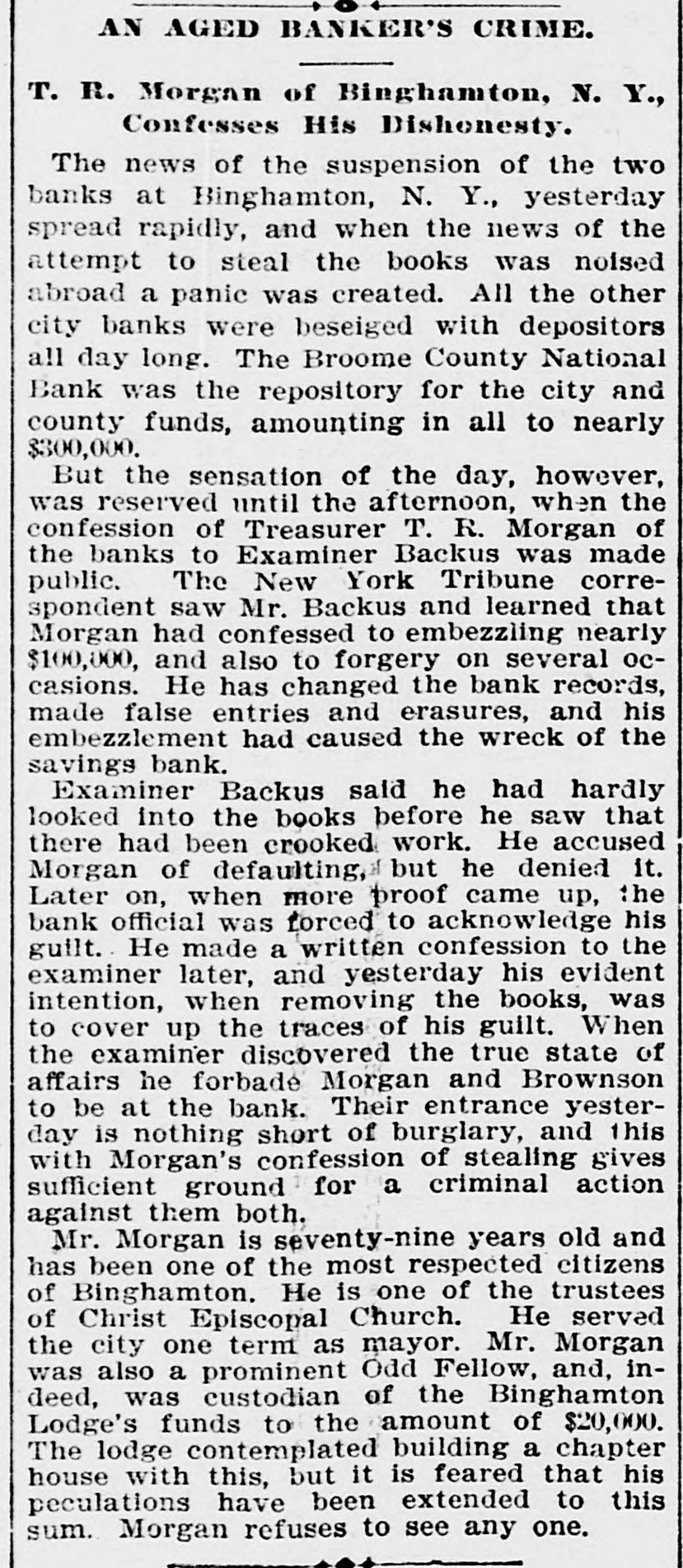
AN AGED BANKER'S CRIME. T. R. Morgan of Binghamton, N. Y., Confesses His Dishonesty. The news of the suspension of the two banks at Binghamton, N. Y., yesterday spread rapidly, and when the news of the attempt to steal the books was noised abroad a panic was created. All the other city banks were beseiged with depositors all day long. The Broome County National Bank was the repository for the city and county funds, amounting in all to nearly $300,000. But the sensation of the day, however, was reserved until the afternoon, when the confession of Treasurer T. R. Morgan of the banks to Examiner Backus was made public. The New York Tribune correspondent saw Mr. Backus and learned that Morgan had confessed to embezzling nearly $100,000, and also to forgery on several occasions. He has changed the bank records, made false entries and erasures, and his embezzlement had caused the wreck of the savings bank. Examiner Backus said he had hardly looked into the books before he saw that there had been crooked work. He accused Morgan of defaulting, but he denied it. Later on, when more proof came up, the bank official was forced to acknowledge his guilt. He made a written confession to the examiner later, and yesterday his evident intention, when removing the books, was to cover up the traces of his guilt. When the examiner discovered the true state of affairs he forbade Morgan and Brownson to be at the bank. Their entrance yesterday is nothing short of burglary, and this with Morgan's confession of stealing gives sufficient ground for a criminal action against them both. Mr. Morgan is seventy-nine years old and has been one of the most respected citizens of Binghamton. He is one of the trustees of Christ Episcopal Church. He served the city one term as mayor. Mr. Morgan was also a prominent Odd Fellow, and, indeed, was custodian of the Binghamton Lodge's funds to the amount of $20,000. The lodge contemplated building a chapter house with this, but it is feared that his peculations have been extended to this sum. Morgan refuses to see any one.


Article from The Birmingham Age-Herald, March 12, 1908

Click image to open full size in new tab

Article Text

FINANCIAL BILL HOTLY DENOUNCED Senator Clarke of Arkansas Hits Several Fierce Blows ALDRICH ATTEMPTS REPLY Investigation of Causes of the Panic Is Demanded by Senator Clarke, Who Also Denounces New York Stock Exchange. Washington, March 11.-Senator Clarke of Arkansas denounced the pending currency bill in a speech in the Senate today, declaring that no currency legislation should be enacted until an investigation is held as to the causes of the panic. "No such legislation is necessary now, said Mr. Clarke. "It is not only not necesI sary, but it may become dangerous. am not disposed to tolerate the idea of giving any support to the committee bill, nor the substitute proposed by the minority members of the Senate." If emergency currency is to be provided, Mr. Clarke said, the benefits should be extended all persons whose legitimate business demands cause them to need it. Mr. Clarke denounced the operations of stock exchanges and said the American people would not be satisfied with the proposed currency legislation without a complete knowledge of causes of the panic. "The time has arrived," he said, "when the affairs of the New .York stock exchange and other stock exchanges must be looked into." Mr. Clarke's reference to the stoppage of the payments by the New York banks called Mr. Aldrich to his feet with the remark that he did not believe the people would permit that course again to be pursued. "I trust the senator from Rhode Island as a historian," retorted Mr. Clarke, "but I do not trust him as a prophet." Mr. Clarke expressed the opinion that the majority would not pass the bill allowing the emergency circulation to be retired without limitation. Mr. Clarke said he would not only require a restriction of reserves, but he would deny to a national bank the right to pay interest on checking accounts. Senator Nelson suggested that the national banks should pay interest on the $250,000,000 of government deposits. Mr. Aldrich said that five years ago he had introduced a bill providing for the payment of interest on such deposits at the rate of 1 1/2 per cent, but, he added, senators had opposed that bill on the ground that it changed the nature of the loan. Former Senator Spooner and the late Senator Morgan, he said, opposed the bill. If that objection could be overcome he declared his willingness to again bring in such a measure. He did not know any reason unless it should be a legal one, of the kind suggested, why interest should not be charged on these deposits. Mr. Culberson, he said, had introduced a bill to require payment of interest on government deposits and it was now before the committee on finance. Mr. Bailey spoke at some length suggesting that the main purpose of his substitute was to favor the principle of government money instead of bank money He explained that he had provided for a distribution of the emergency currency in accordance with population, although he realized that business necessity was a greater measure of the amount they should have. But it was not possible to make sure of the business needs of the several sections and it was a simple matter to ascertain the population. An extended argument was made by Mr. Newlands of Nevada in favor of his view that the sending of a check from one state to another makes the business of banking interstate commerce.