11872. Farmers State Bank (Newman Grove, NE)

Bank Information

Episode Type
Suspension โ†’ Closure
Bank Type
state
Start Date
July 16, 1929
Location
Newman Grove, Nebraska (41.750, -97.775)

Metadata

Model
gpt-5-mini
Short Digest
8ece65807d52f723

Response Measures

None

Description

Articles report the Farmers State Bank of Newman Grove was taken over by the Nebraska State Banking Department in July 1929 as insolvent (no run reported). Attempts at reorganization were discussed but the bank remained in receivership; by 1934 remaining assets were being sold by the receiver. Thus this is a suspension by government action leading to permanent closure/receivership.

Events (2)

1. July 16, 1929 Suspension
Cause
Government Action
Cause Details
State Bank Examiner Lyman C. Sorensen posted notices that the Farmers State Bank was taken over by the Nebraska State Banking Department as insolvent after deteriorating conditions and withdrawals; re-organization meeting was called but the bank was placed in state control.
Newspaper Excerpt
notices were posted the doors ... that the affairs of the bank had been taken over by the state banking department
Source
newspapers
2. June 13, 1934 Receivership
Newspaper Excerpt
order of sale, duly made and entered ... on the 13th day of June, 1934; that the undersigned receiver will sell ... the entire remaining assets said bank
Source
newspapers

Newspaper Articles (6)

Article from Newman Grove Reporter, July 17, 1929

Click image to open full size in new tab

Article Text

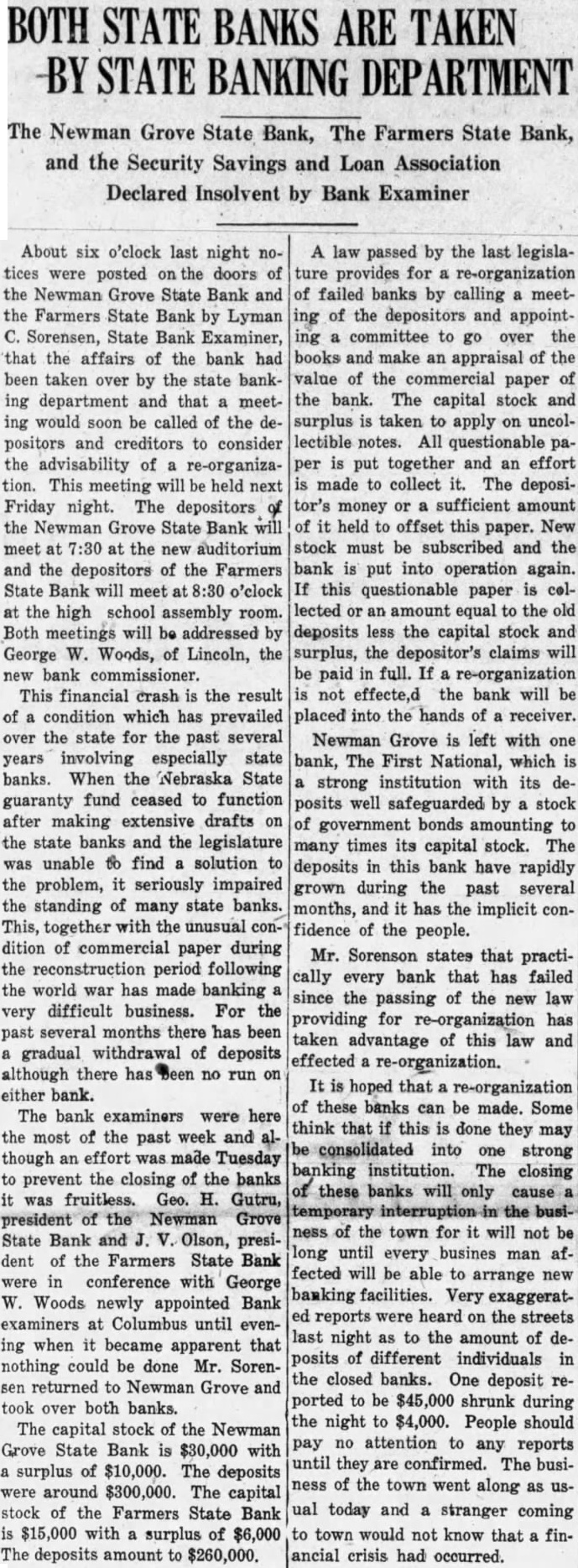
BOTH STATE BANKS ARE TAKEN BANKING DEPARTMENT The Newman Grove State Bank, The Farmers State Bank, and the Security Savings and Loan Association Declared Insolvent by Bank Examiner About six o'clock last night notices were posted the doors of the Newman Grove State Bank and the Farmers State Bank by Lyman C. Sorensen, State Bank Examiner, that the affairs of the bank had been taken over by the state banking department and that a meeting would soon be called of the positors and creditors to consider the advisability of re-organization. This meeting will be held next Friday night. The depositors the Newman Grove State Bank will meet at 7:30 at the new auditorium and the depositors of the Farmers State Bank will meet 8:30 o'clock at the high school assembly room. Both meetings will be addressed by George W. Woods, of Lincoln, the new bank commissioner. This financial crash is the result of condition which has prevailed over the state for the past several years involving especially state banks. When the Nebraska State guaranty fund ceased to function after making extensive drafts on the state banks and the legislature was unable to find solution to the problem, it seriously impaired the standing of many state banks. This, together with the unusual dition of commercial paper during the reconstruction period following the world war has made banking very difficult business. For the past several months there has been gradual withdrawal of deposits although there no run on either bank. The bank examiners were here the most of the past week and though an effort was made Tuesday to prevent the closing of the banks was fruitless. Geo. H. Gutru, president of the State Bank and Olson, president of the Farmers State Bank were in conference with George W. Woods newly appointed Bank examiners at Columbus until evening when it became apparent that nothing could be done Mr. Sorensen returned to Newman Grove and took over both banks. The capital stock of the Newman Grove State Bank is $30,000 with surplus of $10,000. The deposits were around $300,000. The capital stock of the Farmers State Bank is $15,000 with surplus of $6,000 The deposits amount to A law passed by the last legislature provides for re-organization of failed banks by calling meetof the depositors and appointing committee to go over the books and make an appraisal of the value of the commercial paper of the bank. The capital stock and surplus is taken to apply on uncollectible notes. All questionable is put together and an effort per made to collect it. The depositor's money or sufficient amount of it held to offset this paper. New stock must be subscribed and the bank is put into operation again. If this questionable paper is collected or an amount equal to the old deposits less the capital stock and surplus, the depositor's claims will be paid in full. If a re-organization not effecte,d the bank will be placed into the hands of receiver. Newman Grove is left with one bank, The First National, which is strong institution with its deposits well safeguarded by stock of government bonds amounting to many times its capital stock. The deposits in this bank have rapidly grown during the past several months, and it has the implicit confidence of the people. Mr. Sorenson states that practically every bank that has failed since the passing of the new law providing for re-organization has taken advantage of this law and effected re-organization. It is hoped that re-organization of these banks can be made. Some think that if this is done they may be consolidated into one strong banking institution. The closing these banks will only the ness of the town for it will not be long until every busines man affected will be able to arrange new banking facilities. Very exaggeratreports were heard on the streets last night as to the amount of deposits of different individuals the closed banks. One deposit ported to be $45,000 shrunk during the night to $4,000. People should pay no attention to any reports until they are confirmed. The business of the town went along as ual today and stranger coming to town would not know that financial crisis had occurred.


Article from The Madison News, September 12, 1929

Click image to open full size in new tab

Article Text

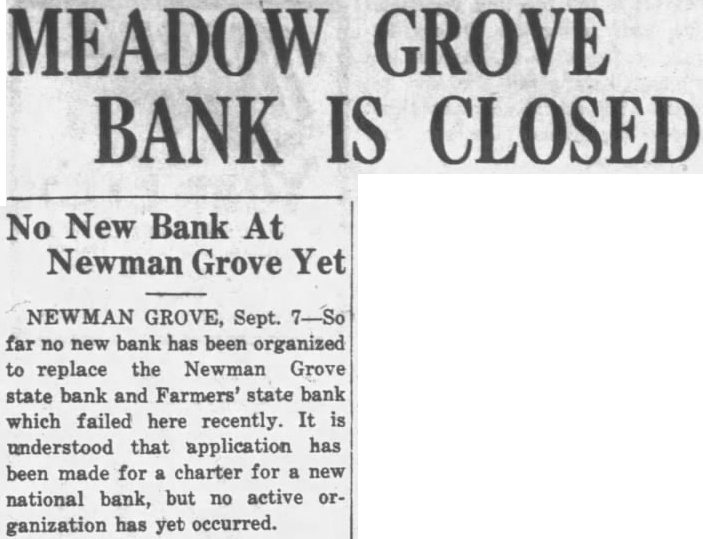
MEADOW GROVE BANK IS CLOSED No New Bank At Newman Grove Yet NEWMAN GROVE, Sept. 7-So far no new bank has been organized to replace the Newman Grove state bank and Farmers' state bank which failed here recently. It is understood that application has been made for a charter for a new national bank, but no active organization has yet occurred.


Article from Norfolk Daily News, September 26, 1929

Click image to open full size in new tab

Article Text

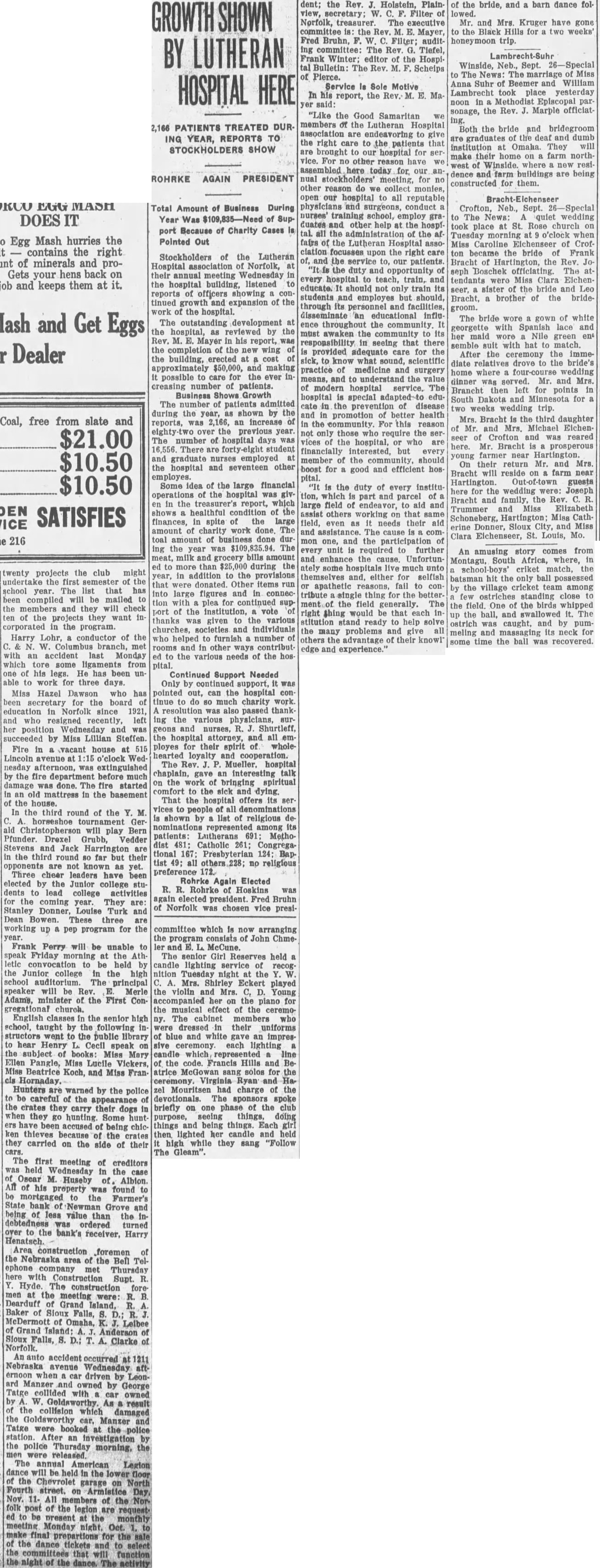
twenty projects the club might undertake the first semester of the school year. The list that has been compiled will be mailed to the members and they will check ten of the projects they want incorporated in the program. Harry Lohr, a conductor of the C. & N. W. Columbus branch, met with an accident last Monday which tore some ligaments from one of his legs. He has been unable to work for three days. Miss Hazel Dawson who has been secretary for the board of education in Norfolk since 1921, and who resigned recently, left her position Wednesday and was succeeded by Miss Lillian Steffen. Fire in a vacant house at 515 Lincoln avenue at 1:15 o'clock Wednesday afternoon, was extinguished by the fire department before much damage was done. The fire started in an old mattress in the basement of the house. In the third round of the Y. M. C. A. horseshoe tournament Gerald Christopherson will play Bern Pfunder. Drexel Grubb, Vedder Stevens and Jack Harrington are in the third round so far but their opponents are not known as yet. Three cheer leaders have been elected by the Junior college students to lead college activities for the coming year. They are: Stanley Donner, Louise Turk and Dean Bowen. These three are working up a pep program for the year. Frank Perry will be unable to speak Friday morning at the Athletic convocation to be held by the Junior college in the high school auditorium. The principal speaker will be Rev. E. Merle Adams, minister of the First Congregational church. English classes in the senior high school, taught by the following instructors went to the public library to hear Henry L. Cecil speak on the subject of books: Miss Mary Ellen Pangle, Miss Lucile Vickers, Miss Beatrice Koch, and Miss FranHornaday. Hunters are warned by the police to be careful of the appearance of the crates they carry their dogs in when they go hunting. Some hunters have been accused of being chicken thieves because of the crates they carried on the side of their cars. The first meeting of creditors was held Wednesday in the case of Oscar M. Huseby of Albion. All of his property was found to be mortgaged to the Farmer's State bank of Newman Grove and being of less value than the indebtedness was ordered turned over to the bank's receiver, Harry Henatsch. Area construction foremen of the Nebraska area of the Bell Telephone company met Thursday here with Construction Supt. R. Y. Hyde. The construction foremen at the meeting were: R. B. Dearduff of Grand Island, R. Baker of Sioux Falls, S. D.; R. J. McDermott of Omaha, K. J. Leibee of Grand Island: A. J. Anderson of Sioux Norfolk. Falls, S. D.; T. A. Clarke of An anto accident occurred at 1211 Nebraska avenue Wednesday aft ernoon when car driven by Leonard Manzer and owned by George Tatge collided with a car owned by A. W. Goldsworthy. As a result of the collision which damaged the Goldsworthy car, Manzer and Tatge were booked at the police station. After an investigation by the police Thursday morning, the men were released. The annual American Legion dance will be held in the lower floor of the Chevrolet garage on North Fourth street. on Armistice Day. Nov. 11- All members of the Norfolk post of the legion are request. ed to be present at the monthly meeting Monday night, Oct. 1, to make final prepartions for the sale of the dance tickets and to select the committees that will function the night of the dance. The activity GROWTH SHOWN BY LUTHERAN HOSPITAL HERE 2,166 PATIENTS TREATED DURING YEAR, REPORTS TO STOCKHOLDERS SHOW ROHRKE AGAIN PRESIDENT NORCO EGG MASH Total Amount of Business During DOES IT Year Was $109,835-Need of Support Because of Charity Cases is Norco Egg Mash hurries the Pointed Out moult contains the right Stockholders of the Lutheran amount of minerals and proHospital association of Norfolk, at tefn. Gets your hens back on their annual meeting Wednesday in the job and keeps them at it. the hospital building, listened to reports of officers showing a continued growth and expansion of the work of the hospital. The outstanding development at the hospital, as reviewed by the Rev. M. E. Mayer in his report, was the completion of the new wing of the building, erected at a cost of approximately $50,000, and making it possible to care for the ever increasing number of patients. Business Shows Growth The number of patients admitted during the year, shown by the reports, was 2,166, an increase of eighty over the previous year. $21.00 The number of hospital days was 16,556. There are forty-eight student and graduate nurses employed at $10.50 the hospital and seventeen other employes. $10.50 Some idea of the large financial operations of the hospital was given in the treasurer's report, which shows a healthful condition of the SATISFIES finances, in spite of the large amount of charity work done, The toal amount of business done during the year was $109,835.94. The meat, milk and grocery bills amount ed to more than $25,000 during the year, in addition to the provisions that were donated. Other items run into large figures and in connection with plea for continued support of the institution, vote of thanks was given to the various churches, societies and individuals who helped to furnish a number of rooms and in other ways contributed to the various needs of the hospital. Continued Support Needed Only by continued support, it was pointed out, can the hospital continue to do so much charity work. A resolution was also passed thanking the various physicians, surgeons and nurses, R. J. Shurtleff, the hospital attorney, and all employes for their spirit of wholehearted loyalty and cooperation. The Rev. J. P. Mueller. hospital chaplain, gave an interesting talk on the work of bringing spiritual comfort to the sick and dying. That the hospital offers its services to people of all denominations is shown by a list of religious denominations represented among its patients: Lutherans 691; Methodist 481: Catholic 261; Congregational 167; Presbyterian 124; Baptist 49; all others no religious preference 172. Rohrke Again Elected R. R. Rohrke of Hoskins was again elected president. Fred Bruhn of Norfolk was chosen vice presi- committee which is now arranging the program consists of John Chmeler and E. L. McCune. The senior Girl Reserves held a candle lighting service of recognition Tuesday night at the Y. W. C. A. Mrs. Shirley Eckert played the violin and Mrs. C, D. Young accompanied her on the piano for the musical effect of the ceremony. The cabinet members who were dressed their uniforms of blue and white gave an impressive ceremony. each lighting a candle which represented line of the code. Francis Hills and Beatrice McGowan sang solos for the ceremony. Virginia Ryan and Hazel Mouritsen had charge of the devotionals. The sponsors spoke briefly on one phase of the club purpose, seeing things, doing things and being things. Each girl then lighted her candle and held It high while they sang "Follow The Gleam". dent; the Rev. J. Holstein, Plainview, secretary; W. C. F. Filter of Norfolk, treasurer. The executive committee is: the Rev. M. E. Mayer, Fred Bruhn, F. W. C. Filter; auditing committee: The Rev. G. Tiefel, Frank Winter: editor of the Hospital Bulletin: The Rev. M. F. Scheips of Pierce. Service is Sole Motive In his report, the Rev. M. E. Mayer said: "Like the Good Samaritan we members of the Lutheran Hospital association are endeavoring to give the right care to the patients that are brought to our hospital for service. For no other reason have we assembled here today for our annual stockholders' meeting, for no other reason do we collect monies, open our hospital to all reputable physicians and surgeons, conduct a nurses' training school, employ gra duates and other help at the hospftal. all the administration of the affairs of the Lutheran Hospital assoclation focusses upon the right care of, and the service to, our patients. is the duty and opportunity of every hospital to teach, train, and educate. It should not only train its students and employes but should, through its personnel and facilities, disseminate an educational influence throughout the community. It must awaken the community to its responsibility in seeing that there is provided adequate care for the sick, to know what sound, scientific practice of medicine and surgery means, and to understand the value of modern hospital service. The hospital is special adapted-to educate in the prevention of disease and in promotion of better health in the community. For this reason not only those who require the services of the hospital, or who are financially interested, but every member of the community, should boost for a good and efficient hos pital. "It is the duty of every institution, which is part and parcel of large field of endeavor, to aid and assist others working on that same field, even as it needs their aid and assistance. The cause is common one, and the participation of every unit is required to further and enhance the cause. Unfortunately some hospitals live much unto themselves and, either for selfish or apathetic reasons, fail to contribute single thing for the betterment the field generally. The right thing would be that each in stitution stand ready to help solve the many problems and give all others the advantage of their knowl* edge and experience.' of the bride, and a barn dance followed. Mr. and Mrs. Kruger have gone to the Black Hills for a two weeks' honeymoon trip. Lambrecht-Suhr Winside, Neb., Sept. 26-Special to The News: The marriage of Miss Anna Suhr of Beemer and William Lambrecht took place yesterday noon in Methodist Episcopal parsonage, the Rev. J. Marple officiating. Both the bride and bridegroom are graduates of the deaf and dumb institution at Omaha. They will make their home on a farm northwest of Winside. where new residence and farm buildings are being constructed for them. Bracht-Eichenseer Crofton, Neb., Sept. 26-Special to The News: quiet wedding took place at St. Rose church on Tuesday morning at o'clock when Miss Caroline Eichenseer of Crofton became the bride of Frank Bracht of Hartington, the Rev. Joseph Boschek officiating. The attendants were Miss Clara Eichenseer, sister of the bride and Leo Bracht, a brother of the bridegroom. The bride wore a gown of white georgette with Spanish lace and her maid wore Nile green en' semble suit with hat to match. After the ceremony the immediate relatives drove to the bride's home where a four-course wedding dinner was served. Mr. and Mrs. Brancht then left for points in South Dakota and Minnesota for a two weeks wedding trip. Mrs. Bracht is the third daughter of Mr. and Mrs. Michael Eichenseer of Crofton and was reared here. Mr. Bracht is a prosperous young farmer near Hartington. On their return Mr. and Mrs. Bracht will reside on a farm near Hartington. Out-of-town guests here for the wedding were: Joseph Bracht and family, the Rev. C. R. Trummer and Miss Elizabeth Schoneberg, Hartington; Miss Catherine Donner, Sloux City, and Miss Clara Eichenseer, St. Louis, Mo. An amusing story comes from Montagu, South Africa, where, in school-boys' criket match, the batsman hit the only ball possessed by the village cricket team among a few ostriches standing close to the field. One of the birds whipped up the ball, and swallowed it. The ostrich was caught, and by pummeling and massaging its neck for some time the ball was recovered.


Article from Nebraska Legal News, September 2, 1933

Click image to open full size in new tab

Article Text

(SYLLABUS) Before in insolvent bank money an may be recovered on the trust fund theory, claimant must show facts to prove that it not simply general deposit. Heard before Goss, Rose, Good, Eberly and Paine, PAINE, This claim by the heirs for payment in full of the balance of deposit made in bank by the executor of the estate, which bank has since become insolvent. James C. Flannigan vicepresident and one of the managing officers of the Citizens Bank of Stuart. While such officer, he was appointed by the county court of Keya Paha county as executor of the tate of John Thomas Payn. A public sale was the property of said Payn on July 25, 1928, being the date of his death, and the said Flannigan deposited more than in said bank as the proceeds of said sale. This deposit made was in the name, Estate of John Thomas Payn, deceased, James C. Flannigan, executor." Checks were drawn said fund by the executor until the balance of the deposit amounted to $4,020.95, at which time the bank went into the hands of receiver. After the bank failed, the county court assigned the funds in the bank to the heirs, who filed their petition of intervention in the district court for against the receiver of bank, alleging that they entitled to payment in full. The receiver denied the liability, and upappeal to the district court it was held that the funds so deposited but general claim, and not trust fund. Among the propositions of law advanced for the reversal of this order of the district court by the appellants are these: The right to follow trust funds is property right, and includes all situations where there fiduciary position, or where one person has the legal title or possession of but property, its ownership is in another; trust funds do not lose their character by being deposited in bank, so long as such funds can distinguished in the hands of the trustee. The general rule that of deposit funds, rightfully made by an executor, cannot be impressed with trust after the bank in which it placed becomes insolvent set out Gray Elliott, 361, 53 554, in which case pointed out that when the bank fails virtually disappears as responsible and party, the rights and equities of the general depositors must be considered. Section Comp. 1929. provides generally that the claims depositors shall, at the time of the closing of bank be first lien on all the assets of such bank: but it was held in State Farmers State Bank, 121 Neb. 532, 237 857, (notes, pp. that this did not to apply fund converted by the bank trustee to own use. This court has held that, where the trust property can be specifically identified, and so found in the hands the insolvent bank's receiver, the beneficial owner may recover the same. Higgins Hayden, 53 Neb. 280. Many courts have held that, where specific money marked and kept separate and intact, unmingled with the money of the bank, the owner is entitled to the full recovery thereof. St. Augustine Paint McNair, 59 Fed. (2d) 755. deposit in bank in the ordinary course of its business presumed be general deposit, even if made by an executor. Leach Beazley, 337, 374. The executor in the case at bar had (SYLLABUS) Items sent to bank for collection and the proceeds thereof are held in trust for the owner. Where collecting bank attempts to remit by draft on collection item. which attempt fails on account of its insolvency, the trust character of the fund is not destroyed in the absence of request for or an agreement to take exchange of the bank in payment. Check or draft ordinarily does not discharge an obligation, unless paid. 4. Whether bank, which fails, after collecting an item. debtor or trustee will be determined by the tent of the parties. Heard before Goss, C. Rose, Dean, Eberly, Day and Paine, JJ. DAY, This proceeding to establish claim against the insolvent Farmers State Bank of Newman Grove and to impress the assets thereof with trust. The Federal Reserve Bank of Kansas City sent the state bank various checks drawn upon it directly to it by mail for collection. The two banks did not carry reciprocal counts, but the state bank, as the collecting bank, was bound to remit the proceeds. This the state bank tempted to do by sending its draft on correspondent bank, which was not paid because of the insolvency of the state bank. The trial court held that the Federal Reserve Bank had valid claim against the state bank and impressed the assets with trust, entitled to priority over claims of depositors and general creditors. This transaction occured few days before section Comp. St. 1929 (the uniform collection law) took effect, 80 it is not governed by it. The checks and the proceeds thereof were held the by state bank as trustee (State Nebraska State Bank, 120 Neb. 539; Laws 1925, ch. 29) and the judgment of the trial court right, unless, as contended by the receiver of the state bank, there an express or implied agreement that remittance should be made by draft, which amounted to purchase of the exchange of the Farmers State Bank by the Federal Reserve Bank. Under an express agreement between the two banks, the state bank was to collect and mit. By custom of long standing, the state bank had remitted by draft, and from this argued that the Federal Reserve Bank, with knowledge of this custom, exchanged its checks for the draft of the state bank and established the relation of debtor and creditor, rather than that of cipal and agent. If this be true, then the character of the fund was immediately upon the issuance of the draft. the instant case, the contract tween the forwarding and receiving banks did not arise of out custom, but out of an agreement between them, by which the collecting bank agreed to collect the to and remit at to the once forwarding bank. The forwarding bank in this case had no desire or intention to purchase the of the exchange state bank. It was their this purpose, by transaction, to collect upon the checks drawn on the state bank in cash or its equivalent. While it true that for long time the state bank had mitted by means of its draft and that the Federal Reserve Bank had accepted said draft, the draft was the medium by which the state bank tempted to remit and heretofore had transferred funds of which was trustee. If the draft accomplished the of the trust purpose transferring fund from the state bank to the Federal Reserve Bank, then the trust fund extinguished by payment, but on the other the draft was not paid upon presentation, then there was no transfer of the funds. check or draft is never of payment an unless the check is paid. bad check never valid obligation. Omaha Nat. Bank Brady State Bank, 113 Neb. 711. In determining whether or not bank which, after collecting check itself, upon fails debtor or trustee, the court will look to the intent of the parties. Federal Reserve Bank Peters. Bank of Poplar Bluff Millspaugh, Mo. 412. collecting bank's obligation is pay the proceeds of collection in cash or its equivalent. This duty not discharged until the fund is put into the possession of the the bank chooses to transfer the fund by means of draft, has not discharged its obligation until the fund actually transferred. In the instant case, it was unquestionably the intention of the parties to transfer the trust fund by means of draft. The fund, represented as it was by draft, did not change in character because of the means chosen to accomplish the transfer. Custom this case did not amount to an agreement to accept the exchange of the bank. Heretofore, the obligation of the bank to remit had been discharged by check or draft that had been paid. It was impractical to remit by shipment of and it was currency, convenient and proper to transfer the fund by means of good check draft. In an annotation, is said: regards the establishment of preference in the assets of an insolvent bank in favor of one who forwarded to item for colan lection, and received from by way of remittance cashier's check for the amount thereof. it appears, as other cases where bank collects forwarded to it tains the proceeds, to be necessary (1) that the collection and retention of the money created the relation of trustee and beneficiary between the bank and the creditor, that the assets of bank were thereby augmented, and (3) that the creditor be able to trace the fund into the hands the receiver. If this test, in all its parts, met, then the creditor titled to preference for the of the proceeds collected, or cashier's check sent by of remittance way thereof." Colorado Co. Docking, 124 Kan. 48; Hawaiian Pineapple Co. Browne, 69 Mont. 140; Hornick, More Porterfield Farmers Merchants Bank, 568 Dak. National Bank Porter, Idaho, 514. different rule prevails in jurisdictions. Peurifoy First Nat. Bank, Car. 370; Leach Battle Creek Savings 202 Bank, 519. However, this court has long been committed to the doctrine that the collecting bank holds both the item and the proceeds thereof as trustee, and in the absence of an tention to accept in payment rather than as means of payment the change of the bank, the relationship not changed. There no intention on the part of the Federal Reserve Bank, either express or implied, to accept the exchange of the Farmers State Bank as payment. It was the usual means of transmittal, but when was not paid. failed in its purpose and not, in fact, payment. The judgment of the district court AFFIRMED. false statement, with intent to deceive and insists that the of the conauthorized to examine into tract of settlement above referred person the of state bank, it is not was in the note case of the bank, toessential to the commission of the gether with that the offense that the statement be made in the hands of question the of two directors an for collection, and that presence attorney the bank. the examiner and examined the Where state bank undergo- contract and The bank ing an examination by state bank examiner testified that no such conand the cashier the tract there, it shown to was nor Bank makes and him, did he have knowledge nor any statment of the assets of the thereof, or knowledge or informaany bank, he be liable to tion that Lipman had been released may prosecution if the statement knowingly from the liability on note. false and made with intent to deceive Defendant contends that he did not the examiner, regardless of the fact have fair trial, and assigns numthat such examination is not made in erous errors, which will not require the presence of of the bank's discussion. We shall confine our disectors. cussion of errors to those which seem Incompetency of person to be proper for the disposition of as juror will be held waived the case. by the failure to interrogate the juror It is contended that the evidence his VOIR DIRE as to his compet- insufficient to sustain the verdict, ency, and to challenge for that cause. because examination made of the Defendant in criminal action Bassett State Bank by the examiner has right to inquire of state wit- did not occur in the of presence two whether he is biased and pre- of the bank's directors, as required judiced against the defendant, and by law. The statute, making it an ofwitness in the negative fense for an officer of bank to has further right to make false statement to person quire specific of the witness, authorized to examine bank, tending to disclose such bias and not confined to statements made judice. when the bank is undergoing reguOne convicted of criminal lar examination by bank examiner. fense is entitled to new trial if material false statement is made appears that he has been denied by officer of the bank to any perfair and impartial trial, as guaranteed authorized to examine into its by the Constitution. affairs, with an intent to deceive Heard before Goss, C. Rose, Dean, Good, Eberly, Day and Paine, GOOD, Flannigan (hereinafter called defendant), cashier of the Bassett State Bank, was convicted of scribing to false statement concernthe assets of said bank, with tent to deceive persons authorized by law to examine into the affairs of the bank. He was sentenced to prisonment in the penitentiary for of not less than one nor more than ten years. He brings to this court for review the record of his conviction. The particular false statement charged is that, in statement made him as cashier, defendant represented that the bank owned promissory note of one Lipman for $3,000, when, in fact, at the time the statement was made the bank did not own or possess any note on which Lipman was liable for $3,000, for any other amount. The evidence discloses beyond dispute that some time prior to the of the making statement the bank had in its possession an asset promissory note for purporting to have been signby Lipman; that to previous the examination had been made on this note of $600, that it was being carried as an asset to the extent of $3,000. The payee named in this note was the First National Bank, and that bank indorsand delivered the note to the Bassett State Bank. The Bassett State Bank was organized by officers of the First National Bank and took over the assets and business of the latter bank, after which the First National Bank ceased operations banking institution. Lipman claimed the note to be forgery, and there appears to have been considerable litigation between Lipman, the First National Bank and the Bassett State Bank and other banks, of which fendant and his brothers were On the 10th of April, 1929, these several banks and their officers and Lipman entered into an agreement whereby they settled all controversies between them, including all notes liabilities of kind any owing by Lipman to one of any the banks, including the Bassett State Bank. contract of settlement was executed in triplicate. Lipman and other witnesses for the state testified that the note in question at that time was surrendered to Lipman. Defendand other witnesses in his behalf testified that the note was not at that time surrendered to Lipman, but the hands of the bank's attorney O'Neill, Nebraska, for collection, and defendant contends that, while man was released from liability, the First National Bank was liable as indorser to the Bassett State Bank, and the note was carried an asset because of the liability of the indorser. July 1929, state bank iner examined into the affairs of the Bassett State Bank, and at that time defendant, cashier of the bank, subscribed to statement showing the list of assets owned by the bank. In that list appears note of Lipman, $3,000. The bank's record of bills showed note of Lipman, but did not disclose that the First National Bank was liable thereindorser. the bank examiner inquired for this note, he was formed that it was in the hands of the bank's attorney for collection. fendant insists that at the time of the he examination disclosed to the examiner that Lipman was not liable the note, but that it being held liability against the First NationBank because of its indorsement, such examiner, it constitutes an offense, regardless of whether such examination or statement was made in the presence of two directors. Complaint is made that member of the jury was incompetent to act as juror because he deputy sheriff. The statute, defining those who are competent to sit as jurors. excludes therefrom sheriffs, but does not specifically mention deputy sheriffs. has been held by the United States circuit of court appeals in the case of Robinson Territory of Oklahoma, 520, that statute which disqualifies from forming jury service applies as well to deputies as to principal sheriffs. Certainly, every reason that would exclude sheriff from jury service would apply to the sheriff's deputy. In the instant case, however, the question of the competency of the jury was not raised until after verdiet and in affidavits in support of motion for new trial. Defendant was accorded an opportunity to examine the jury as to their qualifications before they were sworn to try the cause. Evidently, he failed to question the juror with respect his official capacity. In this ant was negligent. Had he at that time examined the juror, developed the fact that he was deputy sheriff, and challenged him on that ground, we think the court should, and no doubt would, have sustained the challenge. However, the objection in this case is unavailing. It is general rule that incompetency of to person serve as will be held waived by the failure juror interrogate the juror on his voir dire to his competency, and to challenge cause. The proposition supported by the following decisions: Marino State, 111 Neb. 623, 197 396; Reed State, 75 Neb. 106 Turley State, 74 Neb. 471, 104 Coil State, 62 Neb. 15, Hickey State, Neb. 490, 744. Defendant complains that the trial court failed to submit his defense to the jury in any of the instructions given. What defendants terms his defense was that the asset, appearing under the name of the Lipman note, was carried in that for convenience only, and that representliability of the First National Bank on its indorsement on the back the note. think the real question is whether, in the making of the statement, there was an intent to deceive the bank examiner or the banking department. That was fairly and fully submitted to the We find no prejudicial error in the instructions given by the court, or the court's refusal to those give requested by defendant. Defendant complains because the trial limited his ation of the witness Lipman, in that he was not permitted to show on that Lipman was unfriendly biased and prejudiced against the defendant. The witness stated that he had nothing against the defendant, but, inferentially, that he was prejudiced against defendant's Then followed series questions, wherein it sought to show that the witness had taken an active in part instigating the prosecution of defendant and working against him in various ways, and in employing others to work and testify against defendant. This dence was excluded. Counsel for defendant stated that the only of the evidence was to show the and prejudice of the but witness, he not permitted to The Constitution guarantees to fendant criminal action the Continued on Page
Article from Newman Grove Reporter, June 27, 1934

Click image to open full size in new tab

Article Text

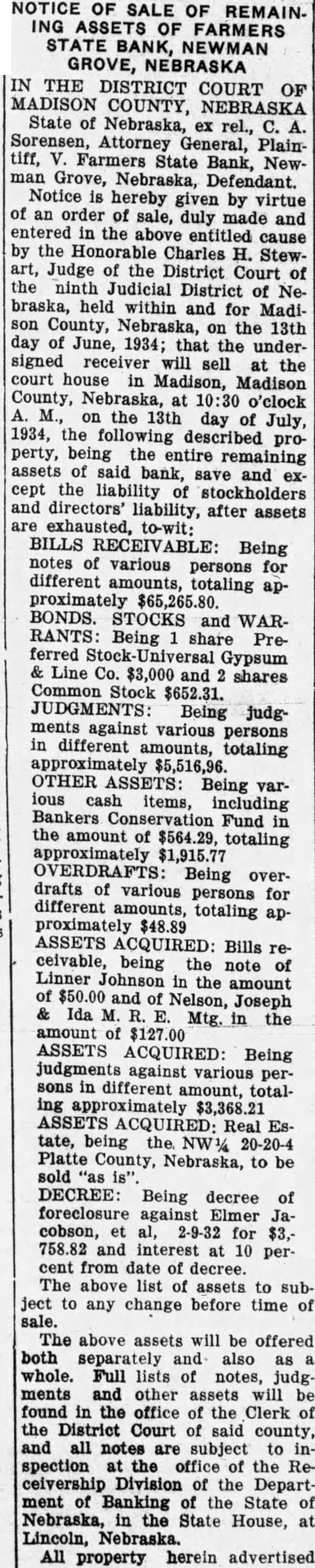
NOTICE OF SALE OF REMAINING ASSETS OF FARMERS STATE BANK, NEWMAN GROVE, NEBRASKA IN THE DISTRICT COURT OF MADISON COUNTY, State of Nebraska, ex rel., Sorensen, Attorney General, Plaintiff, Farmers State Bank, NewGrove, Nebraska, Defendant. Notice hereby given by virtue of an order of sale, duly made and entered in the above entitled cause by the Honorable Charles H. Stewart, Judge of the District Court of the ninth Judicial District of Nebraska, held within and for Madison County, Nebraska, on the 13th day of June, 1934; that the undersigned receiver will sell at the court house in Madison, Madison County, at o'clock on the 13th day of July, 1934, the described property, being the entire remaining assets said bank, save and except the liability of stockholders and directors' liability, after assets are exhausted, to-wit: BILLS Being notes of various persons different amounts, totaling approximately $65,265.80. BONDS. STOCKS and WARRANTS: Being share Preferred Gypsum Line Co. $3,000 and shares Stock $652.31. JUDGMENTS: Being judgments against various persons in different amounts, totaling approximately $5,516,96. OTHER ASSETS: Being various cash items, including Bankers Conservation Fund in the amount of totaling approximately $1,915.77 OVERDRAFTS: Being overdrafts of various persons for different amounts, totaling approximately $48.89 ASSETS ACQUIRED: Bills receivable, being the note Linner Johnson the amount of and of Nelson, Joseph Ida Mtg. the amount of ASSETS ACQUIRED: Being judgments against various persons in different amount, totaling approximately $3,368.21 ASSETS Real Estate, being the NWยฝ 20-20-4 Platte County, Nebraska, to be sold DECREE: Being decree of foreclosure against Elmer Jacobson, et al, 2-9-32 for $3, 758.82 and interest at 10 percent from date of decree. The above list of assets to subject to any change before time of sale.


Article from Newman Grove Reporter, June 27, 1934

Click image to open full size in new tab

Article Text

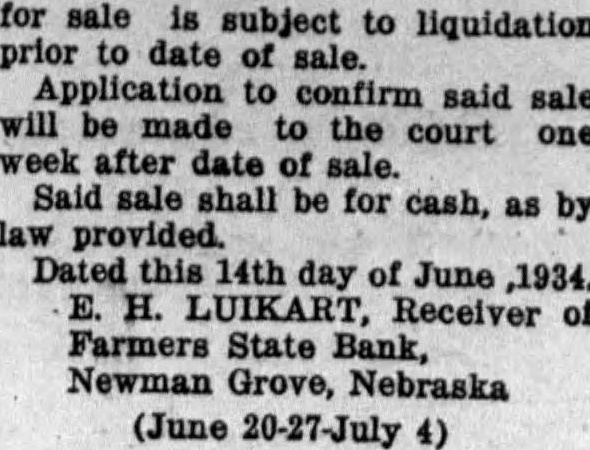
for sale is subject to liquidation prior date of sale. Application to confirm said sale will be made to the court one week after date of sale. Said sale shall be for cash, as by provided. Dated this day of June LUIKART, Receiver of Farmers State Bank, Newman Grove, Nebraska (June