First National Bank (Somersworth, NH)

Episode Information

Episode Type
Suspension → Reopening
Start Date
December 16, 1908
Location
Somersworth, New Hampshire (43.262, -70.865)
Bank Type
national
Charter Number
1180
Alt. names
Great Falls National Bank

Metadata

Events (5)

1. May 22, 1865 Chartered
Source
historical_nic
2. December 16, 1908 Suspension
Cause
Bank Specific Adverse Info
Cause Details
Discovery of an $85,000 defalcation by cashier Fred M. (Fred W./Varney) Varney; directors asked liquidation and could not make up shortage
Newspaper Excerpt
The First National Bank of Somersworth, N. H. has been closed by order of the comptroller of the currency
Source
newspapers
3. December 16, 1908 Receivership
Newspaper Excerpt
N. S. Bean appointed receiver (temporary receiver) of the First National Bank of Somersworth
Source
newspapers
4. December 24, 1908 Other
Newspaper Excerpt
receiver will issue negotiable certificates of deposit to depositors (relief measure)
Source
newspapers
5. February 8, 1909 Reopening
Newspaper Excerpt
Comptroller of the currency authorizing the reopening of the First National bank of Somersworth on Feb. 8
Source
newspapers

Newspaper Articles (21)

Article from Evening Journal, December 16, 1908

Click image to open full size in new tab

Article Text

New Hampshire Bank Closes

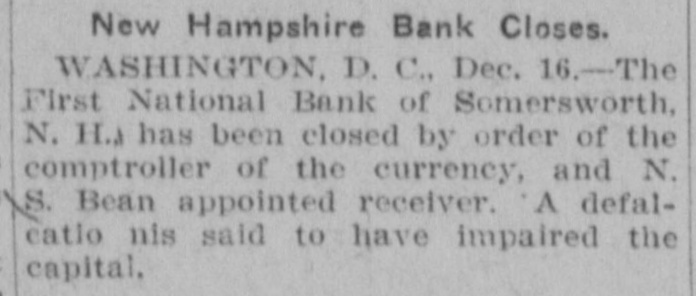
WASHINGTON, D. C., Dec. 16.-The First National Bank of Somersworth, N. H.A has been closed by order of the comptroller of the currency, and N. S. Bean appointed receiver. A defalcatlo nis said to have impaired the capital.


Article from Waterbury Evening Democrat, December 17, 1908

Click image to open full size in new tab

Article Text

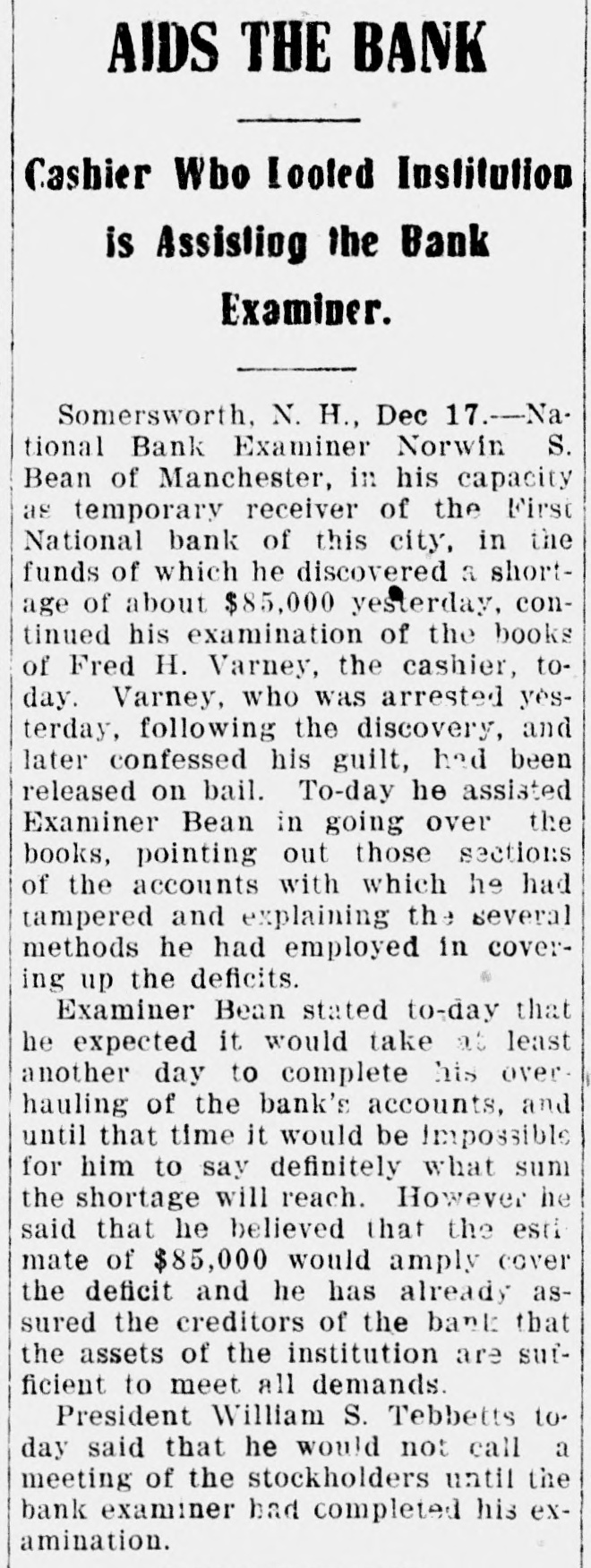
AIDS THE BANK Cashier Who Iooled Institution is Assisting the Bank Examiner. Somersworth, N. H., Dec 17.--National Bank Examiner Norwin S. Bean of Manchester, in his capacity as temporary receiver of the First National bank of this city, in the funds of which he discovered a shortage of about $85,000 yesterday, continued his examination of the books of Fred H. Varney, the cashier, today. Varney, who was arrested yesterday, following the discovery, and later confessed his guilt, had been released on bail. To-day he assisted Examiner Bean in going over the books, pointing out those sections of the accounts with which he had tampered and explaining the several methods he had employed in covering up the deficits. Examiner Bean stated to-day that he expected it would take at least another day to complete his overhauling of the bank's accounts, and until that time it would be Impossible for him to say definitely what sun the shortage will reach. However he said that he believed that the esti mate of $85,000 would amply cover the deficit and he has already assured the creditors of the bank that the assets of the institution are suificient to meet all demands. President William S. Tebbetts toa day said that he would not call meeting of the stockholders until the bank examiner bad completed his examination.


Article from Los Angeles Herald, December 17, 1908

Click image to open full size in new tab

Article Text

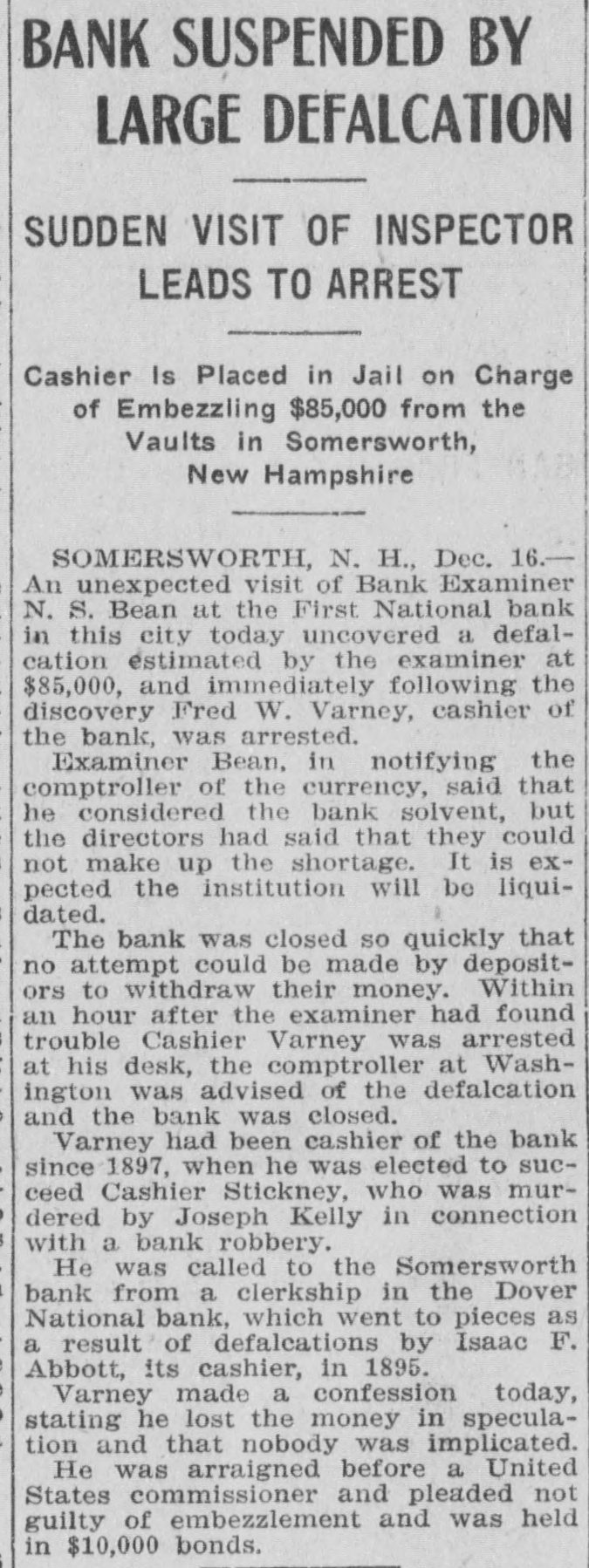
BANK SUSPENDED BY LARGE DEFALCATION SUDDEN VISIT OF INSPECTOR LEADS TO ARREST Cashier Is Placed in Jail on Charge of Embezzling $85,000 from the Vaults in Somersworth, New Hampshire SOMERSWORTH, N. H., Dec. 16.An unexpected visit of Bank Examiner N. S. Bean at the First National bank in this city today uncovered a defalcation estimated by the examiner at $85,000, and immediately following the discovery Fred W. Varney, cashier of the bank, was arrested. Examiner Bean, in notifying the comptroller of the currency, said that he considered the bank solvent, but the directors had said that they could not make up the shortage. It is expected the institution will be liquidated. The bank was closed so quickly that no attempt could be made by depositors to withdraw their money. Within an hour after the examiner had found trouble Cashier Varney was arrested at his desk, the comptroller at Washington was advised of the defalcation and the bank was closed. Varney had been cashier of the bank since 1897, when he was elected to succeed Cashier Stickney, who was murdered by Joseph Kelly in connection with a bank robbery. He was called to the Somersworth bank from a clerkship in the Dover National bank, which went to pieces as a result of defalcations by Isaac F. Abbott, its cashier, in 1895. Varney made a confession today, stating he lost the money in speculation and that nobody was implicated. He was arraigned before a United States commissioner and pleaded not guilty of embezzlement and was held in $10,000 bonds.


Article from Burlington Weekly Free Press, December 17, 1908

Click image to open full size in new tab

Article Text

BANK CASHIER A DEFAULTER First National Bank at Somers worth, N. H., Closed with $85,000 Shortage VARNEY HAS CONFESSED Has Taken Large Smins from the Bank and Lost " in Speculation--Kept Two Sets of Books but Bank Examiner Took Him by Surprise Yesterday. Summersworth N. H. Dec. 16.-The doors of the First National bank of this city were closed to-day followIng the discovery of a shortage placed at $85,000 and Fred M Varney. the cashier, was arrested on a charge of being a defaulter. The trouble was discovered by National Bank Examiner N. S. Bean of Manchester. According to W S. Tebbetts, president of the bank Verney has admitted that he took lange sums from the bank which nad been lost in speculation. He said that he alone was responsible for the defalcation which had been accumulating for the last six years Varney was given a hearing late this afternoon, He pleaded not guilty and furnished bail of $10,000 for his appearance before the United States district court at Portsmouth in March Examiner Bean regards the bank as solvent, but says that the directors declare inability to make up shortage and have requested liquidation. Late to-day Mr. Bean was appointed temporary receiver by the comptroller of the currency. The officers of the bank are: W. S. Tebbetts. president, and the following directors: W. S. Tebbetts, C. H. Wells, F. C. Bates, Charles F. Harmon, G Fred Simms. Sidney F. Stevens, and W. S. Lawson. WAS NOT A SHOWY MAN. Varney is 39 years old. He is married and has one child, a son of ten years. He is a member of many fraternal organizations and served the city two years as city treasurer. Varney did not live ostentatiously but it was known to his friends that he was deeply interested in the stock market. It is understood that Varney employed two sets of books. one of which was submitted to the bank ex. aminer on his visits to the bank and the other kept by the cashier private1y. The unexpected appearance of the examiner this week led to the disclosure of the shortage. In a statement issued late to-day, Presi dent Tebbetts said that Examiner Bear had informed him that all depositors would be paid in full. The latest statement of the finances, made in September, 1908. was as follows: Capital. $100,000; surplus, $20,256: deposits $220,244; loans and discounts. $214,937: cash


Article from New-York Tribune, December 17, 1908

Click image to open full size in new tab

Article Text

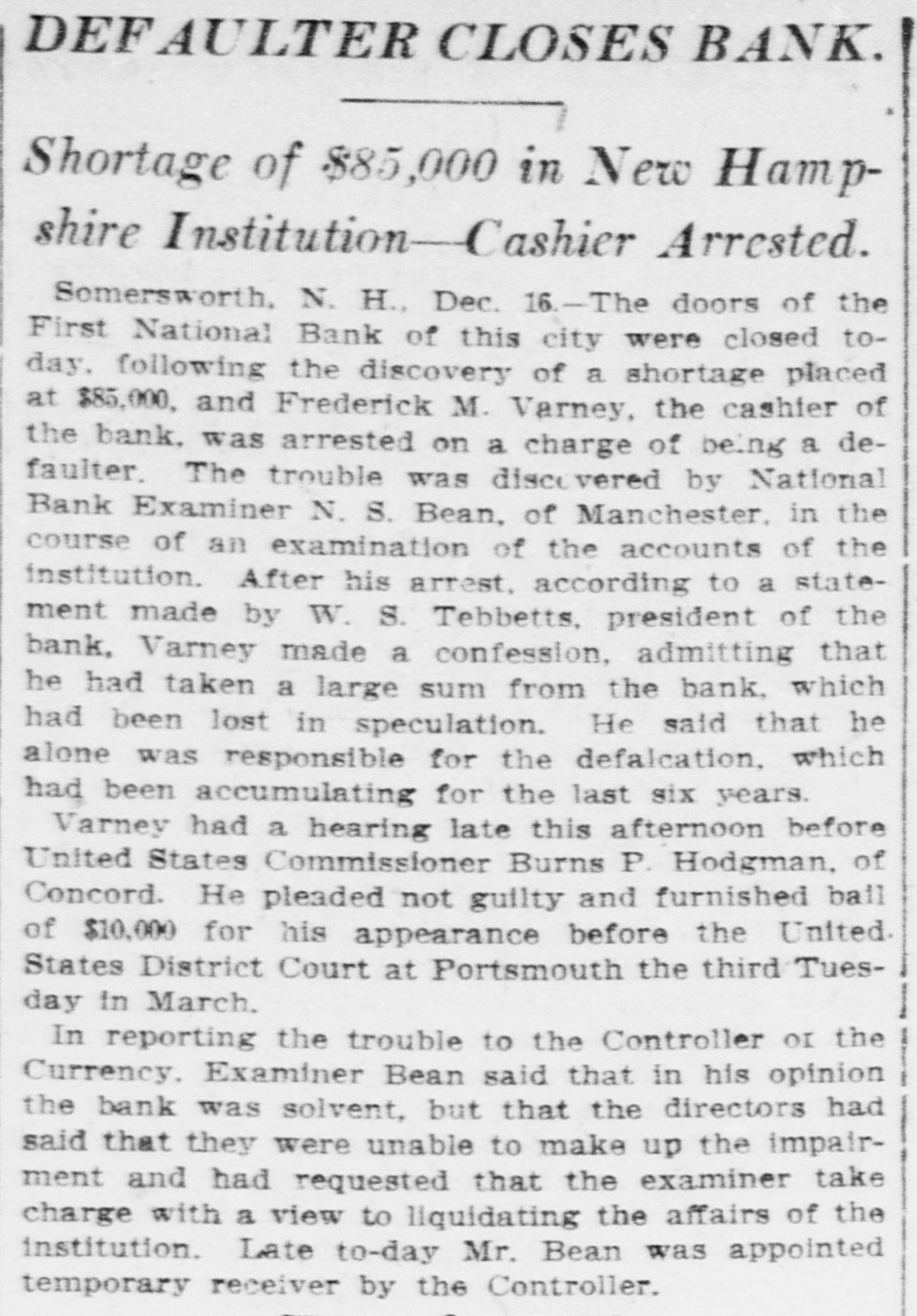
DEF AULTER CLOSES BANK

Shortage of $85,000 in New Hampshire Institution-Cashier Arrested. Somersworth, N. H., Dec. 16.-The doors of the First National Bank of this city were closed today. following the discovery of a shortage placed at $85,000. and Frederick M. Varney, the cashier of the bank. was arrested on a charge of being a defaulter. The trouble was discovered by National Bank Examiner N. S. Bean, of Manchester in the course of an examination of the accounts of the institution. After his arrest. according to a statement made by W. S. Tebbetts, president of the bank, Varney made a confession, admitting that he had taken a large sum from the bank. which had been lost in speculation. He said that he alone was responsible for the defalcation. which had been accumulating for the last six years. Varney had a hearing late this afternoon before United States Commissioner Burns P. Hodgman, of Concord. He pleaded not guilty and furnished ball of $10,000 for his appearance before the United. States District Court at Portsmouth the third Tuesday in March. In reporting the trouble to the Controller OI the Currency. Examiner Bean said that in his opinion the bank was solvent, but that the directors had said that they were unable to make up the impairment and had requested that the examiner take charge with a view to liquidating the affairs of the institution. Late to-day Mr. Bean was appointed temporary receiver by the Controller.


Article from The Roswell Daily Record, December 18, 1908

Click image to open full size in new tab

Article Text

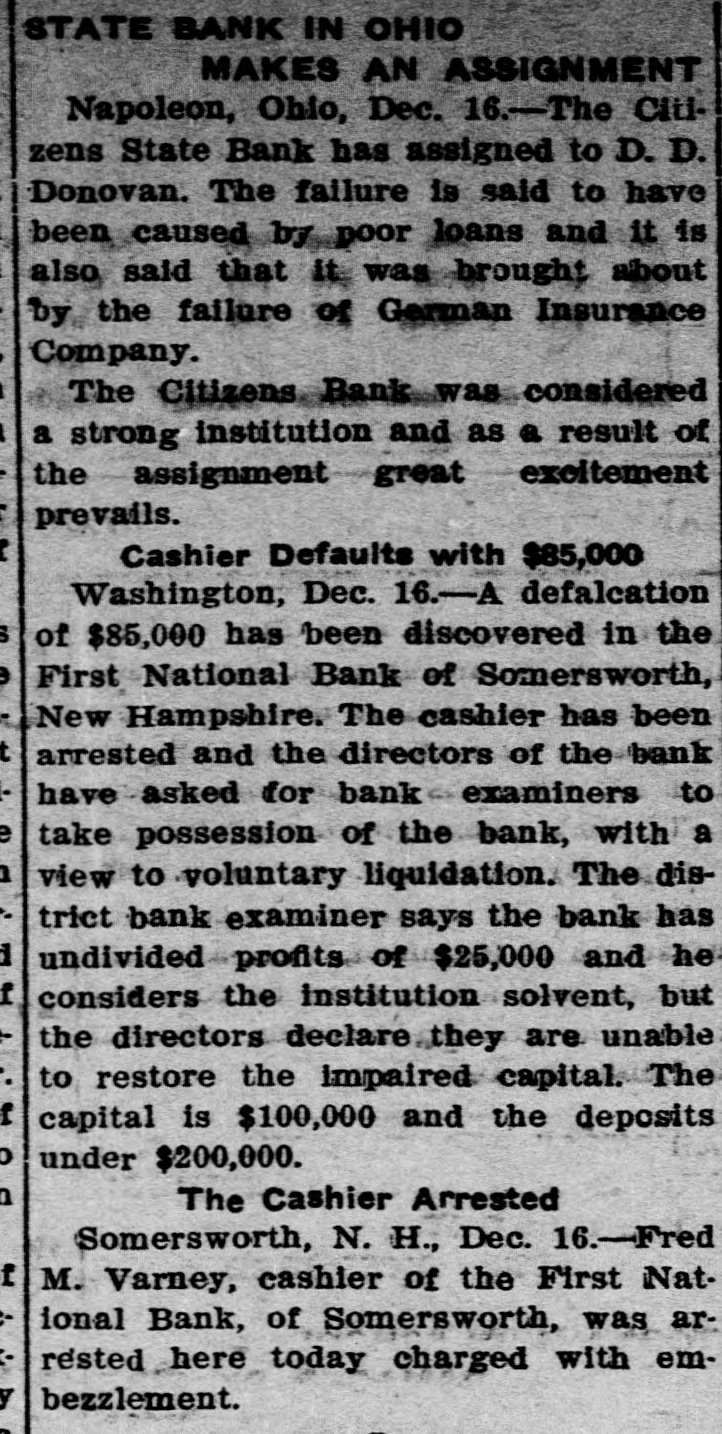
STATE BANK IN OHIO MAKES AN ASSIGNMENT Napoleon, Ohio, Dec. 16.-The Citizens State Bank has assigned to D. D. Donovan. The failure is said to have been caused by poor loans and it is also said that it was brought about by the failure of German Insurance Company. The Citizens Bank was considered a strong institution and as a result of the assignment great excitement prevails. Cashier Defaults with $85,000 Washington, Dec. 16.-A defalcation of $85,000 has been discovered in the First National Bank of Somersworth, New Hampshire. The cashier has been arrested and the directors of the bank have asked for bank examiners to take possession of the bank, with a view to voluntary liquidation. The district bank examiner says the bank has 1 undivided profits of $25,000 and he considers the institution solvent, but the directors declare they are unable to restore the impaired capital. The capital is $100,000 and the deposits under $200,000. The Cashier Arrested Somersworth, N. H., Dec. 16.-Fred f M. Varney, cashier of the First National Bank, of Somersworth, was arrested here today charged with embezzlement.


Article from The Barre Daily Times, December 18, 1908

Click image to open full size in new tab

Article Text

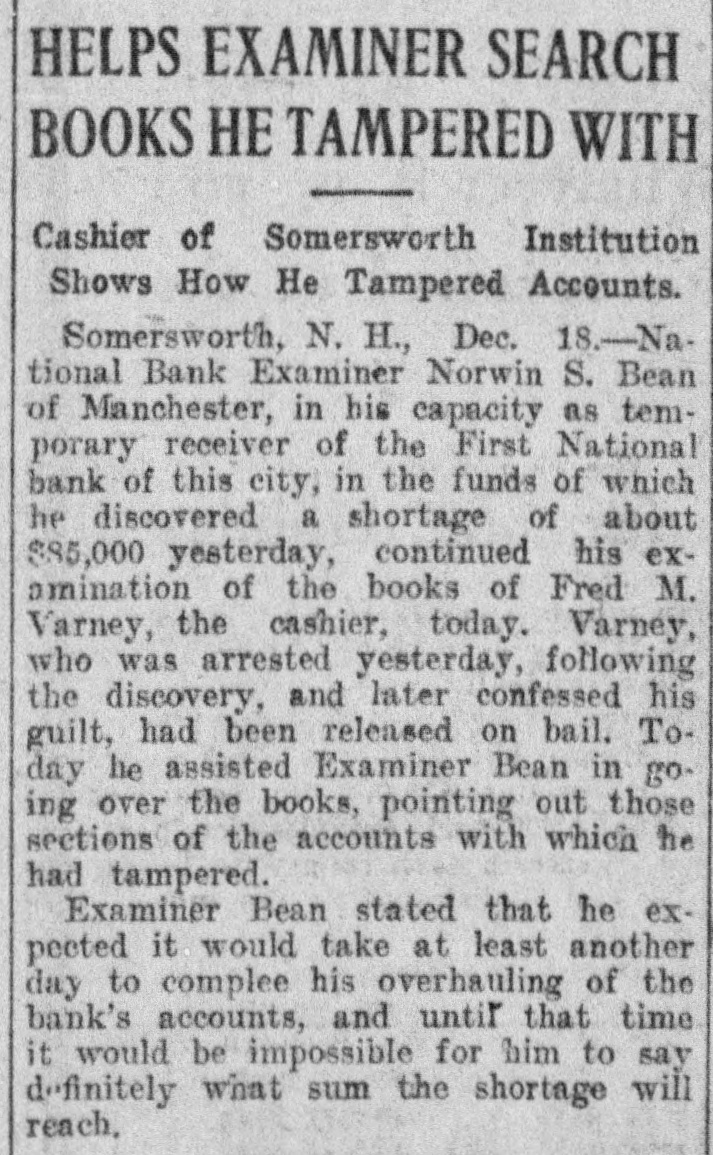
HELPS EXAMINER SEARCH BOOKS HE TAMPERED WITH Cashier of Somersworth Institution Shows How He Tampered Accounts. Somersworth, N. H., Dec. 18.-National Bank Examiner Norwin S. Bean of Manchester, in his capacity as temporary receiver of the First National bank of this city, in the funds of which he discovered a shortage of about $85,000 yesterday, continued his examination of the books of Fred M. Varney, the cashier, today. Varney, who was arrested yesterday, following the discovery, and later confessed his guilt, had been released on bail. Today he assisted Examiner Bean in going over the books, pointing out those sections of the accounts with which he had tampered. Examiner Bean stated that he expected it would take at least another day to complee his overhauling of the bank's accounts, and until that time it would be impossible for him to say definitely what sum the shortage will reach,


Article from The Barre Daily Times, December 19, 1908

Click image to open full size in new tab

Article Text

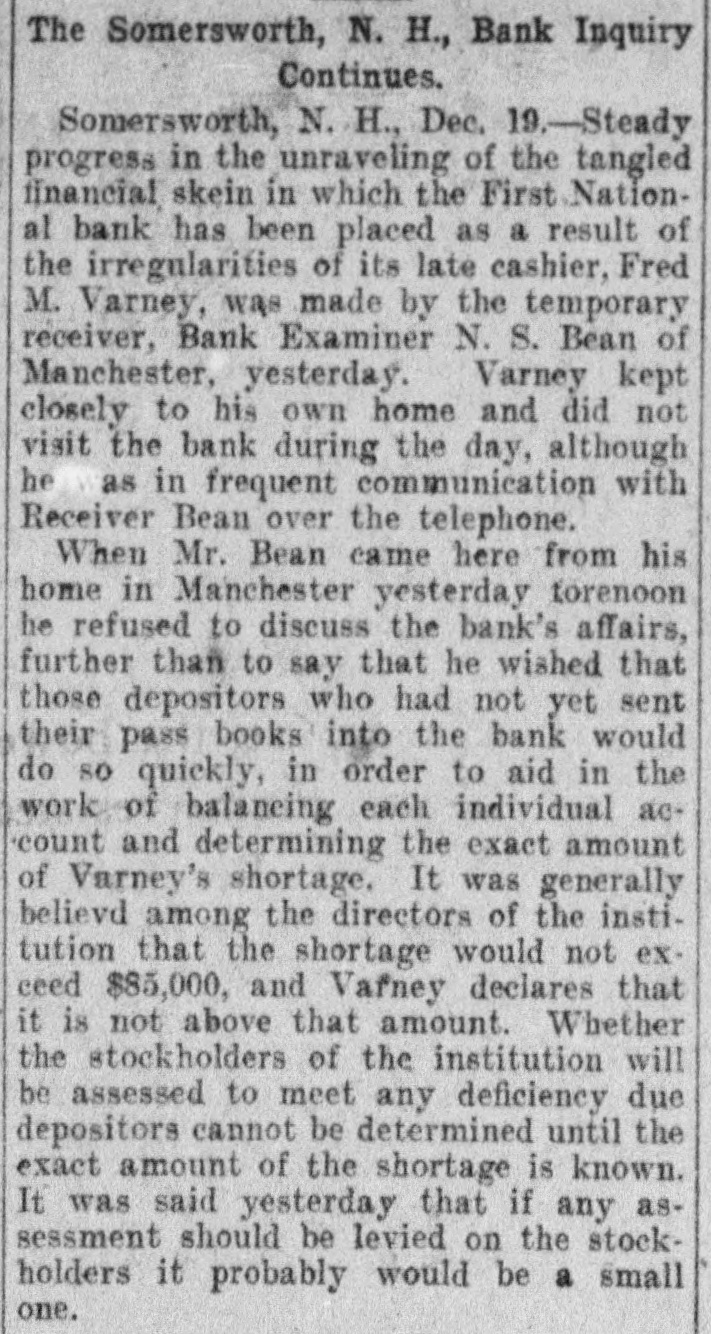
The Somersworth, N. H., Bank Inquiry Continues. Somersworth, N. H., Dec. 19.-Steady progress in the unraveling of the tangled financial skein in which the First National bank has been placed as a result of the irregularities of its late cashier, Fred M. Varney, was made by the temporary receiver, Bank Examiner N. S. Bean of Manchester, yesterday. Varney kept closely to his own home and did not visit the bank during the day, although he as in frequent communication with Receiver Bean over the telephone. When Mr. Bean came here from his home in Manchester yesterday torenoon he refused to discuss the bank's affairs, further than to say that he wished that those depositors who had not yet sent their pass books into the bank would do so quickly, in order to aid in the work of balancing each individual account and determining the exact amount of Varney's shortage. It was generally believd among the directors of the institution that the shortage would not exceed $85,000, and Varney declares that it is not above that amount. Whether the stockholders of the institution will be assessed to meet any deficiency due depositors cannot be determined until the exact amount of the shortage is known. It was said yesterday that if any assessment should be levied on the stockholders it probably would be a small one.


Article from The Barre Daily Times, December 22, 1908

Click image to open full size in new tab

Article Text

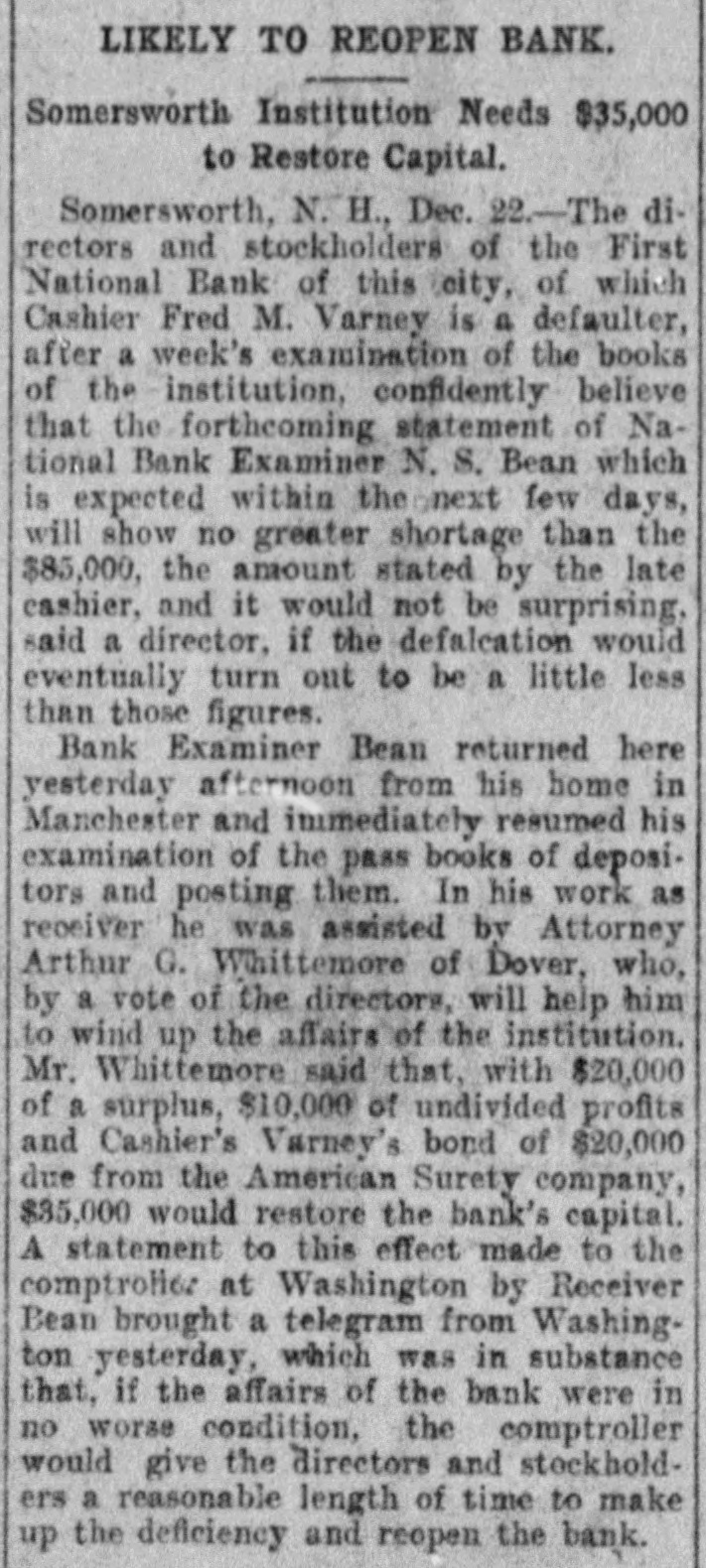
LIKELY TO REOPEN BANK

Somersworth Institution Needs $35,000 to Restore Capital. Somersworth, N. H., Dec. 22.-The directors and stockholders of the First National Bank of this city, of which Cashier Fred M. Varney is n defaulter, after a week's examination of the books of the institution, confidently believe that the forthcoming statement of National Bank Examiner N. S. Bean which is expected within the next few days, will show no greater shortage than the $85,000, the amount stated by the late cashier, and it would not be surprising. said a director, if the defalcation would eventually turn out to be a little less than those figures. Bank Examiner Bean returned here yesterday afternoon from his home in Manchester and immediately resumed his examination of the pass books of depositors and posting them. In his work as receiver he was assisted by Attorney Arthur G. Whittemore of Dover, who, by a vote of the directors, will help him to wind up the affairs of the institution. Mr. Whittemore said that, with $20,000 of a surplus, $10,000 of undivided profits and Cashier's Varney's bond of $20,000 due from the American Surety company, $85,000 would restore the bank's capital. A statement to this effect made to the comptroller at Washington by Receiver Bean brought a telegram from Washington yesterday, which was in substance that, if the affairs of the bank were in no worse condition, the comptroller would give the directors and stockholders a reasonable length of time to make up the deficiency and reopen the bank.


Article from Daily Kennebec Journal, December 25, 1908

Click image to open full size in new tab

Article Text

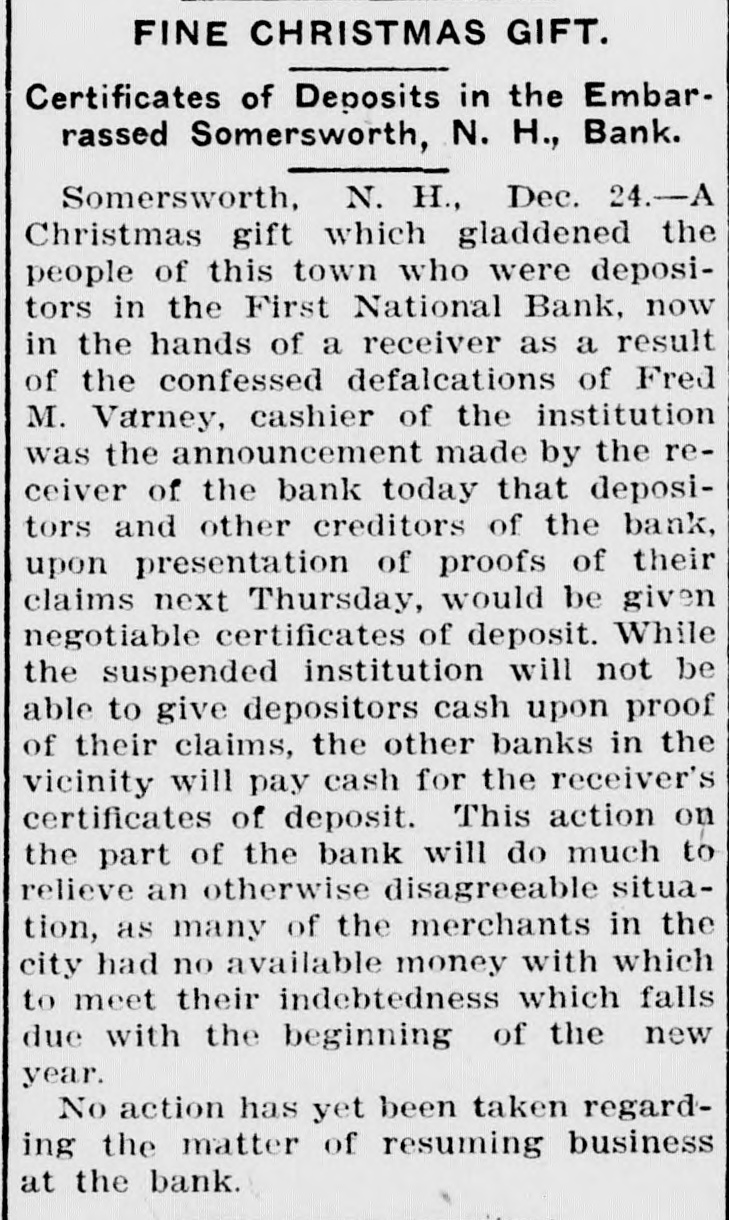
FINE CHRISTMAS GIFT

Certificates of Deposits in the Embarrassed Somersworth, N. H., Bank. Somersworth, N. H., Dec. 24.-A Christmas gift which gladdened the people of this town who were depositors in the First National Bank, now in the hands of a receiver as a result of the confessed defalcations of Fred M. Varney, cashier of the institution was the announcement made by the receiver of the bank today that depositors and other creditors of the bank, upon presentation of proofs of their claims next Thursday, would be given negotiable certificates of deposit. While the suspended institution will not be able to give depositors cash upon proof of their claims, the other banks in the vicinity will pay cash for the receiver's certificates of deposit. This action on the part of the bank will do much to relieve an otherwise disagreeable situation, as many of the merchants in the city had no available money with which to meet their indebtedness which falls due with the beginning of the new year. No action has yet been taken regarding the matter of resuming business at the bank.


Article from Daily Kennebec Journal, December 30, 1908

Click image to open full size in new tab

Article Text

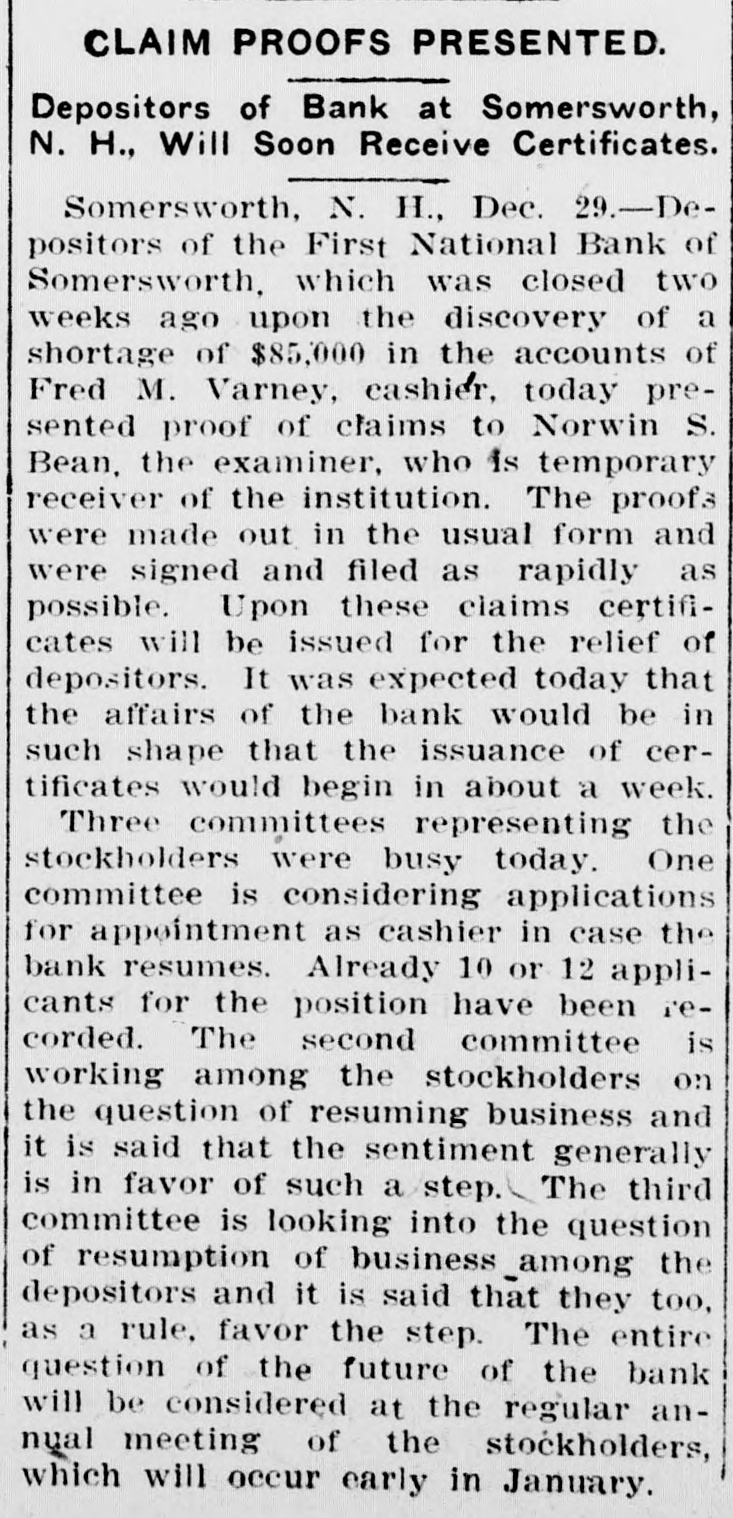
CLAIM PROOFS PRESENTED

Depositors of Bank at Somersworth, N. H., Will Soon Receive Certificates. Somersworth, N. H., Dec. 29. - Depositors of the First National Bank of Somersworth, which was closed two weeks ago upon the discovery of a shortage of $85,000 in the accounts of Fred M. Varney, cashier, today presented proof of claims to Norwin S. Bean, the examiner, who is temporary receiver of the institution. The proofs were made out in the usual form and were signed and filed as rapidly as possible. Upon these claims certificates will be issued for the relief of depositors. It was expected today that the affairs of the bank would be in such shape that the issuance of certificates would begin in about a week. Three committees representing the stockholders were busy today. One committee is considering applications for appointment as cashier in case the bank resumes. Already 10 or 12 applicants for the position have been recorded. The second committee is working among the stockholders on the question of resuming business and it is said that the sentiment generally is in favor of such a step. The third committee is looking into the question of resumption of business among the depositors and it is said that they too, as a rule. favor the step. The entire question of the future of the bank will be considered at the regular annual meeting of the stockholders, which will occur early in January.


Article from Washington Telegraph, January 8, 1909

Click image to open full size in new tab

Article Text

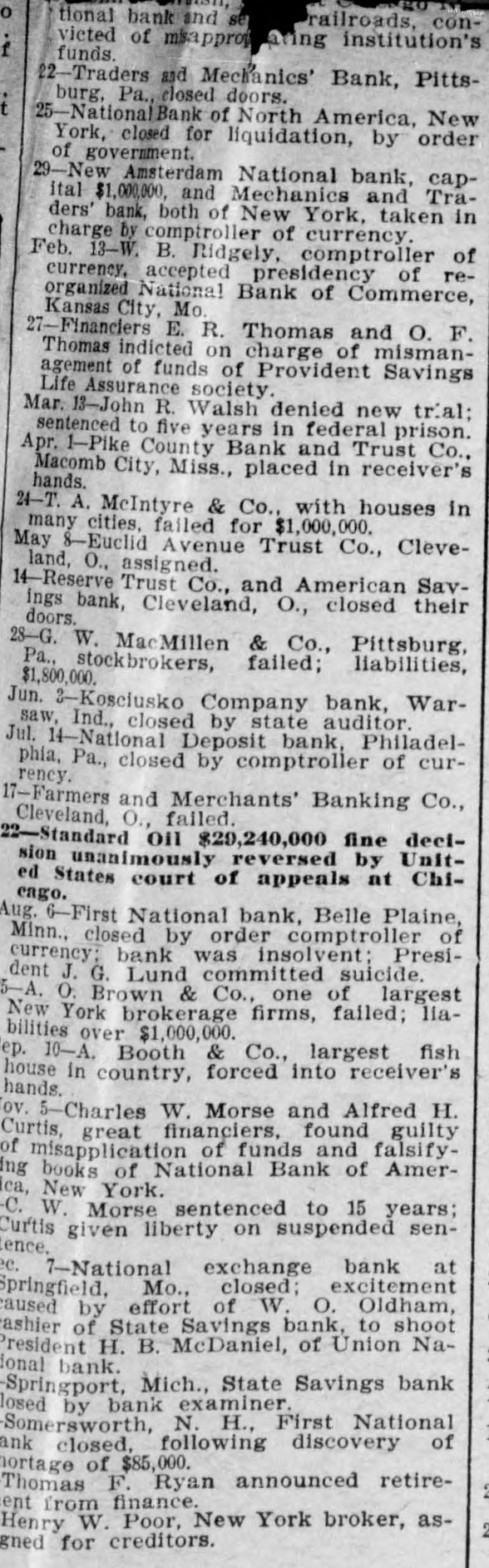
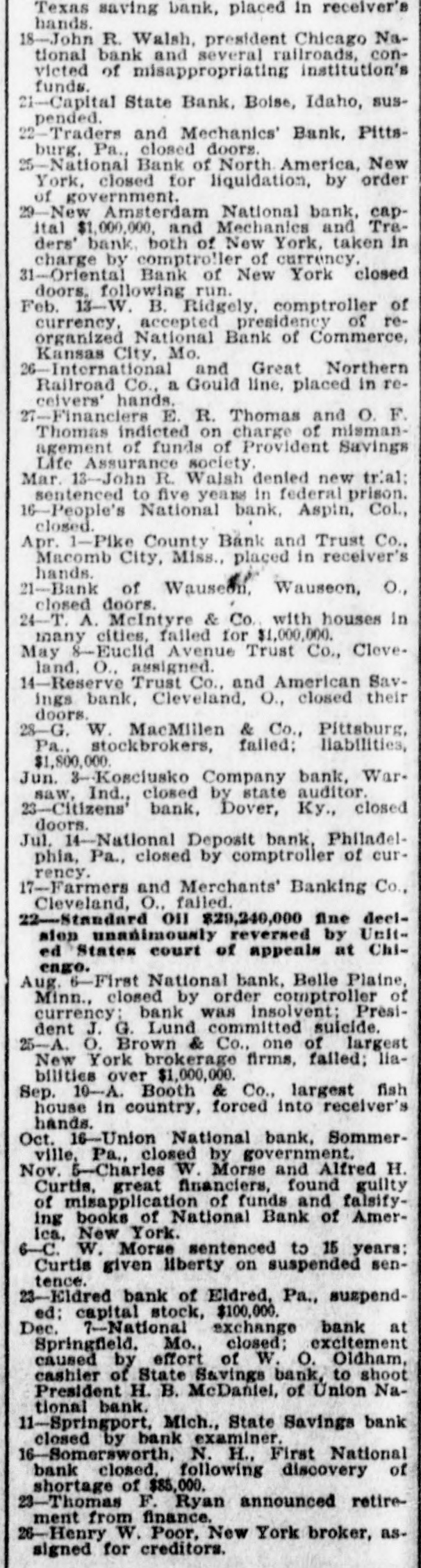
o tional bank and se railroads, convicted of msapprop aring institution's f funds. 22-Traders and Mechanics' Bank, Pittsburg, Pa. closed doors. t 25-NationalBank of North America, New York, closed for liquidation, by order of government. 29-New Amsterdam National bank, capital $1,000,000, and Mechanics and Traders' bank, both of New York, taken in charge by comptroller of currency. Feb. of 13-W. B. Ridgely, comptroller currency, accepted presidency of reorganized National Bank of Commerce, Kansas City, Mo. 27-Financiers E. R. Thomas and O. F. Thomas indicted on charge of mismanagement of funds of Provident Savings Life Assurance society. Mar. 13-John R. Walsh denied new trial; sentenced to five years in federal prison. Apr. 1-Pike County Bank and Trust Co., Macomb City, Miss., placed in receiver's hands. 24-T. A. McIntyre & Co., with houses in many cities, failed for $1,000,000. May 8-Euclid Avenue Trust Co., Cleveland, O., assigned. 14-Reserve Trust Co., and American Savings bank, Cleveland, O., closed their doors. 28-G. W. MacMillen & Co., Pittsburg, Pa., stockbrokers, failed; liabilities, $1,800,000. Jun. 3-Kosciusko Company bank, Warsaw, Ind., closed by state auditor. Jul. 14-National Deposit bank, Philadelphia, Pa., closed by comptroller of currency. 17-Farmers and Merchants' Banking Co., Cleveland, O., failed. 22-Standard Oil $29,240,000 fine decision unanimously reversed by United States court of appeals at Chicago. Aug. 6-First National bank, Belle Plaine, Minn., closed by order comptroller of currency; bank was insolvent; President J. G. Lund committed suicide. 5-A. O. Brown & Co., one of largest New York brokerage firms, failed; liabilities over $1,000,000. ep. 10-A. Booth & Co., largest fish house in country, forced into receiver's hands. OV. 5-Charles W. Morse and Alfred H. Curtis, great financiers, found guilty of misapplication of funds and falsifying books of National Bank of AmerIca, New York. -C. W. Morse sentenced to 15 years; Curtis given liberty on suspended senlence. ec. 7-National exchange bank at Springfield, Mo., closed; excitement aused by effort of W. O. Oldham, ashier of State Savings bank, to shoot President H. B. McDaniel, of Union Nadonal bank. Springport, Mich., State Savings bank losed by bank examiner. Somersworth, N. H., First National ank closed, following discovery of hortage of $85,000. Thomas F. Ryan announced retire2 ent from finance. Henry W. Poor, New York broker, as2 gned for creditors.


Article from The Farmington Times, January 8, 1909

Click image to open full size in new tab

Article Text

Texas saving bank, placed in receiver's hands. 18—John R. Walsh, president Chicago National bank and several railroads, convicted of misappropriating institution's funds. 21—Capital State Bank, Boise, Idaho, suspended. 22—Traders and Mechanics' Bank, Pittsburg, Pa., closed doors. 25—National Bank of North America, New York, closed for liquidation, by order of government. 29—New Amsterdam National bank, capital $1,000,000, and Mechanics and Traders' bank, both of New York, taken in charge by comptroller of currency. 31—Oriental Bank of New York closed doors, following run. Feb. 13—W. B. Ridgely, comptroller of currency, accepted presidency of reorganized National Bank of Commerce, Kansas City, Mo. 26—International and Great Northern Railroad Co., a Gould line, placed in receivers' hands. 27—Financiers E. R. Thomas and O. F. Thomas indicted on charge of mismanagement of funds of Provident Savings Life Assurance society. Mar. 13—John R. Walsh denied new trial; sentenced to five years in federal prison. 16—People's National bank, Aspin, Col., closed. Apr. 1—Pike County Bank and Trust Co., Macomb City, Miss., placed in receiver's hands. 21—Bank of Wauseon, Wauseon, O., closed doors. 24—T. A. McIntyre & Co., with houses in many cities, failed for $1,000,000. May 8—Euclid Avenue Trust Co., Cleveland, O., assigned. 14—Reserve Trust Co., and American Savings bank, Cleveland, O., closed their doors. 28—G. W. MacMillen & Co., Pittsburg, Pa., stockbrokers, failed; liabilities, $1,800,000. Jun. 3—Kosciusko Company bank, Warsaw, Ind., closed by state auditor. 23—Citizens' bank, Dover, Ky., closed doors. Jul. 14—National Deposit bank, Philadelphia, Pa., closed by comptroller of currency. 17—Farmers and Merchants' Banking Co., Cleveland, O., failed. 22—Standard Oil $29,240,000 fine decision unanimously reversed by United States court of appeals at Chicago. Aug. 6—First National bank, Belle Plaine, Minn., closed by order comptroller of currency; bank was insolvent; President J. G. Lund committed suicide. 25—A. O. Brown & Co., one of largest New York brokerage firms, failed; liabilities over $1,000,000. Sep. 10—A. Booth & Co., largest fish house in country, forced into receiver's hands. Oct. 16—Union National bank, Sommerville, Pa., closed by government. Nov. 5—Charles W. Morse and Alfred H. Curtis, great financiers, found guilty of misapplication of funds and falsifying books of National Bank of America, New York. 6—C. W. Morse sentenced to 15 years; Curtis given liberty on suspended sentence. 23—Eldred bank of Eldred, Pa., suspended; capital stock, $100,000. Dec. 7—National exchange bank at Springfield, Mo., closed; excitement caused by effort of W. O. Oldham, cashier of State Savings bank, to shoot President H. B. McDaniel, of Union National bank. 11—Springport, Mich., State Savings bank closed by bank examiner. 16—Somersworth, N. H., First National bank closed, following discovery of shortage of $85,000. 23—Thomas F. Ryan announced retirement from finance. 26—Henry W. Poor, New York broker, assigned for creditors.
Article from Daily Kennebec Journal, January 12, 1909

Click image to open full size in new tab

Article Text

CONDENSED DISPATCHES

An edict issued Monday at Pekin approves the measures already inaugurated by which the department of finance is to organize and control the financial affairs of the various provinces with the object ultimately of establishing provincial and national budgets. Lady William Beresford, who was Lillian Warren Price. daughter of the late Commodore Price, U. S. N., of New York, died Monday in London. She had been ill for some months past and her death was not unexpected. Lady Beresford's first husband was Louis Hammersly of New York. After his death she married in 1888 the eighth duke of Marlborough, who died in 1892. She was consequently known for a time as the Dowager Duchess of Marlborough. Her third husband was Lord William Leslie De La Poor Beresford, who died in 1900. A. Holland Forbes of New York, vice president of the Aero Club of America, and N. H. Arnold of North Adams, Mass., were at St. Louis Monday viewing the various sites deemed adequate for the purpose of inflating the balloons entered in the first annual race to be held during the first week of June. Although several cities are making efforts to get the race, Mr. Forbes admitted St. Louis and Indianapolis are practically the only ones in the running. The receivers of the Arnold Print Works and its subsidiary corporations, appointed by Judge Lowell in the United States circuit court in Boston Nov. 7, 1907, were discharged Monday in the same court, the property and linances having been adjusted and turned over to a creditor's committee. The receivers were Henry E. Warner and James J. Storrow of Boston and W. Murray Crane of Dalton. Mr. Warner was paid $50,000 for his services, but the other two receivers refused to accept any remuneration for their services. Having received a favorable reply from the holders of 800 out of 1000 shares of the stock of the First National Bank of Somersworth, N. H.. whose cashier, Fred W. Varney, had a shortage of $85,000 to the proposed voluntary contribution of $35 a share, a second notice was mailed today to the holders of the remaining shares asking them to join in the contribution in order that the bank might resume business. It was pointed out to these stockholders that every day's delay meant an added expense as all the depositors are receiving interest on their deposits. The bank officers have 20 applicants for the position of cashier.


Article from The Bridgeport Evening Farmer, January 23, 1909

Click image to open full size in new tab

Article Text

STOCKHOLDERS MUST PAY $35 (Special from United Press.) Somersworth, N. H., Jan. 23.-Natioral Bank Examiner Bean, temporary receiver of the First National Bank which was closed December 15, last, upon the discovery of the defalcation by Cashier Varney amounting to $85,000, has begun the collection of the assessment of $35 a share necessary to sustain the impaired capital of the institution. It is believed that by February 1 a large part of the $35,000 required will have been turned in by the stockholders. The bank will then resume business.


Article from Norwich Bulletin, February 5, 1909

Click image to open full size in new tab

Article Text

First National Bank of Somersworth to Reopen Next Week. Somersworth, N. H., Feb. 4.-The reopening of the First National bank of Somersworth some time next week is assured, according to a statement issued by the directors of the institution late today. Temporary Receiver N. S. Bean today telegraphed to the comptroller of the currency at Washington notifying him that the impairment of $85,000,000 in the bank's capital. caused by the alleged defalcation of its cashier, Fred M. Varney, had been made good and asking formal permission to reopen the bank.


Article from The Barre Daily Times, February 5, 1909

Click image to open full size in new tab

Article Text

DEFALCATION MADE GOOD

Permission to Reopen Somersworth Bank is Now Asked For. Somersworth, N. H., Feb. 5.-The re opening of the First Nationatl bank of Somersworth, sometime next week, is assured, according tc a statement issned by the directors of the institution late yesterday. Temporary Receiver Norwin S. Bean, telegraphed to the comptroller of the currency at Washington notifying him that the impairment of $85,000 in the bank's capital caused by the alleged defalcation of its cashier, Fred M. Varney, has been made good and asking formal permission to reopen the bank. Of the total impairment $35,000 was restored by assessments of the stockholders, Melvin L. Stevens, formerly in the office of the treasurer of the Boston & Maine railroad in Boston, wil be the new cashier.


Article from Daily Kennebec Journal, February 6, 1909

Click image to open full size in new tab

Article Text

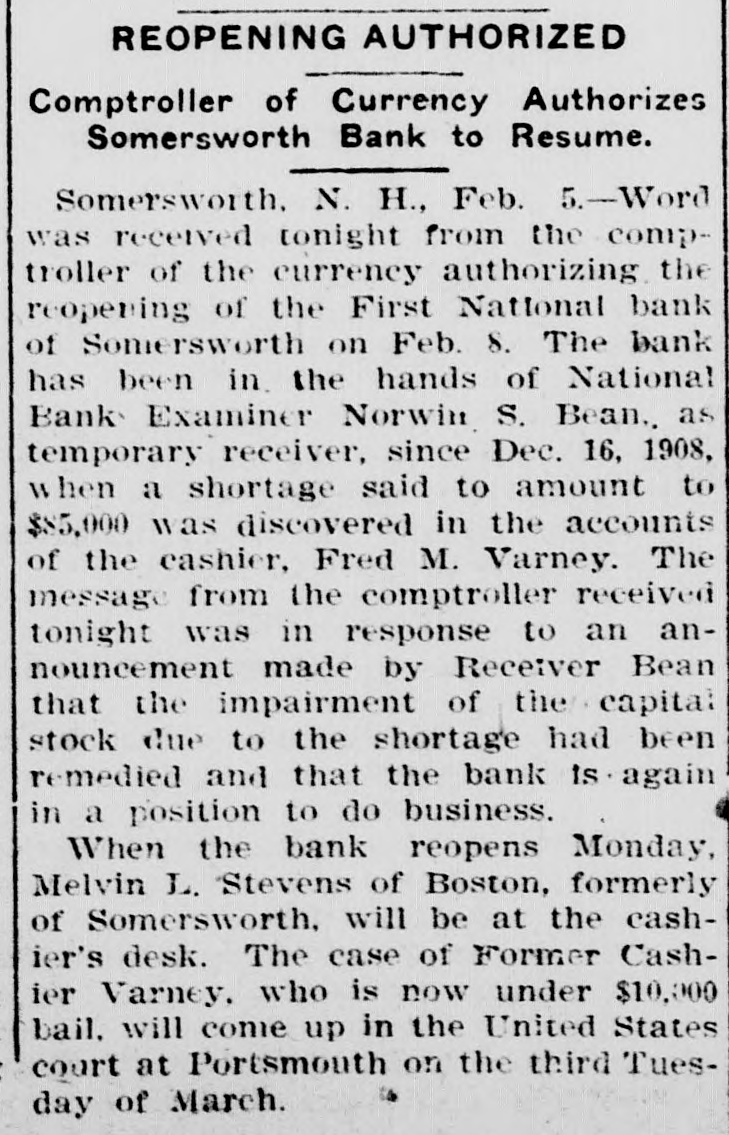
REOPENING AUTHORIZED Comptroller of Currency Authorizes Somersworth Bank to Resume. Somersworth. N. H., Feb. 5.-Word was received tonight from the comptroller of the currency authorizing the reopening of the First National bank of Somersworth on Feb. 8. The bank has been in. the hands of National Bank Examiner Norwin S. Bean., as temporary receiver, since Dec. 16, 1908, when a shortage said to amount to $85,000 was discovered in the accounts of the cashier, Fred M. Varney. The message from the comptroller received tonight was in response to an announcement made by Receiver Bean that the impairment of the capital stock due to the shortage had been remedied and that the bank is again in a position to do business. When the bank reopens Monday, Melvin L. Stevens of Boston, formerly of Somersworth. will be at the cashier's desk. The case of Former Cashier Varney, who is now under $10,000 bail. will come up in the United States court at Portsmouth on the third Tuesday of March.


Article from Evening Star, February 7, 1909

Click image to open full size in new tab

Article Text

New Hampshire Bank to Reopen

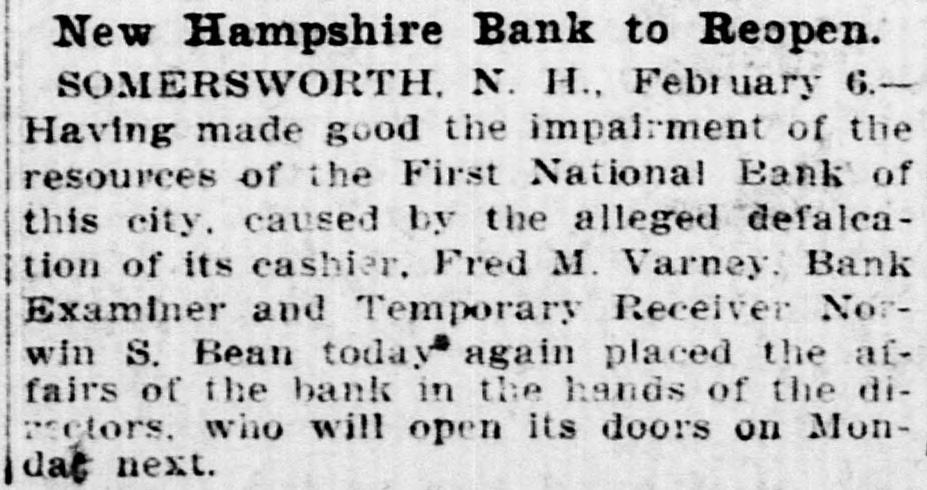
SOMERSWORTH. N. H., February 6.Having made good the impairment of the resources of the First National Bank of this city, caused by the alleged defalcation of its cashier. Fred M. Varney. Bank Examiner and Temporary Receiver Norwin S. Bean today again placed the atfairs of the bank in the hands of the directors. who will open its doors on Mondat next.


Article from Daily Kennebec Journal, February 9, 1909

Click image to open full size in new tab

Article Text

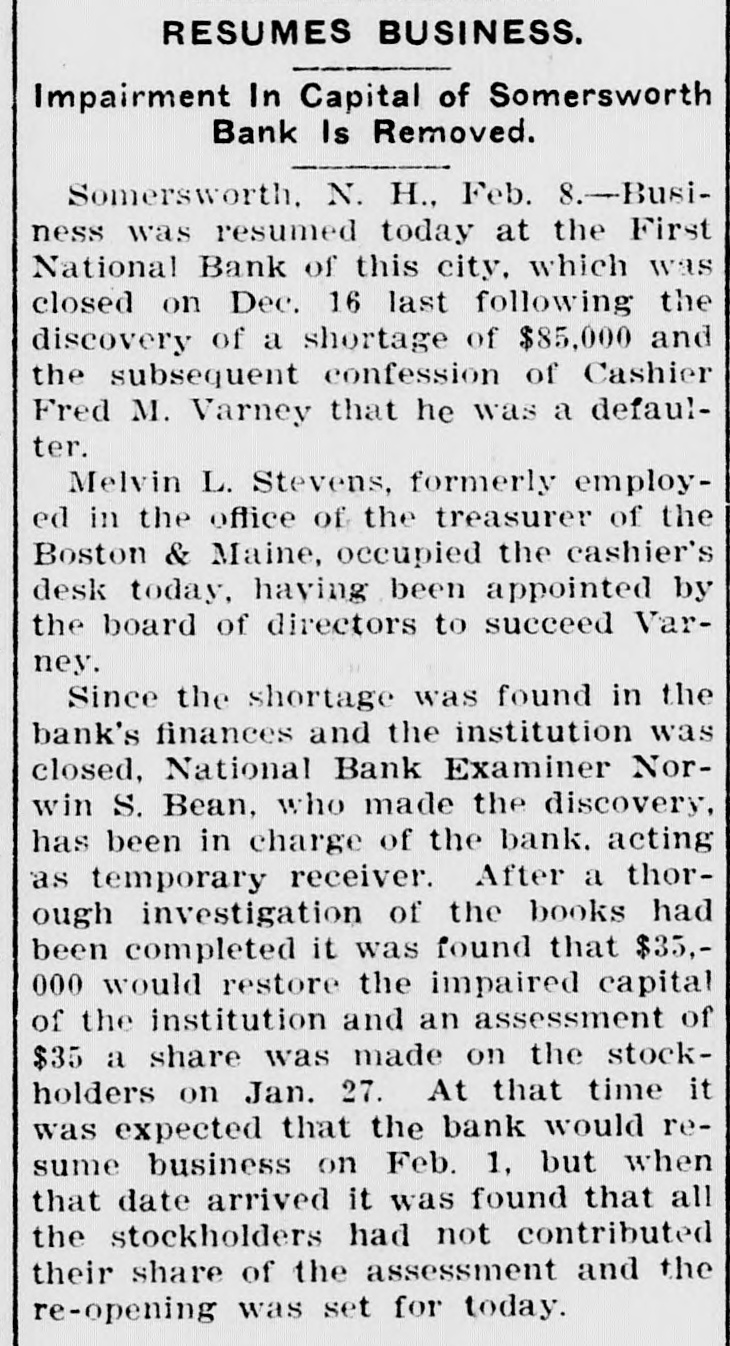
RESUMES BUSINESS

Impairment In Capital of Somersworth Bank Is Removed. Somersworth, N. H., Feb. 8.-Business was resumed today at the First National Bank of this city, which was closed on Dec. 16 last following the discovery of a shortage of $85,000 and the subsequent confession of Cashier Fred M. Varney that he was a defaulter. Melvin L. Stevens, formerly employed in the office of the treasurer of the Boston & Maine, occupied the cashier's desk today, having been appointed by the board of directors to succeed Varney. Since the shortage was found in the bank's finances and the institution was closed, National Bank Examiner Norwin S. Bean, who made the discovery, has been in charge of the bank. acting as temporary receiver. After a thorough investigation of the books had been completed it was found that $35,000 would restore the impaired capital of the institution and an assessment of $35 a share was made on the stockholders on Jan. 27. At that time it was expected that the bank would resume business on Feb. 1, but when that date arrived it was found that all the stockholders had not contributed their share of the assessment and the re-opening was set for today.


Article from The Barre Daily Times, February 10, 1909

Click image to open full size in new tab

Article Text

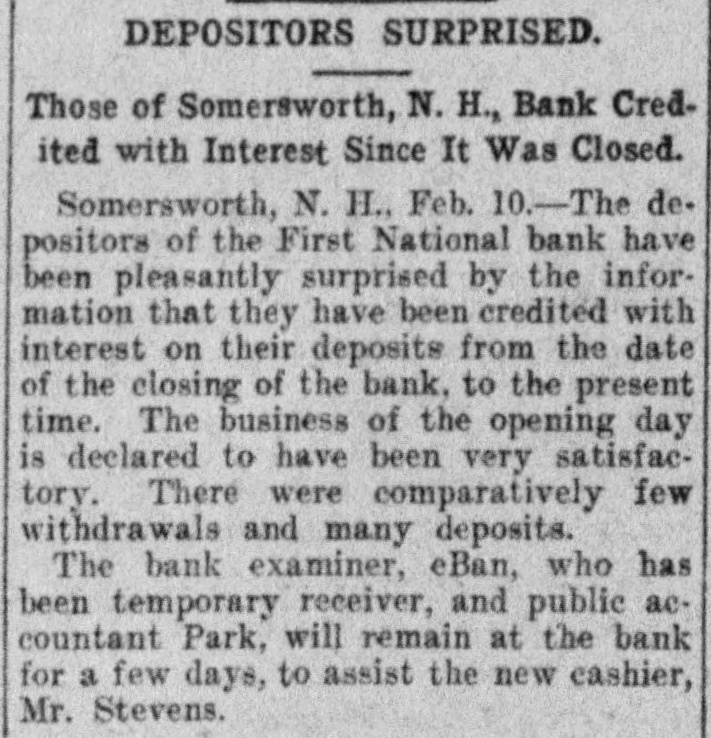
DEPOSITORS SURPRISED

Those of Somersworth, N. H., Bank Credited with Interest Since It Was Closed. Somersworth, N. H., Feb. 10.-The depositors of the First National bank have been pleasantly surprised by the information that they have been credited with interest on their deposits from the date of the closing of the bank, to the present time. The business of the opening day is declared to have been very satisfactory. There were comparatively few withdrawals and many deposits. The bank examiner, eBan, who has been temporary receiver, and public accountant Park, will remain at the bank for a few days, to assist the new cashier, Mr. Stevens.