B. K. Jamison & Company (Philadelphia, PA)

Episode Information

Episode UID
1161482591091
Episode Type
Suspension β†’ Reopening
Bank Type
private
Bank ID
116148259 hash
Start Date
November 28, 1890
Location
Philadelphia, Pennsylvania (39.952, -75.164)

Metadata

Model
gpt-5-mini (chosen from majority vote of a three-model LLM ensemble)
Short Digest
2c7e7565b1c18c20

Response Measures

None

Description

Assignee name appears as Samuel J. (or Justin/Gustave) Thompson in various reports (OCR variations).

Events (3)

1. November 28, 1890 Other
Newspaper Excerpt
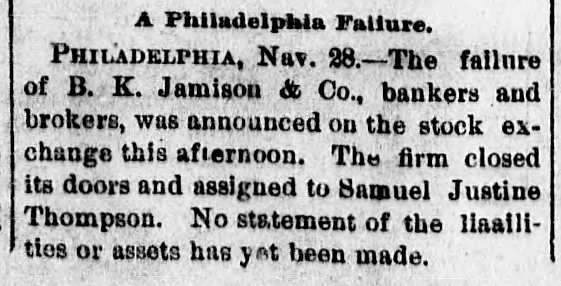
The firm closed its doors and made an assignment to Samuel J. Thompson.
Source
newspapers
2. November 28, 1890 Suspension
Cause
Bank Specific Adverse Info
Cause Details
Unable to realize upon assets after heavy investments in unproductive land/enterprises and money-market stringency; correspondent banks called in deposits hastening suspension.
Newspaper Excerpt
The firm closed its doors and made an assignment to Samuel J. Thompson. The suspension resulted from the failure of the firm to realize upon its assets.
Source
newspapers
3. December 26, 1890 Other
Newspaper Excerpt
Barker Brothers & Co. and B. K. Jamison & Co., bankers, ... are expected to resume and pay dollar for dollar.
Source
newspapers

Newspaper Articles (18)

Article from The Wheeling Daily Intelligencer, November 29, 1890

Click image to open full size in new tab

Article Text

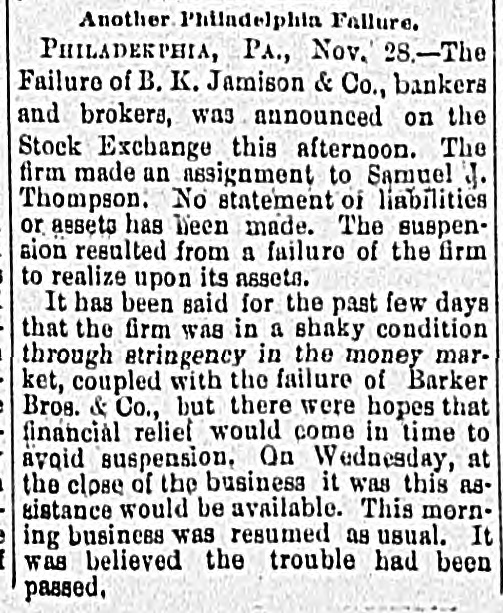
Another Philadelphia Failure. PHILADEKPHIA, PA., Nov. 28.-The Failure of B. K. Jamison & Co., bankers and brokers, was announced on the Stock Exchange this afternoon. The firm made an assignment to Samuel J. Thompson. No statement of liabilities or assets has been made. The suspension resulted from a failure of the firm to realize upon its assets. It has been said for the past few days that the firm was in a shaky condition through stringency in the money market, coupled with the failure of Barker Bros. & Co., but there were hopes that financial relief would come in time to avoid suspension, On Wednesday, at the close of the business it was this asaistance would be available. This morning business was resumed as usual. It was believed the trouble had been passed,


Article from The Roanoke Times, November 29, 1890

Click image to open full size in new tab

Article Text

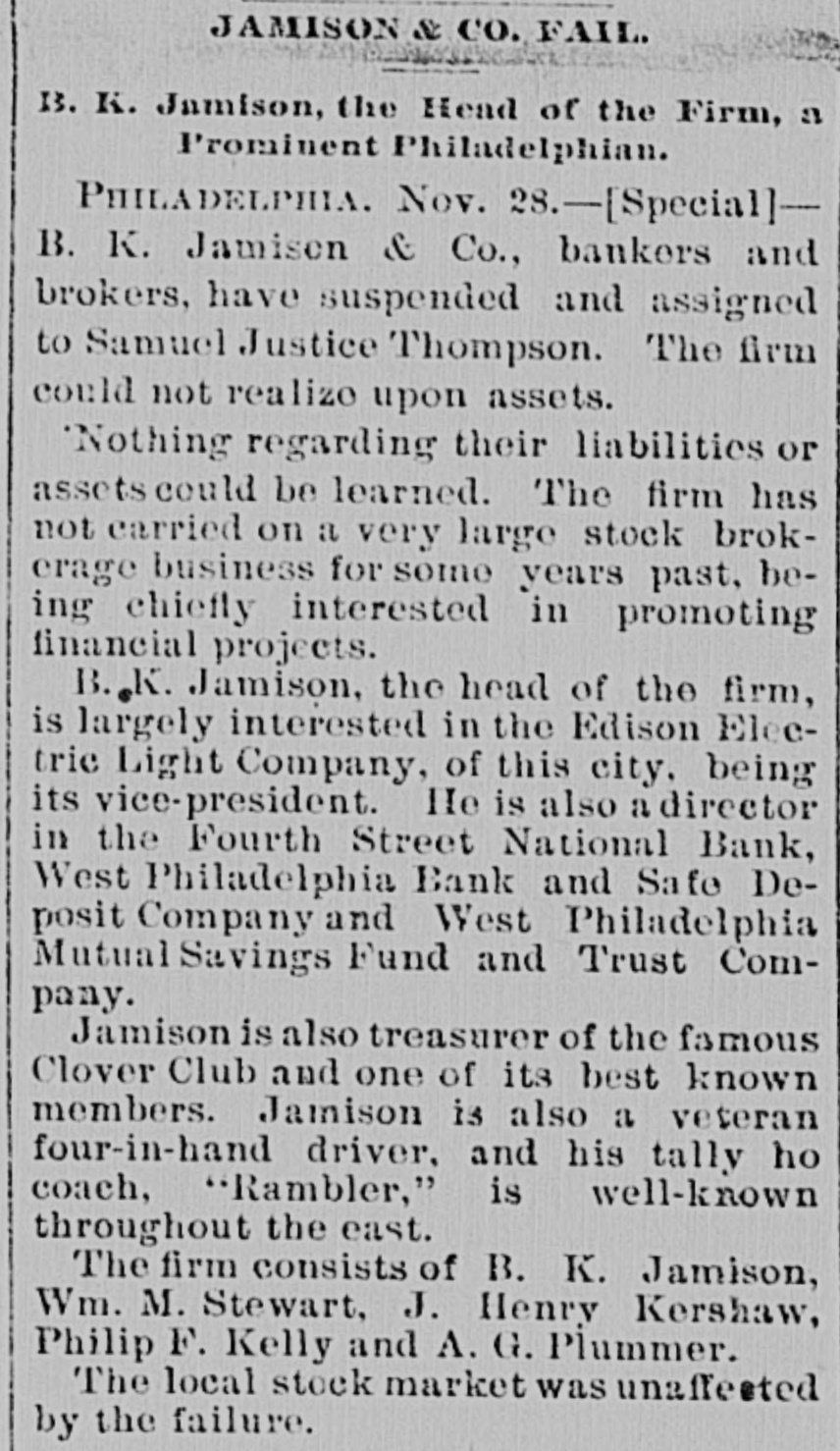
JAMISON & CO. FAIL. B. K. Jamison, the Head of the Firm, a Prominent Philadelphian. PHILADELPHIA. Nov. 28.-[Special]B. K. Jamison & Co., bankers and brokers, have suspended and assigned to Samuel Justice Thompson. The firm could not realize upon assets. "Nothing regarding their liabilities or assetscould be learned. The firm has not carried on a very large stock brokerage business for some years past, being chiefly interested in promoting financial projects. B.K. Jamison, the head of the firm, is largely interested in the Edison Electric Light Company, of this city, being its vice-president. He is also a director in the Fourth Street National Bank, West Philadelphia Bank and Safe Deposit Company and West Philadelphia Mutual Savings Fund and Trust Company. Jamison is also treasurer of the famous Clover Club and one of its best known members. Jamison is also a veteran four-in-hand driver, and his tally ho coach, "Rambler," is well-known throughout the east. The firm consists of B. K. Jamison, Wm. M. Stewart, J. Henry Kershaw, Philip F. Kelly and A. G. Plummer. The local stock market was unaffected by the failure.


Article from The Cheyenne Daily Leader, November 29, 1890

Click image to open full size in new tab

Article Text

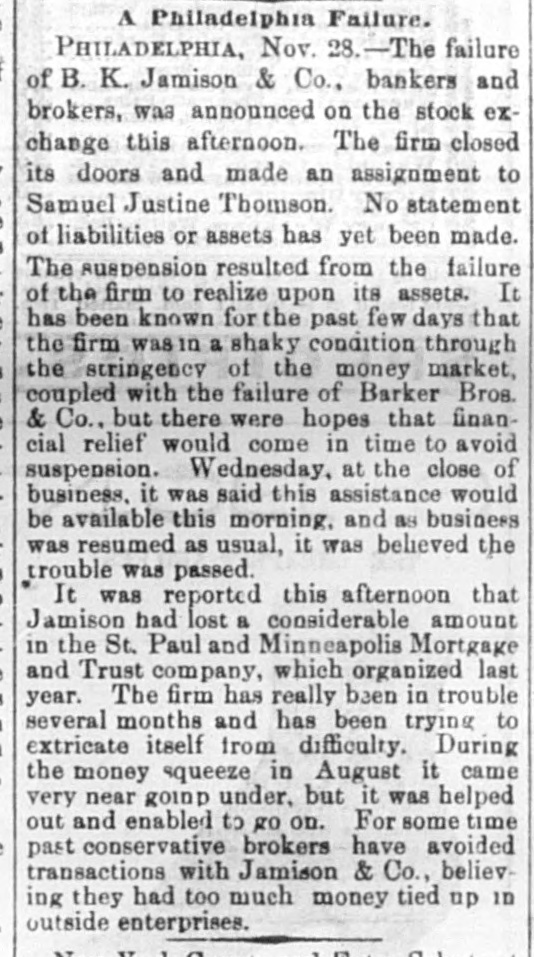
A Philadelphia Failure. Philadelphia, Nov. 28.-The failure of B. K. Jamison & Co., bankers and brokers, was announced on the stock exchange this afternoon. The firm closed its doors and made an assignment to Samuel Justine Thomson. No statement of liabilities or assets has yet been made. The suspension resulted from the failure of the firm to realize upon its assets. It has been known for the past few days that the firm wasin a shaky condition through the stringency of the money market, coupled with the failure of Barker Bros. & Co., but there were hopes that financial relief would come in time to avoid suspension. Wednesday, at the close of business, it was said this assistance would be available this morning, and as business was resumed as usual, it was believed the trouble was passed. It was reported this afternoon that Jamison had lost a considerable amount in the St. Paul and Minneapolis Mortgage and Trust company, which organized last year. The firm has really been in trouble several months and has been trying to extricate itself from difficulty. During the money squeeze in August it came very near goinp under, but it was helped out and enabled to go on. For some time past conservative brokers have avoided transactions with Jamison & Co., believing they had too much money tied up in outside enterprises. No.


Article from Wheeling Register, November 29, 1890

Click image to open full size in new tab

Article Text

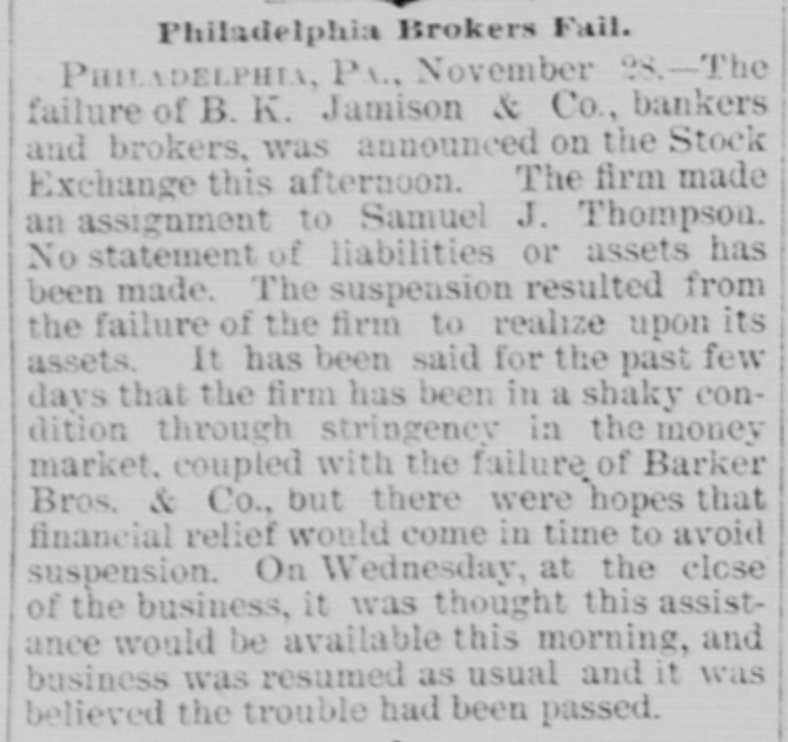
Philadelphia Brokers Fail. PHILADELPHIA, P... November 28.-The failure of B. K. Jamison & Co., bankers and brokers, was announced on the Stock Exchange this afternoon. The firm made an assignment to Samuel J. Thompson. No statement of liabilities or assets has been made. The suspension resulted from the failure of the firm to realize upon its assets. It has been said for the past few days that the firm has been in a shaky condition through stringency in the money market. coupled with the failure of Barker Bros. & Co., but there were hopes that financial relief would come in time to avoid suspension. On Wednesday, at the close of the business, it was thought this assistance would be available this morning, and business was resumed as usual and it was believed the trouble had been passed.


Article from New-York Tribune, November 29, 1890

Click image to open full size in new tab

Article Text

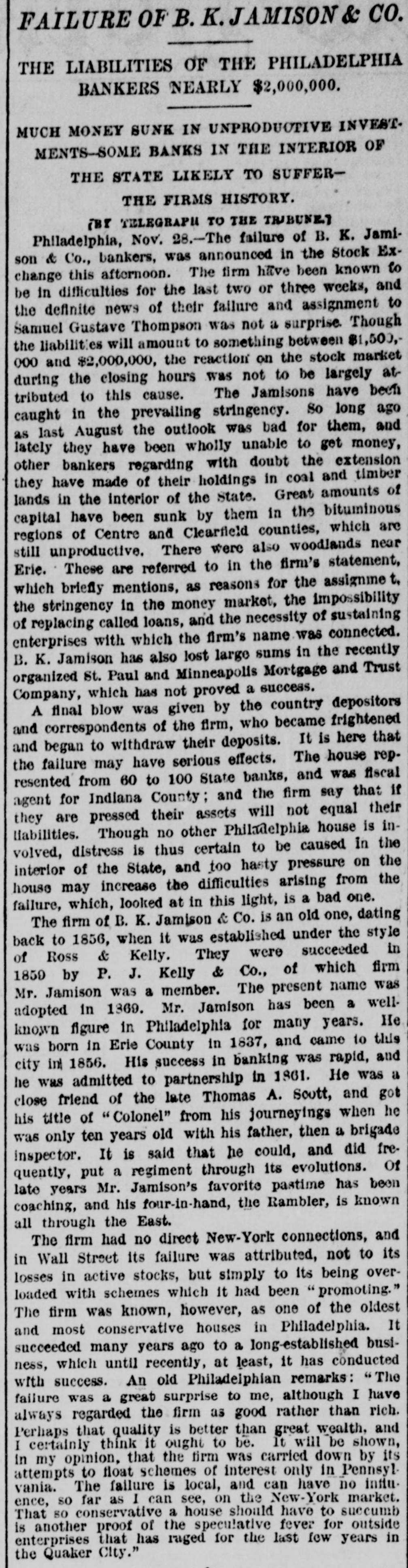
FAILURE OF B. K. JAMISON & CO. THE LIABILITIES OF THE PHILADELPHIA BANKERS NEARLY $2,000,000. MUCH MONEY SUNK IN UNPRODUCTIVE INVESTMENTS-SOME BANKS IN THE INTERIOR OF THE STATE LIKELY TO SUFFERTHE FIRMS HISTORY. (BY TELEGRAPH TO THE TRIBUNE.) Philadelphia, Nov. 28.-The failure of B. K. Jamison & Co., bankers, was announced in the Stock Exchange this afternoon. The firm have been known to be in difficulties for the last two or three weeks, and the definite news of their failure and assignment to Samuel Gustave Thompson was not a surprise. Though the liabilities will amount to something between $1,500,000 and $2,000,000, the reaction on the stock market during the closing hours was not to be largely attributed to this cause. The Jamisons have been caught in the prevailing stringency. So long ago as last August the outlook was bad for them, and lately they have been wholly unable to get money, other bankers regarding with doubt the extension they have made of their holdings in coal and timber lands in the interior of the State. Great amounts of capital have been sunk by them in the bituminous regions of Centre and Clearfield counties, which are still unproductive. There were also woodlands near Erie. These are referred to in the firm's statement, which briefly mentions, as reasons for the assignme t. the stringency in the money market, the impossibility of replacing called loans, and the necessity of sustaining enterprises with which the firm's name was connected. B. K. Jamison has also lost large sums in the recently organized St. Paul and Minneapolis Mortgage and Trust Company, which has not proved a success. A final blow was given by the country depositors and correspondents of the firm, who became frightened and began to withdraw their deposits. It is here that the failure may have serious effects. The house represented from 60 to 100 State banks, and was fiscal agent for Indiana County and the firm say that if they are pressed their assets will not equal their liabilities. Though no other Philadelphia house is involved, distress is thus certain to be caused in the interior of the State, and too hasty pressure on the house may increase the difficulties arising from the failure, which, looked at in this light, is a bad one. The firm of B. K. Jamison & Co. is an old one, dating back to 1856, when it was established under the style of Ross & Kelly. They were succeeded in 1859 by P. J. Kelly & Co., of which firm Mr. Jamison was a member. The present name was adopted in 1369. Mr. Jamison has been a wellknown figure in Philadelphia for many years. He was born in Erie County in 1837, and came to this city in 1856. His success in banking was rapid, and he was admitted to partnership in 1861. He was a close friend of the late Thomas A. Scott, and got his title of "Colonel" from his journeyings when he was only ten years old with his father, then a brigade inspector. It is said that he could, and did frequently, put a regiment through its evolutions. Of late years Mr. Jamison's favorite pastime has been coaching, and his four-in-hand, the Rambler, is known all through the East. The firm had no direct New-York connections, and in Wall Street its failure was attributed, not to its losses in active stocks, but simply to its being overloaded with schemes which it had been promoting." The firm was known, however, as one of the oldest and most conservative houses in Philadelphia. It succeeded many years ago to a long-established business, which until recently, at least, it has conducted with success. An old Philadelphian remarks: The failure was a great surprise to me, although I have always regarded the firm as good rather than rich. Perhaps that quality is better than great wealth, and I certainly think it ought to be. It will be shown, in my opinion, that the firm was carried down by its attempts ence, That vania. so so The conservative to far float as failure I schemes can is a see, house local, of on interest should and the can New-York have only have to in no succumb Pennsyl. market. influis another proof of the speculative fever for outside enterprises that has raged for the last few years in the Quaker City."
Article from The Seattle Post-Intelligencer, November 29, 1890

Click image to open full size in new tab

Article Text

A BIG PHILADELPHIA FAILURE. Jamison & Co., Bankers and Brokers, Assign-Bad New York Wreck. PHILADELPHIA, Nov. 28.-The failure of B. K. Jamison & Co., bankers and brokers, was announced on the stock exchange this afterndom. The firm closed its doors and made an assignment 10 Samuel Justin Thompson. The statement of liabilities or assets has not yet been made. The suspension resulted from the failure of the firm to realize upon as-ets. It has been known for the past few days that the firm was in a shaky condition, through the stringency of the money market, coupled with the failure of Barker Bros. & Co., but there were hopes that financial relief would come in time to avoid suspension. Wednesday, at the close of the business, it was said that this assistance would be available this morning, and as business was resumed as usual it was believed that the trouble had been passed. Two thousand shares were sold on the stock exchange this afternoon for the account of Jamison & Co. The firm has always had a high reputation, and the opinion is general this afternoon that the failure will not be a bad one, or that other moneyed institutions will be seriously affected. The firm was the Philadelphia correspondent of a large number of country banks, and it is said the failure Was hastened in some degree by these institutions calling in loans to the firm, and closing accounts in consequence of the present stress in financial circlea. It was reported this afternoon that Jamison & Co. were interested to a considerable amount in the St. Paul and Minneapolis Mortgage and Trust Company, which was organised last year. The firm has really been in trouble several months, and has been trying to extricate itself from the difficulty. During the money squeeze in Augutt it came very near going under, but it was helped out and enabled to go on. For some time past conservative brokers have avoided transactions with Jamison & Co., believing the firm had too much money tied up in outside enterpris a. The head of the firm said this evening that they could not now make s statement, but if pushed by creditors they would probably not be able to resume. By outside people the liabilities are variously estimated at from $500,000 to $1,000,000. NEW YORK. Nov. 28-Schedules in assignment of John T. Walker, John W. Combs and Joseph Walker, composing the firm of John T. Walker, Son & Co., were filed today. They show the liabilities of the firm to be $2,094,000, the nominst assets $1,433,000, and the actual assets $1,101,000.


Article from Richmond Dispatch, November 29, 1890

Click image to open full size in new tab

Article Text

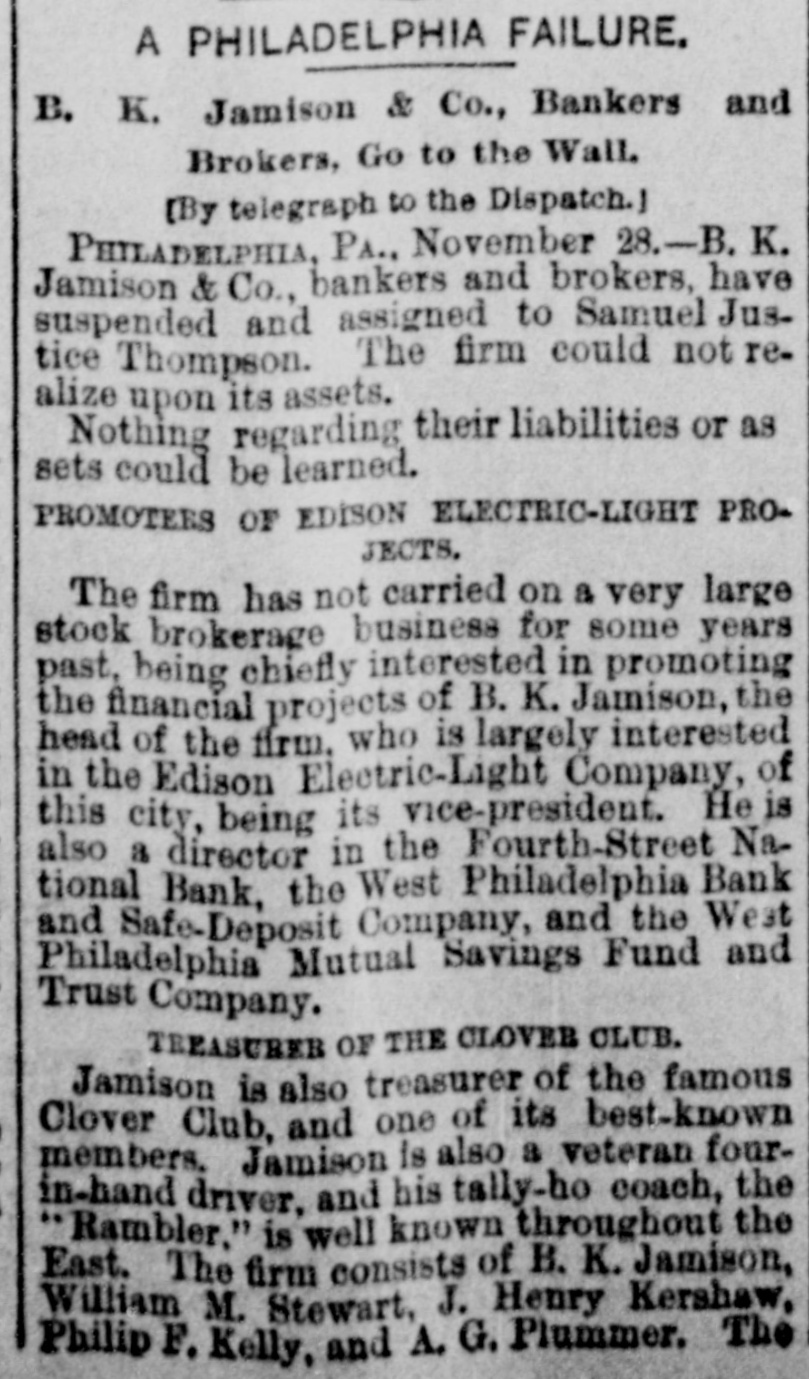
A PHILADELPHIA FAILURE. B. K. Jamison & Co., Bankers and Brokers, Go to the Wall. (By telegraph to the Dispatch.] PHILADELPHIA, PA., November 28.-B. K. Jamison & Co., bankers and brokers, have suspended and assigned to Samuel Justice Thompson. The firm could not realize upon its assets. Nothing regarding their liabilities or as sets could be learned. PROMOTERS OF EDISON ELECTRIC-LIGHT PROJECTS. The firm has not carried on a very large stock brokerage business for some years past, being chiefly interested in promoting the financial projects of B. K. Jamison, the head of the firm. who is largely interested in the Edison Electric-Light Company, of this city, being its vice-president. He is also a director in the Fourth-Street National Bank, the West Philadelphia Bank and Safe-Deposit Company, and the West Philadelphia Mutual Savings Fund and Trust Company. TREASURER OF THE CLOVER CLUB. Jamison is also treasurer of the famous Clover Club, and one of its best-known members, Jamison is also a veteran fourin-hand driver, and his tally-ho coach, the "Rambler." is well known throughout the East. The firm consists of B. K. Jamison, William M. Stewart, J. Henry Kershaw, Philip F. Kelly, and A. G. Plummer. The


Article from The Salt Lake Herald, November 29, 1890

Click image to open full size in new tab

Article Text

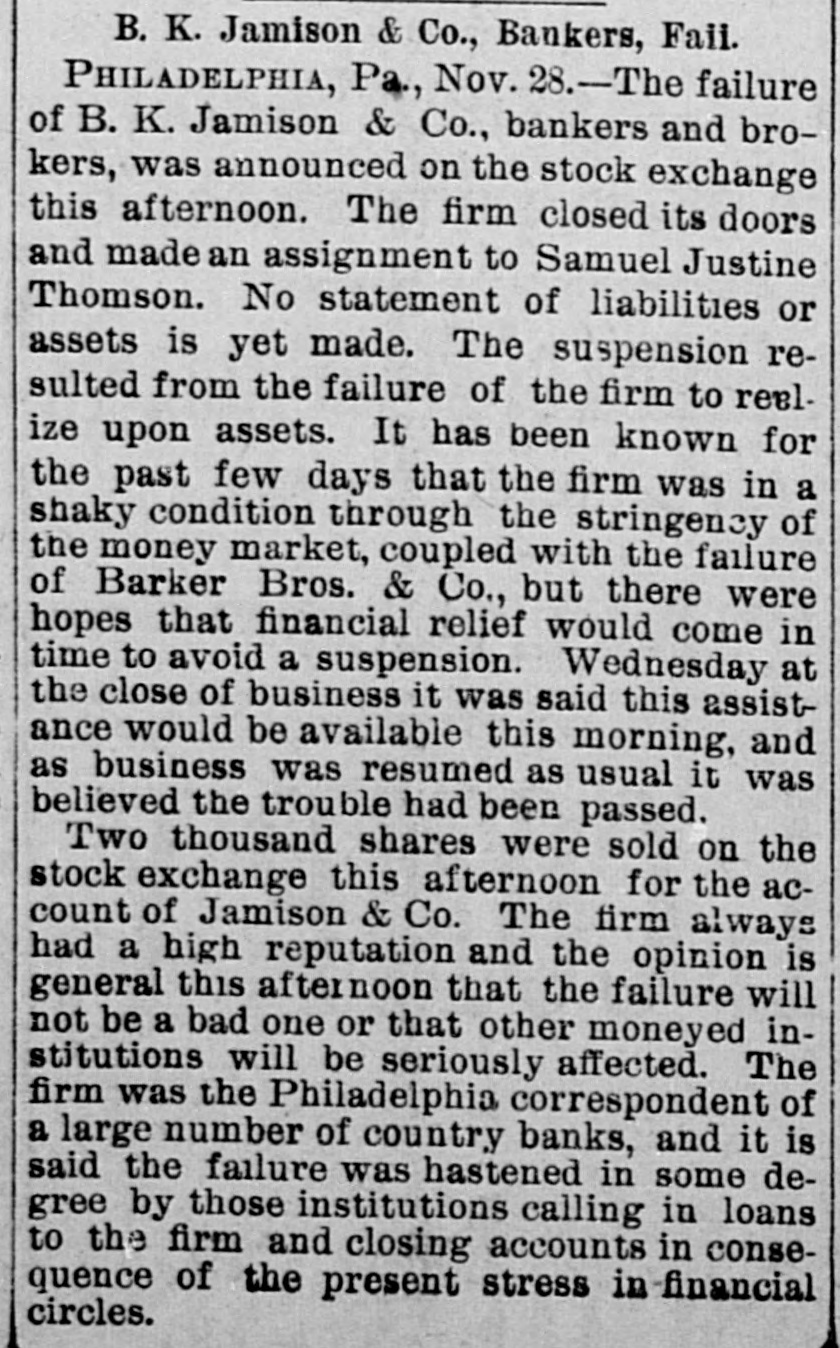
B. K. Jamison & Co., Bankers, Fail. Philadelphia, Pa., Nov. 28.-The failure of B. K. Jamison & Co., bankers and brokers, was announced on the stock exchange this afternoon. The firm closed its doors and made an assignment to Samuel Justine Thomson. No statement of liabilities or assets is yet made. The suspension resulted from the failure of the firm to reelize upon assets. It has been known for the past few days that the firm was in a shaky condition through the stringency of the money market, coupled with the failure of Barker Bros. & Co., but there were hopes that financial relief would come in time to avoid a suspension. Wednesday at the close of business it was said this assistance would be available this morning, and as business was resumed as usual it was believed the trouble had been passed. Two thousand shares were sold on the stock exchange this afternoon for the account of Jamison & Co. The firm always had a high reputation and the opinion is general this afternoon that the failure will not be a bad one or that other moneyed institutions will be seriously affected. The firm was the Philadelphia correspondent of a large number of country banks, and it is said the failure was hastened in some degree by those institutions calling in loans to the firm and closing accounts in consequence of the present stress in financial circles.


Article from The Morning Call, November 29, 1890

Click image to open full size in new tab

Article Text

A PHILADELPHIA FAILURE. The Banking-House of B. K. Jamison & Co. Forced to Suspend. PHILADELPHIA, Nov. 28.-The failure of B. K. Jamison & Co., bankers and brokers, was announced on the Stock Exchange this afternoon. The firm closed its doors and made an assignment to Samuel Justine Thomson. No statement of the liabilities or assets is made. The suspension resulted from the failure of the firm to realize upon its assets. It has been known for the past few days that the firm was in a shaky conditi on through the stringency of the money market, coupled with the failure of Barker Brothers & Co., but there were hopes that financial relief would come in time to avoid a suspension. Wednesday, at the close of business, it was said this assistance would be available this morning, and, as business was resumed as usual, it was believed the trouble had been passed. Two thousand shares were sold on the Stock Exchange this afternoon for the account of Jamison & Co. The firm always had a high reputation, and the opinion is general this afternoon the failure will not be a bad one, or that other moneyed institutions will be seriously affected. The firm was the Philadelphia correspondent of a large number of country banks, and it is said the failure was hastened in some degree by these institutions calling in loans to the firm and closing accounts in consequence of the present stress in financial circles. It was reported this afternoon that Jamison lost considerable in the St. Paul and Minneapolis Mortgage and Trust Company, which was organized last year. The firm has really been in trouble for several months and has been trying to extricate itself from its difficulty. During the money squeeze in August it came very near going under, but it was helped out and enabled to go on. For some time past conservative brokers have avoided transactions with Jamison & Co., believing the firm had too much money tied up in outside enterprises. The head of the firm said this evening that he could not now make a statement, and if pushed by creditors would probably not be able to resume. By outside people the liabilities are variously estimated at from halfia million to a million. NEW YORK, Nov. 28.-Schedules in the assignment of John T. Walker, John W. Combs and Joseph Walker, composing the firm of John T. Walker, Son & Co., were filed to-day. They show liabilities of $2,094,000, nominal assets $1,433,000 and actual assets $1,010,000.


Article from The Morning News, November 30, 1890

Click image to open full size in new tab

Article Text

BAD BREAKS IN BUSINESS. Jamison's Debts Heavier Than at First Supposed. PHILADELPHIA, PA., Nov. 29.-The failure of B. K. Jamison & Co. divided the attention of the street this morning with the startling publication of John A. Baker's gigantic forgeries. The general opinion seems to be that the failure of Jamison & Co, will be worse than at first reported. The firm are said to have been large borrowers lately, and several financial institutions of this city are thought to have been heavily hit by their suspension. The failure has had no appreciable effect on the local stock market, stocks to-day being dull but steady. NO STATEMENT MADE YET. As yet the firm have not made any state. ment regarding their position, and Assignee Thompson said it would be impossible to give even an approximate estimate of the assets and liabilities. Beyond thestatement no informagiven tion in to the papers last night regard to Baker's enormous peculations will be made public by the counsel of the absconder's family. It IS the general impression that Baker has made good his escape from the country and will not be apprehended. A SUIT BY THE STATE. State Treasurer Boyer to-day entered two suits in the common pleas courtagainst B. K. Jamison & Co., upon a bond for $100,000, dated in June last, to secure the payment of state's money, which the firm are said to have held in their possession. In the affidavit filed with the bond Treasurer Boyer avers that the amount due on the bond filed in the action, and the judgment thereon, is $25,000, that being the amount at this time on deposit with Jamison & Co. By the suit it is sought to hold not only the firm, but the individual members responsible. EBENSBURG BANKERS FAIL Johnston, Buch & Co., at Ebensburg, bankers of that place, closed their doors this morning, their failure being one of the results of that of Jamison & Co., who were Johnston, Buch & Co.'s correspondents. not to be to lic, Their but statement they expect has yet been able made pay pub- all depositors in full, in deferred payments running for one year. They lost $40,000 by Jamison's failure. LIABILITIES OF OVER $1,000,000. PHILADELPHIA, Nov. 29, 10 P. M.Assignee Thompson had progressed far enough in his examination of their affairs this afternoon to be able to say to-night that the sum due depositors amounts to probably $500,000. A large portion of this represents money placed on deposit with the firm by banks in various parts of the state, between sixty and one hundred of which were represented in Philadelphia by Jamison & Co. The indications now are that the liabilities of the firm will exceed $1,000,000. A RUN ON A BANK AT DULUTH. MINNEAPOLIS, MINN., Nov. 29.-A special to the Journal from Duluth, Minn., says: "The private bank of Hail & Co. closed its doors this morning temporarily. In a run yesterday $30,000 of the $70,000 of deposits were drawn out. When the cash was exhausted Mr. Hall addressed the waiting depositors and told them that he could pay no more cash, but if they would wait a day or two they would be paid in full. He had not raised the necessary funds to-day. No runs have been made on the other banks."


Article from Richmond Dispatch, November 30, 1890

Click image to open full size in new tab

Article Text

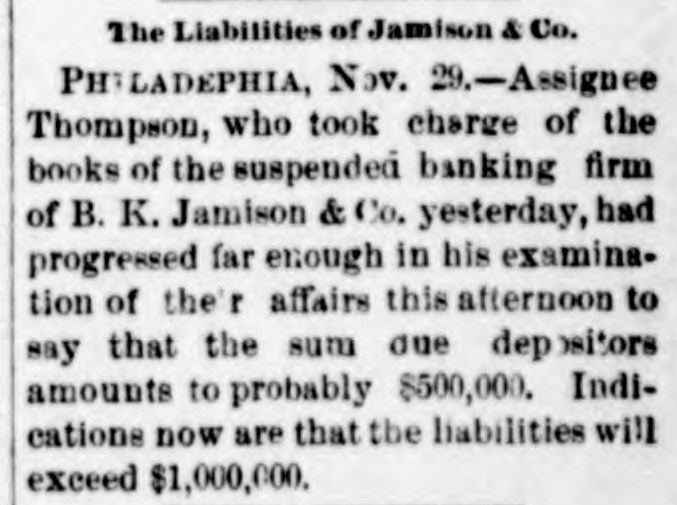
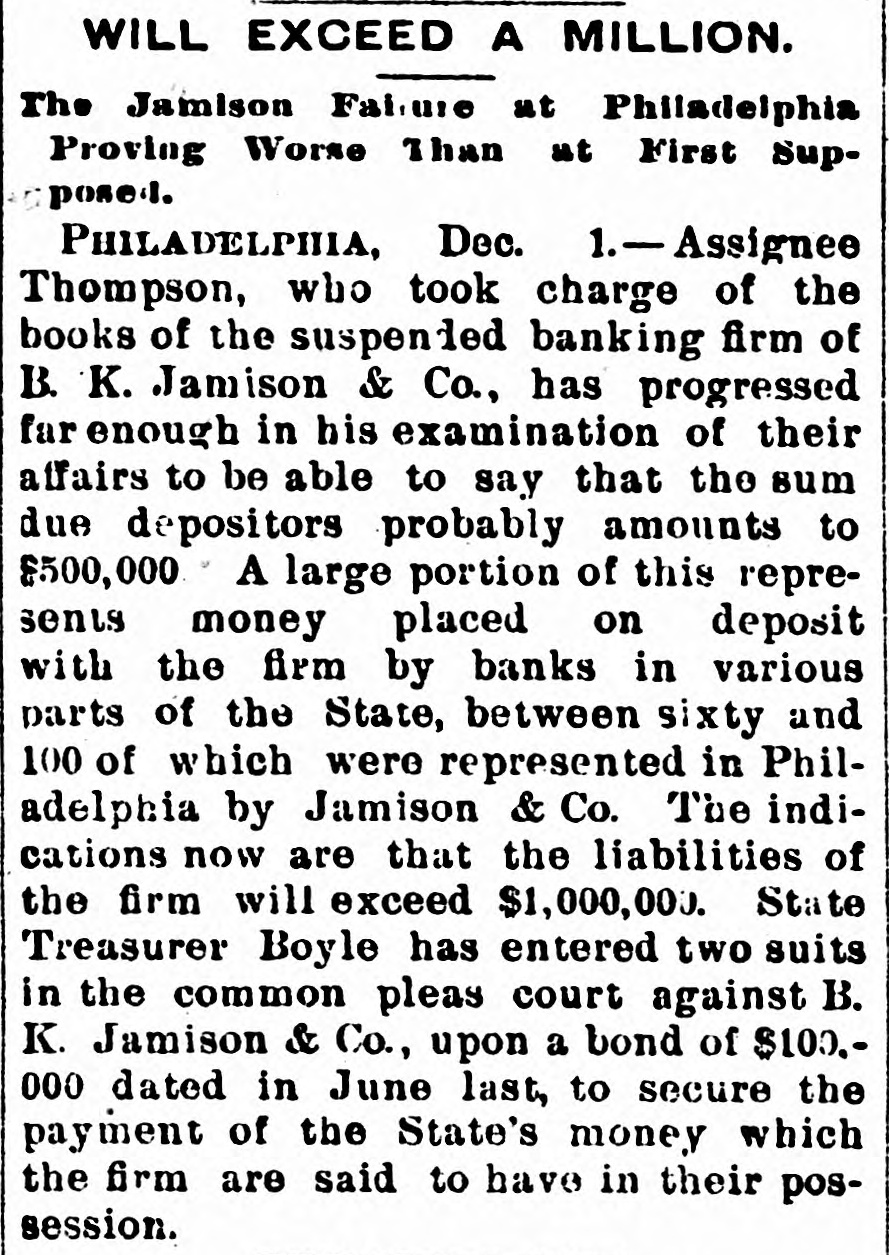
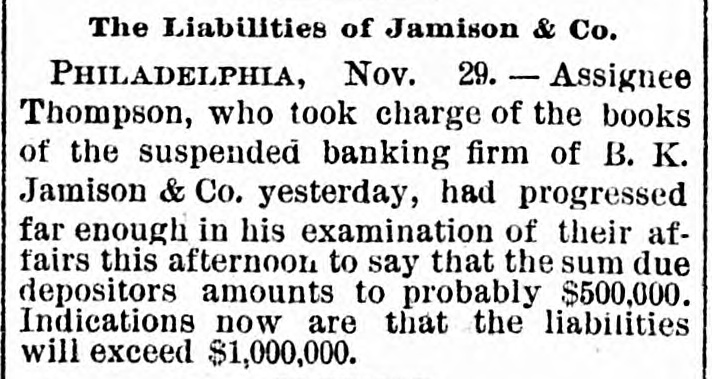
WORSE THAN REPORTED. Jamison & Co.'s Failure Hurts Other Institutions. Bytelegraph to the Dispatch.] PHILADELPHIA, PA., November 29.The failure of B. K. Jamison & Co. divided the attention of the street this morning with the startling publication of John A. Baker, Jr.'s gigantic forgeries. The general opinion seems to be that the failure of Jamison & Co. is worse than at first reported. The firm are said to have been large borrowers lately and several financial institutions of this city are thought to have been heavily hit by their suspension. The failure has had no appreciable effect on the local stock market, stocks to-day being dull but steady. As yet the firm have not made any statement regarding their position and assignee. Thompson says it would be impossible to give even an approximate estimate of the assets and liabilities. Beyond the statement given to the papers last night no information in regard to Baker's enormous peculations will be made public by the counsel of the absconder's family. It is the general impression that Baker has made good his escape from the country and will not be apprehended. SUITS TO SECURE, State-Treasurer Boyer to-day entered two suits in the Common Pleas Court against B. K. Jamison & Co. upon a bond for $100,000, dated in June last, to secure the payment of the State's money which the firm are said to have had in their possession. In the affidavit filed with the bond Bover avers that the amount due on the bond filed in action and the judgment thereon is $25,000, that being the amount at this time on deposit with Jamison & Co. By the suit it is sought to hold not only the firm, but the individual members responsible. DOORS CLOSED. Johnston, Buch & Co,, at Ebensburg, Pa, bankers of that place, closed their doors this morning, their failure being one of the results of that of Jamison & Co., who were Johnston, Buch & Co.'s correspondents. Their statement has not yet been made public, but they expect to be able to pay all depositors in full in deferred payment running for one year. They lost $40,000 by the Jamison failure. Assignee Thompson had progressed far enough in the examination of their affairs this afternoon to be able to say that the sum due depositors amounts to probably $500,000. A large portion of this represents money placed on deposit with the firm by banks in various parts of the State, between sixty and one hundred of which were represented in Philadelphia by Jamison & Co. The indications now are that the liabilities of the firm will exceed $1,000,000.


Article from Pittsburg Dispatch, November 30, 1890

Click image to open full size in new tab

Article Text

STATE MONEY HELD By the Firm of Jamison & Co. Secured by Bonds of $200,000 WHICH TREASURER BOYER HOLDS. Liabilities of the Broken Banking House Amount to $1,000,000. MOSTLY DEPOSITS OF STATE BANKS ISPECIAL TELEGRAM TO THE DISPATCH.1 PHILADELPHIA, November. 29.-The liabilities of the banking house of B. K. Jamison & Co. have been approximately estimated. They will amount to $1,000,000. Samuel Gustine Thompson says the deposits of the various State banks and individuals will constitute the bulk of the liabilities, and will reach about $500,000. It' is estimated that liabilities in other directions will run up to a like figure. There is no estimate of what will be the amount of the assets. The street is utterly unable to arrive at any opinion of this end of the assignment. While this is true, the prevailing impression is that B. K. Jamison & Co. have suffered a heavy failure, and that only by careful moving of the securities can the firm be able to come out whole. ARE NOT BEING PUSHED. The house, through Mr. Jamison, expressed itself as being well pleased with the treatment received from all the creditors. They have not pressed their claims to secure immediate payment, and the firm is satisfied that they will not. Mr. Jamison asserts that if this good will continues to be shown to the house the creditors will receive all that is due them, and they will probably be able to resume business in a very short time. It is definitely known that the failure of the banking house will not cripple or cause a collapse of any local institution. There are many creditors in the city, but they are mostly private individuals. But there is every uncertainty as to what will be the outcome of the insolvent firm's connection with 80 or 100 banks throughout the State. Fears are unwillingly entertained that the Jamison failure may possibly lead to a disruption of some of these. It has been found impossible to learn from B. K. Jamison & Co. what they owe to these country banks. The firm says it is not in a position to give out the amount of the accounts with any one or all of these institutions. Mr. Jamison and his colleagues, however, hold the opinion that the accounts are not large enough to produce any serious results, and that there is no reason why a run should be made on the country banks. HELD $25,000 OF STATE MONEY. The news that B. K. Jamison & Co. held $25,000 of the State's money caused considerable interest on the street during the day. There had been rumors that the firm had some of the Commonwealth's funds, but not much credence was placed in them. When State Treasurer Boyer heard of B. K. Jamison & Co.'s failure on Friday, he immediately hastened from Harrisburg to this city. The State Treasurer held a consultation with Mr. Jamison and Assignee Thompson. Through his private counsel, J. Quincy Hunsicker. the State Treasurer entered a record in Court of Common Pleas No. 4 of the two bonds given to him to secure his deposit of State moneys with the insolvent firm. Each of the bonds was for $100,000. One was signed by the members of the firm in the name of B. K. Jamison & Co. The other was signed by the members of the firm in their individual capacity.


Article from Waterbury Evening Democrat, December 1, 1890

Click image to open full size in new tab

Article Text

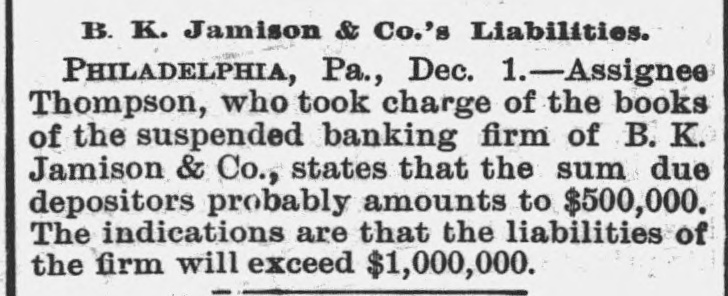
B. K. Jamison & Co.'s Liabilities. PHILADELPHIA, Pa., Dec. 1.-Assignee Thompson, who took charge of the books of the suspended banking firm of B. K. Jamison & Co., states that the sum due depositors probably amounts to $500,000. The indications are that the liabilities of the firm will exceed $1,000,000.


Article from Evening Star, December 26, 1890

Click image to open full size in new tab

Article Text

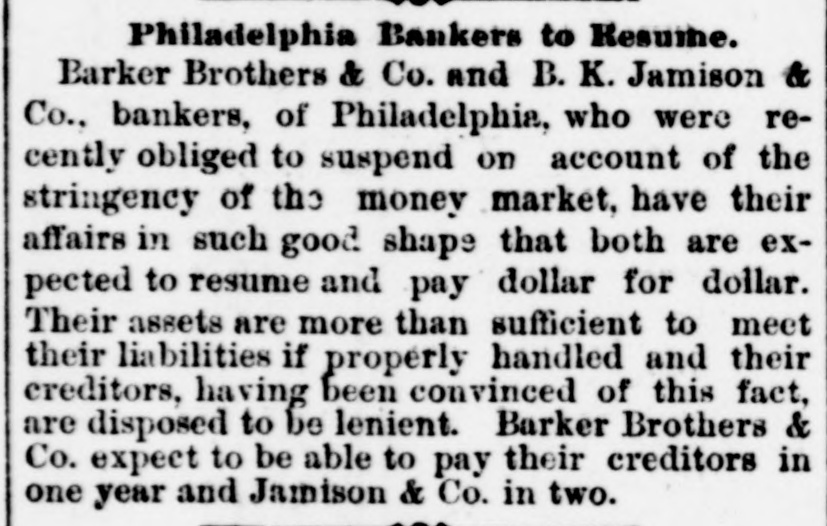
Philadelphia Bankers to Resume. Barker Brothers & Co. and B. K. Jamison & Co., bankers, of Philadelphia, who were recently obliged to suspend on account of the stringency of the money market, have their affairs in such good shape that both are expected to resume and pay dollar for dollar. Their assets are more than sufficient to meet their liabilities if properly handled and their creditors, having been convinced of this fact, are disposed to be lenient. Barker Brothers & Co. expect to be able to pay their creditors in one year and Jamison & Co. in two.


Article from Asheville Daily Citizen, December 27, 1890

Click image to open full size in new tab

Article Text

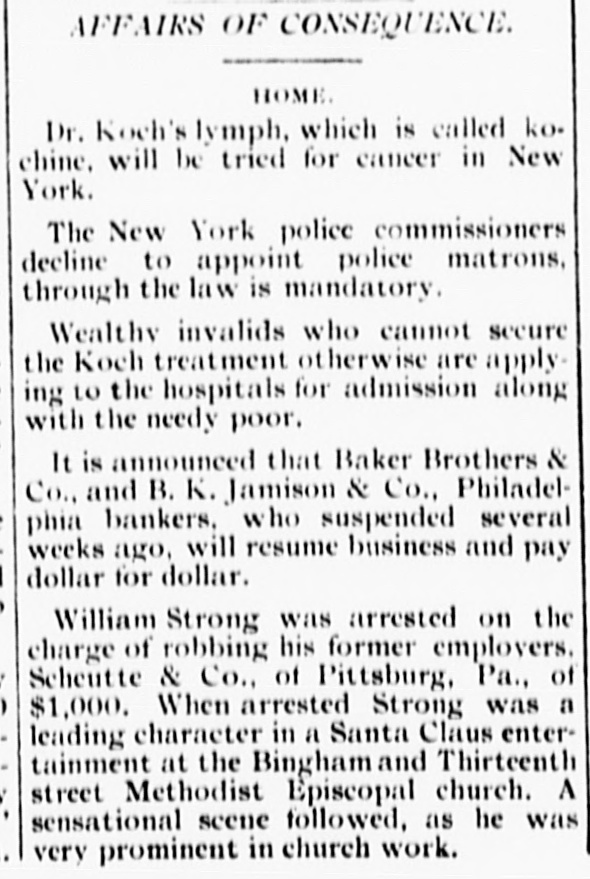
AFFAIRS OF CONSEQUENCE HOME Dr. Koch's lymph, which is called kochine. will be tried for cancer in New York. The New York police commissioners decline to appoint police matrons, through the law is mandatory. Wealthy invalids who cannot secure the Koch treatment otherwise are apply ing to the hospitals for admission along with the needy poor. It is announced that Baker Brothers & Co., and B. K. Jamison & Co., Philadelphia bankers. who suspended several weeks ago, will resume business and pay dollar for dollar. William Strong was arrested on the charge of robbing his former employers. Scheutte & Co., of Pittsburg, Pa., of $1,000. When arrested Strong was a leading character in a Santa Claus entertainment at the Bingham and Thirteenth street Methodist Episcopal church. A sensational scene followed, as he was very prominent in church work.


Article from Waterbury Evening Democrat, December 29, 1890

Click image to open full size in new tab

Article Text

NEWS OF THE DAY. The Grand Duke Constantine, the Czar's uncle, is dying. The Bijou Theatre in Minneapoli S was burned yesterday. Loss, $30,000. There is a probability that Italy will soon admit American pork and lard. Many Hebrews in New Haven, Conn., favor changing their day of worship from Saturday to Sunday. The total assets of B. K. Jamison & Co., the suspended bankers of Philadelphia, are $164,559.44. M. Floquet has announced his desire for re-election to the Presidency of the French Chamber of Deputies. Fire at Gloucester, Mass., destroyed a barn and contents, together with two horses belonging to Robert Cook. Archbishop Ryan of Philadelphia lectured last night on "Christianity and Civilization" at the Metropolitan Opera House in New York. The Fishing Creek Lumber Company of Lancaster, Pa., has made an assignment. It is believed the assets will more than cover the liabilities. James Vest, a school teacher, was found frozen to death in a snow drift on the road leading across the mountain from Six Mile Creek to Mud River, W. Va, Nathan Davis, of Easton, one of the oldest residents of Fairfield County, Conn., is dead, aged 94 years and 1 month. He died in the same house in which he was born. Mr. Balfour, Chief Secretary for Ire. land, has reconsidered his original determination, and now declines to speak in the Province of Ulster during January. The journey of the young Czarewitch, Nicholas, around the world, which was to last a year, has been brought to a sud, den end and he will soon be back in St. Petersburg. The English army authorities are organizing a corps of signallers for the army, the recruits being selected from the Postoffice rifle volunteers, preference being given to those trained in telegraphy. The Dorchester Express Company's stable in Dorchester, Mass, was burned Saturday with nearly the entire contents including wagons, harness, hay and considerable freight. Nineteen horses were saved. The makers of flour barrels in Buffalo, N. Y., have decided to close their works this week because of low prices and no profits. They assert that it costs them 36 cents to*make barrels which h they have to sell for 33 cents. The shut down will throw 300 or 400 men out of employment. Ira M. Harrison, one of the oldest, wealthiest and best known citizens of Newark, N. J., lies at the point of death at his home, No. 1,013 Broad street. He was stricken with heart disease several days ago, and his death is momentarily expected. A fire early in the morning destroyed two business houses in Passaic street, Paterson, N. J., occupied by William Taylor, a clothier, and R. R. Berdar, furniture dealer. The buildihgs belonged to Messrs. Traelstrom and Tornquis. The loss will reach $25,000; insured for about half that amount. At a meeting of the numerous creditors of Winslow, Rand & Watson, dealers in teas and coffees, Nos. 197 and 199 State street, Boston, the committee of investigation appointed at a previous meeting rèported that the firm offered fifty cents in cash and five cents in twelve-month 6 per cent. notes. The creditors will probably accept the offer.


Article from Spirit of Jefferson, January 13, 1891

Click image to open full size in new tab

Article Text

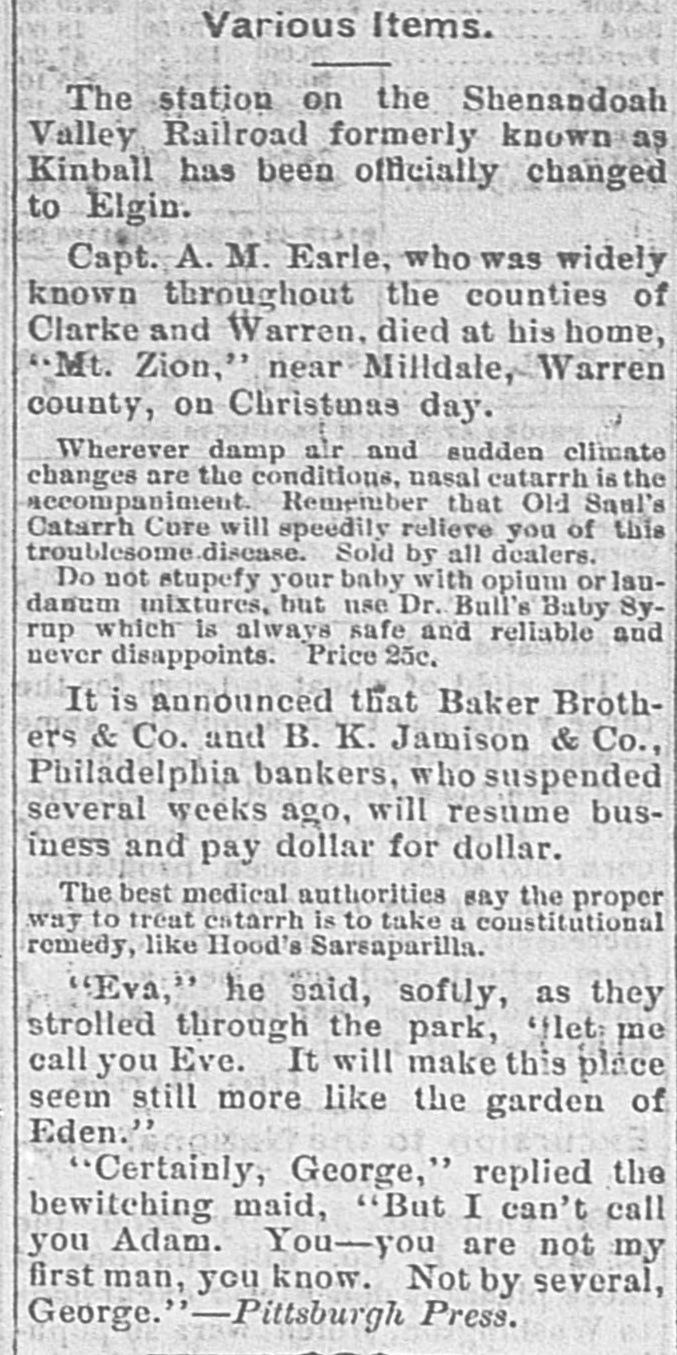
Various Items. The station on the Shenandoah Valley Railroad formerly known as Kinball has been officially changed to Elgin. Capt. A. M. Earle, who was widely known throughout the counties of Clarke and Warren, died at his home, Mt. Zion," near Milldale, Warren county, on Christmas day. Wherever damp air and sudden climate changes are the conditions, nasal catarrh is the accompaniment. Remember that Old Saul's Catarrh Cure will speedily relieve you of this troublesome disease. Sold by all dealers. Do not stupefy your baby with opium or laudanum mixtures, but use Dr. Bull's Baby Syrup which is always safe and reliable and never disappoints. Price 25c. It is announced that Baker Brothers & Co. and B. K. Jamison & Co., Philadelphia bankers, who suspended several weeks ago, will resume business and pay dollar for dollar. The best medical authorities say the proper way to treat catarrh is to take a constitutional remedy, like Hood's Sarsaparilla. "Eva," he said, softly, as they strolled through the park, 'flet: me call you Eve. It will make this place seem still more like the garden of Eden." "Certainly, George," replied the bewitching maid, "But I can't call you Adam. You-you are not my first man, you know. Not by several, George.' '-Pittsburgh Press.


Article from Spirit of Jefferson, January 13, 1891

Click image to open full size in new tab

Article Text

Various Items. The station on the Shenandoah Valley Railroad formerly known as Kinball has been officially changed to Elgin. Capt. A. M. Earle, who was widely known throughout the counties of Clarke and Warren, died at his home, "Mt. Zion," near Milldale, Warren county, on Christmas day. Wherever damp air and sudden climate changes are the conditions, nasal catarrh is the accompaniment. Remember that Old Saul's Catarrh Cure will speedily relieve you of this troublesome disease. Sold by all dealers. Do not stupefy your baby with opium or laudanum mixtures, but use Dr. Bull's Baby Syrup which is always safe and reliable and never disappoints. Price 25c. It is announced that Baker Brothers & Co. and B. K. Jamison & Co., Philadelphia bankers, who suspended several weeks ago, will resume business and pay dollar for dollar. The best medical authorities say the proper way to treat estarrh is to take a constitutional remedy, like Hood's Sarsaparilla. "Eva," he said, softly, as they strolled through the park, 'flet, me call you Eve. It will make this place seem still more like the garden of Eden." "Certainly, George," replied the bewitching maid, "But I can't call you Adam. You-you are not my first man, you know. Not by several, George." -Pittsburgh Press.