Article Text
COLORADO. DENVER, March 20.-The exchange bank of Denver, A.J. Williams, president; J. M. Strickeler, cashier, suspended this morning. The bank was never strong and the failure creates little surprise. Other banks are not effected.
2dcc9b820688e043None
Click image to open full size in new tab
COLORADO. DENVER, March 20.-The exchange bank of Denver, A.J. Williams, president; J. M. Strickeler, cashier, suspended this morning. The bank was never strong and the failure creates little surprise. Other banks are not effected.
Click image to open full size in new tab
Bank Suspension in Colorado. DENVER, COL., March 20.-The Exchange bank. of Denver, A. J. Williams, president, and J. M.Strickler, cashier, suspended payment this morning. The bank has never been strong. and the failure creates little surprise. Other banks are not affected.

Click image to open full size in new tab
The Exchange Bank of Denver has suspended. The failure causes no surprise. Other banks are not affected.
Click image to open full size in new tab
FAILURE OF A DENVER BANK. DENVER, Col., March 20.-The Exchange Bank of Denver has been placed in the hands of a receiver, J. M. Strickler, the cashier. The bank was incorporated January 1, 1876, with a paid-in capital of $200,000, A. J. Williams being the president. About three years ago it was discovered that the late cashier, S. G. Collins, had loaned the funds so recklessly that the greater portion of the paid-up capital had been absorbed, and at a meeting of stockholders the capital stock was reduced to $100,000. The report for February 2, 1882, showed liabilities of $261,825, exclusive of capital stock and the surplus fund of $82,544 and assets of $444,371. The New- York correspondents were the Tradesmen's National Bank and Wells, Fargo & Co. PITTSBURG, Penn., March 20.-A dispatch from NewBrighton, Penn., says: R. E. & H. Hoopes, private bankers at this place, suspended payment to-day. The failure is said to have been caused by a number of bad investments. No idea of the extent of the liabilities could be obtained to-day, but it is said they will be from $60,000 to $70,000, and that the assets will not amount to over $40,000. The firm has been doing business for twenty-five years.
Click image to open full size in new tab
Bank Suspension. DENVER, March 20.-The Exchange Bank of Denver suspended this morning. The bank was never strong. The failure creates little surprise. The other banks are not affected.
Click image to open full size in new tab
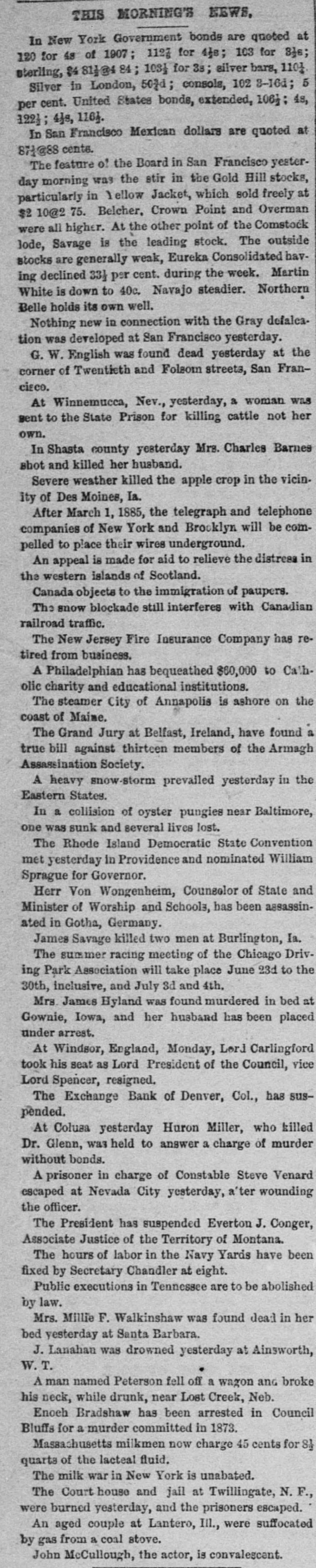
THIS MORNING'S NEWS, In New York Government bonds are quoted at 120 for 48 of 1907; 112g for 4}s; 103 for 336; sterling, $4 811@4 84 103 for 3s; silver bars, 1101 Silver in London, 507d; consols, 102 3-16d; 5 per cent. United States bonds, extended, 106}; 4s, 122} ; 41s, 116 In San Francisco Mexican dollars are quoted at 871@88 cents. The feature of the Board in San Francisco yesterday morning was the stir in the Gold Hill stocks, particularly in Yellow Jacket, which sold freely at $2 10@2 75. Belcher, Crown Point and Overman were all higher. At the other point of the Comstock Jode, Savage is the leading stock. The outside stocks are generally weak, Eureka Consolidated having declined 33} per cent. during the week. Martin White is down to 40c. Navajo steadier. Northern Belle holds its own well. Nothing new in connection with the Gray defalcation was developed at San Francisco yesterday. G. W. English was found dead yesterday at the corner of Twentieth and Folsom streets, San Francisco. At Winnemucca, Nev., yesterday, a woman was gent to the State Prison for killing cattle not her own. In Shasta county yesterday Mrs. Charles Barnes shot and killed her husband. Severe weather killed the apple crop in the vicinity of Des Moines, Ia. After March 1, 1885, the telegraph and telephone companies of New York and Brocklyn will be compelled to place their wires underground. An appeal is made for aid to relieve the distress in the western islands of Scotland. Canada objects to the immigration of paupers. The snow blockade still interferes with Canadian railroad traffic. The New Jersey Fire Insurance Company has retired from business. A Philadelphian has bequeathed $60,000 to Calholic charity and educational institutions. The steamer City of Annapolis is ashore on the coast of Maine. The Grand Jury at Belfast, Ireland, have found a true bill against thirteen members of the Armagh Assassination Society. A heavy snow-storm prevailed yesterday in the Eastern States. In a collision of oyster pungies near Baltimore, one was sunk and several lives lost. The Rhode Island Democratic State Convention met yesterday in Providence and nominated William Sprague for Governor. Herr Von Wongenheim, Counselor of State and Minister of Worship and Schools, has been assassinated in Gotha, Germany. James Savage killed two men at Burlington, Ia. The summer racing meeting of the Chicago Driving Park Association will take place June 23d to the 30th, inclusive, and July 3d and 4th. Mrs. James Hyland was found murdered in bed at Gownie, Iowa, and her husband has been placed under arrest. At Windsor, England, Monday, Lerl Carlingford took his seat as Lord President of the Council, vice Lord Spencer, resigned. The Exchange Bank of Denver, Col., has suspended. At Columa yesterday Huron Miller, who killed Dr. Glenn, was held to answer a charge of murder without bonds. A prisoner in charge of Constable Steve Venard escaped at Nevada City yesterday, a'ter wounding the officer. The President has suspended Everton J. Conger, Associate Justice of the Territory of Montana. The hours of labor in the Navy Yards have been fixed by Secretary Chandler at eight. Public executions in Tennessee are to be abolished by law. Mrs. Millie F. Walkinshaw was found dead in her bed yesterday at Santa Barbara. J. Lanahan was drowned yesterday at Ainsworth, W. T. A man named Peterson fell off a wagon and broke his neck, while drunk, near Lost Creek, Neb. Enoch Bradshaw has been arrested in Council Bluffs for a murder committed in 1873. Massachusetts milkmen now charge 45 cents for 81 quarts of the lacteal fluid. The milk war in New York is unabated. The Court house and jail at Twillingate, N. F., were burned yesterday, and the prisoners escaped. An aged couple at Lantero, III., were suffocated by gas from a coal stove. John McCullough, the actor, is convalescent.
Click image to open full size in new tab
Bank Failure at Denver. DENVER. Col., March 20.-The Exchange Bank of Denver suspended this morning. The bank was never strong, and the failure creates little surprise. Other banks are not affected.
Click image to open full size in new tab
A Denver Bank Bursted. DENVER, Col., March 20.-The Exchange bank of Denver suspended this morning. The bank never was strong, and the failure creates little surprise, and other r banks are not affected.
Click image to open full size in new tab
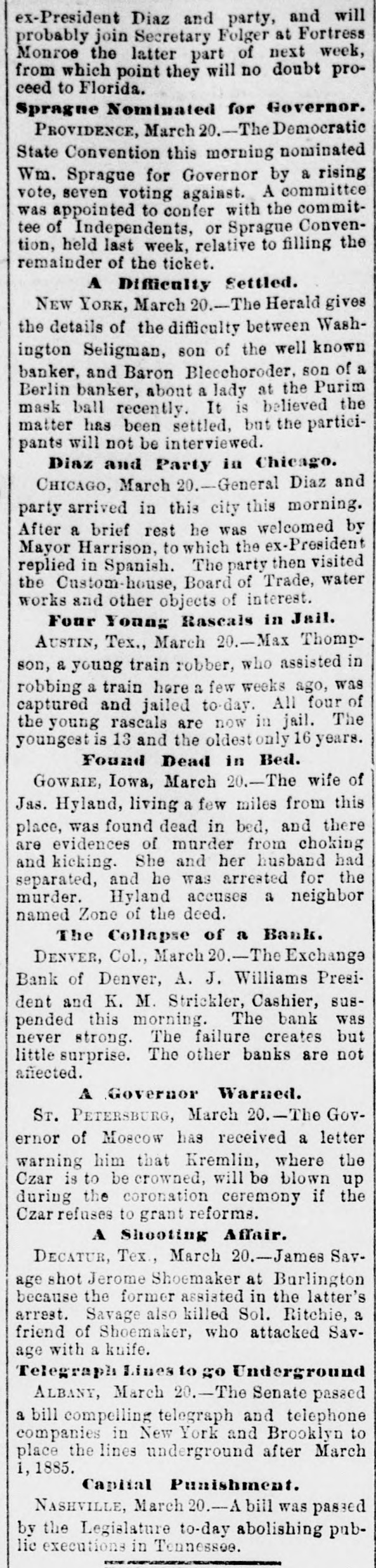
ex-President Diaz and party, and will probably join Secretary Folger at Fortress Monroe the latter part of next week, from which point they will no doubt proceed to Florida. Spragne Nominated for Governor. PROVIDENCE, March 20.-The Democratic State Convention this morning nominated Wm. Sprague for Governor by a rising vote, seven voting against. A committee was appointed to confer with the committee of Independents, or Sprague Convention, held last week, relative to filling the remainder of the ticket. A Difficulty Settled. NEW YORK, March 20.-The Herald gives the details of the difficulty between Washington Seligman, son of the well known banker, and Baron Blecchoroder. son of a Berlin banker, about a lady at the Purim mask ball recently. It is believed the matter has been settled, but the participants will not be interviewed. Diaz and Party in Chicago. CHICAGO, March 20.-General Diaz and party arrived in this city this morning. After a brief rest he was welcomed by Mayor Harrison, to which the ex-President replied in Spanish. The party then visited the Custom-house, Board of Trade, water works and other objects of interest. Four Yonag Rascals in Jail. AUSTIN, Tex., March 20.-Max Thompson, a young train robber, who assisted in robbing a train here a few weeks ago, was captured and jailed today. All four of the young rascals are now in jail. The youngest is 13 and the oldest only 16 years. Found Dead in Bed. GOWRIE, Iowa, March 20.-The wife of Jas. Hyland, living a few miles from this place, was found dead in bed, and there are evidences of murder from choking and kicking. She and her husband had separated, and he was arrested for the murder. Hyland accuses a neighbor named Zone of the deed. The Collapse of a Bank. DENVER, Col., March 20.-The Exchange Bank of Denver, A. J. Williams President and K. M. Strickler, Cashier, suspended this morning. The bank was never strong. The failure creates but little surprise. The other banks are not affected. A Governor Warned. ST. PETERSBURG, March 20.-The Governor of Moscow has received a letter warning him that Kremlin, where the Czar is to be crowned, will be blown up during the coronation ceremony if the Czar refuses to grant reforms. A Shooting Affair. DECATUR, Tex., March 20.-James Savage shot Jerome Shoemaker at Burlington because the former assisted in the latter's arrest. Savage also killed Sol. Ritchie, a friend of Shoemaker, who attacked Savage with a knife. Telegraph Lines to go Underground ALBANY, March 20.-The Senate passed a bill compelling telegraph and telephone companies in New York and Brooklyn to place the lines underground after March i, 1885. Capital Punishment. NASHVILLE, March 20.-A bill was passed by the Legislature to-day abolishing publie executions in Tennessee.
Click image to open full size in new tab
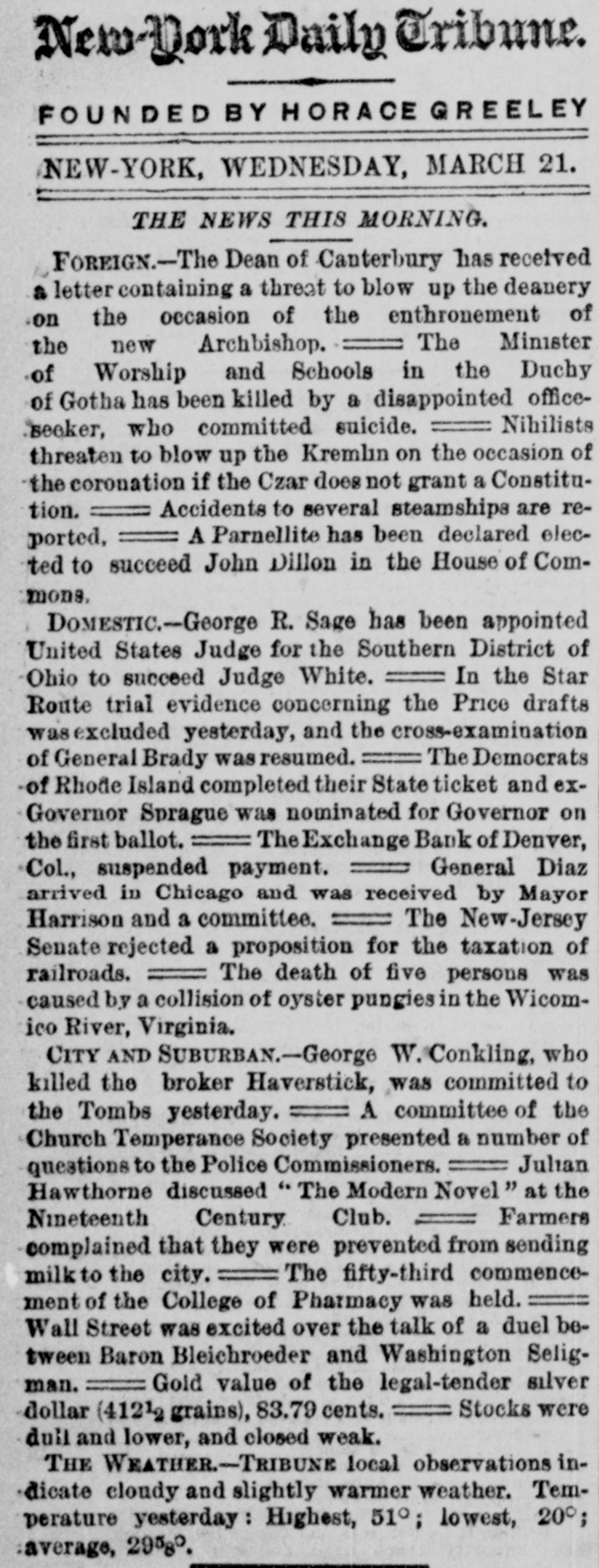
New-York Daily Tribune. FOUNDED BY HORACE GREELEY NEW-YORK, WEDNESDAY, MARCH 21. THE NEWS THIS MORNING. FOREIGN.-The Dean of Canterbury has received a letter containing a threat to blow up the deanery on the occasion of the enthronement of Minister The new the Archbishop. of Worship and Schools in the Duchy of Gotha has been killed by a disappointed officeNihilists seeker, who committed suicide. threaten to blow up the Kremlin on the occasion of the coronation if the Czar does not grant a Constitution. Accidents to several steamships are reA Parnellite has been declared elecported, ted to succeed John Dillon in the House of Commons. DOMESTIC.-George R. Sage has been appointed United States Judge for the Southern District of Ohio to succeed Judge White. In the Star Route trial evidence concerning the Price drafts was excluded yesterday, and the cross-examination The Democrats of General Brady was resumed. of Rhode Island completed their State ticket and exGovernor Sprague was nominated for Governor on the first ballot. The Exchange Bank of Denver, General Diaz Col., suspended payment. arrived in Chicago and was received by Mayor Harrison and a committee. The New-Jersey Senate rejected a proposition for the taxation of railroads. = The death of five persons was caused by a collision of oyster pungies in the Wicomico River, Virginia. CITY AND SUBURBAN.-Georg W. Conkling, who killed the broker Haverstick, was committed to the Tombs yesterday. A committee of the Church Temperance Society presented a number of Juhan questions to the Police Commissioners. = Hawthorne discussed "The Modern Novel" at the Nineteenth Century Club. Farmers complained that they were prevented from sending The fifty-third commencemilk to the city. ment of the College of Pharmacy was held.= Wall Street was excited over the talk of a duel between Baron Bleichroeder and Washington Seligman. Gold value of the legal-tender silver dollar (41212 grains), 83.79 cents. Stocks were dull and lower, and closed weak. THE WEATHER.-TRIBUNE local observations indicate cloudy and slightly warmer weather. Temperature yesterday Highest, 51°; lowest, 20°; average, 29%go.
Click image to open full size in new tab
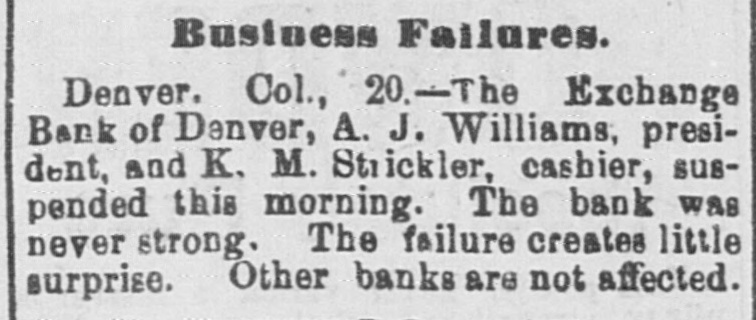
Business Failures. Denver. Col., 20.-The Exchange Bank of Denver, A. J. Williams, presidont, and K. M. Strickler, cashier, suspended this morning. The bank was never strong. The failure creates little surprise. Other banks are not affected.
Click image to open full size in new tab
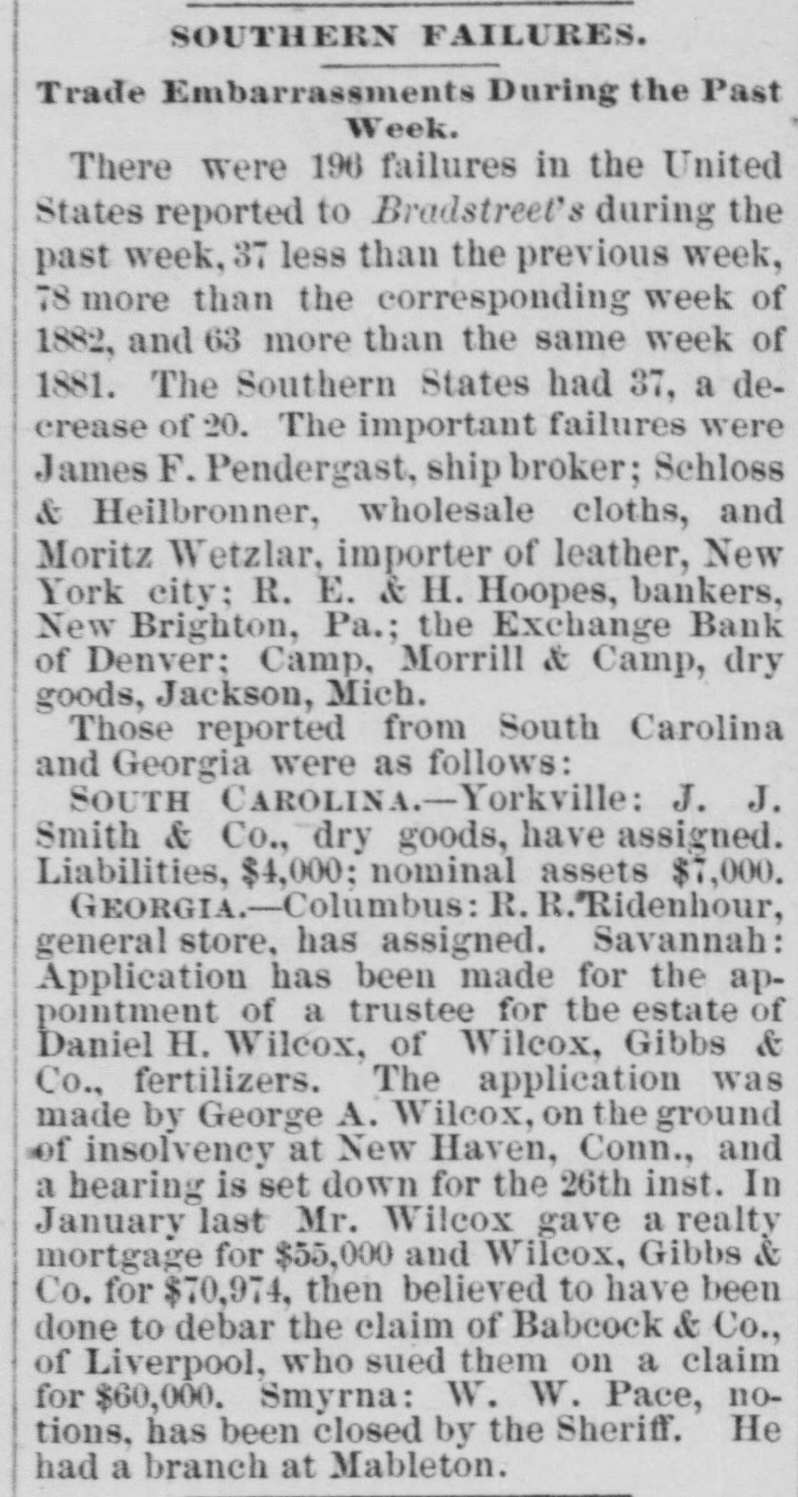
SOUTHERN FAILURES. Trade Embarrassments During the Past Week. There were 196 failures in the United States reported to Bradstreet's during the past week, 37 less than the previous week, 78 more than the corresponding week of 1882, and 63 more than the same week of 1881. The Southern States had 37, a decrease of 20. The important failures were James F. Pendergast, ship broker; Schloss & Heilbronner, wholesale cloths, and Moritz Wetzlar, importer of leather, New York city; R. E. & H. Hoopes, bankers, New Brighton, Pa.; the Exchange Bank of Denver: Camp, Morrill & Camp, dry goods, Jackson, Mich. Those reported from South Carolina and Georgia were as follows: SOUTH CAROLINA.-Yorkville: J. J. Smith & Co., dry goods, have assigned. Liabilities, $4,000; nominal assets $7,000. GEORGIA.-Columbus: R. R. "Ridenhour, general store, has assigned. Savannah: Application has been made for the appointment of a trustee for the estate of Daniel H. Wilcox, of Wilcox, Gibbs & Co., fertilizers. The application was made by George A. Wilcox, on the ground of insolvency at New Haven, Conn., and a hearing is set down for the 26th inst. In January last Mr. Wilcox gave a realty mortgage for $55,000 and Wilcox, Gibbs & Co. for $70,974, then believed to have been done to debar the claim of Babcock & Co., of Liverpool, who sued them on a claim for $60,000. Smyrna: W. W. Pace, notions, has been closed by the Sheriff. He had a branch at Mableton.