Article Text
NEW YORK BANK CLOSED
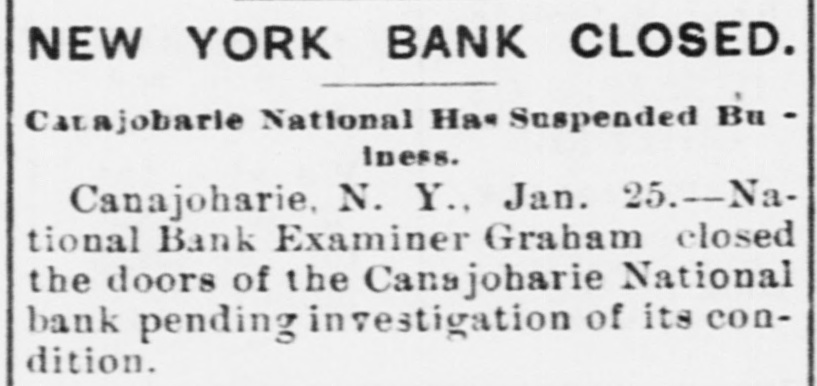
Catajobarie National Has Suspended Bu iness. Canajoharie, N. Y., Jan. 25.--National Bank Examiner Graham closed the doors of the Canajoharie National bank pending investigation of its condition.
Capital injected, Full suspension, Books examined
Other: Bank was placed in hands of a national bank examiner/receiver; resumption required conditions from the Comptroller (administrative receivership and subsequent recapitalization via stock reduction and paid assessment).
Click image to open full size in new tab
Catajobarie National Has Suspended Bu iness. Canajoharie, N. Y., Jan. 25.--National Bank Examiner Graham closed the doors of the Canajoharie National bank pending investigation of its condition.
Click image to open full size in new tab
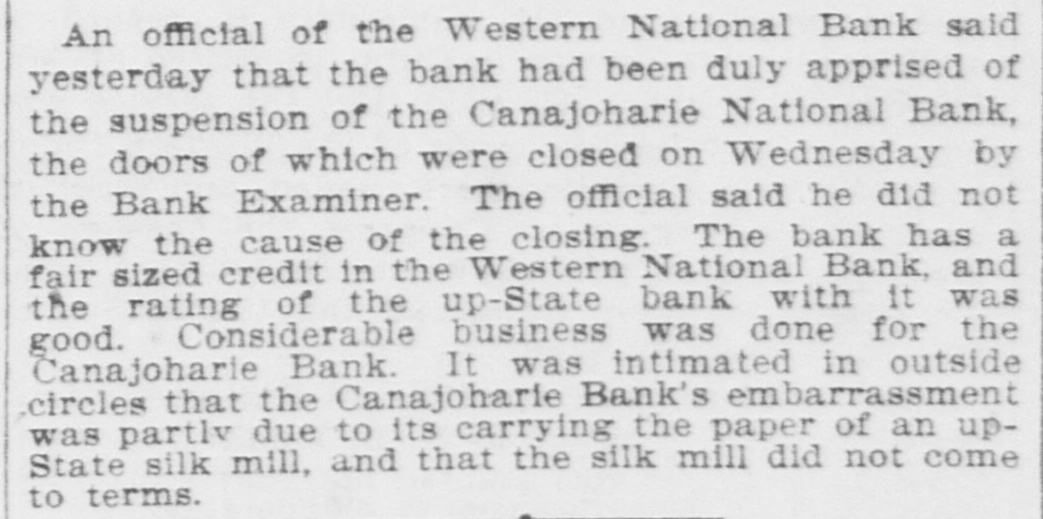
An official of the Western National Bank said yesterday that the bank had been duly apprised of the suspension of the Canajoharie National Bank, the doors of which were closed on Wednesday by the Bank Examiner. The official said he did not know the cause of the closing. The bank has a fair sized credit in the Western National Bank, and the rating of the up-State bank with it was good. Considerable business was done for the Canajoharie Bank. It was intimated in outside circles that the Canajoharie Bank's embarrassment was partlv due to its carrying the paper of an upState silk mill, and that the silk mill did not come to terms.
Click image to open full size in new tab
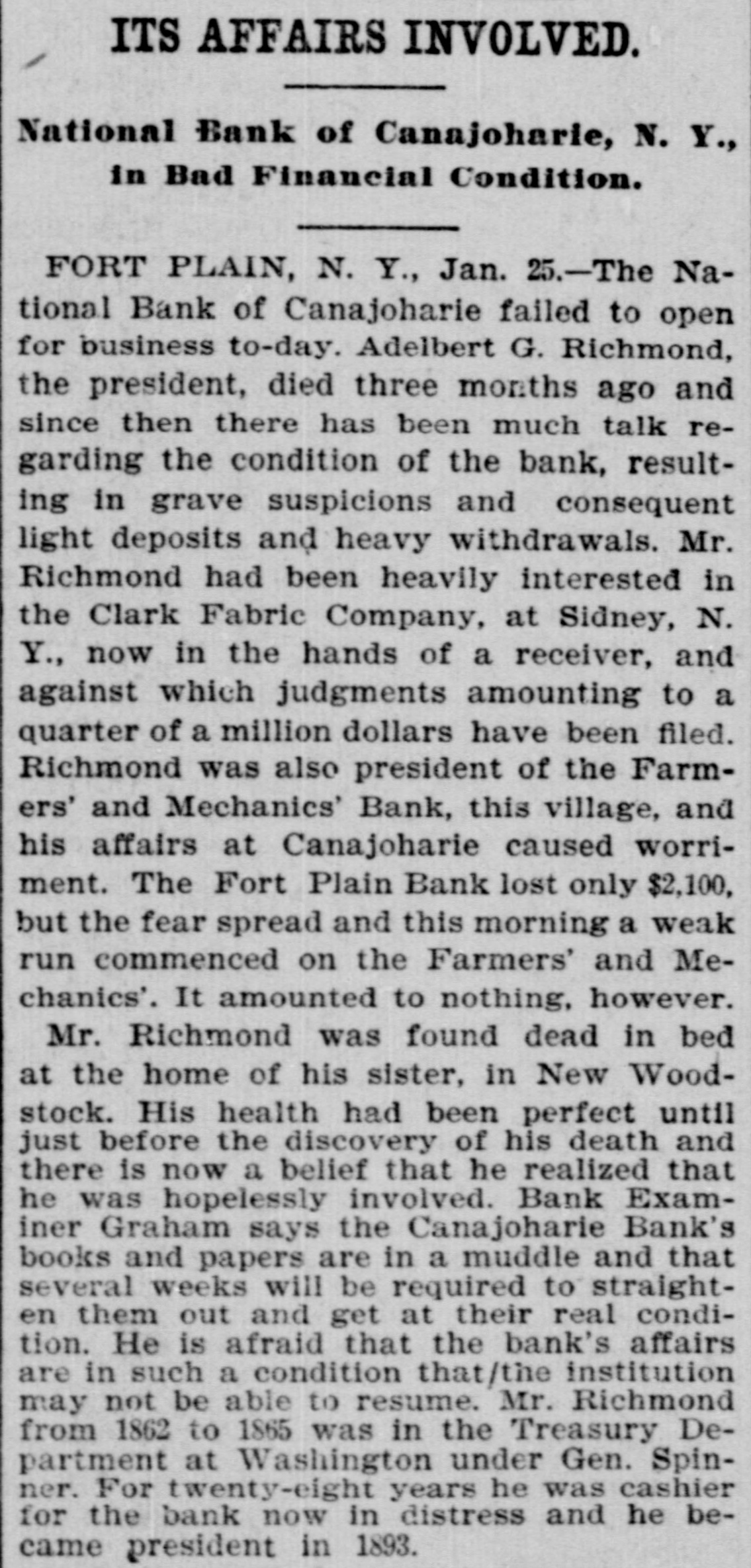
National Bank of Canajoharie, N. Y., in Bad Financial Condition. FORT PLAIN, N. Y., Jan. 25.-The National Bank of Canajoharie failed to open for business to-day. Adelbert G. Richmond, the president, died three months ago and since then there has been much talk regarding the condition of the bank, resulting in grave suspicions and consequent light deposits and heavy withdrawals. Mr. Richmond had been heavily interested in the Clark Fabric Company, at Sidney, N. Y., now in the hands of a receiver, and against which judgments amounting to a quarter of a million dollars have been filed. Richmond was also president of the Farmers' and Mechanics' Bank, this village, and his affairs at Canajoharie caused worriment. The Fort Plain Bank lost only $2,100, but the fear spread and this morning a weak run commenced on the Farmers' and Mechanics'. It amounted to nothing, however. Mr. Richmond was found dead in bed at the home of his sister, in New Woodstock. His health had been perfect until just before the discovery of his death and there is now a belief that he realized that he was hopelessly involved. Bank Examiner Graham says the Canajoharie Bank's books and papers are in a muddle and that several weeks will be required to straighten them out and get at their real condition. He is afraid that the bank's affairs are in such a condition that/the institution may not be able to resume. Mr. Richmond from 1862 to 1865 was in the Treasury Department at Washington under Gen. Spinner. For twenty-eight years he was cashier for the bank now in distress and he became president in 1893.
Click image to open full size in new tab
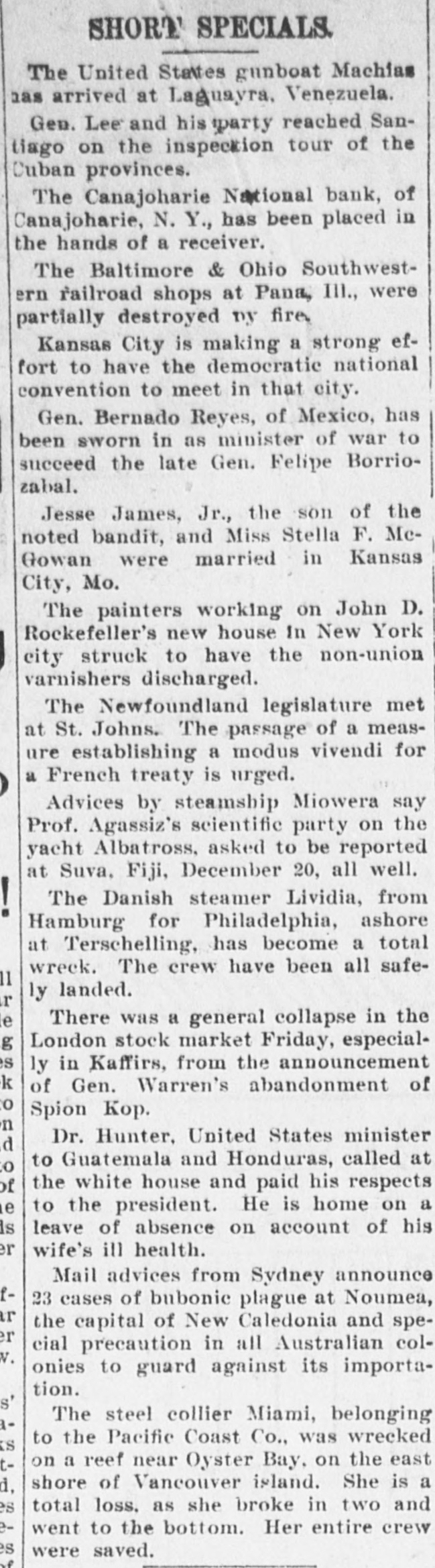
The United Stattes gunboat Machias has arrived at Laguayra, Venezuela. Gen. Lee and his iparty reached Santiago on the inspection tour of the Cuban provinces. The Canajoharie National bank, of Canajoharie, N. Y., has been placed in the hands of a receiver. The Baltimore & Ohio Southwestern railroad shops at Pana, III., were partially destroyed ny fire. Kansas City is making a strong effort to have the democratic national convention to meet in that city. Gen. Bernado Reyes, of Mexico, has been sworn in as minister of war to succeed the late Gen. Felipe Borriozabal. Jesse James, Jr., the son of the noted bandit, and Miss Stella F. MeGowan were married in Kansas City, Mo. The painters working on John D. Rockefeller's new house In New York city struck to have the non-union varnishers discharged. The Newfoundland legislature met at St. Johns. The passage of a measure establishing a modus vivendi for a French treaty is urged. Advices by steamship Miowera say Prof. Agassiz's scientific party on the yacht Albatross, asked to be reported at Suva. Fiji, December 20, all well. The Danish steamer Lividia, from Hamburg for Philadelphia, ashore at Terschelling, has become a total wreck. The crew have been all safe11 ly landed. r e There was a general collapse in the g London stock market Friday, especialS ly in Kaffirs, from the announcement k of Gen. Warren's abandonment of o Spion Kop. n Dr. Hunter, United States minister d to Guatemala and Honduras, called at o the white house and paid his respects of e to the president. He is home on a IS leave of absence on account of his er wife's ill health. Mail advices from Sydney announce f23 cases of bubonic plague at Noumea, ar the capital of New Caledonia and speer cial precaution in all Australian colV. onies to guard against its importation. The steel collier Miami, belonging to the Pacific Coast Co., was wrecked IS on a reef near Oyster Bay, on the east - shore of Vancouver island. She is a d, total loss. as she broke in two and es went to the bottom. Her entire crew es were saved.
Click image to open full size in new tab
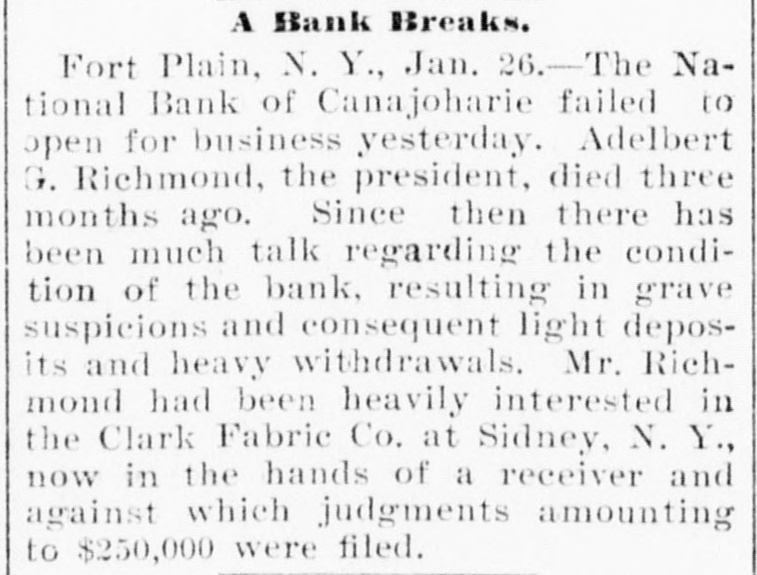
Fort Plain, N. Y., Jan. 26.-The National Bank of Canajoharie failed to open for business yesterday. Adelbert G. Richmond, the president, died three months ago. Since then there has been much talk regarding the condition of the bank, resulting in grave suspicions and consequent light deposits and heavy withdrawals. Mr. Richmond had been heavily interested in the Clark Fabric Co. at Sidney, N. Y., now in the hands of a receiver and against which judgments amounting to $250,000 were filed.

Click image to open full size in new tab
THE oill providing for separate cars for whites and negroes on the railways passed the Virginia Senate without a dissenting vote. The governor's approval is a foregone conclusion. In a collision between a special passenger train and a freight train at Waycross, Ga., fifteen passengers were injured. The Philadelphia coroner's jury found four persons responsible for the death of Miss May Bibighaus in the opium joint. The Canajoharie (N. Y.) National Bank suspended, and E. J. Grabam. national bank examiner, was placed in charge. Six hundred operatives at the American Hide and Leather Company's tanneries in Lowell, Mass., went on strike. James and Amos Pierce were arrested in Chester, Pa., on suspicion of having murdured George B. Eyre. Frederick Lempke, a Christian scientist, committed suicide by thrusting his head into a red hot stove. Six thousand dollars' worth of diamonds was stolen from Joseph K. Davidson & Son in Philadelphia. The third dynamite outrage in Leadville, Col., wrecked the home of A. V. Hunter, the millionaire. Lewis Havens, of Philadelphia, died suddenly in a car at Lenoir, N.C. A fire at Dawson City destroyed 400,000 worth of property. Samuel Peter Meyers was hanged at Somerset. Pa. R. H. Nicholas, a native of Baltimore, and superintendent of the New York, Philadelphia and Norfolk Railroad, died in Philadelphia. Brigadier General Charles W. Squires, a prominent Confederate during the Civil War, died in St. Louis, aged sixty. Judge Wallace, in the United States Court at Albany, concurred with the lower court in refusing to grant a writ of habeas corpus in the case of Captain Oberlin M. Carter, convicted of conspiracy against the government. May Bebehaus, aged nineteen, died in Philadelphia from the effects of smoking opium in den. Julius Bandmann, an old merchant of San Francisco, is dead. John Klonthan died at Berryville, Va., aged seventy-one. Count Boni de Castellane, with his wife, Anna Gould, reached New York, and denied absolutely that he had lost anything in speculations, declaring that he had never speculated in his life. A.P. T. Elder. formerly a publisher in Chicago, plead guilty in the United States Court, that city, to having used the mails to defraud. Clarence W. Robinson was appointed commonwealth's attorney in Newport News, Va., to fill the vacancy caused by the death of J. K. M. Newton. John Potter Stockton, formerly United States senator, who was for years attorney general of New Jersey, died at the Hotel Hanover, in New York. William W. Patch, who during the war saved General Sherman and his staff from capture, died at his home in Galesburg, III. Captain William H. Gibson succeeded Captain Sigsbee as commander of the battleship Texas at the Brooklyn navy yard. J. Edgar Walton was arrested in the Chicago National Bank on a charge of forgery. David Murdock, assistant roadmaster of the Maryland division of the Pennsylvania Railroad at Gray's Ferry, Philadelphia, was killed by a train. The loss by the fire at the winter quarters of the Barnum & Bailey Circus, at Bridgeport, Ct., is estimated at $125,000. Many cars were destroyed. Captain Frederick J. Mills, formerly lieutenant governor of Idaho, who killed J. C. O'Melveney, was acquitted of murder in Salt Lake. Edward Oswald was found guilty of murder in the first degree at Camden, N. J., for billing his wife and six-year-old child. The Delaware, Lackawanna and Western Company began shutting down its coal mines in Pennsylvania. W. J. McConnell, the temperance advocate of Cleveland, died in Philadelphia from excessive use of morphia. John Brown, a notorious chicken thief, was sentenced, in Norfolk, to the penitentiary for ten years. As the result of a family row in New York between the Collettis and the Spinellas three of the Collettis were killed and two of the Spinellas were arrested, the third being a fugitive. The British steamer Sutton, with iron ore, for Philadelphia, was stranded on Fenwick Island Shoals, near Lewes, Del. Boats from the revenue cutter Onondaga rescued the crew. Marshall Waggoner, an infidel who was converted to Christianity, burned his collection of books on infidelity in the furnace of the United Brethren Church at Toledo, O. Rev. Charles Earl Preston, of Jamestown, R.I., who ran away from his wife, was arrested in Troy, N.Y., where he had gone with a young lady of his church. Miss Kate Herbotscheimer, of Princeton, III., was acquitted of the murder of Charles Salzman, to whom she had been engaged to be married. Mrs. Bertha Ruprecht, made despondent by the death of her husband in Batavia, N. Y., made a desporate attempt to commit suicide. The will of Father Chiniquy, the excommunicated priest, who died in Montreal, gives his property to his wife and daughters. Mrs. Anna George, the woman in the Saxton murder case in Cleveland, O., is now a cloak model in New York. Seth Low. president of Columbia College, was also elected president of Barnard College. The Baldwin Locomotive Works is building thirty locomotives for French railways. A report comes from Chicago that as R result of the recent agreements of the trunk line officials, separate city ticket offices will be abandoned in Baltimore, Philadelphia and other cities, and joint offices will be substituted. The tobacco growers of North Corolina have agreed to sell none of their product to the American Tobacco Company for five years. Van Wickle Co., coal miners at

Click image to open full size in new tab
United the of Court rejected the proposition, being unwilling to let the matter go beyond the State courts. The president of a bank which is a depository for Kentucky State funds refused to honor vouchers signed by Governor Taylor, and the warden of the penitentiary refused to release a convict whom Governor Taylor bad pardoned. The militia still guard the capitol grounds and building, with instructions to receive no orders from Goebel. The condition of Goebel continues critical. Gov. Taylor sent a telegram to President MeKinley declaring that he was doubtful of his power to control the situation, and asking that the President recognize him as governor. The funeral train bearing the remains of Major General Lawton, Major Logan and Dr. Armstrong started for the east from San Francisco. While trying to save children from a fire in a parochial school building in St. Louis, Catholic sister perished with one of her little pupils. Former Bink President Charles H. Cole, of the Globe National Bank of Boston, gave bail in $50,000 to answer the charge of embezzlement. The fast passenger train on the Plant sys tem was wrecked near Tampa, Fla. Several passengers were killed and others injured. Miss Filemon D. Genova leaped from the third-story window of a burning tenement in New York and was killed. Mrs. Louisa Schaeffer was killed in Chicago by Nicholas Hotzler, whom she had refused to marry. Fire in the manufacturing district of Dayton, O., caused a loss of $500,000. William Goebel was sworn in as Governor of Kentucky, and J. H. Beckham as lieutenant governor. The Democratic members of the legislature filed a written statement saying they were in favor of seating him, but had been prevented by Governor Taylor. who kept them out of all halls by the military, and issued a proclamation adjourning the legislature to meet in London on February 6. Loriston M. Fairbanks, father of United States Senator Fairbanks, died at Pasadena, Cal. Smallpox is prevalent in the central section of West Virginia. Wade Paugh was frozen to death in Ritchie county, W. Va. The British steamer Marston Moor went ashore off New Inlet, near Cape Hatteras. The Heywood Brothers' chair factory, in New York, was destroyed by fire. The Patternmakers' Union of Chicago has demanded a nine-hour day. Mrs. Fred Reed, of Boonton, N. J., found her rubaway busband near Middletewn, N. Y., and then made the discovery for the first time that she was a stepmother. One man was killed and a dozen others fatally injured by an explosion of a battery of four bollers in the steel department of Phillips, Minnick & Co. mill, in Pittsburg. Jesse Wilson, a colored undertaker of Norfolk, Va., was arrested for burying a threeyear-old child in the same coffin with an unknown woman. W. D. Smith, of Macon, Ga., wassentenced to imprisonment for life for throwing acid into the face of Mrs. Susie Hilliard, permanently blinding her. The union painters and decorators of Newport News, Va., demanded a reduction of one hour per day at the present wages. Former Captain Ike T. Jobe, accused of fraudulently Issuing transportation orders, was captured near Johnson City, Tenn. Luella C. Oakes, of New York, sued her former husband and his present wife for putting her in an insane asylum. Alice Kelly, a bride of three months, went from sleep to death in New York, gas coming through unused pipes. Rev. Dr. Parkhurst, of New York, proposes that saloons shall be allowed to sell beer on Sunday. Henry Noble and his sweetheart were blown from a bridge while driving near Danbury. Ct., during a storm. The Southern Naval Stores Company was chartered in Savannab, Ga., with a capital of $300,000. Major Thomas A. Brander, a prominent ex-Confederate, died at his home in Richmond. The bill providing for separate cars for whites and negroes on the railways passed the Virginia Senate without a dissenting vote. The governor's approval is a foregone conclusion. In a collision between a special passenger train and a freight train at Waycross, Ga., fifteen passengers were injured. The Philadelphia coroner's jury found of four persons responsible for the death Miss May Bibighaus in the opium joint. The Canajoharie (N. Y.) National Bank suspended, and E. J. Graham. national bank examiner, was placed in charge. Six hundred operatives at the American Hide and Leather Company's tanneries in Lowell, Mass., went on a strike. James and Amos Pierce were arrested in Chester, Pa., on suspicion of having murdured George B. Eyre. Frederick Lempke, a Christian scientist, committed suicide by thrusting his head into a red hot stove. Six thousand dollars' worth of diamonds was stolen from Joseph K. Davidson & Son in Philadelphia. The third dynamite outrage in Leadville, Col., wrecked the home of A. V. Hunter, the millionaire. Lewis Havens, of Philadelphia, died suddenly in a car at Lenoir, N. C. A fire at Dawson City destroyed $400,000 worth of property. Samuel Peter Meyers was hanged at Somerset, Pa. R. H. Nicholas, a native of Baltimore, and superintendent of the New York, Philadelphia and Norfolk Railroad, died in Philadelphia. Judge Wallace, in the United States Court at Albany, concurred with the lower court in refusing to grant a writ of habeas corpus in the case of Captain Oberlin M. Carter, convicted of conspiracy against the government.
Click image to open full size in new tab
Jesse Wilson, a colored undertaker of Norfolk, Va., was arrested for burying a threeyear-old child in the same coffin with an unknown woman. W. D. Smith. of Macon, Ga., was sentenced to imprisonment for life for throwing acid into the face of Mrs. Suste Hilliard, permanently blinding her. The union painters and decorators of Newport News, Va., demanded a reduction of one hour per day at the present wages. Former Captain Ike T. Jobe, accused of f udulently issuing transportation orders, was captured near Johnson City, Tenn. Luella C. Oakes, of New York, sued her former husband and his present wife for putting her in an insane asylum. Alice Kelly, a bride of three months, went from sleep to death in New York, gas coming through unused pipes. Rev. Dr. Parkhurst, of New York, proposes that saloons shall be allowed to sell beer on Sunday. Henry Noble and his sweetheart were blown from a bridge while driving near Danbury. Ct., during a storm. The Southern Naval Stores Company was chartered in Savannah, Ga., with a capital of $300,000. Major Thomas A. Brander, a prominent ex-Confederate, died at his home in Richmond. R.H. Nicholas, a native of Baltimore, and superintendent of the New York, Philadelphia and Norfolk Railroad, died in Philadelphia. The bill providing for separate cars for whites and negroes on the railways passed the Virginia Senate without a dissenting vote. The governor's approval is a foregone conclusion. In a collision between a special passenger train and a freight train at Waycross. Ga., fifteen passengers were injured. The Philadelphia coroner's jury found four persons responsible for the death of Miss May Bibighaus in the opium joint. The Cannjobarie (N.Y.) National Bank suspended, and E. J. Graham, national bank examiner, was placed in charge. Six hundred operatives at the American Hide and Leather Company's tanneries in Lowell, Mass., went on a strike. James and Amos Pierce were arrested in Chester, Pa., on suspicion of having murdured George B. Eyre. Frederick Lempke, a Christian scientist, committed suicide by thrusting his head into a red hot stove. Six thousand dollars' worth of diamonds was stolen from Joseph K. Davidson & Son in Philadelphia. The third dynamite outrage in Leadville, Col., wrecked the home of A. V. Hunter, the millionaire. Lewis Havens, of Philadelphia, died suddenly in a ear at Lenoir, N. C. A fire at Dawson City destroyed $400,000 worth of property. Samuel Peter Meyers was hanged at Somerset. Pa.
Click image to open full size in new tab
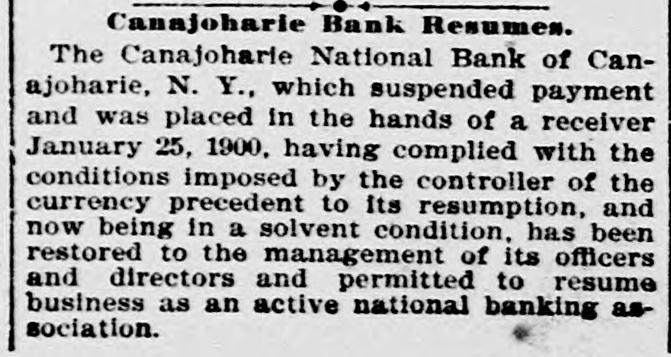
Canajoharie, N. Y., May 11.-The - stockholders of the Canajoharie National Bank, at a meeting today, unanimously voted to reduce the capital stock from $125,000 to $50,000. and to resume business, which has been suspended since January 25. The assessment of 25 per cent on the original stock was all paid in. Controller Dawes will be asked to reopen the bank next week.
Click image to open full size in new tab
The Canajoharie National Bank of Canajoharie, N. Y., which suspended payment and was placed in the hands of a receiver January 25, 1900, having complied with the conditions imposed by the controller of the currency precedent to its resumption, and now being in a solvent condition, has been restored to the management of its officers and directors and permitted to resume business as an active national banking association.
Click image to open full size in new tab
The amount of bonds so far exchanged at the treasury for the new 2 per cent consols is $271,348,850. North York, a hamlet on the line of the Wisconsin Central railroad, was entirely destroyed by fire last night. In a quarrel over children at Scranton, Pa., Mrs. Pace slashed Mrs. Bellows with a butcher knife, perhaps fatally. Near Harrisonburg, Va., Edward Phillips resisted an attempt of Deputy Sheriff Karicobe to arrest him and was shot dead. The Peruvian government has ratifled the resolution of congress approving the extradition treaty with the United States. The directors of the Baltimore and Lehigh railroad yesterday declared a dividend of 2 1/2 per cent on the company's $843,500 capital stock. The Canajoharie National bank, of Canajoharie, N. Y., which suspended payment and was placed in the hands of a receiver Jan. 25, 1900, has resumed business. In unveiling a memorial of Admiral Farragut at Lewes Ferry, Tenn., yesterday Admiral Dewey declared Farragut "the greatest naval commander in the annals of our country."
Click image to open full size in new tab
The National bank of Canajoharie, N. Y., which suspended payment and was placed in the hands of a receiver Jan. 25, 1900, having complied with the conditions imposed by the comptroller of the currency precedent to its resumption and now being in a solvent condition, has been restored to the management of its officers and directors and permitted to resume business.
Click image to open full size in new tab
WASHINGTON, May 16.-The Canajoharie National bank of Canajoharie, N. Y., which suspended payment and was placed in the hands of a receiver Jan. 25, 1900, having complied with the conditions imposed by the comptroller of the currency precedent to its resumption and now being in a solvent condition, has been restored to the management of its officers and directors and permitted to resume business as an active national banking association.
Click image to open full size in new tab
The National bank of Canajoharie, N. Y., which suspended payment and was placed in the hands of a receiver Jan. 25, 1900, having complied with the conditions imposed by the comptroller of the currency precedent to its resumption and now being in a solvent condition, has been restored to the management of its officers and directors and permitted to resume business.
Click image to open full size in new tab
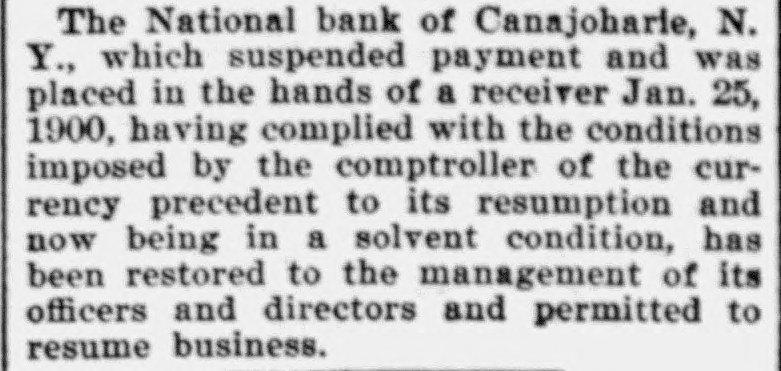
The National bank of Canajoharie, N. Y., which suspended payment and was placed in the hands of a receiver Jan. 25, 1900, having complied with the conditions imposed by the comptroller of the currency precedent to its resumption and now being in a solvent condition, has been restored to the management of its officers and directors and permitted to resume business.