Metropolitan National Bank (New York, NY)

Episode Information

Episode UID
112101013
Episode Type
Run โ†’ Suspension โ†’ Reopening
Bank Type
national
Bank ID
11210 national
Charter Number
1121
Start Date
May 14, 1884
Location
New York, New York (40.714, -74.006)

Metadata

Model
gpt-5-mini (chosen from majority vote of a three-model LLM ensemble)
Short Digest
8bd1e12ea4533ebd

Response Measures

Accommodated withdrawals, Borrowed from banks or large institutions, Clearinghouse loan, Public signal of financial health, Full suspension, Books examined

Clearinghouse involved: Yes (loan, examination, or other measures)

Events (5)

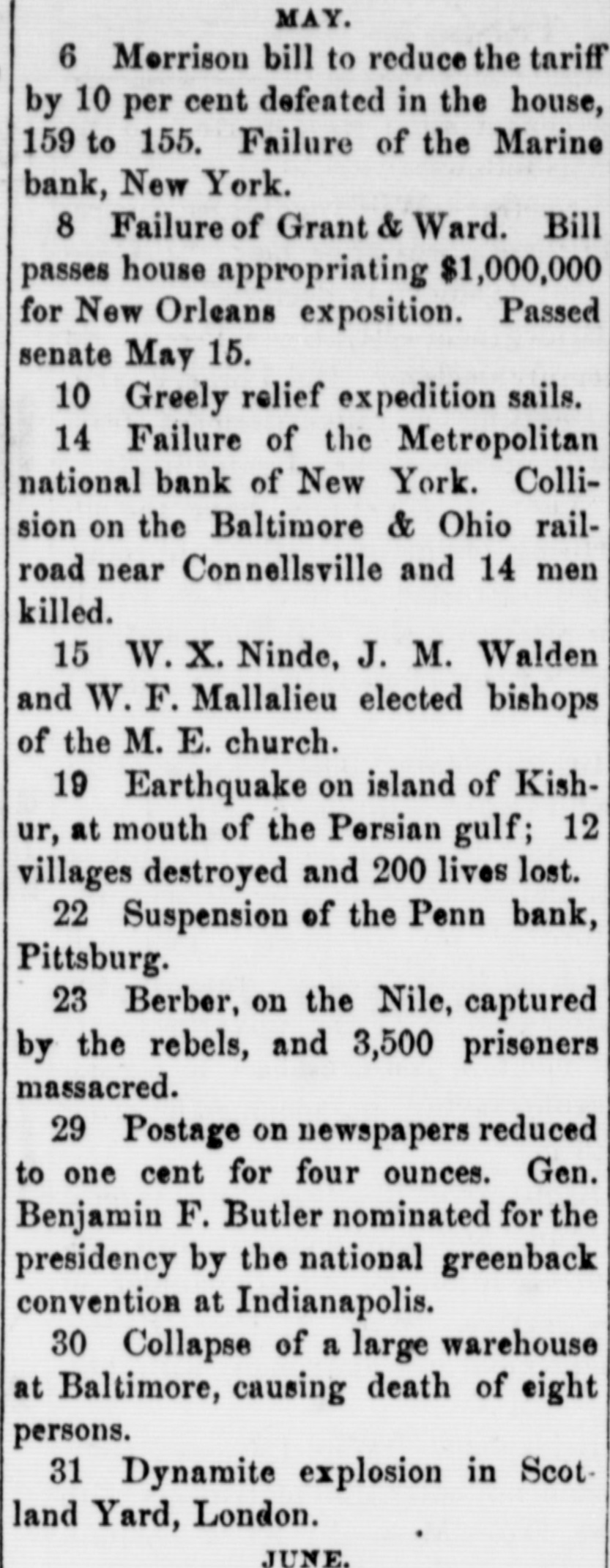
1. May 6, 1865 Chartered
Source
historical_nic
2. May 14, 1884 Run
Cause
Bank Specific Adverse Info
Cause Details
Large loans to Nelson Robinson & Co. and heavy losses of President George I. Seney on railroad investments precipitated loss of confidence and withdrawals.
Measures
Cashier closed doors; Clearing House committee investigated and prepared clearing-house certificates to assist solvent banks.
Newspaper Excerpt
large crowds of depositors were seen in front of the Second National and Metropolitan National, and when the cashier of the Metropolitan slammed down his slide and ordered the doors closed a wild scene of tumultuous confusion and excitement followed.
Source
newspapers
3. May 14, 1884 Suspension
Cause
Bank Specific Adverse Info
Cause Details
Suspension followed runs and was driven by the bank's large exposures to failing brokerages and related loans (Nelson Robinson & Co.) and Seney's losses.
Newspaper Excerpt
The Metropolitan National Bank ... closed its doors. The suspension only temporary ... A committee of the Clearing House investigated the affairs of the bank and it was decided that its assets would justify the resumption of business.
Source
newspapers
4. May 15, 1884 Reopening
Newspaper Excerpt
It will, therefore, open its doors to-day. ... The Metropolitan opened its doors at noon, and other National banks continued receiving deposits and paying checks. The flurry is evidently over.
Source
newspapers
5. November 18, 1884 Voluntary Liquidation
Source
historical_nic

Newspaper Articles (22)

Article from Sacramento Daily Record-Union, May 15, 1884

Click image to open full size in new tab

Article Text

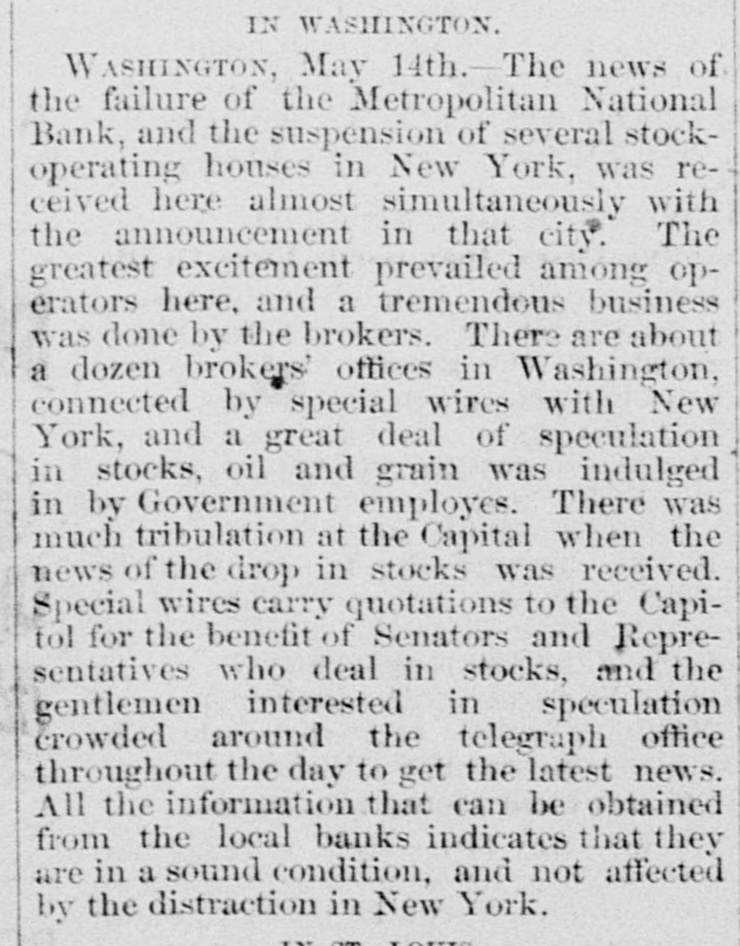
IN WASHINGTON. WASHINGTON, May 14th. The news of the failure of the Metropolitan National Bank, and the suspension of several stockoperating houses in New York, was received here almost simultaneously with the announcement in that city. The greatest excitement prevailed among operators here, and a tremendous business was done by the brokers. There are about a dozen brokers' offices in Washington, connected by special wires with New York, and a great deal of speculation in stocks, oil and grain was indulged in by Government employes. There was much tribulation at the Capital when the news of the drop in stocks was received. Special wires carry quotations to the Capitol for the benefit of Senators and Representatives who deal in stocks, and the gentlemen interested in speculation crowded around the telegraph office throughout the day to get the latest news. All the information that can be obtained from the local banks indicates that they are in a sound condition, and not affected by the distraction in New York.


Article from The Indianapolis Journal, May 15, 1884

Click image to open full size in new tab

Article Text

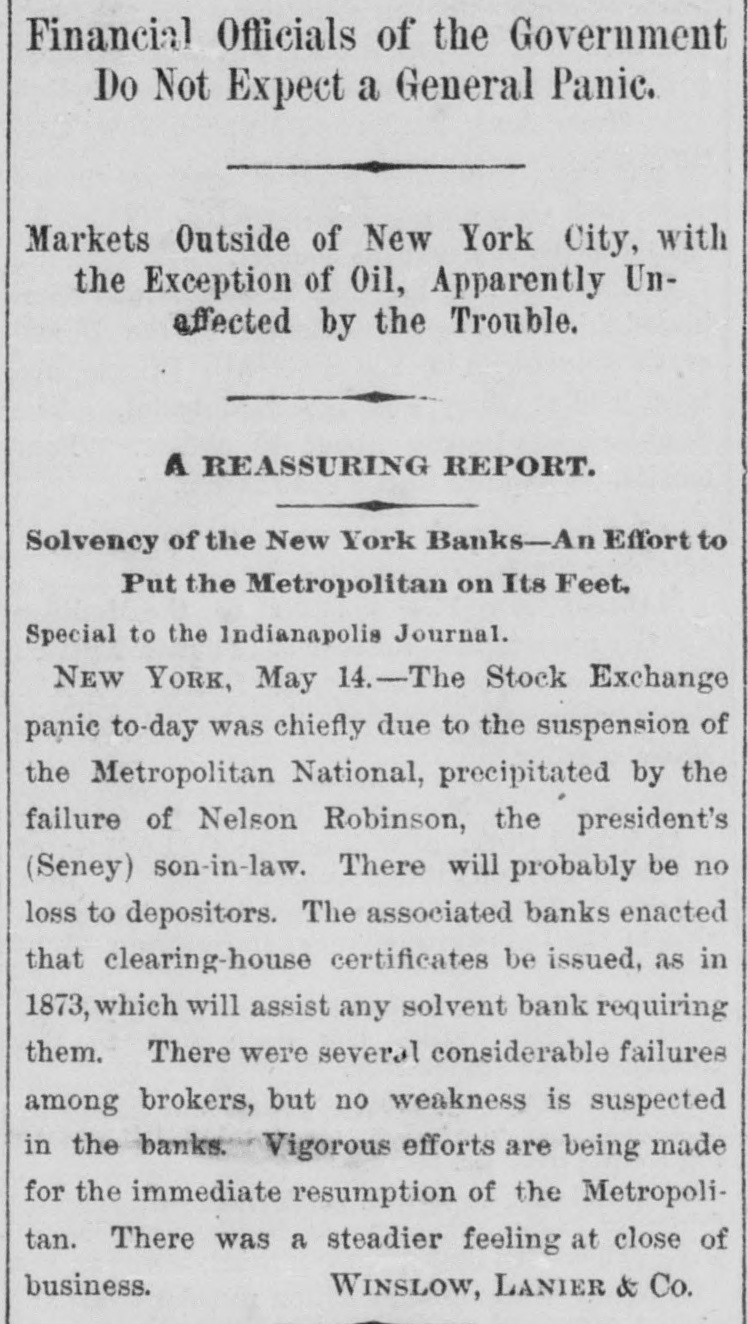
Financial Officials of the Government Do Not Expect a General Panic. Markets Outside of New York City, with the Exception of Oil, Apparently Uneffected by the Trouble. A REASSURING REPORT. Solvency of the New York Banks-An Effort to Put the Metropolitan on Its Feet. Special to the Indianapolis Journal. NEW YORK, May 14. - The Stock Exchange panic to-day was chiefly due to the suspension of the Metropolitan National, precipitated by the failure of Nelson Robinson, the president's (Seney) son-in-law. There will probably be no loss to depositors. The associated banks enacted that clearing-house certificates be issued, as in 1873, which will assist any solvent bank requiring them. There were several considerable failures among brokers, but no weakness is suspected in the banks. Vigorous efforts are being made for the immediate resumption of the Metropolitan. There was a steadier feeling at close of business. WINSLOW, LANIER & Co.


Article from New-York Tribune, May 15, 1884

Click image to open full size in new tab

Article Text

FORCED TO SHUT THE DOORS SEVEN FIRMS AND A BANK SUSPEND. THE CITY STARTLED BY THE CLOSING OF THE METROPOLITAN BANK. THE SUSPENSION ONLY TEMPORARY-GEORGE I. SENEY'S FINANCIAL TROUBLES-FAILURE OF WELL-KNOWN WALL STREET FIRMS. The business community in this and other cities was startled yesterday by the suspension of the Metropolitan National Bank, of which George I. Seney is president. This was due to large loans to the Wall Street firm of Nelson Robinson & Co., which is composed of Mr. Seney's son-in-law and two sons; Mr. Seney has invested so extensively in the securities of various Southern railroads, and of late has suffered so large losses, that he was unable to sustain the firm by the use of his own private resources. A committee of the Clearing House investigated the affairs of the bank and it was decided that its assets would justify the resumption of business. It will, therefore, open its doors to-day. Nelson Robinson & Co. failed with large liabilitiรฉs. O. M. Bogart & Co. also suspended, and these failures were followed by those of Hatch & Foote, Donnell, Lawson & Simpson, Goffe & Randle, J. C. Williams and Hotchkiss, Burnham & Co. These financial troubles caused intense excitement in Wall Street and extremely heavy declines in stocks. Last evening, however, the feeling was general that there would be no serious misfortunes to-day. There was a run on the Second National Bank yesterday, but every demand was promptly and fully met. The Atlantic State Bank of Brooklyn, a correspondent of the Metropolitan Bank, closed its doors.


Article from Daily Yellowstone Journal, May 15, 1884

Click image to open full size in new tab

Article Text

MINUS MILLIONS. New York Stock and Money Markets Shaken with Heavy Failures. Metropolitan Bank and Phoenix Ins. Co. Gone-Sec. Folger Puts up $200,000,000. Telegraph Topics-Cattle Comments-Murder UnavengedLocal Round up. Special Telegram to YELLOW*TONE JOURNAL New York Faitures. New YORK, May 14,-Heavy failures has entised the greatest excitement here to-day that we have had since the panie of 73. New York bankers and stock brokers have gone under and the Metropolitan National bank. one of the oldest in the city has gone into the lintuds of 11 receiver. Among the broken firms and corporations are Bogert & Co., stock brokers; Donnell, Lawson & Co., Bankers, and the Phoenix Insurance Co. The intimate relations of Donnell, Lawson & Co. to the railroads and banks make their failure particularly noticable. Their liabilities will run up into the millions and their fine banking house on Broadway is besieged by a crowd of creditors. The Metropolitan bank was under the presidency of George I. Seney, who has such extensive inter ests in Western lands. The Phonix Insurance Co. is a corporation of Brooklyn with offices in its magnificent building on Broadway, corner of John street. Excited men rushed to fro in the stock exchange and in its vicinity as failure after failure was annonneed from the president's chair and the scene beggared description. The metropolitan bank has been looked upon as one of the staunchest institutions in the country. Secretary Folger has stepped to the front and it is believed will avert a general panie by his determination to take up two hundred millions government bouds before due. This causes some abatement of the excitement.


Article from Delaware Gazette and State Journal, May 15, 1884

Click image to open full size in new tab

Article Text

A the New York After Stock and the at SCoDA one was Stock NEW YORK, May 14 Exchange eitement this morning There intense was Bell stocks partly for the who soon brokers ability to meet their announced their 10.15 m. Nelson, Before sion. Goff & Randall announced Robinson their & At the Stock Exchange there suspendrop in prices of to 54 per compared closing. cent TRYING TO ALLAY FEARS NEW M Bogart YORK, & Co. May 14, Wall street suspension to the have announced their chairman Stock Exchange. of the Stock Exchange The announced Second from the rostrum has just National Bank that the worthy of confidence is solvent and nonnoe Messrs. Nelson. Robinson & Co them that active stocks carried an and yesterday at by ple carrying them good prices books not alarmed they will in loaus show proving that money is obtainable their for them. J.C. Williams, to broker, says in suspended the report that he has refer. annound stocks Several the day. account & under the rule day for his were bought Co. have 11.45 Bogart to John Wheeler assigned $86,000. , Robinson guaranteed preferences by Net New Herald said good this delivery It transpired yesterday that morn the Second there Bank, at No 190 Fifth avenue National of the president, John C. The name and its exient ciated with the defalcation. Eno, not at fixed was Wall street less than $2,000,000. usual, were speculations and losses, irregularities. the alleged cause at office the to The failure of Mr appear brokers yesterday involved difficulties of a the which may unique character succeeds morning, unless lead it to its suspension once. large sum of money at in getting & Eno, father of the young bank Amos owner of the Fifth presider property and is reported Avenue Hotel score of millians. He was to bank meeting of directors of the present close At the eight. stated that the of the meeting loss had been 'made busi the bank would continue HATCH FOOTE SUSPEND NEW Foote YORK, have May 14-11 a. m.-Hatch the Stock announced their suspension account precipitated Exchange. on The refusing to certify of Phenix BANK THE NEW YORK, May 14-11.40 a ropolitan Bank has The doors are shut tight just suspended. THE FINANCIAL SITUATION COMPLICATED FIVE of financial NEW YORK, May 14 SUSPEND complication supplemented by the the past iug the management regard tional Bank, which the Second nation of the in feeling about such president. has brought the that opening financial situation of uncertainty stock the on business morning, it telt that exchange announced another imminent. was Before long one dieaster failure after bad announced their suspension, until five firms Metropolitan National and the its doors. Bank had closed President George most the prominent has been one of Seney has the and exchange speculatora the was rated commercial is likely The failure Hatch & Foote world held firms. they country outside in the individuals in the city Secretary to to take up Washington telegraphed and the of one bonds hundred twenty. The bonds seventh 20th such that further atepa tary promises be taken the present order will sitnation. another $10,000,000. NEW May YORK Wall this street hour from Church people Trinity houses and are many h Wal 1412 30 YORK NEW May street frantic making and are balk prices which This Pacific Misscuri better is There elightly touched 67, Pacific and bonds was Bank $500,006 morn house Co. & Robinson last partners. Metro the clearing Bank $10,977,000 $491,000 deposits, $8,452,000. is con failure Bogart have as they paper commercial in and privileges house solid and streets Broad the Stock Exchange are filled surrounding ing masses and the galleries with the trading room are overlooking manifest tion. The excitement crowded to reple almost sidea unpreced all confusion exchange is business but there little the for show account of business. BUS PANICKY. The situation further failures decidedly panicky is the are looked for. Distrust most prominent banks accounts are carefully feature, scrutinizing and to Bank The Phonix refused certify and Foote Hatch checke their suspension has house the purpose It is the situation peril. which FOLGER. Aub the in p been aud morning the of my Wall ht use all prevent hia limit of extreme authority. THE ith


Article from Savannah Morning News, May 15, 1884

Click image to open full size in new tab

Article Text

THE FINANCIAL SITUATION. Savannah Merchants Not Affected by the Disturbances in Wall StreetOpinions of Leading Firms- What a Prominent Bank Official Said. The announcement yesterday of the failure of the Metropolitan National Bank and other failures in New York, created a flurry in commercial circles in Savannah. A MORNING NEWS reporter, starting in the vicinity of the MORNING NEWS office, called upon the leading business firms likely to be affected by the crash. Mr. S. Guckenheimer, of the firm of S. Guckenheimer & Son, Nos. 149 and 151 Bay street, was asked whether the financial developments during the past two or three days in New York would cause any embarrassment in Savannah. Mr. Guckenheimer smiled and remarked: "No one that I know in Savannah will suffer, principally because there is not much of a speculative spirit among Savannah merchants, who rely more on doing a substantial and legitimate business. There may be one or two gentlemen in the city who keep a small deposit in the Metropolitan Bank, but beyond that I do not think any one will be hurt. I know that I am all right and that my four mules out in the street there will continue to pull as steady as ever. My idea is that the failures will be confined principally to Wall street." Messrs. Bendheim Bros. & Co. said: "We hold a check for a small sum on the the Metropolitan National Bank, but the check would be good as gold for its full value, even if the bank should go as high as a kite. We are not hurt by the failure." Messrs. Herman & Kayton were then interviewed. Mr. Kayton said: "The failnre or suspension will have a good effect, and will make business men more cautious. I know our bu ess will not be affected by it. and I do not know any one in Savannah who can be embarrassed. The whole thing is confined to Wall street, and cannot affect Savannah unless the panic should become general. Everybody in this section of the country is doing what is called a safe business. Trade has been comparatively dull for some time, and there has not been such a great demand for money here for moving crops, etc. Hence the effect of the failure will be limited to a few speculators. The people in New York have been speculating, and now there is an ordering up of accounts among them. Few who do a legitimate business exclusively will suffer even there. One of the most prominent bank officials of the city was called upon and signified his willingness to converse upon the subject, but said that his name must not be used. "The failures are not calculated to affect any interest in this city that I am aware of," said he. "The bank of which I am one of the representatives has no account with the Metropolitan National. 1 think the financial disturbance will be confined to Wall street, and I do not recognize any existing circumstances in the run of business here by which any bank of this city or cotton firm could be affected. especially at this season of the year. The only interest that would likely to be affected is the naval stores, because that trade is continued into the summer. Yet none of the houses in Savannah may have any connection with the institutions that have gone under during the past day or two." "Is there any probability that the financial disturbance will become general?" "I can see no reason why it should." The reporter happened to see the last issue of the Bankers' Almanac, January 1, 1884, and found that no bank or banker in Georgia kept an account with either the Marine or the Metropolitan National Bank of New York. He also ascertained that no bank in South Carolina kept an account in either of those banks, and but one in Florida. Messrs. John Judge, No. 102 Bay street, and J. Willis Moore, manager of the Messrs. Chess Carley Company in this city, were called upon. Mr. Judge is identified with the naval stores trade here. He and Mr. Moore both said that they were quite positive that none of the dealers or manufacturers of naval stores in this vicinity kept an account in either of the banks. They were not prepared to say whether the financial breaks would become general, but they were rather inclined to believe that the effect of the failures would be limited to speculators in New York. Mr. Joseph J. Wilder said: "The failures cannot injure any interest in the South unless it may be that of the East Tennessee, Virginia and Georgia Railroad, which has done SO much to injure Savannah. The crippling of that railway may result in a benefit to Savannah indirectly through the Central Railroad. The East Tennessee, Virginia and Georgia road is controlled by Northern capitalists, prominent among whom is Mr. George I. Sesney. I do not think that the failures will lead to an extended financial complication."


Article from New-York Tribune, May 15, 1884

Click image to open full size in new tab

Article Text

NEW-YORK DAILY TRIBUNE, THURSDAY, MAY 15, 1884. b when they were surprised by this tumble, they could not Steamship Company, 100; Western Union. 300; and a lay their hands on them for negotiation. Then the failures Northwest common, 100. d of the Marine and Metropolitan National Banks have proThe sales for Goffe & Randall were: Union Pacific, 11 voked a feeling of insecurity, and this morning, when the 1,100 shares; Delaware, Lackawanna and Western,1,000; n latter institution closed its doors, the brokers' customers Lake Erie and Western, 100: New- York, Lake Erie and came to them in flocks and demanded their collaterals. Western, 100; New-York Central, 400; Oregon TransThe firms were not all in a position to respond, and, in continental, 700; Western Union, 200; and West consequence, they were obliged to suspend. Shore, 10. Wasthe number of stocks sold under the rules for sus. B pended firms larger than you have known on the Ex-' MR. SAGE'S "PUTS AND CALLS." change? No. comparatively moderate. I fail to find any indicaA large amount of stocks was "put" to Rustion in this trouble to make me believe that there is anyit sell Sage on his privileges yesterday. When the thing in It more than a temporary inconvenience. ToB hour of 1:45 (the usual hour) came the morrow :I think you will not notice that anything unusual has occurred in the Exchange. w receiving of stocks was stopped promptly. A long Do you regard the condition of the Second National 0 line of clerks and "put and call" brokers with Bank as serious! tl Not a bit of it. That bank is as sound as a rock. and stocks in their hands was still in front I I doubt very much If you will hear of any other banks of the window and some of them complained loudly be. getting into trouble for some time. 81 cause they had reached the office before the ex. Did the failures to-day affect your firm in any way? b No, not in the least. piration of the hour. Mr. Sage gave them to


Article from The Indianapolis Journal, May 16, 1884

Click image to open full size in new tab

Article Text

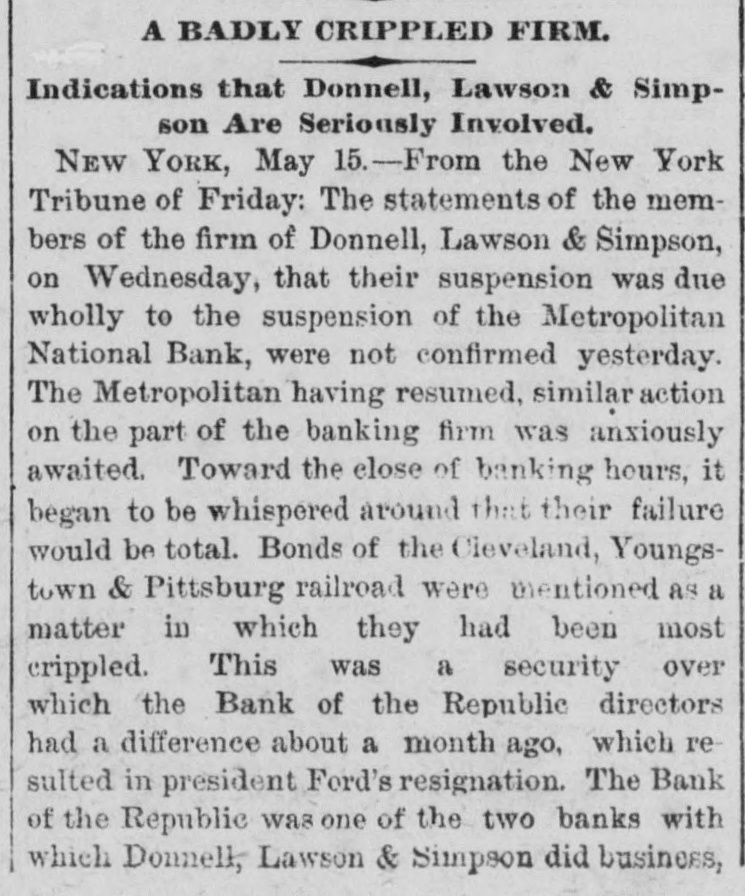
A BADLY CRIPPLED FIRM. Indications that Donnell, Lawson & Simpson Are Seriously Involved. NEW YORK, May - From the New York Tribune of Friday: The statements of the members of the firm of Donnell, Lawson & Simpson, on Wednesday, that their suspension was due wholly to the suspension of the Metropolitan National Bank, were not confirmed yesterday. The Metropolitan having resumed, similar action on the part of the banking firm was anxiously awaited. Toward the elose of banking hours, it began to be whispered around that their failure would be total. Bonds of the Cieveland, Youngstown & Pittsburg railroad were mentioned as a matter in which they had been most crippled. This was a security over which the Bank of the Republic directors had a difference about a month ago, which resulted in president Ford's resignation. The Bank of the Republic was one of the two banks with which Donnell, Lawson & Simpson did business,


Article from Iowa County Democrat, May 16, 1884

Click image to open full size in new tab

Article Text

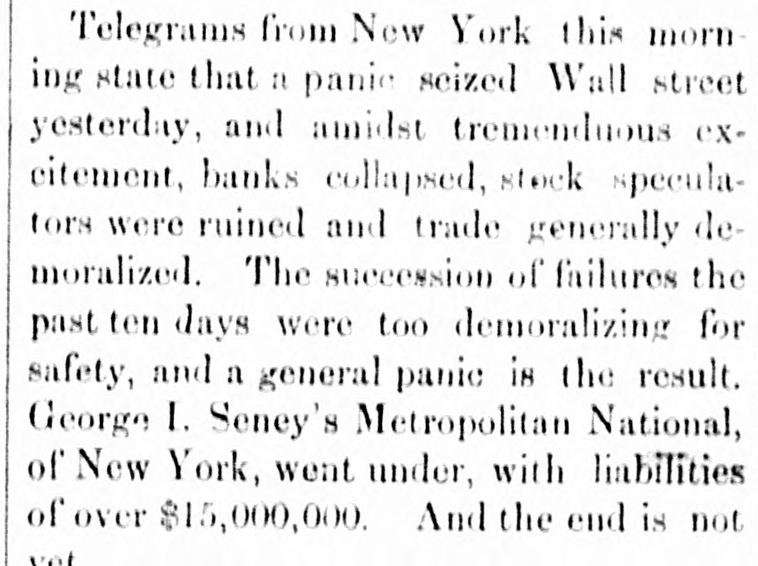
A PANIC ON WALL STREET. Wall Street, New York, -was the scene of a serious panic on Wednesday. The Chicago Times of Thursday morning says: The announcement yesterday morning that John C. Eno, president of the Second National bank of New York was a defaulter for nearly $2,000,000 was sufficient to pave the way for a serious panic in Wall street. In the wild rush to sell securities prices opened from one to five points lower, and dropped at a frightful rate of speed. Within a few minutes the suspensions were announced on the stock exchange of Hatch & Foote and O. M. Bogert & Co., heavy banking houses, and of J. C. Williams, Goff & Randall, and N. Robinson & Co., brokers. Next came the failure of the Metropolitan National bank, with a capital of $3,000,000, whose president is Geo. I. Seney, promoter of the NickelPlate road, whose losses in the Ohio Central and East Tennessee roads are believed to be very heavy. A run commenced on the Second National bank, where depositors soon found that James A. Trowbridge had been elected president; that the defalcation of J. C. Eno had been promptly paid up by his father, and that the bank examiner pronounced the institution sound. By noon every foot of room in Wall street for ten blocks was occupied by an excited crowd, among them being many ladies. Secretary Folger happened to be in New York and ordered the immediate payment of the last call for bonds, in the hope of easing the monetary stringency produced by the panic, as currency commanded 1 per cent. per diem. Before the stockexchange closed the suspensions were announced of Hotchkiss & Burnham and of Donnell, Lawson & Simpson. Later in the afternoon the Atlantic State bank of Brooklyn with a capital of $2,000,000 closed its doors. The event of the morning drove St. Paul preferred, Northwestern common, and Pulman stock to par, knocked Michigan Central 12 points, forced Union Pacific to 39 and Western Union to 49. The total transaction were 630,000 shares. The petroleum markets in the Pennsylvania cities were driven down ten points, with but little recovery. July wheat in Chicago at one time showed a decline of 41 cents from Tuesday's highest figures, but most of the loss was regained. Charles M. Bayard, a stock-broker in Philadelphia, suspended payment. In Boston large blocks of Mexican Central bonds and Atchison stock was flung on the market, causing a drop of from tive to seven points. In London, Louisville and Nashville stock fell nine points, and other American securities showed a corresponding decrease in value. No Chicago bank or individual seems to have been effected by the exciting events of the day.


Article from Wood River Times, May 16, 1884

Click image to open full size in new tab

Article Text

A FLURRY IN WALL STREET. Several Heavy Failures, but None Materially Affecting Idaho. Day before yesterday several heavy failures occurred in New York City, a general depreciati in of values set in, money commanded three per cent. per day, in addition to the regular rate of interest, and things looked decidedly panicky, until the United States Treasurer stepped in the breach, offering $11,000,000 in coin at once, and as much more if necessary. The Clearing House Association, which includes all the best banks in the city, also determined to stem the tide by offering assistance to the embarrassed banks. The market thereupon rallied, and a disastrous panic was prevented. But one of the suspended institutions had extensive connections west of the Rocky Mountains-Donnell, Lawson & Simpson. Harkness & Co. and Guthrie, Dooley & Co., of Ogden; J. T. Morgan & Co., of Blackfoot and Ketchum; Donnell, Clark & Larrabee, of Butte and Deer Lodge, Montana; are all former or present correspondents of Donnell, Lawson & Simpson, of New York, and probably had funds there. But they will doubtless not lose anything by the suspension, as Mr. Donnell is a man of vast wealth, with property scattered all over the United States, and the suspension of his New York bank will undoubtedly be only temporary. No other Idaho banks are believed to be involved. The flurry, even though it should degenerate into a panic (which is very improbable), will not complicate matters here, as money has been too scarce to admit of the taking of any dubious risks by the local banks,and the mines are all down to the bedrock basis of merit. The Philadelphia Smelting Company, of Ketchum, is the only one of our prominent enterprises that is at all heavily involved, and that company is being carried by one of its Philadelphia stockholders who is worth many millions, and who makes a specialty of gilt-edged securities. He is therefore abundantly able to take care of the smelting company. THE FLURRY OVER. Aron Morris received a dispatch, to-day, stating that the Metropolitan National Bank had resumed, and that Donnell, Lawson & Simpson would resume in a day or two. The flurry IS evidently over.


Article from The Dillon Tribune, May 17, 1884

Click image to open full size in new tab

Article Text

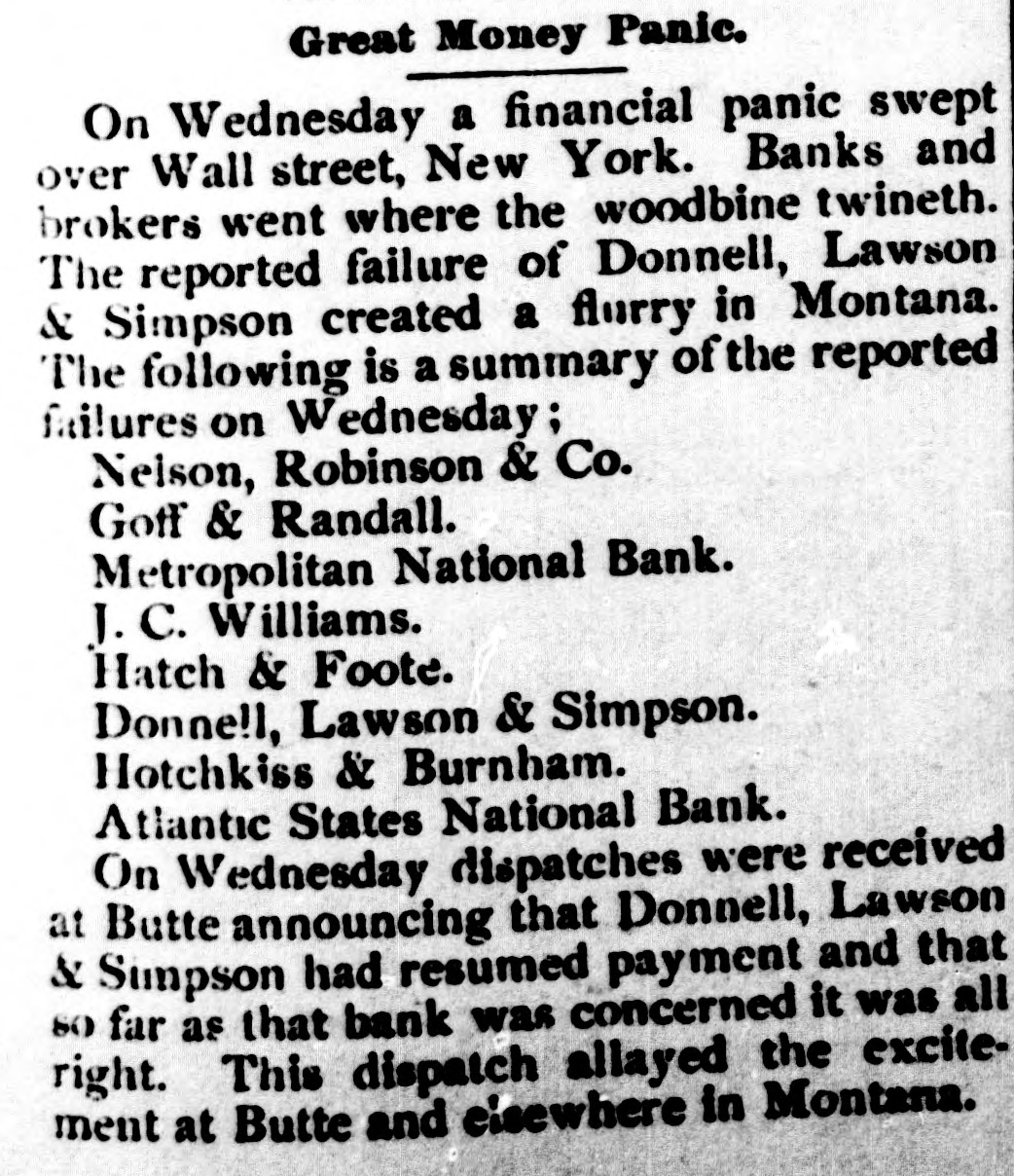
Great Money Panic. On Wednesday a financial panic swept over Wall street, New York. Banks and brokers went where the woodbine twineth. The reported failure of Donnell, Lawson & Simpson created a flurry in Montana. The following is a summary of the reported failures on Wednesday; Neison, Robinson & Co. Goff & Randall. Metropolitan National Bank. 1. C. Williams. Hatch & Foote. Donnell, Lawson & Simpson. Hotchkiss & Burnham. Atlantic States National Bank. On Wednesday dispatches were received at Butte announcing that Donnell, Lawson & Sunpson had resumed payment and that so far as that bank was concerned it was all right. This dispatch allayed the excitement at Butte and elsewhere in Montana.


Article from The Canton Advocate, May 22, 1884

Click image to open full size in new tab

Article Text

The great break of last Wednesday on Wall street has in a measure subsided, and the flurry being over, confidence has been partially restored. At the opening of business on "black Wednesday" an impending disaster seemed to hover over the minds of the stock gamblers on Wall and Broad streets, the mammoth failures of the few days previous having the effect of multiplying four-fold the fears of a financial crash. Soon after one o'clock large crowds of depositors were seen in front of the Second National and Metropolitan National, and when the cashier of the Metropolitan slammed down his slide and ordered the doors closed a wiid scene of tumultuous confusion and excitement followed. At the stock exchange continuous announcements of failures of smaller firms were being made, and when the suspension of the Metropolitan was made known, complete disaster seemed to stare everybody in the face. The brokers were a struggling, howling mass, and the galleries were ordered emptied. The day throughout was one of continuous and almost unprecedented confusion, and when the gong of the stock exchange sounded, one of the most exciting days in the history of that institution closed. The net result of the day was the suspension of the Metropolitan Bank, the Atlantic State Bank of Brooklyn, the failure of sixteen broker firms, a depreciation of values to the extent of tens of millions, and an advance in money to 3 per cent per diem. Of the brokers but two were large houses, those of Hatch & Foote. and O. M. Bogart & Co., The wild excitement of Wednesday was continued the next day in about the same manner, and the extravagant scenes of the previous day were repeated. There was a failure in the morning which startled the operators for a moment, a great scramble for money all day, feverish flucnation in prices, and an approach to a settled feeling when, just as the brokers finished their work, a startling disaster in the failure of Fisk & Hatch stamped upon the hopes for the best and set the market on a rattling down pace, which stopped only when the gong sounded at 3 o'clock. The net results for Thursday were the failure of Fisk & Hatch, A. W. Dimick & Co., and several brokers with capital of less than a million dollars. The Metropolitan opened its doors at noon, and other National banks continued receiving deposits and paying checks. People were gradually returning to their senses, and foreign orders for stock caused a better feeling. On Friday the superstitious crash that was expected failed to culminate, and outside of a few failures at Boston, New York and Chicago nothing startling occurred to mar the fancied serenety of the financial horizon. The panic is over, and eastern capitalists who have been investing their means in watered stock and sky-rocket securities will turn their attention to western fields where speculation in deeded farms on Dakota's fertile plains will reap for them a surer harvest than wild-cat speculation in the financial center of the nation. The Wall street disturbance will be productive of great good to Dakota, and more hard cash will be put into circulation in the Sioux valley as a natural result.


Article from The Iowa Plain Dealer, May 22, 1884

Click image to open full size in new tab

Article Text

NEWS CONDENSED. Concise Record of the Week. EASTERN. The wildest excitement New York has known since the Jay Cooke fa'lure in September, 1873, prevailed in Wall street on Wednesday, the 14th Inst. Thousands of brokers and bankers were at their offices two hours earlier than usual, and immediately upon the opening of the Stock Exchange great uneasiness became manifest. The galleries and the floor were packed, and before business bad fairly started some one yelled out: "The Second National and the Metropolitan have gone up!" The scene that followed beggars all description. Pandemonium reigned, and roar after roar from excited men put a stop to trading. Messenger boys dashed hither and thither. calling out in shrill, excited tones names familiar in financial circles, adding to the wild scene. At an early hour the failure of J. C. Williams was announced. and in the next breath came the failure of the old house of O. M. Bogart. Again and again the surging crowd yelled, and were answered by excited thousands in Broad and Wall streets and Exchange place. Fail. ure after failure was announced in rapid succession, each collapse causing a fresh renewal of the excitement. The cu:mination was reached, however, when the vast exchange received proclamation of the ruin of Hatch & Foote, the greatest brokerage house on the street. The crowd scemed stunned for an instant, when a great wail of distress shook the building. They knew that a great panic had struck the street, and looked at each other in helpless amazement "Secretary Folger is at the Treasury building and will help us," rang out a clear strong, steady voice close to the Chairman's desk, and Immediately deafening cheers rang out through the building and were taken up and repeated upon the street. Many leading members rushed over to the Treasury building. found Judge Folger seated on the railing about Washington's statute, and received from him assurances that the Government would do everything in its power to help the street. This good news was carried back to the Exchange and produced a marked effect. Comparative quiet was restored, and operators began to look about and calcu ate the damage produced by the financial cyclone. It was found that two national banks, with a capital of $3,000,000 and $2,000,000, respectively, and eight of the largest brokerage firms in the city had collapsed: that stocks had declined as they were never known to decline before, and that the prices of produce had also greatly shrunk. An improved feeling was noted at the opening of the New York Stock Exchange on the 15th inst., until the failureof A.W. Dimock & Co.-the senior member of the firm is President of the Bankers and Merchants' Telegraph Company-was announced. The securities grew weaker. and again rallied when the Metropolitan National Bank resumed. At the latter bank, as well as at the Second National, many deposits were withdrawn. but the money was promptly paid. About fifteen minutes before the close of business the failure of Fisk & Hatch was announced, causing a sensation, as Mr. Hatch is President of the Stock ExchangeThen prices tumbled, and the market closed in a chaotic condition. No serious disturbances were reported throughout the country, the feeling prevailing that the storm could be weathered. In London and other European trade centers there was some excitement. and a fall in values of American securities was noticed. George I. Seney resigned the Presidency of the New York Metropolitan Bank, and Henry L. Jacques was chosen for the position. In the Stock Exchange on the 16th inst. values opened lower and unsettled, but before the first call a steadier feeling manifested itself, an advance of 1 to 2ยฝ per cent. being noted. Then the failure of H. C. Hardy & Sons was announced, when values again sagged off, and the list dropped still further when it became known that the Newark Savings Institution had closed its doors. After this, confidence began to return. there Leing heavy purchases of stocks for foreign shipment. Before the close a dread of further failures resulted in a feverish feeling. which passed away rapidly when no disasters occurred, and the market closed in a "whirl of buoyaney" unknown for a long time. Call loans dropped from 1ยฝ per cent. per diem to 5 to 6 per cent. per annum, and large amounts of money were received from the country. The feeling of confidence was enhanced by the Bank of New York loaning $3,000,000 on Government bonds, and by the issuance of $5,000,000 certificates by the Clearing House. Closing deals indicated an


Article from The Rock Island Argus, May 23, 1884

Click image to open full size in new tab

Article Text

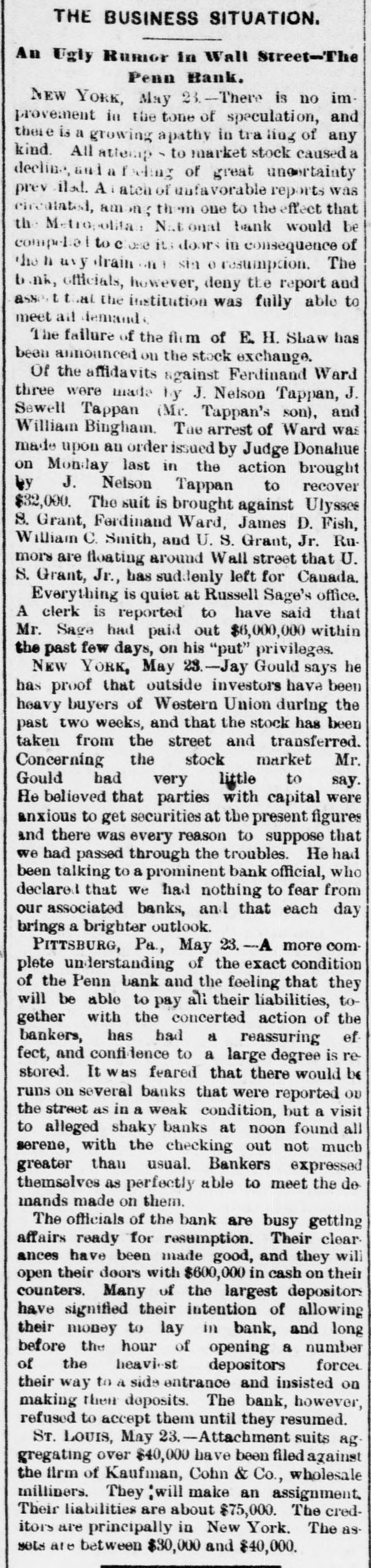
THE BUSINESS SITUATION. An Ugly Rumior in Wall Street-The Penn Bank. NEW YORK, May 23.-There is no im provement in the tone of speculation, and there is a growing apathy in tra ling of any kind. All attemp to market stock caused a decline, and a eding of great uncertainty prev ilsd. A atch of unfavorable reports was circulated, among them one to the effect that th Metropolita: National bank would be competal to close it: doors in consequence of the avy drain .11 sin o resumption. The bank, officials, however, deny the report and assettial the institution was fully able to meet all demand The failure of the firm of E. H. Shaw has been announced ou the stock exchange. Of the affidavits against Ferdinand Ward three were made by J. Nelson Tappan, J. Sewell Tappan (Mr. Tappan's son), and William Bingham. The arrest of Ward was made upon an order issued by Judge Donahue on Monday last in the action brought by J. Nelson Tappan to recover $32,000. The suit is brought against Ulysses S. Grant, Ferdinand Ward, James D. Fish, William C. Smith, and U. S. Grant, Jr. Rumors are floating around Wall street that U. S. Grant, Jr., has suddenly left for Canada. Everything is quiet at Russell Sage's office. A clerk is reported to have said that Mr. Sage had paid out $6,000,000 within the past few days, on his "put" privileges. NEW YORK, May 23.-Jay Gould says he has proof that outside investors have been heavy buyers of Western Union during the past two weeks, and that the stock has been taken from the street and transferred. Concerning the stock market Mr. Gould had very little to say. He believed that parties with capital were anxious to get securities at the present figures and there was every reason to suppose that we had passed through the troubles. He had been talking to a prominent bank official, who declared that We had nothing to fear from our associated banks, and that each day brings a brighter outlook. PITTSBURG, Pa., May 3.-A more complete understanding of the exact condition of the Penn bank and the feeling that they will be able to pay ali their liabilities, together with the concerted action of the bankers, has had a reassuring ef fect, and confidence to a large degree is restored. It was feared that there would be runs on several banks that were reported on the street as in a weak condition, but a visit to alleged shaky banks at noon found all serene, with the checking out not much greater than usual. Bankers expressed themselves as perfectly able to meet the do mands made on them. The officials of the bank are busy getting affairs ready for resumption. Their clear ances have been made good, and they will open their doors with $600,000 in cash on their counters. Many of the largest depositors have signified their intention of allowing their money to lay in bank, and long before the hour of opening a number of the heaviest depositors force their way to a side entrance and insisted on making then deposits. The bank, however, refused to accept them until they resumed. ST. LOUIS, May 23.-Attachment suits ag gregating over $40,000 have been filed against the firm of Kaufman, Cohn & Co., wholesale milliners. They :will make an assignment, Their liabilities are about $75,000. The creditors are principally in New York. The assets are between $30,000 and $40,000.


Article from The Times, May 23, 1884

Click image to open full size in new tab

Article Text

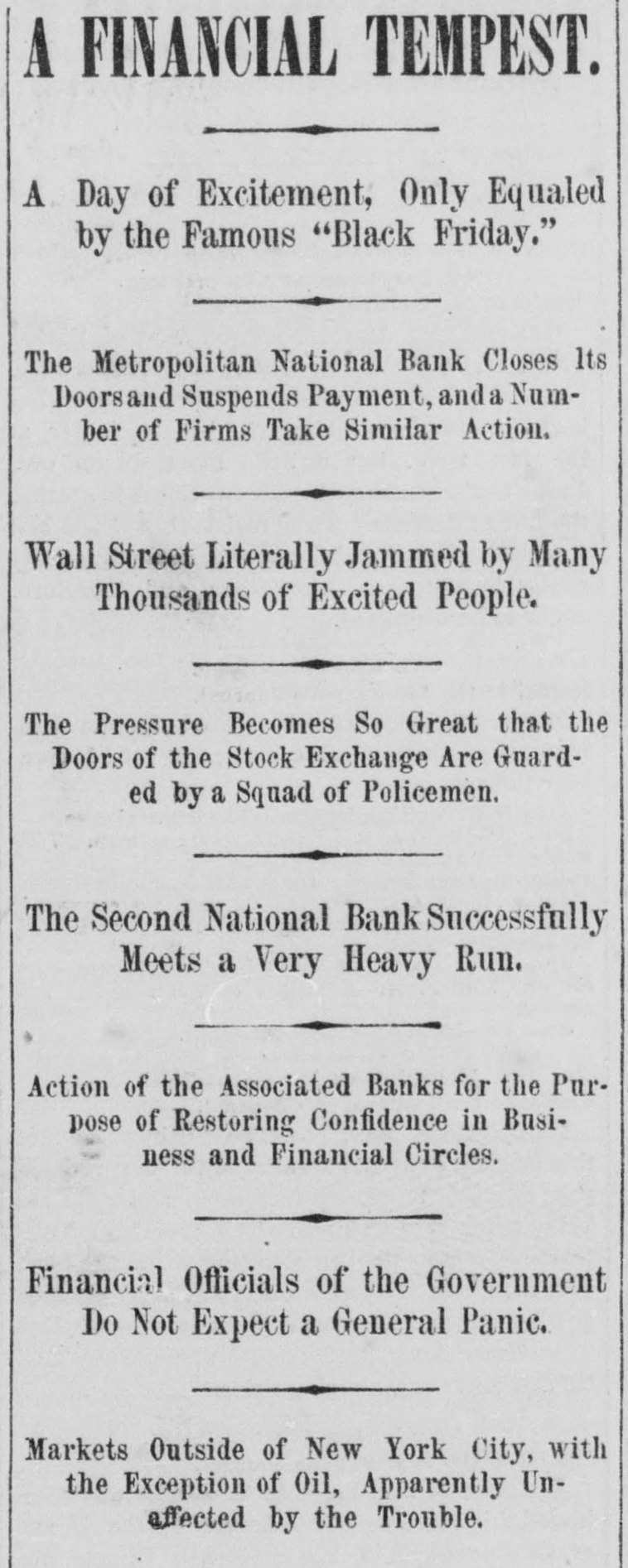
WALL STREET PANIC. A TUMBLE IN STOCKS, AND FIRM AFTER FIRM FORCED TO SUSPEND. The announcement Wednesday morning that John C. Eno, president of the Second National bank of New York, was a defaulter for nearly $2,000,000 was sufficient to pave the way for a serious panic in Wall street. In the wild rush to sell securities prices opened from one to five points lower, and dropped at a frightful rate of speed. Within a few minutes the suspensions were announced on the stock-exchange of Hatch & Foote and O. M. Bogert & Co., heavy banking-houses, and of J. C. Williams, Goff & Randall, and N. Robinson & Co., brokers. Next came the failure of the Metropolitan National bank, with a capital of $3,000,000, whose president is George I. Seney, the promoter of the Nickel-Plate road, whose losses in the Ohio Central and East Tennessee roads are believed to have been very heavy. A run commenced on the Second National bank, where depositors soon found that James A. Trowbridge had been elected president; that the defalcation of J. C. Eno had been promptly paid up by his father, and that the bank examiner pronounced the institution sound. By noon every foot of room in Wall street for ten blocks was occupied by an excited crowd, among them being many ladies. Secretary Folger happened to be in New York and ordered the immediate payment of the last call for bonds, in the hope of easing the momentary stringency produced by the panic, as currency commanded 1 per cent. per diem. Before the stock-exchange closed the suspensions were announced of Hotchkiss & Burnham and of Donnell. Lawson & Simpson. Later in the afternoon the Atlantic State bank of Brooklyn, with a capital of $2,000,000 closed its doors. The events of the morning drove St. Paul preferred, Northwestern common, and Pullman stock to par, knocking Michizan Central 12 points, forced Union Pacific to 39 and Western Union to 49. The total transactions were 630,000 shares. The petroleum markets in the Pennsylvania cities were driven down ten points, with but little recovery. July wheat in Chicago at one time showed a decline of 41 cents from Tuesday's highest figures, but most of the loss was regained. Charles M. Bayard, a stock-broker in Philadelphia, suspended payment. In Boston large blocks of Mexican Central bonds and Atchison stock were flung on the market, causing a drop of from five to seven points. On Thursday the resumption of business by the Metropolitan National bank of New York, under the presidency of Henry L. Jacques, gave a strong impetus to the stock market. There was no wild enthusiasm over Wabash or Denver, but such properies as ordinarily do something for their owners were in brisk demand at better orices. The announcement of the failare of A. W. Dimock & Co., promoters of the Bankers' and Merchants' Telegraph company had but little effect on the howling crowd of brokers on the stock-exchange. Parties deeply interested scattered over the country the statement that foreign bankers were hungry for American securities, and quotations were marked up rapidly unil the famine was appeased. Money ruled firm at 12 per cent. per annum. A sharp decline in government bonds out the speculative fraternity on their guard, and just before the close of business prices were smashed from one o five points by the collapse of Fisk & Hatch, the heaviest dealers in federal securities.


Article from New-York Tribune, May 25, 1884

Click image to open full size in new tab

Article Text

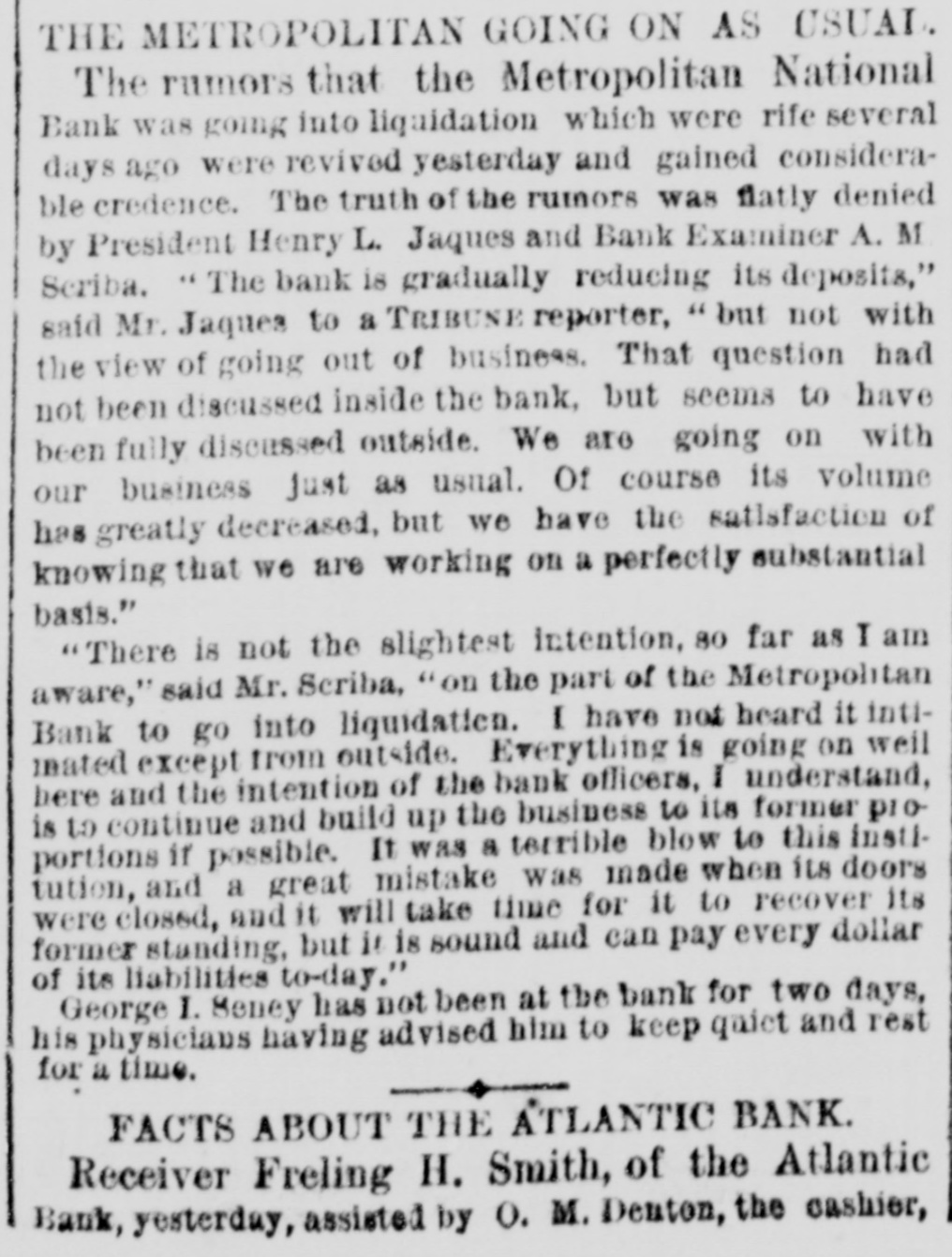
THE METROPOLITAN GOING ON AS USUAL. The rumors that the Metropolitan National Bank was going into liquidation which were rife several days ago were revived yesterday and gained considerable credence. The truth of the rumors was fiatly denied by President Henry L. Jaques and Bank Examiner A. M Scriba. " The bank is gradually reducing its deposits," said Mr. Jaques to a TRIBUNE reporter, " but not with the view of going out of business. That question had not been discussed inside the bank, but seems to have been fully discussed outside. We are going on with our business Just as usual. Of course its volume has greatly decreased, but we have the satisfaction of knowing that we are working on a perfectly substantial basis." "There is not the slightest intention, so far as I am aware," said Mr. Scriba, "on the part of the Metropolitan Bank to go into liquidation. I have not heard it intimated except from outside. Everything is going on weil here and the intention of the bank officers, I understand, is to continue and build up the business to its former proportions if possible. It was a terrible blow to this institution, and a great mistake was made when its doors were closed, and it will take time for it to recover its former standing, but it is sound and can pay every dollar of its liabilities to-day." George I. Seney has not been at the bank for two days, his physicians having advised him to keep quiet and rest for a time. FACTS ABOUT THE ATLANTIC BANK. Receiver Freling H. Smith, of the Atlantic Bank, yesterday, assisted by o. M. Denton, the cashier,


Article from The Bozeman Weekly Chronicle, May 28, 1884

Click image to open full size in new tab

Article Text

TOLD IN A LINE. Chief Justice Waite spends the summer at Lynn, Conn. Bartholdi, the sculpor, will be banqueted in Paris Wednesday. Senator Edmunds hasgone to Vermont with his wife and daughter. Roger A. Pryor was blackballed by the New York bar association Thursday. President Arthur recently repeated a whole page of Vernon Grey, not having seen the work in twenty years. Justice Harlan, who is holding court in Chicago, could not get rooms at the hotels and is sleeping in a room adjoining his court room. Mr. Emerson, known to the general the less name of sailed by the "Billy," public by conventional Adriatic for England. He has a horse entered for the Derby, to be run on the 26th. Miss Braddon, the novelist, has for many years given every Wednesday a roasted leg of mutton for dinner to the poor children of a neighboring public school. In private life Miss Braddon is known as Mrs. Maxwell. Webb, the heir to Byron's of Newstead commansion Algernon Abbey, lately suicide at int his The mitted estate passed Dambridge, father's England. hands from those of Col. Wildman, to whom it was sold by Byron. W. Drexel, the New York banker, the railway man, J. Senator J. Arkell, and A. Sleicher, of newspaper fame, become the directors of the Albany Journal, now newly incorporated, with $140,000 capital. Charles O'Connor's fine estate on North Shore, including his fire-proof liwill pass by into of the Roman the brary hands building, Catholics request of Nantucket. Mr. O'Connor paid off the entire debt of the town of Nantucket. Mrs. Frank Leslie's weekly reception at the Victoria hotel, Thursday evening was attended by the literary friends of Mrs. Robert M. Wilcox, nee Miss Ella Wheeler, the Wisconsin poetess, who was staying in New York for a few days on her wedding tour. Prof. Gilbert E. Bailey, the well known has been reappointed Territorial of Wyoming geologist, geologist Territory. Prof. is one of the early much to develop has Bailey done pioneers, the mineral and resources of the Black Hills of Dakota. Stone Pasha reviewed the Sixty"ninth regiment in New York Thursday night. He wore his Egyptian uniform, saluted the as it passed in review with and bore the his yataghan, regiment decorations of the Turkish order of the Medjidieh and of the crown of boiy on his breast. Robert Seney, a son of the president of the Metropolitan National bank, and a member of the firm of Nelson, Robinson & Co., of New York, was just about to start from London on a six-weeks' tour of the continent when he heard of the embarressment of his father's bank and the suspension of his own firm, and started for home. James Whitcomb Riley, the Indiana poet, whose verses are everywhere quoted, was born at New Bedford, Mass. Capt. Riley gave the young man an ample fortune when he attained his majority, and young James invested the bulk it in hotel, which he named the of a his hotel Ocean View house. Riley sold in the winter of 1878, invested hismoney in Pennsylvania oil, lost everything, and thon moved to Indiana, to try farming. Mrs. Belva A. Lockwood, the woman lawyer, is to deliver her lecture, "The Statesman and His Shortcomin on the 30th. ings," American Chicago In recent- this lecture, delivered in Washington ly, Mrs. Lockwood's strictures on Blaine and Tilden were so severe that the friends of those gentlemen asked her to leave those passages out hereafter. Mrs. Lockwood has in her possession photographic copies of the "Mulligan letters," which she will exhibit to her audience.


Article from Lancaster Daily Intelligencer, October 18, 1884

Click image to open full size in new tab

Article Text

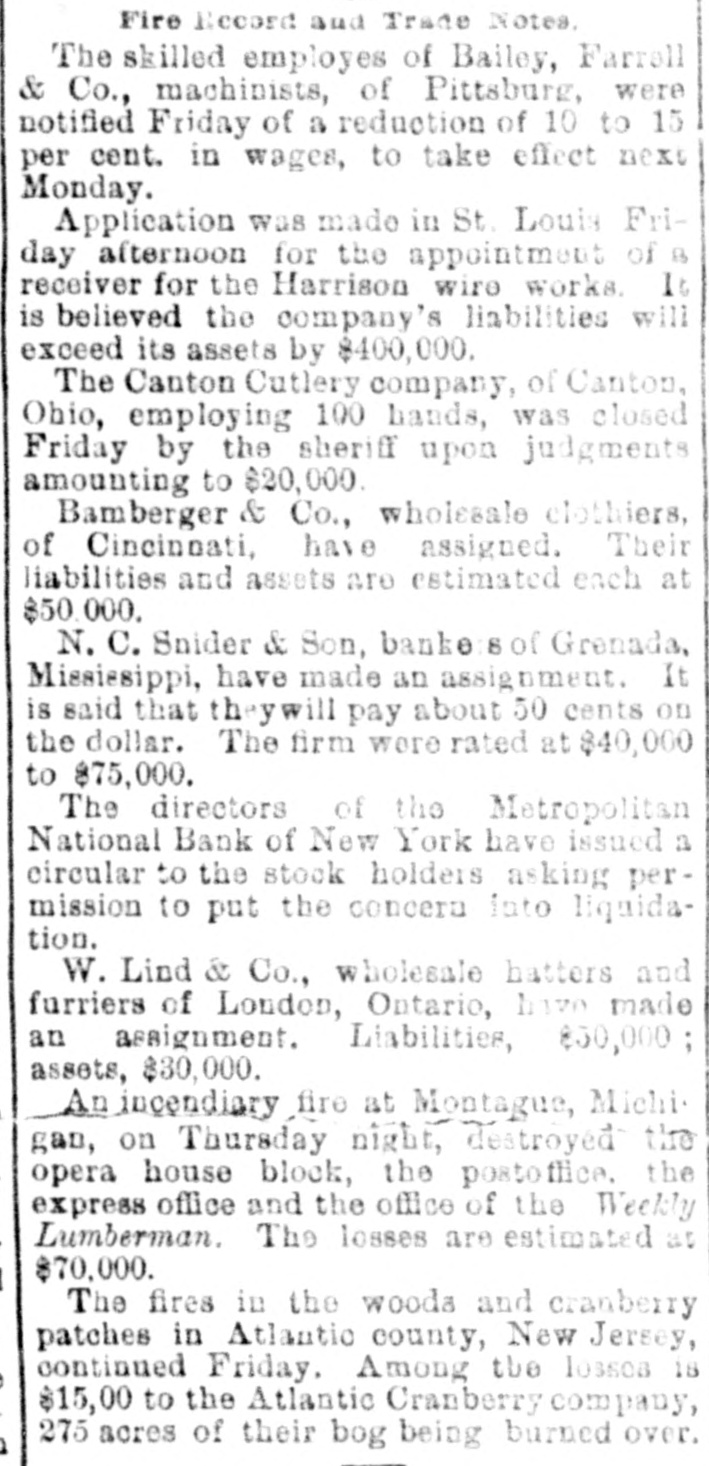
Fire Record and Trade Notes The skilled employes of Bailey, Farroll & Co., machinists, of Pittsburg, were notified Friday of a reduction of 10 to 15 per cent. in wages, to take effect next Monday. Application was made in St. Louis Friday afternoon for the appointment of B receiver for the Harrison wire works It is believed the company's liabilities will exceed its assets by $400,000. The Canton Cutlery company, of Canton, Ohio, employing 100 hands, was closed Friday by the sheriff upon judgments amounting to $20,000 Bamberger & Co., wholesale clothiers, of Cincinnati, have assigned. Their liabilities and assets are estimated each at $50.000. N. C. Snider & Son, banke 8 of Grenada, Missiesippi, have made an assignment. It is said that th will pay about 50 cents on the dollar. The firm were rated at $40,000 to $75,000. The directors of the Metropolitan National Bank of New York have issued a circular to the stock holders asking permission to put the concern into liquidation. W. Lind & Co., wholesale batters and furriers of London, Ontario, have made an assignment. Liabilities, $30,000 assets, $30,000. An incendiary fire at Montague, Michi gan, on Thursday night, destroyed thro opera house block, the postoffice. the express office and the office of the Weekly Lumberman. The losses are estimated at $70,000. The fires in the woods and cranberry patches in Atlantic county, New Jersey, continued Friday. Among the lossea 18 $15,00 to the Atlantic Cranberry company, 275 acres of their bog being burned over.


Article from Daily Kennebec Journal, November 19, 1884

Click image to open full size in new tab

Article Text

TELEGHAPHIC SPARKS. Willis L. Boughton. formerly of Norwalk, Conn.. was sentenced in New York, Tuesday, to the State prison for one year for having voted illegally at the late election. The trouble in the Branford lock works at New Havea has been amicably settled, the men will return to work Wednesday. The mills of the Sharon, Pa.. Iron Co., employing 500 men, closed down Tuesday on account of lack of orders. Tuesday the stockholders of the Metropolitan National Bank voted that the institution go into voluntary liquidation. John B. Merrill, editor of the Woodhaven, L. I., Journal was arrested Monday night on complaint of a police officer who charged him with libel. He was admitted to bail. Ex-Gov. Hendricks has started from Indiapolis to attend the democratic jollification meeting at Brooklyn next Thursday evening. Fire in Patterson, Pa., Tuesday forenoon, destroyed eight houses. occupied by eleven families. A reduction of 10 to 15 per cent in the pay of the operatives of tho Great Falls, N. H., cotton mills is announced; also that the mills will run on two-thirds time for the present The New York State board of canvassers will meet Wednesday afternoon at 3 o'clock. Returns from 11 counties have not yet been received. The board will probably adjourn until Friday. In Richmond, Va., great jubilee in the celebration of Cleveland and Hendricks election occurred Tuesday. Preparations had been in progress for the week and the affair was a grand success. Geo. B. Hender, one of proprietors of the Crystal Palace Opera House in Montreal has absconded. Cleveland plurality in West Virginia, with three counties to hear from, will be 4500. There was a light snow fall in New York, Tuesday evening; the first of the season. The New York Chamber of Commerce had its 116th annual banquet at Delmonico's Tuesday night. Among the guests were Senators Hawley and Warner Miller. Minister Morton, Monsignor Capel, Hon. Wm. M. Evarts and Hon. S. S. Cox. United States Senator Lamar of Mississippi has commenced suit in the United States Circuit Court against the government to recover $100,000 for cotton taken from his plantation in 1865 The Vermont legislature has set as the date for final adjournment Wednesday, Nov. 26th. A bill passed the Vermont House, Tuesday, increasing the salary of the Governor to $1500; a bill establishing a soldiers' home passed the House unanimously. Complete unofficial returns from 14 counties in Nevada show the following republican majorities : Blaine, 1664; Woodburn, for Congress. 358; Hawley, supreme judge, 990. Commander-in-Chief John S. Kountz of the G. A. R. was given a cordial reception in Worcester, Mass. Tuesday night. At a conference of the representatives of the leading rolling mills in Philadelphia, Monday, a reduction of 5 4-5 per cent. in the wages of the puddlers and other workmen was agreed on. The reduction will effect about 5000 workingmen in Philadelphia. In the House of Lords, Tuesday, the franchise bill passed the second reading without division.


Article from The Daily Cairo Bulletin, November 20, 1884

Click image to open full size in new tab

Article Text

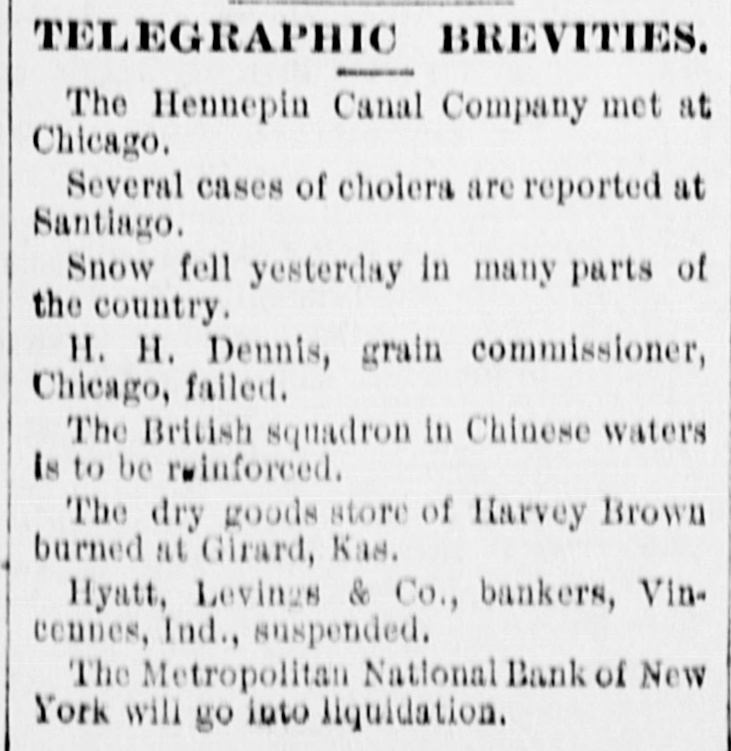
TELEGRAPHIC BREVITIES. The Hennepin Canal Company met at Chicago. Several cases of cholera are reported at Santiago. Snow fell yesterday in many parts of the country. H. H. Dennis, grain commissioner, Chicago, failed. The British squadron in Chinese waters is to be rwinforced. The dry goods store of Harvey Brown burned at Girard, Kas. Hyatt, Levings & Co., bankers, Vincennes, Ind., suspended. The Metropolitan National Bank of New York will go into liquidation.


Article from New-York Tribune, June 3, 1885

Click image to open full size in new tab

Article Text

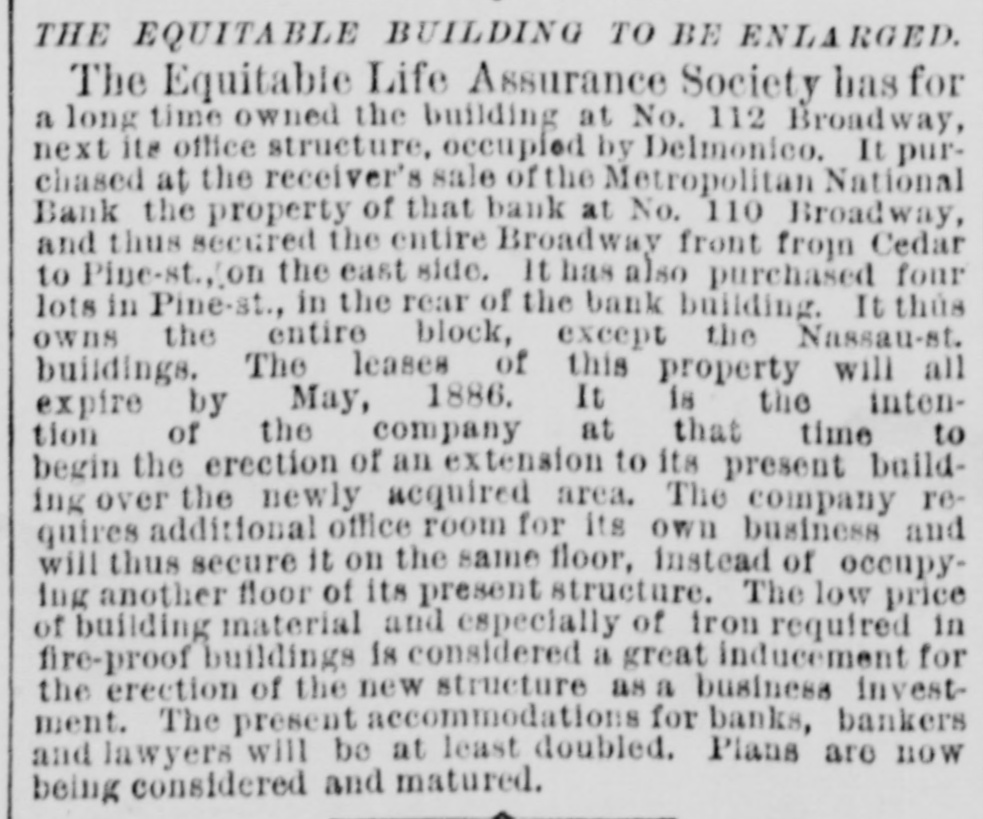
# THE EQUITABLE BUILDING TO BE ENLARGED. The Equitable Life Assurance Society has for a long time owned the building at No. 112 Broadway, next its office structure, occupied by Delmonico. It purchased at the receiver's sale of the Metropolitan National Bank the property of that bank at No. 110 Broadway, and thus secured the entire Broadway front froรฎn Cedar to Pine-st., on the east side. It has also purchased four lots in Pine-st., in the rear of the bank building. It thรบs owns the entire block, except the Nassau-st. buildings. The leases of this property will all expire by May, 1886. It is the intention of the company at that time to begin the erection of an extension to its present building over the newly acquired area. The company requires additional office room for its own business and will thus secure it on the same floor, instead of occupying another floor of its present structure. The low price of building material and especially of iron required in fire-proof buildings is considered a great inducement for the erection of the new structure as a business investment. The present accommodations for banks, bankers and lawyers will be at least doubled. Plans are now being considered and matured.


Article from New-York Tribune, December 20, 1885

Click image to open full size in new tab

Article Text

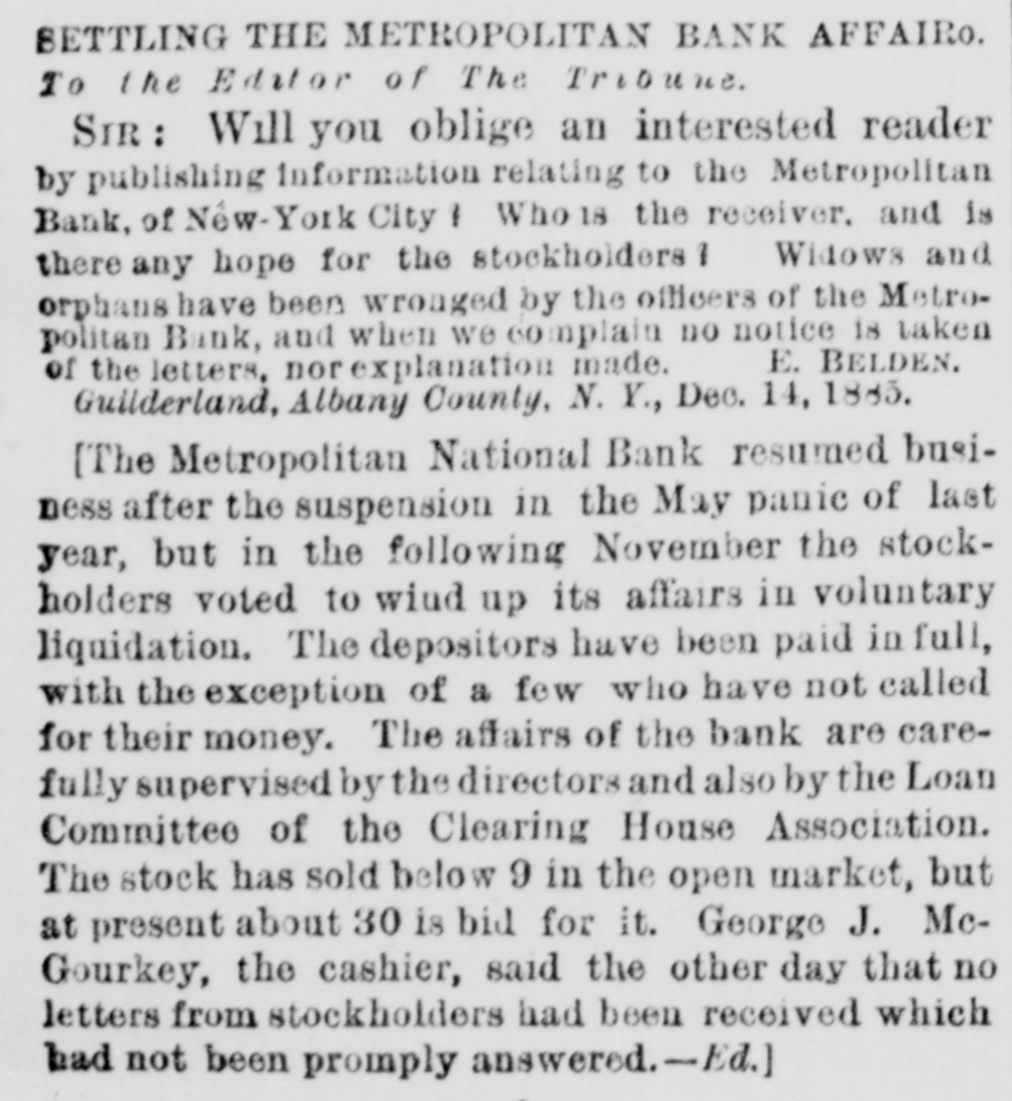
BETTLING THE METROPOLITAN BANK AFFAIRo. To the Edator of The Trioune. SIR Will you oblige an interested reader by publishing information relating to the Metropolitan Bank, of New-York City I Who 18 the receiver. and is there any hope for the stockholders I Widows and orphans have been wronged by the officers of the Metropolitan Bank, and when we complain no notice is taken E. BELDEN. of the letters, nor explanation made. Guilderland, Albany County, N. Y., Dec. 14, 1885. [The Metropolitan National Bank resumed business after the suspension in the May panic of last year, but in the following November the stockholders voted to wiud up its affairs in voluntary liquidation. The depositors have been paid in full, with the exception of a few who have not called for their money. The affairs of the bank are carefully supervised by the directors and also by the Loan Committee of the Clearing House Association. The stock has sold below 9 in the open market, but at present about 30 is bid for it. George J. McGourkey, the cashier, said the other day that no letters from stockholders had been received which had not been promply answered.-Ed.]