Article Text
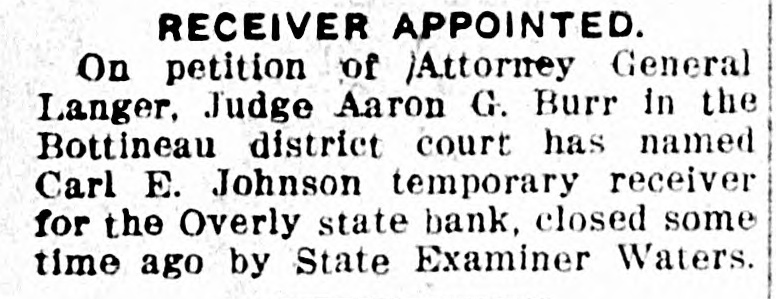
RECEIVER APPOINTED. On petition of /Attorney General Langer, Judge Aaron G. Burr in the Bottineau district court has named Carl E. Johnson temporary receiver for the Overly state bank, closed some time ago by State Examiner Waters.
dd84dae068fa05faNone
Click image to open full size in new tab
RECEIVER APPOINTED. On petition of /Attorney General Langer, Judge Aaron G. Burr in the Bottineau district court has named Carl E. Johnson temporary receiver for the Overly state bank, closed some time ago by State Examiner Waters.
Click image to open full size in new tab
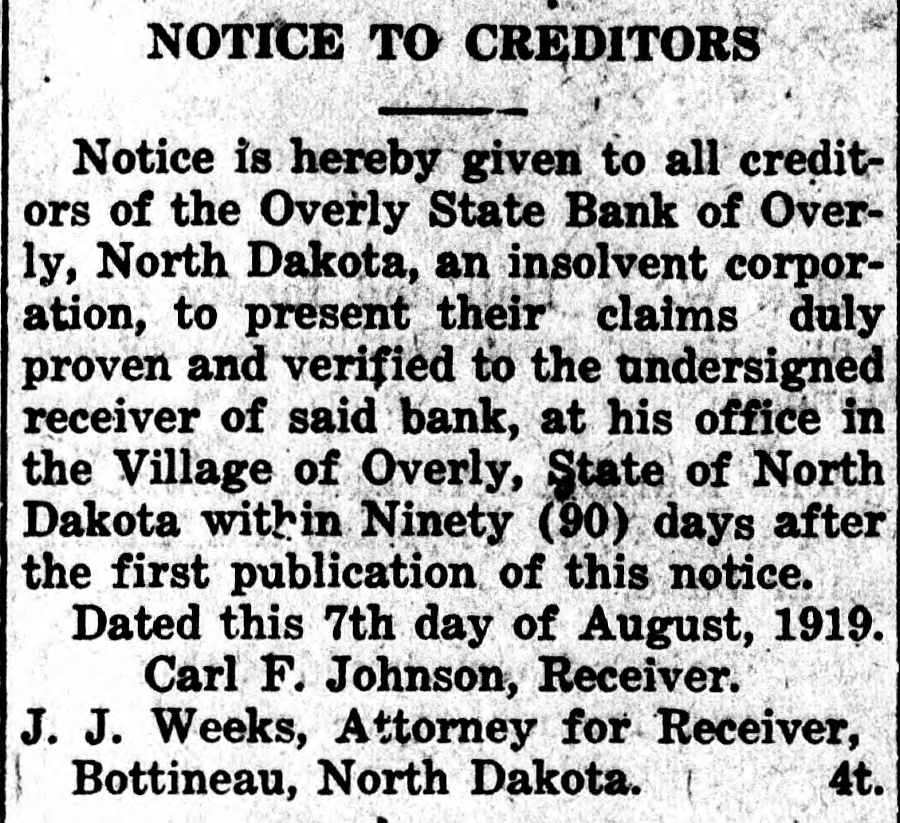
NOTICE TO CREDITORS Notice is hereby given to all creditors of the Overly State Bank of Overly, North Dakota, an insolvent corporation, to present their claims duly proven and verified to the undersigned receiver of said bank, at his office in the Village of Overly, State of North Dakota within Ninety (90) days after the first publication of this notice. Dated this 7th day of August, 1919. Carl F. Johnson, Receiver. J. J. Weeks, Attorney for Receiver, 4t. Bottineau, North Dakota.
Click image to open full size in new tab
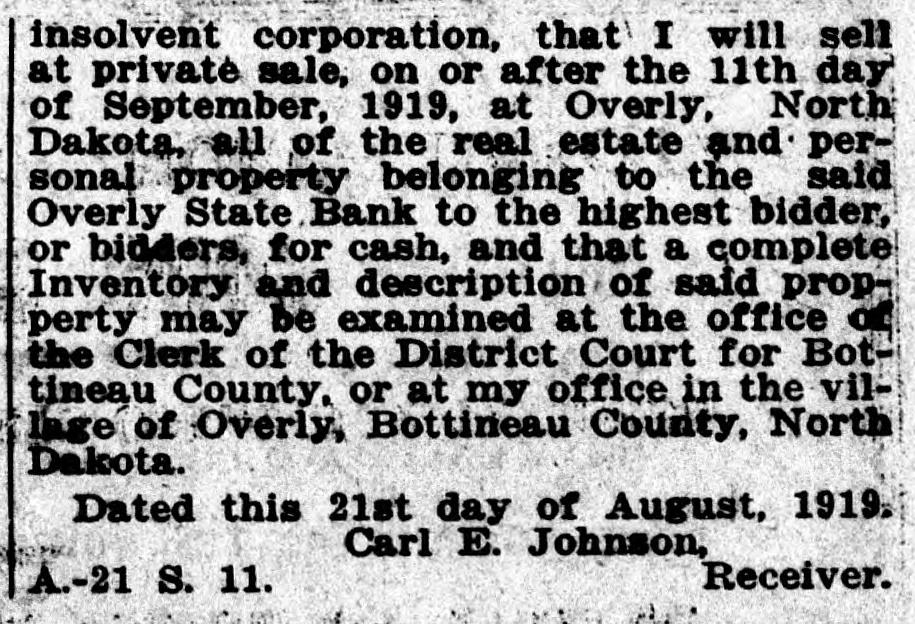
insolvent corporation, that I will sell at private sale, on or after the 11th day of September, 1919, at Overly, North Dakota, all of the real estate and personal property belonging to the said Overly State Bank to the highest bidder, or bidders, for cash, and that a complete Inventory and description of said propperty may be examined at the office of the Clerk of the District Court for Bottineau County, or at my office in the village of Overly, Bottineau County, North Dakota. Dated this 21st day of August, 1919. Carl E. Johnson, Receiver. A.-21 S. 11.
Click image to open full size in new tab
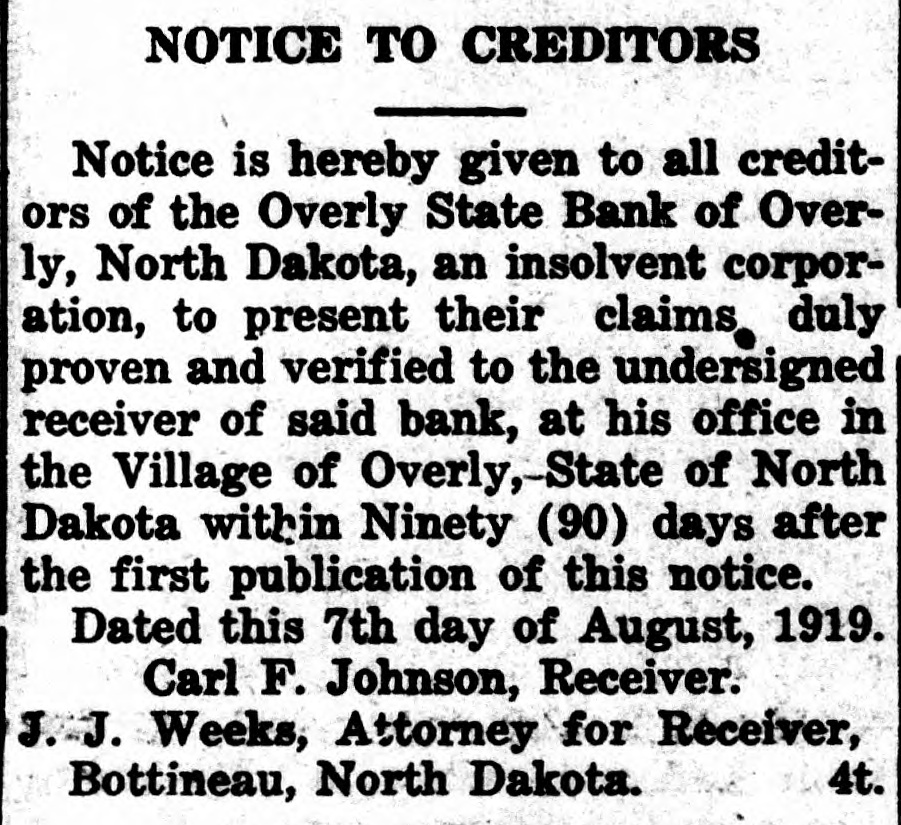
NOTICE TO CREDITORS Notice is hereby given to all creditors of the Overly State Bank of Overly, North Dakota, an insolvent corporation, to present their claims duly proven and verified to the undersigned receiver of said bank, at his office in the Village of Overly,-State of North Dakota within Ninety (90) days after the first publication of this notice. Dated this 7th day of August, 1919. Carl F. Johnson, Receiver. J.J. Weeks, Attorney for Receiver, 4t. Bottineau, North Dakota.
Click image to open full size in new tab
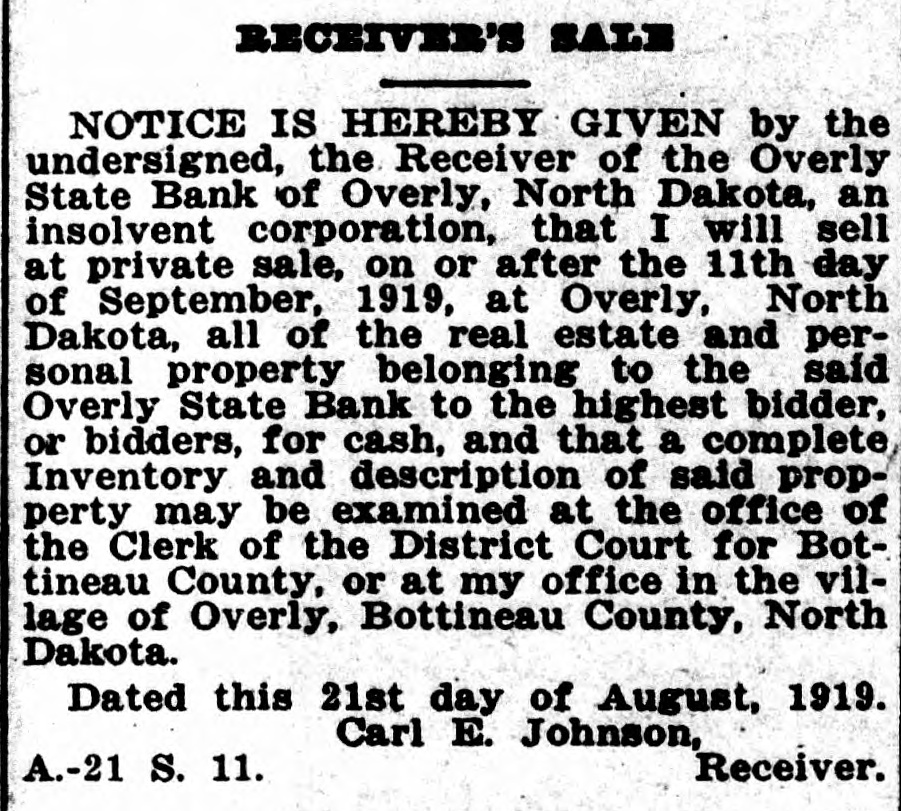
RECEIVER'S SALE NOTICE IS HEREBY GIVEN by the undersigned, the Receiver of the Overly State Bank of Overly, North Dakota, an insolvent corporation, that I will sell at private sale, on or after the 11th day of September, 1919, at Overly, North Dakota, all of the real estate and personal property belonging to the said Overly State Bank to the highest bidder, or bidders, for cash, and that a complete Inventory and description of said propperty may be examined at the office of the Clerk of the District Court for Bottineau County, or at my office in the village of Overly, Bottineau County, North Dakota. Dated this 21st day of August, 1919. Carl E. Johnson, Receiver. A.-21 S. 11.
Click image to open full size in new tab
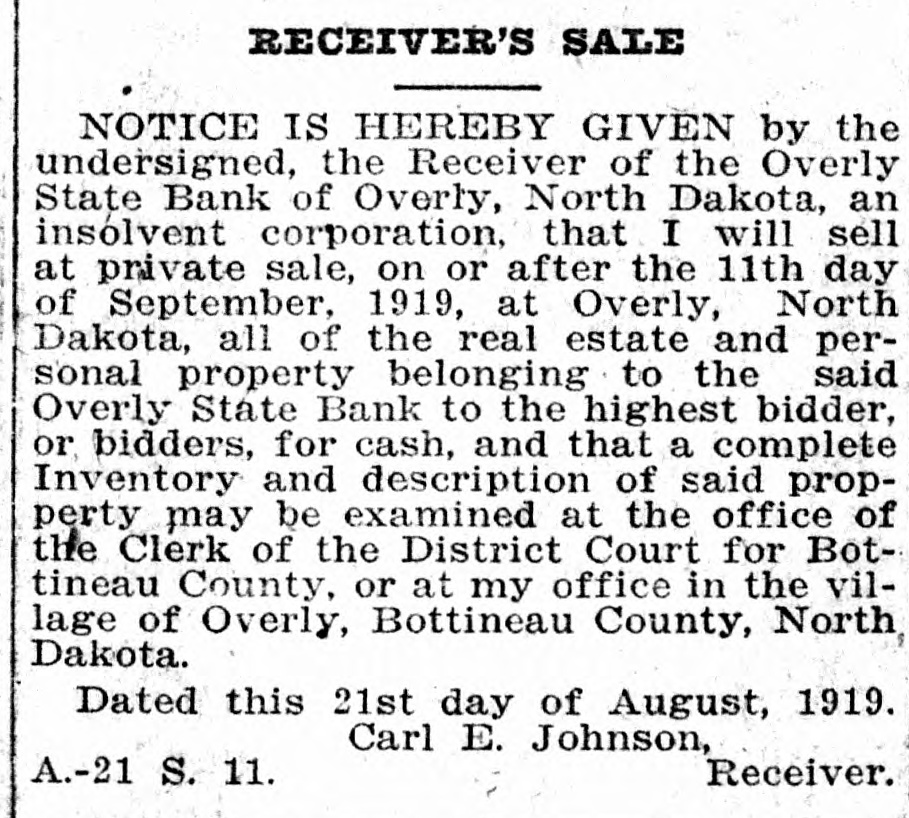
RECEIVER'S SALE NOTICE IS HEREBY GIVEN by the undersigned, the Receiver of the Overly State Bank of Overly, North Dakota, an insolvent corporation, that I will sell at private sale, on or after the 11th day of September, 1919, at Overly, North Dakota, all of the real estate and personal property belonging to the said Overly State Bank to the highest bidder, or bidders, for cash, and that a complete Inventory and description of said propperty may be examined at the office of the Clerk of the District Court for Bottineau County, or at my office in the village of Overly, Bottineau County, North Dakota. Dated this 21st day of August, 1919. Carl E. Johnson, A.-21 S. 11. Receiver.
Click image to open full size in new tab
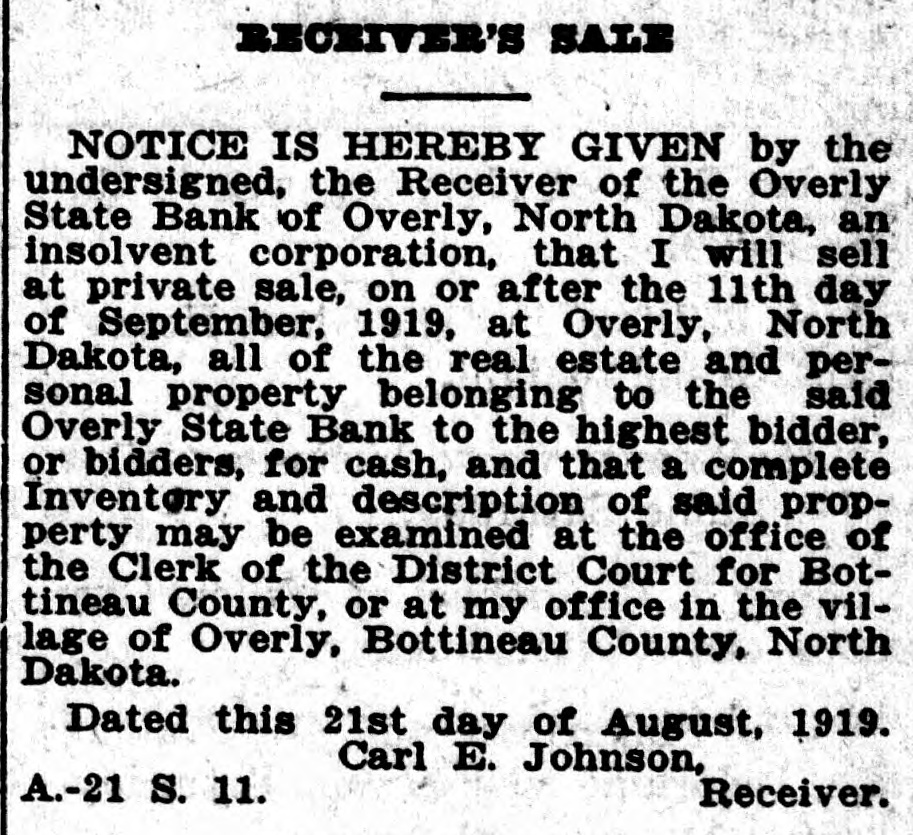
RECEIVER'S SALE NOTICE IS HEREBY GIVEN by the undersigned, the Receiver of the Overly State Bank of Overly, North Dakota, an insolvent corporation, that I will sell at private sale, on or after the 11th day of September, 1919, at Overly, North Dakota, all of the real estate and personal property belonging to the said Overly State Bank to the highest bidder, or bidders, for cash, and that a complete Inventory and description of said propperty may be examined at the office of the Clerk of the District Court for Bottineau County, or at my office in the village of Overly, Bottineau County, North Dakota. Dated this 21st day of August, 1919. Carl E. Johnson, A.-21 S. 11. Receiver.
Click image to open full size in new tab
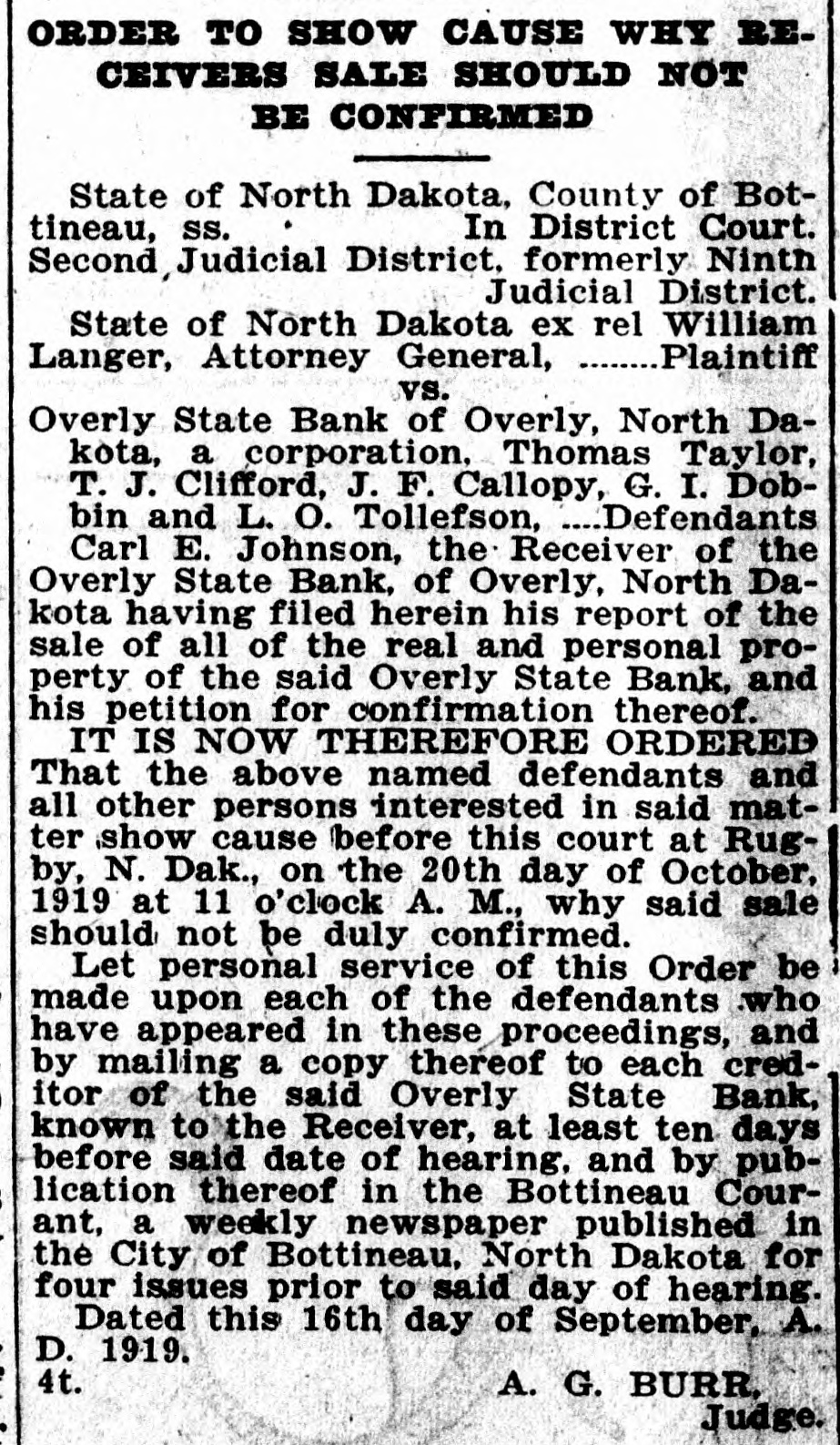
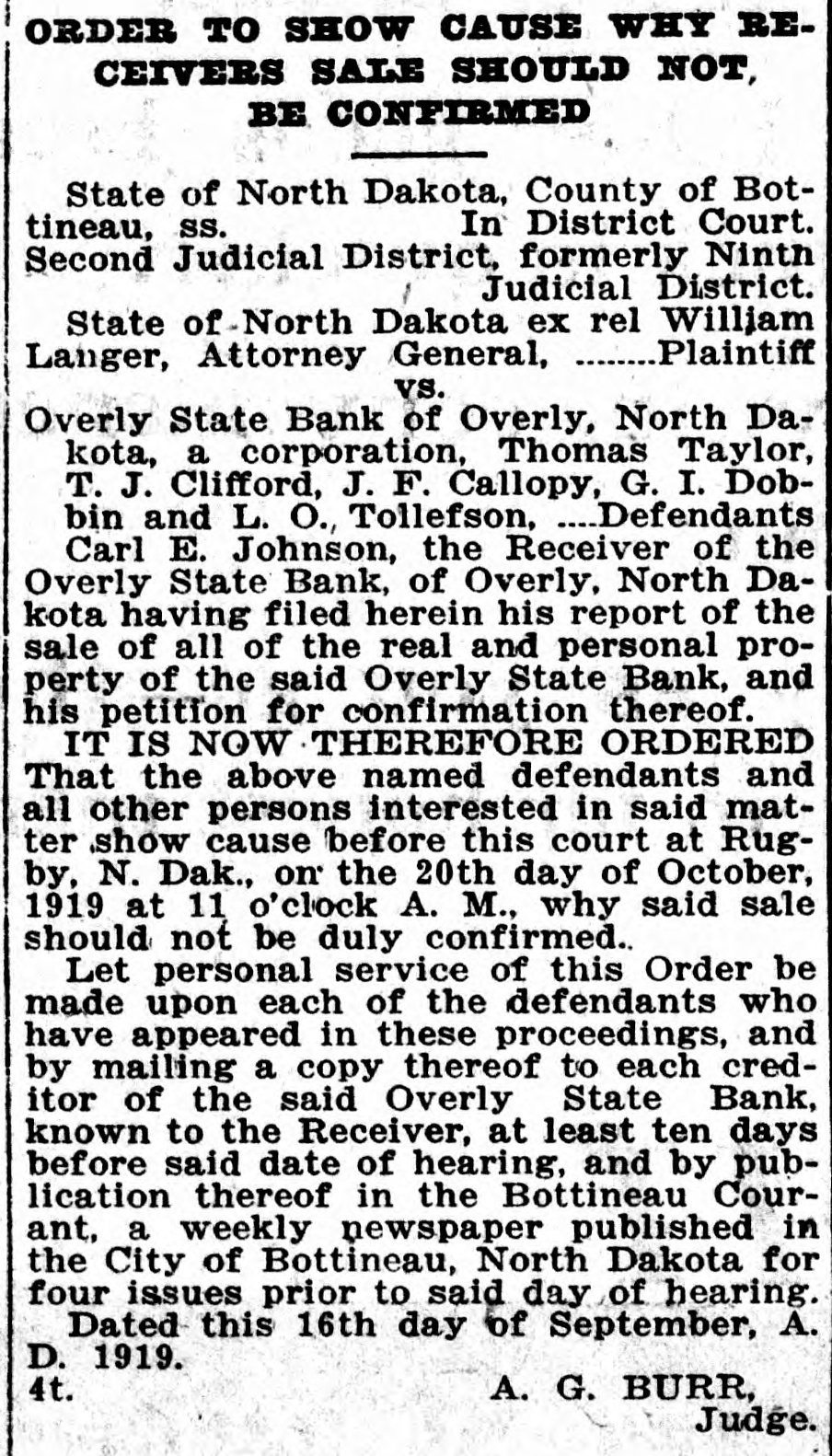
ORDER TO SHOW CAUSE WHY RECEIVERS SALE SHOULD NOT BE CONFIRMED State of North Dakota, County of BotIn District Court. tineau, SS. Second, Judicial District. formerly Ninth Judicial District. State of North Dakota ex rel William Plaintiff Langer, Attorney General, vs. Overly State Bank of Overly, North Dakota, a corporation. Thomas Taylor, T. J. Clifford, J. F. Callopy, G. I. Dobbin and L. O. Tollefson, Defendants Carl E. Johnson, the Receiver of the Overly State Bank, of Overly, North Dakota having filed herein his report of the sale of all of the real and personal property of the said Overly State Bank, and his petition for confirmation thereof. IT IS NOW THEREFORE ORDERED That the above named defendants and all other persons interested in said matter show cause before this court at Rugby, N. Dak., on the 20th day of October, 1919 at 11 o'clock A. M., why said sale should not be duly confirmed. Let personal service of this Order be made upon each of the defendants who have appeared in these proceedings, and by mailing a copy thereof to each creditor of the said Overly State Bank, known to the Receiver, at least ten days before said date of hearing, and by publication thereof in the Bottineau Courant, a weekly newspaper published in the City of Bottineau, North Dakota for four issues prior to said day of hearing. Dated this 16th day of September, A. D. 1919. 4t. A. G. BURR, Judge.
Click image to open full size in new tab
ORDER TO SHOW CAUSE WHY RECEIVERS SALE SHOULD NOT, BE CONFIRMED State of North Dakota, County of BotIn District Court. tineau, SS. Second Judicial District, formerly Ninth Judicial District. State of North Dakota ex rel William Plaintiff Langer, Attorney General, vs. Overly State Bank of Overly, North Dakota, a corporation, Thomas Taylor, T. J. Clifford, J. F. Callopy, G. I. Dobbin and L. O., Tollefson, Defendants Carl E. Johnson, the Receiver of the Overly State Bank, of Overly. North Dakota having filed herein his report of the sale of all of the real and personal property of the said Overly State Bank, and his petition for confirmation thereof. IT IS NOW THEREFORE ORDERED That the above named defendants and all other persons interested in said matter show cause before this court at Rugby, N. Dak., on the 20th day of October, 1919 at 11 o'clock A. M., why said sale should not be duly confirmed. Let personal service of this Order be made upon each of the defendants who have appeared in these proceedings, and by mailing a copy thereof to each creditor of the said Overly State Bank, known to the Receiver, at least ten days before said date of hearing, and by publication thereof in the Bottineau Courant, a weekly newspaper published in the City of Bottineau, North Dakota for four issues prior to said day of hearing. Dated this 16th day of September, A. D. 1919. 4t. A. G. BURR, Judge.
Click image to open full size in new tab
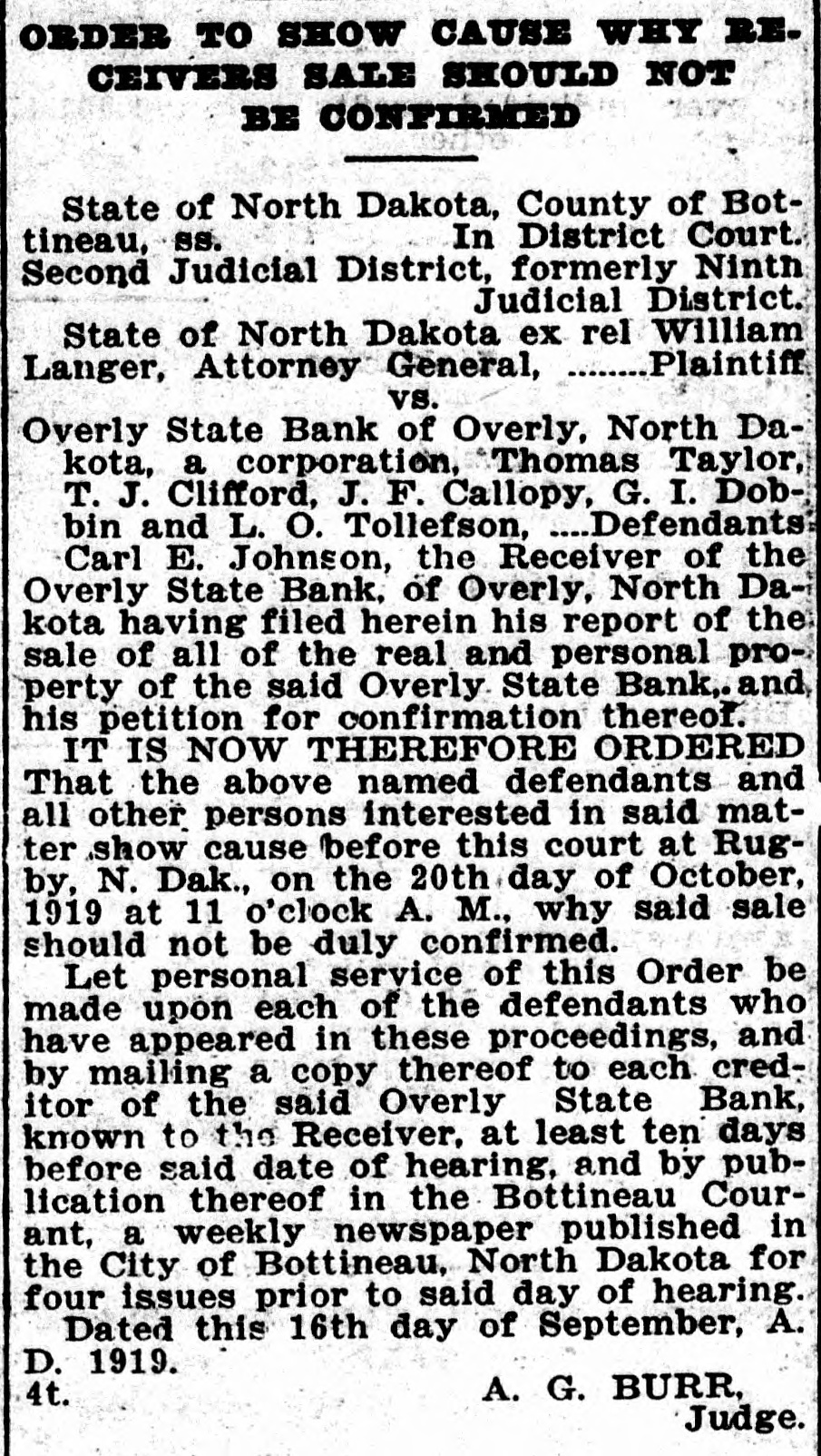
ORDER TO SHOW CAUSE WHY RE. CEIVERS SALE SHOULD NOT BE CONFIRMED State of North Dakota, County of BotIn District Court. tineau, SS. Second Judicial District, formerly Ninth Judicial District. State of North Dakota ex rel William Plaintiff Langer, Attorney General, vs. Overly State Bank of Overly, North Dakota, a corporation, Thomas Taylor, T. J. Clifford, J. F. Callopy, G. I. Dobbin and L. O. Tollefson, Defendants: Carl E. Johnson, the Receiver of the Overly State Bank, of Overly, North Dakota having filed herein his report of the sale of all of the real and personal property of the said Overly State Bank,. and his petition for confirmation thereof. IT IS NOW THEREFORE ORDERED That the above named defendants and all other persons interested in said matter show cause before this court at Rugby, N. Dak., on the 20th day of October, 1919 at 11 o'clock A. M., why said sale should not be duly confirmed. Let personal service of this Order be made upon each of the defendants who have appeared in these proceedings, and by mailing a copy thereof to each creditor of the said Overly State Bank, known to the Receiver, at least ten days before said date of hearing, and by publication thereof in the Bottineau Courant, a weekly newspaper published in the City of Bottineau, North Dakota for four issues prior to said day of hearing. Dated this 16th day of September, A. D. 1919. A. G. BURR, 4t. Judge.