St Louis National Bank (St Louis, MO)

Episode Information

Episode Type
Suspension β†’ Reopening
Start Date
September 26, 1873
Location
St Louis, Missouri (38.627, -90.198)
Registered Place
St. Louis
Bank Type
national
Charter Number
1112

Metadata

Events (4)

1. May 4, 1865 Chartered
Source
historical_nic
2. September 26, 1873 Suspension
Cause
Macro News
Cause Details
Currency payments suspended citywide during the Panic of 1873; banks in St. Louis halted specie/currency payments.
Newspaper Excerpt
In St. Louis the bank suspension appears to be total.
Source
newspapers
3. October 27, 1873 Reopening
Newspaper Excerpt
The banks of St. Louis all resumed currency payment to-day.
Source
newspapers
4. January 17, 1899 Voluntary Liquidation
Source
historical_nic

Newspaper Articles (12)

Article from New-York Tribune, September 26, 1873

Click image to open full size in new tab

Article Text

New-York Daily Tribune

FOUNDED BY HORACE GREELEY. FRIDAY, SEPTEMBER 26, 1873. At a stormy Erie meeting in London, President Watson received a unanimous resolution of thanks, and announced that his road wanted $30,000,000 at once. The French Conservatives claim a majority of 20 in the Assembly in favor of a monarchical restoration; the Republican members threaten to resign in a body. The Spanish Government has demanded of England the release of the Vitoria and Almanza. = The U. steamer Tigress is still searching for the Polaris crew. Secretary Richardson, Attorney-General Williams, and other officials determined, it is said, after long consultation, that the Government should not use any portion of the legal-tender reserve for the purchase of additional bonds. The banks of Chicago, Cincinnati, Baitimore, Nashville, and New-Orleans have suspended the currency payment of large demands. In St. Louis the bank suspension appears to be total. Failures are reported in New-Brunswick, N.J., Selma, Ala., Indianapolis, MemThe schooner Whiting phis, Atlanta, and Augusta. was wrecked at Grand Haven, Mich., all the crew but one being Descued after a thrilling fight with the waves. = An Anti-Kellogg Convention has been called, to meet at New-Orleans Nov. 24. There were no further suspensions in Wall-st., although aid from the Government in the purchase of bonds was entirely withdrawn. The difficulty in getting foreign exchange has affected the export trade somewhat disastrously. The Stock Exchange endeavored, by the appointment of a Committee, to force settlements upon last week's transactions. The Bank Presidents did not favor the theory of the Stock Exchange 10 regard to the resumption of business. ==== Sprague's attorneys endeavored to show that the money for his investments was borrowed from the Brooklyn Trust Company. The Grand Jury issued a public call for testimony. The District-Attorney refused to announce his intentions concerning the jail frauds. The Committee on investigating department affairs or- The Liberal Republican General Commitganized. tees made arrangements for holding primaries, and listened to Gen. Coctrane's remarks on the issues of the campaign. The Kings County Democratic primaries were held. The Newark Democratic Convention made municipal nominations. = An effort to act on the Police Justice nominations falled in the Board of Aldermen. - The Protestant Episcopal Diocesan Convention was addressed by Bishop Potter. - Prominent delegates to the Conference of the Evangelical Alliance, and Wilkie Collins, arrived. Damaging testimony was adduced in the baby-farming examination. The Harlem Rowing Club's Fall races were pulled, and entries for the National Amateur Regatta were announced. = The New-Jersey section of the NewYork and Oswego Midland Railroad is to return to its
Article from The Van Buren Press, September 30, 1873

Click image to open full size in new tab

Article Text

IT All the St

Louis Banks have suspended until the 1st of November. A general suspension of Banks all over the country may be expected.


Article from The Saline County Journal, October 2, 1873

Click image to open full size in new tab

Article Text

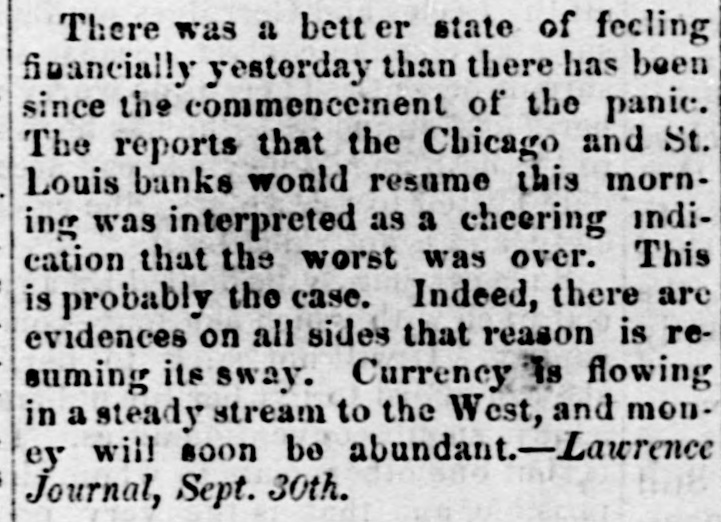
There was a bett er state of feeling financially yesterday than there has been since the commencement of the panic. The reports that the Chicago and St. Louis banks would resume this morning was interpreted as a cheering indication that the worst was over. This is probably the case. Indeed, there are evidences on all sides that reason is resuming its sway. Currency is flowing in a steady stream to the West, and mon. ey will soon be abundant.-Lawrence Journal, Sept. 30th.


Article from The Wheeling Daily Intelligencer, October 16, 1873

Click image to open full size in new tab

Article Text

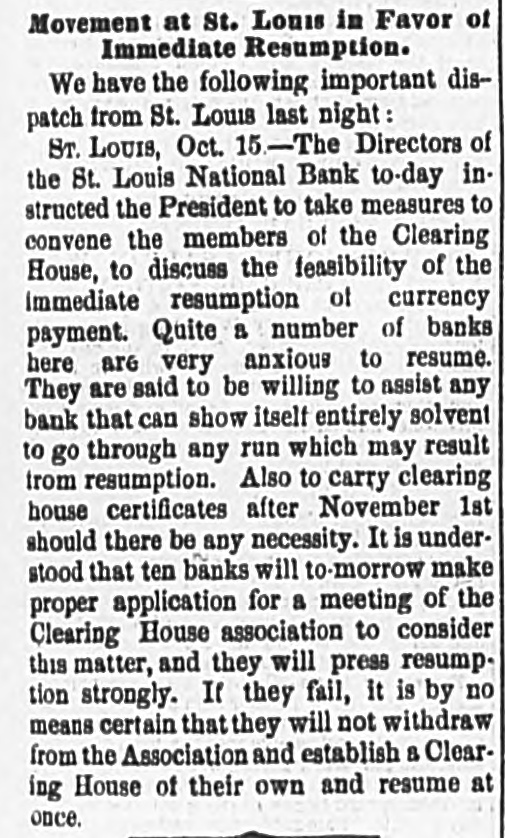
Movement at St

Louis in Favor of Immediate Resumption. We have the following important dispatch from St. Louis last night: ST. LOUIS, Oct. 15.-The Directors of the St. Louis National Bank to-day instructed the President to take measures to convene the members of the Clearing House, to discuss the feasibility of the Immediate resumption of currency payment. Quite a number of banks here are very anxious to resume. They are said to be willing to assist any bank that can show itself entirely solvent to go through any run which may result from resumption. Also to carry clearing house certificates after November 1st should there be any necessity. It is understood that ten banks will to-morrow make proper application for a meeting of the Clearing House association to consider this matter, and they will press resumption strongly. If they fail, it is by no means certain that they will not withdraw from the Association and establish a Clearing House of their own and resume at once.


Article from Helena Weekly Herald, October 16, 1873

Click image to open full size in new tab

Article Text

A RIBERNIAN BANK INCIDENT

A Woman that Wanted her Money. From the St. Louis Democrat, Septeinber 27, The news of the suspension of the banks of the city, published in the papers of yesterday morning, created intense excitement in Kerry Patch. The thrifty population of that classic precinct are in the habit of depositing their meagre earnings in the savings banks, and anything that casts a shadow upon those useful institutions throws a gloom over the the in Patch. Kerry, The after first feeding duty performed pig and yesterday milking the goat, was to go down town and look after the deposits in bank. One determined WOman took her station in front of the Hibernian Bank, and patiently waited on the sidewalk for two hours, until she saw the doors opened. Then she entered with a firm step, and addressing young Tansey, said, in a voice of thunder: "Is this bank suspended?" 'Yes, madam, but only temporarily." "Tipperarily, is it? I know what a Tipperary suspension is-it manes gone up. I've got $200 deposited in this bank, and I want my money." "Well, madam, you need not talk so loud. Give me your pass book, and you shall have your money." "Have you got it?" "Yes, I've got it. Hand out your book." "Are you sure you've got my $200 safe and sound?" "Yes, here it is. Don't make so much noise." "I've got a right to make a noise. I worked hard for that $200, and do you think I'm going to lose it without making a noise?" "Itell you that your $200 is not lost; here, take it away, and don't talk so loud." "You've got it, have you?" 'Yes; I tell you it is here." My $200?" Yes, your $200; take it and go." What do I want with it? Didn't I put it in and the a launched here for into safe keeping?" lengthy and loud harangue depositor on the banks and bankers, attracting a crowd around the door. One of the directors, finding the woman could not be silenced, called in a policeman, who took her by the arm for the purpose of leading her out. "Is it the likes of you that dares to lay the weight of your dirty claws on a dacent WOman with $200 in bank? Get out of this and lave me alone, ye spalpeen-I'm a dacent woman, G-d-you." At this moment the president of the bank entered, and, learning the cause of the disturbance, ordered the woman to be released, and invited her politely to take a seat. "I don't want to sit down. I've got two hundred dollars in this bank, and I'm used to standin." "Madam, I think you had better take your money." Have you got it ?" Yes, here is your money." What do you take me for? I put my money in this bank for safe keeping, and be not to to it a a away. dad I'm This is goin' bank be of deposit, forced and take I'm depositor-do you mind that?" It was in vain that the depositor was urged to draw her money. She would neither take it nor remain silent. After standing an hour or two longer, and talking all the time at a not children furious had rate, she had remembered their breakfast, that and her with many a protestation against the attempt to force a poor woman to draw her money, and she wended informed her all way the neighbors back to Kerry that the Patch, Hi1 bernian Bank was only foolin', and had not suspended at all.


Article from Chicago Daily Tribune, October 27, 1873

Click image to open full size in new tab

Article Text

FINANCIAL.

A Chapter of Wall Street Rumors.

Serious Financial Irregularities Among the Railroads.

The Lake Shore and Toledo, Wabash & Western Involved.

Vanderbilt's Star Begins to Wane in Wall Street.

Reasons Assigned for the Decline in His Stocks.

Ex-Secretary McCulloch's Northern Pacific Presentiments.

The St. Louis Banks to Resume Currency Payment To-Day.

Effects of the Panic on Eastern Manufacturers.

NEW YORK. Special Dispatch to The Chicago Tribune. THE DECLINE IN VANDERBILT STOCKS. NEW YORK, Oct. 20. The sudden and rapid decline in Vanderbilt stocks yesterday is attrib-uted to the agitation of the affairs of the Lake Shore Railway Company, and of those of the Union Trust Company, together with the publi-cation of reiterated charges of fraud on the part of the Executive Committee of the Lake Shore Railroad Company. Reports that mismanago-mont had been discovered in the affairs of the Toledo, Wabash, & Western Railroad; and that the New Jersey Southern Railroad was bankrupt; and that the Chesapeake & Ohio Railroad could not pay its debts, also contrib-uted to offect this decline. Lake Shore people strenuously deny the truth of such charges against their Executive Committee, and the officers of the Union Trust Company decline to say any-thing regarding the present condition of their affairs.

THE POPULAR OPINION in Wall street concerning Com. Vanderbilt is divided. One side believes in his integrity, and in that of his associates; and the other side as confidently advance the opinion that George Bird Grinnell & Co. are merely the scapegoats of the Vanderbilt party, and deserve the sympathy, not the censure, of the community.

THE TELEGRAPH COMPANIES. The project for the formation of a combina-tion of telegraph companies, which has been in contemplation for some time, and is now about to be consummated, has been hastened in conse-quence of Vanderbilt's acquisition of the West-ern Union Telegraph Company.

RUMORS OF DEFALCATIONS in several railway companies have exercised a depressing effect on the market for several days. Prominent among suspected corporations is the Lake Shore Company. The embezzlement or fraud said to have taken place in this Company's affairs is variously estimated at from several hundred thousand to several million dollars. The officers of the Com-pany deny this; but inquiry develops the fact that they lost a large amount by the failure of George Bird Grinnell & Co. A Director of the Company says that only about $250,000 was lost through the failure of this firm.

THE CANADA SOUTHERN RAILWAY, which was embarrassed during the early days of the panic, is now undergoing a process of resus-citation. The floating debt of the road is re-ported at $20,000,000. It is proposed to fund the floating debt, and, possibly, some of the earliest maturing coupons. The matter will probably be arranged within two days.

TOLEDO, WABASH WESTERN. It is alleged that the rumored frauds in the Toledo, Wabash & Western Railway have grown out of the stock operations of Azariah Boody, Vice President of the road. It is said that in-vestigation by an administrator succeeded in discovering frauds exceeding several hundred thousands of dollars. W. L. Scott, Director of the Road, informed a Tribune reporter that a few years ago Mr. Boody was a member of the firm of Kidd, Prolco & Co., No. 19 Broad street. This firm had done stock business for Boody, and he had been accustomed to place the money of the Road in their custody. He withdrew from the firm, which then became O. H. Peirce & Co., and continued to act as his bankers. About the time of the failure of Peirce & Co., a change was made in the direction of the Road, and it was discovered that a part of the Company's funds were still with Peirce. All except a sum not ex-ceeding $100,000 had been recovered, as had nearly all the securities. This amount Boody was abundantly able to pay, so there was little cause for apprehension; and the Road was do-ing as well as could be desired.


Article from Chicago Daily Tribune, October 27, 1873

Click image to open full size in new tab

Article Text

ST. LOUIS.

Special Dispatch to The Chicago Tribune.

THE BANKS TO RESUME.

ST. LOUIS, Oct. 26.-The St. Louis banks will rèsume currency payments to-morrow. There is a little uneasiness in some quarters in regard to the result, but no serious trouble is anticipated. The banks have been strengthening themselves as well as they were able, and it is thought that nearly all will be able to go through without much difficulty. A few have been a little slow in redeeming their Clearing-House certificates, and there will probably be some of these out-standing for some days to come. It is said that the strong banks will help the weak ones until the crisis is passed. No run is expected, although many small depositors, it is thought, will withdraw their funds and transfer them to other banks.

GENERAL BUSINESS.

The jobbing trade is generally dull. Business on 'Change shows faint signs of revival. Manufacturers are running carefully. The saw-mills and flouring-mills are all in operation again. Building has been checked, and lumber men are complaining bitterly. The iron-mills and fur-


Article from Chicago Daily Tribune, October 28, 1873

Click image to open full size in new tab

Article Text

ST. LOUIS.

Special Dispatch to The Chicago Tribune. St. Louis, Mo., Oct. 27.β€”The banks of St. Louis all resumed currency payment to-day. There was no excitement, and no signs of a run anywhere. All have strengthened themselves greatly since the suspension, and some report twice as much currency as they have on hand in ordinary times. Some bankers say that there is at present $6,000,000 or $8,000,000 more currency in the banks at present than they have commonly in their vaults. Nine hundred thousand dollars of the $1,400,000 Clearing-House certificates have been retired, and the rest will be withdrawn, it is thought, without trouble. If things go on quietly for a few days, it is hoped that discounts will be made as freely as they were a month ago. Exchange is sold at 1-10 to ΒΌ premium.


Article from Lexington Weekly Intelligencer, October 29, 1873

Click image to open full size in new tab

Article Text

The Dispatch asserts that the banks of St. Louis had five millions more currency in their vaults on Monday, when they resumed payment, than they had at their suspension.


Article from The Saline County Journal, October 30, 1873

Click image to open full size in new tab

Article Text

On Monday the banks of St. Louis resumed currency payments. The event occurred without any unusual excitement. No runs took place, but, on the contrary, the deposits exceeded the demands. This action of the banks has been marked with no unusual excitement because there was a general public confidence in Western banks, and the approval with which business men received the intelligence that banks were not paying out heavy amounts of currency during the panic generated confidence among all classes, which soon settled into unconcern. The resumption by the St. Louis banks was tardy, when compared with the prompt action of the Chicago houses, and hence the business of the country governed by St. Louis markets has been rather backward. In this matter we see the need of more direct communication with Chicago by a road that will work up her interest on its line, that we need not be governed by the slow and easy going St. Louisans.


Article from Evening Star, October 30, 1873

Click image to open full size in new tab

Article Text

RESUMPTION OF CURRENCY PAYMENT IN ST. LOUIS.

The banks of St. Louis all resumed currency payment on Monday. There was no excitement, and no signs of a run anywhere. All have strengthened themselves greatly since the suspension, and some report twice as much currency as they have on hand in ordinary times. Some bankers say that there is at present $6,000,000 or $8,000,000 more currency in the banks at present than they have commonly in their vaults. Nine hundred thousand dollars of the $1,400,000 clearing-house certificates have been retired, and the rest will be withdrawn, it is thought, without trouble. If things go on quietly for a few days, it is hoped that discounts will be made as freely as they were a month ago. Exchange is sold at 1-10 to ΒΌ.


Article from The Elk County Advocate, November 6, 1873

Click image to open full size in new tab

Article Text

Haven was entered on a recent Satur- day night and the carpet stolen from the floor.

Mr. Moore, of the Altoona Sun, has withdrawn his suit against D. R. Ream, for libel, and paid the costs himself. A new Presbyterian church in Gir- ard township, Clearfield county, will be dedicated on next Thursday. Easton has only two policemen, and these spend half the time fighting to see who shall be chief and who the "force'.'

The citizens of Indianoplis are proud of one of their girls who whistles over 100 tunes. The Louisville Courier Journal concludes that the only way to reform vicious women is to shoot bad men. How is this for a French description of a young lady: "She leaves off kissing at twelve, and begins again at twenty." The bulding of an ox cart is said to be among the lost arts in Georgia. Florida is reported to be already filling with invalids for the winter season. Sacramento contributes to refined ci7- ilization 8,000 hogsheads of beet sugar. A Texan ranch man boasts of thirteen bullet holes in his skin from Indian rifles.

A result of the Nation system of education in England has been to increase the demand for female teachers. Boston is proud of the fact that, with her increased dimensions, she will pay forty per cent. of the entire State tax. Amherst Agricultural College proposes to teach its students to drill for soldiers as well as for turnips, and to cultivate the sword and sward simultaneously.

An ingenious Kentuckian has invented a wheelborrow in which a man can trunble himself home at night, if necessary, without troubling his friends. Hannah Ruland, aged 100 years, died in New York city on Sunday. The ship Three Brothers carries 4300 tons of wheat, and is the largest sailing vessel in the world. Her cargo is valued at $199,000.

It is stated the Atlantic and Pacific and Kansas City and Northern Railroads will reduce the salaries of all their employes, from presidentdown, 10 per cent. George Wolf, a wealthy farmer residing three miles from Hopkinsville, Ky., was assassinated in his bed Tuesday night, October 23. A bale of cotton for the Memphis sufferers sold on Change at Louisville, last week, for $455, or about $1 per pound. The cigar makes of New York city have been informed that their wages will be reduced to the rates of a year ago.

The Newburg, N. Y., steam mills have been stopped for an indefinite period. About 400 persons are thrown out of employment. 2,417 miles of new postal service has been put in operation since June 30, 1873, making a total at this date of 65,876 miles of such service in the United States.

All the banks of St. Louis resumed currency payments on Monday. Nothing unusual occurred, there was no excitement, and confidence seems to be restored. The deposits exceed the drafts. An account of the recent hurricane on the Florida coast has been aeceived at the War Department, Washington. Cattle were swept into the sea, house undermined and uuroofed, and boats lost.

The two female members of the Wyo ming Legislature are said to have already required great proficiency in the art of throwing ink-stands and dodging law books.

Twenty-odd convicts at Auburn, in additional to board and lodgings at the expense of the State, get military pensions from the Federal Government for pocket money.

Brashear, La., after congratulating itself on escaping an invasion of the yellow fever, has succumbed to the more fatal importation of 300 barrells of Cincinnati whiskey.

The burial of a State elephant with royal honors is noted as an important item of news from Siam. The death of the king would hardly have created a greater sensation.

A New Bedford sea captain has invented a new plan for building ships. He proposes to do away with the usual rib frame and double sheathing, and build them with plank twelve inches wide, laid flat one upon the other, and firpaly bolted together