11076. First National Bank (Minot, ND)

Bank Information

Episode Type
Run โ†’ Suspension โ†’ Unsure
Bank Type
national
Bank ID
4009
Charter Number
4009
Start Date
January 4, 1892
Location
Minot, North Dakota (48.233, -101.296)

Metadata

Model
gpt-5-mini
Short Digest
92b2d974d13f2c1d

Response Measures

Full suspension

Receivership Details

Depositor recovery rate
26.0%
Date receivership started
1896-08-12
Date receivership terminated
1899-10-30
OCC cause of failure
Excessive lending
Share of assets assessed as good
17.8%
Share of assets assessed as doubtful
52.5%
Share of assets assessed as worthless
29.7%

Description

Contemporary reports (Jan 1892) state the Ward county treasurer withdrew county funds from the First National Bank of Minot, causing a suspension. The withdrawal is attributed to the principal proprietor's refusal to pay taxes; that refusal is cited as triggering a run and the subsequent suspension. The articles do not report a reopening or final closure/receivership, so outcome is unclear.

Events (4)

1. April 13, 1889 Chartered
Source
historical_nic
2. January 4, 1892 Run
Cause
Bank Specific Adverse Info
Cause Details
County treasurer withdrew deposits after principal proprietor refused to pay taxes; that withdrawal precipitated a run on the bank.
Measures
County treasurer withdrew county funds; bank suspended payments (see suspension event).
Newspaper Excerpt
It is stated that the reason why the county treasurer of Ward county withdrew the county funds from the First National Bank of Minot, causing its suspension, was because the principal proprietor of the bank refused to pay taxes.
Source
newspapers
3. January 4, 1892 Suspension
Cause
Bank Specific Adverse Info
Cause Details
Suspension caused by large withdrawal of public (county) deposits after proprietor's refusal to pay assessed taxes; suit later brought to collect taxes (~$2,000).
Newspaper Excerpt
It is stated ... the county treasurer of Ward county withdrew the county funds from the First National Bank of Minot, causing its suspension.
Source
newspapers
4. August 12, 1896 Receivership
Source
historical_nic

Newspaper Articles (3)

Article from The Washburn Leader, January 9, 1892

Click image to open full size in new tab

Article Text

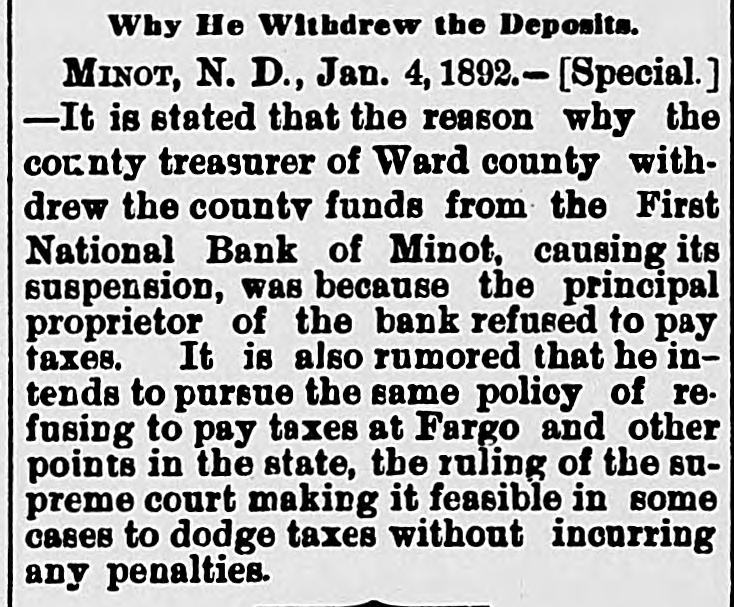
Why He Withdrew the Deposits. MINOT, N. D., Jan. 4, 1892.- [Special.] -It is stated that the reason why the county treasurer of Ward county withdrew the countv funds from the First National Bank of Minot, causing its suspension, was because the principal proprietor of the bank refused to pay taxes. It is also rumored that he intends to pursue the same policy of refusing to pay taxes at Fargo and other points in the state, the ruling of the supreme court making it feasible in some cases to dodge taxes without incurring any penalties.


Article from The Washburn Leader, January 16, 1892

Click image to open full size in new tab

Article Text

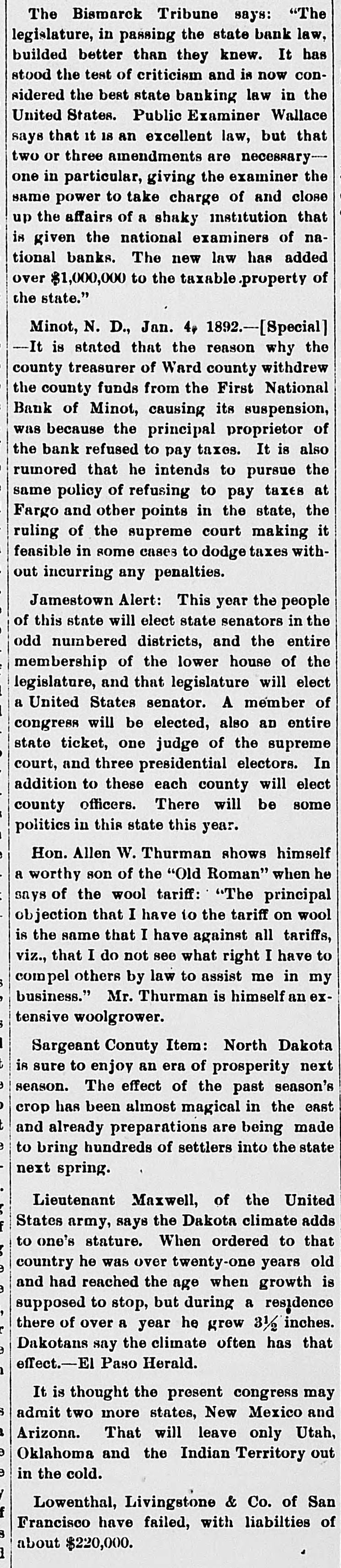
The Bismarck Tribune says: "The legislature, in passing the state bank law, builded better than they knew. It has stood the test of criticism and is now considered the best state banking law in the United States. Public Examiner Wallace says that it 18 an excellent law, but that two or three amendments are necessary---------------one in particular, giving the examiner the same power to take charge of and close up the affairs of a shaky institution that is given the national examiners of national banks. The new law has added over $1,000,000 to the taxable property of the state." Minot, N. D., Jan. 4, 1892.-[Special] -It is stated that the reason why the county treasurer of Ward county withdrew the county funds from the First National Bank of Minot, causing its suspension, was because the principal proprietor of the bank refused to pay taxes. It is also rumored that he intends to pursue the same policy of refusing to pay taxes at Fargo and other points in the state, the ruling of the supreme court making it feasible in some cases to dodge taxes without incurring any penalties. Jamestown Alert: This year the people of this state will elect state senators in the odd numbered districts, and the entire membership of the lower house of the legislature, and that legislature will elect a United States senator. A member of congress will be elected, also an entire state ticket, one judge of the supreme court, and three presidential electors. In addition to these each county will elect county officers. There will be some politics in this state this year. Hon. Allen W. Thurman shows himself a worthy son of the "Old Roman" when he says of the wool tariff: "The principal objection that I have to the tariff on wool is the same that I have against all tariffs, viz., that I do not see what right I have to compel others by law to assist me in my business." Mr. Thurman is himself an extensive woolgrower. Sargeant Conuty Item: North Dakota is sure to enjoy an era of prosperity next season. The effect of the past season's crop has been almost magical in the east and already preparations are being made to bring hundreds of settlers into the state next spring. Lieutenant Maxwell, of the United States army, says the Dakota climate adds to one's stature. When ordered to that country he was over twenty-one years old and had reached the age when growth is supposed to stop, but during a residence there of over a year he grew 3ยฝ inches. Dakotans say the climate often has that effect.-El Paso Herald. It is thought the present congress may admit two more states, New Mexico and Arizona. That will leave only Utah, Oklahoma and the Indian Territory out in the cold. Lowenthal, Livingstone & Co. of San Francisco have failed, with liabilties of about $220,000.
Article from The Bottineau Pioneer, March 5, 1892

Click image to open full size in new tab

Article Text

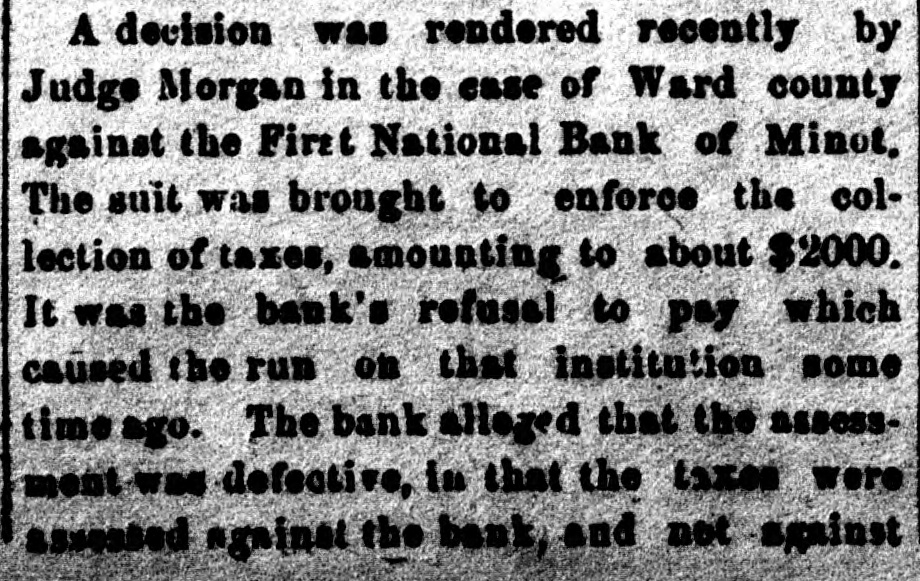
A decision was rendered recently by Judge Morgan in the case of Ward county against the First National Bank of Minot. The suit was brought to enforce the collection of taxes, amounting to about $2000. It was the bank's refusal to pay which caused the run on that institution some time ago. The bank alleged that the assessment was defective, in that the taxes were assessed against the bank, and not against