Merchants & Mechanics Bank (Wheeling, VA)

Episode Information

Episode Type
Suspension β†’ Reopening
Start Date
May 29, 1837
Location
Wheeling, Virginia (40.064, -80.721)
Bank Type
state

Metadata

Notes

Sources show the bank suspended specie payments in May 1837 as part of a wider crisis; no reopening or closure details in these articles.

Events (1)

1. May 29, 1837 Suspension
Cause
Macro News
Cause Details
Suspension occurred amid a widespread banking crisis and following northern banks' suspension of specie payments; part of a common precautionary suspension across the state and nation.
Newspaper Excerpt
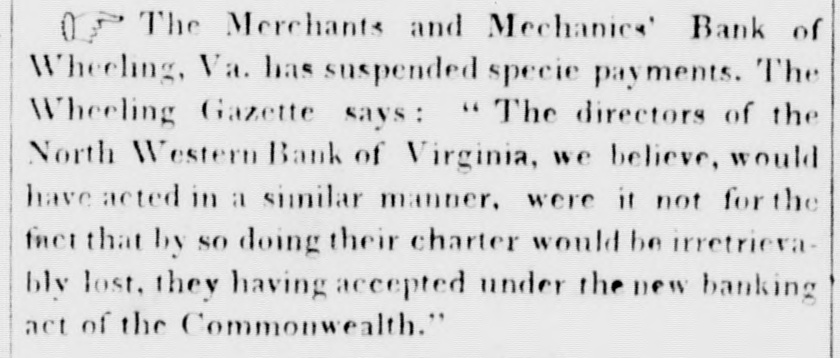
The Merchants and Mechanics' Bank of Wheeling, Va. has suspended specie payments.
Source
newspapers

Newspaper Articles (6)

Article from Lynchburg Virginian, May 29, 1837

Click image to open full size in new tab

Article Text

07 The Merchants and Mechanics' Bank of Wheeling, Va. has suspended specie payments. The Wheeling Gazette says : "The directors of the North Western Bank of Virginia, we believe, would have acted in a similar manner, were it not for the fact that by so doing their charter would be irretrievablv lost, they having accepted under the new banking act of the Commonwealth."


Article from Lynchburg Virginian, June 15, 1837

Click image to open full size in new tab

Article Text

unrin as numbry Unity insideration of the General Assembly 'he Bank of Virginia, the Farmer's Bank of Vir iia. the Bank of the Valley, and the Merchants I Mechanics' Bank of Wheeling. have severally spended specie payment. The North Western ink. at chedate of the latest accounts continued to et 11k is institution in the banking engagements with punetuality. Commonwealth and the which the s not been compelled seek protectionagainst essure of the times III suspension of payments The ink of Virg me declared the resolution the 15th May : on the day after. the example was followed the Farmers' Bank. Before this step was taken d even before it appeared to have been anticipated. had been resorted to by the Banks of the large com veral cities of the North Subsequently and III ick succession Bank after Bank has followed the ample set first in the City of New York, and now re is scareely a Bank of large capital and extend operations 111 any part of the Union, which re ems notes in specie. It was not to be expected that the Banks of this annouwealth-those of them at least whose issues I been bagely and widely diffused- could long con ue to pay specie after the Banks of the Northern I Easterncities had resolved to withhold it. Prior n to the declaration of the Northern Banks, spe was a premium. and had become an article of the : and the demands for it. and the premium 11 uld command were sure to be increased, and int of fact. were increased, by the determinat on 01 se banks to close their vands. As 2 resequence, ge and increasing demands would be made up our banks, to redeem their notes and liquidate balces: and their ability to meet such demands was minished bv withing the hance of supply from that airendested to them. 11 was apparent that the Commonwealth ( r refer especially to e two principal institutions.) would be brought at t to a denial of specie. A course of rigorous col tion, whilst it would have aggravated greatly the abliedistress,could at most have but delayed the evil , -and the banks were reduced to the necessity of a loosing between a suspension of payments. as easure of precantion. and of losing their supply with I being able effectually to resist the run which oud be be made upon them. The former alterna e was recommended by the examples of other ikk-by considerations of impartial justice to creditor-li the their delitors were unexpectedly and rich rds every embarrassments involved in . final security of their debts-and was the course patently best calculated to avoid agitation and the 111. and revenable them to assist 10 correcting rangement which had occurred in our pectimity Whatever neeris. difference of opinion there may be as to , cause, there cambe but one opinion respecting i reality audextent of the public distress. Failures unexampled amounts Inveoccurred: confidence, dwidbitthe immensecredit which tripopheld, sgone: , price of every agricultural product has declined d 111 atine of peace. and in the absence of physiI calamity, the wholecountry is uneasy and anxious out the future. Patience economy and industry i reliance upon themselves, and the exertion of in study virtues, will enable OUR citizens to reco i speedily from their embarrassments and thus which atd the only sure resource against the evils experienced and the best defence against their nurence hereafter. The time is unpropitions, ifit were otherwise de able. to attempt any radical change* in the policy the commonwealth. The system of Banking has en long since introduced and we find it fixed upThe Commonwealth 19 largely interested 111 us. stocks of our banking institutions, through the nd for internal improvement and the literary nd and the stock which is thus held, is part of : security which has been pledged to the performed holders debt. Bank paper bas long of currency, and the public the purposes the money holders The of poor and the rich, counted as rehants and traders of our towns have been ac USmed to look to the Banks, for facilities and aid d their instrumentality it was, they have to maketheir purchases of 11 would surely be unwise III a en d farmer. through enabled the need planter period of un difficulty, and when private credit is in ual facilities. to put dow 11 institutions whis hare 40 corporated with every public and individualinterest, d from which it would result as MII immediate con be quence. that the difficulties of paying would be iiiagmented whilst the debt to be paid would eased. Thereare there who who would have no inks, either State or Federal, and are for enforcing the metallic circulation of the country, I to impracticable, and the agitation of that mal exclusive condition believe The project this be whot in pen- to could have no other effect than still further , range the business. od oppress every interest highest in : And consider it of the to maintain the credit of the under proper regulations portance forming. community. and State reforms. Bank- Banks. substitute for a U. States Id affords the only the dangerous scheine of a powerful ainst only their practical preservation defence and over adowing national institution. By the provisions introduced into the charter taken of e Farmers' Bank at the renewal in 1821, the the charter of the North Western Bank and Bank >111 ink of the Valley, the corporate powers of that the Bank of the Valley. except the purpose and losing their d collecting debts of accounts, and they because ted by the refusal to pay specie act liable to serious penalties. The same the of like Bank of Virginia ereby part and the not Mer Mechanics' Bank of Wheeling is visa in d alike heavy condemnation. at these institutions are fivored ants and by respect But by whilst the exthe community without your be to serious in the amended charter of light ovision laws, exposed inconvenience the interference, Bank Bank by the of whic declares, that " if the said time fail or refuse to redeem its notes in orginia, receivable shall gold any silver coin. its issues shall be no longer payments the Banks to the are State.' not relieved. the revenue. amount thou g If to upwards of four hundred on cannot be spend amount of gold and time --This dollars maverage annually, silverwould paidexcept be in tem the country. rarily withdrawn from circulation. at the very to


Article from Martinsburg Gazette, June 21, 1837

Click image to open full size in new tab

Article Text

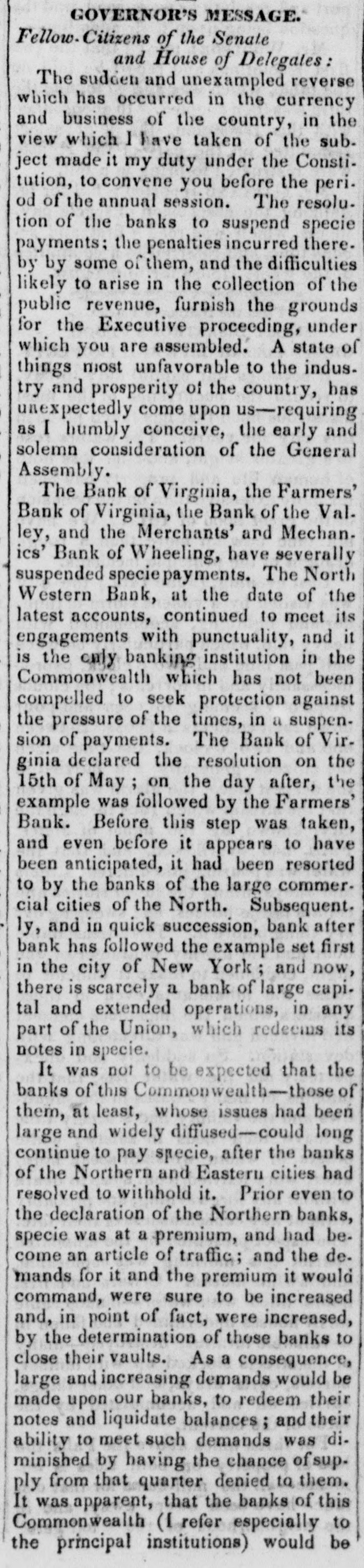
GOVERNOR'S MESSAGE.

Fellow-Citizens of the Senate and House of Delegates:

The sudden and unexampled reverse which has occurred in the currency and business of the country, in the view which I have taken of the subject made it my duty under the Constitution, to convene you before the period of the annual session. The resolution of the banks to suspend specie payments; the penalties incurred thereby by some of them, and the difficulties likely to arise in the collection of the public revenue, furnish the grounds for the Executive proceeding, under which you are assembled. A state of things most unfavorable to the industry and prosperity of the country, has unexpectedly come upon us-requiring as I humbly conceive, the early and solemn consideration of the General Assembly.

The Bank of Virginia, the Farmers' Bank of Virginia, the Bank of the Valley, and the Merchants' and Mechanics' Bank of Wheeling, have severally suspended specie payments. The North Western Bank, at the date of the latest accounts, continued to meet its engagements with punctuality, and it is the culy banking institution in the Commonwealth which has not been compelled to seek protection against the pressure of the times, in a suspension of payments. The Bank of Virginia declared the resolution on the 15th of May; on the day after, the example was followed by the Farmers' Bank. Before this step was taken, and even before it appears to have been anticipated, it had been resorted to by the banks of the large commercial cities of the North. Subsequently, and in quick succession, bank after bank has followed the example set first in the city of New York; and now, there is scarcely a bank of large capital and extended operations, in any part of the Union, which redeems its notes in specie.

It was not to be expected that the banks of this Commonwealth-those of them, at least, whose issues had been large and widely diffused-could long continue to pay specie, after the banks of the Northern and Eastern cities had resolved to withhold it. Prior even to the declaration of the Northern banks, specie was at a premium, and had become an article of traffic; and the demands for it and the premium it would command, were sure to be increased and, in point of fact, were increased, by the determination of those banks to close their vaults. As a consequence, large and increasing demands would be made upon our banks, to redeem their notes and liquidate balances; and their ability to meet such demands was diminished by having the chance of supply from that quarter denied to them. It was apparent, that the banks of this Commonwealth (I refer especially to the principal institutions) would be


Article from Staunton Spectator, and General Advertiser, June 22, 1837

Click image to open full size in new tab

Article Text

Virginia Legislature.

EXTRA SESSION.

HOUSE OF DELEGATES.

MONDAY, June 12. 1937. At 12 o'clock, the Speaker of the last session, (Mr. Linn Banks of Madison,) took the Chair, and called the House to order.

A Communication from the Governor was then handed to the Speaker, by Capt. J. B. Richardson, private Secretary, which was read as follows: Fellow-Citizens of the Senate, and House of Delegates.

The sudden and unexampled reverse which has occurred in the currency and business of the country, in the view which I have taken of the subject, made it my duty, under the Constitution, to convene you before the period for the annual session. The resolutions of the Banks to suspend specie payments-the penalties incurred thereby by some of them, and the difficulties likely to arise in the collection of the public revenue, furnish the grounds for the Executive proceeding under which you are assembled. A state of things most untavorable to the industry and prosperity of the country, has unexpectedly come upon us, requiring, as I humbly conceive, the early and solemn consideration of the General Assembly.

The Bank of Virginia, the Farmers' Bank of Virginia, the Bank of the Valley, and the Merchants' and Mechanics' Bank of Wheeling, have severally suspended specie payments. The North Western Bank, at the date of the latest accounts, continued to meet its engagements with punctuality, and is the only banking institution in the Commonwealth which has not been compelled to seek protection against the pressure of the times in suspension of payments. The Bank of Virginia declared the resolution on the 15th of May; on the day after, the example was followed by the Farmers' Bank. Before this step was taken, and even before it appears to have been anticipated, it had been resorted to by the Banks of the large commercial cities of the North. Subsequently and in quick succession, Bank after Bank has followed the example set first in the City of New York, and now there is scarcely a Bank of large capital and extended operations in any part of the Union, which redeems its notes in specie.

It was not to be expected that the Banks of this Commonwealth-those of them at least whose issues had been largely and widely diffused-could long continue to pay specie after the Banks of the Northern and Eastern cities had resolved to withhold it. Prior even to the declaration of the Northern Banks, specie was at a premium, and had become an article of traffic; and the demands for it, & the premium it would command, were sure to be increased, and in point of fact, were increased, by the determination of those banks to close their vaults. As a consequence, large and increasing demands would be made upon our banks, to redeem their notes and liquidate balances; and their ability to meet such demands was diminished by having the chance of supply from that quarter denied to them. It was apparent that the Banks of this Commonwealth, (I refer especially to the two principal institutions,) would be brought at least to a denial of specie-a course of rigorous collection, whilst it would have aggravated greatly the public distress could at most have but delayed the evil day-and the banks were reduced to the necessity of choosing between a suspension of payments, as a measure of precaution, and of loosing their supply without being able effectually to resist the run which would be made upon them. The former alternative was recommended by the examples of other banks-by considerations of impartial justice towards every creditor-by the embarrassment in which their debtors were unexpectedly involved, and the final security of their debts-and was the course apparently best calculated to avoid agitation and alarm, and to enable them to assist in correcting the derangement which had occurred in our pecuniary concerns.

Whatever difference of opinion there may be as to the cause, there can be but one opinion respecting the reality and extent of the public distress. Failures for unexampled amounts have occurred: confidence, and with it, the immense credit which it upheld, is gone: the price of every agricultural product has declined; and in a time of peace, and in the absence of physical calamity, the whole country is uneasy and anxious about the future. Patience, economy and industry-a reliance upon themselves, and the exertion of their sturdy virtues, will enable our citizens to recover speedily from their embarrassments, and thus afford the only sure resource against the evils which are experienced, and the best defence against their recurrence hereafter.

The time is unpropitious, if it were otherwise desirable, to attempt any radical changes in the policy of the commonwealth. The system of banking has been long since introduced, and we find it fixed upon us. The Commonwealth is largely interested in the stocks of our banking institutions, through the fund for internal improvement, and the literary fund; and the stock which is thus held, is a part of the security which has been pledged to the holders of the public debt. Bank paper has long performed all the purposes of currency, and by the holders of it, the poor and the rich, is counted as money. The merchants and traders of our towns have been accustomed to look to the Banks for facilities and aid; and through their instrumentality it was, they have been enabled to make their purchases of the planter and farmer. It would surely be unwise in a period of difficulty, and when private credit is in need of unusual facilities, to put down institutions which are so incorporated with every public and individual interest, and from which it would result as an immediate consequence, that the difficulties of paying would be augmented whilst the debt to be paid would be increased. There are those who would have no Banks, either State or Federal, and are for enforcing an exclusive metallic circulation.


Article from The Madisonian, August 16, 1837

Click image to open full size in new tab

Article Text

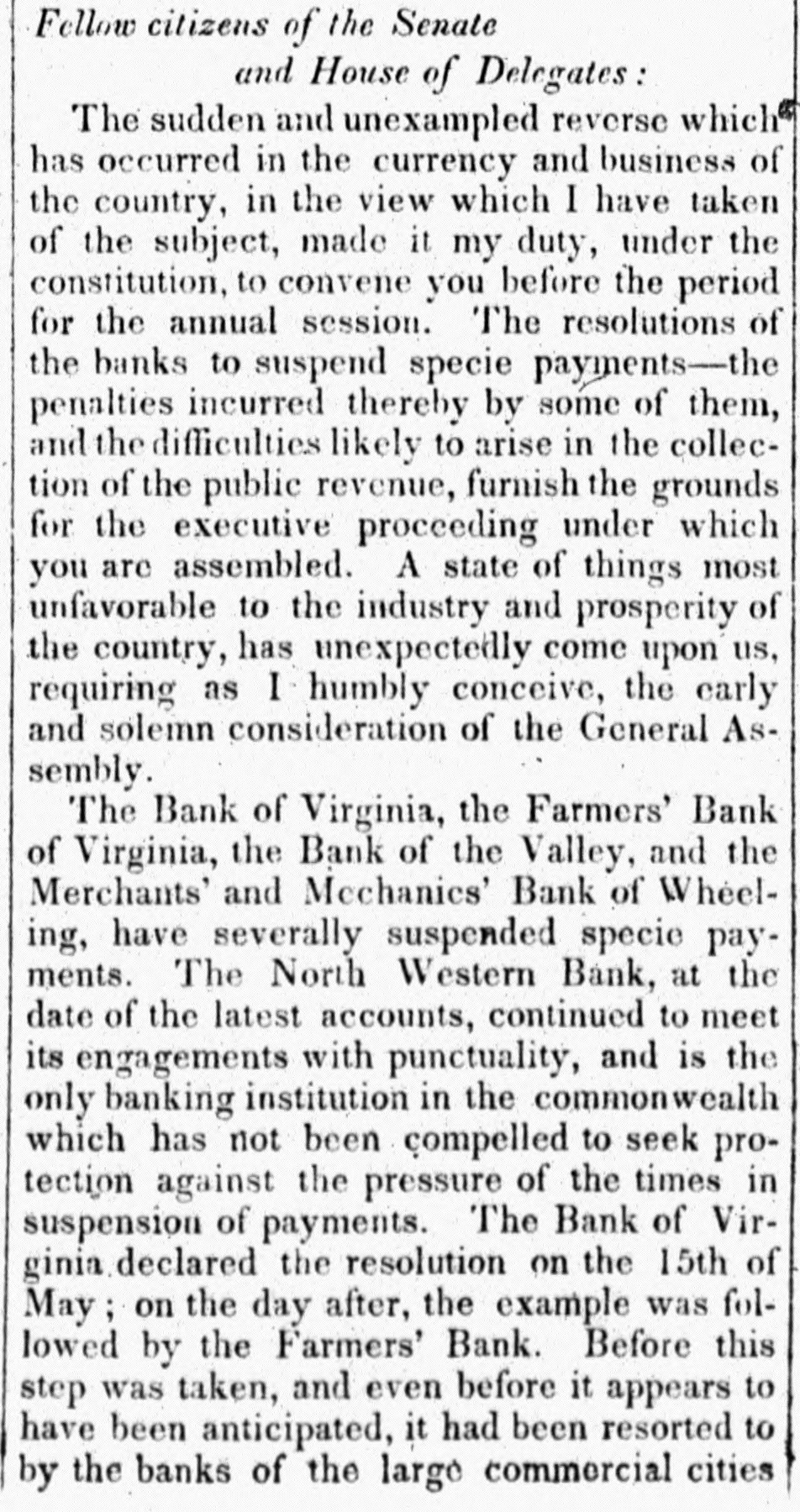
Fellow citizens of the Senate and House of Delegates:

The sudden and unexampled reverse which has occurred in the currency and business of the country, in the view which I have taken of the subject, made it my duty, under the constitution, to convene you before the period for the annual session. The resolutions of the banks to suspend specie paymentsβ€”the penalties incurred thereby by some of them, and the difficulties likely to arise in the collection of the public revenue, furnish the grounds for the executive proceeding under which you are assembled. A state of things most unfavorable to the industry and prosperity of the country, has unexpectedly come upon us, requiring as I humbly conceive, the early and solemn consideration of the General Assembly.

The Bank of Virginia, the Farmers' Bank of Virginia, the Bank of the Valley, and the Merchants' and Mechanics' Bank of Wheeling, have severally suspended specie payments. The North Western Bank, at the date of the latest accounts, continued to meet its engagements with punctuality, and is the only banking institution in the commonwealth which has not been compelled to seek protection against the pressure of the times in suspension of payments. The Bank of Virginia declared the resolution on the 15th of May; on the day after, the example was followed by the Farmers' Bank. Before this step was taken, and even before it appears to have been anticipated, it had been resorted to by the banks of the large commercial cities


Article from Richmond Enquirer, March 31, 1838

Click image to open full size in new tab

Article Text

stated that but a small portion of his constituents were interested in the proposed amendment, but the resolu. Hon upon them was unjust. Mr. rejoined, and read an amendment, which he should offer, see case of the rejection of the proviso. Further remarks were made by Messrs. Harrison, Cootes and Murdaugh-and the question being taken on Mr. Lucas's motion to strike out the proviso, it was de. cided in the negative-Ayea 40, noes 50. Mr. McDoWELL movedito-add to the proviso the following words: Procided, further, That it shall at all times be in the power of the Legislature, to repeal or modify this provision. Mr. LUCAS and Mr. HARRISON expressed their assent to this provision-and Mr. MURDAUGH. and Mr. SHERHARD opposed it. Mr. McDOWELL urged the propriety of reserving to the Legislature the right/of supervising the interests of the portion of that people immediately concerned. Mr. WOOLFOLK thought the Legislature, having at all times the power to modify or repeal the charter of the Winchester and Potomac Company, there was no necessity for the provision. Mr. KINNEY said if the Legislature had control over the Baltimore Company, it would be well enough; but this would be reccinding the very provision just adopted. by the House. Mr. Lucasasked the ayes and noes, which were taken, and the amendment was rejected by the following vote -ayes 51, noes 59. Mr. VENABLE offered- the following amendment to the first section: "And provided further, that the said sub. scription shall be made on the same terms, in regard to the guaranty of six percent interest, with the subscription of three millions made by the State of Maryland, in an act passed in June, 1836. Mr. McDoWELL moved to amend the amendment by adding-"Procided, That the State of Virginia hereby pledges itself relinquish her demand for interest, when it shall be certifiedito the Board of Public Works that the State of Maryland has made like relinquishment. This was agreed to, and the amendment as amended. was agreed to. Mr. VENABLE moved further to amend the bill by inserting before the commencing clause the following " Be it further enasted, That the company accept of the subscription herein provided for, it shall be subject to the provision contained in the act passed on the 11th of March, 1837, establishing general regulations for the incorporation of railroad companies, on the subject of the transportation of the mail, and its stock, property and profits shall be subject to toxation, so far as the ju. risdiction of this Commonwealth extends, any thing in the act passed March 8th, 1827, confirming the act of the General Assembly of Maryland, creating the company, to the contrary notwithstanding. Mr. BOTTS stated the various considerations which would compel him reluctantly to vote against the bill. Mr. STUART replied to the objections of Mr. BOTTS, and insisted that they were not well founded. Discarding. himself, all narrow and sectional considerations, he should vote for the bill, and hoped that it would meet the favor of the House. Mr. HARRISON read the act of 1827, to shew that the privileges granted under it to the Baltimore Company, were far greater than those now asked. M. BOTTS rejoined, and enlarged upon the objections which influenced his mind. Mr McDowel stated the provisions of the bill, as now amended, and pointed out the liberal character of the terms asked. He referred to the remark of Mr. Randolph, and to the justice of granting to Wheeling even a greater amount than now proposed, if she had come here seeking aid upon the usual terms, and enforced in hie usual cogent manner the propriety of passing the bill. Mr. VENABLE expressed his thanks to the gentleman from Rockbridge for calling his attention to the provisions of the bill, which be thought just and liberal.When the fact was remembered, that nothing was to be paid by the State, until the road was completed to Wheeling, and that interest was guaranteed, he thought every member should vote for the bill. The question being then taken, the vote on the engrossment was decided in the negative, as follows Ayes-Messrs Rives, Stuart, Kinney, Fryatt, Snod. grass, Shanks, Peyton, Triplett, Tarr, Thornburg, Corbin, Castleman, Servant, Sangster, Marshall, Digges, Dickinson, Deskins, Wood, Sherrard, Watkins, Ogles. by, Pinnell, Odell, Park, White, Mullen, Harrison, Flowers, McCandlish, Lucas, Smith of K., Tayloe, Allen, McDonald, Luckett, Beard, Taylor of L., Newman, Haymond, Morgan, Chapman of M., Barnett, Buck, Cunningham, Murdaugh, Segar, McConnell, Woolfolk, McPherson, May, Tunstall, Cabell, Fairfax, Venable, Williams, Storms, Robertson, Leyburn, McDowell, Gray, Culbertson, Conn, Crawford, Davis, Crutchfield, Ford, Witten, Ripley, Goodson, Gleaves-71 Noes-Messrs. Banks, (Speaker,) Bayly of A., Poulson, Jeter, Byrd, Mitchell, Cobbs, Turnbull, Mallory, Hubard, Yancey, Daniel, Cheatham, Cardwell, Cox, Hill, Wilson, Vaughan, Lorimer, Payne, Keen, Chap. man of G. & M., Smith of GI, Spencer, Edmunds, Botts, Smith of 1. of W., Wright, Shadwick, Conway, Goodwyn, Orgain, Hudgins, Garland, Burwell, Brown, Alexander, Fitzgerald, Adains, McCoy, Gay, Shands, Cootes, Thomas, Clayton, Prince, Walker-47 On motion of Mr. HARRISON, the House adjourned. Friday, March 30. The usual communication, of bills passed, was received from the Senate. The House agreed to the various amendments to several bills. THE BANKS. The bill concerning the banks of this Commonwealth, with several amendments of the Senate, came up for consideration. Upon the various propositions of the Senate, much de bate arose between Messrs. May, Venable, Sherrard, Harrison, McDowell, Smith of I. of W., Kinney, Tunstall, Botts, McConnell, Robertson, Fisher, Watkins and Crutchfield Several amendments to the Senate's amendment were made on motion of Messrs. MAY and VENABLE. The amendment of the Senate, directing proceedings agains the Merchants' and Mechanics Bank of Wheeling, was disagreed to, on motion of Mr. KINNEY in A provision was adopted, restricting the Banks their issue of $1 and $2 to 120 days after resumption of specie payments. The bill was then returned to the Senate. Several engrossed bills were passed. BALTIMORE AND oito RAILROAD. The bill providing subscription on behalf of the State to the stock of this company, came up about 3 o'clock. Mr. ROBERTSON made an ineffectual motion to lay the bill on the table. Messrs. BOTTS and ROBERTSON opposed its passage, and Messrs. HARRISON and McDowell sustained it. After various unsuccessful motions to adjourn, the vote on the passage of the bill was decided in the affirmative-ayes 65, noes 52. Mr. TUNSTALL, after a suspension of the rule, intro. duced a resolution, directing a bill to be brought in, authorizing a subscription of three fifths to the stock of the Roanoke, Danville and Junction Railroad Company This resolution was negatived, after some debate, by a vote of 46 to 51 On motion of Mr. TAYLOR of H., the House adjourned. MARRIAGES Married, on Thursday, the 1st of March, by the Rev. Andrew McDowell, Mr. THOMAS M. BLACKBURN of Henrico county, to Miss of Hanover. CHAPPELL, ELIZABETH Married, the same time and place, by the same, Mr. WILLIAM BLACKBURN Hanover, to Miss SARAH CHAPPELL, of Hanover. Married on Wednesday March