1101. Market Street Bank (San Francisco, CA)

Bank Information

Episode Type
Run → Suspension → Closure
Bank Type
state
Start Date
February 21, 1908
Location
San Francisco, California (37.780, -122.419)

Metadata

Model
gpt-5-mini
Short Digest
0a8910e8

Response Measures

Full suspension, Books examined

Other: Multiple rehabilitation/reopening schemes (Market Street Securities Company issuing bonds to depositors) and prolonged litigation; receiver appointed and criminal investigations of officers.

Description

The Market Street Bank suspended payment in Feb 1908 after being unable to meet immediate demands. Officials claimed solvency but lack of cash; attempts to rehabilitate via a Market Street Securities Company issuing bonds to depositors and other schemes were tried but failed. The bank was declared insolvent by the bank commissioners and litigation led to a receiver being appointed; the institution did not successfully reopen. Later investigations and criminal proceedings followed.

Events (4)

1. February 21, 1908 Run
Cause
Bank Specific Adverse Info
Cause Details
Heavy immediate withdrawals and inability to meet demands; bank claimed solvent but pressed for cash and unable to meet obligations.
Measures
Bank officials and directors proposed issuance of bonds via the Market Street Securities Company to replace passbooks; plans to issue bonds to depositors to cover deposits and reopen.
Newspaper Excerpt
The Market Street Bank, savings and commercial, temporarily suspended payment this morning, A notice posted on the door says the bank is entirely solvent, but has not sufficient cash on hand to meet all immediate demands.
Source
newspapers
2. February 21, 1908 Suspension
Cause
Bank Specific Adverse Info
Cause Details
Suspension due to inability to meet immediate cash obligations after heavy withdrawals and unsafe conduct/management later alleged by authorities.
Newspaper Excerpt
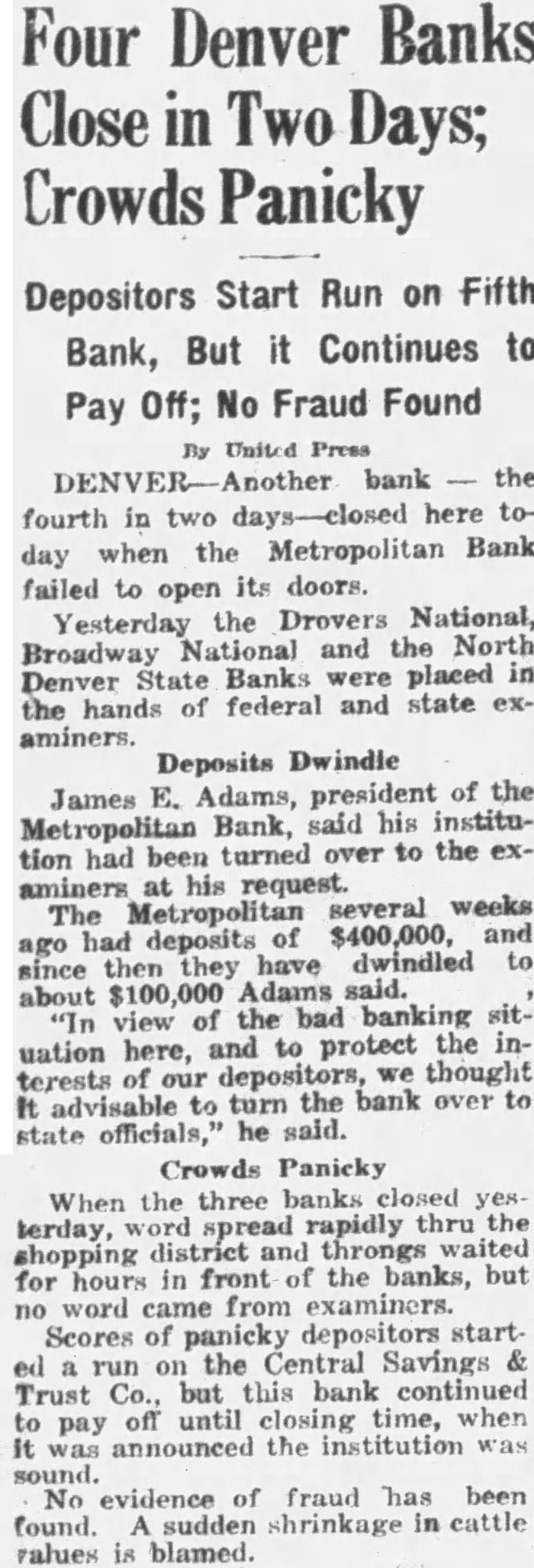
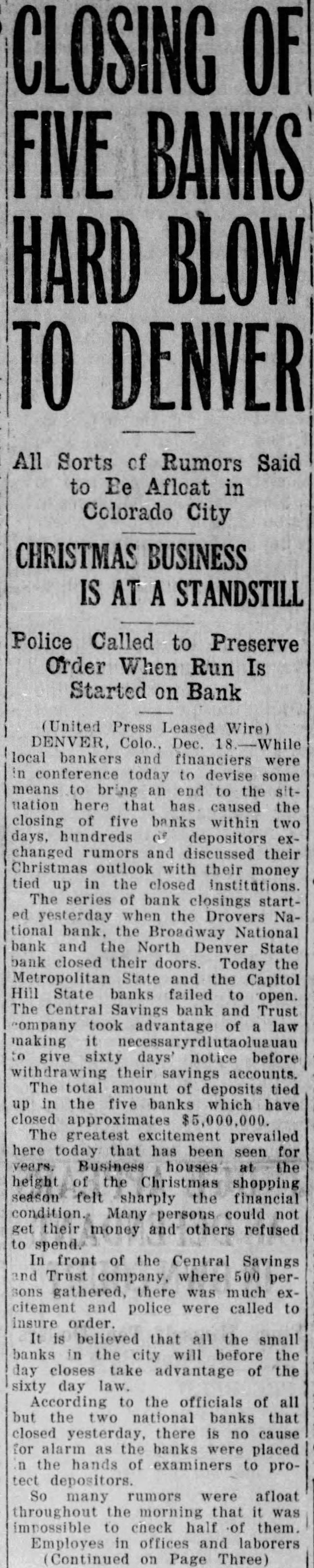
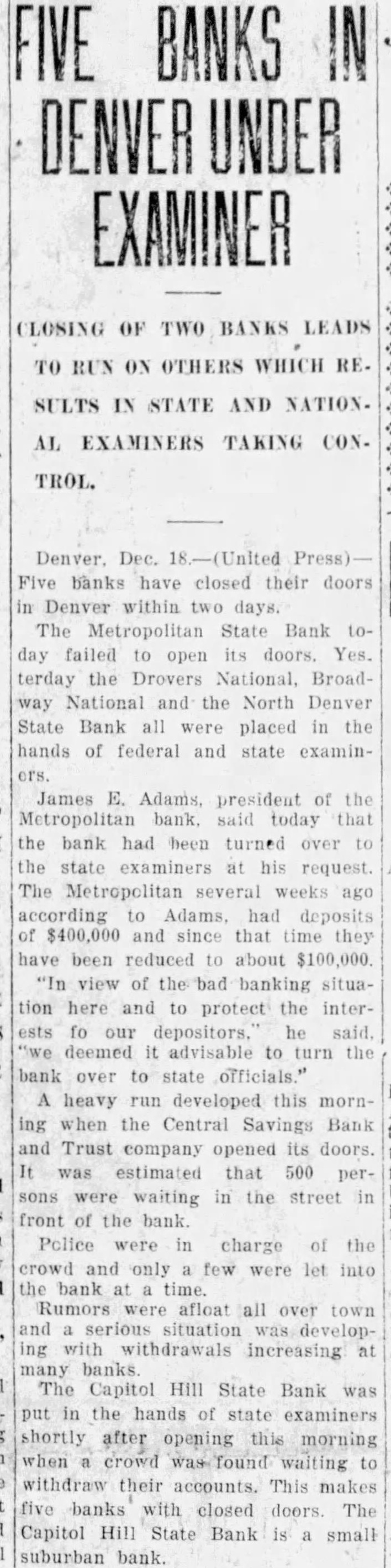
The Market Street bank ... did not open its doors this morning. Its financial condition is being investigated by the bank commissioners. The bank has deposits amounting to $1,132,206. The officials of the institution claim that it is solvent, but state they are pressed for money to meet demands.
Source
newspapers
3. March 17, 1908 Other
Newspaper Excerpt
Martel wishes to launch securities company which will issue bonds to depositors in the Market Street bank to the extent of their deposits... The Market Street securities company... will issue bonds ... secured by and be a first charge and lien upon all the assets of the Market Street bank.
Source
newspapers
4. March 27, 1908 Receivership
Newspaper Excerpt
Suit to have the Market street bank adjudged insolvent and to have a receiver appointed was filed in the superior court yesterday by Attorney General Webb... The Market street bank closed its doors February 20, owing to inability to meet obligations. The bank commissioners the same day started an investigation of the affairs of the bank, and March 19 resolved that it was unsafe for the corporation to continue transacting business and assumed control from that date.
Source
newspapers

Newspaper Articles (24)

Article from Warren Sheaf, April 26, 1906

Click image to open full size in new tab

Article Text

into temporary hospital, the harbor hospital being unable to accommodate all the injured who were brought there. About 100 patients were stretched on the dock at one time. Thursday evening tugs conveyed them to Goat island, where they were lodged in the hospital. The docks from Howard street to Folsom street have been saved, and the fire at this point was not permitted to creep farther east than Main street. To add to the horrors of the situation and the general alarm explosions of sewer gas shook many streets. A Vesuvius in minature was created by such an upheaval at Bryant and eighth streets. Cobblestones were burled 20 feet upward and dirt blew out of the ground. The only bank in the huge ruined district that escaped destruction was the Market Street bank, at the corner of Seventh and Market streets. It is in the gutted Grand building, but the firemen saved the ground floor. It will pay out money just as soon as it hears from the Clearing house officials. A corner of the city near the Pacific mail wharves at Second and Brannan streets, was not ruined, and the sailors' home is intact. The Postal Telegraph company has restored its cable connection with the orient by establishing a station at Ocean Beach, but there is no service yet for delivering messages there. Many Killed by Crazed Cattle. A series of fatalities took place Thursday as the result of the stampeding of a herd of cattle at Sixth and Folsom streets. Thre hundred of the panic-stricken animals ran when they saw and felt the flames and charged wildly down the street, trampling under foot all who were in the way. One man was gored through and through by a maddened bull. At least a dozen persons, it is said, were killed. Shock Empties Wells. A feature of San Francisco was the many wells and cisterns upon which thousands of residents depended for water for drinking and cooking. Every earthquake has affected these cisterns and wells. Water in many of them disappeared and did not return for months. The earthquake of Wednesday had the same effect, and this accounts, in part at least, for the scarcity of water after the shocks. While the city pipe system suplied a large Continued on page 5.


Article from East Oregonian : E.O, May 24, 1906

Click image to open full size in new tab

Article Text

San Francisco May 24.-At a secret meeting of the board of fire underwriters held at Oakland, definite action was taken in the matter of fixing insurance rate for San Francisco. It was decided to double all rates. Some members favored fixing different rates for the burned and unburned sections, but a flat rate for the entire city was finally decided upon and all special rates abrogated. The lines of depositors around the savings banks are materially smaller today, and more deposits were made than withdrawals. As a result of the opening of banks for unrestricted business building operations are given a great - impetus. The construction of scores of new frame buildings begun this morning. Banks All on Solid Ground. At the Market Street bank the line at the paying teller's window was smaller than at the receiving teller's The same was true at the Western National bank and National Bank of the Pacific. Deposits at the Mutual Savings bank were comparatively small, and judging from the line at the paying teller's window. the heaviest run of any of the downtown banks was made there. All demands, however. were paid in full. At the Crocker Woolworth bank over $50,000 in gold coin was paid in today before 11 o'clock, while the withdrawals were very small. At the Union Trust company the deposits exceeded the withdrawals tenfold. Protest Cancelling Bonds. The lobby committee on special session of the legislature today decided against the proposition for the legislature to extinguish $177,000,000 worth of unsold San Francisco bonds. Assurances are received from financiers that the present outstanding bonds are saleable. and the money is needed im-


Article from The Washington Times, February 21, 1908

Click image to open full size in new tab

Article Text

BANK CLOSES DOOR IN SAN FRANCISCO SAN FRANCISCO, Feb. 21.-The Market Street Bank, savings and commercial, temporarily suspended palyment this morning, A notice posted on the door says the bank is entirely solvent, but has not sufficient cash on hand to meet all immediate demands.


Article from Los Angeles Herald, February 22, 1908

Click image to open full size in new tab

Article Text

MARKET STREET BANK IN SAN FRANCISCO SUSPENDS By Associated Press. SAN FRANCISCO, Feb. 21.-The Market Street bank, located at the corner of Seventh and Market streets, did not open its doors this morning. Its financial condition is being investigated by the bank commissioners. The bank has deposits amounting to $1,132,206. The officials of the institution claim that it is solvent, but state they are prossed for money to meet demands.


Article from The Tupelo Journal, February 28, 1908

Click image to open full size in new tab

Article Text

San Francisco Bank Suspends. San Francisco, Cal.-The Market Street Savings and Commercial Bank temporarily suspended payment Friday morning. A notice posted says the bank is entirely solvent, but has not sufficient cash on hand.


Article from The San Francisco Call, March 1, 1908

Click image to open full size in new tab

Article Text

WIDOS. Page 47 EDITORIAL Page 28 Congress doing politics. An impassioned appeal. Page 28 Altering the face of nature. Page 28 The fire insurance situation. Page 28 GRAFT "Higherup" graft defendants widely circulate copies of Rabbi Kaplan's affidavit in desperate effort to turn public sentiment Page 19 CITY Growth of Lincoln-Roosevelt league forces Herrin machine out into the open to fight for life. Page 17 J. C. Stubbs, Harriman's general traffic manager, on the eve of railroad commissioners' investigation visits many shippers who recelved favors. Page 17 Investigation discloses startling figures regard ing sums. paid by San Francisco in fire insurance premiums. Page 24 Paderewski tells of his work and praises some Page 27 of the American composers. Sigmund Woolberg, who was gold broker for United States in civil war, dies at son's home. Page 22 Fate of the suspended Market street bank will be decided this week by the state board. Page 40 Andrea Sbarbero to leave for Washington to protest on behalf of California winemen against the Littlefield bill. Page 32 Mrs. Susie K. Christ of San Francisco elected by California Native Daughters to succeed the grand late Miss Mary A. Dempsey as treasurer. Page 24 Archbishop Riordan will administer sacrament of confirmation to large class at Sacred Heart church today. Page 40 Civil war veteran, unable to find work. commits suicide. by taking carbolic acid in park. Page 19 C. A. Chichester, customs broker, accuses partners and brings suit against associates of two firms. Page 40 Cherry blossom fete charming scene with its tableaux of little folk and society girls in kimonos and obis. Page 20 SUBURBAN Mill valley woman who cashed forged check said to have eleped with daughter's husband. Page 32 Sausalito druggist sues business rival on charge Page 23 of damaging his crédit. Young coed at University of California pays ber way through college by Tearing bees. Page 36 Society to welcome Miss Marian Barney, who returns to Oakland to join the Bishop players. Page 36 Berkeley improvement clubs and Lincoln Roosevelt league to urge board to make town separate supervisorial district. Page 47 Powder experts engaged in effort to prove Mrs. Martin responsible for explosion at Ogden home. Page 36 COAST Work on the blg drydock at Mare island is being rushed by government; Page 32 Imperial county's rapid strides amaze State Controller Nye. Page 23 Vallejo's three cornered maxoralty contest to be decided at the polls Monday. Page 19 Mrs. Charlotte L. Noyes, a divorced woman who posed as. a widow, is slain at Los Angeles by mining engineer with whom she quarreled over losses on horse races. Page 18 EASTERN General movement is begun in Chicago for a denunciation of anarchists and Hearstism from Catholic pulpits, and Jews of the lake city decide to co-operate in the crusade. Page 17 Los Angeles to ask that fleet stop there on was to San Francisco, as navy department has not setttled itinerary. Page 17 Dorothy Russell, the actress, becomes the wife of a rich Japanese. Page 17 Navy officers renew criticisms of warship construction before senate committee. Page 23 Bryan speaks before Mississippi legislature and scores Kentucky democrats who voted for a republican senator. Page 20 FOREIGN Battleship. fleet steams out of Callao on way to Magdalena bay where it .will arrive March 14. Page 17 SPORTS Chicago White Sox baseball team starts on its Page 34 long training trip to Pacific coast. Tony Faust wins the Waterhouse cup at Emeryville, two and a quarter miles, from Red Leaf by a nose. Page 33 Lee Rose, the hitberto unbeaten 2 year old, outfooted by Aunt Aggle in the Woodland stake at Santa Anita. Page 33 Attention of high school athletes now centers Page 34 upon baseball contests. Coast Champion McLoughlin and former Champion Melville Long will meet in a tennis match Page 34 at the California club today Three golf teams are a tie in mixed fourPage 34 somes on the links at Ingleside. Jimmy Britt is installed an 8 to 10 favorite over Battling Nelson for their fourth meeting in Page 35 Los Angeles Tuesday night. LABOR W. R. Hearst and Examiner are arraigned in labor council meeting for change of base on Page 29 liquor question. MARL Vanguard of Arctic whaling fleet will sail toPage 47 day for northern waters. MINING Stocks dull and listless on mining exchange Page 39 and prices decline in consequence.


Article from The San Francisco Call, March 17, 1908

Click image to open full size in new tab

Article Text

MARTEL HAS PLAN TO AID DEPOSITORS Securities Company to Take Over All Assets for Benefit of All Concerned Bank Commission Tentatively Promises Its Favorable Consideration A. F. Martel, president of the suspended Market Street bank. had a plan for the rescue of that institution to submit to the bank commissioners yesa terday. Martel wishes to launch securities company which will issue bonds to depositors in the Market Street bank to the extent of their deposits. The securities company would have a capital stock of $1.000,000. Martel asked permission of the commission to submit his plan to the depositors and creditors of the bank. They informed him that if he was successful in getting the creditors to consent to his plan the commission would give him a further hearing and if he could promise adequate capital the plan might receive favorable consideration. William S. Vawter of Santa Monica, the newly appointed commissioner. took his seat in the board yesterday. Vawter. who was a banker of Los Angeles and Santa Monica, was named by acting Governor Warren Porter to succeed Hermann Silver as bank commissioner. The bank commission adjourned to this afternoon. The plan which Martel will submit to the bank's creditors is outlined in the following letter which is to be sent to them today: Announcement by the directors of the Market Street bank: We are glad to he able to announce that Be have made arrangements to protect all the depositors. In order to avoid the large expenses of a receivership and to conserve the assets of the bank and to pay the depositors as soon as possible in full. plans have been perfected between the bank and a securities company. as follows: The Market Street securities company. with a fully subscribed capital stock of $1,000,000. will issue bonds in denominations of $10 and upward. with 5. per cent interest bearing conpons attached These bonds will be secured by and be a first charge and lien upon all the assets of the Market Street bank (which are ample to pay all depositors in fully and also the assets of the Market Street securities company. both including the following: Promissory notes secured by decis of trust on San Francisco improved real estate for an amount in excess of $500,000. Promissory notes secured by deeds of trust on Oakland and other real property in counties bordering San Francisco bay for an amount In excess of $300,000. Bonds and other assets with the Market Street bank of a value in excess of $150,000. Bonds and stock deposited by the directors and share holders of the Market Street bank of an estimated rslue of $1,225,000. Paid up capital stock and surplus of the Market Street bank. the sum of which is in excess of $135,000. Total security, $2,310,000. As all the liabilities of the Market Street bank amount to $1,000,000 in round numbers. the total Issue of bonds will not exceed that amount. 323 You are entitled to an allotment of such bonds in the amount of your deposit with interest thereon. This plan. which is the same used successfully in the case of the other banks without the loss of a cent to their depositors, is the result of careful investigation and considers tion and presents the best possible means of protecting all parties and avoiday the neces a sity of the bank passing into the hands of receiver at an enormous cost for depositors It is hoped that you will avail yourself of this offer immediately. as the time is (V. tremely limited within which action cap he taken, and prompt attention is absolutely essen tial. Now, it is for you to decide whether you want bonds or a receiver. If you take the bonds He shall resume business at once. and it will enable us to cash your bonds at par as fast as we can realize on the securities, without loss to you. Please sign and return inclosed postal card or call at the bank. which will be kept eject next week from 9 a. m. till p. m. daily for 1 purpose of giving out the bonds. Yours truly, THE MARKET STREET BANK. (By A. F. Martel. President.)


Article from The San Francisco Call, March 21, 1908

Click image to open full size in new tab

Article Text

ASK FOR RECEIVER FOR SUSPENDED BANK Recommendation That Attorney General Proceed Against Market Street Concern The bank commissioners yesterday recommended that Attorney General Webb begin legal proceedings for the appointment of a receiver for the Market street bank, because the directors of that institution have failed to make good their promises to straighten out their financial affairs within a month's time. When the bank suspended it had $1,000,000 on deposit, of which $800,000 had been loaned on mortgages. Its officers claimed that they would make good and pay dollar for dollar, but owing to the financial stringency they were unable to keep 'their promise within the prescribed time. The action came as a surprise to the officials of the bank, who say that they will contest the suit. A few days ago they proposed a scheme to issue bonds for the passbooks of the depositors. This plan was neither approved nor condemned by the bank commissioners, who issued a statement yesterday say. ing that the matter rested entirely with the officials of the bank. Attorney General Webb yesterday filed a suit to have the bank of Greater San Francisco declared insolvent, and to have a receiver appointed. It is alleged that the bank has conducted its business in an unsafe manner, and failed to comply with the orders of the bank commissioners regarding the disposition of certain stocks and bonds. The bank was declared insolvent February 28 by the bank commissioners.


Article from The San Francisco Call, March 22, 1908

Click image to open full size in new tab

Article Text

GOOD NEWS FOR DEPOSITORS OF THE MARKET STREET BANK The announcement made by the Market Street Bank to the public in another column, wherein it is stated that arrangements are being perfected for the reopening for general business of the Market Street Bank in a few days, comes as welcome news to both depositors and the business world. The plan of resumption contemplates the issuance to depositors of bonds in denominations of ten dollars and upward bearing 5 per cent interest, secured by and to be a first lien upon all the assets of the bank, which are claimed to exceed the liabilities to depositors by 2 1/2 times their value. The bonds are being as freely accepted as the president, A. F. Martel, can sign them. This plan, while affording the depositor every possible guarantee of receiving 100 cents on the dollar, obviates the appointment of a receiver, and thus saves to the bank an enormous expense that would otherwise be entailed.


Article from The San Francisco Call, March 27, 1908

Click image to open full size in new tab

Article Text

MARKET STREET BANK IN COURT Attorney General Files Suit to Have Institution Adjudged Insolvent Suit to have the Market street bank adjudged insolvent and to have a receiver appointed was filed in the superior court yesterday by Attorney General Webb. Pursuant to the prayer of the complaint, Presiding Judge Sturtevant signed a restraining order prohibiting the directors of the bank, A. F. Martel, L. Q. Haven, E. C. Dudley, W. S. Upham and Oliver Ellsworth, and all other officials of the institution, from transacting or attempting to transact any business of the bank, from disposing of or attempting to dispose of any of its assets, or from interfering in any manner with the property and assets of the corporation during the pendency of the action. The suit was assigned by Judge Sturtevant to his own department. The complaint filed by the attorney general alleges that the bank and its directors have been conducting the business of the corporation in an unsafe manner. The Market street bank closed its doors February 20, owing to inability to meet obligations. The bank commissioners the same day started an investigation of the affairs of the bank, and March 19 resolved that it was unsafe for the corporation to continue transacting business and assumed control from that date. have the German system adopted here. For despite all this criticism I believe that the system of teaching young children that has developed in America Is the most beautiful educational development that we have brought about. It creates independence: it makes for individuality and brings out the qualities of leadership. The only trouble is that it is not always applied correctly. It is like a dangerous weapon that must be handled carefully. Common sense will suggest its proper evolution. But it is the only method devised which has brought out the ability to do a new thing. and to do it when some one isn't there to tell you how. PROGRESS IN CALIFORNIA Judge Frank J. Murasky outlined to the teachers the work accomplished by the juvenile courts in San Francisco. Dr. Alexis F. Lange, professor of education at the University of California. spoke at length on "Public Spirit and Education." Lange outlined educational progress in California in the last 30 years and discussed the relation of public spirit to higher education. He said: The so called university spirit is ceasing to be merely an animal spirit, but is one of publie spirit. Our nation is coming of age. For the first time it has a conscience, and for much of this higher education is responsible. And of those who are doing a great work in education the women are playing a great part. The institute will continue this morning, when Dr. Russell will again speak.


Article from The San Francisco Call, July 18, 1908

Click image to open full size in new tab

Article Text

SCHEME TO REOPEN BANK IS REJECTED Court Has No Power to Accept the Plan Proposed by Stock Holder Allen The scheme of I. B. Allen for the rehabilitation of the insolvent Market street bank, of which he is the principal stock holder. was summarily turned down by Judge Sturtevant yesterday. Allen's proposal was to take over a large proportion of the assets of the bank, to sell unissued stock on a 15 per cent commission and to reopen the institution and run it under supervision of the court and bank commissioners. Judge Sturtevant pointed out that there was no provision of the law under which he could authorize such a procedure. His power was limited to adjudging the bank solvent or insolvent and having already adjudged it insolvent and named a receiver, he could not now permit a stock holder to reopen it. To sanction such a scheme as that submitted by Allen, the judge added, would simply result in tying up the affairs of the bank in still further litigation and thus keep the depositors from sharing in the assets. The stay granted the bank pending the perfection of an appeal against the judgment declaring the institution insolvent expired yesterday and, unless the appeal is perfected before 10 a. m. today, Louis H. Mooser, the receiver, will take charge at that hour. In order to put the appeal in shape, it is necessary for the bank to deposit an appeal bond. Attorney P. L. Shuman, who has replaced Oliver Ellsworth as counsel for the bank, yesterday asked Judge Sturtevant to fix the amount of the bond. The judge delayed doing so until this morning, intimating, however, that he would probably name a sum in the neighborhood of $200,000. W. W. Kaufman, attorney for the receiver, will ask that the bond be fixed at four or five times that sum. "This is an absolutely frivolous appeal," said Kaufman last night. "It can only operate to keep the depositors. out of their money for a long period. If the appeal be forced it keeps Mr. Mooser from taking possession of the bank, but if he is permitted to go in he will be able to pay the depositors a 25 per cent dividend in two weeks. An appeal will tie up the assets for at least a year."


Article from The San Francisco Call, July 23, 1908

Click image to open full size in new tab

Article Text

BANK DEPOSITORS ASK FOR RETURN OF BOOKS Market Street Securities Com= pany Refuses to Give Them Back The Market Street bank was besieged with depositors all day yesterday. They were endeavoring to secure the return of their bankbooks, which they had surrendered for bonds issued by the Market Street securities company. Receiver Mooser could not return the books and the securities company has refused to do so. In a statement issued Tuesday to the depositors Mooser advised them to hold on to their books. Since the publication of his statement many of the depositors have attempted to return their bonds and get their books back. None of the officers of the securities company could be seen yesterday and it could not be ascertained whether the books will be returned for the bonds.


Article from The San Francisco Call, August 12, 1908

Click image to open full size in new tab

Article Text

CASHIER OF BANK REFUSES TO TALK On Advice of Counsel, Nash Declines to Explain to District Attorney President Martel Agrees to Transfer His Property to Receiver W. B. Nash, former vice president and cashier of the Market street bank, upon the advice of his attorney, Frank Drew, refused to appear before the several explain istrict-attorney yesterday transactions morning that and are on the books of the wrecked institution. A. F. Martel, president of the bank, was beard by Langdon Saturday. Nash was to have appeared Monday. His attorney asked for a continuance until yesterday morning, but then telephoned to the district attorney to the effect that he had advised his client not to appear. Attorney Drew stated last night that he had not defied the district attorney, but under the circumstances had advised his client to say nothing. Whether the matter would now be taken before the grand jury, Langdon refused to state, Langdon said yesterday that no further testimony, since that given by Martel on Saturday, had been taken. The testimony of Martel last Saturday was practically a complete confession. He testified that everything he had done while president of the bank he had done with the conviction that it was right. Any irregularities that had been traced to him, he said, were not done with intent, but through ignorance. Joseph M. Kinley, attorney for Martel, has advised his client to tell everything. Every piece of property owned by Martel is to be turned over to Receiver Mooser. A deed to the Ashbury street residence was signed yesterday. Kinley has a plan for the reopening of the bank. He said yesterday: "I have made arrangements by which I think I can, with others with whom I am acting, reopen that bank with money enough to pay every depositer dollar for dollar and interest. We could have had the bank open by this time if it had not been for the friction that has arisen in regard to the exchanging of pass books for bonds. If we succeed in reopening the bank every depositor will be protected. Martel has turned everything he owns over to me and I will turn it over to the receiver. Martel has been honest in every transaction of the bank. He has been imposed on, that's all." The matter of the sale of 20 of the bonds of the Yosemite Valley railroad is to come up before Judge Sturtevant the this $900 morning. each for the Mooser bonds, has which, been offered in opinion of several bond brokers, is a reasonable figure.


Article from The San Francisco Call, August 13, 1908

Click image to open full size in new tab

Article Text

MARKET BANK YET FIGHTS FOR DELAY New Attorney, Joseph Campbell, Is Unsuccessful in Objections to Bond Sale Declares He Will Have New Scheme of Rehabilitation, but Court Is Skeptical After a strenuous but unavailing objection by Attorney Joseph Campbell, the latest of the procession of attorneys for the directors of the Market street bank, Judge Sturtevant vesterday permitted Receiver Louis H. Mooser to sell 20 bonds of the Yosemite Valley railroad company. Mooser said the offer he had received had to be accepted yesterday or else it would be withdrawn. "I will immediately serve uotice of appeal, so the bonds will not be sold. anyway," threatened Campbell as he left the court. When Campbell asked for a continuance of the hearing Judge Sturtevant said: "I would like to accommodate you, but you are the fourth attorney the bank has had, and they have all pleaded for delay." Campbell answered he had only been retained the day before, and said he for was busy preparing a petition presentation to the court, embodying a scheme that he believed would end the entire proceedings immediately and result in the depositors getting all their money. "The same thing has been said to me repeatedly in behalf of the directors, but we have got no further," returned the judge. "I will hear the petition." BONDS HARD TO SELL Receiver Mooser testified that he had made inquiries and had ascertained that there was little sale for the bonds, and that $900 was a very fair offer. His brother, Joseph Mooser, who is in the the as to made of brokers, inquiries employ of receiver, testified who hard had told him the bonds were very to deal in. "Do you folks intend to raise this bid?' asked Judge Sturtevant of Campbell. "No, but we hope to make a showing on Monday that will end this whole matter," Campbell replied. I have been hearing that for months past. The petition is granted," concluded the court. Still another attempt is to be made on behalf of the Market street securities company to have set aside the judgment by which the Market street bank was declared insolvent and a receiver appointed. S. R. Porter. a depositor, who has over $1.600 in the bank, gave notice yesterday that on August 21 he will move for a new trial of the cause and for leave to intervene. He proposes a scheme similar to that which has already been turned down by Judge Sturtevant, by which the securities company will turn over the passbooks it has obtained, representing $656,000 of deposits, in return for the Burlingame terrace lots and the contracts of sale at a valuation of $321,000 and other assets and property of the bank at a valuation of $350,000. There will then remain in the hands of the bank, according to Porter's petition, cash and convertible securities worth $390,000, which will be sufficient to pay all the debts and liabilHe claims, ities of the institution. therefore, that the bank is not insolvent, never has been insolvent, and that the judgment should be set aside. DENIES CLASH WITH NASH "The report that there has been a clash between Mr. Nash and myself is false." said A. F. Martel, president of the bank, yesterday. Martel, who has refused to talk much of late, spoke up when he was questioned as to a clash between himself and W. B. Nash. He denied that there had been anything but the best of feelings between himself and Nash. Nash also denied the report. He said that there was no danger of a clash, that he and Martel had always been the best of friends, and that he saw no reason for the breaking of that friendship. Louis H. Mooser, the receiver of the bank, stated that in his opinion Martel and Nash were sure to clash sooner or later. He said: "When I. as receiver, make a demand on the Market street securities company for the books of the depositors, which it holds, Martel will be willing to turn them over, but the others in the securities company possibly will object. If they do object, and Martel insists upon turning the books over to me, I do not see how a clash can be averted." A course of investigation into the affairs of the bank has been outlined by the district attorney, which he re6 fuses to give out. The refusal of Nash to testify, upon the advice of his attorney, now puts the matter up to the grand jury. The case has not yet been presented to the grand jury,


Article from The San Francisco Call, August 15, 1908

Click image to open full size in new tab

Article Text

PLANS TO REOPEN MARKET ST. BANK Attorney Joseph Campbell, who is acting for the directors of the Market street bank, announced yesterday that his plan for the rehabilitation of the institution was practically completed. He will apply to the court on Monday for permission to reopen the bank. Campbell refused to announce his plan before Monday. He said that he was not sure that It would go through. Until the rehabilitation is actually accomplished Campbell says he is sure of nothing. Joseph L. Kinley, attorney for Martel, also had a plan for the rehabilitation of the bank, but has dropped it, as he thinks it would be financial suicide on the part of any financier to attempt to put the wrecked Institution on its feet. John C. Hughes, former cashier of a well known bank in Kansas City, who a week ago intimated to the receiver that he was willing to purchase the assets of the bank, has also backed out. He is willing to buy the fixtures, but does not care to accumulate a lot of valueless assets. He would like to start a bank under another name. BOND SALE FALLS THROUGH The sale of 20 bonds of the Yosemite valley railroad company at $900 each appears to have fallen through. The intending purchaser has become frightened over the notice of appeal filed by Attorney Campbell. It looked as though Receiver Mooser and members of the Depositors' association would clash yesterday afternoon. An advertisement calling upon all depositors to file their claims with the receiver started things. Several depositors had their claims made out and acknowledged before a notary. Members of the association were of the opinion that this was not necessary, and were on the point of seeking an injunction against the receiver, when an obliging atterney informed them that the claims must be filed. CALL PUBLIC MEETING The association has called another public meeting at the Colonial theater, in McAllister street, for Sunday. The purpose of the meeting is to submit reports to the members of tne association and to secure more members. Only bona fide members of the association and prospective members who have their bank books will be admitted. The meeting will be held from 1 o'clock in the afternoon until 5.


Article from The San Francisco Call, August 16, 1908

Click image to open full size in new tab

Article Text

GRAND JURY WILL INVESTIGATE BANK If Findings of Receiver Mooser Are Correct Indictments Are Expected Depositors of Market Street Concern Will Hold an Important Meeting Today Action by the grand jury in the Market street bank case probably will be taken Tuesday, when the inquisitors assemble. District Attorney Langdon has finished taking testimony. He took only the testimony of the receiver of the bank and of President Martel. Nash, the vice president and cashier, refused to testify upon the advice of his attorney. If the findings of Receiver Mooser are found to be correct, indictments with many counts will probably result from the investigations which are to be carried on by the grand jury. The plans of Attorney Joseph Campbell for the rehabilitation of the bank will be heard by Judge Sturtevant Monday. So many plans for the reopening of the bank have been submitted that there is small chance of Campbell's plan being accepted. The depositors are clamoring for their money, or as much of it as they can get. Mooser promises to pay a dividend in a few weeks, but if Campbell's plan is accepted the dividend will have to be postponed until it is found out whether or not the plan will be successful. The Market street bank depositors' protective association, which was formed by depositors of the bank July 26, will hold another public meeting this afternoon at 1 o'clock in the Colonial theater. The officers of the association will report to the members during the meeting. Only members of the association and prospective members are to be admitted. An effort is to be made to bring the membership of the association up to 1,000.


Article from The San Francisco Call, August 17, 1908

Click image to open full size in new tab

Article Text

BANK VICTIMS ASK FOR INVESTIGATION Market Street Depositors Demand That Langdon Hunt for Fraud Members Hold Stormy Meeting and Clamor for Martel, but He Does Not Appear The Market street bank depositors' protective association called upon District Attorney Langdon, by resolution, yesterday to probe the affairs of the Market street bank and to prosecute vigorously all persons guilty of mismanagement of the institution's affairs. Many of the depositors were in an angry mood. They were all waiting for Martel, president of the wrecked bank, to appear and explain several of the transactions that are on the books of the bank. Martel did not appear. Neither did any of the other directors of the bank. The resolution calling upon the district attorney to investigate the affairs of the bank did not come until just before adjournment. Henry Sparrenberg, one of the depositors, was granted the floor and made a speech in which he denounced the directors of the bank and the district attorney. Langdon was scored for what the speaker termed his inactivity. Sparrenberg said: "The receiver states that there is crookedness on the face of the books of the bank: if there is, the men who are guilty of these frauds should be placed where they belong. Why doesn't Langdon get busy and bring these directors to the front? I can tell you. It's a word of five letters-graft." At the conclusion of Sparrenberg's remarks the audience began to roar for Langdon to take action. Chairman Randolph was on the point of adjourning the meeting when John R. Tyrell, who had defended Receiver Mooser earlier in the afternoon, presented the following resolution, which was unanimously carried: Whereas, the dishonest and corrupt practices of the officials of the Market street bank have caused that institution to be placed in the hands of a receiver and the report of the receiver shows gross mismanagement on the part of the officials amounting to violations of the law. and Whereas, bank failures are a source of great hardship and suffering to the depositors therein, and it is high time the guilty officers should be punished, now therefore be it Resolved, that the Market street bank depositors' protective association, in convention assembled. does hereby call upon the Honorable William H. Langdon to thoroughly probe the affairs of said bank. and ifia crime has been committed vigorously to prosecute the guilty ones, without favor or immunity. There were no protests among the depositors. Every member of the association was in favor of prosecuting the men who, they claim, stole their savings. There were more than 400 depositors at the meeting. They all voted in favor of the resolution, The members of the committee of the association made an appeal to those not already members to Join at once. The speakers declared that nothing effective could be done without a majority of the depositors behind the association. Secretary M. H. Morris scored the courts and bank commissioners in his remarks. He claimed that if the commissioners had attended to their business properly the failure of the bank never would 'have happened. Allegations that the receiver would put in a bill of more than $100,000 for expenses and salary brought John R. Tyrell to the front in defense of Mooser. He explained to the meeting the necessity of having a receiver and asserted that the receiver was there to look out for the depositors' interests and not those of the bank officials. The question of bringing suit against the directors was deferred until the full report of the receiver has been made.


Article from The San Francisco Call, August 28, 1908

Click image to open full size in new tab

Article Text

NEW DISCREPANCY FOUND BY MOOSER Receiver of Market Street Bank Finds Another Strange Real Estate Deal Experts who worked on the books of the Market street bank yesterday did not toil for naught. Early in the day's work, according to Louis H. Mooser, receiver for the bank, a discrepancy was discovered which brings the names of W. B. Nash and Charles W. Smith, who figured in the Burlingame terrace muddle, into the limelight. For several days accountants have been diligently working to discover additional discrepancies to those which it is alleged have already been found. Yesterday records of a real estate deal in which a piece of property in the south line of Pacific avenue, between Baker and Broderick streets, had been purchased and improved was singled out. Plainly enough, Mooser says, the entry of the money loaned was made, but beyond that nothing further appears on record. The names of Nash and Smith appear in connection with the deal and the experts are puzzled to learn where $9,100 which should have been paid to the bank as interest and principal on the loan went. Mooser declared that this amount was equally divided between Nash and Smith when it should have been turned into the bank and added to the institution's profits. When the grand jury convenes again on September 1 additional evidence to that already found will be presented by the experts, whom Mooser declares will have found further trace of the alleged misappropriation of the funds realized by this real estate transaction. L. H. Mooser yesterday made the following statement: "Smith and Nash borrowed $10,000 from the bank with which to purchase property. Later $14,000 was loaned for the purpose of erecting an apartment house on the property. The $10,000 was repaid, but notes calling for $3,650 and $5,500 in partial payment were never paid. So there is $9,000 due the bank which was never paid, and We have every reason to believe that this was divided and the record which should have been made carefully covered up." Charles W. Smith was a clerk in the employ of Nash and is alleged to have been the dummy purchaser of the Burlingame terrace property. At present he is in New York in connection with business concerning the Direct Line telephone company.


Article from The San Francisco Call, September 29, 1908

Click image to open full size in new tab

Article Text

RECEIVER SPURNS COMPANY'S SCHEME Market Street Securities Con= cern's Plan for Wrecked Bank Is Refused The Market street securities company, the concern that was organized for the purpose of rehabilitating the Market street bank, has submitted another plan to the receiver for the rehabilitation of the bank. Having secured possessión of the bank books of a good many of the depositors, through issuing bonds, the securities company now submits a proposition to Louis H. Mooser, the receiver, whereby it offers to accept the Burlingame lots, $92,000 in cash, 52 bonds and several mortgages and notes, which Mooser says are the best assets the bank now possesses, in lieu of the claims it holds against the bank. The securities company is the holder of bank books and certificates of deposit to the amount of $655,794.69. These books and certificates were secured from depositors. o Mooser says the securities company does not own the bank books. His attorney, W. W. Kaufman, is of the opinion that the offer of the securities is neither feasible nor legal. He declares the securities company's legal right to hold the books is being contested by the depositors and that the depositors would object strenuously to any such a proposition. The depositors' association held a meeting when they heard of the proposal and decided to protest against any such plan. The executive committee has prepared a letter, in which it advises its members not to accept the interest on their bonds from the securities company, because if they do accept this interest, wihch is payable October 1, it will be impossible to set aside the transfer, which they are now attempting to do.


Article from The San Francisco Call, October 4, 1908

Click image to open full size in new tab

Article Text

MARTEL IS FREED ON $15,000 BONDS A. F. Martel, the indicted ex-president of the Market street bank, yesterday secured his release on bail from the county jail. His codefendants, W. B. Nash and L. Q. Haven, were already out. The amount of bail in Martel's case was $15,000. His bondsmen were Frank Drew, Frank Coghlan and M. D. Levinson. Drew, who is an attorney representing Nash, went on the bond only temporarily, and another name will be substituted for his on Monday. A citizen who had promised to become a surety failed to appear in Judge Dunne's court, and Drew, although reluctant to go on the bond, was prevailed to do so by Attorney T. C. West, in order to save Martel a return to the county jail. Decision on the demurrers interposed to the indictments by Martel, Nash and Haven was continued for a week by Judge Dunne yesterday. The announcement that the Market Street Securities company, the company that issued bonds to the depositors of the Market street bank in lieu of their bank books, was now paying the first installment of interest has caused Louis H. Mooser, receiver of the bank, to issue a statement, in which he advises the depositors not to accept the interest on the bonds. Mooser, in his statement, argues that should any of the bond holders accept the interest, he, the receiver, will be compelled to pay to the securities company the dividend that that depositor should receive; that the securities company will receive in the neighborhood of 60 cents on the dollar, while the depositor will only receive 5 per cent interest each year," with a large possibility of never regaining any portion of his principal. Throughout his entire statement Mooser argues that the securities company has not sufficient assets to pay the principal.


Article from The San Francisco Call, June 9, 1909

Click image to open full size in new tab

Article Text

TRIAL OF ALLEGED WRECKER OF BANK Cashier Nash of Market Street Concern Faces Jury on Felony Charge Accused of Making False Sworn Statements to the Bank Commissioners The first of the criminal trials arising out of the suspension of payment by the Market street bank more than a year ago began in Judge Dunne's court yesterday, William B. Nash, the cashier, being placed on trial on an indictment charging that he made false reports to the bank commissioners. The jury was impaneled at the morning session and the taking of testimony will commence today. THE SPECIFIC CHARGE The specific allegation of the indictment is that in August, 1906, Nash, together with A. F. Martel, president of the bank, made a sworn statement to the commissioners that the entire capital stock issued. totaling $102,000, had been paid for in actual coin, whereas $35,000 of the stock, issued to Martel and Nash, was paid for with bonds of the Sierra Nevada power and water company, of which Martel and Nash were president and secretary respectively. Louis Ferrari, the assistant district attorney who is conducting the prosecution, states that the trial will involve an investigation of the affairs of the bank from the time of its incorporation in March, 1903. Ferrari asserts that every report made to the commissioners was false. Of the $50,000 supposed to have been paid for stock when the bank incorporated only $950 was paid in cash, the remainder being represented by notes given by the incorporators. BONDS GIVEN FOR STOCK The transaction by which Nash and Martel issued to themselves $35,000 worth of stock of the bank in exchange for bonds of the Sierra Nevada power and water company took, place November 18, 1905. It is asserted that at that time the bonds of the Sierra Nevada company were practically worthless and were not listed on the market. Not a cent of money went into the possession of the bank for the stock it issued. There was owing to the bank by the Sierra Nevada company at that time $30,000 on an unsecured note. The penalty for the offense charged is imprisonment for from three to ten years. ARRAY OF ATTORNEYS Opposed to Prosecutor Ferrari, Nash has four lawyers attending to his defense-Carroll Cook, Joseph Campbell, Frank Drew and William Metson. All were in court yesterday." The jury impaneled comprises the following: Nels S. Nelson, Christopher Brannigan, Robert Lutge, Henry Euler, John Ewing, C. Copertini, H. Faber, Antonio Scalmanini, Charles Barner, Adolph L. Both, Hermann E. Besthorn and Samuel Kragen.


Article from The San Francisco Call, September 9, 1909

Click image to open full size in new tab

Article Text

SUIT ON NOTE GIVEN MARKET STREET BANK Purchaser of Assets Seeks to Recover $13,000 From Woman Suit for $15,000 on a promissory note was commenced yesterday against Marinda Rittenhouse by Ira M. Cobe, the Chicago speculator. who purchased from the receiver all the assets of the insolvent Market street bank. The defendant gave the bank a note for that amount July 11. 1905, secured by a mortgage on property in Golden Gate avenue, west of Pierce street. Cobe asks for judgment directing the sale of the realty in satisfaction of his claim.


Article from The San Francisco Call, November 17, 1909

Click image to open full size in new tab

Article Text

ORDER MEIGS AND CRANE IMPRISONED Officials of Market Street Se= curities Company Adjudged in Contempt Given Until 9 o'clock Today to Surrender Books to the Receiver F. M. Meigs and Arthur Crane, president and secretary respectively of the Market street securities company, were adjudged guilty of contempt of court by Judge Seawell yesterday and ordered confined in the county jail until they have turned over to William Greer Harrison, receiver, the books and assets of the securities company. Their contemptuous conduct consisted in their refusal to deliver up the papers upon regular demand made by . Harrison. The order of commitment to jail was not put into the hands of the sheriff for execution yesterday. P. L. Benjamin, attorney for Samuel L. Jenkins, the plaintiff in the case, obtained from Meigs and Crane a promise that they would, deliver up the books to Harrison by 9 o'clock this morning, and he agreed to suspend proceedings until that hour. "If the papers are not surrendered by 9 tomorrow morning," said Benjamin last night, "I will place the order in the hands of the sheriff for execution. I fear, however, they do not intend to keep their promise. I think by tomorrow morning they will be out of the city. Under the present proceedings we can not take forcible possession of the papers, and will have to begin another action for that purpose if Meigs and Crane still refuse to give them up. I don't believe they will remove the books out of San Francisco." It is claimed in the complaint of Jenkins that Meigs and Crane have mismanaged the Market street securities company for their own benefit, and that they retained more than $100,000 paid the company by the receiver of the insolvent Market street bank. They are also alleged to have sold stock of the Market street securities company and retained the cash.


Article from The San Francisco Call, March 8, 1910

Click image to open full size in new tab

Article Text

BANKERS' AFFIDAVIT DISMISSED BY COURT Allegations of Conspiracy Are Thrown Out of Case The affidavit made by F. M. Meigs and Arthur Crane, president and secretary of the Market street securities company, making allegations of conspiracy against Attorney J. C. Campbell, Louis Mooser, receiver of the Market street bank, and Attorney P. L. Benjamin was ordered stricken from the files by Judge Seawell yesterday. The charge made by Meigs and Crane was that Campbell, while representing the Market street bank, accepted a fee of $5,000 from Stanley W. Swabey, representative of Ira M. Cobe, to dismiss the appeal from the judgment declaring the bank insolvent and that thereupon Swabey, for Cobe, purchased all the assets of the bank from the receiver.