
First National Bank (Louisa, VA)

Episode Information

Episode Type
Suspension β†’ Closure
Start Date
March 6, 1933
Location
Louisa, Virginia (38.025, -78.004)
Bank Type
national
Charter Number
10968

Metadata

Receivership Details

Depositor recovery rate
74.2%
Date receivership started
1933-08-30
Date receivership terminated
1939-12-28
Share of assets assessed as good
52.0%
Share of assets assessed as doubtful
41.4%
Share of assets assessed as worthless
6.7%

Notes

Receivership date (1933-08-30) is known from bank records; articles from 1935 refer to the receiver's suit.

Events (4)

1. March 30, 1917 Chartered
Source
historical_nic
2. March 6, 1933 Suspension
Cause
Government Action
Cause Details
National banking holiday / gubernatorial proclamation suspending bank operations during March 1933
Newspaper Excerpt
Virginia banks had only suspended operations during the national holiday, which began March 6.
Source
newspapers
3. August 30, 1933 Receivership
Newspaper Excerpt
W. B. Gilmer, receiver of the First National Bank of Louisa, (mentioned in multiple 1935 articles).
Source
newspapers
4. August 30, 1933 Receivership
Source
historical_nic

Newspaper Articles (10)

Article from Evening Star, March 15, 1933

Click image to open full size in new tab

Article Text

BANKS IN NEARBY COUNTIES REOPEN

Most Neighboring Virginia and Maryland Institutions on Normal Basis.

With a majority of the banks functioning on a normal basis, "business as usual" was the slogan in the Maryland and Virginia counties around Washington today.

Shortly after their doors opened, bankers of the various counties reported deposits were "heavier than usual," while withdrawals were described as "normal," indicating the experience which Washington's banks had yesterday was being repeated on a smaller scale today in Maryland and Virginia.

As President Roosevelt's progressive program for reopening the Nation's financial institutions reached its third stage, the restored confidence which has been so evident in the financial centers and big towns of the country during the past two days, reached the rural areas and small towns this morning.

Others to Open Later.

Marylanders were particularly happy to have their banks functioning again, as they have been closed by gubernatorial holiday proclamations since February 25. Virginia banks had only suspended operations during the national holiday, which began March 6.

State Bank Commissioner John J. Ghingher of Maryland emphasized, in announcing the list of banks licensed to reopen, that those not included were not necessarily unsound and probably would be permitted to resume functioning in the near future. The commissioner issued licenses for 96 State banks and expects to have more time to examine the unlicensed ones with a view to reopening them in the next few days.

Ten of the 11 banks in Montgomery County whose doors have been closed during the holiday reopened for business this morning, with the other institution awaiting action by the Federal Reserve Bank in Richmond on its application to resume normal operation.

With the exception of the Farmers' Banking & Trust Co. of Rockville and the Bank of Damascus the 10 institutions open for business were operating with no restrictions on withdrawals. A 2 per cent limit has been placed on withdrawals from the Farmers' Banking & Trust Co. and the Bank of Damascus.

Eight on Normal Basis.

The eight banks that resumed business on a normal basis are the First National Bank of Gaithersburg, Citizens' Bank of Takoma Park, Takoma Park Bank, Germantown Bank, Bank of Bethesda, First National Bank of Sandy Spring, Sandy Spring Savings Institution and the Silver Spring National Bank.

Officials of the First National Bank of Gaithersburg said this morning that they have not yet received their license from the Federal Reserve Bank of Richmond, but opened for business when given the assurance that the license would be granted today.

The Montgomery County National Bank of Rockville was not open this morning, but the cashier of the institution declared that application had been made with the Federal Reserve Bank for a license to operate on a normal basis with no restrictions on withdrawals.

Ira C. Whitacre, cashier, Silver Spring National Bank said, "We opened this morning on a 100 per cent basis and (Continued on Page 5, Column 3.)"

Article Text

Hearing Goes On Over Bank "Pool"

Hearing in the suit of W. B. Gilmer, receiver of the First National bank of Louisa, against C. L. Perkins, W. Worth Smith, Jr., and others, to recover $22,000 with interest, was continued today. The defendants formed a buying pool of themselves for the specific purpose of buying the stock of the First National bank of Louisa for profit, Mr. Gilmer charges.

A total of 230 shares of the capital stock at a par value of $100 a share was acquired by the combine, which paid for this stock with the proceeds of a note signed by all of the group. The American Bank and Trust Company of Richmond discounted the note. It is claimed by the defendants that they are liable only as individuals in the stock-buying transaction and each can be held for only an eleventh part of the amount sued for, whereas the receiver alleges they are each responsible for the entire amount.


Article Text

Hearing in the suit of W. B. Gilmer, receiver of the First National bank of Louisa, against C. L. Perkins, W. Worth Smith, Jr., and others, to recover $22,000 with interest, was continued today. The defendants formed a buying pool of themselves for the specific purpose of buying the stock of the First National bank of Louisa for profit, Mr. Gilmer charges.

A total of 230 shares of the capital stock at a par value of $100 a share was acquired by the combine, which paid for this stock with the proceeds of a note signed by all of the group. The American Bank and Trust Company of Richmond discounted the note. It is claimed by the defendants that they are liable only as individuals in the stock-buying transaction and each can be held for only an eleventh part of the amount sued for, whereas the receiver alleges they are each responsible for the entire amount.


Article Text

group he was a director of the bank. The suit grows out of a transaction in bank stock. Receiver Gilmer charges that in September, 1930, when the bank was solvent the defendants formed a buying pool of themselves for the specific purpose of buying the stock of the First National Bank of Louisa for profit.

The combine, it is alleged, acquired 230 shares of the capital stock at the par value of $100 a share. They paid for this stock with the proceeds of a note signed by all of the group. The note was discounted in the American Bank and Trust Company, Richmond.

It was further testified a majority of the stock was placed with J. P. Donnally, trustee, by the defendants in order that it could be more easily sold to others. The defendants claim they are liable only as individuals in the stock-buying transaction and each can be held for only an eleventh part of the amount sued for.

A new fossil bed containing bones of the prehistoric mastodon has been discovered near Brownwood, Tex.


Article Text

Trial of Suit On Louisa Bank Officials Starts

Receiver Seeks to Recover $22,000 From Perkins, Worth Smith and Others

Trial of the suit of W. B. Gilmer, receiver of the First National Bank of Louisa, against C. L. Perkins, W. Worth Smith Jr. and others to recover $22,000 with interest was begun before Judge Way and a jury in the United States District Court. At 5:30 in the afternoon, the evidence being not all in, Judge Way adjourned court until this morning.

W. Worth Smith Jr. of the defendants, was a candidate for Governor in 1933. Like others of the defendant


Article Text

RICHMOND, Va., April 24. yesterday in Federal Court in a $22,000 suit brought by W. B. Gilmer, receiver of the First National Bank of Louisa, against C. L. Perkins, W. Worth Smith, jr., and several others

The suit grew out of a transaction in bank stock. Receiver Gilmer charged that in September, 1930, when the bank was solvent, the defendants formed a buying pool for the specified purpose of buying stock of the bank for profit.

The combine acquired 230 shares of stock with the proceeds of a note signed by all the group. The note was discounted at the American Bank and Trust Company, which later failed.

Mr. Smith, a State senator of Louisa, was a candidate for governor in 1933. He was exempted from liability in the verdict today because he is in bankruptcy. He is a brother of Representative Howard W. Smith of the Eighth District.


Article Text

$22,000 BANK SUIT VERDICT TO GILMER

RICHMOND, Va., April 23. Verdict for the full amount was directed by Judge Luther B. Way, today in Federal Court in a $22,000 suit brought by W. B. Gilmer, receiver of the First National Bank of Louisa, against C. L. Perkins, W. Worth Smith, jr., and several others.

The suit grew out of a transaction in bank stock. Receiver Gilmer charged that in September, 1930, when the bank was solvent, the defendants formed a buying pool for the specified purpose of buying stock of the bank for profit.

The combine acquired 230 shares of stock with the proceeds of a note signed by all the group. The note was discounted at the American Bank and Trust Company, which later failed.

Mr. Smith, a State senator of Louisa, was a candidate for governor in 1933. He was exempted from liability in the verdict today because he is in bankruptcy. He is a brother of Representative Howard W. Smith of the Eighth District.


Article from The Washington Times, April 24, 1935

Click image to open full size in new tab

Article Text

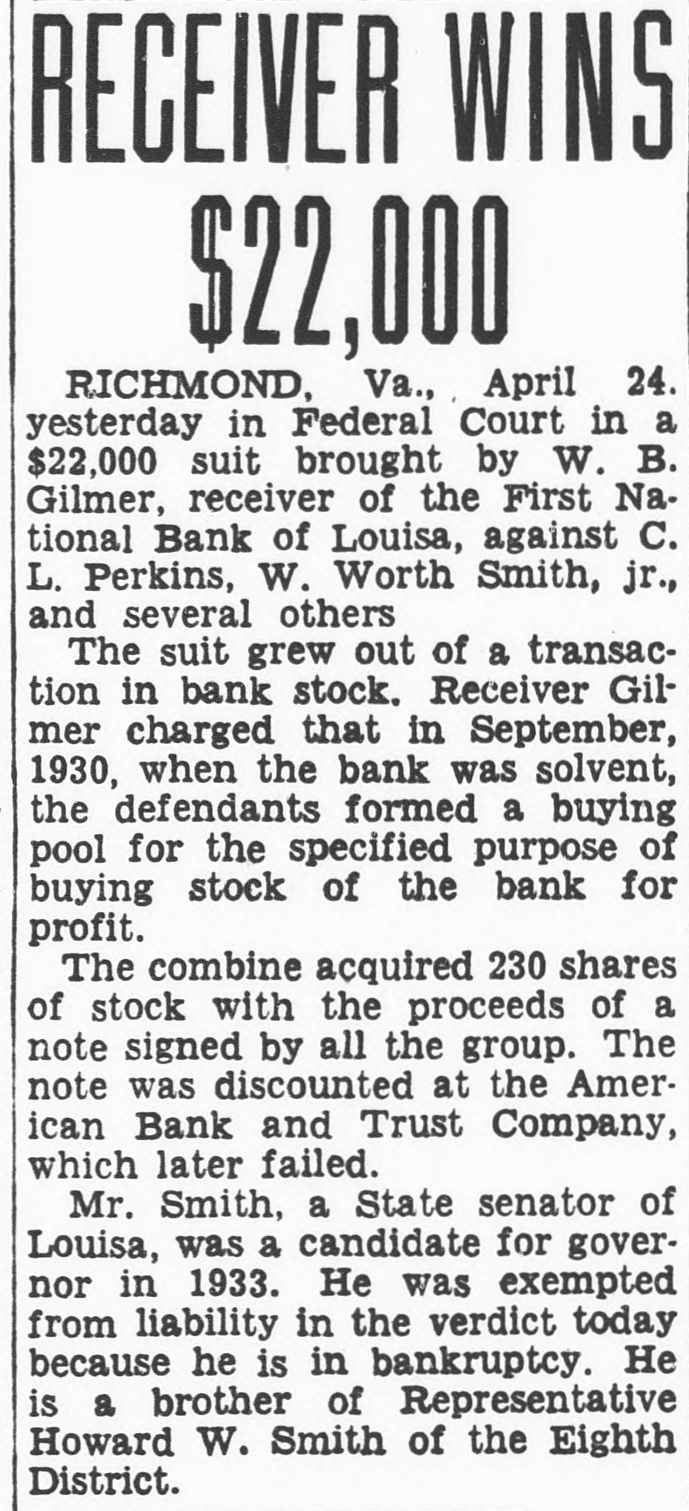
RECEIVER WINS

$22,000

RICHMOND, Va., April 24. yesterday in Federal Court in a $22,000 suit brought by W. B. Gilmer, receiver of the First National Bank of Louisa, against C. L. Perkins, W. Worth Smith, jr., and several others

The suit grew out of a transaction in bank stock. Receiver Gilmer charged that in September, 1930, when the bank was solvent, the defendants formed a buying pool for the specified purpose of buying stock of the bank for profit.

The combine acquired 230 shares of stock with the proceeds of a note signed by all the group. The note was discounted at the American Bank and Trust Company, which later failed.

Mr. Smith, a State senator of Louisa, was a candidate for governor in 1933. He was exempted from liability in the verdict today because he is in bankruptcy. He is a brother of Representative Howard W. Smith of the Eighth District.


Article Text

W. Worth Smith Loses Bank Suit

Former Candidate One Of Group Beaten In Case By Louisa Receiver

Richmond, Va., April 24.β€”Verdict for the full amount was directed by Judge Luther B. Way yesterday in Federal Court in a $22,000 suit brought by W. B. Gilmer, receiver of the First National Bank of Louisa, against C. L. Perkins, W. Worth Smith, Jr., and several others.

The suit grew out of a transaction in bank stock. Receiver Gilmer charged that in September, 1930, when the bank was solvent, the defendants formed a buying pool for the specified purpose of buying stock of the bank for profit.

The combine acquired 230 shares of stock with the proceeds of a note signed by all the group. The note was discounted at the American Bank and Trust Company, here, which later failed.

Mr. Smith, a State senator of Louisa, was a candidate for governor in 1933. He was exempted from liability in the verdict today


Article Text

TRIAL OF SUIT AGAINST LOUISA BANK OFFICIALS

Louisa, April 24.β€”Trial of the suit of W. B. Gilmer, receiver of the First National Bank of Louisa, against C. L. Perkins, W. Worth Smith, jr. and others to recover $22,000 with interest was begun before Judge Way and a jury in the United States District Court Monday.

W. Worth Smith, jr., of the defendants, was a candidate for governor in 1933. Like others of the defendant group he was a director of the bank. The suit grows out of a transaction in bank stock. Receiver Gilmer charges that in September, 1930, when the bank was solvent the defendants formed a buying pool of themselves for the specific purpose of buying the stock of the First National Bank of Louisa for profit.

The combine, it is alleged, acquired 230 shares of the capital stock at the par value of $100 a share. They paid for this stock with the proceeds of a note signed by all of the group. The note was discounted in the American Bank and Trust Company, Richmond.

It was further testified a majority of the stock was placed with J. P. Donnally, trustee, by the defendants in order that it could be more easily sold to others. The defendants claim they are liable only as individuals in the stock-buying transaction and each can be held for only an eleventh part of the amount sued for.