Click image to open full size in new tab
Article Text
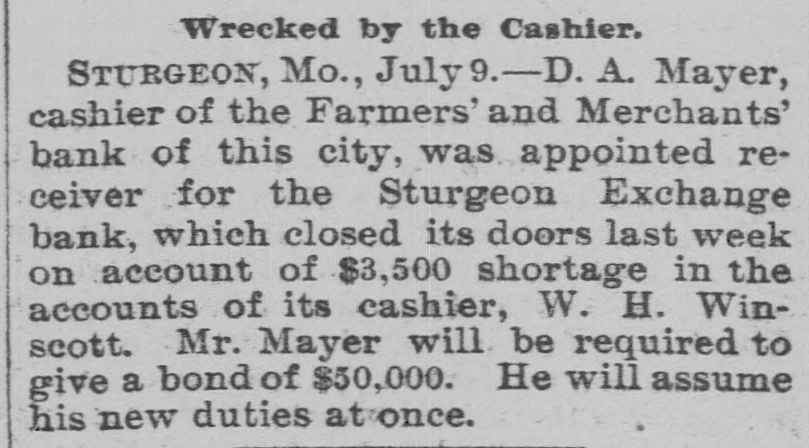
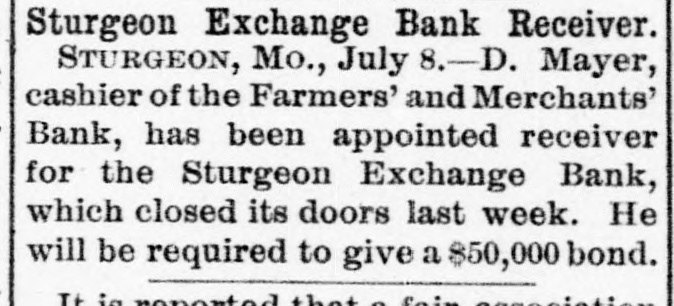
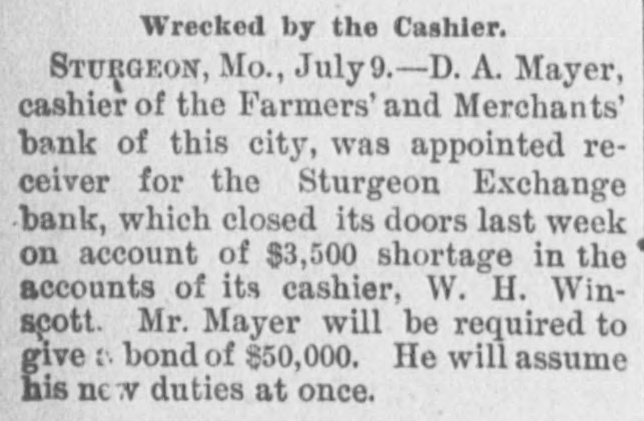
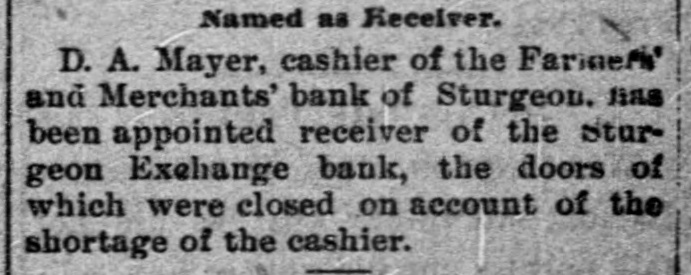
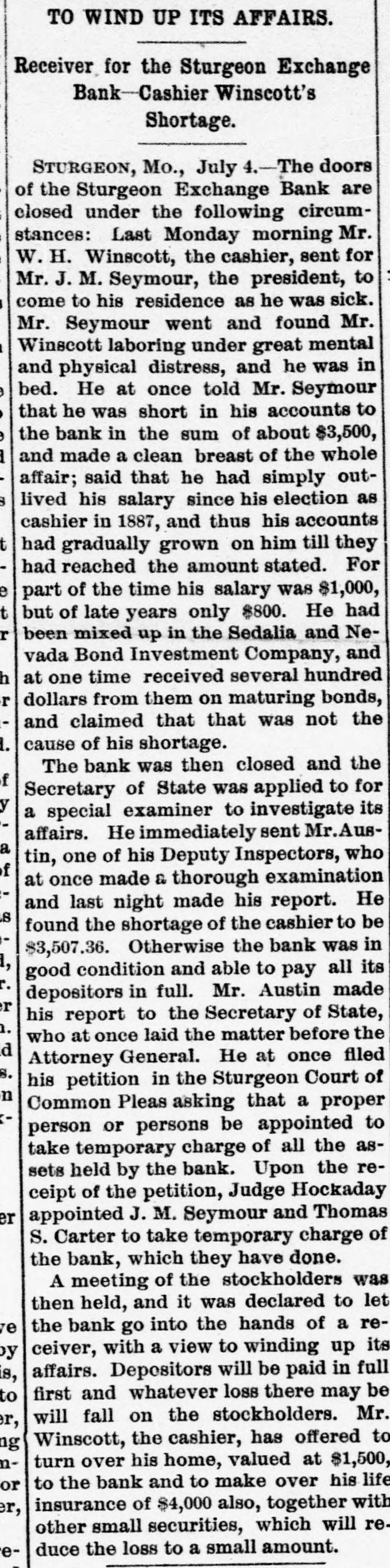
TO WIND UP ITS AFFAIRS. Receiver for the Sturgeon Exchange Bank-Cashier Winscott's Shortage. STURGEON, Mo., July 4.-The doors of the Sturgeon Exchange Bank are closed under the following circumstances: Last Monday morning Mr. W.H. Winscott, the cashier, sent for : Mr. J. M. Seymour, the president, to come to his residence as he was sick. Mr. Seymour went and found Mr. Winscott laboring under great mental and physical distress, and he was in bed. He at once told Mr. Seymour that he was short in his accounts to the bank in the sum of about $3,500, and made a clean breast of the whole affair; said that he had simply outlived his salary since his election as cashier in 1887, and thus his accounts had gradually grown on him till they had reached the amount stated. For e part of the time his salary was $1,000, but of late years only $800. He had r been mixed up in the Sedalia and Nevada Bond Investment Company, and at one time received several hundred h r dollars from them on maturing bonds, and claimed that that was not the cause of his shortage. The bank was then closed and the f Secretary of State was applied to for y a special examiner to investigate its affairs. He immediately sent Mr. Ausa tin, one of his Deputy Inspectors, who f at once made a thorough examination and last night made his report. He S found the shortage of the cashier to be $3,507.36. Otherwise the bank was in good condition and able to pay all its depositors in full. Mr. Austin made r his report to the Secretary of State, 1. who at once laid the matter before the d Attorney General. He at once filed S. his petition in the Sturgeon Court of n Common Pleas asking that a proper person or persons be appointed to take temporary charge of all the assets held by the bank. Upon the receipt of the petition, Judge Hockaday er appointed J. M. Seymour and Thomas S. Carter to take temporary charge of the bank, which they have done. A meeting of the stockholders was then held, and it was declared to let 70 the bank go into the hands of a receiver, with a view to winding up its y affairs. Depositors will be paid in full s, to first and whatever loss there may be will fall on the stockholders. Mr. r, Winscott, the cashier, has offered to 1g à turn over his home, valued at $1,500, to the bank and to make over his life or insurance of $4,000 also, together with er, other small securities, which will reduce the loss to a small amount. e'