Article Text
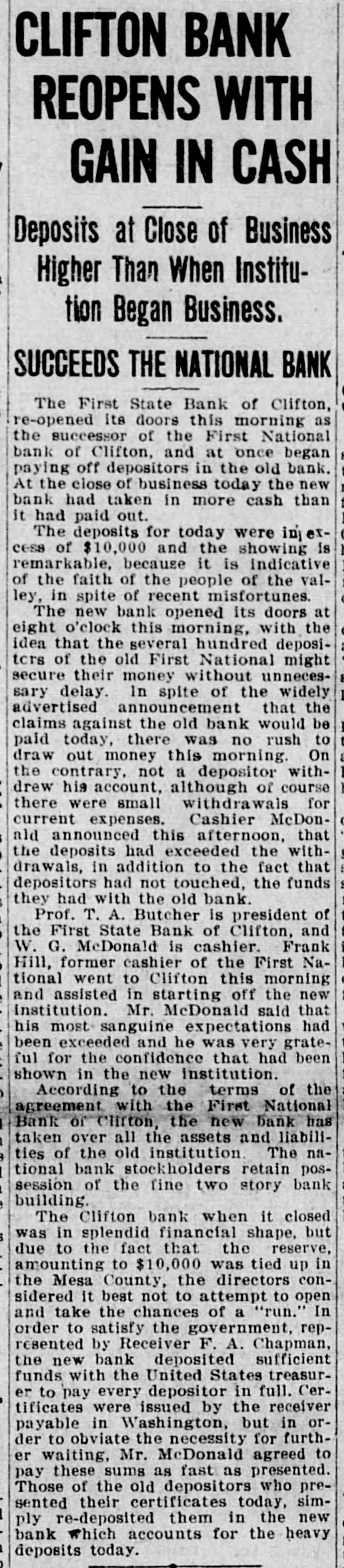
CLIFTON BANK REOPENS WITH GAIN IN CASH Deposits at Close of Business Higher Than When Institution Began Business. SUCCEEDS THE NATIONAL BANK The First State Bank of Clifton, re-opened its doors this morning as the successor of the First National bank of Clifton, and at once began paying off depositors in the old bank. At the close of business today the new bank had taken in more cash than it had paid out. The deposits for today were injercess of $10,000 and the showing is remarkable, because it is indicative of the faith of the people of the valley, in spite of recent misfortunes. The new bank opened its doors at eight o'clock this morning, with the idea that the several hundred depositcrs of the old First National might secure their money without unnecessary delay. In spite of the widely advertised announcement that the claims against the old bank would be paid today, there was no rush to draw out money this morning. On the contrary. not a depositor withdrew his account, although of course there were small withdrawals for current expenses. Cashier McDonald announced this afternoon, that the deposits had exceeded the withdrawals, in addition to the fact that depositors had not touched, the funds they had with the old bank. Prof. T. A. Butcher is president of the First State Bank of Clifton, and W. G. McDonald is cashier. Frank Hill, former cashier of the First National went to Clifton this morning and assisted in starting off the new institution. Mr. McDonald said that his most sanguine expectations had been exceeded and he was very grateful for the confidence that had been shown in the new institution. According to the terms of the agreement with the First National Bank of Clifton, the new bank has taken over all the assets and liabilities of the old institution. The national bank stockholders retain possession of the fine two story bank building. The Clifton bank when it closed was in splendid financial shape, but due to the fact that the reserve, amounting to $10,000 was tied up in the Mesa County, the directors considered it best not to attempt to open and take the chances of a "run." In order to satisfy the government, represented by Receiver F. A. Chapman, the new bank deposited sufficient funds with the United States treasurer to pay every depositor in full. Certificates were issued by the receiver payable in Washington, but in order to obviate the necessity for further waiting, Mr. McDonald agreed to pay these sums as fast as presented. Those of the old depositors who presented their certificates today, simply re-deposited them in the new bank which accounts for the heavy deposits today.