Wall Street National Bank (New York, NY)

Episode Information

Episode UID
107501016
Episode Type
Suspension β†’ Reopening
Bank Type
national
Bank ID
10750 national
Charter Number
1075
Start Date
August 11, 1884
Location
New York, New York (40.714, -74.006)

Metadata

Model
gpt-5-mini (chosen from majority vote of a three-model LLM ensemble)
Short Digest
f2ba02b1033c26a2

Response Measures

None

Description

Closure due to cashier irregularities; reports indicate voluntary closing pending investigation and expectations of eventual reorganization or payment to depositors.

Events (3)

1. April 28, 1865 Chartered
Source
historical_nic
2. October 15, 1883 Voluntary Liquidation
Source
historical_nic
3. August 11, 1884 Suspension
Cause
Bank Specific Adverse Info
Cause Details
Cashier charged with irregularities/shortage and making improper loans and over-certifying checks; alleged $200,000 shortage and bad loans led to closure.
Newspaper Excerpt
Wall street bank has just closed its doors owing to irregularities on the part of its cashier. The bank will remain closed until matters are investigated.
Source
newspapers

Newspaper Articles (18)

Article from Wilmington Daily Commercial, September 22, 1873

Click image to open full size in new tab

Article Text

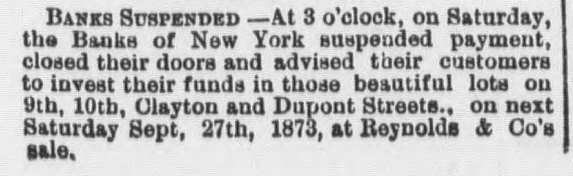
BANKS SUSPENDED -At 3 o'clock, on Saturday, the Banks of New York suspended payment, closed their doors and advised their customers to invest their funds in those beautiful lots on 9th, 10th, Clayton and Dupont Streets., on next Saturday Sept, 27th, 1873, at Reynolds & Co's sale.


Article from Wilmington Daily Commercial, September 22, 1873

Click image to open full size in new tab

Article Text

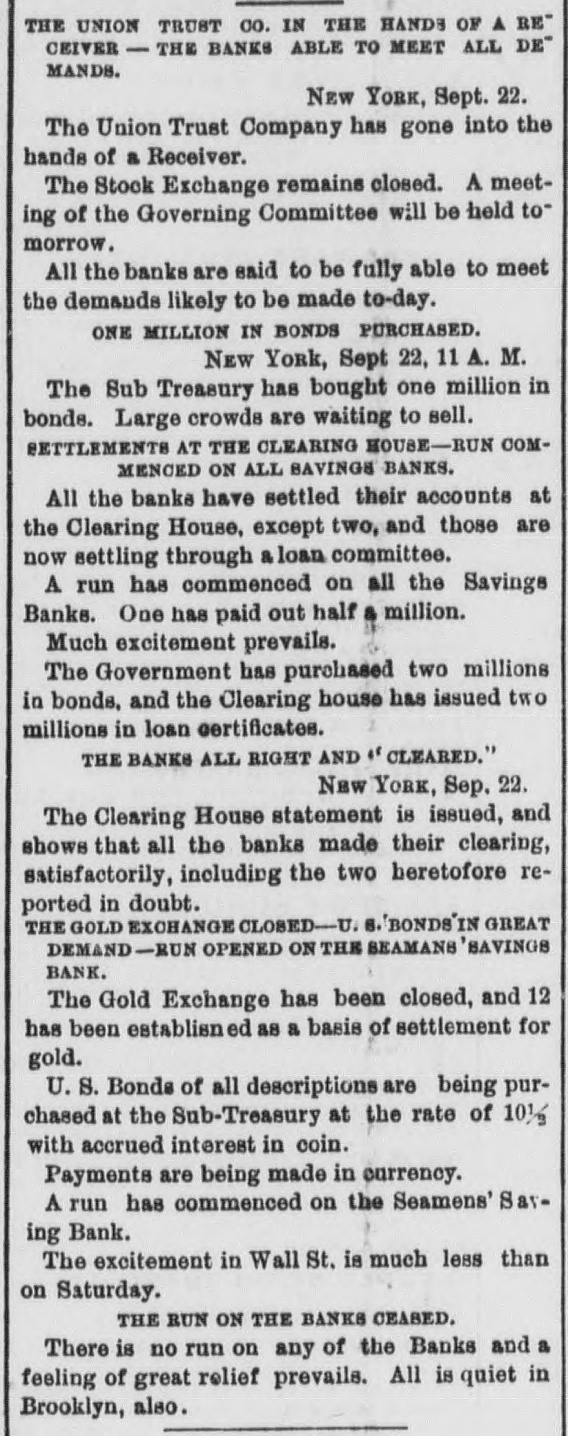
THE UNION TRUST co. IN THE HANDS OF A RE" CEIVER - THE BANKS ABLE TO MEET ALL DE" MANDS. NEW YORK, Sept. 22. The Union Trust Company has gone into the hands of a Receiver. The Stock Exchange remains closed. A meeting of the Governing Committee will be held tomorrow. All the banks are said to be fully able to meet the demands likely to be made to-day. ONE MILLION IN BONDS PURCHASED. New York, Sept 22, 11 A. M. The Sub Treasury has bought one million in bonds. Large crowds are waiting to sell. SETTLEMENTS AT THE CLEARING HOUSE-RUN COMMENCED ON ALL SAVINGS BANKS. All the banks have settled their accounts at the Clearing House, except two, and those are now settling through a loan committee. A run has commenced on all the Savings Banks. One has paid out half & million. Much excitement prevails. The Government has purchased two millions in bonds, and the Clearing house has issued two millions in loan certificates. THE BANKS ALL RIGHT AND " CLEARED." New YORK, Sep. 22. The Clearing House statement is issued, and shows that all the banks made their clearing, satisfactorily, including the two heretofore reported in doubt. THE GOLD EXCHANGE CLOSED-U 6. BONDS IN GREAT DEMAND-RUN OPENED ON THE BEAMANS SAVINGS BANK. The Gold Exchange has been closed, and 12 has been established as a basis of settlement for gold. U.S. Bonds of all descriptions are being purchased at the Sub-Treasury at the rate of 101/3 with accrued interest in coin. Payments are being made in currency. A run has commenced on the Seamens' Saying Bank. The excitement in Wall St. is much less than on Saturday. THE RUN ON THE BANKS CEASED. There is no run on any of the Banks and a feeling of great relief prevails. All is quiet in Brooklyn, also.


Article from Wilmington Daily Gazette, September 22, 1873

Click image to open full size in new tab

Article Text

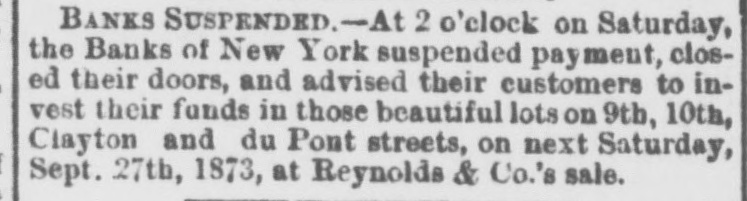
BANKS SUSPENDED.-At 1 2 o'clock on Saturday, the Banks of New York suspended payment, closed their doors, and advised their customers to invest their funds in those beautiful lots on 9th, 10th, Clayton and du Pont streets, on next Saturday, f Sept. 27th, 1873, at Reynolds & Co.'s sale. I


Article from Alexandria Gazette, September 24, 1873

Click image to open full size in new tab

Article Text

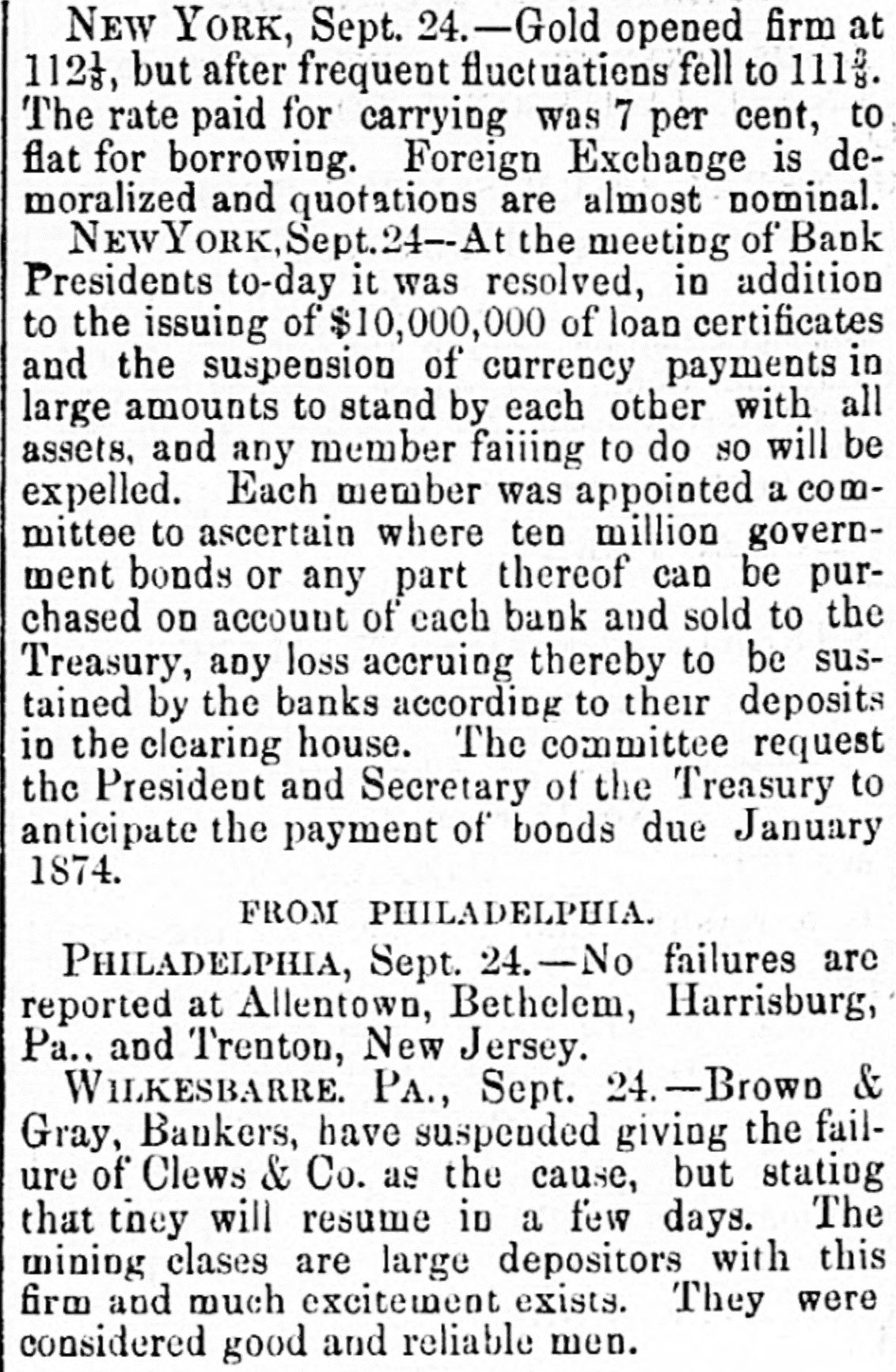
NEW YORK, Sept. 24.-Gold opened firm at 112g, but after frequent fluctuatiens fell to 111g. The rate paid for carrying was 7 per cent, to flat for borrowing. Foreign Exchange is demoralized and quotations are almost nominal. NEWYORK, Sept.24--At the meeting of Bank Presidents to-day it was resolved, in addition to the issuing of $10,000,000 of loan certificates and the suspension of currency payments in large amounts to stand by each other with all assets, and any member faiiing to do SO will be expelled. Each member was appointed a committee to ascertain where ten million government bonds or any part thereof can be purchased on account of each bank and sold to the Treasury, any loss accruing thereby to be sustained by the banks according to their deposits in the clearing house. The committee request the President and Secretary of the Treasury to anticipate the payment of bonds due January 1874. FROM PHILADELPHIA. PHILADELPHIA, Sept. 24.-No failures are reported at Allentown, Bethelem, Harrisburg, Pa.. and Trenton, New Jersey. WILKESBARRE PA., Sept. 24.-Brown & Gray, Bankers, have suspended giving the failure of Clews & Co. as the cause, but stating that they will resume in a few days. The mining clases are large depositors with this firm and much excitement exists. They were considered good and reliable men.


Article from New-York Tribune, September 25, 1873

Click image to open full size in new tab

Article Text

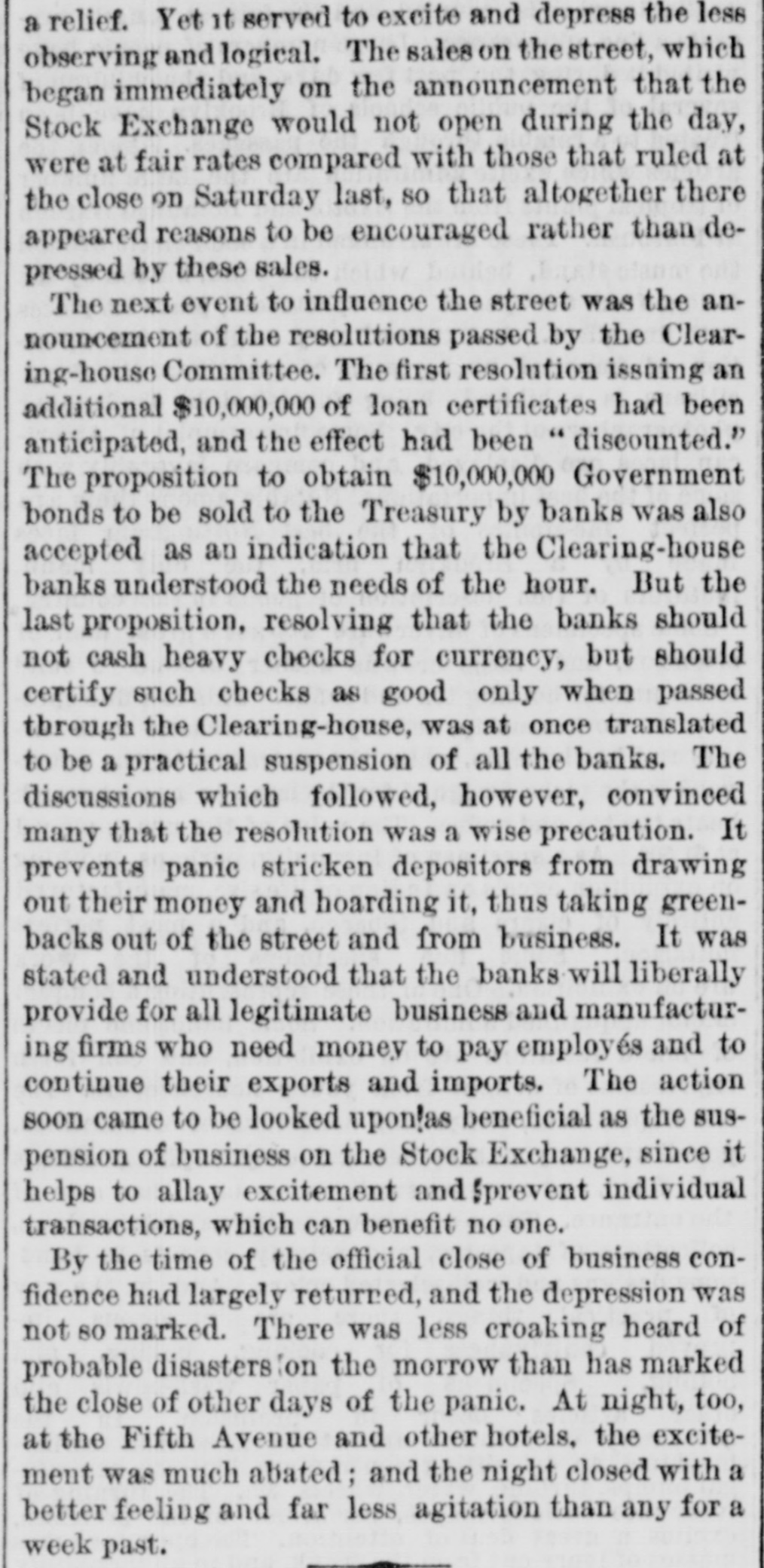
a relief. Yet it served to excite and depress the less observing and logical. The sales on the street, which began immediately on the announcement that the Stock Exchange would not open during the day, were at fair rates compared with those that ruled at the close on Saturday last, so that altogether there appeared reasons to be encouraged rather than depressed by these sales. The next event to influence the street was the announcement of the resolutions passed by the Clearing-house Committee. The first resolution issuing an additional $10,000,000 of loan certificates had been anticipated, and the effect had been "discounted." The proposition to obtain $10,000,000 Government bonds to be sold to the Treasury by banks was also accepted as an indication that the Clearing-house banks understood the needs of the hour. But the last proposition, resolving that the banks should not cash heavy checks for currency, but should certify such checks as good only when passed through the Clearing-house, was at once translated to be a practical suspension of all the banks. The discussions which followed, however, convinced many that the resolution was a wise precaution. It prevents panic stricken depositors from drawing out their money and hoarding it, thus taking greenbacks out of the street and from business. It was stated and understood that the banks will liberally provide for all legitimate business and manufacturing firms who need money to pay employΓ©s and to continue their exports and imports. The action soon came to be looked upon as beneficial as the suspension of business on the Stock Exchange, since it helps to allay excitement and prevent individual transactions, which can benefit no one. By the time of the official close of business confidence had largely returned, and the depression was not so marked. There was less croaking heard of probable disasters on the morrow than has marked the close of other days of the panic. At night, too, at the Fifth Avenue and other hotels, the excitement was much abated; and the night closed with a better feeling and far less agitation than any for a week past.


Article from The Portland Daily Press, September 27, 1873

Click image to open full size in new tab

Article Text

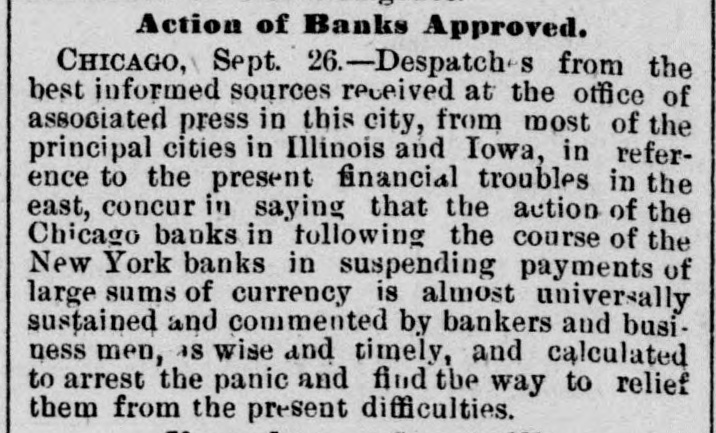
Action of Banks Approved. CHICAGO, Sept. 26.-Despatch-s from the best informed sources received at the office of associated press in this city, from most of the principal cities in Illinois and Iowa, in reference to the present financial troubles in the east, concur in saying that the action of the Chicago banks in following the course of the New York banks in suspending payments of large sums of currency is almost universally sustained and commented by bankers and business men, as wise and timely, and calculated to arrest the panic and find tbe way to relief them from the present difficulties.


Article from Chicago Daily Tribune, September 28, 1873

Click image to open full size in new tab

Article Text

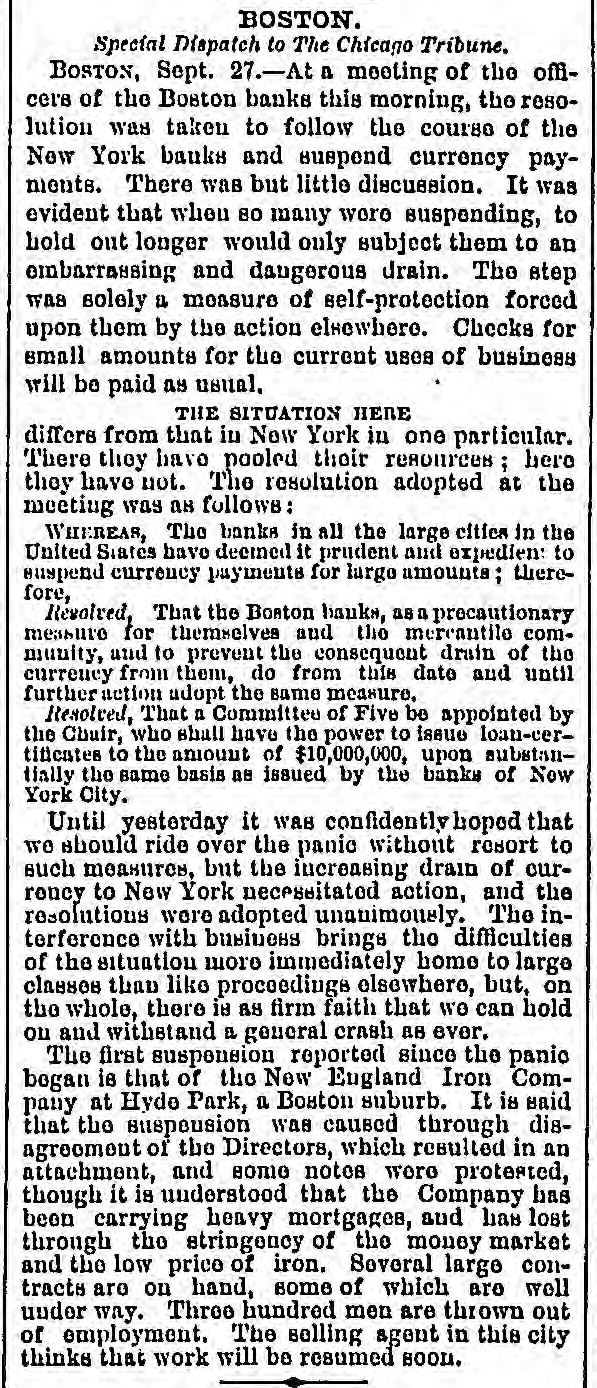
BOSTON. Special Dispatch to The Chicago Tribune. BOSTON, Sept. 27.-At a meeting of the officere of the Boston banks this morning, the resolution was taken to follow the course of the New York banks and suspond currency payments. There was but little discussion. It was evident that when 80 many were suspending, to hold out longer would only subject them to an embarrassing and dangerous drain. The step was solely a measure of self-protection forced upon them by the action elsewhere. Checks for small amounts for the current uses of business will be paid as usual. THE SITUATION HERE differs from that in New York in one particular. There they have pooled their resources : here they have not. The resolution adopted at the meeting was as follows: WHEREAR, The banks in all the large cities in the United States have deemed it prudent and expedient to suspend currency payments for largo amounts; therefore, RΓ©volved, That the Boaton banks, as a precautionary measure for themselves and the mercantilo community, and to prevent the consequent drain of the currency from them, do from this date and until further action adopt the same measure, Resolved, That a Committee of Five be appointed by the Chuir, who shall have the power to issue loan-certiticates to the aniount of $10,000,000, upon substantially the same basis as issued by the banks of Now York City. Until yesterday it was confidently hoped that we should ride over the panic without resort to such measures, but the increasing drain of ourrency to New York necessitated action, and the resolutions were adopted unanimously. The interference with business brings the difficulties of the situation more immediately home to large classes than like proceedings elsewhere, but, on the whole, there is as firm faith that we can hold ou and withstand a general crash 88 ever. The first suspension reported since the panic began is that of the New Eugland Iron Company at Hyde Park, a Boston suburb. It is said that the suspension was caused through disagreement of the Directors, which resulted in an attachment, and some notes were protested, though it is understood that the Company has been carrying heavy mortgages, and has lost through the stringency of the money market and the low price of iron. Several large contracts are on hand, some of which are well under way. Three hundred men are thrown out of employment. The selling agent in this city thinks that work will be resumed soon.


Article from The Daily Phoenix, October 3, 1873

Click image to open full size in new tab

Article Text

Telegraphiq APPLA CARLIST DISSENSIONS DEMORATIZATION OF INSURGENTS-MONRY OF October 1.-Diseensions in MADRID, ranks of the Corlists are increasing. and the leaders Derregarray, Roda and Lizzaraga The have left their commands arrived at Bayonne. Edward October 2-Sir LONDON, the celebrated painter, isdead. from Landleer, October 2. Dasortere and inMADRID, report emoralization the insubordination. Cartagena A majority of but are desire to surrender, more surgents overawed by liberated coavjole and desperate BERLIN, volunteers. October 2.4"Trade A (panic specila on tion is almost suspended the The bourse King is of apprehended Saxony is dangerously sick. LONDON, October Robert Bigby, the English October writer, 2. is dead. Despatches from MADRID, sections of the country represent The all much better feeling prevails. in the re-establishment that of discipline in the served to restore confidence all insurrections. ability army of the Government to suppress relegraphic-American Matters. CONVIOTED-DEZAULTING_CA CASH KU ER-COTTON KLUX DAMAGED IN TEXAS-JUS STATES "RAID" OF UNITED SOLDIERS TIFIABLE IN MEXICO-VELLOW FEVER DEATHS-AID TO SUFFERERS-SIOK AND PUOLLIST-RESUMPTION OF BANKS BROKERS-THE MODOO SUSPENSION- DEMO PLATFORM OF THE NEW YORK CRACY, &0., &0 BROWNSVILLE, TEXAS, October 1.heavy rains have damaged entire Continued cotton crop throughout the have the Rio Grande Valley. Worms lower appeared on a number of plantations The in vicinity, doing much damage. inches this are covered with several the lowlands of water, stopping the work of gathering crop. charge of the Vose Publico, that The United States soldiers When had again the armed invaded Mexico, is untrue. the steamboat Little Fleta stranded on Army Mexican bank of the Rio Grande, with Paymaster Nichols was a passenger, who of United States soldiers, a guard in saving the cargo and guarded landing it assisted and the paymaster's safe after it from the wreck N.O. October 1. The Courts first RALEIGH, Klux trial before, the State Johnson Ku off before Judge Watts, at and came Superior Court, this week, resulted County in the conviction of the parties white, the murder of two men-one of other colored. They went disguised whipped the the colored man's house and to to death on the 6th of September and senhim were convicted o-day. of No tenced They to be hanged on the 13th vember. 3,000 articles have been entered Over exhibition in the coming State instant Fair, for commences on the 13th of the which D. W, Voorhees, the orator the 15th. Hon. will reach here on society, The citizens are making preparations large the ccommodation of the crowd for of visitors that is expected. October Millard FillBUFFALO, the International Exposimore Redmond, of New opened D. Orleans, large. followed tion. The audience is very Ste ST. Louis, Odtobernia Cashier In of the St. Lbula Mutual Life with Company, is from the safe. His surance $6,500 ven#, missing, accounts do not ap- bepear correct, and his friends lieve he embezzled the funds. Nashyille, on Wednesday the In day of the Blood Horse ASHOCIA- heats, second the first race, two mile tion won races, by Arizona, beating Lampie, 3,4634 Carrington was and Duster-time heats, The second race. mile Sur3.441/4. won by Quartermaster, bearing and Lady vey, was Fiprence, Emer Florence Greenfield. YORK October,1--Mid-night- banks NEW visitits the different savings fears on A city, to dayshaw that all vauished, this of depositors haye their the part large numbers who drew out it. and last week have returned money are about $13,000,000 in green- all in the vaults, which, signs of any run are There backs passed, will when be distributed through other channels. NEW YORK, October -The Danforth half Locomotive Works is working on in They have plenty of cashed. money time. but can't get a check bank, John C. Heonan is fatally sick, with hemorrbage of the langs. 386 delegates to the Evangelical morrow, Convention, which assembles to have arrived. Grinnell & Co., brokers and bankers, Paton G. B. & have Co., suspended. one of the oldest dry


Article from National Republican, October 4, 1873

Click image to open full size in new tab

Article Text

# SHALL THE BANK SUSPENSION CONTINUE It is very much to be feared that the banks will over-do the "financial business" in main-taining themselves in a state of slege against the demands of the business necessities of the country, and by a protracted suspension of business excite a feeling of uneasiness and alarm in the public mind. It may have been necessary immediately following the financial crash of September 26 and 27, and the con-sequent panic produced in the popular mind, to adopt such measures as were calculated to prevent a positive breaking up and ruin of legitimate commercial business; but the feel-ing is now rapidly gaining ground that no real necessity exists for the banks maintain-ing closed doors against the payment of the demands of those who have entrusted money deposits to their keeping. So long as the necessity for this embargo was patent the public acquiesced in it; but it is becoming a matter of doubt whether the time has not ar-rived when the banks should manifest a dis-position to return to the normal condition of affairs. In a case of this kind a mere doubt in the public mind becomes a positive and threaten-ing danger, a danger as pregnant with dire-ful results to the banks as to the industrial and commercial interests of the country. There is certainly nothing in the present situ-ation to warrant the banks in maintaining an almost absolute suspension of payment; and the fact that some of these monetary institu-tions, by a little business enterprise, have continued to pay all demands of their patrons furnishes some justification for this view. We believe there should be at least some re-laxation of the established embargo, if not a full resumption of payments; and it is to be hoped the banks will act in such a manner as not to permit the impression to get abroad that they are taking advantage of a mag-nanimous public indulgence to speculate upon the people. Every day this suspension is maintained adds to the danger of the situation. Mechan-ical and manufacturing establishments are being forced to stop operations and discharge their workmen because of the maintenance of the bank suspension, and the mechanics thus deprived of their sources of daily supply when applying to the banks and savings in-stitutions for their savings against an emer-gency of this character are turned away empty handed. Herein lies the great danger of the situation now. It will not do to per-mit this state of affairs to continue. If the banks fail to meet the emergency the emer-gency may overwhelm the banks in the com-mon disaster that is threatened. In connec-tion with this matter the following paragraph, from the St. Louis Democrat, is pertinent and timely: "Resumption is the sure refuge of the banks; it will save them from the disasters of the whole-sale depreciation of securities and products which a protracted suspension would almost cer-tainly precipitate; it will save the dry goods and grocery merchants from the reflex surge of the derangement, which, if not arrested, may over-whelm them; it will save the banks from the cold, settled distrust which will certainly creep into the public mind if the suspension continues; it will rescue trade from its present idleness, and it will save the country from the serious peril of a shinplasterinundation. We say nothing here about the bankruptcy act further than this: that any Congressional relief for violations of it will necessarily be impartial. If it extends to the banks, it will have to extend to the debtors of the banks also, and thus in the end it might do more harm to a solvent bank than good. The New York banks suspended on Thursday, the 24th inst., and their fourteen days' limit under the act will terminate on the 8th of October. In all seriousness, we do not believe it will be safe for them to delay their resumption beyond that day. It would be better if they begin it before, for there is no conjecturing what feeling the present suspense of the public mind may result in."


Article from Eaton Weekly Democrat, October 9, 1873

Click image to open full size in new tab

Article Text

, OHIO, THURSDAY, OCTOBER 9, 1873. Cincinnati had followed the example of New r THE FINANCIAL CRASH. York. They at once yielded to the presSS sure. There is no apparent excitement on the to streets. The Situation in New York and the e, CHICAGO, Sept. 27.-Yesterday the financial is East. tidal wave caused the first real damage in this 1city. At 10 o.clock a. m. it was announced NEW YORK, Sept. 25.-The feeling in Wall from the Clearing-House that, an account of street was much quieter to-day. No more the extraordinary situation, no deposits would failures have been reported, and it is believed g, for the present be received and no checks confidence will soon be restored. There was n would be paid by the following banks Union less excitement on the street than for any day 7. National Bank, Cook County National Bank, for a week. The crowds which have assemk Second National Bank, Manufacturers' Nabled in Wall and Broad streets for some days tional Bank, National Bank of Commerce. y past were not visible. A feeling prevailed that These banks all claim that their suspension is a general suspension of the banks would be only temporary, that they have ample assets necessary. and a rumor was current that the to meet all demands, and that they will reSecretary of the Treasury had advised that d sume business so soon as they can convert course. This rumor, however, was authoritae those assets into curreney. There is a strong tively contradicted, the Secretary declining to d belief that the crisis of the panic has been advise the banks in any way. It transpired reached and passed, and that there will be no k that the Sub-Treasury in New York had dismore suspensions. bursed $25,000,000 in greenbacks in the purThe mercantile classes do not seem to have chase of bonds, and that a portion of this had d been thus far affected. and have been able to come out of the so-called reserve of $44,000,meet all their obligations as they matured. y 000. At this point the purchase of bonds was Deposits are still made in all the banks. That e, stopped. there has been a withdrawal of currency for The action of Secretary Richardson in stopa the purpose of hoarding it in private safes is ping the purchase of bonds, and in refusing to y obvious; but if the banks continue to meet anticipate the 5 per cent. bonds of 1874, due the requirements of their customers a few Jan. 1. was eagerly discussed, and, so far as 1, days longer, most of this hoarded currency could be ascertained, met with but moderate n will come forth. The receipts of currency approval. The Stock Exchange still remains here by express are large. The country must closed. The views of those prominent in the n have the breadstuffs and the provisions which dry goods trade are encouraging in the greatS are packed in our warehouses and stock-yards, est degree. Business is abont as good this n and to get them the money must be sent here. month as it was during the same period last A dispatch from Leavenworth, Kan., ang year, and shows hardly any more of a falling nounces the temporary suspension of the folo off than would properly accompany the end of lowing banks: Frst National, Second National, the season. The produce market remains in a Leavenworth Savings, Clark & Co., Newman & nominal state. Large amounts of grain have Havens. Good feeling prevails among merarrived here which were intended for shipg chants, all seeming to appreciate the situation. ment, and now remains in the warehouses in e consequence of the inability to negotiate CHICAGO, Sept. 29.-The two most important foreign exchange. developments of Saturday were the suspension of the Third National Bank, and the anNEW YORK, Sept. 26.-The general feeling in 1nouncement that the Cook County National, financial circles has decidedly improved. The which closed on Thursday, would resume on t day's record closes with some confidence in the Monday (to-day). The suspension of the belief that the bottom of the panic has been Il Third National, though not unlooked for in reached in this city, and thereis a fair prospect banking circles-the run on it having been that, when the Stock Exchange opens, there of heavy-created a feeling of depression in the will be little room left to arrange in the way of le community. The bank was the second largest settlements between brokers, so that there will be no new failures to announce. in the city, its deposits amounting to about $4,000,000. It is said the institution will soon The Loan Committee of the Clearing-House 11 resume, as its securities are all right. and can has issued about $1,500,000 in loan certificates be made available with little delay. to-day, making the entire amount issued about W All the banks, with the exception of those $18,000,000. that had suspended, passed the Clearings Mercantile paper falling due at the banks is House with flying colors. This fact, added to e being paid with remarkable promptness. the cheerful news received from abroad, There was an extraordinary excitement in served to re-establish confidence, and renew the gold markets to-day, which at one time and strengthen the spirit of moderation that threatened remarkable results. The price has been generally manifested since the panic moved up to 1141, against 1111 at the opening. began; and it came to be the accepted theory A private telegram from London says that the suspension of the Third National $4,500,000 has just been drawn from the Bank ff marked the turning-point of the crisis, that of England and shipped to New York. the storm had spent its fury, and the sunlight The total liabilities of the Union Trust Comwas about to break through the dark clouds. pany are $6,273,518; assets, $7,491,276. The An immense volume of currency is flowing institution will probably resume in a short time. into the city. Over $4,000,000 has been received by express in the past forty-eight NEW YORK, Sept.29.-Wal street is as quiet as h hours. usual, and matters are beginning to assume S The total assets of the Union National their normal condition. The crisis is over, (familiarly known as Coolbaugh's Bank, and although the scarcity of currency is seriously the largest in the city), which suspended last felt, and will be for some time to come. a week, are given at $5,600,000; liabilities, $4,The feasibility of resuming specie payment 300,000. n is exciting attention among our leading finanThere is little or nothing doing at the stockciers and business men, and especially those yards. There is over a million dollars' bankers who issue bills of foreign exchange. worth of stock in the yards, and the pens are a An argument heretofore set forth, that to reso full that no more stock can be received for sume specie payment would depreciate values, the present. can hardly be advanced, now that stocks and CINCINNATI, Sept. 29.--The financial situation securities are flat. here to-day appears to be improved. At the e The suspended firms are rapidly reorganizclose of business an improved feeling was ing, and promise a resumption of business plainly manifest. before the end of the week. Howes & Macy ST. LOUIS, Sept. 29.-Quietnessreigne among & have practically resumed already. Clews the banks here. All are paying checks under Co. and Fisk & Hatch will resume within a the rule, and everybody seems cheerfully to few days. acquiesce in the arrangement. The feeling on The following table shows the prices curChange was better, and prices for some arttrent for leading stocks on Wednesday, Sept. cles are stiffened materially. d 17, the day before Jay Cooke & Co. failed, and CHICAGO, Sept. .-About $4,000,000 in curthose current on the street to-day rency has been received in this city within the Sept. 17. Sept. 29. 1 last 48 hours, making about $11,000,000 for New York Central 86 10014 the last five days. Three of the suspended 91 Lake Shore 62 r banks have resumed. The Union National Northwestern 571/2 371/2 83 Rock Island 1031/2 (Coolbaugh's) has gone into voluntary liquiPacific Mail 29 431/4 dation. Produce markets active. Wheat and 27 St. Paul 451/4 corn are advancing. The storm is practically 89 Western Union 55 over, everything is serene, and people wonder Wabash 41 591/3 g why they allowed themselves to become so ex19 Union Pacific 24 1/8 a cited, 37 1/8 Ohio and Mississippi 241/2 OTHER POINTS S BOSTON, Sept. 29.-The bank presidents of Detroit, Cleveland, Toledo, Milwaukee, Duthis city have decided to make only emall curbuque, Keokuk, DesMoines, and in fact nearly t rency payments, and to issue $10,000,000 of every Western city and town heard from, reloan certificates. port an improved feeling in financial circles.
Article from Daily Kennebec Journal, October 16, 1873

Click image to open full size in new tab

Article Text

# GENERAL NEWS. Frederick Chase Hutchinson, one of the family of singers, is dead. Pere Hyacinthe has been elected one of the three cures in Geneva by the Old Catholics. It is expected that the New York banks will resume currency payments next week. Newton has decided to cast off its swaddling clothes and become a city, the 17th in Massachusetts. The King of Italy has presented to the Empress of Austria a costly set of jewelry made in Rome. Christian Unity was practically illustrated in New York last Sunday. An Episcopal Bishop administered the Sacrament in a Presbyterian Church. T. Parkin Scott, Judge of the Supreme Bench of Maryland, died at Baltimore Monday morning, aged 70. The Chicago Post says that "if a son of Henry H. Wise is making speeches against his father, he must find himself compelled to change his politics several times a day." Many delegates to the Evangelical Alliance visited Philadelphia Monday and were entertained with a public reception and a banquet at the Continental Hotel, by the Philadelphia branch of the Alliance. The Cincinnati banks resumed payment of currency Monday. There were no runs and no excitement, and business men are very cheerful over the result. Most of the banks received more on deposits than they paid out. The republicans of the French Assembly paid M. Thiers a congratulatory visit Monday. The meetings of the several factions for the designation of members of the general committee of management will be held at various times next week. They have a calf out in Oregon who sports a nice little pair of wings. These ornamental appendages are about the size of turkey wings and crop out just behind the shoulders. Thomas A. Ridgely, formerly Medical Director on General Grant's Staff, was on Monday sentenced to three years' imprisonment in State Prison for breaking into a dwelling house in the daytime and stealing books, which he sold for liquor. "You ought to let me pass here free of charge, considering the benevolent nature of my profession," said a physician to a toll-gate keeper. "Not so," was the reply, "you send too many dead heads through here now." The doctor did not stop to argue the point, but paid his toll and passed on. In the naval battle off Cartagena thirteen men were killed and forty-seven wounded on the rebel fleet. Senor Mayer, a member of the Junta, was killed on board the Numancia. The Richmond Enquirer is attempting, at this late day, to fire the Virginia heart by printing, day after day, in capitals, such par-


Article from Chicago Daily Tribune, October 23, 1873

Click image to open full size in new tab

Article Text

MONEY AND COMMERCE. MONETARY. WEDNESDAY EVENING, Oct. 22. Money matters are very quiet in this market, and we find no considerable change to note in the aspect of affairs since the beginning of the week. New York exchange continues scarce, and sold between banks to-day at 500 per $1,000 premium. Shippers' bills drawn against grain in transit are taken at ΒΌ and also at ΒΎ of 1 per cent discount. The amount of this class of bills is, however, very small, compared to what it would be under ordinary circumstances at this season of the year. One obstacle to the free movement of grain is, that shippers of cargoes cannot get the usual advances from their New York consignees, because the latter cannot get the usual accommodations at the New York banks. The movement of Western crops to market is therefore being done mainly on Western capital. The scarcity of money in the Eastern markets also has its effect upon the prices of products, as well as of the foreign exchange made against the shipment of the products to Europe. There is a very moderate but steady flow of currency from this city to New York, but the stock of currency in the banks here is very large, and some of it can very well be spared. The main cause of the great accumulation of currency here is that the banks of this city are still acting on the policy of keeping their whole reserve here in greenbacks, instead of keeping half of it in New York exchange, -as the Nationals are permitted to do by law, and as has heretofore been their custom. The recent panic gave the Western banks such a scare that, even after New York banks resume currency payments, it will be a long time, perhaps a year or two, before the New York balances of Western banks will increase to anything like the proportions they had attained just before the panic. The accumulations of money caused by the increase of banking facilities, are, however, bound to accumulate somewhere at certain seasons of the year. No amount of currency-tinkering to make the volume of currency "elastic," will prevent this accumulation of bank credits, even if the much-denounced system of paying interest on deposits were entirely discontinued. These accumulations once made, there is no question that inducements of one kind or another will be offered to draw this temporarily unused money out into the prosecution of enterprises and speculations that could not command the money under any other condition of the money market. In the foregoing connection, we print the following ably-written communication from a banker at Eau Clairo, Wis., in DEFENSE OF INTEREST ON DEPOSITS: To the Editor of The Chicago Tribune: DEAR SIR: By common agreement the "system of paying interest on deposits subject to call," seems to have been chosen as the goat over which to confess all the iniquities of the children of Mammon, and, putting their transgressions in all their sins upon his head, they are going to send him away by the hand of a fit man into the wilderness. The fit man in this case may prove to be President Grant, who proposes to recommend a law absolutely prohibiting the practice, which he, as well as all those whose views on the subject find expression in print, calls by very hard names. It must be agreeable to those who have been tinkering at our finances in a legislative and administrative way, to be assured that the real cause of all the recent trouble is a natural outgrowth of competition in the banking business, and nothing for which they are in any way responsible. They will thereby be cheered and encouraged to proceed. It is encouraging, also, for those who may have taken desponding views of human nature to observe the zeal and the high moral tone with which metropolitan bankers are advocating a return to sound and legitimate banking principles, especially in this direction. There is something quite touching in the circulars with which they favor country bankers now-a-days, -the old matter-of-fact inducement style of that literature having given place to something very like gush. So also their opinions, given as the results of interviewing, and reflected in financial columns. No doubt the enthusiasm of good resolve, which always comes to men in times of adversity, has much to do with this feeling-but the idea will suggest itself whether the leaven of selfishness is not in some degree responsible for this particular uprising of the spirit of reform? However, manner and motives are beside the question which I beg permission to put, which is: Will so radical a reform as is proposed in the matter of paying interest on deposits be productive of good? Will it result in making the banks keep a larger reserve, and so become safer depositories, -better able to withstand the shock of panics, -while at the same time affording legitimate accommodations to the business community? In short, will it make them fitter to fulfill all the functions which pertain to banks? This is, in effect, asking-and perhaps this is a more pertinent way of putting the question-will it endow bank-managers with a greater degree of sagacity, judgment, and honesty? Will it make them brave without recklessness; prudent without timidity; firm without obstinacy; amenable to counsel, yet not vacillating? All this, and more, will it do if we are to take literally the somewhat extravagant talk on the subject; yet, when thus put, no one would probably answer the question affirmatively. We must reduce it, then, still further, and ask: Will the contemplated reform remove any of the allurements that lead men away from the paths of correct banking? Will it free the business from any of the dangerous vicissitudes we are so familiar with? Has the much-abused practice no element which dissuades from undue expansion in some directions as much as, if not more than, it encourages it in others? It is the object of this article to assert-no matter how indifferently the assertion be maintained-that these are at least open questions. It is indeed much too extended a subject to be satisfactorily discussed within the limits of your space, or the time and patience of the reader of a daily paper. The best argument to be urged against loose talk on any subject is the logic of facts. Statistics have come to be regarded with a good deal of respect, but, unfortunately, not very much statistical information bearing on this subject has thus far been collected, and, such as there may be, is not accessible to the writer. It is a matter of general knowledge, however, which of the leading banks of the country have the largest number of country correspondents, and, therefore, pay interest most largely, and if the practice is necessarily fraught with so much danger, it is evident that we shall see these banks betraying the greatest weakness in times of panic. Take, for example, the two banks which have confessedly the largest deposits of this kind in New York and Chicago, respectively. The Associated Press dispatch of the 17th, from New York, says: "The present system of pooling was gotten up for the benefit of weak banks, especially those paying 4 per cent on balances." Would the writer include the National Park Bank in that category? and yet that bank probably pays more interest in that way, both absolutely and relatively, than any bank in New York, while all advices, public and private, agree that the Park Bank is sound, if any of them are (I say probably because at this distance one can only make a qualified statement of this kind, and I therefore write under correction). The Chicago bank referred to is, of course, the


Article from The Daily Dispatch, October 27, 1873

Click image to open full size in new tab

Article Text

# FINANCIAL. SATURDAY, October 25, 1873. There is a continued improvement in good feeling in financial circles in all the principal cities of the country, but stocks are yet unsettled in almost every locality. On Thursday the New York stock market was weak and lower during the day, but closed with a slight recovery from the extreme depression. On Friday the general list was more steady, with a slight decline. At a meeting of the New York Clearing-house on Thursday a resolution was offered proposing to use national bank notes in settlement of differences at the clearing-house. The resolution was voted down by a large majority; but in view of the improved condition of the banks it was resolved to abandon the "pooling" process on the 1st proximo. In reference to this action the Baltimore Sun (money article) of to-day says: "It is indicative of preparation for a speedy re-sumption of full currency payments. Some of the banks are said to be already paying on all demands when preferred to the certification of checks, and the difference against the checks of other banks that decline to pay out large sums of currency is only ΒΌ@Β½ per cent. Some of the first class of banks are not only helping their neighbors to greenbacks and sending currency to their country corre-spondents, but they are paying out their debtor balances at the Clearing-House, as a matter of choice, in greenbacks, in place of relief certificates. No bank that hopes to retain their old accounts of value, or expects to acquire new accounts of a desirable character, city or country, as the smoke of the panic clears up, will deem it prudent to have it known that it is behind its neighbors. It is quite confidently asserted, however, that the New York banks generally will resume full currency payments by the 1st November. It is hardly thought the Philadelphia banks can follow the example. A large amount of dividends have to be paid in Philadelphia at that time." Papers supposed to be in the confidence of the Administration say that so far as the Government can do so it is already assisting towards the equalization of currency with specie. Secretary Richardson states that the Government will pay out silver as soon as it can be profitably and conveniently coined for that purpose, and the treasury is following, as far as possible, the policy of specie payments.


Article from Daily Globe, September 8, 1881

Click image to open full size in new tab

Article Text

ALL AROUND THE GLOBE. The New York produce and cotton exchange, clearing house, and all banks will be closed to-day. The mayors of New York and Brooklyn have issued proclamations calling on all to close their places of business, and trade will be suspended in both cities. Robert Steep, of Manville, Kan., nine miles west of there, while crossing the railroad track in a wagon, was killed by railroad train No. 3. Alex. Grey, of Allegheny City, one of the wardens of the western penitentiary, received serious injuries on the Pennsylvania railroad, at Seaman Place, yesterday, dying several hours afterwards.


Article from Savannah Morning News, May 17, 1884

Click image to open full size in new tab

Article Text

THE WALL STREET PANIC. Some Features of it as Presented by th New York Papers-1 President Georg I. Seney's Career-His Gifts-The Caus of His Failure-Facts About Grant Ward. The Wall street panic appears to b about over and confidence is partially, not wholly, restored. At one tim Wednesday), however, the situation looked very threatening. One of the ugl features of the day was the ruthless man ner in which the names of banks wer bandied about. Scarcely a bank withi a radius of half a mile of the Stock Ex change escaped suspicion, and incipien "runs" were started in half a dozen in stitutions that proved to be perfectly so vent. Depositors, each in a more or les feverish state of anxiety. presented them selves at the tellers' windows of the Phe nix, the Union, the Wall Street and th Gallatin National Banks, but they wer speedily reassured as to the soundness those institutions. Reports were in cin culation about noon that 'runs' were ing made on the Fourth National an United States National Banks, but officer of those two banks laughed the state ments to scorn. President Baldwin, the first -named institution, said that hi bank was not only as firm as a rock, bt that there had not been an excited cust mer inside of it during the day AMONG THE MANY EXCITING RUMORS of the day was one that Jay Gould ha been driven to the wall and had bee obliged to open his famous strong box which he keeps in the vaults of the Me cantile State Deposit Company for purpose of raising money by using all hi securities as collateral. Mr Gould ha been unable-so the story went-to rais as much money as he needed on thes securities Mr. G. Morosini, M Gould's assistant, said that the repor concerning Mr. Gould was not true. "If Mr. Gould has failed, said M Morosini, with a pleasant smile and charming broken English, wish that might fail also, in the same way. He as solid as what you call-rock Mr Washington E. Connor, Mr. Gould broker. said the report was one of th wildest and most absurd of the day has not borrowed a dollar,' added M Connor "The securites were taken of the vault this morning, but they wer taken back this afternoon. That is a every day occurrence, and is done in th usual course of business. IT WAS APPARENT THAT THE RECEN FLURRY in Wall street had trightened the de positors of the Metropolitan Nation: Bank. The deposits have ranged as hig as eleven millions of dollars. The las statement showed that they had run dow to a little over three millions, and withi the past few days there had been heav depletions. The bank had become in volved in the heavy operations of Nelso Robinson & Co., whose checks were large ly certified and not made good on Tue day. Mr. Robinson is son-in- law of Pre ident Seney, and two of Mr. Seney's son are partners in the firm. But the most serious matter presente was the embarrassment of the Presiden George I. Seney. who is largely connecte with many railroad enterprises. La summer Mr. Seney was the holder of about $4,000,000 of East Tennessee, Virginia an Georgia Railroad income bonds, whic cost him and the other members of syndicate about 40 cents on the dolla They are now selling for about 15. T1 bonds have been as high as 73, and M Seney had great confidenc in them. The constitute a large part of the assets of bank When the demands of deposito and other creditors became pressing, was, of course, impossible to realize an thing on such assets without a ruinou sacrifice Some of the Directors, among who were Isaac H. Bailey, were loth to su pend, and up to the last minute urged tl possibility of obtaining aid from other banks MR SENEY AND HIS ENTERPRISES. The bulk of the responsibility for tl failure the bank was sides place with President Seney He was born Astoria, L.I., in 1826, and was the son a Methodist who occupied se eral pulpits in this city including Mulberry street and Allen street His was daughter of Con modore Nicholson. One of his aunts the wife of Albert Gallatin. Mr. Sene was educated at Wesleyan Universit and Columbia College, and was graduate from Columbia in 1847 He W: made paying teller of the Metropo itan Bank in 1847, and cashier years later. On the death of John Williams he was made President, since he reached that position his will been really the law of the bank M Seney negotiated what is known as tl Nickel Plate Railroad enterprise, and said to have realized about a million an a half out of his sale of it to the Vande bilts. GIVING A FORTUNE AWAY. Then he loomed out as one of the m lionaires of the metropolis, and about te years ago astonished even his most in mate friends with his princely gifts various ational and stitutions. He began with a gift of to the Long Island Historical Society at followed up with valuable books manuscripts. He gave 500 to the Your Men's Association and $27 000 to the Wesleyan University Middletown. Conn., where he received early education. He gave sixteen lots Seventh avenue, Brooklyn, and $200,000 cash for the purpose of constructing new hospital, which is not yet finishe His total gifts to the Long Island Histo cal Society amounted $62,000 He $20,000 to the Industrial Home in Butl street, $50,000 to Emory College in 0 ford. Ga., and $100,000 to Wesleyan F male College at Macon, and other benefa tions, most of which were unsolicited. In explanation of these gifts, he said them to the Lord that he found it better to give than that he took pleasure in partir with half a million dollars in this way that he preferred giving in his lifetime waiting until death for a bequest which might be defeated by contest over will. He used to talk of the bad effec upon a man's disposition of hoardin wealth, and took pride in saying h gifts did not go to the idle, the dissipate or the undesery Yet at the time most of these gifts we made, while many who had long know him were surprised at these unexpecte evidences of wealth, others who kne something of his real situation, and tl immense required by his ex sive terprises. remonstrated with hir He was warned that he could not aff it; that he might get his affairs into ous complications. But he replied with great ardor and enthusiasm that he cou well afford it, and that it was his rigl and pleasure to do what he chose with own. He at the same time disclaime any desire for notoriety in the matter, an did not give ostentatiously. but rath quietly He prided himself upon bein governed by business common sense his gifts. MR. SENEY'S HOME AND WAYS. Mr. Seney lives in the splendid mansio built by Rockwell, on the crest of hill opposite Wall street ferry in Broo lyn. His neighbor across the street is A. Low. The house, which was fitted at great expense as model in sanitatio proved fatal to Mr. Rockwell, and aft his death it was discovered that the ma sion was actually ventilating gre sewer. Mr. Seney, since purchasing has added to it an art gallery. containir the choicest collection of paintings Brooklyn. He was a domestic man, ticent in habit and was but little know by sight in Brooklyn. Like Ferdinar Ward, he was an attendant of the Churo of Pilgrims. The persuasiveness of tl Rev. Dr. R.S. Storrs was potent in ope ing his purse strings, especially for ditions book treasures in the Lor Island Historical Library, of which was a most liberal patron, buyir classics, engravings, and rare thing


Article from Daily Kennebec Journal, August 12, 1884

Click image to open full size in new tab

Article Text

BANK SUSPENSION. The Wall Street National Bank Unopened Monday-Cashier Charged With Irregularities. NEW YORK, Aug. 11. Wall street bank has just closed its doors owing to irregularities on the part of its cashier. The bank will remain closed until matters are investigated. The president is Thos. W. Evans and the cashier John P. Dickinson. The bank is at No. 15 Broad street, and is a State bank. When its last annual statement was issued in September, 1883, the figures were: Paid up capital $500,000; surplus $65,196; undivided profits $47,736. C. F. Timpson, a prominent banker, says relative to the closing bank, that trouble arises from the fact that the cashier had been loaning money freely on insufficient securities which at the present time have little market value. The bank owes the house of C. F. Timpson & Co. a small and insignificant sum. The vice president of the Wall street bank states that the clearances of the bank will go through the clearing house today. The capital stock will probably be swept away. Depositors will eventually be paid in full. It is likely that 50 per cent will be paid them by the end of this week. It is stated that the cashier's shortage will amount to $200,000 and that the bank has $50,000 of bad debts. The bank's deposits will be paid in full and the bank will be able to straighten out its affairs. C. F. Timpson and C. J. Osborne, directors of Wall street National Bank on Saturday night and Sunday made a thorough examination of its affairs and decided in justice to all parties not to open the institution this morning. The result of their examination was as follows: Deposits $1,250,000; call loans $1,100,000; good business paper $350,000; cash on hand $185,000. WASHINGTON, Aug. 11. It is learned at the treasury that in Sept. 1883, the bank examiner in New York, found evidence of over certification of checks on the part of officers of Wall street bank. The evidence was laid before the secretary and by him referred to the attorney general. The result was that the teller of the bank was indicted for violation of bank laws. Efforts were also being made to indict other officers of the bank. when the bank went into voluntary liquidation, and soon after was reorganized under the laws of New York. Its suspension calls for no action on the part of the national authorities. NEW YORK, Aug. 11. Henry Clews said Chas. J. Osborne, who is worth several million dollars and director in Wall street Bank, had expressed willingness to help the bank out of its present emergency. A rumor prevailed that the deficiency would reach $250,000, and Dickson had been in the habit of charging on the books for larger loans than he actually made and pocketing the difference, the latter however did not receive general credence. J. P. Dickinson is 38 years old and is a son-in-law of Chas. H. Simpson, vice president of Wall street Bank. The bank has been regarded as shaky for some time past and depositors has been withdrawing accounts from it. At the clearing house it had liquidated its debts and its accounts were even. Rumors of failure of other firms closely connected with the bank could not be verified.


Article from New-York Tribune, August 12, 1884

Click image to open full size in new tab

Article Text

years. He is a son of John B. Dickinson, a California millionaire, who died in March. 1875. It is reported that he received but a small portion of the estate in consequence of the heavy advances made to him during his father's lifetime. His position in the bank was due to the influence of his father-inlaw. C. F. Timpsom, who had been active in its management. HISTORY OF THE BANK. The bank was chartered originally in 1838 as the Mechanics' Banking Association of New-York, and it became a National Bank on May 1, 1865. About three years ago some of the active directors, under the leadership of the late Trenor W. Park, secured control of the stock with a view of making the bank strictly a Stock Exchange institution, whose chief business should be the clearing of stocks Application for the change of name to the Wall Street National Bank wasgranted, and on the completion of the Mills Building the bank removed from its old quarters, No. 38 Wall-st., to its present rooms just north of the main entrance to the building on Broad-st. About a year ago the bank withdrew from the National system and was reorganized under the State laws. Just before this change had been accomplised the failure of Cecil, Ward & Co., stock brokers, exposed the fact that the bank had been guilty of over-certifying checks. and for this violation of the Federal laws the officers were subsequently indicted. The present officers and directors of the bank are Thomas W. Evans, president; C. F. Timpson, vicepresident: and besides these Charles J. Osborn, William L. Scott. Joseph K. Wells, J. G. McCullougn, William J. Hutchinson and F. B. Jennings, directors. The vacancy in the board caused by the recent death of Joseph G. Mills has not been filled. The capital has not been increased, although it was a part of the plan of the present stockholders at least to double the present capital of $500,000. According to the report of its condition on March 22, the bank had, in addition to 1'8 capital, a surplus of $65,197. and undivided profits amounting to $23,003. In the last weekly bank statement made to the close of business on Friday. the bank reported: loans, $1,472,300; specie, $151,700: legal-tenders, $86,100; and deposits $1,192,000. ITS FUTURE COURSE UNDECIDED. The present directors are said to own the bulk of the stock, which was recently quoted at about par. The bank has not recently been considered strong, however, and during the May panic checks drawn on it were refused by several prominent brokers. The officers declared at the time that there was no excuse for this alarm and no foundation for the rumors affecting it which were frequently circulated. Indeed, President Evans has often boasted in a mild way that the bank had passed through the May crisis with greater ease than many larger institutions. As to the future the principal directors said yesterday that no course had been decided on. They denied the rumor which was circulated in the afternoon that some of the large stockholders had agreed to make up the deficiency in capital so as to allow the bank to resume business immediately. President Evans said that some of the heaviest stockholders were out of town at present and that no action would be taken, probably, without consulting them. Charles J. Osborn, who holds a large amount of the stock, said that until he had found out exactly the condition of affairs he could not sav whether the bank would be reorganized or not. NOTHING KNOWN AT DICKINSON'S HOUSE. John P. Dickinson's house. No. 80 East Seventyseventh-st. 18 one of a handsome brownstone row close to Madison-ave, When a TRIBUNE reporter rang the bell last night a portly woman emerged from the only part of the house which showed a light-the basement-and came into the area. She seemed much aggrieved when asked what she knew of Mr. Dickinson's whereabouts and her only answers to any questions were firstly that she was only the care-taker and secondly that she had not seen any one of the name of Dickinson for a week or more A stone's throw from John P Dickinson's dwelling is that of his brother. Frank 1 Dickinson No. 1,00g Madison-ave He received the reporter with much courtesy, but denied any knowledge of his brother or his brother's atfairs We rately met in business, sald he, and quite as rarely socially, I am therefore simply in the position of one of the public in this matter and derive all my knowledge from the newspapers,


Article from St. Paul Daily Globe, August 12, 1884

Click image to open full size in new tab

Article Text

NEW YORK. [Special Telegram to the Globe.] NEW YORK, Aug. 11.-As usual during the summer season, the stock exchange did not open until 11 o'clock this morning, and the announcement which was posted on the door of the Wall Street National bank, that, owing to the irregularities on the part of the cashier, the bank would remain closed until matters could be investigated, had become generally known. The opening prices on the exchange were generally 1 to 11/4 per cent. lower than the final quotations on Saturday, but sustaining orders were not wanting, especially for the active stocks, and during the forenoon most of the early declines were regained. This afternoon the market has again been weak, without any special feature other than the development of this morning and the announcement this afternoon that the earnings of the Northwestern railroad for the first week in August show a falling off of over $60,000 as compared with last year. The extreme declines this afternoon have ranged from 1 to 3 per cent. a part of which has been recovered in the last half hour. The market is feverish and unsettled, with evidence of sup. porting orders from strong houses and a natural disposition to decline. It is stated that the Trunk line arbitrators have forwarded their decision in the matter of percentages to Commissioner Fink, with a request to have it promulgated at once and the Grand Trunk percentage is smaller than that recommended by Mr. Fink. There is no appeal from the decision of the arbitrators. The coal companies have agreed to suspend mining operations during the first week in September. Mr. Oliphant, for many years vice-president of the Delaware & Hudson Canal company, has been elected president in place of Mr. Dickson, deceased. In reviewing the market Boody, McClellan & Co. say: "The announcement of the failure of the Wall Street bank before business commenced was sufficient to insure a weak and feverish opening and quotations were very Irregular. The first sale of Central & Hudson was 2 per cent. below the closing figure of last week. There was considerable excitement and the market was qutte fever ish Orders, evidently for the purpose of