Receiver appointed and firm in bankruptcy; reorganization/possible resumption discussed but actual reopening not documented here.
Events (3)
1.February 2, 1910Suspension
Cause
Bank Specific Adverse Info
Cause Details
Shrinkage in value of bonds held and heavy undertakings on behalf of the Buffalo & Susquehanna railroad; inability to meet calls for additional security.
Newspaper Excerpt
The suspension of Fisk & Robinson, a bond and banking house, which occurred late yesterday afternoon, was announced at the opening of the stock exchange today.
Source
newspapers
same day
2.February 2, 1910Receivership
Newspaper Excerpt
An involuntary petition in bankruptcy was filed by creditors ... Bronson Winthrop was appointed receiver with a bond of $50,000.
Source
newspapers
+87 days
3.April 30, 1910Other
Newspaper Excerpt
It is expected that an arrangement will be made ... by which the banking firm of Fisk & Robinson, which failed in the early winter, will be able to settle with creditors and gain their discharge in bankruptcy.
Source
newspapers
Newspaper Articles (16)
1.February 2, 1910Daily Kennebec JournalAugusta, ME
Click image to open full size in new tab
Article Text
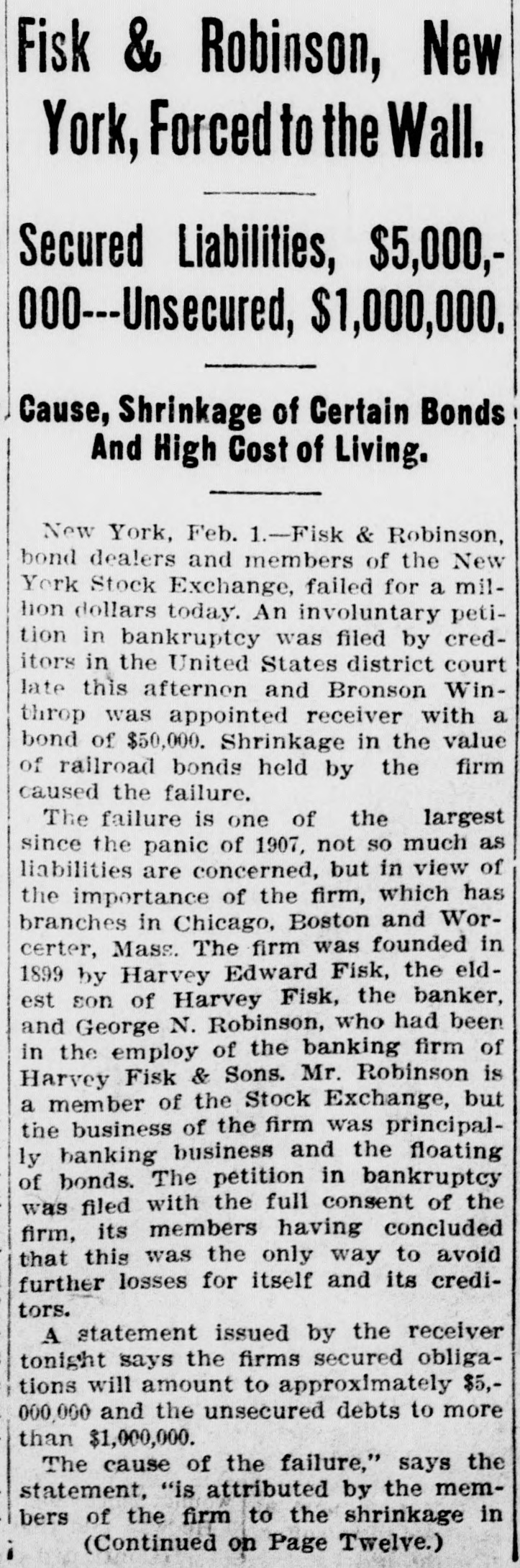
Fisk & Robinson, New York, Forced to the Wall. Secured Liabilities, $5,000,000--Unsecured, $1,000,000. Cause, Shrinkage of Certain Bonds And High Cost of Living. New York, Feb. 1.-Fisk & Robinson, bond dealers and members of the New York Stock Exchange, failed for a million dollars today. An involuntary petition in bankruptcy was filed by creditors in the United States district court late this afternon and Bronson Winthrop was appointed receiver with a bond of $50,000. Shrinkage in the value of railroad bonds held by the firm caused the failure. The failure is one of the largest since the panic of 1907, not so much as liabilities are concerned, but in view of the importance of the firm, which has branches in Chicago, Boston and Worcerter, Mass. The firm was founded in 1899 by Harvey Edward Fisk, the eldest son of Harvey Fisk, the banker, and George N. Robinson, who had been in the employ of the banking firm of Harvey Fisk & Sons. Mr. Robinson is a member of the Stock Exchange, but the business of the firm was principally banking business and the floating of bonds. The petition in bankruptcy was filed with the full consent of the firm, its members having concluded that this was the only way to avoid further losses for itself and its creditors. A statement issued by the receiver tonight says the firms secured obligations will amount to approximately $5,000,000 and the unsecured debts to more than $1,000,000. The cause of the failure," says the statement, "is attributed by the members of the firm to the shrinkage in (Continued on Page Twelve.)
2.February 2, 1910Evening Times-RepublicanMarshalltown, IA
Click image to open full size in new tab
Article Text
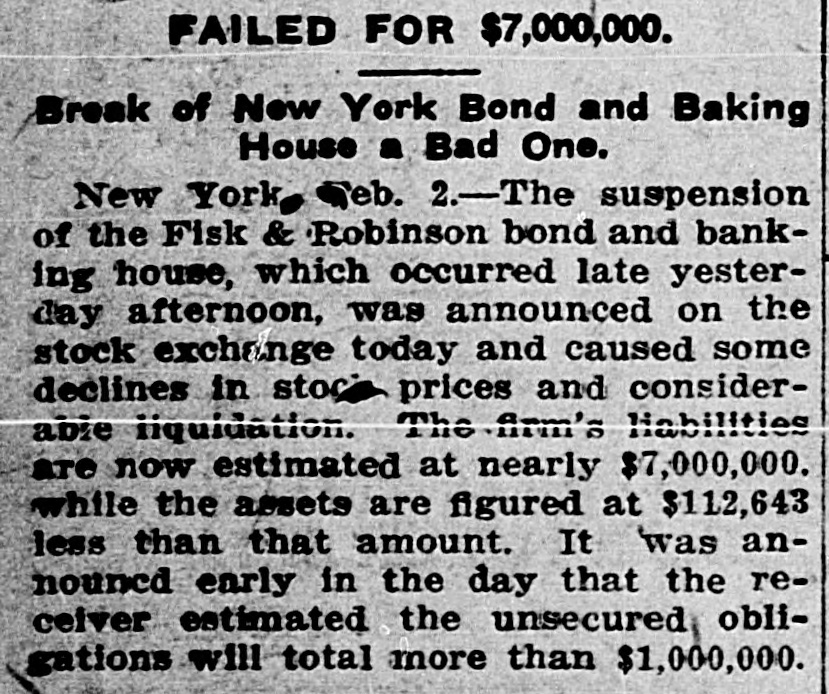
FAILED FOR $7,000,000. Break of New York Bond and Baking House a Bad One. New York Geb. 2.-The suspension of the Fisk & Robinson bond and banking house, which occurred late yesterday afternoon, was announced on the stock exchange today and caused some declines in stoc prices and considerable iiquitation. mL a 11 firm's lichilities are now estimated at nearly $7,000,000. while the assets are figured at $112,643 less than that amount. It was announed early in the day that the receiver estimated the unsecured obligations will total more than $1,000,000.
3.February 2, 1910The Ogden StandardOgden, UT
Click image to open full size in new tab
Article Text
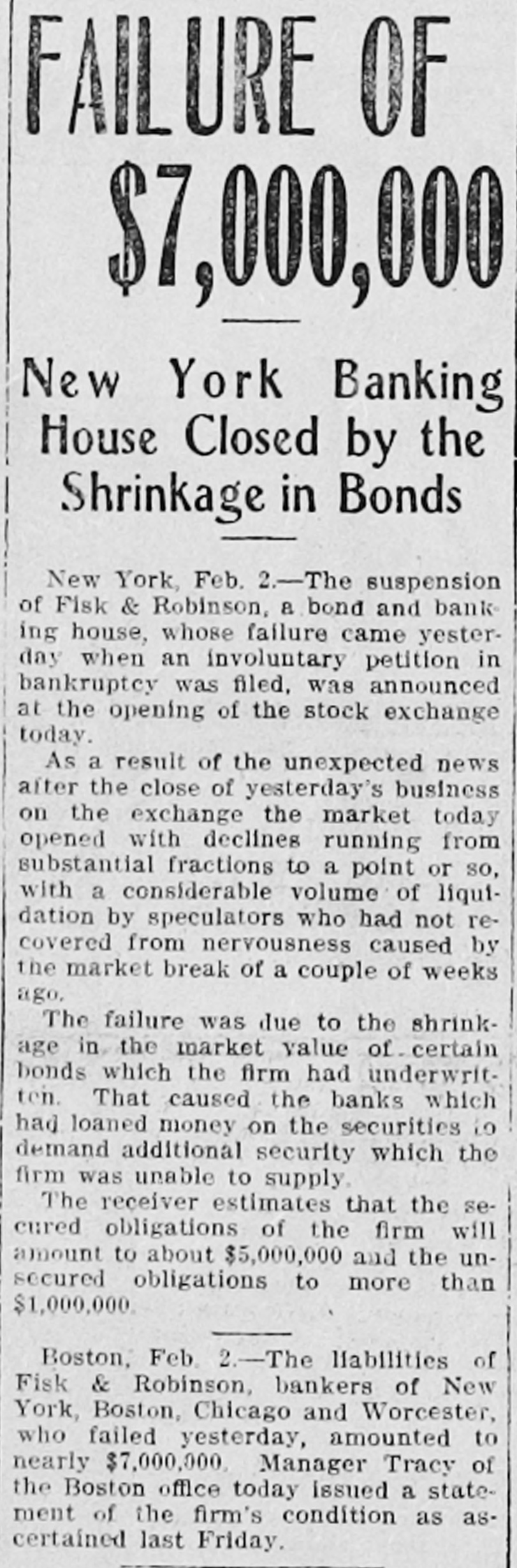
FAILURE OF $7,000,000 New York Banking House Closed by the Shrinkage in Bonds New York, Feb. 2.-The suspension of Fisk & Robinson, a bond and bank ing house, whose failure came yesterday when an involuntary petition in bankruptcy was filed, was announced at the opening of the stock exchange today. As a result of the unexpected news after the close of yesterday's business on the exchange the market today opened with declines running from substantial fractions to a point or so, with a considerable volume of liquidation by speculators who had not recovered from nervousness caused by the market break of a couple of weeks ago, The failure was due to the shrinkage in the market value of certain bonds which the firm had underwritten. That caused the banks which had loaned money on the securities to demand additional security which the firm was unable to supply. The receiver estimates that the secured obligations of the firm will amount to about $5,000,000 and the unsecured obligations to more than $1,000,000. Boston, Feb. 2.-The liabilities of Fisk & Robinson, bankers of New York, Boston, Chicago and Worcester, who failed yesterday, amounted to nearly $7,000,000 Manager Tracy of the Boston office today issued a statement of the firm's condition as ascertained last Friday.
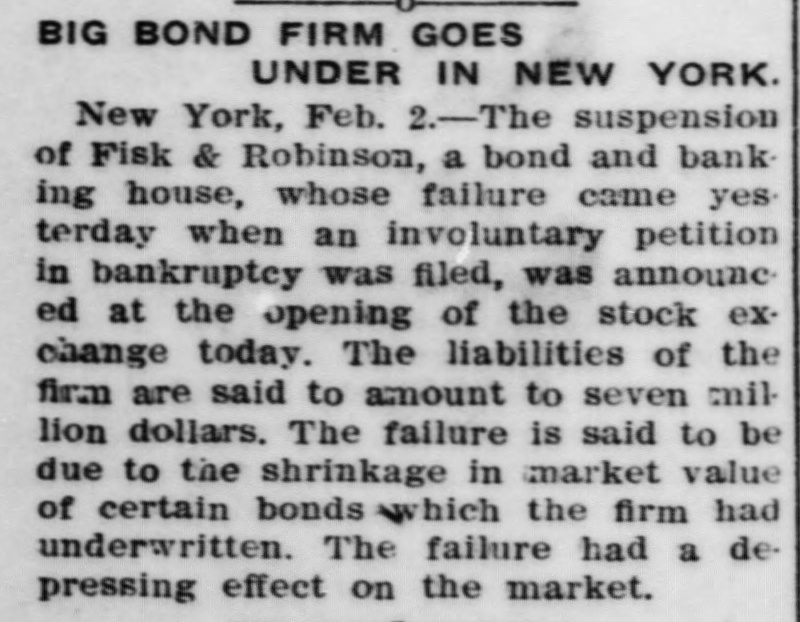
BIG BOND FIRM GOES UNDER IN NEW YORK. New York, Feb. 2.-The suspension of Fisk & Robinson, a bond and bank ing house, whose failure came yes. terday when an involuntary petition in bankruptcy was filed, was announced at the opening of the stock exchange today. The liabilities of the firm are said to amount to seven million dollars. The failure is said to be due to the shrinkage in market value of certain bonds which the firm had underwritten. The failure had a depressing effect on the market.
5.February 2, 1910The Daily SentinelGrand Junction, CO
Click image to open full size in new tab
Article Text
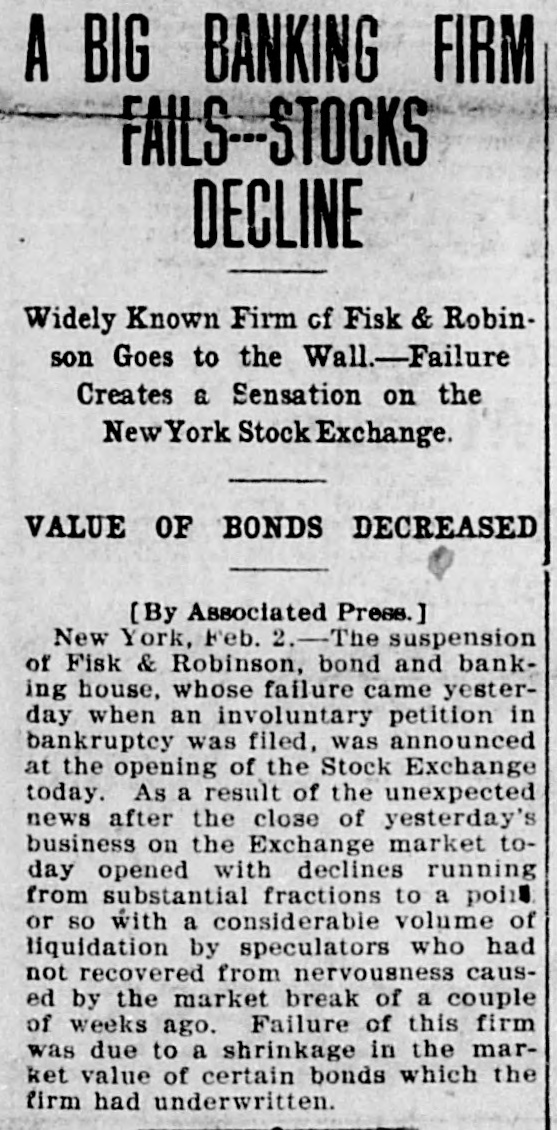
A BIG BANKING FIRM CALLO FAILS-STOCKS DECLINE Widely Known Firm of Fisk & Robinson Goes to the Wall.-Failure Creates a Sensation on the New York Stock Exchange. VALUE OF BONDS DECREASED [By Associated Press. ] New York, Feb. 2. -The suspension of Fisk & Robinson, bond and banking house, whose failure came yesterday when an involuntary petition in bankruptcy was filed, was announced at the opening of the Stock Exchange today. As a result of the unexpected news after the close of yesterday's business on the Exchange market today opened with declines running from substantial fractions to a poir or so with a considerable volume of liquidation by speculators who had not recovered from nervousness caused by the market break of a couple of weeks ago. Failure of this firm was due to a shrinkage in the market value of certain bonds which the firm had underwritten.
6.February 2, 1910The Calumet NewsCalumet, MI
Click image to open full size in new tab
Article Text
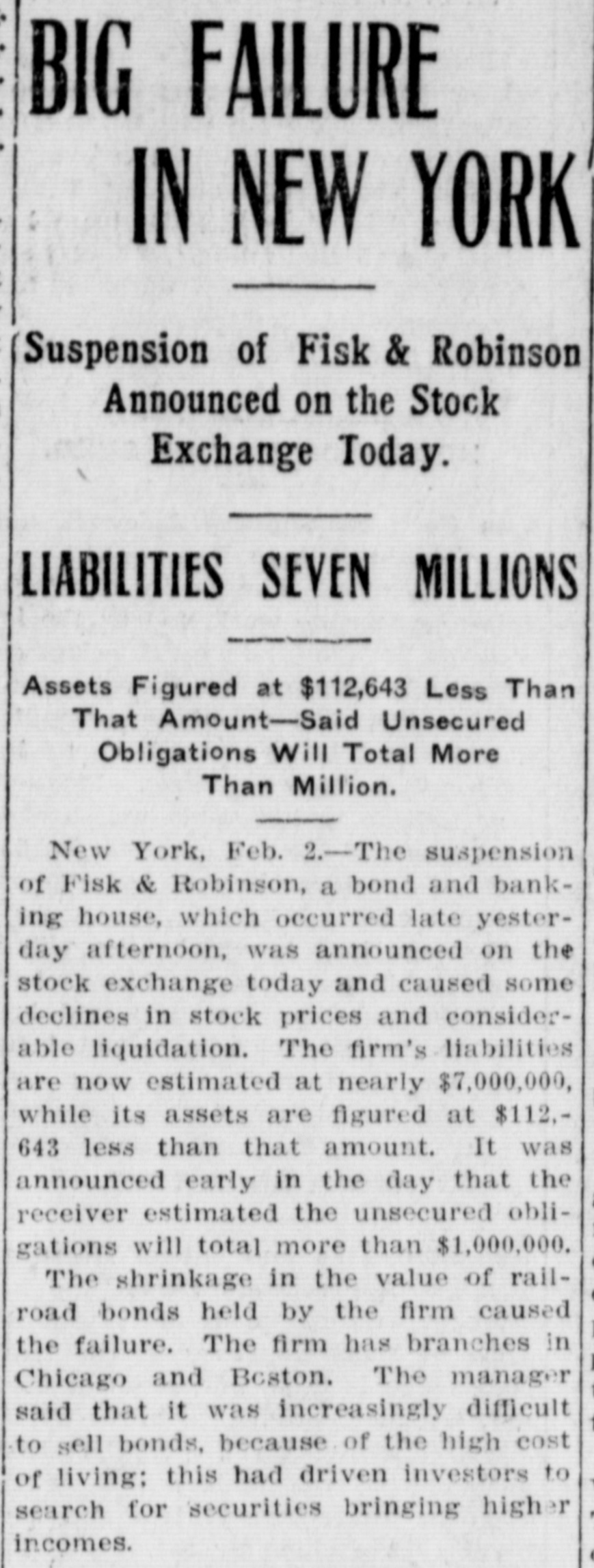
BIG FAILURE IN NEW YORK Suspension of Fisk & Robinson Announced on the Stock Exchange Today. LIABILITIES SEVEN MILLIONS Assets Figured at $112,643 Less Than That Amount-Said Unsecured Obligations Will Total More Than Million. New York, Feb. 2.-The suspension of Fisk & Robinson, a bond and banking house, which occurred late yesterday afternoon, was announced on the stock exchange today and caused some declines in stock prices and considerable liquidation. The firm's liabilities are now estimated at nearly $7,000,000, while its assets are figured at $112,643 less than that amount. It was announced early in the day that the receiver estimated the unsecured obligations will total more than $1,000,000. The shrinkage in the value of railroad bonds held by the firm caused the failure. The firm has branches in Chicago and Boston. The manager said that it was increasingly difficult to sell bonds, because of the high cost of living: this had driven investors to search for securities bringing higher incomes.
7.February 2, 1910The Detroit TimesDetroit, MI
Click image to open full size in new tab
Article Text
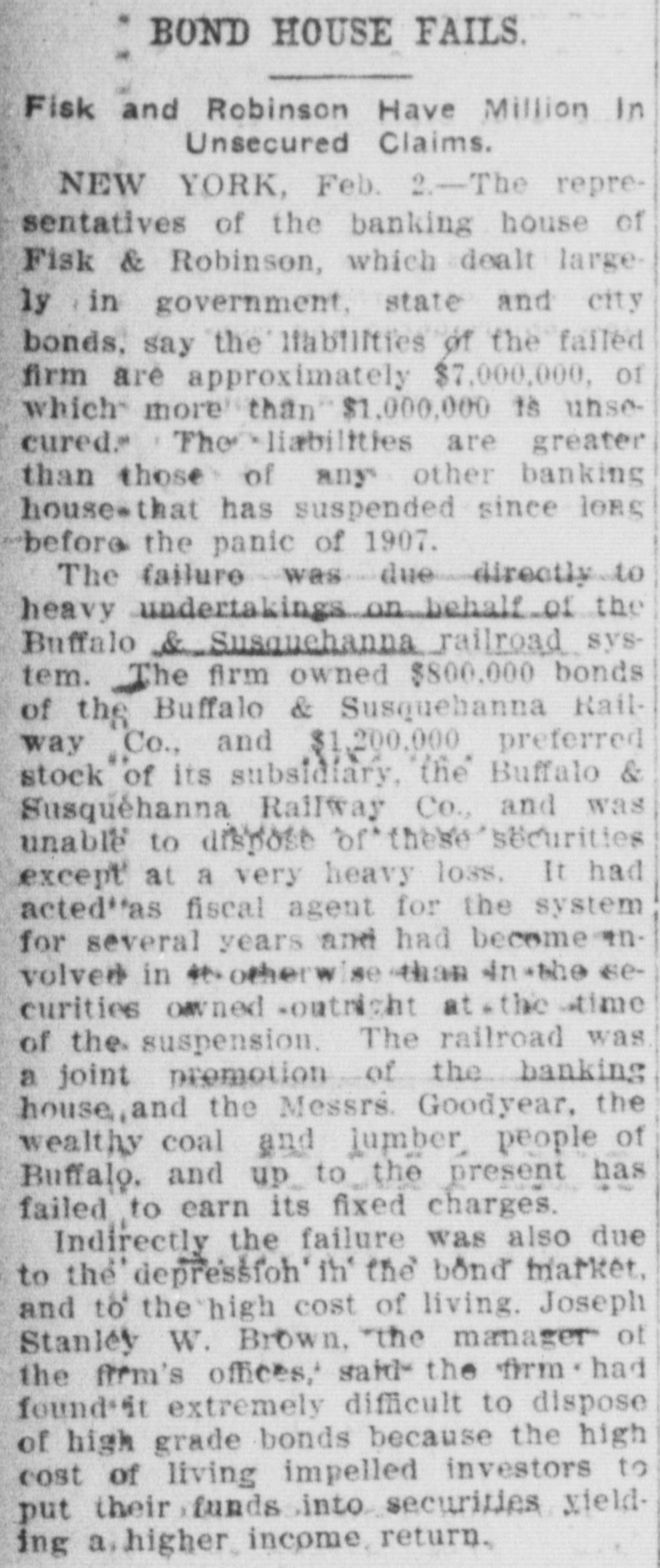
BOND HOUSE FAILS
Fisk and Robinson Have Million In Unsecured Claims. NEW YORK, Feb. 2.-The representatives of the banking house of Fisk & Robinson, which dealt large ly in government, state and city bonds, say the liabilities of the failed firm are approximately $7,000,000, of which more than $1,000,000 1s unsecured." The liabilities are greater than those of any other banking house*that has suspended since long before the panic of 1907. The failure was due directly to heavy undertakings on behalf of the Buffalo & Susquehanna railroad system. The firm owned $800,000 bonds of the Buffalo & Susquehanna Railway Co., and $1,200,000 preferred stock of its subsidiary, the Buffalo & Susquéhanna Railway Co., and was unable to dispose "of" these securities except at a very heavy loss. It had acted**as fiscal agent for the system for several years and had become involved in 4th otherwise than in *the securities owned soutricht at athe time of the. suspension. The railroad was a joint promotion of the banking house, and the Messrs. Goodyear, the wealthy coal and lumber people of Buffalo. and up to the present has failed to earn its fixed charges. Indirectly the failure was also due to the depression' ih' the bond market, and to the high cost of living. Joseph Stanley W. Brown, The manager of the firm's offices,' said* the firm had found*it extremely difficult to dispose of high grade bonds because the high cost of living impelled investors to put their funds into securities yielding a, higher income, return.
8.February 2, 1910The Topeka State JournalTopeka, KS
Click image to open full size in new tab
Article Text
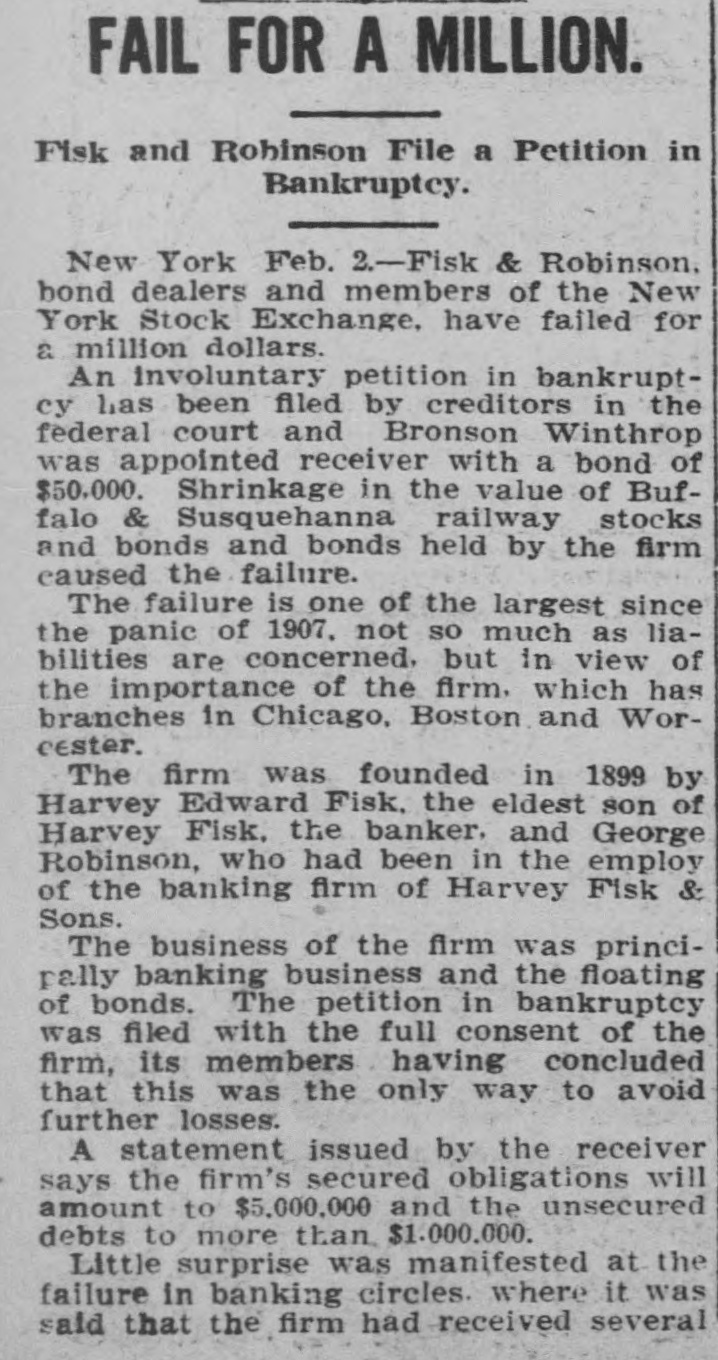
FAIL FOR A MILLION
Fisk and Robinson File a Petition in Bankruptcy. New York Feb. 2.-Fisk & Robinson. bond dealers and members of the New York Stock Exchange. have failed for a million dollars. An involuntary petition in bankruptcy has been filed by creditors in the federal court and Bronson Winthrop was appointed receiver with a bond of $50,000. Shrinkage in the value of Buffalo & Susquehanna railway stocks and bonds and bonds held by the firm caused the failure. The failure is one of the largest since the panic of 1907. not so much as liabilities are concerned. but in view of the importance of the firm. which has branches in Chicago, Boston and Worcester. The firm was founded in 1899 by Harvey Edward Fisk, the eldest son of Harvey Fisk. the banker. and George Robinson, who had been in the employ of the banking firm of Harvey Fisk & Sons. The business of the firm was principally banking business and the floating of bonds. The petition in bankruptcy was filed with the full consent of the firm, its members having concluded that this was the only way to avoid further losses. A statement issued by the receiver says the firm's secured obligations will amount to $5,000,000 and the unsecured debts to more than $1.000.000. Little surprise was manifested at the failure in banking circles. where it was said that the firm had received several
9.February 3, 1910Daily Kennebec JournalAugusta, ME
Click image to open full size in new tab
Article Text
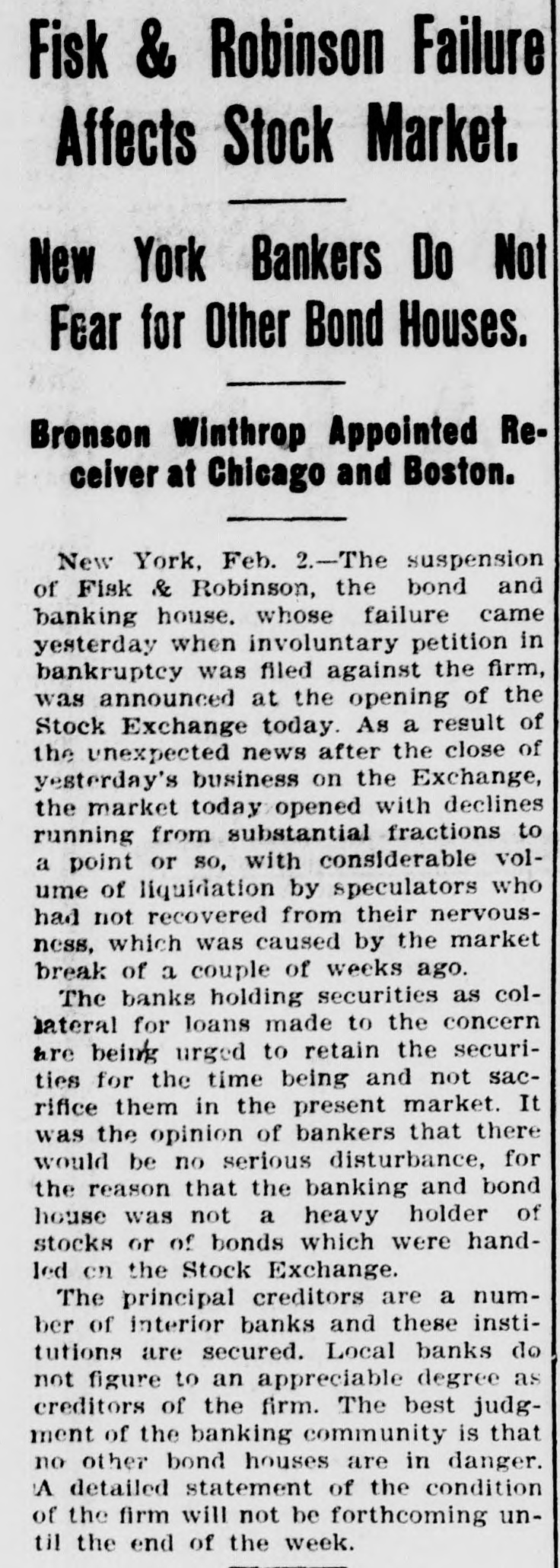
Fisk & Robinson Failure Affects Stock Market. New York Bankers Do Not Fear for Other Bond Houses. Bronson Winthrop Appointed Receiver at Chicago and Boston. New York, Feb. 2.-The suspension of Fisk & Robinson, the bond and banking house. whose failure came yesterday when involuntary petition in bankruptcy was filed against the firm, was announced at the opening of the Stock Exchange today. As a result of the unexpected news after the close of yesterday's business on the Exchange, the market today opened with declines running from substantial fractions to a point or so, with considerable volume of liquidation by speculators who had not recovered from their nervousness, which was caused by the market break of a couple of weeks ago. The banks holding securities as collateral for loans made to the concern are being urged to retain the securities for the time being and not sacrifice them in the present market. It was the opinion of bankers that there would be no serious disturbance, for the reason that the banking and bond house was not a heavy holder of stocks or of bonds which were handled en the Stock Exchange. The principal creditors are a number of interior banks and these institutions are secured. Local banks do not figure to an appreciable degree as creditors of the firm. The best judgment of the banking community is that no other bond houses are in danger. A detailed statement of the condition of the firm will not be forthcoming until the end of the week.
10.February 3, 1910Ottumwa Tri-Weekly CourierOttumwa, IA
Click image to open full size in new tab
Article Text
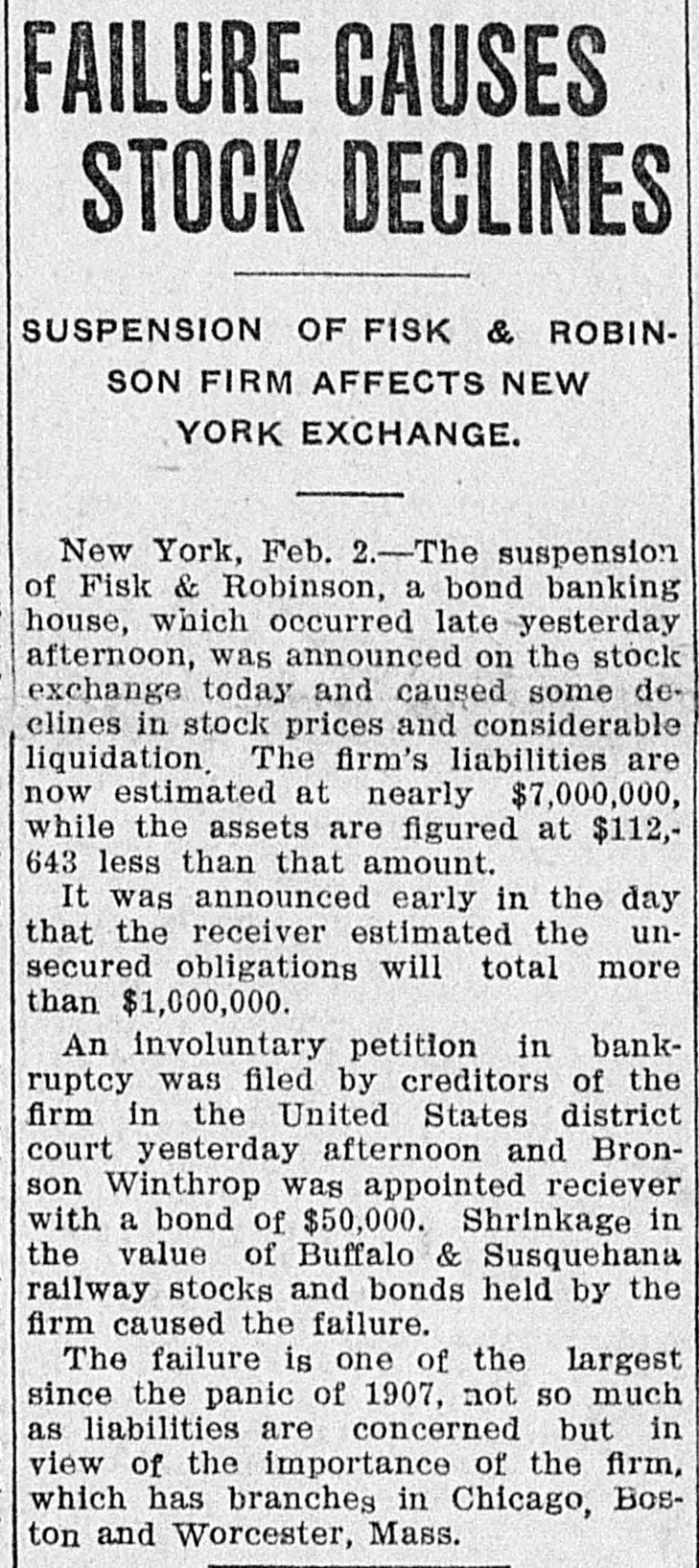
FAILURE CAUSES STOCK DECLINES SUSPENSION OF FISK & ROBINSON FIRM AFFECTS NEW YORK EXCHANGE. New York, Feb. 2.-The suspension of Fisk & Robinson, a bond banking house, which occurred late yesterday afternoon, was announced on the stock exchange today and caused some declines in stock prices and considerable liquidation. The firm's liabilities are now estimated at nearly $7,000,000, while the assets are figured at $112,643 less than that amount. It was announced early in the day that the receiver estimated the unsecured obligations will total more than $1,000,000. An involuntary petition in bankruptcy was filed by creditors of the firm in the United States district court yesterday afternoon and Bronson Winthrop was appointed reciever with a bond of $50,000. Shrinkage in the value of Buffalo & Susquehana railway stocks and bonds held by the firm caused the failure. The failure is one of the largest since the panic of 1907, not so much as liabilities are concerned but in view of the importance of the firm, which has branches in Chicago, Boston and Worcester, Mass.
11.February 3, 1910Connecticut Western NewsNorth Canaan, Salisbury, Canaan, CT
Click image to open full size in new tab
Article Text
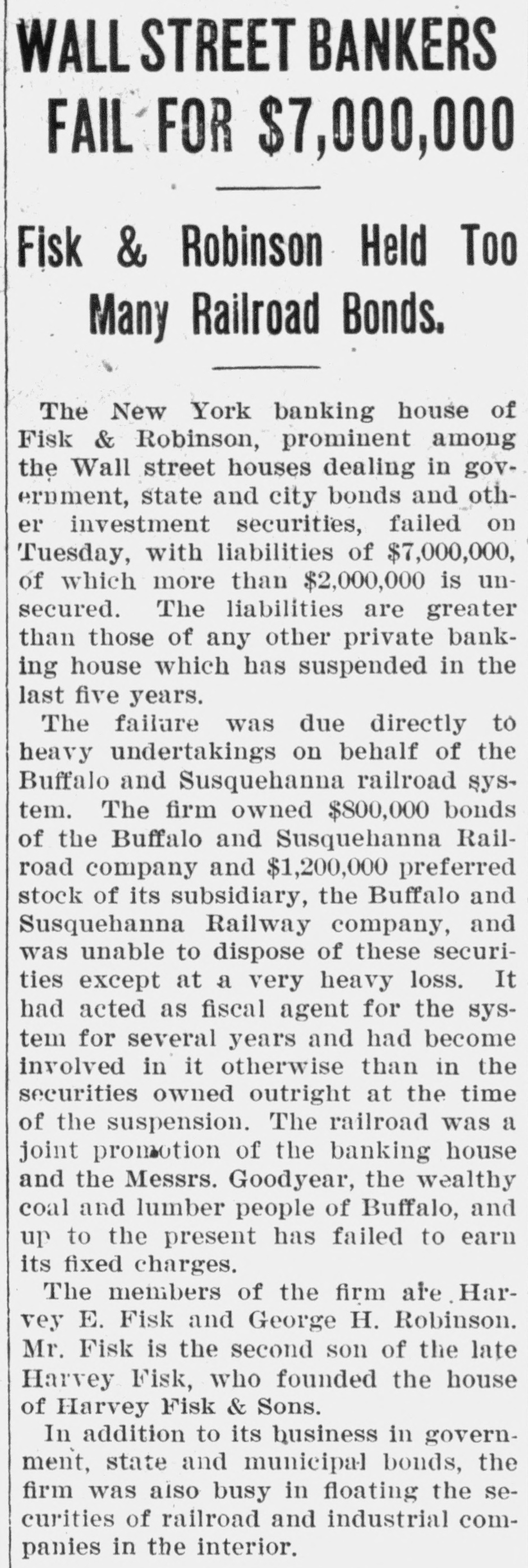
WALL STREET BANKERS FAIL FOR $7,000,000 Fisk & Robinson Held Too Many Railroad Bonds. The New York banking house of Fisk & Robinson, prominent among the Wall street houses dealing in government, state and city bonds and other investment securities, failed on Tuesday, with liabilities of $7,000,000, of which more than $2,000,000 is unsecured. The liabilities are greater than those of any other private banking house which has suspended in the last five years. The failare was due directly to heavy undertakings on behalf of the Buffalo and Susquehanna railroad system. The firm owned $800,000 bonds of the Buffalo and Susquehanna Railroad company and $1,200,000 preferred stock of its subsidiary, the Buffalo and Susquehanna Railway company, and was unable to dispose of these securities except at a very heavy loss. It had acted as fiscal agent for the system for several years and had become involved in it otherwise than in the securities owned outright at the time of the suspension. The railroad was a joint promotion of the banking house and the Messrs. Goodyear, the wealthy coal and lumber people of Buffalo, and up to the present has failed to earn its fixed charges. The members of the firm are Harvey E. Fisk and George H. Robinson. Mr. Fisk is the second son of the late Harvey Fisk, who founded the house of Harvey Fisk & Sons. In addition to its business in government, state and municipal bonds, the firm was also busy in floating the securities of railroad and industrial companies in the interior.
12.February 3, 1910The Detroit TimesDetroit, MI
Click image to open full size in new tab
Article Text
BOND HOUSE FAILS
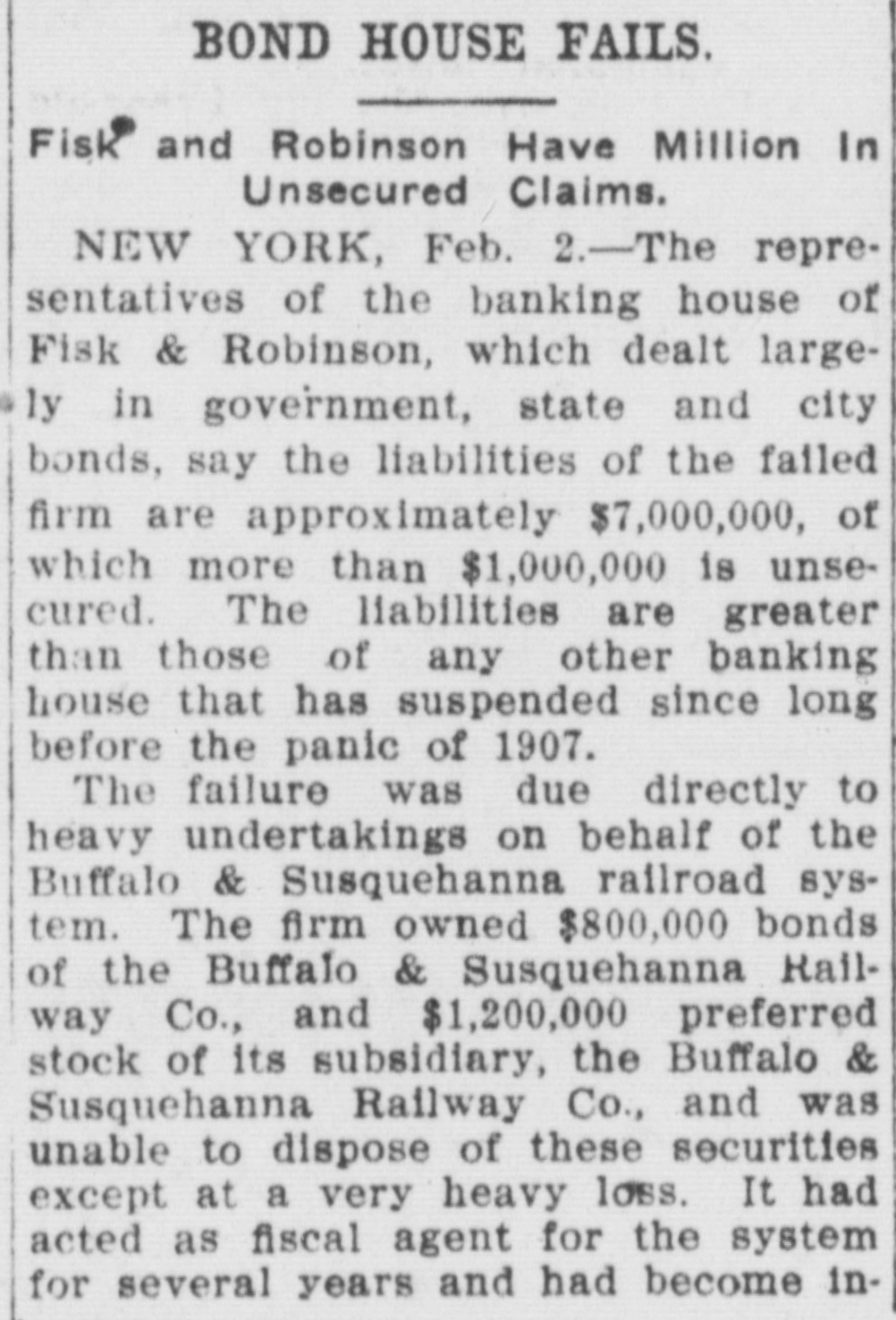
Fisk and Robinson Have Million In Unsecured Claims. NEW YORK, Feb. 2.-The representatives of the banking house of Fisk & Robinson, which dealt largely in government, state and city bonds, say the liabilities of the failed firm are approximately $7,000,000, of which more than $1,000,000 is unsecured. The liabilities are greater than those of any other banking house that has suspended since long before the panic of 1907. The failure was due directly to heavy undertakings on behalf of the Buffalo & Susquehanna railroad system. The firm owned $800,000 bonds of the Buffalo & Susquehanna Railway Co., and $1,200,000 preferred stock of its subsidiary, the Buffalo & Susquehanna Railway Co., and was unable to dispose of these securities except at a very heavy loss. It had acted as fiscal agent for the system for several years and had become in-
13.February 4, 1910New-York TribuneNew York, NY
Click image to open full size in new tab
Article Text
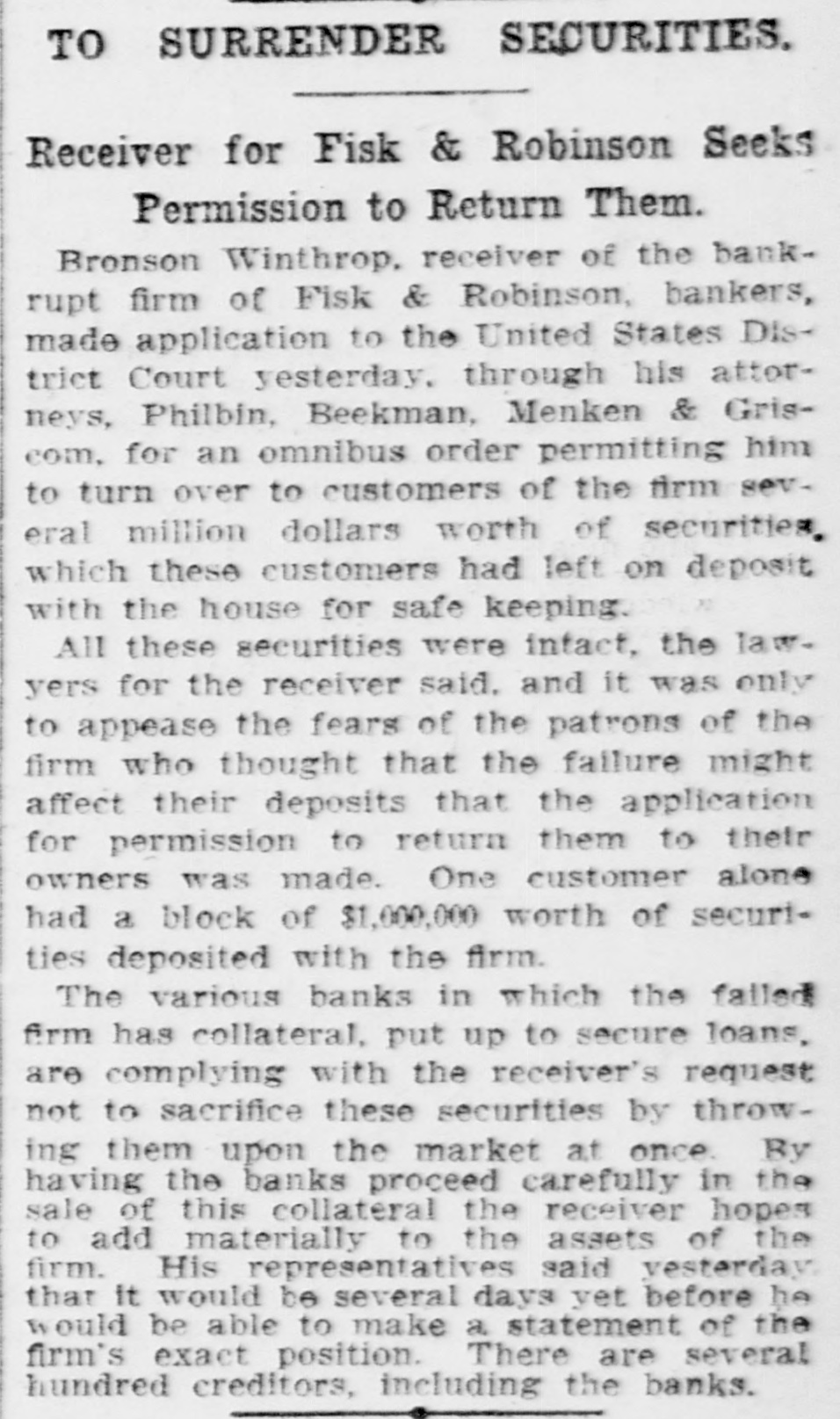
TO SURRENDER SECURITIES
Receiver for Fisk & Robinson Seeks Permission to Return Them. Bronson Winthrop. receiver of the bankrupt firm of Fisk & Robinson, bankers, made application to the United States District Court yesterday. through his attorneys, Philbin, Beekman, Menken & Griscom. for an omnibus order permitting him to turn over to customers of the firm several million dollars worth of securities. which these customers had left on deposit with the house for safe keeping. All these securities were intact, the lawyers for the receiver said. and it was only to appease the fears of the patrons of the firm who thought that the failure might affect their deposits that the application for permission to return them to their owners was made. One customer alone had a block of $1,000,000 worth of securities deposited with the firm. The various banks in which the failed firm has collateral, put up to secure loans, are complying with the receiver's request not to sacrifice these securities by throwing them upon the market at once. By having the banks proceed carefully in the sale of this collateral the receiver hopen to add materially to the assets of the firm. His representatives said yesterday that it would be several days yet before he would be able to make a statement of the firm's exact position. There are several hundred creditors, including the banks.
14.February 9, 1910New-York TribuneNew York, NY
Click image to open full size in new tab
Article Text
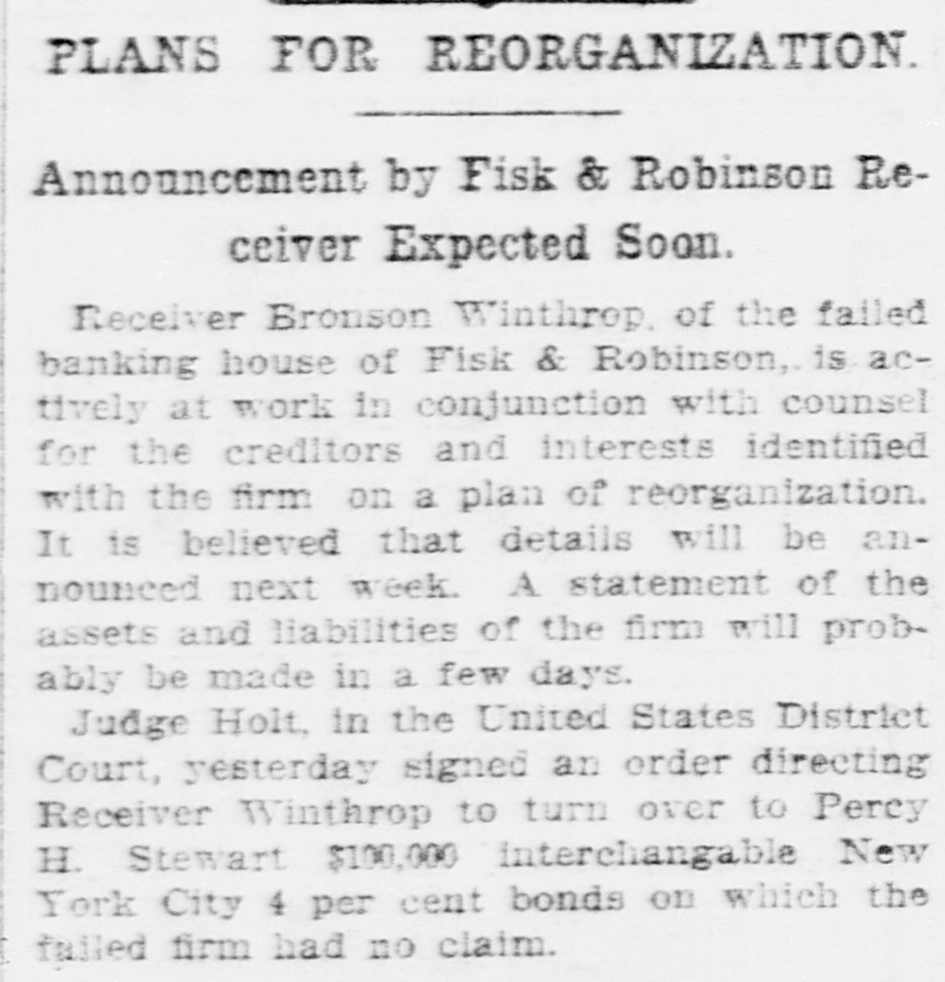
PLANS FOR REORGANIZATION
Announcement by Fisk & Robinson Receiver Expected Soon. Receiver Bronson Winthrop. of the failed banking house of Fisk & Robinson, is actively at work in conjunction with counsel for the creditors and interests identified with the firm on a plan of reorganization. It is believed that details will be announced next week. A statement of the assets and liabilities of the firm will probably be made in a few days. Judge Holt, in the United States District Court, yesterday signed an order directing Receiver Winthrop to turn over to Percy H. Stewart $100,000 interchangable New York City 4 per cent bonds on which the failed firm had no claim.
15.February 10, 1910The Mathews JournalMathews, VA
Click image to open full size in new tab
Article Text
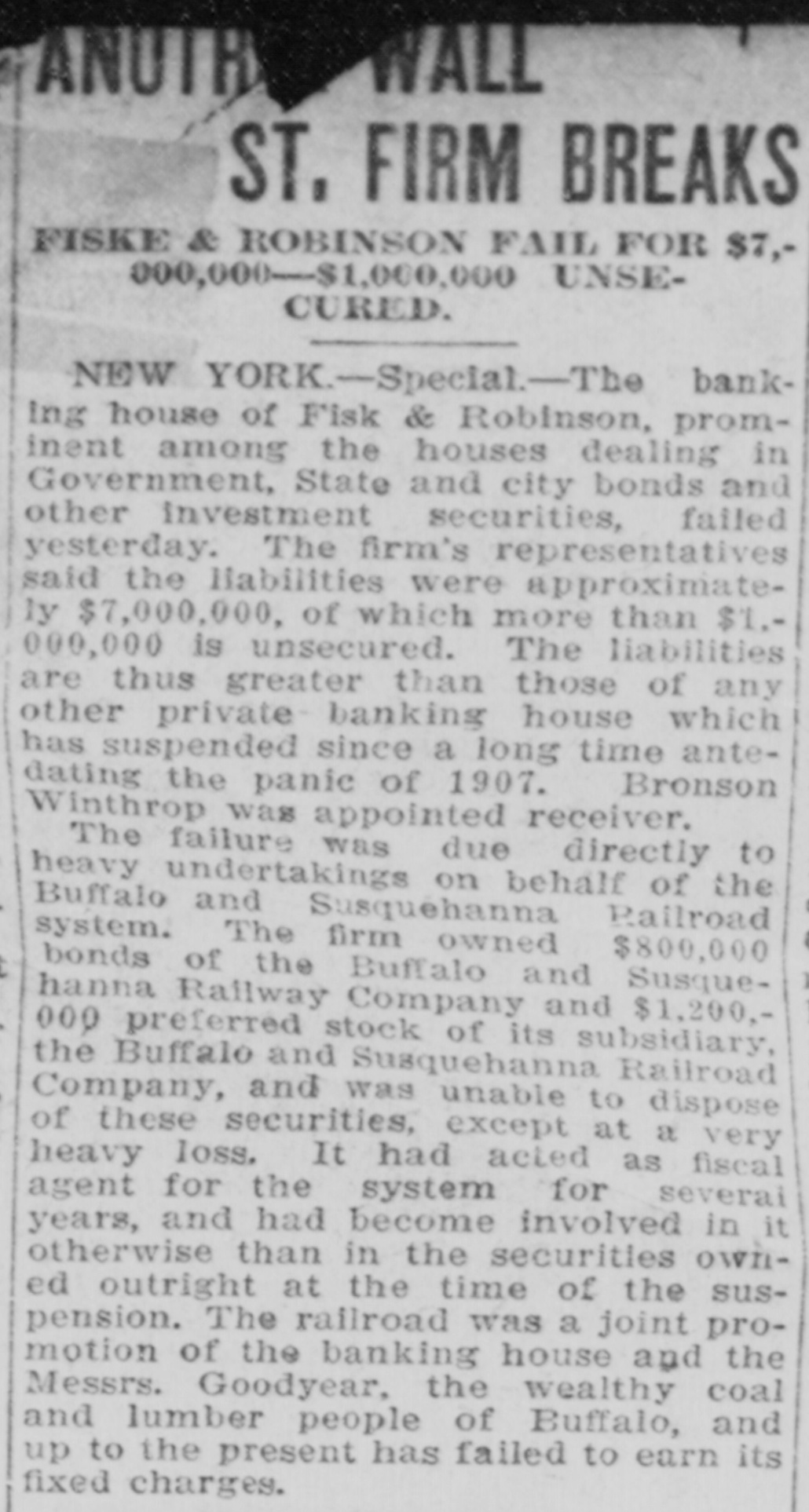
WALL ANUTR ST, FIRM BREAKS FISKE & ROBINSON FAIL FOR $7,000,000-$1,000,000 UNSECURED. NEW YORK-Special-The bankIng house of Fisk & Robinson, prominent among the houses dealing in Government, State and city bonds and other investment securities, failed yesterday. The firm's representatives said the liabilities were approximately $7,000,000, of which more than $1.000,000 is unsecured. The liabilities are thus greater than those of any other private banking house which has suspended since a long time antedating the panie of 1907. Bronson Winthrop was appointed receiver. The failure was due directly to heavy undertakings on behalf of the Buffalo and Susquéhanna Railroad system. The firm owned $800,000 bonds of the Buffalo and Susquehanna Railway Company and $1,200,000 preferred stock of its subsidiary, the Buffalo and Susquehanna Railroad Company, and was unable to dispose of these securities, except at a very heavy loss. It had acted as fiscal agent for the system for several years, and had become involved in it otherwise than in the securities owned outright at the time of the suspension. The railroad was a joint promotion of the banking house and the Messrs. Goodyear, the wealthy coal and lumber people of Buffalo, and up to the present has failed to earn its fixed charges.
16.April 30, 1910Newark Evening Star and Newark AdvertiserNewark, NJ
Click image to open full size in new tab
Article Text
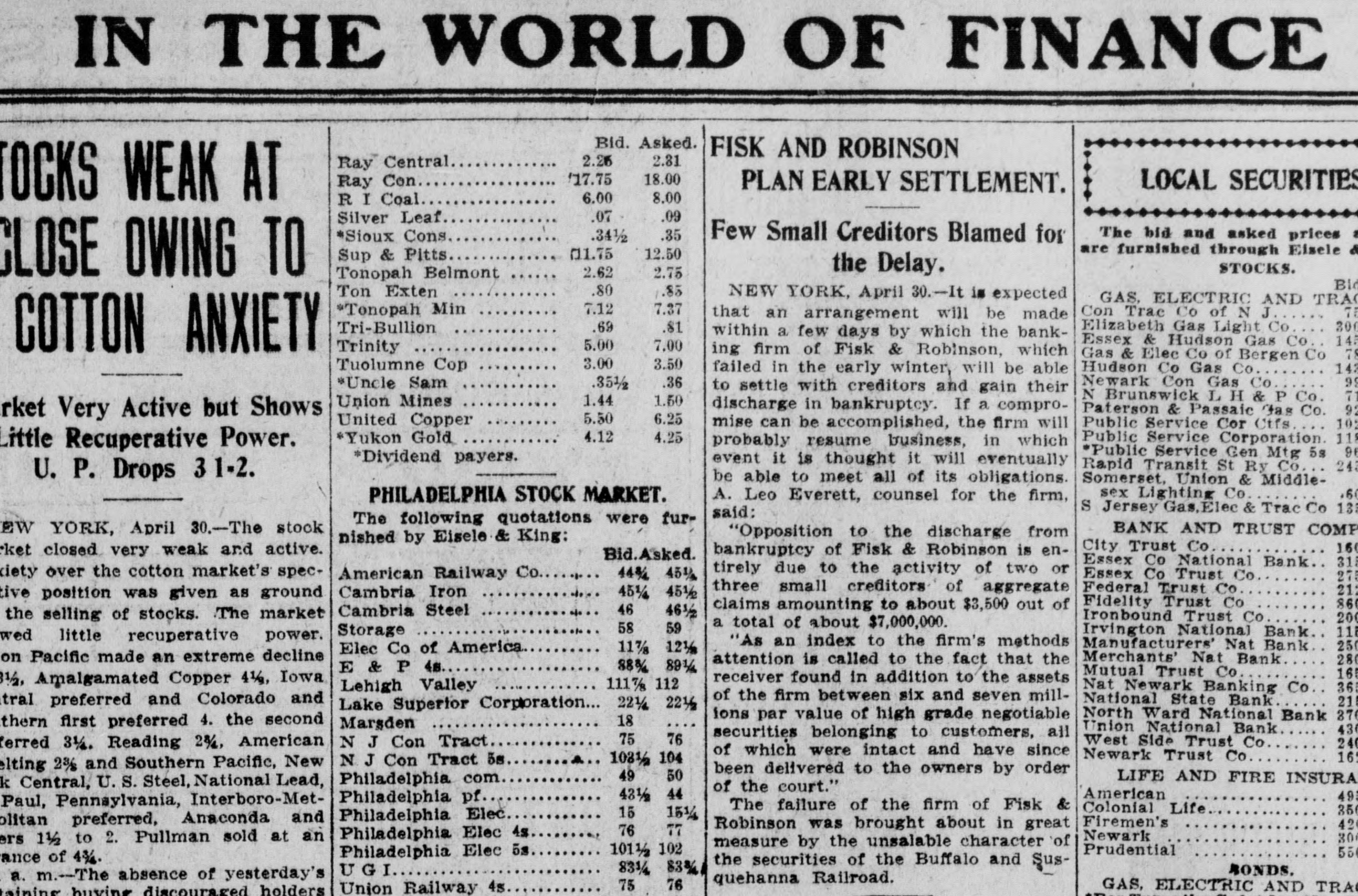
FISK AND ROBINSON PLAN EARLY SETTLEMENT.
Few Small Creditors Blamed for the Delay.
NEW YORK, April 30.—It is expected that an arrangement will be made within a few days by which the banking firm of Fisk & Robinson, which failed in the early winter, will be able to settle with creditors and gain their discharge in bankruptcy. If a compromise can be accomplished, the firm will probably resume business, in which event it is thought it will eventually be able to meet all of its obligations. A. Leo Everett, counsel for the firm, said:
"Opposition to the discharge from bankruptcy of Fisk & Robinson is entirely due to the activity of two or three small creditors of aggregate claims amounting to about $3,500 out of a total of about $7,000,000.
"As an index to the firm's methods attention is called to the fact that the receiver found in addition to the assets of the firm between six and seven millions par value of high grade negotiable securities belonging to customers, all of which were intact and have since been delivered to the owners by order of the court."
The failure of the firm of Fisk & Robinson was brought about in great measure by the unsalable character of the securities of the Buffalo and Susquehanna Railroad.
Bank runs are almost always and everywhere a deterioration of bank fundamentals.
But not for you.
You are the measure-zero exception: great fundamentals, solid bank, and yet the Diamond Dybvig fairy spread its rumor. Depositors woke up. Your collateral was not prepositioned. The Clearinghouse had it for you.
Do not pass Go. Do not collect $200. Go directly to jail… or worse.