First National Bank (Adrian, MO)

Episode Information

Episode UID
1037501480
Episode Type
Run → Suspension → Closure
Bank Type
national
Bank ID
103750 national
Charter Number
10375
Start Date
April 11, 1923
Location
Adrian, Missouri (38.398, -94.352)

Metadata

Model
gemini-3-flash-preview (chosen from majority vote of a three-model LLM ensemble)
Short Digest
d421a125e10ac499

Response Measures

Accommodated withdrawals, Borrowed from banks or large institutions, Capital injected, Full suspension, Books examined

Other: The bank was reorganized under a new name and management with a 33% assessment on stockholders to pay depositors in full.

Description

The bank closed permanently following the run and was replaced by a new institution under a different name and management.

Events (5)

1. April 25, 1913 Chartered
Source
historical_nic
2. April 11, 1923 Run
Cause
Bank Specific Adverse Info
Cause Details
Arrest of the cashier on embezzlement charges triggered depositor panic.
Measures
The bank president attempted to raise cash in Butler, MO, to meet depositor demands.
Newspaper Excerpt
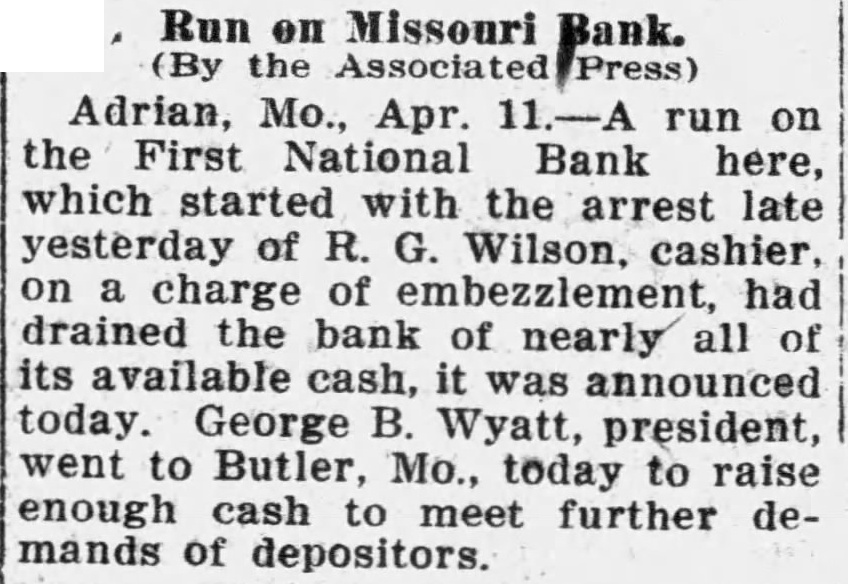
A run on the First National Bank here, which started with the arrest late yesterday of R. G. Wilson, cashier, on a charge of embezzlement, has drained the bank of nearly all its available cash
Source
newspapers
3. April 11, 1923 Suspension
Cause
Bank Specific Adverse Info
Cause Details
The bank was forced to close after a run depleted its available cash following the cashier's arrest for embezzlement.
Newspaper Excerpt
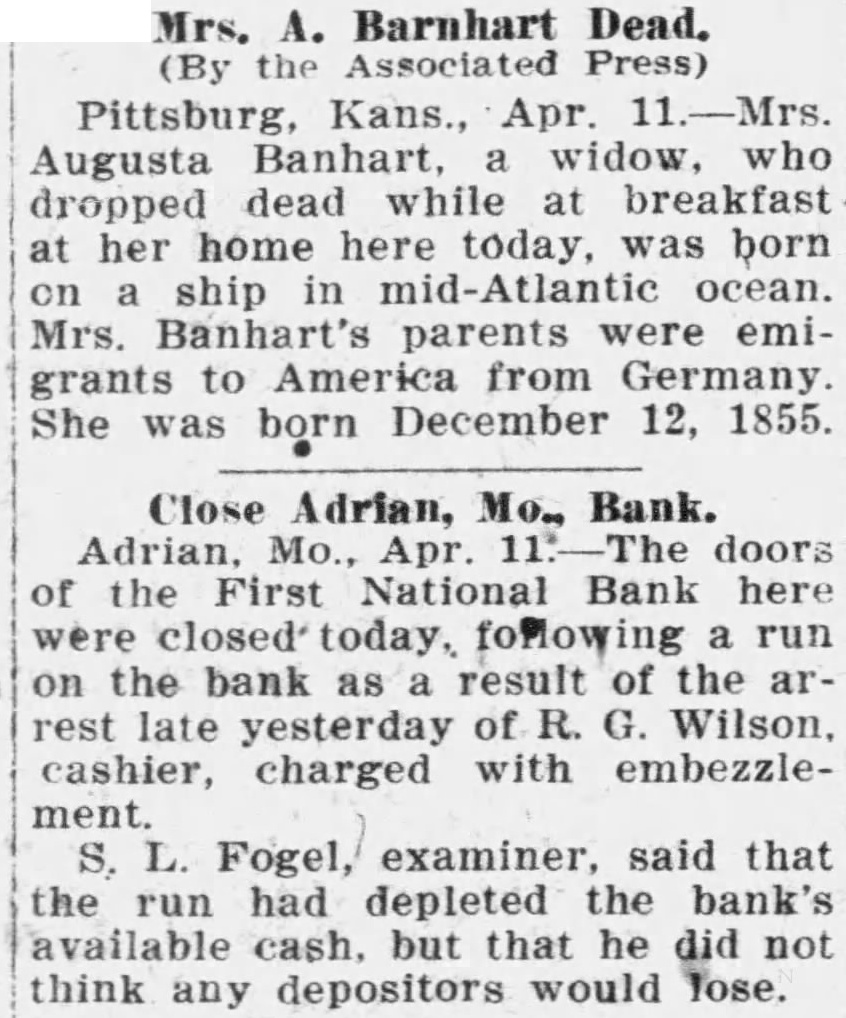
The doors of the First National Bank were closed today, following run on the bank, as a result of the arrest late yesterday of R. G. Wilson, cashier, charged with embezzlement.
Source
newspapers
4. April 30, 1923 Other
Newspaper Excerpt
The stockholders of the closed bank have decided to levy an assessment of 33 per cent on the capital stock and pay all the depositors in full. It has been decided to organize a new bank under a new name and under a new management. The capital stock of the new bank to be $25,000.
Source
newspapers
5. August 20, 1923 Voluntary Liquidation
Source
historical_nic

Newspaper Articles (20)

Article from Carthage Evening Press, April 11, 1923

Click image to open full size in new tab

Article Text

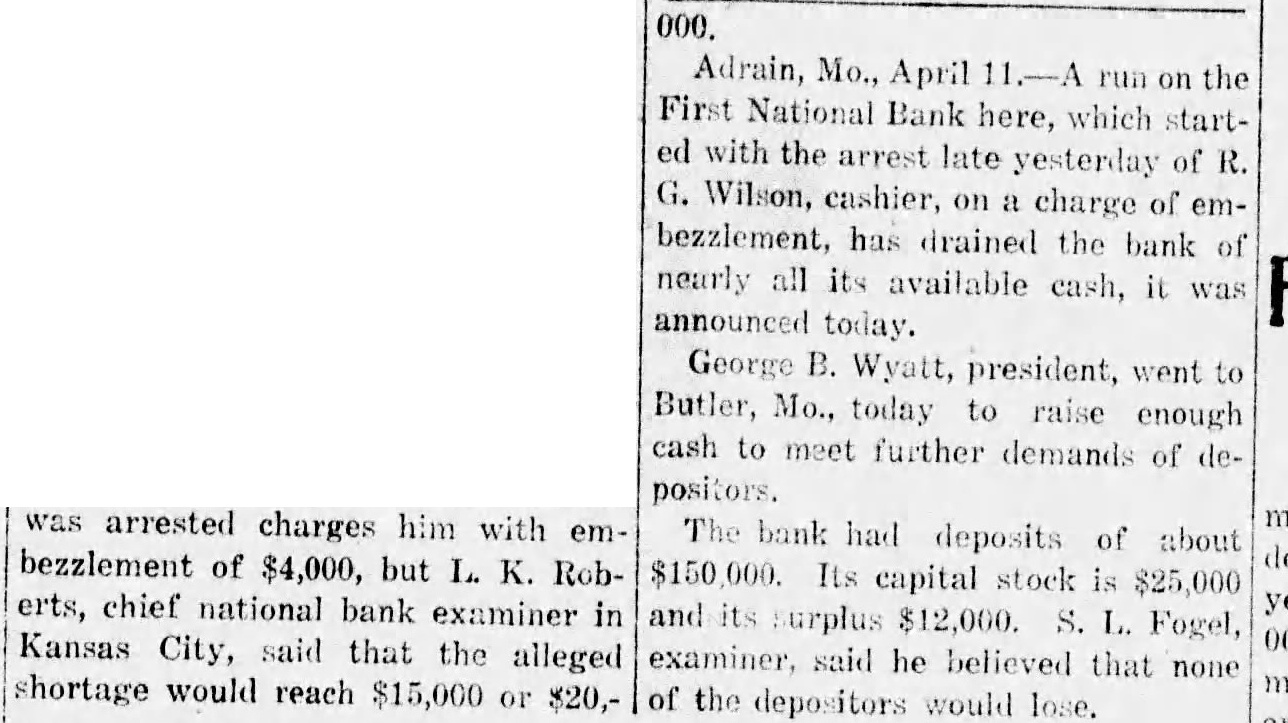
was arrested charges him with embezzlement of $4,000, but L. K. Roberts, chief national bank examiner in Kansas City, said that the alleged shortage would reach $15,000 or $20,000. Adrian, Mo., April 11.—A run on the First National Bank here, which started with the arrest late yesterday of R. G. Wilson, cashier, on a charge of embezzlement, has drained the bank of nearly all its available cash, it was announced today. George B. Wyatt, president, went to Butler, Mo., today to raise enough cash to meet further demands of depositors. The bank had deposits of about $150,000. Its capital stock is $25,000 and its surplus $12,000. S. L. Fogel, examiner, said he believed that none of the depositors would lose.


Article from Carthage Evening Press, April 11, 1923

Click image to open full size in new tab

Article Text

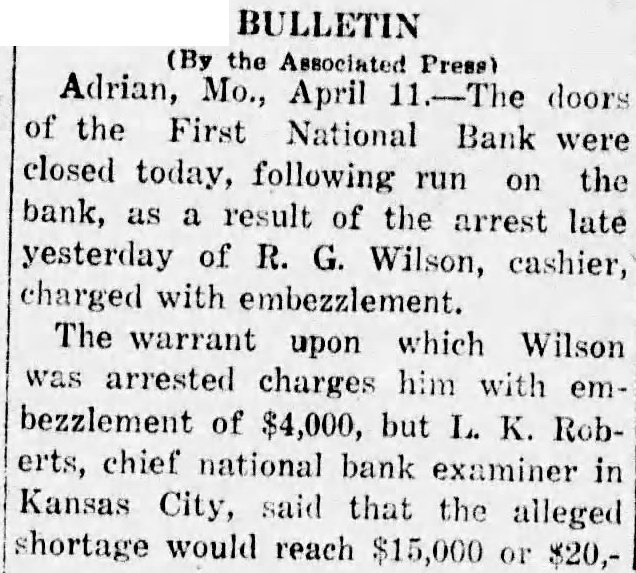
BULLETIN (By the Associated Press) Adrian, Mo., April 11.—The doors of the First National Bank were closed today, following run on the bank, as a result of the arrest late yesterday of R. G. Wilson, cashier, charged with embezzlement. The warrant upon which Wilson was arrested charges him with embezzlement of $4,000, but L. K. Roberts, chief national bank examiner in Kansas City, said that the alleged shortage would reach $15,000 or $20,-


Article from Carthage Evening Press, April 11, 1923

Click image to open full size in new tab

Article Text

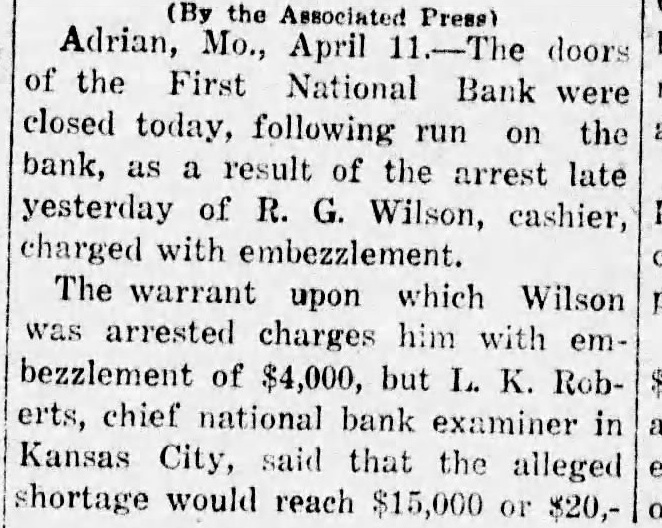
(By the Associated Press) Adrian, Mo., April 11.—The doors of the First National Bank were closed today, following run on the bank, as a result of the arrest late yesterday of R. G. Wilson, cashier, charged with embezzlement. The warrant upon which Wilson was arrested charges him with embezzlement of $4,000, but L. K. Roberts, chief national bank examiner in Kansas City, said that the alleged shortage would reach $15,000 or $20,-


Article from St. Louis Post-Dispatch, April 11, 1923

Click image to open full size in new tab

Article Text

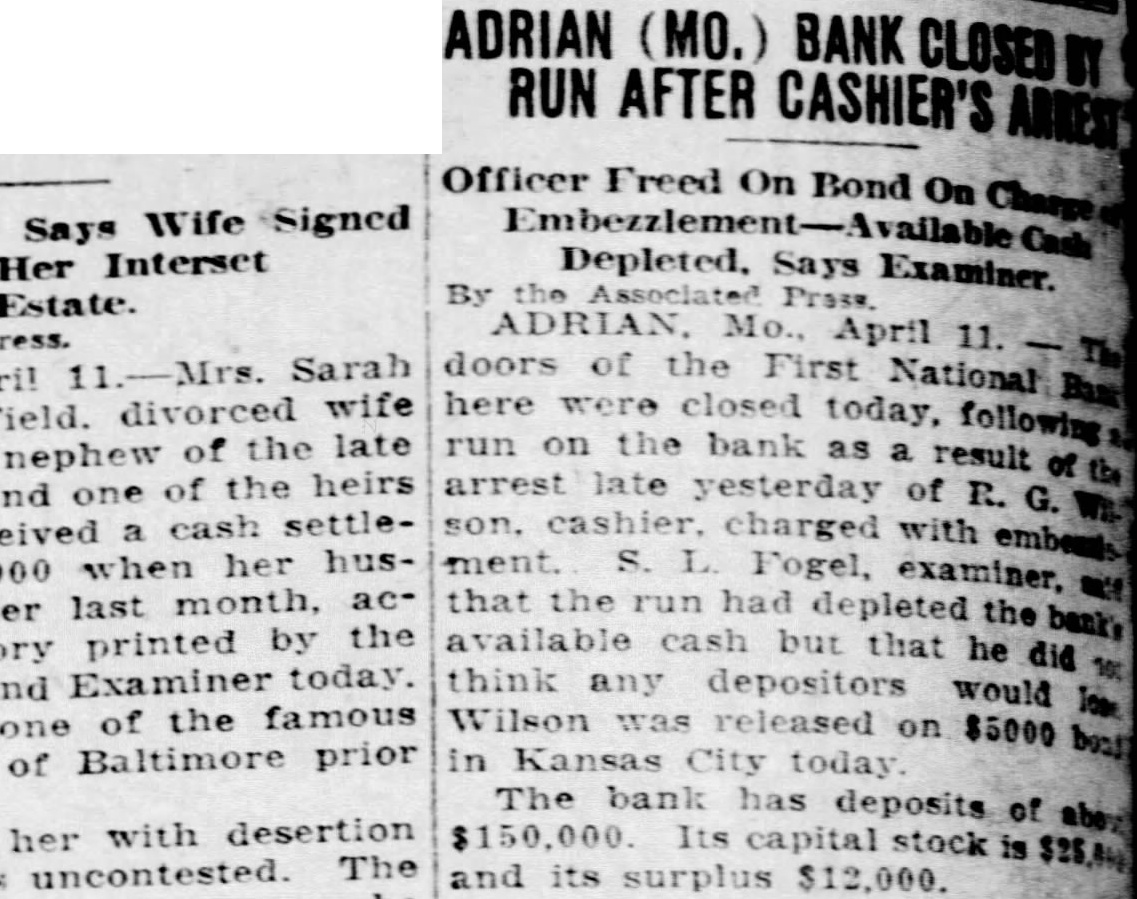
ADRIAN (MO.) BANK CLOSED BY RUN AFTER CASHIER'S ARREST Officer Freed On Bond On Charge of Embezzlement—Available Cash Depleted, Says Examiner. By the Associated Press. ADRIAN, Mo., April 11. — The doors of the First National Bank here were closed today, following a run on the bank as a result of the arrest late yesterday of R. G. Wilson, cashier, charged with embezzlement. S. L. Fogel, examiner, said that the run had depleted the bank's available cash but that he did not think any depositors would lose. Wilson was released on $5000 bond in Kansas City today. The bank has deposits of about $150,000. Its capital stock is $25,000 and its surplus $12,000.


Article from Joplin Globe, April 11, 1923

Click image to open full size in new tab

Article Text

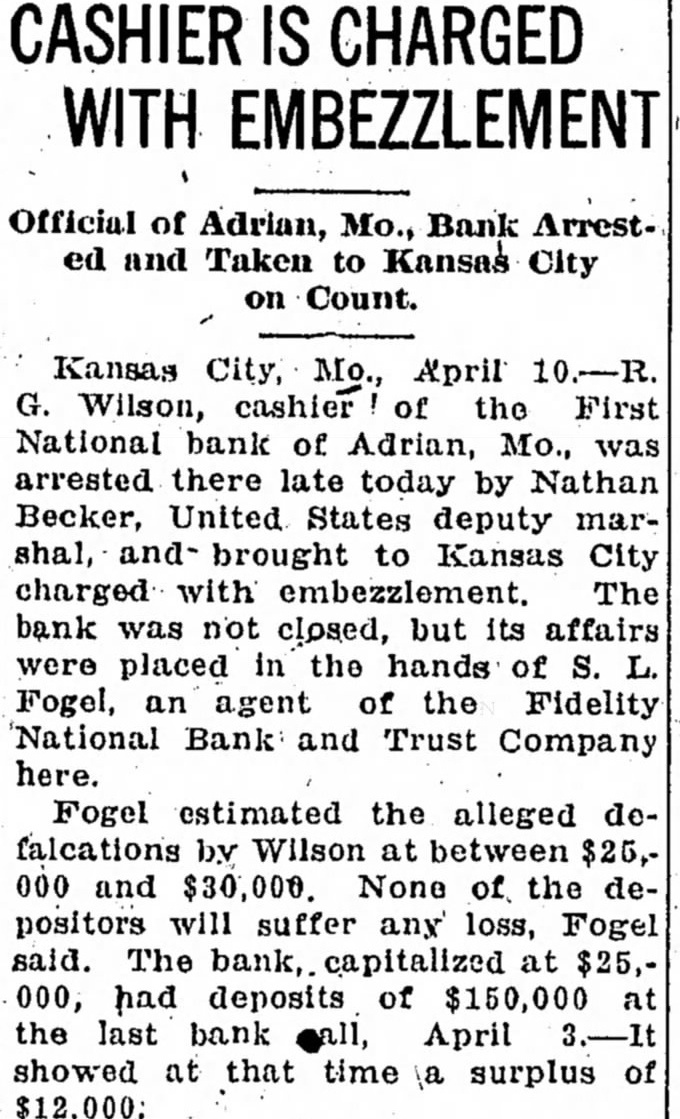
CASHIER IS CHARGED WITH EMBEZZLEMENT Official of Adrian, Mo., Bank Arrested and Taken to Kansas City on Count. Kansas City, Mo., April 10.—R. G. Wilson, cashier of the First National bank of Adrian, Mo., was arrested there late today by Nathan Becker, United States deputy marshal, and brought to Kansas City charged with embezzlement. The bank was not closed, but its affairs were placed in the hands of S. L. Fogel, an agent of the Fidelity National Bank and Trust Company here. Fogel estimated the alleged defalcations by Wilson at between $25,000 and $30,000. None of the depositors will suffer any loss, Fogel said. The bank, capitalized at $25,000, had deposits of $150,000 at the last bank call, April 3.—It showed at that time a surplus of $12,000.


Article from The St. Louis Star and Times, April 11, 1923

Click image to open full size in new tab

Article Text

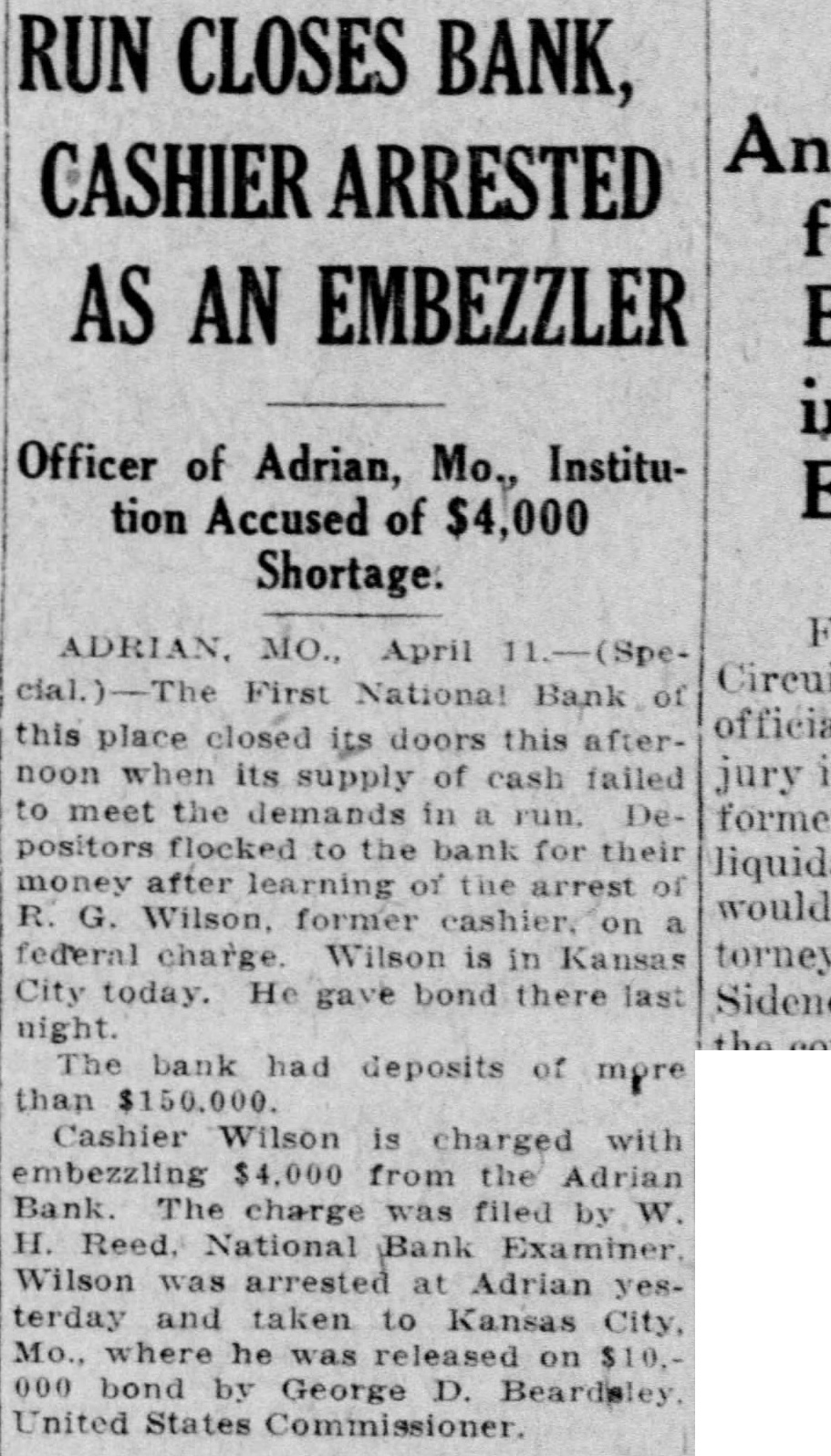
RUN CLOSES BANK, CASHIER ARRESTED AS AN EMBEZZLER Officer of Adrian, Mo., Institution Accused of $4,000 Shortage. ADRIAN, MO., April 11.—(Special.)—The First National Bank of this place closed its doors this afternoon when its supply of cash failed to meet the demands in a run. Depositors flocked to the bank for their money after learning of the arrest of R. G. Wilson, former cashier, on a federal charge. Wilson is in Kansas City today. He gave bond there last night. The bank had deposits of more than $150,000. Cashier Wilson is charged with embezzling $4,000 from the Adrian Bank. The charge was filed by W. H. Reed, National Bank Examiner. Wilson was arrested at Adrian yesterday and taken to Kansas City, Mo., where he was released on $10,000 bond by George D. Beardsley, United States Commissioner.


Article from Moberly Monitor-Index and Moberly Evening Democrat, April 11, 1923

Click image to open full size in new tab

Article Text

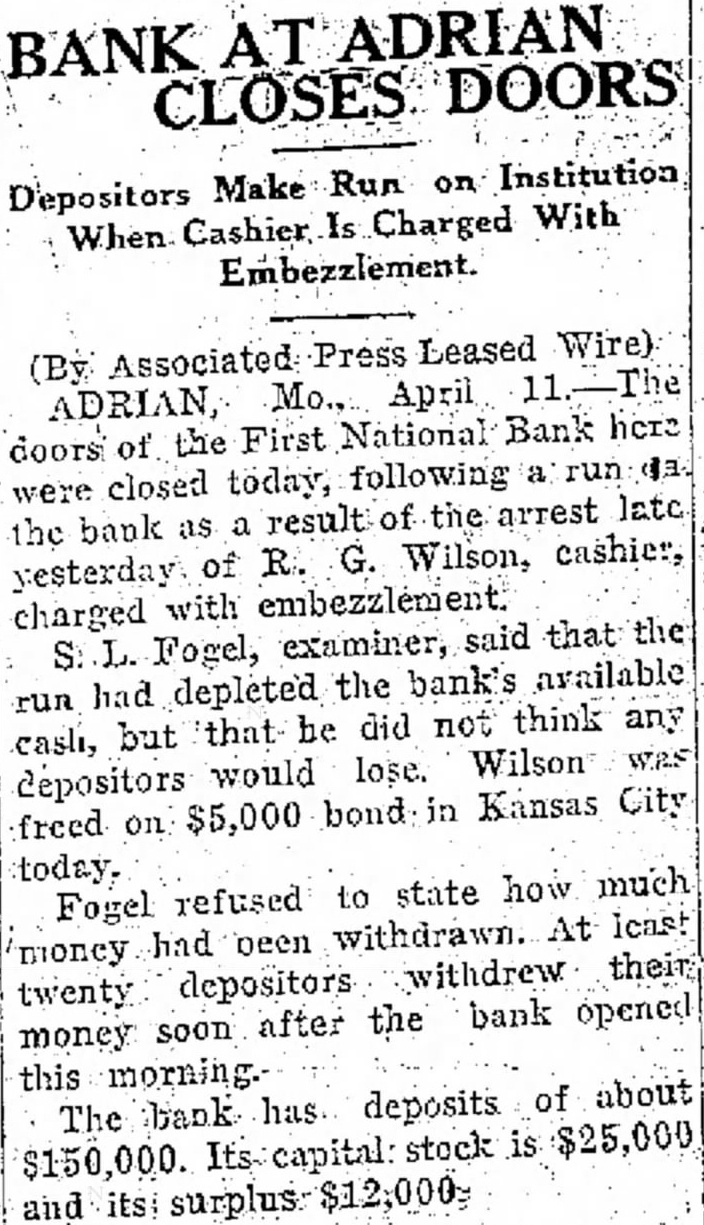
BANK AT ADRIAN CLOSES DOORS Depositors Make Run on Institution When Cashier Is Charged With Embezzlement. (By Associated Press Leased Wire) ADRIAN, Mo., April 11.—The doors of the First National Bank here were closed today, following a run on the bank as a result of the arrest late yesterday of R. G. Wilson, cashier, charged with embezzlement. S. L. Fogel, examiner, said that the run had depleted the bank's available cash, but that he did not think any depositors would lose. Wilson was freed on $5,000 bond in Kansas City today. Fogel refused to state how much money had been withdrawn. At least twenty depositors withdrew their money soon after the bank opened this morning. The bank has deposits of about $150,000. Its capital stock is $25,000 and its surplus $12,000.


Article from The Iola Register, April 11, 1923

Click image to open full size in new tab

Article Text

Run on Missouri Bank. (By the Associated Press) Adrian, Mo., Apr. 11.—A run on the First National Bank here, which started with the arrest late yesterday of R. G. Wilson, cashier, on a charge of embezzlement, had drained the bank of nearly all of its available cash, it was announced today. George B. Wyatt, president, went to Butler, Mo., today to raise enough cash to meet further demands of depositors.


Article from The Iola Register, April 11, 1923

Click image to open full size in new tab

Article Text

Mrs. A. Barnhart Dead. (By the Associated Press) Pittsburg, Kans., Apr. 11.—Mrs. Augusta Banhart, a widow, who dropped dead while at breakfast at her home here today, was born on a ship in mid-Atlantic ocean. Mrs. Banhart's parents were emigrants to America from Germany. She was born December 12, 1855. Close Adrian, Mo., Bank. Adrian, Mo., Apr. 11.—The doors of the First National Bank here were closed today, following a run on the bank as a result of the arrest late yesterday of R. G. Wilson, cashier, charged with embezzlement. S. L. Fogel, examiner, said that the run had depleted the bank's available cash, but that he did not think any depositors would lose.


Article from The Hutchinson News, April 11, 1923

Click image to open full size in new tab

Article Text

RUN ON A BANK. It Started With Arrest of Cashier for Embezzlement. Adrian, Mo., April 11.—A run on the First National bank here, which started with the arrest late yesterday of R. G. Wilson, cashier, on a charge of embezzlement, had drained the bank of nearly all of its available cash, it was announced today. George B. Wyatt, president, went to Butler, Mo., today to raise enough cash to meet further demands of depositors.


Article from St. Joseph Gazette, April 12, 1923

Click image to open full size in new tab

Article Text

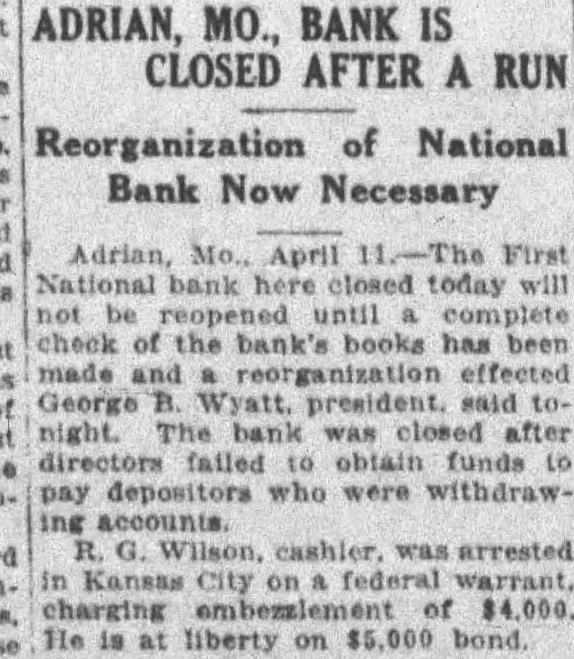
ADRIAN, MO., BANK IS CLOSED AFTER A RUN Reorganization of National Bank Now Necessary Adrian, Mo., April 11.—The First National bank here closed today will not be reopened until a complete check of the bank's books has been made and a reorganization effected George B. Wyatt, president, said tonight. The bank was closed after directors failed to obtain funds to pay depositors who were withdrawing accounts. R. G. Wilson, cashier, was arrested in Kansas City on a federal warrant, charging embezzlement of $4,000. He is at liberty on $5,000 bond.


Article from Fort Scott Tribune and The Fort Scott Monitor, April 12, 1923

Click image to open full size in new tab

Article Text

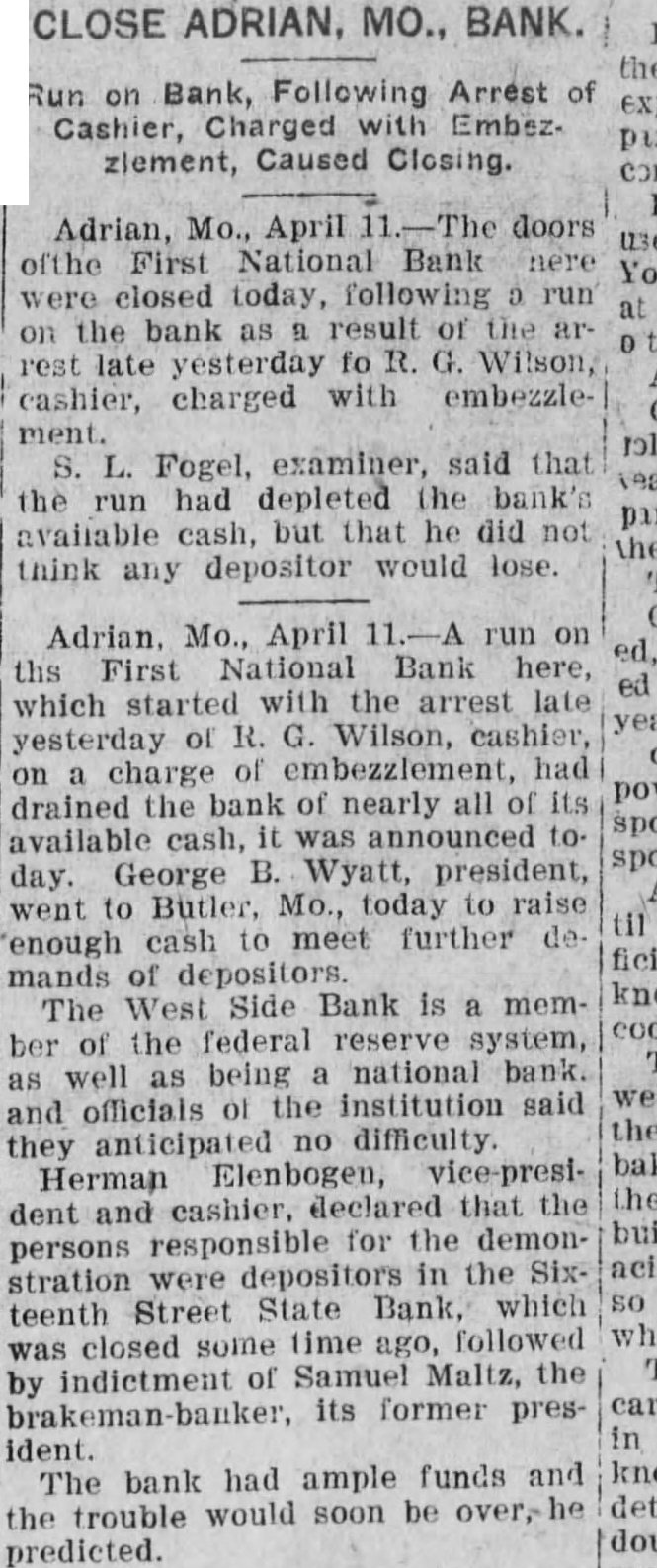
CLOSE ADRIAN, MO., BANK. Run on Bank, Following Arrest of Cashier, Charged with Embezzlement, Caused Closing. Adrian, Mo., April 11.—The doors of the First National Bank here were closed today, following a run on the bank as a result of the arrest late yesterday of R. G. Wilson, cashier, charged with embezzlement. S. L. Fogel, examiner, said that the run had depleted the bank's available cash, but that he did not think any depositor would lose. Adrian, Mo., April 11.—A run on the First National Bank here, which started with the arrest late yesterday of R. G. Wilson, cashier, on a charge of embezzlement, had drained the bank of nearly all of its available cash, it was announced today. George B. Wyatt, president, went to Butler, Mo., today to raise enough cash to meet further demands of depositors. The West Side Bank is a member of the federal reserve system, as well as being a national bank, and officials of the institution said they anticipated no difficulty. Herman Elenbogen, vice-president and cashier, declared that the persons responsible for the demonstration were depositors in the Sixteenth Street State Bank, which was closed some time ago, followed by indictment of Samuel Maltz, the brakeman-banker, its former president. The bank had ample funds and the trouble would soon be over, he predicted.


Article from Butler Daily Democrat, April 12, 1923

Click image to open full size in new tab

Article Text

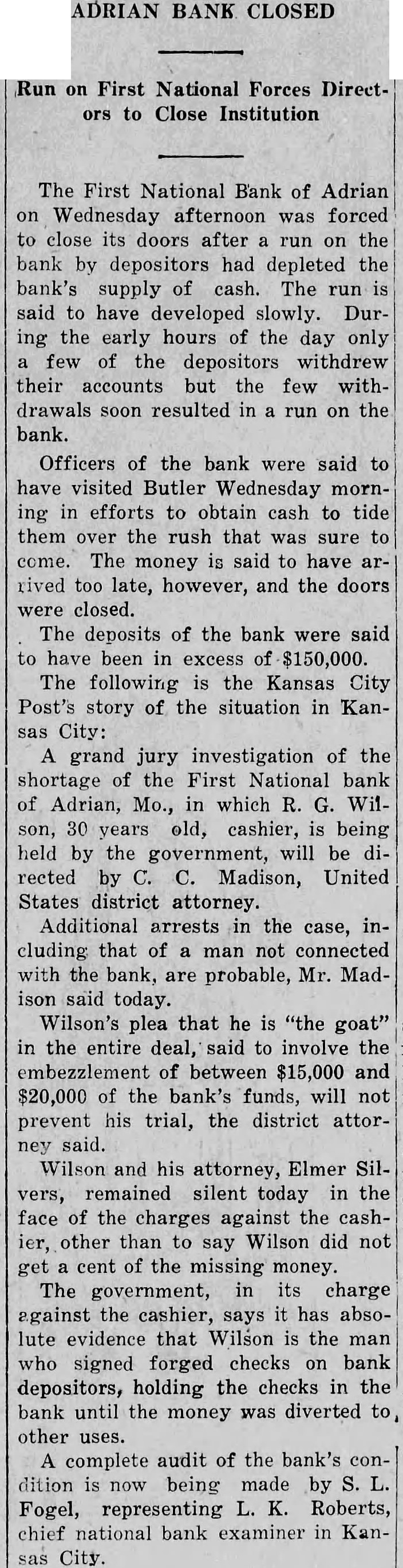
ADRIAN BANK CLOSED Run on First National Forces Directors to Close Institution The First National Bank of Adrian on Wednesday afternoon was forced to close its doors after a run on the bank by depositors had depleted the bank's supply of cash. The run is said to have developed slowly. During the early hours of the day only a few of the depositors withdrew their accounts but the few withdrawals soon resulted in a run on the bank. Officers of the bank were said to have visited Butler Wednesday morning in efforts to obtain cash to tide them over the rush that was sure to come. The money is said to have arrived too late, however, and the doors were closed. The deposits of the bank were said to have been in excess of $150,000. The following is the Kansas City Post's story of the situation in Kansas City: A grand jury investigation of the shortage of the First National bank of Adrian, Mo., in which R. G. Wilson, 30 years old, cashier, is being held by the government, will be directed by C. C. Madison, United States district attorney. Additional arrests in the case, including that of a man not connected with the bank, are probable, Mr. Madison said today. Wilson's plea that he is "the goat" in the entire deal, said to involve the embezzlement of between $15,000 and $20,000 of the bank's funds, will not prevent his trial, the district attorney said. Wilson and his attorney, Elmer Silvers, remained silent today in the face of the charges against the cashier, other than to say Wilson did not get a cent of the missing money. The government, in its charge against the cashier, says it has absolute evidence that Wilson is the man who signed forged checks on bank depositors, holding the checks in the bank until the money was diverted to other uses. A complete audit of the bank's condition is now being made by S. L. Fogel, representing L. K. Roberts, chief national bank examiner in Kansas City.


Article from The Weekly Kansas City Star, April 18, 1923

Click image to open full size in new tab

Article Text

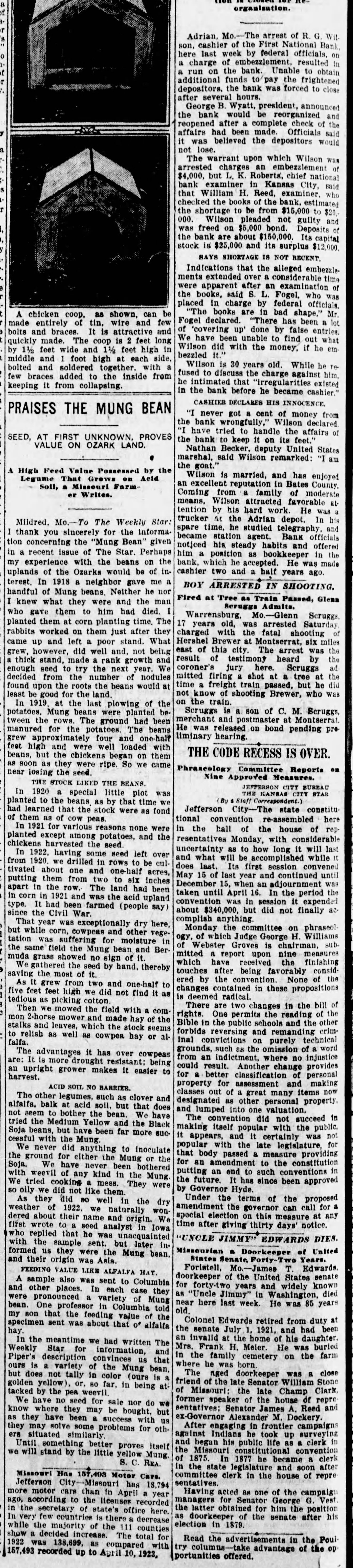
Adrian, Mo.—The arrest of R. G. Wilson, cashier of the First National Bank, here last week by federal officials, on a charge of embezzlement, resulted in a run on the bank. Unable to obtain additional funds to pay the frightened depositors, the bank was forced to close after several hours. George B. Wyatt, president, announced the bank would be reorganized and reopened after a complete check of the affairs had been made. Officials said it was believed the depositors would not lose. The warrant upon which Wilson was arrested charges an embezzlement of $4,000, but L. K. Roberts, chief national bank examiner in Kansas City, said that William H. Reed, examiner, who checked the books of the bank, estimated the shortage to be from $15,000 to $20,000. Wilson pleaded not guilty and was freed on $5,000 bond. Deposits of the bank are about $150,000. Its capital stock is $25,000 and its surplus $12,000. SAYS SHORTAGE IS NOT RECENT. Indications that the alleged embezzlements extended over a considerable time were apparent after an examination of the books, said S. L. Fogel, who was placed in charge by federal officials. "The books are in bad shape," Mr. Fogel declared. "There has been a lot of 'covering up' done by false entries. We have been unable to find out what Wilson did with the money, if he embezzled it." Wilson is 30 years old. While he refused to discuss the charge against him, he intimated that "irregularities existed in the bank before he became cashier." CASHIER DECLARES HIS INNOCENCE. "I never got a cent of money from the bank wrongfully," Wilson declared. "I have tried to handle the affairs of the bank to keep it on its feet." Nathan Becker, deputy United States marshal, said Wilson remarked: "I am the goat." Wilson is married, and has enjoyed an excellent reputation in Bates County. Coming from a family of moderate means, Wilson attracted favorable attention by his hard work. He was a trucker at the Adrian depot. In his spare time, he studied telegraphy, and became station agent. Bank officials noticed his steady habits and offered him a position as bookkeeper in the bank, which he accepted. He was made cashier two and a half years ago. A chicken coop, as shown, can be made entirely of tin, wire and few bolts and braces. It is attractive and quickly made. The coop is 2 feet long by 1½ feet wide and 1½ feet high in middle and 1 foot high at each side, bolted and soldered together, with a few braces added to the inside from keeping it from collapsing. PRAISES THE MUNG BEAN SEED, AT FIRST UNKNOWN, PROVES VALUE ON OZARK LAND. A High Feed Value Possessed by the Legume That Grows on Acid Soil, a Missouri Farmer Writes. Mildred, Mo.—To The Weekly Star: I thank you sincerely for the information concerning the "Mung Bean" given in a recent issue of The Star. Perhaps my experience with the beans on the uplands of the Ozarks would be of interest. In 1918 a neighbor gave me a handful of Mung beans. Neither he nor I knew what they were and the man who gave them to him had died. I planted them at corn planting time. The rabbits worked on them just after they came up and left a poor stand. What grew, however, did well and, not being a thick stand, made a rank growth and enough seed to try the next year. We decided from the number of nodules found upon the roots the beans would at least be good for the land. In 1919, at the last plowing of the potatoes, Mung beans were planted between the rows. The ground had been manured for the potatoes. The beans grew approximately four and one-half feet high and were well loaded with beans, but the chickens began on them as soon as they were ripe. So we came near losing the seed. THE STOCK LIKED THE BEANS. In 1920 a special little plot was planted to the beans, as by that time we had learned that the stock were as fond of them as of cow peas. In 1921 for various reasons none were planted except among potatoes, and the chickens harvested the seed. In 1922, having some seed left over from 1920, we drilled in rows to be cultivated about one and one-half acres, putting them from two to six inches apart in the row. The land had been in corn in 1921 and was the acid upland type. It had been farmed (people say) since the Civil War. That year was exceptionally dry here, but while corn, cowpeas and other vegetation was suffering for moisture in the same field the Mung bean and Bermuda grass showed no sign of it. We gathered the seed by hand, thereby saving the most of it. As it grew from two and one-half to five feet high we did not find it as tedious as picking cotton. Then we mowed the field with a common 2-horse mower and made hay of the stalks and leaves, which the stock seems to relish as well as cowpea hay or alfalfa. The advantages it has over cowpeas are: It is more drought resistant; being an upright grower makes it easier to harvest. ACID SOIL NO BARRIER. The other legumes, such as clover and alfalfa, balk at acid soil, but that does not seem to bother the bean. We have tried the Medium Yellow and the Black Soja beans, but have been far more successful with the Mung. We never did anything to inoculate the ground for either the Mung or the Soja. We have never been bothered with weevil of any kind in the Mung. We tried cooking a mess. They were so oily we did not like them. As they did so well in the dry weather of 1922, we naturally wondered about their name and origin. We first wrote to a seed analyst in Iowa who replied that he was unacquainted with the sample sent, but later informed us they were the Mung bean, and their origin was Asia. FEEDING VALUE LIKE ALFALFA HAY. A sample also was sent to Columbia and other places. In each case they were pronounced a variety of Mung bean. One professor in Columbia told my son that the feeding value of the specimen sent was about that of alfalfa hay. In the meantime we had written The Weekly Star for information, and Piper's description convinces us that ours is a variety of the Mung bean, but does not tally in color (ours is a golden yellow), or, so far, in being attacked by the pea weevil. We have no seed for sale nor do we know where they may be bought, but as they have been a success with us they may solve some problems for others situated similarly. Until something better proves itself we will stand by the little yellow Mung. S. C. REA. Missouri Has 157,493 Motor Cars. Jefferson City—Missouri has 18,794 more motor cars than in April a year ago, according to the licenses recorded in the secretary of state's office here. In very few countries is there a decrease while the majority of the 111 counties show a decided increase. The total for 1922 was 138,699, as compared with 157,493 recorded up to April 10, 1923. BOY ARRESTED IN SHOOTING. Fired at Tree as Train Passed, Glenn Scruggs Admits. Warrensburg, Mo.—Glenn Scruggs, 17 years old, was arrested Saturday, charged with the fatal shooting of Hershel Brewer at Montserrat, six miles east of this city. The arrest was the result of testimony heard by the coroner's jury here. Scruggs admitted firing a shot at a tree at the time a freight train passed, but he did not know of shooting Brewer, who was on the train. Scruggs is a son of C. M. Scruggs, merchant and postmaster at Montserrat. He was released on bond pending preliminary hearing. THE CODE RECESS IS OVER. Phraseology Committee Reports on Nine Approved Measures. JEFFERSON CITY BUREAU THE KANSAS CITY STAR (By a Staff Correspondent.) Jefferson City—The state constitutional convention re-assembled here in the hall of the house of representatives Monday, with considerable uncertainty as to how long it will last and what will be accomplished while it does last. Its first session convened May 15 of last year and continued until December 15, when an adjournment was taken until April 16. In the period the convention was in session it expended about $340,000, but did not finally accomplish anything. Monday the committee on phraseology, of which Judge George H. Williams of Webster Groves is chairman, submitted a report upon nine measures which have received the finishing touches after being favorably considered by the convention. None of the changes contained in these propositions is deemed radical. There are two changes in the bill of rights. One permits the reading of the Bible in the public schools and the other forbids reversing and remanding criminal convictions on purely technical grounds, such as the omission of a word from an indictment, where no injustice could result. Another change provides for a better classification of personal property for assessment and making classes out of a great many items now designated as other personal property, and lumped into one valuation. The convention did not succeed in making itself popular with the public, it appears, and it certainly was not popular with the late legislature, for that body passed a measure providing for an amendment to the constitution putting an end to such conventions in the future. It has since been approved by Governor Hyde. Under the terms of the proposed amendment the governor can call for a special election on this measure at any time after giving thirty days' notice. "UNCLE JIMMY" EDWARDS DIES. Missourian a Doorkeeper of United States Senate, Forty-Two Years. Foristell, Mo.—James T. Edwards, doorkeeper of the United States senate for forty-two years and widely known as "Uncle Jimmy" in Washington, died near here last week. He was 85 years old. Colonel Edwards retired from duty at the senate July 1, 1921, and had been an invalid at the home of his daughter, Mrs. Frank H. Meier. He was buried in the family cemetery on the farm where he was born. The aged doorkeeper was a close friend of the late Senator William Stone of Missouri; the late Champ Clark, former speaker of the house of representatives; Senator James A. Reed and ex-Governor Alexander M. Dockery. After engaging in frontier campaigns against Indians he took up surveying and began his public life as a clerk in the Missouri constitutional convention of 1875. In 1877 he became a clerk in the state legislature and soon after committee clerk in the house of representatives. Having acted as one of the campaign managers for Senator George G. Vest, the latter obtained for him the position as doorkeeper of the senate after his election in 1879.
Article from Stockton Journal, May 17, 1923

Click image to open full size in new tab

Article Text

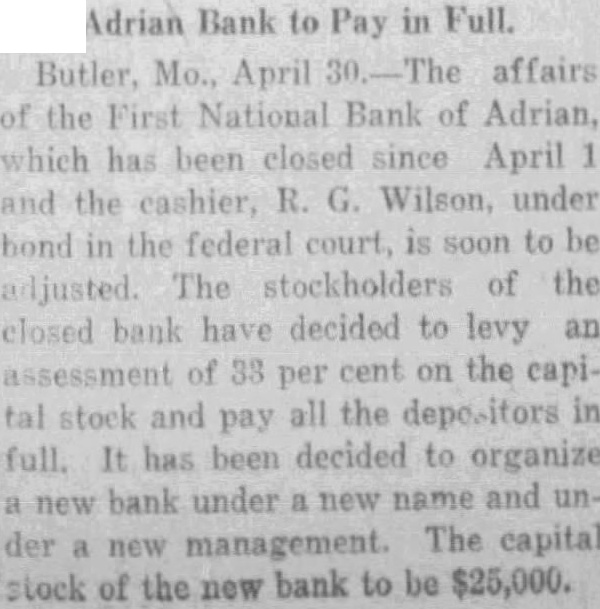
Adrian Bank to Pay in Full. Butler, Mo., April 30.—The affairs of the First National Bank of Adrian, which has been closed since April 1 and the cashier, R. G. Wilson, under bond in the federal court, is soon to be adjusted. The stockholders of the closed bank have decided to levy an assessment of 33 per cent on the capital stock and pay all the depositors in full. It has been decided to organize a new bank under a new name and under a new management. The capital stock of the new bank to be $25,000.


Article from The Kansas City Times, June 23, 1923

Click image to open full size in new tab

Article Text

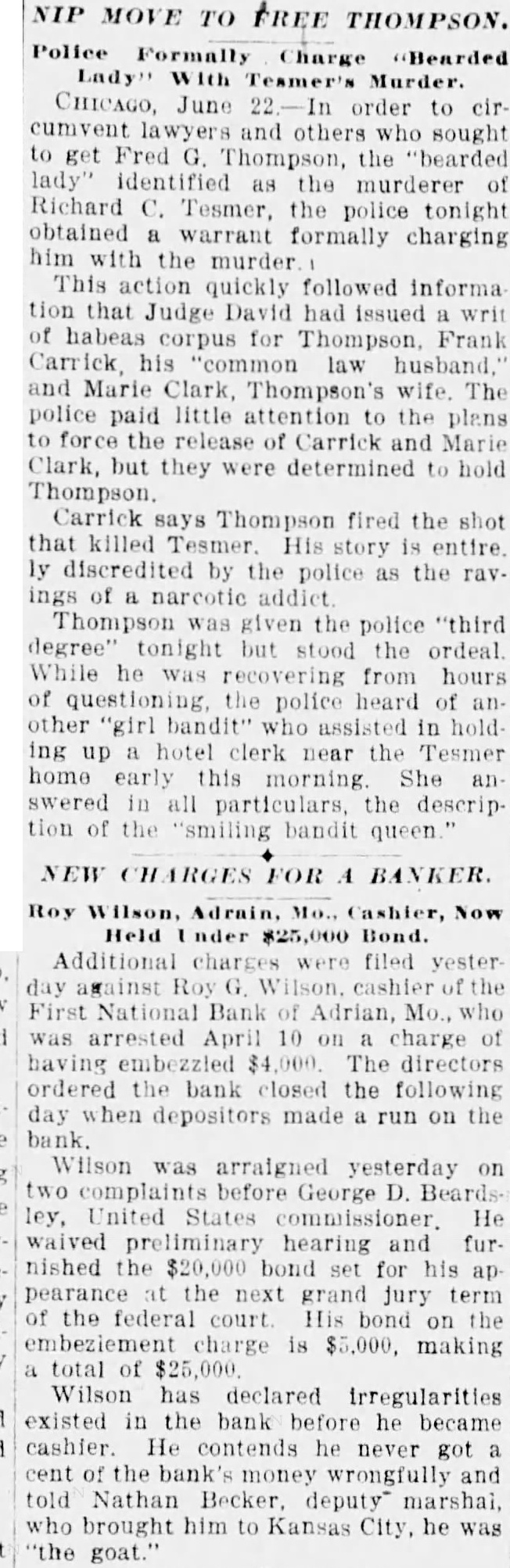
NIP MOVE TO FREE THOMPSON. Police Formally Charge "Bearded Lady" With Tesmer's Murder. CHICAGO, June 22.—In order to circumvent lawyers and others who sought to get Fred G. Thompson, the "bearded lady" identified as the murderer of Richard C. Tesmer, the police tonight obtained a warrant formally charging him with the murder. This action quickly followed information that Judge David had issued a writ of habeas corpus for Thompson, Frank Carrick, his "common law husband," and Marie Clark, Thompson's wife. The police paid little attention to the plans to force the release of Carrick and Marie Clark, but they were determined to hold Thompson. Carrick says Thompson fired the shot that killed Tesmer. His story is entirely discredited by the police as the ravings of a narcotic addict. Thompson was given the police "third degree" tonight but stood the ordeal. While he was recovering from hours of questioning, the police heard of another "girl bandit" who assisted in holding up a hotel clerk near the Tesmer home early this morning. She answered in all particulars, the description of the "smiling bandit queen." NEW CHARGES FOR A BANKER. Roy Wilson, Adrian, Mo., Cashier, Now Held Under $25,000 Bond. Additional charges were filed yesterday against Roy G. Wilson, cashier of the First National Bank of Adrian, Mo., who was arrested April 10 on a charge of having embezzled $4,000. The directors ordered the bank closed the following day when depositors made a run on the bank. Wilson was arraigned yesterday on two complaints before George D. Beardsley, United States commissioner. He waived preliminary hearing and furnished the $20,000 bond set for his appearance at the next grand jury term of the federal court. His bond on the embezzlement charge is $5,000, making a total of $25,000. Wilson has declared irregularities existed in the bank before he became cashier. He contends he never got a cent of the bank's money wrongfully and told Nathan Becker, deputy marshal, who brought him to Kansas City, he was "the goat."


Article from Butler Daily Democrat, June 23, 1923

Click image to open full size in new tab

Article Text

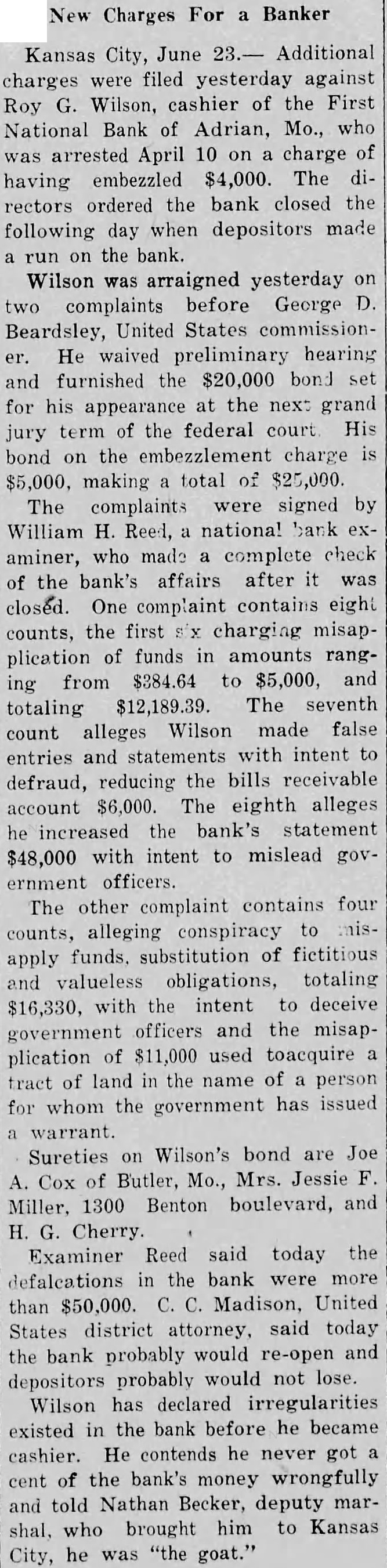
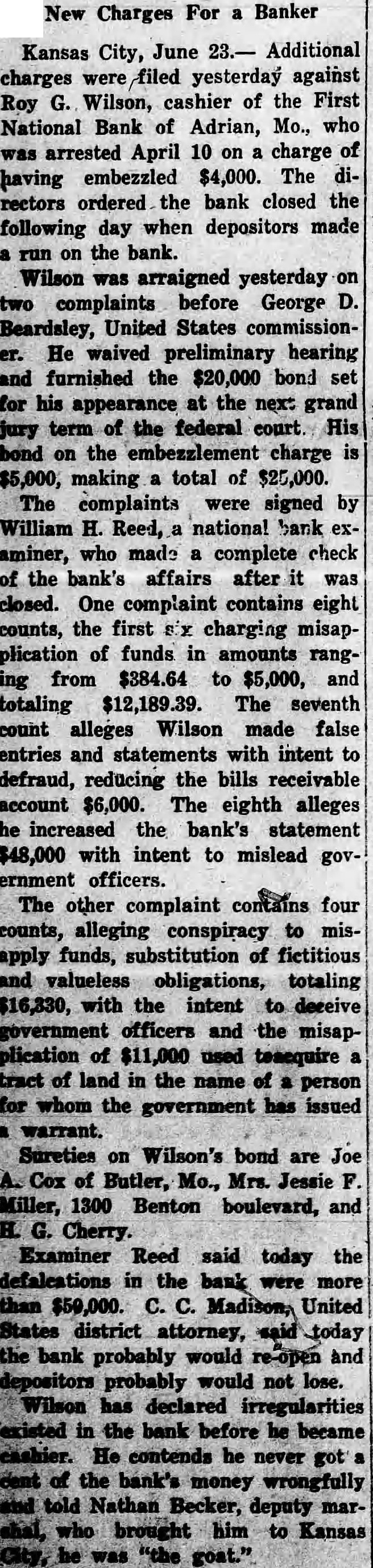
New Charges For a Banker Kansas City, June 23.— Additional charges were filed yesterday against Roy G. Wilson, cashier of the First National Bank of Adrian, Mo., who was arrested April 10 on a charge of having embezzled $4,000. The directors ordered the bank closed the following day when depositors made a run on the bank. Wilson was arraigned yesterday on two complaints before George D. Beardsley, United States commissioner. He waived preliminary hearing and furnished the $20,000 bond set for his appearance at the next grand jury term of the federal court. His bond on the embezzlement charge is $5,000, making a total of $25,000. The complaints were signed by William H. Reed, a national bank examiner, who made a complete check of the bank's affairs after it was closed. One complaint contains eight counts, the first six charging misapplication of funds in amounts ranging from $384.64 to $5,000, and totaling $12,189.39. The seventh count alleges Wilson made false entries and statements with intent to defraud, reducing the bills receivable account $6,000. The eighth alleges he increased the bank's statement $48,000 with intent to mislead government officers. The other complaint contains four counts, alleging conspiracy to misapply funds, substitution of fictitious and valueless obligations, totaling $16,330, with the intent to deceive government officers and the misapplication of $11,000 used to acquire a tract of land in the name of a person for whom the government has issued a warrant. Sureties on Wilson's bond are Joe A. Cox of Butler, Mo., Mrs. Jessie F. Miller, 1300 Benton boulevard, and H. G. Cherry. Examiner Reed said today the defalcations in the bank were more than $50,000. C. C. Madison, United States district attorney, said today the bank probably would re-open and depositors probably would not lose. Wilson has declared irregularities existed in the bank before he became cashier. He contends he never got a cent of the bank's money wrongfully and told Nathan Becker, deputy marshal, who brought him to Kansas City, he was "the goat."


Article from The Butler Times-Press, June 28, 1923

Click image to open full size in new tab

Article Text

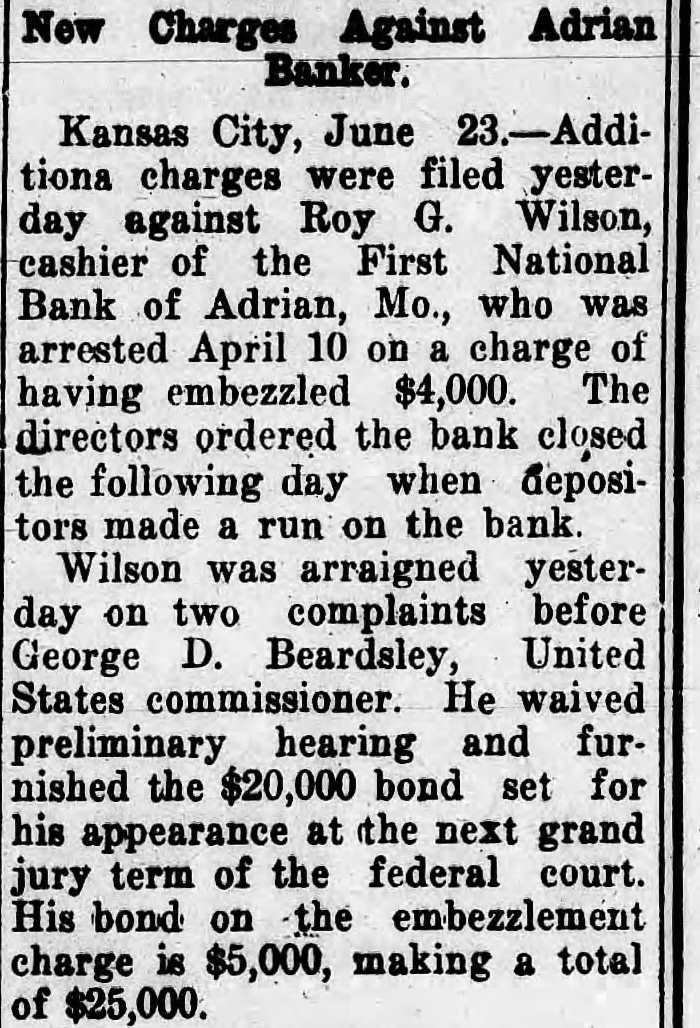
New Charges Against Adrian Banker. Kansas City, June 23.—Additional charges were filed yesterday against Roy G. Wilson, cashier of the First National Bank of Adrian, Mo., who was arrested April 10 on a charge of having embezzled $4,000. The directors ordered the bank closed the following day when depositors made a run on the bank. Wilson was arraigned yesterday on two complaints before George D. Beardsley, United States commissioner. He waived preliminary hearing and furnished the $20,000 bond set for his appearance at the next grand jury term of the federal court. His bond on the embezzlement charge is $5,000, making a total of $25,000.


Article from Harrisonville Review and Cass County Leader, June 28, 1923

Click image to open full size in new tab

Article Text

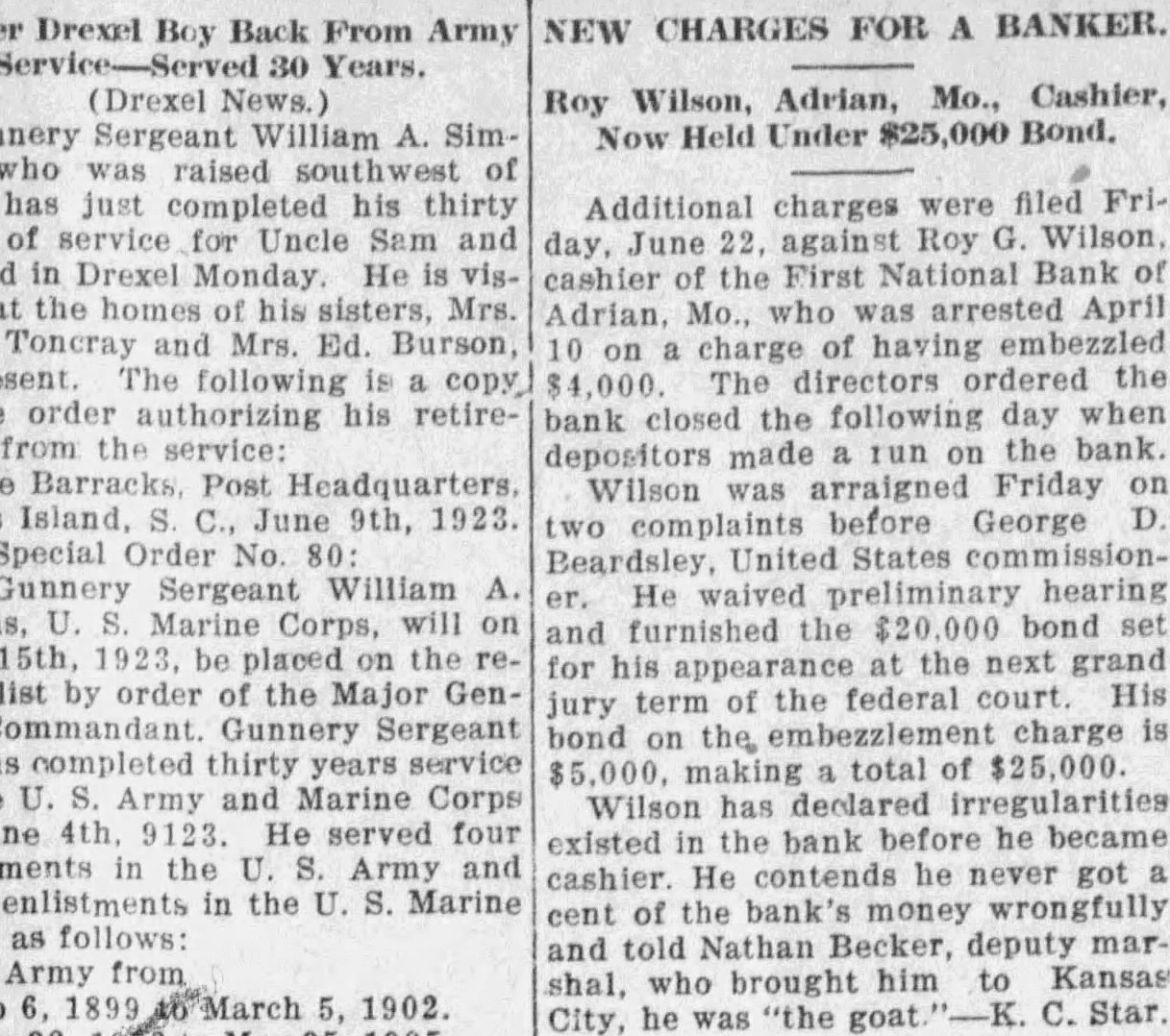
NEW CHARGES FOR A BANKER. Roy Wilson, Adrian, Mo., Cashier, Now Held Under $25,000 Bond. Additional charges were filed Friday, June 22, against Roy G. Wilson, cashier of the First National Bank of Adrian, Mo., who was arrested April 10 on a charge of having embezzled $4,000. The directors ordered the bank closed the following day when depositors made a run on the bank. Wilson was arraigned Friday on two complaints before George D. Beardsley, United States commissioner. He waived preliminary hearing and furnished the $20,000 bond set for his appearance at the next grand jury term of the federal court. His bond on the embezzlement charge is $5,000, making a total of $25,000. Wilson has declared irregularities existed in the bank before he became cashier. He contends he never got a cent of the bank's money wrongfully and told Nathan Becker, deputy marshal, who brought him to Kansas City, he was "the goat."—K. C. Star.


Article from Bates County Democrat, June 28, 1923

Click image to open full size in new tab

Article Text

New Charges For a Banker Kansas City, June 23.— Additional charges were filed yesterday against Roy G. Wilson, cashier of the First National Bank of Adrian, Mo., who was arrested April 10 on a charge of having embezzled $4,000. The directors ordered the bank closed the following day when depositors made a run on the bank. Wilson was arraigned yesterday on two complaints before George D. Beardsley, United States commissioner. He waived preliminary hearing and furnished the $20,000 bond set for his appearance at the next grand jury term of the federal court. His bond on the embezzlement charge is $5,000, making a total of $25,000. The complaints were signed by William H. Reed, a national bank examiner, who made a complete check of the bank's affairs after it was closed. One complaint contains eight counts, the first six charging misapplication of funds in amounts ranging from $384.64 to $5,000, and totaling $12,189.39. The seventh count alleges Wilson made false entries and statements with intent to defraud, reducing the bills receivable account $6,000. The eighth alleges he increased the bank's statement $48,000 with intent to mislead government officers. The other complaint contains four counts, alleging conspiracy to misapply funds, substitution of fictitious and valueless obligations, totaling $16,330, with the intent to deceive government officers and the misapplication of $11,000 used to acquire a tract of land in the name of a person for whom the government has issued a warrant. Sureties on Wilson's bond are Joe A. Cox of Butler, Mo., Mrs. Jessie F. Miller, 1300 Benton boulevard, and H. G. Cherry. Examiner Reed said today the defalcations in the bank were more than $50,000. C. C. Madison, United States district attorney, said today the bank probably would re-open and depositors probably would not lose. Wilson has declared irregularities existed in the bank before he became cashier. He contends he never got a cent of the bank's money wrongfully and told Nathan Becker, deputy marshal, who brought him to Kansas City, he was "the goat."