Article Text
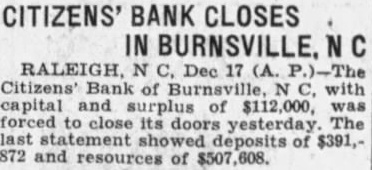
CITIZENS' BANK CLOSES IN BURNSVILLE, N RALEIGH N C, Dec 17 (A. capital and surplus of $112,000, was forced to close its doors yesterday The last statement showed deposits of $391,872 and resources of
529316b0100cf806None
Click image to open full size in new tab
CITIZENS' BANK CLOSES IN BURNSVILLE, N RALEIGH N C, Dec 17 (A. capital and surplus of $112,000, was forced to close its doors yesterday The last statement showed deposits of $391,872 and resources of
Click image to open full size in new tab
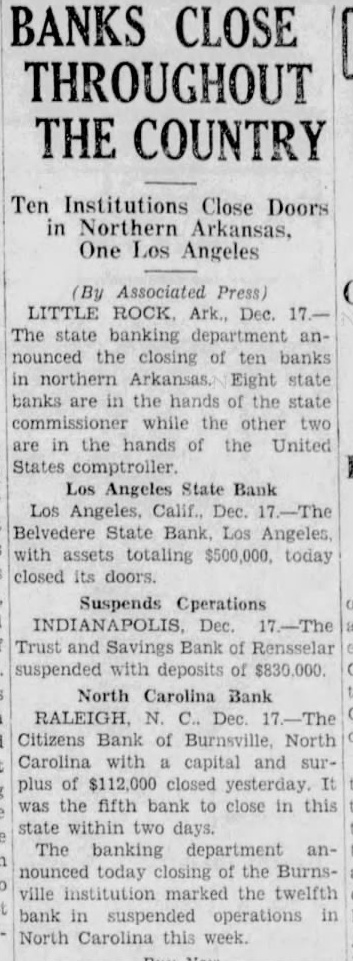
BANKS CLOSE THROUGHOUT THE COUNTRY Ten Institutions Close Doors in Northern Arkansas, One Los Angeles (By Associated Press) LITTLE ROCK Ark., Dec. The state banking department announced the closing of ten banks northern Arkansas. Eight state banks are in the hands of the state commissioner while the other two are in the hands of the United States comptroller. Los Angeles State Bank Los Angeles, Calif., Dec. Belvedere State Bank. Los Angeles, with assets totaling $500,000. today closed its doors. Suspends Cperations Dec. Trust and Savings Bank of Rensselar suspended with deposits North Carolina Bank Dec. Citizens Bank of Burnsville, North Carolina with capital and plus of $112,000 closed yesterday. was the fifth bank to close in this state within two days. The banking department nounced today closing of the Burnsville institution marked the twelfth bank in suspended operations in North Carolina this week.
Click image to open full size in new tab
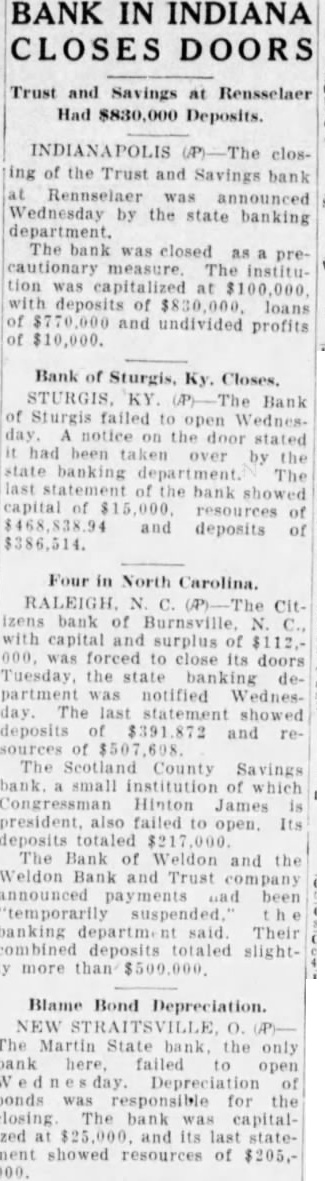
BANK IN INDIANA CLOSES DOORS Trust and Savings at Rensselaer Had $830,000 Deposits. INDIANAPOLIS closing of the Trust and Savings bank at Rennselaer was announced Wednesday by the state banking department. The bank was closed as precautionary measure The institution was capitalized at $100,000 with deposits of loans of $770.000 and undivided profits of $10,000. Bank of Sturgis, Ky. Closes. STURGIS, KY The Bank of Sturgis failed to open Wednesday. notice on the door stated it had been taken over by the state banking department. The last statement of the bank showed capital of resources of 94 and deposits of $386,514. Four in North Carolina. RALEIGH. N. The Cit izens bank of Burnsville N. with capital and surplus of $112.000, was forced to close its doors Tuesday, the state banking department was notified Wednesday. The last statement showed deposits $391.872 and resources of $507,608 The Scotland County Savings bank. small institution of which Congressman Hinton James president, also failed to open. Its deposits totaled The Bank of Weldon and the Weldon Bank and Trust company announced payments been "temporarily banking departm said Their combined deposits totaled slightly more than $500.000 Blame Bond Depreciation. NEW STRAITS O. The Martin State bank the only bank here. failed to open day Depreciation bonds was responsible for the closing The bank was capitalized at $25 000 and its last state ment showed resources of $205,000.
Click image to open full size in new tab
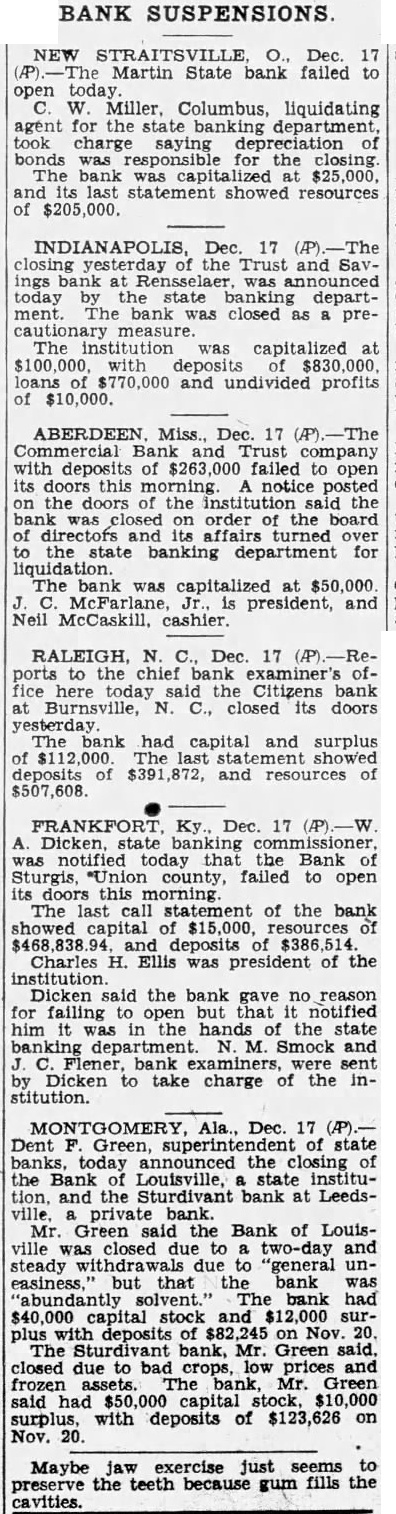
BANK SUSPENSIONS NEW Dec. Martin State bank failed open today Miller. Columbus, liquidating agent for the state banking department, took charge saying depreciation bonds responsible the closing last statement showed resources INDIANAPOLIS, Dec 17 yesterday the Trust and Savbank was today the state banking departThe bank was closed as precautionary capitalized with $830,000. loans $770,000 and undivided profits $10,000. ABERDEEN Miss., 17 Commercial company with deposits of failed to open its doors this morning notice the the on order the board over state banking department for liquidation. The bank capitalized at $50,000 McFarlane, president, and Neil McCaskill, cashier. RALEIGH, Dec. 17 ports chief examiner's fice here the Citizens bank Burnsville, N. closed its doors yesterday bank had capital and surplus deposits and FRANKFORT Dec. Dicken, was notified today that the Bank Sturgis, county, failed to open this The call statement of the bank showed of Charles H. Ellis was president of the institution Dicken said the bank no reason for failing open but notified him hands the M. Smock and Dicken to take charge of the in- Ala., Dec. 17 Dent Green, state today the the Bank Louisville, instituand the Sturdivant Leedsville, bank. Green said the Bank of Louisville was closed due two-day and steady due "general easiness, that the bank $40,000 stock with deposits Nov. The Sturdivant bank, Mr. Green said, closed due to bad crops, low prices frozen assets. The bank, Green had capital stock, $10,000 surplus, with deposits of on Nov. Maybe jaw exercise just seems preserve the teeth because gum fills the cavities.