Federal American National Bank & Trust Company (Washington, DC)

Episode Information

Episode Type
Suspension โ†’ Closure
Start Date
March 1, 1933*
Location
Washington, District of Columbia (38.895, -77.036)
Bank Type
national
Charter Number
10316
Canonical name
Federal National Bank
Alt. names
Federal American National Bank; Federal American National Bank & Trust Company

Metadata

Receivership Details

Depositor recovery rate
75.0%
Date receivership started
1933-10-31
Date receivership terminated
1938-05-20
Share of assets assessed as good
43.7%
Share of assets assessed as doubtful
37.4%
Share of assets assessed as worthless
19.0%

Notes

Receivership date matches known government record (receiver Cary A. Hardee took over after conservatorship).

Events (5)

1. January 18, 1913 Chartered
Source
historical_nic
2. March 1, 1933* Other
Newspaper Excerpt
the bank was in conservatorship from March until November of last year; conservator John Poole named for Federal-American National Bank and Trust Company
Source
newspapers
3. March 3, 1933 Suspension
Cause
Government Action
Cause Details
Nationwide bank holiday proclaimed by President Roosevelt and regulation No.10 restrictions during March 1933
Newspaper Excerpt
the bank holiday proclaimed by President Roosevelt
Source
newspapers
4. October 31, 1933 Receivership
Newspaper Excerpt
terminated his services October 31, 1933; since that time the bank has been in the hands of Cary A. Hardee, the receiver, who, to date, has spent ... in winding up the affairs of the bank.
Source
newspapers
5. October 31, 1933 Receivership
Source
historical_nic

Newspaper Articles (25)

Article from The Washington Times, March 9, 1933

Click image to open full size in new tab

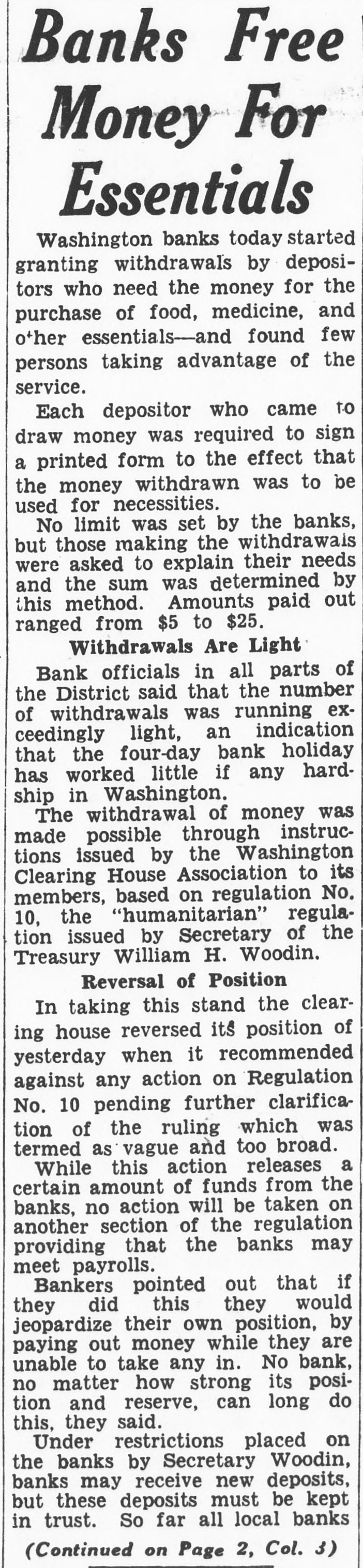
Article Text

Banks Free Money For Essentials Washington banks today started granting withdrawals by depositors who need the money for the purchase of food, medicine, and other essentials-and found few persons taking advantage of the service. Each depositor who came to draw money was required to sign a printed form to the effect that the money withdrawn was to be used for necessities. No limit was set by the banks, but those making the withdrawais were asked to explain their needs and the sum was determined by this method. Amounts paid out ranged from $5 to $25. Withdrawals Are Light Bank officials in all parts of the District said that the number of withdrawals was running exceedingly light, an indication that the four-day bank holiday has worked little if any hardship in Washington. The withdrawal of money was made possible through instructions issued by the Washington Clearing House Association to its members, based on regulation No. 10, the "humanitarian" regulation issued by Secretary of the Treasury William H. Woodin. Reversal of Position In taking this stand the clearing house reversed its position of yesterday when it recommended against any action on Regulation No. 10 pending further clarification of the ruling which was termed as vague and too broad. While this action releases a certain amount of funds from the banks, no action will be taken on another section of the regulation providing that the banks may meet payrolls. Bankers pointed out that if they did this they would jeopardize their own position, by paying out money while they are unable to take any in. No bank, no matter how strong its position and reserve, can long do this, they said. Under restrictions placed on the banks by Secretary Woodin, banks may receive new deposits, but these deposits must be kept in trust. So far all local banks (Continued on Page 2, Col. 3)


Article from The Washington Times, March 10, 1933

Click image to open full size in new tab

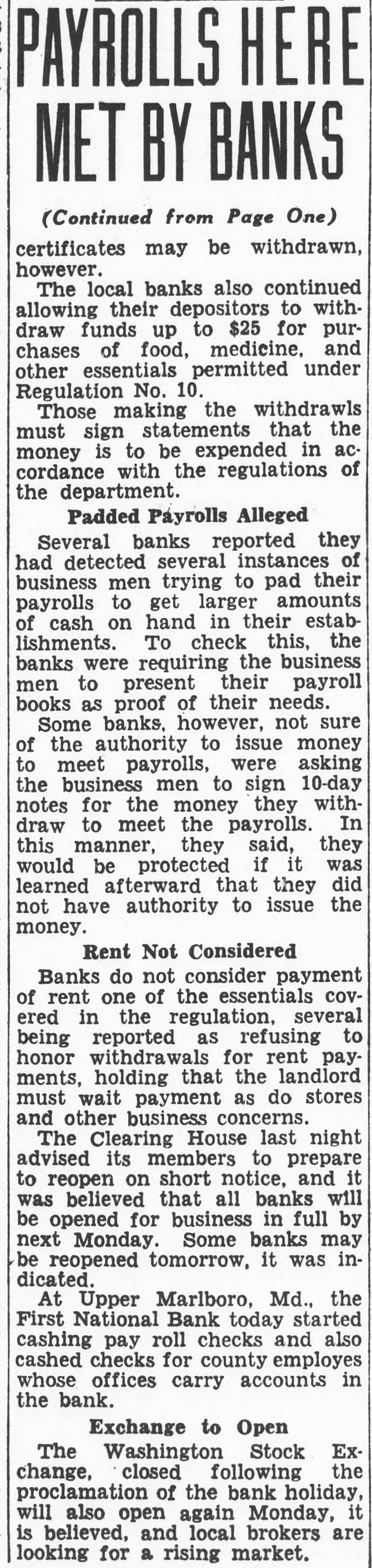
Article Text

PAYROLLS HERE MET BY BANKS (Continued from Page One) certificates may be withdrawn, however. The local banks also continued allowing their depositors to withdraw funds up to $25 for purchases of food, medicine, and other essentials permitted under Regulation No. 10. Those making the withdrawls must sign statements that the money is to be expended in accordance with the regulations of the department. Padded Payrolls Alleged Several banks reported they had detected several instances of business men trying to pad their payrolls to get larger amounts of cash on hand in their establishments. To check this, the banks were requiring the business men to present their payroll books as proof of their needs. Some banks, however, not sure of the authority to issue money to meet payrolls, were asking the business men to sign 10-day notes for the money they withdraw to meet the payrolls. In this manner, they said, they would be protected if it was learned afterward that they did not have authority to issue the money. Rent Not Considered Banks do not consider payment of rent one of the essentials covered in the regulation, several being reported as refusing to honor withdrawals for rent payments, holding that the landlord must wait payment as do stores and other business concerns. The Clearing House last night advised its members to prepare to reopen on short notice, and it was believed that all banks will be opened for business in full by next Monday. Some banks may be reopened tomorrow, it was indicated. At Upper Marlboro, Md., the First National Bank today started cashing pay roll checks and also cashed checks for county employes whose offices carry accounts in the bank. Exchange to Open The Washington Stock Exchange, closed following the proclamation of the bank holiday, will also open again Monday, it is believed, and local brokers are looking for a rising market.


Article from The Washington Times, March 13, 1933

Click image to open full size in new tab

Article Text

BANKS PREPARE FOR OPENING TOMORROW All to Resume at Same Time If Reserve Board 0. K's Clearing House Plea Washington banks today were awaiting word from the Federal Reserve Bank at Richmond for permission to resume activities tomorrow. It is expected that the Federal Reserve will honor the request of the Washington Clearing House Association and send out notification simultaneously, so that all banks here which are members of the system will receive licenses and open at the same time. The Clearing House made this request, pointing out that failure of any bank to open at the same time as the others might be misconstrued by depositors. While the local banks are expected to reopen tomorrow morning. Secretary of the Treasury William H. Woodin issued instructions to banks that they guard against hoarders. Withdrawals Limited Until more normal conditions have been established. the Secretary instructed, withdrawals should be limited at the discretion of the bank to necessary funds. This will permit the banks to restrict withdrawals of, in their judgment, the money to be taken out of circulation. Warning was again issued that 3 o'clock Friday is the deadline for those who have been hoarding gold or gold certificates to turn them in. Names to Be Listed At the close of the banking lists of those who sums or 1 will be have gold day February Friday withdrawn gold certificates large sent Reserve to since the of governor of the Federal at Richmond for such action as the Government may deem advisable in view of the President's edict against hoarding. It is believed that few persons will fail to turn in their gold as the President asked, bankers pointing out that in the past few days many thousands of dollars have already been turned in at local banks and at the Treasury. Today, the last of the bank holiday proclaimed by President Roosevelt, found Washington banks carrying on limited business and prepared for general reopening tomorrow. The reopening is expected to give a bc m to local business. Savings banks and other institutions here which are not members of the Federal Reserve System have applied to the Comptroller of the Currency for licenses to reopen, and it is expected that they will be given permission to resume on Wednesday.


Article from The Washington Times, May 18, 1933

Click image to open full size in new tab

Article Text

The name, the First National Bank of Washington, the unanimous choice of directors of five closed banks participating in the merger, has been definitely discarded, it was learned today. The name by which the bank will be known is to be announced by President Edwin C. Graham today. Stock Campaign Opens Each of the five banks began an intensive campaign today to obtain $1,250,000 in subscriptions to the capital stock of the new institution. Use of the name First National, it was said, would ze contradictory to a policy observed by the Treasury Department in disapproving adoption of a name which has once been used by a bank which has failed. A First National in the District. it was said, went into receivership about 50 years ago. The names Central, United, and Hamilton, it was stated at yesterday's meeting of directors, had been approved by the Treasury officials. The names of Colonial and Consolidated also were suggested. At a meeting of directors of the institutions which are merging their "prime" assets in the new bank it was stated by Mr. Graham that he hoped the stock would be subscribed in seven days and that the new bank would be functioning early in June. 100,000 Depositors The new bank, it was stated. will start business with entirely liquid assets totalling $11,131,211 and that it will have 100,000 depositors. Member of Reserve It will be a member of the Federal Reserve system and will conduct a general banking business unencumbered with real estate or real estate mortgages, it was stated. Slow or doubtful assets are to be liquidated through conservators of the "old" banks. This, it was pointed out, would be and to than other Shuman, stockholders more ing W. returns rapid Irving orderly depositors of in methods. the bring- office and reorganization division of the of the Comptroller of the Currency, in reviewing the "Washington plan" of releasing frozen assets of closed banks, reminded the directors that stockholders' liability with respect to the "old banks" remains until the liquidation of their affairs is completed. 50 Per Cent Available All banks becoming a part of the new institution will make available 50 per cent of their deposits. 1 The capitalization of the new institution probably will be e changed as other banks enter the S merger. The five participating banks at S present are the Federal-American < National Bank and Trust Comf pany, the District National, the e Potomac Savings, Washington f Savings and the Northeast Savings. t The Woodridge-Langdon Savings and Commercial Bank also is exI pected to join and the United States Savings, Seventh Street ) I Savings and Chevy Chase Savings : Banks, are considering joining.


Article from The Washington Times, May 25, 1933

Click image to open full size in new tab

Article Text

POOLE, EVANS PONDER NEW BANK POSTS 2 Must Quit as Conservators If They Become Officers Of Hamilton National John Poole, president of the Federal-American National Bank and Trust Company, one of 13 local banks operating on a restricted basis, is expected today decide whether he will remain to as conservator of that bank or become an officer in the new Hamilton National Bank. Poole's decision is to be made at because J. this time Wilmer the FedWaller, vice president of has vice named ert1-American, president and also cashier been of the new bank. Poole, Treasury officials stated, could not serve both as conservator of the old and officer of the new bank. Evans to Choose, Also jr., president and of the conservator Joshua Evans, District National, will also be required to make a choice, it is said. Evans' decision, however, is not expected in the near future. Few, if any, employes of banks participating in the formation of the Hamilton will lose their jobs because of the merger, Edwin C. Graham, president. stated today. Instead of cutting down personnel of the banks. Graham indicated more help might be needed. Closing out the business of the merging institutions will be a "tremendous task," he said. Opening of the new bank will also mean there will be openings for experienced help. Progress Noted Expressing satisfaction made in with securing the progress being subscriptions to the $1,000,000 capital stock and $250,000 surplus for new the Hamilton National, for Graham emphasized the need intensive work and "fullest cooperation" on the part of stockholders and depositors of the members banks. Total subscriptions for stock to date were not disclosed following a meeting of the general subscription committee yesterday. It was pointed out that some of the subscription committees had not been able to begin active work until yesterday. Bank Bill Helps Sale of stock in the new bank, it is said, has been stimulated by the passage by the House of the Class-Steagall banking bill with an amendment which provides for elimination of the double liability of stockholders in national institutions chartered after the bill has gone into effect. The bill still has to receive the sanction of the Senate and signature resigned R. L. of Hargreaves President Roosevelt. has as conservator of the Park Savings Bank and has been replaced by J. L. Bailey. Both men are bank examiners of the Treasury Department. Hargreaves resigned on his own and has request been assigned another task as bank examiner.


Article from The Washington Times, June 29, 1933

Click image to open full size in new tab

Article Text

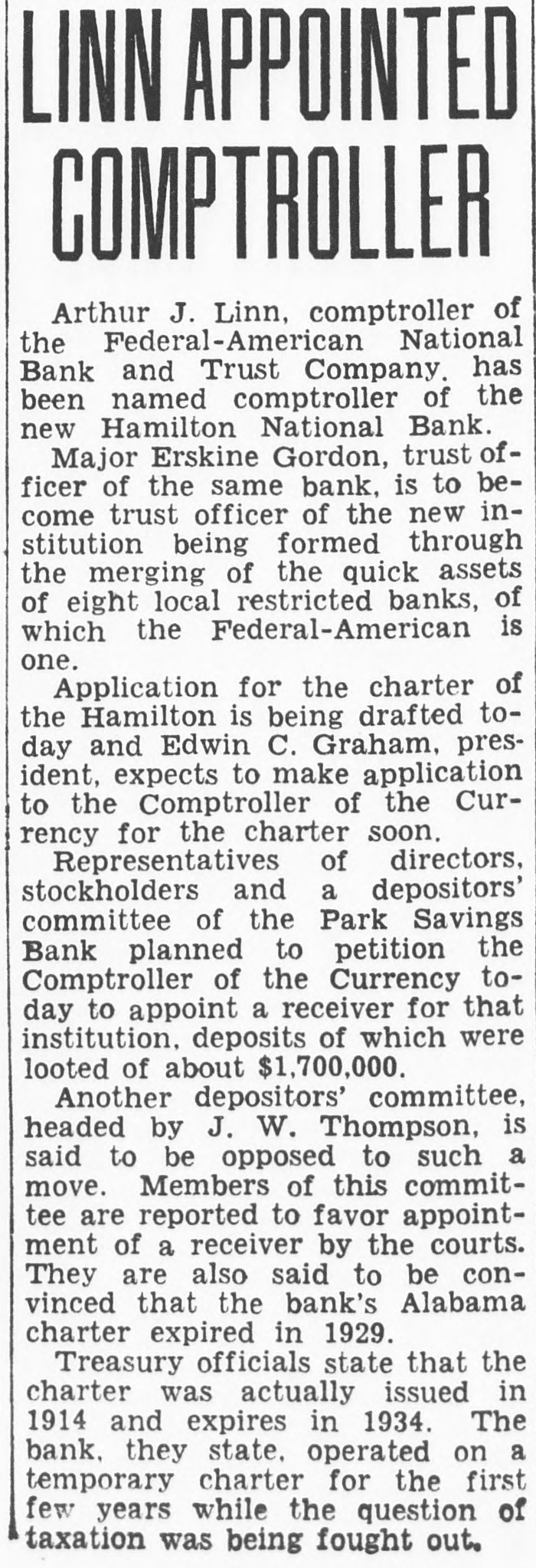
LINN APPOINTED COMPTROLLER Arthur J

Linn, comptroller of the Federal-American National Bank and Trust Company. has been named comptroller of the new Hamilton National Bank. Major Erskine Gordon, trust officer of the same bank, is to become trust officer of the new institution being formed through the merging of the quick assets of eight local restricted banks, of which the Federal-American is one. Application for the charter of the Hamilton is being drafted today and Edwin C. Graham, president, expects to make application to the Comptroller of the Currency for the charter soon. Representatives of directors, stockholders and a depositors' committee of the Park Savings Bank planned to petition the Comptroller of the Currency today to appoint a receiver for that institution. deposits of which were looted of about $1,700,000. Another depositors' committee, headed by J. W. Thompson, is said to be opposed to such a move. Members of this committee are reported to favor appointment of a receiver by the courts. They are also said to be convinced that the bank's Alabama charter expired in 1929. Treasury officials state that the charter was actually issued in 1914 and expires in 1934. The bank. they state, operated on a temporary charter for the first few years while the question of taxation was being fought out.


Article from Evening Star, August 30, 1933

Click image to open full size in new tab

Article Text

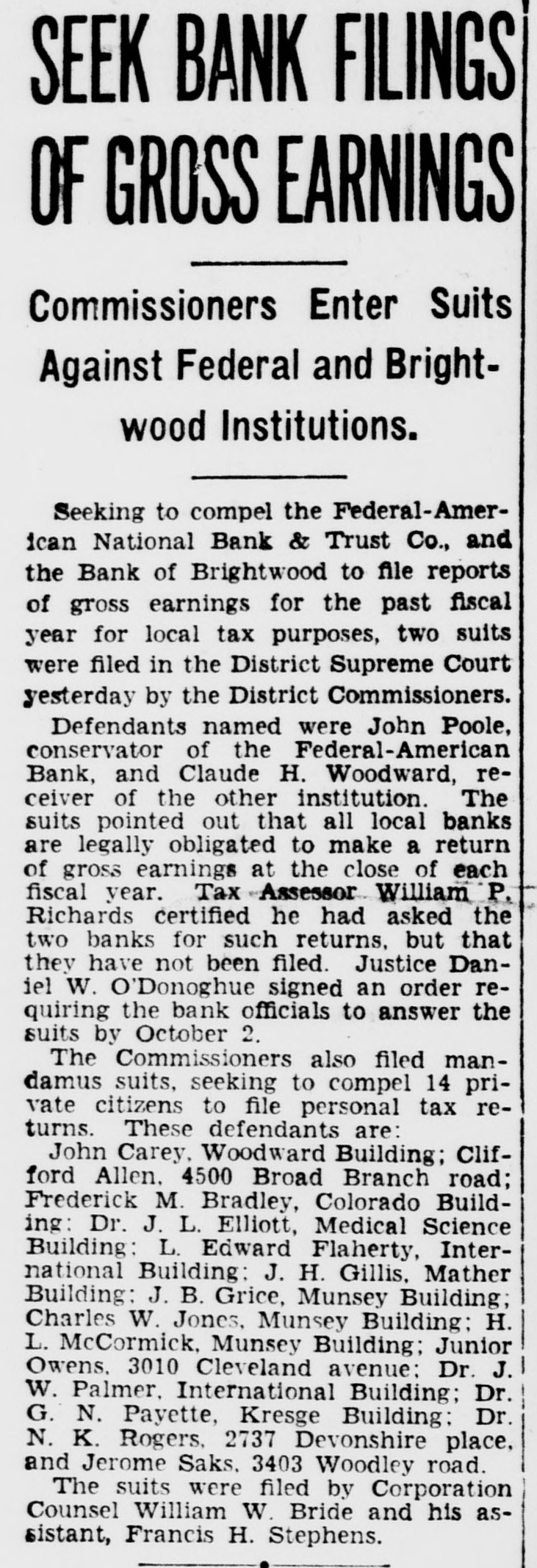
SEEK BANK FILINGS OF GROSS EARNINGS Commissioners Enter Suits Against Federal and Brightwood Institutions. Seeking to compel the Federal-American National Bank & Trust Co., and the Bank of Brightwood to file reports of gross earnings for the past fiscal year for local tax purposes, two suits were filed in the District Supreme Court yesterday by the District Commissioners. Defendants named were John Poole, conservator of the Federal-American Bank, and Claude H. Woodward, receiver of the other institution. The suits pointed out that all local banks are legally obligated to make a return of gross earnings at the close of each fiscal year. Tax Assessor William P. Richards certified he had asked the two banks for such returns, but that they have not been filed. Justice Daniel W. O'Donoghue signed an order requiring the bank officials to answer the suits by October 2. The Commissioners also filed mandamus suits, seeking to compel 14 private citizens to file personal tax returns. These defendants are: John Carey, Woodward Building; Clifford Allen. 4500 Broad Branch road; Frederick M. Bradley, Colorado Building: Dr. J. L. Elliott, Medical Science Building: L. Edward Flaherty, International Building: J. H. Gillis, Mather Building: J. B. Grice, Munsey Building; Charles W. Jones, Munsey Building: H. L. McCormick, Munsey Building: Junior Owens. 3010 Cleveland avenue: Dr. J. W. Palmer. International Building; Dr. G. N. Payette, Kresge Building: Dr. N. K. Rogers, 2737 Devonshire place, and Jerome Saks. 3403 Woodley road. The suits were filed by Corporation Counsel William W. Bride and his assistant, Francis H. Stephens.


Article from Evening Star, September 25, 1933

Click image to open full size in new tab

Article Text

BANKING EXPANDED HERE BY OPENING New Hamilton National Adds Substantially to City's Facilities. BY EDWARD C. STONE. Washington's banking map, which has been very much contracted since last March, was expanded materially today by the opening of eight banking offices in various parts of the city As noted in detail elsewhere in today's Star. the Hamilton National Bank threw open its doors for 100 per cent banking business this morning, the new institution being a merger of seven banks which have been operating on a restricted basis ever since the bank holiday last Spring The consolidation gives citizens access to 50 per cent of the funds that were tied up in 11 different banking offices The new bank has a main office and seven branches. While the District National's building and that of the Washington Savings Bank are not being used by the new institution, yet these banks are in the merger and half the funds in these two banks were made available today to their old depositors who opened accounts in the Hamilton The branch of the FederalAmerican at Fifteenth and H streets northwest not was reopened The Hamilton's main office is located at Fourteenth and G streets. in the former Federal- American National Bank & Trust Co Building. The seven branches are the Potomac at Wisconsin avenue and M street in Georgetown Woodridge-Langdon, at 2027 Rhode Island avenue northeast Northeast formerly Northeast Savings Bank. 800 H street northeast Seventh Street Seventh and N streets northwest Brookland. at Twelfth and Newton streets northeast Dupont Circle. Connecticut avenue at Dupont Circle, and Pennsylvania Avenue at Twentieth street northwest All eight offices did a rushing busi ness today Some depositors put in money others took some out. New ac. counts were opened After banks have been closed several months. there is banking business of every kind to be transacted Tellers had to hustle Officers were rushed attending to important matters for customers All day bank officials were showered with congratulations and best wishes by other bankers. business men old and new depositors and personal friends. Each banking office was literally buried with flowers the gifts of business friends and admirers 'A blessed event said one visiting banker By far the most important local financial development in the past six months, said another Daylight Savings Time Ends. Tickers in the brokerage offices here started off at 10 o'clock this morning an hour later than usual because of the conclusion of daylight savings time in New York Local offices were well filled with customers as the new sebedule went into effect Clocks in many of the offices which have been running on davlight time all Summer, were set back on standard The market opening was irregular and somewhat lower in the majority of stocks. It is generally believed among traders that there is to be no inflation of currency The President is understood to favor inflation of credit This means that speculators will have a hard time forcing stocks up with wild inflation talk Some brokers here think that the price of wheat cotton and other commodities and the price of the dollar abroad may be the leading market factors for time Now Comes Kidnaping Insurance. So far as known, Washington residents are about to be offered kidnaping insurance for the first time Old-time life insurance. accident insurance and every other kind, including insurance against hurricanes, has been offered here for years M Leroy Goff. in the Woodward Building, says that insurance against kidnaping was first started in London Risks have been taken on both adults and children The insurance companies in England have been unwilling to take any risks on people who have been threatened by kidnapers. Up to this time there has been quite variation in rates. It was understood today that definite rates have not been established in Washington Rates in England have been based partially on the prominence of the people insured and the amount of wealth which they are supposed to have Security Storage Dividend The board of directors of the Security Storage Co. have declared the regular quarterly dividend of $1.25 per share on the stock of this company payable on October 10. to the stock holders of record at the close of business October 6. the books to be closed between said dates respectively The first sale on the Washington Stock Exchange today was $1,000 transfer in Washington Railway & Electric 4s at 85. Washington Gas 5s. 1960, came out at 103 3/4 on $1.000 sale Washington Gas 6s series B, moved in $1.000 sale at 1031 a Capital Traction 5s appeared on the board twice, both $1,000 sales. one at 54 and the other at 531% The closing bond sale was a $500 transaction in Washington Gas 5s 1958 at 85 Trading in the stock division was confined to Railway & Electric preferred small lot moving at 861/2 and another small lot advancing to 87 Heard in Financial District Tomorrow is the date announced for the payment by the Commercial National Bank of more than $1,030,000 to depositors in this institution which is now in receivership This will be the first payment since the bank was closed last February and is about 20 per cent. according to Receiver Baldwin National Power & Light Co. has declared the regular quarterly dividend of $1.50 on the per cent preferred stock. payable November 1 to stock of record October One hopeful sign for the utility companies comes from Philip Lieber, president of the United States League of Building and Loan Associations Mr Lieber declares, according to the Wall Street Journal that re-employment will enable 1,000,000 families to leave the homes of relatives and set up their own homes within a year If Mr Lieber's prognostication proves correct the change would mean substantial pick-up in domestic business for utility companies The 'doubling up' process was one of the important factors in cutting down utility companies' domestic load


Article Text

THIRD FEDERAL NATIONAL DIVIDEND WILL BE PAID

Washington, Nov. 22 The office of Representative McCormack (D, Mass.) announced today that treasury officials had reported a third dividend soon would be paid to depositors of closed Federal National bank, of McCormack's office was informed by aids of that the Finance tion had approved application of the bank receivers for loan to make payment of the dividend before ChristWithin short time, they said, checks per dividend would be sent to 35,000 depositors.


Article from Evening Star, February 7, 1934

Click image to open full size in new tab

Article Text

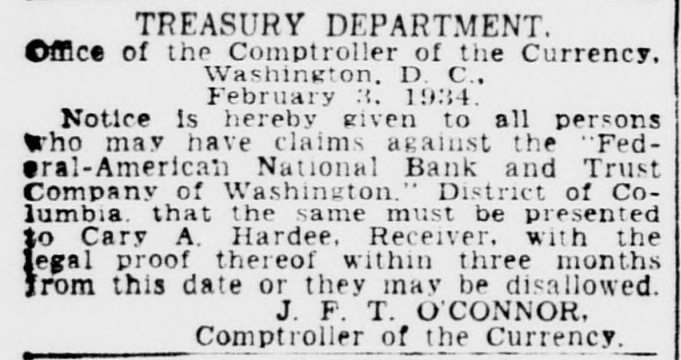
TREASURY DEPARTMENT

Office of the Comptroller of the Currency. Washington, D C., February 3. 1934 Notice is hereby given to all persons ho may have claims against the "Fedoral-American National Bank and Trust Company of Washington District of Columbia. that the same must be presented to Cary A Hardee, Receiver. with the legal proof thereof within three months from this date or they may be disallowed. J. F. T. O'CONNOR. Comptroller of the Currency.


Article from The Washington Times, July 20, 1934

Click image to open full size in new tab

Article Text

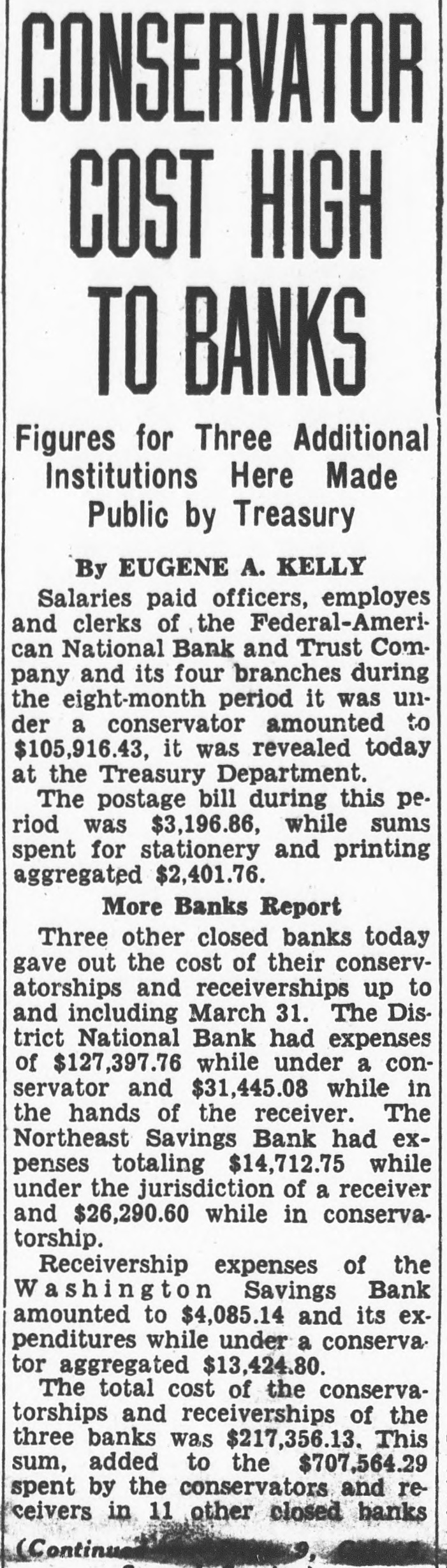
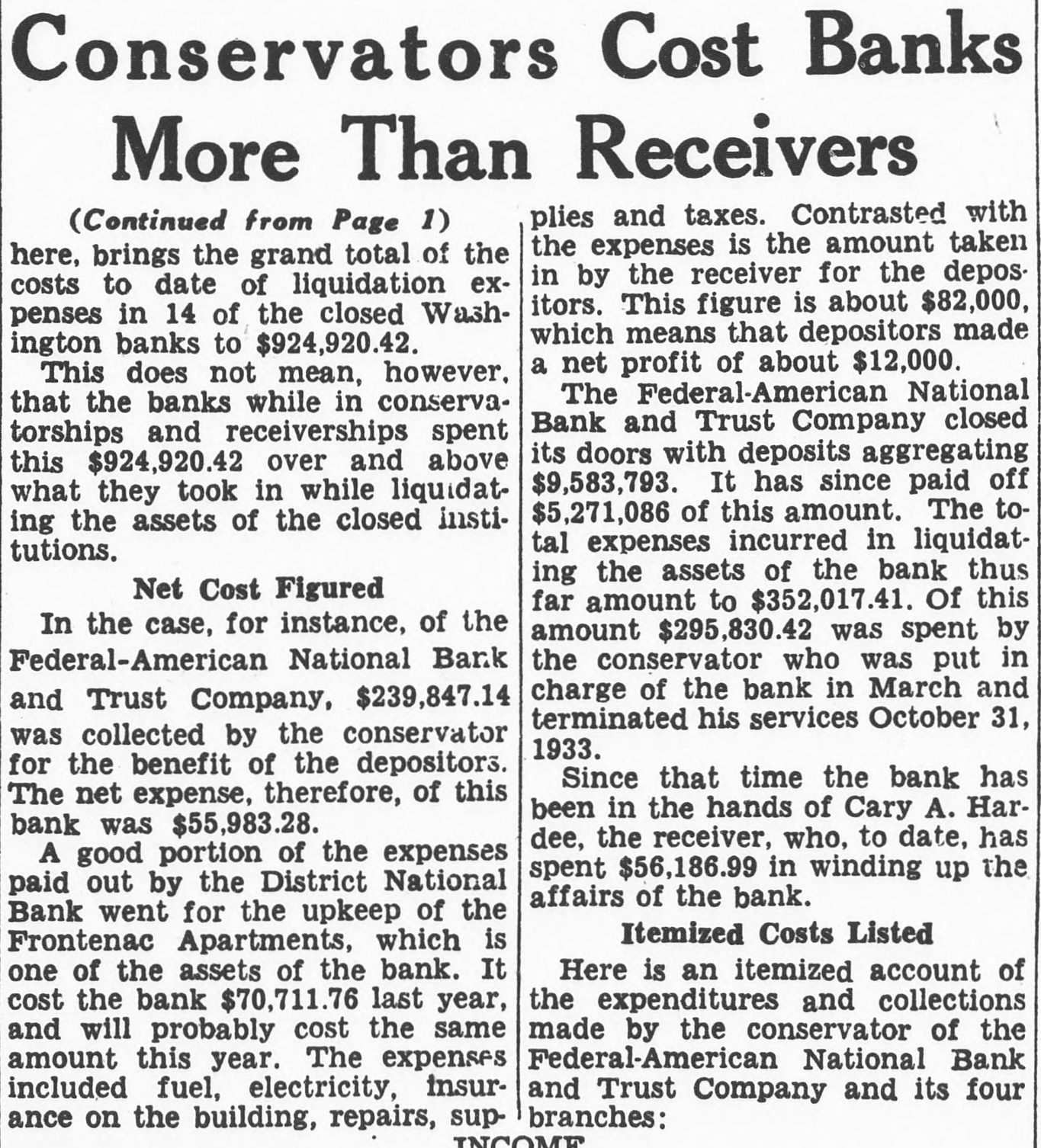
CONSERVATOR COST HIGH TO BANKS Figures for Three Additional Institutions Here Made Public by Treasury By EUGENE A. KELLY Salaries paid officers, employes and clerks of the Federal-American National Bank and Trust Com. pany and its four branches during the eight-month period it was under a conservator amounted to $105,916.43, it was revealed today at the Treasury Department. The postage bill during this period was $3,196.86, while sums spent for stationery and printing aggregated $2,401.76. More Banks Report Three other closed banks today gave out the cost of their conservatorships and receiverships up to and including March 31. The District National Bank had expenses of $127,397.76 while under a conservator and $31,445.08 while in the hands of the receiver. The Northeast Savings Bank had expenses totaling $14,712.75 while under the jurisdiction of a receiver and $26,290.60 while in conservatorship. Receivership expenses of the W Washington Savings Bank amounted to $4,085.14 and its expenditures while under a conservator aggregated $13,424.80. The total cost of the conservatorships and receiverships of the three banks was $217,356.13. This sum, added to the $707,564.29 spent by the conservators and receivers in 11 other closed banks (Continue


Article from The Washington Times, July 20, 1934

Click image to open full size in new tab

Article Text

Conservators Cost Banks More Than Receivers plies and taxes. Contrasted with (Continued from Page 1) the expenses is the amount taken here, brings the grand total of the in by the receiver for the deposcosts to date of liquidation exitors. This figure is about $82,000, penses in 14 of the closed Washwhich means that depositors made ington banks to $924,920.42. a net profit of about $12,000. This does not mean, however, The Federal-American National that the banks while in conservaBank and Trust Company closed torships and receiverships spent its doors with deposits aggregating this $924,920.42 over and above $9,583,793. It has since paid off what they took in while liquidat$5,271,086 of this amount. The toing the assets of the closed instital expenses incurred in liquidattutions. ing the assets of the bank thus Net Cost Figured far amount to $352,017.41. Of this In the case, for instance, of the amount $295,830.42 was spent by Federal-American National Bank the conservator who was put in charge of the bank in March and and Trust Company, $239,847.14 terminated his services October 31, was collected by the conservator 1933. for the benefit of the depositors. Since that time the bank has The net expense, therefore, of this been in the hands of Cary A. Harbank was $55,983.28. dee, the receiver, who, to date, has A good portion of the expenses spent $56,186.99 in winding up the paid out by the District National affairs of the bank. Bank went for the upkeep of the Itemized Costs Listed Frontenac Apartments, which is one of the assets of the bank. It Here is an itemized account of cost the bank $70,711.76 last year, the expenditures and collections made by the conservator of the and will probably cost the same Federal-American National Bank amount this year. The expenses included fuel, electricity, insurand Trust Company and its four branches: ance on the building, repairs, sup-


Article from The Washington Times, October 13, 1934

Click image to open full size in new tab

Article Text

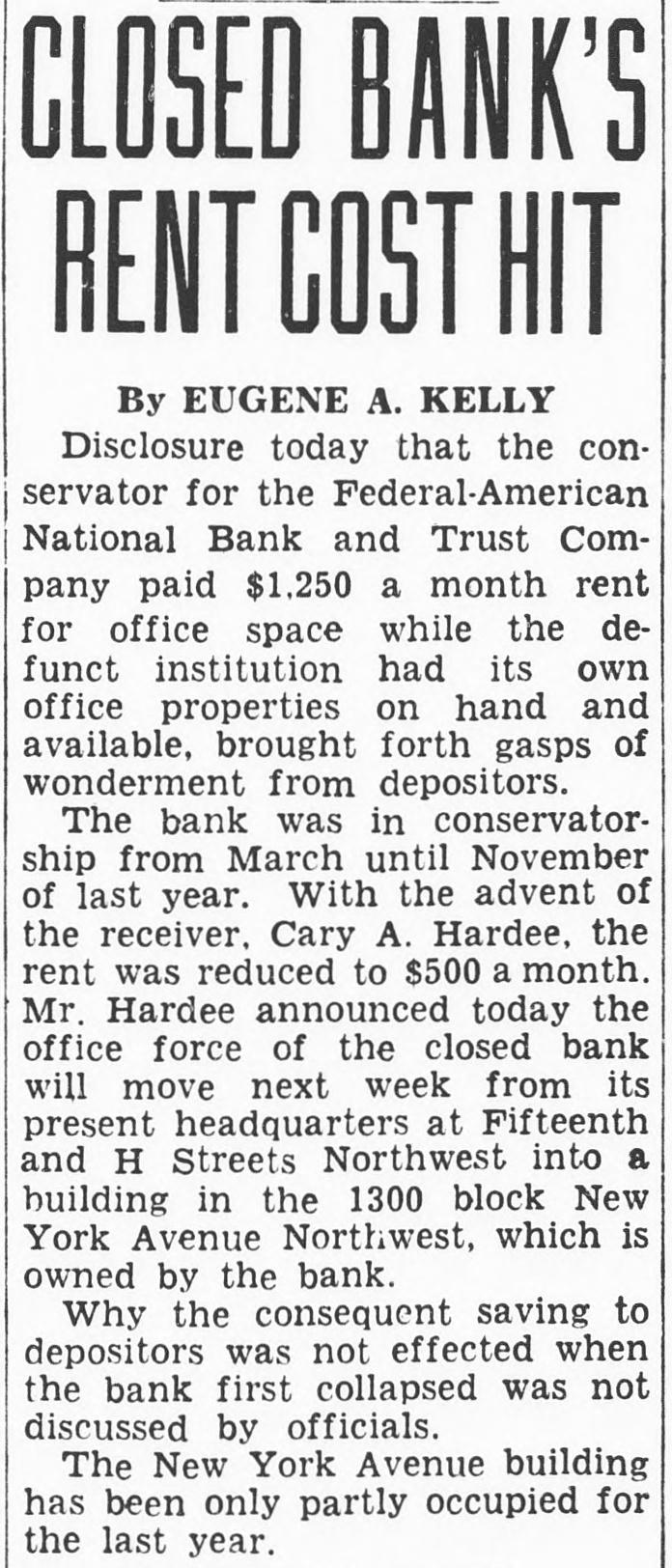
CLOSED BANK'S RENT COST HIT By EUGENE A. KELLY Disclosure today that the conservator for the Federal-American National Bank and Trust Company paid $1,250 a month rent for office space while the defunct institution had its own office properties on hand and available, brought forth gasps of wonderment from depositors. The bank was in conservatorship from March until November of last year. With the advent of the receiver, Cary A. Hardee, the rent was reduced to $500 a month. Mr. Hardee announced today the office force of the closed bank will move next week from its present headquarters at Fifteenth and H Streets Northwest into a building in the 1300 block New York Avenue Northwest, which is owned by the bank. Why the consequent saving to depositors was not effected when the bank first collapsed was not discussed by officials. The New York Avenue building has been only partly occupied for the last year.


Article from Evening Star, October 27, 1934

Click image to open full size in new tab

Article Text

SPECIAL NOTICES

RECEIVER'S SALE OF BANKING EQUIPment and very fine Oriental rugs of the Federal-American National Bank & Trust Co. by auction. at 15th and H sts. n.w., Tuesday. October 30. 10 a.m. CARY A. HARDEE. Receiver.


Article from Evening Star, December 7, 1934

Click image to open full size in new tab

Article Text

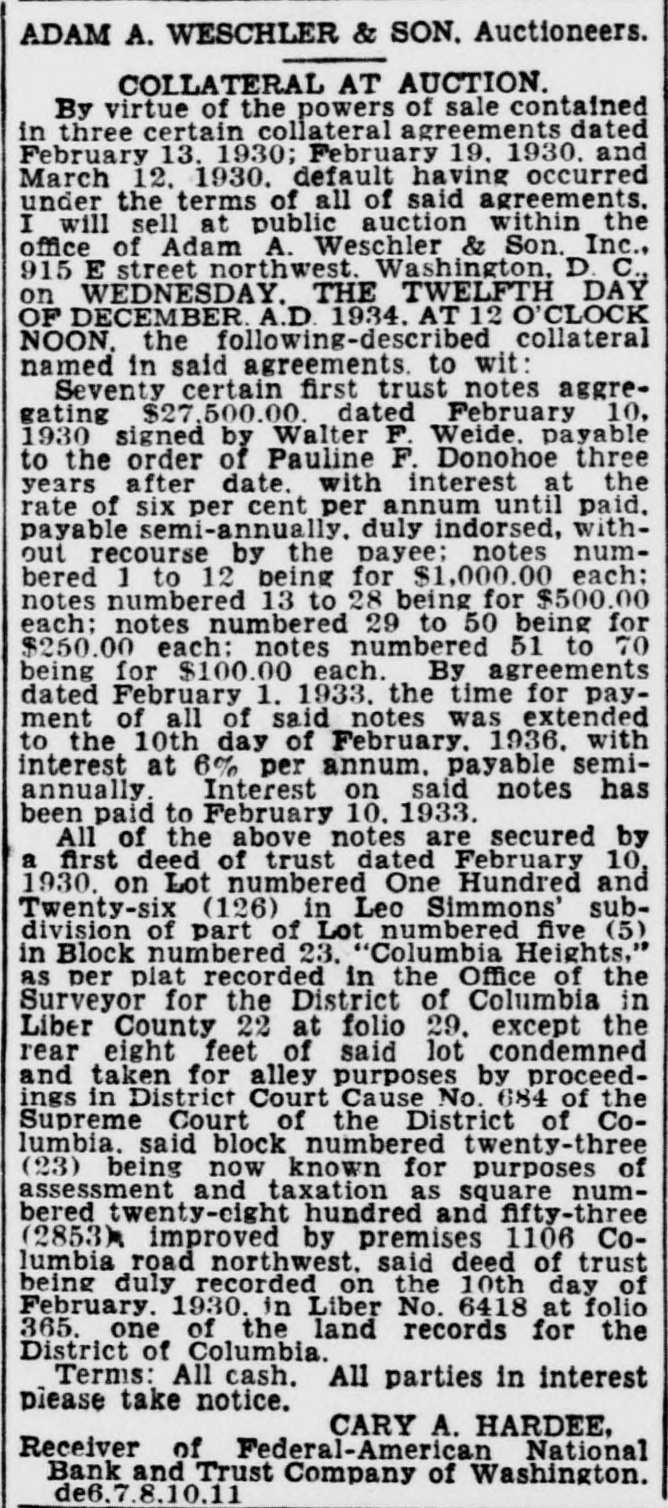
no13.16.20.23.27.30-de4.7.10.11 ADAM A. WESCHLER & SON. Auctioneers. COLLATERAL AT AUCTION. By virtue of the powers of sale contained in three certain collateral agreements dated February 13. 1930; February 19. 1930. and March 12. 1930. default having occurred under the terms of all of said agreements, I will sell at public auction within the office of Adam A Weschler & Son. Inc., 915 E street northwest. Washington, D C on WEDNESDAY, THE TWELFTH DAY OF DECEMBER A.D 1934 AT 12 O'CLOCK NOON. the following-described collateral named in said agreements. to wit: Seventy certain first trust notes aggregating $27,500.00 dated February 10. 1930 signed by Walter F. Weide. payable to the order of Pauline F Donohoe three years after date. with interest at the rate of six per cent per annum until paid. payable semi-annually. duly indorsed, without recourse by the payee: notes numbered 1 to 12 being for $1,000.00 each: notes numbered 13 to 28 being for $500.00 each; notes numbered 29 to 50 being for $250.00 each: notes numbered 51 to 70 being for $100.00 each. By agreements dated February 1. 1933. the time for payment of all of said notes was extended to the 10th day of February. 1936. with interest at 6% per annum. payabile semiannually Interest on said notes has been paid to February 10. 1933 All of the above notes are secured by a first deed of trust dated February 10, 1930 on Lot numbered One Hundred and Twentv-six (126) in Leo Simons subdivision of part of Lot numbered five (5) in Block numbered 23. "Columbia Heights." as per plat recorded in the Office of the Surveyor for the District of Columbia in Liber County 20 at folio 29 except the year eight feet of said lot condemned and taken for alley purposes by proceedings in District Court Cause No. 684 of the Supreme Court of the District of Columbia, said block numbered twenty-three (23) being now known for purposes of assessment and taxation as square numbered twenty-eight hundred and fifty-three (2853), improved by premises 1106 Columbia road northwest. said deed of trust being duly recorded on the 10th day of February. 1930. in Liber No. 6418 at folio 365, one of the land records for the District of Columbia Terms: All cash. All parties in interest please take notice. CARY A. HARDEE. Receiver of Federal-American National Bank and Trust Company of Washington. de6.7.8.10.11 (Continued on Next Page.)


Article from Evening Star, December 11, 1934

Click image to open full size in new tab

Article Text

ADAM A

WESCHLER & SON. Auctioneers. COLLATERAL AT AUCTION. By virtue of the powers of sale contained in three certain collateral agreements dated February 13. 1930; February 19, 1930. and March 12. 1930. default having occurred under the terms of all of said agreements. I will sell at public auction within the office of Adam A. Weschler & Son. Inc., 915 E street northwest. Washington, D. C. on WEDNESDAY. THE TWELFTH DAY OF DECEMBER. A.D. 1934. AT 12 O'CLOCK NOON. the following-described collateral named in said agreements. to wit: Seventy certain first trust notes aggregating $27,500.00. dated February 10, 1930 signed by Walter F. Weide. payable to the order of Pauline F. Donohoe three years after date. with interest at the rate of six per cent per annum until paid. payable semi-annually. duly indorsed, without recourse by the payee; notes numbered 1 to 12 being for $1,000.00 each: notes numbered 13 to 28 being for $500.00 each; notes numbered 29 to 50 being for $250.00 each: notes numbered 51 to 70 being for $100.00 each. By agreements dated February 1. 1933. the time for payment of all of said notes was extended to the 10th day of February. 1936, with interest at 6% per annum. payable semiannually Interest on said notes has been paid to February 10. 1933. All of the above notes are secured by a first deed of trust dated February 10, 1930. on Lot numbered One Hundred and Twenty-six (126) in Leo Simmons' subdivision of part of Lot numbered five (5) in Block numbered 23. "Columbia Heights," as per plat recorded in the Office of the Surveyor for the District of Columbia in Liber County 22 at folio 29. except the rear eight feet of said lot condemned and taken for alley purposes by proceedings in District Court Cause No. 684 of the Supreme Court of the District of Columbia, said block numbered twenty-three (23) being now known for purposes of assessment and taxation as square numbered twenty-eight hundred and fifty-three (2853) improved by premises 1106 Columbia road northwest. said deed of trust being duly recorded on the 10th day of February. 1930. in Liber No. 6418 at folio 365. one of the land records for the District of Columbia. Terms: All cash. All parties in interest please take notice. CARY A. HARDEE. Receiver of Federal-American National Bank and Trust Company of Washington. de6.7.8.10.11


Article from Evening Star, January 14, 1935

Click image to open full size in new tab

Article Text

SEEN IN PROSPECT FOR CLOSED BANK Federal-American May Give Depositors Added 10 Per Cent. DEFINITE PREDICTION AS TO TIME NOT MADE Receiver Hardee Reports on Condition of Institution to Controller of Currency. Prospects for another dividend of 10 per cent for depositors of the insolvent Federal-American National Bank & Trust Co. are seen in the quarterly report of the receiver, Cary A. Hardee, available today No definite official prediction can be made now as to the possible date of payment, as this may depend somewhat on a court case now pending, which questions the stock assessment: Receiver Hardee declined to announce a dividend, as this statement must come from the controller of the currency. But figures in this report to the controller showing condition of the receivership at the end of 1934 give ample hope of a dividend soon. The Federal-American is the largest insolvent bank in Washington, and declaration of another dividend would have wide-spread effect throughout the city. It would mean payment of more than $859,000 to more than 25,000 depositors. The new dividend would be the second paid out of this institution, and would bring the total dividends up to 60 per cent. The first dividend of 50 per cent was made possible and was paid in September, 1933. when the Federal-American reorganized and reopened as part of the new Hamilton National Bank merger. Since the receiver has taken charge the total paid on the original 50 per cent dividend has mounted to the sum of $4,134,487.73, out of the total deposit liability of $9,692,017.91 Total offsets allowed by both the conservator and the receiver amounted at the end of 1934 to $1,051,517.68, and total losses were charged off. cluding those on assets and stock assessment amounting to $561,025.80 Payment Above Average. The stock assessment, out of which most of the cash which will be ready for a 10 per cent dividend comes, is being paid by shareholders owning the $2,000,000 capital stock of the bank. The assessment was for 100 per cent and is being paid at rate said to be in excess of the average assessment collections over a period of years in the liquidation of national banks by the controller of the currency. Cash collected from the stock assessment by the end of 1934 amounted to $727,575.41, which is about per cent of the entire $2,000,000. This constitutes the largest part of the item marked "cash in hands of receiver and controller, which amounts to $870,567.78 From this sum of more than $800, 000 cash now ready there must be subtracted a total of $36,289.61 held trust for owners of various kinds, leaving about $834,000 actually available for payment of a 10 per cent dividend, about $25,000 short of that actually needed At the rate of collections, however, this is expected to be coming in soon. There are still more than $348,000 in unsecured liabilities whose owners have not proved their claim, nor asked for payment. Sufficient funds must be on hand for a dividend to meet demands from these people should they suddenly file their claim and ask for payment. The total deposit liabilities, including both those for which receivers' certificates have been issued and those which have not been claimed, amount to $8,590,000. Liquidation Proceeding. The Federal-American liquidation still is proceeding and there are several important pieces of real estate belonging to the institution which some day are expected to bring substantial funds into the receivership, if sold. Among the principal pieces of real estate are the old American Building 1315 F street, where the American National Bank once was located: the old Federal-American National Bank Building at Fourteenth and G. now rented to the Hamilton National Bank as its headquarters; a branch bank house at Twentieth street and Pennsylvania avenue, another at Twelfth and Newton streets northeast, both of which are rented as Hamilton Bank branches, and several apartment houses. Receiver Hardee also has filed with the controller of the currency his quarterly report on condition of the Chevy Chase Savings Bank, which was bought and reopened by the Riggs National Bank as a branch Total assets of the Chevy Chase Bank are listed at $1,008,810.12, and there has been no stock assessment against shareholders. Total cash collected from assets was $580,363.74 at the end of the year and from that had been paid one 60 per cent dividend of $405,390.50. Depositors of this bank got an additional 5 per cent because the bank went 5 per cent restricted basis before the President's bank holiday. This bank borrowed nothing from the R. F C. Cash in hand was listed at $41,550.51. WOMEN FLEE AS FIRE

Article from The Washington Times, April 20, 1935

Click image to open full size in new tab

Article Text

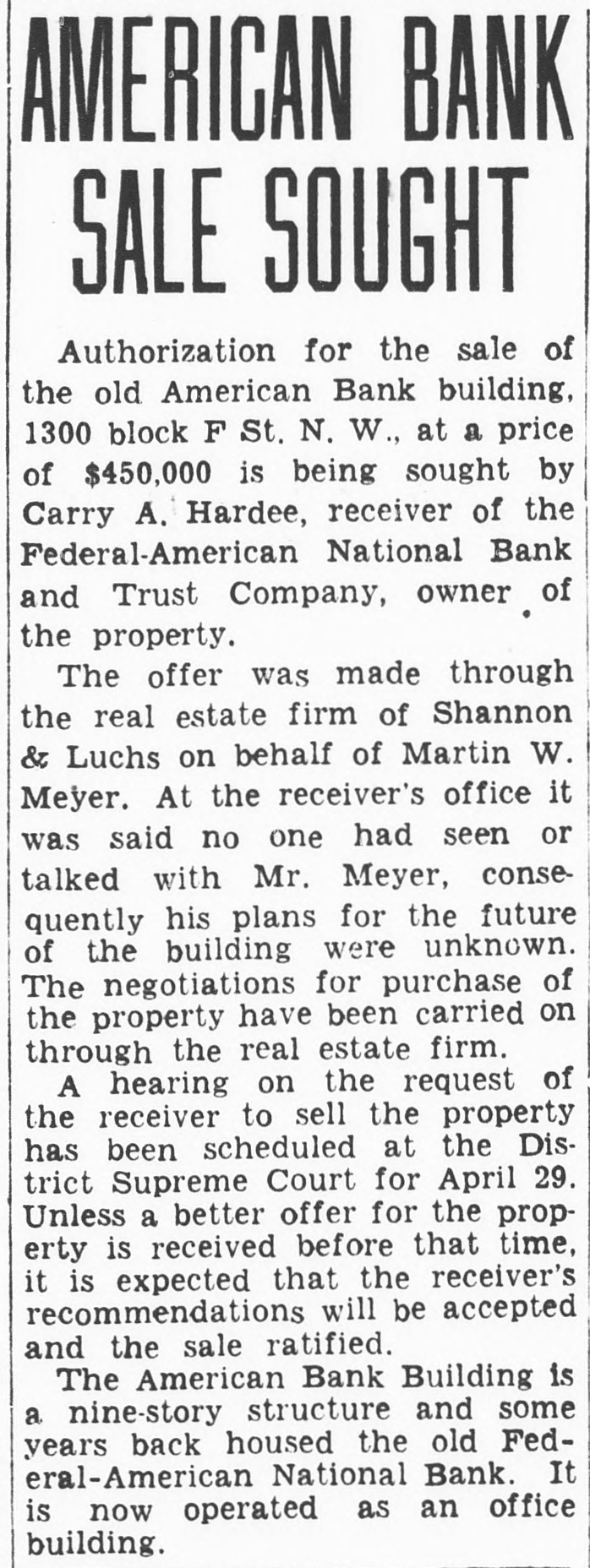
AMERICAN BANK
SALE SOUGHT

Authorization for the sale of the old American Bank building, 1300 block F St. N. W., at a price of $450,000 is being sought by Carry A. Hardee, receiver of the Federal-American National Bank and Trust Company, owner of the property.

The offer was made through the real estate firm of Shannon & Luchs on behalf of Martin W. Meyer. At the receiver's office it was said no one had seen or talked with Mr. Meyer, consequently his plans for the future of the building were unknown. The negotiations for purchase of the property have been carried on through the real estate firm.

A hearing on the request of the receiver to sell the property has been scheduled at the District Supreme Court for April 29. Unless a better offer for the property is received before that time, it is expected that the receiver's recommendations will be accepted and the sale ratified.

The American Bank Building is a nine-story structure and some years back housed the old Federal-American National Bank. It is now operated as an office building.


Article from Evening Star, May 10, 1935

Click image to open full size in new tab

Article Text

AUCTION SALES-FUTURE DAYS

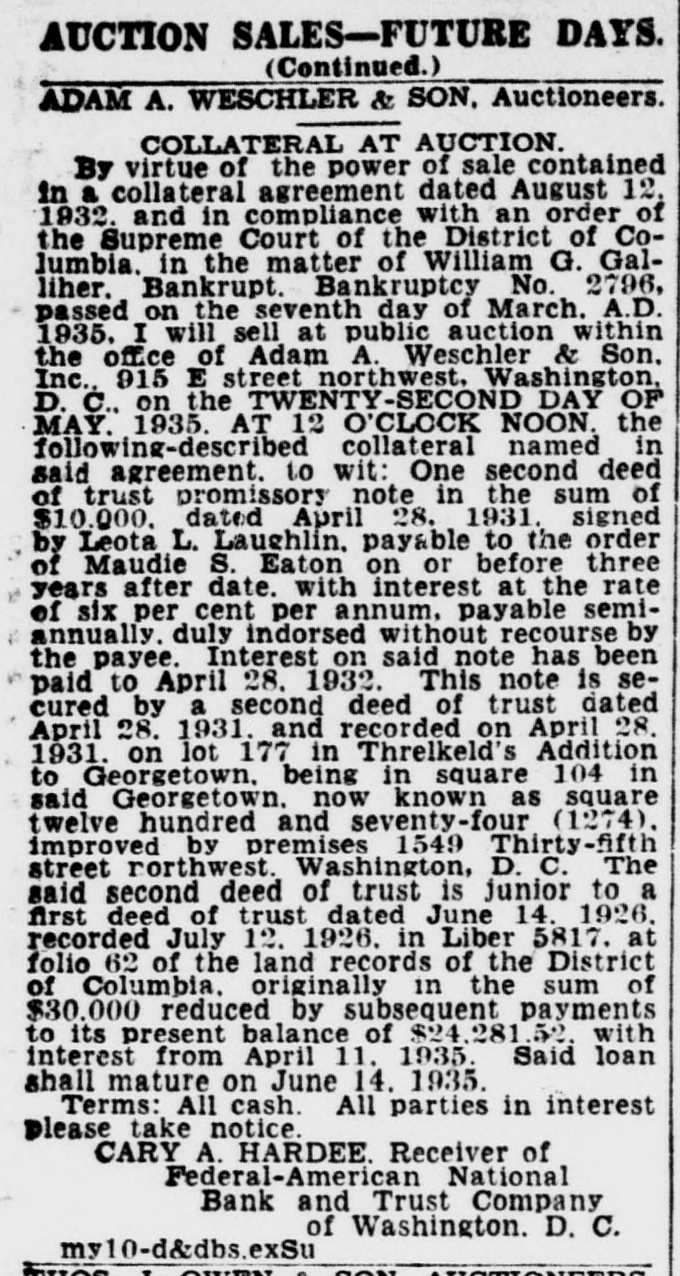
(Continued.) ADAM A. WESCHLER & SON. Auctioneers. COLLATERAL AT AUCTION. By virtue of the power of sale contained in a collateral agreement dated August 12. 1932. and in compliance with an order of the Supreme Court of the District of Columbia. in the matter of William G. Galliher. Bankrupt. Bankruptcy No. 2796, passed on the seventh day of March. A.D. 1935. I will sell at public auction within the office of Adam A. Weschler & Son. Inc., 915 E street northwest. Washington, D. C., on the TWENTY-SECOND DAY OF MAY. 1935. AT 12 O'CLOCK NOON. the following-described collateral named in said agreement. to wit: One second deed of trust promissory note in the sum of $10.000, dated April 28. 1931. signed by Leota L. Laughlin. payable to the order of Maudie S. Eaton on or before three years after date. with interest at the rate of six per cent per annum, payable semiannually. duly indorsed without recourse by the payee. Interest on said note has been paid to April 28. 1932. This note is secured by a second deed of trust dated April 28. 1931. and recorded on April 28. 1931. on lot 177 in Threlkeld's Addition to Georgetown, being in square 104 in said Georgetown. now known as square twelve hundred and seventy-four (1274), improved by premises 1549 Thirty-fifth street northwest. Washington, D. C. The said second deed of trust is junior to a first deed of trust dated June 14. 1926, recorded July 12. 1926. in Liber 5817. at folio 62 of the land records of the District of Columbia. originally in the sum of $30.000 reduced by subsequent payments to its present balance of $24,281.52. with interest from April 11. 1935. Said loan shall mature on June 14. 1935. Terms: All cash. All parties in interest please take notice. CARY A. HARDEE. Receiver of Federal-American National Bank and Trust Company of Washington. D. C. my10-d&dbs.exSu


Article from Evening Star, July 13, 1935

Click image to open full size in new tab

Article Text

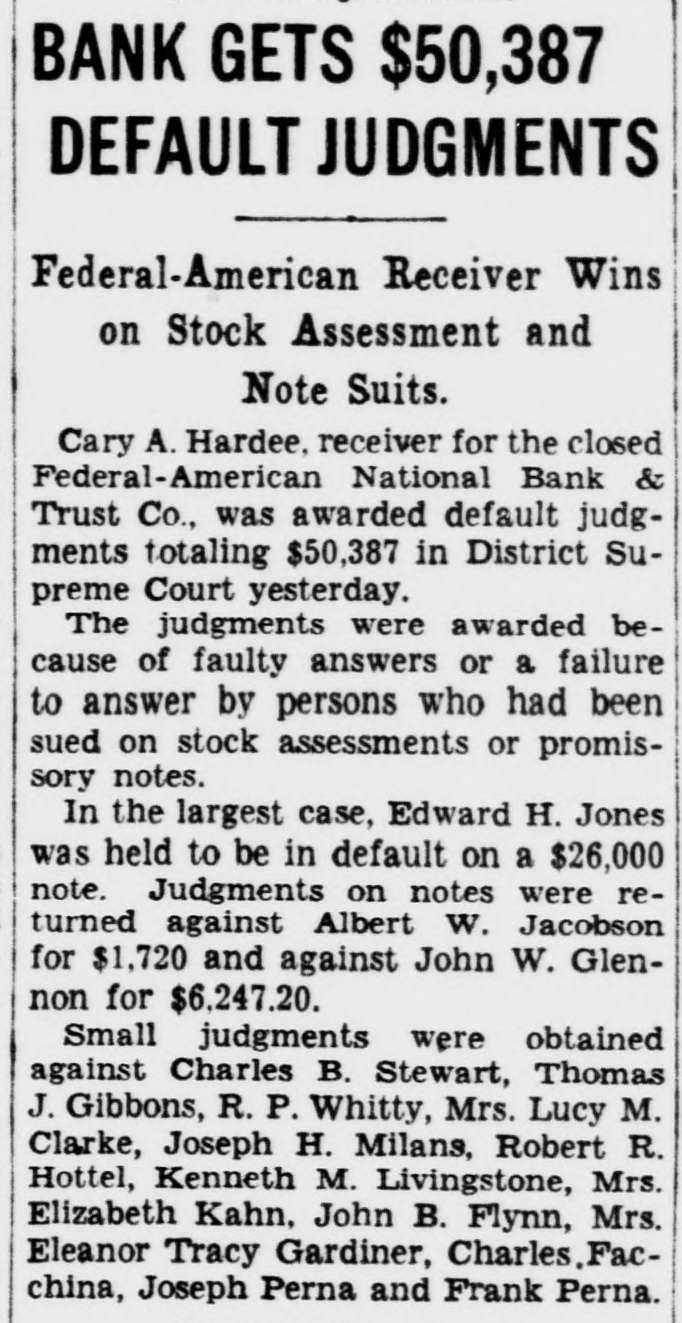
BANK GETS $50,387 DEFAULT JUDGMENTS Federal-American Receiver Wins on Stock Assessment and Note Suits. Cary A. Hardee, receiver for the closed Federal-American National Bank & Trust Co., was awarded default judgments totaling $50,387 in District Supreme Court yesterday. The judgments were awarded because of faulty answers or a failure to answer by persons who had been sued on stock assessments or promissory notes. In the largest case, Edward H. Jones was held to be in default on a $26,000 note. Judgments on notes were returned against Albert W. Jacobson for $1,720 and against John W. Glennon for $6,247.20. Small judgments were obtained against Charles B. Stewart, Thomas J. Gibbons, R. P. Whitty, Mrs. Lucy M. Clarke, Joseph H. Milans, Robert R. Hottel, Kenneth M. Livingstone, Mrs. Elizabeth Kahn, John B. Flynn, Mrs. Eleanor Tracy Gardiner, Charles, Facchina, Joseph Perna and Frank Perna.


Article from The Washington Times, October 12, 1935

Click image to open full size in new tab

Article Text

REALTY RISE LIFTS VALUE OF ASSETS Institution Still Owes $4,000,000; Has $1,000,000 Now With the upswing in local real estate values the assets held by the defunct Federal American Na. tional Bank and Trust Company have increased appreciably in value, with the result that the closed institution ultimately will pay depositors about 85 per cent of their accounts, it was disclosed today in the quarterly statement of condition of the bank. The Federal American National Bank and Trust Company today owes its depositors about four million dollars. It already has paid a 50 per cent dividend. This time last year little hope was held for a payment exceeding 60 per cent all told. Bank officials are faced with the annoying situation of having more than $1,000,000 on hand for the immediate distribution to depositors, yet being hamstrung by a court order. A good portion of the $1,000,000 was raised through assessments levied against stockholders of the bank. Stockholders are attacking the legality of these collections and, until this dispute is settled in the courts, payment of the money to the depositors will be withheld. Cary A. Hardee, reeciver for the bank, estimates the assets today held by the bank are worth more than $3,000,000 on the open market. Book value of these assets is about $8,700,000. Besides these estimated assets, of course, the depositors have the $1,000,000 in cash awaiting them.


Article from Evening Star, October 14, 1935

Click image to open full size in new tab

Article Text

ADAM A

WESCHLER & SON. Auctioneers COLLATERAL AT AUCTION. By virtue of the power of sale contained in a certain collateral agreement dated April 7. 1933, default having occurred under the terms of said agreement. I will sell at public auction within the office of Adam A. Weschler & Son. Inc. 915 F street northwest. Washington. D. C., on MONDAY. THE TWENTY-EIGHTH DAY OF OCTOBER. A.D. 1935. AT TWELVP O'CLOCK NOON. the following-describes collateral named in said agreement. to wit: Third deed of trust promissory note dated February 18. 1930. signed by D. C. Realty Company. Inc., in the sum of $200,000.00 payable on or before one year after date to the order of Thomas T. Kellar. and duly indorsed without recourse by said payee bearing interest at the rate of 6 per cent per annum until paid, payable semi-a nually. The above note is secured by a third deed of trust dated February 18. 1930 from D C. Realty Company. Inc. a Dela. ware corporation. to Munsey Trust Com. pany, recorded on February 20. 1930. is Liber 6421. at folio 345 on the following. described property to wit: "All of original lot 8 and parts of original lots 9 and 14 in square 168. described in one parcel at follows: Beginning for the same at point on the north line of G street. 5 feet east of the southwest corner of sai a square; thence east on said line of street. 79 feet to the southeast corner of said original lot 8: thence north along the east line of said lot. 112 feet 8 inches to the rear line thereof: thence west on said rear line and the south line of lot 11. 78 feet; thence south 112 feet 8 inches to the line of said G street. and beginning. Also lots 30 and 31 in Niles' subdivision of loti in said square recorded in Liber H. D. C. folio 85 of the records of the office of the surveyor of the District of Columbia. Alse lot 10 in Davidson's subdivision of lots in the said square recorded in Liber N. E. folios 11 and 12 in the aforementione surveyor's office records. And also part of the said square 168, described as fol. lows: Beginning for the same at northwest corner of said lot 30: thence north 4 feet thence east 50 feet: thence south 4 feet to the northeast corner of said lot 31; thence west 50 feet to beginning." now known for purposes of assessment and taxation al lot 818. square 168. Terms: All cash. All parties in interest please take notice. CARY A. HARDEE. Receiver of the FederalAmerican National Bank and Trust Company of Washington. 16.18.21.23.25


Article from Evening Star, January 17, 1937

Click image to open full size in new tab

Article Text

SECOND DIVIDEND BY BANK LIKELY Federal-American Depositors Learn Remaining Assets Are $2,927,189. With prospects for another dividend to depositors in a few weeks, the Federal-American National Bank & Trust Co., largest closed bank in Washington, is shown by the latest quarterly statement of the receiver, Cary A. Hardee, to have remaining assets of an estimated value of $2,927,189.63. No definite indication is forthcoming as to how soon the dividend can be paid to the thousands of depositors of this bank, nor how large a `dividend it will be. But the figures of the report show that the receivership is being shaped into condition for payment of the second dividend. First Dividend 50 Pct. First dividend was paid out of this bank in September. 1933, amounting to 50 per cent. On this first dividend, the conservator and receiver have paid to depositors a total of $4,182,531.46. of which $3,885,604 was paid by the conservator. The Reconstruction Finance Corp. loan of $2,348,425.97 has been entirely repaid. Collections of stock assessment are shown to be high, with $1,200,824.96 paid by stockholders out of a total assessment of $2,000,000 on the capital stock. Unsecured Liabilities. Unsecured liabilities at the date of suspension of the bank, March 3, 1933. stood at $9,332,245.87, representing the money owed to general depositors. Receiver's certificates have been issued for the great majority of this, but most of these certificates are being held at the office of the receiver for depositors. There are unsecured liabilities listed as neither "paid or proved," amounting to $241,244.34. The cost of liquidation of the bank is shown to be $530,950.90, which is less than the income from the assets listed as $704,157.49 collected from interest, premium, rents and other sources. Cash in the hands of the receiver and the controller of the currency is $707,209.16.


Article from Evening Star, March 28, 1937

Click image to open full size in new tab

Article Text

D.C. BANK TO PAY SECOND DIVIDEND Federal-American Plans to Distribute $1,248,000, Starting April 5. BY HAROLD B. ROGERS. Payment of a 15 per cent dividend to 23,000 depositors of the closed Federal-American National Bank & Trust Co., amounting to more than $1,248,000, will begin Monday, April 5, it was announced last night by Cary A. Hardee, receiver. Hardee has arranged a system of paying depositors in groups-some each day-to avoid confusion and crowds in the office, 1336 New York avenue. "Notice will be mailed to each depositor," the receiver explained, "with instructions to call at the bank for dividend checks on the date indicated in the notice." He asked depositors to adhere strictly to the notices and to bring their cards with them for identification. The payment will constitute the second dividend from this bank, which distributed the first dividend of 50 per cent in September, 1933. Other Dividends Promised. Hardee said "further dividends will be available to the depositors at a later date as the bank has a large amount of assets on which it cannot realize at the present time. Neither would it be advisable to liquidate at once. No intimation as to the time of further payments an be made now." He promised, however. "a further payment at the earliest possible moment." The Federal-American was the largest Washington bank to fail to reopen its doors after the bank holiday of March, 1933. It had a capital stock of $2,000,000 and total assets of a book value of $17,095,563.64. The institution was first placed in the hands of a conservator, John Poole, former president of the bank. Through sale of some of its assets to the new Hamilton National Bank and a loan from the Reconstruction Finance Corp., it was able to pay 50 per cent to depositors when the Hamilton bank opened in September, 1933. In addition to paying out the 50 per cent, which went to unsecured creditors, the Federal-American has paid out secured and preferred liabilities totaling $4,576,047.42. The loan from the Reconstruction (See FEDERAL-AMERICAN. A-11.)


Article from Evening Star, May 17, 1937

Click image to open full size in new tab

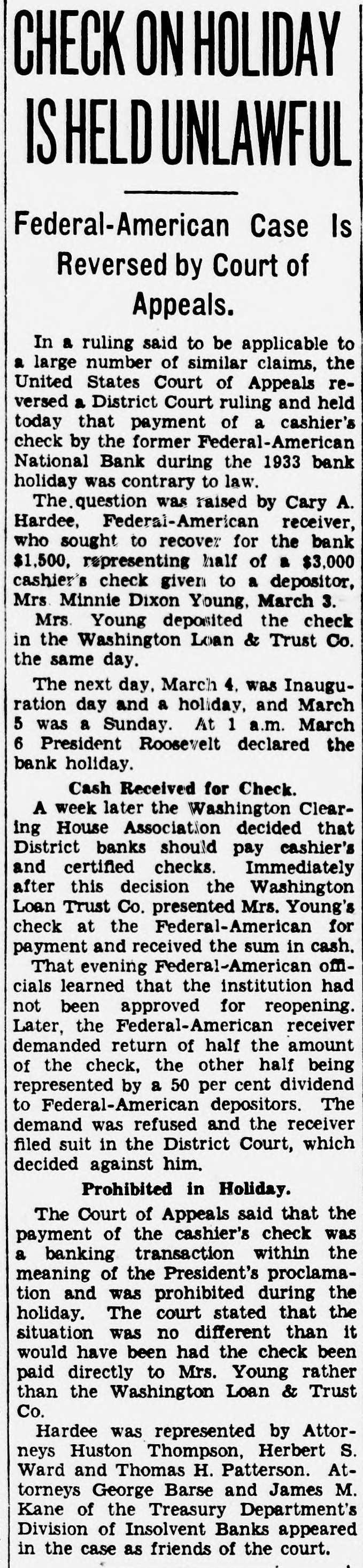
Article Text

CHECK ON HOLIDAY ISHELDUNLAWFUL Federal-American Case Is Reversed by Court of Appeals. In a ruling said to be applicable to a large number of similar claims, the United States Court of Appeals reversed a District Court ruling and held today that payment of a cashier's check by the former Federal-American National Bank during the 1933 bank holiday was contrary to law. The. question was raised by Cary A. Hardee, Federai-American receiver, who sought to recove% for the bank $1,500, representing half of a $3,000 cashier's check given to a depositor, Mrs Minnie Dixon Young, March 3. Mrs. Young deposited the check in the Washington Loan & Trust Co. the same day. The next day, March 4. was Inauguration day and a holiday, and March 5 was a Sunday. At 1 a.m. March 6 President Roosevelt declared the bank holiday. Cash Received for Check. A week later the Washington Clearing House Association decided that District banks should pay cashier's and certified checks. Immediately after this decision the Washington Loan Trust Co. presented Mrs. Young's check at the Federal-American for payment and received the sum in cash. That evening Federal-American offcials learned that the institution had not been approved for reopening. Later, the Federal-American receiver demanded return of half the amount of the check, the other half being represented by a 50 per cent dividend to Federal-American depositors. The demand was refused and the receiver filed suit in the District Court, which decided against him. Prohibited in Holiday. The Court of Appeals said that the payment of the cashier's check was a banking transaction within the meaning of the President's proclamation and was prohibited during the holiday. The court stated that the situation was no different than it would have been had the check been paid directly to Mrs. Young rather than the Washington Loan & Trust Co. Hardee was represented by Attorneys Huston Thompson, Herbert S. Ward and Thomas H. Patterson. Attorneys George Barse and James M. Kane of the Treasury Department's Division of Insolvent Banks appeared in the case as friends of the court.