Bank of Cuba (New York, NY)

Episode Information

Episode UID
1026871456
Episode Type
Suspension โ†’ Closure
Bank Type
state
Bank ID
102687 routing
Routing Number
1-0268
Start Date
April 11, 1921
Location
New York, New York (40.714, -74.006)

Metadata

Model
gpt-5-mini (chosen from majority vote of a three-model LLM ensemble)
Short Digest
aff14fb93f9522c9

Response Measures

None

Description

Local New York State Banking Department took charge and moved to liquidate the bank after its Cuban correspondent suspended.

Events (2)

1. April 11, 1921 Receivership
Newspaper Excerpt
The Bank of Cuba in New York, the statement read, has decided to liquidate, and the State Banking Department has taken charge.
Source
newspapers
2. April 11, 1921 Suspension
Cause
Government Action
Cause Details
State Banking Department took charge and suspended operations following the suspension/moratorium of the Banco Nacional de Cuba which tied up assets.
Newspaper Excerpt
The Banking Department of the State of New York took charge yesterday of the assets and total resources of the Bank of Cuba in New York
Source
newspapers

Newspaper Articles (2)

Article from New-York Tribune, April 12, 1921

Click image to open full size in new tab

Article Text

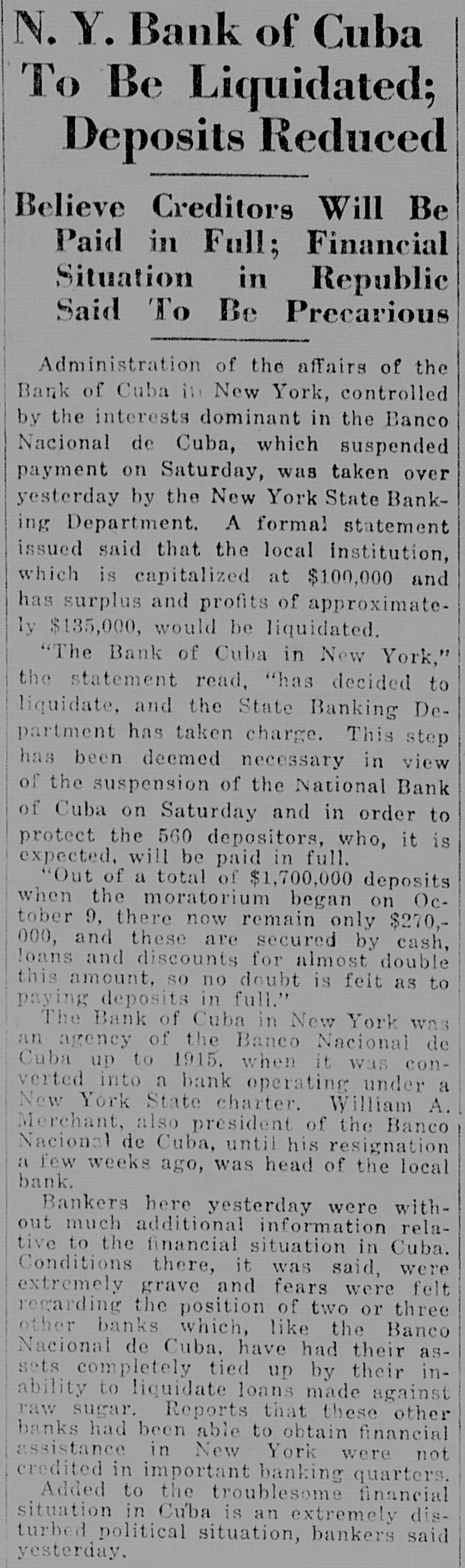
N. Y. Bank of Cuba To Be Liquidated; Deposits Reduced Believe Creditors Will Be Paid in Full; Financial Situation in Republic Said To Be Precarious Administration of the affairs of the Bank of Cuba iii New York, controlled by the interests dominant in the Banco Nacional de Cuba, which suspended payment on Saturday, was taken over yesterday by the New York State Banking Department. A formal statement issued said that the local institution, which is capitalized at $100,000 and has surplus and profits of approximately $135,000, would be liquidated. "The Bank of Cuba in New York," the statement read, "has decided to liquidate, and the State Banking Department has taken charge. This step has been deemed necessary in view of the suspension of the National Bank of Cuba on Saturday and in order to protect the 560 depositors, who, it is expected, will be paid in full. "Out of a total of $1,700,000 deposits when the moratorium began on October 9, there now remain only $270,000, and these are secured by cash, loans and discounts for almost double this amount, so no doubt is felt as to paying deposits in full." The Bank of Cuba in New York was an agency of the Banco Nacional de Cuba up to 1915. when it was converted into a bank operating under a New York State charter. William A. Merchant, also president of the Banco Nacional de Cuba, until his resignation a few weeks ago, was head of the local bank. Bankers here yesterday were without much additional information relative to the financial situation in Cuba. Conditions there, it was said, were extremely grave and fears were felt regarding the position of two or three other banks which, like the Banco Nacional de Cuba, have had their assets completely tied up by their inability to liquidate loans made against raw sugar. Reports that these other banks had been able to obtain financial assistance in New York were not credited in important banking quarters. Added to the troublesome financial situation in Cuba is an extremely disturbed political situation, bankers said yesterday,

Article from The New York Herald, April 12, 1921

Click image to open full size in new tab

Article Text

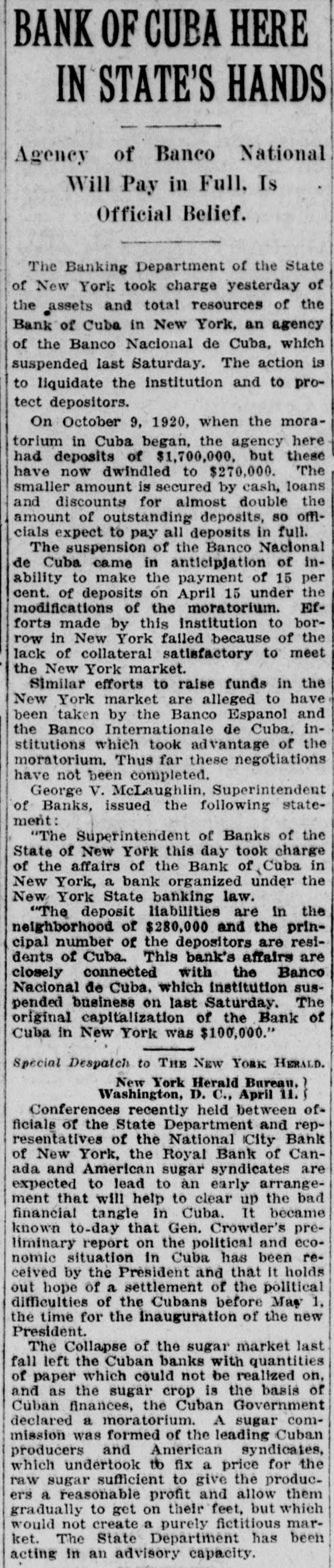
BANK OF CUBA HERE IN STATE'S HANDS Agency of Banco National Will Pay in Full. Is Official Belief. The Banking Department of the State of New York took charge yesterday of the assets and total resources of the Bank of Cuba in New York, an agency of the Banco Nacional de Cuba, which suspended last Saturday. The action is to liquidate the institution and to protect depositors. On October 9, 1920, when the moratorium in Cuba began, the agency here had deposits of $1,700,000. but these have now dwindled to $270,000. The smaller amount is secured by cash, loans and discounts for almost double the amount of outstanding deposits, so offcials expect to pay all deposits in full. The suspension of the Banco Nacional de Cuba came in anticipiation of inability to make the payment of 15 per cent. of deposits on April 15 under the modifications of the moratorium. Efforts made by this institution to borrow in New York failed because of the lack of collateral satisfactory to meet the New York market. Similar efforts to raise funds in the New York market are alleged to have been taken by the Banco Espanol and the Banco Internationale de Cuba. institutions which took advantage of the moratorium. Thus far these negotiations have not been completed. George V. McLaughlin, Superintendent of Banks, issued the following statement: "The Superintendent of Banks of the State of New York this day took charge of the affairs of the Bank of Cuba in New York, a bank organized under the New York State banking law. "The deposit liabilities are in the neighborhood of $280,000 and the principal number of the depositors are residents of Cuba. This bank's affairs are closely connected with the Banco Nacional de Cuba, which institution suspended business on last Saturday. The original capitalization of the Bank of Cuba in New York was $100,000." Special Despatch to THE NEW YORK HERALD. New York Herald Bureau. Washington, D. C., April 11. Conferences recently held between officials of the State Department and representatives of the National City Bank of New York, the Royal Bank of Canada and American sugar syndicates are expected to lead to an early arrangement that will help to clear up the bad financial tangle in Cuba. It became known to-day that Gen. Crowder's preliminary report on the political and economic situation in Cuba has been received by the President and that it holds out hope of a settlement of the political difficulties of the Cubans before May 1. the time for the Inauguration of the new President. The Collapse of the sugar market last fall left the Cuban banks with quantities of paper which could not be realized on, and as the sugar crop is the basis of Cuban finances, the Cuban Government declared a moratorium. A sugar commission was formed of the leading Cuban producers and American syndicates, which undertook to fix a price for the raw sugar sufficient to give the producers a reasonable profit and allow them gradually to get on their feet, but which would not create a purely fictitious market. The State Department has been acting in an advisory capacity.