Trust Company of America (New York, NY)

Episode Information

Episode UID
1021271380
Episode Type
Run Only
Bank Type
trust
Bank ID
102127 routing
Routing Number
1-0212
Start Date
December 12, 1914
Location
New York, New York (40.714, -74.006)

Metadata

Model
gpt-5-mini (chosen from majority vote of a three-model LLM ensemble)
Short Digest
5b9a93d8053c7cc4

Response Measures

None

Events (2)

1. December 12, 1914 Other
Newspaper Excerpt
collapse of his business enterprises, particularly the bank run in connection with the Fourteenth street store (Siegel)... Fourteenth Street Bank reported in bankruptcy/examination of Henry Siegel
Source
newspapers
2. March 10, 1933 Run
Cause
Local Banks
Cause Details
Runs followed failure/closure of nearby banks (Knickerbocker closed; National Bank of America suspended) which triggered heavy withdrawals
Newspaper Excerpt
the terrifying queues outside the Trust Company of America
Source
newspapers

Newspaper Articles (2)

Article from The Washington Herald, December 13, 1914

Click image to open full size in new tab

Article Text

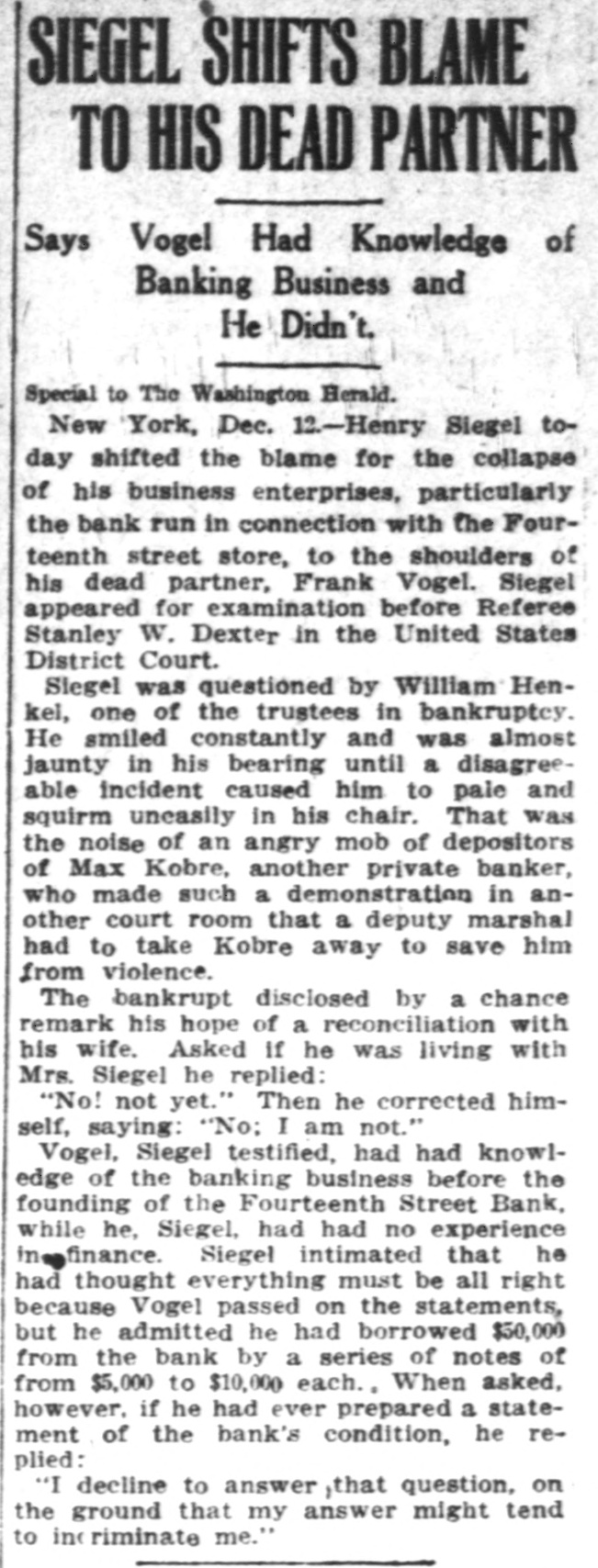
SIEGEL SHIFTS BLAME TO HIS DEAD PARTNER Says Vogel Had Knowledge of Banking Business and He Didn't. Special to The Washington Herald. New York, Dec. 12.-Henry Siegel today shifted the blame for the collapse of his business enterprises, particularly the bank run in connection with the Fourteenth street store, to the shoulders of his dead partner, Frank Vogel. Siegel appeared for examination before Referee Stanley W. Dexter in the United States District Court. Siegel was questioned by William Henkel, one of the trustees in bankruptcy. He smiled constantly and was almost jaunty in his bearing until a disagreeable incident caused him to pale and squirm uneasily in his chair. That was the noise of an angry mob of depositors of Max Kobre, another private banker, who made such a demonstration in another court room that a deputy marshal had to take Kobre away to save him from violence. The bankrupt disclosed by a chance remark his hope of a reconciliation with his wife. Asked if he was living with Mrs. Siegel he replied: "No! not yet." Then he corrected himself, saying: "No; I am not." Vogel, Siegel testified, had had knowledge of the banking business before the founding of the Fourteenth Street Bank, while he, Siegel, had had no experience infinance. Siegel intimated that he had thought everything must be all right because Vogel passed on the statements, but he admitted he had borrowed $50,000 from the bank by a series of notes of from $5,000 to $10,000 each., When asked, however, if he had ever prepared a statement of the bank's condition, he replied: "I decline to answer that question, on the ground that my answer might tend to inc riminate me."

Article from The Indianapolis Times, March 10, 1933

Click image to open full size in new tab

Article Text

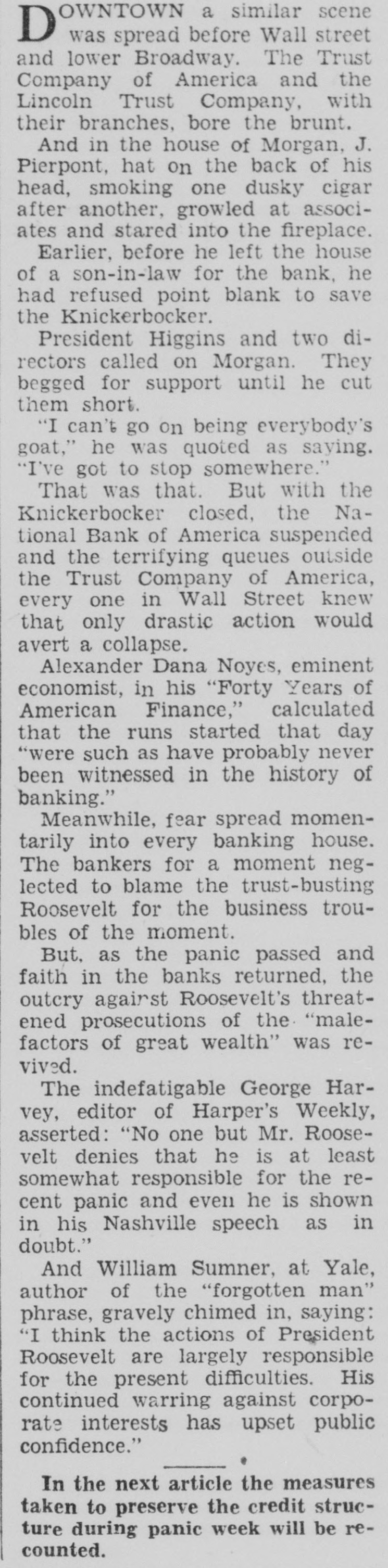
OWNTOWN a similar scene D was spread before Wall street and lower Broadway. The Trust Company of America and the Lincoln Trust Company, with their branches, bore the brunt. And in the house of Morgan, J. Pierpont, hat on the back of his head, smoking one dusky cigar after another, growled at associates and stared into the fireplace. Earlier, before he left the house of a son-in-law for the bank, he had refused point blank to save the Knickerbocker. President Higgins and two directors called on Morgan. They begged for support until he cut them short. "I can't go on being everybody's goat," he was quoted as saying. "I've got to stop somewhere." That was that. But with the Knickerbocker closed, the National Bank of America suspended and the terrifying queues outside the Trust Company of America, every one in Wall Street knew that only drastic action would avert a collapse. Alexander Dana Noyes, eminent economist, in his "Forty Years of American Finance," calculated that the runs started that day "were such as have probably never been witnessed in the history of banking." Meanwhile, fear spread momentarily into every banking house. The bankers for a moment neglected to blame the trust-busting Roosevelt for the business troubles of the moment. But, as the panic passed and faith in the banks returned, the outcry agairst Roosevelt's threatened prosecutions of the "malefactors of great wealth" was revived. The indefatigable George Harvey, editor of Harper's Weekly, asserted: "No one but Mr. Roosevelt denies that he is at least somewhat responsible for the recent panic and even he is shown in his Nashville speech as in doubt." And William Sumner, at Yale, author of the "forgotten man" phrase, gravely chimed in, saying: "I think the actions of President Roosevelt are largely responsible for the present difficulties. His continued warring against corporate interests has upset public confidence." . In the next article the measures taken to preserve the credit structure during panic week will be recounted.